Category ►►► War Against Radical Islamism
October 13, 2012
Obama's Orwellian Binge and Purge
This post is a Sachi-Dafydd joint.
"If you want a picture of the future, imagine a boot stamping on a human face -- for ever." George Orwell, Nineteen Eighty-Four, chapter 3.
One would imagine that to "know your enemy" is common sense, and nobody would gainsay it. If we're ignorant of whom we're fighting, how can we hope to out-think, surprise, resist, and defeat him?
Knowledge is our most powerful weapon: knowledge of strategy and tactics; of how to maintain supply lines and other logistical necessities; of actionable intel on what the enemy is going to do next; of how to transport combat units quickly hither and thither; and of course, knowledge of who the enemy is (so we know who to attack), how he fights (so we know what signs to look for), and how he thinks (so we understand what the enemy will do even before he himself knows.
One would imagine. But under President Barack "Ve knew nussink, nussink!" Obama, our military is systematically purging that valuable weapon of knowledge, word by word and concept by concept, from our military, intelligence, and political agencies... and all in the name of sensitivity and political correctness.
This Orwellian loss of language, like the "Newspeak" of Nineteen Eighty Four, has one obvious and ominous consequence. Since language evolved, human beings have learned to think primarily in terms of words; so when all the words that describe an idea are banned, it becomes impossible even to think it, because we have no verbal hook to hang it on.
That is precisely what the Obamunists have done... and now it even has its human face. Meet LTC Matthew Dooley, a West Point graduate and decorated combat veteran... a once and perhaps future instructor at the Joint Forces Staff College at the National Defense University, teaching such courses as "Perspectives on Islam and Islamic Radicalism."
His courses were popular among students and colleagues. Nevertheless, Dooley was relieved of his position NDU. He and his course was adjudged "unprofessional" and "against our values," by no less a personage than Martin Dempsey, Chairman of the Joint Chiefs of Staff. Chillingly, this is no isolated case; it has become Department of Defense policy to remove from training materials and even military-university textbooks and course outlines any word or concept that is declared objectionable by Moslem in general or even by Islamists in particular.
In October 2011, a cohort of Islamic and Islamist individuals and organizations -- including a number of radical Islamist groups, including unindicted co-conspirators in the Holy Land Foundation trial -- the Council on American-Islamic Relations, CAIR, and the Islamic Society of North America, ISNA -- jointly signed a letter to a number of federal, state, and local agencies, including the Pentagon, Homeland Security, the FBI, the CIA, and local law-enforcement. The Islamist letter complains about supposedly offensive, bigotted, and religiously discriminatory documents and training courses, and its authors demand that the Obama administration purge all such material.
The letter was taken seriously by the administration, which responded, as instructed, with a sweeping purge of all military training documents. Page after page of materials were ruthlessly cut from the curricula of training and education courses, simply because the passages contained certain expressions that angered radical Islamsts and their co-dependents. Much of the purge was less surgical and more like an overwrought lumberjack. Sometimes, every single word that could describe a concept was rejected, leaving the concept itself inarticulable.
The purge policy did not arise from a vacuum; oddly, it began under the administration of George W. Bush... and initially was a misguided effort, not to shelter Moslem terrorism, but rather to avoid glorifying, aggrandizing, and popularizing radical Islamists.
In April of 2008, the Bush administration sent a global memo to American embassies; the memo listed specific words that should not be used, such as "jihadist" (holy war or struggle) and "mujahedeen" (holy warriors, warriors for God):
- "Never use the terms 'jihadist' or 'mujahedeen' in conversation to describe the terrorists. ... Calling our enemies 'jihadis' and their movement a global 'jihad' unintentionally legitimizes their actions."
- "Use the terms 'violent extremist' or 'terrorist.' Both are widely understood terms that define our enemies appropriately and simultaneously deny them any level of legitimacy."
- On the other hand, avoid ill-defined and offensive terminology: "We are communicating with, not confronting, our audiences. Don't insult or confuse them with pejorative terms such as 'Islamo-fascism,' which are considered offensive by many Muslims."
I understand the Bush State Department's intent. But any word can be misused or corrupted and be turned into an excluse for the chronically violent to act violently. That cannot mean we should purge such words from our lexicon, particularly when those most anxious to censor our speech are those who ally themselves with our enemies and routinely engage in Dawa -- jihad and the imposition of sharia law through means other than actual combat.
Dawa includes direct propaganda; "lawfare" (using our own civilized legal system against us); calling mass protests; appealing to the eager and pliant "fourth estate," the press; teaching Islamism in liberal universities as gospel; producing or at least influencing the production of movies and television shows, and other ostensible entertainments, that portray sharia and Islamism in a positive lighe; or alternatively, using methods such as boycotts, protests, and political persuasion to prevent the production of movies or tv shows that depict radical Islamism in a critical light.
And of course Dawa includes persuading military leaders, up to the Chairman of the JCS, to do their dirty work for them by purging "objectionable" words, phrases, and understandings in the name of diversity, tolerance, and inclusiveness. Leftist totalitarians are already in the censorship groove; it doesn't take much to get them all het up about "religious bigotry" or "hate speech."
Our Founding Fathers had a different approach: Rather than try to prevent speech considered "bad," they allowed it; and they likewise encouraged counter-speech that was "good," or at least allowed speech aggressively supporting and attacking every conceivable proposition. We now call that our sacred right to freedom of speech; and the religious nature of the phrase is no accident: Such universal freedoms come ultimately from the Hebrew and Jewish side of our American Judeo-Christian heritage, and are utterly rejected by the same radical Islamists who use freedom of speech here to support the imposition of sharia. (Their love of free speech ceases the moment sharia law is established, naturally.)
Rather than purge words from teaching materials lest some Islamist get huffy, we should redouble using those very "forbidden" words; but using them in an accurate, correct, and complete context. We enrich our ability to think by having more word arrows in our vocabulary quiver; and we do not further corrupt the English language by transforming it into Newspeak, trying to bludgeon Americans into concensus by whittling their tongues down to size.
Ever since Obama went on his Middle-East apology tour, Americans have suspected something strange was going on. He called it his "smart diplomacy," but we sensed something more sinister: The president was not simply apologizing for America's sins, he was kow-towing to radical Islamists and changing the language of our official documents -- and by extension through the establishment media, of our very way of thinking about radical Islamism.
Like Obama's Fast and Furious scandal, Purgegate had its earliest roots in the Bush administration; but also like Fast and Furious, the bad seed sprouted a far more poisonous fruit when Obama took office. From the Washington Times piece:
By 2011, Obama’s Counterterrorism and Deputy national security advisor John Brennan was urged by Muslim, Arab, and South Asian organizations to begin an “independent, effective investigation into the federal government’s training of its agents and other law enforcement” and institute a “purge” of any material that the undersigned organizations deemed unacceptable.
In an October 19, 2011 letter to Mr. Brennan, the groups criticize for anti- Muslim bias the FBI’s 2011 training manual, the books at the FBI library in FBI training academy in Quantico, Virginia, specific FBI trainers and analysts, and a report made by Army Command and General Staff at the Fort Leavenworth School of Advanced Military Studies."
Swiftly thereafter, Tom Perez, head of the Justice Department’s Civil Rights division, made his final recommendations to John Brennen:
In response to these recent disclosures, federal officials across the country—particularly FBI field offices—have been reaching out to local Muslim communities to state that the offensive training materials do not reflect the opinion of the FBI, its field offices or the federal government. Until the following steps are taken to remedy this problem and to prevent it from recurring, we will not be confident in these assertions. We urge you to create an interagency task force, led by the White House, tasked with the following responsibilities:
We paraphrase the so-called "following steps" that Perez recommended:
- Review all FBI, DoD, and Homeland-Security trainers and training materials at government agencies;
- Purge all biased materials;
- Install mandatory re-training programs;
- Ensure all trainers who used "biased" training materials are effectively disciplined (Adios, Col. Dooley);
- Ensure that bigoted trainers and biased materials are purged;
- Make clear that religious practice and political advocacy are protected under the First Amendment, are not indicators of violence, and shall not be subject to surveillance or investigation.
The recommendations concluded:
The interagency task force should include a fair and transparent mechanism for input from the Muslim, Arab, and South Asian communities, including civil rights lawyers, religious leaders, and law enforcement experts.
But not, it appears, any military, intelligence, or even diplomatic personnel or organizations that might harbor "bigoted trainers and biased materials." Presumably this would include anybody who saw a connection of some sort, however tenuous, between radical Islam and murderous terrorism.
How significant was the ideological purge of inconvenient military, diplomatic, and intelligence truths? Is there any basis to conclude that this was a deliberate effort to expunge certain ideas from the American mind, so that better and more "flexible" understandings, perhaps more anti-colonial, could take their mental slots? Consider this point from the Washington Times:
In December of 2011 Congressman Dan Lungren, California Republican, questioned Paul N. Stockton, assistant secretary of defense for homeland defense, at a joint session of the Senate and House Homeland Security Committee. After much back and forth, Stockton would not say the United States was “at war with violent Islamist extremism.” House Judiciary Committee Chairman Lamar Smith, Texas Republican, had a similar experience in May of 2010, when he questioned Attorney General Eric Holder at a House judiciary hearing about the issue of radical Islam.
The FBI training manual changed. Nearly 900 pages of training that was considered offensive were deleted. Members like Congressman Allen West, Florida Republican, and Congressman Louie Gohmert, Texas Republican, were critical of the purge.
Gohmert questioned FBI director Robert Mueller in May 2012 about the deleting of FBI material. Rep. Gohmert went to the House floor and compared the number of times certain terms (at 22:40) were used in the 9/11 Commission report as opposed to the now purged FBI training manual. For example, according to Gohmert, the 9/11 report mentioned the word “Islam” 322 times. However, Gohmert discusses that the FBI training manual can no longer mention the terms: Islam, Muslim, jihad, enemy, Muslim Brotherhood, Hamas, Hezbollah, al Qaeda, caliphate, Shariah law.
Now we know why "the fierce urgency of now" demanded Dooley's course be thrown into the ashheap of history and his head on a pike: As far as the Obama administration is concerned, there are some things Man is not meant to know; and among those unknowable things is the absurdity of Obama's perverse foreign policy, where we cast off our allies and bitterly cling to our adversaries and enemies.
Dooley himself is fighting back, trying to regain his job. But the real issue here is not whether one man can stop the boot from stamping on his face, but whether the American electorate can bring itself to believe just how anti-American is the American president... and can find the spine to do something about it on November sixth.
Hatched by Sachi on this day, October 13, 2012, at the time of 10:19 PM | Comments (0)
September 27, 2012
Moaning Mona
By now everybody knows that Mona Eltahawy -- writer for the Washington Post and the New York Times, stalwart Leftist activist, and now evidently supporter of jihad -- was arrested last Tuesday for defacing a poster. The poster was displayed (after a bitter legal fight) in ten New York subway stations; it reads:
BETWEEN THE
CIVILIZED MAN
AND THE SAVAGE,
SUPPORT THE
CIVILIZED MAN.
DEFEAT JIHAD
Leftists across America and in Europe have weighed in on this controversy; while most (but not all) condemn Eltahawy's vandalization of the poster, they are in unanimity that the advertisement itself constitutes "hate speech." Even New York City's Metropolitan Transit Authority considered the adverts hate speech, because Pam Gellar was forced to get a court decision requiring the MTA to display them.
I confess being puzzled: How can it be hate speech to oppose holy war against innocents?
I have yet to find a person who has even the sketchiest argument why supporting the "civilized man" and supporting Israel while opposing holy war is hateful. Most simply announce that it's hate speech, relentlessly repeat that it's hate speech, and declare that only haters could possibly disagree that it's hate speech (generally accompanied by the verbal equivalent of pounding on the table). But surely there must be some intellectual, rational, logical argument behind the idea that such a poster is hateful.
Is there a good, or at least not entirely stupid argument that the ad is hate speech? Because it seems to me that the only way to read this as an attack on Moslems in general -- is first to equate radical Islamists to all Moslems. Which would, I am sure, make these purportedly pro-Moslem Progressivists actually anti-Moslem religious bigots.
Jihad -- as used in this advert, and as commonly used by people everywhere, including Moslems -- means war waged by radical Islamists in order to bring about the imposition of sharia law. Sharia law is one of the two most oppressive, anti-liberal, sexist, theocratic, triumphalist ideologies on the planet (the other being totalitarian socialism, whether national or international). Thus if so-and-so considers anti-shariaism itself, by its very nature, to be hate speech, doesn't that mean so-and-so necessarily supports sharia? After all, if you hate all systems other than sharia, what then is left?
And anyone who supports the imposition of sharia law -- which is totalitarian and the whole point of jihad -- is by definition a totalitarian. (Similarly, a person who hates all economic systems but Capitalism is by definition a capitalist.)
I've long thought the Left was in fact totalitarian: Michelle Obama telling everyone how to eat, Michael Bloomberg telling his subjects how much soda to drink, enviro-mental cases telling us what vehicles we're allowed to utilize, ad nauseum; but is the Left now openly ready to "come out" about the totalitarian tendency of Progressivism?
Perhaps it's possible that the advert really is hate speech, even if nobody on la Rive Gauche can articulate why. If so, then a new advert with the same structure but different content should likewise be hate speech. Let's consider:
BETWEEN THE
INNOCENT MAN
AND THE CRIMINAL,
SUPPORT THE
INNOCENT MAN.
DEFEAT THE MAFIA
Is this hate speech? If not, then why not? Other than the most diehard Italian Americans who actually deny that la Cosa Nostra even exists, what civilized person could possibly object to this advert?
Or this one:
BETWEEN THE
FREE MAN
AND THE FASCIST,
SUPPORT THE
FREE MAN.
DEFEAT NAZIISM
Is there anything in this advertisement at which even a freedom-minded German in 1943 could take offense?
I'm often at a loss to explain the leftist mindset; but this time, I am utterly dumbfounded. Can somebody point me to a non-risible argument for the original subway-station advertisement being hate speech? Because I would hate to be forced to believe that the actual offending words are "support Israel," and the only reason to consider this advert "hate speech" is rank Jew hatred.
Hatched by Dafydd on this day, September 27, 2012, at the time of 1:38 PM | Comments (3)
September 21, 2012
Story Wars, Chapter Two
For reasons which remain obvious, the reelection campaign of Barack "I actually believe in redistribution" Obama has turned the tragic, humiliatingly successful attacks against our Cairo embassy and the Benghazi consulate into a week-long "squirrel!" distraction from the parlous state of Obama's economy.
Not that the Permanent Campaign really wants to discuss al-Qaeda overrunning two diplomatic missions, tearing down and burning our American flags, murdering Ambassador Chris Stevens and three other diplomats, and raising the black flag of radical Islamism in their place; no, never that discussion, the Prophet Mohammed™ forbid! The totality the Obamunists want to focus on, and the only story that their media-arm "presstitutes" vigorously flog, is the risible and tendentious meme that the real loser here is Mitt Romney.
Democrats in full scream denounce and repudiate (but fail to refute) Romney's post-attack statements -- variously described by the fourth estate fifth column as "gaffes," "divisive," "unprecedented," "the end of Romney's campaign," and "Romney's worst week ever" -- as insufficiently sensitive to our peace-loving allies in Islamist Egypt and Islamist Libya, and in blatant violation of a longstanding rule of civil discourse the Left just discovered: Presidential challengers shalt not criticize the incumbent's foreign policy in an election year.
All right, I'll bite: Let's take a look at those statements... all of them.
I take for my source that redoubt of right-wing rodomontade, the New York Times, which helpfully collected the colloquy of competing condemnations and complaints, from nine hours before the Cairo embassy was "breeched" until a day or so after. We shall start at the beginning and push on through the batch!
Here is the first infamous statement issued by the Cairo embassy, before the attack on the embassy, but after hysteria had already risen about the "movie that mocked the Prophet Mohammed™" (obviously, as the statement refers to both movie and how it "hurt the religious feelings of Muslims.") Nota Bene: Assume all emphasis in any of these statements is added by me, unless otherwise instructed:
The Embassy of the United States in Cairo condemns the continuing efforts by misguided individuals to hurt the religious feelings of Muslims -- as we condemn efforts to offend believers of all religions. Today, the 11th anniversary of the September 11, 2001, terrorist attacks on the United States, Americans are honoring our patriots and those who serve our nation as the fitting response to the enemies of democracy. Respect for religious beliefs is a cornerstone of American democracy. We firmly reject the actions by those who abuse the universal right of free speech to hurt the religious beliefs of others.
And here is a very important restatement issued (via Twitter) by the same Cairo embassy, but this time after the attacks had begun at "midafternoon", and more than twelve hours after the first statement above; as a timeline check, note that the embassy refers to the "unjustified breach of the Embassy" (This is one of a series of similar tweets that the embassy or the State Department quickly deleted.):
This morning's condemnation (issued before protest began) still stands. As does our condemnation of unjustified breach of the Embassy
(For the record, "this morning's condemnation" could only have referred to this sentence in the original statement: The embassy "condemns the continuing efforts by misguided individuals to hurt the religious feelings of Muslims -- as we condemn efforts to offend believers of all religions." Those are the only two things the original message condemned.)
Allow me to analyze the text:
- The first sentence condemns those who would "hurt the religious feelings of Muslims."
- The next chunk notes that we honor our patriots (how sweet).
- Then the statement reiterates "respect for religious beliefs" (yatta yatta).
- Finally, it rejects speech that "hurt[s] the religious beliefs of others," additionally adding the gratuitous conclusion that speech that hurts "feelings" or "beliefs" actually "abuses the universal right of free speech," which, one concludes, only protects speech to which nobody objects.
That is, the initial statement unquestionably sympathized with the "hurt" felt by Moslems and condemned anyone who said, wrote, or produced anything that might hut Moslem feelings. And the follow-up tweet "stand[s] by" that first missive, thus continuing to sympathize with those who had, by then, savagely attacked us. Remember this point, that the embassy stuck to its guns on its original, protester-sympathetic statement; it becomes a vital issue later.
My first observation: Wow, such a forceful reply to burning, sacking, and murder; we condemn it!
My second: Not one word defending freedom of speech in either of these two official statements, none; only a mewling apology for... what? For not censoring those videomakers, as is universal in Islamic countries?
When an American embassy leads off by condemning American citizens and residents for exercising their freedom of speech -- and then stands by that denunciation, even after rampaging jihadis attack that same embassy plus a consulate, murder four Americans including the Ambassador to Libya, and raise their own bloody, black terrorist flag over the conquered territory, the sanity gap is... breathtaking. Obamunists live in an alternative universe.
That the statements contain not one word about our sacred freedom of speech is hardly surprising: While the hard-Left of the 1930s and 40s had no difficulty vigorously defending the fundamental rights, liberties, and freedoms protected by the Constitution, today's "Progressivists" comprise only the Left of hate-speech codes; of political correctness and sensitivity training; of forced recantation of heretical doctrine and reeducation camps; the Left of argument by intimidation, deceit, and thuggish assault; of "SLAPPs" (strategic lawsuits against public participation) and other forms of lawfare; of government censorship, consent decrees that include a code of silence, and every form of suppression of inconvenient speech they can possibly get away with. And all to silence what Tim Leary used to call "injudicious use of the First Amendment."
Does hurting people's feelings or beliefs really "abuse" the freedom of speech? Anyone who believes it does needs a refresher course in early American history! As the Founding Fathers argued, the only kind of speech that needs protection is unpopular speech; popular speech needs none, because popularity itself confers the protection of numbers.
Besides, as even the least observant observer observes, the cheapest emotions in the world are indignation, outrage, hatred, and fury. Many people can go from zero to six million on the Rage-O-Meter just because somebody took a parking place the irate driver had his eye on. Were we to hand over our freedoms to any old fool who takes offense; were we restrained from expressing any creed that might hurt someone's feelings or beliefs; were the government to prevent us from speaking anything that a listener (seen or unseen) considers "hate speech," then however noble the intent of that government (though nobility is rarely the reason for such censorship), we would have no freedom of speech left whatsoever. For "freedom of speech" is precisely the liberty to say that which pisses off other people.
Yes, even including Moslems.
One would expect that elected or confirmed federal officials, of all people, would understand and defend such liberty; first, they take an oath to do so; second, that freedom has been used incessantly to good effect in this country, from the American revolution, to the abolitionist movement, to the marches and speeches against segregation, to Ronald Reagan calling the Soviet Union an "evil empire," to George W. Bush calling Iran, Iraq, and North Korea the "axis of evil." Despite the fact that everybody on the other side of such speech was (or professed to be) outraged, upset, shocked, shocked, nauseated, and infuriated that free speech could be so abused. Should we have censored Patrick Henry and smothered Martin Luther King, jr., just because lobsterbacks and Klansmen were offended?
Enough, let us move on. Three and a half hours after the tweet (and there were others, deleted by the State Department before the Times could archive them), Hillary Clinton issued her first pronunciamento:
I condemn in the strongest terms the attack on our mission in Benghazi today. As we work to secure our personnel and facilities, we have confirmed that one of our State Department officers was killed. We are heartbroken by this terrible loss. Our thoughts and prayers are with his family and those who have suffered in this attack.
This evening, I called Libyan President Magariaf to coordinate additional support to protect Americans in Libya. President Magariaf expressed his condemnation and condolences and pledged his government’s full cooperation.
Some have sought to justify this vicious behavior as a response to inflammatory material posted on the Internet. The United States deplores any intentional effort to denigrate the religious beliefs of others. Our commitment to religious tolerance goes back to the very beginning of our nation. But let me be clear: There is never any justification for violent acts of this kind.
In light of the events of today, the United States government is working with partner countries around the world to protect our personnel, our missions, and American citizens worldwide.
All right, but how deep is Hillary Clinton's commitment to tolerance of speech that offends her and her boss? Her declaration tells us little we didn't already know:
- We now discover that the State Department doesn't believe that an anti-Moslem video justifies attacking embassies and murdering ambassadors. (Thank heaven for small favors!)
And once again, we sympathize with Moslems everywhere, who suffered such a crushing blow to their self esteem by learning that not everybody loves the Prophet Mohammed™.
- Finally, and let me be clear, we deplore violence.
Anybody notice what is still missing from this series of official responses, both before and after the bestial and unlawful attacks?
Two minutes later, the Department of Hillary summarily rejects the original embassy response, throwing Ambassador to Egypt Anne W. Patterson under the bus (along with her acting comandante, not sure who that was, since she was in Washington DC at the time of the attacks):
The statement by Embassy Cairo was not cleared by Washington and does not reflect the views of the United States government.
Finally, and for the first time (a quarter hour after the Hillary manifesto and about seven hours after the attacks), Gov. Mitt Romney offers his own reaction and thoughts about the official governmental responses to this point:
I'm outraged by the attacks on American diplomatic missions in Libya and Egypt and by the death of an American consulate worker in Benghazi. It's disgraceful that the Obama administration's first response was not to condemn attacks on our diplomatic missions, but to sympathize with those who waged the attacks.
The Left immediately assailed Romney on three grounds:
- That he had no right to jump into this imbroglio because that would "politicize" it.
- On the spurious and unproven grounds that Romney had "confused the timeline" by foolishly thinking that the initial embassy response occurred after the attacks.
- And because, claims the Left, accusing Obama and minions of sympathizing with those who attack us is a vicious, racist lie! Romney's name should instantly be removed from every ballot on all fifty-seven states, allowing Barack "You didn't build that" Obama to win the way he normally wins his elections... by default!
On the first, here is Ben LaBolt, the Mouth of Barack, trying to pound home the first meme less than two hours later, that a presidential challenger has no right to criticize the president's political statements because doing so would politicize them:
We are shocked that, at a time when the United States of America isconfronting the tragic death of one of our diplomatic officers in Libya,Governor Romney would choose to launch a political attack.
I'm shocked, shocked to find that politics is going on in here! So what was LaBolt's own statement, chopped liver? Don't be a dolt: Accusing your opponent of playing politics is itself playing politics.
Never in the modern era have we seen a more politicized presidency than the one we suffer through right now. I marvel at the chutzpah LaBolt required to accuse anyone else of "launch[ing] a political attack!" I reckon he didn't want a crisis to go to waste. We can dispense with the absurdity of the pot calling... oh dear, I don't want to be accused of racism, so I'll just stifle my freedom of speech. (See how well it works?)
All right, but what about the second prong of the attack on Romney? Didn't he confuse the timeline? Isn't he just another fulminating, redfaced, rage-filled, cement-headed, racist rightwinger?
The charge that Romney was just too stupid to know (or too dishonest to admit) that the attacks hadn't occurred yet when the Cairo embassy released its first statement critically depends upon one completely hidden assumption: The Left must assume that Romney had not seen the several follow-up tweets that came after the attacks, where the embassy "stands by" its earlier kowtowing to Moslem sensitivity.
But why wouldn't he have? Many hours had passed between the original embassy statement, the attacks, and Romney's first response. He has a very large and well-funded campaign; and the tweets themselves were known by news agencies -- again obviously, as several of them still exist, even after the State Department deleted them: People knew about the tweets and had saved them.
Let's assume that in the seven hours or so between the attacks and Romney's response, he wasn't just sitting on a treestump, silent as the Sphinx. Let's assume the GOP nominee was actually talking about the most urgent and shocking news story of the day.
Is that so farfetched? How unreasonable is it that Mitt Romney, angered by that first embassy response, asked his staff whether there was any other statement or pronouncement responding to the developing international incident? How unthinkable is it really that some member of his crack staff put the tweets in Romney's hand and said, "take a look at these, governor."
I can easily imagine the conversation -- because I went through pretty much the same conversation with my wife Sachi at about the same time:
ROMNEY: Wait -- when were these tweets sent?
STAFFER: Six-thirty p.m. Eastern time, sir.
ROMNEY: But that's three hours after the attacks! They're still feeling sorry for those poor, put-upon terrorists, even after the attacks? And what's this bit here, that expressing a view that offends Moslems is an abuse of freedom of speech? What lunatic wrote this?
STAFFER: Governor, this statement from the State Department just came in...
ROMNEY: Great leaping horny toads -- what does Hillary Clinton mean when she says we "deplore any intentional effort to denigrate the religious beliefs of others?" Iran says Jews should be exterminated; Hamas calls Jews and Christians "pigs and monkeys," and demands that the U.N. enact an anti-blasphemy law; and the ACLU, great pals of President Obama, are busy in court trying to prevent the display of the "miracle cross" from the World Trade Centers, because God unconstitutionally fused two pieces of metal together! This is insane. This is nothing like what George W. Bush said when he stood on the rubble at ground zero. This administration is a pack of howling jackals! And I'm going to let them know just what I think of such unAmerican bowing and scraping.
The Romney statement could have followed immediately thereafter -- greaty toned down, of course.
But what about the third attack, that it's a damned lie to claim that the government "sympathized" with the radical Islamists? Here is my neat and sweet, three-point syllogism refudiating the Progressivist position on this exchange:
- Count how many times the official administration responses defended our fundamental freedom of speech.
Count how many times, how many lines, how many paragraphs, and the percent of these government responses taken up with blanket, codependent reassurances issued to radical Islamists that we feel their pain, that we're appalled that Americans would "abuse" the freedom of speech in such an unconstitutional way: insulting the Prophet Mohammed™, of all things!
- Contrast and compare: Between those wicked and despicable free-speechers on the right hand and the blood-gutted, human-sacrificing terrorists on the left -- and using only the textual evidence before us -- which side has all of the administration's sympathy? Which side gets the "poor babies," and which gets the back of Obama's hand?
I rest my case: Romney had the bastards pegged.
(If you're still confused about where our government's sympathies lie, just read this breaking Yahoo News story about our tax dollars hard at work... airing an advert in Pakistan reassuring Moslems that we really, really, really don't believe in freedom of speech, and we're extremely concerned for the feelings of jihadists, so please, please, don't kill us!)
Early the next morning, Barack "Too busy with Letterman to meet with Netanyahu" Obama issued his own statement; it was entirely trivial, uninformative, perfunctory. Here is the only sentence that pertains to the question at hand:
While the United States rejects efforts to denigrate the religious beliefs of others, we must all unequivocally oppose the kind of senseless violence that took the lives of these public servants.
Senseless? Really? Al-Qaeda, defeated by "the previous administration," has been resuscitated by the current one. They launched a series of astonishingly successful attacks, killed our people, raised their own flag and burned ours, and generally demonstrated their prowess and fitness to rule the ummah. Makes a heck of a lot of sense from their perspective!
We have one last document to document. Just to make it super-duper clear, this is Mitt Romney's second response, the next morning. Note that what was missing from all of the official government statements is present, loud and clear, in the ringing words of the next President of the United States.
I shall put the entire Romney release under the "Slither on;" here I post only those portions of his televised speech that pertain to what the government forgot, on every possible occasion, to do: make the case for a general right to freedom of speech for everyone, even those living in Moslem countries.
Mitt Romeny makes it crystal clear in this statement what he only implied in his first statement: The Cairo embassy, on its twitter feed, stood by its first apology for freedom of speech at 6:30 pm EDT. Therefore, they effectively issued the same statement twice, once before the attacks and once after them. Romney was outraged by that second statement, the "ditto" declaration. And it was that reiteration, that standing by, that prompted the governor to state, four hours later, that it was "disgraceful that the Obama administration's first response was not to condemn attacks on our diplomatic missions, but to sympathize with those who waged the attacks."
When he made his statement, the embassy had already been attacked -- and had already reaffirmed its initial apology. That is the context in which Romney first sent a statement, then later gave a press conference. Romney and the rest of us already knew that our embassies had been attacked, and anybody following the twitter feed already knew that the embassy was still apologizing for American values even after being attacked and overrun, and after the attack on its sister consulate in Libya turned murderous.
Never forget that. The Left wants us to believe that the Cairo embassy had no idea what was going to happen when they idiotically denigrated freedom of speech. But they did it again after the attacks, so they have no excuse whatsoever.
Here is Romney's presser, beginning with a small portion of his prepared remarks:
America will not tolerate attacks against our citizens and against our embassies. We'll defend, also, our constitutional rights of speech and assembly and religion. We have confidence in our cause in America. We respect our Constitution. We stand for the principles our Constitution protects. We encourage other nations to understand and respect the principles of our Constitution, because we recognize that these principles are the ultimate source of freedom for individuals around the world.
I also believe the administration was wrong to stand by a statement sympathizing with those who had breached our embassy in Egypt instead of condemning their actions. It's never too early for the United States government to condemn attacks on Americans and to defend our values. The White House distanced itself last night from the statement, saying it wasn't cleared by Washington, and that reflects the mixed signals they're sending to the world.
In the Q&A that followed (unlike Obama, Romney welcomes questions; he even welcomes them from those in the news biz who sincerely want to see Romney lose):
Q: The statement you refer to was very -- (inaudible) -- last night -- (inaudible) -- given what we know now?
MR. ROMNEY: I -- the embassy in Cairo put out a statement after their grounds had been breached. Protesters were inside the grounds. They reiterated that statement after the breach. I think it's a terrible course to -- for America to stand in apology for our values, that instead when our grounds are being attacked and being breached, that the first response of the United States must be outrage at the breach of the sovereignty of our nation. And apology for America's values is never the right course.
Q: Governor Romney, do you think, though, coming so soon after the events really had unfolded overnight, it was appropriate to be weighing in on this as this crisis is unfolding in real time?
MR. ROMNEY: The White House also issued a statement saying it tried to distance itself from those comments and said they were not reflecting of their views. I had the exact same reaction. These views were inappropriate, they were the wrong course to take. When our embassy is -- has been breached by protesters, the first response should not be to say, yes, we stand by our comments that suggest that there's something wrong with the right of free speech....
Q: Governor, some people are saying you jumped the gun a little in putting that statement out last night and that you should have waited until more details were available. Do you regret having that statement come out so early, before we learned about all the things that were happening?
MR. ROMNEY: I don't think we ever hesitate when we see something which is a violation of our principles. We express immediately when we feel that the president and his administration have done something which is inconsistent with the principles of America. Simply put, having an embassy which is -- has been breached and has protesters on its grounds, having violated the sovereignty of the United States -- having that embassy reiterate a statement effectively apologizing for the right of free speech is not the right course for an administration.
Sure, it's not Tom Paine or Thomas Jefferson; but for a contemporary politician embroiled in a hot race for the presidency -- which both Gallup and Rasmussen polls today show to be neck and neck -- it's a bold, spirited, unapologetic, and forthright celebration of our greatest freedom. Mitt Romney thinks like a real American, while Barack "Citizen of the world" Obama thinks like an anticolonial Progressivist who has never been sure whether he loves his country or despises it to the bone.
(Much like how the president feels about his biological progenitor: Abandoned by the man himself, Obama wraps himself in a self-generated fantasy -- dreams from his father, dreams from his country, an obsessed fan longing for love with a fictional TV character.)
But back to the point. Mitt Romney's heartfelt response to the administration's tepid condemnation of the attacks, and his outrage at the complete absence of any defense of freedom of speech (in fact, a tacit renunciation of such freedoms, now shackled by the "Tender Sensibilities of Moslems" exception), was clearly the best and most appropriate possible thing he could say anent the craven surrender by the Obamunists.
Several more attacks against the United States have been carried out in Yemen, Kuwait, Morocco, Tunisia, Sudan, and now China; yet even the pro-forma denunciations of violence against America have been dropped, presumably because the administration concludes that denial of the new attacks is more tenable at this point than an explanation of the administration's own foreign-policy and security failures.
What concrete steps have we actually taken to find and punish the Libyan killers, and those Egyptians who so easily overran our actual embassy in Cairo? How are we responding to the new attacks on Americans and on America itself? China and Japan are in a tussle over what the Japanese call the Senkaku Islands and purchased them from its previous owner, the Kurihara family. China calls them the Diaoyu Islands; and since oil was discovered under the islands in 1968, the People's Republic of China demands they be seized from Japan and handed over to China.
Naturally, anti-Japanese protesters in China see this as the perfect opportunity to attack the American ambassador -- because we're allied with Japan, and because one of the islands (Kuba, no relation to Castro's paradise) is used as an American bombing range. For the PRC, snatching away the islands, which have been controlled by Japan or by the United States since 1895 and never by China, would be a "two-fer": Red China would get the oil and would be able to drive the U.S. Navy out of part of what China considers its hemisphere.
Why is Red China so bold as to threaten us and Japan over the sale this month? Because we are weak. America is weaker today than it has been in many, many decades; and the ease and impugnity of these attacks on our embassies (American sovereign territory -- once) and allies proves it. One would probably have to return to the mass American disarmament following World War I to find a moment when we were more ill prepared to defend ourselves, our property, our international rights, and our ideology of liberty.
Barack H. Obama has brought hope and change, all right: He has given our enemies hope and changed America from the final remaining superpower to a global laughingstock which cannot even fight back when attacked, so thoroughly has he gelded us. It's now a serious question whether we can man-up enough to fire the wretched redistributionist; or whether so many Americans have become court eunuchs, depending upon the government for their very sustenance, that a once proud nation now whines under the triple leash of Russia, China, and radical Islamism.
We shall find out how strong those leashes are on November 6th.
Here is the transcript of Mitt Romney's full remarks (truncated at the beginning, as for some reason the feed didn't begin right away):
…. with tragic news and felt heavy hearts as they considered that individuals who have served in our diplomatic corps were brutally murdered across the world.
This attack on American individuals and embassies is outrageous. It's disgusting. It -- it breaks the hearts of all of us who think of these people who have served during their lives the cause of freedom and justice and honor. We mourn their loss and join together in prayer that the spirit of the Almighty might comfort the families of those who have been so brutally slain.
Four diplomats lost their life, including the U.S. ambassador, J. Christopher Stevens, in the attack on our embassy at Benghazi, Libya. And of course, with these words, I extend my condolences to the grieving loved ones who have left behind as a result of these who have lost their lives in the service of our nation. And I know that the people across America are grateful for their service, and we mourn their sacrifice.
America will not tolerate attacks against our citizens and against our embassies. We'll defend, also, our constitutional rights of speech and assembly and religion. We have confidence in our cause in America. We respect our Constitution. We stand for the principles our Constitution protects. We encourage other nations to understand and respect the principles of our Constitution, because we recognize that these principles are the ultimate source of freedom for individuals around the world.
I also believe the administration was wrong to stand by a statement sympathizing with those who had breached our embassy in Egypt instead of condemning their actions. It's never too early for the United States government to condemn attacks on Americans and to defend our values. The White House distanced itself last night from the statement, saying it wasn't cleared by Washington, and that reflects the mixed signals they're sending to the world.
The attacks in Libya and Egypt underscore that the world remains a dangerous place and that American leadership is still sorely needed. In the face of this violence, America cannot shrink from the responsibility to lead. American leadership is necessary to ensure that events in the region don't spin out of control. We cannot hesitate to use our influence in the region to support those who share our values and our interests.
Over the last several years we stood witness to an Arab Spring that presents an opportunity for a more peaceful and prosperous region but also poses the potential for peril if the voices -- forces of extremism and violence are allowed to control the course of events. We must strive to ensure that the Arab Spring does not become an Arab winter.
Q: The statement you refer to was very -- (inaudible) -- last night -- (inaudible) -- given what we know now?
MR. ROMNEY: I -- the embassy in Cairo put out a statement after their grounds had been breached. Protesters were inside the grounds. They reiterated that statement after the breach. I think it's a terrible course to -- for America to stand in apology for our values, that instead when our grounds are being attacked and being breached, that the first response of the United States must be outrage at the breach of the sovereignty of our nation. And apology for America's values is never the right course.
Q: Governor Romney, do you think, though, coming so soon after the events really had unfolded overnight, it was appropriate to be weighing in on this as this crisis is unfolding in real time?
MR. ROMNEY: The White House also issued a statement saying it tried to distance itself from those comments and said they were not reflecting of their views. I had the exact same reaction. These views were inappropriate, they were the wrong course to take. When our embassy is -- has been breached by protesters, the first response should not be to say, yes, we stand by our comments that suggest that there's something wrong with the right of free speech.
Q: So what did the White House do wrong then, Governor Romney, if they -- if they put out a statement saying --
MR. ROMNEY: It's their administration -- their administration spoke. The president takes responsibility not just for the words that come from his mouth but also from the words that come from his ambassadors, from his administration, from his embassies, from his State Department. They clearly -- they clearly sent mixed messages to the world. And -- and the statement that came from the administration -- and the embassy is the administration -- the statement that came from the administration was a -- was a statement which is akin to apology and I think was a -- a -- a severe miscalculation.
Q: Governor, some --
Q: Talk about mixed signals -- (inaudible) -- itself a mixed signal when you criticize the administration at a time -- (inaudible)?
MR. ROMNEY: We're -- we have a campaign for presidency of the United States and are speaking about the different courses we would each take with regards to the challenges that the world faces. The president and I, for instance, have differences of opinion with regards to Israel and our policies there, with regards to Iran, with regards to Afghanistan, with regards to Syria. We have many places of distinction and differences.
We joined together in the condemnation of the attacks on American embassies and the loss of American life and joined in the sympathy for these people. But it's also important for me -- just as it was for the White House last night, by the way -- to say that the statements were inappropriate and, in my view, a disgraceful statement on the part of our administration to apologize for American values.
Q: Governor, some people are saying you jumped the gun a little in putting that statement out last night and that you should have waited until more details were available. Do you regret having that statement come out so early, before we learned about all the things that were happening?
MR. ROMNEY: I don't think we ever hesitate when we see something which is a violation of our principles. We express immediately when we feel that the president and his administration have done something which is inconsistent with the principles of America. Simply put, having an embassy which is -- has been breached and has protesters on its grounds, having violated the sovereignty of the United States -- having that embassy reiterate a statement effectively apologizing for the right of free speech is not the right course for an administration.
STAFF: Last question.
Q: If you had known last night that the ambassador had died -- and obviously, I'm gathering you did not know --
MR. ROMNEY: Well, that came -- that came later.
Q: That's right. If you had known that the ambassador had died, would you have issued --
MR. ROMNEY: I'm not going -- I'm not going to take hypotheticals about what would have been known when and so forth.
We responded last night to the events that happened in Egypt.
Q: Governor, what sort of --
Q: Governor Romney, your -- one of your professed reasons for running is your economic know-how and your private sector experience. But now that foreign policy and the situation in the Middle East -- (off mic) -- the presidential campaign, can you talk about why, specifically, you think you're better qualified than President Obama -- (off mic)?
MR. ROMNEY: I think President Obama has demonstrated a lack of clarity as to a foreign policy. My foreign policy has three fundamental branches: first, confidence in our cause, a recognition that the principles America was based upon are not something we shrink from or apologize for, that we stand for those principles; the second is clarity in our purpose, which is that when we have a foreign policy objective, we describe it honestly and clearly to the American people, to Congress and to the people of the world; and number three is resolve in our might, that in those rare circumstances, those rare circumstances where we decide it's essential for us to apply military might, that we do so with overwhelming force, that we do so in the clarity of a mission, understanding the nature of the U.S. interest involved, understanding when the mission would be complete, what will be left when it is -- what will be left behind us when that mission has been -- has been terminated.
These elements, I believe, are essential to our foreign policy, and I haven't seen them from the president. As I watched -- as I've watched over the past three and a half years, the president has had some successes. He's had some failures. It's a hit-or-miss approach, but it has not been based upon sound foreign policy.
Q: Governor Romney, how, specifically -- how, specifically, Governor Romney, would President Romney have handled this situation differently than President Obama did? Before midnight, when all the facts were known? How would you have handled it differently than the president did?
MR. ROMNEY: I spoke out when the key fact that I referred to was known, which was that the Embassy of the United States issued what appeared to be an apology for American principles. That was a mistake. And I believe that when a mistake is made of that significance, you speak out.
Thank you.
Hatched by Dafydd on this day, September 21, 2012, at the time of 4:11 PM | Comments (0)
September 18, 2012
The Prince's New Clothes
Almost the definition of "TMI", too much information: Prince Harry's naked binge in Las Vegas, shortly before he was deployed to Afghanistan as an Apache pilot. So a young, privileged man got drunk and naked in Las Vegas; what else is new?
Harry, third in line for King of England (after his father, Charles, Prince of Wales; and Harry's brother, William, Duke of Cambridge), was photographed in the buff with some pretty, young, and equally naked thing of the female persuasion, who gallantly crouched behind him during his epic Kodak moment. But that singular embarassment seems to have produced quite a few ripples in spacetime... which may have been the proximate cause of the killing of at least two United States Marines.
A week after Hank's exhibitionist exertions -- and right around the time his sister in law enjoyed her own naked romp in full view of an unnoticed camera -- the princeling was trundled off to war. (What is it with these Royals constantly putting their crown jewels on display?)
All right, all right; it's not as if the Royal Pains sent the blot away to get him out of the headlines. His deployment was long planned; more than likely, he went on a tear in Vegas precisely because he was about to be shipped out. Alas, the former conjecture is exactly what the Taliban believes, or at least professes: That Harry was sent away to cover-up his "shame." He thus became a perfect target for the cave-dwelling barbarians in Afghanistan, he and everyone else around him.
But let's take a side excursion. When we read the news about Prince Harry heading to Afghanistan, many bloggers with a military background were worried. Too much information was being revealed, allowing the "insurgents" -- radical Islamists in the Taliban and allied terrorist groups -- to track Prince Harry's every movement:
The 27-year-old arrived in Camp Bastion in Helmand in the early hours of this morning, where he will be based for the duration of his tour with 622 Sqn, 3 Regiment Army Air Corps.
His role will be to kill insurgents as he operates the aircraft's weapon systems, which include Hellfire missiles and a 30mm chain gun. He will also be expected to provide air cover on missions by special forces....
In stark contrast to the media blackout imposed when the Prince undertook his previous tour, the Ministry of Defence has taken the decision to inform the public about his presence in Afghanistan from the word go, and arranged for a reporter and photographer from the Press Association news agency to fly to Camp Bastion to provide coverage on a pooled basis.
We understand that the Brits wanted to advertise the fact that Prince Harry is a serious officer in the Royal Army; and they wanted to remove the bad taste from Harry's last deployment, which had to be cut short after he was targeted four years ago:
The Prince was "incredibly frustrated" to be pulled out of Afghanistan 11 weeks into his last tour because of US media reporting on his presence there, said his spokesman, though the fully understood why the decision had been taken.
But was it actually necessary to tell the whole world the exact base at which he would be deployed, precisely what his mission would entail, and even which squadron he'd be assigned to? Whatever happened to the old expression, "loose lips sink ships?"
It doesn't take a General Petraeus to figure out that Harry would instantly become Taliban Enemy Number One; plenty of milbloggers foresaw that possibility; they even joked about the possible outcomes to the careless announcement of Harry's whereabouts:
Prince Harry or Captain Wales, whichever you prefer to call him, is reporting for duty at Camp Bastion as an Apache pilot. I believe that his previous tour in Afghanistan saw him in essentially a JTAC role with the british cavalry. The photo and info below was provided courtesy of the MoD [Ministry of Defence].
Is this the result of his vacation in Vegas (the notes I read state that this was long planned)? And why in the hell would the MoD announce the unit, camp, location, etc of his current station?
Surprise, surprise on the Jungle Riverboat Cruise tonight. Just yesterday, two US marines were killed protecting Prince Harry:
British troops were involved in the firefight to repel the deadly Taliban attack on the military base in Afghanistan where Prince Harry is currently based, it was revealed this morning.
At least two US Marines were killed in the strike on the base in Helmand province, which houses American and British troops among others....
A Taliban spokesman said the attack was in revenge for an amateur film that mocked Islam, and because Prince Harry was known to be at the base.
Why do we say they were killed "protecting Prince Harry?" Leaving the boilerplate about "revenge for an amateur film that mocked Islam" on the cutting-room floor -- it's the all-purpose excuse du jour for any Taliban outrage -- the Taliban themselves say they attacked the base precisely because they knew that "Captain Wales" was there.
And the Marines were killed defending against that attack, which actually breeched the 30-foot high, concrete perimeter wall, something which the Taliban had never been able to do before. They must have pulled out all the stops, desperately trying to kill the British Royal.
And how did the Taliban know the prince was there? Because some subgenius in Britain's Ministry of Defence thought it a wonderful idea "to inform the public about his presence in Afghanistan from the word go, and arrange[] for a reporter and photographer from the Press Association news agency to fly to Camp Bastion to provide coverage on a pooled basis!" [Punctuation altered; the original Brit kept a stiff upper lip and refrained from using an exclamation point. -- the Mgt.]
Bureaucrats, even those in the MoD (and those in our own DoD), simply do not see the world as real, populated with real people with real lives to lose. They treat war like an artfully staged "reality TV" show. What the British and American media did to American and British troops is far worse than anything done by those pathetic filmmakers and their lame trailor.
All the latter did was express their political and religious points of view; but the media released a military secret, thus goading the Taliban into an all-out attempt to pull off a 9/11-type "martyrdom operation," with the potential of causing devastating harm to both our countries. Fortunately, the primitive radical Islamists couldn't quite pull it off; they didn't kill Prince Godiva. But they did kill two American Marines.
I wonder whether General Dempsey, Chairman of the Joint Chiefs of Staff, will call those American and British reporters (along with the British Defence Ministry) and urge them to stop revealing military information and offending free countries. He likes to let his fingers do the kow-towing.
Hatched by Sachi on this day, September 18, 2012, at the time of 3:34 AM | Comments (0)
September 11, 2012
Story Wars, Chapter One
Word on the street is that Leon Panetta, the hyperpartisan Democratic representative now inexplicably elevated by Barack "You didn't build that" Obama to Secretary of Defense (i.e., America's penultimate military official), is beside himself with rage at the publication of a book by a former US Navy SEAL, Matt Bissonnette (writing under the pseudonym of "Mark Owen"). Panetta has made it quite clear that he's going to drop the hammer on "Owen":
Defense Secretary Leon Panetta is suggesting that a retired Navy SEAL be punished for writing a book giving an insider's account of the U.S. raid that killed terrorist leader Osama bin Laden.
Asked in a network interview if he thinks the writer should be prosecuted, Panetta replied, "I think we have to take steps to make clear to him and to the American people that we're not going to accept this kind of behavior."
Hm.
Yet it's interesting that Panetta is still not willing to state with authority that "Owen" revealed any classified information whatsoever in the book; the Pentagon is still "reviewing" the situation. Either Panetta and his brass band are inordinately slow readers; or they've already read the dang book twice through, yet still can't find anything in it that shouldn't be. But they're certain that increasingly crabbed and narrow scrutiny will reveal something, anything, to justify prosecution!
The secretary stopped short of accusing the author of revealing classified information, but said Pentagon officials "are currently reviewing that book to determine exactly, you know, what is classified and what isn't, and where those lines are."
(Note that the AP news story charmingly -- or tendentiously -- refuses to print the title of the book: No Easy Day, if you're curious and want to read it yourself. I cannot recall similar MSM reticence and respect for the military's, or at least the Pentagon's tender sensibilities since... well, since the last time a whistleblower blew the whistle on a Democratic president.)
But the most Alice In Wonderland feature of this bizarre brouhaha is that we do have a public figure who has revealed reams, bushels, boxcars of undisputed, highly classified intelligence about this very same raid. And that incontinent leaker is of course Leon Panetta's boss: Barack Hussein Obama, Occupier in Chief.
President B.O. doesn't "leak" SEAL and bin Laden intel; he blasts it from a firehose. But there is a more fiercely urgent distinction between the two, from the president's perspective: When Barack Obama opens the floodgates of classified material, it's to plant a heroic, epic version of the raid that puts Himself front and center. And he clearly intends his gusher of erstwhile secrets to buttress his national-security credentials, paradoxically enough; for on the campaign trail, he thumps his chest and bleats how "he" killed bin Laden... absurdly contrasting himself favorably to the disfavored Mitt Romney, who has never killed anybody.
Given that context, it's very had not to conclude that what really torques off Secretary Panetta is that "Mark Owen" and co-author Kevin Maurer stomp all over Obama's self-serving fairy tale with the dadburned truth. This undercuts any electoral advantage the killing of bin Laden might otherwise confer on the Lightbringer and Ocean Subsider.
Obama and minions are hopping mad because No Easy Day rained on Obama's campaign parade.
AP's final paragraph is a wonder of undetected irony:
Panetta said the book, which went on sale this week, raises troubling national security questions.
"Well, I think when somebody talks about the particulars of how those operations are conducted, it tells our enemies, essentially, how we operate and what we do to go after them," he said.
Preach it, Grandmaster P.!
Hatched by Dafydd on this day, September 11, 2012, at the time of 1:40 PM | Comments (6)
January 1, 2012
Barack the Peacemocker
According to my favorite blogger at my favorite blog (and the Associated Press), President Barack H. "Bubble Boy" Obama is currently in secret negotiations with the Taliban -- to be "mediated," if Obama has his way, by Sheikh Yusuf al-Qaradawi: a Koran-thumping, jihad-urging, radical-Islamist cleric in Afghanistan.
The bare bones of the agreement our president is hammering out with the Taliban is this:
- Americans unconditionally withdraw all forces from Afghanistan.
- We give up all objection to the Taliban returning to power (as part of a "coalition" with the Karzai government * ).
- We build a headquarters compound for the Taliban.
- We announce that we are no longer enemies with the Taliban.
- We release all Taliban prisoners from Guantanamo Bay and allow them to return to Afghanistan -- and resume the activities that landed them in Gitmo in the first place.
- We issue an apology from the deck of the USS Ronald Reagan; after which Obama goes barefoot and bareheaded to Kandahar, where he bows deeply from the waist and begs forgiveness -- for George W. Bush's wickedness.
(That last bullet point isn't official; I'm just logically extrapolating.)
In the Power Line post, John Hinderacker theorizes about what President B.O. has in mind:
[T]he Afghanistan war is deeply unpopular [it is? I thought that was the good war! -- DaH], and Obama wants to run for re-election next November on the boast that he "ended two wars." The baleful consequences of re-installing the Taliban in Afghanistan will not appear until long after the next election campaign, which is all that Obama cares about.
John implies, I believe, that the maneuver will have the desired effect: Obama will be lionized for being the peacemaker, Bush reviled as a warmonger, and this will give Bubble Boy a swift boost into a second term. But bear in mind that traditionally, the closer we approach an election, the more pessimistic become the lads at Power Line.
I have a different take on the political outcome of Obama "workin' the machinations behind the scenes," as Louis Farrakhan might put it. Rather than a political triumph for Obama, I see a soft spot that even the Republican Party will be able to hit while dead drunk and with one eye tied behind its back -- which, to be honest, is the way it usually campaigns.
Here's the plan. We wait until Barack Obama begins strutting and chest thumping about how he has "ended two wars," then we respond thus:
President Obama has discovered a super-easy way to end any war quickly: just surrender. We prematurely withdraw from Afghanistan at the same time we prematurely withdraw from Iraq, leaving the door wide open to an Iranian invasion; what a diplomatic masterstroke! Obama becomes the first president in American history to lose two wars... simultaneously!
It seems the One We Have Been Waiting For actually believes that surrendering to two different gangs of radical Islamists is America's greatest national-security triumph, and he expects us to reward him with another term. Even worse, these are two wars that we had already won -- that is, until Barack Obama took over and found a way to snatch defeat from the jaws of victory. Heckuva job, Mr. President.
I have no idea who gave him the cockamamie idea to bring the Taliban back in Afghanistan and to prematurely withdraw from Iraq and allow Iran to take over. It's as if in 1945, after the Germans surrendered in World War II, FDR had entered into secret negotiations with the surviving Nazis to withdraw all American troops, then help restore the Nazi Party to power again in Germany... while simultaneously encouraging the Soviets to seize control of Japan, China, and the Philippines.
Even Jimmy Carter stands in awe of such a colossal concatenation of catastrophe.
Barack Obama has pulled off a feat that none of us thought possible: His foreign and national-security policy has failed even worse than his domestic and economic policy... a breathtaking achievement!
I say, bring it on; how I long to have that debate. What is Obama going to argue? "Look, it has been three months already, and the Taliban has not yet reinstated mass torture-executions of Christians, moderate Moslems, and uppity women!"
Well of course not: Part of Obama's secret deal with the Taliban requires them to hold off until Obama is safely reelected... probably the only clause of the contract they will fulfill; and then only because having Barack Hussein Obama continue to occupy the White House is in the Taliban's best interest, and Iran's as well.
All that's left is to declare all American hydrocarbon fuel off-limits at the very moment the Iranians decide to blockade the Strait of Hormuz; then the cosmic Obasmic failure will be complete, thorough -- and irreversible.
* Note that the Taliban and Hamid Karzai's government are deadly, sworn enemies; how's that parlay going to work out?
Cross-posted on Hot Air's rogues' gallery...
Hatched by Dafydd on this day, January 1, 2012, at the time of 12:34 PM | Comments (0)
September 11, 2011
Where We Were
My own story is not particularly inspiring: I was still sleeping (morning does not become Dafydd) when Sachi, who had left for work long earlier, came bursting home, shook me awake (none to gently), and breathlessly announced, "Dafydd, something terrible has happened -- the World Trade Center is gone!"
As I tried to make sense of what she was saying, she spilled the rest of the news -- that a barbaric and evil terrorist attack brought down both the Twin Towers and leveled one of the segments of the Pentagon, or the five-sided triangle, as I call it. Worse, that there were still unaccounted planes in the air, other targets, and that Southern California could be in the crosshairs as well.
We spent the day glued to the television while calling friends and relatives, naturally; but my own experience of the enormity was neither interesting nor personal but purely communal. (I found out later that one of my cousins, who worked in a building just a few blocks from the WTC, had actually eyewitnessed the second plane striking the south tower.)
But Sachi's tale is rather more interesting and cautionary, speaking to the heart of why the September 11th attacks could succeed in the first place. So I turn the forum over to her...
That day, Tuesday, September 11, 2001, I left home a little after six in the morning, PST. When I turned on the radio, I heard the excited voice of a local Los Angeles radio show host, Larry Elder. I thought it was strange, because his program usually came on in the afternoon. I don't remember whose program I expected, but normal programming was not on. The first words I heard Elder say were "-- the worst terrorist attack in the US history!"
I remember shouting at the radio: "What? What happened?" It seemed like forever before Elder came back to the point that two jet airliners had slammed into the World Trade Centers, and that several planes were still unaccounted for.
Elder was on with another news reporter from New York, who talked about the many people still trapped inside the two towers. The New York reporter said people were actually jumping off the buildings to their deaths rather than brave the heat and hopelessness on the roof. Then suddenly, he stopped and shouted, "What was that?"
A terrible sound came over the radio, like something big exploding. It was the sound of the first tower collapsing, the south tower (which was actually the second tower struck).
Still driving, I started to feel dizzy. I thought it was not safe for me to drive any longer. But I was very close to the Navy base where I worked as a civilian engineer, so I kept on going. A half an hour after the south tower collapsed, while I was waiting in a terrible jam-up at the security gate, I heard the second tower disintegrate.
The base was at Threat Condition Delta, the highest alert condition. Sailors with automatic weapons, not the usual security guards, were checking our credentials and cars a lot more thoroughly than usual. Needless to say, it took long time to get through the gate.
Over the next thirty minutes or so, I began to hear what had already happened to United Flight 93, which had crashed into Stonycreek Township, PA; and to American Flight 77, which had crashed into the Pentagon.
Finally I parked and headed for the office, but I felt disconnected. I had to lean over the car to stop myself from falling. I kept saying out loud, "Oh my god, oh my god!"
As soon as I got to my desk, I tried to call Dafydd. But for some reason, the phone in the office was out of order, and I didn't have a cell phone back then.
In a stunning instance of irony, the attack fell on a Tuesday; and in 2001, an anti-terrorism brief was given every Tuesday at our base. As a new employee, I was scheduled to attend a brief that very morning!
At 0900 PST, I attended the brief. But the instructor just shook his head and said, "Everything I was going to tell you is out the window. I was supposed to tell you that a highjacking is a survivable situation, as long as you do what the highjacker demands. Don't be a hero. See how that turned out!"
So instead, we just watched the TV. For the first time, I actually saw what I had only heard before: planes driving into the towers, people jumping off the buildings, and the two towers crumbling like waterlogged sand castles, one after another.
I couldn't cry; I just felt sick to my stomach.
After the brief, we non-essential employees were all dismissed. "Go home, don't come back until we call you." I drove home.
I went into the bedroom and woke Dafydd. I remember saying, "Dafydd, something terrible has happened...!"
Hatched by Dafydd on this day, September 11, 2011, at the time of 4:33 PM | Comments (0)
August 23, 2011
They Call the Wind "Sharia"
Let's start with a simple call and response.
Mr. Bones:
A national drive against citing “foreign” laws in U.S. courts -- one that critics say is a veiled attack on Islamic Shariah law -- has reached the state with the nation’s largest concentration of Muslims.
The Michigan bill, which mirrors "American Laws for American Courts" legislation introduced in more than 20 other states, was introduced in June by state Rep. Dave Agema, Grandville Republican. He has argued that it has nothing to do with Islam or the faith’s Koran-based Shariah law, but is designed to stop anyone who seeks to invoke a foreign law in state courts.
Mr. Tambo:
Victor Begg, a Republican and senior adviser to the Council of Islamic Organizations of Michigan, calls the legislation "hogwash" and said it is clear there is an underlying agenda. He suggested that such measures moving through more than 20 states are part of an organized and well-funded "witch hunt" and that Islam and Muslim-Americans are the real targets.
"We are appalled that our elected officials would waste their time on something that is unnecessary," Mr. Begg said, noting Michigan’s economic woes, including one of the nation’s highest jobless rates.
"We are very unhappy that in these days and times that a large number of legislators would target a minority faith like ours. This is reminiscent of what happened to Catholics a century ago. We don’t need to go back to the Dark Ages here. We have built relationships and we do a lot of interfaith work, and we are not into civil rights, filing lawsuits and such."
Catholics? Were Catholics in the United States trying to introduce Catholic ecclesiastical law into civil and criminal courts? Were they prevented from doing so by brand new legislation forbidding the vicars of Christ from exercising temporal authority over citizens? In my readings of history, I seem to have overlooked that chapter.
In fact, the "Catholic" accusation is a complete non-sequitur, a red herring; but it's also a preemptive strike of "dawa," the promulgation and propagation of jihad by means other than actual warfare.
The American Laws for American Courts legislation can be argued either way, pro or con (though I think on the whole it's a very good idea, and I would vote for it if it was a citizens constitutional amendment).
It's certainly true that American law comes from British law, to a large extent, so we've already let the cat out of the bottle. And what about situations where a court is stuck deciding a case with virtually no American caselaw; shouldn't the court at least look at how other nations have dealt with the situation, for good or ill?
But on the other hand (how Kerryesque!), other countries almost certainly have very different ideas of due process, evidence, and the rights enjoyed by the people. Areas of conflict between foreign courts and the demands of American jurisprudence include:
- The citizen's interaction with the government, including the right to keep and bear arms, religious freedom, freedom of speech and assembly, and due process rights, all of which many countries curtail in ways that would be unconstitutional in the United States;
- The proper interaction between men and women, often abused via the acceptance of so-called "honor" killings and curtailing of women's property rights, voting rights, employment rights, and women's right to choose their own relationships (forced marriages);
- The tension between the individual and his or her community; many countries enforce a national culture by law, for example by prescribing or prohibiting unconventional clothing or hairstyle, banning certain kinds of music, literature, art, and even advertising, or confining immigrants to special zones to avoid "corrupting" the native-born;
- And the proper role of Capitalism; many foreign countries greatly mistrust private capital altogether and have criminalize "excess profit," or allow the State to sue individuals to relieve them of the fruits of their labors; others set up so many rules, regulations, and required licenses that only the well-connected can run the gauntlet to start a new business. (Alas, the United States itself is starting to heed the call of that siren temptation.)
To hijack foreign laws in order to force the United States to become one with the rest of the world would be an irrecoverable enormity that would either spell the end of American exceptionalism -- which many opponents of American Laws for American Courts would likewise denounce -- or spark another bloody American revolution to restore liberty and freedom.
But whichever side you take on the underlying sins and virtues of the legislation, one fact is demonstrably clear: The American Laws for American Courts legislation itself is facially and de facto non-sectarian. Unlike some recent state actions, it does not single out sharia law or any other specific foreign law (which would allow-by-omission the admissibility of all the rest).
I have added the model legislation for American Laws for American Courts in the "Slither on" section of this post (click to read); you can read it for yourself and judge whether it specifically and particularly attacks sharia law while allowing American courts to base decisions on other foreign courts, or whether it is even-handed and applies equally to all.
I take this version of the model legislation from the American Public Policy Alliance. On their website, they do cite sharia law as the most dangerous current incursion of foreign concepts of jurisprudence into American law; but the legislation itself singles out no particular foreign court whatsoever, not sharia, nor Communist, nor tribal principles of criminal compensation, nor the Napoleonic Code of France.
Yet despite that fact, all of the mass protest against this law -- both by sectarian groups like the Council on American Islamic Relations (CAIR, essentially a front group for Hamas and the Muslim Brotherhood) and the Council of Islamic Organizations of Michigan, and by atheist and non-sectarian activist groups like the American Civil Liberties Union (ACLU, essentially a front group for the most liberal of the Democratic National Committee) -- all the mass protest has focused exclusively on Moslems and the introduction of sharia law into many, many states of the United States.
Which, in a completely unrelated coincidence, has been accelerating of late:
A study by the Center for Security Policy in Washington, D.C., looked at 50 appellate cases from 23 states and found that Shariah law had been applied or formally recognized in court decisions.
Those cases, said Christopher Holton, a vice president at the center, represent the tip of the iceberg in what he describes as a growing conflict in state courts, where many decisions are never publicized.
"There is no question -- Shariah principles are finding their way into our courts for years now. It’s inherently discriminatory for women -- most of these involved family law. When you get a ruling in a child custody case from Saudi Arabia, Iran, Pakistan or Egypt and it’s family law, it’s all Shariah," he said.
So how should we understand this phenomenon? I have a simple principle: When a law banning X is proposed, and a person or group vigorously opposes that law, there are only two plausible motivations:
- The opposition has no personal interest in X but is simply high-minded and believes in the liberty of others, enough so to put themselves at risk for pure principle.
- The opposition actually wants to engage in X and is angry at being thwarted; it has a deep and direct personal interest in stopping the legislation.
Consider Motivation 1: If the opponents of American Laws for American Courts are simply high-minded, then they must believe that courts should generally be allowed to cite not only sharia law but also rulings from Catholic countries like France and Italy; Protestant countries like Great Britain and Germany; the lone Jewish state of Israel; countries whose governments are very socialist and anti-religion in general, like the Netherlands, the Scandanavian countries, and Red China; and of course "international courts," such as the International Court of Justice and the International Criminal Court (both at the Hague), the European Court of Human Rights in Strasbourg, France, and indeed all other courts in France, Belgium, Spain, Germany, the U.K., Australia, and Canada that claim "universal jurisdiction" when prosecuting "crimes against humanity."
Such noble dissenters would never single out one kind of court and one alone, because that would fly in the face of the exact principle they defend... just as a true supporter of the principle of freedom of religion cannot say, "oh, but of course I don't mean religious freedom for Mormons; that's totally different!"
But of course, that is precisely how a person or group would act if he opposed the legislation for Motivation 2 -- because he or they actually want to engage in X themselves and are fighting back when told they cannot. There is nothing inherently wrong with Motivation 2; it generally supplies far more energy to a movement than the detatched and lofty dissent emanating from Motivation 1. I would say much of the mounting opposition to Obamunism comes from people suddenly being directly hurt by that avatar of "Progressivism."
But by the same token, opponents driven by Motivation 2 are often few but fanatical, and frequently act contrary to the rights, privileges, and welfare of the many.
I think it obvious which motivation, 1 or 2, best categorizes CAIR and the Council of Islamic Organizations of Michigan; they rail against the legislation as "an organized and well-funded 'witch hunt'" whose "real targets" are "Islam and Muslim-Americans." You certainly don't hear CAIR sticking up for the International Tribunal for the Law of the Sea. (For that matter, you also don't hear CAIR supporting the authority of American courts to try American-killing jihadis in American courts, even when the murders are committed in some Moslem dictatorship. It only applauds international precedents when they favor Islamism, sharia, and jihad, not when they attempt to hold radical Islamists accountable for their despicable deeds.)
No doubt whatsoever; the vast majority of those opposing the American Laws for American Courts legislation are doing so from an entirely self-serving motive: They have a long-term plan to fully embed sharia law into U.S. courts.
But why? Consider this: If jurisdictions within the United States codify sharia law into their public legislation, that would allow radical imams to declare the United States to be part of the ummah, the Moslem world; then, under sharia, such a declaration would make it perfectly legitimate to call for full-scale jihad against America -- bombings, assassinations, and the use of weapons of mass destruction -- to "reclaim" that "Moslem" country that is currently "occupied" by infidels.
Laws such as American Laws for American Courts are vital in order to maintain, not some racial or religious "purity of essence," but the seminal, organic principles upon which this country was founded: individual liberty, limited government, and Capitalism.
As Sam Gamgee says, there are good things in this world, and they're worth fighting for. I believe one whopping good thing worth fighting for is the American system of justice: When not being abused by traitors, seducers, and corrupters, it is still the ninth wonder of the world.
This is the model legislation suggested by the American Public Policy Alliance:
MODEL LEGISLATION
AN ACT to protect rights and privileges granted under the United States or [State] Constitution.
BE IT ENACTED BY THE [GENERAL ASSEMBLY/LEGISLATURE] OF THE STATE OF [_____]:
The [general assembly/legislature] finds that it shall be the public policy of this state to protect its citizens from the application of foreign laws when the application of a foreign law will result in the violation of a right guaranteed by the constitution of this state or of the United States, including but not limited to due process, freedom of religion, speech, or press, and any right of privacy or marriage as specifically defined by the constitution of this state.
The [general assembly/state legislature] fully recognizes the right to contract freely under the laws of this state, and also recognizes that this right may be reasonably and rationally circumscribed pursuant to the state’s interest to protect and promote rights and privileges granted under the United States or [State] Constitution, including but not limited to due process, freedom of religion, speech, or press, and any right of privacy or marriage as specifically defined by the constitution of this state.
[1] As used in this act, “foreign law, legal code, or system” means any law, legal code, or system of a jurisdiction outside of any state or territory of the United States, including, but not limited to, international organizations and tribunals, and applied by that jurisdiction’s courts, administrative bodies, or other formal or informal tribunals For the purposes of this act, foreign law shall not mean, nor shall it include, any laws of the Native American tribes in this state.
[2] Any court, arbitration, tribunal, or administrative agency ruling or decision shall violate the public policy of this State and be void and unenforceable if the court, arbitration, tribunal, or administrative agency bases its rulings or decisions in in the matter at issue in whole or in part on any law, legal code or system that would not grant the parties affected by the ruling or decision the same fundamental liberties, rights, and privileges granted under the U.S. and [State] Constitutions, including but not limited to due process, freedom of religion, speech, or press, and any right of privacy or marriage as specifically defined by the constitution of this state.
[3] A contract or contractual provision (if capable of segregation) which provides for the choice of a law, legal code or system to govern some or all of the disputes between the parties adjudicated by a court of law or by an arbitration panel arising from the contract mutually agreed upon shall violate the public policy of this State and be void and unenforceable if the law, legal code or system chosen includes or incorporates any substantive or procedural law, as applied to the dispute at issue, that would not grant the parties the same fundamental liberties, rights, and privileges granted under the U.S. and [State] Constitutions, including but not limited to due process, freedom of religion, speech, or press, and any right of privacy or marriage as specifically defined by the constitution of this state.
[4]
A. A contract or contractual provision (if capable of segregation) which provides for a jurisdiction for purposes of granting the courts or arbitration panels in personam jurisdiction over the parties to adjudicate any disputes between parties arising from the contract mutually agreed upon shall violate the public policy of this State and be void and unenforceable if the jurisdiction chosen includes any law, legal code or system, as applied to the dispute at issue, that would not grant the parties the same fundamental liberties, rights, and privileges granted under the U.S. and [State] Constitutions, including but not limited to due process, freedom of religion, speech, or press, and any right of privacy or marriage as specifically defined by the constitution of this state.
B. If a resident of this state, subject to personal jurisdiction in this state, seeks to maintain litigation, arbitration, agency or similarly binding proceedings in this state and if the courts of this state find that granting a claim of forum non conveniens or a related claim violates or would likely violate the fundamental liberties, rights, and privileges granted under the U.S. and [State] Constitutions of the non-claimant in the foreign forum with respect to the matter in dispute, then it is the public policy of this state that the claim shall be denied.
[5] Without prejudice to any legal right, this act shall not apply to a corporation, partnership, limited liability company, business association, or other legal entity that contracts to subject itself to foreign law in a jurisdiction other than this state or the United States.
[6] This subsection shall not apply to a church, religious corporation, association, or society, with respect to the individuals of a particular religion regarding matters that are purely ecclesiastical, to include, but not be limited to, matters of calling a pastor, excluding members from a church, electing church officers, matters concerning church bylaws, constitution, and doctrinal regulations and the conduct of other routine church business, where 1) the jurisdiction of the church would be final; and 2) the jurisdiction of the courts of this State would be contrary to the First Amendment of the United States and the Constitution of this State. This exemption in no way grants permission for any otherwise unlawful act under the guise of First Amendment protection.
[7] This statute shall not be interpreted by any court to conflict with any federal treaty or other international agreement to which the United States is a party to the extent that such treaty or international agreement preempts or is superior to state law on the matter at issue.
Hatched by Dafydd on this day, August 23, 2011, at the time of 6:49 PM | Comments (9)
June 6, 2011
On Beyond al-Qaeda: the Long War Ten Years After
After the long-overdue death of Osama bin Laden, Barack H. Obama has chosen to reduce the war against radical Islamism -- the "long war" -- to "finishing the job" in Afghanistan; it's a monstrous caricature of synecdoche that underpins every foolish program of his foreign policy.
Afghanistan has symbolic and military significance; but truly, I'm far more concerned about radical Islamists running their own countries -- with advanced technology and deadly weapons already -- in Iran, Syria, Indonesia, Pakistan, and Turkey; or living (and plotting) within high-tech, war-torn countries such as India, Russia, Bosnia, Lebanon, and Israel; or living within extremely high-tech countries as spies and sabateurs, using the cover of poorly administered "guest worker" programs and relatively unvetted legal or illegal immigration -- in countries such as France, Australia, Great Britain, Spain, Italy, the Netherlands, Canada, Central and South America, and the United States.
Afghanistan was only centrally important for a while because it was the current address of al-Qaeda in 2001; but as near as makes no difference, al-Qaeda no longer exists. That doesn't mean the threat is gone; in the amorphous, soupy manner of this kind of long war, the threat center has simply shifted locations.
Until and unless we change the entire wartime equation -- the one where you input the current security and ideological situations at one end, and a horrifically unacceptable level of successful terrorism pops out at the other -- we will be in as much danger and more as we were ten years ago.
The major difference is that back then, the deadly peril of terrorism was largely an unknown unknown; today it's a known unknown, which is a huge leap forward -- if we can maintain that consciousness. Alas, under the second Bush term and Obama's term, I fear it's slip-sliding away.
Still, many Americans have begun to realize that the danger will only increase until we attack it at its root. We've achieved that understanding before -- in 1776, 1787, 1860, 1941, 1981, and 2001; and what Man has done, Man can aspire to do.
We must find a way to achieve two critical goals:
- We absolutely must alter how post-Cold War Americans think about security issues; we must re-learn that "eternal vigilance is the price of liberty," vigilance not only against enemies without (radical Islamism and Communism) but those within (Obamunism).
As Jefferson wrote, "Against us are... all timid men who prefer the calm of despotism to the boisterous sea of liberty... We are likely to preserve the liberty we have obtained only by unremitting labors and perils."
Americans used to understand this, and not so very long ago, within our own conscious memories. We persistently fall into the fatal fallacy that having defeated the enemy du jour -- the Nazis, the Soviets -- vigilance has become passé. We no longer need those scary men on the wall; let's make them get real jobs, like being a ward heeler or a community activist.
But vigilance alone is not enough; it's a strong defense, but we all know what is the best defense...
- Begin fighting just as hard to advance our ideology of liberty, free will, individualism, ethical monotheism, and Capitalism as the radical Islamists and the bloody-handed socialists fight to advance their despicable ideologies of religious and political submission and eternal servitude.
That is, as hard as Americans used to fight in decades past to advance the ideology of liberty. What Man has done... did I say that already?
Liberty always has at least some appeal in every culture; even people who like to be bossed around generally hate their own bosses. For God's sake, on today's great anniversary, let's start defending, promoting, advancing, and spreading the ideology of liberty once more.
We've done such a great job evangelizing American Borg culture and the wealth, security, and choice it provides; we must expend even more effort spreading the "good news" of that same culture's ideological foundation. That is our most urgent long-term task.
The last president who really achieved that was also the last to attempt it: Ronald Reagan -- thirty years ago. But Americans are again ripe for such a crusade; the post-Cold War moral drift is, I believe, largely driven by the lack of a higher calling. We thrive on a reach that exceeds our grasp, it is our natural state.
More than anything else, it is America's yearning for that evangelist feeling, for knowing we're not just hunkering down to preserve our own bitter-won gains but boldly advancing them across the world, that makes political superstars out of people like Sarah Palin, Michelle Bachmann, Rush Limbaugh, Glenn Beck, and the raft of small and subversive groups collectively called the tea partiers (subversive of the last three decades' political understandings). For all their flaws, they call us to a higher and distinctively American purpose in life, something beyond meaningless "hope" and "change" and "spreading the wealth around."
Vigilance and ideological evangelism: That is what will, in the end, win this particular long war. Let's hope it won't take so long to ramp up for the next grand crusade after that!
Hatched by Dafydd on this day, June 6, 2011, at the time of 2:11 PM | Comments (0)
The Commencement of History
I'm off to get a commie,
So send me a salami
And try to smile somehow.
I'll look for you when the war is over,
An hour and a half from now!
In a previous post on Big Lizards, perennial commenter MikeR took issue with a central (if unstated) point. I had noted that, while Chairman Paul Ryan (R-WI, 96%) was excellent on matters of budget and the economy, he didn't seem to have much of a grasp, let alone any fire in the hole, for fighting what has been dubbed the Long War, the war against radical Islamism. Therefore I concluded that he was not yet ready for promotion to President of the United States.
MikeR responded in the comments:
Dafydd, I think a lot of this hangs on whether one thinks that the Long War against Islamic Terrorism is still a critical job of the president. At some point during the Iraq War, I guess we parted ways on that....
I no longer see radical Islam as being an existential issue for the United States....
I think that most Americans are probably closer to my point of view.
I am certain MikeR is right about that last: They are closer to his point of view... as were they in 1940, 1980, and 2001. Americans have a bad tendency to mistake holding our enemies at bay with having no more enemies.
We've all seen that wonderful piece of inadvertent, pro-vigilance propaganda, the Bush-41 era movie a Few Good Men, starring Jack Nicholson, Tom Cruise, and some woman. Let me quote the part that was supposed to make viewers roll their eyes and smirk knowingly, winking about those insane few who actually believed the United States needed actual "defense" from our "enemies." The writers were actually true to the characters (until the very end), and the very opposite happened as they had expected: The scene instead became perhaps the best articulation in any recent movie of why complacency is prelude to national disaster.
Please bear in mind that my argument isn't directed at MikeR, but rather at those "most Americans" he called upon for authority:
Son, we live in a world that has walls, and those walls have to be guarded by men with guns. Who's gonna do it? You? You, Lt. Weinburg?
I have a greater responsibility than you could possibly fathom. You weep for Santiago, and you curse the Marines. You have that luxury. You have the luxury of not knowing what I know: that Santiago's death, while tragic, probably saved lives. And my existence, while grotesque and incomprehensible to you, saves lives.
You don't want the truth, because deep down in places you don't talk about at parties, you want me on that wall; you need me on that wall.
We use words like honor, code, loyalty. We use these words as the backbone of a life spent defending something. You use them as a punchline.
I have neither the time nor the inclination to explain myself to a man who rises and sleeps under the blanket of the very freedom that I provide, and then questions the manner in which I provide it. I would rather you just said thank you, and went on your way. Otherwise, I suggest you pick up a weapon, and stand a post. Either way, I don't give a damn what you think you are entitled to.
Again I note that I'm not saying MikeR is merely complacent; nor am I trying to explain why he personally no longer thinks radical Islamism poses an existential threat. I am certain he thought deeply about it before arriving at that conclusion. But he wrote something further; he wrote that "most Americans are probably closer to my point of view"... And it is that to which I respond here.
Yes, I agree; most Americans probably are closer to his point of view. But but I fancy they are for very different reasons than his own.
Many Americans, perhaps even most, recoil in horror or disgust from the thought that hundreds of thousands of people are actively seeking to kill as many of us as possible to overthrow liberty and individual conscience -- that millions are actively aiding and abetting them -- that hundreds of millions are in sympathy with their goal of a world caliphate run by Moslems with everyone else enslaved or discriminated against -- and that 1.5 billion at the very least acquiesce to that dream, a nightmare that is the real "long war," going all the way back to the seventh century founding of Islam.
Americans reject the very well established fact of a determined, thirteen-hundred-years war for two reasons:
- First, because it is so existentially terrifying that mere war, normal war as in Iraq and Afghanistan, becomes a comforting mental euphemism.
- And second, most Americans reject the existence of monsters because the men on our wall have done such a bravura job of protecting them, like Strider and his Rangers protected the hobbits in the Shire. Only a handful of monsters have breeched our wall, and the protected have concluded that no more orcs or balrogs lurk on the other side; they've all been driven away. The danger is over -- and it was blown all out of proportion in the first place!
In fact, many Americans now believe the only real danger to the protected comes from those scary protectors themselves.
MikeR is right: I part company with "most Americans" on this point. I know the orcs are still there; and even though we've killed one or two balrogs, there are still plenty left in stock. We haven't slain Sauron yet, and we never will; because Sauron (and Morgoth before him) isn't a person -- he's an ideology, a diseased mode of thought with an infinite number of faces. Sauron is, in Thomas Jefferson's words, "every form of tyranny over the mind of Man."
In the past, tyranny used the face of a bloodthirsty god, Moloch, or his divine successors, the iron gods of fire and blood and death. Then in the eighteenth through twentieth centuries, tyranny put on a new face: It tarted itself up as the vox populi (as in the French Revolution), ultimately wearing the face of "scientific" socialism, both national and international. And now, the wheel having come full circle, we're right back to a leering, false god of servitude, slavery, and submission.
But it's the same old Evil: You produce, and I consume; you labor, and I loaf; you obey, I command. That demon can be defeated in this theater or that, but never destroyed.
The storm outside our wall still gathers, and it rages stronger now, with more ghoulish gales having joined the whirlwind, than it did on September 11th, 2001. The trumpet that heralded that lightning blast wasn't the culmination; it wasn't playing Taps; it was actually blowing Charge, signaling commencement of the next phase of the longest war.
Too bad America hasn't yet even sounded Reveille.
Hatched by Dafydd on this day, June 6, 2011, at the time of 5:25 AM | Comments (9)
May 31, 2011
Cerebrating Death
Hassan Nasrallah, Secretary-General of Hezbollah, famously made the following grisly remark in 2004:
The Jews love life, so that is what we shall take away from them. We are going to win, because they love life and we love death.
He merely paraphrased a near contemporary of Mohammed, an unnamed seventh-century warlord who bragged about his "army of men that love death as you love life." Indeed, we tend to contrast Western liberal democracy with radical Islamism by saying we have a culture of life, while they have a culture of death. I have even characterized the latter as a culture of human sacrifice and Moloch worship.
So I understand why some naive and morally confused priests, pastors, ministers, imams, and rabbis condemn celebrating the assassination of Osama bin Laden, calling it "morally equivalent" to Palestinians celebrating the murder of thousands of people at the World Trade Centers, the Pentagon, and in a field in Pennsylvania. But understanding need not yield agreement; these condemners are dead wrong; they are indeed "naive and morally confused."
Dennis Prager has a great column today in Townhall.com, and a longer version of the argument at the Jewish Journal; I will be quoting from the latter.
Here is Prager's core argument:
As a rule, little changes in basic human responses. For example, it is probably fair to say that throughout human history, just about all decent people have celebrated the death of those human beings understood to be truly evil.
It takes a lot to change such basic human reactions. But over the last generation, a major attempt to do so has been made. And it has somewhat succeeded.
Osama bin Laden, a man whose purpose in life was to inflict death and suffering on as many innocent people as possible -- the more innocent his victims, the greater his achievement -- was finally killed, and much of the Western world’s religious and secular elite has expressed moral annoyance with those who celebrated this death.
The argument is that no person’s death should be celebrated. Therefore celebrations of bin Laden’s death are morally questionable.
Prager continues, noting that this confusion results from not distinguishing between the killing of innocents and the killing of the guilty; but I believe the root grows much deeper, tapping into the polluted water-table of a general lack of discrimination and of intellectual laziness, perhaps even narcissism. If all answers are correct, then no answer is correct, and there is no need to think, judge, or conform to any particular standard; simply find the cultural standard that agrees with you and wallow in it, happy as a pig in a rug.
Worse, the "argument" appears to be just another example of leftist mysticism, the conscious rejection of logic. And as always on the left, mysticism, metaphysics, and ethics begin and end with sloganeering. (Epistemology never enters into the equation; per Thomas Sowell's the Vision of the Anointed, the Left simply receives the Vision from on high -- that is, from anybody to their left -- and parrots it uncritically.)
Examples of Progressivist reasoning:
- All you need is love.
- War is not the answer.
- Hope and change.
- Food for all.
- Land for use.
- You can't hug your children with nuclear arms.
- The survivors will envy the dead.
- From each according to his ability, to each according to his need.
- No enemies to the left.
- Hey, hey, ho, ho, Western Civ. has got to go.
- Solidarity forever.
- One planet, one people.
- Soak the rich.
And the slogan most relevant to this post,
- Why do we kill people who kill people to show that killing people is wrong?
In my youth, this seemingly rhetorical question adorned literally hundreds of thousands of posters, usually printed in ink that glowed under black (UV) light. Cool, man. For impact, the fallacy relies upon a faux irony that only exists when stripped bare of all context. Restore the missing adjectives, and watch that slogan transform from rhetorical question -- how can we possibly teach the evil of killing by killing? -- to virtual tautology, and incidentally into a more succinct version of Dennis Prager's argument:
Why do we kill evil people who kill innocent people to show that killing innocent people is wrong?
The question answers itself.
Prager tries to find a logical calculus of morality:
It seems to me that if one does not celebrate the death of a truly evil person, one is not celebrating the triumph of good over evil. I do not see how one can honestly say, “I am thrilled that bin Laden can no longer murder men, women and children, but I do not celebrate his death.”
Yes, I know one can argue that bin Laden’s arrest and life imprisonment would have also prevented his murdering anyone else. Indeed, anyone opposed to capital punishment would have to prefer that bin Laden had been captured and tried. But no one could argue that a dead bin Laden is less likely to provoke further terror than a living bin Laden.
Celebrating the death of bin Laden is a moral imperative.
But it goes nowhere, just as Ayn Rand's attempt to deduce all ethics from "A is A" is mathematically doomed to failure: You can't make the jump from verbs of identity to imperatives without further grammatical input. (It's no coincidence that Prager and Rand, along with Michael Medved and many other representatives of the punditocracy, are basically innumerate: Innumeracy is one of many symptoms of paralogia.)
The problem with leftism is not strictly with the rules of inference -- though that is often one of the root problems with Progressivists; it equally arises from faulty premises and subversive goals. Those who say ordering the death of bin Laden is "morally equivalent" to bin Laden ordering the deaths of (relative) innocents on September 11th, 2001 are not simply confused whether bin Laden is a good person or a bad person; they passionately believe there is no real distinction between the concepts of good and evil, that we should strive to be, as proclaims the title of one of Friedrich Nietzsche's books, "beyond good and evil".
The Left sees those two terms, good and evil, laden with the plunder of social propaganda... hence their fascination with cultural relativism, the idea that you're only allowed to judge a culture based upon its own standards. (Under this deranged philosophy, Hitler's only crime was that he didn't kill enough Jews; he was supposed to get them all!)
In other words, to paraphrase Ronald Reagan, you can't argue a man out of something he wasn't argued into in the first place. This is higher-wisdom stuff, the "Vision," whose beholders thereby become the "anointed" and are granted absolute moral dispensation: E.g., Roman Polanski isn't a rapist; he's an artist. Barack Obama isn't a serial liar running a gangster government; he's off to save the world.
And in the minds of Western, liberal, non-Moslems who nevertheless protested against the assassination of bin Laden, the target wasn't a terrorist, a homophobe, a violent misogynist, or a mass murderer; he was a "warrior against imperialism" and American hubris! Like Che Guevara, bin Laden lasted long enough to metamorphose, not into a Kafka-esque cockroach, but into a charismatic but remote revolutionary figure, just the type to tickle the Left's fancy.
And just the type for them to martyrize, all in the name of moral preening and militant, censorious post-judgmentalism.
Me, I celebrated; Sachi and I drank a toast. And if anybody had tried to shame me for it, I would have hurled the booze in his face, glass and all. To commit yet another paraphrase, this time of S.I. Hayakawa, I have a very low threshold of idiocy.
Hatched by Dafydd on this day, May 31, 2011, at the time of 10:00 PM | Comments (0)
May 2, 2011
What It Doesn't Mean
As we all raise our glasses and toast the toasty hellish roast in which Osama bin Laden is just now finding himself -- is he disappointed that he won't be getting those seventy-two raisins? -- let's spare a few thoughts about what the long-overdue assassination doesn't mean:
- It doesn't mean the end of the War Against Radical Islamism or Islamist adventurism and attempted conquest, more's the pity.
Ever since at least Tora Bora (possibly before), Ayman Zawahiri has been the real operational boss of al-Qaeda -- what's left of it, after the kills and captures we've carried out in the intervening decade; we've mowed them down like scything wheat.
Remember Musab Zarqawi, the head of "al-Qaeda in Iraq," desperately begging bin Laden to send reinforcements? The U.S. Army and Marines not only didn't leave, as bin Laden had promised, they poured into Iraq like a tsunami overtopping a levee. A year after Zarqawi sent that letter, we killed him too. There's very little left in the al-Qaeda organization these days; and bin Laden's role has long been confined to being the "spiritual leader."
In any event, Hezbollah, Hamas, and even the Taliban have long since overtaken aQ as our core enemies in the War Against Radical Islamism.
- It doesn't mean that Barack H. Obama is now guaranteed a second term, as a friend of mine worries.
See everybody and his unkie's monkle knows that we've had death squads out trying to kill not only bin Laden but Zawahiri and many other top al-Qaeda leaders ever since 2001; in fact, we've been extraordinarily successful -- which is why nobody has heard a peep from al-Qaeda for many years, ever since the Anbar "awakening," other than the occasional video or audio tape.
So nobody's going to buy the idea that the successful hit was due to B.O.'s brilliant Special-Forces leadership, though some might pretend to believe it for political impact. By contrast, a huge percentage of Americans might well be offended that Obama is trying to grab credit away from the CIA snipers! The preposterous and insulting claim will just make Obama seem even more smuggish, conceited, and self-absorbed than voters already think him.
He will get a short-term bump in the polls, but that's just euphoria at bin Laden's death. After a few weeks, it will drift right back down to where it is now... particularly as reality sinks in that bin Laden himself has been a dead letter for years.
But there's an even more embarassing possibilty here. We know that Saddam Hussein used a lot of look-alikes, precisely to confuse the myriad of people who wanted to see him attain room temperature. Is it completely impossible that Osama bin Laden might do the same? There must be other extremely tall Arabs who are cadaverously thin and can grow a beard.
Imagine, just suppose, that when the CIA returns the body to Langley, or wherever our main CIA medical facilities are found, and they compare the DNA of the corpse to samples taken from bin Laden's relatives... imagine that the analysis proves that the deceased is not, in fact, OBL. After Obama has made his triumphal credit grab, to find out that it wasn't even the tall man himself would be so humiliating, so perfect an example of "pride goeth before destruction, and an haughty spirit before a fall," that Barack Obama would become the world's laughingstock.
What would that do for his reelection chances?
It will probably turn out to be bin Laden; but we're never sure until we're sure, eh?
- Finally, it doesn't mean that bin Laden now becomes a world martyr, radicalizing millions upon millions of ordinary Moslems and rallying hundreds of thousands to the cause. That train has long since sailed.
I cannot but believe that the vast majority of Islamdom has grown weary of constant combat. (I exclude the Palestinians from this war-weary cohort; but the rest of the ummah thinks they're totally insane anyway.) Besides, those radicals who are desperate to fight for their brother Moslems have their own causes to occupy their energies -- mostly in trying to overthrow the dictatorial, national-socialist governments that litter the Middle East like broken promises on the marble floors of Congress.
I doubt that bin Laden's call for a world-wide caliphate (with himself the Caliph) ever held much appeal to Moslem Arabs in Yemen, Lebanon, Egypt, Libya, let alone to Persian Moslems, Indonesian Moslems, or Chechen, Bosnian, Indian, or Chinese Moslems. Even if they cheered his attack on the World Trade Centers and the Pentagon, it wasn't a pledge of loyalty to al-Qaeda so much as Schadenfreude against America and Israel, for those radical Islamists who see us as the Great and Little Satans, respectively.
If his life did not inspire, his death will likely not radicalize. We may see some riots, but that's due to the very fact that (presumed) non-Moslem CIA snipers done in the old man of the mountains. When some new outrage displaces the current one, bin Laden will be forgotten like yesterday's cud.
But still, there is an excellent chance that Osama bin Laden, who "needed killin'" more than almost anybody in the current era, has gone to meet his judgment and his doom. So let's celebrate what the assassination was -- the ignoble, ignominious end of one of the world's most evil men -- but without falling into the error of making more of it, for better or worse, than it truly signifies.
Hatched by Dafydd on this day, May 2, 2011, at the time of 1:35 AM | Comments (6)
April 28, 2011
Will "Director" Petraeus Betray Us, or Hooray Us?
With the news that President Barack H. Obama intends to name Gen. David Petraeus Director of the Central Intelligence Agency -- after current top spook Leon Panetta, who spent a couple of years in the Army, shifts to being Secretary of Defense -- we are left with a series of known (and unknown) unknowns. After all, Petraeus has been in the Army for decades and could not thus enunciate his own political positions and opinions; he could only support the policy of the Commander in Chief under whom he served, whether that was Nixon, Ford, Carter, Reagan, Bush, Clinton, Bush, or Obama.
Given that tabula rasa, we must identify at least a few of the conundrums:
- Most urgently, can Petraeus actually master an out-of-control, leak-crazy, internationalist progressivist CIA... or at least render it somewhat less anti-American?
- Does the appointment mean that the CIA will actually become more like it's "predecessor," the Office of Strategic Services (OSS) in World War II? That is, will the CIA show more interest in furthering America's military aims and less in trying to pick the next president?
- Does the appointment mean that David Petraeus is interested in heading into electoral politics next?
- Does it show Petraeus is going to "come out" as a Democrat to run against the Republican incumbent in 2016?
- Does it mean Obama has changed his mind about the need for the United States to have a strong and vigorous intelligence community to further American goals... or does it mean Petraeus has grown in office and now supports Obamunism, full and stark?
What will happen to the Afghanistan war effort as Petraeus withdraws, ushering in Marine Lt.Gen. John R. Allen as Commander, U.S. Forces Afghanistan (USFOR-A) -- a man who has no Afghanistan experience whatsoever? Though Gen. Allen certainly does have battlefield experience in the War Against Radical Islamism: He was Deputy Commanding General in al-Anbar province, Iraq, during the Iraq war.
But what type of commander is he? Is he like Petraeus, with a deep understanding of contemporary counterinsurgency strategy? Or is he more akin to the Shinseki-ites devoted to the Powell Doctrine of endlessly refighting WWII in all the dorky, little countries found in what Thomas P.M. Barnett, author of the Pentagon's New Map, aptly calls the "Non-Integrating Gap?"
I doubt anyone can answer these questions authoritatively at this juncture in time, as Nixon was wont to say; but they are indeed critical queries.
And here is the last and most pregnant:
- Will the appointment receive vigorous examination during Senate confirmation hearings, in order to answer some of these unknowns, among others? Or will Republicans and Democrats alike give the war hero a pass -- the former because he is a war hero; the latter because he will have been appointed by the Obamacle, whom all Democrats must prop up and buttress in every imaginable way for the 2012 election?
At the moment, President B.O.'s deft and crafty move has handed us a Petraeus in a poke.
Cross-posted on Hot Air's rogues' gallery...
Hatched by Dafydd on this day, April 28, 2011, at the time of 5:01 PM | Comments (2)
March 30, 2011
A Question That Deserves an Answer
Today's Libya news is not good:
Moammar Gadhafi's ground forces recaptured a strategic oil town Wednesday and moved within striking distance of another major eastern city, nearly reversing the gains rebels made since international airstrikes began. Rebels pleaded for more help, while a U.S. official said government forces are making themselves harder to target by using civilian "battle wagons" with makeshift armaments instead of tanks....
Airstrikes have neutralized Gadhafi's air force and pounded his army, but his ground forces remain far better armed, trained and organized than the opposition....
Gadhafi's forces also have adopted a new tactic in light of the pounding airstrikes have given their tanks and armored vehicles, a senior U.S. intelligence official said. They've left those weapons behind in favor of a "gaggle" of "battle wagons": minivans, sedans and SUVs fitted with weapons, said the official, who spoke anonymously in order to discuss sensitive U.S. intelligence on the condition and capabilities of rebel and regime forces.
Winning!
Obviously, it's still a volatile situation, and the rebels might yet rally and regain the upper hand. But we must grab the bull by the tail and look the facts in the face: There is a very real possibility that Gaddafi's forces will finally crush the untrained, unled, poorly armed uprising.
Whither then? Commander in Chief Barack H. Obama has very few options, given his prior performance (or nonfeasance) and emphatic pronouncements, including his speech a scant two days ago:
- He could intensify the bombardment and target military facilities across Libya. (Which I say he should have done from the git-go -- strike not just tanks but bases, government buildings, gasoline refineries, and the homes of top members of the government, including You-Know-Who.)
- He could arm the rebels; but given that many of the rebels are radical Islamists who hate America -- and evidently some are even full-blown members of al-Qaeda -- that might raise opposition to the Libyan adventure to a fever pitch, and it could create huge problems over the next two years.
- He could rescind his heartfelt pledge to protect and preserve Muammar Gaddafi's life at all costs; but then he would have to spin like a whirling Dervish to explain why yesterday's war crime is today's U.N.-authorized, kinetic military action.
He could change his mind even more profoundly and order American boots and rifles on the ground. But a full ground invasion would require weeks to prepare, and Qaddafi would almost certainly have won by then.
We could instead use small groups of special forces to get an attack rolling more quickly; but strike where? Raid what? Capture who? Unless we seized or killed Col. Q. almost immediately, our Arab "allies" would likely flip on a dime and condemn the entire operation, pull out their own forces, and of course leave us vulnerable to IED and terrorist attacks. Plus, our Western allies would probably get cold feet as well.
And how could Obama possibly avoid the obvious and odious comparison to George W. Bush, and the highly successful operations in Afghanistan and Iraq, with the dog's breakfast of a collapse in Libya?
Or the final Obamic option: After the president dithered for weeks before deciding to do anything; after he waited to get approval from the U.N., but then completely bypassed our own Congress; after he flung our forces into aerial attacks and killed many civilians along with the bad guys; after he made a huge point of renouncing American leadership and handing the operation over to NATO; after he went on television and unconvincingly explained why he thought this
warkinetic military action was so vital to America (if not us, who? if not now, when? if not about me, then why bother?) -- Barack Obama could simply declare defeat and go home.That is, he could start a war few seemed to want, prosecuted it in a pathetic, faint-hearted, and fumbling way, and then run away, leaving Muammar Gaddafi even stronger and more despotic than ever. Heck of a job, Barack! I'm sure that will do wonders for his plummeting poll numbers.
Other dictators (e.g., Mahmoud Ahmadinejad and Bashar Assad) would be emboldened and would regain their vicious and bloodthirsty Libyan ally; the entire situation in the Middle East would become decidedly worse and more deadly for the West, and for America in particular.
See, this is the sort of Hobson's-choice we get (and deserve!) for electing the unexamined presidency in 2008; for allowing jingoisms like "Hope" and "Change," which sound vague but are in fact meaningless, to displace experience, gravity, competence, and coherence; for opting to roll the dice on a complete unknown, an unseasoned "playground president," rather than demand the same standard of disclosure, openness, access, and investigation that we have always insisted upon in previous Presidents of the United States: We got us an incurious, incompetent craven in the White House at a time of grave national peril. (Of course such a president creates his own tsunami of grave national peril.)
I mentioned the contrast with the two wars of the preceding administration; let's make that comparison.
George W. Bush took both major wars seriously: He consulted extensively with Congress, including the minority Democrats. He sought and received authorizations for the use of force from Congress on both occasions. He went to the U.N. and, as Obama did, obtained a UN Security Council resolution that could be read as authorizing both wars; but he had an actual strategy for both the initial invasions and the occupations of both countries -- the first worked brilliantly, the second not so well. He knew how many troops he would have to commit and had at least somewhat of an idea how long it would take. He certainly had a firm set of victory conditions in mind, and thus we always knew whether we were winning or losing at any given moment.
Finally, Bush leveled with the American people, persuasively explaining the rationale for the wars and what we the people could expect.
Obama has done none of that. He more or less stumbled into the war like tripping over a drunk, finding himself thoroughly entangled with incoherence and befuddlement before even realizing it. He has no plan, just a series of negatives which boil down to a steadfast refusal to do anything that might actually win the war. And he's doing everything imaginable to convince us that he is no leader and doesn't even want to be one; he prefers that NATO -- meaning France's Nicolas Sarkozy, Germany's Angela Merkel, and Canadian Gen. Charles Bouchard -- take command, with American forces just following their orders. Thus Obama hopes to avoid at least some of the blame if things go dreadfully wrong... which his own fecklessness makes much more probable.
And suppose they do go dreadfully wrong: Losing a war in such an embarassing manner would not only flip the 2012 election once again, making it likely that any vaguely competent-sounding Republican would beat the Obamunist at the polls, it would damage American national security for years to come.
For that reason, even if victory would slightly help the Obama administration, we should still fervently hope that some miracle occurs to transform our president from a mere community organizer sinking in the deep end (or more recently, "an errand boy for grocery clerks") into a reasonably competent warrior.
Either that, or we must hope that one of our allies, who stands to lose as much as we if Qaddafi wins this war, steps up and grabs the reins. But my God, what a position to find ourselves in: Praying that the flibbertigibbet French swoop down and save our bacon!
Hatched by Dafydd on this day, March 30, 2011, at the time of 6:16 PM | Comments (2)
March 23, 2011
How to Blight a War
First off, I must point out that I am not a military expert; this isn't a MilBlog; I don't have any experience commanding troops in battle; I was never Secretary of the Navy; I never taught at Annapolis, VMI, or even Wellesley.
Still, I think I'm on pretty safe ground in saying that an American military establishment that allows itself to be dragged willy-nilly into a war in North Africa; rushes to obtain United Nations support but pointedly refuses to ask Congress for authorization; loudly announces it won't use ground forces under any circumstances; makes conflicting and incomprehensible pronouncements of victory conditions; admits it has no idea how long it will take to win -- or even what "winning" means; pushes itself into control of the air strikes, drops a bunch of bombs in seemingly random locations, and then announces after a few scant days that it has become bored and restless and wants to cede control of the entire operation to some other country and just MoveOn... I think it safe to conclude that said military establishment is in total collapse.
Have I exaggerated Barack and Billery's Wacky Adventure? Have I misstated the sequence of events? I stand willing to be instructed in what really happened -- which must surely be less insane than it looks to us, the observing, here in Sector 001.
Here is the always reassuring Robert Gates, Secretary of Defense to presidents, prime ministers, and the crowned heads of Europe:
Defense Secretary Robert Gates acknowledged Wednesday that there is no clear end to the international military enforcement of a no-fly zone over Libya, and says no one was ever under any illusion that the assault would last just two or three weeks.
He added that the U.S. could turn over control of the operation as soon as Saturday, but could not say how the coalition operation might be resolved.
I feel better already. I'll have that drink now, if you please.
I have read that it's the soaring gasoline prices that may well drag Barack H. Obama to defeat in 2012; yet I cannot help but suspect that this Libyan lunacy, as it shreds whatever credibility remains of the President's national-security strategy after two long years of imperialist Obamunism (seems like twenty), will be even more devastating to his diminishing reelectoral chances. Is there anybody left in the country (besides Garth Brooks) who doesn't look upon our Island King of the Peacock Throne, and laugh, laugh -- until he cries, cries?
America is going to be a long time living down the national, self-inflicted humiliation of November 4th, 2008.
Hatched by Dafydd on this day, March 23, 2011, at the time of 3:19 PM | Comments (8)
March 9, 2011
The Pulse of the Axis of Evil
Nuclear electromagnetic pulse weapons (NEMPs): In a single explosive EMP flash, detonated 400-500 km above the surface and thus impervious to most of our ballistic missile defenses (BMDs), we could lose nearly the entire communications network -- including broadcast television and radio, cable and satellite channels, shortwave and microwave broadcast, and cell phones (which are simply UHF radio phones); all modern unshielded electronic devices -- including computer microprocessors, the internet, hard drives, video- and audiotape, televisions, radio receivers, radar installations, missiles that use sophisticated guidance systems, and microprocessor implants in cars, microwave ovens, thermostats, and the like (some vacuum-tube technology would be spared); and even the nationwide power grid.
All it takes is an enemy ruthless enough, and little-enough concerned about retaliation, to get his hands on such a device, mount it on a missile, and "pull the trigger."
And according to ABC News, the Democratic People's Republic of Korea is just this close to developing an NEMP; and North Korea has already used non-nuclear electromagnetic pulse weapons (NNEMPs) against American and South Korean forces in the Korean peninsula... and shows interest in exporting such weapons to radical Islamist countries and organizations:
The North is believed to be nearing completion of an electromagnetic pulse bomb that, if exploded 25 miles above ground would cause irreversible damage to electrical and electronic devices such as mobile phones, computers, radio and radar, experts say.
"We assume they are at a considerably substantial level of development," Park Chang-kyu of the Agency for Defense Development said at a briefing to the parliament Monday.
Park confirmed that South Korea has also developed an advanced electronic device that can be deployed in times of war.
The current attempts to interfere with GPS transmissions are coming from atop a modified truck-mounted Russian device. Pyongyang reportedly imported the GPS jamming system from Russia in early 2000 and has since developed two kinds of a modified version. It has also in recent years handed out sales catalogs of them to nations in the Middle East, according to South Korea's Chosun Ilbo.
(This post is dedicated to all those on the Left -- and the "Realists" on the Right -- who mocked George W. Bush for including North Korea with Iran and Iraq in his original "Axis of Evil" speech.)
Detonating an NEMP high above North America would devastate not only power and communications but the economy (obliterating internet-based financial transactions and electronically stored financial data), transportation (disrupting electronic monitoring and control of everything from traffic signals to freight-train switching to commercial air traffic control), and even our military, much of which relies heavily on GPS navigation and site determination -- though United States forces do still train extensively in low-tech navitation and warfare. The electromagnetic pulse would wash across the entire continental United States, plus the southern part of Canada and northern Mexico, like a tidal wave of voltage-lava, melting all the circuits in its path unless specially shielded.
Such a strike would be utterly devastating, resulting in trillions of dollars in damages... and tens or hundreds of thousands of deaths, both direct (from crashes) and indirect, from loss of medical records, the inability of emergency services to respond to life-or-death situations, utility and power shutdowns, and economic dislocation. Recovery would likely take decades. And there is absolutely nothing we can do at this time to prevent or even mitigate it; shielding every electrical circuit in the U.S. heavily enough to resist an NEMP would dwarf the cost of all natural disasters and terrorist attacks of the last century combined.
A nuclear electromagnetic pulse attack starts by detonating a nuclear warhead in the high atmosphere; this produces a burst of gamma radiation, which triggers beta rays -- that is, high-energy electrons moving at more than 90% the speed of light -- between 20 and 40 km altitude. The gamma radiation is deflected at right angles by the Earth's magnetic field to create an oscillating electric current in the atmosphere. And this oscillation in turn generates a pulse or burst of electromagnetic energy. [Beta-ray correction per commenter Count to 10 on the Hot Air rogues' gallery cross-post. Thanks!]
When this EM firestorm strikes the surface, it will have a peak power density of 50,000 volts and millions of megawatts, easily enough to fry most modern transistors and microcircuits. Since the pulse from detonation to peak value takes only 5 nanoseconds (five billionths of a second), and the entire first component (E1) of the EMP effect is over at about 1 microsecond (one millionth of a second), protection technology -- designed for much slower lightning strikes -- generally cannot react quickly enough to save the delicate printed circuitry that run our electronic devices these days. Any modern device without thick passive shielding will likely be destroyed or severely damaged.
There are additional secondary effects of an NEMP, dubbed E2 and E3, that are respectively similar to lightning strikes (E2) and electromagnetic storms caused by very severe solar flares (E3); surge-protectors can ordinarily handle those -- unless they are compromised, damaged, or destroyed first... which is exactly what phase E1 of a Nuclear Electromagnetic Pulse attack accomplishes. Thus the E2 and E3 phases are often much more devastating than are natural lightning strikes and EM storms.
So far, the North Koreans have not detonated any NEMP device; the EM pulses they have used to jam or damage our GPS and other electronic devices are non-nuclear, and their range is much more limited; but the principle is the same. NNEMP weapons (non-nuclear) use a non-nuclear method to generate the initial burst of energy, generally chemical explosives; the energy front is sent through wave-shaping circuits or microwave generators, thence through an antenna:
This is the second time North Korea has sought to interfere with military communications. Pyongyang is thought to have been behind a failure of GPS receivers on some naval and civilian aircraft during another joint military exercise in August.
South Korea's minister of defense at that time had reported to the Congress, warning that the North poses "a fresh security threat" capable of disrupting guided bombs and missiles by sending signals over a distance of up to 60 miles.
However Russia, which sold North Korea the non-nuclear devices that it has used against South Korea and its allies (including the United States), also has an arsenal of the nuclear version; the only force we have to rely on to safeguard against North Korea getting its hands on an NEMP is the basic "decency" and "good sense" of Putin's post-Soviet paradise. Color me unreassured.
The effect of an NEMP detonated over the United States would be catastrophic; but what would be our response? More appropriately, what are we doing to prevent it from happening in the first place?
I'm sure nuclear scientists have tackled the technological aspect of the threat; but we could also begin shielding vital systems, switches, and lines; infiltrating our own Korean-speaking and -looking agents into the DPRK to find out how far they've gotten, rather than overrelying upon intelligence-sharing from the Republic of Korea (South Korea); and even using backchannel communications to warn North Korea's sponsors (mainly Russia and China) that if Kim Jong-il actually utilizes one, we will consider it to be a nuclear attack on the United States -- and we will respond appropriately, both against North Korea and anyone we believe helped them. Or might have helped them.
Obviously, much of the anti-EMP research is heavily classified, and I have no idea how far we've gotten. Is there a wide-area techie defense against an electromagnetic pulse? But I'm far more worried about the political aspect: Simply put, I do not trust the Obama administration to do anything effective on either front. I don't believe they are taking the threat seriously; President Barack H. Obama surely believes that his peerless "smart diplomacy" with the Democratic People's Republic of Korea, coupled with his slavish kow-towing to Red China and Russia, will induce the DPRK dictator to back away from his threats to wipe America out via a nuclear EMP.
And even if Kim -- or his looming successor, Kim Jong-un, a.k.a. "Lil' Kim" -- committed the unthinkable against us, what would the Obamunist do about it? He has shown himself incapable of responding to a military threat, incompetent at running a war, and averse to the point of revulsion to defending the United States or retaliating upon our attackers. More than likely the president would issue a very stern diplomatic communique through the proper channels (once radio communications, television broadcasts, word processors, and teleprompters were brought back online); file a criminal and civil complaint in the International Court of Justice at the Hague; and furiously tingle his bell.
And even more likely, that is what Kim believes Obama would do (and not do); which makes it ever so much more probable that North Korea will go right ahead and use the first NEMP they acquire against us... or at least threaten to use it unless Obama capitulates and gives Kim -- well, whatever he demands, again and again. Nothing works better than nuclear blackmail, when you have an anti-American coward and weakling in the White House.
If there is a God, and if He believes we're on His side, then let's hope He ensures that the DPRK does not get a nuclear electromagnetic pulse weapon; at least not until we have a president who takes seriously the primary duty of the office: to protect American territory, the American people, and America itself from violent attack by foreign princes and terrorists.
Otherwise, "American exceptionalism" will take on a new and very tragic meaning.
Cross-posted on Hot Air's rogues' gallery...
Hatched by Dafydd on this day, March 9, 2011, at the time of 7:58 PM | Comments (5) | TrackBack
January 19, 2011
Obamacle Tries to Make Lemonade Out of a Sow's Ear
For years during both the George W. Bush and Barack H. Obama presidencies, American military commanders have complained that Pakistan is not fighting hard enough against Taliban and al-Qaeda forces along the Pakistan/Afghanistan "border" -- which is entirely artificial, as the Pashtun and other tribes move back and forth across the menagerie lion with impunity, indeed without even being aware (I suspect) that they have crossed from one country to the other.
Though every region in Pakistan is dangerous, the most deadly is likely the seven Federally Administered Tribal Areas (FATAs), called Agencies:
- Bajaur
- Mohmand
- Khyber
- Orakzai
- Kurram
- North Waziristan
- South Waziristan
(The FATAs also include six Frontier Regions: Bannu, Dera Ismail Khan [Darazinda], Kohat [Darra Adam Khel], Lakki Marwat, Peshawar, and Tank [Jandola].)
Pakistan (L) and FATAs pullout (R)
Because the FATAs abut Afghanistan, terrorists and insurgents attack Afghans, Americans, or our Coalition partners, then flee back across the "border" and moon American troops, which must perforce come to screeching halt at that crayon mark. Once in Pakistan, the most we can do is lob Hellfire missiles from drone aircraft.
The situation in the FATAs got significantly worse when Pakistan strongman Gen. Pervez Musharraf was ousted from power in August, 2008, after seven years of iron-fisted rule. Musharraf had "aligned" Pakistan with the international coalition that fought the Taliban and al-Qaeda in Afghanistan, but he was eventually forced to resign after being threatened with impeachment.
He was succeeded by the head of the Pakistan People's Party, President Asif Ali Zardari -- widower of Benazir Bhutto, who was assassinated in 2007, likely by al-Qaeda and possibly on orders of Ayman Zawahiri, Osama bin Laden's left-hand man. Since assuming the Barnacle Throne, or whatever they call it, Zardari has prosecuted the war against the terrorists with a notable lack of zeal.
And even more recently, Nawaz Sharif, head of the Pakistan Muslim League-N (N for Nawaz faction) -- long suspected of having cozy ties with terrorists -- has yet again become a rising star in Pakistan. Correspondingly, the prospects of that country fighting a full-on war to expunge the Taliban, the ocean in which the fish of al-Qaeda swim, has sunk even lower.
The current strategy appears bizarre: The Pakistan army has fought against the Taliban in six of the FATAs; but they have by and large ignored North Waziristan. Not surprisingly, a motley crew of Taliban, al-Qaeda, and assorted other nuts, fruits, and flakes has collected there, sludge always finding the lowest level:
Pakistani Army operations in the other six of seven tribal areas near the border with Afghanistan have helped drive fighters from Al Qaeda, the Pakistani Taliban, the Haqqani network and other militant groups into North Waziristan, the one tribal area that Pakistan has not yet assaulted.
And now, in an almost freakish claim, "senior United States intelligence and counterinsurgency officials" are saying that the existence of a safe haven along the Pakistan-Afghanistan border is a good thing:
A growing number of senior United States intelligence and counterinsurgency officials say that by bunching up there, insurgents are ultimately making it easier for American drone strikes to hit them from afar.
American officials are loath to talk about this silver lining to the storm cloud that they have long described building up in the tribal area of North Waziristan, where the insurgents run a virtual mini-state the size of Rhode Island. This is because they do not want to undermine the Obama administration’s urgent public pleas for Pakistan to order troops into the area, or to give Pakistan an excuse for inaction.
“We cannot succeed in Afghanistan without shutting down those safe havens,” Adm. Mike Mullen, the chairman of the Joint Chiefs of Staff, said last week, underscoring a major conclusion of the White House’s strategic review of Afghanistan policy last month.
But as long as the safe havens exist, they provide a rich hunting ground, however inadvertent it may be.
It's an amazing bit of rhetorical gymnastics. While these anonymous intelligence and counterinsurgency stratgists admit it would be better if Pakistan actually stepped up and destroyed the terrorists -- you think? -- they nevertheless continue making excuses and trying to minimize the embarassment of a presidential administration that has fecklessly and only half-heartedly fought against those who struck the United States ten years ago. (And the embarassment of the Zardari administration, as well.)
How's this for rationalization:
A senior counterterrorism official concurred, saying: “We’ve seen in the past what happens when terrorists are given a de facto safe haven. It tends to turn out ugly for both Pakistan and the United States. It’s absolutely critical that Pakistan stay focused on rooting out militants in North Waziristan....”
But half a dozen senior intelligence, counterterrorism and military officials interviewed in the past several days said a bright side had unexpectedly emerged from Pakistan’s delay. Pounding the militants consolidated in the North Waziristan enclave with airstrikes will leave the insurgents in a weakened state if the Pakistani offensive comes later this year, the officials said.
“In some ways, it’s to our benefit to keep them bottled up, mostly in North Waziristan,” said a senior intelligence official, who like others interviewed agreed to speak candidly about the Pakistan strategy if he was not identified. “This is not intentional. That wasn’t the design to bottle them up. That’s just where they are, and they’re there for a reason. They don’t have a lot of options.”
The claim might have some merit under two conditions:
- First, if we had a real plan for taking advantage of this "bunching up" of terrorists, something a bit more robust and lethal than Predator drone attacks that kill three or four of them at a time and often miss the actual commanders. Alas, President B.O. has no stomach for the fight, and indeed is sticking to his timetable for pulling all our troops out of Afghanistan starting in June 2011. The odds that he would send American troops directly into Pakistan (as he suggested during his presidential campaign) is nil.
- Second, if those advancing the claim were confident enough about it that they were willing to use their names. Alas, nobody is willing to go on record saying it's a good thing that Pakistan is leaving the terrorist haven of North Waziristan unmolested... and I suspect we all know the reason why they won't.
By contrast, those who say it's a rotten thing that Pakistan is shying away from North Waziristan are willing to show their faces, are much more highly placed, and are legion. For example:
All the more reason proponents of Pakistani action say time is of the essence. “I’ve been very clear in my conversations with General Kayani over the last year or so that there needs to be a focus, from my perspective, on North Waziristan,” [Chairman of the Joint Chiefs of Staff] Admiral [Michael] Mullen told reporters in Islamabad last month. “That’s where Al Qaeda leadership resides, that’s where the Haqqani network, in particular, is headquartered, and the Haqqanis are leading the way and coming across the border and killing American and allied forces. And that has got to cease.”
Admittedly, North Waziristan is the hardest Taliban/al-Qaeda nut to swallow. But as noted above, that's all the more reason to swallow hard and crack it.
And wouldn't it be nice if we had a president with enough leadership that he could not only persuade our supposed allies to step up, but also step up himself and cancel the troop withdrawal. We could certainly use the extra forces to move into North Waziristan and deny the terrorists their safe haven.
Then we might obliterate the Taliban and al-Qaeda, and we might even break the back of the terrorist Haqqani network, which enjoys widespread support within Pakistani security and intelligence forces themselves, since Haqqani often launches terrorist attacks against Afghans perceived as supporting the United States. In June of last year, the Pakistani Army and Intelligence heads, Gen. Ashfaq Parvez Kayani and Lt. Gen. Ahmad Shuja Pasha, held power-sharing talks with Afghanistan President Hamid Karzai, offering to incorporate Haqqani into the Afghanistan government after the U.S. leaves:
Washington has watched with some nervousness as General Kayani and Pakistan’s spy chief, Lt. Gen. Ahmad Shuja Pasha, shuttle between Islamabad and Kabul, telling Mr. Karzai that they agree with his assessment that the United States cannot win in Afghanistan, and that a postwar Afghanistan should incorporate the Haqqani network, a longtime Pakistani asset. In a sign of the shift in momentum, the two Pakistani officials were next scheduled to visit Kabul on Monday, according to Afghan TV.
The Haqqani network has its base in North Waziristan, another reason Pakistan has avoided attacking that Tribal Area:
But there have long been suspicions among Afghan, American and other Western officials that the Pakistanis were holding the Haqqanis in reserve for just such a moment, as a lever to shape the outcome of the war in its favor.
On repeated occasions, Pakistan has used the Haqqani fighters to hit Indian targets inside Afghanistan, according to American intelligence officials. The Haqqanis have also hit American ones, a possible signal from the Pakistanis to the Americans that it is in their interest, too, to embrace a deal.
Evidently, Pakistan considers the eventual behind-the-scenes control of Afghanistan after we withdraw a much more important war -- of conquest -- than the minor war of mere national defense in their own tribal areas. Sadly but not shockingly, even some members of the Obama administration seem willing to allow Pakistan and the Haqqani terrorist network to carve up Afghanistan:
Some officials in the Obama administration have not ruled out incorporating the Haqqani network in an Afghan settlement, though they stress that President Obama’s policy calls for Al Qaeda to be separated from the network. American officials are skeptical that that can be accomplished.
Richard C. Holbrooke, the Obama administration’s special envoy to Pakistan and Afghanistan, said on a visit to Islamabad last weekend that it was “hard to imagine” the Haqqani network in an Afghan arrangement, but added, “Who knows?”
"Realists" like the late Richard Holbrooke may go and come, but the urge to appease abides.
Hatched by Dafydd on this day, January 19, 2011, at the time of 1:18 AM | Comments (0) | TrackBack
January 12, 2011
The Lizardian/WARI Doctrine (for Winning the War Against Radical Islamism)
The war against radical Islamism (WARI) is completely winnable; but we have not, to date, taken the necessary steps to win it. George W. Bush made a good-faith beginning, but we need to build on what he started, expand where necessary and harden what we already have, in order to have a chance for ultimate victory.
I'm not a military or foreign-policy expert, nor a historian, nor a philosopher; my formal training is all in math. I am a clear thinker, however -- which is worth more than the yammering of most "pundants," as Bush would call them (total value: a bucket of warm spit).
So what, from the perspective of this "subject-matter generalist," do we need to do? I reduce it to "the Four Dees": Defund, defend, debate, and defeat.
Defund the terrorists
Defund the human-sacrificing Moloch-worshippers. We must remove all prohibitions against drilling for our own oil and natural gas. It's all right to retain restrictions to ensure we drill in the most environmentally sound way that is economically feasible; but there is no excuse for banning oil and natural-gas production anywhere in American territory -- thus forcing us to rely upon our mortal enemies for the lifeblood of the United States.
In addition, we must charge full steam to the metal to develop, bring online, and improve the performance of non-petroleum energy sources, especially those that can produce energy in large quantities, such as nuclear power plants and solar-power satellites; but spot-sources, such as rooftop solar cells and windmill farms, are useful as well.
And there is nothing wrong with conservation, so long as we don't fantasize that it can take the place of energy production; it makes good business sense... for example, pushing (via an "X Prize," say) high-temperature ceramic engines for cars, so they can more thoroughly burn gasoline or other inflammables -- and flywheel technology to capture the energy from braking and use it for acceleration -- all in order to obtain dramatically better mileage, perhaps as much as 80 to 100 miles per gallon.
The overall goal is to scale back, by orders of magnitude, the moolah we in the West fork over to the Arabs, the Russians, and our pal, President for Life (and Beyond), Oogo Chavez of Venezuela.
Defend the homeland
To quote Patrick Henry, "The great object is, that every man be armed."
Outside the United States, the first line of defense is the American military. But inside the country, where the military services cannot normally operate (under the Posse Comitatus law), the first line of defense is the armed American citizen.
The problem of course is the patchwork of anti-gun and anti-concealed-carry laws that liberals have erected, with the sole purpose being to nullify the very sentiment propounded directly above; since the late 1960s, the New Left has vigorously, at times viciously, opposed the very idea of individual self defense and defense of family, the neighborhood, and society in general. They insist that all social defense must come from the police.
And then they demand that the police likewise be disarmed, as in Great Britain.
Thirty-seven of the fifty (or is that fifty-seven?) states have shall-issue Carry Concealed Weapon (CCW) permit laws, where the state authorities are required to grant a CCW to any adult who passes a background check and a firearms safety class; and Vermont does not require a permit to carry concealed in the first place. But in the twelve remaining states that do not have such laws, CCW permits are granted capriciously, by cronyism, or not at all under any circumstance; these twelve states comprise about a third of the population of the United States (32.3%)... and of course no state CCW permit is valid in all other states.
Considering the war we find ourselves engulfed by -- and the inability of police or even the Army, should it come to that, to be everywhere at once -- the only solution is to rearm the citizenry. I would suggest that Congress (when we again have a responsible, adult Congress) should rely upon its Article I, Section 8 authority "to provide for the common defense," to "make rules concerning captures on land and water," "to provide for calling forth the militia to execute the laws of the union, suppress insurrections and repel invasions," and most particularly "to provide for organizing, arming, and disciplining, the militia" to make the appropriate laws to allow every law-abiding, qualified citizen to carry a concealed weapon legally in every state and the District of Columbia, including on commercial airplanes, trains, and buses.
I am not a lawyer; but I believe it would be absolutely constitutional, under the enumerated powers of Congress listed above, to enact legislation that would (a) redeclare that all able-bodied men, and women this time, between certain ages, comprise the "unorganized militia;" and (b) enact a Federal CCW (FCCW) permit that supercedes all state, local, and federal gun-control laws.
The FCCW would require a background check, some training in combat shooting, firearms legality, and I suggest also training in behavioral profiling. The FCCW permit must include a photo of the holder and his biometric information; those attempting to board public transportation while armed are required to show their permits, and in some cases may also have to use a digital thumbprint to identify themselves.
In other words, rather than trying to make America a "gun-free zone" -- that is, a victim-disarmament zone -- let's return to our foundational principle of individual responsibility for defending the nation and the innocents within it against the enemies who strike by stealth, assassination, and mass murder.
It seems to work fairly well for the Israelies (though Janet "Big Sister" Napolitano insists it wouldn't "scale up").
Debate the real issues
It's urgent that we begin an honest discussion of the threat of jihadism and dawa, and the rights and duties of citizens of a free country.
The president must take the bull by the horns and look the facts in the face: Islam is not a "religion of peace;" but then, neither is Christianity, Judaism, Hinduism, Shinto, Sufism, socialism, or Buddhism. No religion is uniformly peaceful; all have troubled histories of violence and murder, especially in their early stages.
The rough beast of Islam is such a danger today because its childhood has stretched across centuries, as it slouches towards the world caliphate. What Islam needs, if it is to endure, is to pass from minority, through puberty, into adultery. (Wait, I don't think that came out quite right.) If it doesn't grow up and start acting like a modern adult, the rest of the world will ultimately have to smash Islam flat; it will become an existential threat, and no other choice will be available but destroy or be destroyed.
In order to live in relative peace, Islam needs a reformation; essentially, it needs to admit that humans by nature have free will, including religious freedom. Only then can an enlightenment, or age of reason, begin -- one hopes without the need for a Thirty Years War. Thus, we need to clarify to the nation that we are not fighting all of Islam, only that portion that refuses to accept freedom... including the freedom to dissent from Islam.
Moslems who accept that they can convince but must not coerce will be unmolested; those who believe in spreading Islam by the sword (or by dawa), and who practice what they preach, must be targeted by relentless legal, military, and social interdiction. America and the rest of the West must unify, not against all Islam, but against that understanding of Islam that is incompatible with the individual freedoms at the core of modernity.
(At the moment that understanding composes a huge but undetermined chunk of Islamdom; it's pretty ugly. But hundreds of millions of Moslems don't support jihad, don't want to see a world caliphate under sharia, and would be perfectly happy living in civilized countries with rights and liberties.)
That case has never been made with real clarity to the American people; it's high time we elected a president who will make it, who will speak to us about radical Islamism the way Ronald Reagan spoke to us about Communism and other totalitarian, paranoid styles.
Defeat the enemy
We must mentally prepare America for the struggle ahead, in a serious way. George W. Bush started doing this, but he didn't follow through; it must be a "total war" against ignorance and wishful thinking.
In particular, he or she must make Americans understand that, to paraphrase Donald Rumsfeld, you go to war against the enemies you have, not the enemies you wish you had.
Yes, it would be less nerve-wracking to have a clear-cut, comprehensible enemy like the Axis in World War II, or even the Communist North Vietnamese and their "mini-me" Viet Cong terrorists. It would be wonderful to look forward to an eventual surrender signed in a brick schoolhouse in Rheims or on the deck of the USS Missouri... but that's not going to happen.
This is a different kind of war than we are used to seeing in the last hundred years; it has more in common with the Indian wars than with the wars of the twentieth century. Nor will hostilities ever completely cease; new "prophets" will always arise and try to rekindle the flames of the salafi, the wahhabi, al-Andaluz.
But the war can still be won: We will have defeated the radical Islamists when no government on Earth will befriend them.
We have a long way to go; but if we can envision the end of the war, we will have heart enough to see it through. Our problem to date is that presidents and prime ministers throughout the West have offered only two visions: Perpetual warfare with no visible progress -- or surrender and dhimmitude. This is proof positive that we're not using the correct "grand strategy" against this enemy. We need clear and unbiased thinking in the Pentagon, the State Department, and within the intelligence community; anyone who is not on board for victory, real victory, must be discharged (which likely means we need an end to public-employee unions, who of course fight against merit-based termination with every fiber in the book).
When no nation befriends radical Islamism, all nations will fight it; and without a government-protected home base, without friendly territory, they will be about as effective as neo-Nazis and state secessionists.
The de-lemma we face
Everything above depends upon several conditions:
- We need a Congress and POTUS that actually intend to win the WARI, the war against radical Islamism.
- We need lower-level government functionaries, flunkies, and nomenklatura who do not see America itself as their greatest enemy, wasting time and treasure fighting against any war measure that might actually be effective.
We need a citizenry that wants the United States to survive into the twenty-second century; that believes in the sacred rights, liberties, and freedoms we enjoy -- and the equally sacred duties we accept; and a citizenry that believes (this is the really controversial part) in something greater than themselves.
Most would call this last belief "God," or more precisely, the ethical-monotheism that Dennis Prager writes about; but it's acceptible if some call it a "higher calling," so long as it's centered around traditional American virtues. These include liberty, democracy, Capitalism, service, and tolerance of the tolerant (coupled with intolerance of the intolerant). (Note that tolerance is not the same thing as approval or government preferential treatment.)
- And we need foreign allies equally willing to undertake a WARI, as we cannot do it alone.
None of these conditions is impossible; all are necessary; and the sum is likely sufficient. We can take the first step in 2012, by electing a president who understands the WARI and is willing to fight it, plus a Congress that will enact the bills and consent to the officials (civilians and general officers) who will turn the new president's leadership into action on the ground.
Fortunately for us, such a president and such a Congress, with such clear vision of the urgency of the task and what we need to accomplish it, will have equally useful ideas on the economy, so-called "entitlement" programs, health care, border enforcement and the reforming of legal immigration, enforcing the Monroe Doctrine against Oogo, and most other issues; so there need be no conflict among Republicans, conservatives, right-leaning Independents, truly moderate Democrats, and even those few libertarians (such as myself) who understand that rights may be inalienable (you can't give them away), but they are surely suppressible; and that, for any government to defend liberty, it must first be able to defend itself.
I believe there is something greater than ourselves, and this "something" gives me hope that we will first engage, and then defeat the enemies of liberty, as we have in the past.
Hatched by Dafydd on this day, January 12, 2011, at the time of 2:44 PM | Comments (0) | TrackBack
November 18, 2010
TSA Exceptionalism
Although there is no hard evidence as yet, it's becoming increasingly plausible that Janet Napolitano, Capa di Tutti Capi of the Department of Homeland Security, has been giving -- or at least considering giving -- special exemptions from the highly invasive airport porno-scan and the even more highly invasive "custody search" of all passengers; these possible exemptions would only be extended to (drum roll) Moslem women in full burkas... and perhaps inadvertently to Moslem men in full burkas.
Or perhaps even women (or men who can "pass") just wearing the head covering, the hijab, plus the veil. Anything, that is, that so completely obscures the head, face, and/or body that identification is impossible; those passengers will (perhaps!) receive a "get out of humiliation free" card, a fact which Napolitano cannot seem to deny:
When asked today if she will insist that Muslim women wearing hijabs must go through full body pat downs before boarding planes, Homeland Security Secretary Janet Napolitano did not say yes or no, but told CNSNews.com there will be “adjustments” and “more to come” on the issue.
“On the pat downs, CAIR [the Council on American-Islamic Relations] has recommended that Muslim women wearing hijabs refuse to go through the full body pat downs before boarding planes,” CNSNews.com asked Napolitano at a Monday press conference. “Will you insist that they do go through full body pat downs before boarding planes?”
(CAIR also helpfully suggested that Moslem women could "pat down [their] own scarf, including head and neck area, and have the officers perform a chemical swipe of [their] hands.”)
Napolitano "responded" to Cybercast News Service's question thus:
“Look, we have, like I said before, we are doing what we need to do to protect the traveling public and adjustments will be made where they need to be made,” Napolitano responded. “With respect to that particular issue, I think there will be more to come. But, again, the goal here, you know, we’re not doing this just to do it. We’re doing it because we need to keep powders and gels and liquids off of planes that are unauthorized just as we need to keep metals off of planes.
Unless those powders, gels, and liquids are carried by Moslem women. Or Moslem girly-men.
Dear Secretary Napolitano;
How about instead trying to keep terrorists off of planes?
This freakish policy must be the synthesis of (1) confusing the actor with the inanimate object he uses in the action, colliding with (2) the overriding imperative to play the dhimmi to every nutty fatwa issued by CAIR, the Muslim American Society, Iran, Hamas, or any other radical Islamist group that practices either full-blown jihad or at least dawa, the use of preaching, threats, extortion, "lawfare," protests, organized whining and complaining, or any other means (short of actual slaughter) to push for world Islamic domination.
Rational people already know what to do: The most effective and least invasive security protocol would be to a system of behavioral profiling, accompanied by facial and body recognition of suspected terrorists by electronic scaning and by human "spotters" who roam the airport concourse, men and women exceptionally good at recognizing people from a photograph.
But liberals like Napolitano (and her own boss, Barack H. Obama) utterly refuse to consider these methods, probably because they treat passengers as individuals responsible for their own behavior, rather than representatives of groups with varying degrees of aggrievedness... and also because it smells a bit too much like Israel, which the Obama administration considers a pariah state, and every Israeli policy thus tainted and unusable.
At the very least, to speed up the process and minimize the angst, we should implement an "opt-in" system, where frequent fliers can submit to a fairly deep background check, pay a modest fee, and be issued a picture I.D. with biometric information on it, such as a thumbprint. At the airport, they would show their cards, submit to a quick facial-recognition scan and electronic thumbprint, and bypass the security line altogether. But that, of course, is pure elitism; and the top-level Obamunists cannot tolerate any such elite group... except for themselves, of course; you'll never catch Janet Napolitano having to go through the porno-scanner! (Except perhaps as a one-time publicity stunt, though so far, she has refused even that.)
With the obvious security measures swiftly and soundly rejected, Secretary Napolitano instead concocts an astonishing invasion of privacy for all airline travelers, without regard to their likelihood of posing a threat -- and then considers exempting the very people most likely to pose just such a threat: Moslems, whether male or female, who are so intensely religious (or so intensely comitted to jihad) that they must conceal their features and form from all security officers and scanners.
We apply the most intrusive, offensive, humiliating, and degrading imaginable security scrutiny to those least likely to commit terrorism, and then apply virtually no scrutiny at all to those most likely to want to blow up an airliner or fly it into a building. What could possibly go wrong?
Dennis Prager is fond of saying that the difference between conservatives and liberals is that conservatives think liberals are wrong and need to be convinced, but liberals think conservatives are either evil or insane (or both) and need to be put away. But as we are subjected more and more to liberal-progressives in full cry, and we see the natural end-result of the cult of liberalism (see When Prophecy Fails), it becomes impossible not to see the death-spiral of sanity inherent in leftism. When an ideology starts from a fundamental disconnect from reality, it eventually must either collapse upon itself -- or else deny and reject that reality in increasingly strident and ultimately hysterical pronunciamentos and surreal policies.
At that point, conservatives and other anti-liberals face their own dilemma: How do we inform the electorate of the sheer madness into which the Left has fallen without sounding delusional ourselves?
Of course, maybe that's the progressive plan of Barack Obama. If this month's elections are any guide, it ain't working.
Hatched by Dafydd on this day, November 18, 2010, at the time of 12:44 PM | Comments (4) | TrackBack
November 14, 2010
Profiles in Servility
I am a frequent traveler. I fly a lot. I fly at least once a month, sometimes eighteen, twenty times a year; so aviation security is a great concern for me. I endure lengthy security line; I wear slip-off shoes, no belt, jewelry, or God forbid, an underwire bra. I am careful and efficient opening up my bags. In short, I am the Asian businessman (businesswoman) you really, really want to be behind in the TSA line.
However, the stupid, new security measures implemented by the Transportation Security Agency simply go too far: The full body scanning and the enhanced pat down -- actually a "custody search," according to one cop on an interview show -- are not only intrusive, they are inefficient and ineffective. I'm thinking of joining the grass-roots protest by refusing to fly to the East Coast and scheduling a teleconference instead.
Already, many pilots and flight attendants are considering boycotts. Many passengers are considering alternatives to flying, rather than going through such terrible experiences. If enough people opt out of flying this holiday season, it could spell disaster for the airline industry.
The TSA would probably justify their security fondling by bringing up Umar Farouk Abdulmutallab, a.k.a. Abdul Metal-Knob, a.k.a. the Undiebomber of last Christmas. True, his bomb was not detected by the normal metal detector; but had the Department of Homeland Security (TSA's parent) done its job properly, Metal-Knob couldn't have come near the airport in the first place.
Metal-Knob was a known terrorist, considered so dangerous that his name was already on DHS's no-fly list. He was not supposed to fly at all! But there he was, aboard a Northwest Airlines flight. Why? Because somebody in charge of the DHS failed to do her job; that is, somebody who shall remain nameless, but whose initials are Janet Napolitano, hand-picked by Barack H. Obama to be Secretary of Homeland Security.
Janet Napolitano was once governor of Arizona ("I can see Mexico from my house!"); after Metal-Knob's bomb failed to explode and kill everyone aboard, Napolitano declared "the system worked!"; and she raised a boatload of money for Obama's presidential campaign. The One We Just Shellacked concluded that these three accomplishments (especially the last) easily qualified her to become the point-woman for defending the American homeland.
In addition to allowing Metal-Knob onto Northwest Airlines, DHS and TSA have also done a great job keeping the total number of illegal aliens enrolled in American flight schools down to just a few thousand:
Outside Boston, one shady flight school provided single-engine pilot lessons to at least 33 illegal immigrants from Brazil. But clear counter-terror rules ban illegal aliens from enrolling in U.S. flight schools. Clear counter-terror regulations require TSA to run foreign flight students’ names against a plethora of terrorism, criminal and immigration databases. Head-scratching airport security officials were at a loss last week to explain how dozens of these illegal alien students eluded their radar screen when the agency “performs a thorough background check on each applicant at the time of application” and checks “for available disqualifying immigration information,” the Boston Globe reported....
Whistleblowers have warned for years about the gaping holes in both the TSA’s and the Federal Aviation Administration’s foreign pilot screening systems. In 2005, aviation safety inspector Edward H. Blount of the Alabama Flight Standards District Office sent a letter to the TSA warning of federal policies that were “fostering illegal flight training by foreign individuals” in the U.S. on improper visas. Blount reported that he and another investigator were told by a TSA official that the agency was “not going to look at the visa status” of pilot applicants....
In 2008, ABC News discovered that thousands of foreign nationals were able to enroll in flight schools despite the strict flight security rules. “Some of the very same conditions that allowed the 9-11 tragedy to happen in the first place are still very much in existence today,” one regional TSA officer warned. “TSA’s enforcement is basically nonexistent,” former FAA inspector Bill McNease told the network. The matter was kicked upstairs to DHS higher-ups in Washington. And there it gathered dust.
While TSA agents are busily groping innocent men, women, and children, real terrorists are slipping through the our non-existent security screening, even earning pilots licenses in the United States. I'm sure it's all George W. Bush's fault.
So if you're not keen to have some overweight, sweaty, 22 year old grab your groin -- or worse, give an amateur breast exam to your sixteen year old daughter -- then what is the alternative? Fortunately, others have already paved the way to far more effective and less intrusive security measure.
Unfortunately, the way was paved by the Israelis... so there's about a zero percent chance the Obamunists will ever give it a try. I'm talking about good, old behavioral profiling. David Nodell writes:
The most effective check, as many analysts have commented, remains the human one, Israeli-style, designed to detect bombers rather than bombs. The system works: Every passenger in the queue for the check-in at Ben-Gurion airport, or for any El Al flight elsewhere, is questioned, if only for a few seconds, by a trained ‘selector,’ who can basically conclude within a few seconds from someone’s reactions -- body language and facial expressions more than verbal responses -- to questions such as ‘Where did you come from just now?’ and ‘Did you pack your bags yourself and did anyone give you anything to take to someone else at your destination?’ who might be a potential threat from who is just the average tourist. This leaves time to ask people who might be a threat more searching questions before even considering whether to search them and their bags or not. As Daniel Pipes reminds us in an article almost 21 years ago, this is what saved an El Al flight from London in April 1986 from being blown up by the completely unwitting Ann-Marie Murphy, in whose luggage her Arab boyfriend had hidden a bomb.
Behavioral profiling cannot be mistaken or confused with racial profiling. Racial profiling is not only offensive to certain group of people, it simply doesn't work: Terrorists quickly realize you're only searching Arabs, for example, so they recruit another blond-haired, blue-eyed Johnny Taliban to carry the plastique. You just can't go by race, sex, or country of origin; you must hunt for people who behave suspiciously, then implement a thorough search.
Whatever name, religion, skin colour or clothes you bear passing through airports and their security checks, your behavior is the most telling. If you are planning to blow yourself up together with two or three hundred other people, you are anxious that you are going to succeed without first getting caught, and concerned that Allah’s heaven will match the glowing descriptions on which you have been fed by your instructor or imam: the stress does show -- which is why there is a good chance that you will get caught.
This, of course, cannot be done by an untrained TSA circus-seal just been hired off the street last week. The selectors must be highly trained professionals with real-world experience in behavioral profiling; so what better material to recruit than current or former police officers? Police profile people's behaviors all day, every day, as anyone knows who has watched even a couple episodes of COPS.
You're pulled over by a highway patrol officer. "Good evening sir; do you know why I stopped you?" (First test -- guilty conscience?) "Where are you going, sir? Where are you coming from? (Second -- the route should match the location of the stop.) "Have you had anything to drink tonight, sir?" (Third -- Does the driver start to get nervous? Can he not remember exactly how many drinks? Does the cop smell alcohol on the driver's breath?) And so on; the patrolman's exact sequence of questions depends on the circumstances, what more serious offenders he's already on the lookout for, and of course on any evasive, non-responsive, or just plain goofy answers he receives.
And the same basic technique works for jihadi bombers too, as the Israelis demonstrate with their almost perfect record of keeping their airliners safe.
Obviously, ordinary beat cops don't pat down or interrogate everyone they see; they have neither the time nor the need. Instead, they are very highly trained over many months in the Academy, augmented by years on the job, to spot suspicious activities and notice people who are simply wrong. They pull such people over and start asking questions that anybody with nothing to feel guilty about should easily be able to answer.
Most of us are innocent; all we want to do is get from one place to another with no delay. Conducting custody searches and taking pornographic pictures of everyday grandfathers, grandsons, and businesswomen wastes time and causes unnecessary anguish.
It also gives TSA and DHS -- and the American public -- a dangerously false feeling of security; we think we're safe, when in fact terrorists can use fairly simple tricks to "defeat" the security protocols (administered by bureaucratic nitwits): Terrorists can always find some weapon nobody thought to scan for. Prior to the 9/11 attacks, nobody imagined nineteen men could bring down the two tallest buildings in America with a handful of retractable utility knives, a.k.a. "box cutters."
So, why not implement the more effective, tested, and proven technique of behavioral profiling? I think there are three main reasons the current administration shies away:
- First, it's just too hard for a three-weeks wonder to do.
In the short training period, TSA can teach him to conduct an invasive custody search, fondling passengers for fun and wages, and to push a button and look at a video screen. Whether he can spot something suspicious in the image is another question; but I doubt the TSA workers are as much concerned with protecting passengers -- the inspectors aren't flying! -- as they are with getting a cushy job that requires no heavy lifting, putting in their eight hours, and going home.
But he certainly cannot be trained in a week, a month, or even six months to spot a wannabe terrorist walking through the airport concourse.
- Second, profiling of any kind smacks too much of "discrimination."
The "progressive" nomenklatura who clutter up the TSA and the rest of DHS, along with the CIA, Justice Department, State, the Department of Agriculture, and all other branches of the administration (even when we have a Republican president) have an ideological fetish that prevents them from "discriminating" in any way between people... including discriminating between the innocent and the deadly. They simply do not believe in evil people... just evil inanimate tools, like guns, bombs, and Bibles.
The permanent bureaucracy is horrified by the very idea of holding individuals responsible for their own actions; it flies in the face of leftist orthodoxy, which sees people only as representatives of special interests. If a member of a minority group (and who isn't?) commits a crime or even acts suspiciously, he cannot be held responsible unless you hold every other member of that group equally responsible. When a highly visible group (race, sex, age) is considered "oppressed," then every member of that group has what Ann Coulter calls "absolute moral authority" and cannot be held to account for anything.
To a liberal, behavioral profiling doesn't really exist; it's mentally impossible due to stereotypes and hidden prejudices; to the Left, "profiling" always and everywhere just code for racism, sexism, homophobia, or Islamophobia.
- And third, there's that pesky Israeli "taint."
You just can't get away from it. If the Jews Israelis pioneered the technique, then it must be a crime against humanity!
The fact that the progressive-bureaucratic ideology fits so neatly with the laziness of most TSA hirees is sheer coincidence. (Pay no attention to that man behind the curtain.)
But when the TSA and DHS refuse to do their jobs, we shouldn't allow them to play "CYA" by forcing us to endure yet another level of intrusive inspection, one that goes beyond even that reserved for criminal suspects. What's next, full body-cavity searches? Lengthy background checks? Forcing all air passengers to fly stark naked?
Ordinary Americans will not stand for being treated like potential killers; we'll either file lawsuits or simply refuse to fly.
Meanwhile, if you are planning on flying this holiday season, expect to see a long line at the security check. Especially be prepared to hear children screaming, men yelling, women crying, and passengers being dragged off to detention for "dissing" their TSA protectors. Nice way to start the Christmas holiday, don’t you think?
Dafydd adds: Could these "custody searches" and full-body naked scans be a back door to full-blown affirmative action in TSA hiring? If they're really going to do this, they'll need a massive hiring spree; but since at least a third of air passengers are female, and since females make up a much smaller percent of the TSA, and since most women would absolutely refuse to be fondled or seen in the nude by a male TSA agent... then logically, nearly all the new hires would have to be women, just to bring females up to parity with males.
I can just see the Triumvirate of Harpies -- Janet Napolitano, Hillary Clinton, and Carol Browner -- marching arm in arm into the Oval Office chanting "We shall overcome!" The president would be charmed, I'm sure.
Hatched by Sachi on this day, November 14, 2010, at the time of 11:01 PM | Comments (7) | TrackBack
September 13, 2010
What If We Made Every Day "Burn a Koran Day"?
I rib you not; what if, every day of every week of every month of every year, folks in the West held a good old, traditional Koran despoiling?
Suppose each of us ran out and bought 52 copies of the Koran (or al-Quran, if you prefer); then, joining in covens of seven, each of us picked a day of the week -- and burned one Koran each name day. That's a year's worth of poached prophet for each cabal!
- Wednesday's child could burn the book.
- The Friday desecrator could fling that week's copy into the sewer.
- The Monday marauder could mangle the monstrosity in a meat masher.
- The man who was Thursday could trample it underfoot with muddy boots.
- Saturday's cross-tab could wrap it with strips of bacon, fry it up, and eat it, leaf by leaf.
- Tuesday's tot could drink lots of Budweiser, then toss the tome in the toilet and make lots of Budweiser.
- And of course, he who is blessed to have the duty of desecrating a Koran on Sunday could hammer a spike through its heart and bury it at a crossroads -- beneath a veritable Vesuvius of hog jowls, pickled pig's feet, and pork rinds.
Then we start all over again.
Dear Mr. Huge: Have you finally and irrevocably flipped your Yid lid? Signed, the Society for Prevention of Lighting Up Holy Lit
No no, I have a point, and it's a good one. Suppose we did this day in and day out, so that never did a single day pass without someone, somewhere creatively desecrating a Koran. On the telly. On YouTube, in the papers, on the sacred soil of the wirefeed. Suppose Koran-obliterating became ubiquitous, offhand, humdrum: Yawn, another Koran in the trash compactor, how droll. Desecrate, desecrate, desecrate!
Hard as it may be to believe, even radical Islamists are human beings; and as humans, eventually they will just plain run out of outrage. Only a tiny handful of people have a literally infinite capacity to become incensed, hysterical, like a middle-aged matron who thinks she saw a mouse. (Or like the gangster Woody Allen described in one of his books, probably Without Feathers, since that's the only one I read: Allen's mafioso was so paranoid, ne never allowed anyone in New York City to get behind him.)
For the rest of the world, including the vast majority of Moslems, outrage is not infinite: Pitching a spaz requires hormones such as adrenalin coursing through one's body; but the body cannot produce adrenalin all day, every day without it taking a terrific toll on health. Sooner or later, each individual hysteric must either calm down, take a deep breath, and resolve just to ignore the unholy undertaking in future... or else die of a coronary delusion at age 38.
Therefore, if the West made every day "Burn a Koran Day," then after a very few months, the ummah would greet each day's desecration as conservatives greet each day's Obamunism: With an exasperated eye-roll, but elsewise equanimity. When Ahmadinejad or Nasrallah or Zawahiri screams "The infidels are burning the Koran, we must rush forth and slay the nearest Christian and the ten nearest Jews!" -- the rest of Islamdom will shrug and say, "So what else is new?" The action of burning a Koran will have utterly lost all impact, all effect, all meaning... it will have become just another book.
And then we can stop.
Hatched by Dafydd on this day, September 13, 2010, at the time of 9:38 PM | Comments (2) | TrackBack
September 1, 2010
Through a Lens Darkly
In a post published today on Patterico's Pontifications, Patterico highlights a pair of news stories that seem at sixes and sevens. Both relate to the two Moslem immigrants from Yemen to the United States who were arrested in the Amsterdam airport and charged with plotting a terrorist attack... but one story says the two were actually friends, while the other says they were complete strangers -- at least according to unnamed U.S. government officials. ("The officials spoke to The Associated Press on condition of anonymity to discuss the investigation.")
Detroit News:
Both of the detained men are friends who lived and worked in Dearborn [Michigan], said Imad Hamad of the American-Arab Anti-Discrimination Committee. The al Soofi and al Murisi families are prominent within the Yemeni-American community in Dearborn, Hamad said.
CNSNews.com reprinting an AP story:
The two men arrested in Amsterdam -- both traveling to Yemen -- did not know each other and were not traveling together, a U.S. government official said.
The point most important to the investigation is whether the two were connected; because if they didn't even know each other, they clearly weren't joined in a conspiracy to blow up planes, and this flight could not have been the "dry run" that many believe it may have been, including police in the Netherlands.
But the salient point to me is the simple fact that one story said the two were "friends who lived and worked in Dearborn" -- and relied upon Imad Hamad, who appears to be local to Dearborn, from the way he speaks of their neighbors; while the other that said they "did not know each other" -- and its source was a pair of anonymous federal officials, presumably associated with the FBI, which is conducting the probe.
Patterico goes on to say, "Who ya gonna believe? I think you know where I stand." But I'm less interested in the metaphysical truth of the terrorism allegation here -- any prosecution would likely occur in the Netherlands -- than I am in the epistemology of terrorist law enforcement. How does the FBI purport to know that the two are strangers to each other?
I'm not a philosopher, but I understand that classical philosophy is divided into three broad areas of study: metaphysics, epistemology, and ethics. (Though with modern philosophy being taken over by psychology and deconstructionism, I have no idea whether anyone else still uses these concepts -- save perhaps in an "archeology of philosophy" class.) Very roughly and glibly put, I define them this way:
- Metaphysics: What we know.
- Epistemology: How we know what we know.
- Ethics: What we do about what we know.
Most people seem to focus on ethics; most of the rest appear lost in metaphysics. But I've always been fascinated by how we "know" what we know -- or think we know; how do we try to answer Pontius Pilate's famous question, "What is truth?"
Problems abound everywhere. First, we must find evidence, which may require a lot of digging. Where is it? Who's got the evidence, and will he tell us?
Next, all that digging will invariably unearth conflicting evidence; how do we reconcile it when (as in this pair of stories) some evidence says one thing, while other evidence says the polar opposite?
Then the third problem: How much of the evidence can we believe? People lie, people forget, people misunderstand or misremember. People do all of the above when they write books, produce documentaries, or publish blogposts, as well. So who is persuasive, and why?
Finally, once we've found as much evidence as we can, and once we've reconciled the contradicitons as best we may, how can we put what's left into a narrative, a story that tells us what happened before, what's happening now, and what's likely to happen in the future?
But even when we've surmounted these general obstacles, there is another and larger hurdle to overcome: the filtering effects of ideology, expectation, face saving, faction, and interest.
- Ideology: Your belief system can determine what you can and cannot accept; for example, a person who, for deeply religious reasons, believes biological evolution doesn't happen will tend to disbelieve any scientific evidence supporting it. Similarly, a devout environmentalist may be ideologically incapable of considering evidence that global warming is natural and has many positive and benign effects.
Expectation: The expression "seeing is believing" has it exactly backwards; it's more accurate to say believing is seeing. That is, we all tend to see what we expect to see.
In the one psych class I took, we were briefly shown a drawing of a subway scene, then asked to write down everything we remembered. One mini scene was an angry encounter in one part of the car between a white and a black man; the white guy held a straight razor in his hand -- not threatening, just holding. Yet more than three quarters of the (very large) class "remembered" the black man holding the razor -- and remembered him threatening the white man with it.
The misremembering seemed evenly divided among Left and Right in that class. Expectation can easily color (sorry!) one's perception and memory... we all tend to remember things, not as they happened, but as they should have happened.
- Face saving: Human beings don't like being embarassed or humiliated, and they will often remember things happening differently to avoid such painfulness. For example, if you were the guy who thought James Joyce wrote "Trees," and the other guy mocked you, then a month later, you might confabulate a memory where you were the one who correctly identified the author as Joyce Kilmer, and it was the other idiot who thought it was James Joyce!
- Faction: If you are a member of a political, business, social, or other faction that vehemently argues for one side of a contentious issue, you may have a very hard time even understanding the other side's evidence, let alone acknowledging it. This is true even if you, yourself don't particularly care about that issue; it's an important issue for your "side," and you identify with that side.
- Interest: If you have a financial or other personal interest in one particular side of an issue, you might not be trustworthy on that point; you may even lie to yourself! For example, if you have a huge investment in a company that sells carbon allowances, you may very well be incapable of fairly evaluating arguments against anthropogenic global climate change. For the same reason, trial lawyers can't see any benefit in tort reform, while even conservative politicians tend to drift into supporting more government control (they "grow in office"), thus giving themselves more power.
Now that we have the rhetorical tools we need, we can get to the point of this post... at last!
Let's assume that Imad Hamad either lives in Dearborn or knows many people who do, so he would actually know whether Ahmed Mohamed Nasser al Soofi and Hezem al Murisi were in fact friends. I suppose Hamad could have some obscure reason why he would either lie about it or be unable to imagine the two not being friends, but I confess I cannot think of any. Why would ideology, expectation, embarassment, faction, or interest hinge on whether those two were friends or strangers to each other?
But let's look at the other side: Members of the administration of Barack H. Obama have many reasons why they really, really wouldn't want to admit (even to themselves!) that this might have been a dry run for a terrorist attack, even if their own evidence implies it:
- The ideology of the Obamunists is that terrorism against the United States was caused by America's own wretched actions -- invading Moslem countries to steal oil, bullying the world, and of course, supporting those Zionist squatters in Palestine. Heck, the president won't even say the word "terrorism;" such events are just "man-caused disasters." Surely anything they do to us, we richly deserved!
- The expectation of the administration is that the election of Barack Hussein Obama, coupled with the wonderfully pro-Moslem and pro-Arab policies he has put into place, will absolutely resolve the "miscommunication" that led to all this violence (in the previous administration). But if guys named Mohamed are still anxious to attack America, then that means... But no, that just can't be.
- And think how embarassing to have a domestic terrorist attack while B.O. was president! Especially two or three years into his presidency, not eight months, as with George W. Bush. The One would never live it down.
- Too, his own ultra-liberal-verging-on-socialist party is absolutely committed to the idea that all we need is diplomacy. They're already looking askance at the Obama administration, what with not shutting down the Guantanamo Bay Detention Facility, continuing the Iraq and Afghanistan wars, and talking about possibly still using Bushitler's military commissions. To remain in good standing with his evaporating political allies, Obama simply cannot prosecute people before they actually set off a suicide bomb or murder some Jews; that could only be racial profiling -- just like W. used to do.
- Finally, the president must consider his own reelection prospects in 2012. If he ever admitted (even if he knows it's true) that radical Islamists continue to attempt massive terrorist attacks, it would immensely complicate his reelection strategy. What is Obama supposed to argue -- "Reelect me, and I swear I won't do as bad a job on national security as my first term?" His own power depends upon convincing voters that he has kept us safe, much better than did his predecessor. He cannot admit it's only sheer luck that we haven't been hit again, or he'll start seeing those "Miss me yet?" t-shirts on his own White House staff.
In other words, Imad Hamad has no obvious reason to lie or misremember that al Soofi and al Murisi are pals, no detectable "parsing filter;" but Obamunists have many filters pushing them to believe the pair were total strangers.
Which is yet one more reason to lean towards believing the Detroit News story over the Associated Press... at least until more and better data comes through.
That was my point, small though it may be. But hey, getting there is half the fun!
Hatched by Dafydd on this day, September 1, 2010, at the time of 6:05 PM | Comments (1) | TrackBack
August 21, 2010
Obamacle Demands Lockerbie Bomber Be Reincarcerated; World Laughs
Today, a spokesman for President Barack H. Obama hilariously demanded that Libya hand over the Lockerbie Bomber to be returned to prison in Scotland:
John Brennan, President Obama’s counterterrorism adviser, told reporters accompanying the vacationing leader the United States has “expressed our strong conviction” to Libya that Abdel Baset al-Megrahi should not remain free.
Brennan criticized what he termed the “unfortunate and inappropriate and wrong decision,” and added: “We’ve expressed our strong conviction that al-Megrahi should serve out the remainder - the entirety - of his sentence in a Scottish prison.”
I doubt that either Brennan, Secretary of State Hillary Clinton, or Obama himself believes that Libyan dictator Muammar Gaddafi will sheepishly hand Megrahi over to Scottish authorities; while I hate to judge before all the facts are in, it does appear that yesterday's censorious "Sermon on the Hill" might have been nothing more than presidential grandstanding.
The Obamunist has repeatedly insisted he did everything humanly possible to stop the release, which he only found out about a day or two beforehand -- far too late to intervene in any serious way. But by golly, he sure talked a good fight!
However, British officials revealed last September that the Obama administration knew about the pending release for months before it happened and was privy to the entire negotiation; yet Obama told no one and did nothing effective to stop it:
British officials claim Mr Obama and Mrs Clinton were kept informed at all stages of discussions concerning Megrahi’s return.
The officials say the Americans spoke out because they were taken aback by the row over Megrahi’s release, not because they did not know it was about to happen.
‘The US was kept fully in touch about everything that was going on with regard to Britain’s discussions with Libya in recent years and about Megrahi,’ said the Whitehall aide.
‘We would never do anything about Lockerbie without discussing it with the US. It is disingenuous of them to act as though Megrahi’s return was out of the blue.
Big Lizards posted about the president's uncharacteristic taciturnity nearly a year ago; to quote myself (my favorite pastime!):
[H]ad Obama put his foot down, perhaps even threatening to go public about the talks (thus scuttling them) -- had he even threatened to reveal the real reason for the amnesty, a massive oil deal for British Petroleum offered as a bribe by Libyan military dictator Col. Muammar Gaddafi -- Obama could almost certainly have stopped the release of Megrahi.
Given the reaction not only here but across the Atlantic, such a deal must be negotiated in the dead of night; a credible threat to bring it out into the open before the terms were agreed upon would have meant both Great Britain and Libya would have had to deny and denounce the deal, and it couldn't have happened... not for years, at least, while the furor died down.
Evidently, Obama feels the periodic urge to thump his chest and buttress his national-security credentials -- especially just before an election, albeit midterm. But to loudly demand the impossible now, when the horse has long since been let out of the bag, doesn't make Obama (or the United States) look strong; it makes us look pathetic and desperate. Worse, America becomes an object of mirth and triumphalism to our enemies. It could hardly be worse if B.O. himself had stood in a dinghy off the shores of Tripoli, shaken his fist and shouted, "You wascally wabbit...!"
Of all the hypocritical and disingenuous things Obama has said, directly or through a sock puppet, this one may top the list. In a single demand, he has pulled off a hat trick:
- Insulted and offended our allies by making out that they went behind Obama's back, when in fact he was fully informed before, during, and after the release;
- Made the United States look weak and impotent;
- Made himself look like a pompous, clueless, ineffectual ass.
By first standing by, hat in hand, while the Brits sold the Lockerbie bomber back to Libya for a mess of petrolidge, then raging and storming a year later, when it has become obvious to the world that we, the Brits, and the Scots were all flim-flammed by Megrahi the Mysterious, President Obama picked the worst possible combination of responses to yesterday's anniversary. I'm certain our radical-Islamist enemies have taken note.
Thank you, Mask Man!
Hatched by Dafydd on this day, August 21, 2010, at the time of 7:32 PM | Comments (2) | TrackBack
August 4, 2010
The Dawa Bums, and the Only Hope
The only hope for final victory in the war against radical Islamism is to turn the majority of the umma against the Islamists, against sharia, against jihad, against dawa.
The only hope to turn the majority of the umma is to bring about a reformation and enlightenment within Islam.
The only hope for reformation and enlightenment is to engage open-minded Moslems in a war of ideas and ideologies.
The only hope to engage open-minded Moslems is clearly to discriminate between Islamists and non-radical Moslems, and to offer persuasive arguments to the latter that radical Islamism is a colossal exercise in cultural suicide.
The only hope to single-out Islamists is to lead Westerners to understand what radical Islamism is; and to shine the light of truth, not only upon obvious terrorists but, much more important, upon the shadow-warriors who practice dawa -- promoting Islamist ideas by means other than violent jihad.
The only hope to lead Westerners to understanding is to speak honestly, forthrightly, and in plain words about the web of mass hatred, human sacrifice, nihilism, totalitarianism, and destruction of the individual that constitutes radical Islamism.
The only hope to expose the dawa-bums is to enunciate those truths again and again and again.
The only hope to speak honestly and enuciate the truths of Islamism is to have courage, determination, and American cussedness.
The only hope to develop courage, determination, and cussedness is to practice it... and that means taking advantage of every election to throw out the appeasers, obfuscators, accomodationists, bribe-takers and rent-seekers, and panderers who infest state legislatures and governors' mansions, Congress, and la Casa Blanca.
The only hope to throw the traitors out is to use our votes wisely: to vote for conservatives and Tea-Partiers in primaries where the state or district is probably going to go Republican no matter what; but not to nominate extremist conservatives in states or districts that are likely to lurch left if the Republican nominee is too right-wing.
And even being willing to vote for a Democrat with clarity on radical Islamism, in preference to a Republican who still thinks Islam is the "religion of peace."
The goal is to change the environment in the states, in Congress, and in the White House... not to "send a message." If you want to send a message, write a blasted blogpost; don't dump your vote.
That's the only hope; so don't blow it.
Hatched by Dafydd on this day, August 4, 2010, at the time of 1:23 AM | Comments (1) | TrackBack
July 29, 2010
Round One Masque for the "Ground Zero Mosque"
Two libertarian friends of mine -- one of whom is the immortal Brad Linaweaver, co-founder of this very blog -- are debating with various libertarian and conservative opponents about whether the city government of New York City should bar construction of Cordoba House on a site two blocks from the remains of the World Trade Centers in southern Manhattan, a site now grimly referred to as Ground Zero.
Those opposed to building the center call it the Ground Zero Mosque (GZM), and the term has become widespread. Those opposed to the opposers object that the term is misleading: Cordoba House an Islamic cultural center, not a mosque, they argue; and it's not to be emplaced exactly upon the rubble of Ground Zero but is actually a couple of blocks away
GZM opponents respond that the center will almost certainly include a mosque, or at least a place where center members can go for Islamic services, to pray, and to hear Islamic sermons... almost certainly radical Islamist sermons, given the nature of the center's Imam, Muslim Brotherhood associate and possible member Feisal Abdul Rauf. It's supposed to be dedicated on the tenth anniversary of the 9/11 attacks (I don't know that this is true, but that is the argument). And they argue that the GZM site chosen by Rauf was the closest he could get to Ground Zero itself; I believe even Rauf admits that, though he disputes the claim that he selected it in order to crow over the attack. And there stands the debate so far.
Brad and the third party wrote me to find out where I stood on the issue; this post is adapted from two e-mails I sent them addressing various aspects. (While Brad suggested I write about this debate, I haven't the permission of the third party to drag his or her name into it; so please forgive me if I don't use a name.)
The controversy has two sides (as most do); the first is the American virtues of religious liberty and property rights, enshrined in both the Declaration of Independence and the Bill of Rights. Let's take that side first.
...With liberty and justice for all
I don't particularly respond to "sacred symbols" or "holy land." I see nothing especially special about Mecca, Jerusalem, the Cross, the Magen David, Ground Zero, or for that matter, Arlington National Cemetary; each is just a physical thing or a spot on the map. While I am moved in various ways by the signified -- the actual events and the purposes behind them -- I feel nothing for the signifiers, the geographical places and symbolic objects that point at the more important ideas and events.
I take no personal umbrage at the owner of the property at Ground Zero -- which happens to be the Port Authority of New York and New Jersey, basically a two-state port district, or government-owned corporation -- choosing to build another office building there, or a taco stand, or a shrine, or a mosque; it's Port Authority property, and the corporation should be able do what it wants with it. But I do understand the power of symbolism to other people... in this case, both to most Americans and to nearly all Moslems:
- To the former, Ground Zero symbolizes a contemptible and unprovoked sneak attack on thousands of American civilians, innocent foreigners, our most revered part of the American government (the military), and indeed upon our entire economic system of (mostly) free enterprise.
- To a great many, if not most Moslems, Ground Zero symbolizes a righteous blow against the wicked Zionists and Crusaders -- however regrettable it may be that some innocent infidels and even some of the faithful had to die in the striking.
- To other Moslems, it symbolizes the radical Islamism that holds Islam in thrall to Mediaevalism, tribalism, xenophobia, and totalitarianism. (I doubt that any but a handful of Moslems has no reaction whatsoever to Ground Zero as a symbol.)
Thus, for purely strategic reasons, an action in the war against radical Islamism, I would far, far prefer that any building erected on the actual site be a tall, powerful, arrogant, American commercial building, rising even higher than did the Twin Towers; and this time, let's design the damn thing to look as much as possible like a colossal, world-bestriding middle finger extended to the Moloch worshippers who plotted and carried out the 9/11 attacks. I hope thereby to rally Americans to defense of our nation and our culture, and dishearten the Islamists by showing that we will not be cowed, intimidated, or defeated.
As a libertarian (or propertarian), I don't believe the City of New York should be able to forbid the Port Authority from allowing someone to build an actual mosque on the actual site of 9/11; for that matter, as the Port Authority is owned by the states of New York and New Jersey, I don't believe the city would have any legal authority to enact such a prohibition.
(I would be much less forgiving if the Port Authority built a groveling appeasement center at Ground Zero. I still believe the corporation should have the right to build such an apology to the jihadis, but its commissioners would be monumental asses to do so. And I would hope some gazillionaire would raise the funds to buy the site from the P.A. and build something more appropriate there instead -- see design point above.)
But for the very same reason -- the sanctity of private property -- I also oppose allowing the city to prevent Rauf from building an Islamic center (or mosque) two blocks away, on land now owned by Soho Properties (a Moslem-run real-estate investment corporation). Soho owns it; the Cordoba Initiative (run by Rauf) presumably leases it; it's their private property... not communal property owned by the citizens of New York City.
Oh yes, and declaring the site, an old Burlington Coat factory, a "historical landmark" in order to deprive its owner of the right to commercially exploit the real estate is an anti-capitalist scheme that would be denounced by every conservative and libertarian in America... if only Soho Properties and the Cordoba Initiative were Christian or Jewish organizations. I understand from Mike Gallagher's radio show that the vote to declare it a landmark failed. Hallelujah, the God of Take-a-Deep-Breath was working overtime that day.
As to whether Cordoba House will include a mosque... so what if it does? There are plenty of mosques in New York already, as well as Christian churches, Jewish synagogues, Hindu temples, Buddhist temples, Shinto shrines, Mormon temples, and probably Scientology churches. Obviously we cannot single out one religion and say "but we don't want them!"
Moslems have as much right to erect Islamic cultural and religious centers as do members of any other religion; we have freedom of religion in America. But that does bring us to the other side of this controversy: How far does religious liberty extend? And must we treat every religious institution with exactly the same degree of scrutiny as all of the others, or can we discriminate on the basis of actual behavior?
"I would remind you that extremism in the defense of liberty is no vice! And let me remind you also that moderation in the pursuit of justice is no virtue!"
The best article about the GZM controversy I have yet read is "Rauf’s Dawa from the World Trade Center Rubble," by Andrew McCarthy, the former Assistant United States Attorney for the Southern District of New York who successfully prosecuted the "Blind Sheikh," Omar Abdel Rahman, and eleven co-defendents for the 1993 bombing of the World Trade Centers. McCarthy also assisted in the prosecution of the terrorists who bombed the American embassies in Kenya and Tanzania; and he is the author of what I believe to be the single most important book on radical Islamism thus far -- the Grand Jihad: How Islam and the Left Sabotage America -- which I urge you all to read.
He argues that Cordoba House is not intended for "interfaith cooperation," as Rauf claims, but is in fact an exercise of dawa, Arabic for spreading Islam by means other than brute force; besides ordinary proselytizing, dawa includes propaganda, lying, bribery, extortion, infiltration, sedition, and sabotage, each of which is condoned by Moslem law if the goal is to advance Islam, specifically radical Islamism and sharia. (Advancing the supremacy of Islam by brute force would be jihad; thus dawa is sometimes called soft jihad by supporters and critics alike.)
McCarthy also amasses good evidence that Rauf is either a member of the Muslim Brotherhood, or at the very least in league with them:
- Two Brotherhood front groups published a special edition of Rauf's 2004 book on Islamism.
Rauf has high praise for the spiritual leader of the Brotherhood, Yusuf Qaradawi, a fundamentalist Islamist (and Brother) who explicitly supports Hamas, the Holy Land Foundation, and suicide attacks on any Israeli and on any American in Iraq. Qaradawi is an exterminationist antisemite who praises Hitler and expresses the desire that during the next Holocaust -- though he claims the Jews exaggerated the previous one -- the final extermination of all Jews in the world will be brought about "at the hand of the believers" (that is, by Moslems).
To Feisal Abdul Rauf, this is a band leader to follow!
Jihadi jiu jitsu
So the question becomes, given that Cordoba House is likely to be a radical Islamist recruitment center, assuming it takes after its founding imam, and a source of infiltration and sabotage into the government and institutions of the United States, for the avowed purpose of overthrowing them and replacing all with a sharia-based Islamic state -- what should be our response? Most of us supported the outing and prosecution of Communist infiltrators, agitators, and saboteurs in the last century; should we not likewise support the outing and prosecution of radical Islamists in this one?
I don't believe the proper response is to prevent it from being sited so close to Ground Zero; but that being said, we certainly have the right to defend ourselves, our nation, and our culture. As Justice Robert H. Jackson opined, "the Constitution is not a suicide pact."
So let's use a little asymmetrical warfare against those who would destroy us. Let's use American ingenuity, which I daresay we have in nigh-infinitely greater supply than adherents of a religion that is frozen in time at the seventh century. We'll turn the enemy's own strength against him: We step back and allow the Cordoba Initiative to proceed, let Rauf build his Cordoba House dawa center; but as it's being built on the site of the old Burlington Coat factory, we should bug the entire building, surveille everyone, and infiltrate the staff and membership.
I suspect such an effort would produce a veritable deluge of actionable, anti-Islamist intelligence. It would allow us to avert numerous terrorist attacks and other crimes, including terrorist funding efforts, sabotage, and espionage. It would give the FBI a tool to uncover untold numbers of Islamist moles, seemingly benign charitable organizations that are in fact the ideological heirs to the Holy Land Foundation. And it would allow us to keep tabs on a very dangerous group of insurgents right here in the United States.
Of course, I would also not be averse to revoking the legal residency or naturalization of any foreign-born resident at the center caught engaging in anti-American activities.
None of these responses conflicts with the principles religious liberty or property rights; certainly law-enforcement agencies have the authority to investigate possible crimes, even when committed by clergy or congregants; and intelligence agencies have authority to detect threats to national security and expedite their extirpation.
The liberal "elites" will believe they have won the day, and in an orgy of overconfidence will take a three-month victory lap. Those conservatives who are eager to trade essential liberty for temporary security will be prevented from giving in to their own worst impulses. And we'll be better able to take the war against radical Islamism straight to the enemy.
See? The quick and the clever can always find a middle ground between fascist tendencies on the Right -- and liberal-fascist tendencies on the Left.
Cross-posted on Hot Air's rogues' gallery...
Hatched by Dafydd on this day, July 29, 2010, at the time of 6:56 PM | Comments (1) | TrackBack
July 28, 2010
Brilliance at Midnight - the Dawn
In the comments of the previous post, commenter BigLeeH asked how I would "go about pursuing the war of ideas which we both agree should be a central focus in our confrontation with radical Islamism." Here are some thoughts I've had recently on that very subject.
(Note that I only discuss here the war of ideas against the radical Islamists; we of course also need actual military action... but that is beyond the scope of this piece.)
I point out that every one of these suggestions was actually carried out during World War II, within the context of the 1930s and 40s, of course. In fact, the defenders of American values went even farther, making scores of movies that were pro-American, pro-allied (including pro-Soviet), anti-Nazi, and anti-Imperial Japanese; producing pro-America propaganda for radio and the stage; and enlisting the aid of popular entertainers world-wide. There is no reason that conservatives within the entertainment industry -- and there are some -- cannot do at least some of that; "What Man has done, Man can aspire to do again."
School's in forever
The most important task before launching into a war of ideas is to fully arm and equip our "soldiers" -- in this case, our soldiers comprise all Americans willing and able to defend Western values of individual liberty, property and Capitalism, freedom of speech and religion (not merely freedom of worship, as Obama would have it), actual rule of law, and governance by the consent of the governed. Bluntly, I mean educating the masses about the Grand Jihad, its goals, its methods, and the existential danger it poses.
There are, as we know, any number of excellent books which will give the reader a very good education in the goals, strategies, and history of what Andrew McCarthy calls the Grand Jihad or the Project, a.k.a. the Islamist Project (just to be more specific). I'm not going to give a suggested reading list, because I can't possibly survey the literature deeply enough to make even a fair pass at it. But I'm sure there are experts in the field, such as former federal prosecutor McCarthy, or Professor Bernard Lewis, or even a lowly journalist like Mark Steyn or Hugh Hewitt, who could promulgate a required and desired reading list.
Step 1 in the war of ideas is not to be a tabula rasa; let's assume you've all read enough to educate yourselves. We move along.
Alas, while such books are necessary, they won't do the heavy lifting of educating the American heartland. Not because Americans are too stupid to read (that's a canard of the Left), but because most Americans either don't have time to read, or have been so traumatized by being force-fed leftist propaganda in school that they never developed the habit of reading. Thus, a 300-page tome is unattractive and intimidating.
Too, young Americans prefer a more interactive, more human style of communication. I believe much of what we find out, despite the left-leaning news media's desperate attempts to suppress it (such as the true nature of ObamaCare, with its huge taxes, massive premium hikes, and rationing councils that amount to death panels), we find out just by talking to our friends. (I call this news distribution system "water-cooler samizdat.")
Americans are always news-hungry; but for the water-cooler samizdat to start spreading the news virally, it must have an input source somewhere.
Our ideological army must publish short, readable articles in surprising venues, from Readers Digest to People to McCall's to Newsweek to Popular Mechanics, even to Playboy... except for the last, all magazines you'd find in a doctor's office or in the lobby of your office building or in the waiting room of your automobile service center.
These articles should:
- Keep the message simple and clear, using plain words.
- Include necessary examples but not lard down the piece with too many anecdotes.
- Be brutally honest -- not minimizing, but not exaggerating, either.
- Focus on the ideology and how it encourages violence when necessary, but is even more dangerous when it's "mere" propaganda and sabotage.
So much for structure; what about substance? I think this should be the general outline of the articles, though obviously each one should deal with a different aspect or "take" on the central theme:
Radical Islamism has been at war with us not just since 9/11, not even just since 1979, when Ayatollah Khomeini seized control in Iran, but at least since 1928, the year that Hassan al-Banna founded the Society of Muslim Brothers (the Muslim Brotherhood). Or perhaps since the mid-eighteenth century, when Muhammad ibn Abd-al-Wahhab began preaching what we now call Wahhabism. Or one could even trace the war's beginning all the way back to Mohammed himself at the turn of the 7th century.
The point is that they, the Islamists, have always known they were at war with us, the West; and they have acted accordingly. Contrariwise, we have known, then forgotten, then remembered, then forgotten again, then remembered again, then forgotten again... for literally centuries. 9/11 was an alarm klaxton warning us that we've allowed the enemy to breach the outer defenses. The threat persists; but too many Americans, and especially too many of our national leaders, have long since hit the snooze button, rolled over, and fallen back asleep.
But can anti-Islamists really gain a toehold in national magazines? Not all, but surely some.
A few of the obvious venues will be utterly hostile to "outing" radical Islamism. But credentialed journalists who oppose the Grand Jihad must keep trying; and of course, keep publishing in those magazines that are not actively hostile to Western values or active collaborators with radical Islamism.
(How does an ordinary writer get published in a magazine like the above? It's not easy; I've never been able to crack them. But one tactic is to team up with someone who has "credentials" in the national-security or Islamic studies field, someone who has the knowledge but not the ability to write a strong article. National magazines are much more likely to publish something by, say, a former senator and his co-writer, or a former CIA analyst and his co-writer, than by some no-name writer whose only nonfiction publication is the blog he writes. Of course, if the writer himself has such credentials, that's even better!)
Another good source of education is a guest speaker at a club, service organization, or church gathering. Such venues are often desperate for entertaining and motivational speakers on a wide variety of topics; so why not this one? Those of you who are good at public speaking could work up a nice 45-minute talk: Why the world seems suddenly upside-down -- and how it's been a long time coming.
The presidential "bully pulpit" is another powerful venue. Of course, Obama is highly unlikely to aid or abet this effort... but if this president won't do it, we must demand that the next president becomes the Great Communicator, like Ronald Reagan, about the threat of our time that rivals the threat of Communism that Reagan faced -- and defeated.
But there are plenty of mini-bully pulpits, many Republican and even some anti-jihad Democratic congressmen who can talk about the Islamist Project -- its origins, its agenda, the threat it poses, and what we can do about it -- during town-hall meetings, during interviews, and during their reelection campaigns. It shouldn't be too much of a distraction; national security is always an important "issue" for American voters.
Once Americans have a much better understanding of what we're up against and where to look for radical Islamist subversion of our system of government (for example, demands for "sharia law" in some section of an American city that happens to have a large Moslem population), they can denounce the idea, out the vermin who are pushing it, and largely neutralize the "soft jihad."
There's gotta be a law...!
And for the most part, there is.
It's long past time we start prosecuting (at the least) every member of the government, federal, state, and local, who knowingly leaks classified information, contributes money or effort to terrorist groups, or infiltrates vital agencies or departments with the intent to sabotage them. For too long, our policy has been to fret and dither but never actually file charges.
This stands in marked contrast with how we treat those caught spying, infiltrating, or sabotaging on behalf of foreign governments in past decades, such as the Soviet Union, Nazi Germany, or a host of other hostiles. Why should covert agents for enemy ideologies like radical Islamism get a free pass?
We'll win some prosecutions and lose others; but even the losses, if well publicized, will serve to wake up Americans and other Westerners to the danger. And every prosecution will out another batch of deep-cover, enemy organizations and individuals; just as the Holy Land Foundation prosecution outed CAIR, the Council for American Islamic Relations, as an "unindicted co-conspirator" in the Grand Jihad.
More particularly, we need to find and expose all the "Major Hasans" who have infiltrated the military, the intelligence services, or the State Department; alas, I suspect there are hundreds of such (wide awake) sleeper agents in our midst.
At the very least, we can start with the loudest, most visible, and most astonishingly overt about their sympathies... as was Nidal Malik Hasan, who is charged with murdering thirteen of his fellow soldiers at Fort Hood and attempting to slay 32 others. His radical Islamism and America hatred was an open secret for years, but the Army did nothing substantial about him. And then he had his episode of "sudden" jihad syndrome. But in most cases, such explosions of violence are neither sudden nor surprising; such radicals generally cannot contain themselves for longer than a few minutes without outing themselves... if anyone's listening.
Let the Midnight Special shine a light on them
Similarly, whenever anti-Islamist government officials of any party, or any news organization that actually supports freedom of the press, obtains intelligence of some atrocity or infiltration or subversion in the West, even outside the United States, it should issue a press release or publish a story, respectively. In the first case, politicians should e-mail the press release to every newspaper, local or national news channel, and news radio show in the country. Many small-town newspapers love getting national press releases, because they can quickly write a story from it, getting some nice, international coverage without them having to pay reporters to hang out in Washington D.C. And Even the big metro papers and the network newsies find it hard to ignore forever a story that powerful Washington personalities are pushing hard.
Even if they write a story to try to refute or rebut the claim that Islamists are trying to subvert and destroy Western democracy, that would be better than completely ignoring it... which is what they do now, with nobody pushing back.
As a general rule, the best way to disrupt the infiltration and sabotage phase of the soft jihad is to drag it, writhing and screaming, into the light of day.
Invite the God of the West into the debate
Conservatives who are well educated on the subject of the Islamist Project, and who are members of a congregation, should encourage their pastors to begin giving sermons on the differences between the Judeo-Christian God and what He wants from Mankind -- and the radical Islamist version of Allah, and what he demands from Mankind. I daresay many more Americans get their worldview and moral compass from church or synagogue than from the rive-gauche news media, shocking as that may sound.
Again, it's vital not to exaggerate; we are not fighting a jihad against all of Islam. There are hundreds of millions of Moslems who reject the Islamist Project, who have undergone a quiet Enlightenment on their own, however ahistorical such moderating influences may be within Islam.
Of course, the Mediaeval Christian Church itself was militant, supremacist, totalitarian, and perfectly willing to slaughter those we now see as innocents, but who the Church damned at the time as heretics, infidels, Jews, witches, or sadly, sometimes simply people who owned property that some powerful clergyman coveted. Such hypocritical or intolerant behavior is, in fact, what led to the Judeo-Christian Enlightenment in the first place; and it can lead to the same rejectionism within Islam... though admittedly, Enlightenment thinkers had more to work with in Judeo-Christianity; neither Jesus nor Moses was a bitter, enraged, vengeful old man defined entirely by who and what he hated, rather that what he loved.
Still, the Reformation and the Enlightenment are precedents we should not discard. I don't believe there are many today who defend, say, the harsh sentences (including death by stoning) for seemingly trivial offenses in ancient Judaism; the violent excesses of the crusades; the expulsion of all Jews from Spain in 1492; the continent-wide Inquisition against witches in the fifteenth century; the St. Bartholomew's Day Massacre in 1572; the brutal suppression of Catholics under Queen Elizabeth in the late sixteenth century, the seventeenth-century witch-mania among Protestant churches in the United States; or even such modern-day acts of extraordinary religious violence as the Mountain Meadows Massacre of more than a hundred peaceful settlers by the Mormons in 1857.
Yet today, neither the Catholic Church, nor the Protestant churches, nor any branch of Judaism, nor the Mormons engage in, condone, or even tolerate such violence and totalitarian control over the individual. They changed; they changed in the wink of an eye; and they changed much for the better.
But no one living in the earlier versions of those societies would have suspected such a change was about happen. It seemed to come out of nowhere; but reformation and englightenment typically do spring "ex-nihilio." There clearly is hope, and we must believe there is hope, that Islam too can shed its own history and become "just another religion."
Such change begins by dissidents drawing contrasts between the paradise the radicals promise -- and the Hell on Earth they actually deliver.
Finally, closer to home, Christian ministries must focus with an even greater intensity on converting black prison inmates to Christianity, to save them from being converted by the Nation of Islam instead. The combination of a violent life history, an unwillingness to live within the law, and a violent, jihadist ideology is the ideal incubator for terrorists, subversives, and saboteurs. Reform would be best; but even if they remain mere criminals, that's far better than becoming self-styled "soldiers of Allah."
"Good enough" is good enough
This list of suggestions is surely not inclusive, but we cannot wait for the perfect plan before we start to implement what we can do today. In fact, if we even followed half or a third of the obvious paths I suggest here, we'd be a heck of a lot better off, better armed, more vigilant, and we would make much harder targets than we do right now.
Hatched by Dafydd on this day, July 28, 2010, at the time of 4:26 PM | Comments (2) | TrackBack
July 26, 2010
Brilliance at Midnight
The take-away from the massive dumping of leaked U.S. military documents on WikiLeaks, documents related to the conduct and progress of the wars in Afghanistan and Iraq, is this: The putative "rift" between Islamist terrorists on the one hand, and radical Islamists who "reject terrorism" (at specific times and places) on the other hand, has nothing to do with any ultimate goal of Islamism.
The rift reflects only a difference of opinion about the precise strategies and tactics for achieving that goal. Islamist victory conditions are the same in both groups: a pure, radical Islamism dominant across the globe, with sharia the final law in every country.
This is, of course, the central thesis of Andrew McCarthy's seminal work, the Grand Jihad: How Islam and the Left Sabotage America. But we see it played out in the carefully parsed response of the administration of Pakistan President Asif Ali Zardari to the documentation, throughout the leaked papers, of cooperation between Pakistan officials and the Taliban... at the very time the former are supposed to be allied with the United States and NATO at war with the latter.
Note how carefully spokesmen dance around the actual accusation:
A senior ISI official, speaking on condition of anonymity under standard practice, sharply condemned the reports as “part of the malicious campaign to malign the spy organization” and said the ISI would “continue to eradicate the menace of terrorism with or without the help of the West.”
The unnamed official pointedly restricted the term "menace" to terrorism; but the danger is not terrorism but Islamism. The accusation against the ISI, the Directorate for Inter-Services Intelligence in Pakistan, is not that they, themselves engage in "martyrdom operations" in Pakistan or Afghanistan; of course they don't (in general). Rather, the data-dump documents that the ISI especially, but other Pakistan government bodies as well, leak military intelligence like a sieve. Some of the leaks are simple incompetence; but others are due to corruption (bribery) or a radical ideology that deliberately aids and abets Islamist groups... including those who prematurely engage in terrorism at this time, before Pakistan has been sufficiently "Islamicized" to embrace the ideology of the Taliban.
And again:
Farhatullah Babar, the spokesman for President Asif Ali Zardari, dismissed the reports and said that Pakistan remained “a part of a strategic alliance of the United States in the fight against terrorism....”
Mr. Babar questioned how Pakistan could possibly have the kind of connections to the Taliban that some of the reports suggest, asking if “those who are alleging that Pakistan is playing a double game are also asserting that President Zardari is presiding over an apparatus that is coordinating attacks on the general headquarters, mosques, shrines, schools and killing Pakistani citizens?”
Yes, I think we all agree that the current quasi-democratic, partially authoritarian regime in Pakistan believes it should remain in charge; consequently, it opposes terrorist attacks on "mosques, shrines, schools," and especially upon "the general headquarters" of Pakistan's military. But that isn't the question, is it?
Are elements of the ISI collaborating with the Taliban to bring about an Islamist revolution in Pakistan? That is the real question, and it remains unanswered by the Zardari administration.
Such a revolution needn't include terrorism; for example, if Zardari himself fully embraced Islamism and enacted sharia law, overturning what democracy Pakistan still possesses and joining "the Project" -- but if he declared himself the supreme Taliban leader in Pakistan -- that would still constitute an "Islamist revolution," without firing a shot. And it would be just as catastrophic for America and the rest of the West as a bloody insurrection or coup d'état.
Terrorism is not the enemy; it is a tactic of the enemy, one bolt in an entire quiver of bolts. A "global war against terrorism" has no meaning; but surely we can understand and support a war against radical Islamism. (To highlight this point, I am changing the category formerly known as "the War Against the Iran/al-Qaeda Axis" -- too limiting! -- to "the War Against Radical Islamism.")
This specifically includes not only those who want to advance Islamist ideas by terrorism but also those, like the Muslim Brotherhood, who share that goal but believe, at this time in history, that the Islamist Project is best advanced by propaganda, sabotage, bribery, "democratically" electing a totalitarian government (which then "pulls the ladder up" behind it)... and only sometimes by terrorism and bloody revolution.
Thus the surety we need is that Pakistan rejects the Islamist Project, and all it comprises:
- Dominance -- Islam is dominant over all the world; infidels worldwide must pay the special tax and be treated as inferior beings.
- Purity -- Islam is the Islam of Mohammed and his original followers; no reformation, no enlightenment, containing no Western ideas of individual liberty, democracy, or separation of religion and State.
- Completeness -- Sharia is the entire law in every country and Islam the entire morality.
- Hegemony -- the "true" Caliphate is restored to its rightful place as supreme ruler of the world.
If highly placed individuals within Pakistan (or Afghanistan) still support any element of the Project, then those individuals are our enemies, regardless of whether they believe terrorism is the best route to advance the Project at this time, in that particular place; and they should be treated as enemies by anyone who purports to reject radical Islamism.
The clever way found by representatives of Pakistan to ignore the implication that high-ranking government and intelligence officials either support the ideology of radical Islamism, or are at least willing to ally with them (for money, for power), and tendentiously redefine the question to focus only on the straw man of direct ISI involvement in terrorist attacks upon themselves, should make us very nervous indeed.
Why can't Pakistani officials, or President Zardari himself, just come right out and denounce the ideology of the Taliban? While it's important what tactics they use to advance that ideology, the most important factor is radical Islamism itself.
But don't look for the current American administration of Barack H. Obama to demand an answer; it has already ruled out ideology as a motivator of "Man-caused disaster" in the first place (an act of "Willful Blindness"). We cannot possibly win the war until and unless we are willing to confront the real enemy -- radical Islamists -- and win the war of ideas.
There are many ways to win a war of ideas or ideologies; but our core strategy is the same as that of the Islamists: conversion. We must convert the unaligned and even the enemy -- either to another religion entirely (Christianity, perhaps), or at least to a non-radicalized version of Islam.
One path to conversion is to prove that our Western "culture of life" leads to a better life than the Islamists' cult of death. Another is to show that the West is the "strong horse;" this plays directly into the Arab cultural tendency to gravitate to the winning side in any conflict. But in order to convert, we need a Borg-like ideology that is powerful and seductive, against which "resistance is futile."
Fortunately, we have a couple ready to hand: Evangelical Christianity is winning that war in Africa, for example, as Animists and even Moslems on that continent are converting in mass numbers to an African Christianity that is both Western in outlook and native in local implementation.
Too, our own American ideology of individual liberty, Capitalism, rule of law, separation of religion and State (while maintaining the connection between religion and culture), and democratic governance by the consent of the governed is itself powerful and awesome, leading to a staggering improvement in human life and meaning, and to a strength that has made the still-young America the most powerful nation on Earth. (Even after eighteen months of Obamunism!)
But you can't surrender your way to victory; we must engage on the most important front -- the ideological one.
That's how our Founders won the Revolutionary War, how the North won the Civil War, and how the Democratic West won World War II and the Cold War... they fought and won the war of ideas. Yet by allowing the multi-culti "elite" to jettison the entire intellectual arsenal of liberty, we have disarmed ourselves in what could be an existential armageddon.
So to hell with taking back "the night;" it's long past time for real America to recapture the light of the Western day.
Cross-posted on Hot Air's rogues' gallery...
Hatched by Dafydd on this day, July 26, 2010, at the time of 6:59 PM | Comments (2) | TrackBack
May 7, 2010
The Flying Fickle Finger of Guilt
I'm a little tired of seeing everything and everybody blamed for the failed intelligence, failed security, and failed prevention of the ultimately failed bombing that Faisal Shahzad failed to perpetrate... that is, blaming everybody except Barack H. Obama, of course. I come not to praise Obama, but to accuse him.
Here are a few facts:
According to a CBS story published Tuesday, May 4th at 2:41 PM, Shahzad was arrested "late Monday night." That would have to be Monday, May 3rd. The story includes the following sentence: "Shahzad... was later read his Miranda rights and continued to cooperate with authorities after that, [Deputy Director of the FBI John S.] Pistole said."
If Shahzad was arrested "late Monday night" and Mirandized prior to Tuesday afternoon, when the story was posted, that means the Feds questioned him less than one day before telling him he had the right to clam up and lawyer-up. This is insane, but hardly unprecedented; they did pretty much the same with the Undiebomber.
(It's irrelevant that Shahzad chose to keep on yapping; just as our counterterrorism strategy cannot be "hope the bombs fail to explode," our terrorist interrogation strategy cannot be "hope the detainees waive their Miranda rights.")
The supposed reason he was Mirandized so quickly was to make it easier for prosecutors to try the case. But that's hardly the most burning issue, is it? It's much more important to determine whether he acted alone, whether he had accomplices who might carry out further bombings -- successfully, this time -- and whether he was part of a large plot directed from Pakistan, by the Taliban, al-Qaeda, or some other international terrorist organization. Prosecution is far down the list of critical tasks, particularly if we can hold him in custody until we finish interrogating him, using enhanced techniques as necessary and legal.
In the case of a terrorist attack, safeguarding the country takes precedence over a criminal prosecution. The inverted priorities are stupid and incompetent.
In a segment on Hugh Hewitt's radio show, I heard some administration spokesman say that they couldn't hold Shahzad as an unlawful enemy combatant because "he is an American citizen.... We can't just hold an American citizen without charges indefinitely." But is he really an American citizen? Let's examine that a bit more thoroughly.
First of all, it was the Obama administration itself that made him a naturalized American citizen on April 17th, 2009. The president and his federal government clearly dropped the ball by not investigating Shahzad more thoroughly -- just as they did in the months leading up to the Fort Hood massacre last November.
But unlike natural-born citizenship, naturalization is not irrevocable.
In order for Shahzad to become naturalized, he must have filled out form N-400 Application for Naturalization from the U.S. Citizenship and Immigration Services (USCIS). Reading that form, I notice the following on page 7:
B. Affiliations.
9. Have you ever been a member of or in any way associated (either directly or indirectly) with:
...
c. A terrorist organization?
10. Have you ever advocated (either directly or indirectly) the overthrow of any government by force or violence?
And on page 8:
D. Good Moral Character
15. Have you ever committed a crime or offense for which you were not arrested?
...
24. Have you ever lied to any U.S. government official to gain entry or admission into the United States?
Shahzad was naturalized in April of 2009; less than two months later, he flew to Peshawar, Pakistan, where he claimed to have undertaken explosives training.
Considering that he had flown to Pakistan many times in the last eleven years, it is a reasonable inference that he did not suddenly develop an interest in -- and contacts with -- terrorist training camps in Pakistan. The most reasonable interpretation of the facts suggests that Shahzad was already in contact with the Taliban and/or al-Qaeda and/or Lashkar-e-Taiba before last April.
If so, then Faisal Shahzad lied on his Application for Naturalization. Lying about a material fact in order to obtain citizenship makes the application fraudulent, which is grounds for administrative denaturalization.
In other words, the Obama administration had an excellent case for stripping Shahzad of his U.S. citizenship... after which he could be held as an unlawful enemy combatant and even transferred to the Guantanamo Bay Detention Facility. So much for the risible claim that his "American citizenship" required the FBI to Mirandize him less than 24 hours after being captured.
Don't let's get buffaloed again: There was no reason at all to Mirandize Faisal Shahzad -- not within 24 hours, nor afterwards. Rather, President Obama should have directed the Justice Department to call an immediate immigration hearing to strip him of the shield of American citizenship precisely so that he could be held as an unlawful enemy combatant and interrogated for as long as it takes to extract all possible intelligence from him.
Anything less constitutes a dereliction of duty on the part of our (ugh) Commander in Chief. Ask not at whom the flying, fickle finger of guilt points; it points directly at B.O.
Hatched by Dafydd on this day, May 7, 2010, at the time of 3:33 AM | Comments (5) | TrackBack
April 22, 2010
The Coming Conflagration: the Inevitable Ground War Against Iran
The mullocracy of Iran has made brutally clear that they will not be satisfied with anything less than a full-scale, intercontinental war against the West, which means (certainly to them) against the United States of America. And in the process of sending this message, they have humiliated and cuckolded our weak and frankly delusional president, Barack H. Obama: His policy of "engagement" -- which appears to comprise begging and pleading with Iran President Mahmoud Ahmadinejad to be his Facebook friend -- lies in ruins; in the process, he has made America the laughingstock of the ummah.
Yes, for all his faults, I certainly miss the muscular foreign policy of George W. Bush.
This is what I'm talking about:
Iran is increasing its paramilitary Qods force operatives in Venezuela while covertly continuing supplies of weapons and explosives to Taliban and other insurgents in Afghanistan and Iraq, according to the Pentagon's first report to Congress on Tehran's military.
The report on Iranian military power provides new details on the group known formally as the Islamic Revolutionary Guards Corps-Qods Force (IRGC-QF), the Islamist shock troops deployed around the world to advance Iranian interests. The unit is aligned with terrorists in Iraq, Afghanistan, Israel, North Africa and Latin America, and the report warns that U.S. forces are likely to battle the Iranian paramilitaries in the future.
The Qods force "maintains operational capabilities around the world," the report says, adding that "it is well established in the Middle East and North Africa and recent years have witnessed an increased presence in Latin America, particularly Venezuela."
So in response to all of the Obamacle's "diplomacy" towards Iran; in response to all the apologies he has made them about America the bully, the unilateral concessions to Russia on sanctions, the heavy-handed pressure on Israel to capitulate to the Palestinians; in response to every Eid and Ramadan greeting Obama has extended to "the Iranian people;" and in particular, in response to the clear policy statement that we will not attack Iran for any reason, and that we shall sit idly by and let them get their nukes... Iran's response to this appeasement is to send even more special forces to our own backyard.
Thank you, Mr. Hope N. Change.
The benefit to Venezuela President-for-Life Oogo Chavez of an infusion of highly trained, brutal, and very combat experienced "shock troops" is obvious: Chavez rules by terror, but the Venezuelan military is frankly pathetic. In particular, Venezuela's next-door neighbor, America-friendly Colombia, has a significantly better trained and better funded military -- according to the CIA World Factbook, Colombia spends about $13.6 billion annually on its military, three times the $4.2 billion spent by Venezuela; and while Colombia President Álvaro Uribe Vélez has his own internal problems fighting the Marxist insurgency -- Revolutionary Armed Forces of Colombia (FARC) -- I suspect that Oogo Chavez must deploy a lot more of his military just to maintain his barbarous rule.
Chavez needs military aid, which the Iranian pact supplies him; but what does Ahmadinejad get? Venezuela is not a Moslem country, nor will it ever be. It's nowhere near Iran, and there is no ideological connection between them, other than hatred of America. And while Venezuela has a lot of oil, so does Iran and hardly needs any crude from Oogo.
That one shared trait then must logically be the answer: The only reason for Iran to send Qods-Force troops to Venezuela is to threaten or attack the United States:
The report gives no details on the activities of the Iranians in Venezuela and Latin America. Iranian-backed terrorists have conducted few attacks in the region. However, U.S. intelligence officials say Qods operatives are developing networks of terrorists in the region who could be called to attack the United States in the event of a conflict over Iran's nuclear program.
Qods force support for extremists includes providing arms, funding and paramilitary training and is not constrained by Islamist ideology. "Many of the groups it supports do not share, and sometimes openly oppose, Iranian revolutionary principles, but Iran supports them because they share common interests or enemies," the report says.
George W. Bush, I believe, once said (if I may paraphrase) that the difference between the Vietnam war and the war against the Iran/al-Qaeda axis is that unlike in Vietnam, if we retreat from the jihadis, they will follow us home and continue the war on American soil. In 2001, al-Qaeda proved it.
It's pretty clear this is exactly the situation we see in Latin America: Under President B.O., we have (in Iran's view) fled the battleground. As Lee Smith discusses extensively in his book on Arab culture, the Strong Horse, the reaction this provokes in the Moslem world is not one of sympathy for the vanquished but rather the bloodthirsty desire to follow and utterly destroy the beaten foe. "Mercy" only has meaning within the ummah as a (possible) response to "submission."
Even though Persian Iran is not Arab, its Moslem culture and history of empire cause it to react just the same: Ahmadinejad unquestionably believes that Iran is the "strong horse," America the weak horse. In his world, once the Iranian people realize how the power has changed with the passing of the Bush administration, they will quickly regroup behind the new strong horse. Thus, when we retreat and submit to Iranian demands and insults, not only does Obama encourage Iran to project yet greater force into the Western hemisphere, buddying up to our greatest enemy in Latin America; but the One We Have Been Regretting Already also manages to strengthen the hand of Mahmoud Ahmadinejad within Iran itself. Obama executes a perfect double-play -- against America.
The latest aggression in Venezuela hardly occurs in a vacuum. Iran has repeatedly attacked American forces, both indirectly and directly, for decades, going all the way back to the hostage crisis of 1979. Attacks continue to the present day:
In response to military intelligence that Iranian troops had infiltrated southern Iraq, President Bush responded forcefully; from 2006 to 2008, we captured a number of Qods Force officers and other personnel.
In July of last year, President Obama ordered five of the most senior Qods Force detainees released from custody and handed over to the Iraqis to be returned to Iran. The president never really explained what he hoped to accomplish by such blatant appeasement. It was not reciprocated by the mullahs.
- We fought a long and ultimately successful campaign against Iran's biggest puppet within Iraq, Muqtada Sadr, driving him to exile in Iran; there he remains, so far as I know -- hunkered down in the holy city of Qom (217th holiest city in all of Islam!)
- Iran also gave powerful explosively formed penetrators (EFPs) to Shiite insurgents in Iraq, along with Qods Force trainers and commando leaders; EFPs are powerful enough even to rip apart our Abrams main battle tanks.
Iran has also been supplying Afghan insurgents with high-powered and technologically sophisticated weaponry with which to fight not only the democratic Afghan government (democratic by the standards of the "non-integrating gap") but also the American military forces prosecuting the Afghanistan counterinsurgency (COIN) under the command of Gen. Stanley McChrystal:
Qods forces in Afghanistan are working through nongovernmental organizations and political opposition groups, the report says. Tehran also is backing insurgent leaders Gulbuddin Hekmatyar and Ismail Khan.
"Arms caches have been recently uncovered [in Afghanistan] with large amounts of Iranian-manufactured weapons, to include 107 millimeter rockets, which we assess IRGC-QF delivered to Afghan militants," the report says, noting that recent manufacture dates on the weapons suggest the support is "ongoing."
"Tehran's support to the Taliban is inconsistent with their historic enmity, but fits with Iran's strategy of backing many groups to ensure that it will have a positive relationship with the eventual leaders," the report says.
Most recently, Iran transferred Scud missiles to Hezbollah in Lebanon; that branch of Hezbollah is nominally controlled by Syria, operating under the direction of Iran. The Scuds have a range of 435 miles and are quite accurate, in contrast to the rockets Hezbollah has been shooting at Israeli cities recently, which have a maximum range of 60 miles (and very little accuracy at even half that distance). This brings nearly all of Israel within Hezbollah's range, including Tel Aviv, Israel's second-largest city with a population of nearly 400,000... and the natural target, as the capital and most populous city, Jerusalem, is also holy to Moslems (the 355th holiest city in all of Islam!)
It was this same Lebanese branch of Hezbollah that directly slaughtered 241 American Marines, sailors, and soldiers (along with 58 French paratroopers) in the Beirut barracks bombing of 1983. Qods Forces also likely had a hand in the terrorist attack on Americans at the Khobar Towers in 1996, killing 19 American servicemen.
Bluntly put, Iran is already at war with America, Israel, and the West, and has been since 1979. In response to Obama's policy of Neville-Chamberlain like capitulation, it has only gotten more aggressive, belligerent, and intractable. And just like the last evil empire we defeated, Iran has boldly moved its military forces into our hemisphere to threaten or even outright attack the United States homeland, secure in the knowledge that even if they did, the only response likely from the Obama administration would be a public tongue-lashing -- followed by a furious fusillade of indictments.
Only two possible endings exist to this buildup of Qods Force in Venezuela and around the world: Either we ultimately go to all-out war against Iran and defeat it, overthrow Ahmadinejad, Supreme Leader Ali Khamenei, and the mullahs, and and "drain the swamp" by democratizing Persia (same caveat about "democracy")... or else Iran goes to all-out war first and defeats us. If we respond by retreating in panic and confusion, then we cede the entire Middle East to what will become an Iranian Caliphate... a crescent stretching from the pyramids of Egypt to the minarets of Istanbul, across the Hindu Kush to Islamabad, encompassing the aptly named Persian Gulf, and with colonies and outposts speckled across Africa, India, and Latin America.
I know which option our current Capitulator in Chief will choose; through Secretary of Defense (and neutered Republican) Robert Gates, Obama has already signalled his intentions: He intends to do nothing:
Defense Secretary Robert M. Gates recently played down the growing Iranian influence in the Chavez government. Asked about Iran's ties to Venezuela, Bolivia and Ecuador, Mr. Gates said, "I think it makes for interesting public relations on the part of the Iranians, the Venezuelans."
"I certainly don't see Venezuela at this point as a military challenge or threat," Mr. Gates said during a visit to the region.
Well, neither do the rest of us, Mr. G.! Neither is Syria, to pick another small ally of the enemy.
Iran itself, however, is a different question, one that Gates should not have begged with a snark: Iran has "the largest missile force in the Middle East" (the Moslem Middle East, one presumes the Washington Times means) and borders the Persian Gulf and the Straight of Hormuz, through which much of the world's oil passes -- including most of the Middle-East oil we buy to fill the gap left by our truculent refusal to responsibly develop our own oil, natural gas, and coal fields. Iran has already overtly threatened, if attacked, to sink a tanker or two in the Straight to shut down all the Western economies, possibly for years. (I wonder: If Iran carried out its horrific threat, then could we drill in ANWR and the Gulf of Mexico?)
Oh yes, and I almost forgot; there's also that pesky "nuclear warhead atop a Shahab-3 missile" problem. That might complicate a war with Iran two or three years from now.
Fortunately, I don't think Iran will be ready to launch such a cataclysmic attack before 2013, so we still have a chance to make the only sane decision and launch a pre-emptive war. (By "pre-emptive," I mean like our other putatively pre-emptive war in Iraq, in which we finally responded to the latest casus belli after twenty years of provocation.)
The Herman Option is more difficult now; evidently, somebody on the Guardian Council staff reads Big Lizards, and Iran has been building more gasoline refineries and trying to strengthen its existing facilities against attack. But the option is still available -- at a somewhat greater human cost than if George W. Bush had acted before leaving office, as he promised he would. I suggest that now is the time to take it; that door may no longer be open for the next president.
Instead, Obama's legacy will be to force us to use a much longer, more expensive, and tremendously bloodier invasion of Persia proper, fighting against the Iranian Revolutionary Guard, the IRG Qods Force, and Hezbollah in Iran, Syria, and Lebanon. Call that the "no-option Obama mandate."
That is, if we have any money left after four years of Obamunism.
Hatched by Dafydd on this day, April 22, 2010, at the time of 3:02 PM | Comments (1) | TrackBack
February 25, 2010
Why the Rush to Blame Mossad - Other Than Anti-Israel Paranoia?
The world still roils over the assassination of Hamas senior commander Mahmoud al-Mabhouh in Dubai; perhaps a better word would be "hyperventilates":
Last week, Israel's ambassador to Britain was called in for an official reprimand by the Foreign Office. In Dubai, Lt. Gen. Dahi Khalfan Tamim, the chief of police for the emirate, has said he is "99 percent" sure that operatives of the Israeli spy agency, Mossad, killed Mr. al-Mabhouh.
But I still haven't seen a single shred of evidence that Mossad, Israel's premier agency for intelligence, covert ops, and counter-terrorism, was behind the bizarre scheme... and several tantalizing bits indicating that they weren't:
- In general, the hit job was too elaborate, too complex, too Byzantine. Gas? Guns? Electrocutions? This is silly.
- The 26-member hit squad was far too large for the job; that scrum was almost guaranteed to be found out!
- The killers were clumsy enough to be caught on surveillance video, which seems very unlike the highly professional Mossad.
- They stole the identities of real Israeli citizens. Far from pointing the finger at Mossad, I believe this curious fact points firmly away from that agency; why would they intentionally implicate their own citizens?
And a new piece of intel I'd not seen until today: According to Dubai intelligence, one of the best in the Middle East, two of the assassins chose a peculiar refuge to flee after the hit:
Nonetheless, some details have emerged that do not track with traditional Israeli intelligence tradecraft. The Dubai authorities this week said two of the operatives fled to Iran.
Let's do a little detecting. We need a suspect group that (a) kills Hamas members; (b) doesn't mind implicating Israel; and (c) has some sort of affinity with Iran. Hm... that's a toughie; unless, just possibly, the hit was actually carried out by Hezbollah.
- Hezbollah is fighting Hamas for control of Gaza and the West Bank; they have ample reason to want to assassinate al-Mabhouh.
- Hezbollah takes its cue from Iran, and no country on Earth hates Israel more than Iran. Killing al-Mabhouh -- and ensuring that Israel would get the blame in the international community, which is always eager to blame the Jews for everything bad in the world, anyway -- would send a tingle down Hassan Nasrallah's leg.
- Hezbollah is Iran's private terrorist group, which they send out to other countries and regions, notably Syria and the Palestinian Authority, to enforce Iran's will. It makes perfect sense for Hezbollah assassins to flee to Iran for sanctuary.
To my thoughts, all signs point to Hezbollah, not Mossad, as the author of this plot. It seems that even the Devil can do a good deed now and again, albeit for his own nefarious reasons.
Cross-posted on Hot Air's rogues' gallery...
Hatched by Dafydd on this day, February 25, 2010, at the time of 2:42 PM | Comments (1) | TrackBack
January 20, 2010
The Exception That Tests the Rule
For anyone who still denies either the rightness or existence of "American exceptionalism," consider this appalling story:
Dutch lawmaker Geert Wilders sat in the defendant's dock Wednesday, nodding his head as prosecutors read aloud a hundred remarks he has made condemning Islam, Muslims and immigrants -- notably one comparing the Quran to Hitler's "Mein Kampf."
Wilders' criminal trial for allegedly inciting hate against Muslims has resonance across Europe: He is one of a dozen right-wing politicians on the continent who are testing the limits of freedom of speech while voicing voters' concerns at the growth of Islam.
For the tendentious phrasing, "the growth of Islam," read the more accurate "the growth of Islamism." If Moslems were coming to the Netherlands and assimilating, as they do for the most part in the United States, I honestly doubt Geert Wilders would have such a problem with them. But because of the liberal socialism of Western Europe, a member of the Dutch parliament is now on trial for properly representing his own constituents.
Here is the philosophical sequence:
- Liberal socialism ("Stalinism lite") has infected Western Europe for many decades. (One could make a good argument that Otto Eduard Leopold prince von Bismarck, the "Iron Chancellor" of Prussia, invented it in the latter half of the nineteenth century.) Note, this is not liberal fascism; it's the internationalist version. Hence the European Union, the first step on the liberal-socialist (lib-soc) road to global government.
- A primary element of liberal socialism is atheism; lib-soc governments persecute Judeo-Christian religions and to a lesser extent frown upon all other religions: Their religion is "secular humanism" -- that is, the First Church of Fundamentalist Materialism, as Robert Anton Wilson used to put it.
- A secondary effect of official and widespread Fundamentalist Materialism is a dramatic and frightening drop in the regional fertility rate. We can explore the "whys" in more depth another time if folks find the connection puzzling; suffice to say that Western Europe is not replacing its population, hence must import truly staggering levels of immigrant labor.
- Since Europe must draw from those cultures that have a high fertility rate for their foreign labor pool, they tend to draw disproportionately from Moslem populations in Indonesia, the Philippines, Malaysia, Turkey, and Morocco. For example, in the Netherlands, six percent of the labor pool are Moslems from the latter two countries. (If the same ratio applied in the United States, we would have 9.25 million Moslem immigrants in the civilian labor pool, or about eight to ten times the level we actually have.)
- Another primary element of lib-soc is authoritarianism; socialist states are authoritatian by definition.
- One secondary effect of authoritarianism is that the government not only does not encourage immigrants to assimilate, it typically doesn't allow them to. Instead, immigrants are shunted into enclaves and ghettos and generally treated as "the help," rather than as full citizens... even those who were actually born in the "host" country. Generation after generation can be born in some European countries, but none is considered a full citizen.
- Such "apartness" leads inevitably to a great many immigrants seeing themselves as transients and foreigners in the land of their birth; they often turn against the "host" with a vengeance, rioting and looting, sealing off areas and declaring them "liberated" from the host and instead under the laws -- or the imagined laws -- of the rioters' ancestral countries. For the most obvious example, Moslem "immigrants" may seal off the Moslem enclaves and declare them under sharia law, instead of French, Dutch, or Spanish law. (The same dynamic of separation from the rest of society leads to criminal behavior among native-born full citizens.)
- Yet another aspect of authoritarianism is that, for all their high-minded hectoring of the rest of the world, socialist countries do not actually protect freedom of speech. (This claim should not even be controversial.)
- Ergo, put everything together, and we have the situation in the Netherlands, which applies in a great many other European countries as well: The country has a real, serious, and growing problem with estranged and disaffected Moslem youths; but hate-speech codes make it a criminal offense to discus the disastrous failure of the government's social policy, even by members of parliament.
It's a prescription for catastophe. It could never happen in Ronald Reagan's or George W. Bush's America because of individualism, assimilation, and community; I fear it may be all too plausible in Barack H. Obama's America.
The solution to this terrible dilemma is quite beyond the capacity of any socialist country; but it's the essence, the very core, of American exceptionalism (or simple Americanism):
- Allow immigrants to assimilate;
- Encourage, urge, and demand that they assimilate;
- Require that they be assimilable before letting them immigrate in the first place;
- And treat them exactly like every other American citizen when they do assimilate and naturalize themselves.
This is the ideal, however imperfectly it can be applied in the real world. Alas that we have an immigration system biased against assimilation; and we have two prevailing ideologies, neither of which is geared towards assimilation for different reasons: The Left doesn't want aliens to assimilate because lib-socs tend to dislike America and all it stands for; while the Right doesn't want aliens to come here at all, by and large, because they understand assimilation is a two-way street.
Like the Borg, when we assimilate an immigrant, we add his cultural "memes" to American culture. That's one reason we're such a powerful and irresistable force for social change throughout the world... and it's a positive characteristic, not a necessary evil.
But I think I fight a lonely war on this issue.
Cross-posted on Hot Air's rogues' gallery...
Hatched by Dafydd on this day, January 20, 2010, at the time of 9:00 PM | Comments (2) | TrackBack
Life Goes On: Adios, Erroll Southers
The week in politics just keeps getting better and better.
In a brief and happy follow-up to an earlier post on Big Lizards, Terror Strike Out, we are pleased to report that Barack H. Obama's nominee to head up the Transportation Security Agency, Erroll Southers, has withdrawn. Or Obama withdrew him. Or he was informed that he would never be confirmed, so beat it.
Or else, maybe another big revelation was about to drop, and he high-tailed it -- Bog only knows:
President Barack Obama's choice to lead the Transportation Security Administration withdrew his name Wednesday, a setback for an administration still trying to explain how a man could attempt to blow up a commercial airliner on Christmas Day.
The Obamacle nominated Southers in September, but Sen. Jim DeMint (R-SC, 100%) put a hold on the nomination. To quote ourselves (one of our favorite pastimes)...
DeMint's hold... is due to Southers' refusal so far to answer one simple question:
DeMint won't withdraw his hold until Southers answers a simple question -- does he think TSA employees should be allowed to collectively bargain with the government on workplace rules and procedures? To date, Southers has declined to give a definitive response to DeMint's question, even though it's importance was highlighted by the attempted Christmas Day massacre of nearly 300 people aboard Northwest Airlines Flight 253 by Umar Farouk Abdulmutallab. The 23-year-old Nigerian Muslim terrorist boarded the Detroit-bound flight despite having explosives sewn into his knickers.
In addition, Paul Mirengoff at Power Line noted that Southers repeatedly lied to the Senate during his, Southers', confirmation hearings. (Actually, I don't think Paul has ever undergone Senate confirmation hearings, so you probably weren't confused. Never mind.)
During testimony before the Senate Homeland Security Committee, two senators, Joe Lieberman (I-CT, 85% Dem) and Susan Collins (R-ME, 20%) -- the chair and ranking member of that committee -- questioned Southers about his abuse of authority when he was in the FBI. In response, he lied at least twice. He "corrected" his testimony only when he was caught.
Southers later admitted that he used his FBI powers to run a database search on his "then-estranged wife's boyfriend," and that the FBI censured him when they found out; that was lie number one. The second was that in his corrected testimony, he said that he had gotten the local police to do the search; in fact, he subsequently admitted he had run it personally, himself. Each correction was issued only after the lie was discovered.
The "coups d'étatist" just keep coming, don't they?
Southers continues to whine about his ill treatment, rather than simply man-up and answer the questions:
Erroll Southers said he was pulling out because his nomination had become a lightning rod for those with a political agenda. Obama had tapped Southers, a top official with the Los Angeles Airport Police Department, to lead the TSA in September but his confirmation has been blocked by Republican Sen. Jim DeMint, who says he was worried that Southers would allow TSA employees to have collective bargaining rights.
In an interview with The Associated Press, Southers said the confirmation process made him question his willingness to participate in public service.
"I am not a politician. I'm a counterrrorism expert," Southers said Wednesday. "They took an apolitical person and politicized my career."
His response makes me doubly glad that DeMint stood firm on the unionization question, and that Lieberman and Collins stood firm on the abuse issue. Curiously, it looked like Obama and Southers had already won just before they pulled the plug (kind of like the voter intimidation case against the Black Panthers). From the Washington Post piece liked atop:
The withdrawal of Southers' nomination was another setback for the TSA at a time when the government is still trying to answer questions from Congress about how a man was able to carry out a bombing attempt on Christmas Day on a Northwest Airlines flight found from Amsterdam to Detroit.
Democrats had lined up behind Southers' nomination after the December incident, with Majority Leader Harry Reid, D-Nev., saying he would call for a full Senate vote on his confirmation this year.
This is why I wonder whether another shoe was about to drop: Ordinarily, a president doesn't pull a nominee when the Majority Leader of the Senate has practically guaranteed a vote. Perhaps Southers, like ObamaCare, fell "victim" to the election of Scott Brown in Massachusetts... which means that Obama must have been pretty sure that Republicans would vote en masse against the Southers nomination.
Frankly, I would find that unlikely... unless the president (or his nominee) knows something I don't know, a possibility that now becomes a probability.
I admit that on paper, he looked like a good candidate to head the TSA; but that's why you don't hire an applicant until you've had a chance to interview him in person. In this case, it was the tête-à-tête in the Senate that brought out both these problems, either of which alone should have been a deal-killer:
- That Southers clearly had every intent of giving "collective bargaining" rights to TSA employees, so they could threaten national security by going on strike whenever their union demands it (so much for being "an apolitical person");
- And that he had already abused his authority at one law-enforcement agency, then lied to the Senate about it at least twice -- a point he failed to bring up in his whiny withdrawal announcement.
In any event, another Obamic nominee bites the dust. So it goes.
Hatched by Dafydd on this day, January 20, 2010, at the time of 4:54 PM | Comments (1) | TrackBack
January 5, 2010
Yemeni Crickets!
Several interlinked stories highlight the real danger to the country from having a president who is, let us say, reluctant to play his Commander in Chief rôle:
Yemen assures us that it has al-Qaeda completely under control (and they resent us pushing them around):
Yemen showed signs of friction Tuesday with the United States over the fight against al-Qaida, insisting it has the terror group under control, as the U.S. Embassy in San'a ended a two-day closure.Meanwhile, John McCain -- who, with Joe Lieberman, visited Yemen, that garden-spot of the Middle East, in August -- warns of a mounting al-Qaeda presence. (I wonder who we should believe, McCain and Lieberman -- or the Yemeni government?)
"We cannot allow Yemen to be a base for Al-Qaeda to mount attacks on other countries in the region as well as the United States," said McCain, the Republican presidential candidate in 2008....
Lieberman said an American who was working in Yemen had warned him during the August visit that "Iraq was yesterday's war, Afghanistan is today's war and if do not act pre-emptively now, Yemen will be tomorrow's war."
Finally, in response to the Yemen problem, Barack H. Obama has decided to forego the planned release of Gitmoids to Yemen... at least until the furor dies down:
The U.S. will not transfer any detainees from Guantanamo Bay, Cuba, to Yemen right now, White House Press Secretary Robert Gibbs said Tuesday.
Ninety detainees in Gitmo are from Yemen, which is combating a resurgent Al Qaeda. A delayed return could mean they will end up in a federal prison in Thomson, Illinois, Gibbs said...
"While we remain committed to closing the detention facility, the determination has been made that right now any additional transfers to Yemen is not a good idea." [As you can see, with this crowd in la Casa Blanca, there's ever a "Duh" moment! -- DaH]
Recent terrorist events corroborate the McCain-Lieberman warning: We all know by now that failed boxer-bomber Umar Farouk Abdulmutallab trained in Yemen, and that is likely where he got his underwear bomb; and last August, a member of the same al-Qaeda branch in Yemen tried to assassinate Muhammad bin Nayef, Saudi Arabia's chief counterterrorism official, using the same underwear-bomb technique as did Abdulmutallab (and Nayef informed us all about that attack last year). Finally, just a few days ago, the U.S. and U.K. embassies in Yemen were shut down due to credible bombing threats from the same jolly band of terrorists.
Al-Qaeda has strong roots in Yemen, of course; that's whence the bin Laden family originally came, and it's possible that Osama bin Laden himself is technically a Yemeni citizen, not Saudi Arabian (I'm not sure of the law in the two countries). The Moslems in Yemen are a split between Sunni (a big chunk of them Wahhabi) and Shia (including a great many "Twelvers"); and control by the radicals definitely appears to be growing, to the point of having the government in a stranglehold -- or at least a half-nelson.
Note that this is not an example of al-Qaeda being driven out of one place, like Afghanistan, and fleeing over the mountains and across the border into Pakistan. From Waziristan and Balochistan, where we believe al-Qaeda to be headquartered today, Yemen is more than two thousand miles away: The Yemeni al-Qaeda aren't refugees... they're an expanding base of operations.
This is what happens when a president doesn't pro-actively fight against the Iran/al-Qaeda Axis and take the fight to the enemy: During the years when we were going after AQ in Iraq and Afghanistan and all around the world, they were too busy defending (and losing) their home turf to branch out into other countries. They were on the run, especially after we defeated them in their self-styled center of gravity, Iraq.
But Barack H. Obama has made it quite clear that he doesn't consider attacks on the United States and on our allies by Iran, and by Iranian-backed terrorist groups, to constitute a "war." The One al-Qaeda Has Been Waiting For considers such mass murders merely "criminal activities," akin to drug running or auto theft. He sends a dozen signals every month that he has no intention of making war on the evil-doers, but is content to sit back and play defense. And now they're moving right back into the Middle East, into Yemen, which sits at the southern border of Saudi Arabia -- where there is already war, terrorism, and chaos enough to feed a dozen al-Qaedas.
We cannot play defense against the Axis: If we don't take the war to them, they'll follow us home and take it to us.
Al-Qaeda will send as many Einsatzgruppen as necessary, so that at least one will get through; then we'll have another London Tube-bombing sized "man-caused disaster," or even, God forbid, a second September 11th-level catastrophe . But that's what happens when we play defense: We must get it right every time, for all time; they only have to get it right once.
Cross-posted on Hot Air's rogues' gallery...
Hatched by Dafydd on this day, January 5, 2010, at the time of 7:17 PM | Comments (0) | TrackBack
December 18, 2009
Oil Follies - and a Gentle Suggestion
Today, Iran sent troops into Iraqi territory and seized one of Iraq's oil wells.
This is nothing new; it evidently happens several times every year:
The field is about 500 metres (yards) from an Iranian border fort and about 1 kilometre from an Iraqi border fort, US Colonel Peter Newell said, adding that it falls on the Iraqi side of a border agreed between the two countries.
There are five other similar fields that also fall into disputed territory, he said. [The territory is only "disputed" because Iran covets it. -- DaH]
"What happens is, periodically, about every three or four months, the oil ministry guys from Iraq will go ... to fix something or do some maintenance. They'll paint it in Iraqi colours and throw an Iraqi flag up.
"They'll hang out there for a while, until they get tired, and as soon as they go away, the Iranians come down the hill and paint it Iranian colours and raise an Iranian flag. It happened about three months ago and it will probably happen again."
In keeping with the absurdity of Obamunism, everyone -- Americans and Iraqis alike -- is desperate for a "diplomatic" solution:
"There has been no violence related to this incident and we trust this will be resolved through peaceful diplomacy between the governments of Iraq and Iran," a US military spokesman told AFP at Contingency Operating Base Adder, just outside the southern Iraqi city of Nasiriyah.
"The oil field is in disputed territory in between Iranian and Iraqi border forts," he said, adding that such incidents occur quite frequently.
To which I respond, "Well there's yer problem right there!"
Nations always have disputes between them... but territorial integrity is the first and most basic component of sovereignty: If a country cannot hang onto its own territory, it may as well hang it up; it's not really a nation.
(And before anyone starts shouting about immigration, yes I believe that a country must be able to control who crosses its borders; but no, we are not being "invaded" by Mexicans. Immigrants are not invaders; they're guests. They may be unwelcome and unwanted guests, but that doesn't make families the equivalent of heavily armed Iranian soldiers.)
Iraq has been entirely too complacent for entirely too long about so-called "disputed" territory; worse, this lackadaisical attitude, in the Age of Barack H. Obama, has even infected the American military forces in Iraq. This is unacceptable; it's primitivism. And rather than enable it, we should help the Iraqis stamp it out and shift to a modernist conception of sovereign territory.
(The same could be said, by the way, about Japan's complacency when South Korea declares the island of Takeshima part of the Republic of Korea, or when Russia plants its flag on the four disputed islands in the Kuril Island chain, in violation of the San Francisco Peace Treaty of 1951.)
So I have a suggestion; it should be familiar to our Commander in Chief, coming from Chicago... but it appears he has never heard of such a thing, so I'll enlighten him:
- For right now, send a combined U.S. and Iraqi force into the area; the Iranians will amble on out, smirking. We linger at the border for a few weeks, then withdraw. (This step is necessary to feign weakness and set the Iranians up for step 3.)
- Inform Iran that this is the last time they will enter the Abu Gharb oil field, the Iraqi side of the al-Fakkah field, or any other Iraqi oil field... but don't tell them what will happen if they do. We keep troops fairly nearby but not close enough to keep the Iranians from doing what comes naturally.
- Within a few months, Iran will do it again; we know they will, because we deliberately signalled weakness with step 1. This is the trigger for which we will be waiting: Our troops move into the region; the Iranians withdraw. But instead of stopping at the border, American troops move into Iranian territory, seize some of their oil wells (on the pretext that they are "disputed territory")... and sit on them.
- We invite Iraqi oil workers in to start pumping the oil from these wells and driving it back to Iraq. The idea is not just to chase Iran out of Iraq but to force them to serve penance for their sins.
- We hold the wells for six months; then we tell Iran that this seizure was their one warning: The next time Iran invades any portion of Iraq, these wells and unspecified other assets will be annexed to Iraq... permanently.
If we are to introduce Iraq into the community of civilized nations, we must first induce them to break from their bad, old Arab traditions that turn nationalism on its head and keep them a backwards, "third world" nation with a few trappings of modernity. Until they think of themselves as a sovereign nation, nationalism will never trump tribalism.
Such a jump is impossible in Afghanistan, at least anytime in the forseeable future; all we can do there is maintain a more or less "tribal-democratic" government (where each tribe gets a vote -- in the form of each person voting) and keep the Taliban and their ilk out of power. But Iraq can be so much more; they can be a powerful American ally in the Middle East into the future. But we must encourage them to stop thinking like their neighbors and start thinking like us.
We cannot allow them to revert to their former ways; the danger to the United States would be dire.
Alas, this is all fantasy: Barack Obama cannot "feign" weakness because he is weak, and only the strong dare such pretense to draw an attack -- an expected attack -- and turn it back on the enemy. Perhaps someday Iran will school Obama on what it means to act from strength, not submission.
Cross-posted on Hot Air's rogues' gallery...
Hatched by Dafydd on this day, December 18, 2009, at the time of 11:52 AM | Comments (0) | TrackBack
November 20, 2009
Imagine No al-Qaeda, It's Easy If He Tries...
The national-defense syllogism of President Barack H. Obama is pristine in its consistency:
- The war against the Iran/al-Qaeda axis is over! It ended on January 20th, 2009, when the One We Have Been Yearning For was finally inaugurated.
- It was just one more of those failed policies from the previous administration. The war criminal Bush brought it on himself when he enraged the world by launching an unprovoked invasion of Iraq.
There are still a few criminal gangs that want to commit crimes against individuals inside the United States. The attacks on the American embassies in Kenya and Tanzania, the bombing of the U.S.S. Cole, the attacks on the World Trade Centers and some other public building -- these were crimes: serious perhaps, but no different in substance from a home-invasion robbery or a residential burglary.
And we already know how to deal with crime: After the next 9/11, we'll issue an immediate and sweeping flurry of indictments against the suicide perpetrators.
- Of course, you can't stop a burglary with missiles and bombs... therefore we should stand down all those needless, senseless military defenses -- think of the money we could save!
And to gain the love of the whole rest of the world, we should proudly and publicly proclaim that we've done so:
The commander of military forces protecting North America has ordered a review of the costly air defenses intended to prevent another Sept. 11-style terrorism attack, an assessment aimed at determining whether the commitment of jet fighters, other aircraft and crews remains justified....
The review, to be completed next spring, is expected to be the military’s most thorough reassessment of the threat of a terrorism attack by air since Al Qaeda’s strikes on Sept. 11, 2001, transformed a Defense Department focused on fighting other militaries and led to the Bush administration’s “global war on terror.”
Think of it: No more fighter jets fueled and ready to shoot down airliners... no more American troops sent all over the world... no more Guantanamo Bay... no more torturing innocent farmers and scholars kidnapped from Tora Bora. With all the protections against crime we now have -- security screenings at airports, locked cockpit doors, no-fly zones around wherever the Obamacle happens to be -- who needs military force?
The eight-year national nightmare is over; it turns out that the entire premise of "war" was flawed to begin with, as the trials of Khalid Sheikh Mohammed and other criminals prove. And the money, the expense! Just think how all those billions that could be better spent on seizing control of health care and crippling America's energy production:
The assessment is partly a reflection of how a military straining to fight two wars is questioning whether it makes sense to keep in place the costly system of protections established after those attacks on the World Trade Center and the Pentagon. Though the last of the air patrols above American cities were discontinued in 2007, the military keeps dozens of warplanes and hundreds of air crew members on alert to respond to potential threats.
“The fighter force is extremely expensive, so you always have to ask yourself the question ‘How much is enough?’ ” said Maj. Gen. Pierre J. Forgues of Canada, director of operations for the North American Aerospace Defense Command, or Norad, which carries out the air defense mission within the United States military’s Northern Command.
What could possibly go wrong?
We cannot stick with the old regime of military defense anyway; we just don't have the resources:
General Forgues said the American and Canadian fleets of fighters, refueling tankers and radar planes “are always in high demand and low supply.”
Rather than do something crazy and counterproductive, like increasing the supply of fighters and refueling tankers to match the demand, it's so much easier simply to reduce demand by ending the air defenses.
But of course, nothing is carved in stone yet; that Canadian general who runs the American air defense at NORAD, Pierre Forgues, is merely conducting a review. Who can say how it may turn out?
General Forgues cautioned that there was no predetermined outcome of the review and that it was possible the commitment to the air defense mission would remain the same, or even increase.
Just as Obama, after careful consideration, may actually choose a counterinsurgency strategy in Afghanistan and send even more troops than Gen. Stanley McChrystal has requested -- who can say? It's still under review.
The Times notes the truly staggering expenditures of the Bush regime's warmongering and jet-jockeying over the skies of America: Combat air patrols over our cities cost (brace yourselves) in excess of $50 million every week. That's more than $2.6 billion each and every year -- an utterly unsustainable expense, fully equal to an entire week of the price for ObamaCare. How can we possibly continue to bankrupt ourselves by paying for such unnecessary, imperialist, neoconservative militarism?
Thank goodness our nation came to its senses in time to elect a president who believes in strength through disarmament. It's no wonder he was awarded the Nobel Peace Prize; Barack Obama is Mother Teresa on steroids.
Cross-posted on Hot Air's rogues' gallery...
Hatched by Dafydd on this day, November 20, 2009, at the time of 1:27 PM | Comments (1) | TrackBack
November 13, 2009
Michael "Miss-the-Point" Medved Strikes Again
In the first hour of his show today, Michael Medved was objecting to the staggeringly stupid decision by Attorney General Eric Holder to put Khalid Sheikh Mohammed, Ali Abd al-Aziz Ali, Walid bin Attash, Ramzi bin al-Shibh and Mustafa Ahmed al-Hawsawi, each accused of planning the September 11th attacks, on trial in a civilian court in New York City. (Of coruse, the policy could only have been announced had it been enthusiastically approved by President Barack H. Obama; so let's not blame Holder... blame Holder's boss.)
Well of course Medved opposes the scheme; he is (generally) a conservative, and what conservative could possibly support such an asinine policy?
But I was driven to distraction when Medved explained why he was against it. Because of the danger it would provoke another terrorist attack against New York? Because of likely attempts by terrorists to free the Gitmo Five? Because of the horrible risk that they might be acquitted, simply because we would be hamstrung by threats to national security?
Why no: Michael Medved's main argument, which he repeated over and over, was that such a trial would cost too much money.
"This could cost as much as a hundred million dollars!" he hyperventilated -- which, by the way, is less than one one-millionth of the cost of ObamaCare. Several callers took their cue from Medved, calling to complain about wasting all that taxpayer money.
Where to begin? Talk about missing the dead cow on the tennis court. The reason the Holder decision is utterly insane is not the money; and it's not that it would give a "platform" for the terrorists to spout their anti-American propaganda, which Medved also mentioned en passante. I'm sure the courtroom will be closed; and even if there is a TV feed, it will be court controlled, which the judge can order shut down if the defendants begin ranting. (Not that a raging Khalid Sheikh Mohammed screaming "God damn America!" would be a good recruiting tool to convert Americans to jihadist Islam anyway.)
The real danger is twofold:
- It establishes a precedent that such terrorist attacks, launched from a foreign country by foreign nationals, with the aid and support of other foreign nations, are simply criminal acts that should be tried in civilian court, alongside carjacking and check kiting cases.
We must understand that such attacks are the future of warfare. We're not going to be subject to a missile barrage directly from Iran; when Iran attacks us in future, it will be through the agency of another KSM and Ramzi Binalshibh.
- It carries the distinct risk that terrorist attorneys can "game the system" to get all five terrorist detainees acquitted... on grounds that demonstrate once again why we need to try these terrorists via military tribunals, not the civilian justice system (which was never set up to prosecute unlawful enemy combatants).
The defendants' attorneys, probably supplied by CAIR or some other terrorist-linked organization, can use a peculiar tactic to practically force an acquittal: They can claim that they cannot possibly defend against the charges without knowing exactly how they were found, how they were captured, what intelligence led them there, who were the sources for that intel (so they can be subpoenaed into court), what methods were used to collect it, and so forth. Thus, they will demand all such documents -- probably more than a million pages of heavily, heavily classified material -- during discovery.
Obviously, we cannot possibly hand that over to the defendants' attorneys. Even if the attorneys are Americans, how do we know we're not putting such vital intelligence data into the hands of another Lynne Stewart? Even the incompetocracy of Obama will be bright enough to realize it cannot release such intel... which will give the attorneys the perfect opening to demand all charges be dismissed.
In addition, they're sure to move to dismiss charges against KSM on the grounds that Mohammed was "tortured," i.e., waterboarded. This will give the federal courts yet another crack at formally declaring waterboarding to be torture -- which would make it much easier for Team Obama to prosecute our anti-terrorist interrogators... and once again blame George W. Bush for all the woes afflicting America.
At that point, all will be in the hands of a federal judge, then an appellate court panel, then the Supreme Court, where it will ultimately be decided by how Justice Anthony Kennedy feels that day. If he woke up grumpy, we could find all five of them (or perhaps just the most well-known terrorist, Khalid Sheikh Mohammed) acquitted, out on the streets, and quickly back in Iran or Pakistan or Indonesia, receiving a hero's welcome -- and returned once again to the terrorist fold.
(Medved did mention one other problem: That the civilian trial itself, no matter how carefully managed, would almost certainly compromise American intelligence gathering. But he presented it only as a quote from somebody else, at the very end of the hour.)
Honestly, the hundred-million dollar cost is the least of the perils to which such jackassery exposes us.
Queerly enough, the Justice Department also announced that other terrorists from the Guantanamo Bay Detention Facility will be tried -- by military tribunals!
But the administration will prosecute another set of high-profile detainees now being held at the military prison at Guantánamo Bay, Cuba -- Abd al-Rahim al-Nashiri, who is accused of planning the 2000 bombing of the Navy destroyer Cole in Yemen, and four other detainees -- before a military commission.
Why the difference? Because Nashiri attacked a military target, the U.S.S. Cole? But the 9/11 plotters attacked the Pentagon -- which is also a military target, I would reckon. Both KSM and and Nashiri were captured abroad, in Pakistan and the United Arab Emirates, respectively. Both are foreign nationals: KSM is a Kuwaiti, Nashiri is Saudi Arabian. Both planned their crimes abroad.
The only difference appears to be that Nashiri's target was an American ship sitting at anchor in Yemen, while Mohammed's targets were all in the United States; but this hardly seems such an important distinction that we couldn't have tried Mohammed and his five pals in a military tribunal as well, where we could much more securely control the circulation of any discovery documents that could compromise American national security.
I just don't understand what's so hard to understand about the insanity of this grandstanding move -- whose real purpose, I suspect, is to find yet another way to blame everything on Bush. But evidently, it's too subtle a point for Michael Medved to grasp. Yes, I agree, we spend too much federal and state money; we should significantly reduce spending and dramatically drop the tax rates.
But for heaven's sake, that's not the big problem in this case.
Cross-posted on Hot Air's rogues' gallery...
Hatched by Dafydd on this day, November 13, 2009, at the time of 2:12 PM | Comments (3) | TrackBack
November 9, 2009
Could He Ever Bring Himself to Say It? "No We Can't!"
Just an update to our earlier post, Could He Ever Bring Himself to Say It? Obamic Options 004. I posed the following question:
[W]ould President Barack H. Obama ever admit to the American people that -- contrary to the knee-jerk FBI statement -- such a shooting under these assumptions would almost certainly be an act of "jihadist" terrorism?
But I prefaced that question on five assumptions, four of which (all but he last) were being widely reported at the time; I wrote, "let's assume for sake of argument that the following reports are correct." (I even italicized it.) Here are the assumptions:
- The main shooter was Major Malik Nadal Hasan (or Nidal Malik Hasan -- I've seen both versions);
- Hasan was a recent convert to Islam;
- Hasan was "violently hostile" to the deployment of American forces in Afghanistan and Iraq;
- That the two persons currently being held in custody are, in fact, collaborators in the massacre.
- That the two in custody were also recent converts to Islam or radical Moslems.
As it turned out, most of the original assumptions for sake of argument were wrong:
- Yes, it seems pretty solid that Nidal Malik Hasan was the shooter.
- But he was not a recent convert to Islam -- he is a lifelong Moslem who is now a radical Moslem (I don't know whether he has always been radicalized or whether it's a recent event).
- He was certainly "violently hostile" to the Afghanistan and Iraq wars.
- But the two people briefly held in custody were not collaborators and were released.
- I don't have any information whether they were Moslems, so let's call this unconfirmed.
However, my point not only stands but is bolstered. How? How can my point become stronger when 60% of the underpinning of premises on which it was based has been kicked down?
Should be obvious: Because each discarded assumption has been replaced by even more solid evidence that Hasan's massacre at Fort Hood was not senseless and motive-free, but was in fact an act of putative jihad.
We now know about Hasan's repeated anti-American, anti-infidel outbursts, his justification of suicide bombings, his incomprehension that American Moslems could possibly fight against their "brothers" in Afghanistan and Iraq. We now learn that he posted jihadist messages on the internet, that he had contacts with a radical imam who preached at the mosque that the 9/11 butchers attended, and even that he evidently attempted to contact al-Qaeda.
He was not a recent convert, but he was a radical jihadist. He evidently acted alone when he committed mass murder, but at least two witnesses insist he shouted "Allahu Akhbar" as he did it.
Let's just jack up the question and run the new, more careful reporting under it in place of the discarded assumptions; when you finish tightening the bolts, the same question is even more urgent now than it was four days ago.
And now we appear to have an answer: No; Barack H. Obama cannot bring himself to call this brutish massacre "an act of 'jihadist' terrorism." It simply is not in his nature, nor his best interests -- which do not seem to coincide with the best interests of the United States.
Honesty may be the best policy, but it's not Obama's policy.
Hatched by Dafydd on this day, November 9, 2009, at the time of 4:55 PM | Comments (1) | TrackBack
November 8, 2009
A Tale of Two Mentalities
There are so many categories for this post because it touches on so many hot-button issues; but I picked "Dhimmi of the Month" as the primary category. We never did get the polling software off the ground, so you can't vote on it... but I'll still use the category when appropriate.
Sadly, today it's appropriate.
The Chief of Staff of the United States Army, Gen. George Casey, has just uncovered the greatest threat exposed by the Fort Hood massacre, presumably committed by Maj. Nidal Malik Hasan. Is it radical jihadism? A future Islamic terrorist attack in the United States? The use of political correctness as a human shield for potential murderers? The inability of the Army to notice that one of its members swam in currents of hate so strong, they seared his soul (as Winston Churchill put it)?
No. Gen. Casey has identified the real danger: a potential anti-Moslem backlash!
General George Casey Jr., the Army chief of staff, said on Sunday that he was concerned that speculation about the religious beliefs of Maj. Nidal Malik Hasan, accused of killing 12 fellow soldiers and one civilian and wounding dozens of others in a shooting rampage at Fort Hood, could “cause a backlash against some of our Muslim soldiers.”
“I’ve asked our Army leaders to be on the lookout for that,” General Casey said in an interview on CNN’s “State of the Union. “It would be a shame -- as great a tragedy as this was -- it would be a shame if our diversity became a casualty as well.”
General Casey, who was appeared on three Sunday news programs, used almost the same language during an interview on ABC’s “This Week With George Stephanopoulos,” an indication of the Army’s effort to ward off bias against the more than 3,000 Muslims in its ranks.
“A diverse Army gives us strength,” General Casey, who visited Fort Hood Friday, said on “This Week....”
“The speculation could heighten the backlash,” he said on “This Week.” “What happened at Fort Hood is a tragedy and I believe it would be a greater tragedy if diversity became a casualty here.”
Losing our "diversity" would be "a greater tragedy" than the Fort Hood massacre itself? Does any rational human being actually believe this? And does any military historian believe that "a [religiously] diverse Army gives us strength?" I think it clear from context that Casey is claiming that having a tiny handful of Moslem soldiers -- 3,000 out of nearly 1.1 million soldiers -- somehow makes the Army "stronger."
This is ludicrous. I'm positive having Moslems in our ranks doesn't make us any weaker, but neither does it make us stronger, except marginally: If we banned all Moslems from the ranks, we might have to accept a lesser qualified Christian, Jewish, or Buddhist soldier instead of a more qualified Moslem. But the diminishment would be slight at best.
What really makes us stronger is:
- The independence and initiative of our soldiers, especially officers and non-coms;
- Our rigorous and realistic training (with live ammunition);
- Our general population's familiarity with firearms through civilian gun ownership;
- Our technologically advanced weaponry and other warfighting systems;
- And most of all, our ideology of liberty, which gives our servicemen reasons to fight more powerful than "because I told you to."
Casey's remark is yet another example of transforming the criminal into the victim; it's political correctness run wild. And if George Casey cannot understand why Hasan's religion -- which appears by all reports to be a violent, extremist, jihadist sect of Islam -- could be the primary motive behind the otherwise senseless spree killings, then Gen. Casey should be removed as Chief of Staff. Immediately.
It's as stunning as if Eisenhower had said in 1942 that we should not "speculate" on the possible role National Socialism might play in the military aggression of the Axis, lest we create a "backlash" against soldiers with names like, well, Eisenhower. For heaven's sake, the ideology of National Socialism was the primary cause of World War II... just as the ideology of violent Islamic jihadism is the primary cause of global Islamic terrorism.
Or doesn't George Casey believe that? Of course, Casey also didnt' believe in the "surge;" he thought it would inevitably fail, leading to American defeat in Iraq. Fortunately for us (and the Iraqis), he was kicked upstairs, and Gen. David Petraeus took his place as Commander of Multi-National Force - Iraq.
I find it curious that Gen. Casey is so worried about a potential "backlash" against other, non-radical Moslems -- when has this ever happened, by the way? -- but he seems utterly unconcerned about the possibility of another massacre at another military installation by another radical [REDACTED]. I guess each of us must prioritize his own concerns.
Does Casey's response make him a "dhimmi," by which we popularly mean a non-Moslem who bends over backwards to explain away or excuse the excesses of radical jihadism? Yes, I argue it does... because Casey tries to deflect blame from the horrific ideology of jihad: "Nothing to see here, folks; let's just MoveOn!" We know that the jihadist mindset directly causes Islamic terrorism; this appears to be terrorism, perpetrated by a Moslem who increasingly appears to have been radicalized. But we can't "speculate" on this seemingly urgent question for fear of that putative "backlash."
Casey's delusional political correctness was echoed by Sen. Lindsey Graham (R-SC, 82%), naturally enough:
Sen. Lindsey Graham, a Republican of South Carolina, and Sen. Jack Reed, a Democrat of Rhode Island, took also pains on Sunday to say that Muslims have served honorably in the military and at risk to their lives.
“At the end of the day this is not about his religion -- the fact that this man was a Muslim,” Senator Graham said on CBS’s “Face the Nation.”
I wonder if Graham thinks that Osama bin Laden's hatred of the West and of Jews has anything to do with his religion; I'm afraid to ask.
In order to conclude that Hasan's religion had nothing whatsoever to do with the attack, one really must ignore an awful lot of evidence. For example (of both the evidence and how it can be brushed aside):
The San Antonio Express-News has reported that classmates in a graduate military medical program heard Major Hasan justify suicide bombings and make radical and anti-American statements. But investigators have said that Major Hasan might have suffered from emotional problems that were aggravated by the strain of working with veterans of combat in Iraq and Afghanistan and by the knowledge that he might soon be deployed to those theaters as well.
I think I would go along with the general premise that every radical Islamic jihadist "suffers from emotional problems;" but I understand the defense:
You really can't blame him
Only a lad
Society made him
Only a lad
He's our responsibility
Only a lad
He really couldn't help it
Only a lad
He didn't want to do it
Only a lad
He's underprivileged and abused
Perhaps a little bit confused
I note, however, that "understanding" is not the same as "exonerating."
Before we swing to the second "mentality," let's encapsulate the Casey mentality here:
On the base Sunday morning, mourners were asked [by the garrison chaplain] to pray for Major Hasan and his family, The Associated Press reported.
Yeah. That and not blaming the perpetrator are the most urgent tasks before us right now.
There is, however, another way to respond to the Fort Hood "tragedy" (man-caused disaster?); it was exemplified today by the man who is rapidly becoming one of my favorite senators:
A key U.S. senator called Sunday for an investigation into whether the Army missed signs that the man accused of opening fire at Fort Hood had embraced an increasingly extremist view of Islamic ideology.
Sen. Joe Lieberman's call came as word surfaced that Maj. Nidal Malik Hasan apparently attended the same Virginia mosque as two Sept. 11 hijackers in 2001, at a time when a radical imam preached there.
God forbid we should "speculate" about how Hasam's religion might have slightly influenced his murderous actions. "This is not -- the radical imam -- I knew...!"
Classmates participating in a 2007-2008 master's program at a military college complained repeatedly to superiors about what they considered Hasan's anti-American views. Dr. Val Finnell said Hasan gave a presentation at the Uniformed Services University that justified suicide bombing and even told classmates that Islamic law trumped the U.S. Constitution.
Lieberman, chairman of the Senate Homeland Security and Governmental Affairs Committee, wants Congress to determine whether the shootings constitute a terrorist attack.
"If Hasan was showing signs, saying to people that he had become an Islamist extremist, the U.S. Army has to have zero tolerance," Lieberman, an independent from Connecticut, said on "Fox News Sunday." "He should have been gone."
Couldn't we arrange for Gen. George Casey to be gone? He could be kicked upstairs again, this time to junior assistant deputy shavetail to the RINO Secretary of the Army, John McHugh. Then we could replace Casey with a new Chief of Staff, one with a mentality more like Joe Lieberman than George Casey.
Alas, that wouldn't work: The new Chief would have to be nominated by Barack H. Obama... and the One would probably name John Murtha!
Cross-posted to Hot Air's rogues' gallery...
Hatched by Dafydd on this day, November 8, 2009, at the time of 6:26 PM | Comments (3) | TrackBack
November 5, 2009
Could He Ever Bring Himself to Say It? Obamic Options 004
Regarding the shooting at Fort Hood; let's assume for sake of argument that the following reports are correct:
- The main shooter was Major Malik Nadal Hasan (or Nidal Malik Hasan -- I've seen both versions);
- Hasan was a recent convert to Islam;
- Hasan was "violently hostile" to the deployment of American forces in Afghanistan and Iraq;
- That the two persons currently being held in custody are, in fact, collaborators in the massacre.
And let's make one final assumption that is admittedly based on nothing more than my speculation about the nature of the shooting:
- That the two in custody were also recent converts to Islam or radical Moslems.
My question is this: In such a case, would President Barack H. Obama ever admit to the American people that -- contrary to the knee-jerk FBI statement -- such a shooting under these assumptions would almost certainly be an act of "jihadist" terrorism?
Or would he insist it was just a trio of motiveless killers, no matter what?
(Maybe he would dub it a man-caused Major disaster, suggest we respond by initiating a domestic contingency operation, and blame George W. Bush.)
Sachi believes Obama would not; that no matter how much evidence emerged, Obama would never say that this was domestic radical-Islamic terrorism. But I'm not entirely sure; he might realize that the disconnect between what he was saying and what the average guy or gal on the street was thinking would be so great that his approval would suffer significantly.
Recall, we made some assumptions up there: First, that all "facts" reported so far hold up, and second, that the accomplices were also Moslem converts or radicals. So everything I'm saying here is conditional.
But given those assumptions, what do you think the One would say?
Hatched by Dafydd on this day, November 5, 2009, at the time of 3:40 PM | Comments (4) | TrackBack
October 15, 2009
Free the Gitmo 220!
Say -- let's bring Khalid Sheikh Mohammed to the United States to be tried in a civilian court! What could go wrong?
The House of Representatives voted on Thursday to allow foreign terrorism suspects from the Guantanamo Bay prison into the United States to face trial.
The 307 to 114 vote removes one of many roadblocks the Obama administration faces as it tries to empty the internationally condemned prison by January.
Hm, here's a plausible scenario:
- KSM (you may pick the vicious terrorist mass-murderer wannabe of your choice) is brought to the United States for a criminal trial in civilian court.
- Since he would then be granted all the rights normally allowed defendants accused of carjacking or check kiting, he gets the attorney of his choice and full access to discovery.
- CAIR and the Muslim American Society find him an attorney recently moved here from Pakistan, Abdul al-Yazid.
- Mr. al-Yazid immediately demands tens of thousands of highly classified documents related to the capture, detention, and interrogation of Mr. Mohammed, including all intelligence that led to his capture in the first place, sources and methods included.
- The Department of Defense and the White House balk, refusing to hand over such sensitive intelligence to an attorney who has disturbing ties to al-Qaeda and the Taliban.
- The liberal judge rules that without all this intelligence, Mr. Mohammed cannot receive a fair trial. Surely he must have access to all evidence that led to his capture, just as the man arrested for receiving stolen goods has the right to see the evidence that led to the search warrant that led to his arrest.
- The Executive is adamant: No vital intelligence will be given to the al-Qaeda lawyer.
- The Judge dismisses the case, releasing the innocent back to Pakistan, whence he had been captured in 2003. (Assuming Pakistan would even take him, which is doubtful; more likely, he would have to be released here in the United States, there being nowhere else that would accept him.)
- KSM rejoins al-Qaeda -- I've heard rumors there may be some terrorists in Pakistan -- as a top general; jubilation among jihadi around the world.
- The Pakistan government ends up giving the Taliban its own territory, to join with the Taliban tribal territory in Afghanistan that the Barack H. Obama administration reportedly is mulling.
- Khalid Sheikh Mohammed becomes the first Sultan of Talibanistan.
What could possibly go wrong?
There are approximately 220 likely terrorists currently held in the Guantanamo Bay Detention Facility. The One wants to close the facility. We can't possibly find "friendly" countries to take all those detainees, especially since most come from countries that even President B.O. would admit are not exactly cheerleaders for America.
Ergo, the only option eventually will be for the president to release some significant portion of those 220 right here in America... or else admit that he cannot do what he ordered done his second day in office -- even before being nominated for the Nobel Peace Prize!
Barack Obama must pick one of two choices:
- Put American security at catastrophic risk;
- Admit something personally embarassing that makes him look an utter fool.
What could go wrong?
Hatched by Dafydd on this day, October 15, 2009, at the time of 3:36 PM | Comments (1) | TrackBack
September 30, 2009
Withdrawing from Afghanistan, Plus Future Secretary of Defense Chuck Hagel. Pinch Me, I'm Dreaming
I just heard Bill Kristol on the Hugh Hewitt show dropping a couple of political bombshells:
- First, Kristol now believes for the first time that President Barack H. Obama is paving the groundwork for rejecting Gen. Stanley McChrystal's recommendation of a COIN strategy for Afghanistan, including increasing troop levels.
Note that it was the Obamacle Himself who appointed McChrystal to head up his present commands, International Security Assistance Force (ISAF) and U.S. Forces Afghanistan (USFOR-A), just three months ago; and he it was who ordered McChrystal to undertake a complete review of the Afghanistan policy.
I suspect Obama expected McChrystal to recommend declaring defeat and pulling out. But in response to Obama's order, McChrystal released a 66-page report to continuing Secretary of Defense Robert Gates that called for significantly increasing troop levels there and redeploying the force in a counterinsurgency mode, similar to Iraq.
Ever since, as several bloggers have argued (notably John Hinderaker at Power Line), Obama has acted like a man who deeply regrets having picked an actual fighting general in the first place -- and who wants to prepare the American people for the complete rejection of his own appointee's report, in favor of a phased withdrawal from "the war we should be fighting," as some guy named Barack Obama called it during the campaign (in contrast to Iraq, the war we were supposed to lose, one presumes).
- Second, and far more shocking, is some political intel that Kristol received from a person who is in "cose contact" with top Defense officials: That holdover George W. Bush Defense Secretary Bob Gates will be asked by Obama to step down at the end of the year... and that Obama plans to name former senator Chuck Hagel, who never met a war he didn't want us to withdraw from, as his new Secretary of Retreat and Defeat.
Hagel was an infantry grunt in Vietnam for two years, leaving shortly after the Tet Offensive; that experience seems to have colored his attitude towards all subsequent conflicts: He sometimes votes for them (as for example the Iraq war); but as soon as the going gets tough, Hagel demands an immediate and aggressive surrender.
- He was one of only four Republicans in July 2007 who voted in favor of cloture on a bill to force withdrawal from Iraq starting 120 days from that vote; the other three were Olympia Snowe (ME, 12%), Susan Collins (ME, 20%), and Gordon Smith of Oregon, liberals all.
- In railing against the Iraq COIN strategy of Gen. David Petraeus, Hagel called it "the most dangerous foreign policy blunder in this country since Vietnam, if it's carried out." (I don't recall Hagel ever issuing an apology, or even a statement, after the Petraeus strategy proved decisive in our victory in Iraq.)
Speaking about Israeli's incursion into Lebanon to stop Hezbollah's rocket attacks on their northern cities, Hagel blurted out:
"The sickening slaughter on both sides must end and it must end now.... President Bush must call for an immediate cease-fire. This madness must stop."...
"How do we realistically believe that a continuation of the systematic destruction of an American friend -- the country and people of Lebanon -- is going to enhance America's image and give us the trust and credibility to lead a lasting and sustained peace effort in the Middle East?" asked Hagel, the No. 2 Republican on the Senate Foreign Relations Committee.
Yes, the perfect man to defend America -- Barack Obama style. I can just picture the furious and manly letters of strong disapproval Hagel will shoot off whenever some dictator funds and gives safe haven to a terrorist group while they blow up another American embassy.
Currently, Chuck Hagel is Chairman of the Board of the Atlantic Council, a foreign-policy think tank cum policy advocacy group that appears to lean heavily towards diplomacy above everything -- talking loudly and forgetting to bring any stick at all, big or small. (E.g., its International Advisory Board is headed by Brent Scowcroft and includes Zbigniew Brzezinski, Richard Edelman, Lawrence H. Summers, and a huge inflation of bankers and CEOs of vast multinational corporations.)
Hagel replaced outgoing Chairman Jim Jones, who was tapped to serve as Obama's National Security Advisor; Jones was last seen offering what we called "the weirdest explanation to date for cancelling the long-range ballistic-missile defense system in Eastern Europe -- while simultaneously betraying our allies, Poland and the Czech Republic."
Since the Jim Jones appointment as security sock puppet worked out so well for Obama, it certainly seems plausible that he would go back to the same well to draw out a bucketful of Defense Secretary. Admittedly, Kristol just lost his father, Irving Kristol; but it was hardly the sort of shocking or unanticipated demise that might throw William Kristol into a blue funk and darken his normal optimism.
The threatened appointment of Chuck Hagel as Secretary of Defense would be catastrophic for the war efforts, all of them: Iraq, Afghanistan, the war against the Iran/al-Qaeda axis, intelligence gathering, interrogations, dealing with Pakistan, North Korea, China, Russia... and of course, Hagel would be a disaster for Israel, as he would almost certainly back Obama to the hilt in the latter's quest to force Israel back to the indefensible borders of the pre-Six Day War era. (In exchange for the Palestinian's promise that they might seriously consider deciding whether or not to recognize Israel sometime in the distant and not very likely future.)
Appointing Hagel would seriously diminish our ability to protect our allies or even defend ourselves, and in general would signal the end of American power and leadership in the world, at least for a while (say until 2013). Therefore, I conclude that Obama is already plotting to make the appointment.
I must also conclude that the Senate will swiftly approve the nominee; Hagel was once one of them... therefore, "comity of the Senate" and all that, Republicans will probably support him, though he rarely supported them while in that august body.
And there you have it, your recommended minimum daily allowance of political pessimism and national-defense despair.
Cross-posted (of course) to Hot Air's rogues' gallery...
Hatched by Dafydd on this day, September 30, 2009, at the time of 5:39 PM | Comments (3) | TrackBack
September 7, 2009
Lockerbie Bomber Release: What Did Obama Approve, and When Did He Approve It?
Blogger DRJ on powerhouse blogsite Patterico's Pontifications links to an important article; but I think she missed one of its major implications.
She linked to an article in the UK Daily Mail, "No.10 turns on Obama and Clinton for criticising decision to release Lockerbie bomber," focusing on the damage this contretemps is doing to our special relationship with the United Kingdom. But there is a deeper and much more disturbing conclusion to be drawn from that piece:
British officials claim Mr Obama and Mrs Clinton were kept informed at all stages of discussions concerning Megrahi’s return.
The officials say the Americans spoke out because they were taken aback by the row over [Lockerbie bomber Abdelbaset] Megrahi’s release, not because they did not know it was about to happen.
‘The US was kept fully in touch about everything that was going on with regard to Britain’s discussions with Libya in recent years and about Megrahi,’ said the Whitehall aide.
‘We would never do anything about Lockerbie without discussing it with the US. It is disingenuous of them to act as though Megrahi’s return was out of the blue.
But what is the real implication here? If these "British officials" are truthful and accurate, then President Barack H. Obama has known for months that they were negotiating the unconditional release of Megrahi to the Libyans, with predictable results (the "hero's welcome").
But had Obama put his foot down, perhaps even threatening to go public about the talks (thus scuttling them) -- had he even threatened to reveal the real reason for the amnesty, a massive oil deal for British Petroleum offered as a bribe by Libyan military dictator Col. Muammar Gaddafi -- Obama could almost certainly have stopped the release of Megrahi.
Given the reaction not only here but across the Atlantic, such a deal must be negotiated in the dead of night; a credible threat to bring it out into the open before the terms were agreed upon would have meant both Great Britain and Libya would have had to deny and denounce the deal, and it couldn't have happened... not for years, at least, while the furor died down.
And again, the Obamacon must have known this: first and foremost, because he is of course omniscient; just ask any supporter. But beyond that perhaps dubious claim, because Rahm Emanuel would have told him that he had the de facto power to stop the deal, as would neutered Secretary of State Hillary Clinton.
Which leads me to only two possible conclusions:
- The British officials are either lying or jaw-droppingly misinformed about what Obama knew and when he knew it; or...
- Obama could have stopped the release but chose, for political reasons, not to do so. To put it another way, if the Brits are correct, then Obama tacitly approved, by deliberate inaction, the release of the Lockerbie bomber.
I lean towards the second conclusion, since it strains my credulity to the snapping point to believe that unnamed, but surely well known to the British press, "officials" would tell a complete cock-and-bull story that could easily be debunked, leading to their own disgrace and ruin within a day or two.
The administration might argue, as a last-ditch defense, that Obama didn't approve the deal; he just couldn't make up his mind whether to go whole hog to prevent it. But not making a decision is making a decision, the decision to do nothing. And when the non-decider has the power to force a moral conclusion but refuses to exercise it, that equates to approval of and support for rank evil: The sin of omission in such a case is functionally identical to the corresponding sin of commission.
These may be the most urgent questions to be asked of the president at this moment, more important than why he hired Van Jones or what his own health-care takeover plan may be:
- Mr. Obama, did you have advance knowledge about the release of Abdelbaset Megrahi to Libya after only a few years in prison in Scotland, despite his conviction in Scottish court of the murder of 270 people, including 180 Americans, four American intelligence officers, and children and families of many nationalities?
- Given the fact that you allowed the release without blowing its secrecy, at what point did you decide to tacitly acquiesce to that ghoulish decision, whose only justification was a multi hundred million pound bribe (an oil lease) paid by Gaddafi to BP?
- And how can you possibly justify your approval of Megrahi's release? To what principle can you appeal beyond pure political opportunism, coupled with depraved indifference to human life?
If Americans understood that, protestations notwithstanding, Barack Obama was in on the deal to release the Lockerbie bomber, I suspect that might be the last straw for a huge chunk of the still undecided voting population.
Obama has buttered his bread, and now he must sleep in it. We must hold his feet to the grindstone on this vile, cynical, and cowardly "non-decision" decision.
Cross-posted on Hot Air's rogues' gallery...
Hatched by Dafydd on this day, September 7, 2009, at the time of 12:09 AM | Comments (1) | TrackBack
August 23, 2009
Surge Against the Resurgence of the Insurgency
Since Barack H. Obama took office, anti-war protesters, major media figures, and even conservatives seem to have forgotten that there are wars going on still in Iraq and Afghanistan. Thanks to General David Petraeus and his counterinsurgency strategy (COIN) in Iraq, the situation dramatically improved there during the tail end of the Bush adiministration. But in Afghanistan, the situation is not improving; it anything, it's deteriorating.
Our Marines are still there and fighting; we can always rely on them. But they cannot win this war alone; ultimately, Afghanistan must be won by the Afghans themselves. But in a place where terrorist and vengence killings and kidnappings by the Taliban continue to be "situation normal," getting Afghans to join the fight against so-called "jihad" is easier promised than delivered, as the Obamacle is finding out.
The New York Times notes that the Marines are not getting the help they need, either from local tribes or the Afghan national government:
Governor Massoud has no body of advisers to help run the area, no doctors to provide health care, no teachers, no professionals to do much of anything. About all he says he does have are police officers who steal and a small group of Afghan soldiers who say they are here for “vacation.”
It all raises serious questions about what the American mission is in southern Afghanistan -- to secure the area, or to administer it -- and about how long Afghans will tolerate foreign troops if they do not begin to see real benefits from their own government soon. American commanders say there is a narrow window to win over local people from the guerrillas.
Didn't we hear the same story in 2006, in Iraq? Americans are strong; the Marines can win every pitched battle. We have killed tens of thousands of Talibani, conquered most of the territory of Afghanistan, and occupied them with American and local security forces. But have we secured Afghanistan? Hardly. Instead, it threatens to again become what it used to be called: the graveyard of empires.
Why is it that we cannot win the hearts and minds of the Afghans? All right, when George W. Bush was in the White House, distrust was understandable, liberals might argue; Bush was that evil dictator, that big meaniee, who refused to negotiate or even talk with the "freedom fighters" who only had the best interests of their fellow Pashtuns at heart. Naturally Afghans didn't trust Bush -- everybody in the entire world hated him! But Barack Obama -- the One We Have Been Waiting For, the Obamessiah -- surely ought to be able to resolve this situation diplomatically with a few well-chosen words from his trusty teleprompter.
Yet the sad truth of the matter is that it doesn't matter who the president is; all that matters is our long term, consistant, relentless presence in the country... for a long time to come; probably as long as our military presence in the Philippines, fighting the Moro insurgency -- around 15 years -- as an earlier post discussed.
Afghans are afraid: Even if the Marines secure a region, the populace knows we'll eventually leave; we don't plan to live here permanently as colonial masters. And then what?
Counterinsurgency is much like building a road in the desert. We can shovel and smooth, lay tarmac, and build a superhighway; but if we do not constantly maintain it, if we even take a breather, the desert will reclaim its own and turn the fancy road back into sand dunes, as if we were never even there. Look what is happening in Iraq, since Barack H. Obama arrived and began his months-long victory lap. [Sergeant Garcia: How did we capture Zorro? Capitan Monastario: "We?" You had nothing to do with it, baboso! -- DaH]
Afghans will have to live in Afghanistan long after the Americans leave. They need to be convinced that siding with American troops to build a free Afghanistan is a courageous, honorable, and rational idea -- that cooperating with us does not mean signing their own death warrants. Unless we can guarantee the safety of the Afghan civilians, as we did in Iraq (while President Bush was still in charge), we cannot expect the Afghan tribes to cooperate anytime soon.
What Afghanistan needs is a COIN operation, like the one Gen. Petraeus executed to brilliant victory in Iraq; it would have to adapt to local and regional differences between Afghanistan and the Middle East, but the main goal would be the same: protecting the civilian population long enough for effective and honest civil institutions to arise naturally. But with Barack Obama in the White House, I am not as confident we'll succeed as I once was.
Hatched by Sachi on this day, August 23, 2009, at the time of 5:33 PM | Comments (1) | TrackBack
July 18, 2009
The Price of Presidential Poltroonery
On July 2nd, the Iraq government of Prime Minister Nouri al-Maliki unilaterally issued guidelines to the withdrawal of forces agreement; nothing could make more clear how much we have lost by not having President George W. Bush to kick around anymore.
The sudden guidelines, which took American military commanders completely by surprise, included the demand that we cease all joint patrols with Iraqi forces:
In a curt missive issued by the Baghdad Operations Command on July 2 -- the day after Iraqis celebrated the withdrawal of U.S. troops to bases outside city centers -- Iraq's top commanders told their U.S. counterparts to "stop all joint patrols" in Baghdad. It said U.S. resupply convoys could travel only at night and ordered the Americans to "notify us immediately of any violations of the agreement"....
The new guidelines are a reflection of rising tensions between the two governments. Iraqi leaders increasingly see the agreement as an opportunity to show their citizens that they are now unequivocally in charge and that their dependence on the U.S. military is minimal and waning.
The new "guidelines" also reflect demands from Iran. What's next -- no Jewish Marines allowed in Iraq?
I am convinced this Iraqi betrayal would never have happened under President Bush; of all people in the world, Iraqis are most acutely aware of George W. Bush's resolve, his toughness, and his refusal to compromise American security, even to accomodate the vanity of an ally.
But the new administration is a different kettle of monkeys: Maliki understands that President Barack H. Obama is in full diplomatic retreat virtually everywhere, from Russia to North Korea to China -- even to our allies in Europe and Latin America. (Were I a psychologist or psychiatrist, I might speculate that his insensate hunger to meet other heads of state anytime, anywhere, for any reason, and without any preconditions is perhaps best understood as an unconscious need to be loved and approved, possibly due to being abandoned by his father; but I'm not, so I won't.)
In particular, Maliki sees the Obamacle kow-towing to Iran's Mahmoud Ahmadinejad, even to the extent of releasing the very Qods Force officers who have been directing the violence and murder by splinter groups of the Mahdi Miliia against not only American and Coalition forces but Iraqis as well:
The strict application of the agreement coincides with what U.S. military officials in Washington say has been an escalation of attacks against their forces by Iranian-backed Shiite extremist groups, to which they have been unable to fully respond....
A spate of high-casualty suicide bombings in Shiite neighborhoods, attributed to al-Qaeda in Iraq and related Sunni insurgent groups, has overshadowed the increase of attacks by Iran-backed Shiite extremists, U.S. official say....
The three primary groups -- Asaib al-Haq, Khataib Hezbollah and the Promised Day Brigades -- emerged from the "special groups" of the Jaish al-Mahdi (JAM) militia of radical Iraqi Shiite cleric Moqtada al-Sadr, which terrorized Baghdad and southern Iraq beginning in 2006. All receive training, funding and direction from Iran's Revolutionary Guard Corps Quds Force.
"One of the things we still have to find out, as we pull out from the cities, is how much effectiveness we're going to have against some of these particular target sets," the military intelligence official said. "That's one of the very sensitive parts of this whole story."
Sensitive -- you think?
Does anybody believe that Barack Obama is ever going to crack down on Iran, in Iraq or anywhere else, so long as there is the faintest thread of a possibility in the One's mind that he can "talk Iran out of" building a nuclear bomb?
Does anybody think Obama would fight to preserve effective rules of engagement from depredations by the Iraqi Council of Representatives (acting as a stalking horse for Iran) -- or even from our own congressional defeatists trying, once again, to cripple our fighting ability?
Or would he just shrug and go with the flow? Especially if he is completely engrossed in trying to enact his domestic agenda to nationalize health care, the entire banking system, and all energy use; raise taxes back to Carter-era rates; and triple the national debt?
I think our military is quite chary of picking a fight with a tough enemy like Qods Force, unless they can be certain that the Commander in Chief will back our hand 100%. Since certainty is certainly lacking, considering the new CinC, I'm not sanguine about our willingness to go after those "three primary groups" of Shia attacking American forces in Iraq.
Worse, Iraqis are extremely sensitive to signs of their allies going wobbly; in the Middle East, an "ally" is a temporary arrangement subject to change at a moment's notice. If Iraqis gain the faintest sense that we cannot be relied upon, then they will find an ally who is more steadfast. Looking around, now that Bush is gone, there are but two other players in Iraq who have been there from the beginning and who appear determined to stay until the bitter end: al-Qaeda and Iran.
I worry that if Obama continues to send a message of weakness, vacillation, and subservience, the Iraqi Shia, in the face of an increasing tempo of attacks from the former, will naturally turn to the latter:
Maliki has occasionally criticized interference by Shiite Iran's Islamic government in Iraqi affairs. But he has also maintained close ties to Iran and has played down U.S. insistence that Iran is deeply involved, through the Quds Force, in training and controlling the Iraqi Shiite extremists.
U.S. intelligence has seen "no discernible increase in Tehran's support to Shia extremists in recent months," and the attack level is still low compared with previous years, U.S. counterterrorism official said. But senior military commanders maintained that Iran still supports the Shiite militias, and that their attacks now focus almost exclusively on U.S. forces.
With the replacement of George Bush by Barack Obama, the mullahs, the bloodthirsty, megalomaniacal, Twelver mullahs, may win after all; and all that blood and treasure will be flushed away. But the most galling part is this: After physically wrenching a brilliant victory around to a humiliating defeat, does anyone expect the One to accept responsibilty for his own stupid decisions?
Of course not; he'll blame Bush. Obama will crow that this proves he was right all along; the war was unwinnable from the start!
There is one possible saving grace: The troop-withdrawal agreement necessarily contains a lot of vagueness and ambiguity (this is, after all, the Middle East). We might interpret it to make Iraq's unnegotiated "guidelines" to withdrawal invalid.
Naturally, that would be a higher level decision than a mere military commander could make. It's political; it transcends strategy. Such a decision requires some stubbornness, resolution, military acumen, and just a little spine. And it must come from the political command, through the Department of Defense, the State Department, the intelligence agencies, and ultimately from the president himself.
Uh oh...
Hatched by Dafydd on this day, July 18, 2009, at the time of 6:37 PM | Comments (2) | TrackBack
July 16, 2009
The Obamacle's "Drag and Drop" War Against the War Against the Axis
I believe we can safely generalize to this extent: President Barack H. Obama may propose, but his attention wanes when he must then dispose.
Two days after taking office, he ordered a halt in all proceedings of the military hearings desperately trying to try detainees in the Guantanamo Bay Detention Facility, pending an administrative "review." He electifyied the Left (and electrocuted the Right) with a round of stunning rhetoric (Obama "proposes"); but when it came time to actually conduct the review, he lost interest -- nobody "disposes" (and Moses supposes his toeses are roses).
The review lags, and cases drag and droop. Soon some cases may finally drop from sheer inattention:
The unfinished review of the cases against 229 suspected terrorists held at the detention center here has slowed the legal process to a crawl, leaving military prosecutors - and even judges - bewildered as to how to move forward....
In another hearing Wednesday, Ibrahim Ahmed Mahmoud al Qosi, a top aide to Sept. 11 mastermind Osama bin Laden, spent 90 minutes in a high-security courtroom behind razor-wire fences as military prosecutors argued to delay the case until at least September - the deadline for the review.
U.S. Marine Corps Capt. Seamus Quinn, a military prosecutor, told the judge that proceeding with the case now "would be an injustice to all concerned." He said the delay is needed to "address and eliminate all possible challenges" to the government's case.
Defense attorneys also went on the attack, asking the military judges to either dismiss the charges or move forward. "You cannot sit somebody in indefinite detention. It violates every principle we have as Americans," said Navy Lt. Cmdr. Travis Owens, a lawyer representing Al Qosi.
The reason prosecutors moved for a postponement in the Qosi case is that, when the review ends -- if there ever is an end -- Congress will almost certainly have to rewrite the entire rulebook (yet again), in order to satisfy Obama's (and Hillary Clinton's, and Joe Biden's) sense of "fair play for terrorists." If the trials proceed now, then in September or October -- whether the hearing was complete or not -- they will have to start all over.
Defense attorneys are playing "damned if you do, damned if you don't," knowing that it's win-win for them:
If trial is delayed, they will argue that the detainee's right to a speedy trial is being violated.
And if it's not, then they'll argue that the rules were changed in the middle of the game!
Both claims will likely find much support from a chronically conflicted White House, which might jump at the chance to use a legalism as an end-run around actually trying terrorists at all, at all.
But why are we in this situation in the first place? Because on January 22nd, the barely unwrapped Obamacle issued a barely pondered pronunciamento. That brought to an abrupt halt proceedings that had been carefully crafted by a combination of a White House that had been fighting the war against the Iran/al-Qaeda axis for years, two different Congresses, and the United States Supreme Court -- ruling twice.
So, how is the B.O. review going so far?
A government task force has reviewed half of cases against the 229 suspects to determine which ones should be transferred, tried or held indefinitely, said a military official, who spoke on the condition of anonymity. The White House did not respond to questions about the status of the review and the delays in proceedings.
Some "military official" -- a general? rear admiral lower half? colonel? 2nd lieutenant? PO-3? -- says the Obamarama has managed to review 114½ cases in a scant six months; presumably those are the easier ones. Does that mean it's going to be another year gone before they've reviewed the toughies?
And what happens if Obama forgets to rescind his executive order closing Guantanamo Bay before finishing the review -- are all detainees simply released into the wild, without even being tagged? But how will we know their migration routes, their mating proclivities, or even if they're becoming endangered?
Closing the military prison - as Mr. Obama has vowed to do by January - has proved far more difficult than originally thought.
Gee, you think?
Here's a partial timeline of the Dashing Dance of the Detainees:
November 13, 2001: President George W. Bush announces that some detainees will be tried by military tribunal. Democrats drag the proceedings out as much as possible, kicking and screaming every step of the way.
During the 2004 campaign: Democrats demand that all detainees be transferred to civilian courts and tried alongside federal credit-union robbers and marijuana smugglers.
December 30th, 2005: President Bush signs the Detainee Treatment Act (DTA), which limits all interrogations by Department of Defense employees to those allowed by the Army Field Manual, but also makes explicit that unlawful enemy combatants detained outside the territory of the United States have no habeas corpus rights to file petitions in U.S. federal courts. CIA and other non-military interrogators are prohibited from using "cruel, inhuman, or degrading treatment or punishment," but not restricted to the Army Field Manual. Classifications (lawful or unlawful enemy combatant) finally start to roll.
June 29, 2006: US Supreme Court rules in Hamdan v. Rumsfeld -- actually, Justice Anthony Kennedy rules, since the case was 5-3 (Chief Justice Roberts recused himself, having ruled against Hamdan as a circus-court judge) -- that the military tribunals set up by President Bush are inadequate; Court strongly hints that Congress should enact legislation. Everything on hold.
September 28th-29th, 2006: Congress enacts legislation, passing the Military Commissions Act of 2006 (MCA). Classifications start over from scratch, but at least they finally start to roll. Again.
June 29th, 2007: The Supreme Court, which had earlier chosen not to hear the cases Boumediene v. Bush and Al Odah v. United States challenging the MCA, changes its mind and says it will hear the cases. Everything on hold. Again.
December 5th, 2007: Supreme Court hears oral arguments. Everything still on hold.
June 12th, 2008: Supreme Court rules -- actually, once again, Anthony Kennedy rules, since the case was 5-4 -- striking down the MCA as well as the DTA, holding that neither of these acts gives enough rights to terrorists in al-Qaeda and other jihadist organizations. The Court holds that the MCA is inadequate (congressional legislation notwithstanding), and that terrorist prisoners captured on the battlefield deserve either full-blown civilian trials, or at least a military trial that is at least as "fair" as, say, an American soldier being court-martialed for, e.g., robbing a military credit union or smuggling marijuana. Everything must start over from scratch.
November 4th, 2008: Barack H. Obama elected president of the United States. Everything on hold. Again.
January 22nd, 2009: Obama issues EO formally suspending all prosecutions of terrorist detainees until his scream team finishes reviewing all cases. Whenever that turns out to be. Everything at a dead stop, except for defense motions to dismiss charges on grounds that terrorists are being denied a speedy trial.
And now, the punchline:
[O]n May 21, Mr. Obama said in a speech at the National Archives in Washington that the tribunals are "an appropriate venue for trying detainees for violations of the laws of war." But at the same time, he lashed out at the Bush administration for what he called undue delays. [!]
"For over seven years, we have detained hundreds of people at Guantanamo. During that time, the system of military commissions that were in place at Guantanamo succeeded in convicting a grand total of three suspected terrorists. Let me repeat that - three convictions in over seven years. Instead of bringing terrorists to justice, efforts at prosecution met setback after setback, cases lingered on," he said.
I can't imagine why we haven't convicted more terrorists -- it's eerie; it's... inexplicable!
I fear that on the issue of military tribunals commissions courts-martial civilian trials indefinite detention under Obama's, not Bush's orders, the One We Have Been Waiting For is still keeping us waiting, while once again he votes -- "Present!"
Hatched by Dafydd on this day, July 16, 2009, at the time of 11:43 PM | Comments (3) | TrackBack
May 7, 2009
Jew Hatred and Other EuroLeft In-Jokes
I cannot more strongly urge everyone to read Mark Steyn's piece Israel Today, the West Tomorrow. A few snippets:
"Israel is unfashionable," a Continental foreign minister said to me a decade back. "But maybe Israel will change, and then fashions will change." Fashions do change. But however Israel changes, this fashion won’t. The shift of most (non-American) Western opinion against the Jewish state that began in the 1970s was, as my Continental politician had it, simply a reflection of casting: Israel was no longer the underdog but the overdog, and why would that appeal to a post-war polytechnic Euro Left unburdened by Holocaust guilt?
Fair enough. Fashions change. But the new Judenhass is not a fashion, simply a stark reality that will metastasize in the years ahead and leave Israel isolated in the international "community" in ways that will make the first decade of this century seem like the good old days.
The problem is not simply European boredom with Holocaust haranguing but a combination of three trends:
- The demographic expansion of the Arab and Moslem populations, coupled with the decline of the population of (Old World) Christendom. (Christendom is expanding in Latin America, Asia, and Africa; but so far, they have not entered the lists in the battle of civilizations.)
- The aggressive expansion of radical, militant Islamism -- whether of the Salafist, Wahhabist Sunni variety or the Iranian-controlled Qom Shia flavor: Recently, both strains of terrorism-wielding militancy have allied in a war against the "Dar al-Harb," or "House of War" (also called Dar al-Garb, House of the West)... meaning any country that is not run as a sharia state; Shiite Iran now controls Sunni Hamas, for an example of such ecumenicalism.
- The recent suicidal alliance between the atheist, intellectual Left and radical Islamism: The former seem to believe that they can temporarily team up with the Moslem militants to overthrow democracy, Capitalism, and Christendom (and Judaism); then they'll quickly brush the mullahs and caliphs aside, so that the New Marxism -- that is, liberal fascism -- can reign supreme.
The reality of point 3 above, of course, is that the opposite will happen: It is the Islamists who will fall upon their secularist "allies" and rend them to pieces, leaving only the former to reign over the ruins. The Left, especially the EuroLeft, whose "intellectual" ideology still rules the roost over Chinese and Latin American strains, is in fact intellectually bankrupt and enervated. All the passion, energy, and revolutionary fervor comes from the Moslem militants (hence the name).
Back to Steyn... who is, in case you've forgotten in all the excitement, the actual subject of this post...
Brussels has a Socialist mayor, which isn’t that surprising, but he presides over a caucus a majority of whose members are Muslim, which might yet surprise those who think we’re dealing with some slow, gradual, way-off-in-the-future process here. But so goes Christendom at the dawn of the third millennium: the ruling party of the capital city of the European Union is mostly Muslim.
I find this astonishing; not because I was unaware of the trend, but just as Steyn anticipates, because I had no idea we were so far along the trendline. This goes beyond "disturbing" to "time to push the Panic Button." But there's more to come:
One Saturday afternoon a few weeks ago, a group wearing "BOYCOTT ISRAEL" T-shirts entered a French branch of Carrefour, the world’s largest supermarket chain, and announced themselves. They then systematically advanced down every aisle examining every product, seizing all the items made in Israel and piling them into carts to take away and destroy. Judging from the video they made, the protesters were mostly Muslim immigrants and a few French leftists. But more relevant was the passivity of everyone else in the store, both staff and shoppers, all of whom stood idly by as private property was ransacked and smashed, and many of whom when invited to comment expressed support for the destruction. "South Africa started to shake once all countries started to boycott their products," one elderly lady customer said. "So what you’re doing, I find it good."
Others may find Germany in the ‘30s the more instructive comparison. "It isn’t silent majorities that drive things, but vocal minorities," the Canadian public intellectual George Jonas recently wrote. "Don’t count heads; count decibels. All entities -- the United States, the Western world, the Arab street -- have prevailing moods, and it’s prevailing moods that define aggregates at any given time." Last December, in a well-planned attack on iconic Bombay landmarks symbolizing power and wealth, Pakistani terrorists nevertheless found time to divert one-fifth of their manpower to torturing and killing a handful of obscure Jews helping the city’s poor in a nondescript building. If this was a territorial dispute over Kashmir, why kill the only rabbi in Bombay? Because Pakistani Islam has been in effect Arabized. Demographically, in Europe and elsewhere, Islam has the numbers. But ideologically, radical Islam has the decibels -- in Turkey, in the Balkans, in Western Europe.
How long before Europe's liberal-fascist rulers seize upon such "boycotts" as government policy, to placate (appease) the rampaging "Asian youths" in their cities -- and to distract the rest of their population away from the EuroLeft's own abysmal economic, social, and police failures? How long before the "boycott" extends from Israel to "unregistered Israeli agents"... that is, Jews? Please pardon me if I don't have much faith in the ability (or willingness) of leftist intellectuals to take the high road, and not blame some convenient minority group for all of the Left's incompetencies.
(Note the sarcasm-quotes around boycott. A real boycott is voluntary: Charles Parnell did not force anyone to shun landlord Charles C. Boycott. But these Carrefour rioters, which is what they actually are, prevent other people from buying Israeli products.)
I think I can only quote one more passage and remain within the "fair use" exemption to copyright infringement, so I shall choose carefully. Consider this; Steyn postulates :
So it will go. British, European, and even American troops will withdraw from Iraq and Afghanistan, and a bomb will go off in Madrid or Hamburg or Manchester, and there will be nothing left to blame except Israeli "disproportion." For the remnants of European Jewry, the already discernible migration of French Jews to Quebec, Florida, and elsewhere will accelerate. There are about 150,000 Jews in London today -- it’s the thirteenth biggest Jewish city in the world. But there are approximately one million Muslims. The highest number of Jews is found in the 50-54 age group; the highest number of Muslims are found in the four-years-and-under category. By 2025, there will be Jews in Israel, and Jews in America, but not in many other places. Even as the legitimacy of a Jewish state is rejected, the Jewish diaspora -- the Jewish presence in the wider world -- will shrivel.
And then, to modify Richard Ingrams, who will dare not to damn Israel? There’ll still be a Holocaust Memorial Day, mainly for the pleasures it affords to chastise the new Nazis. As Anthony Lipmann, the Anglican son of an Auschwitz survivor, wrote in 2005: “When on 27 January I take my mother’s arm -- tattoo number A-25466 -- I will think not just of the crematoria and the cattle trucks but of Darfur, Rwanda, Zimbabwe, Jenin, Fallujah.” Jenin?
Jenin, you will all recall, is the fake massacre that many accused Israeli forces (without a shred of evidence) of committing in April 2002, during an incursion into the West Bank called Operation Defensive Shield. Despite wild allegations that Israeli Defense Force (IDF) soldiers wantonly slaughtered civilians and machine-gunned prisoners, bulldozed houses and entire apartment buildings with families inside, and tied Palestinians to the front of Israeli tanks as human shields (!), subsequent investigations by the United Nations and even Israel-hating Amnesty International debunked all the claims except two:
- There was indeed a battle in Jenin; but it was between the IDF on the one hand and Hamas, Islamic Jihad and Yassir Arafat's Al-Aqsa Martyrs' Brigades on the other. Nearly everyone killed on both sides during the Battle of Jenin (and in the larger operation) was an armed soldier or militant.
- When Israel took control of Jenin, they followed their longstanding and pretty effective policy of bulldozing houses of the families of suicide bombers -- but specifically, only those houses that had been granted to those families by the PLO or Fatah or Hamas (depending on the era) as a reward for the suicide bombing (eras may go and come, but Jew hatred abides).
Palestinian "leaders" hope to encourage even more suicide bombings, as sons kill themselves so that their fathers and mothers, brothers and sisters, sons and daughters can live in a nice house that otherwise the bomber could never afford. By bulldozing such houses, Israel removes that incentive. Amnesty International, however, considers any bulldozing of "civilian" housing to be a "war crime," no matter the provenance of said house.
War crime it may be, in the technical sense. But to lump Jenin in with the real genocides in Darfur and Rwanda is utter madness, especially for a man whose mother is a Jewish Holocaust survivor. Perhaps when the sharia court comes to hang Mr. Lippman, he will lend them the rope, in an effort to show his "interfaith multiculturalism."
Israel is vitally important to the West not only because it's the Jewish homeland, not only because it's one of only two democracies in the Middle East (the other being the rather recently democratized nation of Iraq), but because Israel is a bellwether, the "canary in a coal mine" that previews what is to come for the rest of the non-Moslem world. As Israel goes, so goeth Dar al-Harb.
Israel is going -- going under for the second time, though not yet the third. An increasing portion of the world sees Israel as the greatest threat to world peace... not because anyone expects Israel to attack Antwerp or Brussels, but rather because the very existence of Israel so enrages Dar al-Islam (the "House of Peace") that they can think of nothing but war and bloody human sacrifice.
The non-American world (plus the Barack H. Obama administration) thinks of Israel as a threat to world peace because of how Moslems insist upon reacting to Israel: "Look what you made me do!"
And they see world peace arising from Israel's suicide as an act of spiritual propitiation, rendering it consistent for militant Moslems to allow everyone else to live in relative peace, as dhimmi, second-class citizens in a sharia state. Thus, secular leftists around the globe argue, we bring about world peace by joining in violent attacks upon the only peaceful culture in the most violent part of the world.
Welcome to the monkey house.
Hatched by Dafydd on this day, May 7, 2009, at the time of 5:59 PM | Comments (2) | TrackBack
May 4, 2009
Silvestre the Prat
Chairman of the House Permanent Select Committee on Intelligence, Rep. Silvestre Reyes (D-TX, 82%), has now sent a letter to the CIA apologizing for Congress' role anent the controversy over waterboarding and other "enhanced" interrogation techniques.
No, really; in his letter, he laments that the Intel Committee didn't run all interrogations more directly, instead leaving such vital functions to professionals who actually knew what they were doing:
"One important lesson to me from the CIA's interrogation operations involves congressional oversight," wrote Mr. Reyes, Texas Democrat. "I'm going to examine closely ways in which we can change the law to make our own oversight of CIA more meaningful; I want to move from mere notification to real discussion. Good oversight can lead to a partnership, and that's what I am looking to bring about."
The letter both seeks to excuse Democrats who were briefed after Sept. 11, 2001, about interrogation techniques such as waterboarding and at the same time suggests that members of Congress cleared to receive highly classified material have a responsibility in the future to let their criticisms be known.
I read this as saying, in effect, "Yes, I admit that we were partly to blame" -- wipes tear from eye -- "we should never have allowed the CIA to make intelligence decisions that we could easily have made in their place." One presumes that little bit of awkward permissiveness will be corrected henceforth, and Congress will assume much more aggressive and direct control of intelligence operations. "No more license for you, young man!" From now on, CIA Director Leon Panetta will sit quietly and wait for instructions from Congress before interrogating any captured man-caused disaster-causing men.
On the other hand, given Panetta's odd set of credentials for his job in the first place -- he was never in the CIA (or any other intelligence-related organization); and in his sixteen years in the House of Representatives, he never served on the Intelligence Committee -- perhaps it's just as well that Congress takes the lead role in this one instance.
(I am being a bit unfair to Director Panetta. It's true he had no formal participation in intelligence gathering or analysis whatsoever, unlike his predecessor, Michael Hayden -- who had a long and distinguished intelligence career before heading up the CIA, including stints running the Air Force's Air Intelligence Agency and working as an intelligence officer in Guam, being Principal Deputy Director of National Intelligence, and running the National Security Agency. But on the third hand, Leon Panetta "has long been an advocate for the health of the world's oceans"... surely a distinction that Hayden cannot claim!)
On the fourth hand, House Intelligence Chair Reyes doesn't exactly come to the table with cleanly scrubbed paws; there is that slight, ah, faux pas he made when his pal, Squeaker of the House Nancy Pelosi (D-CA, 100%), assigned him that committee chairmanship over longtime ranking member and co-statist Jane Harman (D-CA, 100%): Asked by reporter Jeff Stein of the Congressional Quarterly whether al-Qaeda was primarily a Sunni or Shiite organization, Reyes -- who had sat on the House Intelligence Committee and Armed Services Committee for eight years or so -- answered thus:
"Al Qaeda, they have both,” he answered, adding: “Predominantly probably Shi’ite.”
In fact, Al Qaeda was founded by Usama bin Laden as a Sunni organisation and views Shia Muslims as heretics. The centuries-old now fuels the militias and death squads in Iraq.
Jeff Stein, a reporter for Congressional Quarterly, then put a similar question about Hezbollah, the Lebanese Shia group. “Hezbollah. Uh, Hezbollah . . .” replied Mr Reyes. “Why do you ask me these questions at five o’clock? Can I answer in Spanish? Do you speak Spanish?” Go ahead, said Stein. “Well, I, uh . . .” said the congressman.
On the fifth hand, another former Chairman of the Senate Select Committee on Intelligence, Sen. Jay Rockefeller (D-WV, 94%), had his own small brush with destiny: When he was the ranking minority member (which the committee somewhat pompously calls the "committee vice chairman"), he appears to have been a target of a probe by the Justice Department about whether he and former fellow committee member then-Sen. Dick Durbin may have leaked classified information about a new spy-satellite program (including some of the satellite's weaknesses).
Though it's not certain who the probe targetted (we have not yet seen any results yet), the leak immediately followed and buttressed criticism by Rockefeller and Durbin on the floor of the Senate, and Durbin at least subsequently opined that the leak "points to a weakness of the whole process...[that] it takes a leak to understand that billions of taxpayers' dollars are being wasted that could be spent to make America safer."
And a few months earlier (hand number six), a mystery memo drifted out of Rockefeller's "vice chairman's" office in early November, 2003; it was a Democratic game-plan for politicizing an investigation on pre-Iraq war intelligence gathering, using the joint report -- and a planned exclusive minority report -- to campaign against President George W. Bush in 2004. The Wall Steet Journal editorialized on the case a couple of days later (link may require either a subscription or registration; I'm not sure):
Mr. Rockefeller refuses to denounce the memo, which he says was unauthorized and written by staffers. If that's the case, at the very least some heads ought to roll. A good place to start would be minority staff director Christopher Mellon, who served as deputy assistant secretary of defense for intelligence in the Clinton Administration.
But we'd say Republicans ought to go further and make this a matter of political consequence. After months of Democratic charges about the "politicization of intelligence" based on little or no evidence, this memo is smoking gun proof of precisely that. A referral to the Senate Ethics Committee seems in order, and we'd even suggest that the entire committee be shut down, cleaned out and reconstituted later, preferably after the next election.
This may seem like political shenanigans, but we've been here before as a nation. With the Church Committee purges of the 1970s, U.S. intelligence gathering was crippled for a generation, arguably right up through 9/11. Given the crucial importance of intelligence to the war on terror, the country can't afford a repeat Congressional performance.
Sen. Rockefeller still sits on the Senate Intelligence Committee, evidently unscathed and unabashed by his earlier exploits. This history of congressional involvement in the collection, analysis, and management (including keeping secrets!) of vital classified intelligence should at least give the reader a moment's pause about whether expanding congressional control would actually improve matters.
The award for Howler of the Day (last Friday, May Day 2009) goes to the following exchange, from the Washington Times story about House Intelligence Chairman Reyes' letter:
Mike Delaney, staff director for the House Permanent Select Committee on Intelligence, said Mr. Reyes had not received complaints from the CIA about President Obama's decision last month to release Justice Department memos authorizing so-called enhanced interrogation and describing methods that Mr. Obama has banned.
"No, we've not received complaints from CIA work force," Mr. Delaney said. "CIA employees, in the chairman's experience, typically don't complain."
No, they make their displeasures known in more gracious, subtle ways: they leak classified information to blow the cover of operations they dislike, thus destroying their effectiveness.
It's tempting to simply say "a plague on both their houses" and be done with them. Alas, they're responsible for being the nation's eyes and ears. But has anyone looked into the possibility outsourcing the job to Israel's Mossad? They, at least, are run by professionals.
Hatched by Dafydd on this day, May 4, 2009, at the time of 3:19 PM | Comments (1) | TrackBack
April 12, 2009
Time to Fish or Get Off the Pot
While President Barack H. Obama tries to make up his mind how to respond to the Somalian pirates (the larger group, not just the ones who were holding Captain Richard Phillips hostage), he's not wasting any time... he's simultaneously dithering about how to respond to a Somalian Islamist "extremist" group, al-Shabab, that is allied with al-Qaeda. Neither dilemma appears close to resolution; in fact, the paralysis and refusal to use swift retaliatory force reminds me more and more of the 444 days of national humilitation in Jimmy Carter's first term in office.
His second term -- under his standby, Barack Obama -- seems no more decisive on the foreign-policy front than the first term, back in the late 1970s. This stands in bizarre contrast to Obama's firm resolve in his domestic agenda to remake America as a socialist country.
But why not launch a massive attack on the pirates in their lair, to punish them for having attacked an American vessel in the first place? We note with some interest that the entire "community" of Somalis in that modern-day Tortuga (the eighteenth-century pirate island) appears to be on the side of the pirates:
Talks to free [Capt. Phillips] began Thursday with the captain of the USS Bainbridge talking to the pirates under instruction from FBI hostage negotiators on board the U.S. destroyer. The pirates had threatened to kill Phillips if attacked....
Before Phillips was freed, a pirate who said he was associated with the gang that held Phillips, Ahmed Mohamed Nur, told The Associated Press that the pirates had reported that "helicopters continue to fly over their heads in the daylight and in the night they are under the focus of a spotlight from a warship."
He spoke by satellite phone from Harardhere, a port and pirate stronghold where a fisherman said helicopters flew over the town Sunday morning and a warship was looming on the horizon. The fisherman, Abdi Sheikh Muse, said that could be an indication the lifeboat may be near to shore.
The district commissioner of the central Mudug region said talks went on all day Saturday, with clan elders from his area talking by satellite telephone and through a translator with Americans, but collapsed late Saturday night.
"The negotiations between the elders and American officials have broken down. The reason is American officials wanted to arrest the pirates in Puntland and elders refused the arrest of the pirates," said the commissioner, Abdi Aziz Aw Yusuf. He said he organized initial contacts between the elders and the Americans.
Two other Somalis, one involved in the negotiations and another in contact with the pirates, also said the talks collapsed because of the U.S. insistence that the pirates be arrested and brought to justice.
Fine; then the "clan elders" of "the central Mudug region," which contains that "port and pirate stronghold" of Harardhere, are clearly not with us... they are with the pirates. So what is to stop us from launching a series of devastating retaliatory strikes against these strongholds? Nothing, evidently, but Barack Obama's infamous inability to make a decision. (This disability applies even to ongoing wars; in Iraq and Afghanistan, he simply decided not to decide, accepting the Bush doctrine in both theaters by default.)
In fact, Obama is so indecisive that he's not even sure he's ready to commit to criminal charges yet:
U.S. officials said a pirate who had been involved in negotiations to free Phillips but who was not on the lifeboat during the rescue was in military custody. FBI spokesman John Miller said that would change as the situation became "more of a criminal issue than a military issue."
Justice Department spokesman Dean Boyd said prosecutors were looking at "evidence and other issues" to determine whether to bring a case in the United States. The pirate could face a life sentence if convicted, officials said.
Well, that will certainly put the fear of the Judeo-Christian God into Long John Somali!
But back to the problem of al-Shabab. It appears that Obama is not only unwilling to attack pirates, he's also unsure whether we should attack militant Islamist terrorists in Somalia; from the Washington Post article:
Al-Shabab, whose fighters have battled Ethiopian occupiers and the tenuous Somali government, poses a dilemma for the administration, according to several senior national security officials who outlined the debate only on the condition of anonymity.
The organization's rapid expansion, ties between its leaders and al-Qaeda, and the presence of Americans and Europeans in its camps have raised the question of whether a preemptive strike is warranted. Yet the group's objectives have thus far been domestic, and officials say that U.S. intelligence has no evidence it is planning attacks outside Somalia.
An attack against al-Shabab camps in southern Somalia would mark the administration's first military strike outside the Iraq and Afghanistan-Pakistan war zones. The White House discussions highlight the challenges facing the Obama team as it attempts to distance itself from the Bush administration, which conducted at least five military strikes in Somalia. The new administration is still defining its rationale for undertaking sensitive operations in countries where the United States is not at war.
Yes, that's a toughie that would stump even a leader as decisive as Carter, let alone our current President Hamlet; it's especially tough when the president acts as if there never was any discussion in the previous administration about the rationale for launching strikes against terrorists -- and when the most important criterion of the brand new Obamaic rationale is whether such an attack would make the current administration look too much like the Bush administration.
In the meantime, a decision must be made, and the clock is ticking: Do we attack a terrorist group allied with al-Qaeda, which runs terrorist training camps full of domestic and foreign Moloch worshippers (including Europeans and Americans, who could presumably fly under the radar into the United States), which is trying to violently overthrow the current Somali government that we helped install (by supporting the Ethiopian invasion that overthrew the previous, al-Qaeda-friendly government), because we have "no evidence it is planning attacks outside Somalia?"
Of course, neither did the Taliban; they isolated themselves, completely fixating upon Afghanistan and Pakistan. But they also leased their country to the demonic Ayman Zawahiri and Osama bin Laden, offering them safe haven from which they could launch the September 11th attacks, and aiding and abetting them in other, more tangible ways. Somalia looks ready to do exactly the same... for exactly the same group. And say what you will, bin Laden is not an isolationist.
I suppose the alternative course under consideration is to make it "more of a criminal issue" and "determine whether to bring a case in the United States." We might even file an indictment with the International Criminal Court at the Hague... though we'd probably have to agree to give them jurisdiction over American citizens as well.
(No matter -- the ICC's first action against Americans would doubtless be to put George W. Bush, Dick Cheney, Karl Rove, Douglas Feith, John Yoo, Mark Steyn, Rush Limbaugh, and a cast of thousands on trial for crimes against humanity, such as advocating war against terrorists in Iraq and Afghanistan, spying on al-Qaeda without a world search warrant, and lowering taxes on the rich. What's not to like?)
What is the argument against striking at al-Shabab? Primarily that other countries in the world might object:
Some in the Defense Department have been frustrated by what they see as a failure to act. Many other national security officials say an ill-considered strike would have negative diplomatic and political consequences far beyond the Horn of Africa. Other options under consideration are increased financial pressure and diplomatic activity, including stepped-up efforts to resolve the larger political turmoil in Somalia.
That is, all those heads of government who praised Obama to the heavens at the G-20 might instead accuse him of being just like George Bush, and the president's self image would be shattered. Not that those same leaders respected him enough to acquiesce to any of the three major policies he wanted them to implement -- stronger sanctions against Iran and North Korea, stimulus spending, or enlarging the NATO commitment to Afghanistan; but at least they said really nice things about Obama personally.
The most recent discussion of the issue took place early this week, just before the unrelated seizure of a U.S. commercial ship in the Indian Ocean by Somali pirates who [were] holding the American captain of the vessel hostage for ransom.
But are these two questions -- what to do about al-Shabab and what to do about the Somalian pirates -- truly "unrelated," as the Post declares? And even if they are discrete today, how long will they remain so? It stands to reason that terrorists, who oppose the new government of Somalia for being insufficiently Islamist, and pirates, who oppose it for cracking down on piracy, may very well make common cause against their shared enemy.
Barack Obama already fumbled his first test on foreign policy -- the debacle in London at the meeting of the G-20. He appears to have flunked on every measure except cordiality (the leaders all liked him as a person, so long as he kow-towed to China, Russia, the Arab countries, and Europe). I suggest that how we respond to the two Somalian threats represents Obama's first big military-policy test: If he cannot even muster up a military response to pirates and terrorists in the Horn of Africa, then how will he ever respond to the subtler but far deadlier perils of Iran's centrifuges, North Korea's missiles, the Palestinians' pratfalls, Red China's increasing economic dominance, and a resurgent "Soviet Union?"
The answer, I fear, will be even grimmer, and the damage even longer lasting, than his response to the economic crisis.
Hatched by Dafydd on this day, April 12, 2009, at the time of 5:22 PM | Comments (5) | TrackBack
March 7, 2009
I'll Take Both A and B, Patterico
Patterico published a post yesterday comparing two statements, one by Rush Limbaugh, the other by Huffington Post commentator Lee Stranahan. (Patterico titled his post "More on Limbaugh," ha ha.)
Patterico draws a parallel between the two statements -- not difficult, since Stranahan cooperated by deliberately crafting his to reflect Limbaugh's -- and our friend Patterico appears to believe he has scored a point by noting that both have the same structure (which was Stranahan's point anyway). Here's Patterico:
If I were a liberal, and if Stranahan had had a major national platform where the entire country was discussing his views, I’d want to tell him to find a different way to say what he said. Do you think it would help Democrat politicians to spend days answering questions like: “Do you also want the Iraq war to fail, like Lee Stranahan?” -- and have to spend time explaining to people that Stranahan didn’t really want soldiers to die? I’d tell Stranahan: You want to say you opposed Bush’s policies, great. Stop saying it in a way that makes it sound like you wanted troops to die. Yes, I know you don’t mean that. People will still think you do -- and frankly, you weren’t all that clear about saying you didn’t. You said it, but the implications of what you said could suggest to some that you might not have meant it....
Rush has had a major national platform where the entire country was discussing his views. As a result, I wish he’d find a different way to say what he said. I say to him: If you want to say you oppose Obama’s policies, great. Stop saying it in a way that makes it sound like you want Americans out of work. Yes, I know you don’t mean that. People will still think you do -- and frankly, you weren’t all that clear about saying you didn’t.
Anyone who bristles at hearing the phrase “You’re damn right I wanted the Iraq war to fail.” -- or who can imagine other Americans bristling at that line -- should understand what I’m saying.
I have a very different reaction than Patterico, however: I am offended by neither statement; neither makes me "bristle." I take each as a pronouncement of the core position of its speaker:
- Rush Limbaugh wants Barack H. Obama's leftist revolution in America to fail utterly, even if that means many thousands of Americans are temporarily hurt economically; Limbaugh hopes and believes this will make America stronger, so that America will become once more the "shining city on a hill" that Ronald Reagan dubbed us, spreading American-style republicanism across the globe.
- Stranahan wants America's military opposition to the militant Islamism of the Iran/al-Qaeda axis to fail utterly, even if that means many thousands of American soldiers are killed permanently; Stranahan hopes and believes this will make America weaker and more like a European country, so that internationalism will reign supreme and we have one-world government in the model of the United Nations.
What demarcates these polar-opposite worldviews is not the structure of their presentation but the substance of their philosophies; I ringingly endorse Limbaugh's and resoundingly reject Stranahan's.
I share Limbaugh's statement that he hopes Obama fails in his quest to remake America into a socialist state and remake the American citizen into the New Soviet Man... and I reject Stranahan's statement that he hopes the Iraq war fails to stop the tide of militant, fundamentalist Islamism, "jihadism," and terrorism from washing across the entire world, making America an international laughingstock and making it easier for his god, Barack Obama, to utterly transform us into antiAmerica.
I make no apology for being a partisan in that philosophical, political, and military conflict; and I'm astonished that Patterico doesn't see that we can defend Limbaugh's statement on its merits, and attack Stranahan's on its -- using as controversial language as we want -- without offending middle America or being in the least hypocritical: The two philosophies are substantively worlds apart, which is far more important to ordinary people than Stranahan's tendentiously crafted structural similarity.
Hatched by Dafydd on this day, March 7, 2009, at the time of 12:07 PM | Comments (9) | TrackBack
February 20, 2009
Gitmo Litella-ville Blues: Obama Report Says... 'Never Mind!'
Oh, please read this story in the New York Times titled "Guantánamo Meets Geneva Rules, Study Finds":
A Pentagon report requested by President Obama on the conditions at the Guantánamo Bay detention center concluded that the prison complies with the humane-treatment requirements of the Geneva Conventions.
All right; then what in bloody blue blazes were the skirt-hiking, chair-jumping Democrats shrieking about all these years?
Now that the Guantanamo Bay Detention Facility is Barack H. Obama's baby, it's anybody's game: The Pentagon can issue the same sort of report it routinely issued during the Bush administration; but that was then, this is now. Back during the tyranny of the chimp, such reports were routinely savaged, mocked, and made into exhibits in federal human-rights lawsuits. Today, they're simply accepted as more evidence of the fantastic job that the One is doing... look, he's only been president for a month, and already Gitmo is Geneva-clean!
As the great Emily Litella would say...

"Never mind!"
Hatched by Dafydd on this day, February 20, 2009, at the time of 10:19 PM | Comments (0) | TrackBack
February 17, 2009
Say, Let's Nuclearize the Taliban!
Yesterday was a wonderful day in Pakistan... if you're a militant Islamist terrorist, that is. If you're a fan of civilization, however, it's a day of somber reflection for some -- and atonement for others.
Yesterday, the craven, new government of Pakistan signed a deal with the Taliban and al-Qaeda... this time handing Malakand over to them; the region includes the Swat Valley area of Pakistan, which used to be one of the nicest, calmest, and least violent tourist areas of that very troubled country:
Pakistan agreed Monday to suspend military offensives and impose Islamic law in part of the restive northwest, making a gesture it hopes will help calm the Taliban insurgency while rejecting Washington's call for tougher measures against militants.
A U.S. defense official called the deal "a negative development," and some Pakistani experts expressed skepticism the truce would decrease violence. One human rights activist said the accord was "a great surrender" to militants.
It has become increasingly clear that the endpoint of the current government's pathetic "war" against the Taliban -- which seems to be fought primarily using Obamic principles of defensive apology punctuated by frequent concession -- will be complete surrender to Mullah Omar, allowing the Taliban, having been kicked out of power in Afghanistan, to take over Pakistan instead... a nation that possesses actual functioning nuclear weapons.
It also possesses an actual functioning mad scientist: A.Q. Khan was just released from house arrest by the Islamabad High Court this month; Khan confessed to helping Libya, Iran, and North Korea's nuclear weapons programs by sending them centrifuges and other components for building nuclear bombs (he later recanted his confession, saying he misspoke). Khan is now free to travel about Pakistan or out of the country, and even to take control of the Pakistan nuclear program again, should the government decide to invite him back, either before or after they hand Pakistan over to the Taliban.
Why would Pakistan commit such a devastating act of appeasement against a group that is trying to violently seize control of the country itself? Because the government of Pakistan is increasingly afraid to fight for the country. As bad as Pervez Musharraf was, the new tag-team of President Asif Ali Zardari and Prime Minister Yousaf Raza Gilani, both of the Pakistan Peoples Party (formerly led by Benazir Bhutto), and behind-the-scenes khan-maker Nawaz Sharif of the Pakistan Muslim League (N) -- the "N" is for Nawaz -- is staggeringly worse. At least Musharraf actually fought against the Taliban and al-Qaeda, in between occasional "cease fires" allowing both sides to recover; the current government for the most part simply retreats.
And what did Pakistan get in return? They got a ten-day cease fire:
The Swat Taliban, which had said Sunday it would observe a 10-day cease-fire in support of the government's initiative, welcomed the deal.
"Our whole struggle is for the enforcement of Shariah law," Swat Taliban spokesman Muslim Khan said. "If this really brings us the implementation of Shariah, we will fully cooperate with it."
Pakistan officials hasten to add that the form of sharia they offer isn't quite as extreme or cartoonish as what the same Taliban enforced in Afghanistan:
Hoti said the main changes to the legal system promised by the accord already are included in existing laws stipulating Islamic justice. But he said they would be implemented only after peace was restored in the valley. [Aha, hence the "10-day cease-fire"!]
Hoti said the laws, which allow for Muslim clerics to advise judges when hearing cases and the setting up of an Islamic appeals court, would ensure a much speedier and fairer justice system than the current system, which dates back to British colonial times.
The rules do not ban female education or contain other strict interpretations of Shariah that have been demanded by many members of the Taliban in Pakistan -- restrictions imposed by Afghanistan's Taliban regime that was ousted by the U.S.-led invasion in late 2001.
The rules do, however, strengthen "Islamic justice," where secular judges are "advised" by "Muslim clerics," and where such harsh penalties can also be decided by "Islamic appeals court" judges; thus, while the rules do not explicitly call for, e.g., stoning "adulterers" (including rape victims) and homosexuals to death, allowing "honor" killings, and banning music and dancing, they likely would allow individual judges to impose such sentences themselves. Certainly nobody has gone on record saying they wouldn't allow such grotesqueries.
There is a certain "the biter bitten" irony to this; Pakistan helped create the Taliban in the first place, hoping a fundamentalist Islamist Afghanistan would support Pakistan's struggle to seize the part of Kashmir that is still controlled by India, to join it to the part already controlled by Pakistan.
In fact, it was Benazir Bhutto herself who initiated that policy when she was prime minister in the 1990s. She was later assassinated by the Taliban's ally al-Qaeda. Today, the government that appeases the Taliban is led by her widower husband (and partner in corruption) President Zardari; by the party she used to lead, the Pakistan Peoples Party; and by her former ally in bringing down Musharraf (and later rival for the presidency), Nawaz Sharif. Thus the gratitude of the Taliban.
Perhaps this should give Pakistan a clue of how satisfied the Taliban and al-Qaeda will be by controlling but a few regions of that country and imposing only partial sharia law. I think it just barely possible that they will instead see Malakand and the Federally Administrered Tribal Areas as safe havens from which to launch increasingly savage and successful attacks on the rest of the country, until all of nuclear-armed Pakistan is in the hands of those terrorist groups.
Well, President Barack H. Obama -- what is your plan; do you still plan to launch a ground invasion of Pakistan?
"When I am president, we will wage the war that has to be won," he told an audience at the Woodrow Wilson Center in the District. He added, "The first step must be to get off the wrong battlefield in Iraq and take the fight to the terrorists in Afghanistan and Pakistan."
Do you have any specifics? Will you settle upon the Colin Powell approach, taking six months to build up a huge invasion force in the Indian portion of Kashmir? Have you any serious thoughts about the following issues:
- Where we are to get those forces in the first place?
- How we are to get India to allow them to march across their country to threaten all-out war with Pakistan?
- Do you anticipate India will eagerly join the expedition to launch Armageddon between the two unfriendly neighbors?
- How we are to support and supply them in the field?
- What is the goal -- to conquer Pakistan?
- What then... nation rebuilding? Do you have a plan for that?
- How we should respond if the Islamists drop a nuke, which we know Pakistan has, on our expeditionary force? Should we nuke Islamabad in retaliation, a city with a population of 1.5 million, 4.5 million in the metro area?
- Have you consulted with Gen. David Petraeus, who is the commander of CENTCOM? Or even offered him cookies?
- Have you figured out how to sell to the American people a war that would utterly dwarf the Afghanistan and Iraq wars combined?
Afghanistan has 33 million people, Iraq has 25-30 million. Pakistan has a population of 173 million, three times the GDP of Afghanistan and Iraq combined, 1.4 million men in its military forces (including paramilitary and reserves, which would surely be activated in such a war), an air force of 523 combat aircraft (the entire United States has but 2,604)... and those pesky nukes.
If President Obama no longer wants to invade Pakistan, then is he willing to accept a nuclear nation controlled by al-Qaeda and the Taliban? If not -- then what is his plan? He doesn't seem to have commented. Or noticed.
In the meanwhile, Pakistani immigrants living in America -- some of them American citizens -- are being threatened, both directly and by proxy attacks against their families, into sending ransom and tribute to the Taliban and to cease protesting or organizing against terrorists... even to cease speaking about the subject right here in America.
But Zardari, Gilani, and Sharif are hoping the Islamist terrorists will be satisfied with sharia-lite in some areas of Pakistan, that the agreement will bring peace in our time. Well, perhaps; but if so, they would be the first fanatics ever to be bought off by partial appeasement. I think others are more foresighted (from the AP article above):
Critics asked why authorities were responding to the demands of a militant group that has waged a reign of terror [and has specifically fought to overthrow the Pakistan government, both under Musharraf and under Zardari, Gilani, and Sharif].
"This is simply a great surrender, a surrender to a handful of forces who work through rough justice and brute force," said Athar Minallah, a lawyer and civil rights activist. "Who will be accountable for those hundreds of people who have been massacred in Swat? And they go and recognize these forces as a political force. This is pathetic."
President Obama has proven himself an adept at Bush bashing, al-Arabiya kowtowing, and Ahmadinejad fawning. Now let's see him in action in the real world. We'll see if, like his hero Franklin Roosevelt, he excoriates his predecessor... then apes every one of his major policies -- but on steroids.
Hatched by Dafydd on this day, February 17, 2009, at the time of 3:49 PM | Comments (7) | TrackBack
February 10, 2009
Al Qaeda's Army of Darkness
Bill Roggio has a chilling report up at the Long War Journal about the resurgence of the "Shadow Army," comprising elements from al-Qaeda, the Taliban, and numerous other terrorist and paramilitary units. It has been allowed to fester not only in Pakistan but in Afghanistan as well; clearly we blundered in trusting NATO units to take on the fight in the latter country:
The Shadow Army is active primarily in Pakistan's tribal areas, the Northwest Frontier Province, and in eastern and southern Afghanistan, several US military and intelligence officials told The Long War Journal on condition of anonymity due to the sensitivity of the subject.
The paramilitary force is well trained and equipped, and has successfully defeated the Pakistani Army in multiple engagements. Inside Pakistan, the Shadow Army has been active in successful Taliban campaigns in North and South Waziristan, Bajaur, Peshawar, Khyber, and Swat.
In Afghanistan, the Shadow Army has conducted operations against Coalition and Afghan forces in Kunar, Nuristan, Nangahar, Kabul, Logar, Wardak, Khost, Paktika, Paktia, Zabul, Ghazni, and Kandahar provinces.
"The Shadow Army has been instrumental in the Taliban's consolidation of power in Pakistan's tribal areas and in the Northwest Frontier Province," a senior intelligence official said. "They are also behind the Taliban's successes in eastern and southern Afghanistan. They are helping to pinch Kabul."
We first encountered the Shadow Army, then called Brigade 055, during the 2001 invasion; we destroyed it then, but aQ and the Taliban have resurrected and rebuilt the army until it is at least as good as it was pre-invasion (probably better):
The effectiveness of the Shadow Army can be seen in a video taken by an Al Jazeera reporter during an operation in Loisam in the Bajaur tribal agency in the fall of 2008 [see video at the Long War Journal blogpost]. The Taliban forces drive off a battalion-sized assault from regular Pakistani Army troops that are supported by at least a platoon of tanks. The Pakistani tanks are seen racing away from the fighting, and the Pakistani infantry moving in behind them does the same after taking fire. The reporter describes the Pakistani tank commander as "quite shaken." The tank commander calls for airstrikes to take out the Taliban positions, but the infantry and tanks go into full retreat and return to base after the Taliban counterattacks.
Will our new president have the guts to send those "30,000 American troops" into Afghanistan to fight? Or will they simply mill about to make it appear as though Barack H. Obama is "doing something," but in reality will be about as effective as we were during the hunt for Mohamed Farrah Aidid in Somalia?
I know Obama once talked about invading Pakistan, but that was when it was still our ally. I'm not at all convinced that he would be willing to invade Pakistan if it were taken over by the al-Qaeda/Taliban axis and became our enemy again.
Hatched by Dafydd on this day, February 10, 2009, at the time of 4:02 AM | Comments (1) | TrackBack
January 29, 2009
Military Judge Shockingly Chooses to Follow Law, Not Obamic Decree
Military Judge Col. James Pohl decided to continue with the arraignment of Abd al Rahim al-Nashiri, accused of planning the bombing of the U.S.S. Cole in Yemen in 2000, an attack that killed seventeen American sailors and wounded fifty.
Nashiri, one of the Big Three who was waterboarded, is about to be arraigned by a military commission at the Guantanamo Bay Detention Facility. But President Barack H. Obama wants to personally "review" all 245 cases before allowing the George W. Bush policy of trying the detainees by military commissions to proceed. To that end, Obama signed an executive order calling for a delay of at least 120 days, while he decides whether to:
- Close the facility, drop all charges against everybody, and release all the terrorist detainees in the United States;
- Close the facility and rendite all the detainees to European allies -- who refuse to accept them;
- Or close the facility and transfer all the detainees to ordinary federal courts -- which will promptly order the feds to produce all classified data from the war on the Iran/al-Qaeda axis in open court, thus conveying it all to al-Qaeda, Hezbollah, Hamas, Jemaah Islamiya, and every other militant Islamist terrorist organization in the world... and when even the Obama administration refuses to do this, the civilian courts will dismiss all charges against each detainee, releasing them into the United States.
But bizarrely, Judge Col. Pohl has ruled that his military commission will follow the law, which mandates an arraignment hearing by a certain date, rather than Commander in Chief's the hastily drafted delay:
The government, Pohl wrote, sought a delay because if cases went ahead, the administration's review could "render moot any proceedings conducted during the review"; "necessitate re-litigation of issues"; or "produce legal consequences affecting options available to the Administration after completion of the review."
"The Commission is unaware of how conducting an arraignment would preclude any option by the administration," said Pohl in a written opinion, which was obtained by The Post. "Congress passed the military commissions act, which remains in effect. The Commission is bound by the law as it currently exists, not as it may change in the future."
How can mere law trump the pronunciamentos of the One We Have All Been Waiting For? What's the matter with that judge... didn't he get the memo?
The judges in 20 other military-commission cases that were set to proceed within the next 120 days have purportedly agreed to the postponement; Nashiri's is the only case where the judge denied the prosecutor's motion, at least so far. Now an ordinary reasonable person, one would imagine, would take the obvious compromise: accept the postponements of the other cases and order the prosecutor to proceed with the Nashiri case, as Col. Pohl ordered.
But the One is not to be thwarted or ignored. He is determined that Nashiri will not be arraigned during that period, and they're willing to use any means necessary to ensure that President Barack H. Obama, not Judge Col. James Pohl, wins this standoff:
Pentagon spokesman Geoff Morrell said at a briefing today that "this department will be in full compliance with the president's executive order. . . . And so while that executive order is in force and effect, trust me, there will be no proceedings continuing down at Gitmo with military commissions."
So where does that leave us? What means are necessary? I shall have to tell you what the Obama administration is considering, because you would not guess it in a thousand tries: They are looking into the prospect of withdrawing all charges against Nashiri; and then, 120 days from now, trying to refile them.
With the charges withdrawn, obviously Col. Pohl could not proceed. If they're able to refile the charges after the review period, Obama's advisors on military law evidently believe that the case can simply pick up again and proceed as normal. Or else maybe they would have to start all over again; but in any case, Obama will have asserted his authority and shown the military who is boss.
When military defense attorneys heard what was in the offing, some of them said they may force the administration to withdraw all charges against all detainees in Gitmo; I think what they are saying is that they would change their minds about stipulating to the postponement, thus forcing the hand of "the Pentagon official who approves charges and refers cases to trial."
That person is none other than Susan J. Crawford, of course, who came to our attention most recently when she flatly declared that at least one detainee in Guantanamo Bay had been "tortured;" she could not point to a single interrogation tactic that she would argue was torture itself; but she decided the concatenation of tactics bothered her delicate sensibilities:
You think of torture, you think of some horrendous physical act done to an individual. This was not any one particular act; this was just a combination of things that had a medical impact on him, that hurt his health. It was abusive and uncalled for. And coercive. Clearly coercive. It was that medical impact that pushed me over the edge" to call it torture, she said.
She decided not to file charges against the detainee (Mohamed Mani Ahmad al-Kahtani, the "twentieth 9/11 hijacker") in that case. Of course, many, many other prisoners were interrogated using "a combination of things" and could claim it had "a medical impact" on them; thus, they, too, can claim they were "tortured" according to the unique, subjective, virtually iconoclastic standard set by the Pentagon's own convening authority. Thus, she had already set us up for the kill even before Obama's order.
If Crawford now withdraws the charges against Nashiri, and if the military defense attorneys follow through on their threat, Crawford will be caught between the Devil and a deep, blue, hard place:
- On the one hand, if the defense obects to the postponement, many military judges may follow Pohl's lead and side with the defendant's right to a speedy trial, thus denying the prosecutors' motions;
- On the other hand, Obama has issued marching orders to his staff that "there will be no proceedings" until the review period is up, no matter what.
This may leave Ms. Crawford with no option but to withdraw all charges against each detainee. But on the third hand, that path is also fraught with peril: If the arraignment is begun and the defendant pleads not guilty before Crawford can navigate the Pentagon labyrinth and formally withdraw the charges, then at least some defense experts claim that jeopardy attaches... and the Obama administration might not be allowed to reinstate the charges later.
At this point, the Supreme Court rulings of Hamdan and Boumediene, so eagerly praised and even sought by liberal Democrats such as Barack H. Obama, may rear up and bite the country hard. In Hamdan v. Rumsfeld, 126 S. Ct. 2749 (2006), the Court held that it retained jurisdiction to hear habeas corpus filings under the law that created the first set of military commissions, created under the authority of the Detainee Treatment Act of 2005; it also struck those commissions down. The case was decided 5-3, with Chief Justice John Roberts recusing himself, as he had been on the appellate-court panel whose decision was under review by the Supreme Court; but considering his vote on the Boumediene case below, I suspect this would otherwise have been a 5-4 decision.
Then just last year, in Boumediene v. Bush, 553 U.S. ___ (2008), the Court decided a straight-up habeas corpus case arising out of the second stab at military commissions, this time under the authority of the Military Commissions Act of 2006, enacted by the Republican-controlled Congress in October 2006 as a specific remedy for the problems the Court found with the first version of the commissions.
Justice Anthony Kennedy, writing for yet another 5-4 decision, held that the prisoner did indeed have habeas rights; and further, that such rights could not be stripped by subsequent legislation unless that legislation included a "substitute" method for determining guilt that included, well, all the protections offered by the Constituition to defendants in civilian trials.
Therefore, I doubt that the Court as presently constituted (it won't get better with Obama making future appointments) will allow Susan Crawford or Barack Obama or anyone else to keep Nashiri and all the other detainees in indefinite detention if they have withdrawn the charges and are prevented by double-jeopardy from refiling them later.
I suspect the only remedy available in such a case will be the immediate release of all such prisoners... right here in the United States, since no other nation will likely take them. We can't even deport them, because they would clearly face execution and likely torture in their host countries -- and that violates the same section of the Geneva Conventions that so impressed the justices in the majority on both cases: John Paul Stevens, Ruth Bader Ginsberg, David Souter, Stephen Bryer, and of course the swing vote, Anthony Kennedy.
Oh well; that the way the cookie bounces when conservatives stay home and refuse to vote for a Republican Congress and president.
The only solution here will be for President Obama to suck it up and just allow the Nashiri case to proceed, ordering Crawford not to withdraw the charges against that detainee. Without the precedent of dropping the charges for one, the other defense attorneys won't have a snowball to stand on trying to force the withdrawal of charges in other cases. If they refuse to agree to the continuance, then those cases will also simply move forward.
So what are the odds that Obama will accept defeat on this issue, with the mild humiliation and political hit it will bring, rather than jeopardize the centerpiece of the defense against the Iran/al-Qaeda axis -- the detention and trial of terrorist murderers and conspirators? I suppose it depends upon which weighs more heavily in the president's mind: the good of the country or his own personal authority.
Yikes.
Hatched by Dafydd on this day, January 29, 2009, at the time of 6:43 PM | Comments (7) | TrackBack
December 28, 2008
Anyone Up for a Nice, Little Religious War - in Europe?
Bosnia and Herzegovina, when it was part of Yugoslavia, was fairly secular (granted, it was also Communist). But since the horrific war there against Serbia, when Tito's "Yugoslavia" sundered and shivered into pieces that instantly began to gnaw on each other, Bosniak Moslems have veered in a dangerous direction. Fueled by the kindling of several new madrasas (built by our friends, the Saudis) and the recent introduction of "Islamic education" into kindergarten classes, Wahabbi Islamism is sweeping through Bosnia-Herzegovina:
Many here welcome the Muslim revival as a healthy assertion of identity in a multiethnic country where Muslims make up close to half the population.
But others warn of a growing culture clash between conservative Islam and Bosnia’s avowed secularism in an already fragile state.
Two months ago, men in hoods attacked participants at a gay festival in Sarajevo, dragging some people from vehicles and beating others while they chanted, “Kill the gays!” and “Allahu Akbar!” Eight people were injured.
Muslim religious leaders complained that the event, which coincided with the holy month of Ramadan, was a provocation [but what isn't?]. The organizers said they had sought to promote minority rights and meant no offense.
It's not surprising that Bosnian Moslems would respond to their newfound freedom from Communist thugocracy by embracing the forbidden religion of their forefathers; but Serbians had the same reaction, embracing a newly invigorated Christianity. As the Wahabbism and Salafism of their Moslem neighbors take increasingly militant liberties with other Bosnians' freedom of religion (or of secularism), clashes, both verbal and violent, are bound to increase.
Although Bosniak (48%) is the plurality ethnic group and Islam (40%) the plurality religion, in fact Serbs and Croats together form a 51.4% majority of Bosnians, while Eastern Orthodox Christianity and Catholicism account for 46% of citizens of Bosnia-Herzegovina. Thus, being outnumbered and not in totalitarian control of the government, the militant Islamic faction of the Bosniaks feels insecure and "under siege." This of course drives them towards greater militancy and terrorism (but what doesn't?)
I believe we may be on the brink of a new Bosnian civil war, which might serendipitously test a pet proposition of mine: Passionate Christianity is a greater bulwark against militant Islamism than is enlightened Euro-secularlism, and its rise is indeed the only thing that might possibly defeat the so-called "jihadist" movement.
This falls under the rubric of "you can't fight something with nothing;" the standard liberal democracic "philosophy" of Europe is as close to nothing as one can find on this globe; while Christianity, strained and anemic as it may be in this post-Enlightenment, post-Renaissance age of science and sanity, is nevertheless a powerful belief system that (we all remember) united the Jews, the Greeks, and the Romans; conquered the Roman Empire; held sway over most of the known world; civilized the Vikings, the Celts, and other nomads of land and sea; and predates Islam by more than six centuries.
I think we'll find that the government of Bosnia and Herzegovina will be unable to cope with the rise of Saudi-funded extreme Islamism... but the Orthodox and Catholic populations will answer the call to arms. I also believe, perhaps paradoxically, that moderate, modern Moslems will find themselves more on the Orthodox-Catholic side than that of their own fanatical co-religionists, for the same reasons that Sunni Iraqis finally formed the "salvation councils" to rid themselves of their turbulent brothers.
I anticipate a salutory lesson on dealing with the worldwide rise of militant, violent, terrorist Islamism.
Hatched by Dafydd on this day, December 28, 2008, at the time of 8:48 PM | Comments (2) | TrackBack
December 16, 2008
The Party of Pre-Americans
In today's topsy-turvy world, best described by Lewis Carroll's Alice's Adventures in Wonderland --
"Let the jury consider their verdict," the King said, for about the twentieth time that day.
"No, no!" said the Queen. "Sentence first -- verdict afterwards."
-- I thought it best to present my conclusions first, then tuck all the boring explication and justification into the slither-on. This will make it easier for 95% of readers to skip the post entirely, and the remaining 8 to proceed to the argumentum already in a state fit to be tie-dyed.
Accordingly, I conclude that the Republican Party cannot survive as "the native-born American party." We have no option but to reach out to all those immigrants and children of immigrants who come here because they love America and what she stands for. Instead of discouraging or even stopping immigration, we must encourage it -- but only by the right people, those who come here anxious to assimilate, who already believe in American values, no matter where they were born. We need more, not less, immigration by folks who were already American in their hearts long before they immigrated here.
I call such folks "pre-Americans." If we don't want to repeat the same mistake with the rising population of Hispanics that we made with blacks, the Republican Party must become the party of pre-Americans. Here are the three main reasons I discover:
- Without Hispanic votes, we are sunk as a viable party;
- Without (pre-American) immigrants, we cannot survive economically;
- Nor can we win the war against the Iran/al-Qaeda axis.
All else is dicta. Please read the dicta before raining katzenjammers on us in the comments section.
The more I think about it, the more convinced I am that my earlier prediction was correct: The anti-immigration hysteria of some putative "conservatives" during the 109th Congress, while the immigration-reform bill was under consideration, has so poisoned the well that we may never win another national election -- unless we act immediately to undo what a few prominent Republicans did.
I'll call them the Tancredistas, not because Tom Tancredo was the leader of the opposition (he wasn't), but because his anti-immigrant rage -- not simply anti-illegal immigrant, but anti-immigrant, period -- exemplifies all that is wrong with the GOP's approach to the subject. Angry opponents of what they were pleased to call "amnesty" often demanded a moratorium on all immigration; this went far beyond mere opposition to fence-jumping and cut right at the heart of America, which has always been a nation of immigrants.
Worse, whenever any pro-legal immigrationist wondered why the Tancredistas thought we needed to curtail all immigration, the stock answer was invariably that Hispanics "refused to assimilate," or even that it was impossible for Hispanics to assimilate. Sometimes Moslems were tossed into the mix as non-assimilationers, as well; but the Tancredistas never complained about non-assimilating Europeans or Canadians. Evidently, Italians and Albanians were quite willing and able -- just not Hispanics and Moslems. (I wondered aloud about immigrants from Spain, but no one rose to clarify.)
I am quite convinced that the number of out and out racists among the Tancredistas was always very, very small. Most in the anti-"amnesty" camp believe, in their hearts, that they're only opposed to illegality, to lawbreaking, to flouting our national borders.
Alas, even the non-racists adopted exclusionary language, phrases that could hardly be distinguished from those signs during Jim Crow that read "No dogs, Jews, or Coloreds allowed." This sort of cold, harsh language was frequently coupled with irrational arguments: A few La Raza activists parading through Los Angeles carrying Mexican flags and chanting "Aztlan!" were equated to the entire Hispanic population of the United States, for example; any method of regularizing illegals already living here was dubbed "amnesty," even if it involved punishment; and any call to reform the legal immigration system was rejected as "selling out to Ted Kennedy."
Tancredistas offered increasingly pugnacious counterproposals:
- Closing the borders (that permanent "moratorium" on immigration)
- Mass round-ups and deportations
- Kicking "illegal" children out of school
- And denying citizenship to the children of illegals, even if they were born in the United States
All of this energetic and frankly over-the-top anti-immigrant activism has convinced a great majority of American Hispanics, both immigrants and first- or second-generation native-born Americans, that the Republican Party hates them and wants to deport them all -- not just the illegals, but those here legally as well. I believe that most of those I'm labeling Tancredistas (let alone other Republicans) don't really want to deport legal Hispanic immigrants. But that's the way it comes across; and in politics, perception is just as important as reality.
Democrats constantly try to hang a label of racism on us; they hoot that the GOP cannot survive as "the white party." That's certainly true, but it's a vile smear, well befitting their general approach to life: "It's not how you play the game, it's whether you win -- and utterly destroy your opponent." I've never heard anybody inside the Republican Party suggest we should be "the white party."
But a more appropriate and accurate variation on that vile, racist, anti-GOP slander is also true: We cannot survive as "the native-born American party;" we must, must reach out to those who come here wanting to become Americans, those who come here anxious to assimilate, those who come here with American values, no matter where else they had the misfortune to be born. Let's call these folks, those who were already American in hearts and minds even before coming here, "pre-Americans": We must rebrand the Republican Party as "the party of pre-Americans." (Note, I'm not saying exclusively pre-Americans.)
Once our immigration laws become more rational, predictable, and fair, then and only then we can equate pre-Americans with legal immigrants. But our laws are neither rational nor predictable nor fair; they are arbitrary, capricious, and unjust to a staggering degree. (Their only virtue is that they're nowhere near as irrational, unpredictable, and unfair as those of every other nation on the planet.)
Thus, the first step in rebranding the GOP is for the GOP to unify behind a legal-immigration reform law -- which could be separate and distinct from a decision on what to do with illegal immigrants already here, about guest workers, and so forth. The sole purpose of the legal-immigration reform law should be to make the system:
- Rational. Agents should decide who gets residency and citizenship on the basis of assimilability and American values, not irrational criteria such as country of origin or whether the applicant has a cousin with a green card.
- Predictable. Applicants must know in advance how likely they are to gain residency or citizenship... and more important, what steps to take to increase their odds. Thus, those who really want to become Americans and are willing to work for it will have a clue what to do.
- Fair. Agents must decide based upon the individual applicant, not some larger group over which he has no control and may disagree vehemently ("Sorry, we've already admitted our quota of PhDs; we're only admitting plumbers now"). They must also decide based upon known and published criteria that do not change from day to day, depending on which agent or office the immigrant happens to get.
Reform is a good first step, but it's not sufficient to woo back Hispanic Americans who feel betrayed by the GOP. In politics, it's not just what you say but how you say it. Too many Republicans picked an incredibly toxic way to argue against a plan they thought too generous towards illegal aliens... and the words they used convinced tens of millions of immigrants and children of immigrants that they were unwanted nuisances polluting the precious bodily fluids of the United States.
This reaction may be unfair; reality often is. However, given John S. McCain's dismal performance among Hispanics in November -- he was equated with the Tancredistas by a series of Spanish-language ads run by Obama, despite McCain being the leading Republican voice for immigration reform -- it's almost undeniable at this point that the GOP "brand" among Hispanics and other ethnically foreign populations within the country is more unpopular than New Coke.
Therefore, we not only must support significant reform of the legal immigration system, we must start to rebuild our relationship with, in particular, Hispanics. Having given them the impression we were spitting in their faces, we must now show regret for the intemperate language used and begin using much more inclusive language in the future.
There is no need to compromise on the fundamental requirement of controlling our borders; but we must finally recognize that most illegal immigrants are not "criminals," not in the commonly understood sense of a convenience-store robber or a carjacker. Most are simply responding irrationally to an irrational and unjust immigration system. Correct the system -- which we should do anyway for our own reasons -- and we'll see a huge drop in illegal entries, as those pre-Americans who rationally should be admitted are allowed in legally.
But it is important to show sympathy and support for those "huddled masses yearning to breath free" who desperately desire to become real Americans -- those that already have the distinctive American values and virtues. Instead of talking about a moratorium on immigration (which comes across as "There are too many of your sort here already"), we must say, in essence, "While it's important to enforce our territorial integrity, we understand that many folks see America as a 'shining city on a hill,' and we'll do everything in our party's power to open the gates to all those who are truly American at heart... no matter where they were born."
Then actually do it.
When the legal immigration procedure is more rational, predictable, and fair, the honest will use it rather than trying to swim the Rio Grande. With a much smaller rate of illegal border crossings, we could focus much more attention on those who still feel the need to sneak into the United States; likely, there is a very good reason why they cannot immigrate legally. And we would be able to use harsher, more authoritarian means to crack down, since (again) when the honest can enter honestly, only the dishonest persist in entering dishonestly.
Not only do Republicans (and the nation) need pre-American immigrants for economic reasons (they're far better for our country than "guest workers" who feel no affiliation or affinity with the United States), but they would also benefit and strengthen American borg culture, as has every other wave of immigration. American immigration has always been another example, besides Capitalism, of the "creative destruction" that signals a nation rising, rather than the cultural stagnation that betokens a nation in decline. And that's something we desperately need, as we're engaged in a true Kulturkampf (and I don't mean against American liberals).
We're at war with a vicious culture that worships a murder-totem who demands endless human sacrifices; that militant Islamist culture wants to overwhelm the West and institute so-called "sharia" law, enslaving both Christendom and the rest of Islam to its bloodthirsty death cult. All Western, Judeo-Christian and anti-militant Moslem cultures must join forces to defeat the Moloch worshippers.
We cannot retreat into ethnic enclaves and still win that war. Yes, admitting massive numbers of pre-American Hispanics will change American culture... just as did admitting massive numbers of Russians, Poles, Chinese, Irish, Catholics, Jews, and of course Africans. Allowing anyone other than British Anglicans or German Lutherans, the dominant groups when the country was founded, to become American necessarily changed American culture.
But there's nothing inherently wrong with changing American culture; what matters is how it's changed. And there is nothing within traditional Latin-American culture that's incompatible with the deepest American values; it's not like admitting tens of millions of Ayatollah-Khomeini followers. If anything, Latin-American values of work, family, and entrepeneurship are a perfect compliment to the corresponding Republican (and American) values.
The same could have been said of black values back before the civil-rights era... and had we taken the route of eliminating institutionalize state racism, empowering individuals through Capitalism and home-ownership, and raising victims of discrimination up to meet the universal standards (instead of lowering the standards to make it easier for the class of all blacks to exceed them), then I believe we would have a black voting population today that cast its individual votes on the basis of individual opinion, instead of a black voting population that is wholly captive to a single party -- one that does not have the best interests of individual black families at heart.
Ergo, if we don't want to repeat the same mistake with the rising population of Hispanics, the Republican Party must become the party of pre-Americans. I reiterate the three reasons, in increasing order of importance:
- Because without Hispanic votes, we cannot survive as a viable American political party;
- Because without pre-American immigrants, we cannot survive economically;
- Because without pre-American immigrants, we cannot win the war against the Iran/al-Qaeda axis.
It's long past time to swallow our pride and accept the inevitable: There are going to be millions of Latin American immigrants into the United States annually for the forseeable future. The only question is whether they come in through the gate or over the fence... and whether we make it easy for the law-abiding and hard for the bad guys by reforming our broken system -- or do nothing, leaving it equally easy for everyone, righteous or rotten, to enter anywhere and everywhere.
Hatched by Dafydd on this day, December 16, 2008, at the time of 8:25 PM | Comments (41) | TrackBack
December 1, 2008
Puzzle Solved!
My favorite blogger just put up a post on my favorite blog; he quoted from an AP story on the appalling ineptitude of the Indian security forces during the terrorist siege -- where ten men held an entire city of 19 million souls hostage.
Some choice quotes:
As more details of the response to the attack emerged, a picture formed of woefully unprepared security forces. Prime Minister Manmohan Singh promised to strengthen maritime and air security and look into creating a new federal investigative agency - even as some analysts doubted fundamental change was possible.
"These guys could do it next week again in Mumbai and our responses would be exactly the same," said Ajai Sahni, head of the New Delhi-based Institute for Conflict Management who has close ties to India's police and intelligence....
Bapu Thombre, assistant commissioner with the Mumbai railway police, said the police were armed mainly with batons or World War I-era rifles and spread out across the station.
"They are not trained to respond to major attacks," he said.
The gunmen continued their rampage outside the station. They eventually ambushed a police van, killed five officers inside -- including the city's counterterrorism chief -- and hijacked the vehicle as two wounded officers lay bleeding in the back seat.
"The way Mumbai police handled the situation, they were not combat ready," said Jimmy Katrak, a security consultant. "You don't need the Indian army to neutralize eight to nine people."
Constable Arun Jadhav, one of the wounded policemen, said the men laughed when they noticed the dead officers wore bulletproof vests....
Even the commandos lacked the proper equipment, including night vision goggles and thermal sensors that would have allowed them to locate the hostages and gunmen inside the buildings, Sahni said.... [Ajai Sahni is "head of the New Delhi-based Institute for Conflict Management who has close ties to India's police and intelligence."]
The slow pace of the operations made it appear that the commandos' main goal was to stay safe, Hefetz said. [Assaf Hefetz is "a former Israeli police commissioner who created the country's police anti-terror unit three decades ago."]
To which John appends his own bafflement:
In view of the number of terrorist attacks India has suffered, its failure to be more prepared is puzzling.
Well, perhaps the puzzle is more solvable than at first it appears. Of course the Indian authorities failed to be prepared for any sort of resistance: They relied upon India's extensive and draconian gun-control laws.
For what they proved worth.
Hatched by Dafydd on this day, December 1, 2008, at the time of 3:38 AM | Comments (2) | TrackBack
November 28, 2008
Two Steps Forward, One Tantrum Back
In the last few days, we have enjoyed two stunning successes over the militant Islamist terrorist axis that has spread like a contagion around the globe for near a century now -- particularly noticibly since 1979. And as horrific as they were, the attacks in Bombay yesterday were really no setback to the increasingly successful campaign of quashing the Islamist death cult at the back of the seemingly random violence.
First, the victories:
- Yesterday, the Iraqi parliament overwhelmingly (75%) gave final approval to the U.S.-Iraq security pact, allowing American and Coalition forces to remain in Iraq until January 1st, 2012.
While the current pact requires us to leave then, three years is a long time; as Iraqis grow more comfortable with an American presence that does not, in fact, run their country or police their nation, they may well be open to permanent American bases there (it's good for their national security and their economy, especially with oil prices plummeting).
But in any event, for at least three years, neither Iran nor Syria will dare invade Iraq directly, knowing that this would force the hand of even the most left-liberal of Obamatons.
- And on the domestic front, four days ago, the Holy Land Foundation was convicted on all charges of aiding, abetting, supporting, and fostering Islamist terrorism, mostly Hamas.
The HLF "charity" has now been proved in a federal court of law to be nothing but a terrorist front organization. It has been supported by numerous other American and European Islamic groups, including the Council on American Islamic Relations (CAIR), which are now themselves in the legal crosshairs. This decision will have an even greater impact over the long war than the decision by Iraq's parliament allowing our forces to remain in situ for a few more years.
The HLF verdict will have very significant fallout for the quasi-legitimate enablers of terrorism, without which terrorist insurgencies necessarily fail. Most important, it gives us a legal opening to go after other terrorist front groups, like CAIR: Having had extensive and intertwining financial connections with the HLF -- now proven to have been a terrorist financing, supporting, and enabling organization -- these other groups stand in legal jeopardy themselves; all that needs proving is that they knew with whom and with what they collaborated, which should not be that difficult an argument to sustain.
A Barack H. Obama administration should be overjoyed to prosecute group after group, since it gives them the opportunity to fight the war against the Iran/al-Qaeda axis the way they want to do... in the courts!
But it also sets a precedent that even the most spineless Western ally can follow: Follow the money. Now we see the extraordinarily folly of the New York Times "outing" the SWIFT Terrorist Finance Tracking Program. Like everything else in the modern world, international terrorism is very expensive. It's not inherently a moneymaking enterprise; straight robbery and kidnapping for ransom produce only a very tiny portion of their funds. World-wide terrorist attacks depend upon financial and logistical support from, e.g., the government of Iran and individual wealthy Saudis, willing or un-, from non-terrorist supporters of terrorism.
This why we took out Saddam Hussein: Not to steal Iraq's oil, not to "liberate" Iraqis, but to remove the government that was, in 2003, the second biggest supporter of Islamist terrorism (Iran was probably the biggest).
Military force is one way to go after terrorist enablers, but another way is to dry up their funds through legal action. Funding requires banks and other financial institutions; banks must necessarily leave a huge footprint on world financial institutions (they cannot be completely invisible, as a terrorist organization strives for), and this extrusion into the civilized world gives us a handhold by which we can grab them and shake.
Too, even the most terrorist-enabling banks have other concerns besides financing Hamas and PIJ; that is, they have a lot to lose -- so are much more easily intimidated or frightened away than a terrorist bomber who expects to die in the holocaust he causes. Simply put, attacking terrorism by filing criminal cases against its semi-legitimate financial and logistical enablers is an extremely effective (and non-military) strategy; in the elite media's rampaging BDS, they attacked one of the few anti-axis programs that would meet with liberal Democratic approval.
Filing many court cases against Islamist terrorist enablers, to be tried in the ordinary civilian court system, would be right up the Obama adminstration's sleeve -- or even John Kerry's! -- and it would actually be extremely effective, to boot. This is win-win for the incoming "office of the President Elect," and I very much hope that he realizes his opportunity.
Now, to the disastrous attack yesterday in Bombay: While it is of course devastating to everyone personally involved, the reality is that, if it has any effect at all on India's tactics against Sunni terrorism, it will be to intensify and redouble its efforts against the Taliban, al-Qaeda, and related death cultists in Pakistan, China, and India.
It's hardly a shock; many people don't realize that India has the second third largest Moslem population of any country in the world, and the largest Moslem population of any non-Moslem dominated country. [Doh! When I first wrote this, I completely forgot about Indonesia. Yeesh.] Indonesia has the largest population, at 204 million Moslems; Pakistan is second and India third -- but just barely. Although only 13.4% of the Indian population is Moslem, according to the CIA World Fact Book, India's 1.1 billion population yields about 154 million Moslems (larger than the entire population of all but a few countries on earth)... compared to 164 million in Pakistan, which is 95% Moslem.
With such a staggering number of Moslems in a Hindu-majority country, the sad fact is that mass terrorism is a fact of life. It's typically confined to the "disputed" southern region of Kashmir -- the only dispute is that India possesses it and Pakistan wants it -- but Sunni terrorists from India and Pakistan have struck in nearly every large Indian city in recent years. This latest attack is similar in casualties, though larger in scope, to some of the train bombings in the last decade... to be fair, on both sides (though I believe that Moslems are still driving the lion's share of the conflict). It seems large to us because we don't often hear much about the violence in India that has been ubiquitous for centuries before India and Pakistan separated in 1947.
The two countries fought actual wars over Kashmir in 1947, 1965, and 1971; and terrorism is omnipresent. I just don't see that the Bombay attacks could possibly result in, say, India giving up their portion of Kashmir: The land was divvied up between India and Pakistan during the partition; and in the 1950s, China grabbed a chunk of Kashmir in the Northeast. Nothing that happened yesterday is going to change that.
Nor does the current, quasi-democratic government of Pakistan have any intention of fighting another war with India... particularly since both nations have nuclear weapons. In the history of the nuclear age, no two nuclear-armed countries have ever fought a direct war with each other, though "proxy wars" have been frequent. India and Pakistan obviously share a border; the temptation for the loser in such a war, fearing being overrun, to resort to the nukes is so great that I cannot imagine either nation deciding to roll the bones.
So the attacks were really nothing more than a horrible, murderous temper tantrum by the Islamists... or, as I prefer to see it, a mass human sacrifice by an Islamic death cult... senseless, futile, and ritualistic.
Thus, the last week has seen two giant strides forward against the Iran/al-Qaeda axis, tainted only by a vile immolation of innocents by the modern-day equivalent of Moloch worship. No matter how one works the accounts, this has been a very, very good week in the clash between civilization and utter barbarity.
Hatched by Dafydd on this day, November 28, 2008, at the time of 1:19 AM | Comments (2) | TrackBack
November 20, 2008
I Scream Napolitano
I start reading through the AP newswire, and the first thing I see is that Barack H. Obama's "top contender" for Secretary of Homeland Security is -- Arizona Gov. Janet Napolitano?
Janet Napolitano cabinet post within grasp
Has the President-Erect gone barking mad? What in the world remotely qualifies her to assume the second most important cabinet position in the war against the Iran/al-Qaeda axis? Oh, wait; perhaps it's somewhere on this list:
- Anita Hill's attorney during the Clarence Thomas lynching;
- Former U.S. Attorney -- in Arizona;
- Former Attorney General of Arizona;
- First female governor elected to follow another female governor;
- First female governor to be re-elected;
- Would be first female Secretary of Homeland Security;
- Would be first sexually ambiguous Secretary of Homeland Security;
- Endorsed Barack Obama for president during the primaries and joined his transition team.
- Strongly opposes security fence along U.S.-Mexico border;
For some reason, one of these career highlights jumps out at me as likely the most important qualification of all. Can anyone quess which? I am shocked, but not surprised, to discover that Obama considers the Secretary of Homeland Security to be a sinecure to be bestowed upon an early supporter, like ambassador to Luxembourg.
Looking back, there were two previously confirmed Secretaries of Homeland Security and one acting secretary:
- Tom Ridge, first Secretary 2003-2005: Combat veteran of Vietnam and Assistant to the President for Homeland Security from 2001–2003.
- James Loy, acting Secretary 2005: Admiral in the United States Coast Guard; 21st Commandant of the Coast Guard; Administrator for the Transportation Security Administration; Deputy Secretary of Homeland Security.
- Michael Chertoff, Secretary 2005-2009 (est): Assistant Attorney General for the Criminal Division of the Justice Department; led the prosecution of Zacarias Moussaoui; crafted much of the "legal war" against al-Qaeda and other Islamist terrorist organizations; authored much of the USA-PATRIOT Act of 2001.
To this list, perhaps we shall shortly add...
- Janet Napolitano, Secretary 2009-?: Endorsed Barack Obama over Hillary Clinton, soon to be her fellow cabinet secretary.
Add this one to the list of Obamappointments that already includes Attorney General Eric "September 10th" Holder, Secretary of State Hillary "Climber" Clinton, and Secretary of Health and Human Services Tom "DaschilleryCare" Daschle, and I think we have a very clear -- and disturbing -- vision of the upcoming administration: a return to treating terrorism as just another crime, like carjacking or credit-card fraud; the re-erection of the wall of separation between intelligence and law enforcement; a return to Clintonian, September-10th foreign policy; and the resurrection of the slain hydra of universal socialized medicine (should've cauterized those stumps).
Perhaps if we're lucky, Treasury Secretary Barney Frank, Education Secretary William Ayres, and Energy Secretary Ralph Nader will join the crowd.
Is "forward to the past" the sort of change we want to believe in?
Hatched by Dafydd on this day, November 20, 2008, at the time of 10:25 PM | Comments (3) | TrackBack
August 4, 2008
Hamdan's Lawyer Admits Client Was Deep in al-Qaeda
I consider this story to be a rather stunning admission against interest -- or at least against the interests of those who have steadfastly proclaimed the innocence of Salim Hamdan, Osama bin Laden’s driver and the poster-boy for al-Qaeda suspects held "without charge" at the Guantanamo Bay military detention facility (where "without charge" has that special meaning of "without charges in an American civilian courtroom; and we ignore any charges made by military prosecutors at military tribunals, because the corrupt and incompetent Bushies just made that all up.")
During closing arguments at Hamdan's trial before a military tribunal, his lawyer, LTCDR Brian Mizer, has asked for leniency for his client because, he claims, Hamdan told military and CIA interrogators much valuable information... not only about bin Laden's whereabouts, but also details about specific al-Qaeda plots.
This rather undercuts the idea that Hamdan is but an innocent chauffeur caught up in the overly broad fishnet of post-9/11 hysteria:
Secret evidence at the war crimes-trial of Salim Hamdan, Osama bin Laden’s driver, showed that Mr. Hamdan offered “critical details” to American forces “when it mattered most” in 2001, a defense lawyer said on Monday, during closing arguments at the first war crimes trial here....
It had previously been clear from testimony given at public sessions of the trial that Mr. Hamdan cooperated with his captors, providing detailed information about possible locations of Mr. bin Laden and even leading them on a tour of some of Mr. bin Laden’s homes and training camps in Afghanistan.
It was disclosed publicly during the trial that Mr. Hamdan had told interrogators about the role that a senior Al Qaeda operative, Abd al-Rahim al-Nashiri, played in the 2000 attack on an American destroyer, the U.S.S. Cole, in which 17 sailors were killed.
Hamdan could have known bin Laden's haunts and hangouts simply by being his otherwise innocent driver; but nobody has ever suggested that Osama bin Laden was a chatterbox who liked to discuss details of terrorist operations with every Mohammed, Achmed, or Salim underling wandering about. Hamdan could only have known this information by being significantly higher up the totem pole than a mere "driver."
So evidently, even Hamdan's own lawyer admits that Hamdan was deep enough in the conspiracy to know details about previous al-Qaeda operations, including Nashiri's bombing of the USS Cole. Not only that, but during the time he was held "without charge," he was providing valuable information that helped us towards victory in the war against the Iran/al-Qaeda Axis... according to his own defense team.
So let us have no more moaning at the bar about all those innocent farmers, goat herders, and luxury chauffeurs, like Salim Hamdan, swept up by "mistake" and held "indefinitely" for "no reason whatsoever."
Hatched by Dafydd on this day, August 4, 2008, at the time of 2:50 PM | Comments (5) | TrackBack
July 3, 2008
Supreme Sunshine Scenario
Maybe I'm slow (shut up, you in the back), but this just occurred to me...
If John S. McCain wins in November, then he will get to appoint at least one, possibly as many as three Supreme Court justices; the odds are that John Paul Stevens (who will be 89 years old when the next president is sworn at) will have to retire, as well as Ruth Bader Ginsburg (she will turn 76 a couple of months into the new term). Antonin Scalia will turn 73 about the same time Ginsburg has her birthday; and even Anthony Kennedy is in his seventies.
If McCain names someone like John Roberts or Samuel Alito to replace Stevens or Ginsburg, the nominee would be hard to filibuster in the Senate. It's one thing (and already upsetting to millions of American voters) to prevent an appellate-court nominee from getting an up-or-down vote.
But to prevent a vote on a Supreme Court nominee and leave the Court in a state where every controversial case ends in a 4-4 split, would be so brazenly politicizing that it would anger even centrist Democrats. Republicans would romp in the 2010 elections.
Yet absent a filibuster, a new Roberts or Alito has a very good chance of winning -- if not when named, then after the next congressional election. Again, ordinary American voters have a distaste for senators who openly oppose a Supreme Court nominee for obviously political reasons.
So what happens if we can get another Roberts on the bench? One intriguing idea is this: The very next time the Court hears a case that hinges on granting habeas corpus rights to enemy combatants captured and held abroad, it's entirely possible that the new Court will simply reverse the previous Court's Boumediene.
Why not? Which of the four dissenting justices -- Scalia, Clarence Thomas, Roberts, or Alito -- is going to flip over to counteract the new justice's vote to overturn? Kennedy will no longer be the "swing vote," because there will be a solid, 5-justice majority of judicial conservatives.
Certainly liberals are not going to get very far screaming about stare decisis -- the general bias courts should have against radically changing the law by court decision -- because the obvious rejoinder is that that is exactly what the Court did in Boumediene in the first place: It created a brand, new "right" out of thin air. In addition, it will only have been law for a couple of controversial, strife-filled years, hence not yet embroidered into the fabric of American society; and it will already have proven to be unworkable in the real world.
I think it would be an easy call. Justice Kennedy can write the dissenting opinion, if he wants.
So this may not be the catastrophe we all fear... if John McCain beats Barack H. Obama. Contrariwise, if we send B.O. to the White House, the Court will become even more noisome.
Think a second time, conservatives.
Hatched by Dafydd on this day, July 3, 2008, at the time of 8:17 PM | Comments (11) | TrackBack
July 1, 2008
The New "Fairness" Doctrine
and why Patterico, with the best of intentions, got it so wrong.
Patterico has been scathing in his denunciation of the Bush administration and the Pentagon for how they conduct the military tribunals. Back in December, he dubbed the tribunals at Guantanamo Bay "Kafkaesque," saying "they just don’t seem fair." He concludes:
But I do know that the procedures in place now just don’t seem fair. If you can’t find out what evidence the Government has against you; if you can’t present your own evidence; if you are arguing to a tribunal that is told to presume that the Government’s position is correct . . . that’s not fair. It runs a real risk of causing us to hold people who are innocent.
There has to be a better way.
Then today, he crows, or perhaps "views with alarm," that a D.C. circus panel threw out the first enemy-combatant classification by the Pentagon of a detainee:
Add this to the Kafkaseque nature of the tribunals process, which has forced detainees to respond to secret evidence, together with the criticism by a former chief prosecutor that the Administration was rigging trials there to ensure convictions, and the picture is not pretty.
So why do I disagree with Patterico, and why do I think he has gone terribly awry? Consider the last line of his earlier post. The real question here is the very one Patterico begs: "There has to be a better way"... to do -- what?
What's all this then?
Those three judges, the "former chief prosecutor" (Air Force Col. Morris Davis), and Patterico all see these Commission hearings as fundamentally judicial. It's not unreasonable to draw that conclusion, since the result is that those found to be unlawful enemy combatants would be held for periods of time up to life -- and could even be executed.
But reasonable does not mean right... and this conclusion is fundamentally wrong: These hearings are not judicial, nor is their primary purpose justice or punishment; they are military hearings to determine if a detainee is dangerous to the United States.
That is why questions of "fairness" are inappropriate. Fairness is a valid, even vital concern in Patterico's line of work as a deputy district attorney. In civilian trials in civilian courts, the most important underlying issue is justice (of which fairness is an essential component). Practically, the most important question litigated is whether the State has proven, beyond a reasonable doubt, by admissible evidence, that the defendant is guilty of the crimes charged.
But military commissions' most important underlying issue is the same as that of every other branch of the military: victory over our enemies. That means safeguarding American citizens and lawful residents and protecting us from international bad guys. Fairness has nothing to do with it.
- Is it "fair" to bomb a factory during wartime, knowing that at least some of those killed may oppose the war and only be working there under duress, or even as slave labor?
- Is it "fair" to imprison a captured enemy soldier for years, even if he is a draftee?
- Is it "fair" to fire upon enemy combatants, even knowing they are using innocent "human shields," who will necessarily be killed as well?
None of these is in any way fair to the innocents (or at least non-guiltys) involved. But in none of these cases is "fairness" the central concern. If any "crime" was committed, it's a war crime; and the prosecution of war crimes is primarily intended to deter our enemies from doing such things in the future, not to bring about abstract justice for acts in the past. For this reason, war-crimes tribunals traditionally grant many fewer "rights" to the accused than are found in civilian trials of ordinary criminals conducted by those same countries.
In the three cases directly above, Patterico would have no difficulty agreeing with me that we cannot invoke abstract "fairness" to refuse to fight in any situation where innocents might be harmed. On the battlefield, nobody except a pacifist absolutist would be so confused; and Patterico is not a lunatic pacifist by any stretch of rhetoric.
But when the military action shifts from the battlefield to a military commission or tribunal, it superficially resembles a courtroom; "counsels" present "evidence" while a (military) "judge" presides. And that is when those who have spent their lifetimes doing yeoman work within the civilian court system, trying to make America a safer and better place, seem to become befuddled. We see this from Patterico to the D.C. Circus to the Supreme Court's Boumediene decision.
It's said that to a carpenter, every problem looks like a nail, and every solution looks like a hammer. To a heart surgeon, every problem looks like a bad coronary artery and every solution looks like a scalpel. And to a lawyer, even many military lawyers, every problem looks like a crime, and every solution looks like a court trial.
Every objection seems to flow from this single, faulty conceptualization of what these commissions are and what they're supposed to do. For example, what about that charge that the commissions are "rigged" against the detainees?
This bloody fight's been rigged!
Col. Davis bases his accusation on three issues: a lack of "openness" at the commission hearings; the use of classified information that neither the detainee nor his counsel is allowed to see (which "could taint the trials in the eyes of international observers"); and that, as the Nation put it in an interview with Davis, "the process has been manipulated by Administration appointees to foreclose the possibility of acquittal."
The piece in that leftist magazine begins thus -- and here is the same misunderstanding, this time flashing in neon letters the size of the Hollywood sign:
Secret evidence. Denial of habeas corpus. Evidence obtained by waterboarding. Indefinite detention. The litany of complaints about the treatment of prisoners at Guantánamo Bay is long, disturbing and by now familiar. Nonetheless, a new wave of shock and criticism greeted the Pentagon's announcement on February 11 that it was charging six Guantánamo detainees, including alleged 9/11 mastermind Khalid Shaikh Mohammed, with war crimes--and seeking the death penalty for all of them.
In the piece, Col. Davis lobs the allegation that Pentagon general counsel William Haynes demanded the tribunals produce nothing but convictions:
When asked if he thought the men at Guantánamo could receive a fair trial, Davis provided the following account of an August 2005 meeting he had with Pentagon general counsel William Haynes--the man who now oversees the tribunal process for the Defense Department.
"[Haynes] said these trials will be the Nuremberg of our time," recalled Davis, referring to the Nazi tribunals in 1945, considered the model of procedural rights in the prosecution of war crimes. In response, Davis said he noted that at Nuremberg there had been some acquittals, which had lent great credibility to the proceedings.
"I said to him that if we come up short and there are some acquittals in our cases, it will at least validate the process," Davis continued. "At which point, [Haynes's] eyes got wide and he said, 'Wait a minute, we can't have acquittals. If we've been holding these guys for so long, how can we explain letting them get off? We can't have acquittals. We've got to have convictions.'"
First, I am rather skeptical that Haynes said exactly this. Was Col. Davis literally transcribing the conversation while it was in progress? Or is this his reconstruction of the conversation days, weeks, or perhaps two and a half years later? Is this exactly what Haynes said, or is this Davis' tendentious confabulation, based upon his appalled reaction to what he thought Haynes meant?
But let's leave this question aside... despite the fact that it cuts to the fundamental "fairness" of the accusation. How can Davis be unaware of the fact that earlier commissions conducted by the same Pentagon, taking place at the same Guantanamo Bay, managed to release hundreds of detainees from custody... including some who went right out and committed terrorist acts?
Finally, I truly question Col. Davis' historical understanding of war-crimes tribunals if he unfavorably compares the "fairness" of the military commission hearings today with the Nuremberg trials after World War II... considering that far fewer accused Nazis were "acquitted" than terrorist suspects have already been freed from Guantanamo, and the accused Nazis in 1945 had far fewer "rights" than the Military Commissions Act of 2006 gave to the detainees in Guantanamo Bay... even before the Boumediene decision.
To me, it sounds as if Davis is repeating at least one absurdist Democratic Party talking point, regardless of how many others he rejects. The viral meme "MCAs are nothing like the fair and just Nuremberg trials" can be "caught" by anyone whose mind is rendered susceptible by overly legalistic thinking.
The allegation that the system is "rigged" against acquittals is silly, because it has already acquitted hundreds; it betrays Davis' conclusion that these hearings just aren't "fair" to the "accused."
“If the law supposes that,” said Mr. Bumble,… “the law is a ass -- a idiot."
In the New York Times article that sparked Patterico's post today, we discover that the D.C. Circuit panel threw out the Pentagon finding against Huzaifa Parhat, an Uighur Moslem from China, because the classified intelligence against him was not as specific and credible as one would demand in a civilian criminal trial:
Pentagon officials have claimed that the Uighurs at Guantánamo were "affiliated" with a Uighur resistance group, the East Turkestan Islamic Movement, and that it, in turn, was "associated" with Al Qaeda and the Taliban.
The ruling released Monday overturned the Pentagon’s finding after a 2004 hearing that Mr. Parhat was an enemy combatant based on that affiliation. He and the 16 other Uighurs were detained after the American invasion of Afghanistan in 2001.
The court said the classified evidence supporting the Pentagon’s claims included assertions that events had "reportedly" occurred and that the connections were "said to" exist, without providing information about the source of such information.
"Those bare facts," the decision said, "cannot sustain the determination that Parhat is an enemy combatant."
But "those bare facts" are all that we ever get from intelligence operations! That is precisely the reason why civilian courts have no business making the determination whether a person detained is truly an enemy combatant... because the standard demanded by a civilian court for a civilian criminal conviction is virtually impossible to meet in the context of terrorists picked up because of intelligence.
(For one major point, because terrorism is so incredibly destructive, we try to grab them before they carry out their schemes... which means, since the detainee didn't actually succeed, that little evidence is available other than supposition.)
Do these judges imagine that before the Marines open fire on a fleeing vehicle, they must have proof beyond a reasonable doubt that the vehicle contains terrorists? Intelligence is always vague, almost never confirmed, and frequently obtained from foreign sources who do not reveal where they, themselves got it; but if they've been reliable in the past, we must assume they're reliable now, until and unless they disappoint us more than one usually expects from any intelligence. You cannot demand trial-level specificity and sourcing from covert intelligence; it's just not going to be available.
What the court derided -- quoting from Lewis Carroll's the Hunting of the Snark and mocking the administration -- is as good as it gets... and that's the very reason why a civilian court is not competent to make any of these decisions, let alone all of them, as the Supreme Court has now declared. It's as absurd as expecting the D.C. Circuit to approve missile targets in Pakistan.
One law professor understands this point; I'm pleasantly surprised the Times bothered to quote anyone on the military's side at all:
Some lawyers said the ruling highlighted the difficulties they saw in civilian judges reviewing Guantánamo cases.
“This case displays the inadequacies of having civilian courts inject themselves into military decision-making,” said Glenn M. Sulmasy, a law professor at the Coast Guard Academy and a national security fellow at Harvard.
I wonder if Mr. Sulmasy has more or less experience with the needs of the military than do the three judges in the D.C. Circuit panel who decided the Parhat decision.
Old King Cole was a tortured soul
In today's post, Patterico also calls attention to the upcoming trial of Abd al-Rahim al-Nashiri, accused of masterminding the bombing of the USS Cole... and the third detainee, along with Khalid Sheikh Mohammed and Abu Zubaydah, who the CIA has said it waterboarded. Patterico notes that Nashiri claims his "confession" was induced by unspecified "torture".
Of course, Nashiri could be fibbing; to paraphrase Charles Bronson in Breakheart Pass, if a man is a thief and murderer, it follows he may be a liar as well. But let's suppose he is telling the truth for once. This point tells us nothing about whether he is or is not a danger: Even if the confession was true, he still might only have given it because of this supposed "torture."
Why do we customarily believe that in civilian trials, coerced confessions cannot be used? Two main reasons:
- We believe they are of dubious reliability, since the person being tortured might say anything he thinks his torturers want to hear.
Leaving aside the question of whether waterboarding really constitutes "torture" (it certainly forces people to say things they later wish they hadn't), this objection is easily dismissed: If detailed facts came out during the coerced interrogation that were checked and found to be accurate, and if those facts could only be known by the guilty (such as where the body is hidden, in a murder case), then we may conclude the confessor is guilty.
So that leaves only one reason why coerced confessions are never allowed in court:
- Forcing people to testify against themselves is, again, simply unfair; it violates the Fifth Amendment protection against enforced self-incrimination.
But this second point again depends upon thinking that the tribunal is an attempt to mete out justice to a mere criminal, rather than a way for the military to decide whether the country would be safer if we kept the detainee behind bars or even executed him.
Finally, one more purely legal point (bearing in mind I'm not a lawyer): It's plausible to argue that the USA PATRIOT Act allows these tribunals to used evidence obtained for intelligence purposes in military commission hearings, even if the intel itself was obtained by means that would ordinarily render it inadmissible in a civilian court hearing, absent the intelligence angle.
This is a point which I don't believe has ever been addressed by the Supreme Court (not even in Boumediene).
Thus, if we reject "fairness" as the core value we're trying to uphold in the MCA hearings at Guantanamo Bay, and accept instead that the core value is "victory in the war," then we cannot have a hard and fast prohibition on using coerced testimony or even confessions: Again, we're not trying to punish miscreants so much as (a) protect the country from them, and (b) pour l'encouragement des autres.
An army of lawyers
A maxim of the law is that it's better that a thousand guilty criminals go free than a single innocent man be wrongly convicted. But when we're discussing a thousand guilty terrorists, we have to think a second time. When we released Abdullah Salih al-Ajmi from Gitmo (which was clearly a mistake in hindsight), he went right out and killed thirteen innocent Iraqi civilians in a suicide bombing in Mosul.
So if Ajmi is typical, then a thousand guilty terrorists released could kill 13,000 innocent civilians and wound an additional 40,000. That's 53,000 innocent lives destroyed. Some may still believe that's better than keeping one innocent person in Guantanamo Bay... but that is not so obvious to me.
Many folks reading this will object that, even if it's true that judges and lawyers have an overly legalistic bias, it's likewise true that the Military Commissions Act of 2006 had an overly militaristic bias. But the captivity and treatment of enemy combatants, whether lawful or unlawful, is at the core of any military strategy -- thus it's fundamentally a military issue, where the most important issue is victory.
But with Boumediene, the Court has held that henceforth, all major decisions in the detention of combatants -- not just the strictly limited set of decisions that the MCA left up to the D.C. Circuit, but all decisions without exception -- will ultimately be decided by civilian courts, even lowly district courts, by civilian judges who cannot help seeing the "trials" as exercises in legal justice -- where the most important issue is fairness.
Perhaps this new "fairness" doctrine is all for the best; maybe I stubbornly refuse to see the obvious. But certainly nobody on that side of the aisle at any level, from Justice Anthony Kennedy to Patterico, has endeavored to make the case to me that in dealing with terrorists, fairness should trump victory.
I'm listening, but I hear no argument.
Hatched by Dafydd on this day, July 1, 2008, at the time of 7:55 PM | Comments (10) | TrackBack
June 18, 2008
The American Military: Threat... or Menace?
An illuminating argument has erupted between Democratic (de facto) nominee, Barack H. Obama, and Republican (de facto) nominee, John S. McCain. Simply put, Obama said in an interview that we should go back to the Bill Clinton policy of only going after terrorists in the courts, with writs and subpoenas, and not by force and violence; McCain said this was naive, that we had already tried this approach -- and it brought us 9/11; and Obama has ripped him for engaging in the "politics of fear."
Fear. This reminds me... in a BBS discussion I was just involved in, one very leftist participant sneered something (I don't rememeber the precise wording) to the effect that, "I'm not afraid of old men in turbans living in caves," and accused me of being a frightened, sniveling coward.
I asked him whether he had ever wondered why they're now living in caves, instead of Afghan training camps and Iraqi palaces... but he didn't respond, of course; having run rings around me logically, he had already moved on.
The answer should be clear with a little thought: Because military action by President George W. Bush drove them out of those camps and palaces, harried them up and down the land, until finally the only place they could find to hide -- was in a hole, whence they can no longer direct terrorist campaigns against the United States or our allies.
Keep this in mind as you read the following:
At issue were Obama's comments Monday in an interview with ABC News. Obama was asked how he could be sure the Bush administration's anti-terrorism policies are not crucial to protecting U.S. citizens.
Obama said the government can crack down on terrorists "within the constraints of our Constitution." He mentioned the indefinite detention of Guantanamo Bay detainees, contrasting their treatment with the prosecution of the 1993 World Trade Center bombings.
"And, you know, let's take the example of Guantanamo," Obama said. "What we know is that, in previous terrorist attacks - for example, the first attack against the World Trade Center - we were able to arrest those responsible, put them on trial. They are currently in U.S. prisons, incapacitated.
"And the fact that the administration has not tried to do that has created a situation where not only have we never actually put many of these folks on trial, but we have destroyed our credibility when it comes to rule of law all around the world, and given a huge boost to terrorist recruitment in countries that say, 'Look, this is how the United States treats Muslims....
"We could have done the exact same thing, but done it in a way that was consistent with our laws," Obama said.
What conclusions can we draw from this unguarded admission by Sen. Obama?
- Obama as much as admits that under his presidency, America will no longer go after terrorists militarily, but only through the courts.
- He thinks that 1990s policy worked out much better than the current one. Evidently, he is completely ignorant of the numerous terrorist attacks on United States interests during that period... and he has even forgotten 9/11 itself.
(Or perhaps Obama thinks that 9/11 only happened because terrorists thought Bush was weak; had Algore been president, they would have been quaking in their boots so that they would never have attacked us! But that's a bit hard to swallow, considering how comfortable they had become with the Clinton policy -- which allowed for one major terrorist strike against the Great Satan every 2-3 years.)
- As well, Obama has never even heard of any of the terrorist prosecutions conducted by the Bush administration -- including those of "dirty bomber" Jose Padilla, "failed shoe-bomber" Richard Reid, and "twentieth hijacker" Zacarias Moussaoui
John McCain finds the Obama/Clinton/Carter "law enforcement" policy dangerously naive and unworkable:
The McCain campaign responded with a call in which McCain's senior foreign policy adviser Randy Schuenemann said, "Once again we have seen that Senator Obama is a perfect manifestation of a September 10th mindset. He brings the attitude, the failures of judgment, the weakness and the misunderstanding of the nature of our adversaries, and the dangers posed by them to a series of policy positions."
He added, "I have no doubt that we will hear in the course of the day that the Obama campaign will say we're practicing the, quote, politics of fear, and the reality is what Senator Obama's statement reflects last night is that he's advocating a policy of delusion that ignores what happened in the failed approach of the 1990's which allowed al Qaeda to thrive and prosper unmolested and that policy clearly made America less safe and more vulnerable."
For this attitude -- treating mass Islamist terrorism as war, not a criminal conspiracy -- Obama accuses McCain of just reiterating the "failed policies" of President Bush; failed presidential nominee John Kerry charges McCain with "defending a policy that is indefensible;" and Bush hater and presumed National Security Advisor under the Obama administration, Richard Clarke, called McCain's anti-terrorism policy the "big lie technique." Clarke thus directly compares John McCain to Josef Goebbels, Adolf Hitler's Minister for Public Enlightenment and Propaganda.
Obama continued his tirade:
"These are the same guys who helped engineer the distraction of the war in Iraq at a time when we could have pinned down the people who actually committed 9/11," Obama said on his campaign plane.
Presumably, Obama was referring to how some of the perpetrators of the first World Trade Center bombing were prosecuted during the Clinton administration... but was not referring to, or even recalling, the utter failure ever to arrest anybody for any of the other mass Islamist terrorist attacks against the United States during the 1990s and into 2000.
It is true that some terrorists were prosecuted under Clinton; but in fact, Obama appears completely ignorant of the fact that far more terrorists have been criminally prosecuted -- in civilian courts -- during the Bush administration than during Clinton's tenure. The three high-profile cases mentioned above, Padilla, Reed, and Moussasoui, are just the tip of the ice cube.
In fact, according to a report by the Transactional Records Access Clearinghouse (TRAC) out of Syracuse University, there have been 579 terrorism prosecutions from September 11th, 2001, through August, 2006, or 116 per year... compared to only 115 in the previous five years under Bill Clinton, or 23 per year. The rate of criminal-court terrorist prosecutions more than quintupled under Bush from what it was under Clinton.
Sure, maybe Clinton didn't go after the terrorists by force of arms; but don't forget, he didn't prosecute them, either! Does Obama really want to go back to the that failed policy?
Even more important, there are far more failed terrorist prosecutions than there are successful ones. The TRAC study, released in 2006, found that only 1% of defendants actually convicted in terrorism cases received sentences of 20 years or longer; and more than half of convicted defendants received only time already served -- or no prison time at all.
And this doesn't even include terrorists who cannot be tried because, as an integral part of the attack, they killed themselves: Not a single person who carried out the actual hijackings on September 11th, 2001, was ever tried, because all 19 of them died in the bestial orgy of murder.
Why are criminal prosecutions so dicey? The point is that the government's most important task is to prevent terrorist attacks... not sit around, wait for them to happen, and then prosecute the perpetrators (those who happen to survive). Thus lawn-forcement officers try to arrest the terrorists before they commit the attack; and this necessarily weakens the legal case. From the International Herald Tribune:
"There are many flaws in the report," said Justice Department spokesman Bryan Sierra. "It is irresponsible to attempt to measure success in the war on terror without the necessary details about the government's strategy and tactics."
For instance, Sierra said, prison sentences are "not the proper measure of the success of the department's overall counterterrorism efforts. The primary goal ... is to detect, disrupt and deter terrorist activities."
Because prosecutors try to charge potential terrorists before they act, they often allege fraud, false statements or immigration violations that carry lesser penalties than the offenses that could be charged after an attack, Sierra said. This "allows us to engage the enemy earlier than if we waited for them to act first."
But wait; maybe it's just the Bush administration that incompetently handles terrorism cases. Perhaps the Clinton administration was just much better at it. But that's not what the evidence appears to show:
TRAC totaled the cases that prosecutors labeled as terrorism or antiterrorism no matter what charge was brought. It found only 14 prosecutions in fiscal 2000. That rose to 57 in fiscal 2001, which ended three weeks after the Sept. 11 attacks [and which included the last four months of the Clinton administration]. The figure then soared to 355 in fiscal 2002. But by fiscal 2005 it dropped to 46. And in the first eight months of fiscal 2006, through last May, there were only 19 such prosecutions.
Even in FY 2006, the year in which the IHT sniffs that the Bush administration failed to prosecute enough terrorist cases, there were more prosecutions in the first eight months than in all of FY 2000.
But surely such prosecutions are the best method of preventing terrorist attacks... right? Hardly. During the last administration, there were several major Islamist terrorist attacks carried out by al-Qaeda and affiliates: The first World Trade Center bombing in 1993; the Khobar Towers bombing in 1996; the U.S. embassy bombings in Kenya and Tanzania in 1998; and the USS Cole bombing in 2000. In addition, you have to count 9/11 itself in 2001, because the Bush administration had not yet shifted from the Clinton-era "law enforcement" response to terrorism to the more robust policy of military interdiction and of law enforcement driven by intelligence gathering (such collaborations were forbidden by "Gorelick's Wall" until after 9/11).
After we did shift strategy, however, from December 2001 to today, there have been exactly zero successful Islamist terrorist attacks on us, except for attacks on our military in Afghanistan and Iraq as part of "asymmetrical combat operations" in those wars. From five major successful attacks by radical Islamist terrorists to none at all... that's a pretty good argument for the McCain approach, rather than the Obama approach.
And here is yet another: Yesterday in the U.K., the Special Immigration Appeals Commission ordered the Ministry of Justice to release on bail Abu Qatada, the highest ranking al-Qaeda affiliate they currently hold -- and a direct clerical counsel to Osama bin Laden himself.
So why are they releasing him? As near as I can make out, Qatada was being held on an immigration charge:
- He is a Jordanian, and he was tried and convicted in absentia (twice!) in a Jordanian court for "conspiracy to carry out bomb attacks on two hotels in Amman in 1998, and providing finance and advice for a series of bomb attacks in Jordan planned to coincide with the Millennium."
- But because he had these two convictions pending, which presumably could result in a sentence of death in Jordan, he could not be deported back to that country... because the U.K. refuses to recognize the validity of executions.
- Therefore, reasoned the Special Immigration Appeals Commission, since he could not be deported, that meant the entire immigration case against him collapsed.
- Therefore, he could not be held indefinitely without a criminal charge.
- But the moment Qatada was charged with a regular civilian crime, the judges told the Ministry that they had to offer Abu Qatada bail;
It seems that in the U.K., this is an even more fundamental right than here. For one difference, we do not set bail for a prisoner deemed a flight risk; and evidently, the U.K. does.
Therefore, Qatada walks tomorrow. I wonder how long it will be before he is spirited out the U.K. by his al-Qaeda friends? But in any event, that is another reason why America is much better off treating mortal combat as "warfare," rather than a mere "crime" that needs to be investigated, and a flurry of papers that need to fly out in response to the next 9/11.
Hatched by Dafydd on this day, June 18, 2008, at the time of 4:30 AM | Comments (4) | TrackBack
June 15, 2008
More Boumediene Bothers and Bewilderments...
Those ghastly Tribunals...
Here's a thought that should bring you up short:
As Beldar wrote:
These commenters [on Beldar Blog] seem to be unaware that, in direct response to earlier suggestions from the Supreme Court, a bipartisan majority of Congress carefully crafted a system that balanced national security concerns against the need to provide fair, just hearings for these detainees. By no means did Congress rubber-stamp what the Bush-43 Administration suggested.
The resulting system closely resembled, and explicitly drew heavily from, the legal system already in place via the Uniform Code of Military Justice for our own servicemen and -women who are accused of crimes. The resulting statutes thus represented the will of the people as expressed through both of the elected branches of government, which -- not coincidentally -- are also the two branches of government given substantial responsibility by the Constitution with the declaring and conduct of war.
Beldar refers to the Military Commissions Act of 2006, which created a set of procedures for a fair hearing for each and every detainee in the Guantanamo Bay military prison; it provided for legal representation for every detainee, rules of evidence, and a standard of probable cause to hold the captured enemy combatant "for the duration."
That is what five justices of the Supreme Court -- the four ultra-liberals plus Anthony Kennedy -- ruled "unconstitutional"... for foreign terrorists captured on foreign soil during a war, that is. But the same procedure is evidently perfectly constitutional when it's merely our own soldiers, airmen, seamen, and Marines on trial.
Goose, no gander...
Why are the Democrats uniformly cheering and lauding this decision, which seemingly ties the hands of the president and Congress for all time... even during a Democratic administration? Don't they expect to win big in November?
Yes they do, but...
I cannot imagine any other reason -- except a case of Bush Derangement Syndrome so overpowering that it even drives out their own self-interest -- why Democrats would be so united in applauding this wretched opinion, which is likely the worst Supreme Court decision of my lifetime.
Two, four, six, eight...
Finally, I wonder why Republicans and John McCain haven't jumped on a slogan as simple and obvious as this for the election:
I think that succinctly sums up the difference between the two parties... don't you?
Hatched by Dafydd on this day, June 15, 2008, at the time of 8:53 PM | Comments (1) | TrackBack
June 13, 2008
Lizards Propose U.S. Constitutional Amendment
I rarely support proposed federal constitutional amendments; most offer permanent solutions to transient problems, threatening to lock in today's compromise for all time. For exampe, I reluctantly supported the Equal Rights Amendment -- twenty years ago, as a young man; but I don't think I would today, because it is clear that the problems it was designed to resolve have been handled legislatively, and there is no chance that could ever be reversed by judicial fiat.
But yesterday's Supreme Court ruling in Boumediene v. Bush was so devastating in its effects, so unprecedented in its legal claims, and frankly, so mad in its hubris -- an undisguised power grab by the unelected branch of government over the warmaking power of the democratic branches -- that I honestly believe we must pass a constitutional amendment to undo the damage and restore sanity.
I am under no illusions that such an amendment will pass easily or quickly; but as a secondary point, if we word it carefully enough and limit it to just what we need, it will also serve as a potent campaign weapon against Democrats who refuse to support it.
Finally, it deals with an issue of such fundamental importance that it does indeed rise to the level of the Constitution of the United States... for it defines just who is covered by said Constitution.
Here is our first crack at wording such an amendment:
Our objects are threefold:
- The amendment must be brief and precise. The more complex an amendment is, the more leeway anti-American justices and judges have to find loopholes. This amendment is but eighteen words and doesn't even need an "enactment" clause, since all it does is define to whom the rest of the Constitution applies. Think how the framers inadvertently helped gun prohibitionists by prepending "a well regulated militia being necessary to the security of a free state" to the Second Amendment.
- The amendment must be clear to anyone who reads it, even non-lawyers (such as myself). We only have a hope of passing this if every man and woman, and even children above the age of thirteen or fourteen, understands exactly what it would do -- and why it's vital.
- The amendment must be clean. It cannot include hidden or unanticipated wiles; we cannot give the Democrats (and RINOs) any excuse or justification to hide behind as they vote against this amendment. We want a clean choice: Either you believe our Constitution extends protection to aliens living abroad -- or you believe it extends only to the soverign territory of the United States.
For an example of the last, it cannot say "extends to all citizens subject to," because that would mean that all immigrants, even legal immigrants, suddenly lose all constitutional protections. In fact, it cannot even say "all legal residents subject to;" although many people wish they could strip illegal aliens of all constitutional rights (no protection from search and seizure, no requirement to give them a fair trial before imprisoning them for crimes, etc.), such a provision would make it easy for Democrats (and many Republicans) to defeat it.
Worse, it would flip the political effect around to destroy any chance of the GOP picking up seats and trying again in the 111th Congress: Such underhanded and dirty pool would anger even many Americans who oppose legalizing illegal immigrants, and the growing Hispanic vote would become like the black vote: a Democratic plantation.
As I say over and over, I am not a lawyer. This wording may well run afoul of elements of constitutional law. However, a lot of lawyers read Big Lizards, and I especially invite them to comment on the wording and how it could be improved.
After a few days and any corrections that seem better to me, I plan to send this to every Republican senator and congressman, urging them to make it a part of the national GOP campaign for the November elections. I believe such an amendment, coupled with the campaign they're already running to "drill here, drill now, pay less," will give us an unprecedented and unexpected opportunity to reverse the trend of the 2006 elections and actually pick up seats -- perhaps even taking back the Congress. That is tough but doable, if we can change the climate to one that is just as toxic to Democrats, who are suddenly seen as anti-American, as it currently is to Republicans.
For God's sake, for a million practical, legal, and sovereignty reasons, we cannot let this insanity stand. Five people on that Court need a swift and strong kick in the robes from the American people.
Hatched by Dafydd on this day, June 13, 2008, at the time of 2:19 PM | Comments (36) | TrackBack
June 10, 2008
What Was George W. Bush's Worst Mistake?
He never answers such questions (rightly so), but I will. In retrospect, I believe Douglas Feith has perfectly encapsulated it in this passage from p. 228 of War and Decision (the hardcover edition):
In its review of such prewar intelligence failures, the Silverman-Robb Commission criticized the CIA, and the intelligence community in general, for flawed tradecraft. Those failings raise the question of whether policy officials were skeptical enough about the intelligence -- whether we challenged the CIA vigorously enough -- and if not, why not. The errors created an enormous credibility problem for the United States, because Administration officials, for reasons we'll explore further, chose to make the stockpiles -- and the intelligence about the stockpiles -- part of the case for war.
The decision to feature the CIA's badly crafted assessments of Iraqi WMD stockpiles this way was unfortunate, because the existence of those stockpiles was not a cornerstone of our rationale for going to war. But the differences between the actual strategic rationale for the action against Saddam and the public presentation were not lies or misrepresentations. They reflected mistakes in judgment about how best to focus the presentation both at the United Nations (whose support we sought for resolutions approving action against Saddam) and to the American people. By presenting the case for the war poorly, the Administration hurt more than its own credibility; it jeopardized the success of the war effort itself.
This error by the Administration was more than a mere public relations problem. When leaders decide that war is necessary, communicating their reasoning -- showing "a decent respect for the opinion of mankind," as Thomas Jefferson put it -- is a critical element of strategy and statecraft. The Administration's public statements were the basis on which the American people and their representatives in Congress supported the war. The flaws in that presentation inevitably affect the public's willingness to continue to support the war, at times when patience is required and confidence in victory is shaken.
This is true anent the war in particular; but even more generally, the only absolutely miserable element of Bush's presidency has been his inability to communicate. If Ronald Reagan was "the Great Communicator," George W. Bush has proved to be "the Great Miscommunicator."
This has negatively impacted every aspect of his presidency:
- Foreign policy -- even now, he has still not explained his extraordinary success in getting Libya to give up its nuclear program, gaining the cooperation of scores of countries in the war against the Iran/al-Qaeda Axis, and of course prosecuting that war and its campaigns themselves;
- Economic policy -- the inability to explain to the American people why we must privatize Social Security and Medicare/Medicaid, the inability to defend his own necessary tax cuts, and the inability to explain why free-trade agreements are a long-term good to everyone, even those in states hit hard by foreign competition, has eroded our economic position almost beyond repair -- and certainly beyond the repair of this president;
- Energy policy -- the inability to explain to Congress the absolute necessity of exploiting our own vast energy resources, as well as those on the outer continental shelf, has crippled the country... although we have staggeringly large reserves of oil, coal, and natural gas -- not to mention nuclear power generation -- we're pouring hundreds of billions of petrodollars every year into the pockets of men who support terrorist attacks against us and our allies;
- The federal judiciary -- the administration's inability to explain to the people the distinction between judicial activism ("legislating from the bench") and judicial restraint, and why the former will wind up killing us all, has resulted in a brazen power-grab by the judiciary that will haunt us for decades to come;
- Even disaster relief -- the federal response to Hurricane Katrina was most probably the best, the most effectively, and unquestionably the fastest in American history... yet Bush and his inability to communicate his own successes has allowed the Left to slander it as the worst, most inept, and slowest in history.
The ability of the president to communicate -- to his own party, to Congress, to the courts at trial, and to the American voter himself -- turns out to be the single most critical ability he must have. If the president is weak on policy, he has advisors who can help him out. If he is irresolute, his spine can be stiffened by appealing to pride and ego. If he has a vile temper, his aides can sit on his head until it cools.
But if he cannot explain what the hell he's doing, then it doesn't matter how good his policies are or how steadfast and courageous he may be... he is going to lose the confidence of the people, and that will be his destruction. He doesn't become powerless; the vast resources and authorities of the presidency itself see to that. But without the ability to explain, enlist support, keep spirits bright until victory, and finally persuade even naysayers to his side, he cannot do his job the way it should be done.
Don't make the liberal mistake of confusing communication skills with soaring oratory: Given a choice between a person whose rhetoric floats with angels, but who cannot think of a single thing to say, and a person who knows what to say and how to say it, but whose delivery is leaden, I have faith that the American people will select and follow the latter -- as they did in 1952 and 1956, 1968, 1972, 1988, 2000, and 2004.
(In all the other post-WWII presidential elections save one, the conditions did not apply: In 1948, neither Truman nor Dewey could think of anything particularly important to say; in 1960, Kennedy had both delivery and substance; in 1964, both Goldwater and Johnson had substance; in 1976, neither Ford nor Carter had either quality; in 1980 and 1984, Reagan dominated Carter and Mondale on both qualities; and in 1996, Clinton and Dole were equally subtance-challenged. Only in 1992 did style, Clinton, win out over substance, Bush-41, in a big way; and the personal betrayal by Bush of his own promise was an extenuating circumstance.)
Therefore, I'm not worried about the 2008 election: Obama has great delivery -- but that's all he is, a "delivery man": He delivers the package on time but has no idea what's inside.
McCain is not electrifying... but people remember what he says afterwards, for good or ill; he takes positions and defends them, even when we dislike them; he has thought deeply about the great issues of the day and has defensible policies on them all, even if I often disagree with him -- e.g., on campaign finance reform and on drilling in ANWR.
But the Bush administration has been a grand demonstration that communications skills are vital to a successful presidency. If only we could have married the policy-making ability of George W. Bush to Roosevelt's ability to communicate to the average Jane and Joe (and the average Rep. or Sen. Jones)... we would have had a "Ronald Reagan" of the twenty-first century!
Hatched by Dafydd on this day, June 10, 2008, at the time of 12:59 AM | Comments (19) | TrackBack
June 4, 2008
Talking Islam 3.5: Response to Thomas Joscelyn (and Wolf Howling)
The proprietor of Wolf Howling ("GW") left a cryptic comment on Big Lizards wondering whether I would like to respond to his post... in which he critiques both a Big Lizards post and (wait for it) the response to that post on the Weekly Standard website.
Needless to say, I had no idea the Weekly Standard had done such a thing. But it made some sense, as my earlier post had attacked a small section of a book review by Thomas Joscelyn of that revered magazine. For some unfathomable reason, he chose to respond there, where he has an audience of tens of thousands, rather than commenting on our rather obscure blog with its audience of tens of hundreds.
I was going to respond to Joscelyn first, as befitting his august personage; but after reading the relevant post at Wolf Howling -- Much Lizardly Ado About . . . A Little Something -- I realize that GW's point is a necessary precursor to my response to TJ: It gives me the nudge to expand upon what I meant by an "ideological counterinsurgency" -- that it's not merely some minor linguistic changes suggested by a couple of memos, useful though they may be, but a much larger enterprise that will require total committment by our government and many other allied governments.
But every journey starts with a single crawl... and it's self-defeating to hoot and jeer at the crawler because he didn't start with a sprint.
So let's start with Wolf Howling. Here, on a nutshell, is Mr. Howling's critique of (what he believes to be) my position:
Dafydd is right, we absolutely need an ideological counterinsurgency. Defeating al Qaeda physically and stopping Iran’s deadly meddling throughout the Middle East are only treating the symptoms. Both could go away tomorrow, yet our nation will still not be safe from terrorism in the long run at the hands of radical Islamists. That is because the ideology underlying "radical Islam" is what has to be countered. And on that issue, we have failed utterly because have never defined "radical Islam...."
Understand that among those who favor Dafydd’s approach are most of the Wahhabi / Salafi and Muslim Brotherhood organizations in the U.S. Those organizations have spared no expense and no effort to get the U.S. to stop making a connection between Islam, terrorism and jihadism. I fully realize this is not what Dafydd is advocating, but the danger of only going forward on the semantics is that you obfuscate the true nature of the problem and allow the Wahhabists and Salafists off the hook. Their goal is simple -- they want to metasticize in the West without challenge. Without the first step of utter and absolute clarity about the Wahhabi / Salafi / Khomeini sources of Islamic terrorism, mere semantic changes will only further obfuscate the issues -- with a net gain to the Salafists.
My only response to this is that, when I said the semantic changes out of DHS and the National Counter Terrorism Center (NCTC) were a good first step, I meant a good first step for them: That is, I'm glad they have finally realized that an ideological counterinsurgency is just as important for winning the Long War as a military counterinsurgency... both are necessary, urgent, and long overdue.
On the larger issue, I agree with Wolf Howling completely; these linguistic changes cannot be the sum total of the ideological counterinsurgency, and I certainly never meant to imply that they should. He's also right that if they become the entirety, if we fail to confront directly the terrorists' arguments that Islam demands (their understanding of) jihad, then we're in for several very grim decades indeed, with no guarantee that we will win.
But I don't for one moment believe that even the State Department thinks that these minor (but helpful) semantic changes fulfill our duty to respond to the ideology of death. I'm sure they understand we need more... but I'm not at all sure they're on board the full campaign I (and probably you) envision -- and that is definitely a problem.
I believe we need to undertake a full-scale propaganda campaign:
- We -- by we, I mean everybody who opposes the radical militant Islamists -- must clearly identify the schools, both physical facilities and schools of thought, that teach/preach the radical interpretations of Islam that theologically underpin the Islamic death cults;
We must counter those schools and their arguments with alternative interpretations that are just as theologically sound... which means, I am convinced, working with Islamic scholars and clerics who have already been doing this for many years, including (a non-exhaustive list):
- The "Quietist" school of Shiism, whose spiritual leader at the moment is Iraqi Grand Ayatollah Ali al-Sistani in Najaf;
- The Indonesian Sunni organization Nahdlatul Ulama -- the largest Moslem organization in the world with perhaps as many as 40 million members -- which is headed by Abdurrahman Wahid, a.k.a. Gus Dur;
- And the Turks, who are currently opening schools around the world that are teaching a non-violent (or at least much less violent) sect of Islam to counter the influence of the Salafist/Wahhabist schools financed and run by radical Saudi clerics.
They have far more credibilty than we; but we must be careful not to buddy up to them too closely, lest we create an obvious line of attack against them by our enemies. Nobody trusts a sock puppet (except maybe Glenn Greenwald).
- And most important, we must get both State and Defense on board with the program... and also Congress. I'm afraid this will be the hardest task, but it's vital if we're to present a unified front against the enemy. About the only hope would be if the Senate would confirm a "John Bolton"-like nominee as Secretary of State, one who could actually clean house in that wretched, out of control bureaucracy, whose Statethink has swallowed up my second favorite gal, Condoleezza Rice.
(Note that the memos also caution against using the word "Islamist" because it's too easily confused with "Islam," especially by listeners whose native language is not English. But I'm addressing an English-speaking audience of above-average intelligence here, so I'm not going to avoid the term.)
I certainly never meant the linguistic changes to be the entirety of our ideological counterinsurgency; but I do welcome them as an indication that both DHS and State are finally, belatedly, realizing that we desperately need a propaganda offensive (and that there is nothing inherently offensive about propaganda) -- one that is always truthful, because a lie discovered is catastrophic; always respectful of contrary opinion, because a challenge unanswered is a challenger unpersuaded; and relentlessly pro-American and pro-West, because we should never pay for the privilege of being smeared. (I wish VOA followed this rule!)
They see the need for a propaganda offensive; I don't think they're ready yet for the propaganda offensive that we actually need. Just as Moslems can change, so too can bureaucrats.
But it won't be easy, because one characteristic of the West is the reflexive self-destructive tendencies of large portions of it... mainly the Democratic Left, which includes many elements within America and our government. The last time the Democratic Left was solidly behind America was during World War II... when we were allied with the Soviet Union. Most European countries will not follow us down the road of a pro-West propaganda blitz; they're too busy gnashing their teeth about the failings of Capitalism, democracy, and liberty to notice that we're in an existential war with Islamic death cults that want to obliterate us -- and raise in our place a world-wide sharia-state.
So we'll have to go it more or less alone; the U.K. might help, and we'll get sporadic aid from this or that European country that happens to be somewhat more conservative at the moment (France, perhaps, or Italy now that Berlusconi is back; maybe Germany). What we really need is a president who is a hugely effective communicator, and who is on board for the propaganda campaign.
I'm not sure that John McCain is up to the task; but after Barack H. Obama's liberal-fascist moment yesterday after the last primaries, I doubt he's even sure which side he's on.
Regardless, the last thing in the world we should do is heap scorn and mockery on the heads of those professionals at the Department of Homeland Security or the National Counter Terrorism Center who are actually trying to get the ball rolling on such a project. And that segue brings me to the response by Thomas Joscelyn to our Big Lizards post...
Joscelyn was evidently -- annoyed? ticked off? incensed? -- perturbed by our post here, where I rhetorically took him to the woodshed for, in my opinion, unfairly attacking civil servants who were "finally doing something right on the urgent task of confronting the terrorist ideology," as I put it in our first post on this subject. He defended himself hotly in a post on his Weekly Standard blog yesterday.
(Since I cannot imagine that he ordinarily reads Big Lizards, I presume someone sent him a link.)
Mixed messages
Let's get one point out of the way immediately. Joscelyn wrote:
First, he claims that I misrepresent this January 2008 memo from the Department of Homeland Security. He says that I "never actually read the memo itself" and that the term "'jihadist' was not banned"; instead "the memo suggests caution." Here is what I actually wrote: "Just as Willful Blindness was released, the State Department and other agencies published an edict banning the use of the word 'jihadist' (as well as similar terms) from the government's lexicon."
And here's the problem: I never referred to this DHS memo Dafydd cites either directly or indirectly in this sentence or anywhere else in my review. (And, by the way, I actually had read this DHS memo, which is logically and factually flawed in many ways.) I was referring to an even more recent memo accepted by the State Department, which endorsed the ban--that's right, ban--of the use of terms like jihadist.
I accept the correction; I was wrong to leap to the conclusion that he was responding to the memo from the Department of Homeland Security we already linked in previous posts, when in fact he was responding to a memo written by the Extremist Messaging Branch at the National Counter Terrorism Center (NCTC), and released through the State Department. I apologize to Mr. Joscelyn, and I have corrected our earlier post to take this into account.
However, the NCTC memo makes exactly the same argument as the DHS memo as to why we should use certain words and not use others. This is the argument that Joscelyn fails to engage, and indeed does not appear even to understand. Thus, all of my points still apply with minimal modification.
And as to this supposed "ban," he is correct that the NCTC memo says, "Never use the terms 'jihadist' or 'mujahideen' in conversation to describe the terrorists," which sounds pretty emphatic.
But not so fast; on the very first page, that same memo says this:
The following set of suggestions regarding appropriate language for use in conversations with target audiences was developed by the Extremist Messaging Branch of the National Counterterrorism Center [NCTC] and vetted by the interagency "Themes and Messages" editorial board at the CTCC. This advice is not binding and is for use with our audiences. It does not affect other areas such as policy papers, research analysis, scholarly writing, etc. The purpose of this paper is to raise awareness among communicators of the language issues that may enhance or detract from successhl engagement.
Joscelyn writes, "Sounds like a ban to me;" I say, sounds like a non-binding suggestion.
The blunting of the snark
The next matter appears trivial, but in fact, it cuts right to the problem I have with Joscelyn's response to the memo(s) -- and with the responses of Bruce Thornton at the National Review and Robert Spencer at Jihad Watch. Joscelyn tries to score a "touch" against me, but in fact reveals that he simply doesn't get my point:
Second, Dafydd apparently believes that we should call this conflict the "war against global caliphism," or some such. He uses the phrase repeatedly. (Ironically, the web link to his posts on the "war against global caliphism" contains the phrase "war on global jihadism)." [Not ironic; easily explained by the time evolution of that category title. See below.] In that case, he should not be too fond of the NCTC memo, which was approved by State and other agencies, either. For example, the NCTC memo notes:
Avoid the term "caliphate," which has positive connotations for Muslims, to describe the goal of al-Qaida and associated groups. The best description of what they really want to create is a "global totalitarian state."Will Dafydd submit to the NCTC's will, and avoid using the phrase "war against global caliphism"?
I feel such a temptation to say, "well there's yer problem right there!" (I never resist temptation.)
Yes, I have been using the phrase "war against global caliphism." Up until about a year ago (June 29th, 2007), I used "war against global jihad." But that month, I read articles by Col. David Kilcullen, then the senior counterinsurgency advisor to Gen. David Petraeus (then commander of MNF-I) and by Jim Guirard (following up on the Kilcullen article), both on Small Wars Journal; together, they called for "a [new] lexicon to better describe the threat" America and the West face from militant Islamist terrorists and what the DHS memo suggests we call Islamic "death cultists."
I saw where Giurard was heading with this and thought it an excellent idea. So as a first cut at not using bin Laden's vocabulary to describe bin Laden, I changed our category title from "war against global jihad."
Nota bene: Changing the title only changes the title; it doesn't automatically go through thousands of blog posts changing any earlier reference to "global jihadism"... which is why Joscelyn found earlier posts that contained that phrase.
He thought this anomalous somehow, as if it would have been more proper for me to scrub the site of all evidence of my evolving thinking. That's not how we work here at Big Lizards; we believe in transparency... when we change our minds, we don't make stealth corrections: I actually blogged about making this change before I did it.
I hope this clears up the supposed "irony" that puzzled Joscelyn.
I first changed the category title to "war against global hirabah," (unholy war); then I decided that was was too obscure: Calling them "hirabis" was akin to calling them "disestablishmentarians" or "vampires;" you can't just say it, you have to take ten minutes explaining.
I was still looking for a pithy but entirely accurate and truthful phrase to describe who -- and what -- we were fighting. I settled (with misgivings) on the "war against global caliphism." I figured the most salient feature of the revolutionary, radical enemy I was trying to name was that he wanted to overthrow all existing order, particularly democracies where people could choose their own lives, and impose a world caliphate. But I've never truly been satisfied with that term either.
But the point is that I'm not encased in amber; I'm not eternally wedded to any particular term -- nor should any of us be, including Thomas Joscelyn: We should use whatever term best describes the enemy, without adding to the neurolinguistic problem by using his own, self-congratulatory vision of himself as a "holy warrior" (mujahideen) fighting a "holy war" (jihad) against the Great Satan (us).
Far from being "not... too fond of the NCTC memo" because it suggests not using caliphate, I appreciate the guidance by actual experts (as should Joscelyn); I didn't know that it was also flattering to the terrorists; now that I do, I'll stop using that, too.
It has nothing to do with "submit[ing] to the NCTC's will;" submission is the hallmark of Islam, not Americanism. (In fact, I believe the very word "Islam" translates to submission.) But as a patriotic American -- and out of pure self-interest as a person who really prefers living in a free democracy than a sharia state -- I will freely choose to use a better term, as soon as I can think of one. (And when I do, you'll still be able to find earlier posts that use the old phrase. C'est la guerre.)
But I cannot imagine Joscelyn switching for any reason. He and many other conservatives are locked in embrace with whatever terminology they first learned; they act exasperated, even infuriated, when told they should change it, no matter how good the reason.
I believe Joscelyn objects to the memos not because the suggestions they made were inherently bad; rather, his main objection is having to switch at all! That would explain why he never articulated any actual argument against the terms themselves: His core objection is that they're not the ones he's always used (or at least used for so many years).
This may well be the defining difference between us: He wants to continue using the familiar term he's comfortable with, whereas I want to use what works best today, in this conflict. Even if that means change.
Jihad or not jihad, that is the question
And that brings us to Joscelyn's non-response, where he doesn't engage the root of my first post:
Third, and most importantly, "jihadist" and similar terms are appropriate. The government's argument to the contrary is simply wrong. For example, the authors of the NCTC memo argue that using "jihadis" to describe our enemies "unintentionally legitimizes their action." Dafydd picks up on this argument (via the DHS memo I didn't cite [which is also made by the NCTC memo Joscelyn did cite]) when he writes that calling our enemies jihadis is not a smart move "because it confers upon the militant Islamists exactly the legitimacy they crave."
This is wrong for too many reasons to list here. [Oh please, give it a stab, Mr. J.] U.S. policymakers are not granting unintentional legitimacy to the terrorists by calling them jihadis. The jihadis already have legitimacy in the eyes of many because their actions are explicitly endorsed by leading Islamic clerics. [Parenthetical comments and emphasis added.]
All right; "in the eyes of many." But what about the millions of other "manys" who do not look to radical Islamic clerics (leading or not) for moral guidance on jihad? What about those sitting on the fence, with their mugs on one side and their wumps on the other, unsure what to think? They may notice that the terrorists always seem to have their theological enablers (Zawahiri, Khomeini, Sadr), but they also their opponents -- who are also respected clerics. So who's right?
Linguistical tactics can certainly change the dynamic of a debate; but they only have a determinative effect on a small subset of listeners. Most people have already made up their minds, and they only listen to confirm what they already believe. But there are always those who really aren't sure, and they can be won over by the right word -- or lost by the wrong.
That subset may be critical, depending on how near a philosophical tipping point we are. Anent Iraq, for example, it didn't take many passive supporters to create the ratline of safe houses and supplies, informants and intelligencers, that the terrorist groups needed to operate. Consequently, it didn't take a large conversion to flip al-Qaeda or Iranian hegemony into American victory.
In Anbar, Baghdad, Baqouba, Diyala, and other Iraqi provinces in late 2007-early 2008, we contacted Sunni "Salvation Councils," connected them to each other, and supported them in an uprising against al-Qaeda: We turned enough Sunni Iraqis that AQI finally collapsed into ruin. Later, we did the same with the Shia in Basra and the Sadr City slums of Baghdad City, and the Iran-backed militias in Iraq are steadily losing ground as well. We're well on our way to complete victory in Iraq, what Osama bin Laden called the central front in the war between al-Qaeda and the West.
We didn't do this by a mass conversion of radicals to mainstream Islam; the Sunni and Shia are likely just as religiously Islamic as they ever were. Rather, this fight was fought on the definitions: They had to convince themselves that the terrorists were not fighting on the side of God but on the side of their own ambition, or on the side of external, power-mad nations like Iran.
Again, such a paradigm change doesn't occur as a mass movement; it begins with a small cadre of respected insiders, who then, over the space of time, persuade their tribes and their coreligionists. But we may have helped them along by not undercutting them, by not routinely calling their al-Qaeda enemies "holy warriors" fighting a "holy war" against the Great Satan, thus contradicting what tribal leaders and members of the Salvation Councils were arguing.
If changing our lexicon, as Col. Kilcullen and Jim Guirard suggest, can help turn a small cadre away from the terrorists and towards us, help even a little, then why try to laugh it off the stage?
To attack the linguistic approach of the DHS and the NCTC, Joscelyn needs to demonstrate (not simply assert) one of three conditions:
- That the new approach will have little good effect. But if it will do no harm, either, why not do it -- along with other things?
- That it may have a good effect; but there is something better we can do, which will have a much greater good effect, yet is fundamentally incompatible with the linguistic approach. If this is his argument, then what is this "something better," and why is it incompatible with the memos? Joscelyn is mum on both these questions.
- Finally, he can argue that the government's approach will actually have a negative effect. But if that's his argument, shouldn't he be prepared to explain exactly what that bad effect is? Again, he enunicates no downside to this approach.
Those are the only rhetorical options; all else is mishnah.
Now getting back to Wolf Howling's point, I certainly agree that the linguistic changes suggested by the memos are not enough to qualify as an ideological counterinsurgency.
Heck, they're not even enough to fully meet Col. Kilcullen's call for a "new lexicon." He was primarily talking about a new way for our military to approach the sort of counterinsurgencies we're fighting against ideological Islamic terrorist groups... for example, Kilcullen objects that the phrase "major combat operations" -- or as the doctrine was actually termed, Phase III Decisive Operations -- "actively hinders innovative thought" by misleading commanders into thinking that the tank, artillery, and massive infantry actions of early 2003 would literally be "decisive;" when in fact, as Kilcullen puts it, the most critical phase would actually be the post-conflict nation-building and counterinsurgency.
Kilcullen's new lexicon would go far beyond what the memos suggest; but it surely encompasses such a minor linguistic change as well.
Hearts, minds, and stomachs
Joscelyn argues that "many" Moslems have already made up their minds that terrorism against the West is holy war. This is certainly true... but it's also a non-sequitur, since nobody has ever argued that there is not a large group of Islamic clerical terrorist enablers. Even the militant Islamists and terrorist collaborators in CAIR admit that much!
But does Joscelyn accept, even now, that there are many Moslem mugwumps? That for many of them, "jihad" and "mujahideen" are entirely positive terms that help legitimize the death cultists and human sacrificers?
If he doesn't accept this premise, then does he believe there are no undecideds? Does he dispute that for these undecideds, words like "jihad" and "mujahideen" have mostly positive connotations -- as they do for most Moslems, according to the DHS memo (which Joscelyn has also read)?
Or does he believe -- most likely, I think -- that nothing we say or do can possibly have any effect on these undecideds; that they pay attention only to Moslem clerics? If so, then I wish he would straightforwardly make that argument... because I simply don't buy it as is.
We have always insisted that a critical element of warfare is to win the "hearts and minds" of those on the enemy side who are not totally committed to his cause; that tactic presupposes that such persuasion is at least possible.
It seems to have been possible among some Germans in Nazi Germany, among some citizens of Warsaw Pact nations, and among many North Vietnamese: In all of those conflicts, we had many allies within the enemy ranks, just as they had a number of their own allies within ours.
Are Moslems uniquely immune to the lure of such Western -- and not necessarily anti-Islamic -- concepts as democracy, security, and tolerance of individual opinion? I don't believe this, and I'm sure that Thomas Joscelyn doesn't either. But if we agree that such propaganda is sometimes effective, and that there is no inherent reason why that general rule wouldn't apply within the Islamic world... then why not try using it?
What can we possibly lose by refusing to call terrorist butchers and their depraved human sacrifices "holy?" Why should we continue to provide four-part harmony to their self-serving song of themselves? If Joscelyn will answer that question, I promise to ponder his argument deeply (as deep as I'm capable of being).
The only remaining question is whether we have the will -- the stomach -- to inaugurate an all-out propaganda campaign to win whatever hearts and minds we can, hoping they will form the nucleus of the only real, long-term solution to our problem: an Islamic Enlightenment, similar to what Christianity went through in the eighteenth century.
Bottom line
I cede Joscelyn his first point, that he was thinking of a different memo (NCTC's) -- whose argument was nevertheless identical to several decimal points to the one I thought he meant (DHS's).
On his second point, he is correct that I have changed my own use of language as I read new arguments why our lexicon matters; but the reason is not that I obey orders and "submit" to the will of my masters, but rather that I don't consider some phrase I'm currently using to be an "eternal verity" that can never change. I always consider the opinion of those more expert than I that there may be better terminology to use... and so should everyone, including Mr. Joscelyn.
Rhetoric should be a movable verity, one that changes as circumstances change... yet always strives toward the ultimate goal.
But Thomas Joscelyn loses the most important point by default: There is no reason to mock these memos as mere semantics -- when semantics can have such a large impact on a small but critically placed group of Moslem mugwumps. The linguistic change may do some good; it fits in well with what a recognized military expert on the pointy end has suggested; the changes were designed by other recognized experts within the government bureaucracy; and not even Thomas Joscelyn has articulated any bad effects such a change would cause... other than repeating his mantra that we have "fail[ed] to name the enemy" because we use a different name than the familiar, comfortable one Thomas Joscelyn prefers.
Color me unrepentant, unregenerate, and uncowed.
Hatched by Dafydd on this day, June 4, 2008, at the time of 5:55 PM | Comments (6) | TrackBack
June 3, 2008
Talking Islam 3: the "Jihad" Watchdog
Frequent commenter Wtanksleyjr challenged me to respond to this blogpost by Robert Spencer. Spencer attacks a State Department memo -- actually prepared by the Extremist Messaging Branch at the National Counter Terrorism Center (NCTC) and released through the State Department -- that urges the U.S. government to change the lexicon by which it refers to militant Islamists and terrorists.
In fact, Spencer does not respond to the memo itself, which he neither links nor quotes. He responds only to the Times op-ed by P. W. Singer of the liberal Brookings Institution and Elina Noor of the Institute of Strategic and International Studies in Malaysia, and what the op-ed says about the memo. But his attack is no more effective than earlier attacks on the earlier DHS memo with which we've already dealt....
Our previous posts on this issue are:
- Talking Islam 1: Why Bret Stephens Acted the Fool, and Why Heather Wilhelm Needs a Neuron Infusion;
- Talking Islam 2: A Bad Meme Infects the Conservative Meme Pool.
Spencer is often cited as an authority on Islam, but he is actually just a pundit like the rest of us. (If you want an actual Islamic scholar, try Bernard Lewis.) He writes columns for some magazines -- and several of them are quite good. This isn't meant as a fisking of Spencer, whose heart is in the right place. Alas, I just don't think his rhetorical abilities are up to the task.
Spencer has very rigid, unchangeable views on Islam... which he sees (surprise) as rigid and unchangeable. Reading the Truth About Muhammad, Spencer's best known book, Sachi found numerous examples of verses that Spencer insisted could only possibly be read one way, as commanding eternal war against the infidel; yet she, herself thought of several contrary yet equally apropos ways to read the same verses. She was not impressed by his critical thinking.
And neither have I been, when I've read his articles... even when I agree with him, as with his attacks on Iran appeasers and on Rep. Keith Ellison (D-CAIR, 100%). Alas, this piece is no exception.
At first, I thought Spencer was going to give us a different argument:
At issue here is whether it is propagandistic, and playing into the hands of the enemy, to call Osama bin Laden and others like him "jihadists," or whether it is merely descriptive to do so -- in which case avoiding doing so would be playing into the hands of the enemy, for if we cannot name the enemy correctly, we certainly cannot defeat him.
This sounds like he correctly understands that the point of the memo is not to assuage the hurt feelings of the terrorists in the Council on American Islamic Relations (CAIR), but rather to deny a propaganda victory to the terrorists. But reading further, he switches to making exactly the same mistake as the other conservatives who have attacked that memo (or in Spencer's case, a New York Times op-ed on the memo in place of the memo itself):
Here is the fundamental assumption of the new State Department guidelines, as well as of Singer and Noor: that the jihadists are twisting the meaning of jihad within Islam, appropriating for their own purposes what is in traditional Islam a spiritual struggle or a struggle for justice. Singer and Noor appear unaware that the term jihad fi sabeel Allah in the Qur'an and Islamic tradition refers specifically to warfare. They also probably do not realize that in Islamic theology justice is equated with Sharia, such that an "external fight for justice" is a fight to impose Islamic law, with its denial of the freedom of conscience and institutionalized discrimination against women and non-Muslims.
No, no, no! Nobody I have read -- including liberals Singer and Noor -- argues that the word "jihad" cannot mean armed conflict to advance justice and godliness; this is the mother of all straw men in this debate. This is the "bad meme" I referred to in Talking Islam 2.
The underlying assumption behind the memo is that language influences how people think; this is a core conclusion of neurolingistics. If we agree publicly with al-Qaeda that what they're actually doing -- bombing their way across the ummah -- constitutes "armed conflict to advance justice and godliness," then we have lost the propaganda campaign.
Let's take a cleaner example: We all know what Hezbollah is; it's a bloodthirsty death cult that butchers people by the thousands, without regard to race, religion, or even creed... just anybody that the Iranian political leaders tell them to bomb, shoot, or otherwise slay.
But what do they call themselves? Hezbollah literally translates as "army of God." Every time we say Hezbollah this or Hezbollah that, linguistically, we're agreeing with the gangsters that they're God's holy army on earth.
If instead we relentlessly and mercilessly called them "Iran's mercenaries," "Iran's gangsters," or "Iran's enforcers" -- which, by the way, is much more accurate and (Spencer's term) "descriptive" than calling them the army of God -- we use linguistics to drive home the point, to anyone who hears or reads what we say, that they're not a "holy force" trying to unify the ummah behind the true Islam, but rather just a brutal and thuggish army-without-uniforms that does the bidding of whoever currently runs Iran... whether that's Ali Khamenei, Mahmoud Ahmadinejad, or perhaps tomorrow, Mohammad-Taqi Mesbah-Yazdi.
Whether such neugolinguistic tactics work, they certainly cannot hurt. And it's hardly "PC" to refuse to call these terrorists the "army of God" and instead call them "Iran's enforcers."
In his blogpost, Spencer writes:
Al-Qaeda and other contemporary jihadists did not originate this definition of jihad from Ibn Arafa, a scholar of the Maliki school of Islamic jurisprudence, who explains that jihad is "fighting by a Muslim against a kaafir [unbeliever] (who does not have a treaty with the Muslims) to make the word of Allah the highest."
But that begs the question, for this is not what al-Qaeda is doing. They're not trying to "make the word of Allah the highest;" they're trying to make the word of Osama bin Laden (or perhaps his spritual mentor, Ayman Zawahiri) the highest. Most of their energy is spent in murdering "fellow" Moslems with whom they disagree over politics. At best, they're sectarian killers trying to assassinate their way into control of the ummah. How is it "PC" to consistently and relentlessly point this out -- and to deny them their preferred, self-congratulatory term for themselves?
The problem with Robert Spencer is that he is utterly locked into the belief that we are basically at war with Islam itself; that Islam is irredeemably evil; that the Koran can only be read to authorize -- nay, command! -- eternal, bloody war against the West. He insists that Islam must change; but the change he appears to envision is not an Islamic enlightenment but a mass Islamic conversion... which I think he knows isn't going to happen.
Spencer simply does not believe that contemporary Moslems will ever turn against this so-called "jihad." How, then, does he explain the fact that many Moslem nations and the largest of the Moslem religious organizations disagree with him? Simple: He doesn't.
For Spencer's point to carry, he must deny that this is so:
- He cannot admit, for example, that Turkey is a functioning democracy that has not attacked its neighbors (or the West) since the the Ottoman Empire fell and, a few years later, the Republic of Turkey was created.
- He must pretend that Iraq can never be a functioning democracy that supports the West (despite the fact that it already is).
- He must insist that he knows more about the Koran than Grand Ayatollah Ali al-Sistani, Abdurrahman Wahid, a.k.a. Gus Dur, and any other Islamic scholar or cleric who comes out foursquare against what Spencer calles "jihadism"; either that, or else he must accuse everybody who has ever reported on any of these "mainstream," nonviolent Moslems of lying and fabricating quotations to make them look good.
Spencer is an absolutist -- which means that it's impossible to disagree with him unless you're either a fool, an appeaser... or a "jihadist" yourself. He often doesn't even understand the arguments arrayed against his position; and he sometimes replaces them with superficially similar arguments he has already rejected.
For example, I have long derided the term "Islamofascist," or the even stupider term of Michael Medved, "Islamo-Nazi." Spencer later published an article that attacked my position (not because of me; I doubt he's ever even heard of Dafydd ab Hugh or Big Lizards... but others have objected as well); you can find it here.
Now there have been historical examples of Islamic forms of fascism; the Muslim Brotherhood, for example, as well as the political philosophy of Gamal Abdel Nasser, president-for-life of Egypt from 1954-1970. But the term is not used that precisely; in fact, it's flung willy nilly at any Islamic group that practices terror, whether they're religious or socialist, pan-Islamic or only pan-Arabic, a putative "jihadist" group or a revolutionary group. The phrase Islamofascist is therefore utterly useless, because it has no set meaning other than "I don't like you."
Here is Spencer defending the term "Islamo-Fascism" as its used, without even looking into the different kinds of groups that acquire the epithet:
First things first: "Islamo-Fascism" has connections to fascism, as Christopher Hitchens has pointed out, because “both movements are based on a cult of murderous violence that exalts death and destruction and despises the life of the mind.” Both are nostalgic for past glory, obsessed with real and imagined humiliations and thirsty for revenge, filled with anti-Semitism, and committed to sexual repression and its subordination of the female.
Hitchens is a great guy in some ways; but as a critical thinker, he leaves much to be desired. He opposes Islamist terrorism -- but he equally opposes Capitalism (Hitchens is a proud socialist). These similarities exist... but few besides Robert Spencer would use the Hitchens equation as the definition of fascism. Spencer continues:
There is nothing artful or contrived in the term “Islamo-Fascism.” It is derived from history itself. Hassan al Banna, the founder of the Muslim Brotherhood (from which today’s radical Muslim groups descend) was, after all, an open admirer and supporter of Adolf Hitler -- as was the principal theorist of the modern jihad, Sayyid Qutb. During World War II, the Grand Mufti of Jerusalem, cousin of Yasir Arafat and spiritual godfather of Palestinian nationalism, Hajj Amin al-Husseini, pronounced his pro-Nazi sympathies openly and proudly. In May 1941, he issued a fatwa calling upon the Germans to bomb Tel Aviv, and in November 1941 traveled to Berlin and met with Hitler. He implored the Nazi dictator to help implement a Final Solution in the Middle East. Then he went to the Balkans, where he spearheaded the creation of Muslim units of the Waffen SS.
Does it occur to Spencer that this is nothing but an alliance for common cause? Hitler wanted to obliterate Judaism; Islamic radical militants want to obliterate Judaism. But that does not mean that Islamic terrorism is best described as "Naziism." For one major difference, very few Islamic terrorist groups are avowedly atheist. (And even fewer worship the Germanic pagan god Wotan.)
But such public German paganism (and private atheism) were just as central to Naziism as was Jew hatred. And of course, Italian fascism had nothing to do with race-based Jew hatred... at least not until it was taken over by the Nazis, relegating the founder of fascism, Benito Mussolini, to the status of sidekick.
Finally, Spencer gives us yet another definition of Islamofascism:
In terms of the specific terrorist groups and entities mentioned in the MSA packet, all of them -- along with many others -- have indeed made clear that they wish to destroy the United States and dominate the world under an oppressive caliphate – that is, a unified Islamic state ruled by Islamic Sharia law
Rule by theocracy under the supposed direct word of God... how is this the least bit like actual fascism? Is Spencer saying that any empire that sought to "dominate the world" was fascist? Alexander, Caesar, the British Empire -- was Napoleon a fascist? If so, then that word no longer has any meaning.
What Spencer has done here is replace the initial argument -- that we shouldn't use the term "Islamofascism" because it's a poorly defined and misleading neologism -- with a much easier, straw-man argument: That we shouldn't use the term because it's insulting to peace-loving "jihadis." The second argument can be knocked down by simply showing that militant Islamism is, well, militant; while that may be a necessary condition to being "fascist," it's by no means sufficient. And the term fails the other required test... showing that fascism is the correct brand of militarism to use as an analogy to militant Islamism.
This technique is classical Spencerism.
My argument against the term Islamofascism is twofold: First, the second part of the term, "fascism," is so powerful linguistically that it utterly overshadows the first part, "Islam;" yet the most salient fact about militant Islamism is its Islamic character and pretensions... not any putative connection to the economic theories of Mussolini (or Hitler, for that matter).
Second, associating contemporary Islamic death cults with the Fascists or the Nazis fails to note how incredibly primitive and reactionary the former are... fascism and Naziism are twentieth-century heresies of modernity; but radical militant Islamism utterly rejects modernity and civilization, urgently demanding a retreat to the barbaric absolute monarchy of the dawn of the seventh century in the Middle East. "Sharia" terrorists don't even rise to the civilizational level of Nazis.
Fascists would consider such a position even lower on the evolutionary scale than "capitalist imperialism." Calling such human-sacrificing throwbacks "Islamofascists" is like dubbing some aggressive, stone-age warrior-tribe in Melanesia "cannibal-fascists."
Spencer never addresses either of these two points; instead, he fixates on the idea that it's not politically correct and might insult Islamic terrorists... a pair of straw men easily brushed aside with a minimum of intellectual effort.
Back to the core argument. What Spencer does not appear to understand is that religions really do change; but they change internally when their earlier paradigm ceases to work. We have good evidence that Islam hit that point of non-viability in its present form some time ago; Bernard Lewis wrote an entire book analyzing that historical fact: What Went Wrong? There is some evidence that the current (ca. 1920s) so-called pan-Islamic reactionary caliphist movements (as well as the more modernist, socialist movements of, e.g., Nasser of Egypt) are floundering attempts to respond to that failure.
(The collapse is manifest even from within Islam: They have only to compare the economic state of the ummah to that of the West. Why would Allah permit such destitution and backwardness, unless they were doing something wrong?)
So Islam is poised to change. And the only change that will stick is one that is more successful than the current paradigm. But that cannot be one that locks them into perpetual warfare with an enemy that is bigger, richer, and more powerful... and which would crush the ummah like a grape in any direct confrontation.
Most Moslems today do not materially participate in this putative "jihad;" even Spencer agrees. He argues that a majority are either passive supporters or apathetic. But even there, he relies upon polls of dubious authenticity or accuracy; we have no idea how many Moslem respondents honestly believe what they say in such polls, vice how many answer a certain way because they think they're supposed to do.
That polling effect arises even here; we often see polling that is much more PC than the actual vote. In a poll, the respondent is actually talking to a person he imagines might disapprove of his opinion; so he says what he thinks the pollster wants to hear. But later, when he is alone in the voting booth, he is free to vote his actual belief.
That is one of several reasons why I do not believe polling that says some enormous percent of Moslems support "jihad." Another reason, as even Spencer agrees, is that respondents may be thinking of jihad in its "spiritual improvement" sense. A third is that the poll itself is usually conducted by "stringers," who (a) may be agents of jihadist groups (and may let the respondents know what will happen if they answer wrong), or (b) may simply get bored, stop knocking on doors, and just make up the numbers.
And a fourth reason for polling skepticism is that pollsters often ask questions that would cause even me to sound like a "jihadist," such as asking whether a suicide bombing is "ever" justified. Anyone who has the least bit of historical knowledge -- and I proudly admit that "the least bit of historical knowledge" is exactly what I have -- remembers that Claus von Stauffenberg planted a bomb in Adolf Hitler's briefing room in the Führerbunker. As it happens, von Stauffenberg left before the explosion; but had he stayed to ensure that Hitler actually died -- thus making it more likely the plot would have succeeded -- wouldn't that suicide bombing still be "justified?"
I would have to answer "Yes," which means the poll would have marked me down as a jihadist!
Instead of fixating on hard-to-interpret polling, look at what happens when we make secret contact with people who actually live under the control of al-Qaeda or the Taliban or Shiite militias... and we offer our help to free themselves: A huge percentage take us up on the offer and fight for freedom. That sure doesn't sound like people who cheer on al-Qaeda.
According to Spencer, however, none of this is happening. From his blogpost:
It consequently may seem wise for us to try to impugn that legitimacy [of being on God's side] by calling them other names, but then we must ask ourselves: which authority carries more weight for a pious Muslim -- an Islamic scholar renowned for centuries, or the non-Muslim American government?
According to Spencer's theory, Moslems will believe Islamic scholars rather than the non-Moslem American government.
According to the eyewitness accounts of our soldiers in Iraq, Moslems threw in with the non-Moslem American government and actually went to war against al-Qaeda, against Muqtada Sadr, and against the theological teachings of Iranian scholars in Qom.
Which source I should believe?
As Robert Anton Wilson used to say, "convictions make convicts." Spencer's convictions cause him to turn his back on the evidence of his own eyes:
If Muslims really reject the worldview propagated by Al-Qaeda, they can show it best not by getting huffy about Western nomenclature, but by actually fighting against the jihad ideology and Islamic supremacism in their communities. Where is this happening?
In Iraq, in Afghanistan, in Indonesia, in Turkey, in Somalia, and elsewhere. There are many places where Moslems are actually bearing arms against al-Qaeda.
Where in the world are mosques preaching against Osama's Islam, and presenting a viable Islamic alternative that advocates peaceful coexistence with non-Muslims as equals on an indefinite basis? Why, nowhere.
In Indonesia (Nahdlatul Ulama), in Iraq (the "Quietist" school of Sistani), in Turkey (where their madrassim teach exactly that -- and they're exporting that alternative to Wahhabism/Salafism around the world).
Do I think Robert Spencer has never seen or heard of any of this? No, it's impossible, given his interests. Therefore, he must simply reject it all out of hand, because it violates what he "knows" must be true. How is this any different from what Thomas Sowell calls the vision of the anointed?
I understand that many people revere Spencer for (this should make you cringe) speaking truth to power. And I don't deny that he is courageous in sticking to his principles. But I cannot be impressed by Robert Spencer's analytic ability: He begins with his conclusion and reasons backwards... as do most people.
To impress me, however, a person must rise above that average level of mentation and show me that he can break free of his own preconvictions. I want to see an example where Spencer arrives at a conclusion he never expected, merely because that's where the evidence leads. That would make me sit up and take notice.
Hatched by Dafydd on this day, June 3, 2008, at the time of 8:36 PM | Comments (18) | TrackBack
May 31, 2008
Talking Islam 2: A Bad Meme Infects the Conservative Meme Pool - CORRECTION
In our previous post about Bret Stephens' ham-fisted misinterpretation of a memo from the Office for Civil Rights and Civil Liberties of the Department of Homeland Security -- which urges the U.S. government to change the lexicon by which it refers to militant Islamists and terrorists, in order to open what I dubbed an ideological counterinsurgency -- I noted that the usually solid and dependable Bret Stephens had utterly misunderstood the purpose of the memo... which is a neat trick, since it nakedly declared its real purpose right in the memo itself. Heather Wilhelm at Real Clear Politics negligently accepted Stephens' misunderstanding and acted as the first carrier.
We're beginning to see a full-blown epidemic of destructive memes (a meme-idemic?): The bad Stephens memes spread through the body politic (the "dextrosphere," in this case) with the speed of a bacterial epidemic in the real world, as each new person infected by the Stephochete spreads it further through the conservative intellectual domain.
Now, Power Line points us to the most recent outbreaks: Two reviews of the book Willful Blindness, by Andrew McCarthy, hijack the book to bash DHS anent this memo; and both give all appearance that the authors never actually read the memo itself... just Bret Stephens' bad caricature of it.
The first review is by Thomas Joscelyn for the Weekly Standard, the second (subscriber only) by Bruce Thornton for the National Review.
Throughout Joscelyn's review, he consistently refers to the terrorists as "jihadists." But to Moslems or Arabic speakers, the word "jihad" means "holy war": To call someone a "jihadist" is the same as calling him a holy warrior... which is precisely what the death cultists and human sacrificers pine to be. Using the word thus accepts their self-designation at face value without demanding a single concession in return.
This is precisely the argument the memo makes: Why add legitimacy to terrorist claims of holiness? Yet Joscelyn seems not to understand this straightforward point; instead, he imagines a very different (and monumentally silly) basis for the objection to the word "jihadist":
The strategic failure McCarthy exposes is ongoing, and extends even to something as basic as naming the enemy. Just as Willful Blindness was released, the State Department and other agencies published an edict banning the use of the word "jihadist" (as well as similar terms) from the government's lexicon. The thinking is that the terrorists like to call themselves "jihadists," thereby appropriating an Islamic term which can have far more benevolent meanings, such as the struggle for spiritual betterment or simply to do good.
It is true that, in some Islamic traditions, "jihad" has been endowed with such inoffensive meanings. But as McCarthy rightly argues, "jihad" has far more frequently been used to connote violent campaigns against infidels since the earliest days of Islam. When Sheikh Rahman called on his followers to wage "jihad," they knew that their master did not mean for them to become absorbed in prayer.
Moreover, Washington is apparently too obtuse to notice that Saddam Hussein, al Qaeda's terrorists, Tehran's mullahs, and Saudi Arabia's Wahhabi clerics have called for a militant brand of jihad persistently over the past several decades. All of these parties know how their words will be interpreted by the Muslim masses, and no fiat from the Washington bureaucracy will undo this widely accepted meaning.
In this clumsy tirade, Joscelyn makes it quite clear that he has never actually read the memo itself, which certainly does not make the argument that "jihad" shouldn't be used because it really means a struggle for spiritual improvement. Joscelyn appears simply to have made that up. [Joscelyn insists he did so read the memo; very well, then he did not read closely -- because again, even the correct NCTC memo does not make the argument he attributes to it.]
Here is what the DHS memo actually says about the word "jihad":
What terrorists fear most is irrelevance; what they need most is for large numbers of people to rally to their cause. There was a consensus that the USG should avoid unintentionally portraying terrorists, who lack moral and religious legitimacy, as brave fighters, legitimate soldiers, or spokesmen for ordinary Muslims. Therefore, the experts counseled caution in using terms such as "jihadist," "Islamic terrorist,'' "Islamist," and "holy warrior" as grandiose descriptions.
And here is what the NCTC memo says:
Never use the terms 'jihadist' or 'mujahideen' in conversation to describe the terrorists. A mujahed, a holy warrior, is a positive characterization in the context of a just war. In Arabic, jihad means "striving in the path of God" and is used in many contexts beyond warfare. Calling our enemies jihadis and their movement a global jihad unintentionally legitimizes their actions.
First, "jihadist" was not banned [by the DHS memo]; the memo suggests caution.
[Joscelyn has a better argument with the NCTC memo; but even there, on the first page, it says:
The following set of suggestions regarding appropriate language for use in conversations with target audiences was developed by the Extremist Messaging Branch of the National Counterterrorism Center [NCTC] and vetted by the interagency "Themes and Messages" editorial board at the CTCC. This advice is not binding and is for use with our audiences. It does not affect other areas such as policy papers, research analysis, scholarly writing, etc. The purpose of this paper is to raise awareness among communicators of the language issues that may enhance or detract from successhl engagement.
Joscelyn writes, "Sounds like a ban to me;" I say, sounds like a non-binding suggestion to me.]
Second, it does not suggest caution because of any confusion over the true meaning of jihad, rather because jihad is not a dirty word to Moslems... it's a heroic term. It's every bit as counterproductive as calling insurgents "freedom fighters," when in fact they are bloody-minded terrorists.
Instead, the DHS memo suggests the term "death cultists" -- which can hardly be faulted for refusing to call the enemy what he is. The DHS memo also suggests dubbing terrorists takfiri (when talking to Arabic speakers); takfir is the act of "excommunicating" fellow Moslems for "apostasy." After declaring them non-Moslems, killing them becomes legitimiate, in the eyes of other militants. Takfir is always a horribly negative term in Arabic... unlike jihad, which is generally a positive term (several different meanings, all good).
[The NCTC memo suggests "terrorists," "violent extremists," and "totalitarian"... which, once again, does not sound particularly PC to me. Does it to you, readers?]
In other words, this memo constitutes one of the first attempts by the government to generate a "new lexicon," as David Kilcullen famously called for in his article in Small Wars Journal a year ago. Jim Guirard expanded on this article in his own piece a week later: "David Kilcullen's Call for a New Lexicon":
The first of Kilcullen's five steps toward an effective antidote -- a worldwide chemotherapy counterattack -- on the raging AQST cancer is his call for "a new lexicon based on the actual, observed characteristics of [our] real enemies ..."
....Although he does not list particulars of this proposed new lexicon, here are more than a dozen of the Arabic and Islamic words of which he would almost surely approve. They are the words, the semantic tools and weapons, we will need to break out of the habit-of-language box (largely invented by Osama bin Laden himself) which currently depicts us as us the bad guys, the "infidels" and even "the Great Satan" -- and which sanctifies suicide mass murderers as so-called jihadis and mujahideen ("holy guys") and "martyrs" on their heroic way to Paradise....
irhab (eer-HAB) -- Arabic for terrorism, thus enabling us to call the al Qaeda-style killers irhabis, irhabists and irhabiyoun rather than the so-called "jihadis" and "jihadists" and "mujahideen" and "shahids" (martyrs) they badly want to be called. (Author's lament: Here we are, almost six years into a life-and-death War on Terrorism, and most of us do not even know this basic Arabic for terrorism)....
takfir (takh-FEER) -- the Wahhabi and al Qaeda-style practice of making wholesale (and largely false and baseless) accusations of apostasy and disbelief toward Allah and the Qur'an. Those radicals, absolutists and judgmental fanatics who engage in this divisive practice of false witness are called "takfiri...."
So, what is the point of this new and improved lexicon of Arabic and Islamic words and frames of reference? In terms of the vital "hearts, minds and souls" aspects of the Long War (or is it the Endless War?) on AQ-style Terrorism about which Dr. Kilcullen is so appropriately concerned, the rewards could be great, indeed.
Just for starters, imagine the khawarij (outside the religion) al Qaeda's great difficulty in winning the approval of any truly devout and faithful Muslims whatever once these genocidal irhabis (terrorists) come to be viewed by the Umma (the Muslim World) as mufsiduun (evildoers) engaged in Hirabah (unholy war) and in murtadd (apostasy) against the Qur'an's God of Abraham -- and as surely on their way to Jahannam (Eternal Hellfire) for their Satanic ways.
In this context of truth-in-language and truth-in-Islam, bin Ladenism's so-called "Jihadi Martyrdom" becomes Irhabi Murderdom (Genocidal Terrorism), instead, with it a hot ticket to Hellfire rather than to Paradise. And is this not precisely the powerful disincentive we need for the unholy cancer of suicide mass murder?
So Thomas Joscelyn assumes that the memo (which he clearly did not read [closely] before critiquing) "bans" the use of the term jihadist out of some exaggerated sense of tolerance for those Moslems who use it to mean spiritual development; while in reality, the DHS memo merely urges "caution" in using the term [while the NCTC memo makes the "suggestion" it be avoided] because it confers upon the militant Islamists exactly the legitimacy they crave. And the memo very closely tracks a call by Col. David Kilcullen to develop an official "new lexicon" to undercut al-Qaeda by changing the language used in discussing militant Islamism.
Perhaps some of you remember David Kilcullen: He is the ex-Australian-Army colonel who was the top civilian counterinsurgency and counterterrorism advisor to Gen. David Petraeus, while the latter was the commander of Multinational Force - Iraq during the so-called "surge." Kilcullen now serves that same role on the staff of Secretary of State Condoleezza Rice.
I think Petraeus' best mate knows a thing or two about counterinsurgency. But perhaps Mr. Joscelyn knows better. After all, he is a "terrorism researcher, writer, and economist," a subject-matter expert unencumbered by the necessity of putting his theories into practice on the battlefield, with lives on the line. (Of course, I myself do not even rise to what George W. Bush would call a "pundent;" so what do I know? Though at least I can parse simple English sentences with clarity and precision.)
Evidently, Bruce Thornton in NR is another such expert. I cannot see his entire review (I don't subscribe), but Power Line quotes the relevant passage:
This jihadist ideology motivated Abdel Rahman and the 9/11 jihadists, and continues to motivate Islamic terrorism today. But, then and now, this obvious traditional belief is ignored or rationalized away by those entrusted with our security: The secretary of state publicly croons that Islam is the “religion of peace and love,” and the State and Homeland Security departments instruct their employees not to use words like “jihad” or “mujahedeen” (holy warrior) in their communications. In contrast to this delusional thinking, McCarthy bluntly, and correctly, states the obvious: “Islam is a dangerous creed. It rejects core aspects of Western liberalism: self-determination, freedom of choice, freedom of conscience, equality under the law.” We refuse to face the truth about Islam, and thus we disarm ourselves before “a doctrine that rejects our way of life and a culture unwilling or unable to suppress the savage element it breeds wherever it takes hold.”
If we assume this is not a complete non-sequitur, then we must conclude that Thornton is under the impression that the reason DHS [and NCTC] give for cautioning against the promiscuous use of "jihadist" is that the word is actually synonymous to the virtues that form the core of Western liberalism. Else how else could that core stand "in contrast to [DHS's] delusional thinking?"
Which means that Thornton also didn't bother reading the DHS [or NCTC] memos, only a careless reader's drive-by mischaracterization.
Is it really too much to ask that intellectual heavy-hitters with much knowledge of Islamic terrorism, writing reviews of an important book for respectable, nationally distributed conservative magazines, at least bestir themselves to read the primary document -- not a secondary source of dubious authority -- before firing their broadsides at the Department of Homeland Security? Good heavens, Big Lizards applies stricter literary standards before publishing a blogpost!
I read much of Joscelyn's online book, Iran's Proxy War Against America, and found it first rate; I don't know who Thornton is, but I'm willing to give him the benefit of the doubt. However, subject-matter experts are just as prone to careless reading as the rest of us... especially when the misreading fits their preconceived notions of their enemies (DHS [and State], in this case) as benighted fools and political poltroons.
Yet such outbursts of "I don't need to read them, I know what they're going to say" often prove far more embarassing for experts than for us ordinary folk, who have nothing much to lose by accidentally spreading malicious memes.
Hatched by Dafydd on this day, May 31, 2008, at the time of 11:29 PM | Comments (15) | TrackBack
May 27, 2008
Talking Islam 1: Why Bret Stephens Acted the Fool, and Why Heather Wilhelm Needs a Neuron Infusion
The Department of Homeland Security is finally doing something right on the urgent task of confronting the terrorist ideology; but some conservatives, quagmired in their "clash of civilizations" nightmare, are unprepared even to listen. Alas, Bret Stephens, writing on the editorial page of the Wall Street Journal, plays to this crowd (perhaps inadvertently) by mocking a DHS internal memo as "Newspeak" for recommending the language to use to avoid driving mainstream Moslems into the terrorist ideology and instead give them good reason to come over to the side of civilization.
(On Real Clear Politics, Heather Wilhelm dutifully follows suit, parroting Stephens' hilarity with a one-sentence dismissal of the memo -- without, evidently, bothering to read the memo herself or form her own opinion; consider this a rather left-handed hat tip.)
Our government does a lot of stupid, self-destructive things in the long war -- for example, President Bush and Secretary of State Condoleezza Rice were once stalwart against negotiating or even meeting with Palestinian representatives (whether Hamas or Fatah) until and unless they both recognized the right of Israel to exist as a Jewish state and also renounced terrorism... and actually stopped committing terrorist acts. Both Bush and Rice declared this a necessary first step in the "Road Map to Peace."
But now, they appear to have abandoned that precondition and are willing to invite to a Middle East peace conference countries and powers that not only refuse to recognize Israel but actively engage in terrorism against it.
However, that fact that the "invisible foot" of government frequently trips up our best laid plans should not blind us to cases where they really are trying to do the right thing -- and doing a fairly good job of it. I believe this is the case with the DHS memo; we need to see more action (and more sustained effort) in fighting the ideological as well as the military battles.
Stephens' column annoyed me precisely because it may strangle this vital effort in its cradle. Let me explain why that would be so defeatist...
I've been reading Douglas Feith's magnificent but very dense tome War and Decision; one of the most frustrating -- infuriating! -- sections details the attempts by Feith and Secretary of Defense Donald Rumsfeld to get the State Department to move off of its collective posterior... and actually craft an ideological counterinsurgency (my term) to fight against the ideology of violence, murder, torture, and bombing promulgated by al-Qaeda, Iran, and other terrorist actors... an ideology that strongly attracts and least stable and most disaffected of Moslems around the world, losers who believe they have been marginalized by the tyrannical and unresponsive governments that still characterize the ummah.
State insisted that this fell into their jurisdiction, not the Pentagon's; but then they refused to engage or do anything other than issue a couple of press releases. Engaging the terrorist ideology head-on is vital to the war against global caliphism: Without our own futurist, international front of modernity, individualism, and freedom, how can we hope to confront and overpower the terrorists' reactionary ideology?
They preach bloody human sacrifice, eternal war, brutal repression of the individual, and destruction of every vestige of civilization and the modern world beyond what Mohammed himself knew. Without our own ideological counterinsurgency, we're left with nothing but brute physical force. (Certainly Gen. David Petraeus considers the ideological war of ideas to be as important to the Iraqi counterinsurgency as the military forces added during the "surge;" I assume he knows what he's talking about.)
Feith and Rumsfeld were ultimately thwarted in their attempts to get an ideological counterinsurgency up and running; but now, at least, the Office for Civil Rights and Civil Liberties of the DHS has actually begun the long overdue process: They issued an internal memo -- instantly leaked to the press by disgruntled leftists -- suggesting the language the USG (United States government) should use (and terms to avoid) in speaking about the war. It's actually not a bad first effort... despite Stephens' hooting and braying.
The first page of the memo explains why diction -- word choice -- is so important to winning the ideological war against those seeking to impose a worldwide caliphate:
[T]he terminology should also be strategic -- it should avoid helping the terrorists by inflating the religious bases and glamorous appeal of their ideology....
If senior government officials carefully select strategic terminology, the government's public statements will encourage vigilance without unintentionally undermining security objectives. That is, the terminology we use must be accurate with respect to the very real threat we face. At the same time, our terminology must be properly calibrated to diminish the recruitment efforts of extremists who argue that the West is at war with Islam.
DHS amplifies this message on pp. 7-8:
Bin Laden and his followers will succeed if they convince large numbers of people that America and the West are at war with Islam, and that a "clash of civilizations" is inherent. Therefore, USG officials should continually emphasize a simple and straightforward truth:
Muslims have been, and will continue to be part of the fabric of our country. Senior officials must make clear that there is no "clash of civilizations;" there is no "us versus them." We must emphasize that Muslims are not "outsiders" looking in, but are an integral part of America and the West.
Too many conservatives have fallen in love with the romantic idea of a "clash of civilizations," and they passionately believe that we are "at war with Islam." Of course, we aren't and shouldn't be: The majority of Moslems are at least open to modernity, liberty, and democracy, depending on how they are presented... that is, assuming they are not restricted only to those who renounce religiosity -- a requirement never demanded of Christians, Jews, Buddhists, or Hindus, who are allowed to be democratic, modern, yet also religious.
I have seen numerous hard-core, absolutist culture warriors roll their eyes in disgust at such "liberal" thinking. The very idea that not every Moslem wants to murder us all!
I do not believe Bret Stephens is among that group; but his cynicism about everything coming out of DHS makes him an unwitting tool of such absolutist conservatives... they use his column to buttress their own loser-philosophy.
They see themselves as hard-headed, reality-based grownups; anyone who believes that Islam and the West can coexist they accuse of being an infantile fantasist. But if they are correct, then we are already lost: If we literally are at war with a billion fanatics, each of whom is just one cartoon away from strapping on a suicide vest and heading off to the local Galleria, then we cannot possibly win such a war without changing the West so drastically, it would no longer be a liberal, democratic zone of the globe. We should have to become a military dictatorship ourselves to have a chance.
Fortunately, there isn't the slightest bit of evidence that this is true. Every Moslem-majority country has an element, exerting greater or lesser control, of global caliphists who are absolutely our enemies; I'll go farther... this is true in every country that has a substantial Moslem minority. But the existence of an insurgent fifth column within every Islamic enclave does not mean that each such enclave constitutes an insurgency.
That would be "liberal thinking" -- or more precisely, liberal fascist thinking... the idea that each individual is utterly defined by his group identity. That's the thinking behind liberal-fascist ideas from "affirmative action" and "hate-speech" codes to the round-up and incarceration of tens of thousands of Americans of Japanese descent in American concentration camps during World War II. How is liberal racist and classist dogma any different from saying that "all Arabs" or "all Moslems" are enemies of (and incapable of understanding) Western values such as democracy and freedom of conscience?
The overarching purpose of this DHS memo is to give the USG the language to avoid driving fence-sitting or even mainstream Moslems into the arms of militant Islamism, and instead to drive them towards modernity, democracy, and individualism:
Starting from the premise that words do indeed matter, three foundational assumptions inform this paper:
(1) We should not demonize all Muslims or Islam;
(2) Because the terrorists themselves use theology and religious terms to justify both their means and ends, the terms we use must be accurate and descriptive; and
(3) Our words should be strategic; we must be conscious of history, culture, and context. In an era where a statement can cross continents in a manner of seconds, it is essential that officials consider how terms translate, and how they will resonate with a variety of audiences.
So what, specifically, does the memo suggest? Here are a few of the recommendations:
- They urge USG spokesmen to use "caution" in using terms like jihadist, Islamic terrorist, holy warrior, and even Islamist; the former terms because they "give the terrorists the legitimacy they seek" -- they're not really "holy warriors," for God's sake -- and the last, Islamism/Islamist, because, while it's certainly accurate, "it may not be strategic for USG officials to use the term because the general public, including overseas audiences, may not appreciate the academic distinction between Islamism and Islam."
This is not a slam against Moslems; even many Americans who do not study this stuff night and day get those terms mixed up and may not know they mean different things. Yet these suggestions of words to avoid produces much snorting and pawing by Stephens in his WSJ piece:
In "1984," George Orwell famously created Newspeak, "the only language in the world whose vocabulary gets smaller every year." How things haven't changed. The Homeland Security memo begins by declaring that "Words matter," whereupon it proceeds to suggest that some words matter so much it's best not to use them at all. Instead, the memo proposes a "strategic terminology" to dictate the utterances of public officials regarding the so-called Global Struggle.
But Stephens completely misses the point. The memo does not argue that we shouldn't use such words out of an Orwellian desire to make the concepts themselves disappear, as if by magic.
It argues that government officials shouldn't use them for the same reason that we shouldn't call our military effort in Iraq and Afghanistan a "crusade" -- because it may frighten potential Moslem allies into thinking that we plan to take away their countries and force-convert them all to Christianity. Even suspecting such a thing would stampede many Moslems otherwise disposed towards us and against the terrorists into allying with the bad guys, for the same reason we allied with the Soviet Union during World War II: self preservation.
They warn government officials away from using the term "moderate Moslem," because many Moslems imagine that means a Moslem who doesn't really believe in Islam.
A better term to use for a Moslem who does not support extremism, militancy, and violence against the innocent is to call him a mainstream Moslem, or an ordinary or traditional Moslem: That allows him to be very religious but still locates him within the larger Moslem community that does not sacrifice women and children to Moloch. (That's my analogy; the DHS paper doesn't use the terms "human sacrifice" or "Moloch," more's the pity.)
Similarly, they warn we should be careful using Arabic terms unless we really understand what they mean -- not just the literal text but the subtextual meaning as well.
For example, al-Qaeda adherents are "Salafists;" they believe that Islam was perfect in the days of the prophet Mohammed and the two generations that followed, and that should be the model for Islam even today. But that doesn't mean that all Salafists are al-Qaeda supporters. So if we verbally attacked "Salafism," we would be condemning tens of millions of non-violent Moslems in order to get at the tens of thousands of violent Salafists among them. It's a terrible blunder, a stupid strategy that will lead to defeat, like attacking "Catholic priests" for being pederasts, when we really mean to attack just those priests who engaged in such horrific sins (and anyone who shielded them from exposure).
- Nevertheless, the memo does suggest some Arabic terms that cannot be misunderstood. For example, they recommend understanding the concept of takfir: Moslems who declare other Moslems to be apostates or unbelievers ("kafiri"), making it legitimate (to takfiri) to blow them up or torture them to death. The term is universally used in Arabic as a purely negative concept: Nobody says, "Takfir and proud of it, man!"
- Just as nobody says "I'm a cultist." Militant Islamism is a death cult, and that's a perfectly proper word to use against it: It's accurate -- they have very cult-like recruiting and retention techniques (lies, propaganda, isolation, physical coercion) -- and calling terrorists "death cultists" cannot possibly help them recruit new suicide bombers.
At a conference convened two years ago in Amman, Jordan, by King Abdullah, 200 leading Islamic scholars from 50 countries unanimously issued a fatwah condemning takfir; so it's not even controversial: Takfir is bad, and takfiri are despised:
Strictly speaking, takfirism most accurately describes terrorism by Muslims against other Muslims. But it may be strategic to employ the term in a wider context given that (1) many of the leaders of al-Qaeda are known to have adopted a takfiri ideology, and (2) part of the USG's anti-terrorism strategy should be to emphasize that the majority of the victims of modern terrorism are Muslim. There may also be a useful nexus to cult terminology; regarding takfiri indoctrination. French terrorism expert Roland Jacquard states: "Takfir is like a sect: Once you're in, you never get out. The Takfir rely on brainwashing and an extreme regime of discipline to weed out the weak links and ensure loyalty and obedience from those taken as members." Thus the phrase "takfiri dearh cult" may have some relevance.
Again, I don't think Stephens advocates a war of Islam vs. the West; he wrote a very penetrating article about Nahdlatul Ulama, the largest Moslem organization in the world with more than 40 million members... and which is unabashedly pro-West, pro-modernity, and even (yes, really) pro-Israel. I read and posted about it at the time: We Found the "Moslem Methodists!"
But I sure wish Stephens could have thought a second time before firing off today's ill-advised and remarkably unhelpful column. We actually need to get on the same page here: Without a strong ideological component to the war against the takfiri death cults, we are not going to win. The DHS memo is at least a very good first step... and it's unfortunate that some folks are so stuck in the mode of knocking anything DHS or State does that they cannot even notice when they do something right for a change.
Hatched by Dafydd on this day, May 27, 2008, at the time of 7:52 PM | Comments (4) | TrackBack
April 10, 2008
"Time to Begin to... Focus on the Challenges Posed by Afghanistan"
The wit and wisdom of Hillary Clinton on Tuesday, April 8th, 2008:
Without mentioning Senator McCain by name, Senator Clinton responded that supporters of the Bush administration's policy often talk about the cost of leaving Iraq, yet ignore the greater cost of continuing the same failed policy....
"I think it is time to begin an orderly process of withdrawing our troops, start rebuilding our military and focusing on the challenges posed by Afghanistan, global terrorist groups and other problems that confront America," she said.
I think it safe to say that if Democrats have one unifying theme to their national-security policy, it is that Iraq is nought but a "distraction" from the real war, which is against al-Qaeda... but only against the branch of al-Qaeda found along the Afghanistan-Pakistan border. They insist we must immediately withdraw virtually all our forces from Iraq and plant at least a significant portion of them in Afghanistan, to fight the good fight there instead.
Let's not speculate (for this post) about the real motivation behind the call to withdraw from Iraq or even whether Democrats are actually sincere in saying they would vastly increase the forces in Afghanistan. Let's assume complete good faith on their part. (I know it's a stretch, but work with me here.)
My question is -- what more, exactly, do Democrats expect us to do in Afghanistan?
We currently have 31,000 troops in Afghanistan as our component of the NATO mission (the International Security Assistance Force, ISAF); we have already pledged an additional 3,000 Marines for fighting and training purposes (to improve the Afghan National Army). Our ISAF allies have collectively sent an additional 28,000 forces, some of whom fight, while others only participate in nation-building efforts, bringing the total current NATO commitment to 59,000 troops.
The former Chief of Naval Operations of the U.S. Navy, now Chairman of the Joint Chiefs of Staff, Adm. Mike Mullen, wants this overall figure to increase by 7,500 soldiers and 3,000 military trainers; outgoing ISAF commander Gen. Dan McNeill wants to increase by two combat brigades (3,000-8,000 soldiers or Marines) and one training brigade (1,500-4000 soldiers or Marines):
[U.S. Secretary of Defense Robert] Gates said the number of additional combat troops would depend on several things, including the extent of U.S. and NATO success on the battlefield this year, as well as the impact of a new senior U.S. commander taking over in coming months. Gen. David McKiernan is due to replace Gen. Dan McNeill this spring as the top overall commander in Afghanistan.
McNeill has said he believes he needs three more brigades - two for combat and one for training. That translates to roughly 7,500 to 10,000 additional troops. The Bush administration has no realistic hope of getting the NATO allies to send such large numbers.
McKiernan told Congress on Thursday that while he can't yet say how many more troops he would want there, he believes he needs additional combat and aviation forces, intelligence and surveillance capabilities, and training and mentoring teams.
Marines don't use brigades as a normal organizational force; they prefer the regiment. Gen. McNeill is Army, much of our ISAF committment are Marines... so I'm not sure exactly how many troops he calls for. Let's just split the difference between small brigades and big: 5,500 incoming combat troops and 2,750 incoming trainers.
This would mean that we expect our ISAF partners -- all of whom have pledged more troops (France alone will up their committment by at least 700) -- to pony up an additional 3,500 combat troops and 1,750 trainers... unless the next president plans to increase our own committment by more than President Bush has proposed. As noted above, it's unlikely that we can get the full complement from our allies, whose military budgets are woefully small compared to ours (as ours is woefully small, as percent of GDP, compared even to the average of the last 45 years).
However we reach the goal, that would bring the NATO forces in Afghanistan to a total of more than 67,000 combined combat forces and training forces. That, by the way, is all the force that the top commander of ISAF says he needs; he has not called for additional tens of thousands of men.
So what about the Afghan National Army? We have been training them just as we have trained the Iraqi army. As of December 2007, the Afghan army comprised 57,000 soldiers, or about as large as the current ISAF force level. Presumably they are still recruiting, so we can expect tha tnumber to rise along with the NATO forces. But even as they are now, that makes a total integrated army of 116,000 today, rising to about 125,000 over the next year.
(The Afghans are probably not as close to being a modern army in equipment, strategy, and attitude as are the Iraqis, but that is a very high standard; they're certainly far better than they were just a year ago. Fewer units can take the lead, but they generally fight very well when NATO leads.)
So the real question for the Democrats is this: What could we do with, say, 225,000 troops that we can't do with 125,000? If we funneled even just 100,000 of our current 150,000 Iraqi troops into Afghanistan instead, what exactly would the extra brigades be doing that we're not doing successfully now?
And there's where you nit the snag: Afghanistan is even less a force-on-force war than Iraq. When we shifted from the failed "attrition" strategy of Gen. George Casey to the successful counterinsurgency strategy (COIN) of Gen. David Petraeus, we added only 30,000 extra soldiers, an increase of 23%. In Afghanistan, that would mean an increase of only 13,500 NATO troops -- which is only 3,500 more than we're already increasing them.
Is that all the Democrats envision, an additional 3,500 troops? Or are they thinking of something vastly bigger? I have the bizarre image in my head of a Democratic army of 200,000 extra soldiers, all linking hands and walking the length of the border to "find Osama bin Laden!" When (of course) they fail to find him, they'll declare that he, too, was invented by Bush, just like the WMD; there never was a 9/11 attack; and we can go back to Clintonian somnambulism again.
Back to real life. The main point of the so-called "surge" in Iraq was not the increase in troops but the change in strategy; the strategy -- specifically crafted for the Iraq situation -- happened to require 160,000 soldiers, and we only had 130,000 at the time; thus we increased our force structure by the difference.
There's been no such crafting of a COIN strategy in Afghanistan that I know of, because the situation there is not the same as it was in Iraq. But if we eventually do switch to COIN, we will have to evaluate the military needs from scratch... and we might end up increasing forces, but we might end up leaving them the same or even reducing them. The strategy must drive the troop levels, not the other way round. We won't increase troop levels just to increase troop levels, but only as part of a new strategy that demands more soldiers: The strategy comes first; setting force levels is a byproduct of the strategy.
Needless to say, no Democrat -- and no general advising a Democrat -- has crafted such a strategy or reasonably could, since it could only be done by a COIN specialist like Gen. Petraeus who had spent years in Afghanistan and was intimately familiar with the progress of the war and the nature of the enemy right there. So what the heck do candidates like Hillary Clinton and Barack Obama, and other Democratic elected officials, mean by saying we should be "focusing on the challenges posed by Afghanistan, global terrorist groups and other problems that confront America?" What does "focus" mean in this case?
They advocate pulling troops out of Iraq and putting them into Afghanistan. But doing what? Deployed how? Do they mean for combat or training? What mix of Special Forces, air forces, grunts, and administrative/logistics?
How do they want them organized? What strategy should they follow? What would be their rules of engagement? Can ground forces cross into Pakistan in hot pursuit? How about initiating cross-border contact?
Al-Qaeda's presence is mostly in the tribal areas that span the border between Pakistan and Afghanistan -- Balochistan, which also includes a piece of north-eastern Iran; South and North Waziristan in Pakistan; and several other provinces on both sides of the border; the heaviest fighting is currently in southern Afghanistan, which touches both Iran and Pakistan. According to Bill Roggio, attacks are heavy in Kunar in the eastern region, Khost in the southeast, and Helmand and especially Khandahar in the southern region:
According to NATO statistics, “More than 75% of [Afghanistan] experienced less than 1 security incident per quarter per 10,000 people, supporting the assessment that the insurgency is not expanding across [Afghanistan]. 70% of the events occurred in 10% of the districts. The population of these districts is less than 6% of the population of [Afghanistan].” NATO attributes the increase in violence to increased operations by NATO forces.
The problem is that the tribes there do not recognize the border; and there are many trails that cross the Tora Bora mountains or the Hindu Kush, along which al-Qaeda can retreat into Pakistan when we attack (or into Afghanistan when the Pakistani troops attack).
What we really need is a coordinated operation attacking from both sides simultaneously; but we could never get President Musharraf to go along with it... and I suspect we're even less likely to ally with his successor, who will almost certainly be a member either of the Pakistan Muslim League (N) (the "N" is for Nawaz Sharif) or the Pakistan People's Party of the late Benazir Bhutto, both of which are more Islamist and less America-friendly than is Musharraf.
Sad to say, I don't think that a single Democrat has even so much as thought about these questions, let alone come up with any answers. The Democratic slogan "Withdraw troops from Iraq and send them to Afghanistan!" has every bit as much semantic content as their other slogan -- "Free Tibet!"... none at all.
At some point, we may well change strategy in Afghanistan to COIN... or we may change to some other strategy. We may decide to launch a pre-emptive attack on Balochistan and Waziristan; or we may end up cutting a deal with Prime Minister Yousaf Raza Gillani or caliph-maker Nawaz Sharif, after Pervez Musharraf is voted out.
But there is no way to know at this point what we're going to end up doing, because everything is in flux. Thus it's not not irresponsible, it's imbecilic to announce in early 2008 your military plan for Afghanistan in 2009. It's like a financial manager saying, "in 2009, we're going to sell the following stocks and invest in these others here." How can you possibly know today whether that will be a good decision a year from now?
So even giving the Democrats all benefit of the doubt on sincerity and motive, just taking their pronouncements at face value, I can only conclude, in strict social-science terms, that the Democrats are behaving like poorly trained baboons. Their long-war rhetoric is just empty jingoism, whose only purpose is to make them look tough in advance of elections.
They have no specific plan; they have no grand strategy; they're not even aware that such things are required (or exist). They've never read any books that would explain this to them. They don't even know enough to know that they don't know enough; to borrow a wonderful phrase from Donald Rumsfeld, to the Democrats, military strategy is an "unknown unknown."
I recommend we not put one in la Casablanca. I'm not even comfortable with them sitting on the national-security committees; alas, there's nothing we can do about that.
Hatched by Dafydd on this day, April 10, 2008, at the time of 6:16 PM | Comments (7) | TrackBack
April 9, 2008
Between the Lines
It's never safe to take at face value anything written by the mainstream media about Iraq. You must always tease the real story from the misleading and sometimes completely fabricated "first draft of history" they publish. But even propaganda can reveal the deeper truth.
It's now clear that Iraqi Prime Minister Nouri al-Maliki and the Iraqi army and Iraqi National Police showed decisive leadership and initiative -- perhaps a bit too decisive! -- during the recent Operation Knights' Charge in Basra. Even AP is reluctantly reporting the latest achievement of Nouri al-Maliki... though of course they couch it in dismissive terms:
Prime Minister Nouri al-Maliki's faltering crackdown [!] on Shiite militants has won the backing of Sunni Arab and Kurdish parties that fear both the powerful sectarian militias and the effects of failure on Iraq's fragile government.
The emergence of a common cause could help bridge Iraq's political rifts.
The head of the Kurdish self-ruled region, Massoud Barzani, has offered Kurdish troops to help fight anti-American cleric Muqtada al-Sadr's Mahdi Army militia.
More significantly, Sunni Arab Vice President Tariq al-Hashemi signed off on a statement by President Jalal Talabani, a Kurd, and the Shiite vice president, Adil Abdul-Mahdi, expressing support for the crackdown in the oil-rich southern city of Basra.
The elite media used to criticize Maliki for not being able to bring other parties together and for not going after Shiite militias (that is, the Mahdi Militia, a.k.a. Jaish al Mahdi, or JAM). It's true that Vice President Hashemi and Prime Minister Maliki have been bitter rivals; but then, now that Hashemi has decided to support Maliki’s effort, how can the "crackdown" be “faltering?” Rather, shouldn't it now be called "strengthening" -- or even that other favorite media word, "mounting?" (I forgot for a moment: Only problems for Republicans are allowed to "mount.")
Political players in the Middle East are not known for backing the underdog; the best conclusion is that Hashemi has correctly assessed that the Basra crackdown is working, so now he wants to join the "strong horse." Of course, the Associated Press has its own defeatist tale of how the Battle of Basra ended:
The Basra crackdown, ostensibly waged against "outlaws" and "criminal gangs," bogged down in the face of fierce resistance and discontent in the ranks of government forces. Major combat eased after al-Sadr asked his militia to stop fighting last Sunday.
But al-Maliki continued his tough rhetoric, threatening to take his crackdown to the Mahdi Army's strongholds in Baghdad. Al-Sadr hinted at retaliation, and the prime minister backed down, freezing raids and arrests targeting the young cleric's supporters.
How can a campaign that ends with the enemy’s surrender be described as “bogged down?” (Thank goodness they didn't say "quagmired.") It's true that Maliki stated that he would halt offensive action for ten days, but not because he was afraid of Sadr’s revenge; if he feared Sadr, he would never have attacked in the first place -- or at least he would have stopped the moment he saw that the JAM was stronger than he expected.
But instead, Maliki responded to the fierce fighting by sending reinforcements into the battle and driving the JAM out of their entrenched positions. Now it's the Iraqi army that patrols the streets of Basra, not the Mahdi Militia.
There's more, much more that we now learn...
Here is what Bill Roggio (you knew he had to come into this debate somewhere!) has to say about the Battle of Basra:
Subsequent to the ceasefire, the Iraqi military announced it was moving reinforcements to Basra, and the next day pushed forces into the ports of Khour al Zubair and Umm Qasr. Iraqi special operations forces and special police units have conducted several raids inside Basra since then, while an Iraqi brigade marched into the heart of a Mahdi-controlled Basra neighborhood on April 2. And two days after Sadr called for a ceasefire, the government maintained a curfew in Sadr City and other Shia neighborhoods in Baghdad. None of this would be happening had Maliki simply caved to Sadr. [So much for the image of the PM cowering in fear of the sidelined Muqtada Sadr... who is himself still hiding in Qom, Iran, and afraid to show his face even in the Shiite areas of Iraq.]
Maliki's governing coalition did not revolt over this operation. When the Iraqi opposition held an emergency session of parliament to oppose the Basra operations, only 54 of the 275 lawmakers attended. AFP reported, "The two main parliamentary blocs--Shiite United Iraqi Alliance and the Kurdish Alliance--were not present for the session which was attended by lawmakers from radical cleric Muqtada al-Sadr's bloc, the small Shiite Fadhila Party, the secular Iraqi National List and the Sunni National Dialogue Council." The fact that the major political blocs in Iraq's parliament ignored the emergency session is politically significant, and no evidence suggests that Maliki's governing coalition has been jeopardized since then.
(Roggio is now posting at a new website you should all bookmark, Iraq Status Report)
The ten days suspension of offensive operations in the south was meant to give militia members time to lay down their weapons and surrender. Operation Knights' Charge continues against those Iran-trained, Iran-led elements of the JAM that have not stopped their own attacks, according to Roggio, this time writing in the Long War Journal, which he edits.
One of the reasons cited by the elite media to prove that Muqtada Sadr won the Battle of Basra is that Sadr's followers listened to him and stopped fighting when he told them. But it has become increasingly clear that Sadr himself no longer has operational control over the JAM; those element who were actually fighting against the Iraqi army were under the direct leadership of Iranian Qods Force commanders (the so-called "Special Groups")... as is Sadr himself, as Bill Roggio notes in the Long War Journal:
Just as the new Iraqi forces began to arrive in Basrah and US and British forces were gearing up to augment the Iraqi military, Muqtada al Sadr, under orders from Iran’s Qods Force, called for his fighters to withdraw from the streets. Sadr issued a nine-point list of demands, which included that operations cease. Maliki refused and Iraqi and US forces continued to move into Basrah and conduct pinpoint raids against Shia terror groups. More than 200 Mahdi Army fighters were killed, 700 were wounded, and 300 captured during the six days of fighting in Basrah alone.
Despite Sadr’s so-called "order" for them to stand down, some of these Special Groups continue to fight... and continue to be driven out. Eventually, they will have nowhere left to flee to except back into Iran, where they came from.
The media have also criticized Maliki for "not making political progress." Several senators said as much to Gen. David Petraeus and Ambassador Ryan Crocker during the hearings in the Senate Armed Services Committee and the Senate Foreign Relations Committee. But now, as Maliki successfully reaches out to Kurds and Sunni and gains their support, do the MSM praise his effort? (Is that a rhetorical question?)
Of course they don't. They accuse him of seeking short term political gain for his own interests:
But other motives may have played a role in the crackdown.
Provincial elections are scheduled to be held before Oct. 1 and Shiite parties are gearing up for a tough contest in the Shiite heartland of southern Iraq, where oil-rich Basra and the wealthy religious centers of Najaf and Karbala are prizes.
A successful crackdown in Basra would have boosted the election chances of al-Maliki's Dawa party and his Shiite allies in the Supreme Islamic Iraqi Council, whose Badr Brigade militia is the Mahdi Army's sworn enemy.
Let's pause a moment to ponder that last sentence. Nouri al-Maliki was originally a client of Muqtada Sadr. The Dawa Party has historically been associated with the JAM; opposing them on the Shiite side, as AP admits, has been the Badr Brigades (now Badr Organization and no longer functioning as a private militia), controlled by the Supreme Islamic Iraqi Council (formerly the Supreme Council for Islamic Revolution in Iraq).
So AP says that Maliki attacked the militia associated with his own Dawa Party, rather than the one associated with the SIIC, in order to get more Shia to vote for both Dawa and the SIIC.
This is as creative an interpretation as their line that the Iraqi forces were utterly crushed, and Muqtada Sadr was on the brink of wiping them out and making himself Caliph of Mesopotamia... when he suddenly had a change of heart and surrendered instead.
If that makes perfect sense to you, you're probably a liberal.
And now, Maliki and the leaders of the other parties in the Iraqi parliament are taking a bold step to isolate the JAM even further -- by barring any party that maintains a militia from even contesting seats in the Iraqi provincial elections this coming October. From the same Long War Journal piece linked above:
Less than two weeks after Prime Minister Nouri al Maliki launched Operation Knights' Assault to clear the Mahdi Army and other Iranian-backer militias in Basrah, the Iraqi government is moving to ban Muqtada al Sadr's political movement from participating in the election if it fails to disband the militia. Facing near-unanimous opposition, Sadr said he would seek guidance from senior Shia clerics in Najaf and Qom and disband the Mahdi Army if told to do so, according to one aide. But another Sadr aide denied this.
The pressure on Sadr and his Mahdi Army started on Sunday after Maliki announced the plans to pass legislation to prevent political parties with militias from participating in the political process. "The first step will be adding language to a draft election bill banning parties that operate militias from fielding candidates in provincial balloting this fall," Reuters reported on Sunday. "The government intends to send the draft to parliament within days and hopes to win approval within weeks...."
The legislation is said to have broad support from the major Sunni, Kurdish, and Shia political parties, and is expected to quickly pass through parliament.
This leaves the Sadrists in a pickle: If they disband the JAM, then they're just another (minor) political party in the Shiite alliance. But if they don't, they will be nothing but a militia. At that point, Maliki would have even more support for annihilating all trace of the mighty Mahdi Militia from Iraq: They would be the Iranian version of al-Qaeda in Iraq.
But of course, the elite media assure us that Muqtada Sadr won the Battle of Basra, while Prime Minister Maliki was politically ruined.
Yesterday and today, Gen. Petraeus and Amb. Crocker testified on Capitol Hill to various congressional committees. As a glimpse into our political leaders' understanding of such a crucial issue of the Iraq war and how it relates to the larger war against global caliphism, the transcripts of those hearings are illuminating, frightening, and frustrating.
(The transcript for the House Armed Services Committee hearing can be found here; the transcript for Senate Armed Services Committee hearing here; and the transcript for the Senate Foreign Relations Committee hearing here.)
Judging from the Democratic senators’ questions during General David Petraeus’s testimony before Congress this morning, their understanding of the Basra situation is little better than that of the MSM. For that matter, Democratic senators' understanding of Iraq itself, let alone the war, is completely outdated: They imagine it's still 2006, the "civil war" still rages, and a hundred civilians are being slaughtered each day.
But according to Iraq Coalition Casualities, during last month, civilian deaths averaged 27 per day, not 100; but that included the Battle of Basra. February saw only 19 killings per day across the whole country, a drop of more than 80% from the highs of late 2006, before we changed to the counterinsurgency strategy. This stunning turnaround has mostly flown below the Democrats' Iraq-success radar -- which, to be perfectly blunt, is rarely even turned on.
Some of the exchanges are laugh-out-loud funny, such as this between Gen. Petraeus and a certain senator with a "chest full of medals," during the former's testimony before the Senate Foreign Relations Committee. The good senator was trying to get Petraeus to admit that our continued presence in Iraq was the only reason that Iraqis have not stepped up to the plate; if we simply walked away, that would make everything much better:
SEN. KERRY: But isn't there a contradiction, in a sense, in your overall statement of the strategic imperative? Because you've kept mentioning al Qaeda here today. Al Qaeda -- AQI, as we know it today -- first of all didn't exist in Iraq till we got there. The Shi'a have not been deeply interrupted by AQI. The Kurds --
GEN. PETRAEUS: Oh, sir, they were. They were blown up right and left by AQI. That was the height of the sectarian violence.
SEN. KERRY: I understand that. I absolutely understand that. But it is not a fundamental, pervasive -- I mean, most people that I've talked to, Shi'a, and most of the evidence of what's happened in the Anbar province with the Sunni is that once they decided to turn on al Qaeda and not give them a welcome, they have been able to turn around their own security --
GEN. PETRAEUS: And we helped them, sir.
SEN. KERRY: (Inaudible.)
GEN. PETRAEUS: And we cleared Ramadi, we cleared Fallujah, we cleared the belts of Baghdad --
SEN. KERRY: And every plan I've seen --
GEN. PETRAEUS: -- (inaudible) -- Baqubah and everything else.
SEN. KERRY: Every plan I've seen here in Congress that contemplates a drawdown contemplates leaving enough American forces there to aid in the prosecution of al Qaeda and to continue that kind of effort.
GEN. PETRAEUS: That's exactly right, yes, sir.
SEN. KERRY: But then why doesn't that change the political dynamics that demand more reconciliation, more compromise, accommodation, so we resolve the political stalemate which is at the core of the dilemma?
GEN. PETRAEUS: Sure. No, that's -- sir, that's a great question. One of the key aspects is that they are not represented right now. And that's why provincial elections scheduled for no later than October are so important. The Anbar sheikhs, for example, will tell you "We want these elections," Senator, as they, I'm sure, did, because they didn't vote in January 2005. Huge mistake.
SEN. KERRY: (Inaudible.) [By this point, Kerry appears to be just making small squeaking noises.]
GEN. PETRAEUS: And they know it. They'll do much better this time than they did before. More important, even in Nineveh province, where because they didn't vote you have a different ethnic group, actually, that largely is the head of the provincial council. So again, all of those.
SEN. KERRY: (Inaudible.)
GEN. PETRAEUS: Yes, sir. Thank you.
Here is another exchange, this time with Sen. Barbara "Mrs. Kiss Kiss Bang Bang" Boxer (D-CA, 80%): She seizes an extremely important, even urgent issue in her teeth; and like a deranged Pekingese, she won't let it go:
SEN. BOXER: If I could say, I agree with you that there are certain factions there that certainly support Iran. That's part of the problem. But my question is this. Ahmadinejad was the first national leader --
AUDIENCE MEMBER: (Off mike.)
SEN. BOXER: Can you please cool it back there? Ahmadinejad was the first national leader to be given a state reception by Iraq's government. Iraq President Talabani and Ahmadinejad held hands as they inspected a guard of honor while a brass band played brisk British marching tunes. Children presented the Iranian with flowers. Members of Iraq's Cabinet lined up to greet him, some kissing him on both cheeks. So it's not a question about the militias out there. I'm saying, after all we have done, the Iraqi government kisses the Iranian leader! And our president has to sneak into the country. I don't understand it Isn't it true that after all we've done, Iran has gained ground?
AMB. CROCKER: Senator, Iran and Iranian influence in Iraq is obviously an extremely important issue for us, but it's very much, I think, a mixed bag. And what we saw over these last couple of weeks in Baghdad and in Basra, as the prime minister engaged extremist militias that were supported by Iran. is that it revealed not only what Iran is doing in Iraq, but it produced a backlash against them and a rallying of support for the prime minister in being ready to take them on. Iran by no means has it all its own way in Iraq. Iraqis remember with clarity and bitterness the 1980 to '88 Iran-Iraq war.
SEN. BOXER: Yes. Well, that's my point.
AMB. CROCKER: In which --
SEN. BOXER: And now he's getting kissed on the cheek. That's my point.
AMB. CROCKER: And there was a lot of commentary around among Iraqis, including among Shi'a Iraqis, about just that point; what's he doing here after what they did to us during that war? But Iraqi Shi'a died by the tens, by the hundreds of thousands defending their Arab and Iraqi identity and state against a Persian enemy, and that's, again, deeply felt. It means when Iran's hand is exposed in backing these extremist militias that there is backlash, broadly speaking, in the country, including from Iraq's Shi'a. And I think that's important, and I think it's important that the Iraqi government build on it.
SEN. BOXER: I give up. It is what it is. They kissed him on the cheek. I mean, what they say over the dinner table is one thing, but actually kissed him on the cheek. He got a red carpet treatment and we are losing our sons and daughters every single day for the Iraqis to be free. It is irritating is my point.
AMB. CROCKER: Senator, the vice president was in Iraq just a couple of weeks after that, and he also had a very warm reception.
SEN. BIDEN: Did he get kissed?
AMB. CROCKER: I believe -- (laughter) -- he did get kissed.
SEN. BIDEN: I want to know whether he got kissed. That's all. (Laughter.)
Perhaps the general and the ambassador can educate this sad crew of media manipulators in motley; but somehow I doubt it.
Dafydd adds: "The Lord helps those who help themselves." We should begin an urgent project of homeschooling Senate Democrats.
Hatched by Sachi on this day, April 9, 2008, at the time of 7:08 PM | Comments (7) | TrackBack
April 3, 2008
Memo to Japan: You Are Aware There's a War On... Right?
On February 19th, a Japanese Aegis destroyer, JS Atago, equipped with an advanced radar system, collided with a small fishing boat Seitokumaru off the Boso Peninsula in Chiba Prefecture. Tragically, the accident killed a father-and-son pair of fishermen aboard Seitokumaru. Atago was on her way home from Pearl Harbor, having just finished four grueling months of training and testing in Hawaii waters.
It seemed a mere traffic accident, and it had nothing to do with the Aegis system or the radar installation. However, it was the latest in a series of mishaps and scandals that have plagued the Japanese Maritime Self Defense Force (JMSDF -- the Japanese "navy") over the last couple of years. The Minister of Defense egregiously mishandled the collision investigation and public relations, further exposing the deep-seated problems of the ministry itself; and the Japanese press instantly blamed Aegis, demanding to know why a multi-million dollar system designed to intercept missiles in flight didn't somehow make a fishing trawler get out of Atago's way.
The stunned ministry took severe disciplinary action against 88 defense-ministry officials and service members, including Adm. Eiji Yoshikawa, MSDF chief of staff. (This does not include Atago's captain or crew, since the investigation is still underway.) The crew were confined aboard the ship in port, essentially in jail, for over a month; they were subjected to harsh treatment from zealous investigators and scathing criticism from the media. One sailor who'd been on watch the morning of the accident actually attempted to "cut his stomach" -- commit suicide to save his face.
The "mere traffic accident" has metastisized into a full-blown fiasco for the Maritime SDF...
The government concluded that Yoshikawa, who took office in August 2006, should take responsibility for a series of accidents and blunders, including a fire on the destroyer Shirane at Yokosuka base in Kanagawa Prefecture in December 2007 and the leakage of confidential information, including data on the Aegis system....Kohei Masuda, vice defense minister, will have his pay cut by 10 percent for two months.
Defense Minister Shigeru Ishiba said he will return two months of salary for the minister's post in a self-imposed disciplinary measure.
Year 2007 did not start well for JMSDF. In March, a petty officer second class from Destroyer JS Shirane -- yes, the same ship that later had a huge fire -- was arrested for illegally removing classified Aegis-related information from his ship and giving it to his Chinese wife:
Police confiscated digital storage devices containing the data during a search in January of the home of the 33-year-old petty officer 2nd class in connection with his Chinese wife, who is suspected of violating immigration law. The couple were not identified, and the law the wife was suspected of violating was not specified.
Information on her current status was not provided.
The hard drives and other storage media contained Aegis destroyer radar data and telecommunications frequencies, sources said.
Since the unidentified PO2 did not have authorized access to any secret information, police realized that higher up personnel had to be involved in the leak. A 43 year old lieutenant commander was later arrested as well, and he implicated 34 year old Lt.Com. Sumitaka Matsuuchi.
Note: The linked Sankei Newspaper’s article is in Japanese; this quote comes from the same article from the English-language Yomiuri Newspaper, from which no link is available.
A 34-year-old Maritime Self-Defense Force lieutenant commander was arrested Thursday on suspicion of leaking top-secret information about key functions of MSDF Aegis destroyers.
The Kanagawa prefectural police and the MSDF’s Criminal Investigation Command arrested Sumitaka Matsuuchi, a former member of the MSDF’s vessel development team in Yokosuka, Kanagawa Prefecture, on suspicion of violating the Law Concerning the Protection of Secrets for the Japan-U.S. Mutual Defense Assistance Agreement.
It was the first time for a person to be arrested under the law since its enactment in 1954. The law prohibits the leaking of information about weaponry and warships containing U.S. technology.
According to investigators, Matsuuchi used the SDF internal mail service to send a compact disc holding a computer file of top secret information to one of his colleagues around August 2002, at which time he was working for the vessel development division.
By doing so, he leaked secret material to the 43-year-old lieutenant commander, who was an instructor at the MSDF’s First Service School in Etajima, Hiroshima Prefecture, the investigators said.
Matsuuchi admitted the allegation. He told the investigators: “It’s true I handed it to a lieutenant commander who studied in the United States with me after he asked for it. I knew it was top secret material, but I sent it by the SDF’s internal mail delivery service anyway.”
I want to clarify one interesting point about the age of the unnamed lieutenant commander, because it leads directly into the real problem with the Japanese Maritime SDF: In the Japanese military, members often reach a rank plateau and simply stay there for the rest of their careers. Thus it's not unusual to find a 43 year old lieutenant commander (O-4) who remains at that rank for fifteen years.
Why? Because a central problem for the Japanese military is that neither the government nor the country itself really sees the "Self Defence Force" as a real army or the Maritime SDF as a real navy. Japan has been "allergic" to having a real military ever since the Japanese parliamentary democracy was founded after the post-World War II occupation ended.
2007 ended as it began -- with another blow to the pride of the Maritime SDF: JS Shirane, the same ship from which the second class stole the classified information, caught fire when a sailor brought a defective "unauthorized space heater" aboard:
Japanese MSDF 5200 ton destroyer Shirane scheduled to sail out early morning on December 15, caught fire at about 2220 hours on December 14. The Shirane destroyer can hold three helicopters and this is the first Japanese warship to carry a three-dimensional radar....
This fire cause substantial damage to the ship and inured three sailors.
Last year, I worked in Hawaii with a number of members of the Japanese Self Defense Force (SDF). Right after Japan’s first ballistic-missile defense ship, JS Kongo, successfully completed a live firing event, I talked extensively with the public affair officer from Japan. He told me the success of Kongo was very important because the "series of unfortunate events" surrounding the Aegis program had tarnished the Maritime SDF’s reputation, driving public support to an all time low.
The SDF desperately hoped for the total success of Atago’s Aegis system test events in early 2008... and they were not disappointed. Atago successfully completed the final live firing tests in February, and everyone -- including all the American team members I spoke to -- was ecstatic. Finally, they thought, the Japanese Maritime Self Defense Force will become the pride of the Japanese people!
Then on the way home, Atago crashed into the fishing trawler.
When I first heard that almost 90 military and civilian personnel were being disciplined, I thought the Japanese government had gone into overkill, as usual. But the more I think about it, the more convinced I become that this purge may be just what they need.
The impression I got from working with JMSDF servicemen is mixed:
- On the one hand, they are highly efficient, professional, and eager to learn.
- But on the other hand, they have a certain unseriousness that disturbs me. They seem to think the military is just a jobs program with quirky gamerules.
For a simple example, in the United States Navy, we have a rule that officers and enlisted men must "move up or move out;" if a service member is not promoted after several opportunities, he's pushed out the door (I believe this is also true for the other branches). This keeps a constant circulation of new blood in the service and prevents the military from becoming a dumping ground for useless officers and non-coms who are simply given a "window seat," a Japanese term from the days when nobody was ever fired -- but some employees were sidelined into do-nothing jobs where they couldn't cause any damage.
Don’t get me wrong, the SDF service personnel I interacted with were vigilant about checking visitors IDs and logging all recording media that came in to or went out from the ship. They may think the gamerules are peculiar, but they normally follow them.
But oftentimes they forgot that unclassified and classified media should never be mixed; and I believe it was because they never got the underlying point behind the regulations.
For another example, Japanese sailors train for emergency procedures vigorously, much more than their American counterparts. But the training scenarios are always predetermined and known in advance to all the sailors; they would know the exact day and time of the drill -- which in my opinion defeats the whole point of emergency training.
Just as they treat the military as a jobs program, the SDF is simply not on a “war footing” in any other respect. Nobody seems to take the Self Defense Forces seriously as a real military... and that is a fatal flaw.
China poses a much bigger threat to Japan than to the United States. The Chinese government is quite hostile to Japan, and of course much closer; and that's not even taking into account their other enemy, the Democratic People's Republic of Korea -- or their very intense competitor, the Republic of Korea. Seeing what China is doing to the Tibetans, and remembering all the Japanese civilials who were kidnapped over the years by North Korea, it's astonishing that the Japanese imagine those countries would never attack Japan.
Serviceman with access to highly classified information must start taking their responsibilities seriously; they must understand that the beautiful Chinese girl who is overfriendly may very well be a spy.
This is no April Fool; the Chinese government has one of the most active, world-wide human-intelligence spying program in the world. In fact, Gregg Bergersen, a weapons analyst at the Pentagon, just pled guilty to transferring classified air-defense information to a Chinese businessman, Tai Kuo, whom he thought "only" had connections to Taiwan, but who turned out to be a spy for Red China. Kuo is a naturalized American citizen.
The nonchalant attitude towards security on the part of so many Japanese members of the Self Defense Forces and the defense ministry, and towards basic safety -- such as not using unauthorized electric devices on board and failing ot keep an observant watch on the deck -- are all symptoms of fundamental unseriousness about the global war against caliphism. The entire culture of the SDF needs to be upended and overhauled: The Self Defense Force needs to become real military.
The hostility of Japanese public opinion towards the SDF in Japan is unbelievable. Before any details of the accident become clear, the Japanese elite media had already indicted and convicted the sailors. In such a political environment, it seems impossible to imagine turning the SDF into a real, full-time, professional military; but the fate of Japan as a significant power in the 21st century demands it.
I have no idea if they can finally grow beyond the simplistic "war, what is it good for?" meme they absorbed following the catastrophic defeat in 1945... but if they cannot, I'm afraid they will never be able to maintain their economic hegemony in the Orient. Japan can defend its own prosperity without having to recreate the Greater East Asia Co-Prosperity Sphere.
Hatched by Sachi on this day, April 3, 2008, at the time of 7:04 PM | Comments (2) | TrackBack
March 28, 2008
Brave Sir Robin vs. the Mosque of England
In recent years, Moslems in the United Kingdom have gotten bolder. Not only do they commit more violent crime against ordinary British citizens, they demand special treatment from the British government ("All animals are created equal, but some are more equal than others"). Yet I am now convinced that the core of the problem in Great Britain is not the Moslems but the Church of England itself.
Great Britain has a state religion, and many British subjects look to the established church for moral guidance. The house of God should be an unwavering, unchanging, and uncompromising spiritual core of the people. Even though we humans often cannot meet God's expectations, we're at least supposed to learn through the churches and clergy what He expects of us.
Isn’t that why people are willing to risk their lives for their fellow men, for what's right, or for their faith? Isn’t that why ordinary people will rise up to fight against evil? People should know what is good and what is evil.
But what if the church tells you that the most important thing is to be "tolerant of the intolerant" and instructs its faithful to be "sensitive" to a rogue culture -- one that demands human sacrifice, no less -- simply to avoid "conflict?"
As unbelievable as it sounds, that is just what is happening in the UK, per Tony Blankley:
Two weeks ago, the story came from a town with a college that has been a leading force in the advancement of Christian civilization for 900 years: Oxford, England. Once again, something more than bluebirds threatens English skies. It seems that authorities at the Oxford Central Mosque have requested permission to use loudspeakers to blast the call to prayer five times a day from atop their minaret across the town that has heard for the past 900 summers, falls, winters and springs only the bells of the local churches.
Unsurprisingly, the Church of England's bishop for Oxford, the Right Rev. John Pritchard, has announced his support, calling on his congregation to "enjoy community diversity." He would be a likely successor to the current archbishop of Canterbury, who called for Shariah law for England recently.
It is not so much the attempt by European Muslims to alter their adopted homeland to fit their faith that's troubling as it is the willingness of Europeans to accommodate them. Sharia creep will continue as long as it meets no resistance.
If Christianity's teachings are now to include “diversity” of faith, then why should it even be a separate religion? A broken moral compass points nowhere, and cultural sensitivity to the violent will not buy peace; all you will get is more confusion, more violence, and fewer Christians.
We have long known that the "Moslem Mafia" has been running drugs and coercing underaged girls into prostitution. When parents seek help from the local authorities, British police often refuse to pursue the criminals for fear of being insufficiently sensitive to minority cultures or even provoking racial violence:
Last night Mohammed Shafiq, director of the Ramadhan Foundation, said the police were differentiating between criminals on the basis of race.
He claimed, driven by fear of race riots in places like Blackburn and Oldham, officers were "overtly sensitive" and not clamping down on the sordid practice.
His controversial comments in this week's Panorama reignite a massively controversial issue which exploded over a Channel 4 documentary in 2004.
That programme which claimed Asian men in Bradford were grooming under age white girls for prostitution was pulled from C4's schedules.
This was because police claimed at the time that it could provoke racial violence during the local election campaign.
(Hat tip to Lionheart.)
But it's not just "tolerance" that Moslems demand in Great Britain; some Moslem "youths" are beginning to act more like Hitler Youths, with the children of Pakistani immigrants physically attacking Christian and Jewish worshippers and clergymen:
Canon Ainsworth, 57, who was wearing his clerical collar, was punched and kicked by two Asian youths while another shouted religious abuse outside St George’s on March 5. He suffered cuts, bruises and two black eyes. He was discharged from St Bartholomew’s hospital but later readmitted following complications to an injury.
But British authority does nothing, and church authority coos and placates the aggressors. Actually, that is not entirely true; the rozzers have done something: They've arrested a blogger, Lionheart, for the "crime" of exposing the Moslem crimes above. He was arrested for "stirring up racial hatred" against Moslems.
[Dafydd adds: Thank God the UK has such strong freedom of speech protections...]
Evidently, the UK is less interested in stopping the gradual, frog-boiling takeover of their country by Moslem militants than they are in stopping the mouths of those who speak out against it. When the Bishop of Rochester, the Right Reverend Michael Nazir-Ali complained about Moslem violence against non-Moslems, he was severly criticized -- even by the leader of the Liberal Democrat Party:
The Bishop of Rochester, the Rt Rev Michael Nazir-Ali, writing in the Sunday Telegraph, blamed multiculturalism for segregating religious groups and said non-Muslims faced a hostile reception in places dominated by the ideology of Islamic radicals.
He wrote that the integration agenda pursued by the government lacked "a moral and spiritual vision", and he condemned the failure to give priority to the established church [the Church of England], which he believes has led to a "multi-faith mish-mash".
He also questioned whether elements of sharia law were applicable in the UK, particularly the use of loudspeakers on mosques to spread the call to prayer.
The Liberal Democrat leader, Nick Clegg, said the bishop had not produced any evidence of "no-go areas" for non-Muslims, a notion he described as "an extraordinarily inflammatory way of putting it".
Mr. Clegg could perhaps have had a little sensitivity himself, realizing how dangerous it was for an Anglican bishop born in Pakistan to blow the whistle on militant Islam, which might well see him as an "apostate," despite the fact that he was born into a Christian family. Not all Islamist radicals stop to consider the niceties of religious freedom. Coming from a Moslem culture, the bishop evidently understands better than many pure-British clergy the fundamental incompatibility between liberal Christianity and militant Salafism from the land of the Taliban.
So what has the head of the Anglican Church, the Archbishop of Canterbury, to say about these outrageous attacks against men of Christian faith? Well, recently he called for incorporating Sharia in England; then he turned about and equated Moslem extremists and their victims.
It doesn't take much imagination to see how internally divided societies find brief moments of unity when they have successfully identified some other group as the real source of their own insecurity. Look at any major conflict in the world at the moment and the mechanism is clear enough. Repressive and insecure states in the Islamic world demonise a mythical Christian 'West', and culturally confused, sceptical and frightened European and North American societies cling to the picture of a global militant Islam, determined to 'destroy our way of life.' Two fragile and intensely quarrelsome societies in the Holy Land find some security in at least knowing that there is an enemy they can all hate on the other side of the wall.
So is it any wonder that Moslems in the UK are emboldened in direct proportion to the rate of dismay and disheartening of British Anglicans? Not that the Cathlic Church is much better; if they have stepped forward to provide moral guidance to Brits confused by the easy acquiescence of government and religious officials to Islamic bullying, they've been awfully quiet about it.
Recently, the marriage rate in the UK has dropped to a record low. As Moslem worshippers grow, the number of churchgoers diminishes; as politicians turn a blind eye to rampaging "Asian youths" and take seriously demands for polygamy under sharia, and as churches abandon their historic role of enunciating God's eternal law in favor of politicaly correct "tolerance" and "sensitivity" to what looks a lot like evil -- sex-slavery of teenaged girls, violence against priests, threats and intimidation -- it's hardly surprising that the British lose respect for the church, for priests and bishops, and even for God.
The voices of Archbishop Rowen Williams and the Right Rev. John Pritchard are heard throughout the United Kingdom loud and clear. The real danger these people create is not emboldening Islamist extremists but driving Christians away from faith. If British Christians cannot rely on the moral authority of the Church of England, where can they seek it? If the church says there is no difference between Moslem terrorists and Christian faithful, why should anyone go to church, pray, obey the laws of the Bible, or even get married before God? And certainly, why risk life and limb fighting back against violent religious zealots?
I am not a Christian, so take this advice for what it's worth. I think what Britain desperately needs is to purge all these multicultural bishops, these "men without chests," as C.S. Lewis called them... "cerebral men" who are pure thought with no courage, no stability, no magnanimity. Just as the Catholic Church had finally to purge child molesters and practicing homosexual priests, no matter what the cost, the Church of England mast rid itself of forever-compromising, socialist, chestless non-believers who pretend to represent faith.
The survival of Christianity in Great Britain depends on purging the clergy; the survival of the United Kingdom in any recognizable form depends upon the survival of Christianity there.
It's hard to watch Great Britain go down without a fight. I cannot believe there isn't a regiment of English yeomen left to stand against this evil, longbows in hand. Of course there are some, such as Lionheart, Melanie, the Right Reverend Michael Nazir-Ali; and lets not forget the British troops fighting in Iraq and Afghanistan, who are ill-served by their Labour PM Gordon Brown (he's no Tony Blair).
But they are too far and too few between. If the Church of England cannot cover the heroes' backs, how can the flock face the enemy front?
Hatched by Sachi on this day, March 28, 2008, at the time of 5:38 AM | Comments (2) | TrackBack
March 22, 2008
Democrat: War Without Fascism... What's the Point?
No, that's not what freshman senator and longtime congressman Robert Menendez (D-NJ, 90%) intended to say; but if he knew anything about either economics, military strategy, or history, he would have realized what his actual point was:
With U.S. troops entering their sixth year of combat in Iraq, New Jersey Sen. Robert Menendez demanded Saturday that President Bush give an honest assessment of the costs of the conflict.
You keep using that word, "honest." I do not think it means what you think it means.
Menendez responded, "President Bush should tell us the truth -- that after thousands of lives lost and perhaps [he's not sure?] trillions of American taxpayer dollars, Iraq remains crippled by violence and corruption, still light-years [sic] from building a stable government or a lasting peace." [Does Menendez think a light year is a measure of time?]
"Crippled" should be a comparative term, because what Menendez really means is that Iraq is not as stable or peaceful as the United States, or Great Britain, or Canada. But what about compared to Pakistan, where the Musharaff government is about to fall, the president himself will likely be prosecuted, and civil war may erupt -- where one of the sides will be the Taliban?
Or how about compared to Iran, where internal violence against the Iranian people is endemic, thought crime can be punished with death by stoning, the state employs a terrorist group (Hezbollah) as internal police, and the ruling mullahs are so despised that the government only survives by tyranny and the simulation of elections?
For that matter, Iraq doesn't even look that bad compared to Israel right now: The violence is definitely higher, but at least Iraq is actively fighting against it -- and at least the government more or less accurately represents the desires of the Iraqi people (defeat the terrorists and live in peace).
But I suspect the real explanation of Sen. Menendez's absurdist claim is that he hasn't actually reexamined the condition of Iraq and the progress of the war since he was appointed to replace Jon Corzine in January of 2006. He's completely ignorant of the counterinsurgency and everything that has happened since July of 2007.
The senator argued that the war "has severely depleted the resources and morale of our armed forces" and said Bush should acknowledge "that because of Iraq, we haven't finished the job in Afghanistan, al-Qaida is regrouping and our hunt for America's No. 1 enemy -- Osama bin Laden -- has been compromised."
So Menendez is vexed that we've been so busy nation-building in Iraq that we haven't had time to nation-build in Afghanistan?
The Democrats have a fetish with "finding Osama." I think they envision a human chain of soldiers who would join hands and sweep Afghanistan from one end to the other, eventually netting Mr. Big... a very cooperative Mr. Big who wouldn't, for example, slip across the border into Pakistan or hide out in a cave in the Tora Bora Mountains, laughing at the blundering efforts to find him where he is not.
Although I would love for us to find bin Laden, that is not the central focus of the war against global caliphism. The purpose of the long war is to protect the peace and security of the United States of America; that means defeating the global caliphists, not dropping everything to throw our entire Army into finding one long-disempowered monster.
Bin Laden, far as we can tell, no longer has any operational control over what we loosely call "al-Qaeda." He still has spiritual value, but he will continue to have it even after being captured or killed (caliphism is very big on martyrs). It's far more important that we booted the Taliban out of power in Afghanistan, that they're rising in Pakistan, that we obliterated al-Qaeda in Iraq and turned the Iraqi Sunnis against them and many of the Shia away from Muqtada Sadr and his Iranian masters, and that Europe is succumbing to the temptation to be tolerant of the radically intolerant.
It's important to build a modern, civilized nation in Afghanistan; but that is going to be a much more extensive project than doing the same in Iraq. Afghanistan is far more primitive and barbarous a country; it's civilized than Pakistan, which had the benefit of a couple of centuries of rule by the British Empire.
"New Left" Democrats have the attention span of mayflies. If the war is not all neatly wrapped up after 43 minutes of actual plot (not counting commercials and end credits), like Kosovo, they lose interest and wander away. What does Robert Menendez imagine would happen, if only we pulled 150,000 troops out of Iraq and sent them into Afghanistan?
- We would quickly capture bin Laden (who probably isn't even in Afghanistan);
- This would cause the collapse of al-Qaeda and the Taliban, so we could all go back to "situation normal, nothing has changed?"
This vision of the long war is frankly childish. It's not too much to ask that in time of war, we elect grownups to the United States Senate.
Finally, we get to the meat of Menendez's complaint, and indeed that of virtually every Democrat in Congress:
Menendez also linked the cost of the war to the United States' faltering economy. "Instead of building barracks in Iraq, we could be helping millions of Americans avoid losing their homes to foreclosure," he said. "Instead of policing the streets of Baghdad, we could be investing in universal health care and a better education system."
There you go: Were it not for the Iraq war, the federal government could take over even more of the nation's economy! Were it not for the money spent on the Iraq war, we could seize control of the housing market; we could offer socialist health care for (rather, force it upon) all American residents, both legal and illegal; and we could finally get rid of those infuriating private schools, which insist upon rowing against the current, countering our vital reeducation efforts in the public schools.
George W. Bush invaded two countries; but he forgot to use that "crisis" to circumvent the normal democratic procecures and reorganize all of society along military lines. The latter is classical fascism... and it is Democrats, not Republicans, who generally practice it (Wilson, FDR, Johnson). If either Obama or Hillary is elected this November, don't imagine for a moment that we'll withdraw from the war against global caliphism; the new Democratic president will simply use the global "crisis" to institute public and private "cooperation and coordination" and eliminate all that wasteful competition of the free market.
We may pull out of Iraq; but when it subsequently collapses, we'll have to go back in; and that will become yet another crisis du jour, to go along with global militant Islamism, global economic collapse (Democrats create the very crises they then exploit), and global warming:
- To institute socialized medical "alliances" between government and private health-care experts eerily similar to Benito Mussolini's business alliances;
- To seize control of industry in the name of the environment;
- To draft "hate-speech" laws and create an American Human Rights Commission that will finally outlaw all that pesky dissent;
- To reinstate Woodrow Wilson's sedition laws, criminalizing non-cooperation with the Progressivist agenda;
- To seize more and more national resources through confiscatory taxation and onerous regulation;
- To use that vast, new revenue stream to reeducate and reform Americans' health and morals -- from what we are allowed to eat, drink, and smoke to what we are allowed to watch, read, and think -- along the lines of It Takes a Village (and Nineteen Eighty-Four);
- And always, always, to do an end-run around normal democracy, Capitalism, and individual choice... because, during this emergency, there's no time to waste on debate or disputation. The time for selfish indulgence is past; we need action, action, action!
That is what Menendez wants, as does Majority Leader Harry Reid (D-Caesar's Palace, 90%), Squeaker of the House Nancy Pelosi (D-Haight-Ashbury, 95%), and the entire Democratic congressional leadership and the gaggle of committee chairs. This is the core of Progressivism, and has been for more than a century: They long for a terrifying intermarriage between Maximilien Robespierre and Otto von Bismarck, between Jacobite France and totalitarian Prussia.
Had they the opportunity -- under either Hillary Clinton or Barack Obama -- they would cast off all restraint and simply implement what they "know" is necessary. After all, they have the vision; how could they allow mere voters to elect the wrong person?
At core, Robert Menendez's great complaint is that we have our war, but we haven't exploited it to get our fascism. Bush has failed to grasp that war is the health of the fascist state... he's completely missed the point of going to war in the first place.
We've squandered the opportunity to abuse the crisis of the moment to implement eternal tyranny over the mind of Man... for our own good, of course. And all for the want of a Democratic president!
Thanks, Senator Menendez, for letting the mask slip. Once again, the choice come November is clear.
Hatched by Dafydd on this day, March 22, 2008, at the time of 4:24 PM | Comments (5) | TrackBack
Failing to Fight the War Machine
Here is a rare (too rare!) post from our co-conspirator, Brad Linaweaver.
Brad began his political life at the age of four, during the Spanish-American war; he was a conservative then, but the 1960s made him a libertarian, and he burned his AARP card in protest. Then, after viewing the horrors of 9/11, he rose from his walker to become, for the first time, a spry, robust, athletic supporter of what he termed (with pride) "American imperialism."
But he became disenchanted with the war in recent days. Still sharp as a hammer at 114 years young, Brad has now reverted back to libertarianism, going so far as to brazenly, nakedly support Ron Paul for president (it is indeed a blight for sour eyes). He put his clothes back on to be interviewed by Ron Garmon for City Beat's "The Great Hollywood Peace Parade"... yet another left-wing magazine covering Tinseltown as the center of the universe.
(Oddly enough, these progressive corporate dupes have cleverly designed their website so that it's only readable when using Microsoft Internet Explorer; if you use Netscape or Firefox, the text comes up black on black, which is rather hard to read. You must select all the text in order to peruse the article. I'm sorry, but I just find it hilariously ironic that an über-left film rag plays lickspittle to Bill Gates!)
Here -- extracted for your viewing pleasure from endless ramblings about self-immolating musicians, Code Pinko ANSWERistas, and the inevitable fake coffins, puppets, and inflatable beavers -- is Brad's contribution to this magnum gropus. Without führer adieu, heeeeeeeeere's Bradford...!
The Republican Party should not pretend to spread democracy to the benighted regions of the world. That is not in the Republican party's job description. Bush is in the wrong comic book. Bill Buckley thought his Iraq policy “un-conservative,” a fact noted by Fox News in his obituary, which I thought unusually fair and balanced of them.
The left is completely failing to fight the war machine. They won in '06 and have failed ever since. They don’t understand even now how the corporate power-elite runs both parties. George W. Bush is such a happy man these days. Why? He’s done his job, serving his masters well, giving us a foothold in Iraq forever. We will never leave. McCain is being unduly optimistic when he said we’d be there a hundred years. We’ll be in Iraq as long as the American Empire exists. Bush went there for one reason -- to stay there.
They’d rather kill people than develop alternative energy.
Back to Dafydd. Needless to say, I'll put up a post relatively soon responding to Brad's post, with which I, ahem, take some issue.
Hatched by Brad on this day, March 22, 2008, at the time of 5:14 AM | Comments (3) | TrackBack
February 20, 2008
Jobs for Jihadis!
The AP headline: Religious Hard-Liners Out in Pakistan.
The story:
Fed up with violence and economic hardship, voters in the deeply conservative northwest have thrown out the Islamist parties that ruled this province for five years - a clear sign that Pakistanis are rejecting religious extremism in a region where al-Qaida and the Taliban have sought refuge. [Say... that sounds promising...]
Instead, voters in turbulent North West Frontier Province, which borders Afghanistan, gave their support to secular parties that promised to pave the streets, create jobs and bring peace through dialogue and economic incentives to the extremists.
...And that sounds about as effective as making little al-Qaeda dolls and sticking pins in them. Or electing Barack Obama.
The New York Times carries essentially the same message:
The winners of Pakistan’s parliamentary elections said Tuesday that they would take a new approach to fighting Islamic militants by pursuing more dialogue than military confrontation, and that they would undo the crackdown on the media and restore independence to the judiciary....
The two opposition parties share similar views of how to tackle the terrorism problem. The new approach is more likely to be responsive to the consensus of the Pakistani public than was Mr. Musharraf’s and is more likely to shun a heavy hand by the military and rely on dialogue with the militants.
Mr. Zardari [Asif Ali Zardari, widower of Benazir Bhutto and head of the PPP since her murder] said his party would seek talks with the militants in the tribal areas along the Afghan border, where the Taliban and Al Qaeda have carved out a stronghold, as well as with the nationalist militants who have battled the Pakistani Army in Baluchistan Province.
Alas, what the victors propose is not "a new approach;" it's the same old approach that has been used in Pakistan under the previous administrations of Bhutto and Sharif, is currently being used in European countries such as Denmark and the Netherlands, and is being pushed by the Democrats in the United States Congress -- and in particular by Barack Obama, favorite for the Democratic nomination for president, who wants to sit down and dialogue with Mahmoud Ahmadinejad. (Who I believe just said that Israel was a "filthy bacteria... lashing out... like a wild beast." And as George Orwell quotes, "the fascist octopus has sung its swan song.")
We even have a name for this strategy: Appeasement. But at least Neville Chamberlain never fantasized that appeasing Adolf Hitler would produce permanent peace... only "peace in our time."
A combination of trying to buy off al-Qaeda and the Taliban, coupled with the relegation of terrorism to a police problem, not enemy military action, has been tried repeatedly... and has produced one colossal failure after another. President Clinton's policy of policing and appeasing led directly to the 9/11 attacks, for a recent American example. It fails because it avoids the most fundamental and necessary strategy to combat Islamist terrorists: naming the enemy.
This is the perennial problem with Pakistan and other Islamic countries: Even more than the West, the ummah rejects the idea that the problem with hirabis is not that they're poor, downtrodden, or unemployed; their problem is that they are monstrously evil butchers whose vision of Islam demands constant human sacrifice. Militant Islamists are like a mutant hybrid of mullahs and Aztecs.
Naturally, the putative "new approach" of the winners in last Tuesday's Pakistan elections plays well in the elite media, because it plays into the Bush derangement syndrome that fevers their brains; and it also makes everything seem much less scary: They don't want to kill us because of who we are... they want to kill us because they don't have jobs! If we just get them jobs, feel their pain, reassure them that we love them, and dialogue with them, then all this scary stuff will just go away.
And besides: The enemies (Pakistani parliament leaders) of our enemy (President George W. Bush) must be our brothers. Back to AP:
That [the plan to "bring peace through dialogue and economic incentives to the extremists"] may conflict with U.S. pressure to step up the fight against armed militants linked to al-Qaida and the Taliban....
Five years ago, voters in this mostly Pashtun province -- many of them from the same ethnic group as the Afghan Taliban -- set off alarm bells in the U.S. when they elected a provincial government dominated by a coalition of pro-Taliban clerics -- the United Action Alliance.
The alliance rode to victory on the crest of public outrage over the U.S. invasion of Afghanistan, not only winning control of the North West Frontier but taking 12 percent of the vote in national parliament balloting as well.
See? It's all Bush's fault. If only we had listened to Sharon Stone, instead of the Israel lobby; if only, instead of invading Afghanistan after 9/11, we had chosen peace -- and offered the Taliban and al-Qaeda dialogue, understanding, and a jobs program. Possibly membership in NATO.
The election results are very mixed. There were two major winners: The Pakistan Peoples Party (PPP, headed until she was assassinated by Benazir Bhutto, the first head of state to formally recognize and heavily fund the Taliban), nor the Pakistan Muslim League (N) (PML-N, headed by the beloved protege of former Pakistan dictator General Zia, Nawaz Sharif). But neither could even crack the a third of the seats in the National Assembly; the PPP got 86 out of 268 seats (32%), and the PML-N got 66 (25%).
The Pakistan Muslim League (Q) -- the PML faction that supported Pervez Musharraf -- took only 38 of the 268 contested seats, for 14%. And "the remaining seats were divided among seven smaller parties and factions and 27 independent candidates," as the Times reports. (Ten seats are not yet decided.)
In addition, neither of the winning parties has a successful track record. From the Times:
But Mr. Zardari and Mr. Sharif have reasons to bear grudges. Mr. Zardari, who returned from exile only after Ms. Bhutto’s death, spent eight years in prison on murder and corruption charges under the government of Mr. Sharif. Mr. Musharraf was army chief at the time.
Mr. Sharif was thrown out of the government in 1999 by Mr. Musharraf, who mounted a coup and arrested and then exiled him. Many Pakistanis agree that the governments of Ms. Bhutto and Mr. Sharif did not distinguish themselves. Both were ridden with corruption.
But I believe there is real hope here, though not in the way that the drive-by media fantasize. See if this reminds you of anything:
Powerless to stop the militants, local police stood by as tribal leaders opposed to the Taliban were assassinated and owners of video and music stores received threats to close their businesses or face death.
"They made false promises. They said they would give us education, food and jobs but they didn't give us anything. They were all lies," said retired soldier Mohammed Akram Shah. "I am from a village of more than 30 homes and we don't have any electricity even after five years."
As I read this, I see the nascent beginnings of a Pakistan Salvation Council. I don't know if it will be born, but the sperm (the staggering arrogance and murderous hatred of the militant Islamists) and egg (more than five years of Pakistans in the tribal areas having to live under the brutal jacksandal of Taliban/al-Qaeda rule) have merged, and the anger of the people indicates we're at least at the blastocyst phase, if not yet a full-blown embryo.
As Pakistan is still a Democracy, gestation of a Pakistan Salvation Council would likely take the form of a political party, rather than a militia. But if the Moslem terrorists respond as they always have before -- murderously -- then the party will likely metamorphose into an armed political movement. But clearly, the people of Pakistan are fed up to the eyelids with living under terrorist rule... but also by the feeble, half-hearted military tactics of Musharraf's army, which is strong enough to rile the terrorists but not enough to destroy them, cripple them, or drive them out. It's been a "lite" version of the American strategy in Iraq prior to the arrival of Gen. David Petraeus.
So on the whole, I'm pleased by the vote. Not because it's the right solution -- it isn't -- but because it indicates that Pakistanis are groping for a way to boot the militant Moslems. They recognize that what Musharraf was doing wasn't working; they're somewhat willing to give the PPP and the PML-N a second chance (but not particularly persuaded that they're going to succeed)... and I think they're going to start edging closer to the solution that has worked throughout Iraq and that is starting to appear in Afghanistan: Sunni tribesmen themselves rising up against the slaughterhouse-rule of al-Qaeda and the Taliban and recapturing Islam from the Baal worshippers who have declared themselves beyond any judgment but their own.
Islam has gone through periods of horrific expansionist violence against the West and times of relative peace. We're currently in one of the former; but ordinary Moslems around the globe have the power -- and increasingly the will -- to wrench Islam back to the latter.
The rise of salvation councils à la Iraq is exactly what we mean when we call for a more "moderate" Islam.
Hatched by Dafydd on this day, February 20, 2008, at the time of 4:44 PM | Comments (4) | TrackBack
February 13, 2008
Another Painful, Humiliating Loss for Majority Leader Harry Reid...
...Another legislative victory for America:
The president’s remarks came the morning after the Senate handed the White House a major victory by voting to broaden the government’s spy powers and to give legal protection to phone companies that cooperated in President Bush’s program of eavesdropping without warrants.
The immunity for the phone companies is the key difference between the Senate bill and the one passed by the House last year. The president said that without that protection, American telecommunications companies would face lawsuits that could cost them billions of dollars. Without the protection, he said, “they won’t participate, they won’t help us.”
“Liability protection is critical to securing the private sector’s cooperation with our intelligence efforts,” Mr. Bush said.
The bill now returns to the House of Representatives, which refused to grant such retroactive immunity to the telecoms before... presumably on the grounds that they had helped us identify terrorist cells in the United States right after the 9/11 attacks; and, well, no good deed goes unpunished. Or should, if the Democrats have their way.
Incidentally, Democratic presidential candidate Barack Obama raced to Washington D.C. (or perhaps simply stayed there, if he was there for the primary yesterday) to vote against the immunity clause in a failed amendment that would have stripped it from the bill; but then he suddenly became unavailable and incommunicado for the roll-call vote on the actual bill. As was Hillary Clinton, also a Democratic presidential candidate. Profiles in courage!
How bad was the thumping of Majority Leader Harry "Pinky" Reid (D-Caesar's Palace, 90%)?
On Tuesday, the Senate rejected amendments that would have imposed greater civil liberties checks on the government’s surveillance powers. Finally, the Senate voted 68 to 29 to approve the legislation, which the White House had been pushing for months.
The outcome in the Senate amounted, in effect, to a broader proxy vote in support of Mr. Bush’s wiretapping program. The wide-ranging debate before the final vote presaged discussion that will play out this year in the presidential and Congressional elections on other issues testing the president’s wartime authority, including secret detentions [of international terrorists], [so called] torture and Iraq war financing.
That last point, innocuously labeled "Iraq war financing," covers a multitude of leftist sins. It also means that the Democrats plan to try -- for about the eleventh or twelfth time -- to strangle war funding during a war and force defeat on troops who are currently pressing on to victory. This Quisliotic effort is led by the defeatist Reid, who famously declared many months ago, before the counterinsurgency even began, that it had already failed; that we had already lost; that the only thing left to do was evacuate the field and let al-Qaeda take over Iraq.
He spoke only the truth as he saw it, for Harry Reid is an honorable man. So are they all, all honorable men.
The attempted surrender in Iraq had, of course, nothing whatsoever to do with the Democratic Party compulsion to blame everything they hate, from the war to terrorism to the weather to the Boy Sprouts, on President George W. Bush. Honorable men would never be so petty and reckless as to precipitate military defeat and the deaths of hundreds of thousands, just to embarass our own government. And they are all honorable men.
So the next question is, will Squeaker of the House Nancy Pelosi (D-Haight-Ashbury, 95%) now throw herself on the defeatism landmine, bravely immolating herself to rescue the leadership of her Senate counterpart -- at the expense of her own?
Is a rabbi Catholic? Does Ivana Trump sleep in the woods?
How big was the victory for the United States of America in the valiant quest to exterminate the human sacrificers in al-Qaeda, Hezbollah, and other transnational terrorist groups, along with their national sponsors in the Arab states, in Pakistan and Indonesia, and especially in Iran -- our war against global hirabah (Arabic for "unholy war")? Take a look at what our "lame duck" president achieved in Harry Reid's Senate:
The measure extends, for at least six years, many of the broad new surveillance powers that Congress hastily approved last August just before its summer recess. Intelligence officials said court rulings had left dangerous gaps in their ability to intercept terrorist communications.
The bill allows the government to eavesdrop on large bundles of foreign-based communications on its own authority so long as Americans are not the targets. A secret intelligence court, which traditionally has issued individual warrants before wiretapping began, would review the procedures set up by the executive branch only after the fact to determine whether there were abuses involving Americans.
“This is a dramatic restructuring” of surveillance law, said Michael Sussmann, a former Justice Department intelligence lawyer who represents several telecommunication companies. “And the thing that’s so dramatic about this is that you’ve removed the court review. There may be some checks after the fact, but the administration is picking the targets.” [As opposed to unelected federal judges on the secret FISA court -- all honorable men -- picking the terrorist-surveillance targets.]
The Senate plan also adds the provision that was considered critical by the White House: shielding phone companies from legal liability. That program allowed the National Security Agency to eavesdrop without warrants on the international communications of Americans suspected of having ties to Al Qaeda.
More than three dozen lawsuits have already been filed against AT&T, MCI, and other telecoms for violating the privacy rights of Americans who receive phone calls from al-Qaeda. It would be rude and offensive for us to compare these lawsuits to the threats by the Council on American Islamic Relations (CAIR) to target a huge bunch of "John Doe" passengers in the lawsuits filed by CAIR on behalf of the "flying imams" against US Airways. Certainly there can be no similarity between lawsuits designed to stop telecoms from participating in future efforts to identify al-Qaeda cells inside the United States -- and suing passengers for reporting extremely suspicious behavior by Moslem activists on an airline flight from Minneapolis to Phoenix.
No, we can all agree they're not in the least bit similar; still, I wonder how many Democrats would also vote against extending immunity to ordinary citizens who report suspicious, terrorist-like behavior to authorities, immunity from being sued for daring to speak up.
(We'll probably never know; both the House and Senate finally reinserted such protection into the reauthorization of the Homeland Security Bill in late July, 2007... but only after the Democrat-led conference committee first stripped it from the bill on July 20th. I don't know what deal was struck to get it back in, but I believe it was finally reinserted into the final bill before passage.)
Contrariwise, we certainly do know that there are 21 "Blue Dog" Democrats willing to vote for the Senate version of the FISA-reform bill:
Some House Democrats were prepared to support immunity, regardless. In a Jan. 28 letter, 21 Democrats in the conservative Blue Dog Coalition sent a letter to House Speaker Nancy Pelosi, D-Calif., supporting immunity and listing other provisions that they believed were needed in a FISA bill.
They wrote that the Senate bill “contains satisfactory language addressing all these issues, and we would fully support that measure should it reach the House floor without substantial change.”
Those 21 Democrats, plus the 202 Republicans in the House, makes a 51% majority in favor of reforming FISA to allow intelligence agencies to engage in rapid-response surveillance, rather than wait weeks for a FISA decision -- and have to show "probable cause" to surveille even foreign terrorists living abroad. And of course, there are other Democrats who will support the Senate version just to prevent the FISA law from expiring, as President Bush has already announced that he will support no more temporary extentions.
On the other side, some of those 202 Republicans might vote against it. But clearly, this is a vital issue in the war on global hirabah; a substantial portion (possibly a majority) of the House supports it; and the Senate just passed it overwhelmingly.
Of course, Speaker Pelosi pushed instead for a 21-day extension of the bill... knowing the Senate would never go along, and the president wouldn't sign it anyway. Of course, it might buy a few days time. Of course, the August extention expires Saturday. Of course, the House won't be in session either tomorrow or Friday. Of course, of course.
Of course, the delay tactic failed when "more than 30" Blue Dogs joined the Republicans to vote it down, 229 to 191.
That means the Speaker has only two options left in her bag of tricks:
- Refuse to vote on the Senate bill, thus allowing the entire edifice of the Foreign Intelligence Surveillance Act reform to expire in three days... leaving our intelligence agencies high and dry. And all for the want of the will to allow a vote that Pelosi knows she will lose.
- Hold her nose and hold the damned vote.
Which hand will she choose? I suspect that by the end of the day, we will have a vote and a new FISA law sent to the president's desk for signature. That will resolve our intellignece crisis... for the next six years; after which -- you're way ahead of me -- it will expire. Again.
Democrats: So are they all, all honorable men (and women).
Hatched by Dafydd on this day, February 13, 2008, at the time of 4:49 PM | Comments (3) | TrackBack
February 5, 2008
Al-Qaeda "Movin' On Out?"
According to prepared testimony delivered by Director of National Intelligence Michael McConnell to the Senate Select Committee on Intelligence -- chaired, oxymoronically enough, by Sen. John D. Rockefeller IVth (D-WV, 60%) -- al-Qaeda has largely been thwarted in their attempts to launch attacks in Iraq; so they are focusing on conducting future operations from the "lawless" regions of Pakistan along the Afghanistan border. But they are still aggressively pursuing a strategy of carrying out major attack on the West, and have indeed tried several already (which we and our allies shut down):
Last summer, for example, with our allies, we unraveled terrorist plots linked to al-Qa’ida and its associates in Denmark and Germany.... The death last week of Abu Layth al-Libi, al-Qa'ida’s charismatic senior military commander and a key link between al-Qa’ida and its affiliates in North Africa, is the most serious blow to the group’s top leadership since the December 2005 death of then external operations chief Hamza Rabi’a.
Al-Qa’ida in Iraq (AQI) suffered major setbacks last year, although it still is capable of mounting lethal attacks. Hundreds of AQI leadership, operational, media, financial, logistical, weapons, and foreign fighter facilitator cadre have been killed or captured. With much of the Sunni population turning against AQI, its maneuver room and ability to operate have been severely constrained. AQI’s attack tempo, as measured by numbers of suicide attacks, had dropped by more than half by year’s end after approaching all time highs in early 2007. We see indications that al-Qa’ida’s global image is beginning to lose some of its luster; nonetheless, we still face multifaceted terrorist threats.
Unfortunately, they are also making progress towards once again being able to attack the United States directly:
Al-Qa’ida’s central leadership based in the border area of Pakistan is its most dangerous component. Last July, we published a National Intelligence Estimate titled, "The Terrorist Threat to the US Homeland," which assessed that al-Qa’ida’s central leadership in the past two years has been able to regenerate the core operational capabilities needed to conduct attacks in the Homeland.
In particular, here are McConnell's concerns:
- That "Al-Qa’ida has been able to retain a safehaven in Pakistan’s Federally Administered Tribal Areas (FATA)." It's not as large or secure as the one that used to be in Afghanistan; but it can be used for training purposes and as a platform whence to stage attacks "in Pakistan, the Middle East, Africa, Europe and the United States."
- They have managed to maintain a cadre of somewhat skilled lieutenants and operations officers in the Pakistan border region.
- And they have managed to recruit a number of Westerners to their Pakistan safe haven to carry out major attacks on the West.
One very positive note from the DNI:
AQI tactics, tradecraft, and techniques are transmitted on the Internet, but AQI documents captured in Iraq suggest that fewer than 100 AQI terrorists have moved from Iraq to establish cells in other countries.
So the spirit is willing, but the investment of flesh is weak.
Also, interestingly enough, it appears that, like Dr. Frank-N-Furter, AQI's mission is a failure, their lifestyle's too extreme: Numerous religious leaders formerly associated with al-Qaeda have begun denouncing them and their violence (against Moslems, that is); and fewer unconnected terrorist groups and extremists see AQ, or especially AQI, as the model for their own hirabah (unholy war).
I think it increasingly clear that the current situation in Pakistan is unacceptable: Americans can go up to but not across the border between Afghanistan and Pakisan, while President Pervez Musharraf pledges to crack down on the militants in Waziristan and Balochistan and then breaks his pledge. (Whether out of mendacity or simple inability to make headway against the Taliban and al-Qaeda and their supporters is irrelevant.) We must either negotiate a new arrangement with Musharraf -- or else implement one in spite of him.
Later, speaking abour Iran's WMD programs, Mike McConnell clarifies some of the conclusions of the infamous National Intelligence Estimate that said Iran had stopped its nuclear program. What the NIE actually meant, says the Director of National Intelligence is:
- Iran stopped "warhead design and weaponization" and covert attempts to enrich uranium;
- They have not stopped declared programs to enrich uranium (perhaps even weaponizing it);
- And they have actually accelerated their ballistic-missile program, closing in on being able to fire a missile from Iran and hit targets in the United States mainland.
About the other elements of Iran's WMD program:
We know that Tehran had a chemical warfare program prior to 1997, when it declared elements of its program. We assess that Tehran maintains dual-use facilities intended to produce CW agent in times of need [sound familiar...? -DaH] and conducts research that may have offensive applications. We assess Iran maintains a capability to weaponize CW agents in a variety of delivery systems.
We assess that Iran has previously conducted offensive BW [biological warfare] agent research and development. Iran continues to seek dual-use technologies that could be used for biological warfare.
Finally, McConnell noted that, like Iraq, the Afghan army is growing slowly and becoming more and more effective; while the Afghan National Police has grown more quickly -- but "corruption, insufficient training and equipment, and absenteeism hamper their effectiveness."
McConnell concluded on a hopeful (if not Pollyannic) note:
I, my colleagues, and the Intelligence Community we represent are fully committed to arming our policymakers, warfighters, and law enforcement officers with the best intelligence and analytic insight we can. This is necessary to enable them to take the actions and make the decisions that will protect American lives and American interests, here and around the world.
Considering that the Senate I-Com, the very body that DNI Mike McConnell was addressing, now sports such stalwarts of the aggressive collection and distribution of intelligence as Sens. Barbara Mikulski (D-MD, 100%), Sheldon Whitehouse (D-RI, not yet rated), Russell Feingold (D-WI, 100%), and Dianne "DiFi" Feinstein (D-CA, 90%) -- not to mention their Republican counterparts, including Sens. Chuck Hagel (NE, 75%), John Warner (VA, 64%) (for the rest of this year), and Olympia Snowe (ME, 36%) -- the idea that they will make any decision or take any actions at all about anything significant is charming... but about as realistic as the idea that Ron Paul would aggressively pursue the war against global hirabah.
Hatched by Dafydd on this day, February 5, 2008, at the time of 11:51 PM | Comments (4) | TrackBack
January 21, 2008
Petraeus, Shmetraeus; the Real Question Is - Who's Next?
The New York Times carries the vaguely interesting speculation (whic barely even qualifies as news) that top Pentagon brass are trying to decide what to do with Gen. David Petraeus for his next assignment. The choices seem to be:
- Commander of NATO, which would give him a strong say in what we do in Afghanistan, where our combat mission is led by American NATO troops;
- Commander of CENTCOM, which would give him an even stronger say, assuming someone can figure out where to stick Adm. William Fallon. Fallon seems to be doing a bang-up job as CENTCOM commander right now and has said that rumors of his death or imminent retirement are greatly exaggerated.
The idea seems to be for President George W. Bush to give Petraeus an appointment and confirmation before leaving office a year from yesterday. If the administration does not, and if a Democrat wins the presidency, the incoming POTUS will surely do everything he can to sabotage Petraeus' career -- taking petty revenge against him for the crime of rejecting the Pelosi-Reid conclusion that we've already lost the Iraq war... and worse, being proven right!
But if Petraeus can serve a term in a less politically charged job (especially as NATO commander), goes this reasoning, then maybe President Hillary (or President Mike, President Barack, President John, President John, President Mitt, President Fred, or Citoyen Ron) will consider kicking him upstairs to Chairman of the Joint Chiefs of Staff -- a gold watch and a window seat.
I don't know. I don't care. He should stay in Iraq as long as possible, then be moved somewhere he can continue to fight... or perhaps train others to fight. I'm far more interested in the question, who will succeed Petraeus as Commander of Multinational Force - Iraq (MNF-I)?
Here, the Times again channels its beloved anonymous sources:
If General Petraeus is shifted from the post as top Iraq commander, two leading candidates to replace him are Lt. Gen. Stanley A. McChrystal, who is running the classified Special Operations activities in Iraq, and Lt. Gen. Peter W. Chiarelli, a former second-ranking commander in Iraq and Defense Secretary Robert M. Gates’s senior military assistant....
Of the potential successors for General Petraeus, Generals McChrystal and Chiarelli would bring contrasting styles and backgrounds to the fight. General McChrystal has spent much of his career in the Special Operations forces. He commands those forces in Iraq, which have conducted raids against Al Qaeda in Mesopotamia, the mainly Iraqi group that American intelligence says has foreign leadership, and against Shiite extremists, including cells believed to be backed by Iran....
General McChrystal, a 53-year-old West Point graduate, also commanded the 75th Ranger Regiment and served tours in Saudi Arabia during the Persian Gulf war in 1991 and in Afghanistan as chief of staff of the military operation there in 2001 and 2002....
General Chiarelli’s strengths rest heavily on his reputation as one of the most outspoken proponents of a counterinsurgency strategy that gives equal or greater weight to social and economic actions aimed at undermining the enemy as it does to force of arms. General Chiarelli, 57, has served two tours in Iraq, first as head of the First Calvary Division, where he commanded 38,000 troops in securing and rebuilding Baghdad, and later as the second-ranking American officer in Iraq before becoming the senior military aide to Mr. Gates.
In a 2007 essay in Military Review, he wrote: “Unless and until there is a significant reorganization of the U.S. government interagency capabilities, the military is going to be the nation’s instrument of choice in nation-building. We need to accept that reality instead of resisting it, as we have for much of my career.”
There are times in a nation's life when its future lies in the balance, and it is within the power of men to turn the tide of history in one direction -- or the other. In this case, the choice of a successor for Gen. Petraeus appears to leave us with two stark directions:
- If McChrystal is selected, then we have turned towards a policy of clandestine warfare whose only function is to destroy the enemy's will and ability to fight against our interests; this, to my mind, is to return to the cold war strategy of yesteryear, though against a different foe.
- But if Chiarelli is chosen instead, we will have turned instead towards a policy of undermining the enemy by denying him the fertile breeding ground of political and legal chaos, resentment, fanaticism, hopelessness, and futility that attends failed states. We will be firmly on the path of nation-building.
I believe the latter would infuriate most conservatives... and I believe it essential that we follow that path nevertheless.
I harken back to the seminal book the Pentagon's New Map, by Thomas P.M. Barnett. Barnett's genius was to recognize that virtually all threats to the United States and our interests came from a narrow swath cut through the middle of the map. The Pentagon had long called this jagged cancer in the world body the "arc of instability;" but Barnett realized it was something more profound: It largely comprises those nations that stubbornly refuses to integrate with the rest of the world's politics, economics, and communications net.
Not that the Non-Integrating Gap (as Barnett calls it) is bereft of political organization; factions are constantly maneuvering to bind all the world's disgruntled postal workers into a single, globe-girdling caliphate... that is, groups like al-Qaeda and countries like Iran engage in the ceaseless struggle of nation-building; but the "nation" they're trying to build is one that offers neither friendship nor a place at the table for us.
Turning to our Special Forces, not simply as tools but as the sharp end of our foreign policy, means abandoning the nation-building field to militant Islamism. You can't beat something with nothing: AQ and the mad mullahs offer something: stability under their rule. If we offer nothing but dark-of-night strikes on people, places, or things that piss us off, then we can never win this war.
Rather, it's absolutely essential that we offer a creative, constructive plan to drain the fever swamps that breed bin Ladens and Mezba-Yazdis and build something functioning in its place; otherwise, we may as well resign ourselves to a generational, existential war that we jolly well may lose.
We cannot simply frighten hirabis into quiessence by clandestine ops and air strikes. We're talking about people for whom, as Cal Thomas put it, "death is a promotion." If hirabis eagerly look forward to dying in order to kill us, how do we "deter" them? Besides, they're not even rational actors, and there is no central caliphate command that can surrender to us.
Gen. Petraeus succeeded because instead of just more killing, he gave the Iraqis a "tomorrow." After tearing down the insurgency, he built something better in its place. He protected the civilian population, helped strengthen the rule of law in Iraq, coordinated the "rebuilding" of that shattered state, made military service a respected career choice for Iraqis for the first time since the Baath Party took over, and in general, spread hope that out of the ashes of Saddam's putative empire, Iraqis could grow the green shoots of normalcy.
We need to follow up with another commander who has the same far-reaching worldview as David Petraeus... not just another Special-Ops marauder who can destroy but cannot build.
Hatched by Dafydd on this day, January 21, 2008, at the time of 7:07 AM | Comments (8) | TrackBack
December 30, 2007
The Best Years of Their Lives: Hollywood and Franklin's War
This JoshuaPundit piece, which we linked on an earlier Watcher's Council post, raises an interesting question: Why were Americans so much more supportive of World War II -- demonstrating what I would call a "frenzy of patriotism" -- than they are of the current War Against Global Hirabah (WAGH)?
Certainly the WAGH is even more "existential" than the so-called good war: On December 7th, 1941, Japan bombed a fairly remote territory being used as a forward operating naval base in the northern Pacific. When that famous headline appeared -- "Japan Attacks Pearl Harbor" -- I suspect the vast majority of Americans had no idea where Pearl Harbor even was. Or Oahu, for that matter; how many even knew that was an island in Hawaii?
By contrast, every American who wasn't a subliterate troglodyte knew what the World Trade Centers and the Pentagon were. Do you know anybody who didn't (and who was over five years old)?
During the war, many Americans may have fretted that the Japanese and Germans would attack the American heartland; but they never did. By contrast, the 9/11 attacks, which killed more Americans than died at Pearl, struck at three of the four chambers of America's heart: the financial center in Manhattan, the central fortress of the American military, and the political center of the White House or Congress (we don't know the intended target of Flight 93). Had that third prong of the attack succeeded, the devastation could have rivaled the sacking and burning of Washington D.C. during the War of 1812. (The only chamber they missed was some social and entertainment center, such as Disneyland in Anaheim, California.)
Finally, even had we lost World War II, the suffering caused to America would probably be less devastating than it would be if we were to lose the WAGH: Hitler wanted to control America, but he didn't want to kill us all and burn America to the ground.
So why are Americans not particularly anxious to do everything they can to win this war, as they were during World War II? Why do so many Americans urge appeasement, surrender, and even nakedly support the enemy during wartime?
Freedom Fighter's answer was that President Franklin Roosevelt was simply a much better leader than Bush; but I believe that is simply unsupportable. As much as people like to extoll FDR as a leader comparable to Washington and Lincoln, the plain fact is that he just wasn't.
He was likeable; but sheer likeability is not the same as leadership... Bill Clinton was eminently likeable, even lovable; but that didn't make him a leader.
Mere likeability doesn't explain the willingness of Americans to sacrifice virtually every traditionally American verity: the ability to travel freely (rationing of gas and tire-rubber), to eat what we want to eat (food rationing), to be free of massive government intrusion into our lives (the militarization of the country), and even the most essential freedoms of speech, the press, and assembly (censorship, wholesale violation of habeas corpus at Manzanar, even direct control of media outlets by the government).
FDR was certainly not a great leader in terms of policymaking; his response to the Great Depression that brought him to power was an exercise in futility. The unemployment rate spiked to 25% in 1933, then remained mired in the low-20s over the next two years. Until 1940 and the wartime boost in industrial output, unemployment never dropped below 14%, more than five times the unemployment rate of in 1929 (3.2%). Most of the time, it was at 17% or more; that's a lot of Americans out of work and standing in breadlines.
The stellar book by Amity Shlaes, the Forgotten Man, demonstrates quite unequivocably that FDR's economic policies were disastrous and almost certainly prolonged the Great Depression years longer than necessary.
Made it run,
Made it race against time;
Once I built a railroad, now it's done...
Brother, can you spare a dime?
Roosevelt's wartime leadership was hardly any better. Starting with Pearl Harbor, the Army and Navy under Roosevelt made an avalanche of stupid mistakes. It was only because of the even more colossal mistakes by Adolf Hitler, such as holding his Panzer divisions back and allowing the Brits and free French to evacuated more than 300,000 soldiers from Dunkirk, that we were able to stay in the war until our superior industrial capacity could finally put us back in the driver's seat in 1943-1944.
And then the pinnacle of poor leadership occurred in February 1945, when Roosevelt made the colossal mistake of going to Yalta personally, despite his serious illness, to preside over what turned into the enslavement of half of Europe, handed over lock, stock, and manacles to Roosevelt's great friend, Josef Stalin.
Roosevelt didn't simply honor our Soviet allies... he deified them. One need only watch Mission to Moskow, the FDR-ordered Warner Brothers hagiography of Stalin, to see what I mean... but more on this amazing movie later.
And of course, it's hardly the mark of leadership to allow Stalin's spies to riddle the American administration from top to bottom.
So if it wasn't Roosevelt's putative "leadership" that brought virtually Americans on board during World War II, then what did cause that "frenzy of patriotism," and why isn't it happening today? In a single word, the answer is Hollywood.
World War II was America's first "movie war." While there were newsreels made (often staged) during "the Great War," and even some fiction movies, film was still in its infancy in 1917. But by the late 1930s, movies had supplanted radio (which had, in its day, supplanted vaudeville); film was the dominant American art form and primary entertainment medium in the country. Everybody went to see every film that came out; it was a shared American gestalt that we've only recreated since then for rare, exceptional TV shows, such as the Tonight Show during the decades when Johnny Carson was hosting... and even rarer historical events: the assassination of John Fitzgerald Kennedy on November 22nd, 1963; the moon landing on July 20th, 1969; the days right after 9/11.
World War II married the power of the great American medium to the ideological fervor of its creators: The struggle gave leftist Hollywood both an enemy it could truly hate -- Fascism -- and an ally it could truly love, the Soviet Union (at least, after that embarassing little interlude from 1939 to 1940).
Both partners in the nuptials were necessary to produce that frenzy of patriotism. Had we decided to join Germany in its war against the ComIntern, instead of the other way around, we would never have seen the tidal wave of patriotic movies that flooded theaters in the 1940s. But Roosevelt hated Hitler and loved Stalin, so our decision was foreordained (and to be fair, Nazi Germany and Imperial Japan were certainly the most immediate dangers to the United States).
Counting B-movies and featurettes, I'm sure there were more than a thousand World War II-related movies and shorts produced during the war... and every, single film made about the war during the war was completely and unabashedly on the side of the United States and our allies, and against our enemies.
It is probably the only time in American history that the Brahmins of art and intellectualism were 100% behind the actions of a presidential administration during wartime. Gone was the world-weary cynicism, the smirking and winking, the nihilist anarchy we generally associate with the leftist intellegencia. Peer pressure, ideology, personal economic benefit, and the Vision of the Anointed crashed together in a perfect storm of patriotic production.
Every movie, every radio broadcast, stage production, article in a national magazine, pronunciamento from the White House, and congressional floor speech (from either side the aisle) sent Joe Dokes the same message: If you don't jump aboard the military bandwagon, you're a slug and a creep and fair game to be stomped by your erstwhile friends.
Look, there were anti-war movies before WWII -- though like All Quiet on the Western Front (1930) and the Road to Glory (1936), most of these pacifist flicks were about non-American forces. And there were anti-war movies made after WWII, including From Here to Eternity (1953), Paths of Glory (1957), and Catch-22 (1970). But from 1942 through 1945, and probably for a number of years after we won, no movie about the war could be produced unless it took America's side.
America's side and the side of Hollywood's favorite American ally: In 1943, FDR personally ordered the very-conservative Jack Warner to produce Mission to Moscow. This flick, astonishing to see today, is a two-hour journey by Roosevelt's ambassador to the Soviet Union from 1936-1938, Joseph Davies, from credulous naïveté to full-blown Stalin worship. You will never believe it until you actually see it; and even then, your mind may boggle at what your eyes and ears tell you. You may think it was somehow faked by Karl Rove; but I assure you, it is absolutely real. And Mission to Moscow is more typical than anyone cares to remember: Song of Russia (1944) also extolled Stalinism; while in Tender Comrade (1943), Ginger Rogers learns the joy of American-grown Communism.
In any event, during the war, more than a hundred million Americans watched scores of movies telling them that their patriotic duty was to sacrifice their time, money, and freedom "for the duration"... movies that had become the bedrock of the shared American community were all pulling in the same direction, like a twenty-mule team.
It's hardly a shock that Americans patriotically supported World War II like no other before or since: They received the word from on high, delivered by the holy bishops of Hollywood, from Jimmy Stewart to Irene Dunne, to Spencer Tracy, Esther Williams, John Wayne, Rita Hayworth, Humphry Bogart, Jane Wyman, Errol Flynn, Ann Miller, Henry Fonda, Betty Grable, Gary Cooper, Marlene Deitrich, Clark Gable, Carol Lombard, Fred Astaire, Ginger Rogers, Van Johnson, Hedy Lamarr, and on and on. If the Almighty could be half as persuasive as the American cinema in full cry, He would be a happy deity.
Not to mention the songs, of course... from Vera Lynn to Dinah Shore to Sophie Tucker to the Andrews Sisters (I won't bother listing any guys, you know who they are). In every jukebox in America and on every radio broadcast, citizens back home could expect to hear "The Last Time I Saw Paris," or "Boogie Woogie Bugle Boy of Company B," or "Der Fuhrer's Face," or any of a thousand other pro-war, anti-Nazi songs.
It was not government leadership that drove patriotic support for the war; it was the vise-like grip on popular media by the pro-war Left. There were also pro-war novels, plays, production numbers, paintings, and pin-up girls. You couldn't hardly swing a dead Kraut without hitting some elitist member of the Communist Party or fellow traveler -- from Ernest Hemingway, to Dashiell Hammett, to Lillian Hellman, to Dalton Trumbo, to Paul Robeson, to Pete Seeger, to Eleanor Roosevelt -- manipulating some aspect of the mass media to promote victory over the "right-wing" hordes in World War II.
And of course, the right-wingers in the arts (John Wayne, Adolph Menjou, Jimmy Stewart, et al) were bright enough to keep their mouths shut about any disagreements they had with the way FDR ran the country -- or even the war itself -- and just pull along with everyone else... a talent that the Left has sorely lacked (when the president is Republican) since "the big one."
The distinction between then and now is manifest... and maddening. For years, Hollywood simply ignored the WAGH, as if it were all just a crashing bore. And now, finally, they're releasing some war-related product. But what do we get?
- Paradise Now (released on October 28th, 2005);
- Jarhead (November 4th, 2005);
- Syriana (November 23rd, 2005);
- Day Night/Day Night (May 7th, 2007);
- In the Valley of Elah (September 14, 2007);
- The Kingdom (September 28th, 2007);
- Rendition (October 19th, 2007);
- Lions for Lambs (November 9th, 2007);
- Redacted (November 16th, 2007).
Can anyone find a single moment in any of these movies that takes America's side in the war on global hirabah? Can anyone think of a single serious movie -- with the possible exception of a Mighty Heart (June 22nd, 2007) -- that was released after the 9/11 attacks that unambiguously takes America's side in this war? (Even considering comedies, I can only think of one: Team America, October 15th, 2004.)
In music, there are some Country-Western songs that are pro-America or anti-terrorist, from Toby Keith's "Courtesy of the Red, White, and Blue" to Darryl Worley's "Have You Forgotten?" to Chely Wright's "the Bumper of My S.U.V.," probably lots of others. But the saturation is nowhere near as overwhelming as it was in the 1940s; I can't offhand think of a single rock song that fits the category.
And of course, the nattering nabobs of the elite "news" media keep up a steady tom-tom beat of negativism: We're losing, we've already lost, even if we win we've lost our soul; America is on the verge of collapse, we're going to hell in a hambone; say... did George W. Bush bring down those buildings by controlled demolition?
The huge gulf between the movies, music, arts, and literature of World War II and the same sources today explains the difference in patriotic fervor quite nicely... and much more believably than the supposed "leadership" of FDR, or the concomitant "leaderlessness" of George Bush. There is no need to look any deeper for an explanation than the hurricane of bleeding hearts and artists, and what they tell today's media-driven culture, about commerce and conquest, freedom and sharia, the modernity of the West and the Mediaeval pinings of radical Islamists -- and the steel-cage death match they're fighting between them for control of tomorrow.
Hatched by Dafydd on this day, December 30, 2007, at the time of 11:57 PM | Comments (14) | TrackBack
December 28, 2007
Bullets for Ballots: Benazir Bhutto and the Future-Past Imperfect of Pakistan
A roundup of more or less random thoughts on the assassination of Benazir Bhutto. First, of course we've all read yesterday's horrible faux pas by Mike Huckabee -- the man who would be Bill Clinton:
With about 150 supporters crowded around a podium set up on the tarmac of Orlando Executive airport (and about 20 Ron Paul supporters waving signs outside) Mike Huckabee strode out to the strains of “Right Now” by Van Halen and immediately addressed the Bhutto situation, expressing “our sincere concern and apologies for what has happened in Pakistan.”
He (rather, his campaign) quickly issued a statement saying he misspoke (quelle surprise!); he meant to say "concern and sympathies." But how on earth could he manage to misspeak and offer an apology to a radicalizing Islamic nation for the assassination of a beloved (if hapless) once and future leader? What use does Huckabee think the Islamists will make from that blundering soundbite?
This sort of gaffe, coupled with fatuously calling Bhutto a "profile in courage," when she was in fact a profile in power struggle (and the Taliban's first patron in 1996), is exactly why we should demand that the President of the United States have a better foreign-policy understanding than this century's "former governor of Arkansas" has ever demonstrated.
It's not enough to quip, "I may not be the expert that some people are on foreign policy, but I did stay in a Holiday Inn Express last night." I suppose it's a clever play on a commercial (that I've never seen). But the killing itself should tell us that complete naiveté when it comes to foreign affairs is no joke in the midst of an existential war with those preaching global hirabah -- en route to a global caliphate.
The Democrats are no better, of course; they responded to the assassination by blaming Pervez Musharaff and demanding his instant resignation (to be replaced by whom -- Nawaz Sharif, the protégé of former "strongman," General Muhammad Zia-ul-Haq?) Here's Joe Biden:
"This fall, I twice urged President Musharraf to provide better security for Ms. Bhutto and other political leaders -- I wrote him before her return and after the first assassination attempt in October. The failure to protect Ms. Bhutto raises a lot of hard questions for the government and security services that must be answered.
And Bill Richardson:
A leader has died, but democracy must live. The United States government cannot stand by and allow Pakistan's return to democracy to be derailed or delayed by violence.
We must use our diplomatic leverage and force the enemies of democracy to yield: President Bush should press Musharraf to step aside, and a broad-based coalition government, consisting of all the democratic parties, should be formed immediately. [Formed how, exactly? Which angels in the forms of kings will fly down from the sky and put together this coalition of wise men?] Until this happens, we should suspend military aid to the Pakistani government. [Such a boycott of Pakistan will surely cripple the Islamist movement there!] Free and fair elections must also be held as soon as possible. [Put into place by...?]
It is in the interests of the US that there be a democratic Pakistan that relentlessly hunts down terrorists. Musharraf has failed, and his attempts to cling to power are destabilizing his country. He must go."
This is as irresponsible and reckless as "Huckabee’s Sunday School Foreign Policy" is credulous. If Musharaff resigned tomorrow, what would happen? Would the parties in Pakistan simply come together in calm reflection and decide to rule the country wisely and for the good of the people? Who are the Democrats kidding (besides themselves)?
Assassination has been a commonplace in Pakistan politics ever since the country was created amidst a convulsion of Islamist terrorism. It has been truly democratic in the past; but without a dictator like Musharaff at the helm at this moment, the other powers would begin killing each other off like the last act of Hamlet.
In the long run, President George W. Bush is right: There must be a restoration of democracy in Pakistan with free and fair elections. But that cannot happen in the poisoned atmosphere of intimidation, violence, corruption, and murder brought by the Islamist parties -- such as Jamaat-e-Islami, ally of the Muslim Brotherhood and proponent of sharia law for Pakistan -- and their sometime allies, such as Nawaz Sharif, who partnered with Jamaat-e-Islami to form the Islami Jamhoori Ittehad coalition in 1988 that brought him to power two years later. (Of course, intimidation, violence, corruption, and murder are also practiced by opponents of the Islamist parties, including Musharaff himself; but that fact doesn't sweeten the democracy pot any.)
Pakistan is in the same situation as Germany in 1933 or the Palestinian Authority in 2006: When parties campaign by bullets instead of ballots -- Nazis and Communists, Hamas and Fatah -- then there is no such thing as a "free and fair election;" there is only victor and vanquished. This is simply war extended to the voting booth.
The Musharaff government insists that the Taliban and al-Qaeda were responsible for the assassination of Bhutto. This has to rank up there with the least surprising news of 2007; they had repeatedly threatened to slay her if she returned to Pakistan, and they already tried to kill her once by a huge suicide attack in Karachi in October.
But of course, many Bhutto supporters accuse Musharaff instead... so they rampaged through the streets killing 23 other innocent people, to show the wickedness of politics by murder:
On Friday, Bhutto's supporters ransacked banks, waged shootouts with police and burned trains and stations in a spasm of violence less than two weeks before parliamentary elections.
Soldiers patrolled the streets of the southern cities of Hyderabad and Karachi, witnesses said. At least 23 people were killed in unrest, said Ghulam Mohammed Mohtaram, home secretary for Sindh province.
Are these the people who are going to form "a broad-based coalition government, consisting of all the democratic parties?"
While it's naturally tragic that Benazir Bhutto was slain the way she was, I'm quite certain that it would have been a dreadful thing for her to re-assume power in Pakistan. Mark Steyn says Bhutto represented yesterday's Pakistan and would have been doomed to fail -- and drag Pakistan with down with her -- had she returned as prime minister in today's Pakistan:
The State Department geniuses thought they had it all figured out. They'd arranged a shotgun marriage between the Bhutto and Sharif factions as a "united" "democratic" "movement" and were pushing Musharraf to reach a deal with them. That's what diplomats do: They find guys in suits and get 'em round a table. But none of those representatives represents the rapidly evolving reality of Pakistan. Miss Bhutto could never have been a viable leader of a post-Musharraf settlement, and the delusion that she could have been sent her to her death. Earlier this year, I had an argument with an old (infidel) boyfriend of Benazir's, who swatted my concerns aside with the sweeping claim that "the whole of the western world" was behind her. On the streets of Islamabad, that and a dime'll get you a cup of coffee.
Bhutto was, as Steyn sarcastically put it, "everything we in the west would like a Muslim leader to be": Female, secular, and socialist. But her previous governments (1988-1990, 1993-1996) were marred by corruption and socialism.
Both times, she and her party, the Pakistan People's Party, were dismissed from power by corruption charges, which have been substantially confirmed by subsequent investigations by Pakistan, France, Switzerland, and Poland; though one government report -- produced in 2005 at Pervez Musharaff's orders, while he was courting Bhutto to return to Pakistan -- claims the charges were mere fabrications. Musharaff granted Bhutto amnesty in 2007 when she agreed to return.
But she and her husband, Asif Ali Zardari (who spent eight years in prison for corruption), appear to have assets in Swiss bank accounts and in real property held in Great Britain and elsewhere totaling nearly $1.5 billion... money which cannot be easily accounted for legitimately. They were both convicted of money laundering in Switzerland in 2003; and both France and Poland have conducted investigations that found corruption by Bhutto and Zardari in those countries.
Her party, the PPP, was founded in 1967 by Bhutto's father, Zulfiqar Ali Bhutto -- who was eventually executed for corruption (or judicially assassinated by General Zia, take your pick). It is linked to the Socialist International, and its credo is "Islam is our faith; democracy is our politics; socialism is our economy; all power to the people."
Honestly, I cannot see how Benazir Bhutto, for all that our own State Department has loved her since she was in power (and may have "loved her to death" yesterday), could have represented anything but a Pakistani "Fulgencio Batista," who would likely have ruled so incompetently and corruptly, that she would have opened the door for the tiny minority of Islamists in Pakistan to seize power... just as Batista opened the door to Fidel Castro's Stalinists. I have believed for a couple of years now that the return of Bhutto to power in Pakistan would have been utter catastrophe: What the country needs now is stability, which can only come from the defeat of al-Qaeda and the Taliban... not the turmoil of another controversial reign by Benazir Bhutto.
Sad as it is to say, and I am aware of how monstrous this may sound, the assassination of Bhutto by the terrorists may have averted a much worse fate for the nation of Pakistan -- and for us as well, considering the nuclear arsenal that would have been laid in the hands of Ayman Zawahiri and Mohammed Omar.
Max Boot has a more sanguine view of Bhutto. He also says (and I agree with this part) that Pakistan is mostly secular, and the Islamists are only a small percent of the nation:
As I mentioned in a previous post, the Islamic factions are not popular with the people of Pakistan as a whole; they are polling only 4% at the moment, about what Ron Paul is getting in polls of Republican voters. Their support has never exceeded 12% in any election, and that only because Musharraf hobbled the mainstream parties from competing. Now their backing has cratered because of their failure to deliver on their good governance pledges in Northwest Frontier Province which they have been running since 2002.
There is a vast “silent majority” in Pakistan that abhors the militants and has come to detest military rule. They are waiting for a leader. Bhutto, for all her imperfections, could have been that leader. She won’t be now. Alas. But let us hope that she will at least become a martyr for the cause of Islamic democracy, and that her death will inspire others to carry on her brave struggle.
Yet I think that Boot, in the passion of the moment, has failed seriously to consider how severely another corrupt socialist government would have set back the cause of democracy in South-Central Asia; it's just the sort of thing that leads to revolutions -- whether in Russia, Cuba, Iran, the PA, or Pakistan.
All human life has value, but sometimes that value is a negative number. Even occasionally when the person in question is affable, likeable, charming, secular, socialist, and pretty... "everything we in the west would like a Muslim leader to be."
Hatched by Dafydd on this day, December 28, 2007, at the time of 4:29 PM | Comments (11) | TrackBack
December 20, 2007
Today's Huckalunacy: Back to the Future? No, Forward to the Past!
Some evangelicals, such as Lee Harris at TCS (Technology, Commerce, Society) Daily, passionately believe that conservatives (and even non-conservatives such as myself) who say bad things about Mike Huckabee's campaign for the presidency, are simply haters who despise religious people. We spend our time nitpicking every word that Huckabee utters, find absurd conspiracies (such as the "floating cross" in his Christmas TV ad that was actually a reflection off his bookshelves), and even fabricate supposed faux pas out of thin air. We are the polar opposites of those believers who see Jesus in a tortilla and the Virgin Mary in a rock formation.
Not so! In fact, I knew absolutely nothing about Huckabee until I began to hear his own words. I have assumed from the git go that he is no more or less religious than that other evangelical, born-again Christian who currently occupies 1600 Pennsylvania Ave. And everything I have attacked about Huckabee's campaign has been based upon his own words, either spoken, or in the case of his Foreign Affairs article on his deep, surethoughted foreign policy, written after careful pondering and the hiring of a skillful ghostwriter... thus all, one presumes, the considered position of Gov. Mike Huckabee himself.
So I feel no guilt for bringing to your eyes what I just heard with my own ears, on just about the most friendly venue Huckabee can possibly get: the Michael Medved show, a one-on-one conversation with a pal who has pulled out all the stops to turn his show into a virtual daily campaign spot for Gov. Huckabee.
Today, Medved began by asking Huckabee about the section of his article where he says he wants to build up the military much more rapidly than President Bush is doing. As a reminder, this is what Huckabee wrote, or at least put his name to; I include annotations from myself:
The Bush administration plans to increase the size of the U.S. Army and the Marine Corps by about 92,000 troops over the next five years. We can and must do this in two to three years. [Considering that the president has just barely met his own expansion rate, how exactly does Huckabee plan to double it? Care to tell us?] I recognize the challenges of increasing our enlistments without lowering standards and of expanding training facilities and personnel, and that is one of the reasons why we must increase our military budget. [How would increasing our DoD budget cause recruits to magically appear -- and to magically get 4-5 years of training in 2-3 years?] Right now, we spend about 3.9 percent of our GDP on defense, compared with about six percent in 1986, under President Ronald Reagan. [At the peak of the Cold War.] We need to return to that six percent level. [So he wants to add another $240 billion per year to the DoD budget... if he has a plan for getting Congress to vote this -- without a staggering tax increase -- does he care to share?] And we must stop using active-duty forces for nation building and return to our policy of using other government agencies to build schools, hospitals, roads, sewage treatment plants, water filtration systems, electrical facilities, and legal and banking systems. [That would be a great idea, if we could recreate the Foreign Office of the British Empire; but when has America done such a thing in the middle of a war? The Marshall Plan came after Germany was utterly razed.] We must marshal the goodwill, ingenuity, and power of our governmental and nongovernmental organizations in coordinating and implementing these essential nonmilitary functions.
If I ever have to undertake a large invasion, I will follow the Powell Doctrine and use overwhelming force. [A force that took months and months to settle in the friendly country of Kuwait -- which had just been invaded by Iraq, thus was willing to allow us to do so. Which country in the Middle East would have been willing to make itself a target over a six-month period prior to launching our own invasion of Iraq?] The notion of an occupation with a "light footprint," which was our model for Iraq, is a contradiction in terms. [Oddly, though, it seemed to work -- as even Gov. Huckabee admits a couple of sentences later.] Liberating a country and occupying it are two different missions. Our invasion of Iraq went well militarily, but the occupation has destroyed the country politically, economically, and socially. [Destroyed it? It appears to be doing significantly better by many measures than it was under Saddam Hussein.] In the former Yugoslavia, we sent 20 peacekeeping soldiers for every thousand civilians. [And say, that's worked out well, hasn't it!] In Iraq, an equivalent ratio would have meant sending a force of 450,000 U.S. troops. [Great leaping horny toads. And where were we to get the extra 200,000+ troops? Can Huckabee the Great conjure 20 divisions out of his hat?] Unlike President George W. Bush, who marginalized General Eric Shinseki, the former army chief of staff, when he recommended sending several hundred thousand troops to Iraq, I would have met with Shinseki privately and carefully weighed his advice. [Before or after he publicly smeared you with his "advice" at a Congressional hearing?] Our generals must be independent advisers, always free to speak without fear of retribution or dismissal. [Where "our generals" includes Eric Shinseki, but not, evidently, Tommy Franks.]
Look at that -- lots of attacks on Huckabee's ideas, yet not a single reference to "knuckle-dragging evanvgelicals" or "protofascist Christian theocrats!"
But Gov. Huckabee's military naïveté is perfectly encapsulated by a pithy, sententious aphorism he just delivered on the show, which is what spurred me to write this post. Here is what he said -- transcript from my own memory (but as you'll see, it would be hard to get this wrong):
Donald Rumsfeld famously said, "You don't go to war with the Army you'd like; you go to war with the Army you have." But I say, you don't go to war with the Army you have... you go to war with the Army you need. And you don't go to war until you have the Army you need!
(Actually, what Rumsfeld said was "As you know, you go to war with the Army you have. They’re not the Army you might want or wish to have at a later time." But Huckabee's paraphrase is near enough to the meaning.)
Think about that for a moment. How many things are wrong with that sentiment?
How do you calculate "the Army you need?"
Huckabee would use the Powell Doctrine -- where we essentially refight World War II in every military conflict we undertake. The Gulf War was a classic force-on-force confrontation not that different from Patton's North Africa campaign or the Battle of the Bulge. But wars in the future will not much resemble those of the 20th century; and if we're still trying to fight campaigns against agile, assymetrical insurgents with the bigfooted approach of a Colin Powell -- well, look at our Iraq tactics of 2005-2006 and how effective they were.
And for how many years could we have supported that size of a force in Iraq, by the way?
How long do you wait to go to war, trying to raise the Army you think you need under the Powell Doctrine?
When Colin Powell fought the Gulf War, he had the advantage of the Reagan Army build-up already under his belt. I understand that Huckabee wants to build up our armed forces; but he's still only talking about another 92,000 troops -- in three years. But he now says we should have used 450,000 soldiers in Iraq, which is more than 200,000 more than we used. So should we have waited six years to attack Iraq?
What kind of WMD would Saddam Hussein have had by now, had we done nothing for the last six years?
- Where exactly would Huckabee have staged an Allied Expeditionary Force of near half a million? Turkey? Kuwait? Iran? Has the governor even thought this through? Which Moslem country was going to allow us to build up such a massive force of crusading Christians on its territory, in the era of Osama bin Laden and al-Qaeda?
Perhaps Huckabee is covertly saying he wouldn't have invaded Iraq at all; that like President Clinton, he would have been content with occasional bombing runs to "keep Saddam Hussein in his box." And when the sanctions regime collapsed under the weight of the UN's Oil for Fraud bribery scheme, we would have grimly watched -- while building our mighty, Cold-War sized Army -- as Hussein rebuilt his entire arsenal of chemical and biological weaponry.
(Which, by the way, he might have used against neighboring civilian populations or even his own people, rather than against our soldiers... and the civilian death toll could have been much, much higher... even as high as the ludicrous Lancet guesstimate of 655,000 deaths, or the even more risible Opinion Research claim of 1.2 million.)
If that is what Huckabee is saying, I wish he would just straightforwardly make that case, so we could confront his arguments... instead of advocating policies that would force us down that road, willy nilly, in future.
And what if our goal to add another 20-30 divisions were delayed indefinitely by a Congress unwilling to increase the military budget by 65%? How long do we wait before going to war... not just in Iraq, but anywhere?
Years? Decades? Never? But even Huckabee admits that "our invasion of Iraq went well militarily."
It seems he would preferentially never invade anywhere at all if he couldn't get enough troops to do it more or less like Operation Overlord on D-Day. This is like the king who had the largest army in Europe -- but would never fight for fear of "breaking" it.
Pace, Lee Harris, but this is why so many Republicans don't think much of "President" Mike Huckabee. Those of us who are not captive to the identity-politics of evangelism realize that electing yet another naïve Arkansas governor with no foreign policy experience to the White House is probably a bad idea during an existential war against global hirabah. Heck, the first was bad enough during the American vacation from history!
Hatched by Dafydd on this day, December 20, 2007, at the time of 1:37 PM | Comments (17) | TrackBack
December 17, 2007
Huckasmears of Yesteryear...
I'm almost tempted to start a whole new catagory just for bizarre, liberal conspiracy theories that Mike Huckabee buys into; we'll see.
I've been reading Huckabee's article in Foreign Affairs from the January/February 2008 issue. I'm stunned by how many liberal shibboleths the governor would easily pass. (As I type this, Hugh Hewitt is on the same topic.)
Although the article is current, in fact each of these nutroot smears were originally delivered by Huckabee back in September, when he gave a condensed version of this article as a speech at a conference organized by the magazine; so he's been passing these canards for some time. (In that same speech, by the way, he said he was the only candidate with a Theology degree... which, of course, he does not actually have.)
Let's take a look at a couple.
President Bush took "retribution" against Gen. Eric Shinseki
Here's one that no one has mentioned so far:
In the former Yugoslavia, we sent 20 peacekeeping soldiers for every thousand civilians. In Iraq, an equivalent ratio would have meant sending a force of 450,000 U.S. troops. Unlike President George W. Bush, who marginalized General Eric Shinseki, the former army chief of staff, when he recommended sending several hundred thousand troops to Iraq, I would have met with Shinseki privately and carefully weighed his advice. Our generals must be independent advisers, always free to speak without fear of retribution or dismissal.
Mike Huckabee thinks that Gen. Eric Shinseki was dismissed? This is straight out the Democratic talking points. In fact, Shinseki was sworn in for his fixed, 4-year term as Army Chief of Staff in 1999, and he left office in 2003 -- four years later. Huckabee tries to weasel a bit by saying Bush "marginalized" Shinseki; but rejecting a general's advice is not marginalizing him.
Some Democrats make a big deal out of the fact that the Washington Post had an article in April, 2002, claiming that the Bush admininistration had just announced Shinseki's successor... Jack Keane. This, claim Democrats and liberals (such as Mike Huckabee), "undercut" Shinseki and turned him into a "lame duck," or "marginalized" him, as Huckabee says... and all as an act of "retribution" for Shinseki saying that we would need "several hundred thousand" troops to win in Iraq.
There are a two major problems with this Huckasmear:
- Eric Shinseki's successor as Army Chief of Staff was not Jack Keane; it was Gen. Peter J. Schoomaker;
- The Post published its article in April, 2002... but Shinseki made his comment about needing "several hundred thousand troops" in congressional testimony in February 2003, ten months after the supposed "retribution." (I've heard of preemptive war, but preemptive retribution?)
Here is a clip from CNN, where Wolf Blitzer does a little fact-checking on Paul Begala, who appears to be Huckabee's main source:
BLITZER: As promised yesterday, we want to do a follow-up now on something Paul Begala said in an exchange with Torie Clarke yesterday in our strategy session. Paul charged that General Eric Shinseki was effectively relieved of duty as Army chief of staff for testifying under oath that the U.S. needed lots more troops to secure Iraq.
We promised to check the facts on that. And here's what we've come up with. This is what we know. General Shinseki served out his full four-year term as the Army chief of staff. But the defense secretary Donald Rumsfeld tapped a successor for Shinseki back in April of 2002, more than a year before his retirement.
That person didn't wind up taking the job, but such an early announcement was indeed embarrassing to Shinseki, and some say it wound up undercutting his clout inside the Pentagon.
Here's a critical point on the timing. The Pentagon was planning for Shinseki's retirement nearly a year before the general testified that several hundred thousand soldiers might be need in post-war Iraq. That testimony got a very quick response from the secretary, that would be Donald Rumsfeld, who charged that Shinseki's assessment was flat out wrong.
Rumsfeld says that suggestions, though, that Shinseki was fired are a myth. Our senior Pentagon correspondent Jamie McIntyre, who's done a lot of reporting on this story, says that Shinseki was certainly ostracized and criticized for his testimony about troop levels in Iraq. But Jamie says Shinseki was not fired. He wound up retiring after serving his full four-year term.
This show aired on March 21, 2006... a year and eight months ago. Yet Mike Huckabee still believes, today, that the "arrogant" President Bush, probably acting from his "bunker mentality," took "retribution" on Gen. Shinseki by "marginaliz[ing]" or "dismiss[ing]" him for saying we would need more troops than Rumsfeld was planning at the time. Gov. Huckabee is way behind even the MSM on correcting a Democrat smear of George W. Bush.
Bush "let bin Laden escape at Tora Bora" by outsourcing the battle to the Afghans
Just one more; the rest must wait for another day, another Huckapost:
When we let bin Laden escape at Tora Bora, a region along the Afghan-Pakistani border, in December 2001, we played Brer Fox to his Brer Rabbit.
This is another Democratic talking point against Bush; it was first reported in 2002, starting with the Washington Post, I believe, and then all over the elite media. Every so often, the meme bubbles up again: A 2004 document surfaces that allegedly charges a prisoner with "assist[ing] in the escape of Usama Bin Laden from Tora Bora;" Fox News reports that some Afghan warlord claims he was the one who helped Bin Laden escape Tora Bora, and so forth.
But the fact is that no Army document has ever been presented, and nobody in charge of that battle has ever come forward to say, that we knew then or know today whether Osama bin Laden was personally present at Tora Bora. Jed Babbin did what none of these other news agencies did: He actually interviewed those involved and asked them:
I asked [Lt. Gen. Michael DeLong, deputy commander of CENTCOM during the Afghan conflict] to bottom line it: Had the Bush administration concluded that OBL was present in Tora Bora? Was it the gravest error of the war to not commit enough U.S. ground troops? "Rifle" DeLong said, "Somebody could have made that statement, but it sure as hell wasn't the people who fought the war." No one in the military chain of command -- or in the Pentagon in any position of authority -- has reached this phantom "conclusion" that we blew it at Tora Bora....
After the north fell and then Kabul, "...we got word that Osama bin Laden with his leadership -- what was left of it -- could possibly be up in the Tora Bora mountains. We also got word the same day that he could be in Egypt." Reports poured in, some appeared reliable, that OBL could also be in Dubai or in Pakistan. Franks and DeLong concluded, based on the preponderance of the intelligence that OBL was in Tora Bora. U.S. forces couldn't invade Egypt, Pakistan, or Dubai, but they could take a shot at Tora Bora where a substantial number of al Qaeda -- with or without bin Laden -- were hiding. Once again, the Afghanis were integrated with the American and Coalition forces. Nobody "outsourced" the job to them.
Babbin's piece was published on November 1st, 2004. Considering this Huckasmear along with the one above, and his statement that "If I ever have to undertake a large invasion, I will follow the Powell Doctrine and use overwhelming force," and his unattainable demand that we must raise our Defense budget up to what it was during Reagan's term, during the Cold War (that is, add $240 billion annually to bring it up to 6% of the GDP)... I have to wonder whether Huckabee is simply living in the past. Did he stop following the War on Global Hirabah in 2003, or has he read or learned anything more recent than that? (What next... will he demand we bring back the Crusader program?)
And who is is actual advisor on this? We already know he would have believed Eric Shinseki over Tommy Franks; does he also pine for advice from Madeleine Albright, Paul Begala, and Sen. John Kerry (D-MA, 95%)?
The more I read about him -- in his own words! -- the more I believe that Huckabee is the wrong man for the wrong job at the wrong time. If I may quote Friend Lee (notwithstanding Huckabee apologist Michael Medved), "it can't be hush-a-bye time soon enough for Mike Huckabee."
Hatched by Dafydd on this day, December 17, 2007, at the time of 6:12 PM | Comments (4) | TrackBack
December 13, 2007
The Men on the Wall
I recently had a conversation with a Japanese-American who calls himself "Asean-Peace." He is a regional director of an NGO on an island in the South Pacific, and I know him through online correspondence. We argued about maritime safety in Japanese waters and the dangers that face Japanese merchant and naval vessels in international waters. When I complained that the United States Navy often has to protect the Japanese because the Japanese ships cannot defend themselves (not even from pirates in Somalian waters), he said something profoundly disturbing.
But before I get to that, let me detour to a great work of literature; don't worry, it will all make sense in the end. Trust me.
One of my favorite novels is J.R.R. Tolkin's the Lord of the Rings trilogy. Overall, I was extremely pleased with Peter Jackson's movie adaptation. However, he disappointed me when he decided to cut a critically important chapter near the end of the trilogy: "The scouring of the Shire." A subsequent interview with Jackson, in which he referred to this chapter as an "anticlimax," led me to believe that Jackson never fully appreciated the importance of the return to the Shire and the final war. In fact, this chapter, not the destruction of the ring and the war against Sauron, is the true climax of the entire story.
The Lord of the Rings begins and ends in a land called the Shire ("shire" is a British word similar to county or parish); the Shire is where live the main characters of the novel, the "hobbits."
The Shire has been a peaceful place for generations. It is said that there once was a great war in which many hobbits fought and died; but that was so long ago that even ancient memories had long since forgotten it.
Except for a few hobbits who live in a city called Bree, hobbits don't venture out of the Shire. Occasionally, the Shire hobbits hear rumors of approaching war; but war always means "bad things happening in faraway places" to them... nothing to do with the Shire! The Shire is peaceful, and that is all that matters.
But what the hobbits don't realize is that their beloved Shire has been protected night and day by a group of raggedly dressed but impeccaby captained warriors called the Rangers. The Rangers -- led, in the story's era, by Strider, also called Aragorn -- have fought many, many battles over centuries to prevent evil forces from advancing into the Shire.
Hobbits occasionally see Rangers, but they think of them only as dangerous and unseemly folk to be avoided. The Rangers' bravery and blood are not only not appreciated, they are not even noticed.
Bear all that in mind; let's return to my online acquaintance from Japan.
Asean said that Japan is paying "a lot of money" to the U.S. for protection. What he meant was that Japan allows the United States to maintain military bases in Japan, mostly free of charge; and that Japan even pays some of the operating costs and the expenses of moving to new locations... for example, when we had to relocate our base from Okinawa to Guam because of protests by Japanese leftists.
Also, the Japanese government buys a lot of U.S. savings bonds, which (insisted Asean) keeps the American economy afloat. I was told by a number of Japanese that if Japanese taxpayers stopped supporting our economy, it would collapse. Frankly, I think that is a bloody bunch of... but I digress.
Since the US military is the only entity capable of policing the world, why shouldn't Japan totally rely upon them? That is how my online correspondent sees the situation: Japan pays enough to buy its protection, so what are Americans complaining about?
I told Asean that paying others to protect your own country is a sure way to lose face. He shrugged; most Japanese think merely losing respect is a cheap price to pay for never having to fight. Japan suffered so much from the last war -- in which Japan was the imperialist aggressor -- that many Japanese simply refuse to fight again, ever... no matter what the provocation. They won't to fight even to protect their own interests, land, or culture; they are content to outsource national defense in a way that Americans cannot even imagine.
Is this a position worthy of a once-proud nation of Samurai warriors? How can they face their ancestors, who would have fought bravely and died rather than surrender?
Aside from the craven and disgusting nature of this attitude, their strategy of self defense by proxy is doomed to fail. It has several problems:
Refusing to fight does not let you avoid war; rather, it invites war.
Why did radical Iranian students keep American hostages for 444 days, rather than the three or four days which they initially planned? Because then-President Jimmy Carter made it very clear that he would not initiate any military action against Iran to get the hostages back.
Why did Sadam Hussein openly defy UN resolution after UN resolution following the Gulf war? Because then-president Bill Clinton was utterly unwilling to fight an open war with Hussein.
And why did al-Qaeda launch the 9-11 attacks? Because Osama bin Laden passionately -- and wrongly -- believed that Americans would not fight. America is weak and corrupt, he said, and they will run if we are bold. The perception of weakness invites attack; the perception of strength deters attack.
Mercenaries are not loyal to you; they always have their own agenda.
Americans will protect Japan only when it is necessary for American defense. But if we have to choose between Japan and our own interests, the choice is clear.
- Americans cannot be everywhere; we're not omnipotent: It's impossible for the United States to fully protect Japan even if we wanted.
- Finally, the most likely reason outsourcing national defense will fail is the "men on the wall" syndrome: Just like the hobbits of the Shire, the Japanese have not fought a war for a long, long time. They have forgotten how to fight, and even that there is any need to fight.
Because Japan has let someone else do the fighting for them, they have forgotten that the war currently raging between Western civilization and radical Islam involves Japan, as well. They have forgotten the need for the men on the wall, as Col. Nathan R. Jessep (Jack Nicholson) puts it in the 1992 movie a Few Good Men. I think this is a good time to revisit that speech, the only honest scene in Rob Reiner's movie:
We live in a world that has walls, and those walls have to be guarded by men with guns. Whose gonna do it? You? You, Lt. Weinburg?
I have a greater responsibility than you could possibly fathom. You weep for Santiago, and you curse the Marines. You have that luxury. You have the luxury of not knowing what I know: That Santiago's death, while tragic, probably saved lives.
And my existence, while grotesque and incomprehensible to you, saves lives. You don't want the truth because deep down, in places you don't talk about at parties, you want me on that wall, you need me on that wall.
We use words like honor, code, loyalty; we use these words as the backbone of a life spent defending something. You use them as a punchline.
I have neither the time nor the inclination to explain myself to a man who rises and sleeps under the blanket of the very freedom that I provide, and then questions the manner in which I provide it. I would rather you just said "thank you," and went on your way. Otherwise, I suggest you pick up a weapon and stand a post.
Either way, I don't give a damn what you think you are "entitled" to.
Since Tom Cruise -- and Rob Reiner -- are unable to answer Nicholson's point, they find a way to destroy him using a stupid pet trick. But the points still stands, right up there on the wall with the Marines; Reiner cannot cannot answer because there is no answer.
The reason Japanese are now bitterly complaining about American bases being in Japan, about having to pay the cost of relocation -- a relocation Japan itself demanded -- is that they have forgotten why Americans are there in the first place.
Who are these people spending our tax money and staying on our land for free? they demand to know. Well, it isn't "free": Americans are there to protect Japan, and the risk we incur is the price we pay for having our own bases in Asia. A fair deal, position for protection... remember? People who once thought the price was well worth it now decide they're paying too much.
This is only natural, because two whole generations of Japanese have never seen war. It doesn't exist to them, and they don't remember why those men were on top of that silly wall in the first place. (There's an old American expression: Never tear down a fence until you know why someone put it up.)
And that is the reason Peter Jackson is dead wrong, and "the scouring of the Shire" is so important: war finally comes to the Shire itself. The Rangers are long gone, Gandalf is elsewhere, and even the elves have left. There is nobody else to defend the Shire but the hobbits. If they want to take back their land, they must themselves fight against the occupiers. A couple of hobbits who had ventured out of the Shire and fought in alien lands, Merry and Pippin, lead the battle. They've seen war; they've learnt how to fight.
Maybe as more and more Japanese work closely in peacekeeping operations with Americans and other fighters -- even if the Japanese work in a non-combat capacity -- they will rediscover war, the common heritage of all humanity. Then they can return to Japan and explain to Japanese civilians about the wall, the men, and "punchlines" like honor, duty, and a code. (We even have a word for that already: Bushidō (武士道). Too bad Japanese youths have never heard of it.)
This is not just about Japan. Europe suffers from the same syndrome. In fact, it's even worse in Europe, since the war has already reached their lands. How many terrorist attacks and riots do they need before they finally wake up?
It is time for both Europe and Japan to scour their own shires.
Hatched by Sachi on this day, December 13, 2007, at the time of 8:19 PM | Comments (10) | TrackBack
December 3, 2007
Japanese Ship Sails Dangerous Waters
Recently, I had the opportunity to talk to a naval officer in the Japanese Maritime Self Defence Force (JMSDF). The conversation turned to the Japanese role on the war on global hirabah, as Dafydd calls it (the global war on terrorism, GWOT, as everyone else calls it).
You might not know that under Japan's pacifist constitution, the JMSDF is not legally allowed to engage in any aggressive war, regardless of its merits. However, as our ally, they are allowed (and obligated) to help our war effort in a limited, non-violent capacity. .. which they used to do by refueling American naval ships in the Indian Ocean, among other tasks.
But this effort was halted at the insistance of the opposition parties in the Japanese Diet (parliament); by refusing to support the anti-terrorism bill that fostered such cooperation, the opposition effectively made sure it would expire:
Japan's government ordered its ships supporting U.S.-led forces in Afghanistan to return home Thursday, after opposition lawmakers refused to support an extension of the mission, saying it violated the country's pacifist constitution....
It was an embarrassing retreat for Japan's new Prime Minister Yasuo Fukuda, who was a strong advocate of the six-year mission and had vowed to pass legislation that would let Japan take on at least a more limited role in fighting terrorism in the region.
The order also reflected the growing power of Japan's main opposition party, which made significant gains in elections in July and is pushing to scale back the country's role in international peacekeeping efforts that involve military operations.
Many Japanese do not understand the urgent need to protect their own country. They think the GWOT is something Americans are doing which does not affect Japan at all. Some members of the Diet argue that cooperating with the US will unnecessary endanger Japan; and the Japanese "mainstream media" openly criticize the JMSDF for becoming almost a part of the United States Navy.
But the fact is that Japanese commercial ships are routinely attacked on the high seas by terrorists and pirates. Yes, pirates -- in 2007. And we're not talking Captain Jack Sparrow here: A Japanese blogger (probably female, but bloggers in Japan rarely have "about me" pages on their blogs) called Usagi ni Kaze (兎に風) reminds us of an incident that occurred three years ago. The link is to an English translation; I have left it mostly uncorrected:
April 24, 2004. British Navy assigned to Persian Gulf in part of multinational forces noticed dubious 3 high-speed boat approaching to the Japanese tanker ”Takasuzu” that was piered to the oil-loading port near Basra. Apparently 3 small boats were the self-exploding terrorist attacking the tanker.
The British Norfolk operation log reported that oil-loading port terminal became a target of terrorists. One of the high-speed boats exploded about several hundred-meters off from Takasuzu tanker. The bullets were biting into body of the Tanker making a big hole, and iron-wraught door blew apart. Unfortunately 2 US Marine Corps and and 1 Coast Guard died. Terror was blocked but 3 lost lives.
I think she (or he) means the terrorists were shooting at the tanker before setting off the explosives on the small boat.
My Japanese officer acquaintance reports that Japanese combat ships are not allowed to patrol the area, not even to protect Japanese shipping. Even if a naval vessel happened to have been there, it's not likely they could have done much, because of their overly restrictive rules of engagement.
"Even if we are attacked, we can only fight back with the equivalent power," my acquaintance said. "That means if the terrorists use pistols, we cannot shoot back at them with machine guns. What happens if a boat filled with explosives approaches? Which weapon is the Japanese destroyer allowed to use? Who knows?" He sounded quite frustrated.
Usai ni Kaze and other Japanese bloggers point to this much more recent attack on a Japanese ship to show that the situation is not improving:
A Japanese chemical tanker with 23 Korean, Filipino and Myanmar crew on board has been hijacked off the coast of northern Somalia, a piracy watchdog and officials said Monday. The vessel, believed to be carrying oil products, sent out a distress message on Sunday which was picked up by a rescue centre in Norway and relayed to the International Maritime Bureau's (IMB) Piracy Reporting Centre here. "We tried to establish contact with the ship but we failed to get any response, so we than contacted coalition warships in the area," IMB spokesman Noel Choong told AFP. The coalition naval forces informed the IMB that the ship then entered Somali territorial waters, meaning no rescue could be initiated, he said.
Acccording to CNN Japan, two American destroyers, the Arleigh Burke and the Porter, chased after the pirates. As several Japanese bloggers have pointed out, the Japanese media barely even reported this attack; they're so quiet that the details of the attack are very sketchy.
The Somalian ocean is notoriously dangerous due to rampant piracy; it's the Tortuga of the twenty-first century. Last March, two U.S. Navy warships, the cruiser Cape St. George and the destroyer Gonzalez, exchanged gunfire with pirates off the coast of Somalia:
The battle started after the USS Cape St. George and USS Gonzalez, which were patrolling as part of a Dutch-led task force, spotted a 30-foot fishing boat towing smaller skiffs and prepared to board and inspect the vessels.
The suspected pirates were holding what appeared to be rocket-propelled grenade launchers, the navy said. When the suspects began shooting, naval gunners returned fire with mounted machine guns, killing one man and igniting a fire on the vessel.
(I have some personal knowledge of this incident; a current co-worker of mine (American) was aboard the Gonzalez during the firefight.)
The reason Japanese media is silent about these incidents is that they want to play down the real danger Japanese commercial ships face on the open ocean. They know that if Japanese realized how dangerous maritime activity had become, they would demand that the "Japanese Maritime Self Defence Force" become an actual blue-water navy... which would require the constitution be changed; Japan is an island nation that lives by the sea trade, and Japanese know how vital that is to their own livelihood.
For further evidence of Japan's need for a real navy, and the weakness caused by its lack, see also our series about South Korea, Japan, and the island of Takeshima:
Some concerned Japanese bloggers are very frustrated by the fact that the Japanese government, by law, currently keeps its ships defenseless against terrorists and pirates. "Don't forget," Usagi ni Kaze writes in another post, "three Americans have lost their lives protecting our ship." She (he) thinks it's disgraceful that Japanese purposely allowed the anti-terrorist resolution to lapse, thus forcing Japan to cease protecting the freedom of the seas -- or even its own shipping -- while still giving "plausible deniability" to ministers and members of the Diet who don't want to be seen as endangering Japanese merchant vessels.
Today's AP story addresses the growing problems in the Gulf of Aden and the Indian Ocean off the coast of Somalia, the follow up to the seized Japanese tanker incident:
The U.S.-led coalition working to secure sea lanes beset by pirates believe skiffs like the ones used in the attack on the Japanese ship must have come from elusive "mother ships...." [They mean a larger ship that launches the small skiffs and other boats that carry out the actual attack; the larger ship would be the "base" which must be destroyed to stop the pirates or terrorists.]
The International Maritime Bureau has recorded 31 attacks off Somalia this year but believe many more go unreported.
The 31 includes the seizure a month ago of a Japanese tanker carrying as much as 40,000 tons of highly explosive benzene in the Gulf of Aden.
Initially, American intelligence agents worried terrorists from Somalia's Islamic extremist insurgency could be involved and might try to crash the boat into an offshore oil platform or use it as a gigantic bomb in a Middle Eastern port.
When the Japanese vessel was towed back into Somali waters and ransom demanded, the coalition was relieved to realize it was just another pirate attack.
The more recent attack on a separate Japanese vessel occurred some 85 nautical miles from Somalia in the busy lanes used by boats entering the Suez Canal -- too far for the two small boats carrying pirates to have come from shore. Some attacks are even farther from land, as much as 250 nautical miles, Hasham said.
The pirates boarded the Japanese vessel before their skiffs were destroyed and remain aboard. The U.S. Navy has in the past persuaded pirates to abandon ships they have boarded and still hoped to do so in the case of the Japanese vessel -- though that might be complicated now that the pirates no longer have skiffs on which to leave.
No warship has located a mother ship yet, although that could be due to the continuos radio chatter they put out to warn pirates that they are patrolling the area in an effort to deter attacks. However, numerous ship captains have reported seeing the bigger pirate vessels.
Thanks to blogs and other media outlets, the Japanese people are slowly waking up. I am hopeful that the resolution will be re-approved, and that refueling in the Indian Ocean will resume; just as Democrats here in America will be forced, in the end, to approve funding for the Iraq war without an attached date for America to surrender to the terrorists. In America, sanity usually prevails; I am not so sure about Japan, though.
In any event, the pace at which the Japanese are navigating this water is agonizingly slow and nerve-wracking.
Hatched by Sachi on this day, December 3, 2007, at the time of 3:19 PM | Comments (2) | TrackBack
October 31, 2007
Courts v. Terrorism = Wile E. Coyote v. Road Runner
Another terrorism trial in civilian court has just gone awry; it is now a world-wide phenomenon:
Spain's National Court convicted the three main suspects in the Madrid commuter train bombings of mass murder Wednesday and sentenced them to tens of thousands of years in prison for Europe's worst Islamic terror attack.
But the verdict was a mixed bag for prosecutors, who saw four other key defendants convicted of lesser offenses and an accused ringleader acquitted altogether.
With much of the case resting on circumstantial evidence, the three judges may have been wary after a number of high-profile Spanish terror cases were overturned on appeal.
Spain's prime minister said the verdict still upheld justice. But victims of the attack, which killed 191 people and wounded more than 1,800 when bombs exploded on four trains on March 11, 2004, expressed shock and sadness over the court's decision.
In short, the court convicted the low-level button-men who actually carried out the Madrid bombings, but it acquitted the top terrorist bosses who planned and ordered it in the first place... including Rabei Osman Sayed Ahmed, the ringleader -- who has already been convicted and jailed in Italy for the bombings in Spain, but who was found not guilty in Spain because Spanish judges found "nuances" in Osman's surveillance-taped confession.
The problem with trying to prosecute terrorists in civilian courts is that the latter were never set up to handle global conspiracies that play out over multiple cell phones, the internet, and coded conversations in several different countries. Just a simple, factual recounting of a typical conspiracy the size of the one in the Madrid bombings is apt to sound like paranoid ravings to a jury not versed in the scope and mindless ferocity of such attacks.
Thus, they tend to discount the testimony of insiders and subordinates... particularly when couched in the bizarre religious beliefs that characterize those willing to commit what amounts to human sacrifice on a scale not seen since the Aztecs. But jurors also reject the dry, factual recitations by experts on terrorism from, e.g., Israel -- as we saw in the Holy Land Foundation trial, for which see more below.
And that's assuming one even has low-level perpetrators still sucking air and available for prosecution, turning to state's evidence, and convicting their terrorist overbosses: Often, as in 9/11, the actual "soldiers" plan on joining the mass human sacrifice they precipitate.
Worse, as Judge Richard Posner pointed out, it's ludicrous to require a warrant based upon probable cause before we can start surveillance -- which is inevitably the situation we're in whenever we rely upon the civilian court system -- because the whole purpose of surveillance is to determine "who is a terrorist" in the first place! (Hat tip to Power Line.) You obviously cannot produce probable cause for surveilling "John Does 1 through 57 to be named later."
Terrorism is not even like organized crime. At the end of the day, the Mafia (and versions from other countries, such as the "Mexican Mafia" or the "Vietnamese Mafia") have a simple and understandable purpose: to make money for those at the top. Thus, you can generally prove who is il capo di tutti capi by simply following the money trail.
But the purpose of terrorism is simultaneously more elusive, like trying to nail Jell-O to the wall, and more irrational: Thus, to the extent that jurors are rational men and women, they naturally resist believing that people could rationally plot an irrational, insane, and meaningless act of mass murder.
Look at the sustained effort on the part of thousands of intelligent and rational pundits to figure out what "caused" Mohammed Atta and his 18 merry men to "martyr" themselves in order to destroy multiple buildings and kill nearly 3,000 souls... after all, it couldn't possibly be for the risible reason that American troops profaned the holy country of Saudi Arabia -- which Osama bin Laden hated and despised above all others! That wouldn't be... rational.
And the prosecution of terrorist cases is also hampered by the defense tactic of demanding hundreds of heavily classified documents in discovery and trying to call top antiterrorism officials to testify under oath; when the government refuses, for obvious reasons, to produce those documents and witnesses, many soft-hearted, soft-headed, and very angry liberal judges retaliate against the government by dismissing the charges... on grounds that Mr. Terrorist is not getting a fair trial. Thus, such judges force the government into a Sophie's Choice moment: Either they can convict this one terrorist -- or else they can continue to fight against the global Salafist, terrorist conspiracy... but not both.
Finally, many countries routinely refuse to extradite wanted prisoners to the United States if the prisoners could possibly be subject to the death penalty.
For all of these reasons, a typical civilian-court trial has about as much chance of convicting and properly sentencing a terrorist mastermind as our hapless coyote has of catching the road runner. Most of our judicial efforts come boxed from the same Acme Co. that supplies Wile E. Coyote with the rockets that malfunction, carrying him over the cliff to disappear in a tiny dust cloud at the bottom.
Another perfect example is the just "concluded" -- by which I mean "ended in a mistrial without a conclusion on nearly all the charges" -- Holy Land Foundation trial. Despite a massive volume of intelligence information introduced to the jury, much of it from "an array of internal Muslim Brotherhood documents from the 1980s and early 1990s," the jury could not agree on a single conviction for a single charge for any of the seven defendants.
There have been some partial successes: The Italian conviction of Osman cited above, for example. But even in that case, the man actually convicted (in Italian court) for planning and ordering the Madrid bombings -- thus organizing a mass murder, as far as Italian law is concerned -- received a sentence of just ten years... which an Italian court of appeals promptly reduced to eight years. That works out to just slightly over 15 days per murder, in case you're counting.
In another infamous case, the Bush administration eventually saw the graffiti on the wall and transferred the Jose Padilla prosecution from military to civilian court. At that point, the government had to drop all of the allegations that Padilla was plotting a "dirty bomb" attack (an attack using conventional explosives wrapped in a dangerously radioactive casing) and other attacks on American soil... likely because they could not use in civilian court any of the intelligence data from Khalid Sheikh Mohammed:
Padilla's attorneys would have argued that since Mohammed was "tortured" (waterboarded), everything he said was inadmissible; worse, even the successful capture of Padilla and any evidence taken at the time came, ultimately, from Mohammed's intelligence... hence was "fruit of the poisoned tree" and likewise inadmissible.
The prosecution was reduced to presenting evidence to a grand jury that got Padilla indicted on three counts -- one of which, conspiracy to murder, kidnap, and maim, was immediately chucked out by the trial judge. It was restored by the appellate court, but it's another illustration of the "soft-hearted judge" dilemma above.
There is a reason the Bush administration has resisted, to the maximum extent possible, shifting primary responsibility for dealing with terrorists to the civilian court system... and it's not that Bush wants to shred the Constitution and imprison thousands of liberal activists in Gitmo: it's that terrorists are well-trained in using the rights and liberties of our own judicial system as a weapon against us.
They are well-versed in tying our courts into knots, playing the victim, and shifting blame to American foreign policy. And because the refutation of such lies would require revealing classified information that is vital to national security, the government is typically helpless to defend itself and its prosecution.
Alas, there is also a reason why the Democrats, to a man (and I include Hillary in that), will fight until the cows come home to roost to return the war on global hirabah to the courtrooms, as it was under President Bill Clinton: Because it's so much easier simply to charge terrorists in civilian court, then throw up one's hands at the mistrials and not-guilty verdicts and say "what can we do?" than to take on the duty oneself and actually achieve results.
Declaring that the proper way to fight terrorism is not with special forces and intelligence but subpoenas and indictments relieves a future Democratic administration from all responsibility. It takes the whole "terrorism thing" off the president's plate... allowing him or her to focus on more pleasant tasks, such as raising taxes on poor smokers in order to finance government-run health care for all middle-class children and their parents.
Hatched by Dafydd on this day, October 31, 2007, at the time of 7:56 PM | Comments (7) | TrackBack
October 30, 2007
Dem Prez Candidates Find Unanimity - Opposing Presidential Authority!
Sen. Barack Obama (D-IL, 95%), Sen. Hillary Clinton (D-Carpetbag, 95%), and ex-Sen. John Edwards have three things in common:
- Each is a current (or former) member of the Senate;
- Each is running for president... a.k.a. "chief executive";
- Each claims he wants presidential power curtailed, making the president little more than a congressional catspaw.
How's that last one again? I think Hillary expressed it best (with a hat tip to Real Clear Politics):
The Attorney General is the chief defender of the rule of law in our country. After Alberto Gonzales's troubled tenure, we cannot send a signal that the next Attorney General in any way condones torture or believes that the President is unconstrained by law.
What exactly does this mean? The Democrats made the meaning explicit a few days ago, as we faithfully reported in Mucking About With Mukasey: When Democratic senators write "condones torture," you should read "refuses to declare the use of waterboarding anathema, forbidden under any or all circumstances, no exceptions."
Attorney General Designate Michael Mukasey, in his Senate confirmation hearings, has so far refused to declare waterboarding to be torture or to agree to forbid the president to order it (though how Mukasey -- who works for the president, not the other way around -- could enforce such a ban is left hanging). Thus, Clinton and Obama have both declared they will not vote to confirm him. Can't have an Attorney General who thinks the president is "unconstrained by law!"
But wait -- how is waterboarding related to the "rule of law," of which the Attorney General should be "the chief defender?" No bill declaring waterboarding to be an act of torture has ever been enacted into law in the United States. In fact, Congress has never sent such a bill to the president to be vetoed. While "torture" is banned, it is left up to the president to determine how to execute that law -- specifically, to determine what does and does not constitute torture, using broad guidelines contained in various acts and treaties.
But these Democratic candidates want to remove that task from the president's plate. Rather, they want the president's understanding of the laws banning torture -- Title 18, part I, chapter 113C, § 2340 of the United States Code, for example -- to shift with every shift of the majority wind blowing from Congress, without the tedious necessity of Congress passing bills that the president is willing to sign... or (in a pinch) overriding the president's veto.
What these candidates demand is that President Bush declare waterboarding torture for no other reason than that a majority of Congress considers it torture -- as if the president himself should have no say in the matter. The so-called Commander in Chief and Chief Executive becomes a congressional spokesman, fit only to echo the understanding of the law as enunciated by congressional leaders.
The president thus becomes Chief Executive Secretary to the majority leader of the Senate and the squeaker of the House.
On a related point, recall that Democratic senators routinely ask judicial nominees, during their confirmation hearings, how they will rule on various cases. In particular, they invariably ask nominees to federal district courts, circuit courts, and the Supreme Court whether they will uphold a woman's "right" to get an abortion, with the clear understanding that if they will not, or if they refuse to answer, that senator will oppose their confirmation. This is just as improper as demanding that an incoming Attorney General agree to congressional policy decisions that will bind the president as a condition of his confirmation; and it indicates a very disturbing pattern:
Democrats evidently believe that, while we have three coequal branches of government, one is more coequal than the others.
But it's not just my inference here; we can take the direct word of John Edwards. While Edwards has become almost a fringe candidate, he speaks for a great many other Democrats in the Senate and House. In his own statement rejecting Mukasey (though he has no say in that question), he included this paragraph:
Mukasey has also said that the president doesn't necessarily have to abide by acts of Congress. We need an Attorney General who will put the rule of law above the administration's short-term political interests, and Mukasey has already shown that he's unwilling to do that.
Sadly, Edwards actually appears to believe that a president must "abide by acts of Congress"... all of them. (The statement makes no sense unless we assume that Edwards meant to allow no exceptions; if exceptions are allowed, then anything can be an exception!) But what if a runaway Congress enacts a patently unconstitutional law? Must the president abide by it anyway?
Here is the scenario: Suppose John Edwards becomes president; and because of the Silky Pony's feckless policies, we are hit with another terrorist attack -- but this one is a widespread, distributed attack on America's malls. In 12 Gallerias across the country, a series of coordinated bombings kill 23,000 last-minute shoppers during Christmas week.
Al-Qaeda swiftly claims credit for the attacks, and within a couple of days, the attacker are identified; all are Arab Americans. In a spasm of rage, Congress passes a law ordering the immediate arrest and detention of all Americans of Arabic descent. President Edwards valiantly tries to stop the madness, but Congress overrides his veto.
He is now faced with a constitutional crisis: The act is clearly unconstitutional and should be overturned when the courts get around to hearing it. But they're in no hurry, just as they were not in 1942. So should President Edwards go ahead and implement this obviously unconstitutional act of Congress? Or should he exercise his authority -- and duty -- as a coequal branch of the government to ignore the act, on his own authority?
The point of the exercise is that "the law" is not solely determined by statutory law enacted by Congress: It also includes the Constitution, the bedrock law of our government, along with caselaw.
Likewise, Congress is not the sole arbiter of what the Constitution and the law require, either. The Supreme Court obviously plays a role; but so too does the president, in his capacity as the executor of the laws of the land -- including the most basic law, the Constitution of the United States of America.
But while Congress seems willing to include the Court into the club of those who get to determine what is constitutional, it is equally pleased to include the president out of that fraternal order. And since many senators also believe they should only confirm judges who agree in advance to decide certain cases in favor of the senator's position, these members of Congress quite clearly believe that Congress should be preeminent in determining what "rule of law" means. This tendency crosses party lines, by the way; cf. Sens. Arlen Specter (R-PA, 43%), Lindsay Graham (R-SC, 83%), and everyone on the Gang of Fourteen.
This is almost an attempt at a slow-moving, bloodless coup d'état... well, "bloodless" in the sense that they do not openly espouse killing the president; but they do push policies that are likely to get a lot of Americans killed, in the guise of protecting their "civil liberties." From Hillary again:
We need to restore the nation’s confidence in the Department of Justice. The Department must once again defend our Constitution and the rule of law without regard to ideology and partisanship. And we need to protect the country from terrorism while also respecting Americans’ civil liberties.
It's not quite clear to me how waterboarding Khalid Sheikh Mohammed -- a Kuwaiti on the lam, who was captured by Pakistani troops in Rawalpindi, Pakistan, with or without CIA participation, and was transferred to CIA custody -- impacts "Americans’ civil liberties." Perhaps Hillary Clinton will elaborate when she's asked that tough question during tonight's Democratic candidates' debate. [Note for the irony impaired...]
In fact, I do not believe there is any evidence that any American citizen or legal resident has ever been waterboarded in order to obtain information. However, we have waterboarded many American soldiers and CIA interrogators as part of their training for either resisting that interrogation technique (in the case of soldiers) or using it on captured terrorists (in the case of CIA interrogators).
Also, at least one reporter, Fox News Channel's Steve Harrigan, voluntarily underwent three of the reputed five stages of waterboarding for a video report. Harrigan pronounced it "torture," but he also noted that just a few minutes after each session, he felt perfectly fine -- which makes his pronouncement a bit dicey, as all definitions of psychological torture I've seen, including the legal one above, require "prolonged mental harm" resulting from the session.
Others who have undergone it, including many military and CIA personnel, say it's not torture. The point is not to prove one way or another (though I believe it is not torture, and I would happily undergo it just out of curiosity) but to prove a much easier point: That waterboarding is a controversial issue with people of good faith and strong experience landing on both sides.
In other words, it's a perfect candidate for a case by case determination whether it's legitimate to use waterboarding to obtain intelligence information, based upon the criticality of the information sought, the particular person it's sought from, and any prevailing exigent circumstances. Implementation like this is precisely the purview of the Executive branch, not the Legislative -- which creates one size fits all rules for everyone -- or the Judiciary -- which decides ex-post facto whether information gathered can be used at trial; nobody has ever attempted to use a "confession" obtained by waterboarding in court as evidence at the confessor's criminal trial.
Whether or not to use waterboarding to obtain critical intelligence is a job for Super President, not Glacially Ponderous Judge or Mealy-Mouthed Congressman. But to the top three Democratic candidates for Chief Executive Secretary of the United States Congress, branches one and two need only ask Congress what they think, and then rubber-stamp the congressional leadership's decision... the president as puppet.
I wonder: How much of this do they truly believe and would actually follow through on if elected... and how much is just electoral hype in the never-ending Democrat hit single, "The Bushies Have Bushwhacked America"?
Hatched by Dafydd on this day, October 30, 2007, at the time of 6:26 PM | Comments (6) | TrackBack
October 29, 2007
Does Kagan Read Big Lizards, or Does Big Lizards Anticipate Kagan?
Actually neither; Frederick W. Kagan has been making this same point for weeks now -- that we've already won the first Iraq battle against al-Qaeda, giving us encouragement as we tackle the second against the Iran-controlled Shiite militias. But he makes the argument very forcefully in an opinion piece in the current Weekly Standard.
Kagan, recall, was a co-author along with Gen. Jack Keane and Maj. Daniel Dwyer of Choosing Victory: A Plan for Success in Iraq, which most argue was the impetus behind President George W. Bush deciding to scrap the previous strategy we were using in Iraq and choose a counterinsurgency strategy (and a new general) instead. The link above is actually to a Power Point presentation on the strategy (masquerading as a PDF file) that I particularly like: Just set the zoom to "Fit page" and keep pressing the Page Down key to progress through the "slides."
From the Weekly Standard piece, here is Kagan putting it on a nutshell:
America has won an important battle in the war on terror. We turned an imminent victory for Al Qaeda In Iraq into a humiliating defeat for them and thereby created an opportunity for further progress not only in Iraq, but also in the global struggle. In the past five months, terrorist operations in and around Baghdad have dropped by 59 percent. Car bomb deaths are down by 81 percent. Casualties from enemy attacks dropped 77 percent. And violence during the just-completed season of Ramadan--traditionally a peak of terrorist attacks--was the lowest in three years....
Before the surge began, American forces in Iraq had attempted to fight al Qaeda primarily with the sort of intelligence-driven, targeted raids that many advocates of immediate withdrawal claim they want to continue. Those efforts failed.... Success came with a new strategy....
The so-called "water balloon effect," in which terrorists were simply squeezed from one area of the country to another, did not occur in 2007 because our commanders finally had the resources to go after the terrorists wherever they fled.... The addition of more forces, the change in strategy to focus on protecting the population, both Sunni and Shia, and the planning and execution of multiple simultaneous, and sequential operations across the entire theater combined with a shift in attitudes among the Sunni population to revolutionize the situation.
Everyone should read this (fairly short) opinion piece. Coming as it does from the military historian most qualified to opine on the counterinsurgency, and being so succinct and clearly thought out, it shines as one of the preeminent, must-read publications on the endgame in Iraq. I believe it stacks up well beside the Arthur Herman piece we first linked on January 4th, 2007, in Iran Strategies 6: Preparing For the "Herman Option?", and the recent Max Boot book War Made New: Technology, Warfare, and the Course of History: 1500 to Today... three publications that are essential to understanding the post-modern, distributed, asymmetrical warfare of insurgencies and terrorist groups today.
(Dare we call that "POMODA" war?)
If you read all three, I guarantee you'll know more about the subject than all but a child's handful of senators, congressmen, and civilian administration officials. Which is scary and discouraging, when you stop to think about it.
Hatched by Dafydd on this day, October 29, 2007, at the time of 6:49 PM | Comments (1) | TrackBack
October 26, 2007
Mucking About With Mukasey
In our last whack at the contentious issue of the resignation of Attorney General Alberto Gonzales and his replacement (maybe) with "someone better," I warned that this might not be as easy or successful as 158% of all conservatives swore it would be. "Why, anybody we get would better than Gonzales!" was the usual refrain, as I recall; also, "We just fire Gonzales, then go out and get someone much, much better!"
I played Cassandra then, pointing out that, while I shared many of the conservative objections to Gonzales, replacement proponents were skipping over a critically important step: They had no plan for how to get this "someone better" confirmed by a Democratic Senate... or even supported by a Judiciary Committee chaired by Sen. Pat "Leaky" Leahy (D-VT, 95%), with ranking Republican Arlen Specter (R-PA, 43%).
Why would Democrats support an attorney general who is "better" than Gonzales -- from a conservative perspective? The Democrats are enemies of conservativism... they want to hurt or destroy it, not promote it.
In that previous post linked above, "Is AG Designate Mukasey Already Kowtowing to Pat Leahy?", I worried that Mukasey was already, on the first day of his hearing, giving a number of answers and reassurances to Democrats that I found disturbing (the reassurances, I mean... though I must admit I actually do find some of the Democrats themselves "disturbing" as well):
- He reassured Democrats that he believes that the president "doesn't have the authority to use torture techniques against terrorism suspects;"
- That he would bar United States Attorneys and other lower-ranking Justice-Department officials from making or receiving calls to "political figures to talk about cases;" thus, local elected officials would not be allowed even to talk to the USA for their district to answer their constituent's questions about cases of local interest. (This also appears to imply that local Republicans were tainting or biasing cases somehow -- an allegation which the Democrats could never support, but to which Mukasey now lends credibility by his ham-fisted answer.)
- That his primary role as attorney general will be to say "No" to the president; "that's what I'm there for," he assured Sen. Charles Schumer (D-NY, 100%). [And here I thought the primary purpose of the AG was to execute the laws of the United States of America... not to stop the president from doing anything that offends Chuck Schumer];
That, in the Department of Justice, “Hiring is going to be based solely on competence and ability and dedication and not based on whether somebody’s got an ‘R’ or a ‘D’ next to their name.”
Which sounds good, until one recalls that Janet Reno, Hillary Clinton (D-NY, 95%), James Carville, Sandy Berger, and Noam Chomsky all have "competence and ability and dedication;" but are they really good rôle models for top picks in the Mukasey Justice Department? I noted that Mukasey had left off the quality of "willingness... to follow the president's legal priorities and agendas, rather than ride off on their own quests."
Mukasey as a "political peace offering" to Democrats, as AP called him on October 17th, was worrisome enough; but his refusal to take a stand on some very important controversies over the next few days was worse. Repeatedly, for example, the Democrats drilled down on what, exactly, constituted forbidden "torture" -- in particular, did that prohibition apply to waterboarding, the most successful method of interrogating terrorists we have ever developed?
To which questions, Mukasey answered a resounding and calming "I don't know." He claimed not to know what waterboarding was, thus couldn't make a decision.
Well... the "peace offering to Democrats" appears to be in peril due to that very waffling, for today we have this:
The nomination of Michael B. Mukasey as attorney general encountered resistance today, with some Democratic senators suggesting for the first time that they might oppose Mr. Mukasey if he does not make clear that he opposes waterboarding and other harsh interrogation techniques that have been used against terror suspects.
The ranking Republican on the Senate Judiciary Committee, Arlen Specter of Pennsylvania, joined in the expressions of concern about Mr. Mukasey. The senator said in an interview today the nomination could hinge on Mr. Mukasey’s written response to a series of questions posed to him this week about the Bush administration’s anti-terrorism policies, including its use of interrogation techniques like waterboarding, which simulates drowning.
But what does the Times mean by saying "some Democratic senators?" As it turns out, what they're obliquely trying to say is that all Democrats on the J-Com -- a majority, of course, since the Democrats run the Senate -- plus Senate Majority Leader Harry "Pinky" Reid (D-Caesar's Palace, 90%) demand that he specifically ban waterboarding, or they won't vote for his confirmation:
On Tuesday, all 10 Democrats on the Judiciary Committee sent a letter to Mr. Mukasey asking him to make a clear-cut statement of opposition to waterboarding and to describe it as illegal.
On Thursday, the Senator Majority Leader, Harry Reid of Nevada, was asked by a reporter if Mr. Mukasey should be confirmed in light of his failure to make a statement of opposition to waterboarding.
“We’ll have to wait and see,” Senator Reid said, adding that he had been “troubled” by Mr. Mukasey’s testimony last week. “I think if he doesn’t change his direction in that regard, he could have at least one concern. And that’s me.”
The chairman of the Judiciary Committee, Senator Patrick J. Leahy, said that his vote on the nomination might depend on Mr. Mukasey’s written response to questions about waterboarding. “It’s fair to say that my vote would depend on him answering the question,” he told reporters. [I suspect that Leahy would not be satisfied by Mukasey "answering the question" by rejecting a ban on waterboarding. But I'm probably doing the senator an injustice; I'm sure he is an honorable man; so are they all, all honorable men.]
Alex Swartsel, spokeswoman for Senator Sheldon Whitehouse of Rhode Island, another Democrat on the committee, said Friday that Mr. Mukasey’s views on waterboarding were “the issue could cause the senator to vote against Mukasey.” She said Mr. Whitehouse “wants to see the judge’s answer before he makes that determination.”
So there you have it. The Democrats are making it blindingly clear: The cost for confirming Michael Mukasey is that he promise to make waterboarding illegal in all cases.
Will the president accept this ultimatum? Will he throw away the only means we have of extracting intelligence vital to our nation's security from the hardest terrorist prisoners... just to make a "political peace offering" to the Democrats? And if he refuses -- if Mukasey sticks to his ambivalent, waffling, Kerryesque, "on the one hand/on the other hand" guns -- will the Democrats on the J-Com, joined by Arlen Specter, shoot down Mukasey's nomination, setting us right back to square one again?
Is this what the collapse of GOP support for Gonzales has bought us?
We closed our piece last time with a plea for conservatives to explain to us, in comments here or blogposts or articles elsewhere, why it was, in the end, a good thing that we forced Gonzales from office. So far as I know, none has taken up the angry man's burden; having accomplished the purpose of getting rid of the hated Gonzales -- who stood in the way of mass deportations of all illegals, either directly or by "attrition" (which means starving them out) -- conservatives seemed to do naught but congratulate themselves on a job well done... and then just, like the moving finger, move on.
I'll close this one the same way: Will some conservative who called for the ouster of Alberto Gonzales please step up to the plate and make a reasoned argument why we're better off now -- even if Mukasey agrees to make waterboarding illegal in all circumstances and for any reason -- than we were with the admittedly flawed Gonzales?
I'm tired of hearing crickets. Time's a flying.
Hatched by Dafydd on this day, October 26, 2007, at the time of 5:34 PM | Comments (16) | TrackBack
October 17, 2007
Is AG Designate Mukasey Already Kowtowing to Pat Leahy?
Ever since the drumbeat to "fire Gonzales" shifted from Democrats and RINOs (about whose opinion on the subject, who cares?) to conservative Republicans upset that Attorney General Alberto Gonzales opposed the mass deportation of illegal aliens, I have warned that if Gonzales went, it would be virtually impossible to find someone that most Republicans would consider "better."
It would be trivially easy to find someone we would consider worse... and I'm starting to worry that that's exactly what President Bush, abandoned on the issue by Republicans as well as Democrats, has done: replaced King Log with King Stork:
Attorney General-designate Michael Mukasey said Wednesday the president doesn't have the authority to use torture techniques against terrorism suspects, a stance not taken by predecessor Alberto Gonzales and considered key to the nominee's confirmation.... [But how is "torture" defined -- the Bush/Gonzales way, or the Leahy/Schumer way?]
Within minutes of convening the hearings, Leahy elicited specific assurances from the nominee that had been sought by liberal interest groups and senators who had endured months of Gonzales' faulty memory during congressional hearings and highly parsed statements.
Under questioning by Leahy, Mukasey promised to bar all but the top Justice employees from taking calls or making calls "to political figures to talk about cases," a problem under Gonzales. [A "problem" to Democrats and RINOs like Sen. Arlen Specter (R-PA, 43%); I don't recall conservatives complaining.]
"Partisan politics plays no part in either the bringing of charges or the timing of charges," Mukasey said....
Sen. Charles Schumer, a Democrat from Mukasey's home state of New York, said he already had heard the answer he wanted in a private meeting with Mukasey a day earlier. Schumer said he asked the nominee, "Will you have the courage to look squarely into the eyes of the president of the United States and tell him 'no,' if that is your best legal and ethical judgment?"
Mukasey, Schumer said, replied: "Absolutely. That is what I am there for." [The Attorney General is "there" to tell the president he can't implement policy that Democrats don't like -- not to prosecute the laws of the United States?]
The White House has seldom, if ever, placated prickly Democrats into the kind of support they are exhibiting for Mukasey. But in the troubled twilight of Bush's second term, Mukasey's nomination is a political peace offering. [Was that what conservatives were hoping for when they demanded Gonzales' ouster... that his replacement would be a "peace offering" to Democrats?]
Did Senate Judiciary Committee Chairman Pat "Leaky" Leahy (D-VT, 95%) also elicit a definition of prohibited torture from Mukasey that includes waterboarding, stress positions, a raised voice, the attention grab, or that crime against humanity, the belly slap?
Did they gain a promise from Mukasey to resign only if his personal ethical standards were offended by the president -- or also if Leahy's ethical standards were offended?
And does another promise Mukasey made to the Democrats mean that local congressmen and senators cannot even call U.S. attorneys to inquire whether there is an investigation about some local issue, and whether it's progressing or stymied? That hardly seems like undue interference by politicians in legal issues. And while we're on it, did Mukasey also pledge not to dismiss any USAs -- unless Democrats on the Senate J-Com approve the firings in advance?
We don't know the answers to any of these vital questions. But the New York Times adds one more "interesting" policy that Mukasey definitely pledged to Democrats and RINOs on the J-Com that he would implement:
Moreover, the nominee said, “Hiring is going to be based solely on competence and ability and dedication and not based on whether somebody’s got an ‘R’ or a ‘D’ next to their name.”
I notice he excluded basing hiring on the willingness of candidates to follow the president's legal priorities and agendas, rather than ride off on their own quests. Does this mean Mukasey has pledged to hire as a US Attorney or Assistant Attorney General the next competent, legally astute, and dedicated Ruth Bader Ginsburg or Stephen Breyer who comes along?
But besides mere competence, ability, and dedication, ideology and the willingness to be the president's voice, not a wild card with a wild hair, must play a role in selecting top officials at the Justice Department, as well as United States Attorneys.
What if a candidate has all the proper attributes on paper, but he makes it clear that he thinks the most urgent issue to pursue, to the exclusion of virtually everything else, is the unsupported accusation of massive suppression of minority voting by the wicked Republicans -- rather than well-founded allegations of voter fraud by Democrats? What if he announces, in the interview, that he plans to launch an immediate investigation of the "vital unanswered question" of what the president knew about 9/11, and how long before the attack did he know it? Or if a nominee for USA of some border-state declares that the most important task of his office will be to assist state and local law enforcement authorities track down and prosecute policemen who cooperate with federal immigration agents, in defiance of local "non-compliance" and "sanctuary" laws?
On its face, this pledge would seem to directly contradict the very idea of the unitary executive -- supported by conservatives and originalists, but hated and despised by the Left (at least when a Republican is in the White House): the theory that the elements of the Executive branch of government are extensions of the president... not completely independent agents whose real job is to confront and thwart the president at every turn.
For example, the Secretary of State does not set her own foreign policy; she implements the foreign policy of the president. But does the incoming Attorney General believe he and his hirees set legal policy, and to hell with the president?
Maybe I'm just paranoid; but when both the Times and AP simultaneously write entire stories gushing over how many concessions the Attorney-General designate has already made to Democratic senators on the opening day of his confirmation hearing, I don't feel easy or comfortable that we've made a good swap.
On the other hand, maybe Mukasey is just saying whatever it takes to get confirmed, and he doesn't really mean it... in which case, he's a liar. As Sancho Panza says in Man of La Mancha, "Whether the stone hits the pitcher or the pitcher hits the stone, it's going to be bad for the pitcher."
So I would appreciate it if conservatives could please tell me why it was such a wonderful, productive idea to force Alberto Gonzales out -- if his replacement sees his primary role as saying "No" to the president whenever Pat Leahy frowns.
Hatched by Dafydd on this day, October 17, 2007, at the time of 2:50 PM | Comments (4) | TrackBack
October 12, 2007
The Shia Awaken
We've talked about this in previous posts -- for example, in The "Don't Make Waves!" Theory of Iraqi Politics -- but it occurred to me as soon as I began hearing about the "Anbar awakening" that the same dynamic would apply to the Shiite areas of Iraq: In short order, the Shiite militias were sure to go overboard in their thuggish, homicidal zeal, and begin brutalizing the Shia... just as al-Qaeda in Iraq did against the Sunni. At that moment, time would be ripe for a "Shia awakening," where Iraqi shia would turn on the militias that presume to speak for them.
Surprise, it's starting to happen... and even the New York Times has sat up and taken note:
In a number of Shiite neighborhoods across Baghdad, residents are beginning to turn away from the Mahdi Army, the Shiite militia they once saw as their only protector against Sunni militants. Now they resent it as a band of street thugs without ideology.
The hardening Shiite feeling in Baghdad opens an opportunity for the American military, which has long struggled against the Mahdi Army, as American commanders rely increasingly on tribes and local leaders in their prosecution of the war.
The Times does a remarkable job (for the elite media) of fairly and in unbiased fashion describing the mechanism of Shiite discontent (apologies for the long quotation):
In interviews, 10 Shiites from four neighborhoods in eastern and western Baghdad described a pattern in which militia members, looking for new sources of income, turned on Shiites....
The street militia of today bears little resemblance to the Mahdi Army of 2004, when Shiites following a cleric, Moktada al-Sadr, battled American soldiers in a burst of Shiite self-assertion. Then, fighters doubled as neighborhood helpers, bringing cooking gas and other necessities to needy families.
Now, three years later, many members have left violence behind, taking jobs in local and national government, while others have plunged into crime, dealing in cars and houses taken from dead or displaced victims of both sects.
Even the demographics have changed. Now, street fighters tend to be young teenagers from errant families, in part the result of American military success. Last fall, the military began an aggressive campaign of arresting senior commanders, leaving behind a power vacuum and directionless junior members.
“Now it’s young guys — no religion, no red lines,” said Abbas, 40, a Shiite car parts dealer in Ameen, a southern Baghdad neighborhood. Abbas’s 22-year-old cousin, Ratib, was shot in the mouth this spring after insulting Mahdi militia members.
“People hate them,” Abbas said. “They want them to disappear from their lives.”
A mouthpiece for Iranian puppet Muqtada Sadr carefully explained that all of the Mahdi Militia members committing criminal violence against Iraqis are actually -- by that very act -- not members of the Mahdi Militia... a useful and fluid redefinition that allows the militia to slough off all accountability for the violence that continues, albeit at a much slower rate.
And as Sachi has argued many times in this blog, when Sadr does return from Iran (like the Turkish ambassador to the United States, Muqtada Sadr was withdrawn to his host country Iran for "further consultations"), he will not only find that the remnants of the Mahdi Militia don't want him or any of his "loyal lieutenants" back, but that there's no more militia to return to anyway.
I may as well go public with a bold prediction I have privately made to several friends: Big Lizards predicts that the Iraq insurgency is going to collapse much faster than anyone has publicly dared suggest. First AQI dangles at the end of its rope (there's a nice visual); now the Shia turn on the Mahdi and Badr militias. So who's minding the insurgency?
The collapse of the insurgency would have happened much earlier, in my opinion, were it not for the intervention of foreign forces. No, I don't mean the United States and the Coalition... I mean Iran's aggressive warmongering and the foreign hirabis from central al-Qaeda. Both Iran and al-Qaeda -- the latter may be funded by the former -- saw a national or ideological interest in fomenting a civil war in Iraq.
However, because of the essentially tribal -- not sectarian -- nature of Iraq, coupled with a cohesive Iraqi identity binding the tribes together, both Iran and al-Qaeda were unsuccessful; there never was a real civil war in Iraq... not even in 2006, after AQI blew up the golden-domed al-Askiri Mosque in Samarra on February 22nd. Both sects carried out a long wave of gangland massacres; but neither fielded armies or set up shadow governments.
As it becomes clear that there never will be a civil war, and that the Iraqis have turned against the joint insurgencies (Sunni against al-Qaeda and Shia against Iran), rather than being driven by fear into the arms of their Islamist "saviors," I strongly believe the principals will pull back. In the long run, neither has the resources to remain engaged in a losing war.
This will happen months before the November elections; and the victory in Iraq will play a major role. Simply put, the Democrats have some small nits against the GOP, but they're old chestnuts such as abortion and tax cuts; the only major new argument was over Iraq. In the 2006 elections, the Iraq war appeared to be a loser -- and so too were the Republicans. But they didn't lose as much as the Democrats had predicted; many voters took a "wait and see" attitude.
And good thing they did. If the war goes as I predict, and the very significant drop in violence we've seen continues, accompanied by a significant drop in the level of U.S. forces in Iraq (possibly to as low as 75,000) and a concommitent drop in American casualties, Iraq will increasingly and correctly be seen as a historic American victory.
Bear in mind, this is no guarantee that the voters will reward the Republicans: A Democratic President, Woodrow Wilson, and a Democratic Congress entered into World War I in 1917, won it handily in 1918... and in that same year, the GOP captured both houses of Congress. Two years later, Republicans solidified their congressional gains and added the presidency, all in a landslide. Even so, it's surely better for the sane party if Iraq is considered a victory, not a defeat.
Let's invite the Times to pen the Mahdi Militia's epitaph:
Ali, the Ur businessman, said he expected the Mahdi Army to be much smaller in the future. People simply do not believe its leaders anymore. “There is no ideology among them anymore,” he said.
Hatched by Dafydd on this day, October 12, 2007, at the time of 11:11 PM | Comments (8) | TrackBack
September 25, 2007
Military Tribunals Finally Listening to Big Lizards' Advice
Last June, a pair of judges on U.S. military tribunals issued a ruling that may be the most boneheaded technicality in American judicial history. (They were not ruling on the same case, but they used the exact same excuse in two different cases to dismiss all charges against enemy combatants, holding that the military tribunals themselves had no jurisdiction.) We wrote about it at the time:
In what AP calls "a stunning reversal for the Bush administration's attempts to try Guantanamo detainees in military court" -- but which rational observers would call "a shockingly thin example of dismissal by technicality" -- a military judge has dismissed murder charges against a detainee at Guantánamo Bay... because the military's combat status review tribunal only classified him as an "enemy combatant," rather than as an "unlawful enemy combatant"...
The law says that only those persons who are qualified to be designated as unlawful enemy combatants can be tried; the clear intent and substance of the law is not affected by whether the earlier tribunal used the same words as the later-enacted law, but by whether they used the same standards... and Judge [Army Col. Peter] Brownback should jolly well understand that.
All he needed to do was check that the criteria used by the earlier tribunals to declare someone an "enemy combatant" are the same as those that used today to declare someone an "unlawful enemy combatant." Maybe this is the non-lawyer in me; but it was utterly clear to everyone, including the detainees, that the entire purpose of the status-review tribunal was to determine whether they were bad enough to warrant trial by a military tribunal.
The detainees knew exactly what that meant: They knew that if they were found to be "enemy combatants," they would be tried by a military court. Now the defense argues -- and the judge, Army Col. Peter Brownback, seems to have independently argued himself into believing -- that the trivial difference in words violates the rights of the detainees, because they didn't know they were in jeopardy of trial if found to be enemy combatants... which was the very term used at the time to designate those detainees eligible for trial!
The two judges -- Brownback and Navy Capt. Keith Allred -- ruled not only that they could not preside over the cases against the two enemy combatants (one of which was the infamous Salim Ahmed Hamdan of the even more infamous Hamdan Supreme-Court decision), they could not even hear evidence about whether the two were, in fact, "unlawful enemy combatants," as opposed to mere "enemy combatants." They decided they (or any other tribunal judge) lacked any jurisdiction whatsoever, and all the cases against all the detainees should be dismissed.
It was like a Barry Sheck dream come true.
Fortunately, a three-judge panel of the Military Tribunal Appellate Court reads Big Lizards. At least, I can only conclude that, as they used virtually the same argument today in overturning the decision of Judge Brownback as we argued in the previous post last June. (They did not specifically consider Allred's decision; but since it was identical with that of Judge Brownback, one presumes the same ruling will reverse that of Allred as well; I wonder if he will mulishly force the court to do so explicitly?) According to the New York Times:
The three appeals judges said yesterday that Judge Brownback had “abused his discretion in deciding this critical jurisdictional matter without first fully considering” the government’s evidence. The appeals court sent the case back to Judge Brownback for further consideration....
The military appeals court said in its ruling yesterday that Judge Brownback was wrong in concluding that he did not have the authority to decide whether a detainee was an “unlawful” enemy combatant, which would give his court the power to hear a war-crimes case.
The court said the trial judge could hear the government’s evidence that a detainee was an unlawful combatant. An unlawful combatant, for example, could be a fighter who does not wear a uniform and conceals his weapons.
It's hard to fathom just how stupid were the original decisions. I took a stab at in the June post; but reading it over, I don't think I succeeded. Let's see if I can do better in my second time at bat:
- Congress originally passed a law setting up a system of military tribunals. The basic procedure was that the president first had to evaluate every detainee's case and determine whether each was or was not an "enemy combatant." Those determined to be enemy combatants would then be tried by the tribunals, while the rest would have to be released.
- They went through the process; the Pentagon held hearings and determined that 80 of the 300+ detainees qualified as enemy combatants. They put them on trial. (The classification hearings determined that a number of detainees used to be enemy combatants but were no longer; in several well-known cases, it became clear the Pentagon was punked.)
- But before the trials, Hamdan went to the Supreme Court and successfully argued that the procedures at the trial itself were unconstitutional. The Supreme Court did not hold that there was anything wrong with the process that classified Hamdan and the other 79 as "enemy combatants," nor that there was anything wrong with the label itself.
- But when Congress enacted a new law, responding to the Hamdan decision, they used a slightly different label: They said that only "unlawful enemy combatants" could be tried. However, they used the exact, same criteria to determine status as an unlawful enemy combatant as had been used under the previous law to determine status as an enemy combatant. The two terms were de-facto identical, and even de-jure -- if one dug so deep as to consider the definition, not merely the label.
- Yet when the first two cases came to trial, Allred and Brownback both ruled that they lacked jurisdiction to hear the trials, because Hamdan and Omar Ahmed Khadr had only been designated "enemy combatants," per the first law, not "unlawful enemy combatants," per the second.
- This might have been all right... except that they also ruled that they lacked jurisdiction even to hear any evidence that the two defendants were, in fact, unlawful enemy combatants under the new designation; or that, in fact, the two terms had identical definitions.
This is the ultimate in technicalities, exactly the sort of thing that confusticates ordinary people about the American judicial system: Horrific murderers and terrorists should be turned loose -- because the administration used a slightly different label for them (based on earlier legislation) than was picked by a later Congress in writing subsequent legislation, even though the two labels were defined by identical language in each act.
That last point (6) is the dumbass ruling that was struck down today; the appellate court held that the two previous judges did indeed have jurisdiction to hear evidence that the "enemy combatants" (old label) were also "unlawful enemy combatants" (new label):
In the ruling Monday, the military appeals judges, the United States Court of Military Commission Review, agreed that the law written by Congress did say that finding by a military panel that a detainee was an “unlawful” enemy combatant was a prerequisite for prosecution. But the judges said Congress intended the Guantánamo courts to apply usual procedures of military courts.
“This would include the common procedures used before general courts-martial permitting military judges to hear evidence and decide factual and legal matters concerning the court’s own jurisdiction over the accused appearing before it,” the appeals judges wrote. [One can almost "hear" the annoyance and exasperation in the appellate judges' decision.]
Again, since there is no difference between the criteria for each label, it should be easy to prove... unless Brownback and Allred decide to dig in their heels and declare that Congress was wrong to define unlawful enemy combatant as it did; the judges could tack on one impossible criterion after another until they can achieve their goal: making it impossible to prosecute anyone for anything before a military tribunal.
Dennis Edney, Mr. Khadr’s Canadian lawyer, said the defense was considering whether to appeal to the United States Court of Appeals for the District of Columbia Circuit. If there is an appeal, it could delay the resumption of Guantánamo cases yet again.
Mr. Edney said he was disappointed by the military panel’s ruling but not surprised. “Omar Khadr still faces a process that is tainted, and designed to make a finding of guilt,” he said.
Well, yeah; and Mr. Edney is doing everything in his powe to prevent the court ruling, thus put-off any finding of guilt. I believe he has fallen for the great temptation of defense attorneys, where getting the client off becomes the overriding goal, rather than ensure he has a fair trial. (This is the snare into which Lynne Stewart fell, finally winding up convicted of passing messages from Sheikh Omar Abdel-Rahman to his terrorist cell.)
The real underlying problem here should be obvious: There is an amazing amount of resistance among the military's Judge Advocate General (JAG) Corps to the very idea of trying terrorist detainees in military tribunals, notwithstanding both statutory law and military tradition. Most lawyers are liberals, and this evidently applies even when the lawyer works for the military.
I believe most of them desperately want all detainees to be charged and tried in civilian courts, with the full panoply of criminal-defendant rights to counsel of their choice, open and public trial, the ability to subpoena all evidence (including heavily classified evidence) they claim will help their defense, and the power to subpoena all individuals involved in their capture -- from the soldiers trying to fight a war in the field to the Secretary of Defense and even the Commander in Chief who ordered the war fought in the first place -- and haul them all into court to testify for as many weeks as the judge orders.
We see this same tendency in politicians who are too closely allied with the JAG Corps: I believe that is what drives Sens. John McCain (R-AZ, 65%) and Lindsey Graham (R-SC, 83%), for example. Among this crowd, no military tribunal process will ever be fair or sufficient: They reject the very idea of treating terrorists any differently than we treat carjackers and pickpockets. Despite the decidedly uncertain record of attempting to try terrorists in civilian courts, "Jaggers" believe that we'll forfeit the "moral high ground" if we don't sacrifice national security on the altar of judicial purity.
There is a controversial Latin saying: fiat justicia ruat coelum; "let justice be done, though heaven should fall." I happen to believe this, but it critically depends on how one defines "justice." But what these Jaggers have in mind is something far more radical -- and utterly indefensible: "Let procedure be followed, though America should fall."
Even as a libertarian-conservative-ish political non-Euclidean, I consider this a foolish and unnecessary self-immolation; I agree rather with the last sentence of the dissent of Justice Robert H. Jackson in the case Terminiello v. Chicago:
There is danger that, if the Court does not temper its doctrinaire logic with a little practical wisdom, it will convert the constitutional Bill of Rights into a suicide pact.
This certainly applies in the Case of the Footdragging Military Judges. Let us move past the surreal technicalities, get on with the cases, and finally see the backs of these infamous detainees.
Hatched by Dafydd on this day, September 25, 2007, at the time of 3:03 PM | Comments (10) | TrackBack
September 6, 2007
Let's Play "Guess the President!"
A federal judge has just thrown out one part of the revised Patriot Act as unconstitutional:
A federal judge struck down parts of the revised USA Patriot Act on Thursday, saying investigators must have a court's approval before they can order Internet providers to turn over records without telling customers.
U.S. District Judge Victor Marrero said the government orders must be subject to meaningful judicial review and that the recently rewritten Patriot Act ''offends the fundamental constitutional principles of checks and balances and separation of powers.''
The suit was brought by the ACLU, and the judge's ruling would rip to shreds one of the most critical elements of our intelligence war against al-Qaeda -- in order to protect the putative "right" of terrorist suspects to privately plot attacks over the internet.
Now, here's the game: Without looking him up, can anyone guess which American president nominated Judge Marrero to the bench in 1999?
(Hint: There is a clue cleverly concealed in the sentence directly above.)
Hatched by Dafydd on this day, September 6, 2007, at the time of 2:37 PM | Comments (4) | TrackBack
August 25, 2007
How Dare the Dictator Spy on Radical Mosques!
This could get interesting (and potentially ugly): An imam and a pizzeria owner were convicted of supporting terrorism... and they're now appealing, claiming the National Security Agency's Terrorist Surveillance Program violated their constitutional rights.
First, just the facts, ma'am:
After a bloody raid by American military forces on an enemy camp in Rawah, Iraq, on June 11, 2003, a Defense Department report took inventory. Eighty suspected terrorists killed. An enormous weapons cache recovered. And, in what the report called “pocket litter,” a notebook with the name and phone number of the imam of a mosque halfway around the world, here in the state capital.
Prompted by that notebook and records of 14 phone calls between the imam, Yassin M. Aref, and Damascus, Syria, the Federal Bureau of Investigation quickly began a sting operation aimed at Mr. Aref. Federal agents used an informant with a long history of fraud who spun tales to Mr. Aref about a fictitious plot involving shoulder-launched missiles and the assassination of Pakistani diplomat in New York.
Mr. Aref and a friend who owned a pizzeria were convicted of supporting terrorism by agreeing to help launder money for the fake operation, and in March the two men were sentenced to 15 years in prison.
What makes the case unusual is that Aref may have been under surveillance by the National Security Agency, possibly under the TSP. There are two external indicators of this:
An exchange during the trial over an FBI agent who was on the stand. One of Aref's defense attorneys (who is paying for the high-powered legal defense?) asked Special Agent Timothy Coll whether Aref had been under "24-hour surveillance." The lead prosecutor, Assistant U.S. Attorney William C. Pericak, objected, saying "I’m concerned that a truthful answer should implicate classified information."
The defense lawyer rephrased the question to ask only whether Aref had been under 24-hour physical surveillance, and Coll quickly answered No. I'm not sure how Coll interpreted the phrase "physical surveillance," or even whether that is a term of art; but the implication is certainly that Aref was under 24-hour non-physical surveillance, which may mean a phone tap, which in turn may mean the TSP.
- At one point during the trial, the defense lawyers asked the judge to require the federal government to produce information about the TSP. The government (the Times is unclear what branch or division, or whether it came through Pericak) responded with a brief that was itself classified. The defense attorneys were not allowed to see the prosecutor's filing, even though they had "security clearances" (again, no indication how high); and Judge Thomas J. McAvoy subsequently denied the defense motion -- with his entire decision classified and unavailable to the defense attorneys.
Neither of these is as definitive as the Times appears to believe. It's possible, for example, that Aref did have his phone calls intercepted... but it may have been by the FBI after receiving a warrant from the Foreign Intelligence Surveillance Court (FISC). In such a case, the warrant would be classified, and the FBI agent hesitant to answer a question about the surveillance without it first being formally declassified.
And it's entirely possible that the government's response to the request for TSP information could have been that Aref was under surveillance pursuant to a FISA warrant, not the TSP; but that the information requested was nevertheless highly classified and could not be revealed or even discussed. This is an alternative reason why the judge's order itself could be classified, as well.
Note that the Times article nowhere says or even suggests that evidence from telephone intercepts (by the NSA or anyone else) was actually presented at trial, heard or seen by the jury, or even that the prosecutor attempted to introduce such evidence and was rebuffed. The main pieces of evidence against the defendants were the recordings of their conversations with the "informant with a long history of fraud" during the sting. (Was the writer's insertion of "long history of fraud" intended to lure readers into believing that the case, despite the guilty verdicts, was fraudulent?)
There is one other indicator, though it's rather vague. According to the Times' unsupported word, unnamed "officials" told them there was a connection:
The wiretapping program was disclosed by The New York Times in December 2005. The next month, The Times reported that officials had cited the arrests of Mr. Aref and the pizzeria owner, Mohammed M. Hossain, as one of the relatively rare instances in which domestic surveillance by the N.S.A. had played a role in a criminal case.
The Times explicitly identifies the TSP program in the first sentence of the paragraph quoted above (the program "disclosed by The New York Times"). But in the next sentence, they slip on their cloak of vagueness, invoking only "domestic surveillance by the N.S.A." Since we know the NSA was running multiple intelligence-gathering programs at the time, there is no way to be sure which one "officials" were citing -- if indeed the conversation ever occurred at all, and assuming it wasn't one of those non-confirmation confirmations, à la the "re-reporting" of the Beauchamp story by the New Republic.
It's possible that Aref was surveilled under the TSP; after finding the notebook in the Rawah raid that put the feds onto Aref, the NSA might have begun intercepting his international telephone calls, to see who he was contacting. Even so, I'm still not sure how this would become a critical factor in the trial:
- We already know how the feds got Aref's name, and it had nothing to do with the TSP;
- Armed with that name, it would have been simple for the FBI to get a warrant from the FISC;
- Aref was neither convicted nor even charged with committing a terrorist act abroad, or acting in concert with any known foreign terrorist, in which an NSA telephone intercept under the TSP would play a role;
- The Times doesn't say what Aref and pizzeria owner Mohammed M. Hossain were actually convicted of, but I presume it was conspiracy to support an act of terrorism, with the third "conspirator" actually being an FBI informant, Shahed Hussain, who was wired for sound. Again, nothing to do with the TSP.
Nevertheless, the defendants' attorneys have seized upon the TSP as a last-ditch effort to avoid a stretch in the pokey for their clients... and the New York Times sees the challenge as an opportunity to get a federal circus court to rule the entire surveillance program unconstitutional:
But their case seems far from over, and it has become a centerpiece in the effort to challenge one of the Bush administration’s signature espionage programs.
Lawyers for Mr. Aref say they have proof that he was subjected to illegal surveillance by the National Security Agency, pointing to a classified order from the trial judge, unusual testimony from an F.B.I. agent and court documents concerning the calls to Syria.
If they are right, the case may represent the best chance for an appellate ruling about the legality of the N.S.A. program, which monitored the international communications of people in the United States without court approval. Unlike earlier and pending appeals disputing the program, all of them in civil cases, Mr. Aref’s challenge can draw on the constitutional protections available to criminal defendants.
The Times -- and presumably the entire panoply of leftist law professors, activists, and their elite-media lapdogs who have ached for a chance to take Bush down over this -- seems most enraged by the fact that civil-court attempts to ban the TSP and other intelligence-gathering operations have run into the brick wall of "standing," thwarting the valiant efforts of the heroic anointed: Unenlightened courts keep holding that the plaintiffs cannot show that they, personally, were subjected in any way to the TSP, and therefore have no standing to sue.
To the Times, via a surrogate interviewee, this constitutes an unfair legal technicality:
In the civil cases, appeals courts have confronted significant threshold questions, including whether the plaintiffs have standing to sue.
“There are dodges available in civil cases that just aren’t available in criminal cases,” said Corey Stoughton, a lawyer with the New York Civil Liberties Union, which has filed supporting briefs in the case. “This case might be able to put this issue to the test.”
I can't shake the feeling that to the Times, the Aref-Hossain case is the Left's best chance to finish the world-saving job that the Times began when it disclosed the program; that is, I believe that the Times saw its role as shining the light of day on a horrific violation of the constitution... a revelation that would allow activists and law professors to finally shut down all these thuggish, unnecessary, police-state infringements of our sacred constitutional right to support anti-American, anti-Western, anti-Jew, and especially anti-Bush terrorists.
The fate of Yassin Aref and Mohammed Hossain themselves is an inconsequential side issue.
It appears to me that these defendants are being treated much the way the Left treated "Jane Roe," who never did get her abortion... for which the real-life Norma Leah McCorvey, now an anti-abortion activist, is very thankful. Once McCorvey served her purpose, the attorneys in that case dropped her like a squalling newborn.
I cannot help but believe that the elite media could not care less whether Aref and Hossain end up serving their 15 years, just as they never cared whether McCorvey got her abortion, what happened to her, and what she later came to believe; all of that is irrelevant -- what matters is the ideological struggle, and the real defendants are the American people, who are clamoring for terrorist suspects to be given full rights to treat the American justice system the way Lindsay Lohan, Paris Hilton, and O.J. Simpson have.
Having already Simpsonized the civil and civilian criminal courts (for those with money, or connections to activist organizations that have money), now the elites want to Simpsonize national security and terrorist surveillance and interdiction.
The Times would stamp out every post-9/11 surveillance and intelligence program implemented by the Bush administration, without regard to what that will do to national security; if we get hit with another 9/11, it's a small price to pay for humbling Bush (can't make an omlet without breaking a few legs). Besides, saying that Bush has made America into a police state should certainly help Democrats in 2008.
Any surveillance or intelligence gathering at all -- even when it's driven by such simple and clear-cut evidence as the subject's name and phone number found in a notebook during a terrorist raid in Iraq -- is tyranny and oppression. Another one of the unrebutted New York Times interviewees, one of the lawyers for Aref, expressed it best, I think:
Terence L. Kindlon, a lawyer for Mr. Aref, saw the matter differently.
“The F.B.I. case was a hoax that grew out of the Bush administration’s misuse of fear to turn our democracy into a dictatorship,” Mr. Kindlon said.
I never realized I lived in a dictatorship. First they came for the terrorists...
I eagerly await the day when the jackboot will be thrown into the melting pot, and the fascist octopus will sing its swan song (hat tip to George Orwell). Journalists of the world unite behind radical Islamism! You have nothing to lose but your independence, your freedom, and your heads.
Hatched by Dafydd on this day, August 25, 2007, at the time of 3:48 PM | Comments (3) | TrackBack
August 16, 2007
Cognitive Dissidents
I'm very happy that Jose Padilla was just convicted on all counts in federal court today. I'm glad that -- barring a successful appeal -- he'll spend the rest of his life behind bars.
But I'm not pleased with the continuing cognitive dissonance within the elite media, as they prosecute their unfathomable war against global intelligence gathering. To see the absurdity you must swallow to be an anti-military tribunal liberal, read on:
Neal Sonnett, a prominent Miami defense lawyer who heads an American Bar Association task force on treatment of enemy combatants, said the verdict proves that the U.S. detention camp at Guantanamo Bay, Cuba, is unnecessary to deal with terrorism suspects.
"This verdict once again demonstrates that federal courts are perfectly capable of handling terrorism cases," Sonnett said.
Note that Neal Sonnett is the only legal expert cited in this entire article; he thus stands as the voice of the media. The thrust of his argument is that, since Padilla was eventually tried in federal court and convicted, therefore we don't need military tribunals... the federal court system can handle all terrorist prosecutions.
But wait, let's add the very next paragraph:
Neal Sonnett, a prominent Miami defense lawyer who heads an American Bar Association task force on treatment of enemy combatants, said the verdict proves that the U.S. detention camp at Guantanamo Bay, Cuba, is unnecessary to deal with terrorism suspects.
"This verdict once again demonstrates that federal courts are perfectly capable of handling terrorism cases," Sonnett said.
The charges brought in civilian court in Miami were a pale shadow of those initial dirty bomb claims in part because Padilla was interrogated in a military brig and was not read his Miranda rights.
In other words, assuming the federal authorities were not simply lying (which I suspect is what AP and most other members of the drive-by media believe)... we had good evidence that Padilla specifically came here to carry out a "dirty-bomb" attack -- that is, an explosive device wrapped with a dangerously radioactive shell to create "dirty" shrapnal. But we couldn't use it, because (a) we obtained it from highly classified sources that could not be jeopardized by being introduced at trial; in addition, (b) we confirmed the accusation via Padilla himself admitting it... but we couldn't use that, either -- because we didn't allow him to have an attorney present, directing his response to every question.
We know (a) that we had evidence of the dirty-bomb charge before Padilla's capture, else why would we have nabbed him and talked about a dirty-bomb in the first place? (Unless, again, one begins by believing that everything the Bush administration says is a lie.)
And we know that AP believes, rightly or wrongly, that (b) Padilla confessed to the dirty-bomb charge; if not, why would his non-Miranda-ization even matter? The Miranda rule only covers evidence obtained at least in part by statements made by the defendant.
Thus AP believes that there was evidence of a dirty-bomb attack that we could not, for various reasons, use in federal court. So thank God he also committed other crimes that were more easily prosecuted!
However, other terrorists may be more clever than Padilla and his co-defendants, Adham Amin Hassoun and Kifah Wael Jayyousi; they may not leave a trail that can be followed by a normal criminal investigation -- subject to all the normal limitations on the collection of evidence; but which can be tracked by the use of expanded intelligence operations that could not be introduced in federal court, either because they violate some right guaranteed to ordinary criminal defendants or because introducing them as evidence would expose covert sources, methods, and technology. Such exposure allows other terrorists to elude capture by the same means.
In ordinary criminal trials, we accept the fact that a certain percent of guilty defendants will get off "on a technicality." We even say things like "better a hundred guilty defendants go free than a single innocent defendant be wrongly convicted." And what is the consequence of the guilty going free? So there will be a bit more crime, a few more robberies... even, sadly, a few more murders. But nothing with the potential to shred the very fabric of society.
This philosophy works exellently well... when the primary purpose of the judicial system is to punish transgressors who get caught and to deter others by the threat of punishment.
But where national-security is concerned, we are much less concerned with punishing the guilty than protecting society from dangerous people. Nor does deterrence factor into the equation when dealing with attackers who expect to die during their crime... as Cal Thomas put it, fanatics "who see death as a promotion." (Ralph Peters repeatedly uses the line, but Cal had it first.)
Especially in the current environment of existing weapons of mass destruction, just one of those guilty defendants who go free could later set off a bomb that kills tens of thousands (as would have happened on September 11th, 2001, if the Twin Towers had fallen immediately), drive the economy into recession or depression, lead to wars where more tens of thousands must die, possibly split us from our allies, and even lead to draconian security laws here in the United States that suspend actual civil liberties.
The enormity of letting guilty hirabi terrorists go free "on a technicality" vastly outweighs the abrrogation of any putative "rights" those terrorists may claim.
Of course, this puts a great responsibility onto the Executive, who must honestly and to the best of his ability distinguish actual terrorists from innocents caught in a web of suspicous-looking circumstances... and even from terrorist wannabes who don't really do anything but shoot off their big mouths, like Ward Churchill or most of those teenaged imbeciles who march around at "peace" rallies carrying Hezbollah flags.
Even when tribunals are conducted entirely by the Executive, they must include adequate safeguards against wrongful conviction; thus I support in theory the Hamdan case... but I think the Court went too far down the road of demanding that those who violate the Geneva Conventions themselves be offered the protections of Geneva. But clearly, we were unable to try Padilla in federal court for the most serious charge of plotting a radiological attack in New York City... because of the restrictions inherent in trying people in ordinary, civilian court.
And even the elite media agrees -- despite simultaneously trying to argue the opposite.
Hatched by Dafydd on this day, August 16, 2007, at the time of 3:31 PM | Comments (0) | TrackBack
August 15, 2007
Horrific Nineveh Bombing Shows Counterinsurgency Working
Contrary to the line many elite media are taking, the coordinated quadruple suicide bombings in Nineveh yesterday -- which appear to have killed between 250 and 500 Yazidis, making it the single worst terrorist attack of the entire Iraq war -- have not "dealt a serious blow" to the claim that the new counterinsurgency strategy is working.
In fact, they emphatically demonstrate that it is.
Geography lesson
Consider where the bombing occurred:
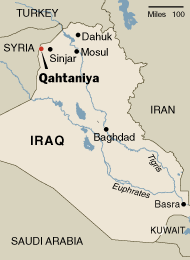
Al-Qaeda bombing of Yazidi Kurds at Syrian Border
The red dot marks the approximate area of the four explosions. This is about as far as one can get from our counterinsurgency and still remain in Iraq.
We're fighting heavily in Anbar province in the west; in Najaf in the southwest; in Diyala and Baghdad in the east; and we have a lot of forces in Sulaymaniyah in the northeast, hard up against Iran. The Kurds are very strong in Kirkuk in the north; and the Brits have not yet left Basra in the southeast.
Just about the only place left for al-Qaeda in Iraq (AQI) to operate with any degree of impunity is in the northwest, in the remote desert inhabited by a smattering of Yazidis. In fact, even the New York Times has noticed this geographic reality, though they try to spin it into a negative:
All three towns [Sinjar, Amerili, Tal Afar] lie north of the main areas affected by the increase in American troop strength that began in March, supporting the notion that, as in numerous earlier American offensives, insurgents have moved from where they are being attacked and restarted their operations elsewhere....
Asked why insurgents would pick such simple villages in the desert for such a colossal attack, General Bergner said: “Perhaps their vulnerability. Perhaps they were a target that they could attack.”
The Times wants readers to believe this shows that the "surge" is a failure. After all, al-Qaeda is simply moving "from where they are being attacked" and "restart[ing] their operations elsewhere."
But that is precisely what the counterinsurgency aims to do: Unlike the previous "attrition" strategy, we don't just attack higgledy-piggledy following the terrorists, allowing them to set the operational tempo; instead, we began by defining an area of control -- the "white" area, using the terminology of French Lt.Col. Galula in Algeria, one of the recent architects of modern counterinsurgency theory. Then we expand from the "white" areas into the adjacent "pink" (contested) areas.
As we invest pink areas and turn them to white, that automatically makes what had been adjoining, enemy-controlled (red) areas into contested pink areas. That is, rather than chase al-Qaeda up and down Iraq, we start in one or two spots and expand outward -- like oil expanding across troubled waters.
"Victory" occurs as we push the enemy farther and farther away from the military, political, and economic centers of the country... which is precisely what we see happening in Iraq today. This attack is a perfect example.
Propinquity
Even more interesting about the geography of this attack: It's virtually on the Syrian border, over which AQI has been smuggling weapons, fighters -- and suicide bombers -- for several years. From the AP story linked above:
"This is way out by the Syrian border, an area where we do think in fact some suicide bombers are able to come across the border. It's an area that is very, very remote - quite small villages out there - and it was disheartening for us, too, obviously," [Gen. David] Petraeus told The Associated Press in an interview.
In the past, prior to the Coalition's new offensive strategy, al-Qaeda had little trouble smuggling suicide bombers across the Syrian border -- either in Anbar or Nineveh provinces -- and then transporting them to Baghdad, or any other location in central Iraq, where the blasts can be more spectacular (and, they hope, visible to the American elite news media parked in the Green Zone) and affect far more mainstream Iraqis. But in this bombing, while they likely got the murderers across from Syria, they were unable to move them very far. So instead, they tried to make lemonade by bombing a tiny sect that lives right at the border: the Yazidi.
I'm absolutely certain that al-Qaeda in Iraq would much rather have killed 250 people in Baghdad (capital of Baghdad province), Ramadi (capital of al Anbar), or Baqouba (capital of Diyala), where our counterinsurgency is actually focused... rather than a pair of villages in Nineveh so tiny, they're not even represented on most maps of Iraq. For that matter, al-Qaeda would almost certainly have rather blown up Kirkuk or Mosul... which, while not being part of the "surge," are at least major cities in the north and eponymous provincial capitals.
The only thread AQI can hang their rampage on (other than "that's the best we could do") is the infamous Yazidi stoning on April 7th, 2007. On that day, between one and two thousand Yazidi men stoned to death a 17 year old Yazidi girl, Du’a Khalil Aswad, for the crime of loving a Moslem boy and planning to elope (and possibly convert to Islam; that part is unclear). After Aswad was murdered, her body was burned and buried with the remains of a dog.
In "retaliation," AQI launched a reprisal massacre of 23 Yazidi men on a bus 13 days later... but that was in Mosul, the capital of next-door Mosul province. Since then, the Yazidi have not been singled out by AQI.
Again, I find it very unlikely that this was planned all along for two obscure Yazidi villages. We know the plan is at least a week old, because AQI distributed leaflets warning about it; but that was likely after they had already smuggled in the bombers... and realized they couldn't move them anywhere where an attack would be more visible and intimidating.
The overwhelmingly likely explanation is that the target was picked primarily for propinquity: The bombers could get to those villages; they could not get even as far as Mosul, let alone Baghdad... the American Army and Marines were in the way.
Religious profiling
Another reason the Yazidi are a curious target is that they are not, in fact, considered Islamic. They are an offshoot of an offshoot of an amalgamation of the pre-Islamic Middle East, archaic Levantine (descended from Crusaders) and Islamic religions, Kurdish culture and language, and bits and pieces of Sufism. They seem to me to occupy a similar position in the Middle East to the Mormons here... I don't mean the mainstream, late 20th-century Mormonism of Mitt Romney; I'm referring to the violent, polygamous version of Mormonism in the 19th century -- the Mormons that initiated the Mountain Meadows massacre, for example.
Those Mormons were driven from pillar to post in the United States; typically, they tried to immigrate west, out of the country (which did not yet extend "from sea to shining sea;" there was a big gap of wilderness in between Missouri and California). But as America kept catching up to them, they found themselves more and more in conflict. Christians tended to consider them heretics back then; some remnant of that prejudice exists today, with many otherwise ecumenical Christians angrily asserting that even present-day Mormons are not Christians.
Similarly, as AP puts it:
Some Muslims and Christians consider an angel figure worshipped by Yazidis to be the devil, a charge the sect denies. The Islamic State in Iraq, an al-Qaida front group, distributed leaflets a week ago warning residents near the scene of Tuesday's bombings that an attack was imminent because Yazidis are "anti-Islamic."
Why is this significant? Because typically, AQI wants to target its ghastly and spectacular bombing attacks against mainstream Shiite targets... such as the al-Askari "Golden Dome" mosque in Samarra. In a pinch, they may punish "rebellious" Sunni tribesmen in Anbar or Diyala. But what impact would result from bombing an obscure, non-Islamic sect that most Iraqis only associate with the stoning of Ms. Aswad? Iraqis (even mainstream Kurds) will likely just shrug. And the distance from there to the nearest front in the war is so great that it will be hard even for Sen. Russell Feingold (D-WI, 100%) to argue that this constitutes a failure of Gen. Petraeus's strategy.
Bottom line
Again, I think this shows that AQI is reduced to striking whatever target is nearest to hand, out by the Syrian border, where they're hiding; and they must take "pot luck" when selecting victims. More than anything else, this reminds me of the 1992 Los Angeles riots, where rampaging bands of black and Hispanic youths burned down a thousand buildings -- almost all locally-owned and run businesses in their own neighborhoods. Why? Because those were the only buildings they could get at. Buildings in Beverly Hills, the west side, Palos Verdes, and even many Korean-owned stores and restaurants were too heavily guarded by homeowners and shopkeepers.
This is not to say that AQI will never get lucky again with a terrible attack on an important target in the heartland of Iraq. But such attacks have become fewer and fewer as the counterinsurgency continues:
The number of truck bombs and other large al-Qaeda-style attacks in Iraq have declined nearly 50% since the United States started increasing troop levels in Iraq about six months ago, according to the U.S. military command in Iraq.
The high-profile attacks -- generally large bombs hitting markets, mosques or other "soft" targets that produce mass casualties -- have dropped to about 70 in July from a high during the past year of about 130 in March, according to the Multi-National Force - Iraq.
In 2006, AQI destroyed the al-Askari mosque; in April of this year, they bombed the Iraqi parliament; in June, they knocked down the two remaining minarets of the al-Askari mosque (which few realized were still standing anyway). And yesterday, they bombed an obscure pre-Islamic sect of Kurds living right on the Syrian border, in the extreme northwest corner of the country.
In the counterinsurgency war we're fighting, that's exactly what victory looks like.
Hatched by Dafydd on this day, August 15, 2007, at the time of 6:23 PM | Comments (5) | TrackBack
August 13, 2007
We Are Not Terrorists! Pakistani Hit Song
In the UK, two brothers -- 20 year old Khurrum Mahmood and 18 year old Khaiyyam -- persuaded their media-consultant father Wasseem to start a music video project. The idea was to gather a bunch of Pakistani pop stars (yes, there are some) to sing a "message" song... sort of a Pakistani version of "We are the world."
But the message of this song is very different: Rather than pining for world peace or food for all, this song specifically targets Islamic terrorism.
It's called "Yeh Hum Naheen," Urdu for "We are not that." Wasseem was able to gather "eight out of the ten most popular Pakistani pop-artists" to sing verses. Here is the English translation of the lyrics: (You can watch the video here.)
These stamps of death on our foreheads
are the signs of strangers
The name by which you know us
We are not that
The eye with which you look at us
We are not that
That is not us, not us
We are scared of the dark
So much that we are burning our own home
The Stories that are being spread in our name are lies
That is not us, not us
Tha name by which you know us
We are not that
The eye with which you look at us
That is not us, not us
This is not just another "celebrity sanctimony" project, which costs the rich and famous nothing and pays big dividends in public image and commercial exposure. Taliban and al-Qaeda terrorism is very real in Pakistan. There are many Pakistanis who are sympathetic to radical Moslem movements, particularly in the southwest province of Balochistan (bordered by Iran and Afghanistan) and just north in Waziristan, part of the tribal territories.
Unlike the faux courage of Western celebs, as they rail against against "oppression" and "the regime" in Washington D.C., singing this song can quite literally "kill one's career."
The encouraging thing is that the song is a hit. The video claims that there have been 60,000 to 70,000 downloads already. It may not seem like much to us, when hundreds of thousands download YouTubes of Pearl Jam or Barry Bonds hitting his 756th; but in a poor, tribalist country like Pakistan, almost the definition of the "Non-Integrating Gap," such widespread downloading is monumental.
I don't know if this song will lead to anything, but it's a start. If Islam is ever to change and become a modern religion, reform must arise from within.
Pakistanis must have seen what happened to the Sunni in Afghanistan and Iraq, when they fell under the "benevolent" caliphate of al-Qaeda and the Taliban. They must realize how militant Islamists treat ordinary people... even those who fit the narrow straight-jacket of acceptable religous belief; the Taliban even ban music and dancing, for Allah's sake.
I hope the song's message reaches far and wide in that turbulent country, waking up the tribal Moslems and making them think a second time about supporting death-cultists who sacrifice children in the name of God.
Hatched by Sachi on this day, August 13, 2007, at the time of 4:31 AM | Comments (4) | TrackBack
August 8, 2007
Kosher Security: the War Against Global Pork
This is the second in our ongoing series, searching for a unifying theme of national security in the campaigns of Republican candidates for president. I believe that we desperately need such a theme: an easy-to-understand, overarching "narrative" that melds together a number of urgent problems and their solutions. Our first post in this series explained why the future of energy production is actually a national-security issue:
In this installment, I hope we can demonstrate that eliminating "pork" (earmarks, phonemarks) from the government's diet is also a vital national-security issue.
First, let's start with a definition: Not every earmark is "pork." In the Congress, an earmark means a section of appropriations legislation that directs funding to a specific, named purpose. If the purpose truly benefits the entire country -- for example, earmarking funds to upgrade and improve the Air Traffic Control computer system -- there is nothing untoward about it. It could still be either a good or bad expenditure, but it's not necessarily corrupt, even if it specifies the company that will perform the upgrade.
The problem arises when the earmark is directed to a project benefitting only the district or state of the powerful congressman who forced its inclusion... and especially when it benefits a particular business within that district (or even elsewhere) that just happens to have contributed significant money to that congressman's reelection fund. Let's agree to call earmarks intended to benfit only a narrow subset of Americans, at the expense of the rest of us, "evil-earmarks," or EEs, to distinguish them from the other kind.
EEs can be a profitable deal for the company: They bundle $200 thousand from "voluntary" employee contributions to Congressman Smitty, and Congressman Smitty directs $223 million worth of new business to the company, building a Mucus Museum or a new dome for the George Soreass Sports Centre. If it just so happens that the 200 Gs came from a hundred executives, each of whom owns significant stock in the company, and if the company stock rises a few points because of the earmark, it can even be profitable (and legal) for the donating employees.
Of course, it's not so good for the rest of us, who have to pay higher taxes to support somebody else's wretched soccer stadium. $223 million may be a mere molecule in the opalescent ocean of federal spending; but a couple thousand of such earmarks would be greater than this year's entire budget for the Department of Defense. A billion dollars here, a billion dollars there... it adds up.
And as it adds up, such corruption saps the economic strength of the United States.
Econ. 101
Most economists -- and by definition all free-market economists, who are the only ones I care about (color me prejudiced) -- agree that wealth is generally much better spent or invested by its creators, or those who legitimately purchase it, than by the government. Financial decisions of governmental bodies or functionaries are often not made on the basis of a proper cost-benefit analysis but for purely political reasons.
For example, consider the move by politicians (and left-liberal academics at state-funded universities) in the 1970s and 80s to divest pension-fund portfolios of all stock in South African companies, to protest Apartheid... and the similar move among many state and local governments -- and left-liberal academics at state-funded universities -- to divest pension funds of all stock in Israeli companies, and even non-Israeli companies that do business in Israel, to protest Israel's continued existence. Or consider the move to divest from Wal-Mart because Wal-Mart's employees continue to vote against unionizing.
When people invest their own money, they tend to take more care; and they tend to put economic considerations above sending a partisan message. But when they invest "OPM," they're much less circumspect. Democrats especially are always willing to purchase sanctimony by digging down deep -- into your pocket.
It is a truism requiring no argument that investing for non-economic reasons will not, in general, generate as great a return as investing based upon purely economic reasons. Bad investments of great magnitude damage the economy. Thus, evil-earmarks damage the economy.
Why does this matter? For the obvious reason that the operating budget of the United States -- and all components, including the DoD, the CIA, DHS, NSA, FBI, and the State Department -- critically depends upon the health of the nation's economy: Anything that damages the economy, including evil-earmarks, harms national security.
The road to apathy
But there is a more subtle way that EEs become a national-security issue: They are the most visible examples of corruption in government; and when the government is seen as corrupt, it's harder to inspire support for vital national-security programs, from the NSA's Terrorist Surveillance Program and the data-mining program, to support for the Iraq and Afghanistan wars, to military recruitment.
The more people believe the government is corrupt, the less likely they are to believe anything government officials say... hence the less likely they are to support intelligence gathering programs and major sacrifices, such as war. In an indirect but nevertheless very real sense, past GOP corruption led Americans to discount defenses of the war and other security measures. Many Americans believed "they'll say anything to keep the spigot wide open."
Now the Democrats are in charge, to a large extent because of the perception of a "Republican culture of corruption;" and voters have discovered that lobbyists are equal-opportunity seducers: They're just as happy bribing Democrats as Republicans, and the former are equally willing to grab for the cash. Thus, despite many promises to the contrary, in the end, the Democrats could not bring themselves to shine a spotlight on individual earmarks; since they took over the corrupt practice of evil-earmarks themselves, they have lost all interest in making EEs public record.
In fact, they even invented a brand new method of achieving the same goal, which has been dubbed "phonemarking." See the link above.
Visible corruption leads to the erroneous belief that it "doesn't matter" who is in charge, because "they're all equally corrupt." This in turn leads to voter apathy... or even worse, electoral tribalism, where elections are treated as playoff games; voters cheer when "their guy" wins, regardless of his issue positions, experience, or even fitness for the job.
An apathetic or tribalist electorate has a very hard time understanding bipartisan issues such as war, national security, protecting the borders, the rule of law, and leadership. They care only where their "team" stands in the rankings.
Finis
A presidential candidate can sum up this entire syllogism very pithily:
I have never seen a valid counterargument: Stopping evil-earmarks is a vital national-security issue, and it should be defended as such by all the Republican candidates for president... and indeed, the Democrats as well; though so far, the latter -- notably including the Democratic presidential candidates -- seem as incapable of understanding this point as the Republicans who ran the 109th Congress last term.
Hatched by Dafydd on this day, August 8, 2007, at the time of 3:22 PM | Comments (2) | TrackBack
August 6, 2007
Democrat Inadvertently Blurts Out Truth
A spokesman for the presidential campaign of Sen. Barack Obama (D-IL, 95%) accidentally let slip an inconvenient truth... and nobody noticed! (Except the lizards, of course; the lidless eye sees all.)
Defending Obama's feckless threat to invade Pakistan if their war against al-Qaeda doesn't proceed fast enough for Obama, Bill Burton spake:
“The fact that the same Republican candidates who want to keep 160,000 American troops in the middle of a civil war couldn’t agree that we should take out Osama bin Laden if we had him in our sights proves why Americans want to turn the page on the last seven years of Bush-Cheney foreign policy.”
The problem with this puffery is that it's simply not true that "Americans want to turn the page." Some do, some don't; in the most recent USA Today/Gallup poll on the war, 57% say we shouldn't have invaded (i.e., want to "turn back the page"); but 57% is not a consensus. However, a simple substitution makes the statement absolutely true and virtually a tautology. Consider this version with one word rewritten:
Yes it does; it indicates ("prove" is too strong a formulation) that to Democrats, the war on global hirabah begins and ends with Osama bin Laden: To the congressional majority, we can win everywhere else; but if bin Laden isn't captured and prosecuted, we have lost. But even more ominously, we can lose everywhere else; but so long as we capture bin Laden and put him on trial (in the U.N.'s International Court of Justice at the Hague, of course), then we've won!
Such juvenile thinking permeates the Democratic party more thorougly than Shiite militias have penetrated the Iraqi National Police. Another example, just enunciated by Max Boot in an interview on Hugh Hewitt: the unreasonable demand put upon Prime Minister of Iraq Nouri al-Maliki to ram reforms through the Iraqi parliament... when we, ourselves, deliberately wrote their constitution to weaken the prime minister, back when our greatest fear was another Iraqi "strongman" rising to replace Hussein. We weaken the prime minister, then imagine that if only we replace Maliki with another guy, he'll be able to solve the political problems ("Daddy fix!").
The gravest problem facing America today, in my never particularly humble or hesitant opinion, is the fact that a huge chunk of the electorate suffer from -- and an entire major political party is now based upon -- Peter Pan Syndrome: They've never grown up, living instead in a perpetual state of adolescence and "teen logic":
- They make unreasonable, truculent demands;
- They have no idea how such demands could possibly be met, no strategy or even vague suggestion;
- Yet they promise vast retribution if the magical president doesn't make it so;
- When thwarted, they fly into a rage;
- They blurt out horrid things they never meant to say -- then defend their misstatement with the ferocity of Howard Dean defending his latest verbal gaffe;
- And when the policies they demand (or inflict upon the American people) collapse, leaving a shattered industry or sector as testament to Democratic fecklessness... their only explanation is to shrug and say, "it seemed like a good idea at the time."
Republicans and GOP-leaning independents have it in their power to prevent another Peter Pan presidency. And the first step is to stop forming a circular firing squad at the drop of a disagreement. To quote that great small-f federalist, one of the authors of the Constitution, and perhaps the greatest epigrammatist in American history -- I refer to Benjamin Franklin, of course -- "gentlemen, we must all hang together, or assuredly we shall all hang separately."
Hatched by Dafydd on this day, August 6, 2007, at the time of 5:25 PM | Comments (6) | TrackBack
August 1, 2007
Gonzales, Intelligence, and Perjury: the Penultimate Word
Today, Attorney General Alberto Gonzales received his best testimonial yet from the pen (all right, word processor program) of Director of National Intelligence Mike McConnell (all right, from some flunky who actually does the typing).
Our previous reporting on this issue can be spelunked here:
As the post is fairly long -- but absolutely fascinating, riveting! -- I'm tucking the rest into the "slither on;" I urge you to read it; I can personally vouch that the author is brilliant when sober.
McConnell sent a letter to Arlen Specter (R-PA, 43%), ranking Republican on Chairman Pat Leahy's (D-VT, 95%) Senate Committee on the Judiciary, trying to explain to Specter -- as if to a retarded seventh grader -- why Gonzales, in telling the truth, therefore did not lie:
In a letter to Sen. Arlen Specter (R-Pa.), McConnell wrote that the executive order following the Sept. 11, 2001, attacks included "a number of . . . intelligence activities" and that a name routinely used by the administration -- the Terrorist Surveillance Program -- applied only to "one particular aspect of these activities, and nothing more."
"This is the only aspect of the NSA activities that can be discussed publicly, because it is the only aspect of those various activities whose existence has been officially acknowledged," McConnell said....
McConnell's letter was aimed at defending Attorney General Alberto R. Gonzales from allegations by Democrats that he may have committed perjury by telling Congress that no legal objections were raised about the TSP. Gonzales said a legal fight in early 2004 was focused on "other intelligence activities" than those confirmed by Bush, but he never connected those to Bush's executive order.
Gonzales had been asked point blank, during Senate J-Com testimony, whether the argument in the hospital was over the TSP; he therefore, honestly and accurately, said no, it was about a different program... and he then offered to go into secret session to describe exactly what program he and then-Attorney General John Ashcroft discussed.
Chairman Leahy, however, had zero interest in finding out; he was only interested in screaming "perjury!" and demanding a special counsel (all right, manipulating four other Democrats on the committee, plus Majority Leader Harry "Pinky" Reid, D-Caesar's Palace, 90%, into screaming perjury and demanding a special counsel; see links above.)
This seems pretty conclusive. So why "penultimate?" Because I cannot imagine that the Democrats -- and their RINO acolytes, such as Arlen Specter -- will discard the perjury card merely because Gonzales told the truth. I sense another shoe about to drop.
As it happens, I'm not just whistling past the gravy train; revisionism has already started. Now it turns out that even if Gonzales fully and truthfully answered the question, he still "misled Congress" because he did not immediately disclose every classified intelligence program in our arsenal... on national TV:
Charles E. Schumer (N.Y.), who was among a group of four Democratic senators who called last week for a perjury investigation of Gonzales, said: "The question of whether Attorney General Gonzales perjured himself looms as large now as it did before this letter.
"This letter is no vindication of the attorney general," he said.
Is it just me? Shouldn't the revelation that a statement thought perhaps to be perjury was in fact completely truthful at least make it implausible that it was also perjury?
And what about our esteemed RINO from Pennsylvania? Arlen Specter is witholding comment, as the Democrats have yet to give him a lead:
Specter was noncommittal yesterday on whether McConnell's explanation resolved his questions about the accuracy of Gonzales's previous testimony to the Senate Judiciary Committee, where Specter is the ranking Republican. Specter said he was waiting for a separate letter from the attorney general to provide additional clarification.
"If he doesn't have a plausible explanation, then he hasn't leveled with the committee," Specter said on CNN. Justice spokesman Brian Roehrkasse said that "the department will continue to work with Senator Specter to address his concerns" but declined to comment further.
Pssst... Sen. Specter: Perhaps Gonzales' "plausible explanation" for why he said that there was no dissent on the TSP, that it was on a different intelligence program instead, is that there was no dissent on the TSP... it was on a different intelligence program instead. You think?
Finally, the Washington Post indulges in one of liberalism's favorite ploys; they quote an allegedly unbiased expert to "analyze" the situation -- which analysis, oddly enough, always seems to point exclusively in one direction:
Kate Martin, executive director of the Center for National Security Studies, said the new disclosures show that Gonzales and other administration officials have "repeatedly misled the Congress and the American public" about the extent of NSA surveillance efforts.
[Sidebar: Am I the only person who has no recollection of Gonzales or President Bush ever claiming that the TSP was the only surveillance program we had? I would certainly hope we have many more than one -- and in fact, many more than are known by the editors at the elite media.]
"They have repeatedly tried to give the false impression that the surveillance was narrow and justified," Martin said. "Why did it take accusations of perjury before the DNI disclosed that there is indeed other, presumably broader and more questionable, surveillance?"
The "Center for National Security Studies" is a bitter, relentless partisan in the conflict between Congress and the White House over who should run this war (and previous wars, even back to the Clinton administration): From their website, it appears they invariably take the side of Congress in trying to extract information, no matter how heavily classified, from the Executive. Too, Kate Martin is a professor at ultra-liberal Georgetown University.
So we are shocked, shocked to discover that she is 100% on the side of Pat Leahy and Chuck Schumer (D-NY, 100%) in demanding that Albert Gonzales brief all members of both houses of Congress on every last intelligence surveillance program under the NSA, CIA, or any other intelligence agency.
Martin and her fellow Democrats demand that Leahy, et al, of the Senate Judiciary Committee be briefed -- including the fifteen J-Com members who are not members of the Senate Select Committee on Intelligence... and there is a reason it's called "select;" J-Com Chairman Leahy in particular was expelled from the Intelligence Committee... for leaking classified information (hence his nickname).
I guess Kate Martin has never heard the words "need to know."
And the Democratic House is now competing with the Democratic Senate to see who can make the most outrageous demand. On Monday, Chairman of the House Judiciary Committee Chairman John Conyers, Jr. (D-MI, 100%) -- who had evidently read the New York Times and Washington Post articles revealing that the Gonzales-Ashcroft main event really was about a different program than the TSP -- fired off an angry letter to Attorney General Gonzales insisting that Gonzales spill the beans about every intelligence program we have... to John Conyers, who is not a member of the House Permanent Select Committee on Intelligence and never has been:
We have two potential concerns with the disclosure. First, at a time when the Administration is seeking to make changes to the Foreign Intelligence Surveillance Act, it is imperative that all members of the House Judiciary Committee be fully apprised of these controversial, and possibly unlawful, programs, and any related programs....
We now request copies of all opinions, memoranda, and background materials, as well as any dissenting views, materials, and opinions regarding the same, concerning the database program disclosed by the media yesterday.
Yow. Why doesn't the White House just burn a few hundred CDs containing the complete NSA and CIA databases and pass them out to all 535 members of Congress?
(All right, 540 -- counting D.C. Delegate Eleanor Holmes Norton, the delegates to the territories of American Samoa, Eni F. H. Faleomavaega, Guam, Madeleine Bordallo, and the United States Virgin Islands, Donna M. Christian-Christensen, and Resident Commissioner of Puerto Rico Luis Fortuño.)
And all their aides, of course; mustn't forget the congressional aides, including those who are still teenagers. After all, if you can't trust a teenaged girl with a deep and vital intelligence secret, well who can you trust?
The ultimate word of the Penultimate Word is this: Democrats in Congress will not rest until we have no secrets, none whatsoever; everything we know, every program we undertake to develop actionable intelligence against past, current, and future terrorist threats, should be instantly and unreservedly shared with thousands of senators, representatives, delegates, aides -- and anyone else that anyone else might choose to enlighten.
The insanity (and inanity) of this position is manifest and requires no explanation. But the implication is chilling. This demand isn't just surrendering in Iraq; the Democratic Party's overt position has now become one of utter American defeat in the broader war against global hirabah ("unholy war"). Because if we were to reveal all that we were doing to collect intelligence... well, then we might as well not bother doing it, because none of it would work anymore.
Leahy is not an idiot, and neither is Schumer nor Conyers. They know the logical consequences of what they demand. So why do they demand it?
Straightforward question, simple answer: They believe "Nixoning" Bush, accusing him of a coverup, will help their political fortunes in 2008.
What I cannot answer is whether the motivation is core hatred of America as it currently exists... or depraved indifference to what, if we lost this war, America might become.
Hatched by Dafydd on this day, August 1, 2007, at the time of 5:03 PM | Comments (7) | TrackBack
July 26, 2007
Korean Hostages Threatened by Taliban; America Blamed
According to Robert Koehler of the Marmot's Hole, the Korean press is all set to blame America if the Taliban makes good its threat to kill the 23 (now 22) Korean Christian-evangelists currently held hostage.
The Korean press reasons thus: Kabul is reluctant to negotiate with the Taliban only because of pressure from the West... i.e, the United States and our "lapdog," Great Britian. Since Afghanistan relies upon foreign aid, the press concludes, Afghan President Hamid Karzai dares not offend America or our allies. So it's all America's fault.
But Koehler points out that if Karzai is reluctant to listen to South Korea's plea, it's not necessarily because of the United States: South Korea is simply short stacked, due to the insignificant contribution it has made in the Afganistan war:
Of course, what Yonhap doesn’t say is that, perhaps, Kabul is ignoring the Taliban’s demands because a) it doesn’t want to turn kidnapping into a lucrative business, and more to the point b) Korea’s contribution to the fight against the Taliban has been next to nil, and its 200 non-combat troops will be withdrawn by the end of the year anyway. Kabul has absolutely no reason whatsoever to free enemies of the state who, upon their release, will go about attacking schools, hospitals and other infrastructure, killing Afghan civilians and attacking both its troops and the troops of allied states, all to rescue a bunch of highly irresponsible individuals who should have never been in the country in the first place and were probably engaged in activities [Christian evangelism] even the Karzai government deems illegal. When Kabul freed five Taliban terrorists to save an Italian journalist earlier this year, it didn’t do it out of the kindness of either Karzai’s or Bush’s heart -- it did it because Italy threatened to pull out its 2,000 troops. Influence is earned, and Seoul -- so sorry -- hasn’t earned any.
So what is Korea to do? Koehler suggests that instead of blaming the US, Korea should offer to provide more troops, real combat or police troops, to Afghanistan.
If South Korea wants to have some influence, it must earn it. Yes, such an act could anger the Taliban, and they might very well retaliate by killing all the hostages. But they've said they're going to kill them anyway -- and evidently have already killed one. Even without Korea offering new troops, the fate of the hostages seems grim.
But if Korea were to respond to the kidnapping and threat with force instead of appeasement, at least they could show the Taliban (and the world) that Korea is a force to be reckoned with. After all, there are still more than 150 Korean evengelists still living in Afghanistan. If South Korea wants to avoid future kidnapping, they had better start showing some spine now.
Dafydd adds: Sure, the South Koreans may be weenies. But what about the Japanese? They're being whupped by weenies!
Hatched by Sachi on this day, July 26, 2007, at the time of 6:04 PM | Comments (2) | TrackBack
July 24, 2007
World Moslems: Jihad Is Like So Ten Minutes Ago
Pew Research, which has been polling the world about its hatred of America for decades, has detected a fascinating trend: Since 2002, Moslem support for Osama bin Laden, al-Qaeda, and suicide bombings has plumeted -- by more than 40% in some countries. At the same time, their sense of personal and national well-being has risen dramatically; the two measurements are not completely unconnected.
2002 is likely when support for radical, militant Islam hit its peak worldwide: The 9/11 attacks had just percolated down to the level of the individual Achmed in the street, making the Moslem street believe that bin Laden was the "strong horse." Then the Taliban was crushed, enraging the street at the unfairness of life and frightening them about the march of the crusaders. And we had not yet done anything to raise Moslems up out of tyranny and poverty. It's easy to picture half the ummah marching towards Mecca chanting "solidarity forever!"
But then the hated tyrant Saddam Hussein was overthrown by the United States -- Crusaders and Zionists! -- liberating 27.5 million Moslems. Following four years of brutal fighting in Iraq, during which we never cut and ran -- and during which we also helped Moslems create what is currently the only Arab-Moslem democracy in the world -- the "street" has evidently decided that savagery, butchery, mayhem, and indiscriminate killing of innocents is not so grand a plan as they used to think. Not to mention the many Moslems who got a first-hand look at what life under a "caliphate" would be like; I suspect that had a lot to do with the change in attitude, both about the tactics and goals of terrorists and about who is actually the "strong horse" and who the lame pig.
It's a sea change, and it's still accelerating:
Muslims around the world increasingly reject suicide bombings and other violence against civilians in defense of Islam, according to a new international poll dealing with how the world's population judges their lives, countries and national institutions.
A wide ranging survey of international attitudes in 47 countries by the Pew Research Center also reported that in many of the countries where support for suicide attacks has declined, there has also has been decreasing support for al-Qaida leader Osama bin-Laden.
The 95-page survey found that surging economic growth in many developing countries has encouraged people in these countries to express satisfaction with their personal lives, family income and national conditions, said Andrew Kohut, the center's director.
"It's a pro-globalization set of findings," Kohut said.
Another way to put it uses the language of Thomas P.M. Barnett: Moslems in the Middle East, in Pakistan, and in other countries are starting to glimpse what life in the Functioning Core is like -- and to contrast it with the 7th-century life in the Non-Integrating Gap offered by al-Qaeda and the Shiite Twelvers.
In a shocking and wholly unanticipated development, it turns out that there is only one region where support for suicide attacks on innocent civilians has not dropped at all... the Palestinian territory:
But support for suicide bombings is widespread among Palestinians, the report said, with 41 percent saying such attacks are often justified while another 29 percent say they can sometimes be justified. It found that only six percent of Palestinians—the smallest in any Muslim public surveyed—say such attacks are never justified.
Some more findings of the Pew poll:
- In Jordan, Moslems who think of bin Laden as a "world leader" dropped from 56% in 2002 to 20% in 2007.
- Jordanian Moslem support for suicide bombings dropped from 43% to 23%.
- In Lebanon, support for suicide bombings dropped from 79% to 34%.
- In Pakistan, it fell from 33% to 9%.
- In fact, "the report said support for such bombings and terror tactics has dropped since 2002 in seven of the eight countries where data were available."
It is absolutely imperative that we build on this dramatic change, rather than insist (as some still do) that we are at war with the entire ummah ("Moslemdom"). As Moslem countries have more and deeper contact with the West, as they see up close and personally what living in a Taliban or Iranian regime looks like... and yes, as they look at the example of now-democratic Iraq, right in the heart of the Middle East, they are coming to the same conclusion: There is no future in "jihad." The future is to be found, not by fighting modernity, but by embracing it.
And by its very nature, modernity is moderate.
Thus, most Moslems are moderating, which is precisely the predicted effect of edging from Gap to Core: The more a person has invested in society, the less willing he is to support violent revolution and mindless human sacrifice. (We see the same dynamic at play in domestic crime, especially within street gangs.)
Within a decade or so, we may not need to ask where all the Moslem Methodists are, for they will be living all around us. As to whether or not they will be strong enough to break the cycle of martyrdom, that I cannot guess. But with so much at stake, how can we afford not to seize such birds when they knock on the bush?
Hatched by Dafydd on this day, July 24, 2007, at the time of 11:08 PM | Comments (3) | TrackBack
Executive Energy
One of the reasons I'm not entirely thrilled with the current bunch of presidential candidates... wait, a detour: Many animal-nouns have associated words for collections of that animal; for example, a gaggle of geese, an exhaltation of larks, a bay of hounds, a bale of turtles, and a murder of crows. Since most politicians are more or less barnyard animals, it makes sense that they have their own collection term. I propose "a corruption of politicians" and a "smarm of candidates."
One of the reasons I'm not entirely thrilled with the current smarm of presidential candidates is that none of them seems to be able to articulate a coherent theme... a single "big issue" that can spawn a whole series of positions that all relate to a central principle. You can have more than one; Reagan had two: The destruction of the Evil Empire, which drove every element of his foreign policy, and the primacy of the individual taxpayer in running his own life, which informed most of his domestic ideas. But without at least one, it's very hard to answer the fundamental question of electoral politics: What makes you different from the other guys?
We live in dangerous times. I believe that our candidates need to focus like a laser beam on national security, but not just in the form of mass invasions of enemy countries (though that is clearly one element that should never be taken off the table). I want to see national security taken seriously enough by some candidate for president that it drives both his foreign and domestic programs. (Naturally, no Democrat would care for principle-based governance; so consider that I speak only to the GOP candidates.)
Let me give you an example of what I mean: One of the big four -- Rudy, Fred, Mitt, or John -- should distinguish himself from the smarm by developing and repeatedly enunciating a coherent, long-term energy policy geared towards replacing foreign oil importation with domestic production as much as possible, as a necessary component of national security. And that should be a major and oft-explained component of his presidential campaign.
The connection is clear; anyone can understand it: The only reason that either Sunni "al-Qaeda" terrorist groups or Shiite "Twelver" terrorists have the resources to threaten the world is that oil-rich countries like Iran and Saudi Arabia (and Venezuela) keep shoveling mountains of petrodollars at them. How long would Hezbollah last if Iran were not able to pay for it? How many radical mosques would we have in the United States if Saudi Arabia didn't have enough money to finance them?
Obviously, then, we can drastically cut the threat to American national security by reducing the price of oil. High oil prices mean the oil producers have money to burn... and they burn it by giving it to Salafists, Wahhabis, and Shiite death squads. But low oil prices means that members of OPEC do not have anywhere near the money they need to fund global hirabah ("unholy war").
All right, so how do we reduce the price of oil? This is Econ. 101 stuff: Price is controlled by demand drawing upon supply. When demand is high and supply low, prices rise; but if either demand drops or supply rises, prices fall.
We cannot significantly reduce demand for oil, so we concentrate on the supply side. And the best -- and most readily apparent -- method of increasing the world supply of oil is to drill more. If we were to drill in the Gulf of Mexico, off the California coast, and of course in the Arctic National Wildlife Refuge in the northeast corner of Alaska, we could reduce our own need to buy foreign oil so dramatically, it would likely drop the price of oil for everyone else, too.
And even though it's difficult to reduce world demand while China and India grow exponentially, we could still reduce our own demand by expedited building of scores of high-tech, safe nuclear power plants (Integral Fast or Pebble Bed designs). Why not? It's a good thing with or without the unifying theme.
OPEC would be in a tizzy. Terrorist butchers would find their paychecks slim and sporatic. And the economic side benefits here in America would include reduced prices and shrinking inflation for all... which would probably also mean the Federal Reserve loosening money, allowing more economic expansion. We increase our national security and improve our economy all in one swell foop.
So where is the GOP candidate willing to step forward and forcefully make this case? Where is the Fred Thompson or Mitt Romney or Rudy Giuliani who will seize this strongest of all electoral themes and beat Hillary and Barack over the head with it?
I even have his slogan: "Defund al-Qaeda by drilling in ANWR!"
Over the next few weeks, I'll post a few more examples of how a principled theme of "boosting national security" can lead to a surprising number of foreign and domestic policies, each of which are good ideas in themselves; but together, they will make our country, and everyone who lives here, safer, more prosperous, and more secure.
Hillary Clinton has her "theme song;" let's us have our campaign theme. There, I'm done.
Hatched by Dafydd on this day, July 24, 2007, at the time of 4:33 AM | Comments (35) | TrackBack
July 20, 2007
Dubai Ports Weird
Matt Drudge linked a story with a fairly cryptic one-liner that I simply couldn't resist: "White House Backed Dubai Ports Deal In Exchange For Intel." The "story" turned out to be the "Inside the Ring" column by Bill Gertz in the Washington Times; Gertz discussed a passage in a book by Rowan Scarborough, the crux of which is that there was a deeper, secret reason why President George W. Bush approved the deal for Dubai Ports World -- a shipping company owned by the United Arab Emirates -- to take over cargo operations at major American ports.
During the insane donnybrook that erupted on both right and left about that deal, many covert motives were suggested by its most energetic opponents: that Bush had sold out to al-Qaeda, that he had been duped by the jihadist UAE, that liberal cells at Treasury and DHS had tricked the political appointees, and in general that the deal would be terrible for American security (some used the phrase "outsourcing port-security operations," but that argument was so specious that it was quickly dropped).
But now, if we can believe Scarborough, there really was a covert reason; but it wasn't what anybody (including myself) imagined: Evidently, in exchange for okaying the deal, DPW was going to allow us to plant CIA agents in DPW-run ports all around the world... including those in some of our most dangerous enemies and challenging allies in the Middle East, in Asia, and even in South America:
Former Inside the Ring co-author Rowan Scarborough has written a new book revealing a key reason the Bush administration pressed hard for the 2006 deal for the United Arab Emirates-based Dubai Ports World to take over management of several U.S. ports.
According to Mr. Scarborough, the administration wanted the deal to go through because the UAE government had agreed to let the United States post agents inside its global port network who could report on world shipping.
Dubai Ports currently runs port facilities at key U.S. intelligence targets, including Venezuela, China, Pakistan, India and Saudi Arabia.
"Dubai Ports, in essence, was going to become an agent of CIA," Mr. Scarborough said in an interview. "The arrangement is helping us detect whether any kind of terror contraband was being moved around."
(The book Gertz refers to is Sabotage: America's Enemies Within the CIA, by Rowan Scarborough.)
Let's assume for the moment that Scarborough's claim is true; after all, if we assume it's false, then this entire blogpost is as worthless and useless as the rest of Big Lizards. But if so, three points of interest immediately become apparent:
- Clearly, President Bush could not have publicly announced such an offer; he could, however, have privately briefed Republican and Democratic members of the House and Senate Select Committees on Intelligence.
Did he? Did any members of the Intelligence committees oppose the deal? I cannot find any that I clearly remember voicing an opposing view; former senator and Intel-committee member Jon Corzine (D-NJ), a deal opponent, had already left the Senate by the time the controversy erupted in February 2006 and would not have received any classified briefing).
(In the 109th Congress, the memberships of the relevant committees can be found here for the Senate, and here for the House.)
In any event, there is no way most opponents could have known about the alleged offer.
- Equally clearly, Bush had a very strong reason to push for the deal, even if he could not, for obvious reasons, enunciate it. He was not simply being "PC" or "multi-culti," not trying to appease the Arabs, and not being bribed or tricked.
Folks may differ on whether the offer was substantial enough to overcome whatever danger they see by replacing British management of cargo ops with UAE management of cargo ops (given that only the management hats would change, while the actual cargo handlers would have remained American longshoremen). But if one believes Scarborough, it's no longer possible to say there was "no good reason" for the deal, or that Bush got "rolled" by the UAE.
- Finally, Bush has probably been trying to find a way to get those embeds anyway... but whether he has or has not, those "key intelligence targets" will go crazy trying to find them.
Especially Oogo; I'm convinced that as soon as he hears about this claim, he'll begin raiding the management offices at DPW's cargo terminal at Puerto Cabello -- the largest seaport in Venezuela, whence the country's vast oil production flows out of Venezuela and into the world market. If Chavez acts true to the racing form, he will seize personnel and use fairly violent means to find the "spies," "assassins," and "saboteurs" he just knows are lurking within.
I hope their cover is deep and wide; and if they're not really there, then I hope DPW gets so angry it simply pulls out, bringing Venezuela's oil industry to a standstill. My, but we live in interesting times!
Hatched by Dafydd on this day, July 20, 2007, at the time of 5:06 PM | Comments (5) | TrackBack
July 17, 2007
NIE Assessment of Threats Inexplicably Fails to Include Democrats - Updated
Source update: See below.
Warning: The just-released NIE from the Directorate of National Intelligence, coupled with the Democratic response to it, may lead to a serious and traumatic case of mental whiplash (quick, somebody call John Edwards!)
Here is one of the central findings of the NIE:
We assess that al-Qa’ida will continue to enhance its capabilities to attack the Homeland through greater cooperation with regional terrorist groups. Of note, we assess that al-Qa’ida will probably seek to leverage the contacts and capabilities of al-Qa’ida in Iraq (AQI), its most visible and capable affiliate and the only one known to have expressed a desire to attack the Homeland. In addition, we assess that its association with AQI helps al-Qa’ida to energize the broader Sunni extremist community, raise resources, and to recruit and indoctrinate operatives, including for Homeland attacks.
Translation: Since AQI is the only element associated with the broader al-Qaeda that is actually fighting hirabah against the West on a daily basis, broader al-Qaeda will try to team up with AQI (now contained with the "Islamic State of Iraq" group) to carry attacks to the American homeland. Success by AQI feeds success by the umbrella organization; defeat of AQI is defeat of al-Qaeda.
But here is the Democratic response to this section of the report:
Mr. Reid said the report underlines the urgent need to change course in Iraq, an argument also made by Representative Ike Skelton, the Missouri Democrat who heads the House Armed Services Committee. “We must responsibly redeploy our troops out of Iraq,” Mr. Skelton said in an interview with The Associated Press. “This will allow us to concentrate our efforts on Afghanistan and the Al Qaeda terrorists who attacked us on 9/11.”
Equally important to the threat is the effectiveness of our response to the threat. How are we doing? Here is what the NIE says:
We assess that greatly increased worldwide counterterrorism efforts over the past five years have constrained the ability of al-Qa’ida to attack the US Homeland again and have led terrorist groups to perceive the Homeland as a harder target to strike than on 9/11. These measures have helped disrupt known plots against the United States since 9/11.
The Democrats interpret this passage thus:
But Senator Harry Reid of Nevada, the Democratic majority leader, said the report shows that the Bush administration’s national security strategy “has failed in its most basic responsibility,” to capture or kill Osama bin Laden and his confederates and to eliminate the threat posed by their terrorist network.
Yeah, I remember that codicil to the 2001 Authorization for the Use of Force: that the only real goal of the War Against Global Hirabah is to capture or kill Osama bin Laden, personally. Not even Ayman Zawahiri -- al-Qaeda's actual operational leader -- counts as anything other than one of "his [OBL's] confederates"... or in Gilligan's Island terms, one of "and the rest."
Bin Laden is the top man, and we should focus all of our resources, manpower, and effort on coming up with a plan to, as military strategist Phil Donahue put it, "just go right in there and get him."
Then we can all just go home and back to sleep.
Republicans appear to have a different interpretation of the NIE:
Representative John A. Boehner of Ohio, the Republican minority leader, said that the new intelligence estimate confirms that the administration’s policies have weakened terrorist capabilities. “Retreat is not a new way forward when the safety and security of future generations of Americans are at stake,” he said in a statement.
What is most remarkable about the part of the NIE made public is the studied indifference to figuring out who is really behind the world's Islamic terrorism; while most serious analysts have had the revelation that all roads lead to Teheran (passing through Damascus), the unclassified portion of the NIE only mentions Iran in a single sentence -- and only as it relates to Hezbollah, which is openly the terrorist arm of the ayatollah:
We assess Lebanese Hizballah, which has conducted anti-US attacks outside the United States in the past, may be more likely to consider attacking the Homeland over the next three years if it perceives the United States as posing a direct threat to the group or Iran.
I hope the classified section is less circumspect.
I read not a single word about Iran's support for ostensibly Sunni Hamas, or their support for both Iraqi Sunni terrorists (foreign and domestic) and also Shiite death squads, such as the Mahdi Militia that used to be controlled by Iranian puppet Muqtada Sadr.
And not even a nod towards the new evidence of a strong connection between Iran and al-Qaeda terrorists, as elucidated by Michael Ledeen at NRO (hat tip to Scott Johnson at Power Line). Ledeen quotes the president, who stands virtually alone among Republican or Democratic politicians in perceiving the true global nature of this struggle:
At his press conference last week, President Bush -- echoing the public assessments from his military underlings in Iraq -- gave a clear picture of the war. Remarkably, not a single political leader or pundit saw fit to notice the dimensions of the war he described:
The fight in Iraq is part of a broader struggle that’s unfolding across the region...The same regime in Iran that is pursuing nuclear weapons and threatening to wipe Israel off the map is also providing sophisticated IEDs to extremists in Iraq who are using them to kill American soldiers.
The same Hezbollah terrorists who are waging war against the forces of democracy in Lebanon are training extremists to do the same against coalition forces in Iraq.
The same Syrian regime that provides support and sanctuary for Islamic jihad and Hamas has refused to close its airport in Damascus to suicide bombers headed to Iraq.
...the war against extremists and radicals is not only evident in Iraq, but it’s evident in Lebanon, the Palestinian Territories and Afghanistan.
(I heard on Brit Hume yesterday that the president intends to use executive orders to put heavy sanctions on companies and organizations controlled by the Iranian Revolutionary Guard; and that Bush plans to declare Iran's Qods Force a "terrorist organization," which will trigger a whole raft of new sanctions and prohibitions... which I hope will make it even easier to seize and hold (or kill outright) any Qods Force member caught outside Iran -- say in Waziristan, the Horn of Africa, or even the United States. But I cannot find written verification of this story; can any commenter help me out here? Thanks.)
If I must sum up the NIE in a single sentence, it would be this: The situation is improving, we're making much headway, but al-Qaeda, its affilliates, and other terrorist groups are still dangerous, toxic, and relentless... so keep fighting the good fight.
How the Democrats can translate this to "Nothing to see here, let's all just declare defeat and go home," is beyond my comprehension or forgiveness. 20 years from now, if we're still here -- and I firmly expect us to be -- there will be a lot of once-powerful Democratic "leaders" hiding in the dark and silent places, desperately hoping to be forgotten... because the alternative -- to be remembered -- is too painful.
Hatched by Dafydd on this day, July 17, 2007, at the time of 5:48 PM | Comments (12) | TrackBack
July 13, 2007
Who Can It Be Now?
In the article about the prosecution resting in the Jose Padilla trial, I tripped over this line in the lede:
For a star defendant whose name is known around the world, Jose Padilla has become almost a bit player in his terrorism support trial -- and some observers say the federal government may not have proved its case against him.
"Some observers?" Who might that mean?
Five grafs later, I had my answer:
"Although everyone has been referring to this case as the Padilla trial, the government's case against Padilla has been pretty thin," said David O. Markus, a Miami defense attorney who has frequently written about the case on his legal blog. "I'm sure the government lawyers are sweating quite a bit right now."
So there we have it: Whenever the elite media casts doubt on a legal case in the war against global hirabah ("unholy war"), declaring that "some observers" say the case is weak, they mean "some defense attorneys who run legal blogs."
Now we know.
Hatched by Dafydd on this day, July 13, 2007, at the time of 5:22 PM | Comments (4) | TrackBack
July 11, 2007
"Victory Is Silence"
Driving home from my épée lesson today, I was listening to the second hour of Hugh Hewitt's show. He was only taking callers who were current active-duty military who had either been in Afghanistan or Iraq; but he made one exception. That exception was such an exceptional call, I simply must share (before Dean Barnett does, I hope!)
The caller's name was Bruce, and he was a civilian. His son is active duty in Iraq right this minute, and Hugh let him on to speak on behalf of the son. What follows is not verbatim quotation; I don't have a transcript, of course, because it was just broadcast less than an hour ago. But the substance is pretty accurate, as any subsequent transcript will prove.
"Your son is currently in Iraq, right?" asks Hugh; "how's he doing?"
"He's going out of his mind with boredom... because he's stationed in Ramadi, and he hasn't heard a shot fired in combat for the last six weeks."
Bruce went on to explain that Ramadi is so peaceful, the residents and Coalition members are rebuilding all the damage caused by years of al-Qaeda infestation. Then he returned to the lack of gunfire in what used to be al-Qaeda central... and Bruce said the following:
"This is what I want to tell all those people in Washington. This is what Victory is; Victory is silence."
He said he had just heard CNN journalist Michael Ware on some news show say that Ramadi was the home base of al-Qaeda in Iraq. Bruce wished Ware would just go there and see for himself what it was really like. But that's unlikely, even though Ware is based in Baghdad. And it wouldn't have much effect on the debate in D.C. anyway: There are none so deaf as those who will not hear.
The Democrats (and some renegade Republicans) hear nothing; nothing penetrates, nothing rattles round their skulls like dried-out knucklebones. But in Ramadi, there is Nothing to hear; and that is exactly what we're looking for: Not a signing ceremony on the deck of the USS Missouri, but just simple peace, quiet, and Nothing.
Victory is silence.
Hatched by Dafydd on this day, July 11, 2007, at the time of 5:38 PM | Comments (7) | TrackBack
July 8, 2007
High Noonan
In a comment on a previous post, commenter Terrye said the following:
I know I am an Independent and I voted a straight Republican ticket in 06 while real true blue Republican conservatives like Noonan were telling people to stay home and let the Democrats win.
This started me thinking. This post began as a comment; but like Topsy, it "just grew," and I decided to promote it to the rank of blogpost. So here goes...
First, a whiff of heresy to start the day: Peggy Noonan is not a "true blue Republican conservative;" she is instead a "Reagan conservative," and thereby hangs a tale...
I cannot tell what her political position was BR (before Reagan), but I wouldn't be surprised if she grew up much more liberal than she became later. Regardless, she glommed onto Reagan during his 1980 campaign (or perhaps a little earlier) and hasn't let go since.
Now, many Republicans will argue that conservatism is entirely defined by WWRD ("what would Reagan do?") The problem is that Ronald Reagan -- who was himself eclectic -- chose to define his presidency on only two big (urgent) ideas:
- Economic policy reform: lower taxes and lower interest rates, though he never carried through to privatizing "entitlement" programs such as Social Security and MediCare, and he never quite understood the importance of small business -- especially independent (non government-subsidized) technological innovation;
- Confronting Communism around the globe.
Strangely, his eagerness to engage in "foreign adventures" to hit Communism never seemed to spill over into a general theory of active military and diplomatic engagement on behalf of other urgent foreign-policy goals. For example, after Libya committed the Berlin disco bombing, Reagan decided a response was necessary; but his response was limited to a single bombing raid. He made no attempt to get at the root cause -- in Libya, Arabic nationalism rather than extreme Islam -- and resolve it.
Qaddafi pulled in his horns, but not for long; and his subsequent attacks on America (such as the Lockerbie bombing) were more subtle than the Berlin attack had been. He also waited until Reagan was nearly out of office: Because Reagan had set in place no anti-pan-Arabist policy that would survive his own presidency -- he thought Libya a nuisance, not a new anti-American front -- Qaddafi simply outwaited him.
Reagan treated pan-Arabism, and the pan-Islamism of Iran, as annoying distractions to the "real" problem of stopping Communism, rather than as separate, distinct, and very serious threats to America in their own ways. Destroying the Soviet Union was vital, and Reagan was both prophet and general (like Mohammed!) on that front. But he was AWOL on the Arab/Moslem threat.
Today, there is a strong strain of conservatism that loyally plays follow the leader down that same blind trail; they typically oppose the Iraq war as the very sort of "foreign alliances, attachments, and intrigues" that George Washington warned against in his farewell address.
That was good policy... in the 18th century. But that was then, this is now: 2007 is not 1796, and the world is far too interconnected and integrated today to retreat behind the walls of "Fortress America" and let the rest of the world rot. (See the Pentagon's New Map, by Thomas P.M. Barnett, for further information.)
Such Reagan conservatives were willing to go along with the first stage of the Iraq war, invasion followed by the swift collapse of Hussein and the Baathists; but when the war evolved to the counterinsurgency, reconstruction, and diplomacy of today, they lost interest.
For some reason I cannot ken, many "Reagan conservatives" are allergic to an activist foreign policy -- except insofar as it applies to Russia, Red China, North Korea, Vietnam, Cuba, and now Venezuela (anyone detect a pattern here?) In particular, they deride any response anywhere that goes beyond "killing people and breaking things," as if America were a blundering ogre whose only weapon is a massive tree trunk in one hand.
Thus, many -- most definitely including Noonan -- hated the post-war attrition strategy, and now they hate the counterinsurgency strategy... or even the fact that we have a post-war strategy at all. Their preferred plan would have been to smash Iraq flat, bounce the rubble, and then toddle off with a quiet glow of satisfaction at a job well done. Putting the rubble back together again makes the job seem overdone, in their minds, like trying to put the firecracker back together after exploding it.
They deride swamp-draining as "nation-building," which appears to be a term of opprobrium: Either they believe building something is inherently inferior to tearing it down, or they believe our enemies do not deserve (e.g.) the Marshall Plan or the rebuilding of Japan, or else they judge America to be utterly incompetent at doing so... which is a harsh and ahistorical judgment to make, considering our mixed but not at all catastrophic record of achievement at reconstructing the conquered in our own image.
Curiously, this reticence does not carry over to the remnants of the former Soviet Union; we are expected to make them capitalist democratic republics. I believe this to be an example of taking a prophet's action (or inaction), which may have been driven entirely by personal, secular, human considerations, and imbuing it with almost religious significance: We visit the house where George Washington once slept the night; we avoid broccoli because the prophet always hated it.
Reagan never took seriously any foreign policy threat beyond world Communism... so who are we mortals to run where the great man feared to tread? Remember, Khomeini took over Iraq the year before Reagan was elected; yet in Reagan's entire eight years in office, he never did a thing about the rise of the regional superpower and its terrorist arm Hezbollah -- not even when they attacked us and killed 241 Marines and 58 French paratroopers in Beirut in 1983.
For many Reagan conservatives, Reagan himself becomes not merely the greatest president of the twentieth century, which most of us would agree he was, but a Mohammed-like figure who both defines and limits modern American conservatism: Just as many extreme Moslems will not do anything unless the prophet did it first, it seems that a typical Reagan conservative like Peggy Noonan is suspicious of any action that goes beyond what Reagan did -- and what she imagines he would do today, were he only still alive.
Thus, at core, Peggy Noonan is angry at George W. Bush for not allowing the Salafist and Shiite fever swamp to fester, as "the prophet" did: To move beyond the divine master is to become apostate.
Because Bush has actively tried to dismantle the irhabi hirabah infrastructure by a combination of war, diplomacy, and reconstruction or "nation building," which the entire region desperately needs, Noonan feels he has abandoned Reaganism and become just like George H.W. Bush, the first man to jilt her at the ideological altar. (Unlike Jeanne Kirkpatrick -- whom Noonan wishes she were -- Noonan is more of a "feeler" than a "thinker.")
Bush-41 personally betrayed her: She wrote his "read my lips, no new taxes" speech. I think Noonan, like many Reagan conservatives, was always chary of Bush jr., breathlessly waiting for him to "betray the legacy," just as his father did. Thus, at the first sign of deviancy -- whether it's nation-building, immigration reform, or a more robust integration with the outside world, working with other countries rather than dictating to them (as Reagan conservatives falsely remember Reagan doing) -- Noonan, et al, instantly cried "havoc" and let slip the dogs of Reagan orthodoxy.
I have never had much respect for Noonan as a thinker; now I despise her as a spineless defeatist. I fully expect her eventually to find a home in Pat Buchanan/Bill O'Reilly socially conservative populism (as Buckley appears to be doing), thus completing the dawn-to-dusk cycle from naif to Reagan acolyte (Noonan's high) to aging Mother Superior of the First Church of Fundamentalist Reaganism.
She will end her days as an embittered Maureen Dowd of the Right, endlessly railing against the modern and clinging to her narrowing tunnel-vision of Reaganism as if it were poor King Charles' head.
Hatched by Dafydd on this day, July 8, 2007, at the time of 3:25 PM | Comments (47) | TrackBack
July 6, 2007
Winning Does Not Equal Losing, Ms. Phillips
Yesterday, Power Line posted this gloomy view by Melanie Phillips on the war against global hirabah (unholy war). I like Melanie and read her blog regularly; I think she is very insightful. But like Mark Steyn and Robert Spencer, her world view is far too pessimistic -- every silver lining has a dark cloud before it. Phillips was talking about the recent BBC's attempt to legitimize Hamas at the wake of their reporter, Alan Johnston's release:
And this Hamas coup is in turn but one part of a broader strategy. Hamas is an arm of the Muslim Brotherhood. All over the world, the Brotherhood is behind the pincer movement of jihad through terrorism and jihad through cultural capture. And manipulation is the name of the game it plays. It creates terrorist or insurrectionary pressure; it then poses as the ‘honest broker’ peacemaker; it thus turns its victims into its supplicants and can then turn the ratchet still further. It played this game in France, when the French government implored the Brotherhood imams to restore order in the wake of the Muslim riots in the banlieues (riots that it said were ‘nothing to do with Islam’). It has played it over Alan Johnston. And it is playing it in Britain and the US, where its proxies have been pushing hard for ‘engagement’ with the Brotherhood as an antidote to al Qaeda -- and where, with the British and American political elite now in such moral, intellectual and political disarray, it is now succeeding.
We are losing.
This is absurd: We are not "losing." On the contrary, I even venture to say that we are quite clearly winning by any objective metric.
For one thing, look at the pathetic terror attempts by those “doctors” in the United Kingdom. With all their neurosurgery brainpower, all they could come up with was a couple car bombs and a crash. And failed attempts at that!
Blowing up cars used to be al-Qaeda’s specialty. If they cannot even do that, it tells you how depleted their personnel resources must be. The MSM often deride our military as having a hard time recruiting young people (which is not true, by the way). But I wonder how well al-Qaeda’s recruitment office could possibly be doing with the slogan, “Be all you can be -- blow yourself up for a lost cause!”
Compared to this, the UK’s intelligence office is doing a remarkable job. Whatever Melanie has to say, even she must admit the swift arrest of dozens of terrorists by the UK police was quite impressive.
It is no coincidence that no terrorist attack has succeeded in the United States since 2001. The greatest strategic asset terrorists rely upon is the element of surprise; that is the only thing they have going for them. But once we're on our guard, we can roll up their operations pretty swiftly.
This is true throughout the West. A few days after the March, 2004 Madrid train bombing in Spain, Spanish authorities moved quickly to foil successive attempts by the same terrorist cell, which would have caused a lot more damage than the initial train attack. No terrorist attacks have succeeded in Spain since then; just as none has succeeded in Great Britain since the 7/7 terrorist bombing of 2005 and quite a few have been thwarted.
Once the element of surprise is gone, terrorists cannot succeed in the Western world. All they can achieve today is blowing up the only place where they still have local support: their own home turf, the ummah. But the strategy of "fouling your own nest" cannot continue indefinitely: If you keep blowing up your friends and neighbors, your popularity may suffer.
Consider Iraq, where more and more Sunni tribal leaders and tribesmen are turning against al-Qaeda.
The same thing is happening to Taliban in Afghanistan. Remember the "spring offensive" which they so loudly announced back in January? Have you heard what came of it? Well, it fizzled. But the NATO "winter-spring-summer offensive" has not let up from last December through today; we have already killed more than 2,000 Taliban fighters just since January, compared to a scant 3,000 for all of 2006.
The Taliban never had a chance to regroup and attack; they're too busy running, hiding, and dying. Before they realized it, spring came and went; now it's summer, and the Taliban's position is worse than ever.
As Strategy page reported few days ago, the Taliban, which used to be an actual fighting force -- deploying armies and armor in the field -- now resorts to suicide bombings, rapidly causing them to lose what feeble local support they still had:
June 25, 2007: The Taliban has admitted defeat, in their own unique way. In recent media interviews, Taliban spokesmen announced a shift in emphasis to suicide bombings. The Taliban also admitted that the Americans had infiltrated their high command, which led to the death or capture of several senior Taliban officials, and the capture of many lower ranking ones as well. There have also been some prominent defections recently, which the Taliban spokesmen did not want to talk about. [Emphasis added.]
Also, according to the Asia Times, Pakistan is now cooperating with us more than ever before: Pakistani strongman Pervez Musharraf will now allow NATO itself to enter Pakistan in hot pursuit of al-Qaeda and Taliban insurgents (hat tip to Power Line Forum poster RogerS):
Since last September, North Atlantic Treaty Organization forces in Afghanistan have been pressing Islamabad for the right to conduct extensive hot-pursuit operations into Pakistan to target Taliban and al-Qaeda bases.
According to Asia Times Online contacts, NATO and its US backers have gotten their wish: coalition forces will start hitting targets wherever they might be.
Pakistani President General Pervez Musharraf is expected to make an important announcement on extremism during an address to the nation in the next day or two....
[T]he US was even prepared to withdraw its support of Musharraf, who seized power in 1999, but after a visit by Vice President Dick Cheney to Pakistan, the general remains in favor. Cheney’s office is believed to run the United States’ Pakistan policy.
The reasons are probably twofold: the US needs Pakistan’s support should it attack Iran (covert operations into Iran are reportedly already taking place from Pakistan), and the US is concerned over the revival of the Taliban and al-Qaeda in Pakistan
I am not saying we should let our guard down; we must remain vigilant. But Melanie Phillips notwithstanding, there is good reason be optimistic.
We should have confidence in the moral and physical superiority of Western culture over the hirabah waged against the world. The irhabis (terrorists) will not win... because when it comes to fighting, killing, and conquest, we are the greatest culture that has ever existed.
Hatched by Sachi on this day, July 6, 2007, at the time of 5:04 PM | Comments (4) | TrackBack
ACLU Left "Standing" Out in the Cold (and a Game of Pin the Party on the Judge!)
In a wonderful ruling today out of the Sixth Circus, the ACLU's gaggle of the perpeturally aggrieved was told to pack up their federal lawsuit against the NSA al-Qaeda intercept program; the appellate court held that none of them has standing -- meaning none could show that he, personally, was surveilled by the NSA.
The case, American Civil Liberties Union v. National Security Agency, was appealed by the Bush administration after federal Motown Judge Anna Katherine Johnston Diggs Taylor ruled in August that the program was unconstitutional and must immediately be ended; she magnanimously agreed to stay her ruling pending appeal... provided that appeal commenced in one week.
In October, the Sixth Circuit panel issued its own (unanimous) stay. And then today, it announced the 2-1 decision voiding the suit. (In an irritating but understandable act of judicial restraint, the court, once having found a lack of standing, did not reach the merits of the case.)
So it's time now to play -- pin the party on the judge! See if you can guess which president appointed which judge...
We have district-court Judge Anna Katherine Johnston Diggs Taylor and appellate court Judge Ronald Lee Gilman ruling for the ACLU; and appellate court Judges Alice M. Batchelder and Julia Smith Gibbons ruling against the ACLU.
I'm sure you're already way ahead of me, so here is the answer:
- Anna Katherine Johnston Diggs Taylor: appointed by Jimmy Carter in 1979;
- Ronald Lee Gilman: appointed by Bill Clinton in 1997;
- Alice M. Batchelder: appointed to the district-court bench by Ronald Reagan in 1985, elevated to the appellate court by George H.W. Bush in 1991;
- Julia Smith Gibbons: appointed to the district-court bench by Ronald Reagan in 1983, elevated to the appellate court by George W. Bush in 2001.
So for anyone who is still unclear about the monumental importance of presidential judicial nominations...
This isn't the end of the issue; there are other suits, and no circus court has yet ruled on the merits of this case or any of the others:
A number of other challenges to the program have been consolidated before a federal judge in San Francisco, and the federal appeals court in California, the United States Court of Appeals for the Ninth Circuit, will hear an appeal from one of the judge’s preliminary rulings next month.
Some plaintiffs in that case contend that they can prove standing even under the Sixth Circuit majority’s analysis. Those plaintiffs, an Islamic charity and two of its lawyers, say they have seen a classified document confirming that their communications were actually intercepted.
I'm not sure any of these plaintiffs will be found to have standing, even those who claim they've "seen" evidence, unless they can produce that evidence in court (which -- reading between the lines -- it appears they cannot). Regardless, I still have confidence that when the Supreme Court finally rules on those merits, they will find that the president and Commander in Chief has plenary authority to order survillance of enemy combatants.
Unless, of course, flibbertgibbit Justice Anthony Kennedy has another bad robe day.
Hatched by Dafydd on this day, July 6, 2007, at the time of 1:53 PM | Comments (4) | TrackBack
July 2, 2007
Media Breakthrough: Finally Admits We're In Proxy War With Iran
I believe we're starting to see the first cracks in the media dike.
This New York Times story about the announcement by Multinational Force - Iraq today, directly tying Iran to the January attack on American troops in Karbala, is remarkable... Not for the accusation itself, which every reader of this blog or any other in the dextrosphere already knows about; but for the simple, straightforward way it is reported -- without evasion, defeat-mongering, or snideness:
In effect, American officials are charging that Iran has been engaged in a proxy war against American forces for years, though officials today sought to confine their comments to the specific incidents covered in their briefing.
When the Karbala attack was carried out on January 20 this year, American and Iraqi officials said that it appeared to be meticulously planned. The attackers carried forged identity cards and wore American-style uniforms.
One American died at the start of the raid, but the rest of the American soldiers were abducted before they were killed.
Some officials speculated at the time that the aim of the raid might have been to capture a group of American soldiers who could have been exchanged for Iranian officials that American forces detained in Iraq on suspicion of supporting Shiite militants there.
But while Americans officials wondered about an indirect Iranian role in the Karbala raid, until today they stopped short of making a case that the Quds Force may have been directly involved in planning the attack.
Even the headline is non-evasive: "U.S. Ties Iran to Deadly Iraq Attack."
The story is not written with the certainty that the elite media reserves for discussions of the guilt of Republicans charged but not yet convicted of crimes; but it's still a couple of parsecs away from the usual reportage, where this story would be titled "Iranians Refute 'Wild Accusations' of Complicity in Attack." A month ago, this story would have begun and ended with a large number of quotations from unnamed "Middle-East experts," who would mock the American claims as the pathetic flopping of a landed fish; and would abruptly shift on paragraph four to a lengthy recitation of every American soldier or Iraqi civilian who had died, been wounded, been frightened, or had a sprained nose in the previous 24 hours... what I call the Generic Litany of Defeat.
Rather, the Times reports neutrally, giving the evidence a fair shake; they devote a couple of paragraphs to the pro-forma Iranian denial, but again report it with verbal neutrality... and the paper even interrupts the Iranian pish-toshing to lob another accusation:
Previously, Iranian officials have said that the United States is fabricating evidence to back up its accusation that Iran is sending bombs and weapons into Iraq. Some critics have cast doubt on the American military statements about the penetrator bombs, saying the evidence linking them to Iran was circumstantial and inferential.
In remarks that were reported over the weekend, Iran’s defense minister, Mohammad Najar, denied American claims of Iran’s “military interference” in Iraq. “We have many times announced that we are ready to cooperate with the Iraqi government so to restore security and stability to that country,” Mr. Najar was quoted as saying in a July 1 report by the Iranian student news agency, ISNA. It did not make clear which remarks he was responding to. Today’s assertions by the American military spokesman, which were presented at a news briefing here, marked the first time that the United States has charged that Iranian officials have helped plan operations against American troops in Iraq and have had advance knowledge of specific attacks that have led to the death of American soldiers.
I believe we're near a tipping point, though I'm not sure which side of we're on yet. Here is the other coverage of this American charge against Iran that I've found...
U.S. military spokesman Brig. Gen. Kevin J. Bergner said the Quds Force, part of Iran's elite Republican Guards, was seeking to build an Iraqi version of Hezbollah to fight U.S. and Iraqi forces - and had brought in Hezbollah operatives to help train and organize militants.
U.S. military spokesman Brig. Gen. Kevin J. Bergner said the Quds Force, part of Iran's elite Republican Guards, was seeking to build an Iraqi version of Hezbollah to fight U.S. and Iraqi forces - and had brought in Hezbollah operatives to help train and organize militants.
"Our intelligence reveals that the senior leadership in Iran is aware of this activity," Bergner told a Baghdad news conference. He said it would be "hard to imagine" that Iran's supreme leader Ayatollah Ali Khamenei did not know about the activity.
The AP story still includes the Litany; but this time, readers must read all the way to the end to find it. And when they do, they also discover this buried nugget:
An American soldier was killed Monday by an explosion in Salahuddin province, a center for Sunni insurgents northwest of Baghdad. The U.S. military also reported the deaths of five U.S. service members killed in fighting a day earlier, in attacks in Baghdad and western Anbar province.
But violence appeared sharply down in Baghdad and other parts of the country, amid an intensified U.S. security sweep aimed at uprooting Sunni insurgents and Shiite militias in the capital and areas to the northeast and south.
Bergner said the Qods Force was involved in a brazen attack in the city of Kerbala in January when gunmen disguised as Americans made their way into a government compound and killed one U.S. soldier and seized four others whom they later killed.
Washington has long accused the Qods Force of arming and training Shi'ite militants who attack U.S. and Iraqi soldiers but previously it said it was not clear whether these actions were carried out with the full knowledge of Iran's leadership....
"Our intelligence reveals that senior leadership in Iran is aware of this activity," Bergner told a news conference. "We also understand that senior Iraqi leaders have expressed their concerns to the Iranian government about the activities."
Reuters includes the Litany, but it's short and shoved to the very bottom of the story.
The briefing by U.S. military spokesman Brig. Gen. Kevin J. Bergner laid out what he described as an extensive program coordinated by Iran's elite Quds Force, the militant wing of the Revolutionary Guard, to provide armor-piercing weapons, funnel up to $3 million a month to extremist groups and train Shiite militiamen in three camps near Tehran.
While U.S. officials have repeatedly alleged that sophisticated Iranian-made weapons are killing Americans in Iraq, and that the Quds force is complicit in the violence, today's briefing offered the most specific accusations to date of direct Iranian involvement in specific attacks against U.S. forces.
The general also drew a new link with Hezbollah, saying an operative arrested in March had spent the previous 10 months worked [sic] with the Quds force to train Iraqis after years of commanding a Hezbollah special operations group.
The Post does not include either the Litany or even any specific denials from Iran.
Could the elite media finally have concluded that the state of permanent denial of global terrorist threats, coupled with nakedly partisan assaults on the president, the military, and all Republicans and cheerleading for the Democrats, are the major culprits in the catastrophic drop in readership of American newspapers? If so, it would see they have also finally concluded that their own survival as media institutions is more important that solidarity with the leaders of the Democratic Party -- the Harry "Pinky" Reids and Nancy Pelosis of Congress, the Democratic presidential candidates, and most important... the screaming meemies in the sinister side of the blogosphere.
Elements of the bigfoot media at last admit that:
- Iran is fighting a proxy war against America in Iraq;
- That Iran and Hezbollah are intimately connected in a mini-Axis of Middle-East Evil;
- And that there has been a tremendous reduction in civilian deaths as we have shifted from chasing terrorists to protecting the Iraqi population per counterintelligence strategy.
Can an admission be long coming that the Iraq war is also an intense battle in the war against al-Qaeda?
Hatched by Dafydd on this day, July 2, 2007, at the time of 3:05 PM | Comments (10) | TrackBack
COINs and Moles and Stuff; a Round-Up
Let's start with the good news (sorry, no bad news this time; so this can't be mainstream News!) Baghdad pacification proceeds apace, and we now firmly control half of the city that all agree is the linchpin of Iraq (or, with the recent executions, perhaps the lynchpin):
In the face of stiffening insurgent resistance, U.S. and Iraqi security forces now control about half of Baghdad, the American commander overseeing operations said Friday.
Maj. Gen. Joseph F. Fil, Jr., commander of Multi-National Division Baghdad, told reporters at the Pentagon that progress in securing the capital has been steady and that while he could use more U.S. troops he believes he has enough -- with the recent arrival of reinforcements -- to complete his mission....
Fil said American and Iraqi security forces now control 48% to 49% of the 474 neighborhoods in Baghdad. That is up from 19% in April, he said. Two weeks ago his boss, Lt. Gen. Raymond Odierno, said about 40% of the city was under control.
Fil defined "control" as "where we have our security forces there and we're denying that space to enemy forces." [In Col. David Galula's lexicon, these would be "white" areas.]
U.S. and Iraqi forces are conducting clearing operations in 36% of the capital's neighborhoods ["pink" areas] -- about the same percentage as in April, he said. In neighborhoods that are neither under control nor in the process of being cleared ["red" areas -- now down to 15% of Baghdad], coalition forces are "disrupting" insurgent forces, Fil said.
And it's not just Sunni areas we're holding, clearing, or disrupting: We have commenced moving heavily into Sadr City, much to the public chagrin (and temper tantrum) of Iraq Prime Minister Nouri al-Maliki:
Iraqi Prime Minister Nouri al-Maliki condemned a U.S. raid Saturday in Baghdad's Shiite Sadr City slum - a politically sensitive district for him - in which American troops searching for Iranian-linked militants sparked a firefight that left 26 Iraqis dead.
The U.S. military said all those killed in the fighting were gunmen, some of them firing from behind civilian cars. But residents said eight civilians were killed in their homes and angrily accused American troops of firing wildly during the pre-dawn assault.
It's odd that we're always "firing wildly;" and yet in these gunfights, there typically are major enemy casualties -- and hardly any Americans shot.
Al-Maliki last year banned military operations in Sadr City without his approval after complaints from his Shiite political allies. The ban frustrated U.S. commanders pushing for a crackdown on the Mahdi Army, blamed for sectarian killings.
Al-Maliki later agreed that no area of the capital was off-limits, after President Bush ordered reinforcements to Iraq as part of the Baghdad security operation.
And now he's whining again. Fiddle-de-dee! I suspect it's more for internal theater than any real objection to our raids: Muqtada Sadr, still nominal head of the Mahdi Militia, represents a rival Shiite power source; it's hard to imagine Maliki's loyalty to his old friend would slop over into carrying water for the renegade, virtually illiterate "cleric"... who himself is carrying water (or perhaps Uranium) for the Iranian mullahs.
Maliki's faux anger reminds me of Groucho Marx ("Otis P. Driftwood") in a Night at the Opera. He's having lunch with a floozy he picked up, when he sees rich patron of the opera Margaret Dumont (Mrs. Claypool) -- with whom he was supposed to lunch -- waiting in annoyance at the next table. The waiter brings the check for the meal that Driftwood and his girl du jour just ate, and he picks it up...
Then Groucho promptly switches tables and begins sweet-talking Mrs. Claypool. I strongly suspect that after declaring our raid to be an outrage, Maliki too will quietly switch tables and suggest a few more Sadr-City oases to hit. (Another movie quote, this time from Casablanca, that is apropos: "I'm shocked, shocked to find that gambling is going on in here!")
The U.S. military said it conducted two pre-dawn raids in Sadr City, killing 26 "terrorists" who attacked U.S. troops with small arms fire, rocket-propelled grenades and roadside bombs. But Iraqi officials said all the dead were civilians.
Of course... technically, Osama bin Laden and Ayman Zawahiri are also "civilians;" they're certainly not in anybody's official army, navy, or air force. So let's say both sides are right: We killed 26 civilian terrorist combatants -- sorry, make that "terrorists," scare-quotes and all.
But what's all this in service of? Where are we really going with this counterinsurgency? Who better to instruct us but retired Australian Lt.Col. David Kilcullen. Who is David Kilcullen, some might ask? Well, Wikipedia is usually fairly reliable for simple biographical details of newsmakers:
David Kilcullen, Ph.D. (born 1967) is a leading contemporary practitioner and theorist of counterinsurgency and counterterrorism. A former Australian Army officer, he left the Army as a Lieutenant Colonel in 2005 and is now a senior civil servant, seconded to the United States State Department. He is currently serving as Senior Counterinsurgency Adviser, Multi-National Force - Iraq, a civilian position on the personal staff of American General David Howell Petraeus.
Currently based at the US State Department, Dr Kilcullen, 39, has a doctorate in political anthropology, focusing on the effects of guerrilla warfare on non-state political systems in traditional societies. (His thesis was on the political power-diffusion effects of successful and failed counter-insurgency operations in Indonesia.) He has served in several counterinsurgency and guerrilla warfare campaigns in Southeast Asia and the Middle East, as well as in peacekeeping and peace enforcement operations. While based at the U.S. State Department he has served as Chief Strategist in the Office of the Coordinator for Counterterrorism, and has worked in Pakistan, Afghanistan, Iraq, the Horn of Africa and South-East Asia. He has also written several very influential papers on the insurgency in Iraq after the fall of Saddam Hussein.
(He also advises Secretary of State Condoleezza Rice, which I find surprisingly unsurprising.)
He wrote one of the most fascinating explications of the general purpose behind a counterinsurgency strategy ("COIN") and how it differs from ordinary warfare. Here is the most important point from Kilcullen's important summation of the important purpose and method of the urgently important counterinsurgency in Iraq:
When we speak of "clearing" an enemy safe haven, we are not talking about destroying the enemy in it; we are talking about rescuing the population in it from enemy intimidation. If we don't get every enemy cell in the initial operation, that's OK. The point of the operations is to lift the pall of fear from population groups that have been intimidated and exploited by terrorists to date, then win them over and work with them in partnership to clean out the cells that remain -- as has happened in Al Anbar Province and can happen elsewhere in Iraq as well.
The "terrain" we are clearing is human terrain, not physical terrain. It is about marginalizing al Qa’ida, Shi’a extremist militias, and the other terrorist groups from the population they prey on. This is why claims that “80% of AQ leadership have fled” don’t overly disturb us: the aim is not to kill every last AQ leader, but rather to drive them off the population and keep them off, so that we can work with the community to prevent their return.
Kilcullen notes that this isn't due to kind-heartedness; rather, the purpose of the strategy is fourfold:
- To separate the terrorist enemy from his most potent weapons: the Iraqi people;
- "The enemy is fluid, but the population is fixed." That is, we know where to find the population, but we cannot distinguish the insurgents from the citizens who just want to live, work, and trade. We cannot kill all the enemy; that's impossible. But we can protect the population and drive out the insurgency. So we do what we can and not what we can't.
By cutting the insurgents off from their captive populations, we "asphyxiate" them:
[The enemy] has either to come out of the woodwork, fight us and be destroyed, or stay quiet and accept permanent marginalization from his former population base.Finally, we know who the population is but not who the insurgents are:
[W]e know who the population is that we need to protect, we know where they live, and we can protect them without unbearable disruption to their lives. And more to the point, we can help them protect themselves, with our forces and ISF in overwatch.
(I know, I know, some of the differences between these points are subtle; don't worry, I don't get them either.)
So if our goal is to protect the population, rather than kill some target number of terrorist insurgents, is it working? Are we protecting the population better than we have been in the past?
We certainly don't know for sure yet; the actual COIN operations have barely begun (they started in earnest about two weeks ago). But even so, already civilian casualties are dropping like a stone; here's Power Line's John Hinderaker, my favorite blogger from my favorite blog:
Iraqi government figures suggest that civilian casualties nationwide were down something like 36% in June, for the lowest total this year. I don't know how reliable these numbers are, but the trend clearly seems to be positive. American military commanders said it is too soon to credit the "surge," since the full complement of troops has only been in place for a couple of weeks and operations are ongoing. Again, though, the cause and effect relationship appears pretty clear.
But it's not just the government; even the elite media agree. The website Iraq Coalition Casualty Count keeps track of all media reports of civilian deaths and woundings in Iraq; it's certainly not influenced by the governments of either Iraq or the United States, and it's a completely different count than the one from the Iraqi government.
Yet it shows virtually the same result:
The civilian death toll shows that in May of 2007, there were 1,782 civilian deaths in Iraq reported by the MSM. In April, it was 1,521, and in March, 2,762.
But last month, June of 2007, the elite media reported only 1,146 civilian deaths: that's a drop of 36% from last month (just as the government figures showed by a different count), a 60% drop from this year's high (February, 2,864 deaths), and the lowest rate of civilian deaths since last July.
So to put it on a nutshell...
- We now control 50% of Baghdad;
- We're moving hot and heavy in both Sunni and Shiite enclaves;
- Our purpose is less to kill insurgents than to protect the population from the terrorists' wicked depredations;
- And in point of fact, there is hard (albeit early) evidence that we're succeeding at just that.
And that is the very definition of -- good news!
Hatched by Dafydd on this day, July 2, 2007, at the time of 5:51 AM | Comments (7) | TrackBack
June 29, 2007
Operation Arrowhead Ripper Far Ahead of Schedule
According to Stars and Stripes, Operation Arrowhead Ripper -- the battle for Baqouba, capital of Diyala province, and the self-declared "capital city" of the Islamic State of Iraq (the umbrella group that subsumed al-Qaeda in Iraq) -- is going amazingly well; in fact, commanders on the ground believe they have passed the major-combat phase and now enter the phase where they must purge the population of al-Qaeda support and sympathy, and induce the rest of the citizenry to start outing them:
That sort of information could prove vital as U.S. and Iraqi forces move into the next phase of operations in Baqouba. With almost no hostile fire reported in days, combat operations are winding down. The focus of the effort now is to consolidate control and persuade local residents to begin cooperating with U.S. troops and Iraqi security forces.
The overall intent of this phase of the Baqouba operation, said Capt. Issac Torres, commander of Company C, is to “lock down the local population and keep pressure on them” until they begin turning in al-Qaida and other insurgents who remain in the city.
Col. Steve Townsend, the commander of 3rd Stryker Brigade Combat Team, says that "about half of the estimated 300 to 500 fighters" fled Baqouba; of the remaining 200 or so, we killed 60 and captured 74 (see the sidebar to the article), for a total of 134. We assume the remaining 65 are still hiding in the city somewhere... which is exactly why the new phase of the operation needs to win, if not the hearts and minds, then at least the self-serving cooperation of citizens sick of losing fingers for smoking or being beaten for allowing vegetables potentially to fornicate. (From Michael Yon, hat tip to Power Line.)
The second phase of the operation is the critical component of counterinsurgency (COIN) that was missing at the end of "major combat operations" in Iraq back in May of 2003:
Two years ago, the Islamic State of Iraq declared the city, about 40 kilometers northeast of Baghdad, to be its capital. Fighting in the city and surrounding areas has worsened since last January when insurgents flocked into Diyala province after President Bush announced a plan to send additional U.S. forces to secure Baghdad.
Although fighting to retake Baqouba proved much easier than expected, the next 60 days will prove crucial as U.S. and Iraqi government forces try to win over the local population and restart the economy and government services. [Amazing that everywhere Wahhabi or Twelver terrorists rule, all government functions come to a grinding halt. What bad luck to have so many decades of bad luck!]
The difference this time from 2003? Both the commander of MNF-I (Gen. David Petreaus) and of CENTCOM (Adm. William Fallon) thoroughly understand that we're fighting a COIN strategy -- not a "war of attrition;" in Vietnam terms, we're emulating winner Creighton Abrams, not loser William Westmoreland.
We enter now the most delicate and difficult phase: We must convince the Baqouba Sunnis that al-Qaeda, instead of being mujahadeen and martyrs fighting holy war, are actually terrorist apostates engaging in unholy war -- "irhabiyoun murtaddi" committing "hirabah," to use the "new lexicon" for the war against global jihad (or rather, global hirabah) suggested by Jim Guirard at Small Wars Journal... and assuming I'm getting the endings correct.
(I think I'll change our category "War on Global Jihadism" to "War on Global Hirabah," just to inaugurate the anti-terrorist newspeak. That will take place a few hours from now, after I rebuild the database.)
If once a big enough minority of Iraqi citizens admit that the butchers among them (Shia and Sunni) are not fighting a holy but an unholy war, and that they're terrorists and apostates, not martyrs and faithful, the job will finish itself. So fingers crossed (how Crusader like!) that the 3rd Stryker Brigade Combat Team is as successful in Phase II as they have been in Phase I.
If so, then even Majority Leader Harry "we've already lost" Reid (D-Caesar's Palace, 90%) and Squeaker of the House Nancy "the surge has already failed" Pelosi (D-Haight-Ashbury, 95%) will be hard-pressed to enunciate a convincing reason for immediate panic and withdrawal.
Hatched by Dafydd on this day, June 29, 2007, at the time of 5:19 PM | Comments (14) | TrackBack
Will Anthony Kennedy Rule for al-Qaeda?
The abrupt and unexpected reversal by the Supreme Court today, deciding to rehear arguments about (essentially) whether to grant habeas corpus rights to unlawful enemy combatants detained abroad, hinged on the vote-switch by Justice Anthony "Weathercock" Kennedy. (Incredibly liberal Justice John Paul Stevens also switched, but his vote against was an aberration from the git-go; he was always going to switch if his would be the necessary fifth vote.)
But the impact may be profound -- and dreadful. As five justices had to vote to rehear, this may mean five justices (a majority) now buy the Democrats' central point: that enemy combatants must be treated the same as carjackers and check kiters: granted the full panoply of rights, lawyers, civilian evidentiary hearings, and of course, the ability to subpoena heavily classified documents and to yank top military commanders from the front line, during a war, to sit for weeks in a courtroom being cross-examined by an al-Qaeda attorney on future and ongoing American military plans and operations.
Or, if the subpoenas are rejected, to force the release of terrorist masterminds back into the outside world, where they will instantly start plotting more terrorist attacks (laughing at imprudent Western "jurisprudence" all the way).
From the New York Times:
The issue in the case the court agreed to hear today is whether the Congress can strip the federal courts of the power to hear habeas corpus cases filed by Guantanamo detainees. In legislation passed after last June’s Supreme Court ruling, Congress included a provision barring such suits by the detainees....
The Justice Department has argued that the nation’s defense would be imperiled if habeas corpus cases can be used by federal judges to second guess military officials’ decisions to detain enemies during wartime.
Under the theory of the most liberal members of the Court (and the entire leadership of the Democratic Party), we wouldn't be able to hold any prisoners at all... even on the battlefield. If habeas is granted to prisoners held in Cuba -- not American soil -- then it's granted to all prisoners held anywhere, in any country, so long as Americans have any control or access.
This should be fairly clear: Via "judge shopping," lawyers for detainees -- wherever held -- can always find a judge who is sympathetic to the plight of terrorists unable to ply their demonic trade against Americans... or at least completely unsympathetic to any coercive means the military might use to stop them, which amounts to the same thing.
Such a judge can order the production, in federal court, of every document demanded by the defense, including classified material detailing ongoing intelligence operations (which resulted in the defendant's capture but might have been "erroneous"). And the judge can order that "critical witnesses," such as Gen. David Petraeus (Commander Multinational Force - Iraq) and Adm. William Fallon (Commander CENTCOM), be produced in that same stateside court to fully explain details of ongoing military operations... operations that resulted in the capture of the defendant (relevance!) and perhaps future planned military operations that might be affected by intelligence we gather from the defendant (even more relevance!)
Additionally, under the Fifth Amendment, any detainee could refuse to answer questions or "be a witness against himself," and there woudn't be a thing we could do to force him. After all, if you can't force an American citizen charged with pickpocketing or dealing crack to answer questions, what possible justification can there be to force a Yemeni terrorist captured in Qatar by the CIA and held in Kuwait to answer questions? Certainly not without an al-Qaeda minder -- sorry, I meant "attorney" -- being present!
Simply put, unelected, lifetime-appointed civilian judges would take control of all prisoners captured by the military, the CIA, or even foreign intelligence agencies, if they're unwise enough to allow us access. Welcome to the wonderful world of Democrats.
I'm nervous about this hearing for two reasons:
- In general, I'm skeptical that the Court will ever finally rule that it doesn't have jurisdiction in such a momentous issue; power seeks more power.
- I'm especially skeptical when a majority of justices votes to rehear an issue; why would Kennedy vote to rehear this case -- and then vote to decide it the way it was originally decided back on April 2nd? I have the terrible feeling that Kennedy switched his vote on rehearing because he was persuaded, in backroom discussions with the Court liberals, to switch his vote -- on the underlying question, I mean.
What is really at stake here is whether the Constitution really means what a plain reading of its text indicates it means. The Constitution says (article III, section 2):
In all cases affecting ambassadors, other public ministers and consuls, and those in which a state shall be party, the Supreme Court shall have original jurisdiction. In all the other cases before mentioned, the Supreme Court shall have appellate jurisdiction, both as to law and fact, with such exceptions, and under such regulations as the Congress shall make.
Per above, Congress spoke: It made an exception to the Court's jurisdiction, just as the Constitution allows.
But the Court seems to interpret this constitutional provision as actually meaning that the Supreme Court has whatever jurisdiction it chooses to have, and to hell with the Congress. Evidently we have three coequal branches of government, but one is more coequal than the others.
What next? Will the sheep be trained to chant "five robes good, four robes bad?"
Hatched by Dafydd on this day, June 29, 2007, at the time of 3:24 PM | Comments (5) | TrackBack
June 20, 2007
Dividing and Conquering, or Dancing With the Devil?
Two posts over on my favorite blog, Power Line -- one by Scott Johnson, the other by Paul Mirengoff -- appear to be at war with each other.
In the first, Brothers Grim at Foggy Bottom, Scott links to an article by Eli Lake at the New York Sun. Lake reports that the Bush administration is at least mulling the prospect of opening more direct relations with the Muslim Brotherhood -- "the party that founded modern political Islam," as Lake puts it, and the umbrella organization to many Islamist organizations.
The hope is that, if (a big if) the Muslim Brotherhood -- or a significant element thereof -- can be convinced that violence, murder, terrorism, and the mass slaughter of fellow Moslems is counterproductive (if not morally wrong, which may be a stretch for them), then they could serve as a counterideology, which we desperately need, to al-Qaeda, Hamas, EIJ, and other terrorist groups that more or less spun off from the Brotherhood. (Even a Shiite terror ogranization, such as Hezbollah, could be hurt by such a turn, as a "quietist" version of the Muslim Brotherhood would surely increase the appeal of Najaf Quietism itself in Iraq and even Iran, as a counterweight to Khomeini-ism.)
Scott does not offer a direct attack on the idea, but he seems to weigh in against such a move, quoting from a skeptic but not from anyone actually defending the idea. The very title of Scott's post, while a nice pun, also clearly implies that he thinks such a strategy is a fairy tale.
But just four posts later on the same page, Paul offers his own thoughts in Some Sunni Tribes Turn Against al-Qaeda in Baghdad:
Even the MSM has reported, however grudgingly, our military's success resulting from having enlisted Sunni tribes in the fight against al Qaeda in Anbar province. Attacks there have decreased by 60 percent and al Qaeda is on the run.
Now we are having some success in persuading Sunni tribes to help us against al Qaeda in Baghdad. USA Today reports that more than ten such tribes have signed on. Some of them have members who previously have fought alongside al Qaeda. As Lt. Col. Rick Welch explains, this means "they know where they live... who they are... [and] how they operate."
This tactic is working extremely well in Iraq, as Big Lizards has reported a number of times. A strong case can be made that a similar approach can work internationally... and that clearly is what President Bush has in mind for serious consideration; he has not yet made a final decision.
We've often said in other contexts that "you can't beat something with nothing." This is particularly true when fighting an ideology-based threat such as global jihadism: Its power comes from strong, principled, religious belief; those who sign aboard are looking to live their faith more fully than possible in the typical Arab or Moslem cult-of-personality dictatorship.
In Iraq, for example, many are moved by the thought of self-rule and modernity; but for those who are not, for those who crave a deeper spiritual life, it's useless to say "don't follow radical, militant Islam -- follow democracy instead!" It is far more effective to give these people an intense and all-encompassing religious option that emphatically rejects murder, violence, and coercion... such as the Quietism of Ayatollah Ali al-Sistani for Shia or the Indonesian Sunni Islamist anti-terrorist group Nahdatul Ulama (NU), which has a membership in the tens of millions.
Can the Muslim Brotherhood become such a force? That is, one presumes, just what the administration is exploring, inviting two Islamic scholars on opposite sides of the question to the White House for discussion and debate -- which, by the way, is a technique Ronald Reagan often used to try to understand a contentious issue.
Certainly, there is no question that members of the Brotherhood have engaged in terrorism in the past, and the Brotherhood has spun off several horrific terrorist groups (including Egyptian Islamic Jihad, led by Ayman Zawahiri of later al-Qaeda fame, and Hamas). One can argue that the Brotherhood radicalizes some people who then split away and form Islamist groups more radical than the Brotherhood.
But it's also true that the organization has denounced many terrorist groups, including al-Qaeda. The Brotherhood supports the idea of sharia law and a world-wide caliphate; but if we could appeal to elements within the organization that reject violent coercion as the path to that caliphate, we might have a serious line of attack in the propaganda war for the ummah... a vital front we have by and large neglected, ignored, even actively shunned so far.
I don't know if the Muslim Brotherhood will turn out to be the proper vehicle for such a front; they may, in the end, prove too radical, too devoted to Islamic rule to balk at the mass killing of innocents. But without exploring the idea in depth, we won't know whether such an alliance would divide and conquer our jihadist enemies -- or fool us into dancing with the Devil, giving aid and comfort (and some cheap laughs) to those very same enemies.
Still, I enthusiastically applaud such "sideways thinking" outside the normal channels of the D.C. political ideological complex, which currently offers only three paths forward, none of them very promising:
- The "Realism" of Kissinger and Scowcroft, which cuddles up to Arab strongmen to maintain order and security;
- Incessant military intervention in every potentially troublous Moslem country;
- Or cowardly and foolhardy retreat to "Fortress America" to contemplate domestic policy and our navels.
I won't say there's "no harm" in investigating this front, because we could be sucked into doing the wrong thing. But I do argue there is a powerful upside that we can no longer afford to overlook. So as Ronald Reagan's mother (he assured us) used to tell him while pushing him around in his pram, "trust but verify."
Hatched by Dafydd on this day, June 20, 2007, at the time of 2:35 PM | Comments (5) | TrackBack
June 11, 2007
Be Sure You're Sitting Down for This...
Today, a three-judge panel of the 4th circus court of appeals ruled that the commander in chief (that would be George Bush) can no longer hold an enemy combatant for the duration of hostilities... which would come as quite a shock to previous wartime presidents (if Franklin Roosevelt were alive today, he would be spinning in his grave).
Instead, two of the three judges -- Diana Motz and Roger Gregory -- agreed with each other that in future, enemy combatants captured or held in the United States should be tried in the normal criminal court system, just like shoplifters and carjackers, so that al-Qaeda sleeper-cell operatives:
- Can have jihadist lawyers of their choice;
- Can prevent any and all interrogation or intelligence gathering by anyone, because that would, of course, queer the criminal case against him and likely trigger an immediate release under habeas corpus;
- Can subpoena all relevant or irrelevant national-security documents as part of their “defense;”
- And can summons the entire command corps of Multinational Force - Iraq, all overt and covert CIA agents working in counterterrorism, and the President of the United States as "witnesses."
If the government fails to produce any of these demands, the al-Qaeda suspect must, one presumes, be acquitted and set free. Sounds fair to me.
But here is the shocker: The lone dissenting judge, Henry E. Hudson, was appointed by George W. Bush.
Of the two judges who joined the majority opinion, Motz was appointed by President William Jefferson Clinton and confirmed by the Senate in 1994, when the Democrats still controlled that body.
The other, Gregory, was given a recess appointment by Bill Clinton in the year 2000, after the Republican Senate refused to confirm him (in the waning days of the Clinton presidency; after the election; after the long count; after Vice President Gore conceded; as Clinton was trying to stack the courts).
Then in 2001, when the Senate was 50-50, and Bush was having trouble with the Democrats refusing to allow any conservative judges through, the president was forced to cut a deal with them (in May of 2001 -- remember that?) As Byron York at the National Review explains things:
After weeks of threats from Senate Democrats, this afternoon George W. Bush will send to the Senate the names of eleven nominees to the federal circuit courts of appeal. The president's choices -- he picked two Democrats, both Bill Clinton nominees, as well as several solid conservatives -- reflect the White House's understanding of how difficult it will be to confirm judges who are opposed by key Democrats in the 50-50 Senate.
First the Democrats. Bush will renominate Roger Gregory to the Fourth Circuit Court of Appeals. Gregory was originally nominated by Bill Clinton, who used a recess appointment to place him on the court after the Senate refused to act on the nomination. Democrats have made Gregory a cause celebre in recent months, alleging that Republican opposition to Gregory, who is black, was racially motivated [Bush having such a well-documented hatred of blacks]. They have aggressively pushed Bush to name Gregory, a move that was also approved by home-state senators John Warner and George Allen, both Republicans, and by Virginia governor James Gilmore, head of the Republican National Committee.
So the lone Republican judge sees the president as less of a threat to the nation than al-Qaeda, while the two Democrat judges are utterly unserious about fighting the war against global jihad: They want it "fought" as a purely criminal matter, so that it will not be fought at all.
I know you are stunned by this turn of events. I mean, who would have thunk it?
Hatched by Dafydd on this day, June 11, 2007, at the time of 10:56 PM | Comments (15) | TrackBack
June 4, 2007
What's In a Label? Everything, It Would Seem
In what AP calls "a stunning reversal for the Bush administration's attempts to try Guantanamo detainees in military court" -- but which rational observers would call "a shockingly thin example of dismissal by technicality" -- a military judge has dismissed murder charges against a detainee at Guantánamo Bay... because the military's combat status review tribunal only classified him as an "enemy combatant," rather than as an "unlawful enemy combatant":
A military judge on Monday dismissed terrorism-related charges against a prisoner charged with killing an American soldier in Afghanistan, in a stunning reversal for the Bush administration's attempts to try Guantanamo detainees in military court.
The chief of military defense attorneys at Guantanamo Bay, Marine Col. Dwight Sullivan, said the ruling in the case of Canadian detainee Omar Khadr could spell the end of the war-crimes trial system set up last year by Congress and President Bush after the Supreme Court threw out the previous system. The ruling immediately raised questions about whether the U.S. will have to further revise procedures for prosecuting prisoners, leading to major delays. [The original law was thrown out by the Supreme Court's Hamdan decision, but not because of any irregularities in the definition of "enemy combatant" or the operation of the status-review tribunals -- the Mgt.]
But Omar Khadr, who was 15 when he was captured after a deadly firefight in Afghanistan and who is now 20, will remain at the remote U.S. military base along with some 380 other men suspected of links to al-Qaida and the Taliban.
And why didn't they label Khadr an "unlawful enemy combatant?" Because the term wasn't available as a separate category under the original law.
However, the status-review tribunals used the same criteria for the designation of "enemy combatant" as they would now use for the designation "unlawful enemy combatant." The term has changed, but the definition is the same:
The judge, Army Col. Peter Brownback, said he had no choice but to throw the Khadr case out because he had been classified as an "enemy combatant" by a military panel years earlier -- and not as an "alien unlawful enemy combatant."
The Military Commissions Act, signed by Bush last year, specifiies that only those classified as "unlawful" enemy combatants can face war trials here, Brownback noted during the arraignment in a hilltop courtroom on this U.S. military base.
All 80 of the detainees who are slated for military tribunals have that same label; thus, military judges will almost certainly dismiss all the other cases as well on the same grounds. They won't even bother to hear any evidence -- as they did not in the Khadr case: They will simply declare they have no jurisdiction and dismiss the charges.
The chief defense attorney, Col. Sullivan, goes far beyond his duty to defend his clients; he says that this decision proves the entire system of military tribunals is "a system of justice that does not comport with American values" and that we should scrap the entire thing. If by "American values," he means really recent ones where decisions turned on "what the meaning of 'is' is," maybe he's right; if so, then the military too has lost its moral compass (as we already knew about the State Department and its ugly offspring, the CIA).
Here is the situation, from what I can determine:
- Under the recently enacted law, prisoners can only be tried at military tribunals if they are declared by a status-review tribunal to be "unlawful enemy combatants;"
- The status of "unlawful enemy combatant" requires a number of criteria: A, B, C, D;
- The earlier status-review tribunal determined that 80 of the 380 prisoners at Gitmo statisfied criteria A, B, C, and D; the other 300 or so did not;
- But they used the term "enemy combatant" for those 80 prisoners, per the law they operated under, rather than "unlawful enemy combatant." The current law had not yet been written, and the status-review tribunals had no crystal ball: They did not realize they would have to have used a different term, after the original law was thrown out and rewritten by Congress;
- ...Therefore, all the cases must be dismissed for lack of jurisdiction!
This is a perfect example of mistaking the map for the territory; it's like sitting down in a fancy restaurant -- and devouring the menu! The label itself is irrelevant; you can call them "sunshine needlepoint combatants," so long as you require the same criteria as for "unlawful enemy combatants."
The law says that only those persons who are qualified to be designated as unlawful enemy combatants can be tried; the clear intent and substance of the law is not affected by whether the earlier tribunal used the same words as the later-enacted law, but by whether they used the same standards... and Judge Brownback should jolly well understand that.
All he needed to do was check that the criteria used by the earlier tribunals to declare someone an "enemy combatant" are the same as those that used today to declare someone an "unlawful enemy combatant." Maybe this is the non-lawyer in me; but it was utterly clear to everyone, including the detainees, that the entire purpose of the status-review tribunal was to determine whether they were bad enough to warrant trial by a military tribunal.
The detainees knew exactly what that meant: They knew that if they were found to be "enemy combatants," they would be tried by a military court. Now the defense argues -- and the judge, Army Col. Peter Brownback, seems to have independently argued himself into believing -- that the trivial difference in words violates the rights of the detainees, because they didn't know they were in jeopardy of trial if found to be enemy combatants... which was the very term used at the time to designate those detainees eligible for trial!
The idea is that, if someone doesn't know a hearing can result in him having to stand trial, he might not put up a vigorous defense; thus, he might be tricked into allowing himself to be (more or less) "indicted" without a fight. But for God's sake, everybody knew that was the purpose of the status-review hearings. Everybody. Both the detainees and their military lawyers knew. The tribunal itself knew. Even the media knew. Nobody was caught by surprise here.
Here's the analogy:
Suppose Congress passed a law saying that everyone who committed murder on federal property would be indicted as a "federal murder defendant;" those so designated could be tried in federal court; and those so designated, during their actual trials, could only use attorneys from a specific list generated by the Department of Justice.
While the Supreme Court hears the inevitable challenge to this, 80 people are indicted by the Justice Department as "federal murder defendants."
But the Supreme Court strikes down the original law, saying defendants must be allowed counsel of their choice at their actual trials after being indicted. Congress rewrites the law, saying everyone who committed murder on federal property would be indicted as a "federal homicide defendant;" and those so designated, during their actual trials, could use any dadburned attorneys they want.
But then, when the first trial comes up, the judge dismisses the charges because the defendant was designated a "federal murder defendant," while the law only allows trial for "federal homicide defendants." That's totally different! Charges dismissed.
This is a perfect example of why normal people hate and despise trial lawyers as a class.
I have a thought. I realize this may be somewhat radical, even crazy, but...
The status-review tribunals almost certainly used, as their standard, the very criteria now required for "unlawful enemy combatants" -- that was, after all, the entire purpose of the status-review tribunals; and the fact that they only applied the "enemy combatant" label to 20% of the prisoners makes clear it was a pretty strict standard.
So why doesn't -- now don't come after me with pitchforks and torches! -- why doesn't President Bush, as Commander in Chief, simply direct the tribunals to look at the casefiles of each of the 80 prisoners determined to be "enemy combatants," check to see that the standards required for that designation match those required for the new designation of "unlawful enemy combatant," and then just change the stupid label?
Problem solved? Oh, no, of course not; it would have to go back to the Supreme Court, wouldn't it? After all, the burning question we face anent these men is what label was used -- not what criteria were used for that label.
I'm starting to agree with Chief Defense Attorney Sullivan (a colonel in the United States Marine Corps, sadly): "[this ruling is] the latest demonstration that this newest system just does not work." Evidently, not even the military itself can put terrorists on trial without getting tangled in absurdist definitions and technicalities that have no relevance to the actual charges... or to fighting terrorism and defending the United States.
Hatched by Dafydd on this day, June 4, 2007, at the time of 2:08 PM | Comments (6) | TrackBack
May 27, 2007
Let Their Victims Come
Hugh Hewitt appears to keep wavering between wanting only intense scrutiny of immigrants from countries with extensive jihadist networks -- and wanting to ban such immigrants entirely, without concern whether they're jihadists or refugees; but maybe I'm just misreading him. Often, his sentences are so ambiguous it's impossible to tell:
Bensman's focus today is on the plight of Iraq's Christians, 600,000 of whom have fled the Islamists of their home country, many into America. The article again details just how porous our borders are, and though Bensman's writing elicits great sympathy for the refugees, it also underscores just how easy it has been for Middle Eastern people to enter the country through the past few years. Even if the ration [sic, he must mean "ratio"] is 1,000 refugees to 1 jihadist, the number of terrorists or terrorist sympathizers in the country illegally is not small, and the idea of giving them legal status strikes me as insane.
Is the referent of "them" in the last sentence (highlighted blue) "refugees" or "terrorists or terrorist sympathizers"? Obviously it would strike any sane person as insane to give the latter legal status; the question is whether we throw out the bathwater with Rosemary's baby.
I'm disturbed that Hugh keeps quoting from counterterrorism experts whose attitude appears to be "ban them all, let God sort them out." They argue not that we should scrutinize immigrants from such countries -- which is a reasonable proposition I favor -- but that we should simply prohibit immigration into the United States from them; or at least, from countries that do not have a national database of terrorist suspects -- which is likely nearly all of Moslem and strong-minority-Moslem nations.
Here's a section from the latest "expert"; this is actually all one paragraph smushed together; I have reparagraphed it for easier reading:
You want solid reform, here's how you do it.
First, if you're going to let these &^%$# in, you give them a background check they won't forget. You crawl up their &&%$ so much they'll want to leave. Each day, every day you monitor them. This way even if you get a phony name, you got a better chance of nailing them.
It's either that or you end all emigration from those nations I listed above. And believe me, that list is by no means complete. Secondly, you create a computer system that will connect to ALL national computer databases to track these guys, and if the nation in question says "no," then emigration [sic] from that country ends immediately. If they claim they don't have a database, emigration ends until they do.
Those that do come here are still subject to scrutiny that would make any American citizen squeamish. That's OK though because they're not citizens. They don't like it? Screw them. Move to Britain then.
Lastly, if they come from one of those suicide-loving countries, you follow them like the plague until such a time that they become a citizen and are subject to the laws and protections of the nation. And personally ______, that won't happen. These %$#@& never want that. They just want to hurt us worse than the last guy.
His list of countries whose immigrants here are subject to such tactics is: "China, North Korea, Malaysia, Indonesia, Saudi Arabia, Jordan, Afghanistan, Pakistan, the UAE, Iran, Iraq, Syria, Yemen, Turkey, Egypt, Libya, Niger, Somalia, Chad, Sudan, Eritrea, Kenya, Uganda, Nigeria, Angola, Liberia, and the Congo." (No word which Congo: the the Republic of, a.k.a. the French Congo, or the Democratic Republic of, a.k.a. the Belgian Congo. Perhaps both.)
First, it's quite clear that this unnamed "expert" in counterterrorism doesn't believe for one moment that people immigrating here from, say, Iraq or Iraq could possibly be "1,000 refugees to 1 jihadist," as Hugh put it; it's clear this fellow thinks it's the reverse... or perhaps that such immigration is 100% jihadist.
Second, the expert describes earlier how jihadists coming from those countries could evade detection via checking the records by changing their names: "'Abdul ____' will become 'Mohammed ____' or some such," he writes.
But if it's that easy, or if the passport is forged in any event, what is to prevent "Abdul ____" from becoming "Gerhard _____", and the nationality going from Jordanian to German? Or for that matter, there are more and more jihadis who actually are Europeans or Americans of non-Arabic descent: Richard "Failed Shoe Bomber" Reid (English) and José Padilla (Puerto Rican American), for two examples. Both attempted to commit their crimes in 2002, even before Operation Iraqi Freedom began... so evidently, for some time now, al-Qaeda has been planning to shift from using operatives from nations in the ummah to those from Christian countries.
We still end up with all the terrorists, who will enter under passports from "clean" countries (not on the list) -- but we won't get the honest to God refugees.
All right; I know many people will say so what? So a bunch of Christians and Jews fleeing majority-Moslem countries must stay and be persecuted, or even deported back there to be tortured and beheaded. Big deal; as the expert points out, they're not American citizens. "Screw them," to quote both the expert and an earlier, identical sentiment expressed by Markos Moulitsas Zúniga about earlier victims of the same persecutors.
And after all, we have done such things before: In Operation Keelhaul, crafted at the Yalta conference after World War II between Josef Stalin, Franklin D. Roosevelt, and Winston Churchill, Allied soldiers (mostly British, but we connived) forcibly "repatriated" tens of thousands of refugees fleeing Communist Europe back to Stalin's tender mercies. Most were summarily executed; most of the survivors were sent into the Gulag. And both Churchill and Roosevelt knew that this was to be their fate; but hey... "screw them."
All right, fine. Some don't care. But consider this: Those refugees are our best source of human intel about those countries.
Also, assuming that we have any intention of sending CIA agents into any of China, North Korea, Malaysia, Indonesia, Saudi Arabia, Jordan, Afghanistan, Pakistan, the UAE, Iran, Iraq, Syria, Yemen, Turkey, Egypt, Libya, Niger, Somalia, Chad, Sudan, Eritrea, Kenya, Uganda, Nigeria, Angola, Liberia, or either Congo... recent refugees from those countries are the absolute best instructors to train our spies how to speak and act like natives, and what contemporary residents there would know and -- just as important -- not know.
By arbitrarily cutting off all immigration from a laundry list of countries, we also cut ourselves off from all human intelligence and training sources from precisely the areas that most threaten America. It would be as foolhardy as refusing all immigration from Warsaw Pact nations during the Cold War, because among the thousands of anti-Communist refugees, there might be some Soviet agents.
So yes, let's scrutinize them; let's segregate them and insist they be personally interviewed and thoroughly checked. But we must not arbitraily cut off that supply of refugees fleeing from our worst enemies, because those very people can be our best and most helpful allies.
And we must not get so fixated on the "cheap grace" of nationality fixation to avoid the hard work of actually evaluating everyone we can for possible terrorist sympathies. Otherwise, we're going to be blindsided by the next 9/11-style attack by terrorists who understand just how shallow and facile Western thinking can be.
Hatched by Dafydd on this day, May 27, 2007, at the time of 3:14 PM | Comments (10) | TrackBack
May 24, 2007
Bowing to the Inevitable
Big Lizards -- and a whole lot of other folks -- has said repeatedly that, in the end, the Democrats would have to give President Bush the money he needs to keep fighting the war against global jihad... and give it to him without timetables for surrender, without absurd and bogus "readiness rules" that would prevent fresh units from replacing combat-weary veterans, and without 535 "little generals" issuing tactical commands to the troops in the field.
(We tried that last during the Civil War, but it was fewer than 535 back then. Still didn't work.)
The Democrats, for their part, swore that they would never, ever pass such funding without a timeline for withdrawal -- a date certain for American defeat.
Well...
Bowing to President Bush, the Democratic-controlled Congress lined up reluctantly Thursday to provide fresh billions for the Iraq war without the troop withdrawal timeline that drew his earlier veto....
Five months in power on Capitol Hill, Democrats in both houses coupled their concession to the president with pledges to challenge his war policies anew. "Those of us who oppose this war will be back again and again and again and again until this war has ended," said Rep. Jim McGovern, D-Mass.
"I hate this agreement," added Rep. David Obey, D-Wis., the chairman of the House Appropriations Committee who played a key role in talks with the White House that yielded the measure....
Sen. Christopher Dodd of Connecticut, alone among the Senate's Democratic White House hopefuls, pledged in advance to oppose the bill. Sen. Joseph Biden of Delaware said he supported it.
That left Sens. Hillary Rodham Clinton of New York and Barack Obama of Illinois publicly uncommitted in the hours leading to the vote, two leading White House rivals tugged in one direction by the needs of 165,000 U.S. troops - and in another by party activists demanding rejection of the legislation.
After the previous bruising veto battle, Democratic leaders said they hoped to clear the bill for Bush's signature by this Memorial Day weekend.
I know I already talked about this; but it's one of the most important inflection points in prosecuting the overall war, as well as the battles of Iraq and Afghanistan within it: For the first time since last November, we now know for certain that today's Congress hasn't the will to cram defeat down our throats, the way yesterday's did in 1974.
That is a monumental revelation. As much as I have always believed it to be true, it's a tremendous relief to see it verified by actions under the dome.
This also points up the huge distinction between domestic policies, like immigration -- where Congress is typically willing to compromise -- and foreign policy, especially war, where one side must win and the other must lose. As a political (not military) battle, war is a zero sum game: Either you support it, or you don't; you cannot "split the difference" and half-support it.
The congressional kabuki dance also demonstrates the immense superiority of our system of government, a constitutional republic with a strong chief executive, over that of any parliamentary democracy... a more primitive and generally failed form of government that is basically institutionalized tribalism.
To the extent parlimentarianism works at all, it only does when one party seizes so much power that the prime minister more or less apes an American president... as with Tony Blair recently or Winston Churchill during World War II.
But a president has inherent power and the "energy" (as the Federalist Papers put it) to act decisively, while Congress dithers. Even when President Bush's own party wavered, frightened and sweating, Bush stood firm; and by his own force of personality (or mulishness, as you prefer), the plenary powers of the presidency, and the "bully pulpit," he forced Congress to bow to his will.
If this were a parliamentary democracy, he would have been removed as head of the party or his government would have suffered a vote of no-confidence. Bush would have been replaced by an isolationist from the House, who would have pulled out of the war in disgrace and defeat; and if the Democrats won the subsequent election, Squeaker of the House Nancy Pelosi (D-Haight-Ashbury, 95%) would now be that "First Speaker."
(Say, maybe that's why lefties so very much prefer parliamentary democracies to our federal republic: Mob rule is much easier in the former.)
Fortunately, we had Founding Fathers who were geniuses, and we shall continue fighting this existential war:
Bush ordered the deployment of an additional five brigades to Iraq in January to try and quell sectarian violence, and he said summer would be critical to the fate of the new strategy.
Gen. David Petraeus, the top commander in Iraq, has pledged to report to the administration and Congress in September on the progress made in the war, and Bush conceded that al-Qaida terrorists and illegal militias will make sure there is heavy fighting in the interim to try and sap the will of the United States.
"And so, yes, it could be a bloody - it could be a very difficult August," he said.
He said he wants to see American troops "in a different configuration at some point in time in Iraq." He said that meant moving from mostly combat to training, border security and special forces anti-terror operations.
"However," Bush said, "it's going to require taking control" of Baghdad.
I wonder how many Democrats (or even Republicans) will remember in August that back in May, Bush warned it would be bloody, violent, and would probably kill a lot of American heroes. Not many, I would guess; they'll claim that Bush said it would be a "cakewalk" (which he never said, nor did anyone in command authority in the administration), and they'll call it another "Bush lie."
But take Baghdad we must, by any means necessary. That's the game on a nutshell; and now that the Democrats caved, we have a real chance of achieving exactly that.
I wonder how the nutroots are taking the collapse of "the Democratic wing of the Democratic Party?" Even less certain, I wonder how the nutroots will react if we actually manage to secure victory in Iraq? Will they demand we return the "stolen property" -- the Iraqi population -- to the Baathists?
Hatched by Dafydd on this day, May 24, 2007, at the time of 4:06 PM | Comments (9) | TrackBack
May 13, 2007
The War: Plus Ça Change, Plus Ce N'est Pas la Même Chose
Much ado is made of a point -- a cliche, in fact -- that I thought should be fairly obvious: The longer we fight, the more -- and the faster -- the enemy adapts to our methods; but so too, the more and faster we adapt to the enemy's adaptations.
Some Democrats appear to find great cause for rejoicing in the first part of this truism; they hope it signals imminent defeat, allowing them to get on with the urgent task of capturing more seats in Congress and electing a Democratic president. However, by ignoring the second part of the truism, they set themselves up for the catastrophic possibility of America winning.
Let's take a single example: When the enemy realized that we mostly moved soldiers around the battlefield on Humvees, they began attacking them with great effectiveness; IEDs account for most of the 3,300 deaths of our servicemen in Iraq. We responded by switching to the Light Armored Vehicle (LAV) Stryker at the end of 2003 (and by "up-armoring" the Humvee, but that was never particularly satisfactory). The Strykers proved extraordinarily resistant to rocket-propelled grenades (RPGs) and even to the small improvised explosive devices (IEDs) that had killed so many Humvees during the months following the rise of the insurgency in late 2003.
There is no question that the Stryker offered far more protection than the Humvee and troop-transport trucks; and since it was never intended to replace M1 main battle tanks or M2 Bradley Fighting Vehicles, it's counterproductive to compare them. Alas, by late 2006/early 2007, the insurgents in Iraq -- with much help from Iran -- started effectively killing Strykers (and sometimes the men inside) in a number of ambushes. They had learned to buried heavy explosives, shaped charges, and explosively formed penetrators (EFPs), which the Strykers were never designed to repel:
A string of heavy losses from powerful roadside bombs has raised new questions about the vulnerability of the Stryker, the Army's troop-carrying vehicle hailed by supporters as the key to a leaner, more mobile force.
Since the Strykers went into action in violent Diyala province north of Baghdad two months ago, losses of the vehicles have been rising steadily, U.S. officials said.
A single infantry company in Diyala lost five Strykers this month in less than a week, according to soldiers familiar with the losses, who spoke on condition of anonymity because they are not authorized to release the information. The overall number of Strykers lost recently is classified.
Clearly, the enemy has "gotten the Strykers' number," at least if he has a chance to prepare a big enough bomb in advance and plant it deep enough not to be spotted: The Stryker's undercarriage is not heavily armored, and its flat surface makes it an ideal target for EFPs.
The insurgents also apparently are becoming better at hiding the devices - the IED that killed the six soldiers and the journalist was believed hidden in a sewer line. To add potency, insurgents surrounded the device with cement to channel the blast force up into the tank, according to soldiers familiar with the investigation.
Supporters of the Strykers say all that proves that it's the lethality of bombs in Iraq - not the Strykers themselves - that are the problem: The bombs are now so powerful that even Abrams main battle tanks are vulnerable to some of them.
The natural tendency for proponents of tracked vehicles is to point to the Stryker's wheels and say, "Well there's yer problem right there, lady!" Unfortunately, the Abrams MBT and the Bradley have also been killed at somewhat disturbing rates lately; we're fighting a completely different kind of warfare than the Gulf War, during which those two tracked vehicles received their baptism of fire. I honestly think the wheels vs. tracks controversy is a false herring.
The real problem is simply that the most common method of attacking any vehicle in Iraq today -- and in Afghanistan tomorrow, I'm sure -- is from below; and until very recently, no American combat vehicle was specifically designed to counter such attacks... which are not very common in "force on force" warfare. (This is another instance where counterinsurgency strategy differs from the strategy when opposing an enemy army.)
There simply is no way to put enough armor on the undercarriage of a Stryker (or Humvee, Abrams, or Bradley) to prevent a big enough EFP punching through it; the culprit is the flat surface of the undercarriage itself... it's like smashing a wall with a battering ram: Hit hard enough, and you're going to punch right through, because there's nowhere else for the force to go. (It helps that the EFP is also white hot, melting the steel enough to reduce material strength.)
But don't forget the second half of the truism above; the enemy had his inning, and now it's ours...
Enter the MRAP: the Mine Resistant Ambush Protected class of vehicles. The Marines and the Army have more or less settled on the Couger H-series of MRAP and the Buffalo H-series of Mine Protected Route Clearance (MPCV) vehicles, both manufactured by Force Protection Inc... the latter being a somewhat larger version of the Cougar, equipped with a fork-toothed arm for explosive ordnance disposal (the Buffalo's nickname is "the Claw"):

Couger H-series MRAP (L) and Buffalo H-series MPCV (R)
The great innovation of the MRAP is to redesign the undercarriage itself... and to correct the flaw that made our earlier combat vehicles so vulnerable: their underbelly flatness. MRAPs have a V-shaped hull that channels blast effect to the sides of the vehicle, graphically demonstrated here. Even EFPs have trouble penetrating the undercarriage of an MRAP:

MRAP taking blast; explosive force is redirected to sides of vehicle
The design of the MRAP actually dates back more than three decades to counterinsurgency operations in South Africa. The basic idea of a V-shaped hull to channel radiant energy is even older, being the same principle used in "radar-deflecting" airplane hulls, which have been in development at Lockheed's "Skunk Works" since the early 1970s (they won the actual contract for development of the F117A stealth attack aircraft in 1978); and in a sense, the very idea of the prow of a boat being "pointy" is the same principle in action on the surface of the water.
The Army and Marines have currently ordered 7,774 Cougers, and the program has the very enthusiastic support of Secretary of Defense Robert Gates:
Well, I think the first thing that caught my attention, as is often the case, was a newspaper article that indicated that, out of something like 300 incidents involving IEDs, where these MRAP vehicles were involved, no Marines had been killed. And that certainly got my attention.
But the actual buy will likely be much higher, as Multi-National Corps-Iraq, Lt. Gen. Raymond Odierno, has ordered the entire fleet of Humvees in Iraq to be replaced by MRAPs over the next two years, according to the Army Times:
Acting Army Secretary Pete Geren confirmed today that the Army is set to substantially increase the number of Mine Resistant Ambush Protected vehicles it had planned to buy, replacing within two years the 17,700 Humvees now in Iraq....
The Marine Corps already has more than 100 MRAPs on the ground in Iraq, and the Army will field the first of its 2,500 MRAPs in Iraq beginning in August, 700 of which are already in hand, Geren said.
The MRAP program has moved quickly and is a joint procurement effort between the Army and Marine Corps.
What has held back fielding of more MRAPs is not a "hidebound" military culture or the unwillingness to adapt to changing circumstances. Like upgrading personal body armor for soldiers, the real roadblock is that there aren't enough assembly lines to turn out MRAPs at the speed we need them. That will be the biggest hurdle we'll have to overcome to completely replace the fleet of Humvees (and possibly even Strykers) in the timeframe demanded:
As of July 2006, more than 200 Buffalo and Cougar vehicles were deployed in Iraq and Afghanistan without a fatality, despite more than 1,000 mine detonations and IED attacks (see DefenseTech for an especially hilarious example). With more orders in the pipeline from American, Iraqi, and now British customers, meeting production demand has become a challenge for a firm that had just 12 employees at the beginning of 2004.
Force Protection, Inc. hired its 500th employee in July 2006, and a July 17, 2006 release noted that they are engaged in efforts to triple their internal manufacturing capacity. A second and third Cougar production line is being put in place following $41 million of equity financing, and production of its Buffalo variant is also slated to double.
Despite a bit of a slow start, the point carries, I believe. The second half of our cliche above continues to hold true: The enemy adapted to our Humvees and started killing them; we responded by up-armoring them and introducing Strykers. Then the insurgents figured out how to attack our vehicles from below with heavy explosive force... and again we responded, this time with a whole new (for us) class of vehicles, the MRAPs.
In the innovation race, we have the choice to place our money on the United States military and the militaries of our allies -- or on a bunch of Iranian fanatics and their flying monkeys in the Mahdi Militia.
I know where my bet is going.
Hatched by Dafydd on this day, May 13, 2007, at the time of 11:50 PM | Comments (7) | TrackBack
May 9, 2007
We Found the "Moslem Methodists!"
The day after the debut of Big Lizards, we published a post titled "Where Are All the Moslem Methodists?"; we weren't actually seeking some bizarre Christian-Moslem hybrid -- we sought an Islamist alternative to militancy... something like the Quietism school of Shiism, historically associated with the scholars of Najaf, in Iraq. Quietist ayatollahs, such as Grand Ayatollah Ali al-Sistani, stand in stark contrast to the radical Shia who follow Khomeiniism (which is more associated with the holy city of Qom in Iran).
I described what I would call a "moderate" Moslem: This is a person who does not believe force should be used to enforce sharia law and who does not support violent jihad against others, merely because they are "infidels." The acid test of a "moderate" Moslem would be this: Even if he hates the Jews, he cannot support terrorism against them. That is not the only criterion, but it's clearly the hardest!
The problem, I argued, is that, while most Moslems are "moderate" as I defined the term in that earlier post, nearly all Moslem organizations in the Middle East, Europe, and the Americas are radicalized, strident, and militant; this is true of secular as well as religious organizations:
I don't have data on this; but my gut feeling is that the majority of Moslems are moderate as I have described it... but nearly all national or international Moslem organizations, whether overtly religious (like a mosque) or more secular in purpose (like CAIR), are strongly inclined towards militant Islamism and therefore dangerously tolerant of Islamic terrorism. If all that a moderate Moslem sees around him as the public face of Islam are groups that call for jihad, either overtly or slyly, he may well feel that there must be something wrong with him not to feel that same rage and hate. He'll probably fall silent, afraid to object, both because of physical threat, and more important, fear of social shunning....
Maybe if moderate Moslems would concentrate on creating Islamic organizations that give a sense of solidarity to "Moslem Methodists," showing them they're not alone, the natural tendency toward laziness would take over: hating is hot, hard work.
I think I was onto something.
It turns out, however, that this has already been done; there are a number of moderate Islamic organizations... including one Indonesian whopper of a group called Nahdatul Ulama (NU), which claims a membership of around 40 million, but is more likely closer to 30 million... which still makes it the largest Moslem organization in the world.
What amazes me about NU -- mostly because we hear so little about it here in the United States and evidently Europe as well -- is that this very conservative Sunni Moslem organization is pro-Israel, pro-West, and totally opposed to Islamic terrorism against anybody. In fact, the more I read about it, the more convinced I become that NU holds the key to actually winning the war against global jihadism: demonstrating how to be a strong, conservative, religious Sunni without having to slaughter women and children... or even Jews. From the Wall Street Journal opionion piece by Bret Stephens linked above:
Suppose for a moment that the single most influential religious leader in the Muslim world openly says "I am for Israel." Suppose he believes not only in democracy but in the liberalism of America's founding fathers. Suppose that, unlike so many self-described moderate Muslims who say one thing in English and another in their native language, his message never alters. Suppose this, and you might feel as if you've descended into Neocon Neverland.
In fact, you have arrived in Jakarta and are sitting in the small office of an almost totally blind man of 66 named Abdurrahman Wahid. A former president of Indonesia, he is the spiritual leader of the Nahdlatul Ulama (NU), an Islamic organization of some 40 million members. Indonesians know him universally as Gus Dur, a title of affection and respect for this descendant of Javanese kings. In the U.S. and Europe he is barely spoken of at all -- which is both odd and unfortunate, seeing as he is easily the most important ally the West has in the ideological struggle against Islamic radicalism.
I think everybody reading these words would agree that we're never going to win the war against global jihadism unless we engage Islamism, not only with military muscle, not only with diplomacy and economics... but in the realm of ideology: We must convince militant Moslems (red) to become more moderate (pink) and convince "moderate" Moslems to join the fight on our side (white). If we fail to convert red to pink and pink to white, the war will go on and on ad infinitum; Americans will not be safe in the Middle East, in Europe, or even here in America (remember the soldiers at Fort Dix).
I deliberately invoke the counterinsurgency strategy of Col. Galula and Gen. Petraeus, because it's the same core idea: You win by converting enemies to neutrals and neutrals to friends. But how do we go about doing that? You can't beat something with nothing, and we can't beat militant Islamism with a pocketful of secular humanism.
I have seen many people argue that Islam is inherently violent, intolerant, bigoted, and completely incompatible with democratic ideals. But Robert Spencer notwithstanding, the mere existence of the powerful voices of Quietism among the Shia, the colossal NU within conservative Sunnism, and the democracy-ready Kurdish versions of Shafi-Sunnism, Shiism, and Sufism prove that there is nothing inherent in Islam -- or even Islamism -- that demands militancy.
We desperately need a great communicator who can speak to America about the need for moderation among Moslems. And we need a great Islamic communicator, one who can reach those Moslems who do not support jihad and sharia (except as personal goals within their own souls)... but who feel alone and threatened by the militant groups they see all around them.
None of this can possibly come from the Bush administration, I am convinced; but one advantage of the accelerated campaign schedule is that President George W. Bush will very shortly cease to be the loudest voice of the Republican Party. He will be supplanted by Rudolph Giuliani, John McCain, Mitt Romney, and possibly others who will jump in... and possibly shoot past these three.
This is very good, because each of the big three (and several second-tier GOP candidates) is a far better communicator than the current president. I just hope that they all realize -- and soon -- that our national conversation about Islam and democracy is long overdue. Our counterinsurgency strategy depends upon it, as does much of our diplomacy and even our military posture in the war against global jihad.
We have the arguments; we even have powerful allies. All we have lacked for is the voice. Speak up, Republicans... let yourselves be heard! If the (small-d) democratic majority stays silent long enough, it will cease to be a majority.
And that, as we're now starting to see, would be all the more tragic because it is so avoidable.
Hatched by Dafydd on this day, May 9, 2007, at the time of 6:35 PM | Comments (2) | TrackBack
April 30, 2007
The Virtue of "Torture"
Ayn Rand once published a book titled the Virtue of Selfishness, which I didn't actually read: While I like her fiction, I find her nonfiction bombastic and often hilariously uninformed about everything from philosophy to science.
But that won't stop me from stealing the title for this post. What I really want to talk about is Dean Barnett, John McCain, Khalid Sheikh Mohammed (hereafter KSM), and the moral status of both torture and "torture."
Virtue, in this case, means showing that some technique will save innocent lives while not itself being morally repugnant... which is precisely the case I prove for "torture" -- but reject for torture.
Let's set one boundary condition for this debate: We are not interested in either torture or "torture" as punishment; only as a means of extracting information. The other debate is for another time (and probably another blog).
So read on, MacDuff; and damn'd be he who first cries "this is puff!"
Utilizing utilitarianism
Dean has an excellent post up at Hugh Hewitt's blog that makes the case for some version of what he calls torture, even though he really means "torture" (I'll get to the distinction in a few pages):
THE TORTURE DEBATE brings out a similar absolutism from torture opponents. They tend to casually assume that people who support “coercive interrogation techniques” do so because they’re congenital sadists who have just been waiting for this moment in history so they could begin water-boarding Muslims with impunity.
That’s not the case. The people who support coercive interrogation techniques, and I am one of them, do so sadly. Unfortunately, given the nature of the war we’re in, certain moral compromises are a necessity. Using coercive interrogation techniques is one of them.
Alas, Dean's case is almost exclusively utilitarian (as seen above)... can't make an omlet without breaking a few heads, that sort of thing. He conflates it with, e.g., the firebombing of Tokyo; while both "torture" and the horrors of war can be severally moral acts, they aren't the same thing and shouldn't be used as analogies.
And I'm not particularly sad about us using "torture" (not torture) on terrorists such as KSM. Nor do I feel joy. I do take some satisfaction in the thought of KSM's blubbering breakdown, blabbing every bilious villainy to his Marine Corps interrogators. But other than that, I have no opinion, because he is a no-count.
The problem with Dean's utilitarian argument is twofold:
- It requires him to cede the moral high ground from the git-go, arguing that of course torture/"torture" (he doesn't distinguish, though we shall -- below) is morally wrong, but in such and such a case it's a necessary evil.
I think it a breathtaking leap of faith to declare that inflicting pain on some prisoners to gain information is necessarily a moral wrong, whether or not it's balanced by some greater good to be gained. How can anyone make such a pronouncement without even hearing the case?
- Second, the argument that we may do evil X because it's for the greater good requires a threshold calculation that almost nobody is prepared to make -- because it's almost impossible to quantify.
Threshold calculation? Huh? Don't worry, rhetorical help is on the way...
On the threshold of a scream
We often say "the ends don't justify the means," but obviously some ends justify some means: If we could save a thousand innocent lives by harshly scolding a terrorist, I suspect John McCain, Hillary Clinton, heck, even Pat Leahy would go for it. So the problem becomes defining, for any particular end, what level of "means" is allowed -- where every term must be well defined.
It should be clear that there's no easy way to do this. In Dirty Harry, we watched Det. Harry Callahan (Clint Eastwood) stomp on Scorpio's (Andy Robinson) gunshot leg to force him to reveal where he buried a teenaged girl alive; and most of us thought Harry was justified. But that's because the circumstances were about as exigent as they can get: An innocent high-school girl was (we presumed) trapped in a grave, slowly suffocating to death; and equally important, by that point in the movie, we knew to 100% certainty that Robinson's character was Scorpio... and was guilty of murder and kidnapping.
That makes a big difference. Suppose we had not one but three suspects, and we were only 70% certain that one of them was the killer; would it be morally just to torture each of them, hoping that one of them (a) would be Scorpio, and (b) would reveal where he buried the girl? In that case, we're guaranteed that two of the people we torture are innocent of these serial killings and don't know anything about the girl; and there's a 30% chance that none of them is guilty!
So what threshold of certainty need we have about a person's guilt to inflict either torture or "torture" upon him, and what kinds of information are valuable enough to warrant such extraordinary treatment? That's a question impossible to answer in the abstract; it requires a case by case evaluation.
The futility of utility
Dean also raises the question of the effectiveness of torture or "torture," and here he does a good job, I think:
And then there’s the persistent intellectual incoherence of the anti-torture voices. They can’t decide whether they’re against torture because it doesn’t work or whether they oppose it solely on moral grounds. This confusion belies their own sense of their argument’s weaknesses. If you add up the consensus of informed opinions, torture sometimes gets you some really useful and actionable information, and sometimes gets you utter rubbish. Torture opponents know this, which is why they cherry-pick experts who argue that torture never works. Because if a consensus formed that torture produced any good information, and the media acknowledged that consensus, torture opponents know their position would become politically untenable.
This we can use: Obviously, if the only point of torture/"torture" is to extract information, we have no grounds whatsoever for using techniques that are highly unlikely to succeed; all of our moral argumentation should be focused solely on those extreme techniques that actually work... of which there certainly are some.
(And of course we must apply basic information testing to ensure that the prisoners are not simply telling us what we want to hear or what they want us to think. But that's true of any method of interrogation, including the interview conducted by a cop when he pulls you over for speeding, and need not concern us here.)
The mechanics of morality
So if we decide not to essay the utilitarian argument for torture/"torture," then how can we approach the problem? Let's tackle it head-on instead: What would make an interrogation technique "immoral" or "wrong" in the first place? There are several definitions, in decreasing order of universality. An action is immoral if...:
- It violates a code laid down by God, whichever deity that represents to some individual, or by some other power (karma, the cosmic balance, etc.) that transcends all temporal powers; this is believed to apply to everyone, everywhere, whether he accepts it or not.
- It violates a code of conduct laid upon every person within a society; this applies only to those within that society's jurisdiction.
- It violates a code of conduct especially laid upon interrogators: police not being able to interrogate without first "Mirandizing" a suspect, for example; this applies only to those persons who hold the special status of approved government or private inquisitors with special authority beyond that of an ordinary citizen. (I'll lump constitutionality, law, and departmental regulations and pratices into this same category.)
(Call them the codes of God, Man, and Yale, if you prefer.)
Number (1) gives us little help; I don't recall any passage of the Bible (either Jewish or Christian) that discusses what level of interrogation can be used to extract information... the only limitations on the infliction of fear, pain, or injury by the government relate to punishment, not interrogation.
Clearly Islam doesn't restrict the use of either torture or "torture" during interrogations. It's possible that some sects of Buddhism or Hinduism explicitly do, but I would be surprised; and in any event, it's silly to suppose that a Christian nation like the United States would take its cue from the life of Siddhartha Gautama or from the Bhagavad Gita. So we must look elsewhere than God for moral guidance on interrogation techniques.
Number (3) is very specific; but it's too volatile, able to be changed on the fly or suspended in various circumstances. We cannot rely upon mere police department regulations or university standards of behavior, because all it takes is a new chief administrator to change the whole system.
So our primary guide must be number (2), the code of society: This is usually quite explicit, universal (at least, it's supposed to be universally enforced), and at the same time relatively stable over time, with defined and difficult (but not impossible) rules for change.
Social morality: a two-way street
Even within society, there are two classes of rules: a tiny fraction of moral rules that apply to everyone within the jurisdiction of the society, and the vast majority of rules and protections, which only apply to those who accept the social contract.
A better way to describe the distinction, however, is by who such rules are intended to protect. The first group of social rules, the ones that apply to everyone, are designed to protect us from our own worst impulses: they prohibit actions so vile and despicable, they "sear the very souls" of their actors. Even an ordinary person forced by circumstances to commit such horrific crimes irreparably debases himself: Treason, forcible rape, child molestation, and murder of innocents fall into this category. From such sins, there is no restitution, no absolution, and no return.
The second class of social rules and protections are designed to make life smoother. Violations can be expiated by punishment (incarceration, caning, depending upon society and circumstances) and the payment of weregeld. Violations can also be justified either in advance or ex-post facto by exigent circumstances: A hiker lost in the wilderness and starving to death finds an empty hunter's cabin stocked with food; it is perfectly reasonable for him to break in to prevent his own death... though he must leave a note and money (or pay compensation later, if he hasn't enough on his person).
But if the cabin in fact belongs to a bandit and is stuffed with stolen loot, then the owner cannot expect society to give a rat's patootie about his property; if he has a broken window and loses a bunch of his supplies, tough luck.
A man who lives a lawless life has no business demanding social protection from lawlessness.
Unlike the other kind of societal rules, which are designed to protect the potential perpetrator from debasing himself, these rules are actually protections for the potential victims... and the victims must be worthy of such protection.
To scare-quote or not to scare-quote
And at long last -- I know you've been holding your breath waiting, and I wouldn't want you to topple over from lack of oxygen -- we come to our distinction between torture and "torture":
- Interrogational torture (no quotes) comprises the deliberate infliction of death, maiming, or physical agony for the purpose of obtaining intelligence; by its very nature, torture violates the first type of social rule, the one that applies to everyone everywhere within the jurisdiction of the society;
- "Torture," by contrast, is here defined as extreme interrogational techniques that do not rise to the level of actual torture, but which achieve their results through fear, confusion, lies, false friendships, or the infliction of pain, discomfort, or annoyance that falls below agony, maiming, or death; "torture" violates only the second type of social rule -- the protections of which are not available to outlaws.
Thus, Dirty Harry stomping on the gunshot wound of the Scorpio killer is a type-1 violation; it is a moral wrong that can only be justified by the most extreme circumstances. And torturing a group of suspects in the hopes that one of them is actually the kidnapper and will tell the cops where the girl is buried is a moral wrong that is probably never justifiable.
However, police can (and do) trick a suspect into confessing by falsely telling him that his partner already fingered him as the ringleader. Prisoners can be denied privileges such as TV watching until they identify who shivved some guy in lockup.
And a terrorist cannot use social rules to shield himself from, e.g., waterboarding:
- Waterboarding itself is a type-2 violation, as it works its magic by the fear of drowning, not by actual physical torment (such as beatings, burnings, or mutilation);
- Terrorists, by definition, have violently rejected our society and its protections... thus, they have no right to demand protection from type-2 violations -- only from type-1 violations. All we need show is that our suspect is guilty to some chosen degree of certitude, and that the technique to be used is less painful or injurious than actual torture.
This is a much firmer moral basis for extreme interrogation techiques than Dean's utilitarian argument; this argument is robust, confrontational, and easily understood: we're not hurting KSM enough to call it real torture; and KSM has no grounds to toss and moan about it, considering how willing he is to go much further himself... and against actual innocents!
It is not, therefore, immoral for us to very selectively use non-torture "torture" on thugs like KSM. In fact, because the techniques, properly applied, save the lives of thousands of innocents, I can only end where I began: with the virtue of "torture."
Hatched by Dafydd on this day, April 30, 2007, at the time of 6:25 PM | Comments (4) | TrackBack
April 28, 2007
Forgive My Unstiff Upper Lip
There is a fascinating, little back-story concerning that top al-Qaeda agent that we just announced having captured, Abd al-Hadi al-Iraqi, and our closest ally for the last, oh, 192 years. First, let's dress the stage a bit. From the Times of London:
Abd al-Hadi al-Iraqi, a former major in Saddam Hussein’s army, was apprehended as he tried to enter Iraq from Iran and was transferred this week to the “high-value detainee programme” at Guantanamo Bay.
Abd al-Hadi was taken into CIA custody last year, it emerged from US intelligence sources yesterday, in a move which suggests that he was interrogated for months in a “ghost prison” before being transferred to the internment camp in Cuba.
Oh dear. I hope he wasn't inconvenienced, not being able to hide behind his barrister.
So who was Abd al-Hadi anyway? Here's part of his c.v.:
Abd al-Hadi recognised the potential for turning young Muslim radicals from Britain who wanted to become mujahidin in Afghanistan or Iraq into terrorists who could carry out attacks in their home country. He realised that their knowledge of Britain, possession of British passports and natural command of English made them ideal recruits. After al-Qaeda restructured its operations in Pakistan’s tribal areas he sought out young Britons for instruction at training camps. In late 2004 Abd al-Hadi met Mohammad Sidique Khan and Shehzad Tanweer, from Leeds, at a militant camp in Pakistan and, in the words of a senior investigator, “retasked them” to become suicide bombers.
They were sent back to Britain where they led the terrorist cell that carried out the 7/7 bombings, killing 52 Tube and bus passengers.
Oh... you mean that Abd al-Hadi al-Iraqi! The mastermind behind the horrific attack in Great Britain, carried out by British subjects who happened to be Moslem jihadists.
But here is the part that is just delicious, in a bitter-sweet, black-comedy sort of way:
Abd al-Hadi has also been linked to a number of other foiled al-Qaeda plots to carry out attacks in Britain. But the Security Service, which has previously sent officials to question detainees at Guantanamo Bay, may not have the opportunity to question him directly.
The Government’s recently adopted position in favour of closing Guantanamo Bay is likely to act as a bar on agents travelling there.
Because Tony Blair's government has gone on record demanding that we shut down Camp X-Ray at Guantánamo Bay and end all interrogations there, it just doesn't seem, well, entirely cricket for agents of MI5 and MI6 to trundle off to the place they don't believe should exist, to interrogate people they don't believe should be at the place that oughtn't exist -- and possibly even use techniques that should never be used on the people who shouldn't be at the place that oughtn't exist in the first instance.
But of course, they do need some answers to those interrogatories from the man who is where he shouldn't be. So what is British intelligence to do?
It's so simple, I'm surprised you didn't think of it yourselves (for shame!):
British Intelligence would have to rely on relaying questions it would like asked by American interrogators.
And there we have it... the absurdist solution to the surreal conundrum of how to eat your spotted dick and have it, too:
Just send the people who shouldn't be running the place that oughtn't even be there to use the techniques that mustn't be used to interrogate the man who isn't supposed to be held, so that the folks who are too moral to be there themselves can nevertheless gain the critical information they need -- but mayn't have.
As Tom Lehrer sang, "it's so simple, so very simple, that only a child can do it!" Or, it appears, a Brit. (And jolly good thing that we didn't listen to the Brits and actually close the joint, what?)
Has anyone asked Sen. John McCain (R-AZ, 65%), who has also called for the dismantlement of Camp X-Ray, what he thinks of all this?
Hatched by Dafydd on this day, April 28, 2007, at the time of 5:37 AM | Comments (5) | TrackBack
April 17, 2007
The Soundering of Floundering
That sound you hear -- is the sound of Democrats running just fast enough to miss the train. "By jingo, what rotten luck!" I doubt their more radical constituents will be fooled.
For some reason known only to Eris, Goddess of Chaos, the Democrats seem to have convinced themselves that, no matter what President Bush said, he would sign their troop-handcuffing funding bill in the end. But as it becomes increasingly clear that he will veto it instead, just as he promised... it turns out that the Democrats never did have a "Plan B."
So what are they going to do? They don't know. It's obvious they can't simply proceed with the defunding of the war; they simply don't have the votes even to pass such a bill, let alone override a presidential veto. The House surrender bill passed by a bare majority, 218 to 212... and surprise, so did the Senate version, 51 to 47.
If even one, single Democrat refuses to go along with cutting off the troops and leaving them to the tender mercies of al-Qaeda and the Mahdi Militia, if a solitary member crosses the aisle in either house, the bill goes down in flames.
Congressional Democrats say there is no doubt President Bush will soon be confronted with legislation calling for an end to the Iraq war.
But the new majority must decide how far to go in trying to tie Bush's hands and what will happen after the president's inevitable veto.
The debate is likely to expose fissures among Democrats, who remain divided on whether to cut off money for the unpopular war and risk leaving troops in the lurch.
"My feeling is at a certain point we're going to have a 'come-to-Jesus' moment in the caucus and talk about whether you fund (the war) or not," said Rep. Jim McDermott, D-Wash.
"Baghdad" Jim McDermott (D-WA, 95%), you'll recall, visited Saddam Hussein in 2002 to show solidarity and received a $5,000 payoff from a Saddam insider, Shakir al Khafaji. It would be a miracle indeed if Baghdad Jim were to have a "come-to-Jesus" moment. He was reluctant to vote for the bill pushed by Squeaker of the House Nancy Pelosi (D-Haight-Ashbury, 95%), not because it would hogtie our military commanders, but because it actually appropriated money to fight the war.
McDermott is trembling with excitement at the thought of making America lose. I suspect it's as close to a religious experience as he is ever likely to feel.
But there are other Democrats who would recoil from a troop-funding cutoff as from a leper's kiss: Sen. Ben Nelson (D-NE, 35%), for example, or several of the Senate and House freshmen.
Sen. Carl Levin, D-Mich., told reporters Monday that should Bush veto the bill as expected, Democrats would likely opt to replace the withdrawal language with a "softer version" that ties U.S. aid to political progress made by the Iraqi government....
Majority Leader Harry Reid, D-Nev., told reporters Monday he was open to the idea.
"The president is not going to get a bill that has nothing on it," Reid said.
No; but he's likely to get a bill that may as well have "nothing on it." What will eventually land on the desk of the Commander in Chief will be a bill that fully funds the wars and includes vague "goals" and "benchmarks" that the Iraqis ought to meet... but no firm deadlines for withdrawal, and no "triggers" for withdrawal if X, Y, or Z isn't done by time T.
In other words, a clean bill with a little face-saving Democratic window dressing. And Reid and Pelosi will look even more like a pair of jackasses, braying out their defiance as they continue to pull the cart.
Thank goodness for Democratic cravenness. Just think of the fix we'd be in if the congressional Democrats had as much chutzpah as their insurgent allies.
Hatched by Dafydd on this day, April 17, 2007, at the time of 7:42 AM | Comments (2) | TrackBack
April 10, 2007
Congress Elects Itself President
Congress is getting frisky.
Flush with their success in anointing themselves Commanders in Chief of the armed forces (via the supplementary funding bill for the troops) and chiefs of foreign policy (applauding as Squeaker of the House Nancy Pelosi, D-Haight-Ashbury, 95%, negotiates a separate peace at any price with Bashar Assad), Democratic and a few Republican legislators now want the rest of the cake.
They plan to pass a bill establishing a new heirarchy of national security and intelligence priorities for the United States. Demoted from the top spots are global jihadism and terrorist financing networks, the Middle East, nuclear proliferation, CBW, Red China, and North Korea.
Promoted to the top spot will be -- wait for it -- global climate change!
The CIA and Pentagon would for the first time be required to assess the national security implications of climate change under proposed legislation intended to elevate global warming to a national defense issue.
The bipartisan proposal, which its sponsors expect to pass the Congress with wide support, calls for the director of national intelligence to conduct the first-ever "national intelligence estimate" on global warming.
In other news, this month is shaping up as the coldest April ever. Except on Capitol Hill, which is experiencing an unusually hot high-pressure zone.
Lest you think Congress can be satisfied merely by a quick study, which finds that there are no such "national security implications," legislators insist not only that the CIA and the Department of Defenser report -- they demand the Executive agencies arrive at the correct conclusions... and then act on them:
The measure also would order the Pentagon to undertake a series of war games to determine how global climate change could affect US security, including "direct physical threats to the United States posed by extreme weather events such as hurricanes."
The article makes it pretty plain that the purpose is to completely bypass the EPA and the president and simply force the country to implement the Democrats' preferred solutions (smash the looms, same as their solution to "global cooling" in the 1970s). Once again, science is to be decided by a roll-call vote in the House and Senate:
The growing attention to global warming as a national security issue could open new avenues of support for tougher efforts to limit greenhouse gases, according to specialists.
"If you get the intelligence community to apply some of its analytic capabilities to this issue, it could be compelling to whoever is sitting in the White House," said Anne Harrington , director of the committee on international security at the National Academy of Sciences in Washington. "If the White House does not absorb the independent scientific expertise, then maybe something from the intelligence community might have more weight."
When confronted by scientists who refuse to toe the party line on global warming, it's always in the best tradition of the scientific process to turn to Lysenkoism.
There's not much else to say about this story. You can't parody a farce.
Hatched by Dafydd on this day, April 10, 2007, at the time of 4:49 PM | Comments (7) | TrackBack
March 30, 2007
That Was Then, This Is Still Then. To Them. You Dig?
Just a few Spring mullings...
The more I ponder the Democrats, the more amazed am I at their anachronism. They insist upon living in the past. But unlike Civil War reenactors or the Society for Creative Anachronism, the Left also insists that the rest of us live in their past, as well.
Virtually every position they actually take -- and there aren't many -- is an attempt to relive the "good, old days" of the 1960s (actually, a fantasy 60s that's more like Tribes, Billy Jack, or Hair). In their own tepid way, they are as anxious to recreate a bygone era as are Islamic fundamentalists... which may be one reason they find it easier to understand our enemies than fellow Americans.
Hey, Hey, Ho, Ho
First and most obvious is the Democratic/liberal/New Left support for governance by protest. Back in the very late 60s and early 70s, "protest" was more than a means of political expression; it became, for the first time in American history, a lifestyle choice for a small but influential segment of the populace... a populace that has now grown old (if not up) and seized the levers of governmental power.
The 1960s saw the rise of the professional agitator in America; in this, they mimicked the professional rabble-rousers of Europe, starting in the late 19th century and through the early 20th. But as usual in America, nothing succeeds like excess: Our professional agitators became an entire "class."
Thousands of people decided to take Timothy Leary's advice to "turn on, tune in, drop out" without having the least idea what Leary was talking about: There was a chance to freeload in there somewhere, and by golly, they were going to grab it! Most of the hippies weren't particularly political; but when the Yippies took over the "movement," it became explicitly hard-left; in fact, the Youth International Party paved the way for the Symbionese Liberation Army, the ultimate expression of "action directe."
Action directe, besides being the actual name of an actual terrorist group in France, is the philosophy that rational discussion is no longer sufficient to change the direction of the country towards socialism (or more often, Stalinism). Rather, revolutionaries must take "direct action"... that is, protest, sabotage, and violence.
Political violence is like a drug that comes with a built-in higher rationale:
- It gives the user an amazing high;
- It's addictive;
- It becomes all-consuming, so that the addict must drop out of the normal world. Soon, it's the only thing that matters in the addict's life.
(Terrorism is the ultimate example of action directe, of course; but that takes more courage than is found in most American lefties... to our great good fortune.)
As anybody knows who has paid attention in the past few years, protest as a way of life, which had faded from view for decades, is back... big time. Cindy Sheehan may be the best exemplar. (Warning, harshness alert!) She appears to have filled the void left by her son Casey's heroic death in Iraq with perpetual protest against... well, virtually everything. It's hard to pin her down.
But she has abandoned her real family (including her other son) in favor of the permanent-protester acolytes, who call her "Mother Sheehan" and treat her like a visiting saint.
Sheehan is joined on the agitation circuit by virtually every major Democratic politician; they drift from protest to protest, delivering drive-by remarks on a variety of subject about which they are ignorant. At each venue, they lead the audience in some version of the "hey, hey, ho, ho" chant -- e.g., "Hey, hey, ho, ho, western civ has got to go!"
Puppets and pageantry fill the empty corners of their lives the way that family, friends, and civic activities fill the lives of real Americans. I mean literal puppets: Giant marionettes and Hindenburg-sized inflatable animals are perennials at every major protest, just like they are at every children's party.
Most of the perennial protesting politicians did at least go to university during the 60s; but curiously, many were not, in fact, hippies, Yippies, or protesters themselves (think Hillary Clinton). So it may not be nostalgia so much as a "mulligan." It's an attempt to go back in time and actually engage in the socially conscious behavior they always secretly admired, longed to join, but lacked the courage to do: They wish they could have been, if not Jerry Rubin or Abbie Hoffman, at least John Kerry or Jane Fonda.
And of course, given the age advantage of most Democratic party leaders and the fact that they have at least confabulated memories of the great protest "movement" of the 60s, they still receive the worshipful attention of the mass of today's 20-something protesters -- giving them a hit of a stronger and more addictive drug: guruhood.
For those who want a taste of action directe but aren't gutsy enough to go skinny dipping in the Lincoln Memorial Reflecting Pool, the natural analog is governance by judicial fiat: They take their political theater into the courtroom, shop for a sympathetic judge, and parade a circus of pathetic victims whose woes can only be cured by the direct judicial imposition of socialism, atheism, infanticide, and euthanasia.
Hey, hey, LBJ...
The 60s protests had two distinct foci: the civil-rights movement and the anti-war movement. The latter is most obviously relevant today, with the Iraq war dominating the American consciousness like the Incredible Hulk.
It's one thing to protest the plight of the poor, American support for fascist dictators, genetically engineered corn, abortion rights, grapes, or trans-fats. It is an altogether finer thing to protest a war.
For one thing, wars are big, violent, and obvious; you don't need to enunciate a complex explanation of the evils of war -- as you do when protesting the evils of carbon dioxide, which everybody exhales and green plants love.
All you need do is show pictures of dead, bloody bodies, and you're in business. Who could possibly be in favor of dead and/or mulilated kids? The only trick is to make people believe that America is responsible whenever the enemy commits an atrocity... which is not a difficult task, as most people around the world believe that the American government is God and can do anything it wants. So if it's not preventing some catastrophe, the only explanation is -- they want it to happen!
Thus, President Bush wanted Hurricane Katrina to kill those hundreds of thousands of people in Louisiana, because the victims were all poor, black Democrats. He wanted the tsunami to wipe out large portions of the developing world. And he certainly wanted those 650,000 (or was that 650 million?) innocent civilians to die horribly in Iraq.
The first two are hard sells, because most Americans are somewhat skeptical of the ability of the President of the United States to prevent natural disasters by signing the Kyoto Protocol. But since we did, in fact, invade Iraq -- a peaceful country led by an enlightened leader who was keeping the Islamists at bay and bringing prosperity and love to his people -- that's an easy sell to anyone who doesn't like Bush. Or Republicans. Or Southerners. Or anyone who believes in the biblical God.
But being anti-war is more than just protesting; it too is a way of political life. Being anti-war means never having to say you're guilty: It provides absolution for any other sin you may commit. This time, think of the corrupt Rep. John Murtha (D-PA, 65%) -- or the ambulance-chasing, settlement-extorting John Edwards.
You don't even need to enunciate a coherent anti-war position, one that tackles the original danger that sparked the war in the first place. All you need do is intone the appropriate mantra -- "war is not the answer," "give peace a chance," "the survivors will envy the dead," "Bush lied, people died" -- and you never have to answer the question of what would have happened had we not gone to war.
War. What is it good for? Absolutely nothing. So obviously, we must have peace at any price... even if the price is surrender to jihad.
No justice, no peace!
The original cause that spawned the protests of the 60s was civil rights; mass ant-war protest came later. There is a huge advantage to trying to recreate the civil rights era in today's political culture, but there is also a minor drawback:
There really, truly was a nationwide culture of racism and bigotry that had to be overcome, not just in the South but everywhere: Consider the "zoot-suit riots" in Los Angeles, for only one example.
Few people today could look back with equanimity at what ordinary Americans, just a few decades ago, could say and support without feeling shame. Segregation was not invented; and we really did have whites-only public facilities, government sponsored terrorism against Jews, blacks, Hispanics, and Chinese, and concentration camps for Americans of Japanese descent (Michelle Malkin notwithstanding).
- But on the other hand, no such climate exists today. Thus, effective protesters must invent one.
That challenge means the agitator must identify all three elements: the victim, the perp, and the crime. But this can actually be a strategic advantage (when life gives you lemons, squirt lemon juice in people's eyes). During the actual civil-rights era, it was easy for people to ensure they were on the right side: just oppose racial discrimination (Jim Crow laws) while supporting racial discrimination (affirmative action), and you were home free!
But when the Left gets to indentify not only the actors but even the crime itself, then everyone is potentially guilty... so no one is secure.
- Yesterday, the victims were oppressed atheists, the bigots were those who believe in the Judeo-Christian God, and the crime was allowing any cross to be visible anywhere in the United States, rather than hidden decently behind closed church doors. (And sometimes not even there; I cite the College of William & Mary.)
- Today, the victims du jour are radical Moslems, the bigots are those who support the war on global jihad, and the crime is failing to respect the jihadists' religion, which requires them to throw the Jew down the well.
- In early 2001, the victims were Afghan women, the bigots were freshman President George W. Bush and his administration, and the crime was doing absolutely nothing to boot the Taliban out of Afghanistan. See how adaptable the game is?
Maybe tomorrow, the victims will be religious Christian leftists who believe in liberation theology, the bigots will be secular Americans, and the crime will be refusing to vote for socialized medicine and same-sex marriage. We shall overcome!
Where have all the flowers gone?
The Democratic Party has three core crusades, in order of increasing abstraction:
- End the Iraq war at any price: So they agitate for withdrawal, release of political prisoners such as Khalid Sheikh Mohammed and Ramzi Binalshibh, and reinstating the draft, Rep. Charles Rangel's (D-Harlem, 95%) favorite hobby horse: Terror of the draft spawns million-mom anti-war rallies.
- Eliminate the Jim-Crow laws that elevate Judeo-Christian culture and oppress other religions, such as Islam, Wicca, and Santeria: So they agitate for polygamy, gay marriage, and animal sacrifice.
- Suppress democracy -- legislative action -- in favor of judicial decree and action directe: So they support activist judges and nominate politicians who cater to protest groups, from CAIR, to Al Sharpton and Jesse Jackson, to NOW, to NARAL, to International ANSWER, to NAMBLA.
Each affords the opportunity for Democrats to revel in a past that never was -- or at least never was for them; to riot and agitate and feel the joy of bluster and bravado without the actual risk of combat; to fulfill every libertine fantasy they ever dreamt while toiling away in college; to feel self-righteous and wash away the sins that bedevil them; and simply to indulge the childish desire to run off and join the carnival (complete with a Washington freak show that dims the luster of the geek, the fat lady, and the half-man, half-woman).
Nostalgic for yesterday, frightened by tomorrow, and befuddled by today, the Democrats drive pedal to the metal, while staring fixedly in the rear-view mirror. I hope the American people prefer to watch where we're going.
Hatched by Dafydd on this day, March 30, 2007, at the time of 3:59 PM | Comments (7) | TrackBack
March 28, 2007
Britannia No Longer Rules the Waves
On Friday, March 23rd, while British Royal Marines and sailors were inspecting a fishing boat for contraband in Iraqi waters, "a number of Iranian boats" swarmed up and kidnapped the British military personnel. Iranians "interrogated" the uniformed sailors and marines (violating the Geneva Conventions) and are currently holding them hostage. Iran has just released propaganda video of the hostages, in which they are coerced to confess and to praise their kidnappers (more violations of the Geneva Conventions).
Needless to say, the Brits were not "unlawful combatants," and there is no question that the Geneva Conventions cover them.
The sailors and marines were on inflatable boats -- similar to Zodiacs -- that had been dispatched from HMS Cornwall, a Type 22 Corwall class frigate. Thus, here is the first question that should be answered at the inquiry -- the one where the captain of the Cornwall stands in the dock in a maritime court of inquiry:
Captain So-and-so... the Cornwall has excellent radar and surveillance systems. For God's sake, why didn't they detect those Iranian gunboats closing in on their position?
What if it had been a suicide attack instead of a kidnapping? How close would those little boats have gotten to HMS Cornwall herself before you noticed them? Was it... was it tea time?
The Iranian boats should never have been allowed to approach the dispatched boarding party without a fight. The moment the Cornwall detected them, they should have sent the Lynx helo aloft and radioed for air support. The ship was about 50 km from Basra, where the British have a sizeable contingent -- including Harriers.
At a relatively sedate 360 knots (667 km/hr), well within the Harrier's operational range, it would take a squadron about 4.5 minutes flight time. Add in 10 minutes to scramble (they should actually be faster, if they're doing their jobs right)... and a quick radio call when the Iranians first entered Iraqi waters would have gotten air support overhead before the Iranians even reached the marines and sailors.
When the Iranians began firing guns and threatening the British sailors and marines, it would have been child's play for three or four Harriers to sink the Iranian vessels in Iraqi waters. (What would the Iranians try to claim -- that the Brits actually sank those patrol boats in Iranian waters, then airlifted the wrecks two nautical miles to the Iraqi coast?)
Thus, question 2:
But what about the Cornwall herself? Please click on the HMS Cornwall link above; look at the right sidebar, scan down to "armaments" and "aircraft." The Cornwall can sink any ship in the Iranian navy.
Also, at 32 knots capability, it can catch any ship in the Iranian navy except for their "Karman class missile boats," which certainly were not the vessels that attacked. From witness descriptions, the Brits were intercepted by Iranian coastal-patrol vessels, the equivalent of our Vietnam-era Swift Boats, and probably max out at 25 knots.
Such boats could easily be caught and disabled by the Lynx helo that the Cornwall carries on her flight deck, or even the Cornwall herself, even if they fled into Iranian waters: Entering territorial waters of a country in hot pursuit of a military unit from that same country which has just attacked you has always been allowed under the laws of war.
If Iranian Qods Force units attacked us directly in Iraq, then fled back into Iran with us right on their tail, we would be perfectly justified in entering Iran and destroying the unit that attacked us. (It might be unwise, if we suspected a trap; but we would have "international law" on our side, to the extent that such a thing exists.)
The "hot pursuit" rule doesn't cover a third-party attacker; so when al-Qaeda attacks us out of Syria, we cannot simply follow them into Syria... that's a more complicated case. But in the present circumstance, an Iranian naval unit attacked a British naval unit, then fled to Iranian waters; so "hot pursuit" applies.
Thus question three:
Captain So-and-so, when you realized what was happening, why in God's name didn't you order the Cornwall herself into pursuit and at least put up a fight?
And why didn't your men being kidnapped fight back? Self-defense is always a legitimate defense, under any rules of engagement, except one: Fighting is never allowed by troops in the process of surrendering.
So Captain... at what point in this engagement did the Royal Navy surrender? Was it before the first Iranian shot was fired?
Unless the captain of the Cornwall can show a maritime court that he was under secret orders to allow the kidnapping to take place -- in other words, that the sailors and marines were actually spies from MI-6, and this is an intelligence operation, which I highly doubt -- he should be cashiered.
Any person up the chain who promulgated ROEs that led to this humiliation should be sacked. The ROEs should immediately be changed, and Great Britain and the United States should blockade Iranian ports and overfly Teheran -- flying very low at supersonic speeds -- until all the hostages are released unharmed. If Iran wants to fight... well, then it's time to implement the Herman Option.
And the British sailors and Royal Marines themselves should not be lauded as heroes when they return; they should have to face inquiry themselves about why they surrendered to a tin-pot, third-world dictator like Ahmadinejad without even the faintest semblance of resistance.
Evidently, Britons ever, ever, ever shall be slaves.
Hatched by Dafydd on this day, March 28, 2007, at the time of 2:38 PM | Comments (10) | TrackBack
March 23, 2007
Imagine...
It's easy if you try...
This is quite remarkable: The Washington Post, normally a pretty good newspaper, published a front-page article about the Democratic House and Senate caucuses wrangling with their wayward members. They tussled over how to enact legislation that would begin to force an American surrender in Iraq within the next few months -- by hanging that legislation like an albatross around the neck of the president's emergency supplemental war-funding bill.
The Post managed to get all the way through the story... without ever once mentioning the Republicans in the Senate, who will almost certainly filibuster the bill to death. In fact, the Post seemed unaware that Republicans in either chamber would get to cast a vote.
For that matter, they never even mentioned that President Bush fellow, who would naturally veto it, if it ever came to his desk. Rather, the Post implied that passing the Mount Everest of roadblocks -- getting the liberals to agree with the Blue Dogs to agree with Squeaker of the House Nancy Pelosi (D-Haight-Ashbury, 95%) -- meant that the bill would immediately become law!
What, have we suddenly become invisible?
"Liberal opposition to a $124 billion war spending bill broke last night," begins the story...
...when leaders of the antiwar Out of Iraq Caucus pledged to Democratic leaders that they will not block the measure, which sets timelines for bringing U.S. troops home.
The acquiescence of the liberals probably means that the House will pass a binding measure today that, for the first time, would establish tough readiness standards for the deployment of combat forces and an Aug. 31, 2008, deadline for their removal from Iraq.
A Senate committee also passed a spending bill yesterday setting a goal of bringing troops home within a year. The developments mark congressional Democrats' first real progress in putting legislative pressure on President Bush to withdraw U.S. forces.
Progress? Oh, please. They managed to get nearly all the Democrats to agree; I suppose that's progress of a sort... but it's like me saying I'm making "real progress" towards winning the Pullet Surprise this year because I convinced a few of my friends that I really deserve one.
This isn't the FDR era, when we had essentially one-party rule, and even Bob Hope (D-Hollywood, 120%) joked that there must be a Republican hiding in the bushes somewhere. "After all, somebody's buying all that caviar!"
Here is the only mention of the word "Republicans." It's not in the context of the Senate; they only mention House Republicans, who are powerless. I don't have a print edition in front of me, but I wouldn't be surprised if even this pair of grafs comes after the jump:
To the surprise of many antiwar activists, House Democratic leaders have been able to keep their conservative Blue Dog members largely onboard as they ratcheted up the bill's language. But with Republicans virtually united in opposition, Democrats can afford only 15 defections.
Bush and congressional Republicans have done their best to exploit the divisions, repeatedly mentioning that the Democrats are not united.
The editorial board of the WaPo aside, they still have to pass the bill in the United States Senate... where, contrary to the Post's fantasy, Republicans are still allowed to vote on the issue. There are 49 Republicans, 50 Democrats, and one Independent, Sen. Joseph Lieberman (I-CT, 75%); but Lieberman is certain to vote against the timelines and readiness standards and forced troop withdrawals. That makes the score 50-50... and since Sen. Tim Johnson (D-SD, 85%) is likely still medically unable to vote, that makes it 50-49 against passage.
On the last go-round, one Republican senator, Gordon Smith (R-OR, 72%), voted in favor of Majority Leader Harry Reid's (D-Caesar's Palace, 90%) previous attempt to surrender. But two Democrats, Sens. Mark Pryor (AR, 75%) and Ben Nelson (NE, 35%), voted against the bill. (Had Sen. John McCain, R-AZ, 65%, voted, it would have been 51 to 48 against, for an absolute majority.)
If the Democrats manage to get both Pryor and Nelson to flip back, and if they retain the vote of turncoat Smith, the absolute best they can manage is 51 to 49 in favor. But the vote will never even occur, because the Republicans will filibuster it. And the Democrats are lightyears away from the sixty votes needed to break a filibuster.
So just like every other Democratic attempt to starve the troops out of Iraq, binding or non-binding, the result will be a possible victory in the House -- swallowed up by the Senate. No bill will even reach the president's desk for him to veto.
But you'd never realize that from the Washington Post article. If that were all you read, you'd think it was a done deal, and the troops were already on their way home!
The more intriguing question is what will happen after the supplemental funding bill dies in the Senate. Will the House Democrats have the guts to refuse to bring up a clean funding bill? I'm skeptical that they're willing to face the American people and say, "Yes, b'gad, we are cutting off all funding to the troops in the field! Screw them; let 'em all die." If they did that, they certainly could never claim any credit for a victory... but boy, would they own the defeat.
The Democrats are poltroons. They know that if they cut the troops off at the knees, the Democrats would hemorrhage seats in 2008, likely losing one or both chambers of Congress and the presidency. And Bush would find a way to keep the war going anyway. The Democrats are not willing to go to the mattresses for their "ideals;" not if it means sacrificing their majority.
Look at the ADA ratings for Pryor and Nelson: 75% and 35% (!) respectively, and they both represent red states; Ben Nelson is the Democrat's version of Sen. Olympia Snowe (R-ME, 36%). What is the advantage for either of them in throwing away everything, just in order to force a defeat and withdrawal on America?
Harry Reid and Nancy Pelosi may have the burning desire to recreate the Vietnam debacle, but I doubt Pryor and Nelson do... especially when there is zero chance of it passing -- but a 100% chance of a vote against the troops coming back to haunt them. Nelson is much more conservative, and he's safe until 2012; but Mark Pryor is up for reelection in 2008.
How many times are the Democrats going to go replay this commedia dell'arte farce? Have they enacted any substantive legislation through both chambers of Congress yet? I suppose they plan to gallop pell-mell through the entire 110th Congress, doing nothing but trying to cram defeat down the throat of victory in Iraq.
That's fine with me. They won't succeed in doing anything but pâté-ing their own foie gras... and I can live with that.
But next time, maybe Minority Leader Mitch McConnell (R-KY, 84%) can give Washington Post Executive Leonard Downie, Jr. a call and sort of, you know, jog his memory a bit. I'm sure forgetting the very existence of Republicans was just an oversight.
Hatched by Dafydd on this day, March 23, 2007, at the time of 4:15 AM | Comments (3) | TrackBack
March 22, 2007
Europe Awakes
Or, Why I don't fear "Eurabia"
There is a reason, a strong reason, why the West dominates the entire world, sitting astride it as a colossus. It is because Western culture in general, and American culture in particular (as the West's "shining city on a hill"), is Borg culture: We assimilate the best parts of all other cultures we contact, becoming stronger thereby. Resistance is futile.
I do not see us bowing down and surrendering to these turban-headed, Koran-waving, fatwah-issuing, jihadist popinjays and blusterers... no matter what Mark Steyn thinks. We sent them reeling back from the gates of Vienna; we brought the Barbary pirates to their knees -- literally; we crushed Turkey and Araby as a side dish in the Great War; and we dispatched the Taliban and the Baathists in a campaign that lasted about as long as it took to ship our soldiers to the field.
That jihadists, Shia and Sunni, are still extant is a testament to their relative insignificance. Until 9/11, we were barely even aware of their existence; we were too worried about Communism -- a thoroughly Western perverson. Now that the sleeping giant has awakened, terrorists are dying hot and cowardly throughout the ummah; and we have even managed to turn their more modern Moslem brothers against them.
The men and women of the West are simply not going to kowtow to a gaggle (even a largish gaggle) of child-immolating minions of Moloch... not even in "Europe" (as if it were monolithic). And as exhibit A, read this:
A German judge has stirred a storm of protest here by citing the Koran in turning down a German Muslim woman’s request for a fast-track divorce on the ground that her husband beat her.
In a remarkable ruling that underlines the tension between Muslim customs and European laws, the judge, Christa Datz-Winter, said that the couple came from a Moroccan cultural milieu, in which she said it was common for husbands to beat their wives. The Koran, she wrote, sanctions such physical abuse.
But wait! Doesn't that completely undermine everything I just said? A German judge -- a woman, in fact -- has just denied a fellow woman an emergency divorce from her abusive husband... in essence, on the grounds of Sharia law. She ruled that the woman must endure the legally required year-long separation... even if that means her violent and sadistic husband kills her for his "honor.'
Surely that must be evidence that Europe has given up and surrendered to the dark side! Oh, but read on:
News of the ruling brought swift and sharp condemnation from politicians, legal experts, and Muslim leaders in Germany, many of whom said they were confounded that a German judge would put 7th-century Islamic religious teaching ahead of modern German law in deciding a case involving domestic violence....
“A judge in Germany has to refer to the constitutional law, which says that human rights are not to be violated,” said Günter Meyer, director of the Center for Research on the Arab World at the University of Mainz. “It’s not her task to interpret the Koran,” Mr. Meyer said of Judge Datz-Winter. “It was an attempt at multi-cultural understanding, but in completely the wrong context.”
Reaction to the decision has been almost as sulfurous as it was to the cancellation of the opera.
“When the Koran is put above the German constitution, I can only say, ‘Good night, Germany,’ ” Ronald Pofalla, general secretary of the main conservative party in the country, the Christian Democratic Union, said to the mass-market paper Bild.
Dieter Wiefelspütz, a member of Parliament from the more liberal Social Democratic Party, said in an interview that he could not recall any court ruling in years that had aroused so much indignation.
The "cancellation of the opera" refers to the September, 2006 cancellation of a staging of the Wolfgang Amadeus Mozart opera Idomeneo by the Deutsche Oper Berlin, because the performance contained a scene depicting the severed head of Mohammed... which was added by the current director:
The disputed scene is not part of Mozart’s opera, but was added by the director, Hans Neuenfels. In it, the king of Crete, Idomeneo, carries the heads of Muhammad, Jesus, Buddha and Poseidon on to the stage, placing each on a stool.
Even so, the hullaballoo throughout Germany was so cacophanous, the opera company was forced to restore the stricken opera. From our current story:
Last fall, a Berlin opera house canceled performances of a Mozart opera because of security fears. The opera includes a scene that depicts the severed head of the Prophet Muhammad. Stung by charges that it had surrendered its artistic freedom, the opera house staged the opera three months later without incident.
But how about European Moslems? Are they rioting in the streets in support of the unnamed Moroccan husband's right to beat his wife, just as the Koran dictates? Is a pro-wife-beating intifada about to erupt in Berlin, demanding that a section of the city be set aside for Sharia law, where wife beatings, honor killings, and martyrdom operations are legally allowed?
In fact, exactly the opposite: German Moslems are hotly denying that the Koran allows spousal abuse:
Muslim leaders agreed that Muslims living here must be judged by the German legal code. But they were just as offended by what they characterized as the judge’s misinterpretation of a much-debated passage in the Koran governing relations between husbands and wives.
While the verse cited by Judge Datz-Winter does say husbands may beat their wives for disobedience -- an interpretation embraced by Wahhabi and other fundamentalist Islamic groups -- most mainstream Muslims have long rejected wife-beating as a relic of the medieval age.
“Our prophet never struck a woman, and he is our example,” Ayyub Axel Köhler, the head of the Central Council of Muslims in Germany, said in an interview.
It is completely irrelevant whether they are correct about Mohammed or not, and even whether they are correct about the intent of that sura from al-Quran; the only important point is that a wide contingent of German Moslems are embarassed by it and want to pretend it doesn't exist... which is an excellent sign. Christians have done the same with verses such as Exodus 22:18 KJV, or 22:17 NAB/Tanakh: No Christian or Jewish theologian today literally advocates putting anyone to death for sorcery or witchcraft; the biblical verse is "interpreted" to require only spiritual condemnation -- not physical extermination.
But what about this poor, abused woman's case? Does she have to go through the dangerous, year-long separation normally required under German law? Her attorney was concerned that the husband -- who she says already issued death-threats against the wife -- might think that he had the legal right to kill her, since even Judge Datz-Winter said she was still his wife... and more or less sanctioned his violent abuse.
Well, the German courts worried about that message, too:
On Wednesday, the court in Frankfurt abruptly removed Judge Datz-Winter from the case, saying it could not justify her reasoning....
Judge Datz-Winter declined to comment for this article. But a spokesman for the court, Bernhard Olp, said the judge did not intend to suggest that violence in a marriage is acceptable or that the Koran supersedes German law. “The ruling is not justifiable, but the judge herself cannot explain it at this moment,” he said....
A new judge will be assigned to the case, but Ms. Becker-Rojczyk said her client would probably nonetheless have to wait until May for her divorce, since the paperwork for a fast-track divorce would take several months in any event.
So in the end, what do we have? We have a boneheaded judge essentially ruling that Moslem women cannot get a fast-track divorce just because their husbands beat them, because under Sharia law, that's all they can expect.
But then we have a huge, nationwide, explosive reaction by the political, judicial, and religious communities of Germany against that ruling... even including the Islamic community, male and female. No Sharia supporter can possibly be heartened by that response, which conclusively demonstrates that Germans are not at all willing to march down the multi-culti highway to hell.
That ruling was the social equivalent of 9/11... and it's had the same psychological effect there as the physical attacks that day had on us: It has awakened another Western power to the threat posed by the jihadists; and once awake, the giant begins to fight with mighty hammer-blows.
Mark Steyn is wrong, and I suspect he would be a happy man if we could but convince him that he is wrong: We are not "America alone." We are the West. And while America may have been the first to awaken, we are slowly managing to rouse our smaller, older, wearier siblings from their fitful slumbers.
And when we're all finally on our feet, the modern jihadists, from Iran and Hezbollah to the Wahhabis and al-Qaeda, will join the Barbary pirates in the dustbin of history.
Hatched by Dafydd on this day, March 22, 2007, at the time of 6:47 PM | Comments (16) | TrackBack
March 16, 2007
Don't Worry. Be Happy.
Is it just me?
Members of extremist groups have signed up as school bus drivers in the United States, counterterror officials said Friday, in a cautionary bulletin to police. An FBI spokesman said "parents and children have nothing to fear...."
The bulletin, parts of which were read to The Associated Press, did not say how often foreign extremists have sought to acquire licenses to drive school buses, or where....
It noted "recent suspicious activity" by foreigners who either drive school buses or are licensed to drive them, according to a counterterror official who read parts of the document to The Associated Press.
Foreigners under recent investigation include "some with ties to extremist groups" who have been able to "purchase buses and acquire licenses," the bulletin says.
But Homeland Security and the FBI "have no information indicating these individuals are involved in a terrorist plot against the homeland," it says.
Whew! Dodged that bullet. Fortunately, it turns out that these "foreign extremists" (which I believe is Newspeak for "known jihadis") aren't currently involved in "a terrorist plot against the homeland." That we know of. So let's just forget the whole thing and go back to sleep.
I can't be the only one who believes that the phrase "foreign extremist" is more or less defined as "a person in this country plotting some sort of extreme action against someone." How do we know it's not against the United States -- which is, after all, the "Great Satan?" (Israel is merely the "Little Satan.")
Just because he hasn't yet settled on an actual plan of terrorist attack -- assuming our intel is correct about even that much -- doesn't mean he's not positioning himself to have access to 30 or 40 American schoolkids at the drop of a turban, whenever he finally decides how best to use them.
If we strongly suspect that a person is a "foreign extremist," is there some constitutional reason we cannot bar him from any job that puts large numbers of Americans at great risk? Favorite occupations for known jihadis could include:
- Flying a commercial airliner
- Inspecting cargo at a port
- Working in the infectious diseases ward at the Centers for Disease Control and Prevention
- Working at an explosives factory
- Driving a truck containing large quantities of nuclear waste
- ...Or driving a bus full of school children.
At the very least, let's call in the potential employer, apprise him of some of what we suspect about this particular subject... and then remind the employer that, now that he knows the risk, if "anything happens," his company will be liable for any damages. That should cause the employer to reevaluate its hiring procedures.
I know it may be decried by Democrats as racial profiling; but it won't be decried loudly or for very long: I doubt there is any great groundswell of public sympathy for al-Qaeda-linked jihadis in America who are unable to gain employment as school bus drivers; so there's little the Democratic Party can do for this natural constituency of theirs.
Maybe they can pass a non-binding resolution.
Hatched by Dafydd on this day, March 16, 2007, at the time of 2:09 PM | Comments (4) | TrackBack
March 14, 2007
America's Newest Civil-Rights Group: CAIR
This truly is "media madness," as the post category says. The New York Times has just published a virtual hagiography of the Council on American Islamic Relations, our chums of CAIR. In it, we discover that the "critics" of CAIR are all Moslem-hating fanatics -- and Jews:
CAIR and its supporters say its accusers are a small band of people who hate Muslims and deal in half-truths. Ms. Boxer’s decision to revoke the Sacramento commendation provoked an outcry from organizations that vouch for the group’s advocacy, including the American Civil Liberties Union [surprise!] and the California Council of Churches.
“They have been a leading organization that has advocated for civil rights and civil liberties in the face of fear and intolerance, in the face of religious and ethnic profiling,” said Maya Harris, the executive director of the A.C.L.U. of Northern California....
“Traditionally within the government there is only one point of view that is acceptable, which is the pro-Israel line,” said Nihad Awad, a founder of CAIR and its executive director. “Another enlightened perspective on the conflict is not there, and it causes some discomfort.”
The Times even slyly hints, a wink and a nod, that such authoritative sources as University of Chicago Professor John Mearsheimer and Harvard Kennedy School of Government Professor Stephen Walt work hand in glove with CAIR... so how bad could that civil-rights group be?
The Times doesn't actually name Mearsheimer and Walt, of course; that might allow net-savvy readers to Google them and discover just who they are. (For the record, they are the two academics who torpedoed their careers -- except among other antisemites -- trying to prove that the "Israel Lobby" actually controls the American government.) The paper refers to them as "two prominent academics who argue that the pro-Israeli lobby exercises detrimental influence on United States policy on the Middle East." But they're not fooling anyone.
(For more about Mearsheimer and Walt, follow the link to Power Line.)
Let's get a taste of how the Times sees this epochal struggle between the religion of peace and the Israel lobby:
The group, the Council on American-Islamic Relations, defines its mission as spreading the understanding of Islam and protecting civil liberties. Its officers appear frequently on television and are often quoted in newspapers, and its director has met with President Bush. Some 500,000 people receive the group’s daily e-mail newsletter.
Yet a debate rages behind the scenes in Washington about the group, commonly known as CAIR, its financing and its motives. A small band of critics have made a determined but unsuccessful effort to link it to Hamas and Hezbollah, which have been designated as terrorist organizations by the State Department, and have gone so far as calling the group an American front for the two....
Government officials in Washington said they were not aware of any criminal investigation of the group. More than one described the standards used by critics to link CAIR to terrorism as akin to McCarthyism, essentially guilt by association. [Lost in this lurid analogy is the curious fact that McCarthy was right: FDR's State Department and other government entities were, in fact, riddled with Stalinist spies in the 1930s and 1940s -- as Ann Coulter's book Treason clearly and meticulously demonstrates.]
“Of all the groups, there is probably more suspicion about CAIR, but when you ask people for cold hard facts, you get blank stares,” said Michael Rolince, a retired F.B.I. official who directed counterterrorism in the Washington field office from 2002 to 2005.
So what exactly is that determined but unsuccessful effort to link the fine, God-fearing folks at CAIR to Hamas and/or Hezbollah? Let's see what those "blank stares" actually look like:
Broadly summarized, critics accuse CAIR of pursuing an extreme Islamist political agenda and say at least five figures with ties to the group or its leadership have either been convicted or deported for links to terrorist groups. They include Mousa Abu Marzook, a Hamas leader deported in 1997 after the United States failed to produce any evidence directly linking him to any attacks.
There were no charges linked to CAIR in any of the cases involved, and law enforcement officials said that in the current climate, any hint of suspicious behavior would have resulted in a racketeering charge.
Curious that the Times says that critics claim "at least five figures" connected with CAIR have been convicted or deported; but they only mention one, Mousa Abu Marzook... and him for the sole purpose of ridiculing the charge ("innocence by association," I suppose).
Even more curious is that nobody claims that Marzook is a member of CAIR -- just as nobody but the Times denies he is a major terrorist figure. The Times appears to have mixed him up with Ghassan Elashi -- who was convicted of laundering money to Marzook (see below). The elite media's multiple layers of editorial scrutiny strike again.
All right; but what about the unnamed others? Perhaps the small band of critics are referring to these chaps, as documented by Daniel Pipes:
Rabih Haddad
, CAIR fundraiser, deported for being the co-founder and executive director of Global Relief Foundation -- an al-Qaeda front group masquerading as an Islamic charity. The United States Department of the Treasury lists GRF as an al-Qaeda entity:The Global Relief Foundation (GRF), also known as Fondation Secours Mondial (FSM), and its officers and directors have connections to, and have provided support for and assistance to, Usama bin Laden (UBL), al Qaida, and other known terrorist groups.- Ghassan Elashi, Texas-chapter founder and board member and co-founder of the Holy Land Foundation -- yet another terrorist group, according to the United States government (USG). Elashi was convicted in federal court on 21 counts of funding the terrorist organization Hamas via Marzook; Elashi is currently serving seven years in a federal calabooza. (Funneling money to Hamas? Oh, another determined but unsuccessful effort to link CAIR and Hamas; another blank stare.
- Bassem Khafagi, director of community relations (!) for CAIR, was busted by the FBI and charged with funneling funds to terrorist groups. Copped a plea to visa and bank fraud and agreed to be deported to Egypt.
- Randall "Ismail" Royer, erstwhile civil rights coordinator (!!) for CAIR; arrested in 2003 as part of the "Virginia jihad group." Royer pled guilty to 32 counts of "conspiring to provide material support to al Qaeda and to the Taliban" and got a cool 20 years in the stripey hole. But wait -- no connection to the dangerous terrorist groups Hamas or Hezbollah here -- merely al-Qaeda; so CAIR is off the hook for this one!
- Siraj Wahhaj, CAIR advisory board member; in 1995, Wahhaj was named by U.S. Attorney Mary Jo White as "a possible unindicted coconspirator in the plot to blow up New York City landmarks led by the blind sheikh, Omar Abdul Rahman."
- Omar Ahmad, CAIR co-founder; Ahmad, along with Elashi, attended the 1993 meeting that hatched the fake Islamic charity scheme by which groups like the Holy Land Foundation and the Islamic Association of Palestine (IAP) would raise money to fund Hamas. Uh-oh, the determined effort is starting to seem a little less unsuccessful.
The IAP was such a big player in funding Hamas that in 2004, a federal judge found them liable for millions of dollars in damages for having "aided and abetted the Hamas murder of David Boim, an American citizen."
And who ran the AIP? Its president was Omar Ahmad, co-founder of CAIR; the public relations director of IAP was Nihad Awad, the other co-founder of CAIR; another president of IAP was Rafeeq Jabar, a founding director of CAIR; and one of IAP's employees was Ibrahim Hooper -- CAIR's current communications director.
(Oh, wait; I forgot: Pipes, being a vocal Jew, is declared a member of the "Israel Lobby" by Mearsheimer and Walt in their "seminal" study. To quote Emily Litella, never mind!)
Evidently, the Times is aware of none of this. Rather, they state emphatically that --
Some activists and academics view the controversy surrounding the group as typical of why Washington fails so often in the Middle East, while extremism mushrooms.
Yeah. That explains it.
Perhaps the real reason "why Washington fails" is that the frequent cases where CAIR openly defends Hamas and Hezbollah, calls Israel a terrorist state, defends nearly every Moslem accused of terrorist connections -- and even the raft of top CAIR officials who have been arrested, convicted, or deported for terrorist activities -- has not "resulted in a racketeering charge" against them. CAIR appears to have high-level protection.
There appears to be a widespread belief within the USG that, if we were to declare CAIR a terrorist front group, the "Moslem street" would erupt with fury and violence.
Yes, it probably would... if by "Moslem street" we mean the interconnected chain of terrorist organizations, terrorist states, and apologists for terrorism. That group would almost certainly erupt with violence if we did the manly thing and sent CAIR packing.
But of course, that same group erupts with murderous violence when Shiite pilgrims head to Karbala to worship... so I wouldn't take the threat too seriously: al-Qaeda and its affiliates don't need an excuse to slaughter innocents; the drop of a veil will serve just as well.
Hatched by Dafydd on this day, March 14, 2007, at the time of 5:59 AM | Comments (1) | TrackBack
February 25, 2007
The Pentagon's New Map - Simplified
I just realized I can boil down much of what Thomas P.M. Barnett writes in his book the Pentagon's New Map to a single pair of sentences. This drops all the fine detail, of course; its advantage is that it makes the central point as clear as a nutshell.
Barnett divides the world into two regions: the Functioning Core and the Non-Integrating Gap. And I can define those two thus:
- The Functioning Core comprises the nations whose people say "We love life." This includes all those countries that are taking advantage of globalization to interconnect their economies, their communications, and their legal systems to the rest of the civilized world, hoping to "immanentize the eschaton" -- or at least create la dolce vita.
- The Non-Integrating Gap comprises the nations whose people say "We worship death." This includes all jihadist states, of course, but also places like Rwanda-Burundi, Congo, Zimbabwe, North Korea, and Haiti... places where life is a flickering spark, and murder is a negotiating tool or an expression of tribal triumphalism.
I use the verb "to worship" with great deliberation: it's not an abstract love of death that animates these cultures; rather, it's almost like human sacrifice -- as if they must appease a dark and terrifying Chaos Lord by feeding him blood and souls.
Although the details are important, it's also critical to understand that our Grand Strategy over the next few decades (what replaces the Cold War) is the fight between the culture that loves life and the culture that worships death. Our task is to shrink the geographic area that comprises those nations that are members of the latter... to deny our enemy territory.
Clear enough?
Hatched by Dafydd on this day, February 25, 2007, at the time of 4:33 PM | Comments (7) | TrackBack
February 21, 2007
Italy's Left Bares Its Agenda
Italian Prime Minister Romano Prodi's government, having just finished nine months of gestation, has been forced to resign -- because the anti-war Communists, who were members of his coalition, refused to support the anti-terrorist mission... in Afghanistan:
Prime Minister Romano Prodi resigned Wednesday after nine months in office following an embarrassing loss by his center-left government in the Senate on foreign policy, including Italy's military mission in Afghanistan....
The loss, by two votes in the Senate, came on a bid by Foreign Minister Massimo D'Alema to rally the often bickering partners in the coalition, which range from Christian Democrats to Communists.
He was hoping to the allies would close ranks in the vote on foreign policy, including Italy's military mission in Afghanistan, but his bid backfired.
There are several possibilities for Italy's immediate future:
- President Giorgio Napolitano (who is also a "senator for life") could ask Prodi to put a new coalition together; if it includes the Communists, they would assuredly demand Italy pull all its NATO troops out of Afghanistan as a condition to rejoin the coalition;
- But Prodi could instead try to craft a "grand coalition," joining the centrist parts of the Union, his center-left coalition, to the centrist parties in the House of Liberty (or House of Freedoms), Berlusconi's center-right coalition. Berlusconi would certainly have to be included in the government in some significant post, and the Communists and Greens would likely be excluded;
- Or if Prodi tries and fails, or if he's not even asked, then another party leader would try to form a coalition -- perhaps former President Silvio Berlusconi, head of Forza Italia, the leading party in the House of Liberty coalition.
- If none of these works out, then there could be new elections -- though that would be a drastic step, as the last election was less than a year ago.
But I'm less interested in the intricacies of Italian coalition politics than I am in the fact that the Communists broke with Prodi, not over the Iraq war, but in a dispute whether Italy should participate in the non-controversial Afghanistan war... where the defeated Taliban are trying -- without any success so far -- to stage a resurgance.
Even the French and the Canadians participate in Iraq as part of their NATO commitment to the International Security Assistance Force: 1,700 from the former and 2,500 from the latter. At the moment, there are 1,950 Italian troops in Afghanistan... but evidently, the so-called "pacifists" in Italy (perhaps taking their cue from Russian President Vladimir Putin) now almost openly side with the anti-liberal, anti-woman, anti-gay, Moslem-fundamentalist terrorists in the Taliban.
I have argued for some time (since at least 1996 in print) that the global jihadis are the natural heirs of the Communists; that when push comes to pull, totalitarians of a feather stick together. Over and over, in virtually every corner of the globe (well, you know what I mean!), Communists ally with jihadis:
- Russia, swiftly re-Communizing under Putin, and despite fighting for years against Chechen separatists, is clearly allied with Iran against the West;
- Red China is also allied with Iran against the West;
- North Korea conducted nuclear and missile trades with Pakistan, Iran, and Iraq;
- Hugo Chavez of Venezuela has formed a virtual partnership with Hezbollah and Hamas;
- And the Godfather of Latin American Communist revolution, Fidel Castro, formed a deep bond with Ayatollah Ruhollah Khomeini in 1979, launching a connection between Cuba and Iran that exists to this day.
The slow drift of Communists supporting jihadis has dramatically accelerated in recent years. It appears that the party of atheist empire has more in common with the fighters for global theocracy than with any supporter of freedom and liberty.
This may well explain the mounting rejection by the Democratic Party here in America of a serious war against global jihad: it's not that the Democrats are anti-war; a major part of their leftist base has simply become pro-jihad. Recall Michael Moore referring to the Iraqi al-Qaeda terrorists as "Minutemen," and note the embrace by the Democratic Party of noted apologists for jihadist terrorism, such as CAIR, the Nation of Islam, and Sami al-Arian.
This is a very scary development, but I wonder how far it can possibly go: the mass of Democrats in the United States are certainly not supporters of jihad or jihadists. At what point will they suddenly wake up to what the party leadership is doing -- something that formerly Democratic Sen. Joe Lieberman (I-CT, 80%) realized some time ago -- and actually begin doing something about it? Either by voting against future Keith Ellisons in primary elections, or even by starting to vote Republican, as many did during the presidency of Ronald Reagan.
By catering to the leftist MoveOn.org crowd, the Democratic leadership is playing, not just with fire, but with molten lava.
(In the extended entry, I demonstrate my complete inability to grasp the minutiae of Italian politics by discussing the possibilities of Silvio Berlusconi being able to form his own coalition.)
Big Lizards covered the April, 2006 election in three posts:
- Roma Rinse Repeat
- Strange Doin's In the City of Seven Hills
- The Party's Over, Start Dressing For the Next One
In that controversial and still-disputed election, the conservative House of Liberty fared reasonably well in the Senate during initial voting; they won a plurality of 49.86% to the Union's 49.18%. But after counting ballots from abroad, which overwhelmingly favored Prodi's coalition, the Union, this translated to a minority of 156 seats for the House of Liberty to 158 for the Union. Flipping any of several small parties within the Union could give the Senate to the House of Liberty.
The problem is in the Chamber of Deputies, the lower house, where the House of Liberty's loss to the Union coalition by a scant 49.69% to the Union's 49.80% -- 0.11% of the vote -- translated into a seat differential of 281 for the House of Liberty vs. 348 for the Union. Thus, without a new election, it would be very difficult for Berlusconi to woo enough members of the Union to his side to create a majority coalition.
He would need 35 more seats in this chamber to bring his total to 316, a scant majority of the 630 possible seats. The only party other than Olive Tree with that many seats is the Communist Refoundation Party -- and I think Berlusconi would not be interested in a coalition with them. The other Communist Party in Prodi's former coalition is the Party of Italian Communists, who have 16 seats. Then there is the Rose In the Fist, which is a mini-coalition of 18 seats comprising the Italian Democratic Socialists and the Italian Radicals; again, I doubt this is very attractive to Berlusconi... and in any event, all these Communists and Radicals and such are unstable in their loyalty -- as Prodi just learned.
And then there are the Greens, with 15 seats. Without the Olive Tree, there is no way to snag 35 more seats without stealing at least one of these ultra-leftist parties... who would probably demand an end to Italy's participation in Afghanistan as their price to ally with Berlusconi, just as they probably will with Prodi.
This leaves only other possibility for Berlusconi (a slim one, I think): If Prodi tries and fails to form a grand coalition, Berlusconi might try to form his own grand coalition, peeling away the plurality member of the Union, the Olive Tree party (220 seats in the Chamber of Deputies, but only 1 in the Senate), giving him a very strong 501-seat majority (nearly 80%). It's possible, though unlikely, that the Olive Tree party would like a coalition governed by Berlusconi -- whose Conservative government was the longest-lasting in post-WWII Italy -- than in Prodi's Union coalition; they might simply have grown to dislike or distrust Prodi.
Berlusconi would still need to peel off another seat or two in the Senate; but if the Olive Tree party flipped, I'm sure they would take several other centrist parties with them.
Still, I think the best chance for Silvio Berlusconi to return to power would be through a new election... which could go either way. Without it, I believe there is little chance that the House of Liberty will be able to form a majority in the Chamber of Deputies, hence scant chance they can form a new government.
Hatched by Dafydd on this day, February 21, 2007, at the time of 4:09 PM | Comments (5) | TrackBack
February 20, 2007
D.C. Circus to Detainees: Drop Dead
Perhaps the most important ruling of the Bush era (Boumediene v. Bush) was just released today: the D.C. Circus has ruled, by a 2-1 majority, that unlawful enemy combatants detained by the military do not have the right to appeal to the civilian courts to be released:
The U.S. Court of Appeals for the District of Columbia Circuit ruled 2-1 that civilian courts no longer have the authority to consider whether the military is illegally holding the prisoners - a decision that will strip court access for hundreds of detainees with cases currently pending.
"The arguments are creative but not cogent. To accept them would be to defy the will of Congress," wrote Judge A. Raymond Randolph in the 25-page opinion, which was joined by Judge David B. Sentelle. Both are Republican appointees to the federal bench.
Judge Arthur Raymond Randolph was appointed by the first President Bush in 1990; Judge David Sentelle was appointed by Ronald Reagan in 1985. The third member of the panel (who dissented with the ruling) was Judge Judith Ann Wilson Rogers, was appointed by President Clinton in 1993.
The New York Times adds a few interesting fillips:
The court’s majority, citing Supreme Court and other precedent, held that the right of habeas corpus does not extend to foreign citizens detained outside the United States -- the prisoners covered by the new law. A lower court in December followed the same logic to the same conclusion in a related case, involving Salim Ahmed Hamdan, whose earlier appeal to the Supreme Court had led to the overturning of the previous Congressional attempts to limit the prisoners’ avenues to the federal courts.
The decision today, Lakhdar Boumediene v. George W. Bush, involved a consolidation of the cases of 63 detainees, all from foreign countries, who had sought review in two separate federal district courts in Washington. One federal district judge had ruled in 2005 that she had the authority to consider the cases, while another judge ruled that he did not, and granted the administration’s motion to dismiss the cases.
In the earlier case referenced above, Hamdan v. Rumsfeld, Salim Hamdan petititoned for a writ of habeas corpus (seeking release) last December to D.C. District Court Judge James Robertson; but under the new Military Commission Act, he denied the petition.
Robertson, appointed by Clinton in 1994, had granted Hamdan's first habeas corpus petition in 2004. The decision was overturned by a three-judge panel of the D.C. Circuit (which included then-Judge John Roberts) in 2005; but the Supreme Court overturned the D.C. Circuit.
Today's ruling in Boumediene v. Bush is only a way-station en route to the Supreme Court, where it will all come down to a single justice: Anthony Kennedy, who, in the Hamdan case (Hamdan v. Rumsfeld, 126 S.Ct. 2749, 2006), voted with the liberal justices John Paul Stevens, Ruth Bader Ginsberg, Stephen Breyer, and David Souter to strike down the earlier version of President Bush's military commissions, overturning the Roberts (not Robertson) decision of the D.C. Circuit.
(Chief Justice John Roberts recused himself from Hamdan, because he had ruled in the appellate court case before being nominated to the Court; thus, Hamdan was decided by 5-3 instead of 5-4.)
Justice Kennedy joined Justice Stevens' opinion only in part: he agreed that the Supreme Court had jurisdiction, and he agreed that the military commissions lacked constitutionality -- primarily because they were set up entirely by the executive branch of government. Kennedy left the door hanging wide for pretty much the same commissions (with some cosmetic changes) if they were enacted by Congress... which they were last October, as perhaps the last major legislation of the 109th Congress.
Thus, it's reasonable to hope that Kennedy may well uphold Boumediene, now that Congress has spoken. His main concurrance with Stevens was that, since the commissions were not formed by Congress and also differed from the military's procedure in the case of courts-martial, they were not "regularly constituted courts," as required by the Third Geneva Convention, Article 3, section (d), which prohibits --
-- the passing of sentences and the carrying out of executions without previous judgment pronounced by a regularly constituted court affording all the judicial guarantees which are recognized as indispensable by civilized peoples.
But even here, Kennedy dissented in part with the latter's extended exegesis on the Geneva Conventions, disagreeing with Justice Stevens whether those "indispensible" "judicial guarantees" gave a detainee the right to see all the evidence against him -- including highly classified information that would reveal intelligence methods and assets. Stevens and the other three liberal justices appear to want detainees to have all the same protections that would apply to an American gang-banger accused of carjacking or pickpocketing.
The dissent by Judge Rogers argues that the military commissions are unconstitutional because they restrict habeas corpus petitions and because they might include evidence derived from what she calls "torture." From the Times article:
In a dissenting opinion, Judge Judith W. Rogers said that the Military Commission Act had violated the constitutional provision that restricts the suspension of the writ of habeas corpus. She reasoned that the suspension clause limits Congressional powers, rather than conferring a right on the accused.
“Prior to the enactment of the Military Commissions Act, the Supreme Court acknowledged that the detainees held at Guantánamo had a statutory right to habeas corpus,” Judge Rogers wrote. “The MCA purports to withdraw that right but does so in a manner that offends the constitutional constraint on suspension.”
But the constitutional clause in question, Article I section 9, obviously can only apply to persons under the jurisdiction of the Constitution. Lakhdar Boumediene is not a citizen or resident of the United States, was captured abroad, and has never been held on U.S. soil. The only nexus to America is that he is guarded by U.S. forces.
He clearly is not subject to the protections of the United States Constitution... unless Rogers would also argue that U.S. civilian courts have jurisdiction over Iraqi prisoners held by an Iraqi Army unit that happens to include a couple of embedded U.S. Marines.
From AP:
"District courts are well able to adjust these proceedings in light of the government's significant interests in guarding national security," wrote Rogers, a Clinton appointee. "More significant still, continued detention may be justified by a CSRT on the basis of evidence resulting from torture."
Despite Rogers' dissent, this ruling is an excellent step towards restoring judicial sanity to the wartime powers of the president. Clearly, we have always in the past believed that enemy combatants can be detained indefinitely ("for the duration of hostilities"); there is no reason why the civilian courts, which have never been involved in such decisions, should suddenly have jurisdiction over POWs, whether lawful combatants -- enemy soldiers -- or unlawful combatants, non-military, ununiformed spies, saboteurs, and terrorists.
Let's hope that Justice Kennedy is now satisfied that the military tribunals are "regularly constituted," and we can get on with the job of fighting the war against global jihadism.
Hatched by Dafydd on this day, February 20, 2007, at the time of 4:24 PM | Comments (4) | TrackBack
February 10, 2007
Iran Strategies 7: Is the Game Afoot?
The left-wing U.K. Guardian newspaper -- formerly the Manchester Guardian -- is banging pots and pans, warning that U.S. plans to attack Iran are "well advanced;" and that even if we don't attack, our military posture could cause us to drift into "accidental war."
Please, let it be true!
Our previous posts in this series examining our options anent Iran are:
- Iran Strategies 1: the Guillotine Gambit
- Iran Strategies 2: Beachhead Bingo
- Iran Strategies 3: Re-examining the "Default Assault"
- Iran Strategies 4: the Econostrike
- Iran Strategies 5: the Joint-Stike Attack
- Iran Strategies 6: Preparing For the "Herman Option?"
The last link above is the most important, as it details the strategy whose components we appear to have emplaced already (as soon as the carrier battle group of the USS John Stennis arrives in the Persian Gulf).
Let's serious consider the Guardian's factual claims, while not succumbing to their existential angst over the dreadful idea that we might actually strike back at an enemy that has attacked us repeatedly and has been threatening us with death and destruction since the Iranian revolution.
The Guardian is desperately trying awaken us, Paul Revere-like, to the terrible danger that President Bush may order a strike against Iran. But to me, at least, the screeching has the opposite impact: I rest easier in my sleep, knowing we may go to war against Iran sooner, when they are weak, rather than later, when they are strong:
US preparations for an air strike against Iran are at an advanced stage, in spite of repeated public denials by the Bush administration, according to informed sources in Washington.
The present military build-up in the Gulf would allow the US to mount an attack by the spring. But the sources said that if there was an attack, it was more likely next year, just before Mr Bush leaves office.
Certainly we have casus belli; there now appears to be no dissent among the intelligence agencies that Iran is at the very least supplying Shiite death squads in Iraq "the most lethal weapon" in their arsenal... and that Iran knows this explosive, manufactured in Iran and sold or given to the Shiite militias, is killing American troops:
The most lethal weapon directed against American troops in Iraq is an explosive-packed cylinder that United States intelligence asserts is being supplied by Iran.
The assertion of an Iranian role in supplying the device to Shiite militias reflects broad agreement among American intelligence agencies, although officials acknowledge that the picture is not entirely complete....
In interviews, civilian and military officials from a broad range of government agencies provided specific details to support what until now has been a more generally worded claim, in a new National Intelligence Estimate, that Iran is providing “lethal support” to Shiite militants in Iraq.
But I don't think many people even dispute Iran's role helping the anti-democracy forces in Iraq; I'm more interested in what we're going to do about it... so back to the Guardian!
The paper (which is very leftist, anti-American, anti-Iraq War, and even more stridently anti-war against Iran) claims that there is a split within the Bush administration, with the Pentagon and the State Department opposed to any attack on Iran, while the vice president and the "neo-conservatives" supporting just such an attack.
But this distinction seems particularly facile in light of their similar description of the recent strategic change of course in Iraq, which they portray thus:
One of the main driving forces behind war, apart from the vice-president's office, is the AEI [American Enterprise Institute], headquarters of the neo-conservatives. A member of the AEI coined the slogan "axis of evil" that originally lumped Iran in with Iraq and North Korea. Its influence on the White House appeared to be in decline last year amid endless bad news from Iraq, for which it had been a cheerleader. But in the face of opposition from Congress, the Pentagon and state department, Mr Bush opted last month for an AEI plan to send more troops to Iraq. Will he support calls from within the AEI for a strike on Iran?
As readers of Big Lizards (or any other decently competent center-right blog) already know, the new strategy is not simply "to send more troops to Iraq" but a complete change of course. And the Pentagon was not uniformly against the inaptly named "surge;" some top generals were against it, others were for it.
The actual plan was substantially based upon the new official Army counterinsurgency manual that written by then-Lt.Gen. David Petraeus while he served as commanding general of Fort Leavenworth -- which manual itself was based upon strategies and tactics that Petraeus developed fighting in Mosul, when he commanded the 101st Airborne Division in Iraq.
Petraeus, who takes over from Gen. George Casey as Commander of Multi-National Force - Iraq, and Adm. William Fallon, who takes command of Central Command from Gen. John Abizaid, represent one faction within the Pentagon; Casey and Abizaid represent another; and there are other factions as well (including, I suppose, a very small faction that just wants to declare defeat and go home). But to say "the Pentagon" opposed the strategic change of course is as simplistic as saying "Congress" did; in both bodies, some opposed while others supported the president's decision.
Thus, I don't take it very seriously when the same newspaper says that...
The state department and the Pentagon are opposed [to striking Iran], as are Democratic congressmen and the overwhelming majority of Republicans.
More properly, as with the Iraq changes, some but not all members of the State Department and some but not all Pentagon officials likely oppose an Iran strike. About the only thing we can state with certainty is that the Guardian itself is opposed:
But Vincent Cannistraro, a Washington-based intelligence analyst, shared the sources' assessment that Pentagon planning was well under way. "Planning is going on, in spite of public disavowals by Gates. Targets have been selected. For a bombing campaign against nuclear sites, it is quite advanced. The military assets to carry this out are being put in place."
He added: "We are planning for war. It is incredibly dangerous."
I would say precisely the opposite: what's "incredibly dangerous" is not to plan for a war, but simply to blunder into one... or be dragged, kicking and screaming, by the enemy, as in 1941. Rather than sit around with mouths agape, waiting for Iran to launch the full-scale war, we must plot it very carefully. And if we decide that war is ultimately inevitable, then we should start it ourselves -- at a time and place of our choosing, not Ahmadinejad's.
Where the Guardian article gets really peculiar is when the journalists try to psychoanalyze President Bush, presumably hoping to tap into the traditional leftist meme that Republican "warmongers" are mentally disturbed as well as stupid:
Mr Bush is part of the American generation that refuses to forgive Iran for the 1979-81 hostage crisis. He leaves office in January 2009 and has said repeatedly that he does not want a legacy in which Iran has achieved superpower status in the region and come close to acquiring a nuclear weapon capability. The logic of this is that if diplomatic efforts fail to persuade Iran to stop uranium enrichment then the only alternative left is to turn to the military.
In fact, President Bush is of the generation that recognizes that Iran declared war on us in 1979 -- and they have been fighting that war as strongly as they can for the last 28 years. They certainly struck a horrific blow against us in Beirut in 1983, when they killed 241 American Marines, 58 French paratroopers, a Lebanese custodian, and the wife and four children of a Lebanese janitor (the infamous Beirut barracks terrorist bombing).
Iran's current bloody-handed actions in Iraq are further proof that they consider themselves at war against us, even if we haven't yet accepted that we are at war against them:
- Sending arms and explosives to the anti-democratic forces, both Shia and Sunni;
- Giving advanced military training to Shiite terrorists, in order to attack Americans and Iraqi government forces;
- Supporting Muqtada Sadr during the period he was actually fighting against American troops in Najaf and in Sadr City;
- Sending actual members of Iran's Revolutionary Guards into Iraq (Qods Force) to launch direct attacks on American and coalition forces;
- And green-lighting Hezbollah to attack our ally Israel, unprovoked, to draw them into a war in Lebanon.
Iran has been threatening us with horrific retaliation if we do attack; but realistically, there is little they can do. Their most effective response would be to use mines to try to close the Strait of Hormuz, through which a huge percentage of the world's oil passes; but that is precisely what the "Herman Option" is designed to prevent. And in fact, two British minesweeping ships have already been dispatched to the Gulf, along with American submarines.
(Via the Discovery Channel show FutureWeapons, we also have some very new and strikingly good anti-mine technology available to us now; see Krakatoa.)
The Guardian article concludes on what must, for them, be a very sober note:
If it does come to war, [Josh Muravchik, a Middle East specialist at the AEI] said Iran would retaliate, but that on balance it would be worth it to stop a country that he said had "Death to America" as its official slogan.
"We have to gird our loins and prepare to absorb the counter-shock," he said.
Unlike the guardians of the Left -- including the Guardian -- I don't believe that "counter-shock" is going to be anywhere near as bad as we have suffered in Iraq, for the simple reason that we will not invade Iran; that is, we will not send troops to occupy the country and force regime change, as we did in Iraq. That part would be up to the Iranian people themselves, who by all accounts detest the ruling mullahs and hate how they are trying to push modern Persia back into the 7th century.
The strike will be primarily an airstrike against the nuclear targets, and also (if we implement the full Herman Option) against Iran's gasoline refineries and docks, shutting off their supply of fuel. Since we will not have tens of thousands of soldiers in Iran as convenient targets, it will be next to impossible for Iran to retaliate other than by terrorism... and I'm absolutely certain that if they had the capability to strike us via Hezbollah (or some other proxy), they would already have done so: Iran is not exactly scrupulous about international norms of behavior.
But if we wait until Iran is much stronger, especially if they have functioning nuclear weapons, then the specter of retaliation becomes vastly larger. It would be a strategic blunder of colossal enormity to dither until such an attack as the Herman Option becomes impossible, because we're too afraid that a Hezbollah nuclear suicide-boat attack will, e.g., sink one of the two carriers we have in the Gulf, the USS Eisenhower or the USS Stennis, killing 6,000 American sailors and Marines -- and projecting a $5 billion force-projection platform to the bottom of the sea.
If we are ever going to strike, the time to do so is sooner rather than later. And I hope that we strike sooner than "just before Mr Bush leaves office," as the Guardian rather snidely predicts.
Just as it would be wildly irresponsible for Bush not to do something about Iran before he leaves office, it would be cowardly, I believe, to wait until just before leaving... thus saddling Bush's successor, Democrat or Republican, with the consequences of his decision, rather than accepting them himself.
Hatched by Dafydd on this day, February 10, 2007, at the time of 7:44 PM | Comments (7) | TrackBack
February 7, 2007
Putin Wants Nuclear Armed Iran; Sanity Questioned
In another bizarre and unfathomable maneuver, Soviet Communist Party Chairman Vladimir Putin -- I'm sorry, I meant Russian President Vladimir Putin, of course -- has completed the delivery to Iran of 29 advanced TOR-M1 air-defense missile systems, despite American and even U.N. protest; and now the Iranians have tested them and integrated them into their air-defense strategy:
Iran's elite Revolutionary Guards have successfully test-fired a new Russian-made air defence missile system, whose delivery last month sparked bitter US criticism....
"We have successfully test-fired the new modern TOR-M1 defence system, within the framework of the Revolutionary Guards defence doctrine based on a military strategy of deterrence," Revolutionary Guards air force commander Hossein Salami was quoted as telling the ISNA news agency.
"The Iranian armed forces have added the new missile system to its defences to consolidate its defence capabilities," he said.
Why would Russia carge full-steam ahead with this very aggressive delivery, knowing that in the end, taking out Iran's nuclear weapons factories may be the sole viable alternative to nuclear mullahs? The only plausible explanation is that Russia wants to remove the capability of either Israel or the United States to extirpate Iran's budding nuclear arsenal.
Thus, President Putin wants Moslem extremist, terror-supporting Iran to go nuclear.
The odd thing is that Russia has a much more serious Islamism problem than does the West; Russia a pair of horrific, bloody wars with violent jihadists in Chechnya, with attendant violence that has dragged on now for a dozen years and resulted in likely tens of thousands of Russian deaths (including movie patrons in Moscow and shoolchildren in Beslan).
In 2000, Russia reinstalled a puppet government in Grozny; but there is no guarantee that the separatist war won't start up again -- especially if Iran begins funding that terrorist movement, as they fund Hezbollah, Hamas, and many others.
Does Russia think that by selling Iran an air-defense system, they will innoculate themselves against Iranian imperial and jihadist ambitions? If so, then Putin has utterly lost his mind.
Under President Bill Clinton, the United States actually went to war on behalf of Moslem groups against Christians -- twice, once in Bosnia and again in Kosovo. No good deed goes unpunished: Two years later, jihadists struck us on 9/11. Osama bin Laden, in a rambling, anti-American jeremiad, made no reference to our help to the Moslem separatist cause in the former Yugoslavia. (He did, however, castigate us for defending Saudi Arabia and Kuwait against the secular Saddam Hussein.)
The truly interesting question is whether Russians will actually be manning the missile batteries. The deal includes a "service contract," which presumably means spare parts and repairs; but does it also include trained Russian soldiers to operate the system?
If so, then Russia is truly aligning itself against America. But is it aligning itself with Europe? Perhaps the European Union has quietly signalled Russia that it would appreciate them continuing to upgrade Iran's air defenses, so as deliberately to make it more dangerous for the United States to attack Iranian nuclear sites -- a policy that frightens the EU, which prefers the strategy of bribing the Islamists not to attack -- a policy Europe in which Europeans have much more practice.
That would be a sad, shortsighted, and extremely foolish strategy: Not just Russia but the European continent as well has much more to fear from an ascendant, nuclear Iran than do we. (I wonder how much personal animosity between French President Jacques Chirac and President George W. Bush plays into this?)
I doubt the new air defenses will make any difference. If we decide to strike Iran, we may lose a couple more planes; but I don't believe that an extra 29 TOR-M1 batteries can slow us down, let alone stop us. (We would likely take them out with B-2 stealth bombers before even sending in the other planes.) But it does signal that Russia, at least, and probably the rest of Europe, are even less reliable than we imagined in the war on global jihadism.
I think Bush needs to relook Putin in the eyes and update his judgment.
Hatched by Dafydd on this day, February 7, 2007, at the time of 8:26 PM | Comments (3) | TrackBack
January 31, 2007
9/11... Not Your Grandfather's Kind of Apocalypse!
More and more, Big Lizards seems to be zeroing in on the insanity of the big-box media. I don't mind; it's a topic that is critical, amusing -- and endlessly giving.
I am undeterred by the fact that a couple of bloggers I regularly read, Real Clear Politics and Patterico's Pontifications, have already posted on the infamous L.A. Times opinion piece that argues 9/11 wasn't so bad after all. As always, we have our own take... and we shall actually argue the case why global jihadism is indeed an "existential threat" to the United States; and how, if anything, we have underreacted -- not overreacted -- to that threat. Read on...
All the news sources cite some subset of the same three paragraphs from the Op-Ed piece by David Bell in the Los Angeles Times:
Has the American reaction to the attacks in fact been a massive overreaction? Is the widespread belief that 9/11 plunged us into one of the deadliest struggles of our time simply wrong? If we did overreact, why did we do so? Does history provide any insight?
Certainly, if we look at nothing but our enemies' objectives, it is hard to see any indication of an overreaction. The people who attacked us in 2001 are indeed hate-filled fanatics who would like nothing better than to destroy this country. But desire is not the same thing as capacity, and although Islamist extremists can certainly do huge amounts of harm around the world, it is quite different to suggest that they can threaten the existence of the United States.
Yet a great many Americans, particularly on the right, have failed to make this distinction. For them, the "Islamo-fascist" enemy has inherited not just Adolf Hitler's implacable hatreds but his capacity to destroy. The conservative author Norman Podhoretz has gone so far as to say that we are fighting World War IV (No. III being the Cold War).
In place of analysis, Bell uses a classic technique of demagoguery; the first time he introduces his thesis, he phrases it as a question:
Has the American reaction to the attacks in fact been a massive overreaction? Is the widespread belief that 9/11 plunged us into one of the deadliest struggles of our time simply wrong?
The second time, it has assumed more certainty, even though he has not actually argued the case:
[D]esire is not the same thing as capacity, and although Islamist extremists can certainly do huge amounts of harm around the world, it is quite different to suggest that they can threaten the existence of the United States.
Finally, the third and subsequent visitations return to the question form... but instead of questioning the accuracy of the original statement, its truth is treated as so obvious that it can be used as the standard by which to judge contrary opinion:
So why has there been such an overreaction? Unfortunately, the commentators who detect one have generally explained it in a tired, predictably ideological way: calling the United States a uniquely paranoid aggressor that always overreacts to provocation.
Here, the overreaction has magically pressed forward from possible to probable to certain, without ever visibly moving. Repeated assertion, each time a bit more emphatically, replaces the bothersome need actually to argue the case (and define the terms). I call this the Snark Fallacy: "What I tell you three times is true."
(Let's see how he likes it.)
Not to fall into Bell's own penchant for vagueness or "Snark"-iness, let's define our term right off -- what it means to say something is an "existential threat," in five easy pieces:
- The United States is not simply a geographic location on the map, nor does it comprise nothing but a given set of people.
- Thus, it's possible that a country might no longer be legitimately "the United States" even if it still retains that name and still has roughly the same population it had before.
I hope you already see where I'm going with this: Bell's claim that global jihadism cannot destroy the United States is based entirely on the idea that the terrorists cannot kill all 300,000,000 of us... as if that were the sum total measure of a country's existence. Just look at his first paragraph, which I haven't seen quoted anywhere:
Imagine that on 9/11, six hours after the assault on the twin towers and the Pentagon, terrorists had carried out a second wave of attacks on the United States, taking an additional 3,000 lives. Imagine that six hours after that, there had been yet another wave. Now imagine that the attacks had continued, every six hours, for another four years, until nearly 20 million Americans were dead. This is roughly what the Soviet Union suffered during World War II, and contemplating these numbers may help put in perspective what the United States has so far experienced during the war against terrorism.
There is no question that throughout Bell's piece, he unconsciously (or covertly) defines an existential threat as a threat to wipe out the entire population of the United States; if a mere 20 million people are killed, he argues, that isn't existential... after all, the Soviet Union lost that many, yet continued being the Soviet Union.
It's true that such a loss of life did not transform the Soviets from a constitutional republic to a Communist dictatorship; but that's only because they were already a Communist dictatorship even before the war. WWII likewise did not destroy England or France, because they are both "linguistic" nations: tribally defined, where the "tribes" are intimately correlated to language. No other country speaks English or French except those that were once colonies of England or France... and that includes us. (Under the later Czars, the official language of the Russian court was French; but this was not the language of the Russian people.)
Here is another instance from Bell:
Even if one counts our dead in Iraq and Afghanistan as casualties of the war against terrorism, which brings us to about 6,500, we should remember that roughly the same number of Americans die every two months in automobile accidents.
Again, the distinction should be clear (even to a "professor of history at Johns Hopkins University and a contributing editor for the New Republic"): accidents, no matter how deadly, do not fundamentally alter the United States. We may demand seatbelt laws or better enforcement of drunk-driving laws; but nobody demands that cars be abolished and people be restricted to their homes.
Our response to traffic accidents doesn't endanger what is unique about America; but the response that citizens would demand to a series of increasingly horrific terrorist attacks well might.
England would still be England, even if it were a Nazi dictatorship. Heck, France remained France, even though Vichy France was a Nazi dictatorship. But this is irrelevant to the question of whether global jihadism can destroy America. We are simultaneously more robust as a culture and more vulnerable to losing our way than a typical country... which the next two steps in my definition of "existential threat" will make clear, I hope:
- Unlike language-based or tribe-based countries (France, Mexico, Japan), the United States is unique: it was the first country founded on an ideal, liberty, and a creed, government by the consent of the governed -- which together constitutes the core of the Constitution (all else is dicta).
- If this country were ever to alter or abolish either of those two critical elements, directly or by proxy, it would no longer be the United States of America -- no matter what it called itself, no matter how many citizens it still had.
Finally, we arrive at the definition:
- A threat to the United States is "existential" if, unchecked, it's likely to result in a change to our nation's core fundamentals so drastic, that what remains can no longer be called "the United States of America" as we know it today.
With this definition in mind, let's return to Bell's own example from his opening paragraph. Let's suppose that 9/11 were followed, every six hours, by a similar successful attack on the United States.
How many days would it be before the president declared martial law?
How long before we simply started rounding up all Moslems and all persons of Arabic descent? How long until we had concentration camps (a "super-Manzanar"), a Group Areas Act, surveillance of everyone at all times approaching that of the novel Nineteen Eighty-Four, and the suspension ("for the duration of hostilities") of habeas corpus?
The citizenry would demand it. The first duty of any government, before all others, is to safeguard its citizens from deadly peril. When a government fails of that primary duty, the mass of its citizens demands immediate, often ill-considered changes, hoping to restore that security. When people are afraid to go outside for fear of being killed, questions about liberty, fairness, decency, and justice pale into insignificance: safety overrides everything else.
(Benjamin Franklin famously remarked that "Those who would give up essential liberty to purchase a little temporary safety, deserve neither liberty nor safety." In this case, the devil is in the qualifiers: essential and temporary. When the liberty is not essential or the safety is not merely temporary, all bets are off.)
Under the absurdist Bell Scenario, America would probably cease being America within just a few days. Americans would not stand for such a staggering onslaught of murderous assault; they would demand it be stopped by any means necessary.
Now, there are loons who claim we already have everything listed above: they claim that Guantánamo Bay is already a "concentration camp," that we already have "surveillance of everyone," and that we're just plucking up Arabs and Moslems left and right and imprisoning them without a trial for no reason. But this is moonbattery raised to the level of Lyndon LaRouche, who famously called Queen Elizabeth the world's biggest "drug dealer."
We do, along with every other govenrment, engage in a certain amount of deprivation of liberty (though we're more sensitive to it than anyone else). We did have Manzanar during WWII; we do have some degree of surveillance; and Abraham Lincoln did, without question, suspend habeas corpus during the Civil War.
We also have some level of restriction on "government by the consent of the governed." Members of Congress have too high a rate of reelection, and they often listen to lobbyists more than ordinary folks, enacting earmarks for the rich and powerful.
But our divergence from the absolute is both necessary (to some extent) and trivial. These characteristics are not binary operations; liberty is not like a traditional lightswitch, where it's either all the way on or all the way off. It's more like a dimmer switch: we have at all times a range of liberty, as does everyone else. But we prefer our liberty to be set very much brighter than other countries; while Bell's example of the Soviet Union already had its liberty switch set so dim, it was almost indistinguishable from darkness (hence the title of one of the greatest anti-Communist books written by an ex-Communist (the category has hundreds of examples): Darkness at Noon, by Arthur Koestler).
So long as such depredations against our ideal and our creed are carried out with a very light touch, so that liberty and self-governance burn very brightly, America is still America. It may be a horror for those caught in the shadows of darkness such dimming inevitably causes: blacks trapped first by slavery, then by Jim Crow had neither liberty nor self-governance; and for them at that time, "America" was less American than it is now; we rightly rose up against such racism and did our best to abolish it -- or at least make it terribly costly.
But the very fact that such a phrase, "America was less American," is possible shows our uniqueness. After all, nobody said that Russia under Josef Stalin was any less "Russian" than it was under the Czars, or under Alexander Fyodorovich Kerensky, or under Boris Yeltsin. Russia is Russia, no matter how free or tyrannical it is, because it's defined geographically and tribally (in the case of the Soviet Union -- and even Russia alone -- the tribal definition is a defined collection of tribes, organized into linguistic subgroups).
France remained France, even when it was run by a puppet government that took its orders from Adolf Hitler in Berlin. But America would not be America if we became a full dictatorship; any more than Coke would still be Coke if you filled all the cans with tomato juice instead.
So the question is now this: does the threat of global jihadism rise to a level where, if unchallenged in its early phase, it threatens to change the very nature of the United States? I argue that indeed it does... and is every bit as dangerous to us as were Naziism and Communism.
Global jihadism differs from earlier ideologically based violence in three ways:
- Irrationality: We see no rational connection between the stated jihadist goals and the targets of violence; jihadists seem to kill merely for the joy of killing, as if committing human sacrifice to appease "a dark and a vengeful god;"
- Martyrdom: Many jihadis embrace death so eagerly that it's easy to believe them when they say, "the West loves life, but we love death." People who initiate an attack hoping to die cannot be stopped by any means short of killing them or physically wrestling them to the ground and hog-tying them: they cannot be threatened by arrest, capture, or the threat of death or injury, techniques that worked on Nazis and Communists alike, on both micro ("stop or I'll shoot") and macro (Mutual Assured Destruction) levels. Jihadis, by contrast, are like Terminators;
- Apocalyptic vision: Rather than mere conquest, many jihadists -- especially the Shiite "Twelvers" inspired by Iran under President Mahmoud Ahmadinejad -- want to bring about the literal End of Days, the final war of all against all... Armageddon, Ragnarok, call it what you will; their only evident goal is the complete destruction of the world, so that Allah can rule through the Mahdi.
Thus, anyone can be a target of jihadis at any time; the attacks needn't follow any rational plan or strategy; and "halt or I'll shoot" produces only "Allahu akbar!" in response, as the jihadi presses the button and blows up himself and ten other people. The Japanese at the end of WWII had a small number of kamikazes who launched suicidal airplane attacks against Allied ships; jihadis seem to deploy almost nothing but kamikazes!
This renders impotent most of the normal, WWII-style defenses against jihadis (such defenses may work well against state supporters of terrorism, however). As these are the only defenses most Americans know, they are far more frightened of global jihadism than they were of the Nazis, the imperial Japanese, or the Communist bloc: as big and scary as these threats were, we fundamentally understood what we needed to do to overcome them.
But the war against global jihadism is fought in the shadows of back alleys off Haifa Street, across the internet to interdict fundraising and terrorist organizations, and in corporate and financial boardrooms from Switzerland to the Cayman Islands to small banks in Africa and Central Asia.
Our weapons are not just armies and air power, as we have used for the last few decades; but also tiny, 5-25 man units spread across scores of countries around the globe, trying, in between killing bad guys, to teach the fundamentals of civilization to people not much advanced from the days of Mohammed himself... or for that matter, the days of Ogg the Troglodyte, 10,000 years ago. (See Imperial Grunts, by Robert Kaplan.)
Most people really don't understand how to fight this kind of war, against this kind of enemy. Uncertainty and doubt lead inevitably to fear; and fear can lead to irrational responses (such as the suggestion that we "negotiate" with Iran, our greatest, bitterest, most relentless, and most irrational enemy in the Middle East, how best to stabilize the Middle East along American-policy lines).
Under such a terrorist pounding as Baghdad is taking, we would be in grave danger of an irrational response that would change America's character... if we do not undertake the thoroughly rational responses in the war against global jihadism that President Bush and his defenders advocate -- and probably the even more drastic, yet still rational responses proposed by others: Arthur Herman, Mark Steyn, Thomas P.M. Barnett, and so forth.
If I am correctly evaluating this threat as one that, left unchecked, could lead to such a wholesale change in America that most of us would not longer call it "the United States of America" -- note I do not simply assume that I am correct, merely because I have repeated it often enough to hypnotize myself -- if I'm right, then far from overreacting to the threat of global jihadism, we have more than likely under-reacted.
Not all reaction must be warfare, though that will be an essential tool throughout this period (assuming I haven't gone totally around the rocker). But we have underreacted by not treating the war against global jihadism as a total war, one that requires for victory the resources of every component of our society and the West: military, political, economic, artistic, and especially social. We desperately need:
- Soldiers to kill jihadis;
- Statesmen to support our soldiers -- but also to construct modern nations in the "Non-Integrating Gap," where there are now only failed states and tyrannical regimes;
- Financial geniuses to find ways to defund the global jihad -- but also to funnel money to the Gap and teach the people there to use such revenue streams rationally, to privilege civilized behavior and punish primitive thinking;
- Books, paintings, sculptures, music, and especially movies and television shows that accurately portray global jihadism, without sugar-coating, without an anti-American, anti-Western gloss, and without tendentious partisan mudslinging; we need ciizens who understand what we're up against -- but also understand that we're neither helpless nor destined to be defeated;
And we need a social understanding that the long-term solution is to civilize the rest of the world... starting with civilizing ourselves and our country: assimilating immigrants into the American culture (or Western culture, for other countries' immigrants); unabashedly exporting American "Borg" culture to the rest of the world; and dumping the culturally suicidal (and cement-headed) idea of "cultural relativism." Some cultures are perfectly vile, and they should be expunged from face of the Earth.
"Multiculturalism" is fine, so long as it's understood to be restricted to native cuisine, native music, and native costume (the latter only on special dress-up days)... trivial "flavorings" to the greater culture of Western liberal democracy -- liberty, government by the consent of the governed, and Capitalism. Nothing else works, by any rational definition of "works."
If we don't have each and every one of these elements in play, we will lose this war. But I believe we will have them all in play... eventually; American Borg culture is the least suicidal culture on the planet. The only question is how long we wait in denial before giving in to reality... and how much pain we must suffer in the meanwhile.
David Bell does not agree. All right; it's still a free country -- for now. I suspect that reality will eventually rear up and bite us in the fundamentals, though that's just my opinion... and I'm not even a professor of history at Johns Hopkins or anywhere else.
Yet certainly, Bell's analysis was superficial at best: the gravest threat is not that jihadis will individually kill each one of us by car bombs and Galleria shootings... it's that they will inflict so much random, senseless damage that we jettison our own, extraordinarily successful culture in a misguided attempt to "fight irrationality with more irrationality."
I don't want that to happen. So for God's sake, let's fight their irrationality with our total war -- of rational responses to global jihadism, both destructive and constructive: let's kill the jihadis, destroy their organizations, rebuild the Gap states, and transform ourselves into the sort of culture warriors who will stand up and defend our culture without quibbling.
That is victory.
Hatched by Dafydd on this day, January 31, 2007, at the time of 8:38 PM | Comments (6) | TrackBack
January 26, 2007
Eat Or Be Eaten
Democrats have charged that President Bush changed his mind about how well the war was going in Iraq after -- and in response to -- the November election losses. But now it seems that one of the most important changes, the new rules of engagement (ROEs, or new "rule-sets," as Thomas P.M. Barnett would have it), was actually made before that dreadful event... raising the specter that the "decider" might actually have made the decision on its merits, not because of crass political calculation.
Thus it might have come from the military, as Bush said -- not from Karl Rove, as the Democrats say. Great Scott!
As long ago as last fall, the Bush administration authorized our forces to kill or capture any Iranian intelligence agents or members of the Revolutionary Guards sent into Iraq (Qods Force):
The move, approved last fall, is aimed at weakening Iran's influence in the region and forcing Tehran to abandon its nuclear program that the West believes is for nuclear weapons and not energy, the newspaper said, citing the unidentified officials.
For more than a year, U.S. forces have held dozens of Iranians for a few days, taking DNA samples from some as well as photographs and fingerprints from all those captured, the report said [DNA samples allow easy and exact identification of remains after missile strikes -- a delicious prospect].
Several Iranian officials have been detained in three U.S. raids over the last month. Outgoing U.S. Ambassador to Iraq Zalmay Khalilzad told reporters on Wednesday that details of accusations against them would be made public in the coming days.
This coincides with Bush's decision to send two carrier battle groups to the Persian Gulf, to pack a bunch of ABM missiles into friendly countries in the area (such as the United Arab Emirates), and to arm-twist the Brits into sending a pair of minesweeping ships there as well.
I like these moves. In the face of aggressive posturing by Iran and Syria, I have always believed we're far better off confronting and escalating -- reraising the bluffer -- than folding -- withdrawing, apologizing, or trying to come to some diplomatic accomodation ("how about if you only take half of Iraq, and we'll call it even?")
Hezbollah is currently threatening the elected Lebanese government; the proper response is for Prime Minister Fouad Siniora to escalate to the brink of civil war, knowing that if Hezbollah "calls," there is at least a 50-50 chance Hezbollah will be destroyed (especially if the Israelis return, this time under new management); but if Siniora sits back and lets Hezbollah set the pace, then the Lebanese government will assuredly be destroyed and Siniora himself killed, no matter what promises Bashar Assad makes.
Syria has also been representing that it's about to pour across the border again; the United States should call that bluff by overflying the Syrian-Lebanese border with warplanes, making it plain that we're not going to allow Syria to roll south, as they did in the late 1970s: Damascus is not immune, and Teheran cannot protect them from American air power.
We did not destroy the Soviet Union by pulling back when they threatened, or by passively letting them seize more territory; we destroyed them by constant confrontation, containment, and a relentless pro-freedom, pro-liberty propaganda campaign waged through the 1980s.
And that is exactly how we can first contain, then roll back global jihadism: confrontation, coupled with alleviating the conditions that spawn people eager to become martyrs for jihad -- "shrinking the Gap." (Barnett's main thesis.)
You win a war by aggression, not passivity.
Hatched by Dafydd on this day, January 26, 2007, at the time of 2:21 PM | Comments (2) | TrackBack
January 25, 2007
A New Liz-ard?
I just devoured a killer OpEd piece in the Washington Post that reads so brilliant, so clear and concise, and so inarguable that it could have been a Big Lizards post. The author is a former "principal deputy assistant secretary of state for Near Eastern affairs;" she heads the Iran-Syria Operations Group (ISOG), which uses its $80 budget to promote democracy (that is, regime change) in Iran and Syria; and she is married to Phil Perry, the General Counsel of the United States Department of Homeland Security. This gal has gravitas.
In fact, she is even a "Liz-ard," so to speak; her Christian name is Elizabeth, and she goes by Liz... some young gal named Liz Cheney.
I believe she has a famous father, but I don't think I've heard of him.
There are so many great quotes from this piece, I hardly know where to begin. Dang, I sure wish she were a senator, governor, or president! Here are a few excerpts, beginning with, well, the very beginning:
Sen. Hillary Clinton declared this weekend, "I'm in to win." Anyone who has watched her remarkable trajectory can have no doubt that she'll do whatever it takes to win the presidency. I wish she felt the same way about the war.
A few more, just to give you a taste of the joy you'll experience savoring this piece:
We are at war. America faces an existential threat. This is not, as Speaker Nancy Pelosi has claimed, a "situation to be solved." It would be nice if we could wake up tomorrow and say, as Sen. Barack Obama suggested at a Jan. 11 hearing, "Enough is enough." Wishing doesn't make it so. We will have to fight these terrorists to the death somewhere, sometime. We can't negotiate with them or "solve" their jihad. If we quit in Iraq now, we must get ready for a harder, longer, more deadly struggle later....
Beware the polls. In November the American people expressed serious concerns about Iraq (and about Republican corruption and scandals). They did not say that they want us to lose this war. They did not say that they want us to allow Iraq to become a base for al-Qaeda to conduct global terrorist operations. They did not say that they would rather we fight the terrorists here at home. Until you see a poll that asks those questions, don't use election results as an excuse to retreat....
Our soldiers will win if we let them. Read their blogs. Talk to them. They know that free people must fight to defend their freedom. No force on Earth -- especially not an army of terrorists and insurgents -- can defeat our soldiers militarily. American troops will win if we show even one-tenth the courage here at home that they show every day on the battlefield. And by the way, you cannot wish failure on our soldiers' mission and claim, at the same time, to be supporting the troops. It just doesn't compute.
This is a rousing bitch-slapping of Sen. Hillary, but also of Republican Sens. Olympia Snowe (ME, 32%) and Susan Collins (ME, 32%); and it's a bastard-slapping of Republican Sens. Warner, Hagel, Coleman, Brownback, Voinovich, and Smith. All of these Republicans (everyone listed above except Sen. Hillary Clinton, D-NY, 100%) collectively form the Cowards Corps.
I listened to Sen. Norm Coleman (R-MN, 63%) on Hugh Hewitt's show yesterday, and I was rather amused that he did not spend one, single minute explicating why it would help the war effort to send our troops into battle accompanied by the announcement that they're sure to be defeated. (St. Crispin's Day, it ain't.) Rather, Coleman spent the entire interview desperately (and laughably) arguing that the Warner amendment does not say the surge won't work.
Doddering octogenarian Sen. John Warner's (R-VA, 88%) resolution calls, instead of the strategic change of course that the president has already selected, that instead we should announce that we'll be withdrawing by 2008, and that instead we should negotiate with Iran and Syria, begging them to "stabilize" Iraq when we leave.
At the most, it forsees a really tiny surgelet, and only in Anbar province to fight Sunni terrorists... to heck with Baghdad, to heck with democratizing Iraq, to heck with everything else. It's about as anti-surge as the Biden-Hagel amendment, except it doesn't use the Vietnamesque word "escalation." Has Coleman even read it?
Perhaps Mrs. Cheney-Perry could telephone the Cowards Corps and personally tell them just how clownish they are being. (She certainly seems to have more testosterone than any of the males in that group. Well, more than Snowe and Collins, too, of course; but that's not as funny.) Not only are they damaging the country, but even worse from their perspective, they're damaging their own political careers: being a cowardly Republican won't help if their constituents actually want a principled, anti-American Democrat.
Speaking of which, Power Liners John Hinderaker and Scott Johnson followed Coleman on Hugh Hewitt's show, and they tried manfully to find some way to harmonize his current antics with his former stand-up attitude on the war. The best Scott could do was suggest that Coleman's "political viability" in Minnesota politics would be damaged if he did not nakedly undermine our troops. (Evidently, the typical Minnesotan is praying that we lose the war, so America will be humbled and broken.)
I would send a message to Mr. Coleman: dear Senator; if the only way you could maintain your political viability would be to sell out your country during a war -- then you have a duty to sacrifice your political career by doing the right thing instead.
I know it's giddy optimism, but I think there really is a chance that some of these Republican senators will come to their senses -- before they put Congress on record saying we're going to lose the war, and it's too late.
(For comparison's sake, here is how King Henry Vth of England sent off his troops on St. Crispin's Day -- with himself at the head of them... at least according to that Shakespeare fellow; click the "Slither on.")
From King Henry the Vth, Act IV, Scene 3:
This day is called the feast of Crispian:
He that outlives this day, and comes safe home,
Will stand a tip-toe when the day is named,
And rouse him at the name of Crispian.
He that shall live this day, and see old age,
Will yearly on the vigil feast his neighbours,
And say 'To-morrow is Saint Crispian:'
Then will he strip his sleeve and show his scars.
And say 'These wounds I had on Crispin's day.'
Old men forget: yet all shall be forgot,
But he'll remember with advantages
What feats he did that day: then shall our names.
Familiar in his mouth as household words
Harry the king, Bedford and Exeter,
Warwick and Talbot, Salisbury and Gloucester,
Be in their flowing cups freshly remember'd.
This story shall the good man teach his son;
And Crispin Crispian shall ne'er go by,
From this day to the ending of the world,
But we in it shall be remember'd;
We few, we happy few, we band of brothers;
For he to-day that sheds his blood with me
Shall be my brother; be he ne'er so vile,
This day shall gentle his condition:
And gentlemen in England now a-bed
Shall think themselves accursed they were not here,
And hold their manhoods cheap whiles any speaks
That fought with us upon Saint Crispin's day.
Hatched by Dafydd on this day, January 25, 2007, at the time of 4:13 PM | Comments (9) | TrackBack
January 24, 2007
Cautiously Optimistic...
In the first (easy) test today, some of the Republican cowards found just enough courage to reject the worse, Democratic version of the defeatism resolution today, Joe Biden's (D-DE, 100%) "surrender swift":
The Democratic-controlled Senate Foreign Relations Committee dismissed President Bush's plans to increase troops strength in Iraq on Wednesday as "not in the national interest," an unusual wartime repudiation of the commander in chief.
The vote on the nonbinding measure was 12-9 and largely along party lines.
"We better be damn sure we know what we're doing, all of us, before we put 22,000 more Americans into that grinder," said Sen. Chuck Hagel of Nebraska, the sole Republican to join 11 Democrats in support of the measure.
There are two other weak-kneed Republicans on the Foreign Relations Committee: Norm Coleman (R-MN, 64%) and George Voinovich (R-OH, 68%); when an attempt by Coleman to amend the bill to make it more like Sen. John Warner's (R-VA, 88%) slightly less repulsive and dishonorable defeatism resolution ("surrender slow") was defeated in a bipartisan rejection, 17-4, both Coleman and Voinovich refused to sign aboard the Biden version.
In a defeat for Democrats that heartens me a bit, an amendment by Sen. Chris Dodd (D-CT, 100%) went down 15-6; it would have capped the number of American forces in Iraq, saying they "may not exceed the levels" we had before President Bush gave his speech announcing the strategic change of course. As there are only ten Republicans on the Foreign Relations Committee, that means that at least five Democrats voted against capping the troops. (AP did not deign to tell us whether Sen. Chuck Hagel voted for or against the Dodd amendment, but I suspect he voted against it.)
Speaking of not telling, here is the entirety of what Reuters said about the actual vote on the resolution in committee:
On a bipartisan vote of 12-9, the Senate Foreign Relations Committee approved a resolution expressing clear disapproval of Bush's Iraq policy, a day after he asked Congress to give it more time to work. The vote is nonbinding, but supporters hope it will convince the president to reconsider.
Note how "largely along party lines" (AP) becomes "a bipartisan vote" (Reuters). Reuters does not see fit to mention that by "bipartisan vote," they meant 11 Democrats and one Republican.
A later Reuters story corrected that bizarre mischaracterization (the first story was kneejerk; the second was perhaps written after consulting their "public editor," if they have one):
The 12-9 vote by the Senate Foreign Relations Committee drew less Republican support than expected, given growing doubts in Congress about the wisdom of Bush's decision to add 21,500 troops in Baghdad and Anbar province. [By "growing doubts," they mean that liberals of both parties are increasingly against the war; only three non-liberal Republicans support any of these measures.]
Only one Republican, resolution co-author Sen. Chuck Hagel of Nebraska, voted for it, after accusing the Bush administration of playing "ping-pong" with American lives.
I'm cautiously optimistic... but the real test comes later, when the Senate is ready to vote on the Warner "surrender slow" resolution: where will Coleman and Voinovich stand then? Will they come to their senses enough to realize that, if they're worried about their constituents' dislike of the war, they can always vote against the resolutions (saying they undercut the president) -- but still badmouth the war back home?
Hatched by Dafydd on this day, January 24, 2007, at the time of 1:44 PM | Comments (1) | TrackBack
None Dare Call It Cowardice
Here is the most current list of Republican cowards that I can put together:
- Sam Brownback (KS, 100%)
- Susan Collins (ME, 32%)
- Olympia Snowe (ME, 32%)
- Norm Coleman (MN, 64%)
- Chuck Hagel (NE, 96%)
- George Voinovich (OH, 68%)
- Gordon Smith (OR, 58%)
- John Warner (VA, 88%)
The first thing to note is that, apart from Brownback, Hagel, and Warner, the rest are RINOs with an average "Republican partisan score" of only 50.4%; the only other Republican senator who scores lower than the top of this liberal group (Voinovich, 68%) is Sen. Arlen Specter (PA, 63%)... every other Republican senator is more Republican than these five, according to the American Conservative Union ratings.
All right, but what about the three we singled out first? What's up with them? Chuck Hagel has been against the war almost from the very beginning; he appears to be simply opposed to the very concept of American troops being sent anywhere for any reason.
Sam Brownback is running for president -- and he appears to have drunk the media Flavor-Aid that says the American people are desperate to lose in Iraq and are just begging us to turn tail and flee. Having neither principles nor brain cells, Brownback naturally tailors his message to what CBS tells him Americans want to hear.
John Warner is a strange case, however; I can only conclude that his very advanced age -- he turns 80 years old in 25 days -- has driven him into timidity and fear; Warner has become Grandpa Simpson... "oh no, we're all doomed!" What a sad, pathetic old man. If he had any decency, he would resign from the Senate, rather than disgrace his years of fine service with end-of-career hysteria and panic.
Sen. Richard Lugar (R-IN, 88%) is trembling in his boots a bit, but he has not yet completely jumped the shark. And of course, the shining honor roll of Democrats supporting the president on his strategic change of course in Iraq -- exactly what they have pretended to demand for months now -- has but a single member: Sen. Joseph Lieberman (D-CT, 80%).
If the roll-call stays as it is now, and if Minority Leader Mitch McConnell (R-KY, 100%) has enough brass to pull the trigger, then the GOP should be able to filibuster both these insulting, defeatist, and unAmerican resolutions to death: Even if every one of the eight poltroons listed above votes for cloture, along with all 50 Democrats not named Joe Lieberman -- assuming someone channels Tim Johnson's (D-SD, 95%) vote -- that would only give the forces of darkness and despair 58 votes... not enough.
But if two more Republicans defect, or if McConnell is made of Jell-O, then we face the prospect of sending our troops into combat... with the United States Congress shouting after them, "it'll end in tears -- you'll poke your eye out!"
There are times I despise politicians so much, I want to pass a law preventing anyone being elected who actually wants the job.
Too many people grow in office these days. Was it always this bad?
Hatched by Dafydd on this day, January 24, 2007, at the time of 5:35 AM | Comments (12) | TrackBack
January 20, 2007
Into the Gap, Dear Friends!
UPDATED with a correction; see below.
In the comments section of an earlier post, a commenter took exception, rather testily, to my point that none of the dissenting generals summoned to testify before Sen. Joseph Biden's Foreign Relations Committee hearings -- the generals summoned by Biden to oppose our strategic change of course in Iraq -- had any post-9/11 military experience (in fact one of them, Gen. Odom, didn't even have any post-Soviet Union military experience... he's two paradigm shifts behind the power curve!)
The commenter responded,
What the hell does that have to do with anything? What exactly changed in military sciences since 911?
Pretty much our entire military strategy. It was a seminal event, like 1917 or the dropping of the atomic bombs at Hiroshima and Nagasaki.
What the commenter was asking was akin to asking, in 1950, 'What the hell does the atomic bomb have to do with anything? What exactly changed in military sciences since Hiroshima?'
9/11 was not the first indication that our entire military posture was out of whack with the world; but the earlier warnings were polite wake-up calls from the front desk at the hotel: 9/11 was the drill instructor bursting into the barracks and flipping your bed over (with you in it).
From the end of the Cold War until to the attack of 9/11, we more or less ignored the "lesser includeds" until they actually did something; and we gave no thought whatsoever to transnational non-state groups, thinking them only a "police problem." Osama bin Laden declared war on us in 1998 or so... and most Americans (including the top brass in the 5-sided triangle) just laughed. What could some bearded cave-hermit do to the mighty United States of America?
("Lesser includeds": during the Cold War, we focused entirely on fighting the Soviets... believing that if we had an army capable of handling Moscow, it could surely handle any smaller, more primitive country that threatened us, or whom it was in our national interest to attack. Hence, such countries were called "lesser includeds."
(1965-1974 demonstrated that the theory did not always work. The Soviets learned the same lesson during their occupation of Afghanistan a few years later.)
We kept an eye on some about the lesser included states -- Iraq and Iran, North Korea, the former Yugoslavia, etc. -- but we thought about them purely in nation-state terms, and more or less as a nuisance, not a threat: they might invade their neighbors, and we might have to respond, e.g., to push Iraq out of Kuwait. But they couldn't do anything to us; we were the lone superpower, the hyperpower! We would strike at our leisure, using some variation of the Powell Doctrine of overwhelming military force.
I have called that doctrine "refighting World War II;" we fought WWII six times from 1941 to 1999: Kosovo, Bosnia, the Gulf War, Vietnam, Korea, and of course the original itself. We used the same tactics and had more or less the same military understanding in each conflict.
But two years after the sixth WWII, after the World Trade Centers and the Pentagon itself (and the White House, if not for the courageous sacrifice of the passengers of United flight 93), Donald Rumsfeld realized that we had three terrible military dillemmas:
- We had the wrong military;
- We had the wrong strategy;
- We had the wrong political understanding of the threat matrix -- were were looking all the wrong directions.
Nothing was right; Rumsfeld's greatest contribution to American security was not fighting and winning two major wars... his greatest feat was the complete transformation of the American military: force structure, grand strategy, and political theory. This is something which has only been done a few times in the history of the Republic, and even more rarely so much by the efforts of one man.
Rumsfeld is certainly cognizant of the ideas of Thomas P.M. Barnett. While I don't agree with everything Barnett says, the central thesis of his seminal book, the Pentagon's New Map (2004) is bang-on.
What follows is my understanding and analysis of his points; I may not completely get it, but this is more or less what he is saying -- and especially my own thoughts on this profound subject.
Turning on a paradigm
In the early days of our military, our paradigm was that we were a struggling, young nation trying to exert some influence on a world that largely ignored us. Then we became one among many powerful nations that had to be taken into account.
World War I was a singularity point: the relationship of the United States to the rest of the world changed completely with our entry into World War I; from that point on, we were a "superpower" compared to old Europe. This understanding lasted right up through the rise of Germany and Japan: if you wanted to dominate the world, you would eventually have to conquer the United States... something Germany was loath to do, and something Japan thought they could prevent by a swift, unexpected blow in 1941.
Militarily, from 1917 through World War II, we completely altered our force structure and our grand strategy. Consider the changes in the United States Navy: we had already recognized the need for a modern, blue-water navy as early as the 1880s; in 1907, we sent a flotilla to circumnavigate the world. But the most profound changes occurred after WWI, with the rise of battleships, cruisers, submarines, and aircraft carriers -- despite periodic (and absurdly ineffectual) attempts to limit navies worldwide.
Air power was introduced in WWI, and it became a vital part of our force structure in the 1930s and especially during WWII. Armored vehicles (tanks and APCs), machine guns, jeeps and trucks, and self-propelled field artillery did not even exist in the 19th century.
[UPDATE: Commenter visarionvich points out that hand-cranked machine guns -- e.g., Gatling guns -- existed in Civil War days, and even the Maxim automatic machine gun debuted in the 1880s; it appears to have first been used in combat by the Brits in the 1890s, after the development of smokeless powder made it more effective in combat (that is, less obviously visible to enemy forces). So let's say that militarily useful machine guns did not exist until the tail end of the 19th century. The underlying point is intact, I believe.]
During WWII, we fielded armies whose size dwarfed not only the armies of earlier centuries but even our army of today.
And it was also during the period of 1917 through WWII that we first began to appreciate the power and danger of WMD -- weapons of mass destruction; in particular, poison gas and nuclear weapons. (Biowar had been practiced in primative form for centuries.)
On the strategic political front, this was the period of the League of Nations. Our first groping attempt to construct a platform for integrating all nations into modernity, where they could settle their grievances by means other than warfare, was a dismal failure -- as was our second attempt, the United Nations; but the idea was planted and began to take hold in many nations. Today, it appears our best shot at this will be through free-trade agreements that will eventually spread, we hope, to encompass all countries. To paraphrase a pop song, "trade... trade will keep us together!"
(Modernity is here defined as the particular understanding of culture, nationalism, and civilization that developed in Europe and America following the Treaty of Ghent in 1814, which ended the War of 1812 at status-quo ante.)
Our entire concept of warfare was reborn during this period, from the structure of our military forces, to the strategies we employed or anticipated from our enemies, to the uses, abuses, and prevention of warfare itself: war in 1935 was a completely different creature from war in Napoleon's day.
The end of World War II (the original) ended the era of major nation-states in the "Functioning Core" attacking one another; there has been no such attack since 1945. Rather, all state combat has included a state within the "Non-Integrating Gap" as one or both of the combatants: northern Korea invading southern Korea; U.N. forces invading northern Korea; France in Vietnam; America in Vietnam; Iraq invading Kuwait; and so forth... and at this point, I had better define those two terms, the Functioning Core and the Non-Integrating Gap.
The Core and the Gap defined
In my opinion (not Barnett's), the globalization of modernity began in the 1850s, with the opening of Japan by America.
Britain's seizure of Hong Kong in the 1840s had been a classic colonial grab: not only did they make no effort to "modernize" the Chinese, they forced them to buy opium at the point of a gun. They wanted the Chinese to remain ignorant, isolated, primitive, and ruled over by Henry Unwin Addington's Foreign Office.
But when America's Commodore Perry steamed into Uraga Harbor near modern Tokyo (then Edo), refusing to go instead to the southern port of Nagasaki (until then, the only port where foreigners were allowed), he forced the end of the isolationist Tokugawa Shogunate -- which had taken the entire "empire" of Japan "offline," closing it to the rest of the world, from 1616 to 1639 under Iyeyasu, the first Tokugawa shogun, and his grandson, Iyemitsu. (Interestingly, the closing of Japan began as an attempt to ban Christianity from the islands.)
Perry integrated Japan into the Functioning Core of modern, liberal, democratic states; the Japanese expanded their horizons, educated themselves about the outside world, and took their place among the community of nations.
Post-Perry, the Shogunate collapses into the Meiji restoration; and unlike China under the British, the Japanese eagerly embraced Western modernity, becoming the first non-European nation to do so.
This begins what Barnett calls the Functioning Core, which comprises those nations and regions that integrate themselves into the various waves of globalization that have swept across, well, the globe; those nations that interconnect and interact with each other, sharing culture and sharing a "rule-set" that determines behavior, both between different states and within a state. Japan, Great Britain, Western Europe, Canada, Mexico, modern Germany, Nazi Germany, the Soviet Union, post-Soviet Russia, post-Mao China, Argentina, and Israel, are (or were) all examples of countries inside the Functioning Core.
The Non-Integrating Gap comprises all states or regions that remain outside globalization's reach: all of Africa (except for South Africa), Indonesia, Malaysia, Arabia, the 'Stans, and large parts of Central and South America reside inside the Non-Integrating Gap; these are all countries or areas that remain isolated, sometimes by sheer poverty, but often because iron-fisted dictators forbid all contact with the outside world.
A bipolar world
With the end of World War II and the dawn of the nuclear age, the second great world paradigm shift occurred. The first, recall, was when the United States entered WWI in 1917 and broke the multi-year stalemate, crushing the original "axis" of Berlin-Vienna-Budapest. When Great Britain and the United States annihilated Nazi Germany, and America alone simlutaneously broke Japan, that ended the era in which Core states would directly fight one another. Since 1945, none has done so. When they do battle, they fight in the arenas of politics and economics.
Instead, we see wars of Core vs. Gap (the United States in Vietnam) and Gap vs. Gap (Vietnam vs. Cambodia, to stick with that neck of the jungle). We also saw the rise, after WWII, of the Bipolar World: the West vs. the Soviets. We fought the Soviets many times, but always via proxies among Gap nations. (During this period, China went Communist under Mao; but it wasn't until Mao's successor, Deng Xiaoping, that China transitioned from Gap to Core state.)
Our military transitioned during this period to fit the grand strategies of "détente" and "containment." Missiles and strategic aviation became the dominating factors. The purpose of ground armies shifted from fighting war to threatening to fight war -- from combat to the prevention of combat. Think of the vast armored divisions squaring off against each other at the border of West and East Germany -- forces whose only "use" was to prevent the enemy from using his own forces.
The doctrine of MAD -- mutual assured destruction -- was wholly different from any military strategy in the history of the world: it was the theory that no nation could launch a nuclear attack against any other, because the victim would launch a retaliatory strike that, in the ensuing exchange, would utterly destroy both attacker and attacked (the theory was proven correct). One of the greatest analogies in military history perfectly describes MAD: two men locked in a room, standing ankle-deep in gasoline, each holding a lit match.
So the politico-strategic concept of containment -- allowing the expansionist Soviets to do what they wanted within their sphere, but preventing them from extending outside their sphere -- was perfectly reflected in a static military grand strategy that ended direct warfare between Core states, instead fighting entirely within the Gap.
The great (internal) divide
The next paradigm shift came with the final collapse of the Soviet Union in 1991. President Ronald Reagan's genius was to recognize as early as the 1970s that the USSR had become like a "blown egg," a hollowed out eggshell that could be shattered simpy by poking it; but he was unable to deliver that poke until he became president. By the time he left office in 1989, the breach had already occurred, though the final collapse took another couple of years.
Then came the interregnum of the 1990s, when we did not know what was coming next. This led to complete chaos in our military force structure and strategic planning: we were all set up to defend against an Evil Empire that no longer existed. Barnett describes how the Navy especially, but the entire Pentagon, broke into three main groups that fought among each other:
- The Transitioneers: "They saw a world minus the Soviets as quite chaotic, and so they believed U.S. forces needed to be out in the world, dealing with as many of those lesser includes as possible so as to assure the transition to a safer era;"
- The Big Sticks: "They were not interested in trying to manage the world, because they saw that as a drain on much-needed warfighting assets. Instead, they wanted to gear up for the next Desert Storm, figuring the Persian Gulf tussle with Saddam would prove the template for future regional conflicts."
- The Cold Worriers: "They effectively rejected any focus on the lesser includeds, preferring instead to wait for signs of the Big One -- no matter how long that took.... [T]heir real argument was that America needed to keep its powder dry and stay technologically ahead of any great power that might sneak up on us in coming decades."
(Barnett, the Pentagon's New Map, 69-70.)
This hodgepodge of grand strategies, none of which could overcome the others, played against the backdrop of the Clinton administration's military fecklessness:
- They began an 8-year program to slash the military to the bone; this pitted each service, and each group above within each service, against the others in an internecine war over funding;
- They deployed American military forces all around the world, based not on any coherent vision of national security, but rather in a higgledy-piggledy bid for popularity and the attempt to help the Democratic Party (or Bill Clinton) politically;
- Finally, after a brief and disasterous flirtation with military reform under Les Aspin, Clinton's first secretary of defense, the administration shifted to a completely "hands-off" posture... leaving the dogs of the Pentagon to war with each other for the alpha-male slot without any civilian supervision whatsoever. Barnett calls William Perry and William Cohen "two of the quietest secretaries the Pentagon has ever had"... and that's not a compliment.
We were drifting; the Pentagon was consumed by FUD (fear, uncertainty, doubt); we had no idea who the next big enemy would be. Little did we know that all these debates were about to be OBE: overtaken by events.
The great (internal) uniting
On September 11th, 2001, the DI burst into the barracks and flipped all our beds over, jolting us awake in the most abrupt and alarming way.
We realized that we'd been hunting the enemy in all the wrong places: the real danger was not the rise of a new "superpower" to take the place of the Soviet Union, nor from a lesser included like Iraq or North Korea directly attacking us or our assets abroad. The real danger, which everybody had missed (yes, even the godlike Richard Clark himself), was that we would be attacked by transnational third-party terrorist groups, funded and trained by the lesser includeds, but driven by their own ideological demons.
I've come to the conclusion that Iran qua Iran will never attack us; they won't even attack Israel. Oh, Ahmadinejad may order such an attack; but if he did, the mullahs and their generals would simply remove him.
They're content instead to play the role of a mini-Soviet Union, in response to us treating them to a heaping does of "containment." Instead of attacking directly, Iran will send Hezbollah and Hamas to attack Israel, or the United States, or some other Western nation (as the Soviets used Cuba, Angola, Nicaragua, or Vietnam as proxies to attack the West). Hussein's Iraq will eager to train al-Qaeda; anti-Western elements within Saudi Arabia, acting against the express policy of the government of Saudi Arabia, are happy fund al-Qaeda; and radical elements within Pakistan, in direct defiance of President Pervez Musharaff, gleefully offer safe haven to al-Qaeda.
This is the new military paradigm of the post-Soviet, "monocular" era: no direct attack by nations in the Functioning Core against each other; no direct attack by lesser includeds in the Non-Integrating Gap against Core states; but rather attack by subnational-transnational networked armies of terrorists. And the paradigm shift has provoked just as profound an reorganization of our entire military as the other two paradigm shifts (1917 and 1945): not just force structure alone but our grand strategy -- "closing the gap" -- and the very politics of warfare.
Integration: the most urgent mission
After a decade of foundering under first Bush-41 then Clinton, Defense Secretary Donald Rumsfeld developed our first Grand Military Strategy since containment ended; he did this by pushing his aides and the brass until they were ready to strangle him; by plaguing the Pentagon with his interminable "snowflakes," Post-It notes stuck onto computer screens, refrigerators, and memos, containing difficult questions that demanded answers before planning could proceed; and (to be perfectly blunt) by firing or retiring everyone who couldn't adjust.
I'm quite certain that Rumsfeld has read the Barnett book; certainly he is aware of the ideas: Barnett personally briefed all the deputy assistant secretaries of defense in 2002. I doubt the secretary would use Barnettian language; but various contacts Barnett reports with the Office of the Secretary of Defense's "policy shop" make it clear that Rumsfeld "gets" the point.
Our primary military and political mission now is to close the Non-Integrating Gap as much as humanly possible. Not for humanitarian reasons, though certainly that will be a stunning serendipitous benefit. Rather, we must close the Gap because its existence -- its isolation, poverty, violence, and hysterical extremism -- is a critical factor in allowing wealthy, educated terrorist masterminds to transform disgruntled, uneducated, impoverished thugs into transnational terrorist armies that existentially threaten the West.
Close the Gap, and the Osamas of the world will have nowhere to recruit.
Consider all the places where the threat posed by the funding and support of terrorism rises to existential levels: Iran, Pakistan, Saudi Arabia, the Philippines, Indonesia, Malaysia, Chechnya, the 'Stans, Africa, Yemen, Qatar, Lebanon, Syria, North Korea, Southeast Asia. What do these countries and regions have in common?
- They're not all Arabs;
- They're not all Moslems;
- They're not connected by geography;
- They are all, however, contained with the Non-Integrating Gap.
Typically, we don't close the Gap in as dramatic a fashion as we're doing in Afghanistan and Iraq; but that must always remain an option, until globalization becomes truly global, when America has successfully exported modernity to the entire world.
One of the best ways to close the Gap is via free trade and Capitalism; thus, NAFTA and GATT are actually agents of our Grand Strategy... as Gap nations begin trading with the West, they must of necessity open themselves up to the rest of the world -- which is the essence of integrating themselves into the Functioning Core.
Another element of the Grand Strategy is to enter into security arrangements with countries in the Gap, such as Pakistan, Kuwait, and Ethiopia. Look how well that worked just a few weeks ago, as Ethiopian troops -- with U.S. cooperation, planning, and air support -- drove the al-Qaeda-affiliated Islamic Courts Union out of Somalia, a task that we ourselves, plus the U.N., failed to do to extremist warlords (such as Colonel Mohammed Aidid) in the 1990s. Ethiopia was much more effective in Somalia than we because it was fighting in its own backyard.
Another is classic containment, as we're doing at the moment to Iran: isolating the worst offenders and blockading them, so they cannot exploit the Gap to expand their power or sponsor terrorist attacks against the Core.
Finally, we retain the ultimate Weapon of Mass Integration: regime change by force. As with Afghanistan and Iraq, at times it becomes a vital American national interest to remove a particularly dangerous regime within the Gap -- the Taliban, the Baathists, and perhaps the Iranian mullahs, if containment fails -- and replace it with a functioning, modern, integrated democratic state. Sometimes we will succeed; sometimes we will fail... but when we fail, it only means we must try again later; we will never be safe from transnational terrorism until we completely close the Non-Integrated Gap, bringing globalization to everyone... whether by cajoling, bribery, or force of arms.
This is America's most vital mission, for our own survival: to close the Gap. It's wonderful that it will have the extra benefit of relieving pandemic misery and terror that infects those who have the misfortune to live "off the grid" of the world; but, like true Capitalists, we must ultimately function according to "the virtue of selfishness."
Then, when we succeed -- and we must not fail -- we'll be ready for the next great paradigm shift. And who knows what that will be?
Hatched by Dafydd on this day, January 20, 2007, at the time of 6:23 PM | Comments (25) | TrackBack
January 16, 2007
The Gathering Swarm
In our previous post Iran Strategies 6: Preparing For the "Herman Option?", we introduced a well thought out line of attack against Iran that was discussed in a November Commentary column by Arthur Herman, titled Getting Serious About Iran: A Military Option.
Herman describes the prepositioning for the attack:
The first step would be to make it clear that the United States will tolerate no action by any state that endangers the international flow of commerce in the Straits of Hormuz. Signaling our determination to back up this statement with force would be a deployment in the Gulf of Oman of minesweepers, a carrier strike group’s guided-missile destroyers, an Aegis-class cruiser, and anti-submarine assets, with the rest of the carrier group remaining in the Indian Ocean. The U.S. Navy could also deploy UAVs (unmanned air vehicles) and submarines to keep watch above and below against any Iranian missile threat to our flotilla.
In our previous post linked above, we reported that there were now two carrier battle groups (CVBGs) in the Persian Gulf, or perhaps split between the Gulf and the Indian Ocean: the USS John C. Stennis and the USS Dwight D. Eisenhower. Assuming the normal support complement of a CVBG, that means we already had the following in the PiG:
- 2 Nimitz-class nuclear-powered aircraft carriers;
- 4 Ægis-equipped guided-missile cruisers;
- 4-6 Ægis-equipped guided-missile destroyers;
- 2 anti-submarine warfare (ASW) frigates;
- 4 Los Angeles class fast-attack submarines;
- 180 aircraft (counting fixed- and rotary-wing), split between fighters, attackers, ASW, and assault helos that can carry Special Forces.
- An "air defence battalion equipped with Patriot missile batteries to protect America’s Gulf Arab allies from possible air attack from Iran."
And today, the UK Times Online announced that Great Britain is sending two minesweepers to the PiG:
Britain’s contribution is two minehunters HMS Blyth and HMS Ramsey, which will remain in the Gulf for an unusually-long two-year mission to keep shipping routes open in the event that Iran attempts to block oil exports.
The White House has insisted that it has no plans to take military action against Iran. But Condoleezza Rice, the US Secretary of State, described the build up as an evolving strategy to confront Iran’s “destabilising behaviour”.
We described Herman's scenario thus in our previous post linked above:
- Announce that we will not tolerate any nation interfering with the flow of oil through the Strait of Hormuz;
- Back that threat up by sending at least a carrier battle group (CBG) to the Persian Gulf, along with anti-submarine ships and planes (the latter are routinely carried on carriers), minesweepers, Aegis Ballistic Missile Defense System-equipped cruisers and destroyers, UAVs, and our own submarines;
- Declare a one-country blockade of all of Iran's oil shipments out -- and gasonline shipments in; a complete freeze-out. Everyone else gets to ship freely through the strait... just not Iran;
- Launch a "comprehensive air campaign" against Iran's air defenses, air bases, communications grid, and missile sites along the PG;
- Continue the campaign against the nuclear sites and all supporting infrastructure, including roads, bridges, power plants that serve the nuclear development centers at Natanz and Bushehr, and so forth;
- Continue the campaign to destroy all of Iran's gasoline refineries;
- Finally, American Special Forces would seize all of Iran's offshore wells and pumping stations, from the strait to Kharg Island.
The beauty of the plan is that we kill very few Iranian civilians and destroy few civilian facilities, which means we do not turn the pro-American youth away from us; but we end up with the ability to turn Iranian oil exports and gasoline imports on and off at will -- which means we can turn everything off now; and then, if the current regime of mullahs is overthrown and a more acceptable regime replaces it, we can turn it back on again.
The Times consults an "Iranian expert," Dr Ali Ansari, who warns that such an aggressive build-up could "accidentally" provoke a war between the West and Iran:
“There is a distinct possibility that the current cold war could turn hot,” he said. “This is an accidental war waiting to happen. Even with the best will in the world crises are not easily managed. Before you know it you can lose control of the situation.”
Can the UK Times be as dense as their American counterparts in New York and Los Angeles? We have just committed to the Gulf every element necessary for the Herman Option, or some similar attack. Does the UK Times really believe we haven't considered the possibility that the Iranians might decide to attack us first?
It has not escaped Big Lizards' notice that, were the Iranians to attack our ships in the Gulf, we would have carte blanche to respond... and nobody, not even the Democratic Congress, could muster much of an argument against it. (We can, of course, use the very plan we'd already developed.)
The scenario seems not to have escaped the Iranians' attention either: all of a sudden, they want to make nice with us. President Ahmadinejad -- and supposedly Supreme Leader Grand Ayatollah Ali al-Khamenei as well, though they may have had to bring Bob Woodward in to commune with the dead or comatose -- just sent a letter to Saudi Arabia begging the Sunni kingdom to try to smooth things over between Shiite Iran and the Judeo-Christian United States of America:
Iran’s chief nuclear negotiator Ali Larijani delivered letters to Saudi Arabia’s King Abdullah from Iranian leaders, Saudi media said on Monday, in a visit which comes amid rising tension over Iraq and Tehran’s nuclear programme....
Larijani delivered the king a letter from Iranian President Mahmoud Ahmadinejad and Supreme Leader Ayatollah Ali Khamenei. The meeting was also attended by Foreign Minister Prince Saud al-Faisal and key royal diplomat Prince Bandar bin Sultan.
A Saudi official said Iran wanted Saudi leaders to relay a goodwill message to Washington on a desire for cooperation, but gave no more details. US Secretary of State Condoleezza Rice is expected to arrive for talks in Riyadh on Monday and Tuesday.
At the moment -- or as soon as the Blyth and the Ramsey arrive on patrol -- we will have every necessary piece in play; all we need do is launch the attack, either pre-emptively or in response to Iranian aggression.
We may end up in a fast and decisive hot war with Iran sooner than we realize; in fact, by the time we heard it had started, it would be all over but the shouting and screaming and worldwide faux horror... masking a global sigh of relief.
Oh, and it goes without saying [not that that's ever stopped me before] that all credible threats to Iran -- such as a couple of CVBGs in the PiG -- improve the chances that the change of course on our Iraq strategy will actually succeed, bringing us to victory there. Even if we don't get the chance to exercise the Herman Option.
Hatched by Dafydd on this day, January 16, 2007, at the time of 5:06 AM | Comments (8) | TrackBack
January 14, 2007
Big Box Media: Engineering the Unthinkable
Let's review the bidding:
- The New York Times blew the NSA al-Qaeda communications intercept program, tracking the phone numbers, length, and time of phone calls that either originated or terminated abroad, to or from known terrorist telephone numbers -- a program the writers and editors later claimed to believe was unconstitutional;
- The Times, the Wall Street Journal, and the Los Angeles Times revealed our program to track terrorist financing via SWIFT, the Society for Worldwide Interbank Financial Telecommunication -- a program that everyone involved, including the writers and editors of the various newspapers, admitted was perfectly legal, and indeed exactly what everyone (themselves included) said was the most vital kind of terrorism intelligence;
- And now, the New York Times leads with an article blowing yet a third program to gather critical intelligence on terrorist activities and plots within the United States: they revealed today that the Pentagon has been tracking funding for terrorists -- those who have infiltrated the U.S. military or are plotting to attack military installations -- by sending "national security letters" to banks, credit-card companies, and other financial institutions requesting information on specific, identified people suspected of terrorist involvement. Everyone likewise admits this counter-terrorism program is perfectly legal, since compliance with the letters is voluntary.
Each of these revelations (and "lesser included" exposés en passant), but especially the concatenation of all of them in succession, defies all reason; it's as if the media were to telephone a terrorist target before a raid and warn them it was coming (oh, wait -- they did that, too).
Unless...
There is only one circumstance where all this would make sense: if senior writers and editors of the major print media in this country actually want to see another horrific terrorist act succeed in the American homeland... so they can say, "see? President Bush's fascist counter-terrorism programs cannot keep us safe. Let's junk them all and go back to the Clinton era of peace and prosperity instead!"
Very much like the SWIFT program, the terrorist-financing intelligence program that the Times blew today is a perfectly legal method of trying to "follow the money," which every expert (including the Baker-Hamilton Iraq Study Group, as well as each of these newspapers in editorials) argued was the best way to expose terrorists and their plots before they came to fruition:
The F.B.I., the lead agency on domestic counterterrorism and espionage, has issued thousands of national security letters since the attacks of Sept. 11, 2001, provoking criticism and court challenges from civil liberties advocates who see them as unjustified intrusions into Americans’ private lives.
But it was not previously known, even to some senior counterterrorism officials, that the Pentagon and the Central Intelligence Agency have been using their own “noncompulsory” versions of the letters. Congress has rejected several attempts by the two agencies since 2001 for authority to issue mandatory letters, in part because of concerns about the dangers of expanding their role in domestic spying.
I'll bet it was "not previously known" to the terrorists, either. Thank goodness the New York Times has undertaken to keep them up to speed.
And once again, it appears that anonynous "intelligence officials" are the original source of the Times' information about the program (which they are now blowing), though "Pentagon officials" may also be leaking -- in fact, the leakers could be "military intelligence officers," who would fit both descriptions:
Military intelligence officers have sent letters in up to 500 investigations over the last five years, two officials estimated. The number of letters is likely to be well into the thousands, the officials said, because a single case often generates letters to multiple financial institutions. For its part, the C.I.A. issues a handful of national security letters each year, agency officials said. Congressional officials said members of the House and Senate Intelligence Committees had been briefed on the use of the letters by the military and the C.I.A.
So not only is it perfectly legal -- in the entire article, the New York Times never even questions the legality -- but in addition, the Bush administration has kept Congress well informed via the intelligence committees of what it's doing. (The closest the Times comes to suggesting something is wrong with the program is to note that "Some national security experts and civil liberties advocates are troubled," and that one attorney defending a chaplain initially suspected of aiding terrorists was "disturbed.")
It may be illustrative to put this into ordinary criminal terms, so we can examine the pheneomenon without the extra baggage of terrorism, the military, the CIA, and the Bush administration. Imagine that the New York City police are investigating the Gambino Mafia family:
- They start clandestinely intercepting phone calls either to or from known members of the Gambino crime organization; but the New York Times prints a front-page exposé of that operation, claiming there is a problem with the warrant that may, perhaps, render the phone intercept illegal. The Gambinos cease using their phone for crime-related purposes, shifting to other forms of communication.
- Next, the city obtains search warrants for two different businesses owned by the Gambinos and suspected of laundering money for them. On the eve of each search, a reporter from the Times telephones the casino and asks, "you're about to be searched by the NYPD... how do you feel about that?" In each case, when the cops search the next day, the financial records appear sanitized.
- Then the city starts using provisions of RICO (the Racketeer Influenced Corrupt Organizations Act) to obtain bank records for the Gambino family and companies that it owns; the Times swiftly runs a front-page story to that effect -- admitting that the city was in full compliance with the law in trying to get that information -- and the Gambinos shift to banks in the Cayman Islands for all future banking, while all compromised individuals flee to countries with no extradition treaties with the United States, continuing Gambino operations from those locations.
- Finally, NYC sends letters to various credit card companies, requesting that the companies voluntarily turn over the records of named individuals and companies who are known members or affiliates of the Gambinos. The New York Times even outs that voluntary attempt as soon as they hear about it, again not even bothering to allege that there is anything illegal about this... merely citing "civil liberties advocates" who are "troubled" by all this attention paid to a group of people who haven't yet been proven guilty.
At this point, I believe an independent observer could be forgiven for concluding that the newspaper did not want the Gambinos stopped or prosecuted, but would rather they were allowed to continue their nefarious activies without police interference. In fact, I don't think it unreasonable to say that the New York Times, in this hypothetical, has functioned as an accessory to those crimes. It has certainly been on a crusade to run interference for them, alerting them to every attempt by the city to obtain enough evidence to prosecute.
It can't be illegality that has been driving the elite media's crusade to run interference for terrorists in America, because they don't even allege it except for the NSA program. So what does drive them? A pair of grafs buried deep in the Times story reveals what's really eating at the newspaper (and by extension, the elite media in general) about anti-terrorism intelligence programs:
The Pentagon’s expanded intelligence-gathering role, in particular, has created occasional conflicts with other federal agencies. Pentagon efforts to post American military officers at embassies overseas to gather intelligence for counterterrorism operations or future war plans has rankled some State Department and C.I.A. officials, who see the military teams as duplicating and potentially interfering with the intelligence agency.
In the United States, the Federal Bureau of Investigation has complained about military officials dealing directly with local police -- rather than through the bureau -- for assistance in responding to possible terrorist threats against a military base. F.B.I. officials say the threats have often turned out to be uncorroborated and, at times, have stirred needless anxiety.
In other words, the Times editors are upset because they believe that the State Department (and their conjoined twin, the CIA) -- rather than the Department of Defense -- should take the lead in all terrorist investigations... because State's orientation is entirely towards "solving" the problem of global jihadism (or "sacred terror," as Daniel Benjamin and Steven Simon call it) by sitting down with jihadis and negotiating... understanding them, feeling their pain, and offering them political and economic bribes to go attack someone else instead.
It may be appropriate, as Thomas P.M. Barnett argues in the Pentagon's New Map, that State take the lead in constructing the new "rule-sets" by which the democratic nations in the "Functioning Core" identify the lawless regions of the "Non-Integrating Gap" and move them, by force if necessary, out of their isolation and into the global network of democratic decision-making. But he also argues that enforcement of those new rule-sets often requires the brute force of the military; you cannot get by on mere cajoling, begging, and bribing by diplomats alone.
Even when enforcement is required, the media prefer the FBI (not DoD) to handle it, because they see terrorism as "just a crime," after all (albeit a large one that kills hundreds): It should be handled entirely by terrorists being arrested, extradited, and granted fair trials in American civilian courts... where they can be represented pro bono publico by the biggest and most powerful law firms in the country.
Which is, of course, tantamount to wanting them to be acquitted and released. Civilian courts are ill-equipped to handle trials of global jihadists, because they are vulnerable to the standard defense technique of demanding so many critical, classified national-security documents in discovery motions -- motions that are routinely granted by many Clinton-appointed federal judges -- that the administraiton eventually has to drop the case rather than compromise our most vital anti-terrorism secrets.
The Times is not unaware of this loophole.
If somebody can suggest a more honorable reason for such a relentless crusade to blow every, single anti-terrorism program we have, I wish he would suggest it. It's horrible to think that the people controlling what is ultimately our only source of national and international news deliberately manipulate that news in order to engineer a successful terrorist attack on America's heartland, for political reasons of their own; but I have yet to think up an alternative motvation that fits the facts.
Hatched by Dafydd on this day, January 14, 2007, at the time of 5:13 PM | Comments (14) | TrackBack
January 10, 2007
Jungle Boogie
Chalk up another victory in the "war against global jihadism," as the Bush administration now (more correctly) calls it.
In one of the recent airstrikes by United States forces in Somalia -- the AP article is not clear which one -- we managed to kill Fazul Abdullah Mohammed.
Don't recognize the name? CENTCOM believes him to have been the planner and moving force behind the terror-bombing of our embassies in Kenya and Tanzania in 1998... which was the third worst act of terrorism against the United States, in terms of the death toll (after the September 11th, 2001 attack and the 1983 Beirut barracks bombing, which killed 241 American military personnel, 58 French paratroopers, and one Lebanese custodian).
The 1998 American embassy bombings killed 224 people and wounded 4,000 (AP says 225 dead; I don't know where the discrepency lies... my number of 224 comes from a State Department press release about the criminal trial in 2001).
According to the AP story:
Mohammed, 32, allegedly planned the attacks on the U.S. embassies in Kenya and Tanzania that killed 225 people.
He is also suspected of planning the car bombing of a beach resort in Kenya and the near simultaneous attempt to shoot down an Israeli airliner in 2002. Ten Kenyans and three Israelis were killed in the blast at the hotel, 12 miles north of Mombasa. The missiles missed the airliner.
Two other suspects in the embassy bombings, still considered to be at large in Somalia, are Saleh Ali Saleh Nabhan and Abu Taha al-Sudan; I haven't seen any word that either of these has been captured or killed; but they're evidently in the thick of the fighting, so here's hoping.
A few more attacks we haven't heard much about:
U.S. attack helicopters also strafed suspected al-Qaida fighters in southern Somalia on Tuesday, witnesses said....
U.S. officials speaking on condition of anonymity because of its sensitive nature had said earlier that the strike in southern Somalia on Monday killed five to 10 people believed to be associated with al-Qaida....
Col. Shino Moalin Nur, a Somali military commander, told the AP by telephone late Tuesday that at least one U.S. AC-130 gunship attacked a suspected al-Qaida training camp Sunday on a remote island at the southern tip of Somalia next to Kenya.
Somali officials said they had reports of many deaths.
On Monday, witnesses and Nur said, more U.S. airstrikes were launched against Islamic extremists in Hayi, 30 miles from Afmadow. Nur said attacks continued Tuesday.
This appears to be a major -- and very effective -- ongoing operation that is making significant inroads in the Somalia al-Qaeda element, which bubbled to the surface during the short-lived coup of the Taliban-like Council of Islamic Courts, often called the Islamic Courts Union.
The Union was more or less founded in 1999-2000 by the merger of several sharia courts that had ruled much of (Sunni Moslem) Somalia since the Somali government collapsed in 1991. The ICU was allied with al-Qaeda from the start; in 2006, the Bush administration began funding a counter-terrorism group of secular warlords called the Alliance for the Restoration of Peace and Counter-Terrorism (which should make Jim Baker and Brent Scowcroft happy).
The ARPCT fought the ICU, but the Union initially had the better of the exchange: they captured Somalia's capital city of Mogadishu in June, controlled virtually all of Somalia by August -- and were then driven out of power by Ethiopian and national Somali troops (with American support) in December. The jihadis fled into the jungle (which AP now calls by the friendlier term "forest") in southern Somalia, up against the Kenyan border.
Back in 1993, two United States MH-60 Black Hawk helicopters were shot down in Mogadishu; 19 American servicemen were killed (one killed two days after the battle) and between 700 and 1,000 Somali militiamen. In 1999, Mark Bowden wrote the book Black Hawk Down: A Story of Modern War about the battle; the book was made into a movie by Ridley Scott in 2001.
Hatched by Dafydd on this day, January 10, 2007, at the time of 5:33 AM | Comments (2) | TrackBack
January 2, 2007
TSA TLC: the Devil Is In the Details
Several conservative commentators, notably Michelle Malkin channeling Andrew McCarthy and Andrew McCarthy in the raw, are incensed that the Transportation Security Agency (TSA) is sponsoring "sensitivity training" for its airport employees, training them in what to expect from Moslem travelers during the Hajj (which this year corresponds to the Christmas and New Year's holiday season; the Islamic calendars, all eight of them, are lunar based, causing the exact date of the Hajj to shift from year to year).
The Hajj is a religious pilgrimage that Moslems are required to perform at least once in their lives to Mecca and sometimes Medina as well. Typically, they will pray very frequently all during the pilgrimage, may seem subdued and act oddly, and will likely return from the Hajj with a jar full of holy water from the Zamzam Well in Mecca, near the Kaaba. During the Hajj, pilgrims are required to dress in the ihram, a special type of robe.
Each of these things -- intense praying, an odd, nervous or subdued appearance, traditional Arab dress, and carrying vials of liquid -- would ordinarily raise the TSA's suspicion level; all together might set off a red alert, if they did not understand about the Hajj.
And of course, there is always the danger that jihadis might take advantage of the Hajj to hide among batches of pilgrims and commit a terrorist act; so TSA employees must be trained how to spot differences between pilgrims and terrorists that are more subtle than differences between ordinary Moslems (not on pilgrimage) and terrorists. There are many reasons why such cultural-awareness training is vital for the TSA.
Alas, none of this appears in Michelle Malkin's post; here is how she puts it:
Monday morning blood-boiler: Bush kowtows to CAIR
Andy McCarthy rightly excoriates the dhimmis in the Bush administration for pandering to CAIR. [There follows a lengthy quotation from McCarthy.]
Here is a sample from the McCarthy column on NRO; note the enraged language McCarthy uses, bordering on the hysterical:
As if snuggling up to CAIR, coercing our law-enforcement and intelligence professionals to endure CAIR’s Islamic “sensitivity training,” and inviting CAIR to weigh in on our nation’s foreign policy were not enough, we now have a Bush-administration agency publishing an unedited CAIR press release on publicly subsidized, official government Internet space....
This is naked proselytism on behalf of an Islamic interest group [!]. Americans will no doubt be thrilled to learn, through TSA’s good offices, about CAIR’s delight that our travel-safety agency “has provided special training about Islamic traditions related to the Hajj, or pilgrimage to Mecca, to some 45,000 airport security officers[,]” and that this “cultural sensitivity training includes details about the timing of Hajj travel, about items pilgrims may be carrying and about Islamic prayers that may be observed by security personnel.”
Actually, yes; I am "thrilled" to learn this, though I must confess it's hardly a surprise. Because what the TSA boorishly calls "sensitivity training" in its joint press release with CAIR is more accurately termed "awareness training." There is nothing in the release, nor in the original article it's based upon, that sounds like actual sensitivity training... nothing about not using certain terms because they might upset Moslems, for example, and nothing about allowing Moslems to do things disallowed to others.
Rather, it appears to be just "cultural awareness," and it has been going on for years. In other words, since we know that many thousands of Moslems are going to travel in groups -- praying all the way -- during the Hajj, and that they're likely to bring jars of Zamzam holy water back with them, it behooves us to warn the TSA ahead of time what to look for and how to distinguish such pilgrims from groups like the "Flying Imams," who are either Islamist agents provocateurs or even actual, real terrorists.
For the same reason, when the Million Man March is coming to town, the cops train their officers in what to expect, what to look out for, and what to avoid doing to prevent rioting. It's simply the smart thing to do... as McCarthy would realize, if he weren't so intent upon chest-thumping and spewing BDS from the right.
The devil, as always, is in the details. If the TSA were to hire CAIR itself, for example, to teach these cultural-awareness classes, that would be a serious problem; CAIR is unquestionably a terrorist-supporting organization with deep ties to actual jihadist groups. But there simply is no evidence that CAIR had anything to do either with the policy being adopted or in designing the training. CAIR only shows up in the TSA's press release.
McCarthy's TSA link is in the press-release section of the website; it's clearly a joint press release between TSA and CAIR (CAIR's press release was on December 27th, the TSA's one day later). Like it or not, and in spite of (or because of) the fact that CAIR has many deep and integral connections to terrorist organizations, CAIR is the most powerful Moslem spokesgroup in the United States, eclipsing the Muslim Brotherhood's American branch, the Muslim American Society. It's not evidence of "dhimmitude," as Michelle puts it, for the TSA to collaborate on a press release... it's evidence that you cannot dismiss such a powerful organization just because it's also unsavory; you must take it into account, even if that means holding your nose as you do so.
In the original article from the State Department's USINFO website (linked above), predating both press releases, CAIR is not even mentioned; there is no evidence that CAIR supplies or is involved in the training:
[TSA spokesman Darrin] Kayser said cultural awareness has been an integral part of TSA training since the agency assumed responsibility for managing airport security after the September 11, 2001, terrorist attacks on New York and Washington. He said the hajj briefings were essentially “refresher training” and a chance to alert officers that a larger number of Muslim travelers will be passing through the airports during this season. He said the TSA had a particular interest in performing the training this year, as the hajj corresponds with the busy Christmas-New Year holiday travel season.
(USINFO is brought to us courtesy of the State Department's "Bureau of International Information Programs.")
There simply is nothing in either the TSA's cultural awareness or its joint press release with CAIR that constitutes any evidence of "kowtowing" or "dhimmitude" on the part of the Bush administration.
But wait, that's not the end of it; there actually is something sinister... but it emanates from the State Department, the most rogue, out of control agency of the government, and the department that most firmly rejects the idea of the "unitary executive." The Department of State has had its own foreign and domestic policy throughout the Bush administration... first under Colin Powell (who encouraged them), but now even under Condoleezza Rice, who seems genuinely to want to reform them but hasn't yet succeeded.
What is far more disturbing is the next paragraph of the USINFO story, which shows that not only State but also the new Department of Homeland Security itself are still behind the power curve when it comes to the danger we face from jihadi terrorism (the story still has nothing to do with CAIR, however). The provenance of DHS makes it clear that, like the CIA, DHS is a child of the State Department... not of the Defense Department; that is the great flaw that renders both CIA and DHS less than useful in the War on Jihadism:
The training comes just one month after Department of Homeland Security personnel came under criticism for removing six imams from a domestic flight for what one passenger considered suspicious behavior. (See related article.)
In the "related article," also published by the State Department, a spokesman for DHS weighs in on the "flying imams" incident:
According to press reports, a passenger aboard a US Airways flight told a flight attendant that the six men were engaged in suspicious behavior and security personnel subsequently removed those six men from the flight. The men were questioned by the FBI and Secret Service, and then were released, according to press reports....
“Ultimately, it seems that the information had led to a misjudgment, but we’re not going to be critical of that judgment,” [Homeland Security press secretary Russ Knocke] said.
This story dates from November 22nd, 2006, or one day after the incident. Yet even the day before -- the very day it happened -- the Minneapolis Star Tribune had reported that it was not just "one passenger" but multiple "witnesses" who complained about the imams' behavior. The Strib also noted the business with the seatbelt extenders (handy weapons) that were requested, even though the imams didn't need them -- and didn't use them, laying them by their seats instead. (Via Power Line, which has been all over this story like honey on Pooh.)
By the next day (the day of the story on USINFO), the New York Times published a story on the incident that included this (again via Power Line, November 22nd):
Witnesses, including a number of passengers and US Airways employees, said they heard some of the men making anti-American remarks and chanting “Allah,” first as they boarded the plane and then when led off, Mr. Hogan said.
(This was also the first appearance of discussion about the peculiar seating arrangement the imams took, though it was not reported until days later that they were deliberately emulating the seating pattern used by the 9/11 hijackers.)
Here is the point: what in the wide, wide world of sports was DHS doing minimizing the imams' behavior by flatly stating that only "one passenger" had complained, when the MSM were already reporting that there were far more witnesses? And where did DHS get off, concluding -- just one day after the incident -- that removing the imams was a "misjudgment?"
In fact, subsequent revelations make it very clear (and even what was known at the time raised the strong possiblity) that it was excellent judgment, that the imams were clearly and intentionally trying to provoke an incident... probably to set themselves up for a fat lawsuit that CAIR would push through the courts, to scoop up millions of dollars in "damages;" but also to gain a federal court ruling setting Moslems up as a "privileged class," exempted from the behavioral profiling that is routinely applied to every other airline passenger.
There is nothing wrong (other than the goofy name) with giving "sensitivity training" -- awareness training -- to TSA employees about the Hajj. But there is everything in the world wrong with the Department of Homeland Security running interference for Islamists, backed by CAIR and by new Rep. Keith Ellison ("CAIR's congressman"), deliberately creating a security breach for purposes of using the federal courts to weaken American homeland security. The purpose of DHS is to preserve domestic security, not help our enemies endanger it.
I wish those jumping on the TSA for its awareness training had noticed this point instead; it's liable to have far more of a real-world impact and calls for a thorough housecleaning in the agency most involved with protecting the American homeland.
Hatched by Dafydd on this day, January 2, 2007, at the time of 5:30 PM | Comments (2) | TrackBack
December 31, 2006
The Perils of Pakistan
Unlike the usual incisive, cutting, edgy news analysis you're used to finding on Big Lizards, this post will be much more speculative (that is, of no value whatsoever). So don't bother reading it: you'll be bored, and it will just annoy you. I'm sure it already has!
I was fretting about what will eventually happen to Pakistan, where the anti-Islamist military dictatorship of Gen. Pervez Musharraf hangs by a thread. There are only three ways it can end:
- Musharraf is assassinated and his government overthrown; the radical Islamists take over and turn Pakistan into a terrorist state, just like Afghanistan under the Taliban;
- Musharraf survives until he dies a natural death... at which point, the radical Islamists take over and turn Pakistan into a terrorist state, just like Afghanistan under the Taliban;
- Musharraf is forced to cut a deal with the radical Islamists in order to survive; he and they turn Pakistan into a terrorist state, just like Afghanistan under the Taliban.
Not a happy prospect, eh? But wait, let's not be too hasty...
The reason we cannot completely crush the Taliban and al-Qaeda in Afghanistan is that both Pakistan and Iran serve as "safe havens" for these terrorists: they can attack us, then quickly retreat across the international borders, raise their robes, and moon the Coalition forces. As in Vietnam, our rules of engagement (ROEs) do not permit us to invade Iran now.
But Pakistan is a different matter: we cannot invade there precisely because it would put Musharraf's rule at risk. If he cannot even stop the infidel crusaders from rampaging around Pakistan, the Pakistanis would probably rise up in revolt, catapulting the radical Islamists into control of etc.
But lo -- if this had already befallen that country, and it were already a terror-supporting state through any of the scenarios above, then there would no longer be any reason for "hot pursuit" of al-Qaeda in Afghanistan to stop at the border: there would be no ally to protect.
Thus, paradoxically, were Pakistan to fall, it might make it much easier for us to eradicate al-Qaeda: if they fled east, we could follow them to the gates of Kashmir, if necessary, to find and destroy them.
Admittedly, it would be a sphincter-contracting scenario to have a radical Islamist state that actually has a nuclear capability; but Pakistan's bitterest enemy is not the United States but rather India; and India is likewise nuked up and far more likely to lob a few towards Islamabad than would we.
Besides retaliation, there is also the difficulty of Pakistan landing one on Kabul... which one would hope is by now ringed with air defenses, including anti-ballistic missile systems. It's much more likely that our own nuclear retaliation would get through to Pakistan -- than that a putative Pakistan nuclear strike would hit major cities in Afghanistan.
Of course, a jihadist Pakistan might also pass the nukes off to al-Qaeda or some other terrorist group. But Pakistan would have to know that we would retaliate against both itself and Iran, were we to experience a nuclear attack... even one that seemingly came from an "unconnected" terrorist group. This is another check on their behavior: unlike Hezbollah or Hamas, Pakistan has an actual functioning government to maintain and civil society to appease.
Thus, while it would certainly be dicey, we may actually be better off if Pakistan fell to the Islamists than if it stayed in the hands of a dictatorial leader who is less than enthusiastic about pursuing al-Qaeda -- or even letting us do so.
Hatched by Dafydd on this day, December 31, 2006, at the time of 7:20 AM | Comments (9) | TrackBack
December 20, 2006
Solvalogging: Do You Feel Their Pain?
Here's something else for the drive-by media to whine about. Under rules set by the new commander of the Guantánamo Bay task force, Rear Adm. Harry B. Harris Jr., guards at Gitmo will start treating terrorists detinees as if -- well, as if they were terrorist detainees:
After two years in which the military sought to manage terrorism suspects at Guantánamo with incentives for good behavior, steady improvements in their living conditions and even dialogue with prison leaders, the authorities here have clamped down decisively in recent months.
Security procedures have been tightened. Group activities have been scaled back. With the retrofitting of Camp 6 and the near-emptying of another showcase camp for compliant prisoners, military officials said about three-fourths of the detainees would eventually be held in maximum-security cells. That is a stark departure from earlier plans to hold a similar number in medium-security units.
After analyzing the previous rules and the reaction to them by jihadis -- which was, predictably enough, to conclude that America was weak and soft and that the detainees could get away with murder, perhaps literally -- the Marines figured out that the only people left in Guantánamo Bay are the "worst of the worst", except for a few "released" detainees that no country will accept. Such unlawful combatants, being feral animals, understand only one language: brute force. There are some people on whom humane treatment is not only lost, it's tantamount to surrender.
"They’re all terrorists; they’re all enemy combatants," Admiral Harris said in an interview.
He added, "I don’t think there is such a thing as a medium-security terrorist."
In 2005, the Marines had started to transition Guantánamo to a regular POW camp, where the detainees would be treated according to the Geneva Conventions, as if they were simple prisoners of war. They did not expect to do any more serious interrogations, merely hold the prisoners "for the duration," or until they determined they were no longer a threat.
But then the most hardcore jihadis abused their new privileges to convert a number of the more moderate prisoners, and the attacks on guards and suicide attempts by prisoners increased. The Pentagon eventually concluded that the two events were related: that lenient treatment led directly to more aggressive and violent behavior, towards guards, other prisoners, and even directed towards themselves:
[Adm. Harris] and [guard commander, Col. Wade F. Dennis] both asserted that Camp 4 -- where dozens of detainees rioted during an aggressive search of their quarters last May -- represented a particular danger.
Admiral Harris said detainees there had used the freedom of the camp to train one another in terrorist tactics, and in 2004 plotted unsuccessfully to seize a food truck and use it to run over guards.
“Camp 4 is an ideal planning ground for nefarious activity,” he said.
After three prisoners managed to hang themselves -- thus inspiring the rest to even more violence to avenge the "martyr's deaths" of their coreligionists -- the incoming commander decided to go the other direction... a lockdown. Gone were the privileges, even the privilege of company. Many more prisoners are now in solitary confinement; even the exercise yards are single-person.
"They have thrown away the key and forgotten him even though he is spiraling down physically and psychologically," Mr. [Saber] Lahmar’s lawyer, Stephen H. Olesky, said.
Perhaps you consider me a heartless grotesque, but I have to admit that "my give-a-damn's busted" when it comes to these unlawful enemy combatants. They weep great crocodile tears at their harsh treatment... but how many tears do they weep for their victims? Those blown to bits by these men or the cause they serve are confined even more tightly: they're in six by four foot holes in the ground... that is, if their loved ones could find all the pieces.
None of these men has ever shown the least bit of remorse; yet their attorneys want us to feel so sorry for their plight that we let them have all their privileges back -- the same privileves that they used to attempt to murder the prison guards earlier.
Fool me once, shame on you; fool me twice, and I may as well become a Democrat.
I would add only one thing: along with Paul Mirengoff (I think it was he), I believe the next order issued should be that henceforth, no guard at Guantánamo Bay shall be allowed to use kid gloves when handling Korans. Doing so sends the message that even we Americans believe we're "unclean" and unfit to touch a holy book... that we're dhimmi.
From now on, I wish we would just toss the Koran onto the cell floor. If the inmate wants to pick it up and read it, or let it lie where it is, it's all the same to us.
It's far beyond time we teach the Gitmo detainees how it feels to be the weak horse again.
Hatched by Dafydd on this day, December 20, 2006, at the time of 4:36 PM | Comments (6) | TrackBack
December 10, 2006
Riot Boyz Clash, So No Bikini Atoll
Sadly, the much anticipated the Great Australian Bikini March (GABM) has been cancelled... or at least postponed till next month. The organizers of the event blame this largely on irresponsible, drive-by media reporting:
During the month of the campaign, most media were respectful, reported the facts, focused on the issue and agreed that publishing personal details about organizers was unnecessary.
However, during the last few days there have been an increasing smear campaign in an attempt to sensationalise or discredit us....
Apparently some in the media are intent that the GABM should not be allowed to proceed.
Some people are very powerful. It would appear that free speech in a 'tolerant' society is not tolerated. [Emphasis in original]
The level of hostility against us even included verbal abuse and threats to publish our personal details. This culminated in one media outlet doing so and placing a family at risk.
In addition, some allegedly white-supremacist group horned in on the march, which certainly did not help things; in fact, that is probably why the Australiain "elite media," even more left-leaning than ours, went to such great lengths to stop them.
Australian leftist-anarchist blogger Slack Bastard, who has been critical of the march for some time, claims to have the details:
I first became aware of "The Great Australian Bikini March" via the blog of Perth-based convicted neo-Nazi criminal Ben Weerhym, and my first blog entry on the subject is dated November 14. (Ben Weerhym’s promotion of the event had commenced on the previous day, November 13.) His blog entry on the subject, titled "Bikini Babes, No Hijabs - Saturday Dec 9, 2006," named Hawkins and Smith as the organizers, and included their mobile telephone numbers as contacts for the March.
(As usual for left-wing blogs, Slack Bastard did not bother linking to the supposed "neo-Nazi" site. So I did some digging, and here is the "neo-Nazi's" GABM promotional page. I neither confirm nor deny that he is a neo-Nazi; I have no idea; make of it what you will.)
Notwithstanding repeated denials from the GABM organizers, Christine Hawkins and Chris Gemmell-Smith, the Australian media and assorted left-wing bloggers continue to caricature the bikini march as a "white-supremacist"' event. It may be a smear campaign, but in fact, the media does have some small grounds to link the march and the Australian white-supremacist movement. To understand how, we must look back to December 2005.
When I first read about the Great Australian Bikini March, originally planned for Dec 9th, I thought this light-hearted assembly was an Aussie way of protesting the much more serious problems which many other countries face today: culture-aassault by extreme Islam. Comparatively speaking, Australia is dealing with their Moslem invasion much better than Europe; but until I read about the background of this story, I did not realize how much extremism (of both white and Arabic fringes) threatens local communities, even in Australia.
Planning the march for this time of the year (deep summer in the Southern Hemisphere) was not a coincidence: December 11th is the first-year anniversary of the infamous Cronulla riot, which began on Cronulla Beach in New South Wales, near Canberra.
A riot in Australia? I never heard about that!
Evidently, before the riots, beach-goers had been attacked and harassed for quite some time by "Middle Eastern youths" and "Arab youths" -- mostly Moslem Lebanese immigrants, or "migrants," as they're called in Australia.
According to the Wikipedia link above, a few days prior to December 11th, 2005, a couple of white Australians were assaulted by a dozen Moslem youths at Cronulla beach; one man was beaten, as was another man who tried to come to his aid; the attackers are said to have shouted "we own this country" during the assault. A few days later, three lifeguards were also assaulted and seriously injured at the same beach, also by a dozen young Moslem males (thought not necessarily the same ones):
On Sunday 4 December 2005, a group of male youths of Middle Eastern descent were playing soccer on a Cronulla beach when the North Cronulla surf lifesavers are reported to have asked them to stop, as it was disturbing other users of the beach. The response from the youths was: "Get off our beach. This is our beach. We own it."
Gerard Henderson, columnist at The Sydney Morning Herald, alleges that the surf lifesavers then provided the youths with "a degree of verbal provocation", and "reminded the south-western suburb inhabitants that they could not swim". Shortly thereafter three surf lifesavers (aged 15, 19 and 20) were confronted by initially four, and then later up to twelve individuals, and in the process were allegedly assaulted. Not all of those present were directly involved in the melee, and several of the larger group were reported to have attempted to break up the altercation.
Police later claimed that there was no apparent racial motive behind that assault. [Isn't it interesting that this is always the first thing they claim? But note that the police don't mention whether there was a religous motive behind the assault.] A teenager was later charged with assault in company occasioning actual bodily harm.
According to Wikipedia, these incidents (and likely the repeated claim that the migrants owned the country) ticked off local Aussies of "Anglo-Celtic" descent. Wikipedia goes on to say that the Australians heard "inflammatory comments" and some rhetoric that could be taken as racist by radio hosts Alan Jones and Steve Price.
The following weekend, more than 5,000 Australian activists showed up at the beach to protest against Moslem violence; but the party atmosphere soon morphed into a mob mentality, or so says Wiki. When a Middle-Eastern looking man was chased to nearby hotel, the actual riot erupted. Several Middle-Eastern looking people, without regard to their actual nationality, were attacked, their property vandalized. Even an ambulance was attacked.
That night and the following few days, "Arab youths" roamed the street, looking for "revenge" on the whites and sporadically attacking people and burning and vandalizing properties. The violence continued to December 15th.
At the tail end of a Christmas carols service at St Joseph the Worker Primary School drive-by shots were fired into cars and parents and primary school students were verbally abused by men described as Middle Eastern. Furthermore, a total of four Churches in Sydney's South-West were attacked during the evening. The Uniting Church hall in Auburn, which is next to an Islamic centre, was set ablaze about 1.30 a.m. (AEDT) on 15 December. Premier Morris Iemma stated that "it may be" linked to the ongoing riots.
Because of this incident, many anti-bikini-march people from the media and the sinister blogosphere accused this year's bikini marchers of being racially motivated, despite the fact that the organizers of GABM put up a stern warning against violence and alcohol consumption during the march.
I do not condone violence against innocent people, regardless of whether they look different or they come from another country. But this kind of response is bound to happen when the government fails to protect its citizens.
If ordinary beach-goers are constantly harassed and assaulted by "Arab youths" who loudly insist that they, not their hosts, own the country or the beach; if the majority Australians believe nothing will ever happen to the assailants; if the cops won't stop the assaults -- then it's hardly surprising that the majority population will take the law into its own hands. Vigilantism is not necessarily a bad thing, if the only alternative is survival of the loudest and most enraged. But when some fool injects racial prejudice into the mix, and innocents are abused, things get more complicated.
I believe the GABM organizers' intention was sincere. Alas that extremists on both sides hijacked the peaceful march. In the racially and religiously tense society of Australia, a peaceful, lighthearted "bikini march" would have done a world of good. And it can still be done... if the Australian peace officers can finally get serious about securing the peace.
I hope they will be able to march peacefully in January.
Hatched by Sachi on this day, December 10, 2006, at the time of 12:41 AM | Comments (2) | TrackBack
December 7, 2006
Blast From the Past Repost: Remembering Pearl Harbor
Sachi wrote this piece last year on Pearl Harbor Day. Since the post is, alas, even more true today than it was 365 days ago, we decided it was worth revisiting. Once again, we're in danger of forgetting who lurks beyond the gates...
When 9/11 happened, many people compared it to the Japanese attack on Pearl Harbor 64 years ago today. We Americans of Japanese ancestry felt a little bit uncomfortable with the comparison. My father, who still lives in Japan, thought “remember Pearl Harbor” meant “never forgive the Japanese.” But I know better. "No Dad," I told him, "that’s not what it means."
The commonality between the Pearl Harbor attack and 9/11 is its unexpectedness. Both attacks happened when our (American) world was seemingly at peace. What angered us was the enemy’s cowardly and dishonorable attack, the savage disregard for innocent lives. But we were more angry with ourselves for letting our guard down. We were angry at the enemy, sad for our loss, but worse yet, humiliated.
How could mighty America, my adopted country, which has the strongest military and economy in the world and is the most moral nation on the planet, let an enemy attack on our own soil? How could we miss the signs that militant Islamists had been plotting against us for years? How could we have been so complacent?
“Never again,” Americans of 64 years ago swore, “will we allow a savage enemy to attack us on our own soil.” And yet 60 years later, we made exactly the same mistake. Why?
For exactly the same reason: because we forgot. We forgot who was out there beyond the pale. And we forgot how we felt that day December 7th, 1941.
The enemy are not the Japanese. The enemy are not the Moslems. The enemy are the faceless, cowardly savages who are always lurking in the shadows around us, looking for an opportunity to strike at our most vulnerable spot, which usually means innocent women, children, and other civilians. We must never forget that such an enemy exists.
So when we say “remember Pearl Harbor,” Dad, we're really saying "remember that, even when there are no bullets or bombs flying, we are always at war against evil. We have to become like Terminators against barbarity. To paraphrase James Cameron, we can't reason with it, we can't bargain with it, we can't feel pity or remorse or fear... and we absolutely must not stop, ever, until it is dead.”
So, let’s not forget what we felt on Dec 7th and Sept. 11th. Because the minute we forget, it will surely happen again... and another terrible disaster will be forever known only by a date.
Hatched by Sachi on this day, December 7, 2006, at the time of 1:34 PM | Comments (0) | TrackBack
December 6, 2006
Ponderous Ponders
First, on the home front: you guys aren't pulling your end. We've been doing our part, publishing good blogposts about exciting topics (Iraq, Iran, the GWOT, Mark Steyn)... but our hits are down.
The way Sitemeter works is that all visits by the same IP address within a 30-minute window are counted as a single visit: that is, if you visit once at 8:00 am and again at 8:27 am, it's not counted as two visits... just one.
But if you wait, twiddling your toes and filing your teeth, until 8:31 am, then visit -- that is counted as a second hit on the old greeter-meter.
Thus, in order to get our count up, so advertisers will rush to pay us money to keep this site flowing through the interether (whenever BlogAds regains consciousness), please to start visiting multiple times per day. You needn't stay long; for example, if you're headed from Captain's Quarters to Power Line, all you need do is first go to Big Lizards, and then continue on to Power Line. Simple as Simon!
If everybody did that, oh, four or five times a day, it wouldn't cost you much time (10 seconds per visit, maybe) -- but we'd be a powerhouse again in no time.
So let's see if we can't raise the bar up to 2,200 or 2,300 per day... and give those lefty bloggers a hiding they'll never remember!
North Korea is currently playing the roll of gangster state: they've been counterfeiting our money, extorting us by threatening to go nuclear if we don't pay them off, and now they seem to be engaged in "massive insurance fraud" (to the tune of $150 million or more).
Well, two can play at that game, Filstrup: I suggest we set the Bureau of Printing and Engraving to produce hundreds of billions of counterfeit North Korean "won" and start passing them all around Southeast Asia. Sure, some currency speculators will also take a hit -- please, God, let it be George Soros! -- but maybe we can completely collapse the DPRK's economy, make their currency worthless... and send a brutal message to the Dear Leader: don't mess with il capo di tutti capi.
I'm wending my way through Mark Steyn's America Alone. On page 78, I found a couple of thought-provoking passages. Here's the first:
Indeed, co-existence is what the Islamists are at war with -- of, if you prefer, pluralism; the idea that different groups can rub along together within the same general neighborhood. And even those who nominally respect the idea tend, on closer examination, to mean by "pluralism" something closer to "subjugation."
This is actually an old conundrum: if a society's greatest principle is tolerance, then are they obliged to tolerate the intolerant?
- If the answer is Yes, then the society will quickly become an intolerant one, as it's taken over by those who will not tolerate the tolerant;
- If the answer is No, they will not tolerate the intolerant -- then they're not very ruddy tolerant, are they?
Then there is this one, which is somewhat meatier:
The Islamists incite jihad from American, Canadian, British, European, and Australian mosques, and they get away with it. The West's elites lapse reflexively into twittering over insufficient "respect" and entirely fictional outbreaks of "Islamophobia." The Mounties, the FBI, Scotland Yard, and others are reasonably efficient at breaking up cells and plots, but they're the symptoms, not the disease. It's the ideological pipeline that needs to be dismantled. Through their network of schools and mosques, the Saudis are attempting to make themselvs into a Muslim Vatican -- if not infallible, at any rate the most authoritative voice in the Islamic world. We might have responded to the Wahhabist challenge by distinguishing, as William Tayler did, between Sunni and Shia, Sufi and Salafi, and all the rest, and attempting to exploit the divisions. But as proper Western multiculturalists, we celebrate diversity by lumping them all together as "Islam."
So far (through page 89, at least), Steyn hasn't developed this theme; but I think it points us towards one more way we can fight the war of Jihadism vs. Americanism.
Steyn is correct that there are many radical mosques in the United States; I've heard it said (I don't know if this is true) that there are more militant mosques in America than any other Western nation. These radical mosques contain radical imams who preach violent jihad as a matter of course.
Thus, for national security reasons, we should be surveilling every last one of these militant mosques, determined by our own intelligence operations (that is, sending loyal American Moslems into the mosques to listen to the sermons). From what I understand, they hardly hide their inflammatory opinions under a burning bush: it shouldn't be hard to decide that a mosque is "radical" if the imam says the congregation should financially support Hamas and encourage their children to become mall-martyrs.
Get warrants when there's court-level evidence; but do it under the president's plenary power as Commander in Chief when the probable cause is military level but not civil-court level.
Regardless of how we justify it, let's tap their phones, bug their conference rooms, tail their employees. Let's read their mail, ghost their hard drives, and track their bank accounts.
We should have been doing this for the last five years -- and maybe we have and the New York Times just hasn't gotten that leak yet. But somehow I doubt it.
Sure, the Democrats will fly up out of their seats, full nine feet high and higher. They're rush to commit savage acts of "oversight" on those clandestine agencies that are engaged in this "domestic spying."
Heh. Excellent... we send administration representatives (like Tony Snow) out to the Sunday talk shows to say that they neither confirm nor deny that we're doing this -- wink -- but really, Mr. and Mrs. All-American, don't you think we should be? And why are the Democrats so concerned about the "right" of fire-breathing Wahhabi imams to call for assassinations and bombings in Amerca, but not so much about your rights not to be blown up at work, at the mall, and not to have your kids blown up at school, like in Beslan?
I can just see Sen. Carl Levin (D-MI, 100%), sweating bullets on Anderson Cooper 360° or being grilled by Chris Matthews on Hardball, trying to explain why the Democrats don't want to know whether there are any terrorist mosques in America. Maybe the Superglue would break, and those blessed glasses would finally slip off his bulbous nose!
It can only help us to get a fight going between Bush and the congressional Democrats on just how far we should go to protect the American people. It's a heck of a lot better than drawing a line in the sand over minimum wage.
Oh, and by the way... we might just learn enough to be able to deport some of these Saudi-funded imams, or maybe stop a terrorist plot or two. That's almost as good as putting Democrats on the spot!
Hatched by Dafydd on this day, December 6, 2006, at the time of 5:17 AM | Comments (8) | TrackBack
December 5, 2006
XVOA
In the last two posts on Big Lizards, we discussed demography, democracy, and Americanism:
- Reading Between the Steyns: Little Endians and Big Endians
Regardless of the Realists and liberals at the Iraq Study Group -- and the forest-missing microwarriors and isolationists now populating the conservative movement -- defeating al-Qaeda is an important but very minor goal. The true war for survival of the West, the GWOT, will be vision battling vision for the soul of Mankind: and either Islam or Individualism will win.
- Borg Culture: Steyn, Jihad, and the End of Predestinarianism:
Americanism, by whatever name, is the only ideology ready to hand that we can export to counter the death-cult of militant jihadism and win the war for the soul of the world. We mustn't be afraid to shove raw, naked Americanism down the throats of the rest of the world... it's the physic for the pathogen of jihad.
All right, we know what to do and why we need to do it; but how do we do it? How can we "shove raw, naked Americanism down the throats of the rest of the world?"
Let's start with the fundamentals. I have always thought that the best way to teach any subject, from civics to calculus, is to take a historical approach: things happen for reasons; seeing the historical progression makes it a lot easier to understand what we do and why it works (or doesn't work).
Take affirmative action. You can't understand why it's a controversy, why we're even talking about it, without knowing about Jim Crow laws; and you can't understand those without first learning about Reconstruction; and for that, you need to know about the Civil War; and understanding the Civil War requires an examination of slavery; and that takes us all the way back to the Constitutional Convention and the great compromise.
What do foreigners learn about us by this? They learn that we really take seriously the concept of all people being equal under the law; that we have struggled to lift everyone up; that sometimes we go to far trying to help the underdog and need to get back to first principles. And in subtext, it shows how freedom of speech really works, that we're free to criticize the government, and how a real dialog can develop because of this freedom.
In other words, to show the truth about America -- hence Americanism -- we must teach American history to the rest of the world... most of which is woefully ignorant of the subject. (So are most Americans; but believe me, as little as our citizens know about our own history, people in Japan and Italy -- let alone in Iraq and Yemen -- know even less.)
But how can we teach American history to people who live in foreign countries? Must we invade and conquer their school systems, assuming they even have any? Fortunately, there is an easier way...
Television has become the universal language of the world. Even villages in remote locations often have access to a television (perhaps only one in the chief's hut); and certainly most people who live in cities, even in Islamic countries, have TVs. So the idea here would be for the United States to disseminate programming that teaches American history.
Often, the real history is very much at odds with what jihadist or totalitarian governments tell their people about the "Great Satan;" so why would any of these countries allow such broadcasts? The answer is that they wouldn't... so we do it without their consent -- and if they don't like it, too damn bad. Part of fighting a war of ideas is that we cannot be fastidious about the "sovereign right" of nations to malign us and suppress the truth about America's astonishing contribution to the world.
Shortly before Thanksgiving, a reader of the Anniston Star wrote this in a letter to the editor:
The next time you feel doubts about the direction of this country, remember this:
The only two defining forces that have ever been willing to die for you are: (1) Jesus Christ and (2) the American soldier! One died for your soul and the other for your freedom -- even to read this!
I don't know if this is original with James W. Anderson from Talladega, Alabama (Vietnam 1967-68), or if he heard or read it somewhere; but I'm happy to give him credit until another claimant comes along. It's an amazing insight, no matter who originated it... and one that virtually nobody outside the United States really understands. So no pussyfooting.
There are several nuts-and-bolts considerations for this project:
- The shows themselves cannot be dry, academic productions; we can make a signal available, but we obviously cannot force people to watch it.
Now, there's no way that a documentary produced by the State Department could be anything but video death... so we need to hire real professional writers, directors, and producers instead. Better yet, a wealth of such shows has already been produced, from documentaries like the Day the Universe Changed and the Adams Chronicles to movies like Gettysburg and the Patriot. We could go a long way just broadcasting these excellent productions.
- We cannot rely on people speaking English well enough to be able to follow such movies and television series; they must be translated and dubbed.
And by translated, I mean into every language necessary to spread Americanism throughout the world, from Polish to Croatian to Arabic to Pashtun to Farsi to Nubian, and so forth. This must be treated as a major national-security program -- with money and manpower to match. I'd like to see the XVOA (eXtreme Voice of America) funded as well as NASA is ($20 billion), or at least the National Science Foundation ($5½ billion).
In addition, we need to find native speakers of each of these languages, preferably with acting experience, for dubbing. For obscure languages that are hard to find here (not that many, with the number of immigrants we have from everywhere!) we may need to find native speakers and train them to act. As with Bullwinkle and Rocky, each actor may need to play multiple voices.
And we need to pay top dollar... so that aspiring actors are attracted to this project even with the competition.
- We need to put people on the task of finding every possible way to disseminate these dubbed programs everywhere in the world.
Buying a channel (or several) on every satellite TV system is just the beginning; we also need to find a way around governments that go around smashing satellite receivers and jamming transmissions. If necessary (and I think it often is), we should take out jamming stations in enemy countries with cruise missiles. Let 'em scream... what are they going to do about it, declare war on us?
What we're talking about is not just Voice of America, but a super-sized, hyperthyroid, 24/7 American history and propaganda machine. Our biggest worry is the Democrats, who may decide this is the perfect venue to spread anti-Americanism faster than ever before; for this reason, I suggest keeping the XVOA in the hands of the Administration, which is much less likely than Congress to be overtly hostile to the country, even if a Democrat is elected.
Every aspect of American history illuminates one or more elements of Americanism, showing where we came from, what we've gone through, and who we really are. This would do far more for our image in the world (including the ummah) than sending billions to Bangladesh the next time they have a flood (that would be next rainy season) or to Thailand the next time they have a Tsunami (that would be next earthquake season): even when we do that, the local governments lie to the people and tell them all the rescue efforts and food and medical aid came from themselves, not from us.
It would do much more to spread Americanism than would tens of billions spent on foreign aid -- nearly all of which goes to dictators who, again, disburse it as if it came from their own pockets.
And it would be far more effective countering jihadism than the haphazard mix of "American" soft-core porn movies and TV jiggle shows -- from American Pie to Baywatch to Attack of the 60 Foot Centerfold -- that inundate the world, showing the worst aspects of America exaggerated beyond all reason by Hollywood's addiction to sensationalism. (At least, it would show them that we have a better side.)
Visual imagery is powerful, and movies already influence people everywhere. Why shouldn't America, which invented motion pictures and is the most relentless purveyor of them, be able to use them more effectively than jihadis to "sell" our ideology?
This is just the first cut; does any of you have other ideas for spreading the ideology of individualism, freedom, and capitalism?
Hatched by Dafydd on this day, December 5, 2006, at the time of 5:16 AM | Comments (9) | TrackBack
December 4, 2006
Borg Culture: Steyn, Jihad, and the End of Predestinarianism
A commenter on our previous post, Robert Schwartz, quoted a fellow who writes at the Asia Times online under the improbable name of "Spengler" (I cannot find out his full name):
The Islamic world now views the pontiff as an existential threat, and with reason. Jihad is not merely the whim of a despotic divinity, as the pope implied. It is much more: jihad is the fundamental sacrament of Islam, the Muslim cognate of the Lord's Supper in Christianity, that is, the unique form of sacrifice by which the individual believer communes with the Transcendent. To denounce jihad on theological grounds is a blow at the foundations of Islam, in effect a papal call for the conversion of the Muslims.
But is this really true? We all know Moslems who do not believe in or practice jihad as the terrorists believe in it and practice it. Besides my personal acquaintances, which it may not be fair to cite (since you don't know them), there are also well known people like the fellows at Iraq the Model, as well as those not well known but whose existence everyone knows about: Moslem American soldiers, CIA officers, policemen, firemen, doctors, lawyers, and shopkeepers -- who don't, as a rule, advocate or support jihad as the Taliban or the Iranian mullahs do.
So it is possible, even though jihadism is a very powerful ideology that has taken control of a large portion of the ummah. Isn't there some ideology that can infect Islam as thoroughly as has jihadism, a "counter-ideology" that is positive and life-affirming, not a death cult, and which does not require Moslems to convert to Christianity?
Yes, there is... and we all know it, even if we rarely think of it in those terms.
Transforming jihad
The most important point to bear in mind is that such questions as the actual meaning of jihad are answered by cultural, not religious force: I don't believe that the jihadis in Iraq or Gaza believe in militant jihad because they've been religously persuaded by theological argument -- but because all their neighbors believe it.
The way to change that belief is to create swaths of territory (real estate) in which the cultural belief is that jihad is an individual inner struggle against sin, rather than an external war against sinners; a struggle that each individual must freely choose, or it's meaningless; and most important, one that can have immediate material benefits to each individual person, rather than nothing but the promise of eventual "paradise" in the afterlife.
We must create a large territory within the ummah where everyone is surrounded by others who believe the same thing... thus, by the natural human desire to avoid cognitive dissonance, the psychological pressure will be towards sanity.
Ideology and counter-ideology
But how do you get those core swaths in the first place? You must beat down militant jihadism with that counter-ideology I mentioned above; and that requires a very powerful, adaptable, and cohesive counter-ideology; we must directly counter jihadism with an equally strong (or superior) ideology which does as good a job of promoting a sense of community and pulling together as jihadism does.
This is difficult to find but not impossible. In fact, we already have just such a counter-ideology:
- Individualism, as contrary as it may sound, is part of that ideology, as we've seen in our own country. By vigorously supporting the rights of the individual -- which Europe, Japan, and Canada don't support -- America has become the most cohesive and communal country in Christendom. This despite frequent denunciations of individualism by, e.g., the pope and other European religious leaders of Christianity.
- Freedom is another component of that counter-ideology; and again, we find more of that in the United States than in any other country.
- Finally, capitalism, which is the greatest engine of wealth creation ever invented, is absolutely critical... because the hope of wealth by individual effort -- capitalism -- as opposed to wealth by tribal or political affiliation (socialism), is vital in any war that hopes to defeat "holy warriors," who primarily appeal to the poor by saying, in effect, "join our tribe and we will support you."
Individualism plus freedom plus capitalism... we already have a catchy name for that ideology, which has served as a counter-ideology for 230 years against jihadism, against Communism, against Fascism and Naziism, against imperialism, and again monarchism: we call it Americanism.
Ideological synthesis: Americanism
Note that Americanism is neither religious nor secular but can exist in both kinds of subculture: evangelical Christians here still believe in Americanism, as do people like myself who are not religious at all, and in fact come from a non-Christian cultural background as well. And so do American Moslems; Americanism does not require giving up Islam in favor of Christianity (pace, Ann Coulter!)
The rest of the "West" -- Europe, Canada, Japan, and Israel -- have no unique ideology that binds them together as a people the way the combination of freedom, individual rights, and capitalism do here; the French have nothing to counter jihadism when it comes a-courtin'.
So our first great task is to convert our allies to Americanism (which will probably require a different name!); that alone would likely give them enough hope for the future that they start breeding again, which is an excellent start for our cultural defense. But it has a more immediate effect: Americanism is confident enough to believe that it can convert those who immigrate here, what we call "assimilation." But assimilation is a two-way function: American culture is Borg culture. We add bits and pieces of new cultures to American culture, and in return, we Americanize new immigrants.
What else can we say about the power of Americanism?
- America is far richer with a more robust economy than any other Western country;
- We as a culture (despite tolerating individuals who don't fit that profile) retain a vigorous warrior spirit that leads us to savagely defend what we see to be ours;
- We remain intensely curious and pursue science and techological improvement more than any other nation on the planet;
- We think of ourselves as Americans first, everything else second... even liberals who are in fact internationalists still must do ritual obeisance to calling themselves Americans ("hypocrisy is the tribute vice pays to virtue");
- We are the most religiously free country on the planet -- the First Amendment guarantees it -- as well as the most religous free country on the planet (that is, we have more churchgoers than any other country that does not compel religious observance);
- And we at least breed at the replacement level -- though not evenly: even there, it's precisely those areas that most exemplify Americanism (individualism + freedom + capitalism), the so-called "red" states and "red" communities, that breed at significantly more than replacement rate; and it's the "blue" areas that are the least Americanist and the most Europeanist that don't really hold up their end.
These are all unmistakable signs of a vibrant, confident, and growing cultural identity -- which can only be explained by the planetary success of the ideology we're calling Americanism. There is no other explanation: we have the same language as countries that are not so successful (Great Britain, Canada, Grenada); we have the same religions as other failed countries (Spain, Italy, the Netherlands, Scandanavia); and we have a hodge-podge of many races living here, along with polyglot millions for whom English is a second language.
We have the same democratic government -- though with a uniquely American flavor, a constitutional republic as opposed to a parliamentary democracy -- as the entire rest of the West; but even there, the ideology came first and propelled our Founding Fathers to create the first democracy in an era of kings as a representative, constitutional republic. Those democracies that followed (leave England out for a moment) tended to organize themselves along the lines of the French Revolution... which has turned out to be far less successful a model than ours.
(England's Parliament goes all the way back to the nobles who wrested some control from the king in Magna Carta, the "great charter;" it is, like the American system, sui generis. However, it's still too close to the continental model and has proven less able to maintain its distinct cultural identity than Americanism. Propinquity may play a role here: we were protected from the European cultural decline by a great ocean.)
The distinctions between America and the world are nontrivial and nonrandom:
- We are the most capitalistic nation on the planet, and we're the richest;
- We are the freest country, and we're the country with the most immigration;
- We have the most religious freedom of any country, yet we have the most freely embraced religion;
- We are the most individualist country -- and the country with the greatest percent of citizens ready and willing to defend it.
That last point is not a contradiction, though most throughout the world would think so: individualism leads to a greater sense of community than does collectivism... it's not a contradiction, but it is a paradox. For example, the more individualist a community, the more charitable are the individuals in it... because they see charity as the duty of individuals, not the State.
This extends upward: even when government action is required, real Americans prefer that action be conducted at the lowest possible level of government, where we have the most control: city instead of county, county instead of state, state instead of national... and always national over international. Americanism is the ideology of self-control, self-governance, and self-sufficiency. It is ultimately empowering, while jihadism is ultimately infantalizing.
American culture as Borg culture: resistance is futile
Many anti-immigrant politicians (such as Rep. Tom Tancredo, R-CO, 100%) and pseudo-politicians (like Pat Buchanan) push the false meme that Mexican and other Hispanic immigrants "don't assimilate." This is complete nonsense. There is always a loud and angry fringe element that marches in the streets waving Mexican flags... but look at the numbers: in the biggest rally against the House bill that made illegal immigration illegal (I'm being unfair here just for a giggle), they got a few hundred thousand people -- most of whom were not waving Mexican flags.
This in a county that has literally millions of Hispanics, most either directly or ancestrally from Mexico. The population of Los Angeles County is about 10 million; there are 4.65 million Hispanics and only 3 million non-Hispanic whites. So for the first rally, which the Aztlan separatists successfully portrayed as just anti-bill, not anti-American, they still only got 10% of the Hispanic population (at most) to show up and march.
Subsequent marches, after the anti-Americanism of the march leaders was made clear, drew far fewer participants, closer to 1%. And even there, we're just talking about marching; how many Hispanic separatist terrorists are there? Answer: zero.
Our immigrants assimilate, and they partially assimilate (change) the culture; that confidence in our own ideology is one of the things that makes us strong: in Osama's terms, we act like the strong horse, we have confidence that we're the strong horse, therefore we are the strong horse... even with the Democratic Party weighing us down.
There are always exceptions, and of course, some immigrants never Americanize. But unlike in Europe, even if the immigrants themselves resist -- resistance is ultimately futile, because their children belong to us. In France, the children of Algerian Moslem immigrants are much more anti-France and jihadist than their parents (it's the kids leading the French intifada, not the parents); but in America, it works just the opposite: each succeeding generation is more American and less inclined towards the "old country" than the previous.
Expand that outward: there is nothing magical about our mountains, our rivers, or our plains that is any different that the geographical features of other countries; the thing that converts Irish and Italians, Canadians and Cambodians, Nicaraguans and Nigereans is the ideology of Americanism... and the ideology can be exported.
The exception proves the pudding: Americanism, by whatever name, is the only ideology ready to hand that we can export to counter the death-cult of militant jihadism and win the war for the soul of the world. We mustn't be afraid to shove raw, naked Americanism down the throats of the rest of the world... it's the physic for the pathogen of jihad.
The way forward
This is the way forward, to borrow a phrase that will probably permeate the Baker-Hamilton report (and already trips from the lips of National Security Advisor Stephen Hadley almost every time he goes on a Sunday yak show): export the "stronger horse," Americanism, to the rest of the world -- starting with our new allies in Eastern Europe and moving to our old allies in Western Europe, thence beyond the pale to Africa, Araby, and the Orient. Americanism comes ready to adapt to any other culture, any other country: you can have a capitalist, free, and individualist Frenchism, Germanism, Britishism, and even Iraqism, if we but try.
We have right now one of the most Americanist presidents of recent years; George W. Bush isn't as good a communicator as Ronald Reagan, but he's every bit as Americanist. By contrast, BIll Clinton and George H.W. Bush, as well as Gerald Ford, Richard Nixon, and of course Jimmy Carter, were more Europeanist: they all looked to Europe for a lead; they truly believed international organizations (the U.N. or even NATO) were the wave of the future; and I can't imagine any of them believing that "America is the greatest nation on God's green Earth," to rip a phrase from Michael Medved.
But I'm utterly certain that both Reagan and Bush-43 believe (and believed) exactly that, deep in their souls. That, ultimately, is why I do not fear that Bush will use the ISG report as a fig leaf to cover retreat from Iraq, or even from the mission to democratize that country: for George W. Bush, renouncing that policy would be the same as renouncing his religious faith and becoming an atheist.
And that he will not do... no matter how much "pressure" the Democrats bring to bear.
Hatched by Dafydd on this day, December 4, 2006, at the time of 5:54 PM | Comments (8) | TrackBack
Reading Between the Steyns: Little Endians and Big Endians
The Discordians were (are?) a crazy bunch of weirdos who had some truly great ideas. Led by Malaclypse the Younger (usually Gregory Hill) and Lord Omar Khayyam Ravenhurst (typically Kerry Thornley), and later joined by science-fiction author Robert Anton Wilson (usually writing as Mordecai Malignatus), they invented a whole new religion disguised as an elaborate joke disguised as a religion.
They also invented the Law of Fives, the Sacred Chao (a "chao" -- pronounced cow -- is a single unit of chaos) with its associated Hodge and Podge, and the myth of Eris and the golden apple. (Well, they didn't actually invent the last; the ancient Greeks did. But the Discordians pontificated about it a lot.)
They also invented a great game called Po that I've used endlessly to my amusement and enlightenment (and to my neighbors' annoyance and reporting to the authorities). The idea is that you take two contradictory concepts, say "fire" and "water." Then you write them in a line with the word "po" in between.
Po stands for some relationship: this begins the game, which is to find what relationship the po stands for and what is the result of the equation. In this case, we have "fire po water," and the most obvious answer is that po =
"heats," and the solution is "steam." You could say this game of po gave us the industrial age, when humans realized that by superheating water, they could produce steam that would drive steam engines.
(The Discordians would point out that po could also equal "puts out," and the result of "fire po water" would be a soggy campfire. Some solutions are more useful than others.)
Well, the past is prologue. (And what follows is epilogue, since there is no actual content to this post, at least nothing worth reading.) I have been metaphorically devouring Mark Steyn's book America Alone: the End of the World as We Know It; and I have also just read the New York Times' breathless speculation about what will be in the Baker-Hamilton report from the Iraq Study Group and how the president will respond to it.
Steyn, the demography predestinarian, believes that the plummeting birthrate of the West (minus the United States) will inevitably (or at least barring a miracle) lead to the countries of continental Europe being denuded of Europeans, who will be replaced by Moslems, bringing Europe fully into the ummah.
The Times is jazzed about its own prediction -- based upon leaks to them from "commission members" and "officials familiar with" the report (excuse our presumption in assuming that those commission members willing to leak to the New York Times are probably in Lee Hamilton's group of Democrats, rather than James Baker's cabal of "Realist" Republicans).
These leaks to the Times indicate the ISG will recommend we abandon the idea of democratizing the Middle East and withdraw to the "Realist" position (now apparently shared by some of the lads at Power Line) of sitting in our Iraq-based Fortress of Solitude, striking at al-Qaeda when they mass together, and otherwise allowing Iraq to turn into a Shiite dictatorship... but an America-friendly dictatorship (hah). I don't know that the ISG will suggest this course, but they may well.
I know this post is jumping around like a liberal ducking facts, but I'm actually going somewhere with this. Using the game of Po, the secret to my widespread failure, I get this: "Steyn po ISG." The po in this case is "eats," and the result anent Iraq is this very interesting formulation:
In the long run of the war on jihadism, planting a stable democracy in Iraq is far more important than defeating al-Qaeda.
Take a moment and think about that: it's the exact opposite of the Power Line position, which has become the mainstream position: that our only legitimate interest in Iraq is stomping al-Qaeda in Iraq; promoting stable democracy -- or even stopping the gangland war between militias and death squads -- is an irrelevant conceit that we must abandon, in our Realist way, for the good, old-fashioned, .time-honored, and extraordinarily successful tactic of allying with certain dictators against other dictators.
I think I can prove it. Suppose we succeed in destroying the organization formerly led by Musab Zarqawi and now by Hamza Muhajir, but we allow the bloody massacres to continue until the Sunni of Iraq flee into Jordan, Saudi Arabia, and Kuwait. This would leave nothing but Kurdistan in the north -- and in central and south Iraq, a Shia-dominated Iraqi government under the thumb of Muqtada Sadr, hence under the grandthumb of Hezbollah and the great-grandthumb of Iran. Haven't we just jumped out of the pot and into the kettle?
In the short view, if southern Iraq simply becomes part of Greater Iran, we have just helped our greatest non-Communist enemy to become vastly stronger.
But in the long view, it's even worse. If Steyn is right that Europe is committing societal suicide, and white Christian Europeans are abdicating sovereignty over the continent to the influx of Moslems... then how can we stop it? There are only two ways:
- We could possibly find some inducement for Europeans to have more babies. This is true terra incognita: the problem is not physical impotence but the loss of belief in the future, which leads (Steyn argues persuasively) to a turning inward towards the present, towards pure narcissism: live for today, and damn tomorrow!
- Alternatively, we could go the American route (which seems to be working here): rather than stop the substitution of Moslems for Christians in Europe, we could try to create a new Moslem ideology to compete with Islamism and jihad. So far as I can think, the only ideology that could prove strong enough is freedom, individualism, and true capitalism.
This way, as Moslems sweep into control in Europe, they will have effectively been Westernized: this is Islam shorn of its totalitarianism, its tribalism, and its worship of death over life.
What difference does it make to drive al-Qaeda out of Iraq if they just regenerate in Sudan, Pakistan/Kashmir, or Saudi Arabia? For that matter, so what even if we wipe al-Qaeda out of existence entirely -- if that just cleans the docks for Iranian-Hezbollah jihadis instead? As Caiaphas sings in Jesus Christ, Superstar, "we need a more permanent solution to our problem."
Al-Qaeda is a symptom; the symptom is itself dangerous and must be treated... but we'll never be safe, in the Middle East, Europe, or here in America, unless we likewise cure the disease itself. And the disease is a death-cult ideology that is sweeping the fastest-growing and most aggressive culture on the planet.
We need to introduce anti-jihadism leukocytes into Islam's circulatory system. I have actually been arguing this point since long before Big Lizards began, during a long-running discussion, "Are We There Yet?," in the Heinlein Journal in the 1990s; and I continued this discussion in the first week of this blog in my post Where Are All the Moslem Methodists?
Simply put, we need to break the link between Islam and jihad. Just as Christendom finally broke the link between Christianity, crusades, and combustion of heretics, the ummah must do the same -- or World War IV will dwarf its three predecessors, each of which has been more horrific than the last.
We would probably win; but what world would we inherit as our prize? Would enough people survive to maintain civilization? Alternatively, the Moslems could "win" -- but the cost would be even greater, as it's only the science, medicine, technology, and creativity of the Western world that keeps Islam afloat. There are 1.2 billion Moslems today; but during Islam's "Golden Age" (A.D. 700-1400 -- and yes, the irony of the dating is delicious), the entire human population of the earth never exceeded 300 million, which is about all that a pre-technological planet can sustain.
Thus, even if the jihadis succeeded in converting everyone to a Taliban-style Islam, the cost would be the destruction of 75% of all Moslems on Earth. The ummah would consist of scattered, disconnected villages dotting the otherwise unpeopled wilderness. Oh, joy.
Regardless of the Realists and liberals at the Iraq Study Group -- and the forest-missing microwarriors and isolationists now populating the conservative movement -- defeating al-Qaeda is an important but very minor goal. The true war for survival of the West, the GWOT, will be vision battling vision for the soul of Mankind: and either Islam or Individualism will win.
We need to turn our attention to that war; and for that reason, Mark Steyn (whether he realizes it or not) makes a wonderful case for the expansive goal of President Bush to plant a functioning democracy in the heart of the Arab-Moslem-jihadi Middle East.
Nothing less will save our children's children's children.
Hatched by Dafydd on this day, December 4, 2006, at the time of 4:30 AM | Comments (12) | TrackBack
December 1, 2006
That Was Then; This Is Now
The headline says it all: Democrats Reject Key 9/11 Panel Suggestion.
Not that that could stop me from saying even more!
Specifically, one of the most important findings of the National Commission on Terrorist Attacks Upon the United States (a.k.a., the 9-11 Commission), from chapter 13 of the final report, is that appropriations for the clandestine agencies -- the CIA and the "national agencies," comprising the National Security Agency (NSA), the National Geospatial-Intelligence Agency (NGA), and the National Reconnaissance Office (NRO) -- should be separated out from the normal Defense Department appropriations and handled via a special committee, or else by the House and Senate Permanent Select Committees on Intelligence.
Currently, intelligence-agency appropriations are under the purview of the Defense subcommittees of the Appropriations committees. But here is the recommendation of the 9-11 Commission:
Recommendation: Finally, to combat the secrecy and complexity we have described, the overall amounts of money being appropriated for national intelligence and to its component agencies should no longer be kept secret. Congress should pass a separate appropriations act for intelligence, defending the broad allocation of how these tens of billions of dollars have been assigned among the varieties of intelligence work.
Earlier in the chapter, the Commission explained the problem quite clearly:
The current DCI [Director of Central Intelligence] is responsible for community performance but lacks the three authorities critical for any agency head or chief executive officer: (1) control over purse strings, (2) the ability to hire or fire senior managers, and (3) the ability to set standards for the information infrastructure and personnel. [The DCI position was terminated in April of last year in response to another recommendation of the 9-11 Commission; the head of the CIA now reverts to the Director of the Central Intelligence Agency, who is under the authority of the Director of National Intelligence]....
When Congress passes an appropriations bill to allocate money to intelligence agencies, most of their funding is hidden in the Defense Department in order to keep intelligence spending secret. Therefore, although the House and Senate Intelligence committees are the authorizing committees for funding of the intelligence community, the final budget review is handled in the Defense Subcommittee of the Appropriations committees. Those committees have no subcommittees just for intelligence, and only a few members and staff review the requests.
The appropriations for the CIA and the national intelligence agencies- NSA, NGA, and NRO-are then given to the secretary of defense. The secretary transfers the CIA's money to the DCI but disburses the national agencies' money directly. Money for the FBI's national security components falls within the appropriations for Commerce, Justice, and State and goes to the attorney general.
This is absurdly cumbersome, hence dangerous to national security: in Congress, the committees that are supposed to control and provide oversight for the intelligence agencies, the House and Senate Intelligence Committees, have no say over the budgets of the agencies they supposedly control.
While many recommendations of the 9-11 Commission were controversial, there is virtually no controversy among intelligence officers over this aspect: appropriations for intelligence agencies should be made by committees or subcommittees that are exclusively devoted to intelligence, not a wart on the behind of the Department of Defense. That means appropriations should either by handled by the Intelligence committees themselves (best) or at least by dedicated Intelligence subcommittees of the Appropriations committees (adequate).
There is, however, enormous controversy about this recommendation in Congress: on a nutshell, they just don't want to do it.
Robert Novak was on Hannity and Colmes yesterday, and he explained the problem succinctly:
- The Republicans never took up rearranging Congressional appropriations for the intelligence agencies, so they hardly have clean thumbs themselves;
- The Democrats campaigned on the promise -- it was one of only three they made -- to "fully implement the 9-11 Commission's recommendations." That would especially include this one, as the higgledy-piggledy nature of intelligence funding undermines the most important aspect of the GWOT;
Yet now that the Democrats will be the majority, incoming Squeaker Nancy Pelosi is completely unwilling to take any appropriations authority away from her pal and loyal ally, Rep. John "Mad Jack" Murtha (D-PA, 75%), who is pegged to be Chairman of the House Defense Appropriations subcommittee of the Appropriations committee. [Yow!]
(This is especially true after Pelosi's fiasco, trying to install the ethically challenged Mad Jack as Majority Leader, instead of Steny Hoyer -- who trounced Murtha in the caucus vote.)
So... what is the upshot of this "lame duck" period, leading up to the ascension of the Reality-Based Party to the petal-throne of Congressional control? Let's review the bidding:
- The Democrats more or less campaigned on a promise to "redeploy" American troops out of Iraq and into next-door Okinawa before June 2007; in reality, they probably cannot even get a majority of the caucus to vote for that.
- The Democrats absolutely, emphatically, almost hysterically campaigned on the promise to clean up "the Republican culture of corruption," leading to "the most ethical Congress in history;" but they have suddenly decided -- now that they will have the lion's share of power and attract the lion's share of funding from lobbyists -- that the most widely abused "legalized corruption" in Congress -- earmarks -- are just fine as they are and don't need any reform... not even the House rule enacted in the 109th Congress to open all earmarks to the light of day (a rule we predict will "softly and suddenly vanish away" when the 110th Congress convenes on January 4th, 2007).
- The Democrats made virtually a fetish of campaigning on the promise to "fully implement" the 9-11 Commission's recommendations; but as soon as they won, they decided they would follow the lead of the outgoing GOP and refuse to implement the only remaining major recommendation that related to Congress -- because Nancy Pelosi doesn't want to take away any of Jack Murtha's consolation prize. I can't say what the excuse in the Senate will be; but rest assured, there will be one.
So in the three weeks since winning the midterm election, the Democratic majority has managed to betray their voters on all three of their major platform planks. That's even better than Bill Clinton managed!
Not a bad month's work; they may as well knock off now and go on holiday for the next 34 days. Or, heck, the next two years; America won't mind.
Hatched by Dafydd on this day, December 1, 2006, at the time of 4:54 AM | Comments (5) | TrackBack
November 30, 2006
Attack Terrorist Funding - Unless That Means Attacking Terrorist Funding (Clinton Judges, Take 2)
A federal judge has struck down a critical element of "connecting the dots" to fight against terrorism: she says it's unconstitutional to freeze assets of terrorist groups -- because terrorist groups are designated by the president, rather than by a laborious, multi-year process involving Congress and the judiciary, clerks and aides, and the entire labor force of the Bureau of Procrastination... during which multiple challenges could be filed, rulings made and overturned, written, published, discussed, stamped, mailed, folded, spindled, and mutilated, stretching the procedure out long enough to give the bad guys plenty of time (even at a snail's pace) to transfer all the funds to another dummy organization. Then we start all over again. (Though that's not exactly the way she phrased her opinion, I believe.)
A federal judge struck down President Bush's authority to designate groups as terrorists, saying his post-Sept. 11 executive order was unconstitutional and vague.
Some parts of the Sept. 24, 2001 order tagging 27 groups and individuals as "specially designated global terrorists" were too vague and could impinge on First Amendment rights of free association, U.S. District Judge Audrey Collins said.
The order gave the president "unfettered discretion" to label groups without giving them a way to challenge the designations, she said in a Nov. 21 ruling that was made public Tuesday.
The judge, who two years ago invalidated portions of the U.S. Patriot Act, rejected several sections of Bush's Executive Order 13224 and enjoined the government from blocking the assets of two foreign groups.
And here is the really shocking part: Judge Audrey Collins was appointed by -- wait for it -- President Bill Clinton! She was nominated in 1994 and confirmed by the Senate that same year, when it was still under the control of the Democrats.
Say, is there an echo in here?
The ruling was praised by David Cole, a lawyer for the Washington, D.C.-based Center for Constitutional Rights, who represented the plaintiff Humanitarian Law Project. [Never trust any D.C. based organization that includes the word "humanitarian" -- as in vegetarian? -- in its title.]
It "says that even in fighting terrorism the president cannot be given a blank check to blacklist anyone he considers a bad guy or a bad group and you can't imply guilt by association," Cole said.
Sure you can! You aren't really trying, Mr. Cole. How about, "anyone who joins the Ku Klux Klan is guilty of racism?" Or this one: "anyone who joined any version of the Nazi Party after 1945 is a nutter who should be on a leash."
Similarly, I consider it quite reasonable to argue that anyone who joins al-Qaeda in Iraq is more or less a terrorist by definition (and an antisemite by hobby). And any fellow who joins a group called the Humanitarian Law Project is a screaming liberal guilty of utter jackassery... though that last might be more of a genetic disability than a guilty act: every mens rea first requires a rea, after all.
All right, I love picking on idiot rulings by Clinton judges; but there really is a deep point. I'm actually going somewhere with this.
The incoming Democratic majority insists that its primary interest, after raising the minimum wage, is defending the country. It's not your grandmother's Democratic Party -- no more of those anti-war protests, assaults on returning soldiers, bombings of ROTC buildings, attempts to exorcise Yog Sothoth from the center of the Pentagon, or concerned citizens against America chaining themselves to MX missiles. Not this Democratic Party! This is the steely-eyed party of John Murtha, Jim Webb, and Nancy Pelosi; of John McCain (oops, sorry about that), Harry Reid, and Joe Lieberman (oops, sorry about that).
And of course, everyone knows that terrorism travels on its stomach, to paraphrase Napoleon (which is about the only way to discuss what he said, unless you read French). The surest method of killing terrorism is to starve it out, cut off its funding.
Cut its funding by, you know, freezing its assets. Which raises an interesting question: are the Democrats actually in favor of cutting funding to terrorist groups -- hence will denounce this narcissistic, self-indulgent, flower-child, airy-fairy opinion?
Or will they remain true to their roots (and their BDS fix) and praise this decision as the first step in undoing all the horrible depredations against the precious civil liberties of Jemaah Islamiyah and the Tamil Tigers?
Alternatively, if you ask the Democrats, will smoke come out of their ears, as they intone in rising hysteria, "Norman, please explain -- only Norman can explain!" Sorry. Got caught up in a Star Trek moment; Captain Ed understands.
Most likely they'll take the fourth option, the one they've taken so often, it's on speed dial: say nothing. No comment. If a reporter is rude enough to ask Ms. Pelosi about this ruling, she can look blank and say that the 9/11 Commission already determined that there is no al-Qaeda.
Be thankful that President Bush is still president for a couple of years, and let's all hope that 2008 doesn't leave another coal in the electoral sock.
Hatched by Dafydd on this day, November 30, 2006, at the time of 6:03 AM | Comments (11) | TrackBack
November 29, 2006
Intimidating Imams and Ludicrous Lawsuits
The story of the six Intimidating Imams, whose suspicious behavior caused them to be chucked off an airplane at Minneapolis St.Paul International Airport, is starting to smell more and more like a conspiracy...
At first, it just seemed that six obnoxious, insensitive, and clueless Imams, who did not understand the concept of TPO (time, place, and occasion), exhibited behavior that would worry almost anyone -- and then got upset about being questioned by the police. But the more details I read, the less I believe they were simply oblivious to the surroundings:
- They prayed loudly and as a group at the gate and made a point of criticizing the United States for everyone to hear before boarding;
- Three normal-sized Imams asked for seatbelt extenders. Rather than put them on, they placed the extenders -- which would make excellent weapons -- under their seats, within easy reach;
- Two of them then switched to unassigned first class seats, thus positioning the six around the cabin in a formation eerily reminiscent of the 911 hijackers.
The overtly (and deliberately) suspicious behavior of the Intimidating Imams cannot be dismissed as clueless; it was far too organized. They knew exactly what they were doing, and it was purposeful: the intention, made clear by their subsequent legal action, was to scare the crew and passengers enough to get kicked off the plane.
This gave them the perfect opportunity to raise a hue and cry about racism and racial profiling -- providing a cause of action to file a "civil-rights" lawsuit.
In fact, one of the Intimidating Imams has been involved in just such a lawsuit before:
Then there's the case of Muhammed al-Qudhaieen and Hamdan al-Shalawi, two Arizona college students removed from an America West flight after twice trying to open the cockpit. The FBI suspected it was a dry run for the 9/11 hijackings, according to the 9/11 Commission Report. One of the students had traveled to Afghanistan. Another became a material witness in the 9/11 investigation.
Even so, the pair filed racial-profiling suits against America West, now part of US Airways. Defending them was none other than the leader of the six imams kicked off the US Airways flight this week.
Turns out the students attended the Tucson, Ariz., mosque of Sheikh Omar Shahin, a Jordan native. Shahin has been the protesters' public face, even returning to the US Airways ticket counter at the Minneapolis airport to scold agents before the cameras.
The goal of the lawsuit is not simply to make money; it's much more sinister than that: the Intimidating Imams are trying to bully Americans into submitting to the "religion of peace" by manipulating our own cultural sensibilities, our legal system, and the incoming congressional majority Democrats.
Ultimately, the goal of such Islamists is to outlaw all criticism of Moslems or Islam itself, as in nearly all Islamic countries. But they intend to start by getting the incoming Congress to pass special legislation forbidding the "racial" or behavioral profiling of Moslems.
They figure they can use the appropriate code words and intimidate politically correct, weak-kneed Americans so much, they will be afraid to fight back. After all, it's worked in Europe.
In France, political correctness has gotten so ridiculous that the French media cannot even bring themselves to identify the gangs who burn a hundred cars a day (on a "relatively quiet day") as radical Moslems, not even after they seriously burned a young woman on a bus. Attacks on the police by Moslem youths during this "French intifada" have become so common that the police cannot even protect themselves, and instead are ceding swaths of territory to the intifada -- and essentially allowing those areas (some in Paris itself) to be governed under sharia law.
The same thing is starting to happen in Great Britain, though it's not so bad there yet. Dafydd will write about this in a subsequent post.
Nowadays, throughout much of Europe and nearly all the ummah, criticizing Islam, or even so much as speaking out against wearing the veil, can land you in 24-hour police protection... or the morgue. Militant Islamists are trying to bring this same war to America; let's not forget that the Intimidating Imams did not act out their little passion play in a vacuum... MSP is the same airport where Moslem taxi drivers have demanded they not be penalized for refusing to ferry passengers who are carrying alcohol; a cabbie of any other religion who refuses to carry a lawful fare is fined or even fired.
Four of six Intimidating Imams are now working hand-in-sock-puppet with the known Islamic terrorist-supporting organization CAIR, the Council on American-Islamic Relations -- which now boasts its own member of Congress -- to bring their lawsuit. They are traveling around the country (who is sponsoring their travel?) and appearing on TV talk shows to promote their legal cause and disseminate anti-American propaganda. And the American media is lapping it up.
I don't have a transcript, but these are a couple of the tough, penetrating questions CNN’s Paula Zahn asked the Imams on her show:
- "How humiliating was this experience?"
- "Do you think, after 911, that Moslems have been unfairly targeted?"
Rep. Sheila Jackson-Lee (D-TX, 100%) has also chimed in, according to the Washington Times story above:
Rep. Sheila Jackson-Lee, Texas Democrat, said the September 11 terrorist attacks "cannot be permitted to be used to justify racial profiling, harassment and discrimination of Muslim and Arab Americans."
"Understandably, the imams felt profiled, humiliated, and discriminated against by their treatment," she said.
So according to Jackson-Lee, not only can't we profile on racial or religious grounds -- we cannot even profile based upon suspicious behavior! (Maybe she thinks it's a case of "threatening while Moslem.")
Judging by the response of American liberals, one must say that Phase One of the Imam's strategy has worked. We're not yet in the dire situation of many European countries; but that can change almost overnight if we allow this nonsense to continue.
If we refuse even to profile suspicious behavior, then all the banning of liquids and X-Raying bags at the airport won’t do any good: nothing better indicates mal intent than threatening behavior.
We must realize we are at war -- war against radical Islamism and jihadism, as represented by these very Imams and their CAIRing sponsors. We cannot allow ourselves to be intimidated or bullied into submission. This is our country, these are our lives, and we must protect and defend them. Passengers and flight crews -- all Americans everywhere -- must be vigilant against such highly suspicious or odd behavior... it's our first and best defense against attack, something the Israelis discovered long ago.
There is one thing that radical Moslems don't understand: we Americans are the people who refuse to give up our guns. We are the people who say “I’d rather be judged by twelve than carried by six.” For the same reason, I’d rather be called a racist by reporting potential terrorists than keep my mouth shut from fear of offending someone's sensibilities -- and be blown up.
I sure hope all my fellow passengers feel the same.
Hatched by Sachi on this day, November 29, 2006, at the time of 4:21 PM | Comments (3) | TrackBack
Hostile Takeover
I've been thinking about Iraq lately.
All right, all right; I rarely think about anything but Iraq lately, unless it's to think about Iran. Or Syria. Or the GWOT in general. A few days discussing the principles behind police raids was a welcome respite. But here I am again, like a junkie, back in Iraq (mentally).
Yep, I'm goin' to Mes'potamia in my mind.
The Iraq war was really two main phases. Some folks split it finer, but that's more detail than I want at the moment. Broadly speaking, we had the kick-out-the-Baathists phase I -- which was a screaming success -- and the build-up-a-stable-democracy phase II... which has been less than a screaming success. I wouldn't say phase II was a failure; but it was sure going a lot better a year ago than it is today.
For some reason, this reminded me of the classic example of a start-up technology company: they often have an incredible first two or three years; they introduce radical and highly profitable technological advances, allowing them to capture a small but still significant market share... but then they tend to stagnate.
Suddenly, they can't do anything right: they mismanage their IPO; they start having labor problems; QC becomes a big problem, and they're swamped with help-desk calls. They promote their smartest engineers to head up the European division, and within six months they're hopelessly mired in regulatory purgatory. They drop a bundle on TV advertising -- and sales actually go down, rather than up!
The Midas touch has turned to a black thumb. What's going on? How did they go from gold to grunge in such a short time?
Often the very person who made them such a success at the very beginning -- the entrepeneur who started the company and whose vision has been guiding it all along -- is precisely the reason they fail later. The successful engineer is not only creative and innovative, he is easily bored by the mundane reality of running a middling large company. Of course he is; if he weren't, then he probably would have continued working where he was before starting his own company!
The very act of starting a new company implies the entrepeneur prefers to roll the dice than slog through the day-to-day quagmire of corporate shenanigans. But when a company reaches a certain size, it needs an innovator at the helm far less than it needs a steady and experienced player who knows how to work the machine and where all the metaphors are buried.
Innovation is essential; but it's less essential than really knowing how to get a payroll out, how to mollify the workers and (if necessary) deal with the unions, and yes, how to grease the skids of foreign regulatory systems: who you must pay off to get certified for retail sales in Upper Iguana.
The company no longer needs an entrepeneur at the helm: it needs a CEO.
But the founder will rarely leave his baby voluntarily; thus, unless the board of directors ousts him and hires an actual corporate-manager CEO, the company will probably founder, becoming yet another failed start-up.
I think you may see where I'm going with this...
Secretary of Defense Donald Rumsfeld has been one of the most innovative SecDefs in American history; a recent article or blogpost I read about him said he had initiated over one hundred major reforms at the Pentagon. His "snowflakes" (Post-It notes asking tough questions or suggesting alternative ways to think about some problem) are legendary.
And he had a tremendous impact on the American military, probably moreso than any SecDef in the last forty years.
But Rumsfeld has also antagonized the hell out of the E-ring of that five-sided building. He has become the lightning rod for everybody who hates American hegemony. He has been subject to scurrilous and vicious attacks by former generals, foreign defense ministers, the U.N., NATO, and many other representatives of "the military industrial complex" around the world.
In other words, Rumsfeld, like the classic entrepeneur with a cool start-up, has been long (very long) on innovation but quite short on management and people-relations. For a good, long while, that was exactly what we needed.
But now that the Iraq war has shifted into a new state -- call it phase II.V, if you want -- where what it needs is finesse, management, diplomacy (to drag in more coalition allies and make them actually fight), diplomacy (to wheedle a reluctant Democratic Congress aboard), diplomacy (to sooth the ruffled feathers of the brass and hold their hands while the reforms creak slowly forward), and above all, diplomacy (to do a better job explaining to the American voters what the heck we're doing)... well, I think maybe it's time for the entrepeneur to step aside in favor of the experienced CEO.
Robert Gates may be just the fellow:
- He's a career bureaucrat who rose up the ranks of the CIA from a mere analyst to the Director of Central Intelligence... probably the only man ever to do that; so he knows how to play a bureaucracy probably better than anyone currently in government. (In that respect, the Pentagon is likely little different from Langley.)
- He has served in the White Houses of five different presidents, both Democratic and Republican; so he knows how to talk to both sides of the aisle and cajole them into doing what the current president needs to have done.
- He worked closely with James Baker -- and with Ronald Reagan.
- He can convincingly peddle the line that he had nothing to do with getting us into Iraq... but now that we're there, we'd bloody well better win, not lose.
- He has credentials both as a "neocon hawk" (with Reagan against the Soviet Union) and as a "moderate realist" with Baker and Scowcroft... so he will probably get along better with various factions within the GOP.
- And he might turn out to be better at communicating with everyone that Rumsfeld was -- which frankly wouldn't be hard, as the current SecDef is notoriously prickly and closemouthed.
The reforms that Rumsfeld initiated have become part of the system; the best person to shepherd them through now is probably someone who is part of that system, not an outsider imposing it from above. Such monomaniacal brilliance was necessary to kick-start reform in the first place; the insiders were too comfortable endlessly refighting World War II. But now that the bureaucratic reform ball is a-roll, I suspect we need a bureaucrat (who isn't afraid of innovation) to keep it rolling in the right direction.
The entrepeneur vs. the CEO; I have always suspected that the larger a corporation, the more it resembles government. I think we're about to see just how far that analogy applies.
Hatched by Dafydd on this day, November 29, 2006, at the time of 5:26 AM | Comments (4) | TrackBack
November 24, 2006
Doom Is Nigh - for "Movement Libertarianism"
Daniel Weintraub, in his excellent Bee-blog California Insider, published a brief little post about the 92 year old woman who was shot by Atlanta police after she opened fire on them when they attempted to execute a search warrant. This is Weintraub's entire take on the matter:
The government is spying on peace protestors in Sacramento and killing a 92-year-old woman in Atlanta after breaking down her door in a "no-knock raid" while looking for a drug dealer. Maybe it is time for the government to take a time-out.
As a fellow libertarian, I found his take rather disturbing. I thought maybe he simply wasn't aware of all the facts and was just believing the liberal hype. So I sent him links to the two stories on Patterico's Pontifications that brought forward factors that should mitigate too quick a pronouncement of police brutality:
- Libertarians Jump the Gun in Story of Shooting in Atlanta
- Is the Search Warrant in the Atlanta Shooting Case “Public Record”?
(Patterico just now put up another post, Cops in Atlanta Shouted that They Were Police and Wore Vests Labeled “Police”; but I didn't send this one to Weintraub.)
Weintraub's response confirmed what I thought originally: he e-mailed me that, since he opposed the entire drug war and supports legalization, the fact that the cops were serving a lawful search warrant when she opened fire did not change his mind at all: police shouldn't break through doors (even after identifying themselves as police) to catch drug dealers. If they had to enforce such laws (Weintraub asks), why didn't they just stake out the residence and arrest him outside?
Daniel Weintraub and I are both libertarians, and his response perfectly encapsulates the terrible crisis facing contemporary libertarianism... which will shortly kill it if not addressed. His comment, and his subsequent defense of it appealing to the libertarian impulse against anti-drug laws, has touched a raw nerve: this, on a nutshell, is why, since 9/11, I find myself reluctant to admit I'm a libertarian. Libertarianism has not responded well (or at all, actually) to the crises we face today.
First, I also support legalization of all drugs (except antibiotics). But that's not the point, and it wasn't the point Weintraub made -- no matter what he intended.
First, surely he doesn't believe that cops should only enforce laws they personally support? For a libertarian, that would be far worse than the situation now -- since a libertarian (such as myself) must assume that the laws the cops don't support are precisely those that protect our liberties from abuse by the government. Police tend to be authoritarian; that's why they're drawn to law enforcement. Do we really want them picking and choosing which laws they like?
The points about the shooting that Weintraub's brief brief missed, which Patterico brought out, are these:
- The police were attempting to search the premises on the basis of a legitimate search warrant -- not the "wrong house" (as early reports claimed);
- It was the old woman, not the cops, who began shooting;
- She shot three officers before they returned fire;
- Bullets fired by a 92 year old are just as deadly as bullets fired by a 22 year old;
- The police have every legal right, and 95% of Americans would say moral right, to return fire when fired upon.
If you're going to attack the cops' actions, you must respond to these points; if not, the natural response of readers who have learnt them is to dismiss you as a crank, which I'm sure was not Weintraub's intention.
He raises the question of why they didn't just arrest that one guy. But how should they know he's the only person involved in the crime? For that matter, how does Weintraub know that the old lady wasn't involved herself? Old people commit crimes too. Maybe she liked the money.
Patterico also notes that a few days ago, a Texas state trooper pulled over a motorist to cite him for violating the state's seatbelt law. Now, I oppose seatbelt laws too, though I always wear my seatbelt (and always have since long before the same law was enacted in California); but again, I hope we agree that police shouldn't get to pick and choose which laws they enforce and which they routinely ignore.
As he approached, the motorist, who later stated he thought the stop was "unconstitutional," stepped out of his car and shot the officer point blank with a Ruger Mini-14 -- a gun that is functionally identical to the semi-automatic version of the M-16. The officer died.
The motorist was 72 years old. The police video got out to YouTube, and it's clear the officer hesitated to shoot at the motorist when the guy pointed his rifle... probably because he didn't want to shoot an old man; this hesitation led to his death.
We libertarians oppose seatbelt laws; so should we blame the Texas trooper for stopping the motorist, and think he more or less got what he deserved for enforcing such an anti-liberty law as the seatbelt requirement? Is this a mature political philosophy?
Movement libertarians (as opposed to Republican libertarians -- and not just the Libertarian Party) have opposed, almost en masse, virtually every security response we made to 9/11; but they have proposed nothing to take their place. They're worse on this score than the liberals, who at least accept that we need some security. The whole L. Neil Smith/Sam Konkin/New Libertarian/New Isolationist branch of libertarianism ("movement libertarianism") flatly states that "George Bush is the real enemy," and jihadism is either ficticious -- lies spread by "the State" -- or merely the moral, libertarian response of Moslems to our "oppression" of them (which they never specify).
This puts me in a real crisis of conscience: I have considered myself a movement libertarian since I was 19 years old; but on the other hand, liberties don't just float in air: liberty and duty are the obverse and reverse of the same coin.
E.g., as a libertarian, I believe that every sane, non-criminal, mature person should be allowed to carry a concealed gun. But by the same coin, it's also the duty of every person to intervene, as best he can, to protect the innocent from criminal attack. That's the bargain, that's the duty side of the liberty of carrying a gun. Without such social trade-offs, society crashes to the ground. Even libertarian "saints" like Murray Rothbard, Friederich Hayek, and Robert Heinlein understood that.
Suppose we had a libertarian society where anyone who wanted was allowed to carried a gun. Now suppose there is a violent criminal assault against an innocent victim who cannot fight back -- a child, say, or an old person, or a petite woman who cannot handle a gun properly, or a handicapped person. If none of the smug libertarians standing around intervene to save the innocent, if they "stand on their principles" that it's the responsibility of the victim to defend himself (even if he physically can't), and if such attacks therefore become routine... how long do you think that "libertarian society" will last? A society of pure narcissism is unsustainable.
The failure to recognize any duty whatsoever (in trade for liberty) is the great failing of the contemporary libertarian movement: it has morphed from Jeffersonian liberalism to ultimate narcissism. Most libertarians today demand an end to drug laws, not because they really believe in liberty -- because if they did, they would be at war with the greatest destroyers of libertry in the world today, Communists and jihadis -- but because they want to smoke dope.
Most contemporary "libertarians" are in fact simple libertines; but a society of human beings cannot be governed by libertinism. Even those who are not libertines but actually support (verbally, that is) human freedom have been duped by libertines into believing that we can have liberty without the responsibility to defend it, by force if necessary.
But Weintraub didn't just attack the Atlanta cops; he also attacked "spying on peace protestors in Sacramento" as a similar example of (one must presume) un-libertarian activity by the State.
Can he really be unaware that many of those "peace protester" groups -- such as International ANSWER, International Solidarity Movement, and the Council on American Islamic Relations (CAIR) -- are in fact front groups for either Stalinists or jihadis? That they raise money for terrorists and aid and abet "sleeper cells?"
Don't libertarians support "spying" on people who are plotting to take away our liberty, and who have demonstrated the willingness to kill us by the thousands in order to do so?
And we know that we libertarians oppose the drug war, but what about the drug problem? Drugs do, in fact, cause terrible problems in society -- and not just those associated with the artificially high price of drugs, like burglary and robbery to support the habit.
Drugs are very dangerous and destructive. So where is the libertarian program to minimize that destruction? I have been a movement libertarian for 27 years now, ever since I read David ("son of Milton") Friedman's book the Machinery of Freedom... and I have never heard anything but mantras that people have the freedom to "kill themselves." All right in theory; but in practice, rampant drug use destroys minds, souls, and society... what are we libertarians going to do about that, to take the place of the anti-liberty "drug war?"
The sound of crickets chirping.
Weintraub fails to mention that the "92 year old woman" opened fire on the officers first while they were simply trying to conduct a search pursuant to a lawful search warrant. They didn't simply kick down a door and assassinate some random nonagenarian, which is what his phrasing implied. Do we libertarians say that the cops should just refuse to enforce laws we don't like? Or are we saying those officers got what they deserved, and in future, they should just walk away whenever someone resists using deadly force?
If libertarianism continues down the path it currently follows, it will utterly discredit itself -- and utterly discredit the principle of maximal liberty in the process. If libertarians, working hand in hand with liberals, manage to overturn all the security measures we've enacted since 9/11 woke us up (movement libertarians oppose the Patriot Act, tracking terrorist financing, aggressive interrogation of enemy combatants, the Iraq war, the Afghanistan War, and surveillance of any kind, against any target, by "our enemy, the State"), then we will get hit again and again... and the response will not be pretty.
The American people, who (quite understandably) want to survive, will demand intrusions upon our liberty so much more severe than what we have now that even liberals will look back and long for the days of the Patriot Act, NSA surveillance, and the SWIFT program.
Like it or hate it, we are at war; the war was declared by the other side in 1979; and those people have not the slightest interest in, concern for, or even the vaguest understanding of liberty for Daniel Weintraub or Dafydd ab Hugh: to them, most of Americans are dhimmis, fit only to serve the Faithful... and Weintraub and I are nothing but Zionist pigs, fit only for death, as their version of the Koran demands. Why aren't libertarians standing up as a group -- or even as individuals -- to defend liberty against these monsters?
And if we're ever going to see the day Weintraub and I both hope for, where no drugs (in his case) or only one class of drugs (in mine) are proscribed or controlled by the State, then the absolute worst way to go about it is to imply that officers who get shot while trying to execute legitimate search warrants, and who return fire against the person shooting (rather than just walking away and refusing to enforce the law), are simply assassins who like killing old women.
We cannot skate by on Harry Browne libertarianism. Now that he's dead, let's bury that crabbed and egocentric vision of libertarianism deep, at a crossroads, with a stake through its heart.
We need a robust and responsible libertarianism that equally recognizes responsibility and duty alongside liberty, tails alongside heads, the yang to complement the yin. We need a libertarianism that can identify the true enemies of liberty, not simply those closest to home. And we need a libertarianism that accepts practicality when necessary, rather than always being willing to let the other guy die for our lofty theories.
Hatched by Dafydd on this day, November 24, 2006, at the time of 5:12 PM | Comments (62) | TrackBack
November 21, 2006
Ban it, Janet!
Oh ho! Janet Reno -- you remember her? -- has gone to court, leading a bunch of lesser legal accolytes to make it look like a movement, to overturn the anti-terrorism Military Commissions Act of 2006 (MCA).
The MCA was passed by Congress at the end of September 2006; it created the military commissions... you recall, the law responding to the Hamdan decision by the Supreme Court. It passed in the House by 253 to 168 (with 34 Democrats supporting it), and in the Senate by 65 to 34 with 12 Democrats supporting. (In the House, 7 Republicans voted against the bill; in the Senate, the only Republican to vote against it was -- wait for it -- Lincoln Chafee. (Aren't you sad that he's gone?)
Anyway, Stretch Reno really, really dislikes the MCA, and she wants it gone. She and her seven new best pals insist that terrorists can easily be tried in the ordinary criminal-justice system, alongside carjackers and welfare defrauders:
"The existing criminal justice system is more than up to the task of prosecuting and bringing to justice those who plan or attempt terrorist acts within the United States -- without sacrificing any of the rights and protections that have been the hallmarks of the American legal system for more than 200 years," the attorneys wrote.
They are of course correct that terrorist suspects can easily be tried by the CJS; what they can't be is convicted, which is fine by Reno and the Seven Consiglieri.
The problem with the CJS is discovery, of course: any smart lawyer (probably supplied by al-Qaeda) will demand all sorts of highly classified documents, claiming they are all vital and essential to his client's defense. Since there is no way that the federal administration can release such mission-critical information to terrorists and their terrorist shysters (think Lynne Stewart), they will refuse... and that will immediately trigger many federal judges to dismiss all charges and order the terrorist freed. Simplicity itself!
Thus, if Janet Reno, the last Democratic Attorney General, has her way, the carefully crafted work of Congress over the past year plus will be thrown out the window; instead, terrorist suspect will be tried by ordinary civilian courts in a "catch and release" program that will take our breath away. Perhaps quite literally.
So the real question before the house is... will the incoming Democratic majority in Congress support this lawsuit filed by their top cop? Will they agree that terrorist suspect should only be tried by civilian courts, where the terrorists' rights can be fully protected (and to hell with the rest of us)?
Or will they diss Hillary Clinton's closest ally and confidant among President Clinton's cabinet and argue for some form of military commissions... even if they don't particularly like the law that was actually enacted?
Or the most likely, in my opinion: will Democrats duck this issue, focusing instead on such urgent national business as raising the minimum wage and getting Alcee Hastings situated as chairman of the House Permanent Select Committee on Intelligence?
No predictions today -- "only time will tell!"
Hatched by Dafydd on this day, November 21, 2006, at the time of 7:09 AM | Comments (5) | TrackBack
October 31, 2006
Pakistan Kills Innocent Terrorist Trainees!
Yesterday's newswires were abuzz with the raid by Pakistan forces on a very radical "madrassa," or Moslem religious school, near Peshawar -- many of which "schools," especially this one, serve as sources of jihadism, radicalism, and even suicide bombers:
Pakistani army helicopters killed around 80 suspected militants on Monday in a dawn attack on a religious school run by a [now deceased] pro-Taliban commander wanted for harboring al Qaeda fighters, a military spokesman said.
The army said the religious school or madrasa in Chenagai, 10 km (six miles) north of Khar, the main town in the Bajaur tribal region bordering Afghanistan, was being used as a militant training camp.
The strike killed almost everyone present in the madrasa, although at least three wounded were taken to hospital in Khar.
The main purpose of the raid was to capture or kill the leader of the compound, Maulana Liaqatullah (or Liaquat Hussain, or just Liaqat; sources differ); he was in fact killed in the raid. Liaquat was a close associate of Ayman Zawahiri, the reputed Number Two in al-Qaeda (some say Number One). There was early speculation that Zawahiri himself might have returned and been hit; but that seems not to be the case, alas.
[Pakistan army spokesman, Major-General Shaukat] Sultan said there were no women or children present.
Some villagers said there were young children among those killed, but Maulana Faqir Mohammad, a militant commander at the target site, told Reuters Television that the dead were aged between 15 and 25.
But all is not well in the region, which borders Afghanistan and appears (from a BBC map) to be just north of North Waziristan: according to a local unbiased "eyewitness" interviewed by the Beeb, the dead were not militants and terrorist wannabes, no sir, not at all: they were students at the madrassa!
"We received confirmed intelligence reports that 70-80 militants were hiding in a madrassa used as a terrorist training facility, which was destroyed by an army strike, led by helicopters," army spokesman Maj Gen Shaukat Sultan told the Associated Press news agency.
However, an eyewitness told the BBC that the madrassa school was filled with about 80 local students who had resumed studies after the Muslim Eid holidays.
Pardonez-moi, but how does the second claim contradict the first? The whole point of this kind of madrassa is to teach students how to be proper terrorist jihadis. It's like saying that the U.S. Naval Academy at Annapolis isn't full of Naval personnel... just students!
One (now ex-) Pakistan cabinet member called the slain students innocent; but he offers no explanation why students at a radical, terrorist supporting madrassa should not be considered radical and terrorist supporting:
A cabinet minister from Pakistan's North West Frontier Province, Siraj ul-Haq, has resigned in protest over the attack.
"This is a very wrong action. They [the innocent victims] were not given any warning [say, there's a good point -- from now on, each attack will be preceded by a couple of days of warnings to the intended targets!]. This was an unprovoked attack on a madrassa. They were innocent people," Siraj ul-Haq told the Associated Press before resigning.
Many local tribesmen, who are very radicalized themselves (it's not Waziristan, but it's right next door), are protesting -- well, rioting is the better word -- by the tens of thousands; this more than anything tells me that we're finally getting some serious cooperation from Pakistan President Pervez Musharraf (who seized power via a bloodless coup d'état in late 1999):
As many as 20,000 people protested Tuesday in Khar, the main town in Pakistan's northwestern tribal Bajur district, claiming innocent students and teachers were killed in the attack. They chanted: "God is Great!""Death to Bush! Death to Musharraf!" and "Anyone who is a friend of America is a traitor!"
"We will continue our jihad (holy war)! We will take revenge for the blood of our martyrs!" a local Islamic cleric, Maulana Roohul Amin, yelled into a loudspeaker at the rally. "The forces of infidelity are trying to erase us from existence!"
Oh, yeah; they sound more innocent every day.
Here is a test for the alert reader. This next excerpt raises the old Sesame Street question: "one of these things is not like the others / one of these things just doesn't belong!" Can you pick it out?
In January, a U.S. Predator drone fired a missile targeting al-Qaida No. 2 Ayman-Al-Zawahri in Damadola, near Chingai. The strike missed al-Zawahri, but killed several other al-Qaida members and civilians and sparked massive anti-U.S. protests across Pakistan.
Fears were high that Monday's attack will fan unrest across Pakistan, which also witnessed violent protests this year after European newspapers published cartoons of Islam's Prophet Muhammad, and after the August killing of a ethnic-Baluch tribal chief in another Pakistani military raid.
Yes, one of these protests is different from the other two...
Besides Liaquat, another Zawahiri lieutenant, Faqir Mohammed, "left the madrassa 30 minutes before the strike," sayeth AP. I think this may indicate that we're closing in on Zawahiri. It's worth noting that in the case of both the capture of Saddam Hussein and the killing of Musab Zarqawi, we first systematically killed or captured all of their lieutenants, leaving the principals in the hands of less experienced, less competent, and less trusted associates.
He may still slither away; he's a slippery little devil. But at least we seem to be headed in the right direction.
Let's hope that is what is happening here; and let's hope that Musharraf continues until we actually grab the bad doctor. And who knows? Wither Zawahiri goes, there goes also Osama bin Laden... or so says the conventional wisdom.
Hatched by Dafydd on this day, October 31, 2006, at the time of 6:59 AM | Comments (3) | TrackBack
October 29, 2006
We Found a French Extremist - Who Actually Likes l'Amérique
As I was skimming through a Japanese-language wire service, I found this distubing USA Today article about the continuing French intifada:
A group of marauding teenagers set fire to a bus Saturday in the southern French port city of Marseille, seriously wounding a passenger and leaving three others suffering from smoke inhalation, police said.
French police have braced for a surge of violence this weekend, a year after three weeks of riots swept through France's poor neighborhoods, where many immigrants and their French-born children live. Scattered violence was reported Friday, the one-year anniversary of the 2005 riots, and another attack was reported Saturday in Marseille....
In scattered violence from Friday night to Saturday morning, six police officers suffered minor injuries and 47 people were arrested, the Interior Minister said. Bands of youths torched two public buses, and in troubled neighborhoods around the country, youths set fire to a total of 277 vehicles, police said.
On an average night in France, up to 100 cars are torched. In a statement, the Interior Ministry described the anniversary night as "relatively calm." [Good grief! 100 cars a day -- if this were happening in Iraq, Democrats would call it a "civil war"]....
At the height of last year's rioting, about 1,400 cars were burned nationwide in a single night. The rioting was fueled by anger at France's failure to offer equal chances to many minorities -- especially Arabs and blacks -- and France's 5 million-strong Muslim population.
In the Japanese version of this article, the last part was missing, leaving it open whether the violent youths were Moslems or Catholic altar boys. While researching this story, I found another article: Youths set passenger bus alight in Paris from October 23rd.
Wait, Paris? Not Marseille? No; this was a completely separate incident. Two of the biggest cities in France have had near continuous Moslem riots for the last year, with scores of cars a day being torched. In the Paris attack, after the 30 "youths" who burnt the empy bus, they ambushed the arriving firefighters by stoning them:
A band of up to 30 youths forced passengers out of a bus in a southern Paris suburb in broad daylight, set it on fire and then stoned firefighters who came to the rescue, a police official said....
District police chief Jean-Francois Papineau called Sunday's bus attack "deliberate". [Gee, you think?] He said the vehicle was forced to stop at a road block at about 2 pm. Two youths then entered the back of the bus to clear out passengers before dousing it with petrol and setting it ablaze....
When firefighters arrived, the youths began stoning them, he said. No-one was injured. At least one person was arrested. The local prefecture said nearly 30 youths were involved in the incident.
Meanwhile, France's minister for social cohesion, Jean-Louis Borloo, called on citizens to act responsibly because "tensions are raw just as we're in the process of resolving the difficulties".
And if you believe that last...
Curiously, in this article as well, the ethnic background of the 30 "youths" is missing. However, we get a hint from this sentence:
The riots last year laid bare rampant discrimination in the housing projects surrounding France's big cities where numerous French of immigrant origin live, separated from mainstream life.
"French of immigrant origin" my eye. Everybody knows who they are; why can't the elite media just say it? Yes, Paris is burning, and young Moslem men are holding the match.
I heard elsewhere that ambushing police officers in these housing projects has become so commonplace that many policemen refuse to patrol the area, a fact confirmed by the article in the Age:
On Sunday, five people were placed under investigation for attempted murder in relation to an October 13 ambush in the town of Epinay-sur-Seine, north of Paris, in which police were lured to a housing project then attacked by about 30 youths. One officer hit by a rock required 30 stitches to the face.
Again with the ubiquitous, indescribable "youths." So what are the French to do? A French bloger, Sittingbull of Les Chroniqes de l'eXtreme-Centre -- "Chronicles of the eXtreme Center," I presume -- has an extreme suggestion in an extreme post aptly titled "Francifada":
Monsieur Chirac didn’t join the war in Iraq out of fear of his domestic Muslim population. And so, “unsurprisingly when faced with some unhappiness they [French jihadis] believe they can pressure the French state into submission.”
The way out for France is two-fold. Firstly to reform its welfare state and allow the Muslim dominated slums to integrate into French society. The second is to send a signal to the French Muslim community that France doesn’t buckle under threats, that it sees itself as part of the West, allied with America, Israel, and the Free World. On a domestic level, that means employing Mayor Giuliani-style “zero-tolerance” policing in the suburbs. On a national level, France would do well to send troops to fight the Islamists in Iraq and prove themselves to be true members in the coalition in the war on terror. As it is, France is learning the profound truth of which President Bush has begun speaking in respect of Iraq -- if we retreat, the enemy will follow us home.
To be honest, I've not had a very good opinion of the French for a while -- ever since they threw obstacles every which way we turned, before the Iraq war. In Japanese I often sarcastically call that country "Great France." If you know Japanese, you know how ridiculously ironical it sounds.
But it's not fair to condemn the whole country and people just because some French politicians are elitist snobs and arrogant jerks. Even in la belle France, we find "extreme centrists" like Sittingbull, who know what is at stake.
I hope the current situaton in France will not escalate into a full-scale national riot, like last year. And I also hope that the new French parliament will handle this Moslem problem head-on (or "grab the bull by the tail and look the facts in the face," as Dafydd says). Now that I know America has friends like this in France, I can actually hope for just that forceful response.
Of course, as President Bush said, "hoping" isn't a viable long-term strategy; but we'll see what happens.
Hatched by Sachi on this day, October 29, 2006, at the time of 10:11 PM | Comments (1) | TrackBack
October 28, 2006
Genocide in Darfur? Blame Bush!
This post was hatched by Lee; Dafydd is not to blame for this one.
In recent weeks, left-wing money has been buying a lot of airtime urging President Bush to “stop the genocide in Darfur.” Maybe you’ve seen this spot. If only Bush would show “strong leadership” at the UN, the ad asserts, we could get a peacekeeping force into Sudan. The accusation is clear -- if Bush could save thousands of lives with some well-chosen words (and a bit of arm twisting), then isn’t he a monster to sit idly by?
Well, never let the facts get in the way of a good attack ad. The President, beginning in his first term, has spoken strongly about the plight of refugees in Darfur, and the atrocities being committed by the government-sponsored Janjaweed militia.
The Bush Administration has worked persistently on the diplomatic front, but Colin Powell ran into UN inertia, the intractability and complicity of the Sudanese government, and obstruction from other Islamic countries. The available African peacekeeping forces were too weak to make a difference.
Condi Rice is facing all the same obstacles now. The UN Security Council, standing firm (when it suits them) for the principle of the inviolability of the borders of a sovereign nation, concluded that a peacekeeping force could only be sent in at Sudan’s invitation; and what is the chance of that? Khartoum wants peacekeepers to stop the militia about as much as they’d like an extra helping of Moo Shu Pork.
Sudan’s government is up to no good, that’s for sure. But what about the folks behind those TV ads -- what is their motive? Given the UN’s paralysis, will the sponsors of these ads support non-UN intervention in Darfur (hoping perhaps that the US would redeploy troops from Iraq in the effort)?
Their primary goal, in my estimation, is to convince swing voters -- especially those who are wavering on Iraq -- that Republicans are to blame for every death in Darfur, thus using suffering in Darfur as one more reason to put the Democrats in charge of Congress.
Is it working? Does the ad have any traction? Consider: at Bush’s press conference on October 25, 2006, the press corps asked no Darfur-related questions. Zero. It was all about Iraq, except for the Fox reporter, whose question was about North Korea.
Darfur is a major humanitarian crisis, deserving of the world’s attention; but it affects us even more directly. Darfur is yet another example of Muslims acting inexcusably and not being held accountable for it. Given Sudan's long history supporting jihadism, the mass murder, displacement, and dispossession in Darfur risks turning it into a haven for al-Qaeda and similar groups, as it was once before.
Many sincere groups and individuals are concerned about refugees in Darfur, but I think this “stop the genocide” ad -- directed at President Bush -- is not being aired for the right reasons. If this ad continues to run after the election is over, then perhaps I will have been too cynical.
Hatched by Lee on this day, October 28, 2006, at the time of 9:44 PM | Comments (5) | TrackBack
October 18, 2006
Bush Is Right: Iraq Is Like Vietnam
...But not quite the way George Snuffleupagus meant it, and likely not the way other Democrats mean when they hurl the charge.
What am I talking about? (Do I know?) Oh, yes, it's this interview by Snuffleupagus of the president, which includes this exchange of which ABC makes much:
President Bush said in a one-on-one interview with ABC News' George Stephanopoulos that a newspaper column comparing the current fighting in Iraq to the 1968 Tet Offensive in Vietnam, which was widely seen as the turning point in that war, might be accurate.
Stephanopoulos asked whether the president agreed with the opinion of columnist Tom Friedman, who wrote in The New York Times today that the situation in Iraq may be equivalent to the Tet Offensive in Vietnam almost 40 years ago.
"He could be right," the president said, before adding, "There's certainly a stepped-up level of violence, and we're heading into an election."
Oh no! Bush is comparing Iraq to Vietnam! That means even he thinks we're doomed, right? What else could it possibly mean?
Well, it might mean that George W. Bush knows considerably more about the history of the Vietnam War than do George Snuffleupagus, Howard Dean, Nancy Pelosi, Harry "Invasion of the Landsnatchers" Reid, or any of a number of lefty bloggers.
Let's start with the basics. We all agree that, in the end, taking everything (including the politics) into account, we lost the Vietnam War. But that's about as much agreement as we're likely to get.
It is an article of deeply held faith among Democrats that the obscenely powerful North Vietnamese Army (NVA) and their allies in the South, the invincible People's Liberation Armed Forces (Vietcong, or VC), crushed and annihilated the American forces, sending us reeling back like the Nazis (that would be us) from the gates of Leningrad and Stalingrad, torn to pieces by the Mighty Red Army -- that would be the NVA and the VC.
That is, Democrats believe (the way Christians believe in the resurrection of Jesus) that we Fascist, American, running-dog imperialists were militarily beaten by the people's revolution, and that was why we lost Vietnam.
The vision Democrats have of Vietnam is of mobs of hundreds of thousands of cowardly American troops fleeing in panic, deserting by the tens of thousands, being gunned down from behind by the victorious NVA. I'm not exaggerating; talk to any Democrat about the Vietnam War, and you will quickly realize that is exactly the picture that is seared, seared in his imagination.
The "proof" they offer for this bizarre fantasy is the Tet Offensive, a desperate attack by the NVA and the VC, which Wikipedia describes thus:
The Tết Offensive (January 30, 1968 - June 8, 1969) was a series of operational offensives during the Vietnam War, coordinated between battalion strength elements of the National Liberation Front's People's Liberation Armed Forces (PLAF or Viet Cong) and divisional strength elements of the North Vietnam's People's Army of Vietnam (PAVN), against South Vietnam's Army of the Republic of Vietnam (ARVN), and United States military and other ARVN-allied forces.... The offensive began spectacularly during celebrations of the Lunar New Year, and sporadic operations associated with the offensive continued into 1969.
So divisions of the NVA poured across the border, while simultaneously, battalions of VC launched vicious attacks on virtually every major city in Vietnam. The idea was that, since (the Communists believed) the Americans and the government of South Vietnam were so unpopular, such an attack would trigger a nation-wide uprising, a revolution that would sweep the hated Capitalist pigs into the sea.
When Democrats say "Iraq is this generation's Vietnam," that is the context they mean: that Iraq is "unwinnable," as they claim Vietnam was; and that the Iraqi freedom-fighters have won battle after battle against the Fascist American imperialists. Soon, the Democrats fervently hope, America will be beaten and humbled (like on September 11th), and their own guilt at not being born poor, or at least black, will be mildly assuaged.
Well, the Tet Offensive didn't quite work out the way that the Commies planned -- or that the Democrats believe:
The Tết Offensive can be considered a crushing military defeat for the Communist forces, as neither the Viet Cong nor the North Vietnamese army achieved any of their tactical goals. Furthermore, the operational cost of the offensive was dangerously high, with the Viet Cong essentially crippled by the huge losses inflicted by South Vietnamese and other Allied forces.
Ah, but there is one other major pro-Communist force in 1968 that we haven't reckoned with yet: the American elite media, which desperately hoped for a catastrophic defeat of the American forces by North Vietnam and the National Front. Led by "Uncle" Walter Cronkite, the news media brazenly lied about the hammerblows that disintegrated the revolutionary forces; they reported instead that the attack was a historic victory for the Communists:
Many people, both at the time and in retrospect, have criticized the U.S. media for the negative light in which it portrayed both the war in general and the Tết Offensive in particular. Earle Wheeler, then Chairman of the Joint Chiefs of Staff, complained of "all the doom and gloom we see in the U.S. press" after Tết.
The most famous example of an anti-war attitude on the part of an influential press figure was Walter Cronkite's special report on the war of February 27, 1968. After touring the ruined streets and battlefields of the Tết Offensive and interviewing discouraged soldiers and officers in the field, he directly criticized the military leadership and the Johnson administration: "We have been too often disappointed by the optimism of the American leaders, both in Vietnam and Washington, to have faith any longer in the silver linings they find in the darkest cloud." He concluded by saying that the U.S. was "mired in a stalemate" and called for a negotiated end [that is, for an American surrender] to the conflict.
While the Tet Offensive was a military defeat of colossal proportions for the Communists, our own media turned it into a equally huge Communist victory via their relentless propaganda:
Nevertheless, the Offensive is widely considered a turning point of the war in Vietnam, with the NLF and PAVN winning an enormous psychological and propaganda victory.... The Tết Offensive is frequently seen as an example of the value of propaganda, media influence and popular opinion in the pursuit of military objectives.
It is clear from the context of the interview, even in the snippets that ABC chose to highlight in their online story, that President Bush is well aware of the real meaning of Tet; he makes it quite plain in the next thing he says after the bit quoted at the top of this post:
"George, my gut tells me that they have all along been trying to inflict enough damage that we'd leave," Bush said. "And the leaders of al Qaeda have made that very clear. Look, here's how I view it. First of all, al Qaeda is still very active in Iraq. They are dangerous. They are lethal. They are trying to not only kill American troops, but they're trying to foment sectarian violence. They believe that if they can create enough chaos, the American people will grow sick and tired of the Iraqi effort and will cause [the] government to withdraw."
In other words, the president correctly understands that the only sense in which the enemy in Iraq is "winning" is in the propaganda that they inspire and provoke among the persistently anti-American news media... as represented in this case by one George Robert Snuffleupagus, late communications director for President Bill Clinton -- now the victorious strongman of what used to be This Week With David Brinkley.
And its only victory would be if the antique media terrified enough people that they forced us into premature withdrawal of our troops, before they finished the job.
The Democrats want to negotiate a treaty with the terrorists determining how fast we hand Iraq over to al-Qaeda; this puts the Dems in the position of defeatists who declared in 1943 that we could never win the Pacific or European wars -- and who demanded that we negotiate a "settlement" with Nazi Germany and Imperial Japan over how quickly they would be handed the entire eastern hemisphere.
And President Bush is absolutely correct: in the sense of political theater masquerading as warfare, Iraq indeed is very like unto Vietnam.
Hatched by Dafydd on this day, October 18, 2006, at the time of 11:25 PM | Comments (22) | TrackBack
October 11, 2006
Gunpowder, Treason, and Plot
Something happened today that has not happened before in my lifetime, and I daresay in the lifetimes of most of our readers: an American, Adam Yehiye Gadahn, was actually indicted for treason:
A grand jury returned the indictment against Adam Yehiye Gadahn, 28, a suspected al-Qaida operative sought by the FBI since 2004, said the official, who asked to remain anonymous because the indictment was to be announced later in the day....
Gadahn appeared last month in a 48-minute video along with al-Qaida's No. 2 leader, Ayman al-Zawahri, calling on his countrymen to convert to Islam and for U.S. soldiers to switch sides in the Iraq and Afghan wars.
I have mixed feelings about this:
- On the one hand, we need to get over our absurd fear of charging and prosecuting this crime. It's a difficult one to prove -- properly so; but when the evidence is clear, there is no reason to shrink from it.
- But on the other hand, the Founding Fathers made that charge extremely difficult to prove up for a reason: in the days of King George III of England, the charge of treason was flung about willy-nilly as an all-purpose way to shut one's political enemies up -- permanently.
But on the third hand, in the modern era, where nobody has been convicted of treason for 54 years, more and more Americans seem to think they have sovereign authority to make war upon the United States without serious consequences. Maybe if we began enforcing the law, fewer people would break it.
(Note, this reasoning also suggests that we should start prosecuting newspapers and their officers under the espionage act, when they have revealed highly classified national-security programs, in the hopes they will cease doing so.)
- Plenty of Americans seem to think that treason is a joke, a lark, or perhaps a profitable business; and we rarely prosecute them for this most serious of charges. We let them get away with pretending they're just daring defenders of various constitutional rights (hence, they must fight on behalf of an enemy that rejects all rights whatsoever.) It would be worth this prosecution just to wipe the infantile smirk off their faces.
On the whole, I'm glad we're doing this... if for no other reason than I'm curious to see whether any jury has the belly to assume its responsibility to apply the law, even when the charge sounds so scary and other-worldly.
No American has been convicted of treason since Tomoya Kawakita, who had dual citizenship in both Japan and the United States; he was convicted on June 2nd, 1952 and sentenced to death for several counts of torturing American prisoners of war in Japan. President Eisenhower commuted the sentence to life in prison. The President Kennedy pardoned him in 1962 and deported him to Japan.
Some other World War II defendants convicted of treason were:
- Mildred Elizabeth Sisk, a.k.a. Mildred Gillars, a.k.a. "Axis Sally," convicted of one count in 1949 (paroled in 1961);
- Iva Toguri D'Aquino, a.k.a. "Tokyo Rose," convicted in 1949 of being one of the "Tokyo Rose" broadcasters (the others were never tried), sentenced to ten years, paroled after six, and pardoned by President Ford in 1977;
- And Hans Max Haupt, father of Herber Hans Haupt, one of the German saboteurs who were arrested in the United States in 1942, convicted by military tribunal, and executed that same year (of the eight saboteurs, two ratted out their co-conspirators and received lesser sentences, which were then commuted to deportation). The father, Hans Max Haupt, was convicted of treason for aiding and abetting his son in March of 1947 and sentenced to life; I don't know if he was ever paroled or pardoned.
There are plenty enough traitors around now that we ought to revive this charge. I'm certain this will create absolute hysteria among Democrats -- another good reason to do it! -- though if they're wise, they'll wait until after the election... don't want to spook the herd, after all.
Back to Gadahn, or Azzam al-Amriki, Azzam the American, as he was known to his Moslem brothers. Showing an extraordinary grasp of just the right words to bring American soldiers and Marines to his side, Gadahn was shown in a video saying the following:
"If the Zionist crusader missionaries of hate and counter-Islam consultants like ... the crusader and chief George W. Bush [sic, I'm sure he meant "crusader IN chief"] were to abandon their unbelief and repent and enter into the light of Islam and turn their swords against the enemies of God, it would be accepted of them and they would be our brothers in Islam," Gadahn said in English.
I'm sure the heart of every Marine who heard that call swelled in patriotic agreement.
Adam Gadahn is probably just an idiot kid having fun playing traitor. I really want to see his neck stretched and his feet dancing on air; but even if convicted, he'll probably get less than a three-time carjacker in Los Angeles.
Treason is notoriously difficult to prove in court because it's defined in the Constitution, no less -- Article III, section 3:
Treason against the United States, shall consist only in levying war against them, or in adhering to their enemies, giving them aid and comfort. No person shall be convicted of treason unless on the testimony of two witnesses to the same overt act, or on confession in open court.
The Congress shall have power to declare the punishment of treason, but no attainder of treason shall work corruption of blood, or forfeiture except during the life of the person attainted.
Thus, we need two witnesses to the same offense; but since Gadahn saw fit to videotape his treasonous acts (levying war, adhering, and giving aid and comfort -- the Trifecta!) perhaps that won't be hard. I don't know if the court will accept viewing the videotape as evidence equivalent to witnessing the actual act, but maybe we have witnesses who actually saw and heard him with their own eyeballs and earballs.
This is history, folks. If any of you ever witnessed an American treason trial before, it must have been when you were impressionable kids. I hope large portions of it are broadcast on C-Span. It would be instructive, not only to loyal Americans, but to those loyal to a baser cause.
Hatched by Dafydd on this day, October 11, 2006, at the time of 9:51 PM | Comments (18) | TrackBack
October 4, 2006
Carter Judge Slapped Down By Circus
On August 17th, we wrote about 5-named Carter appointee Judge Anna Katherine Johnson Diggs Taylor, a Motown judge who took it upon herself to decide whether the president can intercept communications of al-Qaeda terrorists... and in fact, whether Congress can even allow the president to do so.
"The game is afoot," as Sherlock Holmes said. (Oh yes he did; in "the Adventure of the Abbey Grange," for example.)
The first federal judge has struck down President Bush's NSA al-Qaeda intercept program as an unconstitutional violation of the First Amendment. Anna Katherine Johnston Diggs Taylor ruled for the plaintiff in a lawsuit filed by the American Civil Liberties Union [the AP link is now dead]:
The American Civil Liberties Union filed the lawsuit on behalf of journalists, scholars and lawyers who say the program has made it difficult for them to do their jobs. They believe many of their overseas contacts are likely targets of the program, monitoring phone calls and e-mails between people in the U.S. and people in other countries when a link to terrorism is suspected.
Now, ordinarily, when a judge overturns such a major program as this, especially when there are significant constitutional questions, she will stay execution of her own ruling until the relevant appellate court rules. Maybe I'm mistaken about this, but I sure recall seeing many other judges stay their own rulings; lawyers, am I wrong about this?
But in the Case of Anna Katherine Johnson Diggs Taylor, she refused to do so: rather, she agreed only to stay her ruling, demanding the immediate cessation of the NSA al-Qaeda intercept program, for a single week. That is, she demanded that if the circus court of appeals wants to stay her ruling until they can rule, they'd bloody well better act quickly -- on her schedule, not theirs:
A federal judge in Detroit who has ruled President Bush's Terrorist Surveillance Program unconstitutional Thursday gave the federal government one week to get a higher court to say whether the eavesdropping program should be allowed to continue while her ruling is appealed.
Under the ruling by U.S. District Judge Anna [Katherine Johnson] Diggs Taylor, the National Security Agency program, under which wiretaps can be obtained without first getting warrants, would have to cease Thursday, unless the 6th U.S. Circuit Court of Appeals rules otherwise.
Well, if she wanted to provoke a reaction from the 6th Circuit -- she got one. Today, the Ohio-based court issued its own stay of execution. I can only imagine how irked they must have been, with district court Judge Anna Katherine Johnson Diggs Taylor telling them, in essence, to dance when she plays the tune:
The unanimous ruling from a three-judge panel of the 6th U.S. Circuit Court of Appeals gave little explanation for the decision. In the three-paragraph ruling, judges said that they balanced the likelihood an appeal would succeed, the potential damage to both sides and the public interest.
Actually, I think that's a lot of explanation. Evidently, all three judges believed the following:
- There is a substantial likelihood that they will overturn Anna Katherine Johnson Diggs Taylor's opinion striking down the terrorist communications interdiction program;
- If the program were ended, it would substantially damage United States national security;
- And that there is a strong public-interest argument in favor of the program to counter the public-interest argument against it.
While it's rhetorically dangerous to leap to the conclusion that the circuit court will overturn the district court merely because they agreed to issue a stay, when the decision is unanimous, I think there is at least significant cause for optimism.
So the bony hand of the long-gone administration of James Earl Carter reached out, clutching for its last grasp at anti-Americanism; but it got slapped away by the 6th Circus. I wonder if Anna Katherine Johnson Diggs Taylor stamped her foot like Rumplestiltskin when she heard?
Hatched by Dafydd on this day, October 4, 2006, at the time of 4:53 PM | Comments (2) | TrackBack
September 29, 2006
Pro-Tribunal Democrats
Big Lizards promised to have the list of the twelve Senate Democrats who voted in favor of the military-tribunals bill (S. 3930); Big Lizards delivers:
- Tom Carper (DE, 90%)
- Tim Johnson (SD, 95%)
- Mary Landrieu (LA, 95%)
- Frank Lautenberg (NJ, 100%)
- Joe Lieberman (CT, 80%)
- Robert Menendez (NJ, 100%)
- Ben Nelson (NE, 55%)
- Bill Nelson (FL, 80%)
- Mark Pryor (AR, 90%)
- John "Jay" Rockefeller (WV, 100%)
- Ken Salazar (CO, 100%)
- Debbie Stabenow (MI, 100%)
Five of these senators are running for reelection (boldface), but seven are not; there seems to be no consistent pattern to their relative liberalness. If anyone can detect a pattern here, beyond individuals simply deciding that national security is more important than party solidarity, let us know.
Hatched by Dafydd on this day, September 29, 2006, at the time of 1:36 PM | Comments (5) | TrackBack
September 28, 2006
219 vs. 160; 65 vs. 34 - UPDATED
UPDATED with cool graphics: see bottom!
No, not basketball scores; those are the votes in the House and Senate respectively on the military-tribunals bill that will go to the president's desk after final House passage tomorrow. The first number in each pair is the Republican vote to protect Americans from the terrorists; the second number in each pair is the Democratic vote to protect the terrorists from Americans.
Here is the roll call in the House: 160 of the 202 Democrats (79%) voted against military tribunals to try terrorists, because they believe it's more important to protect the terrorists' rights than to protect our country (additionally, seven Democrats failed to vote). Only 34 out of 202 (17%) voted for the legislation.
Since the Democrats also oppose detaining the terrorists without trial, I can only conclude that nearly four-fifths of House Democrats want the terrorists released, while 3% are indifferent.
219 of the 232 Republicans (94%) voted for the tribunals, while 5 did not vote. 7 Republicans (3%) voted with the terrorists and the Democrats.
In the Senate, 12 Democrats (27%) voted with all but one of the Republicans for a nearly identical bill; 33 of the 45 Democrats (73%, counting Jumpin' Jim Jeffords as a Democrat) voted against trying Khalid Sheikh Mohammed and other terrorists via military tribunals.
One Republican, Sen. Lincoln Chafee (R?-RI, 12%), joins Democrats in wanting to release the terrorists. Note that the liberal Americans for Democratic Action -- the group I use for the Democrats' ratings -- gives "Republican" Sen. Lincoln Chafee 75%... the same rating they give Rep. John Murtha (D-PA) and higher than they give Jane Harman (D-CA, 70%).
In the House, the Republicans who voted against the tribunal bill were:
- Rep. James Leach (R-IA, 33%)
- Rep. Jerry Moran (R-KS, 96%)
- Rep. Roscoe Bartlett (R-MD, 84%)
- Rep. Wayne Gilchrest (R-MD, 42%)
- Rep. Walter Jones (R-NC, 80%)
- Rep. Steven LaTourette (R-OH, 71%)
- Rep. Ron Paul (R-TX, 76%)
Let's make sure they remember what they did, especially every other November. (I don't yet have a list of the twelve Democratic senators who voted for the tribunals bill; when I do, I'll update this post and post an addendum recognizing them for rising above party to think first of country.)
No difference between Republicans and Democrats?
UPDATE: Visuals are often a good way to really internalize numbers; try this (sorry if it's a tad raggedy; I've never done this before!):

Left: Democrats for and against tribunals; right: Republicans for and against tribunals
Hatched by Dafydd on this day, September 28, 2006, at the time of 6:34 PM | Comments (11) | TrackBack
The New Tora Bora Bazora
I'm listening to Hugh Hewitt, who (after a completely inaudible "interview" with Mark Steyn via bad cellphone) is now broadcasting the Senate blathering of Sen. Patrick "Leaky" Leahy (D-VT, 100%) about the military tribunals bill. And this is what Leahy just said, word for word, near as I can recollect (and it is seared, seared in my memory):
Even though they [the Bush administration] had him [Osama bin Laden] cornered at Tora Bora, they yanked the special forces out of there to send them into Iraq.
Is it just me?
I was evidently misinformed that the Battle of Tora Bora took place sometime in December of 2001. There was not even a resolution on the table to invade Iraq at that time... the resolution was not even introduced into the Senate until October 2nd, 2002; it passed the Senate without amendment on October 11th, and was signed by the president on the 16th. And we did not send troops there until March of 2003.
So in the consensus reality -- rather than in Leahy's own private version of history -- more than two solid years elapsed between the battle of Tora Bora and the call-up of troops for an invasion of Iraq. Whatever caused us not to kill or capture bin Laden in 2001, it certainly had nothing to do with the not-yet-extant invasion of Iraq.
Has this been the Democrats' plan all along, why they took over the government schools: to so damage Americans' knowledge of history that demented demagogues like Pat Leahy can make risible claims like this on the Senate floor and not be laughed out of Congress?
I eagerly await the transcription in the Congressional Record, to see whether he decides to "revise and extend his remarks."
Hatched by Dafydd on this day, September 28, 2006, at the time of 3:49 PM | Comments (2) | TrackBack
Misunderestimated
It's a truism -- pounded into our noggins morning, noon, and night -- that we continually underestimate our Islamist enemies. We think that we'll defeat them in a few months, we think they'll give up, we think they'll just go away. And of course, we're continually frustrated by their utter refusal to conform to our foolish stereotypes.
But you know what? The jihadis relentlessly misunderestimate us, the West... and they underestimate us far more egregiously and foolishly than we do them.
Seriously...
Never thought about it?
- They thought that by taking a few hostages or bombing an embassy, they could force us to release prisones; but they underestimated our judicial system.
- They thought that by attacking us on 9/11, we would crumble and beg for mercy; but they underestimated our determination.
- They imagined that those two buildings would topple like dominoes, killing at least 100,000 souls; but they underestimated American architecture.
- They thought that everyone inside would die, but they underestimated our rescue workers and other first responders.
- They envisioned that hundreds of thousands, maybe millions, would die from an Anthrax epidemic; but they underestimated the American medical system.
- They planned that they could just melt into the mountains of Afghanistan, and we would be swallowed up like the Soviets and the Brits before them; but they underestimated the American military.
- They expected the Brits to panic and pull out of Iraq after they blew up some trains, but they underestimated the tenacity of the victors in the Battle of Britain.
- They thought that Canadians could just be bowled over by threats, but Canada responded by giving Paul Martin the heave-ho and electing the Conservatives under Stephen Harper.
- Ditto Australia, which reelected John Howard by a much larger than expected margin.
- They were certain that the Germans would bellycrawl; but Gerhard Schröder was given his walking papers, swapped for Angela Merkel.
- They managed to get José María Aznar López out of Spain in 2004 and Silvio Berlusconi out of Italy in 2006, both elections very narrow; but the leftists who succeeded both leaders -- José Luis Rodríguez Zapatero in Spain and Romano Prodi in Italy -- have not bowed to Islamist demands; in fact, Italy leads the coalition patrolling Lebanon (putting them in direct conflict with Hezbollah); and while Zapatero is the more ardent leftist and has succored and chummed around with the likes of Hugo Chavez and Evo Morales, and while he did withdraw Spanish troops from Iraq, he actually increased Spain's committment to Afghanistan.
- The jihadis thought they could drive us from Iraq and Afghanistan, but they underestimated our military resolve.
- They tried to launch other terror attacks against us -- such as Jose Padilla and failed shoe-bomber Richard Reid -- but they underestimated the abilities of American police forces and even ordinary airline passengers, who subdued Reid when he tried to light the bombs in his shoes.
- And now it even looks as though, when Crock Jacques Chirac steps down next year (and is promptly indicted), he will probably be replaced, not by Dominique de Villepin, but instead by hardliner Nicholas Sarkozy, de Villepin's bitter rival for head of the Union pour un Mouvement Populaire (Union for a Popular Movement).
The Islamists have misunderestimated and discounted us again and again, and always for the same reason: they are utterly convinced that our freedom and love of life are our weaknesses, while their own totalitarianism and love of death are their strengths. Per the National Review:
Another chapter from early Islamic history — serving as a lesson for today's Muslims at war against the West — is the concept of the love of death. This originated at the Battle of Qadisiyya in the year 636, when the commander of the Muslim forces, Khalid ibn Al-Walid, sent an emissary with a message from Caliph Abu Bakr to the Persian commander, Khosru. The message stated: "You [Khosru and his people] should convert to Islam, and then you will be safe, for if you don't, you should know that I have come to you with an army of men that love death, as you love life." This account is recited in today's Muslim sermons, newspapers, and textbooks.
This perverse belief is not confined to the Islam of antiquity:
Hezbollah's Secretary General Hassan Nasrallah revealed in an interview after the recent prisoner swap between Israel and his group: "We have discovered how to hit the Jews where they are the most vulnerable. The Jews love life, so that is what we shall take away from them. We are going to win, because they love life and we love death."
But of course, the Islamists have it exactly backwards: it is their very love of death that is their undoing every time; for men will stand and fight to the death because they love life; but they will not stand and fight at all if all they love is death... for what solace is there in deathwish to give a man courage? A love of death is the mark of despair, not hope.
Because we love life, we revere sacrifice -- but not suicide. Life seeks life, and all those who also love life flock to our shores, desperate to become Americans de jure, as they are already Americans de facto.
And freedom, free-thinking, and individualism have given the world all the great advances in science and technology, in philosophy, in politics, and especially in the art of war. As the aphorism goes, there are no dangerous weapons, only dangerous people.
Islamists are fools with no comprehension of the history of the West: we've butchered far more people than the jihadi's wildest wet dreams. And we did it with style... using industrialization and the market. (Even Hitler and Stalin had to bow to the market in practice, whatever platitudes oozed from their mouths.)
The model of the market shows how millions of individuals making billions of individual decisions will always outthink, outreact, and vastly outperform a command economy driven by totalitarian ideology -- and will outfight them, too. Every innovation in warfare over the past three or four centuries was originated in the West, not the Orient. The very guns they use are European (Kalashnikovs); their tanks and planes are knockoffs of ours; even their damned IEDs are less sophisticated than the Semtex bombs of the verminous IRA.
The jihadis desperately want the final war of Islam vs. the West. And now, as Max Boot so cogently writes in the Los Angeles Times, they're on the road to getting it, good and hard:
Ever since 9/11, a dark view of Islam has been gaining currency on what might be called the Western street. This view holds that, contrary to the protestations of our political leaders -- who claim that acts of terrorism are being carried out by a minority of extremists -- the real problem lies with Islam itself. In this interpretation, Islam is not a religion of peace but of war, and its 1.2 billion adherents will never rest until all of humanity is either converted, subjugated or simply annihilated....
The real enemy we face is not Islam per se but a violent offshoot known as Islamism, which is rooted, to be sure, in the Koran but which also finds inspiration in such modern Western ideologies as fascism, Nazism and communism. Its most successful exponents — from Hassan Banna and Sayyid Qutb to Ayatollah Ruhollah Khomeini and Osama bin Laden — are hardly orthodox interpreters of Islam. They are power-mad intellectuals in the mold of a Lenin or a Hitler. The problem is that the rest of the Muslim world, by not doing more to curb the radicals — whether out of fear or sympathy — lends credence to the most objectionable caricatures of their faith.
In an animalistic display of bestiality, the jihadis club together and circle-jerk themselves into a lather. In a pathetic imitation of teenaged gangs, they egg each other into wilder and more absurdly narcissistic "head-cutting" contests (the metaphoric term takes on a more sinister literal meaning here).
They win miniscule skirmishes, then caper like the demented adolescents in Lord of the Flies, parading their "heroism" for slitting the throats of sleeping children or blowing up a school.
But unless and until more "Moslem Methodists" emerge from the shadows of fear and nakedly confront their gibbering coreligionists, they drive the West closer and closer to an all-out response in which jihadism is outlawed; radical Imams are rounded up by the bushel and either deported or "detained;" Moslem countries around the world are heavily bombed; an American military newly expanded by a reinstated draft runs steel-shod across the face of the ummah; and objections are brushed aside to drilling for oil in American territory and building scores of nuclear power plants across the continent, leading to a complete collapse of the Arabic oil economy.
While some may see this as a "wonderful thing" in the abstract, bear in mind that it's accompanied in real life by the deaths of millions upon millions of people abroad -- most of them complete innocents whose only "crime" was being too afraid of the jihadis to speak out -- and a death-rate among American servicemen and women (mostly conscripts) not seen since the darkest days of World War II.
We would win; the Moslems wouldn't stand a tinker's chance against an aroused and united West.
But at what cost, both to them and us? Nobody reading this is likely old enough to remember how much everday life was regulated by the wartime federal government in the 1940s, via rationing, civil-defense drills, neighborhood organizations, internment of Americans in domestic concentration camps, confiscation by the government of anything useful to the military effort, and in general, a society that today's Americans could only describe as a military dictatorship... but which at the time seemed only natural and necessary.
I would not love life in such a country. Most Moslems do not love death enough to embrace it meaninglessly. So it's about time they stop misunderestimating us, realize that their entire world teeters on the edge of a bottomless pit, and grow a spine. For the love of God.
Show some backbone and beat down the marauding jackals who have hijacked your religion. Hang a few handfuls, and dispossess the rest. Drive them out into the desert and let them eat sand.
Because if you don't, pretty soon we'll be coming for you: and you won't misunderestimate anybody ever again.
Hatched by Dafydd on this day, September 28, 2006, at the time of 3:26 AM | Comments (14) | TrackBack
September 27, 2006
Weak Leak Soup, Ctd: Evolution of a Punk Job
I was going to put a post up here noting that the president saw fit Tuesday to declassify the "key judgments" of the National Intelligence Estimate from April (the one we discussed here too early Tuesday morn, before the announcement). If you'll recall, on Saturday, the New York Times published a story that claimed -- falsely, we now discover -- that the NIE concluded that the Iraq War had "worsened" the threat from terrorism:
A stark assessment of terrorism trends by American intelligence agencies has found that the American invasion and occupation of Iraq has helped spawn a new generation of Islamic radicalism and that the overall terrorist threat has grown since the Sept. 11 attacks.
The classified National Intelligence Estimate attributes a more direct role to the Iraq war in fueling radicalism than that presented either in recent White House documents or in a report released Wednesday by the House Intelligence Committee, according to several officials in Washington involved in preparing the assessment or who have read the final document.
But when the document itself was released Tuesday, it turns out the key findings were far more mixed and balanced; and nowhere did the NIE say that the Iraq War had made terrorism worse: to use the phrase Hugh Hewitt used all afternoon, the Times got punked. Its sources sold it a bill of goods; and like the Sy Hersh travesty on Abu Ghraib, its reputation (heh) lies in tatters. Tatters.
So the MSM came out swinging, here, here, and here: with grim determination, as soon as the document was made available by the NID, they slapped up their stories saying: it confirms eveything we said before! Don't look! Just take our word for it! We wouldn't lie to you 365 days in a single year, would we? (They're nothing if not persistent!)
So I was going to write a post quoting from AP, Reuters, and the New York Tombs, then quoting from the NIE itself, to make them all look like the farkakte macacas they are. Alas, I spent too long on my hobby of painting extra zeros on all my $10 bills... and you-know-who slithered in ahead of me, posting exactly the article that I was going to post (except mine would have been better; no, really). If only I posted it. Or wrote it. Or came out of my digestive torpor soon enough.
So I'm just posting to let you know I won't be posting on this topic. I think, where one's friends are concerned, it's only polite to keep them apprised of one's good intentions, for future reference.
Well... maybe just a little. This is a brief sketch of what I might have said, if I'd said anything (which I didn't, and I'm not).
Prior to the release, the elite media tried to play the Sy Hersh game of creatively (and tendentiously) misinterpreting classified intelligence someone leaked to them, confident that the "secretive" Bush administration would never dare declassify and release it... thus proving them liars. When Bush double-crossed them, they found themselves like a Wile E. Coyote, when he runs off a cliff but doesn't fall... until he looks down.
For God's sake, don't look down! The MSM's instinctive reaction was to double-down and pretend that the law of gravity had indeed been repealed. Here is how AP began their first story after the publication of the NIE showed the entire world that they had relied upon sources who lied to them (the first link in the "so the MSM came out swinging" paragraph above); this was from late Tuesday morning, shortly after the release:
The war in Iraq has become a "cause celebre" for Islamic extremists, breeding deep resentment of the U.S. that probably will get worse before it gets better, federal intelligence analysts conclude in a report at odds with President Bush's portrayal of a world growing safer.
In the bleak report, declassified and released Tuesday on Bush's orders, the nation's most veteran analysts conclude that despite serious damage to the leadership of al-Qaida, the threat from Islamic extremists has spread both in numbers and in geographic reach.
Bush and his top advisers have said the formerly classified assessment of global terrorism supported their arguments that the world is safer because of the war. But more than three pages of stark judgments warning about the spread of terrorism contrasted with the administration's glass-half-full declarations.
Note the specific word "bleak," which they used in their story before the release. In fact, this by and large is the same story they ran before the release; all they did was pop the hood and install an aftermarket clause noting that the report had been "declassified and released."
Don't look down!
By early Wednesday, the AP had added a bit more to their article, softening the hard line that the full document completely vindicated their clumsy hit job:
White House release of a previously secret intelligence assessment depicting a growing terrorist threat gives both political parties new ammunition in the election-season fight over the Iraq war.
For Republicans, the excerpts of the document - declassified under orders from President Bush on Tuesday - are more evidence that Iraq is central to the war on terrorism and can't be abandoned without giving jihadists a crucial victory.
For Democrats, the report furthers their argument that the 2003 Iraq invasion has inflamed anti-U.S. sentiments in the Muslim world and left the U.S. less safe.
In a bleak National Intelligence Estimate, the government's top analysts concluded Iraq has become a "cause celebre" for jihadists, who are growing in number and geographic reach. If the trend continues, the analysts found, the risks to the U.S. interests at home and abroad will grow.
For the first time, AP recognized that there were points on the side of those supporting the Iraq War; but they refused to get all radical on us and actually quote any of those findings. That would have been asking too much.
And note that the NIE is still characterized as "bleak," which is interesting; throughout these permutations, they cling to that word as a liferaft... despite the fact that it never appears in the NIE key conclusions themselves, and the fact -- easily ascertainable by reading them -- that they present a picture that is neither bleak nor rosey but simply a list of challenges and assessments.
Later on Wednesday afternoon, AP put up this story -- still written by the same reporter, Katherine Shrader. It begins thus:
The White House refused Wednesday to release the rest of a secret intelligence assessment that depicts a growing terrorist threat, as the Bush administration tried to quell election-season criticism that its anti-terror policies are seriously off track.
Note the counterattack; AP begins to lay the groundwork here for an infamous argument made popular in the days of bulletin-board systems: the lurkers support me in e-mail. (I think it even became a "filk song" -- not a typo.) That is, the Bush administration is suppressing secret evidence that would actually prove we were right all along. Over the next few days (or weeks), this argument will take shape within other branches of the Democratic Party besides the antique media:
After a few paragraphs wasted arguing with Tony Snow over the release of the really heavily classified portions of the report, AP continues:
In the bleak National Intelligence Estimate, the government's top analysts concluded Iraq has become a "cause celebre" for jihadists, who are growing in number and geographic reach. If the trend continues, the analysts found, the risks to the U.S. interests at home and abroad will grow.
Peppered with questions Wednesday about the report, he [Snow, we presume] said the NIE report was "not designed to draw judgments about success or failure, it's an intelligence document, it's a snapshot."
Snow said the report confirms the importance of the war in Iraq as a bulwark against terrorists. "Iraq has become, for them, the battleground," he said. "If they lose, they lose their bragging rights. They lose their ability to recruit."
He said that a bleak intelligence assessment depicting a growing terrorist threat was only a "snapshot" - not a conclusion
The last line I quote above is especially illuminating; no, I didn't accidentally cut off the period; it's missing in the original. It's clearly an editing mistake; she rewrote the line and separated "bleak" and "snapshot" onto two different lines, then forgot to go back and erase the original (so much for the vaunted "multiple layers of editing!") But note how important it was for Shrader, hence AP, to keep that word "bleak" prominently in the story. She was only dithering whether to place it lower or higher -- and she chose the latter.
AP picks up the Tony Snow argument again:
"The American people deserve the full story, not those parts of it that the Bush administration selects," said Sen. Edward M. Kennedy, D-Mass.
Rep. Peter Hoekstra, R-Mich., chairman of the House Intelligence Committee, warned, however, that releasing more of the intelligence assessment could aid terrorists. "We are very cautious and very restrained about the kind of information we want to give al-Qaida," Hoekstra said....
A separate high-level assessment focused solely on Iraq may be coming soon. At least two House Democrats - Minority Leader Nancy Pelosi of California and Rep. Jane Harman of California - have questioned whether that report has been stamped "draft" and shelved until after the Nov. 7 elections.
An intelligence official, who spoke on condition of anonymity because of the sensitive nature of the process, said National Intelligence Director John Negroponte told lawmakers in writing only one month ago that he ordered a new Iraq estimate to be assembled. The estimate on terrorism released Tuesday took about a year to produce.
AP rejects that obviously concocted explanation that an intelligence assessment might take longer than a month to prepare; it's patently obvious to Ms. Shrader that this is just a dodge to avoid releasing a report that would completely vindicate her -- oops, I mean vindicate the Associated Press -- along with the happy side-effect of bringing about the downfall, ah, defeat of the Republicans in the 2006 election. (Secret evidence that would support me...)
It ends with a couple of rollicking quotes from Joe Biden (D-DE, 100%) and John D. Rockefeller (D-WV, 100%), savaging the president and the war without allowing supporters to confuse matters by participating in the discussion. And once again, AP does not quote those paragraphs that actually make Bush's case about the war -- the complete quotation from which the snippet "cause celebre" was cherry-picked:
We assess that the Iraq jihad is shaping a new generation of terrorist leaders and operatives; perceived jihadist success there would inspire more fighters to continue the struggle elsewhere.
- The Iraq conflict has become the cause celebre for jihadists, breeding a deep resentment of US involvement in the Muslim world and cultivating supporters for the global jihadist movement. Should jihadists leaving Iraq perceive themselves, and be perceived, to have failed, we judge fewer fighters will be inspired to carry on the fight.
By contrast, here is how the Iraq War's effect was described in the original New York Times story about it that was published when the elite media still thought the NIE would remain forever classified and uncheckable:
An opening section of the report, “Indicators of the Spread of the Global Jihadist Movement,” cites the Iraq war as a reason for the diffusion of jihad ideology.
The report “says that the Iraq war has made the overall terrorism problem worse,” said one American intelligence official.
Clearly, the Times' source is describing an earlier section before the "key judgments" that come later; but equally clearly, that earlier section cannot have concluded that "the Iraq war has made the overall terrorism problem worse," as the anonymous source smirked; because if it had, then the corresponding key judgment would not have been so supportive of continued fighting in Iraq.
At worst, the early sections might have quoted one official saying such a thing (possibly Jay "100%" Rockefeller). But that is why we don't release the entire NIE: it's like a packet of court filings that contain arguments from both the plaintiff's attorney and the defendant's attorney... you can't just grab a claim from one and act as if it's been proven in court.
If there were such an assessment by one specific person -- and we don't even know that much -- clearly it was not accepted in the final analysis, not even for a candid document that none of the principals thought would ever be released.
So far, most of the mainstream news stories about the released NIE have shied away from quoting this paragraph in full... likely because it so clearly argues the case for the Bush policy: if, at the end of the day, the jihadis are seen to be winner in Iraq, they will be emboldened and their recuitment will soar; contrariwise, if they are seen as failures -- if Iraq remains as a democratic state in control of its own destiny, rather than a Somalia-like failed state full of terrorist training camps -- then the jihadis will suffer a terrible blow, and their recruitment will drop off.
So the real conclusion of the NIE anent Iraq is that we must win at any cost; cutting and running is not a viable option, no matter what Joe Biden and Jay Rockefeller -- or Nancy Pelosi (D-San Francsico, 95%) and John Murtha (D-PA, 75%) -- say.
Eventually, the media will be forced to admit this; it's been widely quoted in blogs and on the radio, and even in a few television programs. It's possible they've already snuck it into a few stories, buried deep.
But it won't help: they've been exposed, as Hersh was, not only as rampant partisans... but as DNC house organs so partisan they're willing, even eager, to lie, or at least pass along lies in reckless disregard for the truth, to further the political ambitions of their Democratic friends in Congress.
In Othello, the Moor of Venice, Shakespeare wrote:
Is the immediate jewel of their souls:
Who steals my purse steals trash; 'tis something, nothing;
Twas mine, 'tis his, and has been slave to thousands;
But he that filches from me my good name
Robs me of that which not enriches him,
And makes me poor indeed.
How much poorer then is a person, an entire organization, that throws its own century-old reputation into the sewer, merely to help elect its favored party into power?
I actually feel sorry for them. What must it be like to live behind those eyes?
Anyway, that's more or less what I would have written. Except I'm not going to post on this topic.
Hatched by Dafydd on this day, September 27, 2006, at the time of 3:10 PM | Comments (4) | TrackBack
September 26, 2006
Weak Leak Soup
In keeping with the madly egotistical Big Lizards motto -- Never first, always final -- I've been pondering Saturday's New York Times story about the impact of the Iraq War on the global war on terrorism (GWOT) ever since, er, Saturday. (Maybe Sunday; Saturday, I think I was pondering whether to raise the pot on the strength of a king and a trey with a queen-jack-eight on the flop.)
There is a powerful lot that the Times failed to tell us about that story; my idol, John Hinderaker at Power Line, has a great story up quoting several other passages from that same national intelligence estimate (NIE) (enough with the alphabet soup already!) that tend to undercut, to say the least, the spin put on the thing by the Times, as well as their sidekick and pale shadow, the Washington Post.
But craven that I am, I shrink from duking it out with Power Line, who has the actual factual response pretty well covered. Oh, I could think of better arguments to make against the bizarre claims in the media; but I'd just be making them up, so I'd better not.
Let's instead focus on the problems and deficiencies in the two main antique-media stories... by an amazing coincidence, the two I already linked above. Slither on, dude.
Journalistic clairvoyance
Let's start with a startling admission against interest on the part of the "elite" media:
- Neither the New York Times reporters nor the Washington Post reporters have actually seen the NIE. Or any portion of it; they rely entirely upon their various sources' characterization of the NIE.
In other words, they do not actually know if the report "has found that the American invasion and occupation of Iraq has helped spawn a new generation of Islamic radicalism and that the overall terrorist threat has grown since the Sept. 11 attacks," as the Times puts it in a traditionally quaint run-on sentence; they have absolutely no idea. All they know is that one or more of their (anonymous and undescribable) sources claims that's what it says.
Von Unaussprechlichen Külten
Here's another good one:
- Neither the Times nor the Post deigns to name even a single source. Not one. O, for the good old days of Watergate, when Ben Bradlee demanded at least two sources for every claim -- only one of which could be anonymous! (Were that rule in effect today, both the Times and the Post would have to shut down and convert operations to printing vacation brochures and cereal boxes.)
They don't even characterize these sources; for all we know, they could be Oompa-Loompas. Here is how the Times introduces the presumed humans upon whom the entire shebang depends, which they finally get 'round to doing in paragraph 6:
More than a dozen United States government officials and outside experts were interviewed for this article, and all spoke only on condition of anonymity because they were discussing a classified intelligence document. The officials included employees of several government agencies, and both supporters and critics of the Bush administration. All of those interviewed had either seen the final version of the document or participated in the creation of earlier drafts. These officials discussed some of the document’s general conclusions but not details, which remain highly classified.
So let's see... a senior CIA analyst would count, but so would a junior-grade employee of the Department of Agriculture. An "official" might be an aide to Sen. Carl Levin (D-MI, 100%) or Sen. Russell Feingold (D-WI, 100%), both of whom sit on the Senate Select Committee on Intelligence (hence could have access) -- or for that matter, an aide to the disgraced, corrupt liar, Rep. Alcee Hastings (D-FL, 90%), who sits on the House equivalent.
But we do know one thing about some of them, courtesy of the Washington Post; we know that some, at least, of these "officials" have a partisan axe to grind:
"It's a very candid assessment," one intelligence official said yesterday of the estimate, the first formal examination of global terrorist trends written by the National Intelligence Council since the March 2003 invasion. "It's stating the obvious."
If this source begins with the idea that it's "obvious" that the Iraq War has caused us to be less safe, then he's hardly an unbiased source for relaying what the NIE has to say about that subject.
Past the expiry date
- The assessment was begun in 2002, before the Iraq War began -- and it was completed back in April of this year... five months ago.
An awful lot has changed in the past five months... much of it for the better, including the increasing tempo of turning provinces over to the Iraqis, the stunning buildup of the Iraqi military and national police forces, and of course the death of Musab Zarqawi. But this NIE cannot have taken those changes into account, because they hadn't happened yet when it was written.
The school for wives
Here is a minor point that is emblematic of how easy it is to get so lost, you can't see the forest for the weeds:
The Times notes, in a paragraph notable mainly for being oddly out of place in the article, that one danger is that jihadis fighting in Iraq can learn techniques that they subsequently pass along to others:
The report mentions the possibility that Islamic militants who fought in Iraq could return to their home countries, “exacerbating domestic conflicts or fomenting radical ideologies.”
The implication is clear, if rather unbalanced:
- The Times frets that all we're doing in Iraq is training the next generation of jihadis, who will be faster, stronger, and more deadly because of the skill they learn from encounters with American forces.
But this discounts two very important points:
First, that it's the United States, not the jihadis, which has learnt the most from the Iraq War. The American military of 2003 was the most powerful and effective that had ever existed... but that is no longer the case: today, they could get their butts kicked -- by the American military of 2006. We have learned from every encounter, every battle, every victory, and even from the occasional defeat.
Our own effectiveness has grown much faster than that of the jihadis... that's why the death rate of our troops has dropped by nearly 1/3 from "period 3" (from the turnover of sovereignty to the Iraqis to the first set of elections) to "period 5" (from the last set of general elections to today) -- and dropped even further in the last year.
Second, this argument presumes that large numbers of Iraq-based jihadis survive their encounters with the Americans, so that they can pass their experience along to others. In fact, most of those who leave Iraq and head back to their home countries never actually engaged American forces, because we kill or capture a very high percentage of all the terrorists we engage.
In hock to post hoc
Finally, here is the most glaring omission -- whether from the NIE itself or merely from its mischaracterization by the elite media's "sources," we cannot possibly say without seeing the document itself:
- The storyline does not consider what might have happened had we not invaded Iraq and deposed Saddam Hussein.
A lot would have happened: most analysts believe that Hussein was on the verge of cutting a deal with the Europeans (via the corrupt U.N. "Oil for Fraud" program of direct and indirect bribery) to end the sanctions and inspections. As Charles Duelfer and the Iraq Survey Group (ISG... more letters, I'm afraid) assessed in its final report:
There is an extensive, yet fragmentary and circumstantial, body of evidence suggesting that Saddam pursued a strategy to maintain a capability to return to WMD after sanctions were lifted by preserving assets and expertise.
Instead of considering this possibility and exploring which American action would have been better for the terrorists -- attacking Iraq or not attacking Iraq -- the argument of both these articles is strictly "post hoc ergo propter hoc": after the fact, therefore because of the fact. The Leftist, anti-war leakers in the CIA or NSA argue (through their sock puppets in the Times and Post) thus:
- We invaded Iraq, deposed Hussein, and occupied the country;
- Jihadi websites now cite the war to try to drum up recruits;
- Therefore, the Iraq War was a boon to jihadis!
But this is logical gibberish: if, after ranting on and on about Hussein, we had let him stay and even lifted sanctions, then that would be cited by jihadi websites to drum up recruits... just as they cite our failures in Somalia and Sudan, our refusal to retaliate for the Cole bombing, and so forth. The jihadis cite anything that shows us either running away or standing and fighting: either way, they'll spin it to their advantage.
If this is the central conceit of the NIE, as opposed to the media's misinterpretation, then this signals a fatal flaw still extant in the ratiocination of our top intelligence services: they are still thinking linearally, as if al-Qaeda and its spinoffs and wannabes are really just funny-looking Europeans in headscarves, using Western two-value logic and classical game-theory analysis of their own actions and our responses.
If we keep thinking that way, Western civ will fall.
Moslems in general, and especially Middle-East Moslems, and most especially Middle-Eastern jihadis, think in very different, apocalyptic terms. They don't perform a rational calculus to decide whether, say, to try to explode a nuclear weapon in the middle of a Western city: in fact, the "Hidden Imam" theory of players like Iranian President Mahmoud Ahmadinejad says that Mohammed al-Mahdi will arise when the jihadis have precipitated the final battle -- and are losing it badly!
In other words, Ahmadinejad expects to start World War III (or IV, if you count the Cold War), and he expects his side to lose; after which the Mahdi will come, leading the heavenly host of Allah, and wipe away all the infidel armies, ushering in the age of Islam. How do we threaten a man who believes that? Should we threaten not to fight, allowing them to win, and thereby failing to fulfill the conditions that will activate the 12th Imam's return?
If the media's understanding of this not-very-momentous NIE is accurate, then the CIA is still fighting the Soviet Union in the Cold War; and we're in desperate trouble indeed!
As the Bangles sang, we've got to "Walk Like an Egyptian" (or a jihadi) to have a prayer of winning this last crusade. Doesn't mean we have to act like they; only that we must be able to think like they, lest we be surprised again and again by their unconventional and unexpected moves.
So nu?
What's wrong with this "report," at least as recounted in the mainstream media? Virtually everything. It's vague, unsourced, unbalanced, and shows clear signs of mental sclerosis.
But if this is not the NIE's real view, then how low the American media has sunk, if this is the best hit piece on the president and the GOP that they can muster in the last weeks before the election.
Hatched by Dafydd on this day, September 26, 2006, at the time of 5:15 AM | Comments (10) | TrackBack
September 25, 2006
The InSpecter General Returns
First, it was Sens. John McCain (R-AZ, 80%), Lindsay Graham (R-SC, 96%), Susan Collins (R-ME, 32%), and John Warner (R-VA, 88%); they collectively defined what John and Paul at Power Line have aptly begun calling the "terrorist rights wing" of the Republican Party.
Then we started hearing the names of Sens. Olympia Snowe (R-ME, 32%), Mike DeWine (R-OH, 56%), and Lincoln Chafee (R-RI, 12%) bandied about. (Do I bandy a woman's name? I do indeed, sir!)
Then McCain cut a deal with the White House, and the first batch faded; control of the terrorist-rights wing passed to the minor-leaguers in the second paragraph. They sought a leader; they virtually cried out for a knight in shining armor to ride roughshod over the power-mad American crusaders who would trample the rights of Khalid Sheikh Mohammed (KSM), merely to save a paltry few thousand American lives.
And now, the Great Man himself has stepped forward into the void, the vacuum, to seize the laurel wreath (that was tentatively offered to the hightest bidder) and crush it firmly upon his crown, crushing with the might of ten men, because his heart is evenly divided between ten different positions.
The new leader of the terrorist-rights wing is none other than... Sen. Arlen Specter (R-PA, 63%), the InSpecter General himself!
The chairman of the Senate Judiciary Committee said Sunday he has a problem with the Republican agreement on rules for the interrogation and trial of suspects in the war on terror.
President Bush is pushing Congress to put the agreement into law before adjourning for the midterm elections, but Sen. Arlen Specter, R-Pa., said Sunday he "vigorously" disagrees with the habeas corpus provision of the bill.
The provision would allow legal counsel and a day in court to only those detainees selected by the Pentagon for prosecution. Other terror suspects could be held indefinitely without a hearing.
"The courts have traditionally been open to make sure that individual rights are protected, and that is fundamental," Specter said on CNN's "Late Edition. "And the Constitution says when you can suspend the writ of habeas corpus, in time of rebellion or invasion. And we don't have either. So that has to be changed, in my opinion."
Specter scheduled a hearing on the issue for Monday. Otherwise, he said, most of the legislation is a "big improvement" over what Bush originally proposed.
This group of eight Republican senators -- with a mean average "partisanship" score of 57.4%, the most liberal subcaucus of Republicans in the Senate -- still threatens to stymie the president's bid to draw a clear line in the sand between the GOP, which treats national security as the most important issue facing the country, and the Democrats, who treat national security as the forgotten punchline to a joke told by some drunk at the office Christmas party.
If the terrorist-rights wing persists, the Democrats will be able to point to a number of "senior Republicans" who agree with them that we should care more about terrorist rights than American lives.
Arlen Specter was a former prosecutor (the District Attorney of Philadelphia), while Sen. Lindsay Graham was an Air Force Judge Advocate General (JAG); both men seem to be absolutely fettered by their crazed idea that unlawful combatant terrorists in U.S. custody deserve the same panoply of rights as do ordinary civilians charged with carjacking or selling illegal Viagra. Both men are driven by the elevation of legalism to the point of near deification.
When last we caught up with the InSpecter General, he was exercised by the president's use of his own Article-2 powers from the United States Constitution: Arlen Specter was flogging a bill that would lend the "nihil obstat" to the NSA's al-Qaeda communications intercept program. (His idea was that nothing is real until the United States Senate says it's real.)
Sounding less every day like a man who wants to win the war against jihadi terrorism and more like a man who wants the Executive to become "Curly" to the Legislative's "Moe" and the Judiciary's "Larry," Specter now demands that the president defer to the courts on whether terrorist captured on the battlefield can file writs of habeas corpus, demanding their release if the government cannot produce "evidence" that they have committed a "crime"... which, if it required the production in open court of classified materials, would probably result instead in the complete dismissal of charges against KSM and his ilk.
I highly doubt that Specter will push his objection very hard, given the collapse of the McCain branch of the terrorist-rights Republican caucus. I'm sure this is yet another bid for attention, to trot every administration official he can bully into the Judiciary Committee's chambers to perform a ritual mea culpa, accompanied by the subtle strains of an all-bouzouki and -kazoo marching band, the only purpose of which is to assert the primacy of Congress over all -- and the primacy of Specter over Congress.
I can't resist quoting John Collins Bossidy's toast to the Holy Cross Alumni Dinner in 1910:
The home of the bean and the cod.
Where the Lowells talk only to Cabots,
And the Cabots talk only to God.
If only Specter were the senator from Massachusetts instead of Pennsylvania ... for so many reasons!
This objection will fizzle after a hearing or two, during which Specter will get to play prima ballerina. Then the Senate will vote, and the Democrats will desperately try to mount a filibuster... but they'll probably be thwarted by several of their caucus who actually need to win reelection this year (including, evidently, Sen. Hillary Clinton, D-NY, 100%).
For some reason, I am perpetually amazed and amused by the self-importance, bordering upon narcissism, of everybody who opposes George W. Bush -- even those who are nominally Republicans. It's as if, because Bush is so self-effacing, his enemies are required by some obscure clause in the Code of Hammurabi to be preening egoists.
Hatched by Dafydd on this day, September 25, 2006, at the time of 2:52 AM | Comments (3) | TrackBack
September 23, 2006
VegasBlogging 2: Bin Laden Is Either Dead - Or He's Alive
Open post:
Hatched by Dafydd on this day, September 23, 2006, at the time of 2:53 PM | Comments (8) | TrackBack
September 22, 2006
VegasBlogging 1: "Milestones," Or Media Millstones?
This AP story is one of the most maddening, infurating examples of elite-media manipulation I've seen in months. We start with the bizarre, defamatory, and demented headline:
War Price on U.S. Lives Equal to 9/11
Now the death toll is 9/11 times two. U.S. military deaths from Iraq and Afghanistan now match those of the most devastating terrorist attack in America's history, the trigger for what came next. Add casualties from chasing terrorists elsewhere in the world, and the total has passed the Sept. 11 figure.
The latest milestone for a country at war comes without commemoration. It also may well come without the precision of knowing who is the 2,973rd man or woman of arms to die in conflict in Iraq and Afghanistan, or just when it happens [what, no picture for the Wall of Martyrs?]. The terrorist attacks killed 2,973 victims in New York, Washington and Pennsylvania.
In the first place... huh? What's the point of this article? I was about to note that we lost fewer than 2,500 at Pearl Harbor on December 7th, 1941; while a quick glance at the right sidebar to this very blog tells you that during the war for which that attack was the starting gun, 400,000 brave American sailors, Marines, soldiers, and airmen (then still part of the Army) were killed.
There is no relation, cause-effect, or connection between the number of people who died in a precipitating incident and the number killed in the war it precipitates. For heaven's sake, wasn't the War to End All Wars "started" by the death of a single arch-duck?
But then I discovered I didn't even need to make the argument -- because Calvin Woodward, the writer of this very article, made the same blasted argument himself... completely undercutting any point the piece itself might have had:
The body count from World War II was far higher for Allied troops than for the crushed Axis. Americans lost more men in each of a succession of Pacific battles than the 2,390 people who died at Pearl Harbor in the attack that made the U.S. declare war on Japan. The U.S. lost 405,399 in the theaters of World War II.
...But then, immediately he admits he has no point whatsoever, he beetles on, as if he hadn't just shot himself in the mouth:
Despite a death toll that pales next to that of the great wars [another stunning admission against interest!], one casualty milestone after another has been observed and reflected upon this time, especially in Iraq.
[And who's doing the observing and reflecting?]
There was the benchmark of seeing more U.S. troops die in the occupation than in the swift and successful invasion. And the benchmarks of 1,000 dead, 2,000, 2,500.
Now this.
"There's never a good war but if the war's going well and the overall mission remains powerful, these numbers are not what people are focusing on," said Julian Zelizer, a political historian at Boston University. "If this becomes the subject, then something's gone wrong."
You bloody well bet your bippy "something's gone wrong," Professor Zelizer... but it's not a failure of nerve of the American people: it's that, unlike any other war we fought prior to Vietnam, the post-Vietnam media has eschewed both the principle of "a search for the truth" and even the previous war principle of "may she always be right, but our country, right or wrong."
The new media motto is "Amerika, scourge of the world!" I want to make it absolutely clear that I don't question the media moguls' patriotism. I nakedly assert they have none.
I don't know if Woodward (any relation?) wanted to write this revolting article, or if some AP editor assigned it to him. But he clearly embraced his task with enthusiasm, an almost obscene gloating in the deaths of American military personnel. Perhaps I'm overreacting; but read this and tell me there's no trace of cock-crowing:
As of Friday, the U.S. death toll stood at 2,693 in the Iraq war and 278 in and around Afghanistan, for a total of 2,971, two short of the Sept. 11 attacks.
The Pentagon reports 56 military deaths and one civilian Defense Department death in other parts of the world from Operation Enduring Freedom, the anti-terrorism war distinct from Iraq.
Altogether, 3,028 have died abroad since Sept. 11, 2001.
The civilian toll in Iraq hit record highs in the summer, with 6,599 violent deaths reported in July and August alone, the United Nations said this week.
Woodward reels off each number with the gusto of a sports fan reciting stats of his favorite baseball team. I almost get the impression he had them memorized already. (And don't forget, he already admitted that such milestones were meaningless; but not, evidently, to Calvin Woodward.)
The problem is not America. It's not the American people, or the right-wingers, or President Bush, or the neocons.
The problem is AP, Reuters, the New York Times, the Los Angeles Times, the Washington Post, and the news division of the Wall Street Journal (which is as liberal as all the rest, in contrast to the editorial pages). The problem is Woodward himself, and all those like him -- arch grotesques who dance a little Snoopy dance when they can announce another "milestone" of death... and the milestones become millstones around our country's neck, trying to drag us from victory towards defeat like one of Tony Soprano's enemies sinking slowly into the Hudson River with a pair of cement overshoes.
Look at the language of Calvin Woodward:
- He tells us each American death statistic in precise detail; but he says nary a word about enemy casualties, which have been staggingly higher.
- He fails to mention the ouster of the Taliban and of Saddam Hussein, the democratic votes in those countries, the freedom of the people, successes such as the abandonment of nuclear weapons by Lybia's Qadaffi, or the many, many nations that have changed their spots in the last five years and now fight against the terrorists they once tolerated.
- He triumphantly announces that civilian deaths in Iraq "hit record highs in the summer," without troubling to mention that after that peak, they receded very significantly.
- And he uses misleading statistics to suggest comparisons of Iraq to WWII (to Iraq's detriment), when in fact the situations are incomparable.
That last point bears looking at:
A new study on the war dead and where they come from suggests that the notion of "rich man's war, poor man's fight" has become a little truer over time.
Among the Americans killed in the Iraq war, 34 percent have come from communities reporting the lowest levels of family income. Half come from middle income communities and only 17 percent from the highest income level.
That's a change from World War II, when all income groups were represented about equally. In Korea, Vietnam and Iraq, the poor have made up a progressively larger share of casualties, by this analysis.
The accusation is clear from the first paragraph above: "rich men" started the war, but they're sending "poor men" to fight it for them. I'm sure the statistic he cites is accurate; but I'm equally sure it's meaningless. What difference does it make whether a recruit comes from a community "reporting the lowest" or "the highest income level?" If you really want to argue that rich men are sending the poor to their deaths -- you need to look at the income level of the actual soldiers, not the "communities" from which they come.
And who chooses what constitutes a "community" anyway? If you draw the lines tendentiously enough, you can call any community either poor or rich, depending which is needed for the argument.
And of course, one reason that WWII, Korea, and Vietnam had greater participation by rich "communities" like the wealthy, liberal enclaves in New York, Connecticut, and Hollywood, California is that for those other wars, we had the draft. Does Woodward propose we bring it back, as liberal Democratic Rep. Charles Rangel (D-Harlem, 100%) has repeatedly demanded?
The modern, all-volunteer, American military draws disproportionately from the South, not because the South (as a region) is "poor," but because its moral values are more traditional, and because it has a tradition of military service unlike any other region in America. When young men and women in San Francisco, Chicago, Bangor, Philadelphia, and especially Chappaqua are allowed to choose, they tend not to choose to enlist.
Very well; that's freedom for you. But don't, for God's sake, use freedom as a bludgeon against Republicans. There's a limit even to the liberal aphorism "any stick to bash a conservative."
Well... in a decent world, there would be.
It really is time for the antique media to pull up its pants and choose sides (those of them who haven't long ago chosen the side of America's enemies). Until they do, we should not let them get away with standing on the sidelines making snide comments and pulling sarcastic faces. Even New York Times readers deserve better.
Hatched by Dafydd on this day, September 22, 2006, at the time of 7:29 PM | Comments (9) | TrackBack
September 14, 2006
Mr. Graham Regrets He's Unable to Lunch Today
Sen. Lindsay Graham (R-SC, 96%), one fourth of the Lynne Stewart Quartet, was just on Hugh Hewitt's show, frantically trying to spin away his vote on the Senate Armed Services Committee (see below).
From what I could gather, what he thinks he was trying to do was not to allow al-Qaeda personnel to see all of our classified information... he only demands they be allowed to see any classified information that the prosecution wants to use against them.
If President Bush doesn't want them to discover sources, methods, and personnel... why, he has only to instruct the military prosecutor not to introduce any of the voluminous classified evidence at trial. Just allow KSM to walk for lack of evidence, and all will be well.
It's interesting to know that even under the rules rammed through committee by the Lynne Stewart Quartet, a terrorist on trial for mass murder in Iraq will not be able to demand a list of all our covert agents in Venezuela. But I am not reassured.
Hatched by Dafydd on this day, September 14, 2006, at the time of 4:48 PM | Comments (1) | TrackBack
September 6, 2006
Everything Old Is New Again
Gen. John Abizaid is Commander-in-Chief of United States Central Command -- thus in charge of both the Iraq and Afghanistan wars, plus military actions from the Horn of Africa across the Middle East to Central Asia, from Djibouti, Eritrea, and Ethiopia to Kyrgyzstan, Kazakhstan, and Uzbekistan. But he is something else: a driven reformer, in the true sense of trying to deconstruct and reconstruct American strategy in the war on jihadi terrorism.
And he is the subject of a lengthy piece in the Wall Street Journal by staff reporter Greg Jaffe... alas, available online only to subscribers. (Hat tip to Wretchard at the Belmont Club.)
Before assuming his current post heading CENTCOM, he was first offered command of the entire Army; he repeatedly turned down an appointment to be Chief of Staff of the Army, the position now occupied by his boss, Gen. Peter J. Schoomaker. The WSJ article is not clear why, but I think I understand:
After the Sept. 11 terrorist attacks, Gen. Abizaid held top positions in the Pentagon, where he forged a close relationship with the often prickly Mr. Rumsfeld. In the immediate aftermath of the Iraq war, Mr. Rumsfeld and Gen. Richard Myers, then chairman of the Joint Chiefs of Staff, leaned hard on Gen. Abizaid to take on the Army Chief of Staff post, the top job in the Army. Mr. Rumsfeld wanted him to shake up the service, which the secretary thought was too complacent and out of step with his vision to transform the military.
Gen Abizaid repeatedly turned it down, telling colleagues that if he didn't get the Central Command position he would likely retire to California. "Abizaid disagreed with the technology-focused view of warfare that had taken hold in the Pentagon," says one friend who talked with him about the job. In the summer of 2003, he accepted the job as the head of Central Command.
His friend only hints at what I think was going through Abizaid's mind. According to this article, the general has a very unconventional view of how to win the GWOT, which he wanted to implement service-wide; and I am sure that is why Secretary Rumsfeld tapped him for the job.
But like Gulliver in Lilliput, the land of the tiny people, Army Chiefs tend to wake up one day to find they've been tied down by a thousand snares of conventional thinking: they cannot offend this general, they cannot countermand that assistant secretary.
Senator Stickuphisbutt threatens to cut off funding unless they buy three hundred advanced attack helicopters from GruMart, based in his home state. Rep. Swivelspread of the House Armed Services Committee pointedly notes that generals who don't purchase the Big Giant Cannon That Can Shoot a Shell Halfway Around the Earth may not get that new division they need so desperately.
The only way to resist such a force for the status quo is to have an agenda that consists of techniques already proven in the actual crucible of the outside world. That way, you can look a congressman in the eyes and say "it would be a real shame if the American people found out how Congress is preventing the military from doing what has been proven to work."
And you can bark at your subordinate generals and colonels, "do this; it works." Nothing succeeds like success.
So Abizaid has trundled off to the lower postion at CENTCOM, because he doesn't want to become another service chief who spends four years in the top job "growing in office"... meaning that the only change he institutes is to change himself to better fit the status quo. He wants to arrive with proof in hand, the better to implement the sort of reform that the president and especially Secretary Rumsfeld promote -- and that America truly needs.
(It is a calculated risk; if a Democrat is elected president in 2008, the next Chief of Staff of the Army will probably be a Shinseki clone; see above, "growing in office.")
All right, enough with the recap. What exactly is Abizaid's new approach to fighting jihadi terrorism? If you noticed the title, then you're probably already ahead of me: having read the WSJ article (that's what this post is about, in case the exciting intro drove it from your minds!) Assuming they accurately described his strategy... then I think what he has done is reinvent the British Empire -- updated to 2006 and Americanized. We circle around, we circle around...
In the fall of 2002, the U.S. military set up a task force here on the Horn of Africa to kill any al Qaeda fighters seeking refuge in the region. The base was crawling with elite special-operations teams, and an unmanned Predator plane armed with Hellfire missiles sat ready on the runway.
Today, the base houses 1,800 troops whose mission is to build health clinics, wells and schools in areas where Islamic extremists are active. The idea is to ease some of the suffering that leaves the locals susceptible to the radicals' message, thus bolstering local governments, which will run the new facilities and get credit for the improvements.
I know this won't sit well with a lot of you. Too many of us -- yeah, I admit a tendency in this direction -- look at the paragraph above and think, "holy moley, it's midnight basketball for terrorists!"
Be prepared for a shock: "midnight basketball" actually works.
Hard-nosed criminologists -- the same ones who agree with John R. Lott that widespread gun ownership and concealed-carry permits reduce crime -- also agree on this one. A huge percentage of gang violence (not all, of course) is spur of the moment... high-energy teens and twenties, possibly on an amphetamine-like drug such as meth or crack, but maybe just cranked up by their own raging hormones, enter a store. They start horsing around, jostling each other. Then it gets a little more serious -- and suddenly, Stone Cold pulls a gun, shoves it in the proprietor's face, and says "gimmie everything you got, mofo!"
Often, they never intended a robbery when they entered. That's why they had no plan, made no attempt not to be seen on the security camera, and had no escape route planned out. Maybe they panic and shoot everyone; or maybe they just like killing people. But they never planned anything -- because planning involves time-binding... and these morons live in a universe that's thirty minutes wide: anything more than fifteen minutes in the future or longer than fifteen minutes ago... doesn't exist.
Sure, some gang crime is well planned; so is some terrorism (a tiny percentage). Mostly banging is just the natural result of kids with no moral compass whatsoever colliding with a universe where violence is easier than work.
And most terrorism is what Daniel Pipes calls "sudden jihad syndrome," though I think he far underestimates how common it is.
Moslems who feel alienated, drifting through life, cut off from the rest of humanity -- whether in the land of the infidels or an Islamic country -- suddenly pick up a weapon and launch an attack against... someone. Doesn't matter who: for a few brief moments, they feel part of something bigger than themselves (like the gang kids in the liquor store).
Then they start suffering the consequences of their "decision," which was never reasoned through in the first place. But it's too late: they've become hunted men, and they have nowhere else to go but straight to the only group of people who will embrace them, the jihadists.
Midnight basketball works to quell (not end) gang violence because it gives them something transcendent (sports), something to burn that excess energy, something to do with their friends -- at their favorite time of night -- that doesn't involve killing and being killed. It fills the same need that banging fills. And for a similar reason, John Abizaid's strategy may well work to quell (not end) terrorism: because it makes the societies in which potential jihadis live more functional.
Building things gives them work to do that tires them out physically and fills the need nearly all humans have to be part of something communal. And while they're doing that, they're not out shooting anyone.
It also gives them a stake in their own society: every time they pass the well or the school, they can think, "I helped build that." Few people enjoy seeing something they built destroyed; so perhaps they'll even argue some more disaffected friend out of blowing it up next week.
It shocks us how quick some Moslems are to kill their neighbors and blow up buildings in their own cities. The reason is clear: they don't feel like those are their neighbors, and it's certainly not their city. They're aliens in their own lands, as in others:
Of man's bedevilment and God's?
I, a stranger and afraid
In a world I never made.
-- A.E. Housman, the Laws of God
Abizaid, more than anyone here, understands that often, you just have to kill the son of a bachelor and worry about what caused his madness later. But later must come eventually, unless we want to play an endless videogame where an infinite number of jihadis pop up and shoot at us forever. So he tries to ground them in their own countries:
But his view of the region is increasingly shaped by the inability of all that firepower to prevail against a violent strain of Islam seeking to expand its foothold. "The best way to contain al Qaeda is to increase the capacity of the regional powers to deal with it themselves," he says....
In Lebanon, Gen. Abizaid says, he saw firsthand how Hezbollah used guerrilla violence, political activity and social aid to grow over the course of decades. "We Western-educated people tend to view war as first you fight then you talk," he says. "Here you are always talking and fighting." The general's counter strategy -- particularly in the Horn of Africa -- in some ways mimics Hezbollah's hybrid approach to war.
Implementing the "long war strategy," however, has proved fiendishly difficult for troops in the Horn of Africa. The idea is to send small teams into some of the world's most troubled lands to train local forces, gather information and build clinics and schools that extend the local government's influence. The military has long dispatched humanitarian aid, civil affairs teams and military trainers to places like Indonesia, the Philippines and North Africa to provide relief and bolster allies. But the Horn of Africa task force marks the first time that a large military command has been established solely to address the root causes of terrorism in a region.
"This is the most complex thing I have done in my military career," says Rear Adm. Richard Hunt, the commander of the mission.
If this sounds familiar -- exporting modernity -- it's because this is eerily similar to the approach that the British Empire took to pacifying the lands they conquered. They believed in the idea of an "occupation force" that comprised not just soldiers, but civil servants: engineers to build dams and modern buildings, agricultualists to teach modern farming techniques, lawyers to set up Westminster-style legal systems, doctors of modern medicine, and of course teachers to bring "the natives" into the modern world.
These civil servants arrived with every intention of staying for years, decades, maybe even their entire lives. Their children were raised in India, South Africa, the East Indies and thought of those countries as "home;" England was a far-away land that they were forced to visit every once in a while, or even attend school there, so that they wouldn't "go native." (Which of course they did anyway, every chance they got.)
It worked sometimes and failed sometimes; often, it was just a cover for horrific exploitation. But very frequently, even when the Brits were kicked out, the "natives" kept many of the cultural improvements the British had crammed down their throats; India is a good example of this.
Britain wanted an empire, so occupation forces made perfect sense to them. America has never been "imperialist" in that sense, and certainly not in the sense of Spain, France, or Belgium; so the idea of occupation forces is foreign to our thinking. But that is exactly what Gen. Abizaid is trying to inculcate in the American mind: the idea that you cannot rule a country for long; so your best bet is to change the country so that it can rule itself in a way that's conducive to our own cultural standards and national interests.
The Brits did it high-handedly, because they truly believed that Englishmen were genetically superior to all those Hottentots and Fuzzy Wuzzies and Baboos. They believed that natives could never come up to their level, so why bother trying? Just teach them what they need to be good servants, make sure they get it (by force, if necessary)... and then live off the labor of others.
That's not what Abizaid is doing, of course; but it's the same principle at core: he wants to move the "natives" of Moslem lands into twenty-first century modernity, so they'll think just enough like Westerners not to worship death and killing. Then we leave and let them handle their own affairs.
It's not a new idea; but it's a very new and very American riff on an old idea. Everything old is new again.
I have no idea if Gen. Abizaid will succeed; I'm not even sure it's the best strategy. But at least, damn it, he's thinking about a permanent solution, instead of just playing a game of Whack-a-Mole that you can't win, can't draw, and can't even quit.
For some reason, people are allergic to the phrase "root causes." Probably because it's been used so often by lefties as code for "it's all America's fault." But there must be something, somewhere that causes people in one area to be relatively peaceful (such as the United States and Europe), and causes people in another area to be savage, barbaric, violent, unthinking, and filled with a creepy religious fervor that takes the form of wanting to kill anyone who won't convert.
It's not something in the water; and it's not some genetic defect in "Moslems," because Moslems come in all different races. Besides, it's not all Moslems, even in the ummah: look at the lads at Iraq the Model, and most of their readers. They didn't come from another planet; they grew up in Iraq, under Saddam Hussein.
That "something" must be a series of beliefs and attitudes... and beliefs can be changed.
Don't let yourself be driven from possible solutions by liberals who co-opt the language and twist it to use as a weapon against the rest of us. (Take back the lexicon! You have nothing to lose but your clichés.) If we truly could find root causes for some-but-not-all terrorism, we could at least reduce it. Every potential jihadi who opts against it is one fewer person trying to kill us.
So let's all hope that Abizaid is onto something here... and if so, that he is allowed to finish what he started. And of course, let's not stop fighting back whenever we can: the two approaches are not mutually exclusive.
Hatched by Dafydd on this day, September 6, 2006, at the time of 5:17 AM | Comments (9) | TrackBack
August 21, 2006
Politics by Other Means
Bill Roggio at Counterterrorism blog outlines how al-Qaeda in Iraq is trying to win the hearts and minds of Sunni Iraqis by bribes and threats.
The late Musab Zarqawi tarnished the image of the terrorist organization al-Qaeda in Iraq by killing too many innocent Iraqis... and often personally cutting off the heads of victims. Even Sunni Iraqis, who had seen Sadam Hussein's treatment of the Shia, were nauseated by the brutality of al-Qaeda.
Zarqawi's successor -- Abu Ayyub al-Masri -- has recognized that killing innocent Iraqis does not gain popularity for al-Qaeda. Recruitment for suicide bombers is not meeting the quota; although they can kill people by the bus load, threats alone are not enough to control the Iraqi people. In order for them to turn Iraq into terrorist haven, they need support from the local community.
In other words, al-Qaeda in Iraq has decided to enter politics. Maj. Gen. William B. Caldwell, spokesman for multi-naitonal force, explains:
The sectarian violence in and around Baghdad defines the framework of the ongoing conflict in Iraq. Within Baghdad, death squads and terrorists are locked into a mutually reinforcing cycle of sectarian strife, with Sunni and Shi'a extremists portraying themselves as the defenders of their respective sectarian groups.
In regards to al-Qaida in Iraq, their leadership has outlined the end state towards which their propaganda efforts are currently working. Specifically, as given to us by those who have been detained over the last two months, they seek to portray al-Qaida in Iraq as a legitimate political organization to be viewed as the alternative to the legitimate, duly-elected government of Iraq.
Their primary goal in discrediting the government of Iraq is the expulsion of the U.S. from Iraq in order to remove support for the government of Iraq and impose themselves, al-Qaida in Iraq, as the power.
This is yet another reason why it is critical that we stay at least long enough to build up not only the New Iraqi Army (already ready to assume complete authority in 16 of Iraq's 18 provinces), but also the Interior Ministry forces -- the Iraqi police. Once both these groups, plus the national government, are able to function entirely on their own, we can pull most of our troops out, leaving only a small force to assist the Iraqis if need be and also to serve as a platform from which to strike elsewhere in the region.
In mirror-image form, it is equally critical for al-Qaeda to boot us out before the job is done. But aside from influencing the Democratic Party with predigested propaganda distributed through the elite media, how exactly does al-Qaeda plan to acheive this goal?
Al-Qaida in Iraq is making a concerted effort to gain legitimacy by marketing itself to the Iraqi people as a credible, helpful organization that appeals to Iraqis in desperate social and economic situations while projecting a civic-minded image. [That is, by doing in Iraq exactly what Hezbollah does in Lebanon: replace government assistance with their own, so that Iraqis will come to think of al-Qaeda as their "tribe."] They have produced propaganda that blames coalition forces and the Iraqi government for problems such as unemployment, security, government corruption, gas prices and the lack of power, in hopes that this will empower them to take on the role as their protectorate....
In regard to recruitment, al-Qaida in Iraq offers money, cell phones and vehicles to prospective recruits. These items appear somewhat attractive to young men. However, placement and access into the inner circles is won through personal associations, demonstrated loyalty and vetted experience. Key personalities are known associates of trusted members. Abu Uzman (sp) stated that his recruiting plan for the Umar (sic) Brigade relied on his associates talking with people they knew, who then talked to others and so on.
Americans and Coalition forces by and large destroyed the Sunni "resistance" movements against the occupying forces; however, new sectarian violence, instigated by al-Qaeda and fueled by Muqtada Sadr and his al-Mahdi "Army," cannot be so easily wished away.
To create a stable Iraq, we need the support of Iraqi Sunnis, as well as the Shia; Iraq cannot be seen by the Sunnis as a sectarian State. Too, we must be vigilant against al-Qaeda propaganda, and we must purge Shiite extremists; in other words, Sadr must die and the Mahdi Militia be obliterated. Maj. Gen. Caldwell concludes thus:
However, Iraqi security forces, with coalition forces in support, continue to degrade the al-Qaida in Iraq network by removing key to mid-level leadership and aggressively targeting the internal foreign fighter facilitator networks.
As al-Qaida in Iraq attempts to recover from this degradation, they continue to be a primary instigator of sectarian violence in Iraq. A significant portion of detained terrorists are providing clear, actionable intelligence for Iraqi and coalition forces to continue the methodical, deliberate efforts to eliminate terrorism here in Iraq. Iraqi and coalition forces will continue to work closely with each other and with the Iraqi citizens to establish peace and security throughout Iraq.
Hatched by Sachi on this day, August 21, 2006, at the time of 4:00 AM | Comments (3) | TrackBack
August 18, 2006
SF Strap-Ons
The Predator vs. the Eagle... sounds like a new series from Marvel or DC. But really, we're talking about the great divide among Air Force brass over whether it's better to put more emphasis on actual warplanes, such as the F-15 Strike Eagle or the F/A-18 Hornet, or pour more resources into unmanned Predator drones, flown in Iraq, Afghanistan, and other countries, but piloted (according to Robert Kaplan) mostly from trailers at Nellis Air Force Base in Las Vegas (subscription required to read this link, which costs $1 million, I think).
In this case, the "SF" in the title stands not only for Special Forces but also for science fiction, because this story is really about both: science fiction become reality for use by Special Forces in the war against jihadi terrorism.
In the Drone Wars, there are clear advantages to each competitor:
- Human pilots are actually present in the cockpit with the real attack planes, which always gives them an advantage in perception: they know what's going on better than does a pilot flying remotely. They can not only see better, they can hear and feel, or sense, the progress of the engagement.
- But that also means they are in danger themselves, obviously; and less obviously, the ability of the plane is held back by the limitations of the human body. It's easy enough to design a plane that can make a 14-G turn; but it's impossible to locate a pilot who can do the same.
- The drones (unmanned aerial vehicles, or UAVs), besides the obvious advantage that they don't risk an American life, also have the advantage of being much, much smaller than an airplane, which must be big enough to house one or two human beings; thus, the Predators are virtualy invisible on radar and hard to spot even with the naked eye.
- However, they're also slow; they fly by propeller, not jet, and it can take them a long time to get where they're going.
Plus, being so much smaller, they cannot carry as many armaments as a full-sized plane can -- only a couple of Hellfire missiles or JDAM-equipped bombs, in the case of the prevalent MQ-1 Predator.
By contrast, the A-10 Thunderbolt II "Warthog" carries up to eight missiles or bombs, plus the devastating 30mm Avenger Gatling gun, which can fire depleted Uranium shells at a rate of up to 70 rounds per second (after the first, somewhat slower second)... that would be 4,200 rounds per minute, except that it only carries 1,350 rounds. Even so, that is considerably more armament than any UAV carries.
So the argument rages: Man, or machine? But as often happens, the philosophical debate is about to be smashed wide open by a technological advance: a German company, ESG, has developed monofiliment strap-on wings. Holy bat-wings, Batman!
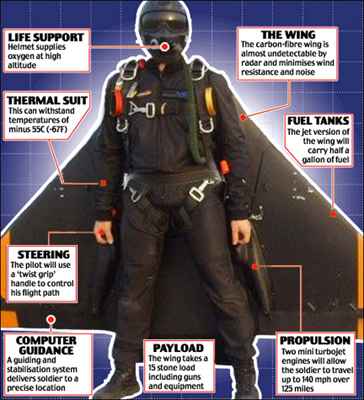
Glidertroopers of tomorrow's war
Airborne units can use these wings in conjunction with a normal parachute to leap out of an airplane and glide for up to 120 miles before pulling the ripcord. In addition, the wings double as storage lockers, allowing the paratrooper to carry 200 lbs of gear to a safe landing.
Elite special forces troops being dropped behind enemy lines on covert missions are to ditch their traditional parachutes in favour of strap-on stealth wings.
The lightweight carbon fibre mono-wings will allow them to jump from high altitudes and then glide 120 miles or more before landing - making them almost impossible to spot, as their aircraft can avoid flying anywhere near the target.
The range means that the actual insertion aircraft need not get anywhere near the target dropzone, dramatically improving the survivability not only of the plane and its crew but the paratroopers themselves. In many cases, such a range -- which can be hugely extended by the addition of a small turbojet engine on the wings -- means that the plane needn't even enter the airspace of the target country; they can drop the paratroopers over friendly territory, allowing them to glide (or fly) themselves into enemy territory.
The radar signature is, of course, barely larger than the paratrooper himself... which means nearly as small as a UAV; but because the wings have human "pilots" (airborne troops), if the tactical situation changes, they can react on the fly (dang!)... I mean, they can just wing it (stop me, someone!)... well, they can respond to their own on-the-spot threat assessment.
One of the critiques that Robert Kaplan levels at the increased reliance of UAVs is that, since they're remotely piloted from the United States, there is too much danger that the top Air Force brass will over-supervise each mission and cause mischief, as in Vietnam; having "glidertroopers" carry out these missions avoids that problem, naturally, since the men making the decisions are the non-coms actually on the ground... or rather, in the troposphere.
It's not too great a jump to imagine a slightly more powerful engine with more fuel, and lightweight, mounted guns or missiles that the glidertroopers can operate. Those would just be minor improvements to what is already demonstrated technology, but the impact on future warfare would be colossal: invisible flying serpents with perfect night vision (NVGs) and a lethal dragon's breath? What would such a unit be called -- the Quetzalcoatl Battalion of the Smaug Regiment?
Swarms of flying monkeys could buzz in from an unexpected quarter, shooting Gatling guns and firing missiles; then disperse in all directions, silent, unseen, untrackable by radar, only to regroup and swarm back from a new angle. An individual man could range high above a city, using telescopic night-vision goggles to follow a small group of terrorists to their lair -- then swoop in and destroy it with a couple of well-placed JDAMs or bursts of gunfire.
There is no reason why slightly more powerful engines could not allow a man to take off from the ground, which would give special forces, even those not trained as glidertroopers, a perfect way to extract from a mission: they return to a pre-determined spot, where wings have previously been hidden (before the enemy is alerted to our presence), strap them on, and fly away to safe rendezvous coordinates; the wings would be equipped with autopilots that use GPS to fly their human cargo in to a perfect landing, all by themselves. This avoids the dangerous necessity of getting a helo into a combat zone now buzzing with enemy activity, following a SEAL or Ranger mission.
And now that I think of it, the same wings, packed with medical equipment, could have a huge impact on military or civilian search and rescue: individual paramedics could zoom across the search area at 150 mph, anywhere from fifteen hundred feet to ten feet off the ground. Once they find victims, if they can't get a helo in to evacuate them (due to proximity to a cliff, for example), they can request an airdrop of some fuel, strap the wounded into the wings, and program them to fly to a location where a rescue helicopter can land.
We could also use these wings to evacuate people trapped inside a burning highrise: skyscrapers could be required by law to keep some large number of such gliders in storage on the roof; a fire-department "smokeglider" flies in, helps victims to strap in, and sends them over the side, where the autopilot takes them a safe distance away and lands.
Unless we actually internalize a science-fiction mentality, we cannot analyze the future.
The one thing we can say with certainty about the future is that it will be very different from the past. It may not differ in just the way we imagine; but without developing the mental muscles of open-minded speculation -- and the sense that technology will do more to determine future society than any other trendline (because technology affects all of the rest!) -- we haven't even a wing or a prayer of being able to respond to that future when it arrives.
Which will be sooner than you think, but later than you wish.
Hatched by Dafydd on this day, August 18, 2006, at the time of 5:13 PM | Comments (5) | TrackBack
August 17, 2006
Anna Katherine Diggs Deep
"The game is afoot," as Sherlock Holmes said. (Oh yes he did; in "the Adventure of the Abbey Grange," for example.)
The first federal judge has struck down President Bush's NSA al-Qaeda intercept program as an unconstitutional violation of the First Amendment. Anna Katherine Johnston Diggs Taylor ruled for the plaintiff in a lawsuit filed by the American Civil Liberties Union:
The American Civil Liberties Union filed the lawsuit on behalf of journalists, scholars and lawyers who say the program has made it difficult for them to do their jobs. They believe many of their overseas contacts are likely targets of the program, monitoring phone calls and e-mails between people in the U.S. and people in other countries when a link to terrorism is suspected.
I can only suppose that the ACLU's argument is similar to the well-known constitutional doctrine that police may not tail a reporter they believe may be meeting with a wanted serial killer for for purpose of writing a book about him, as the police action might make it more difficult in future for that reporter to arrange interviews with other wanted felons.
The White House reacted quickly and predictably. Tony Snow said:
"United States intelligence officials have confirmed that the program has helped stop terrorist attacks and saved American lives," he said. "The program is carefully administered and only targets international phone calls coming into or out of the United States where one of the parties on the call is a suspected al-Qaida or affiliated terrorist."
The ACLU reacted quickly and predictably. Anthony Romero said:
"At its core, today's ruling addresses the abuse of presidential power and reaffirms the system of checks and balances that's necessary to our democracy," ACLU executive director Anthony Romero told reporters after the ruling.
He called the opinion "another nail in the coffin in the Bush administration's legal strategy in the war on terror."
Thank God for the Associated Press, or we would never guess how each party viewed the decision.
Interestingly, Judge Taylor was not appointed by Bill Clinton.
She was appointed by Jimmy Carter in 1979 (type Taylor,Anna in the text box and click Go, then click on her name when it pops up). Thus, her decision was not only quick but also predictable.
Having such a high predictability factor makes the decision itself meaningless -- except as a starter's gun to tell us that the game... but I repeat myself.
I see this as more grist for my argument that it would indeed matter tremendously whether a Democrat or a Republican is elected president in 2008: even if their foreign policy goals would be more or less the same, I believe Democrats are allergic to decisive presidential authority in the collection of intelligence information on our enemies, when that requires tapping phones within the U.S., and its dissemination to the military (or even law enforcement), when that requires breaching Gorelick's Wall.
Since I also believe that Congress and the courts are lagging indicators in the war against jihadi terrorism, and that we can only win with robust use of the military authority of the executive branch, I conclude that electing a Democrat in 2008 would have profoundly bad consequences in the war -- as in, we would be much more likely to lose, or at least suffer terrible attacks that dwarf 9/11, while en route to the next Republican president.
Taylor's decision is not the final word, of course; we always knew this would eventually be decided by the Supreme Court. The next step will be a stay of the judge's order pending review by a circus court; then that court's decision will be stayed pending review by the Supreme Court (which will definitely accept the writ of certiorari).
As John Hinderaker of Power Line has pointed out in a number of posts, Judge Taylor's decision flies in the face of repeated rulings by various federal appellate courts, including the FISA court so much beloved by the Democrats -- today, that is, when they fantasize it might stand in Bush's way while he tries to defend the nation. Those rulings held uniformly that the president does indeed have such broad authority. More than likely, the Sixth Circuit will overturn Judge Taylor's decision, and it will be the ACLU that files for Supreme Court review.
But let's keep a sharp weather eye on this case; or, to quote Mr. Holmes once more, in an analogous context, "I have investigated many crimes, but I have never yet seen one which was committed by a flying creature."
Hatched by Dafydd on this day, August 17, 2006, at the time of 1:49 PM | Comments (10) | TrackBack
August 15, 2006
Why I STILL Don't Write "Islamofascist"
I have long objected to the term "Islamofascist," and even moreso to Michael Medved's new atrocity, "Islamo-Nazi"; but it's not because I'm afraid to hurt the feelings of some poor Moslem somewhere. My objections are:
- The term diminishes the true evil of the real Nazis and Fascists from World War II by "genericizing" their eldritch horror;
- The term also disguises the true evil of the murderous jihadis themselves; their perfidy is not some fabricated similarity to the Italian or German national socialists, but rather their end-of-the-world fanaticism that causes them to see murder as a mitzvah and death as a promotion.
I posted on it before; but today, Scott "Big Trunk" Johnson of Power Line posted a link to a William Shawcross column "on the subject of President Bush's use of the term 'Islamic fascists' to describe those apprehended in the airline terror conspiracy last week," as Scott put it.
I read the article... but I still think it's a very bad idea to use the term Islamofascist; if anything, Shawcross's use of it perfectly illustrates the danger. Here is his entire explanation of why he likes that appellation:
In a live BBC interview recently, I called Hizbullah "Islamo-fascists." The interviewer said nervously, "That's a very controversial description." I replied that it was merely accurate. She brought the interview to a swift close.
But how else should one describe a military machine that marches under the banner of a demagogic leader who seeks above all to kill Jews?
Let's leave aside the unlikelihood that the interview went exactly as Shawcross depicts it here; he's telling a tall tale, and it always makes a more exciting story if one's ideological enemies cringe backwards, covering their eyes, as the hero holds up the holy cross. Let's get at his definition of a Fascist.
To Mr. Shawcross, a Fascist is someone who marches in a military style for a leader who wants to kill Jews "above all."
The imperial Japanese during World War II were allied with Adolf Hitler; they enacted the same socialist and nationalist policies as Nazi Germany and Fascist Italy; but so far as I know, they did not go on any mad hunt for Japanese Jews to destroy; nor have I heard that they segregated American prisoners of war into Jews and gentiles. I suppose Shawcross would say that the WWII Japanese military dictators were not fascists.
Even more absurdly, we note that Mussolini certainly did not "seek above all to kill Jews;" to the extent that he did anything at all towards a "final solution," it was only because Hitler made him do it. Mussolini was very much the junior partner in that relationship.
Thus, despite the fact that Benito Mussolini invented Fascismo (the word itself is Italian) a decade before Hitler came to power in Germany, Mr. Shawcross would have to say that Mussolini was not a fascist!
And what about Josef Stalin? He ran a totalitarian military dictatorship, he was a demagogue, and he had a massive antisemitic campaign that drove the Jews out of large parts of the Soviet Union, enslaved them, and killed them in large numbers. Doesn't that mean that Mussolini and Tojo were not Fascists, but Stalin was? "But how else should one describe" him? ("Stalinist" comes to mind, as does "Communist.")
I don't know what to call the economic system of Iran; but it's certainly nothing like national socialism. And I have seen nothing attributed to Iranian President Mahmoud Ahmadinejad that indicates he wants to hunt down the Jews of Europe, South America, and the United States and kill them.
Sure, he's a little nutty on the subject of the state of Israel (as in, he wants to "wipe it from the map," presumably by the use of those nuclear weapons he's so anxious to get his paws on)... but as for the rest of the Jews in the world, I haven't seen anything that tells me he wants anything different for them than for the rest of the infidels: that they be made slaves to the faithful until such time as the 12th Imam, Muhammad al-Mahdi, is broken out of cold storage by Allah, and the Jews are destroyed for their wickedness in rejecting the original Mohammed.
But Hassan Nasrallah, the secretary general of Hezbollah, is much more brazen about his beliefs, if Shawcross is to be believed (and I certainly believe him):
Hizbullah's Nasrallah has said that he wished all Jews would gather in Israel so they could all be destroyed at once; and that there is no creature more disgusting in the world than a Jew, "and note that I said a Jew, not an Israeli."
So by Shawcross's own definition, Nasrallah is an Islamofascist, because he is obsessed with killing all the Jews... yet his demagogic boss, Ahmadinejad, is not; he is merely a militant anti-Zionist.
Oddly, Osama bin Laden is also not particularly obsessed with the Jews; in the rambling, multi-page letter he released to the world, in which he took credit for the 9/11 massacre, I don't think he even mentions Israel... his big grievance is that American troops were on the holy soil of Saudi Arabia, at the Prince Sultan Air Base (Islam's 2,317th holiest city!) The same can be said of Musab Zarqawi and Muqtada Sadr -- which I suppose must mean that none of them is an Islamofascist either.
The absurdity of this definition is palpable. It's clearly a back-formation: Shawcross wants to call the jihadis something that includes the word "Fascist" or "Nazi," so we know they're really bad; thus, he creatively redefines the venerable word Fascist so that he can use it on Moslem extremists. Yeesh.
It's so obvious that Shawcross (and now President Bush has been infected) is really just saying, "you -- you Islamo-BADTHING!" (And I reckon Medved's "Islamo-Nazi" translates to "Islamo-SUPERDUPERBADTHING!") As a wordsmith, it grates on me like fishhooks across a chalkboard.
As I said back in my original post, the "fascist" component of the word is so highly charged with historical subtext that it becomes a shout -- and reduces the "Islamo" component to a mere whisper. But that's precisely the opposite of what should be: the contagion that spreads like soul-eating bacteria is not civilized Fascism; it's a particularly virulent and savage strain of Islam, one that squats on its haunches in a tent filthy with dried blood and devours all it can reach... it is Azathoth, the Blind Idiot God.
To bury this ancient horror behind the veneer of Fascist modernity -- a twentieth-century creation of fat European leather-boys in fetish-black uniforms -- is a criminal betrayal of language. Jihadism is a hallucinagenic nightmare of Cro-Magnon tribalism, where troglodytes gather to shovel great fistfuls of human flesh into their mouth-holes, while broken slave girls writhe in the dust of the cave floor.
It's not any kind of sophisticated "philosophy," not even an evil, decadent one; malignant jihadism is primordial.
I cannot abide the betrayal of language; and so I will not use the term. Not until somebody shows me a militant jihadist group that has reached the equisitely civilized level of sophistication of Julius Streicher.
Hatched by Dafydd on this day, August 15, 2006, at the time of 10:06 PM | Comments (17) | TrackBack
August 1, 2006
Cold Water on Hot Blood
Originally lobbed into the blogosphere via Captain's Quarters seven days after Future Shock & Awe.
It's not that I didn't post anything in between those two... just nothing worth bringing up again. (Of course, there are those who retort that "nothing worth bringing up again" pretty much describes my entire oeuvre. But those are just lies spread by my competitors.)
A new paradigm is sweeping the blogosphere -- well, that portion of it that I view in between my frequent naps, experiments in animal husbandry, and trips to the taxidermist. The global war on terrorism, or GWOT, is really not a war at all but more akin to a "blood feud." The idea has been discussed by Hugh Hewitt, both online and on the air; by Wretchard (Richard Fernandez) at The Belmont Club; at Free Republic; NoLeftTurns; a Canadian blog called ThePolitic; and many other sites.
I think the originator of this new simile is one Lee Harris. Writing in Tech Central Station on July 8th, "War in Pieces: The Blood Feud," Harris opined:
After the London bombing, I feel more than ever that the war model is deeply flawed, and that a truer picture of the present conflict may be gained by studying another, culturally distinct form of violent conflict, namely the blood feud.
The problem with this simile (which has become an endlessly extending metaphor) is that it both directly contradicts his earlier, far more convincing insight that saw the terrorist acts in a very different way and also contradicts the actual pattern of jihadist attacks we see on the ground. I much prefer his earlier paradigm, which fits the current pattern far better than this new one does (I fear Harris suffers from the need writers all feel to constantly reinvent ourselves). Alas, it hasn’t gotten nearly as much blogplay as the blood-feud article.
Let me explain why I think his first idea was more powerful, why the blood feud is not really a good explanation for the death obsession of jihad -- and then offer what I think is a better metaphor that can actually lead to a real plan for the philosophical war that parallels the military one.
This is long; continue reading at your own risk. Abandon all hope, ye who enter here!
Harris's early musings appeared in the somewhat more prestigious Stanford University magazine Policy Review, in August of 2002. In "Al Qaeda’s Fantasy Ideology," Harris penned a far more robust analysis of the mass psychology of jihadism.
He first discussed the case of a university friend of his in the mid-1960s who planned to attend a particularly unpleasant and violent anti-Vietnam-War protest. Harris, who shared his friend's politics back then, tried to argue him out of it; he pointed out that the protest would not only not gain the anti-war cause any converts, it was more than likely to drive potential allies away, to infuriate the people, and to be all in all massively counterproductive to the political goals of the protesters.
But his friend said that would not matter... for his real purpose in attending was that the protest would be "good for his soul." (All emphasis below is added by me.)
[W]hat it did for him was to provide him with a fantasy — a fantasy, namely, of taking part in the revolutionary struggle of the oppressed against their oppressors. By participating in a violent anti-war demonstration, he was in no sense aiming at coercing conformity with his view — for that would still have been a political objective. Instead, he took his part in order to confirm his ideological fantasy of marching on the right side of history, of feeling himself among the elect few who stood with the angels of historical inevitability. Thus, when he lay down in front of hapless commuters on the bridges over the Potomac, he had no interest in changing the minds of these commuters, no concern over whether they became angry at the protesters or not. They were there merely as props, as so many supernumeraries in his private psychodrama. The protest for him was not politics, but theater; and the significance of his role lay not in the political ends his actions might achieve, but rather in their symbolic value as ritual. In short, he was acting out a fantasy....
For want of a better term, call the phenomenon in question a fantasy ideology — by which I mean, political and ideological symbols and tropes used not for political purposes, but entirely for the benefit of furthering a specific personal or collective fantasy.
He lists several "fantasy ideologies" from earlier eras -- the French Revolution, Mussolini's Fascism, and Hitler's Naziism -- each of which self-consciously evoked great historical empires. Harris argues that the backward look is essential to the fantasy ideology:
This theme of reviving ancient glory is an important key to understanding fantasy ideologies, for it suggests that fantasy ideologies tend to be the domain of those groups that history has passed by or rejected — groups that feel that they are under attack from forces which, while more powerful perhaps than they are, are nonetheless inferior in terms of true virtue.
So what is the backward look that underpins the "fantasy ideology" of jihadism? Professor Bernard Lewis provides the missing clue here. In his seminal work What Went Wrong?, Lewis ably chronicles the angst and befuddlement that Arabs feel at the loss of Arab Moslem preeminence in world civilization.
At one time, during the Dark Ages, Islam, and particularly Arab and Turkish Islam, were the apex of human civilization. Although what they had came mostly from Western sources (Greece and Rome, primarily), at least the Middle East still had it, while Europe had lost virtually everything refined and byzantine. Europeans were reduced to living in mud and wattle huts, while the East languored in pleasure domes and palaces, swimming in clear water above intricate geometrical mosaics.
Militant Islamism provides a backward look to this Islamic golden age, when "God's in His heaven— / All's right with the world!" (to wrench Browning utterly out of all context). The terrible theater of blood that began, for the West, in the 1979 Iranian revolution seems deliberately designed to enchant that epoch back into existence... just as Mussolini conjured Italy into a conquering empire by invading Ethiopia in 1935. Harris uses that absurdist invasion to illustrate the true horror of a fantasy-ideology war:
Any attempt to see this adventure in Clausewitzian terms is doomed to fail: There was no political or economic advantage whatsoever to be gained from the invasion of Ethiopia....
Why invade, then? The answer is quite simple. Ethiopia was a prop — a prop in the fantasy pageant of the new Italian Empire — that and nothing else. And the war waged in order to win Ethiopia as a colony was not a war in the Clausewitzian sense — that is to say, it was not an instrument of political policy designed to induce concessions from Ethiopia, or to get Ethiopia to alter its policies, or even to get Ethiopia to surrender. Ethiopia had to be conquered not because it was worth conquering, but because the fascist fantasy ideology required Italy to conquer something — and Ethiopia fit the bill. The conquest was not the means to an end, as in Clausewitzian war; it was an end in itself. Or, more correctly, its true purpose was to bolster the fascist collective fantasy that insisted on casting the Italians as a conquering race, the heirs of Imperial Rome.
Harris's insight into the theater of the "fantasy ideology" perfectly describes what we can see of the jihadists' attacks: they fit no pattern of rational warfare, but are rather a series of ritualized rains of destruction upon targets deemed symbols of "wickedness"... that is, symbols of Islam's loss of cultural dominance over the world. (I'm only discussing here the grand theatrical attacks or series of attacks, not ordinary acts of terrorism, such as the attack on the U.S.S. Cole.)
- The forces of jihad struck Iran -- Persia -- which had become modernist and more secular under Mohammad Reza Shah Pahlavi.
- They struck repeatedly at the Jews in Israel who were threatening to revive the Christian Kingdom of Jerusalem, but under Jewish control (a double-whammy to militant Islamists!)
- The forces of Persia (still leading the attack) struck the Great Satan in Beirut, driving us from the field -- which served to convince great masses of Moslems that Allah had lifted his hand in support of these holy warriors.
- They struck us again in 2001, according to Osama bin Laden (Sunni Wahhabism now seizing the lead from Shi'ite Persians) to punish us for defiling the land of Mecca with our "crusader" boots.
- Then they struck various Moslem nations (Turkey, Saudi Arabia, Indonesia) that were also venturing into modernity, thus becoming apostate.
- And they struck at the symbol of the greatest reach of the ummah, the Realm of the Faithful, and consequently the greatest pain for many militant Islamists when they contemplate its loss: Spain. The jihadists still call Spain al-Andalus, the name used while Spain was controlled by Moslem "Moors" for seven hundred and eighty-one years, until King Ferdinand finally expelled the last of them in 1492 -- not coincidentally the same year he and Queen Isabella finally agreed to finance Christopher Columbus's expedition to sail west to find the East Indies.
Each of these grand targets was chosen for its symbolic value to Moslems around the world, making them believe that the ummah was just about to be restored with Allah's direct divine help. So long as there was little response from the West but surprise and shock, it would seem like an unbroken line of great "victories" for the jihad.
But Harris's theory of the fantasy ideology could not explain why this particular fantasy seemed to be about blood, death, and destruction alone. After all, other fantasy ideologies were about conquest and military victory, not simple butchery, including the three Harris mentions in his Policy Review article: the French revolution, Italian Fascism, and Naziism. All three had their massacres, especially the last; but in addition to the destruction, there was a sense of the modern in the attempted construction of something that would take the place of that which was torn apart: liberty, equality, and fraternity, perhaps, or the Aryan ubermensch who would be "beyond good and evil." Other fantasy ideologies, such as the Soviet Union, also thought they were creating as well as destroying... creating the New Soviet Man and the "dictatorship of the proletariat." None claimed destruction for its own sake. Shouldn't the jihad be trying more actively to restore the glory of ancient Islam?
I think that is just what Harris is trying to explain, this difference from all previous fantasy ideologies, when he develops his metaphor of the world-wide blood feud.
In the blood feud, unlike war, you have no interest in bringing your enemy to his knees. You are not looking for your enemy to surrender to you; you are simply interested in killing some of his people in revenge for past injuries, real or imaginary -- nor does it matter in the least whether the people you kill today were the ones guilty of the past injuries that you claim to be avenging. In a blood feud, every member of the enemy tribe is a perfectly valid target for revenge. What is important is that some of their guys must be killed -- not necessarily anyone of any standing in their community. Just kill someone on the other side, and you have done what the logic of the blood feud commands you to do.
In the blood feud there is no concept of decisive victory because there is no desire to end the blood feud. Rather the blood feud functions as a permanent "ethical" institution -- it is the way of life for those who participate in it; it is how they keep score and how they maintain their own rights and privileges. You don't feud to win, you feud to keep your enemy from winning -- and that is why the anthropologist of the Bedouin feud, Emrys Peters, has written the disturbing words: The feud is eternal.
Clearly, this is an attempt to explain the mindless, senseless murders, mostly of the "faithful" who were perhaps not quite faithful enough, uncoupled from any serious attempt to create or even conquer. But the problem with Harris's "blood feud" analogy is that it necessarily provokes the reader into visualizing a "tit for tat" scenario -- a cycle of violence, if we must -- that is neither in synch with the concept of a "fantasy ideology" nor even descriptive of the reality we see.
Why would a millennarian, militant religious fantasy ideology await a blow before striking a counterblow? The whole point of the fantasy ideology is that it does not concern itself with the outside reality. Rather, everything outside itself, including its enemies, is merely a "prop" in its global Grand Guignol Theatre.
Nor do we see any such tit-for-tat in the actual operations of jihadist terrorism, outside of Israel. While it may be true that in a blood feud, "every member of the enemy tribe is a perfectly valid target for revenge," Harris must also admit that there is little feeling of tribal solidarity within Islam. Do Indonesian Moslems think they are the same "tribe" as Iranians, Turks, Saudis, or British jihadis like failed shoe-bomber Richard Reid?
In fact, Islam is highly factionalized, from the macro (Shi'a vs. Sunni) to the micro (the tribes in the Sunni Triangle vs. the tribes on the Iraq/Syrian border); and if the West strikes a blow in Baghdad, it's a bit thick to point to an attack months later in Spain or London, carried out by people with no significant contact with jihadis in Iraq, and call it a "counterblow."
I think Harris hit it out of the park the first time: he is correct that this is not a war in the Clausewitzian sense, not a struggle between nations trying to advance political ends by military means. But neither are the terrorists engaged in a simple "blood feud" with the West. To the extent jihadis use that language, they are simply reading their lines in the passion play. We must look elsewhere to understand why this fantasy ideology, apart from all the others, concerns itself only with chaos and destruction, rather than creation and construction -- evil though that construction typically is.
Here is where I have my own ideas. I have long thought that the central organizing principle behind militant Islamism, or jihadism if you prefer, is the death cult. There have been death cults in the past. The most extreme was probably the Aztecs, and estimates of the number of human sacrifices they performed annually range from the tens of thousands up to 250,000. Although various researchers offer "explanations" of the staggering number of human sacrifices more prosaic than religious worship, it's hard to argue that religion was not at least one of the top motivating factors.
Human sacrifice is typically justified by the belief that there is some sort of energy or force found within life, strongest in human beings; sacrificing the man, woman, or child releases this energy somehow, allowing the gods to feed on death, their natural food. Blood and souls for Huitzilopochtli!
I think it quite possible that the leaders of the jihadis are actually death cultists; perhaps they believe that their bizarre version of Allah grew weak from hunger, and that is "what went wrong," to respond to Lewis. In this scenario, by sacrificing mass numbers of people, the militant Islamist leaders believe they feed Allah, and he grows strong. Perhaps he will then respond by reaching forth his hand to crush the infidels, restore the Caliphate, and expand the ummah to blanket the world. Alternatively, perhaps the leaders believe that Allah is angry that they have not been killing infidels and apostates, as he ordered them to do... and if they kill enough, Allah will be mollified and again lead them to supernatural victory.
In either case, I highly doubt the rank and file believe this or that they even wonder why they are asked to kill and kill and kill for no apparent reason; being told by a trusted cleric to do so is probably all they need. It is the leaders of the worldwide jihad that I am trying to understand... because you cannot defeat what you do not comprehend.
But even if the leaders do not literally believe that they are releasing life-energy for their demonic version of Allah, their actions are functionally identical to death cultists. There certainly is more of a match both with what we see on the ground and with Harris's insightful metaphor of the fantasy ideology than we find with his recent blood-feud hypothesis.
A fantasy ideology coupled with a millennarian death-cult fantasy would actually explain both the theater and the obsession with destruction over creation. It also points the way to two natural points of attack by the West.
First, Harris notes that some fantasy ideologies arise from Democracies, such as Naziism, which arose from the Weimar Republic. But he wrongly concludes that establishing democracy is therefore ineffectual at fighting against the fantasy ideology:
[T]o hope that democratic reform would discourage radical Islam ignores the fact that previous fantasy ideologies have historically arisen in a democratic context; as the student of European fascism, Ernst Nolte, has observed, parliamentary democracy was an essential precondition for the rise of both Mussolini and Hitler.
But here, Harris misses the point. Naziism did not arise from democracy, it arose from the collapse of democracy due to economic catastrophe. The collapse of the Weimar Republic had a negative transformative effect on German society, tilting it away from the intolerable reality and towards the grandiose fantasy ideology of Naziism.
Might not the establishment of a new democracy have a mirror transformative effect, from the fantasy of jihadism to the reality of modernity? It certainly seems to be working that way in Iraq and Afghanistan and to some extent in Lebanon. The establishment of democracy where it never existed before allows people to take control of their lives and environment, converting an otherwise intolerable reality -- which could lead a people into fantasy as an escape -- into a manageable and indeed exciting and dramatic reality, where they will feel less need to escape into dreams of empires past.
Second, although Harris primarily considers evil fantasy ideologies, the theory itself seems relatively open to good and positive fantasy ideologies. The precursor to the fantasy ideology is William James's philosophy of "the will to believe," where humans believe in something against all evidence to the contrary; and Harris recognizes that this can be good as well as evil:
Yet the fact that such beliefs cannot be justified by science does not mean that they may not be useful or beneficial to the individual or to the society that holds them. For James, this meant primarily the religious beliefs of individuals: Did a man’s religious beliefs improve the quality of his personal life? For Pareto, however, the same argument was extended to all beliefs: religious, cultural, and political.
He also accepts that such transformative beliefs or "myths" can be deliberately manufactured (or "artificially inseminated"), an idea he attributes to socialist/syndicalist Georges Sorel. But why shouldn't Moslem clerics who oppose jihadism deliberately construct a new "myth" of restoring the greatness of Islam of the past by re-constructing it in the modern world -- rather than by tearing down all of modernity itself, flinging the world back into the Dark Ages, when the ummah was comparatively better off than Christendom?
Why not construct a competing fantasy ideology to combat the evil jihadist fantasy ideology?
Combining Western military power with the transformative democratization of Islam and with a new and powerful myth of rebuilding greatness within, not instead of, modernity could be exactly the key we seek to eradicate the disease of jihadism once and for all time.
Hatched by Dafydd on this day, August 1, 2006, at the time of 1:40 PM | Comments (9) | TrackBack
July 29, 2006
Good News from the Front Lines - News Roundup
There is a lot of good news from the two main fronts, Iraq and Afghanistan; but you're not likely to have heard of any of these small victories unless you read a lot of milblogs.
First, Iraqi Army forces took down six death squad suspects. From ThreatsWatch:
Iraqi Army forces conducted a pre-dawn raid in Baghdad on July 25, capturing six targeted insurgents, all of whom are believed to be involved in ‘death squad’ activities.
As coalition force advisers looked on, Iraqi forces raided an objective in southwest Baghdad consisting of four separate buildings and captured the cell leader and five other key members of an insurgent ‘punishment committee.’
Iraqi forces also seized two AK-47 assault rifles, one pistol, and one set of body armor.
The operation occurred without incident; there were no Iraqi or coalition force casualties.
Hm... that's not good: we captured six bad guys but didn't lose any of ours. Does this violate the Fairness Doctrine?
Second, "Capt. B" at Milblogs reports that the U.S. Marines rescued three kidnap victims in Fuhuylat, Iraq:
Marines from 1st Battalion, 25th Marine Regiment rescued three hostages and uncovered a large weapons cache, including a fully-assembled suicide vehicle-borne improvised explosive device, during Operation Spotlight.
The intelligence-driven operation was conducted alongside Iraqi Army soldiers from 2nd and 4th Brigades, 1st Iraqi Army Division recently. The three hostages were personal assistants of Dr. Rafa Hayid Chiad Al-Isawi, an Iraqi government official in Baghdad. They were held by al-Qaeda insurgents for 27 days....
Marines also recovered IEDs and IED-making material, mortar tubes and round, artillery rounds, machine guns, bulk explosives, anti-tank mines, rocket-propelled grenades and launchers, AK-47 assault rifles, small-arms ammunition and video cameras.
I think I can hear Sen. Harry Reid (D-Caesar's Palace, 100%) already, calling our Marines bullies for not giving the Iraqis a chance. At least, given recent Democratic comments about Israel's "disproportionate" response, I assume that's what Reid would say, if he knew about this raid. Fortunately, he gets his news from the elite media, so he hasn't heard anything. At all.
The situation in Iraq is serious, but Iraqi forces are stepping up to the plate. Alongside American forces, they are raiding and arresting bad guys, not caring whether they're Shia death squad or al-Qaeda combatants.
Meanwhile in Afghanistan, coalition forces killed seven terrorists who attacked them. From CENTCOM:
BAGRAM AIRFIELD, Afghanistan – A Coalition patrol killed seven extremists on July 25 after they attacked Coalition forces in the Garmser District of Helmand Province.
There were no Coalition casualties in the fight. The Coalition unit received small arms, rocket-propelled grenade, machine gun and sniper fire from a group of extremists. The Coalition force returned fire, killing five insurgents
Later in the same area, insurgents fired small arms at an Afghan National Army mortar team, with a Coalition embedded tactical training team attached. The combined unit responded with machine gun fire and killed the remaining two insurgents.
“If enemy extremists fire upon Coalition forces, we will respond with deadly accuracy,” said Lt. Col. Paul Fitzpatrick, Combined Joint Task Force -76 spokesman. “If they attack Afghan civilians, we will respond just as forcefully. We remain committed to engaging any threats to the peaceful future of the Afghan people.”
Afghan National Security forces continue to maintain a strong presence in the area of Garmser and provide security that will enable reconstruction and humanitarian aid projects to be delivered that will improve the lives of the Afghan people.
I don't know, it sounds awfully disproportionate to me: we inflicted seven deaths, six captures, and released three hostages from those poor, honest terrorists just doing their jobs (kidnapping and terrorizing, butchering the innocent, the usual stuff), without losing a single one of our guys.
Is that allowed under the New international Proportional-War Theory?
Hatched by Sachi on this day, July 29, 2006, at the time of 6:31 AM | Comments (4) | TrackBack
July 27, 2006
More Proportionalities Than You Can Shake a Snake At
The Democrats' argument that Israel's response is "disproportionate" can mean one of only two things:
- That it's disproportionate to the attack;
- Or that it's disproportionate to the attacker.
The first possibility is easily rebutted: Israel has been attacked by Hezbollah for years and years and years, losing hundreds of citizens to an insane terrorist campaign, Hezbollah's holy pledge to "drive the Jews into the sea."
Arguably, since it was Hezbollah who pioneered (in the Middle East) the tactic of suicide bombings, a tactic later aped by Palestinian groups, the thousands of deaths of innocent Israelis by Hamas, et al, can also be laid to Hezbollah's doorstop.
So the only real chance for the Democrats to make stick a "disproportionality" argument against Israel's assault is to complain that it's just not fair for that big bully to beat up on that little bully. Is that a valid complaint, that Israel's assault is like a trained heavyweight boxer beating up a schoolgirl? If so, that would certainly be a gross disproportionality.
To the extent that liberals make this argument, in their relentless quest to find moral equivalence between Israeli Jews and Hezbollah terrorists (or even to assign the bulk of the guilt to the former), they either foolishly or mendaciously ignore a glaring point: Hezbollah does not act alone or on its own volition.
The organization was created in 1982, by and large by Iran, and they have been a creature of that theocracy ever since. Iran finances and controls Hezbollah in Lebanon through Iran's cat's-paw, Syria -- which comprises an Alawite-Shiite elite class, the Baath Party, ruling over an oppressed Sunni majority.
Thus, in comparing the relative sizes of the dogs in the fight, the real comparison is not Israel to Hezbollah... it's Israel vs. Iran and Syria in a proxy war that happens to be taking place in Lebanon. It's not just that Hezbollah receives its weapons from Iran; Iran also finances it, trains it, directs it, and indeed, Iranian Revolutionary Guards have been found throughout Hezbollah forces, firing missiles and directing the action.
Hezbollah is not Israel's real enemy: it's nothing more than the Iranian and Syrian "Foreign Legion."
So let's take a look at Iran and Syria compared to Israel; I rely upon the CIA World Factbook for these simple statistics:
| Resource | Iran | Syria | Israel |
|---|---|---|---|
| Population (millions) | 69 | 19 | 6 |
| Economy (billions purchasing power) | 562 | 72 | 155 |
| Economy (official exchange rate) | 181 | 26 | 114 |
| Available military manpower (millions) | 15.7 | 3.5 | 1.3 |
As clearly seen, Israel certainly does not overmatch her two real opponents in this war; in fact, it's the other way around: even just Iran alone is larger, richer, and has a much greater available manpower. While Israel has nuclear weapons that still elude Iran (we hope!), Iran boasts a much more robust military than any country or combination of countries Israel has ever faced before.
Hezbollah is just the tip of the oilberg... make no mistake, Israel faces her deadliest test ever. And if there is any "disproportionality," it's much more accurate to say Israeli forces are disproportionately small compared to the enemies they face.
Israel is the "David" facing the "Goliath" of the Ayatollahs, and no amount of Democratic rewrite can obscure that fact.
Hatched by Dafydd on this day, July 27, 2006, at the time of 5:36 AM | Comments (7) | TrackBack
July 25, 2006
The Hunt for Red Osama
Hugh Hewitt quotes from (but does not link to) a speech given by Sen. Harry Reid (D-Caesar's Palace, 100%), about all the terrible failings of Bush administration policy on the war on jihadi terrorism. These four compound sentences encapsulate the very core of Reid's and the Democrats' argument:
We argued that the administration follow the law and make 2006 the year of transition, with Iraqis taking charge of their own security and government, so that American forces can be redeployed by year's end. [That's a "law," that we have to immediately pull out of Iraq? When was that passed? -- the Mgt.]
Our plan would have given the Iraqi people their best chance for success, while also giving America the best chance to confront the growing threats of North Korea, Iran and terrorism.
Our plan would have engaged regional powers to help bring stability to Iraq, and would have reminded the countries of the world of their commitment to invest in Iraq's long-term economic prosperity.
Our plan would have refocused America's military, diplomatic, and economic might on the terrorist threats that face us in Iraq and globally, including Osama Bin Laden-who remains free 5 years after 9/11.
He included, of course, the traditional Democratic contradictions, which I think is a caucus rule:
- "In the last month, the price of gas has shot past three dollars a gallon." [Yet Democrats oppose any and all drilling and refining of oil, whether off the California coast, in the Gulf of Mexico, or in ANWR.]
- "In the last month, North Korea -- on the Fourth of July -- tested new long-range missiles." [Which we were prepared to shoot down (if the DPRK had succeeded in launching them) using antiballistic missile systems that the Democrats fought hammer and tooth, delaying us for eight long years.]
- "In the last month, Hezbollah has terrorized Israel." [Due to Israel having "redeployed" out of Lebanon in 2000, in a way that mimicked a military rout (despite having lost no battles), in response to heavy pressure from Bill Clinton on Ehud Barak.]
- "And in the last month, Al Qaeda may have found a new sanctuary in large swaths of Somalia." [From which we "redeployed" in a panic under orders by Bill Clinton, paving the way for al-Qaeda to move in as squatters.]
But that's all milk spilt over the bridge. I want to "focus like a laser beam" on Reid's "redeployment" plan. If the Democrats can be said to have any sort of strategic plan at all in the war on jihadism, it's to find an immediate exit strategy.
But what is their positive vision to put in place of fighting wars? They do actually have one, and Sen. Reid alluded to it in this speech: Democrats believe that we should put all our resources into hunting for Osama bin Laden.
That's it; that's the plan. (It should be a new Tom Clancy novel: the Hunt for Red Osama.) Since war is nothing but a big police investigation anyway (see the previous post), the focus should always be on arresting and trying the perpetrator, rather than thwarting future acts.
But what fascinates me is that we already tried this in miniature... and it was an unmitigated disaster. Does anybody here remember Somalia?
The Wikipedia account is more or less accurate:
[Mohamed Farrah] Aidid hindered international U.N. peacekeeping forces in 1992. As a result, the US put a $25,000 bounty on his head [in August 2003] and attempted to capture him. On October 3, 1993 a force of U.S. Army Rangers and Delta Force operators set out to capture several officials of Aidid's militia in an area of the Somalian capital city of Mogadishu, controlled by him. Although technically successful, with the capture of several "tier-one personalities," the operation did not completely go as planned, and between 500 and 1000 Somalis, as well as 19 American soldiers, died as a result.
The people of somalia were later angry at the Rangers and supported Aidid. Videos showed Somalis eating the flesh of Cliff Walcott and his crew members of Super 64. Aidid himself was not captured. The events are commonly known outside Somalia as the Battle of Mogadishu. [I'm not entirely sure about that video claim; I hadn't heard it before. -- the Mgt.]
The U.S. withdrew its forces soon afterwards (a move viewed by some as a sign of weakening American strength on the international front), and the U.N. left Somalia in 1995. Aidid then declared himself president of Somalia, but his government was not internationally recognized.
Under former President George H.W. Bush (Bush-41), the American military initiated a humanitarian operation in Somalia in 1992; but under President Bill Clinton, it morphed -- especially after the "Blackhawk down" incident -- into a massive manhunt throughout that country, which is smaller than either Afghanistan, Pakistan, or Iran (let alone the combination of the three that would be our actual target area to search for bin Laden)... with only one of those three countries willing to allow such a search in the first place: the one we occupy, Afghanistan.
I remember the humiliation of the Hunt for Red Aidid: day after day, week after week, Rangers ranged up and down Somalia, but were unable to catch Mr. Aidid. News reporters were considerably more successful, however, for he popped up fairly regularly, like Whack-a-Warlord, to taunt us and hoot at our pathetic, bootless efforts.
And of course, despite keeping a very high profile (unlike bin Laden), we never managed to catch Aidid in two years of hunting... and then we quit looking and just yanked our troops out. In fact, in October 1993, Clinton had told everybody that we were pulling out in six months, whether we found Aidid or not. The sole target of the Democrats' current battle plan -- Osama bin Laden -- actually cited Clinton's retreat from Somalia as evidence that al-Qaeda could hit the United States with impunity, because we were paper tigers.
Astonishingly enough, Aidid dodged us until March. Then when we evacuated, Aidid emerged from his very public "hiding," crowned himself president, and was promptly shot to death by a rival warlord.
The lesson should be clear: it is virtually impossible to find a single, particular person hiding in a death zone... particularly when he is well-heeled and well-served by fanatical followers who move him around secretly. There are too many caves, too much land, too little "society" to ensare him in its net.
Bin Laden doesn't have any credit cards and he doesn't use an ATM. There are no security cameras in the wilderness of Afghanistan, Pakistan, or Iran -- at least none that we can view. And our satellites are virtually useless trying to pick a single guy out of millions: we don't have Star-Trek "sensors."
And even if we managed to spot him, what would we do... beam him up to the mothership? By the time we could get a Predator close enough to shoot a Hellfire, bin Laden's caravan will have moved on.
Like every other Democratic plan, their GWOT strategy is a prescription for disaster: it would gift us only with humiliation and failure, make us the laughingstock of the world, and squander all the work we have done rebuilding our military capability after eight years of Clinton -- and we still haven't fully recovered from a scant four years of Carter.
If you want to understand "fractals," there is no better place to start than by carefully reading Democratic initiatives: they look stupid as a whole; and the deeper you look, the stupider they get.
Hatched by Dafydd on this day, July 25, 2006, at the time of 4:29 PM | Comments (12) | TrackBack
July 24, 2006
Resupply Is a Two-Way Street
It's been plastered all over the news recently that Israel has caught Syria resupplying Hezbollah missiles (or trying to, at any rate); see the previous post for our reaction to that news on the Syrian front. But as Gary Larson used to say in the Far Side, "two can play at that game, Hoskins!"
Word has now been leaked (by anonymous "American officials") that we've sent an emergency shipment of precision-guided bombs to Israel in order to allow them to continue the campaign:
The munitions that the United States is sending to Israel are part of a multimillion-dollar arms sale package approved last year that Israel is able to draw on as needed, the officials said. But Israel’s request for expedited delivery of the satellite and laser-guided bombs was described as unusual by some military officers, and as an indication that Israel still had a long list of targets in Lebanon to strike.
(A Reader's Digest condensed version of the Times article can be found on Reuters, just in case the Times link stops working.)
This is for those readers here who have been led to believe (by the antique media) that Bush isn't doing anything to help Israel other than chatting them up. We're doing the best things of all: leaning heavily on Syria -- and making sure that Israel has all the precision munitions they need to really grind Hezbollah's face into the offal.
So keep it up, Israel; with the weapons we're supplying you, taking out the entire top Hezbollah leadership should be as easy as shooting drunks in a barrel.
Hatched by Dafydd on this day, July 24, 2006, at the time of 5:17 AM | Comments (11) | TrackBack
July 22, 2006
Everyone Must Read This Story
Hugh Hewitt read this post by David Bogner on the air Thursday, and I thought it was one of the best parables I've heard in years. I urgently urge y'all to read the whole thing; it's not that long, but it will stay with you for the rest of your life.
It's from a blog called Treppenwitz, which I think I should start reading regularly now. Here's the opening:
When I was in the Navy, I once witnessed a bar fight in downtown Olongapo (Philippines) that still haunts my dreams. The fight was between a big oafish Marine and a rather soft-spoken, medium sized Latino sailor from my ship.
All evening the Marine had been trying to pick a fight with one of us and had finally set his sights on this diminutive shipmate of mine... figuring him for a safe target. When my friend refused to be goaded into a fight the Marine sucker punched him from behind on the side of the head so hard that blood instantly started to pour from this poor man's mutilated ear.
Everyone present was horrified and was prepared to absolutely murder this Marine, but my shipmate quickly turned on him and began to single-handedly back him towards a corner with a series of stinging jabs and upper cuts that gave more than a hint to a youth spent boxing in a small gym in the Bronx.
Each punch opened a cut on the Marine's startled face and by the time he had been backed completely into the corner he was blubbering for someone to stop the fight. He invoked his split lips and chipped teeth as reasons to stop the fight. He begged us to stop the fight because he could barely see through the river of blood that was pouring out of his split and swollen brows.
Nobody moved. Not one person....
...But you'll have to click the link and read the original to find out what happened, what was really going on, and how it relates to the Global War on Jihadism.
Hatched by Dafydd on this day, July 22, 2006, at the time of 4:17 AM | Comments (16) | TrackBack
July 13, 2006
More Sound and Fury, Signifying - Nothing Much
Discussion about the Bush administration's supposed about-turn on the NSA al-Qaeda intercept program is floating around the antique media today, and the usual suspects are crowing that Bush has caved. But I really think there's less here than meets the eye:
In a reversal, the White House has agreed to allow a secret federal court review of the National Security Agency's warrantless domestic spying program, a top U.S. Senate Republican announced on Thursday.
Senate Judiciary Committee Chairman Arlen Specter said he had negotiated a bill with the White House to update surveillance laws and clear the way for an examination of the constitutionality of the program designed to track terrorists.
This refers of course to the Federal Intelligence Surveillance Act Court (FISA Court), which will review the NSA program for constitutionality... which of course it could do anyway, with or without the president's approval, simply by accepting a case filed by, e.g., some lefty Democrat in a safe seat.
Specter said that under the deal the court would determine the program's constitutionality based, in part, on arguments presented by the administration.
The court would also examine if the program is "reasonably designed to ensure that the communications intercepted involve a terrorist, agent of a terrorist or someone reasonably believed to have communicated or associated with a terrorist."
This, of course, is an argument that the NSA can easily win... especially if White House attorneys have been keeping up with Power Line!
But if one actually reads deep into the articles, it becomes clear that this is much more of a capitulation by the anti-war senators than it is by the White House.
For example, here is one very important point that may well be overlooked -- at least by folks (on either left or right) desperate to portray the Bush administration as having folded:
"The bill recognizes the president's constitutional authority and modernizes FISA to meet the threats we face from an enemy that knows no bounds, kills with abandon and masquerades as they plot against us," [White House spokeswoman Dana] Perino said.
I interpret this as intimating that the bill recognizes the inherent constitutional authority of the president to protect the country by eavesdropping on international calls of terrorists.
But there is more, according to the New York Times:
Specter said the court would make a one-time review of the program rather than performing ongoing oversight of it.
An administration official who spoke on condition of anonymity said the bill's language gives the president the option of submitting the program to the intelligence court, rather than making the review a requirement.
The official said that Bush will submit to the court review as long the bill is not changed, adding that the legislation preserves the right of future presidents to skip the court review.
In addition to these, the new legislation also implements two urgent clarifications:
- Per a request by the National Securit Agency, the bill makes it clear that the FISA court has no jurisdiction over "international calls that merely pass through terminals in the United States;"
- And this one is truly sweet: the bill would make it a new federal criminal offense for government officials to "misuse intelligence." Depending on the exact wording, this could actually apply to members of Congress, as well as administration officials, who leak classified information to the elite media, hoping to scuttle urgently needed intelligence programs they don't like.
So yet again, what is portrayed by the antique media of the White House caving, capitulating, or executing "a reversal" turns out, upon inspection, to be a good, strong compromise that preserves the president's authority to order such surveillance under his own plenary constitutional power and doesn't give up much at all.
Hatched by Dafydd on this day, July 13, 2006, at the time of 4:08 PM | Comments (1) | TrackBack
July 11, 2006
Article 3
So today's media-driven episode of Bush Derangement Syndrome is the fallacious claim that, in some dramatic turnaround, the Bush administration now finally "admits" that terrorists are prisoners of war, entitled to the full protection of the Geneva Conventions as POWs -- including the right never to be interrogated. For example:
AP: U.S. Will Give Detainees Geneva Rights
The Bush administration, called to account by Congress after the Supreme Court blocked military tribunals, said Tuesday all detainees at Guantanamo Bay and in U.S. military custody everywhere are entitled to protections under the Geneva Conventions....
The policy, described in a memo by Deputy Defense Secretary Gordon England, appears to change the administration's earlier insistence that the detainees are not prisoners of war and thus not subject to the Geneva protections.
Reuters: US applies Geneva Convention to military detainees
The Pentagon acknowledged for the first time that all detainees held by the U.S. military are covered by the protections of an article of the Geneva Conventions that bars inhumane treatment, according to a memo made public on Tuesday.New York Times: In Big Shift, U.S. to Follow Geneva Treaty for Detainees
The Bush administration called today for Congress to fix, rather than scrap, the system of military tribunals that was struck down by the Supreme Court last month, while the Pentagon pledged to treat detainees in accordance with the Geneva Conventions as the court required.
But as Ryan Sager [whoops, make that Jed Babbin... sorry, Jed!] at Real Clear Politics noted (I thought the same thing, but Babbin was there first), this is being completely -- and I (not Babbin) claim deliberately and with malice aforethought -- misreported by the antique media... because in fact, Deputy Defense Secretary Gordon England, who wrote the memo on July 7th, did not make any "shift" in U.S. policy; he quite openly proclaimed that this has been administration policy from the beginning: to apply specific elements of Article 3 to detainees in the war against jihadi terrorism.
There is certainly a danger, which Big Lizards recognized earlier, that subsequent and iterative federal court rulings may lunge further than the Hamdan decision and try to declare the detainees full-blown "prisoners of war." In fact, it appears that Justice John Paul Stevens, leading the pack of braying liberals on the Court, tried to do exactly that. If this happens, it will have catastrophic results in the GWOT.
But that is not what this memo does.
So we don't proceed in a vacuum, here is the relevant text:
The Supreme Court has determined that Common Article 3 to the Geneva Conventions of 1949 applies as a matter of law to the conflict with Al Qaeda. The Court found that the military commissions as constituted by the Department of Defense are not consistent with Common Article 3.
It is my understanding that, aside from the military commission procedures, existing DoD orders, policies, directives, execute orders, and doctrine comply with the standards of Common Article 3 and, therefore, actions by DoD personnel that comply with such issuances would comply with the standards of Common Article 3. For example, the following are consistent with the standards of Common Article 3: U.S. Army Field Manual 34-52, “Intelligence Interrogation,” September 28, 1992; DoD directive 3115.09, “DoD Intelligence Interrogation, Detainee Debriefings and Tactical Questioning,” November 3, 2005; DoD Directive 2311.01E, “DoD Law of War Program,” May 9, 2006; and DoD Instruction 2310.08E, “Medical Program Support for Detainee Operations,” June 6, 2006. In addition, you will recall the President’s prior directive that “the United States Armed Forces shall continue to treat detainees humanely,” humane treatment being the overarching requirement of Common Article 3.
You will ensure that all DoD personnel adhere to these standards. In this regard, I request that you promptly review all relevant directives, regulations, policies, practices, and procedures under your purview to ensure that they comply with the standards of Common Article 3.
This is followed by a quotation of Article 3 of the 1947 conventions, which you may read for yourself here.
The most relevant sentence in the entire memo is the first sentence of the second paragraph, in which England makes plain that the administration's position is that currently existing DoD procedures already comply with Article 3; thus, except for the rules of military tribunals, there is no reason to change policy. Far from being a "big shift," England argues that this is what President Bush has been doing all along.
Note also how he answers the specific worry that Big Lizards enunciated earlier: that this ruling might lead to further rulings banning any interrogation at all of al-Qaeda "POWs," in accordance with other articles of the Geneva Conventions. For example, from Article 17 of those same conventions:
No physical or mental torture, nor any other form of coercion, may be inflicted on prisoners of war to secure from them information of any kind whatever. Prisoners of war who refuse to answer may not be threatened, insulted, or exposed to any unpleasant or disadvantageous treatment of any kind.
If the courts were ever to rule that terrorist detainees were to be given all the rights and privileges of POWs, then Article 17 would apply -- and all interrogation of al-Qaeda detainees of any kind would have to cease the moment the detainee said "I refuse to answer." Instead, all we would be allowed to insist upon was his "surname, first names and rank, date of birth, and army, regimental, personal or serial number, or failing this, equivalent information."
In England's memo, he makes as crystal the administration's position that detainees are not "prisoners of war." The AP story is flatly wrong. If, as AP claims, the memo "appears to change the administration's earlier insistence that the detainees are not prisoners of war and thus not subject to the Geneva protections," then how does AP read the next sentence in the second paragraph -- where England specifically notes that the DoD's policies anent "Intelligence Interrogations" are legal?
In addition, Article 21 begins thus:
The Detaining Power may subject prisoners of war to internment. It may impose on them the obligation of not leaving, beyond certain limits, the camp where they are interned, or if the said camp is fenced in, of not going outside its perimeter. Subject to the provisions of the present Convention relative to penal and disciplinary sanctions, prisoners of war may not be held in close confinement except where necessary to safeguard their health and then only during the continuation of the circumstances which make such confinement necessary.
That means, I believe, that they cannot be held in separate cages or prevented from assembling together and speaking privately -- as we currently do at Guantánamo Bay and likely every other terrorist detainment facility we operate. Again, if the courts started holding that terrorists were POWs, we would have to release them internally within Guantánamo to roam around freely within the camp, conspire together, and coordinate false answers to intelligence interrogations we wouldn't be allowed to conduct in the first place.
You cannot in the same breath say that al-Qaeda detainees are "prisoners of war" and also that we can engage in lengthy interrogations of them, treat them harshly to break them down, and deprive them of privileges if they don't answer or if they lie. There is no rational way that the reporters for the elite media could possibly have read the memo and actually come away with the misunderstanding that from now on, terrorists were POWs. Thus, any reporter who says such a thing is simply lying, as is the editor who allows him to publish.
Some people argue we should "never attribute to malice what can adequately be explained by stupidity." But in many venues, the precise opposite is more true: never attribute to stupidity what can adequately be explained by malice.
Though it may comfort some to think so, reporters and editors at top media sources are not imbeciles. Bill Keller and Dean Baquey did not blow the NSA al-Qaeda intercept program and the terrorist-finance tracking program because they were ignorant; they, along with the reporters they edit, blew those programs (in the New York Times and the Los Angeles Times, respectively) because they hate those programs, they hate the war, they hate Bush, and they want America to lose.
Don't get me wrong, I do not question their patriotism; I nakedly say they have none. They hate Republicans and the president so intensely, it becomes an exquisite experience. It easily overwhelms whatever feeble love for country still remains after decades of relentless liberal brainwashing. As Churchill (Winston, not Ward) said, they swim in currents of hatred so strong, it sears their very souls.
So lying about some sort of flip-flop on the part of George W. Bush is a mere trifle, a bagatelle to the MSM. That's the one they do "twice on Sundays."
Thus, when you read the inevitable flood of stories sneering that Bush has surrendered, that he's been made to eat crow, that the administration has undertaken a "big shift," a turnaround, a 180 -- just bear in mind what you already know about the "lies and the lying liars who tell them" in the nation's newspapers, on television, and especially in the liberal blogs.
There is no policy change here: Deputy Defense Secretary Gordon England has simply reiterated that administration policy already complies with the specific demands of Geneva that apply to non-POWs... with the one exception of the specific procedures to be followed by the military tribunals.
Hatched by Dafydd on this day, July 11, 2006, at the time of 2:54 PM | Comments (2) | TrackBack
June 29, 2006
Time to Withdraw From Geneva... If We Can
Hugh Hewitt says that the actual majority decision of the Supreme Court in the Hamden case does not reach quite as far as the unholy quadrumvirate of Justices Stevens, Ginsburg, Breyer, and Souter did: interpreting the 1949 Geneva Conventions to apply to terrorists captured abroad. Specifically, he says that Justice Kennedy did not join that part of the opinion, opting instead for the narrower view that only the procedures of the military tribunals need comply with Geneva, because some of those held in Guantánamo Bay are members of the Taliban, which was an organized militia (as if mere membership meant they couldn't be terrorists).
I don't know if he is correct; maybe it is actually a majority position. But let's assume Hugh is right, and contrary legal commentators are wrong. That still means that the entire war on jihadi terrorism now hangs by the thread of Justice Anthony Kennedy's sanity and common sense... and that that is a slender lifeline indeed.
If that's where the Court, as a majority, stands, then we're still alive; we're on life support but not dead yet. But -- and it's a Big But -- if "Coin-Flip" Kennedy changes his mind and joins with Stevens, we may find ourselves in a true horror movie.
Because of the terrible danger that this may happen, I sincerely believe it is time for the United States to withdraw (by any means necessary) from the Geneva Conventions... if Justice Stevens will even permit the president and Congress to do so.
This drastic reaction is thrust upon us by the plurality's action, led by ultra-liberal Justice John Paul Stevens. There are now four justices who hold that terrorists must be treated as prisoners of war under the conventions.
To arrive at this weird conclusion, they completely ignored Article 4 of Convention III, Relative to the Treatment of Prisoners of War, which defines who is and who is not a "prisoner of war"... and which clearly and unambiguously excludes terrorists. Article 4 holds that:
A. Prisoners of war, in the sense of the present Convention, are persons belonging to one of the following categories, who have fallen into the power of the enemy...
(2) Members of other militias and members of other volunteer corps, including those of organized resistance movements, belonging to a Party to the conflict and operating in or outside their own territory, even if this territory is occupied, provided that such militias or volunteer corps, including such organized resistance movements, fulfil the following conditions:
(a) that of being commanded by a person responsible for his subordinates;
(b) that of having a fixed distinctive sign recognizable at a distance;
(c) that of carrying arms openly;
(d) that of conducting their operations in accordance with the laws and customs of war.
I do not believe that Stevens ever addressed this provision, which undeniably excludes unlawful combatants, such as al-Qaeda terrorists, from consideration as prisoners of war. He simply dismisses it without discussion and, in essence, declares all unlawful combatants to be legal combatants from now on.
But this clearly was not our intent when we agreed to the conventions. Such unlawful combatants were excluded when we signed, and there's solid evidence we still hold to that exclusion even now.
There was an addition to the conventions, Protocol I, enacted in 1977 that muddied the waters, having the effect of declaring that states party to it must treat even unlawful combatants as they would treat prisoners of war... without calling them prisoners of war.
But because of this very provision, the United States refused to accept Protocol I. We are not signatories to it... shouldn't that alone have convinced Stevens that he was flatly wrong about what we intended when we ratified the original conventions in 1949?
Even the website for the Geneva Conventions itself is at odds with Justice Stevens and his posse:
Combatants who deliberately violate the rules about maintaining a clear separation between combatant and noncombatant groups — and thus endanger the civilian population — are no longer protected by the Geneva Convention.
So how would the terrorists' new status, were a plurality of the Court to become the majority, affect how we must treat them? It would mean, as Stevens argued, we must treat what used to be considered unlawful combatants as well as we treat ordinary American soldiers being tried by courts-martial.
In particular, Justice Stevens, writing for 80% of the majority, opined that Convention III, Relative to the Treatment of Prisoners of War, Article 3, applied to al-Qaeda and other terrorist prisoners. Article 3 requires the following:
To this end the following acts are and shall remain prohibited at any time and in any place whatsoever with respect to the above-mentioned persons....
(c) Outrages upon personal dignity, in particular, humiliating and degrading treatment;
(d) The passing of sentences and the carrying out of executions without previous judgment pronounced by a regularly constituted court affording all the judicial guarantees which are recognized as indispensable by civilized peoples.
The latter requires, as a matter of course -- and this is how the quadrumvirate interpreted it -- that any tribunal trying such prisoners must afford them all the legal protections afforded members of the military being court-martialed... including the right to be present, along with the civilian attorney of their choice, for all introduction of evidence, including highly classified evidence exposing methods and personnel of our intelligence-gathering capabilities.
I would think this would also require the production of all relevant "witnesses" that the prisoner demands at his trial -- which could mean yanking from the field every soldier involved in apprehending him, since the capture is certainly relevant to his case.
As one blogsite put it (I wish I could remember which one), that could in theory mean having to undeploy entire units and send them back to the United States for every trial where a clever attorney (Ramsey Clark, for example, who would of course happily volunteer) figures out that rather than disrupt the entire war, we would just drop the case.
This is absolutely nutty, and I cannot believe that a subsequent Court would really enforce that. But we don't have a subsequent Court; we have this one. And this one, under the direction of Stevens, Ginsburg, Breyer, and Souter, and with only the thin reed of Anthony Kennedy preventing it from being a majority of the Supreme Court, has proven that it jolly well might enforce just such a provision... since four justices did exactly that.
All right, so we can't try them by any rational form of tribunal, since we certainly cannot risk exposure of secrets to the attorney provided by al-Qaeda for each prisoner. But the Court did say we could still hold the prisoners for the duration of hostilities. So no problem, right?
Yeah. Sure. Look again at Article 3, section 1, subsection (c):
To this end the following acts are and shall remain prohibited at any time and in any place whatsoever with respect to the above-mentioned persons:
(c) Outrages upon personal dignity, in particular, humiliating and degrading treatment;
I am sure that the quadrumvirate would hold that this utterly and completely prohibited the interrogation of captured terrorists, no matter where they were captured, where the interrogation took place, or what the circumstances were of the capture. If we caught one of three couriers carrying modified airborne ebola in aerosol containers, we could not, under Hamden, interrogate the prisoner to find out where the other two couriers were.
Certainly nothing more than asking him politely -- certainly not by any method that might outrage his personal dignity. Like, say, waterboarding.
At the moment, I think Congress can redraft the law allowing for tribunals to cover this by requiring a finding by the President of the United States first that a particular detainee is an unlawful combatant anent the Geneva Conventions, and only then can he be tried by the military tribunal. Presumably, this finding would be subject to litigation in the courts; but it's a fairly cut and dried issue, and the test could be written right into the new law.
But that's assuming Kennedy doesn't flip again. If he does, all bets are off.
Simply put, four of the nine justices, through their hysterical and borderline treasonous malinterpretation of the Geneva Conventions, would turn them into an international suicide pact. Stevens sees no "practicable" reasons why captured al-Qaeda terrorists with knowledge of an imminent WMD attack upon the American mainland should not be treated exactly the same as a United States Marine accused of pilfering the petty cash, with all the same rules, protections, and privileges, which includes protection against any form of aggressive interrogation.
So I believe -- purely for defensive purposes -- that it is now time to withdraw from the 1949 Geneva Conventions. It was a good treaty, and it served its purpose; but that was then, this is now.
Wait a minute, Dafydd... what about less drastic measures? If Kennedy flip-flops again, can't Congress just redraft the law to restore our ability to interrogate captured terrorists?
I cannot imagine they could: treaty obligations are considered by the Court the equivalent of constitutional provisions, and they cannot simply be waved away by legislation. No more than could Congress simply pass a law overturning part of the First Amendment. If a majority of the Court ever held that our treaty obligations under the Geneva Conventions required us to treat captured terrorists like members of our own military in courts-martial, Congress could not simply overrule that finding.
And evidently, they also cannot limit the Supreme Court's jurisdiction. They already tried that... and the Court (the full Court, Kennedy concurring) simply rejected it, notwithstanding the constitutional provision that says Congress has exactly that authority. Article III, section 2, of the United States Constitution:
In all cases affecting ambassadors, other public ministers and consuls, and those in which a state shall be party, the Supreme Court shall have original jurisdiction. In all the other cases before mentioned, the Supreme Court shall have appellate jurisdiction, both as to law and fact, with such exceptions, and under such regulations as the Congress shall make.
All right; but what would happen if we did withdraw? Wouldn't that be dangerous for our own soldiers?
The second glib response is that if we do withdraw and no longer extend those protections to others, others will not extend them to us. But this is facile sophistry, because the only enemies we're likely to fight now or in the future -- whether Stalinist North Korea or al-Qaeda and other terrorist groups -- already ignore the Geneva Conventions... as the abduction of Israeli Cpl. Gilad Shalit, currently being held hostage by Hamas, demonstrates: holding hostages is against the Geneva Conventions.
Those countries that actually do abide by them are precisely those Western nations (like the United States) that would abide by them even if fighting a country that did not... and that we're not going to end up at war with in the first place. And even if we did, we could quickly negotiate a temporary treaty incorporating the Geneva protections for the duration of that war.
There is no downside to withdrawal, because the West has accepted their spirit, as it applies to wars against actual countries. For example, we ourselves adhere to the conventions in our treatment of Taliban and Iraqi insurgents who were captured fighting as armed militias while wearing uniforms and such; we do not apply the same interrogation techniques to them that we apply to captured unlawful combatants, such as terrorists.
Even though some Taliban members are at Gitmo, they are precisely those who behaved as unlawful combatants... which is why I'm not in the least confident that Justice Kennedy grasps the distinction; if he thinks that a terrorist becomes a non-terrorist because he happens to be a member of an organized army, even if he acts contrary to the conventions, then Kennedy could easily fall into Liberal-Land hand in hand with the quadrumvirate. It's a short and slippery slope.
So long as the conventions hang out there, and so long as there is no stomach on the part of other countries to negotiate a new protocol making absolutely clear that terrorists are unlawful combatants and are not covered by the protections of the conventions -- and why should they, especially signatories like Iran and Syria? -- the Geneva Conventions are a ticking time bomb, just waiting for one more Supreme Court justice to turn the plurality into a majority.
But the real question is whether the Court -- Kennedy included -- would allow us to withdraw. Having gone so far, would they go the rest of the way and hold that the conventions are eternal, and that we cannot withdraw even if we choose?
I've been looking and looking through them, and I cannot find any reference at all to withdrawal: nothing forbidding it, but no procedures for leaving, either. If Stevens, Ginsburg, Breyer, and Souter are willing to cripple -- essentially obliterate -- our ability to interrogate captured terrorists; and if even Kennedy considers following the conventions more urgent than surviving the war the jihadis imposed upon us; then I'm sure all five of them would move swiftly to prevent any attempt to wriggle out of the straightjacket by withdrawing from the Geneva Conventions altogether.
Which leaves us in a constitutional crisis: has the Supreme Court actually become "more equal" than the other equal powers? Is the only solution impeachment of justices -- assuming the Court would even allow that?
And would the Democrats, in the last analysis, vote to impeach even if Kennedy were to flip on the critical issue of treating all captured terrorists as prisoners of war? Or would they vote to acquit, sacrificing any hope of winning the war against jihadi terrorism in their BDS-driven need to hurt George W. Bush?
The Court has left us with a dreadful Sword of Damocles dangling above our heads. What are we going to do about it?
Hatched by Dafydd on this day, June 29, 2006, at the time of 5:56 PM | Comments (9) | TrackBack
June 20, 2006
Revenge Killing? Hardly
In the last couple of days, al-Qaeda in Iraq killed one soldier, then kidnapped and killed two others. It's sad but expected: this is a war, and we're fighting terrorists whose interest in killing goes beyond mere revenge or warfare to a bizarre form of ceremonial cleansing and death worship.
The new leader of AQI, Egyptian-born Hamza Muhajir, a close friend of AQ number two Ayman Zawahiri, took credit for the killings. Big Lizards strongly suspects that sending a close friend and ally of Zawahiri to take over the organization founded by the now-dead Zarqawi is Osama bin Laden's and Ayman Zawahiri's way of regaining the control over al-Qaeda that they lost when Zarqawi, for a long time, became the most brutal and efffective player under the al-Qaeda ("the base") banner.
The home office is trying to recapture the rogue branch office. Zawahiri complained to Zarqawi that the latter's obsession with killing Iraqis was destroying the organization in the hearts and minds of Iraqis and even other Arabs. Zawahiri demanded that AQI focus more on killing the "crusaders" (Americans)... and the first set of killings by Muhajir indeed seem to be following the Zawahiri line, not the pattern set by Zarqawi.
It won't last; Zarqawi turned to killing Iraqi civilians because he discovered just how hard it is to kill Americans, and the same dynamic will force Muhajir down the same bloody road.
There is no guarantee the home office will succeed, even if Muhajir can stick to the Zawahiri plan; there are many more local butchers who will fight to keep control of al-Qaeda in Iraq in Iraq, and not let it return to Waziristan (or wherever OSM is hiding) -- though one major ally of Zarqawi, "Sheikh Mansour," was just killed (see below).
Some call the brutal torture-murder of the American soldiers a "revenge killing" for our successful attack on Musab Zarqawi; but that is ridiculous. Does anyone seriously argue that if we hadn't killed Zarqawi, AQI wouldn't have kidnapped or killed those two American soldiers?
That is what they do. They kidnap westerners and Iraqis alike, then kill them by brutal torture. This was an attack of opportunity, and it didn't start on June 7th.
My heart goes out to the families and friends of fallen soldiers. But please, our boys did not die in vain. Just before the ambush on these soldiers, a U.S. air strike killed a key AQI leader -- described (as usual) as a "religious emir."
Mansour Suleiman Mansour Khalifi al-Mashhadani, or Sheik Mansour, and two foreign fighters were killed as they tried to flee in a vehicle near the town of Youssifiyah, in the so-called Sunni "Triangle of Death."
U.S. coalition forces had been tracking al-Mashhadani for some time, American military spokesman William Caldwell said in announcing his death. He said al-Mashhadani was an Iraqi, 35 to 37 years old, and that one of the men killed with him was an al-Qaida cell leader identified as Abu Tariq.
(Yet another al-Mashhadani! It does seem to be a common Iraqi name: in addition to Ali al-Mashhadani -- the Iraqi "journalism student" and former terrorist suspect who first claimed the US Marines massacred civilians in Haditha; Abdul Rahman al-Mashhadani -- head of the previously unknown Hammurabi Organization for Human Rights and Democracy Monitoring who handed the suspect video to Ali; and the recently killed Mansour Suleiman Mansour Khalifi al-Mashhadani -- see above -- there is also Mahmud Dawud al-Mashhadani, president of the Iraqi Parliament. Perhaps it's a tribal name.)
One more fascinating point about "Sheikh Mansour":
A document seized from an al-Qaida hideout and released by National Security Adviser Mouwafak al-Rubaie that portrayed the Iraqi insurgency as being in "bleak" shape was directly linked to Mansour, Caldwell said.
Now there's food for thought.
But that attack, wonderful though it was, was not all that we've been up to. While Coalition forces were searching for our two missing solders, we managed to kill or capture even more insurgents:
Caldwell said that Iraqi and American troops involved in the search for the missing soldiers killed three suspected insurgents and detained 34 in fighting that wounded seven U.S. servicemen.
And elsewhere in Iraq:
BAGHDAD, Iraq (AP) - U.S.-led forces killed 15 terror suspects and detained three others during raids Tuesday in a village northeast of Baghdad, the military said. Residents said 13 civilians also were killed.
The military said the raid targeted individuals linked with a suspected senior al-Qaida in Iraq member, but it did not identify him....
Coalition forces found 10 AK-47 assault rifles, a shotgun, a pistol and a crate of explosives at the site, the military said.
So, they killed three of our guys; and meanwhile, we killed 21 and captured 37. If the ambush was to avenge Zarqawi, then incoming AQI leader Hamza Muhajir is off to a grinding halt.
Oh, by the way, the terrorists who fled the US forces were found hiding behind the skirts of local women:
The detained suspects had fled but were found hiding amid nine women, the military said. It said one of the suspects was wounded, but the women were not injured.
How typical. This is the real picture of the "brave" enemy forces we face.
Hatched by Sachi on this day, June 20, 2006, at the time of 4:29 PM | Comments (5) | TrackBack
June 19, 2006
The Exit-Stential Democrats
What is it with Democrats? When they go to the movies, do they spend the entire two hours frantically plotting their quickest escape route to the theater exit doors? Do they actually request airliner seats in the exit rows, so they can rip the door open and bail out should the plane encounter turbulence?
Can they think of nothing but our "exit strategy" from a war that we're still in the middle of fighting? This is creepy. (Via Hugh Hewitt.)
First Rep. John Murtha calls for an "over the horizon redeployment" from Iraq to Okinawa, of all places (he of course means Guam, since we're already redeploying out of Okinawa) -- whence, he assures us, our "fighters" can quickly strike at Iraq... that is, with twenty in-flight refuelings (or forty, if they intend to return after their mission) in order to bomb Iraq without overflying any of Russia, China, India, or Iran.
Then John Kerry proposes that by year's end, we withdraw all troops from Iraq except those absolutely essential. I suppose that makes sense, coming from a man who spent his entire four months in Vietnam plotting his own, personal exit strategy.
Now comes word that the Democrats intend to spend this week as well discussing new exit strategies:
Congressional Democrats, seizing on public discontent over the war in Iraq, will offer legislation this week calling for a phased withdrawal of troops from Iraq and a shifting of forces to other nations, where supporters say American soldiers will be less likely to come under attack. [Aha, they want to keep our soldiers from anywhere they might get shot at... they "support our troops!" -- the Mgt.]
The resolution, crafted by Democratic Senators Jack Reed of Rhode Island and Carl Levin of Michigan, will headline a second week of debate in Congress over the state of the war. It is the first real debate Congress has held on the war since the US invasion in early 2003.
I am pleased to see that the Boston Globe excludes from the word "debate" those 57,966 Democratic campaign commercials, 188,314 appearances on liberal talking-head TV shows, and 7,815,999 public speeches by congressional liberals denouncing (a) the war, (b) the president, and (c) the American military in general -- save for those elements of (c) willing to join the denunciation of (a) and (b). However, even holding a debate on "phased withdrawal" while we're still duking it out is a nutty idea nonetheless.
And it's politically unhelpful to the Democratic Party as well. I can only conclude that Bush Derangement Syndrome has metastisized so thoroughly throughout the party -- evidence even Rep. Jane Harman's (D-CA, 70%) pull-out manifesto last week -- that they literally believe that the nation pines for loss and humiliation as the radical Left does, and that pandering to American cowards is the surest way to win votes in November.
I feel distinctly bipolar about the upcoming election: first, I was optimistic, believing that things would go better as the months progressed (as they have), and that Democrats were sure to pull so many stupid political stunts that they would, yet again, rescue the Republicans with another "own goal."
Then when the Republicans made misstep after misstep and appeared on the brink (as they still are) of making the worst one of all, failing to report an immigration bill out of the joint conference, I found myself pessimistic to the point of despondency (I would be flirting with mortal sin, were I a Catholic).
But now, I discover my first impression was correct after all. I should learn to trust myself more than the antique media. The Democrats will save us once again: the internal enemy of my external enemy is my eternal friend.
Hatched by Dafydd on this day, June 19, 2006, at the time of 5:28 PM | Comments (8) | TrackBack
June 16, 2006
Pinch v. Pinch
In their righteous zeal to close down the Guantánamo Bay detainment camp, the New York Times ran an op-ed from a prisoner recently released from the camp, Mourad Benchellali:
I was released from the United States military's prison camp at Guantánamo Bay, Cuba, in July 2004. As I was about to board a plane that would take me home to France, the last detainee I saw was a young Yemeni. He was overwhelmed by emotion.
"In your country, Mourad, there are rights, human rights, and they mean something," he said. "In mine they mean nothing, and no one cares. So when you're free, don't forget what you've been through. Tell people that we are here."
(Tip of the hat to John Noonan at NewsBusters.)
Mourad Benchellali describes the despair, the incomprehension, and the torture he suffered at the hands of the Americans:
In Guantánamo, I did see some people for whom jihad is life itself, people whose minds are distorted by extremism and whose souls are full of hatred. But the huge majority of the faces I remember -- the ones that haunt my nights -- are of desperation, suffering, incomprehension turned into silent madness.
But the magnanimous fellow has not allowed his dreadful ordeal to poison his own mind. Like Ann Frank, in spite of everything, he still believes that Americans are really good at heart:
I am a quiet Muslim — I've never waged war, let alone an asymmetrical one. I wasn't anti-American before and, miraculously, I haven't become anti-American since.
So how exactly does Mr. Benchellali account for having ended up in Gitmo in the first place? He explains it all very poignantly:
I was seized by the Pakistani Army while having tea at a mosque shortly after I managed to cross the border. A few days later I was delivered to the United States Army: although I didn't know it at the time, I was now labeled an "enemy combatant." It did not matter that I was no one's enemy and had never been on a battlefield, let alone fought or aimed a weapon at anyone.
After two weeks in the American military base in Kandahar, Afghanistan, I was sent to Guantánamo, where I spent two and a half years. I cannot describe in just a few lines the suffering and the torture; but the worst aspect of being at the camp was the despair, the feeling that whatever you say, it will never make a difference.
Mr. Benchellali is correct when he says he cannot describe his torture in "just a few lines." Of course, he cannot seem to describe it in an entire New York Times op-ed, either, as he does not mention even a single instance of torture. Naturally, he has written a book; I'm sure that in the pages of the book, where he has a chance to spread himself, he describes all manner of horrible tortures he endured.
The first point of interest is that, although he begins by saying "I was released from the United States military's prison camp at Guantánamo Bay," what he actually means is that he was released into French custody -- for he is to stand trial in France for attending an al-Qaeda training camp, which he does not deny (he says he went there by mistake, tricked by his brother into thinking it was an Afghan Club Med or somesuch).
But there is an even more intriguing point about Mr. Benchellali. Consider these lines from a (somewhat) reputable news source:
When Chellali Benchellali moved to France 41 years ago his path seemed clear enough. Escaping the misery of his native Algeria, he hoped to get a job, marry, raise a family and blend into the French melting pot. [the French what?]
He got part way there. But for the last six months Mr. Benchellali has been in a high-security French prison along with his wife and two of his sons, all accused of helping to plot a chemical attack in the style of Al Qaeda in Europe. A third son has just been released from the American detention center at Guantánamo Bay, Cuba, one of four Frenchmen handed over to the French authorities this week.
The family's journey from yearning immigrants to alleged Islamic militants - accused of harboring a makeshift laboratory in their suburban Lyon apartment, where one son was said to have been trying to make biological and chemical bombs - is an extreme but still emblematic manifestation of a quiet crisis spreading through Europe's growing Arab underclass.
That's a rather strange concatenation of coincidence: same last name, and the Benchellali family has a son who just got out of Gitmo. But of course, it's no coincidence at all:
According to the police, Menad persuaded his youngest brother, Mourad, a high school dropout, to go with Nizar Sassi, a neighborhood friend, to Afghanistan for Qaeda training in 2001....
Meanwhile, American forces picked up Mourad and Nizar, either in Afghanistan or along the Pakistani border.
But that's not the half of it. The Benchellali famliy had been heavily into jihad for years before Mourad went to the al-Qaeda training camp in Afghanistan. The evidence against them -- much of which comes from the star witness, Mrs. Benchellali -- included the radical sermons Benchellali preached in his makeshift "mosque," his consorting with known jihadis, and the manufacture of "caustic chemicals" and bombs in his house:
In 1993, Mr. Benchellali began raising money and traveling to Bosnia to distribute food and clothing to besieged Muslims. On his fifth trip there, Croatian soldiers seized him and two other men from Vénissieux and held them in brutal conditions for five months.
He came back with even stronger religious convictions and began preaching in the ground-floor activity room of his apartment block. The room soon became known as the Abu Bakr mosque. His sermons took on an increasingly radical tone....
By the mid-1990's, with a civil war in full swing in Algeria, supporters of the violent Armed Islamic Group carried the battle to the Continent. The police say the Abu Bakr mosque became an occasional halfway house for members of the group passing through France.
Mourad's older brothers trafficked in false travel documents for Moslem extremists, and Hafed Benchellali robbed the payroll of his employer; all of this happened while Mourad still lived at home with them.
Thus, far from being a wide-eyed innocent boy picked up in Pakistan for attending an al-Qaeda training camp by mistake... in reality, Mourad Benchellali came from a family of hardened jihadis; he had contact with the Algerian Armed Islamic Group; his brothers were not only hard-core extremists but common criminals as well; and his brother Menad was cooking up biological and chemical weapons in his mother's coffeepot and on her ironing board:
A Vénissieux neighbor who had accompanied Menad to Georgia also told investigators that Menad had trained in ricin production while in Afghanistan and that he had been trying "to make chemical or bacteriological products to commit an attack," according to a transcript of the interrogation.
Mrs. Benchellali, in her early interrogations, told investigators, "I knew well that it was to make chemical bombs or something like that, but I didn't know the details."
And this is the background of the strapping lad who was tricked into thinking an al-Qaeda training camp was, as Mourad put it in his op-ed in the New York Times, "a dream vacation."
The New York Times did not see fit to tell its readers about any of this when it printed Mourad's opinion piece. But let's be charitable; perhaps the Times had no idea of Mourad Benchellali's background when they accepted his piece.
Besides, how sure are we really that the evidence against the Benchellali family quoted above is even accurate? I admitted the news publication was only somewhat reliable; perhaps the Times simply decided it wasn't well enough sourced to bother letting their readers know about it as they read Mourad Benchellali's damning denunciation of Guantánamo Bay.
So -- what was that questionable source, anyway? You're way ahead of me: it was none other than the July 31st, 2004 edition of the New York Times.
Arthur Ochs "Pinch" Sulzberger, jr. -- meet Arthur Ochs "Pinch" Sulzberger, jr.
Hatched by Sachi on this day, June 16, 2006, at the time of 11:58 PM | Comments (15) | TrackBack
Intrigued, Not Convinced
Michael Ledeen over at NRO believes the "planning document" seized in a raid shortly before we killed Musab Zarqawi is a "terribly done...shockingly amateurish...unbelievable" forgery by the Iranians.
I'm not convinced; but he does raise some intriguing questions that beg for answers.
The conceit of the piece is that Ledeen is consulting his Ouija Board to channel the spirit of James Jesus Moreno Angleton, a former CIA counterintelligency guy who died in 1987; in the "dialog," JJA refers to this disembodied spirit -- which is Ledeen's way of raising the questions. (Don't ask.)
For example, here is an early exchange:
JJA: Well, the assumption about this piece of paper is that it reflects the thinking of at least one important terrorist leader, right? Otherwise it wouldn’t be important.
ML: Obviously.
JJA: So how come this terrorist leader makes so many mistakes? I mean, blatant factual errors. Let’s start with his statement -- #5 in the first set of numbered paragraphs -- that there has been “a decline of the resistance’s assaults.”
ML: Well, our casualties are certainly down, aren’t they?
JJA: Not really. May was one of the worst months since the fall of Saddam. Recently there’s been a dramatic increase in assaults and the number of dead innocents. Precisely the opposite of what the unnamed “leader” says.
May was bad, but April was a lot better. The document itself bears no date; so my first question for Ledeen would be, when does he think it was written? (Note the Breitbart.com has the wrong origin for the document; it came from a raid that preceded the death of Zarqawi.)
In the end, Ledeen concludes that it's a deliberately clumsy forgery by the Iranians in order to sow FUD (fear, uncertainty, doubt) about any other papers we might find. But this still requires the document not to be a blatant fraud, else it wouldn't sow anything but laughter.
E.g., the fake evidence of Iraqi attempts to obtain yellowcake was only effective insofar as it was good enough to be believed; that way, some governments might have based all or part of their analysis on it. Then, when it's shown to be a fake, their entire intelligence structure is discredited. Those countries which rejected the fraud from the very beginning, notably the United Kingdom, were unscathed.
Thus, Ledeen's basic theme is inherently goofy: if it were a fraud by an advanced intelligence agency like Iran's, they wouldn't have put so many mistakes into it; however, we have certainly seen documents from, for example, the Iraq Intelligence Service prior to the invasion, that were sweeping in their inaccuracy... yet still provably authentic. It is entirely possible that a particular terrorist writing a particular document might be behind the times and not know that they had launched more attacks in May; he might well still be operating off of April's numbers, no matter when he wrote it.
So mere mistakes are not convincing to me. Let's move on to Ledeen's other criticisms.
JJA: And then — #6 in that first batch — he says that there’s been “an increase in the number of countries and elements supporting the occupation.” I guess he doesn’t read Italian, does he? And even the Brits have announced they’re going to leave. Again, the opposite of the facts. I could go on, but you get the point, don't you?
I think this is just a clumsy mistake on Ledeen's part (see? anyone can do it!) Probably, the writer of the document is referring to increased support from the ummah, from the Arab Moslem countries:
However, here in Iraq, time is now beginning to be of service to the American forces and harmful to the resistance for the following reasons....
6. By allowing an increase in the number of countries and elements supporting the occupation or at least allowing to become neutral in their stand toward us in contrast to their previous stand or refusal of the occupation.
Over the last year or so, a number of countries, particularly Arab countries -- and especially particularly Jordan and Saudi Arabia -- have offered a lot more help to the US in the GWOT in general and even in matters related to the terrorist threat in Iraq. That is most likely what the writer here is talking about, and Ledeen's claim of factual error in the document is simply wrong itself.
Here is another line of attack where I think Ledeen just plain misunderstands the point of the writer of this document:
JJA: Look at #2 in the second group of numbered paragraphs, the ones that make recommendations. It says that the terrorists should “infiltrate the ranks of the National Guard..... In fact they've done it, as everybody knows. The Iraqi people trust the army but they are terrified by the national guard, precisely because there are so many terrorists and terrorist agents in it.
First of all, Ledeen makes a very elementary mistake: the forces of the Interior Ministry are not called "the National Guard." That word in the document comes from the translation supplied by the Iraqi government; as it is not the standard word used for either the New Iraqi Army (Ministry of Defense) or the Iraqi Police (Interior Ministry), we know that it is a mistranslation.
What we do not know off the bat is what is should have read. But we can deduce; here is the description from the document itself:
1. By allowing the American forces to form the forces of the National Guard, to reinforce them and enable them to undertake military operations against the resistance.
That does not sound like a description of the Iraqi Police; they are more or less intact from the Saddam era. But after we toppled the Baathists, one of the first things we did (it was controversial, but I think necessary) was to disband the Iraqi Army and begin forming a New Iraqi Army. And it is the Iraqi Army, not the Iraqi Police, that we have spent so much time training to "enable them to undertake military operations against the resistance."
Thus, when the translator uses the term National Guard, he clearly refers to the New Iraqi Army -- not the Iraqi Police. Once you realize that, the statements about the "National Guard" make perfect sense, coming from a Sunni terrorist:
Such a study is needed in order to show the best means to accomplish the required goals, especially that the forces of the National Guard have succeeded in forming an enormous shield protecting the American forces and have reduced substantially the losses that were solely suffered by the American forces....
2. To assist some of the people of the resistance to infiltrate the ranks of the National Guard in order to spy on them for the purpose of weakening the ranks of the National Guard when necessary, and to be able to use their modern weapons.
Substitute "New Iraqi Army" for "National Guard" above (instead of substituting "Iraqi Police"), and it all falls into place.
Finally, there is what Ledeen evidently considers his killer argument:
JJA: Aha! It emerges bit by bit, but the whole thrust of the document is that Iran is a sweet innocent, actually an ally of the United States in Iraq, and that the terrorists should do everything possible to foster conflict between Iran and the Americans.
Here is what the document says:
It is not known whether American is serious in its animosity towards Iraq [sic -- Iran], because of the big support Iran is offering to America in its war in Afghanistan and in Iraq. Hence, it is necessary first to exaggerate the Iranian danger and to convince America and the west in general, of the real danger coming from Iran, and this would be done by the following.
But again, there is a ready explanation: the Iranians are helping the resistance... but they're mostly helping the Shia, not the Sunni; in fact, Iran-backed Shiite militias (notably that of Muqtada Sadr) are infiltrating the Iraqi Police in order to massacre Sunnis in the centrals areas of Iraq.
Sunni terrorists may well consider this "big support" to the Americans -- who they see as being in league with the Shia.
Thus, nearly all of Ledeen's objections are at least themselves questionable. This is why I say his column intrigues, but it does not convince.
Hatched by Dafydd on this day, June 16, 2006, at the time of 6:57 PM | Comments (1) | TrackBack
June 15, 2006
Text of That Troublous House Resolution...
...That is causing all the furor, angst, hysteria, and dyspepsia among Democrats from Rep. Dennis Kucinic (D-OH, 100%) to Rep. Jane Harman (D-CA, 70%), and all ports en route.
It is H. RES. 861, and you can find it here. (Hat tip to Rich Galen of Mullings fame.)
Read it and see if you can deduce what the heck clause is causing the mass Democratic outbreak of weeping and wailing and gnashing of teeth; danged if I can figure it out.
By the way, another funny point from the AP article I linked earlier. This one is laugh-out-loud funny:
Democrats decried the debate as a sham. They said Republicans promised an open discussion but, instead, stacked the deck in their own favor by limiting debate to 10 hours and barring any amendments.
"Republicans offer a political document, just before the fall elections," Rep. Ron Kind, D-Wis., said. Added Rep. Tom Lantos, D-Calif.: "They are forcing us into a charade."
They also complained that Republicans refused to allow them to present an alternative resolution. But even though they tried, Democrats weren't able to agree on such an alternative.
Oh, my!
Here is the resolution itself...
Declaring that the United States will prevail in the Global War on Terror, the struggle to protect freedom from the terrorist adversary.
Whereas the United States and its allies are engaged in a Global War on Terror, a long and demanding struggle against an adversary that is driven by hatred of American values and that is committed to imposing, by the use of terror, its repressive ideology throughout the world;
Whereas for the past two decades, terrorists have used violence in a futile attempt to intimidate the United States;
Whereas it is essential to the security of the American people and to world security that the United States, together with its allies, take the battle to the terrorists and to those who provide them assistance;
Whereas the Taliban, Al Qaeda, and other terrorists failed to stop free elections in Afghanistan and the first popularly-elected President in that nation's history has taken office;
Whereas the continued determination of Afghanistan, the United States, and the North Atlantic Treaty Organization will be required to sustain a sovereign, free, and secure Afghanistan;
Whereas the steadfast resolve of the United States and its partners since September 11, 2001, helped persuade the government of Libya to surrender its weapons of mass destruction;
Whereas by early 2003 Saddam Hussein and his criminal, Ba'athist regime in Iraq, which had supported terrorists, constituted a threat against global peace and security and was in violation of mandatory United Nations Security Council Resolutions;
Whereas the mission of the United States and its Coalition partners, having removed Saddam Hussein and his regime from power, is to establish a sovereign, free, secure, and united Iraq at peace with its neighbors;
Whereas the terrorists have declared Iraq to be the central front in their war against all who oppose their ideology;
Whereas the Iraqi people, with the help of the United States and other Coalition partners, have formed a permanent, representative government under a newly ratified constitution;
Whereas the terrorists seek to destroy the new unity government because it threatens the terrorists' aspirations for Iraq and the broader Middle East;
Whereas United States Armed Forces, in coordination with Iraqi security forces and Coalition and other friendly forces, have scored impressive victories in Iraq including finding and killing the terrorist leader Abu Musab al-Zarqawi;
Whereas Iraqi security forces are, over time, taking over from United States and Coalition forces a growing proportion of independent operations and increasingly lead the fight to secure Iraq;
Whereas the United States and Coalition servicemembers and civilians and the members of the Iraqi security forces and those assisting them who have made the ultimate sacrifice or been wounded in Iraq have done so nobly, in the cause of freedom; and
Whereas the United States and its Coalition partners will continue to support Iraq as part of the Global War on Terror: Now, therefore, be it
- honors all those Americans who have taken an active part in the Global War on Terror, whether as first responders protecting the homeland, as servicemembers overseas, as diplomats and intelligence officers, or in other roles;
- honors the sacrifices of the United States Armed Forces and of partners in the Coalition, and of the Iraqis and Afghans who fight alongside them, especially those who have fallen or been wounded in the struggle, and honors as well the sacrifices of their families and of others who risk their lives to help defend freedom;
- declares that it is not in the national security interest of the United States to set an arbitrary date for the withdrawal or redeployment of United States Armed Forces from Iraq;
- declares that the United States is committed to the completion of the mission to create a sovereign, free, secure, and united Iraq;
- congratulates Prime Minister Nuri Al-Maliki and the Iraqi people on the courage they have shown by participating, in increasing millions, in the elections of 2005 and on the formation of the first government under Iraq's new constitution;
- calls upon the nations of the world to promote global peace and security by standing with the United States and other Coalition partners to support the efforts of the Iraqi and Afghan people to live in freedom; and
- declares that the United States will prevail in the Global War on Terror, the noble struggle to protect freedom from the terrorist adversary.
Hatched by Dafydd on this day, June 15, 2006, at the time of 11:00 PM | Comments (15) | TrackBack
June 1, 2006
Haditha vs. Abu Ghraib
I want to make perfectly clear what I'm talking about in this post: in the real world, the allegations (no proof or even evidence yet) of what was done at Haditha are of course infinitely worse than what we know happened at Abu Ghraib. A series of deliberate murders of children, women, and non-combatant men is obviously far more horrific than mere humiliation.
That aside, let's turn to the lesser question of politics... which could turn out to be of more moment than the reality.
The politics of Haditha may well determine whether we continue in the Global War on Terrorism. If the anti-war, anti-Bush maniacs can spin this into a Nuremburg trial, where the entire military is indicted for war crimes and atrocities, then the 110th Congress (which begins next January) may severely curtail the war effort... and if there is a Democratic president in 2009, he or she may simply pull us out, willy-nilly. So as sad as it may be to admit, the politics and the policy are inextricably intertwined.
So it's fair to ask, what will the politics of Haditha be?
If a thorough investigation ends up exonerating the Marines, then I believe there will be little problem: the usual suspects (here, in Europe, and in the Middle East) will scream cover-up; but theyr'e always crying "wolf!" anyway. We've already factored in that reaction.
So for analytical purposes, the only case that needs to be looked at is the awful possibility that the charges are at least partly true: that some Marines did, indeed, deliberately kill civilians, possibly even including children.
I am not saying that happened; I am saying that is the only case where we really have to ponder how it may affect the war effort. Any lesser result of the investigation will have no particular effect at all.
Surprisingly, I believe that even if the essential Murtha charge turns out to be true, Haditha will not have as big an impact on public support for the war as Abu Ghraib did. We have spent so much time thinking about the substance, which is much worse than Abu Ghraib, that we've failed adequately to address the politics... which would be much less destructive than Abu Ghraib.
I know a lot of you are incredulous, but walk a few steps with me first.
What was it that caught our attention most about Abu Ghraib? It wasn't concern for the prisoners; we know they're most likely terrorists or at least terrorist supporters. They have killed innocents, and not many Americans care one way or another if they are tormented.
It was not the claim that prisoners were being beaten or threatened with dogs; we all understand that imprisonment is force, and war is deadly force -- and sometimes, those who administer force go too far. We punish them when they do; but we also understand why they did.
No... what stunned and infuriated voters was the sheer perversion of those American troops. Stripping Iraqi prisoners naked? Dressing them in women's clothing? Having a woman dance around and jeer at -- and publicly fondle -- their genitals? This is just weird, disgusting, sick, lurid stuff that belongs in the pages of the National Enquirer, not the playbook of military prison guards.
It was creepy: one of the rumors was that Lynndie England spent a lot of time prancing around the prison nude herself... not only in front of prisoners, taunting them, but the other American soldiers themselves. This claim of exhibitionism, whether true or false, is the kind of abnormal sexuality that preys upon the American sense of decency and morality. We desperately do not want to think of our soldiers as the sort of people who hang out in public restrooms and expose themselves. Any scandal that forces us to do so -- Tailhook, for instance -- outrages the American people more than almost anything imaginable.
It's weird; it's decadent. Worse... it's French.
Americans can understand mere murder, but sensationalism and sexual depravity freak us out. Even after being released from prison, we make convicted flashers register whenever they move into a community; but not criminals convicted of mere murder.
Logical or not, that's how we look at it. Maybe Europeans are different; certainly the U.N. appears to be, considering how blasé they are about allegations that "peacekeepers" and aid workers in Africa forced famine victims to give them sex in exchange for food.
Such debauchery and decadence outrages us far worse, I believe, than would a scandal where some Marines might have snapped under the pressure and turned into the sort of "Ghengis Khan" barbarians of the fevered imagination of the Vietnam Veterans Against the War. (Such people certainly were found occasionally in Vietnam; but there is not a shred of evidence John Kerry ever met any among the Swift Boat crews.)
And for that very reason, I believe the public will be far more willing to accept that such things happen in war: it's only the tiniest of minorities (perhaps five Marines out of 950,000 military personnel who have cycled through Iraq, 0.0005%); they will receive the maximum punishment if convicted -- probably death by hanging or firing squad; yet we still must move on with the war, not throw in the towel because some mentally deranged individuals killed civilians without reason.
I do not believe that Haditha will have the same grip on the American psyche that Abu Ghraib did (and still does today). Not because it's not as bad; it's worse in the cosmic sense. But because it's a more understandable kind of "bad."
Any honest person who isn't a dyed-in-the-mud pacifist can think of circumstances where he or she would contemplate committing murder. But how many Americans can even imagine themselves stripping prisoners naked and lovingly slipping women's panties over their heads?
Murder is evil. Abu Ghraib was grotesque.
Hatched by Dafydd on this day, June 1, 2006, at the time of 6:21 PM | Comments (16) | TrackBack
May 30, 2006
A Warrior's Perspective
Black Five referred us to Owen West's Op Ed piece in the New York Times. Owen West, a reserve Marine major who served in Iraq, is the founder of Vets for Freedom.
He thinks the warriors who are actually doing the fighting are tired of mean-sprited political bickering by both sides:
One party is overly sanguine, unwilling to acknowledge its errors. The other is overly maudlin, unable to forgive the same. The Bush administration seeks to insulate the public from the reality of war, placing its burden on the few. The press has tried to fill that gap by exposing the raw brutality of the insurgency; but it has often done so without context, leaving a clear implication that we can never win.
I don't think West is being fair to the president; rather, he seems to bend over backwards to blame both sides equally -- even when one side is clearly more culpable than the other. Although Bush has refused to take the MSM bait to expound on "the fifty most deadly errors you've made in your presidency," he has certainly been willing to change strategies and tactics in the Iraq War.
For example, by uparmoring Humvees and then substituting Strykers wherever possible; by changing commanders who were not getting the job done; by vigorously prosecuting those who engaged in crimes (such as at Abu Ghraib); and most especially, by completely revamping the training for the New Iraqi Army and for focusing at last on equivalent training for the Interior Ministry police forces.
Still, I can certainly understand West's frustration. He thinks the reason ordinary Americans are not rallying behind the troops like they did during WWII is that our military is too insulated from public. Our troops are all volunteers... which means a few sectors of the country (such as the South), where military service is a tradition, contribute the lion's share of the troops. Many people, especially in the more liberal districts that we most desperately need to bring into the fold, don't even know a single serviceman:
In the past, the American public could turn to its sons for martial perspective. Soldiers have historically been perhaps the country's truest reflection, a socio-economic cross-section borne from common ideals. The problem is, this war is not being fought by World War II's citizen-soldiers. Nor is it fought by Vietnam's draftees. Its wages are paid by a small cadre of volunteers that composes about one-tenth of 1 percent of the population -- America's warrior class.
The insular nature of this group -- and a war that has spiraled into politicization -- has left the Americans disconnected and confused. It's as if they have been invited into the owner's box to settle a first-quarter disagreement on the coach's play-calling. Not only are they unprepared to talk play selection, most have never even seen a football game.
In the past, we relied upon the draft to force even those who would not ordinarily think of military service into the Army. While it led to terrible conflicts (in Vietnam, but even in World War II), it also created a shared experience of service to society. Everyone in the country had either served himself or had relatives or close friends who had served. Everyone knew who the soldiers were: the soldiers were we, ourselves.
But today, in many parts of the country, soldiers, Marines, airmen, and sailors are aliens from another planet: most people living in San Francisco or Chicago or the entire state of Vermont don't know what a soldier is or what he (or she!) does; they don't know why he does it; and they certainly can't imagine what he thinks and worries about while doing it.
In a related vein, people have no idea how modern war is fought. All they see are bits and pieces of confusing, bloody pictures; if you probed, you would probably find that 50% of Americans think that war means the indiscriminate killing of everyone in some geographical area. If they think about military aviation at all, they imagine jet-powered B-29s obliterating entire cities in a single night.
But we don't fight like that anymore. We have conventional ordnance (MOABs, Massive Ordnance Air Blast, a.k.a., the Mother Of All Bombs) that can destroy 10 city blocks; but what we actually do nearly all the time is call down Hellfire and brimstone on a single building, leaving the structures on either side virtually untouched. Our weapons are smart; our targets are targeted. It's not that we're the most moral people in the world (though we are)... we don't want to waste explosive power on people who aren't threatening us.
Americans don't know soldiers; and too often, they don't know us. When we read about American troops being killed, we don't find out what killed them until two thirds of the way through the article; only then do we read that two American troops were killed in a terrorist ambush -- in which, by the way, 80 terrorists were slain, 30 wounded, and a dozen high-value targets captured.
America's conscience is one of its greatest strengths. But self-flagellation, especially in the early stages of a war against an enemy whose worldview is uncompromising, is absolutely hazardous. Three years gone and Iraq's most famous soldiers are Jessica Lynch and Lynndie England, a victim and a criminal, respectively. Abu Ghraib remains the most famous battle of the war.
Soldiers are sick of apologizing for a sliver of malcontents who are not at all representative of the new breed. But they are also sick of being pitied. Our warriors are the hunters, not the hunted, and we should celebrate them as we did in the past, for while our tastes have changed, warfare -- and the need to cultivate national guardians -- has not. As Kipling wrote, "The strength of the pack is the wolf."
I wish West had completed that couplet from Kipling's "the Law of the Jungle," from the Jungle Books:
For the strength of the Pack is the Wolf, and the strength of the Wolf is the Pack.
It signals that as much as America needs her warriors, they need, just as desperately, an American culture that accepts and understands them. We cannot allow the "warrior class" to exist as anything but rhetoric; if they become an actual "class" separate from ordinary Americans, then it's only a short leap until they believe that they're better than "Americans."
Contrariwise, it would take only a little shift in perspective for American civilians to believe that the "wolves" are too wild to live. Our only salvation is if everyone is a wolf, and the pack comprises all of us.
This was always the case in America from the Revolution, and it's still true today... though the silver thread that connects "the men on the wall" to those within the city gates is stretching very thin indeed.
Finally, today's debates are not high-spirited so much as mean-spirited. To allow polarizing forces to dominate the argument by insinuating false motives on one side or a lack of patriotism on the other is to obscure long-term security decisions that have to be made now.
We are clashing with an enemy who has been at war with us in one form or another for two decades. Our military response may take decades more.
West is being too short-sighted here: our enemy has been at war with us for more than a dozen centuries!
Our enemy is a militant jihadi version of Islam that believes it has the moral duty to put everyone on Planet Earth to the choice of "convert or die;" they are at war not just with America, not even just with the men of the West; they are at war with modernity itself. For our enemies, they are always riding across the desert of the world "in perilous fight," with Mohammed himself leading the charge.
This is not all Islam; but it is a piece of Islam that cannot be reconciled with the rest of the world, and which seems to grow stronger with every passing year... and will continue to do so until we deal it the decisive blow that sends it reeling backward -- for a few decades. Until the next time.
If we do not understand and embrace those who defend us today, there may be no one left to defend us tomorrow. Let's sweep all the partisan bickering under the rug and focus on what all real Americans support: the defense of the West and modernity -- the virtues and values of this culture -- against those for whom history ended more than a millennium ago.
Surely that's a fight worth prosecuting; even for Democrats.
Hatched by Sachi on this day, May 30, 2006, at the time of 11:59 PM | Comments (6) | TrackBack
Kappes In Their Hands
The New York Times reports the imminent return of "storied operative" Stephen R. Kappes to the CIA fold.
In his old office at the Central Intelligence Agency, Stephen R. Kappes once hung a World War II-era British poster that announced, "Keep Calm and Carry On." He ignored this admonition 18 months ago, when he resigned in anger after bitter clashes with senior aides to Porter J. Goss.
But now Mr. Goss has been forced out as the agency's director, and Mr. Kappes is poised to return, with a promotion. He would become deputy director, under Gen. Michael V. Hayden, who won Senate confirmation on Friday.
A man of military bearing and a storied past, Mr. Kappes would become the first person since William E. Colby in 1973 to ascend to one of agency's top two positions from a career spent in the clandestine service. General Hayden has said that his return would be a signal that "amateur hour" is over at the C.I.A., which has seen little calm since Mr. Kappes's departure.
Kappes departed rather explosively in November, 2004 after "clashing" with Porter Goss aide Patrick Murray... and that itself is the subject of much angst and hand-wringing... why exactly did Kappes resign?
Many on the right are dreadfully worried about Kappes. They worry that he may have resigned in protest against Goss's attempt to terminate the CIA's long-running war against the Bush administration, fought mostly via leaks to Dana Priest and her colleagues at the Washington Post; Priest, you will recall, wrote the bizarre story about secret CIA prisons in Europe at which terrorist suspects were tortured, killed, and eaten (the bones too; nobody has found a trace of them).
She won a Pulitzer Prize for this reporting -- which was based entirely on anonymous leaks from within the Agency. Her story sparked a continent-wide investigation by Europeans intent upon ferreting out these evil American gulags; alas, they never could find any evidence of them, beyond rumor and the Post story... causing Big Lizards to speculate that the information could perhaps have been a "canary trap" designed to smoke out the leakers.
Longtime and very high ranking CIA analyst Mary O'Neil McCarthy was outed as one of the likely sources; she was terminated -- though not "with extreme prejudice" -- and remains under criminal investigation, though she has not yet been indicted or charged with any crime.
Back to Kappes. The vital question remains: does he represent the same "old guard" at the CIA that Mary McCarthy represents -- the group that refuses to shift out of its Cold War, September 10th mentality -- the group that is fighting a war against the Bush administration? Was Kappes fired because he was an obstacle to reform at the CIA?
Or does Kappes oppose this internecine warfare... and was he fired merely because he had a problem with the allegdly "abrasive" leadership of Murray? This is a question of monumental importance; understandably, the Times comes down on Kappes' side and argues that it's the latter:
The incident that directly led to his resignation occurred in November 2004, shortly after Mr. Goss took over at the agency. Patrick Murray, who was Mr. Goss's chief of staff, ordered Mr. Kappes to fire his deputy, Michael Sulick, after Mr. Sulick had a testy exchange with Mr. Murray.
Mr. Kappes, who at the time was in charge of the C.I.A.'s clandestine service, refused and chose to resign instead.
However, this is not very good evidence, because the Times would likely respond the same way whether they thought he was fired for the reasons stated -- because it embarassed Porter Goss, who was never a friend of the Times -- or they thought he was fired for supporting the leakers, because the New York Times loves the leakers. Defense from the antique media doesn't tell us anything about the circumstances of Kappes' resignation.
I've been trying to track down the source of the meme that Kappes was Leader of Leakers, or at least supported them against the Bush administration; but I'm having little luck. In an article in the Daily Standard from the same month which saw Kappes leave, Stephen F. Hayes, who I respect greatly, talked around the question of why Kappes left. Here is Hayes' only reference to Kappes in that contemporaneous piece:
According to the Post, top advisers to Goss are "disgruntled" former CIA officials "widely known" for their "abrasive management style" and for criticizing the agency. One left the CIA after an undistinguished intelligence career and another is known for being "highly partisan."
On the other side, though, are disinterested civil servants: an unnamed "highly respected case officer," and Stephen Kappes, deputy director for operations "whose accomplishments include persuading Libyan leader Moammar Gaddafi to renounce weapons of mass destruction this year." (Persuasion? Were the Iraq war and subsequent capture of Saddam Hussein mere details?)
With this description of the participants is it any wonder that the anti-Bush-administration leakers often choose the Washington Post?
Hayes clearly indicates that the Post is on the side of the leakers; but he says nothing about Kappes' position on the matter.
Last Monday, Hayes returned to the issue. In the intervening eighteen months, he has become more anti-Kappes... but he still can't seem to muster any believable evidence that Kappes supports leakers or the undeniable war waged by the CIA against Bush. First, Hayes expands upon the departure of Kappes a year and a half ago:
On November 5, Goss's new chief of staff Patrick Murray confronted Mary Margaret Graham, then serving as associate deputy director for counterterrorism in the directorate of operations. The two discussed several items, including the prospective replacement for Kostiw, a CIA veteran named Kyle "Dusty" Foggo. Murray had a simple message: No more leaks.
Graham took offense at the accusatory warning and notified her boss, Michael Sulick, who in turn notified his boss, Stephen Kappes. A meeting of Goss, Murray, Sulick, and Kappes followed. Goss attended most of the meeting, in which the two new CIA leaders reiterated their concern about leaks. After Goss left, Murray once again warned the two career CIA officials that leaks would not be tolerated. According to a source with knowledge of the incident, Sulick took offense, called Murray "a Hill puke," and threw a stack of papers in his direction.
Goss summoned Kappes the following day. Although others in the new CIA leadership believed Sulick's behavior was an act of insubordination worthy of firing, Goss didn't go quite that far. He ordered Kappes to reassign Sulick to a position outside of the building. Goss suggested Sulick be named New York City station chief. Kappes refused and threatened to resign if Sulick were reassigned. Goss accepted his resignation and Sulick soon followed him out the door.
Stephen Hayes is normally direct to the point of bluntness and meticulous in documenting his claims with evidentiary citation (though he inexplicably failed to include much in the way of footnoting in his otherwise excellent book the Connection: How al Qaeda's Collaboration with Saddam Hussein has Endangered America). But note how vague he gets in defending Murray: "others in the new CIA leadership believed." Which others? Were they present at the meeting? Did they listen to both sides, or just to their chum (and boss) in the "new CIA leadership," Patrick Murray?
This vagueness becomes a pattern in Hayes's article.
My problem is that I can easily see both sides of this. I've had experience with bosses who came in with an agenda -- an agenda I agreed with and thought was a great idea -- but who were so personally abrasive that they alienated everyone around them. When I worked at Ashton-Tate, we got a new VP of Technology, or somesuch, brought in from the European side of the company. He was number two in our management heirarchy, second only to the slimey CEO, Ed Esber. He called a meeting of all the tech writers and informed us that we were "a necessary evil," and that "in a sane world, we could just fire all of you."
Upon later reflection, I figured out what he meant: he meant that the software itself should be designed to be self-explanatory. Anybody who has ever used dBASE knows how far we were from that ideal! But Mr. VP's method of expressing that idea left rather a lot to be desired, and it led to an open rebellion against him among many long-term employees... even those who agreed that dBASE IV was notoriously hard to use.
So it's entirely possible that Kappes might agree that ""C.I.A. needs to get out of the news, as source or subject" -- and yet still erupt with anger at high-hatted management tactics, such as "warning" senior, senior officials that they'd better not leak... as if he already suspected them of being behind it all.
On the other hand, I can also see the possibility, though I think it very small, that Kappes might support the traditional bureaucracy über alles, and might even support the war against Bush. The problem is we don't know, and nothing Stephen Hayes says resolves this dilemma:
It remains unclear why the White House would think that the selection of Kappes, who left the CIA after his public dispute with Goss, might reassure members of Congress, especially Republicans, eager to reform the Agency. Former colleagues say that Kappes is a smart and savvy veteran of the Agency's operations side. He is not, however, a reformer. They describe Kappes as an ardent, sometimes reflexive, defender of the CIA bureaucracy.
"Former colleagues?" Would that include Patrick Murray and the aides he brought with him? What is this supposed to tell us?
Hayes notes that bringing Kappes back is clearly a repudiation of Goss... but for what -- his goal of purging the CIA of leakers, or the actual effect of driving out many others due to a lousy management style?
ABC News investigative reporter Brian Ross, guest-hosting the Charlie Rose show Monday night, interviewed former deputy CIA director John McLaughlin. Ross said that people he had spoken with "said that the selection of Kappes indicated the purge that Porter Goss had attempted was over, that it was back to business as usual as it had been 20 months ago." Ross asked McLaughlin: "Is that accurate?"
McLaughlin praised Kappes and replied, "Yeah, I think--I think that's basically an accurate assessment."
John McLaughlin rose to Deputy Director of the CIA under the Clinton-Tenet tenure, continuing under the Bush-Tenet period. When Tenet was booted, McLaughlin was named acting Director of Central Intelligence. It's entirely possible McLaughlin expected he would be named the actual DCI; when Porter Goss was named instead, McLaughlin retired from the agency a couple of months later -- right around the time Kappes resigned.
It's reasonable to suspect that, for reasons entirely personal, John McLaughlin may have a grudge against Porter Goss. So it's hardly surprising that McLaughlin would feel a bit of Schadenfreude at the return of Kappes and the discomfitting of Goss. Still, "business as usual as it had been 20 months ago" means right in the middle of McLaughlin's own tenure as acting director... so he probably doesn't think that's a slam.
Nevertheless, Hayes concludes by drawing a very large mountain out of a very noncommital molehill:
So it's business as usual at the CIA. The White House took on the Agency. And the Agency won.
But where is the evidence that Kappes supports the CIA's war against Bush? If Hayes had anything more explicit, wouldn't he have told us?
I have a serious problem with the basic idea. I find it nearly impossible to believe that President Bush would appoint a director who supported the CIA's war on Bush himself; and I find it equally hard to swallow that Director Michael Hayden, who presumably does not support the war on Bush, would nevertheless bring back a top CIA employee (with explicit White House urging) who supported the revolt. It's a fundamentally absurd premise.
Of course, absurd things can happen, especially in politics. But we shouldn't assume that only absurd things happen; therein lie the "black helicopters."
So until I see somebody present evidence a bit more compelling than what has come forth so far -- a couple of rumors attributed to unnamed "former colleagues" and "people [ABC's Brian Ross] had spoken to" -- I'm going to give Kappes the benefit of the doubt. Let's see if the leaking abates over the next six months... or whether it proceeds full scream ahead.
Hatched by Dafydd on this day, May 30, 2006, at the time of 4:34 PM | Comments (7) | TrackBack
May 22, 2006
Maines Vs. Texas
Dixie Chicks' Natalie Maines is digging the hole deeper and deeper. After three years of backlash and a stunted career, she is even more defiant. In 2003, on the eve of the Iraq war, Maines hijacked a Dixie Chicks concert in Great Britain to announce -- to cheers from her audience -- that she was "ashamed" that President Bush came from Texas.
NEW YORK (AP) - The Dixie Chicks' Natalie Maines apologized for disrespecting President Bush during a London concert in 2003. But now, she's taking it back. "I don't feel that way anymore," she told Time magazine for its issue hitting newsstands Monday. "I don't feel he is owed any respect whatsoever."
In fact, Maines never really did "apologize" in the first place. She said something along the lines that the office of the presidency should be respected, no matter who holds it. I don't consider that an apology; and she didn't even mean that much. Now, Maines is repudiating even that half-hearted non-apology (which fooled nobody, by the way.)
To tell the truth, I really don't care what three dumb Chicks think of the president or the war. But I am angry at the relentless attacks on country singers, their fans, country western music, and the American spirit itself. Listen to what Martie Maquire, another band member, thinks of country western fans:
"I'd rather have a small following of really cool people who get it, who will grow with us as we grow and are fans for life, than people that have us in their five-disc changer with Reba McEntire and Toby Keith," Maguire said. "We don't want those kinds of fans. They limit what you can do."
We know what Maines thinks of Toby Keith; but now Reba's fans are also uncool? I take that personally.
The mainstream press has clearly taken the Dixie Chicks side of this "debate;" they even imply that other country stars made death threats against the chicks:
[Natalie Maines' anti-Bush] remarks led to death threats and a backlash from other country stars, including a high-profile spat with Toby Keith. It also stalled what until then had been the group's smashingly successful career.
Now, that also sentence could also be read to mean that Maines' remarks led to death threats -- and they also (separately) led to a "backlash" by other country singers. But it's carefully crafted so that it's equally proper to read it as saying that "other country stars" reacted with "death threats and a backlash." I think the ambiguity is deliberate: it's a "dual use" smear, like Hussein's WMD arsenal, to make it possible to deny bad intent when called to account.
So how about that "high-profile spat with Toby Keith?" This is true; there certainly was one. But what this story ignores is that the feud was started by Maines herself, who deliberately provoked it a year before her 2003 London smear -- possibly because the Chicks considered Toby Keith their biggest rival in country music at the time, and they may have wanted to piggyback on his success and celebrity to promote their own multiple nominations at the upcoming Country Music Awards. Specifically, both the Chicks and Keith were up for Entertainer of the Year in 2002, and only one could win. (Hint: it wasn't the Texas tornado.)
Toby Keith is actually from Oklahoma (though from Clinton and Moore, not from Muskogee); and interestingly, he is a Democrat -- in the Zell Miller mold -- and he opposed the Iraq war (from an isolationist standpoint). The Chicks never "got" Toby Keith, just like they never "got" country music itself: to this day, they seem to think Keith is a right-wing Republican war supporter.
Toby Keith originally did not say a single thing to Maines about her 2003 comment in London (let alone any death threats). But that wasn't when the "feud" began; in fact, it started well before 2003... but the attacks have mostly come from the Dixie Chicks, mainly from Natalie Maines herself.
Back in August of 2002, Natalie Maines made her first public, gratuitously nasty comment about Toby Keith's song "Courtesy of the Red, White and Blue":
NASHVILLE, Tenn. (LA Daily News) - ABC News Anchor Peter Jennings is apparently not the only celebrity to take issue with Toby Keith's chart-topping country hit, "Courtesy Of The Red, White And Blue (The Angry American)." Now, the Dixie Chick’s lead singer, Natalie Maines, freely shares her dislike of the song.
"Don't get me started," Maines told the Los Angeles Daily News. "I hate it. It's ignorant, and it makes country music sound ignorant. It targets an entire culture - and not just the bad people who did bad things. You've got to have some tact. Anybody can write, 'We'll put a boot in your ass.' But a lot of people agree with it. The kinds of songs I prefer on the subject are like Bruce Springsteen's new songs."
To which Toby Keith said, "you've got to be in my league as a songwriter before I'll even respond to you."
Since then, he's projected images of Maines and Saddam Hussein on big screens behind the stage when he's performing concerts.
But the most infantile attack after Maines' 2003 comment in London came not from Keith, but from the Dixie Chicks themselves:
On May 21, Maines performed on television at the AMC Awards wearing a F.U.T.K. tee shirt – which viewers declared a definite telling off of T.K. (Toby Keith). According to a Dixie Chicks rep, "It’s my understanding that according to chatter on their web site, Natalie’s T-shirt stands for FREEDOM, UNDERSTANDING, TRUTH, AND KNOWLEDGE."
Yeah. Right.
Around this time, a friend's child, whom Keith was very close to, died of cancer. Suddenly the feud between Maines and him just seemed really trivial, and he started ignoring them. Maines may have thought this meant she won; but the reality is that the Dixie Chicks simply ceased to matter in the world of country music: they lost all their award nominations and their CD sales plummeted.
Toby Keith, meanwhile, went on to become one of the greatest forces in the genre in decades. He now owns his own label and has become an institution.
I think at first the Chicks picked on Keith because they percerved him as a rival. They might have thought that attacking him would create the buzz they needed to sweep the CMA awards and launch a huge career in country.
But they wildly misjudged their audience. Toby Keith was not just a musical rival; after 911, and especially after "Courtesy," Toby Keith had become something much larger... and the Chicks never "got it." Keith came to symbolize the angry, defiant American: defiance of Osama bin Laden, of terrorism, and of European-style appeasement. To many Americans, he came to symbolize the spirit of America itself. Keith, the Okie from Clinton, was more Texan than those three dopey Texans.
Natalie Maines clearly understood the defiance part; that's exactly what angered her about Keith's song. Rather than accepting 9/11 as a just rebuke, rather than being humbled and apologetic for all the horrible things we were doing that brought 9/11 on ourselves, Maines understood that Keith's song -- and it's overwhelming reception across the country and especially among the military -- signalled that Americans did not accept the diminished role in the world that Leftists ordered for us. Instead, we made it plain that we were going to fight back -- violently, just as we'd been attacked violently. Keith was a powerful symbol of that resolve.
The Dixie Chicks gambled -- and they lost. They gambled that country fans were just like most rock fans: uncomfortable with the idea that there was something special and essentially good about America, compared to other countries. Maines and the other Chicks thought country fans were basically like the French.
They did not realize what country western music meant to many Americans. Thinking they were attacking American arrogance, they were really attacking the core values of real America. In doing so, the Dixie Chicks have alienated themselves from real Americans.
Hatched by Sachi on this day, May 22, 2006, at the time of 1:46 PM | Comments (27) | TrackBack
May 15, 2006
A Tale of Two Surveys
Or, Creatively Crafting Crafty Questions For Fun and Profit.
Two recent surveys asked respondents about the National Security Agency and the "recent" revelations -- actually four and a half months stale -- that they have collected data from various phone companies on calling habits, creating a massive database to be used to backtrack terrorist connections and spot al-Qaeda plots before they happen.
In the poll by ABC News and the Washington Post (free registration required), 63% of Americans found the NSA call traffic analysis program "acceptable," while 35% found it "unacceptable;" but in the Newsweek poll, conducted at the same time, 41% called it a "necessary tool," while 53% said it "goes too far." What gives? How can two surveys come to virtually opposite results?
Who Gives the Orders Around Here?
There are a number of factors that affect the responses. One is question order: the Newsweek poll first asked whether the respondents approved of how Bush was handling the war on terrorism, then immediately jumped into the NSA question.
Since "terrorism and homeland security" is inextricably bound up with the war in Iraq, and since anyone who follows the antique media version of that war is convinced we're "losing," the "terrorism and homeland security" question is calculated to elicit a negative reaction. Leading with a question that eliicits a response negative towards the president typically causes all subsequent questions about presidential programs to be similarly negative. It's human nature; the earlier questions put respondents in a foul mood.
By contrast, the ABC/WaPo poll asked first whether respondents believed that Bush was protecting Americans' right to privacy while fighting the war on terrorism (which gets a marginal Yes vote); then it asked whether it's doing enough to protect Americans' rights in general (another Yes, this time somewhat stronger: Americans aren't big on rights when their personal survival is at stake). Then which is more important... investigating terrorist threats or protecting privacy (this one is a no-brainer, and it gets a 65-31 victory for investigating terrorism... building to a crescendo).
And only then does it ask about the NSA program. Since respondents have already been primed to compare safety with privacy, they're certainly going to be inclined towards the former.
But there is a much more direct reason why the ABC/WaPo poll found so much more support for the NSA program than did Newsweek.
Words to the Wise
More often than not, the most determinative factor in a poll's results is the actual wording of the questions themselves. Happily, the link above to the ABC/Washington Post poll includes the questions as well as the answers. I cannot find a direct link to the actual questions of the Newsweek poll; but PollingReport.com has the specifics (for a limited time -- get 'em while they're hot!)
Here are the two polls' questions about the NSA program. See if you can figure out the huge, gaping distinction between them. For extra credit, there is one more subtle point that might also affect the responses.
Newsweek poll:
As you may know, there are reports that the NSA, a government intelligence agency, has been collecting the phone call records of Americans. The agency doesn't actually listen to the calls but logs in nearly every phone number to create a database of calls made within the United States. Which of the following comes CLOSER to your own view of this domestic surveillance program? It is a necessary tool to combat terrorism. It goes too far in invading people's privacy.
ABC News/Washington Post poll:
It's been reported that the National Security Agency has been collecting the phone call records of tens of millions of Americans. It then analyzes calling patterns in an effort to identify possible terrorism suspects, without listening to or recording the conversations. Would you consider this an acceptable or unacceptable way for the federal government to investigate terrorism? Do you feel that way strongly or somewhat?
To find out whether you were right, slither on to the extended entry!
Here are the two questions again, this time with the differences highlighted:
Newsweek poll:
As you may know, there are reports that the NSA, a government intelligence agency, has been collecting the phone call records of Americans. The agency doesn't actually listen to the calls but logs in nearly every phone number to create a database of calls made within the United States. Which of the following comes CLOSER to your own view of this domestic surveillance program? It is a necessary tool to combat terrorism. It goes too far in invading people's privacy.
Points to note: the most blatant omission is any explanation of the connection of this program to international terrorism! If a respondent wasn't closely following this case, he might have no idea in the world that the purpose of the NSA program is to spot calling anomalies that might indicate a connection to international terrorist organizations like al-Qaeda or its affiliates.
For all he knows, this could be purely "domestic surveillance" by President Bush of prominent congressional Democrats or anti-war activists. Given the choice between domestic surveillance (of political opponents) and privacy rights, of course more Americans are going to choose the latter. Who wants another Nixon?
The more subtle, extra-credit point to note is that the question does not spell out just what the "NSA" is, other than identifying it as "a government intelligence agency." Few people have heard of it; it's not a political celebrity like the CIA.
When you go to work tomorrow, ask your coworkers what the NSA is; and just call it by its initials. I'd love to know what percent of people can give a reasonably good explanation. It is, of course, the National Security Agency, the largest intelligence organization in the United States and with the biggest budget. It engages in "signals intelligence," eavesdropping on electronic communications and operating spy satellites in orbit.)
ABC News/Washington Post poll:
It's been reported that the National Security Agency has been collecting the phone call records of tens of millions of Americans. It then analyzes calling patterns in an effort to identify possible terrorism suspects, without listening to or recording the conversations. Would you consider this an acceptable or unacceptable way for the federal government to investigate terrorism? Do you feel that way strongly or somewhat?
In counterpoint to the "subtle point" above, in this question, the name of the agency is spelled out: respondents learn that it's about "national security," which makes it clear to most (I believe) that it's not a domestic intelligence agency (as the previous question clearly implies).
But more important is that this question actually explains the connection within the program between recording the number, length, and target of the calls and national security: "It then analyzes calling patterns in an effort to identify possible terrorism suspects, without listening to or recording the conversations."
The point here is quite obvious to me: when Americans have no idea why some seemingly private data (it's really not; but that's a whole 'nother argument) is being collected by the government, they're instinctively against it. This is a healthy trend that you likely wouldn't find in Europe, where government intrusion is readily accepted (not a single European country was founded in rebellion against a colonial master).
But when you actually explain the purpose behind the NSA traffic-analysis program, Americans think it's a great idea and support it two to one.
And that, in my opinion, is the most likely explanation for the seeming disparity of the poll results: Newsweek didn't bother explaining why the NSA was doing this... and ABC and the Washington Post did.
UPDATE 03:18: Well, that was fast: no sooner did I publish this post than I saw that tomorrow's USA Today/Gallup had a similar survey that found "a majority of Americans disapprove of a massive Pentagon database containing the records of billions of phone calls made by ordinary citizens."
The "majority" in question is 51% (to 43% approving). Here is the question they asked:
As you may know, as part of its efforts to investigate terrorism, a federal government agency obtained records from three of the largest U.S. telephone companies in order to create a database of billions of telephone numbers dialed by Americans. How closely have you been following the news about this?
Based on what you have heard or read about this program to collect phone records, would you say you approve or disapprove of this government program?
The USA Today/Gallup survey does not explain the connection... and it gets results eerily similar to the Newsweek poll, which also fails to explain the connection. 'Nuff said.
Hatched by Dafydd on this day, May 15, 2006, at the time of 3:09 AM | Comments (5) | TrackBack
May 5, 2006
The Porter Gloss
Obviously, the big news today is the unexpected resignation of Director of the Central Intelligence Agency Porter Goss, coupled with the refusal of either the president or Goss to explain why he is leaving. The "buzz" all over D.C. -- which I think has it completely backwards -- is that National Intelligence Director John Negroponte canned Goss because Goss was ruffling too many feathers at the Agency:
[Goss] had particularly poor relations with segments of the agency's powerful clandestine service. In a bleak assessment, California Rep. Jane Harman, the Intelligence Committee's top Democrat, recently said, "The CIA is in a free fall," noting that employees with a combined 300 years of experience have left or been pushed out....
Goss has pressed for aggressive probes about leaked information.
"The damage has been very severe to our capabilities to carry out our mission," he told Congress in February, adding that a federal grand jury should be impaneled to determine "who is leaking this information."
Just two weeks ago, Goss announced the firing of a top intelligence analyst in connection with a Pulitzer Prize-winning story about a network of CIA prisons in Eastern Europe. Such dismissals are highly unusual.
Rep. David Obey, D-Wis., said Goss' resignation was good news. "His management style has been wrecking the country's most important intelligence agency," Obey said. "I hope that whoever is selected to take his place will rebuild agency morale and competence."
I suppose it's inevitable, but Big Lizards is convinced that precisely the opposite is true: Goss was fired because he was not aggressive enough in ferreting out the leakers. We've known George W. Bush for five years now; and the one thing that is clear is that when he decides something is important for the country -- such as the Iraq war -- he never lets go of it; he hangs on like a bulldog to a beefbone.
Bush has clearly decided that the conspiracy culture within the Agency, the Bush Derangement Syndrome, has gone so far that it now endangers national security. Goss was brought aboard in the first place by President Bush in 2004 in order to plug those leaks by any means necessary.
I suspect the leak about the CIA "secret prisons" (whether they even existed or whether the intel was a canary trap) was the last straw: true or false, it showed such a flagrant and egregious unconcern for the safety and the diplomatic relations of the United States of America that the persons responsible are tantamount to traitors -- morally, if not legally. The Agency is utterly out of control. It's true, as Gen. McCaffrey noted, that the CIA is at war: but it's more at war with Bush than it is with bin Laden.
There is a whole cadre within the CIA that persists in thinking of it as "the Company," persists in seeing its purpose as playing the Great Cold-War Game, rather than providing wartime intel for destroying America's enemies. I will begin calling this faction le Groupe de la Révolution du Dixième Septembre, or GRS-10e. And I think Porter Goss was actually ousted because he was not making headway fast enough against them.
Bush typically wants the people he is firing -- assuming they've tried their best but just not been good enough -- to go out with a victory, no matter how minor, under their belts; it's a private-sector business practice, so they can plausibly claim they were not fired for incompetence. I suspect Bush, Negroponte, Goss, and other concerned officials probably discussed the departure of Goss some time ago; but since they knew he was closing in on Mary O. McCarthy -- two weeks and still no personal proclamation of innocence from St. Mary of Langley -- they decided to let him nab her first, and then resign.
Both Jane Harman and "Democrat Dave" Obey have been pretty good, but not great, anent the war on terror; but neither has been particularly heartbroken to see the CIA, the NSA, and other clandestine agencies leaking, leaking, leaking damaging information to wreck Bush's warfighting agenda.
I would call Jane Harman, ranking Democrat on the House Permanent Select Committee on Intelligence, a "September 10.5-ist." She's not as bad as the GRS-10e; she knows something momentous happened the next day; but she's not yet willing to admit it was paradigm shattering.
When the House Intelligence Committee decided, in November, 2005, to investigate the persistent leaks from clandestine agencies, Harman urged instead that they return to work on the pre-OIF intelligence, which was obviously far more helpful to Democratic electoral chances a year later:
Earlier this week, Senate Majority Leader Bill Frist, R-Tenn., and House Speaker Dennis Hastert, R-Ill., called for a congressional investigation into the disclosure of the existence of CIA secret prisons in a Nov. 2 story in The Washington Post. The story said they were located in eight countries, including democracies in Eastern Europe.
In a letter, the GOP leaders said leaking of classified information by employees of the government appeared to have increased in recent years, "establishing a dangerous trend that, if not addressed swiftly and firmly, likely will worsen."
On Tuesday, California Rep. Jane Harman, the House intelligence panel's senior Democrat, urged the panel to return to its work on the prewar intelligence on Iraq — a request that mirrored the efforts of Democratic senators to draw attention to the administration's mistakes on the war.
"The point of it is to understand fully how we collected, analyzed and presented intelligence ... and what responsibility the intelligence community had to correct misinformation by policymakers," Harman said in an interview.
I believe both Harman and Obey are going to be disappointed
And I likewise think that Frank Gaffney and Jed Babbin are going to be pleasantly startled, based on what they just said on Hugh Hewitt's radio show: whoever replaces Goss is going to be more vigorous, not less, about obliterating the GRS-10e, root and branch.
I do not join Gaffney and Babbin in believing that John Negroponte is on the side of the leakers, or that Bush would allow him to fire Goss (brought in personally by Bush) without the president's support. Nobody except the most moonbatty Bush haters has ever accused Bush of handing off power to his subordinates.
I'm sure they're correct that there was a power struggle; but Bush has never minded that in the past... recall the Rumsfeld vs. Powell steel-cage death match. I strongly doubt that Bush would have allowed the NID to fire the DCIA unless the president personally agreed that Goss should go.
Nor do I believe, as Babbin, Gaffney, Harman, and Obey all think, that Goss is going to be replaced by a meek staffer who can be easily confirmed and won't rock the boat. I think that's absurd. If that's how Bush operated, crawling to Congress to save his administration, then he would have fired Donald Rumsfeld, which would have thrilled the House and Senate (though it would have neutered his second term).
Let's see who is appointed, and more important, whether the leak investigations continue and accelerate. To paraphrase Maggie Thatcher's famous warning to Ronald Reagan (who needed no such warning), now is not the time to go "wobbly" on President Bush. [Commenter Mike corrects my faulty memory: Thatcher said that to George H. W. Bush... who did need such warning! -- the Mgt.]
Hatched by Dafydd on this day, May 5, 2006, at the time of 3:40 PM | Comments (5) | TrackBack
May 4, 2006
Caroline's Glitch
Power Line highlights a paper by Caroline Glick of the Center for Security Policy that purports to demonstrate -- weakly and not very convincingly, I believe -- that Israel's pull out from Gaza and especially its pending pullout from the West Bank damage both Israeli and world security, vis-a-vis the Global War on Terrorism (GWOT). (Hat tip to Scott at Power Line, who buys Glick's argument hook and crook.)
Her paper relies in large part upon a fundamental fallacy: Glick believes that, were it not for the pullout from Gaza and the proposed pullout from the West Bank, Hamas would never have won election in the Palestinian Authority.
Glick draws extensively from a paper by LG Moshe Yaalon, former Chief of Staff of the Israeli Defense Force; but Yaalon's paper is entirely about the dangers posed by Hamas's victory. Since Glick points to those various problems to denounce the pullout, she can only be assuming that absent the pullout, Fatah would still control the PA.
But that assumption is not only highly speculative, it actually flies in the face of the electoral and polling history prior to Sharon's pullout: Hamas had already won a number of by-elections, beating Fatah; and poll after poll showed that the Palestinians saw Fatah post-Arafat as a spent force, unable to expel the Jews, unable to stand up to Israel or the Great Satan, unable to govern.
Glick (and Yaalon) are absolutely correct that the Palestinians voted for Hamas in large part because they like terrorism, they think terrorism helps their cause, and Hamas promised to stick it to the Jews good and hard. But they thought that before the Israeli pullout just as strongly as they thought it afterwards; it wasn't Sharon's policy of disengagement that caused the Palestinians to hate Jews more than they love their own children.
The election result was a foregone conclusion, unless Fatah successfully rigged the vote. In which case, Hamas would have come to power in a coup d'etat, instead of by overwhelming vote.
When one knocks that plank out of Glick's platform, the entire edifice begins to crumble... because so much of her dire description of disaster flows from Hamas's victory, not directly from the pullout itself. For example, Yaalon says (and Glick writes) that the election elated Iran, encouraged terrorist movements worldwide, and set up a political situation that elevated a terrorist group to the status of "government" -- though of course, Iran already did that back in 1979, when the Ayatollah Ruhollah Khomeini drove out the Shah and installed himself as Supreme Leader.
All true: but all this would have happened after a Hamas electoral victory even absent the Israeli pullout. It was the election, not the pullout, and the evidence indicates Hamas was destined to win no matter what.
Some claims of hers survive the loss of that indirect connection, of course; but they, too, are awfully "iffy." For example, she relies upon another paper by Yaalon -- which, alas, is entirely in Hebrew with no English translation and appears to be on a blog or some other online source (complete with comments) -- to argue that the Gaza pullout did not in any way reduce the engagement between Israel and the PA:
Israel is constrained in its military operations against terrorist forces due to international pressure for it to protect the lives of Gazans, just as was the case when Israel retained its military control over Gaza. Because Israel remains the party that the Palestinian Authority and the U.S.-led international community views as responsible for the welfare of Gaza’s population, it has failed to disengage.
Thus, she argues, the "disengagement" from Gaza bought Israel nothing.
But even if this is true, it's a paralogical argument. If one says one is going to disengage but then does not really do so, it's absurd to argue that therefore, disengagement doesn't work. The proper solution in this case is not to consign disengagement to the dustbin of history, but rather to actually do what you said you were going to do!
- Cut off the Israeli tax revenues that historically were sent to the Palestinians; Israel sent the money because they were ruling over the Palestinians. Now that they're not, there is no reason to continue, is there?
- Stop all trade between the Palestinian Authority and Israel. This may be rough on some Israelis, but it will be a lot harder on Gazans.
- Prevent all civilian border crossings except for medical emergencies or some forms of humanitarian relief, if the Palestinians actually begin starving to death.
Once Israel has done that, it can decide whether real disengagement works. Until then, we really don't know, do we?
One whole branch of Glick's argument is that, with Hamas in control of that territory, al-Qaeda has moved in; and even long-standing terrorist groups in the area (Hezbollah, al-Aqsa, Palestinian Islamic Jihad, and of course Hamas itself) are pumping heavy weapons and more jihadis into Gaza. She reports that they flow across the Egyptian border -- I have no reason to doubt her -- and that the Egyptians do nothing to stop them:
Israeli withdrawals also adversely impact the stability of its peace treaty with Egypt. Egyptian security forces in the Sinai refuse to control their border area with Israel.17 Israeli military commanders and defense officials believe that Egypt hopes to use the instability of the Sinai and the Sinai-Gaza border to induce Israel to abrogate the demilitarization clauses of the 1979 Israel-Egypt peace treaty. This would allow the Egyptian military unlimited deployment rights in the Sinai. Such remilitarization of the Sinai will cause an immediate destabilization of the region by making the specter of regional war with Israel all the more tangible.
The only footnote to back up this claim is to two of her own articles in the Jerusalem Post, “Arik and the tooth fairy” and “Irrelevant visions,” which (one presumes) make this same argument; since both have faulty URLs, it's impossible to say for sure. But let's take it as read: lots of weapons being imported into Gaza.
This is Glick's strongest argument, that the actual physical presence of Israeli troops in Gaza prevented heavy weapons (Kassam rockets, artillery, and suchlike) from being brought into the region; when Israel withdrew, terrorist groups began to militarize Gaza. Thus, she argues, the same thing will happen in the West Bank if Israel leaves:
Before the Israeli withdrawal from Gaza, the three Israeli communities in northern Gaza provided a buffer zone that protected the adjacent Israeli city of Ashkelon from Palestinian rocket attack by keeping the city out of range of these munitions. Additionally, IDF forces operating in Gaza used their bases adjacent to these communities to launch operations in Palestinian populated areas next to them like Beit Hanoun, to prevent the terror forces from amassing significant arsenals of such weapons systems and from extending their range. Similarly, IDF forces operated within Gaza to limit terror forces’ ability to freely attack other Israeli communities that border Gaza.
Today, IDF forces are deployed inside of Israeli communities in the Western Negev adjacent to Gaza where they work to protect these communities from the constant barrage of rockets and mortar shells that terrorists lob at them from Gaza every day. The terror forces – both Palestinian and foreign – have exploited the absence of Israeli ground forces in Gaza to amass arsenals whose sophistication and size present would have been unimaginable before Israel’s withdrawal from the area. They have also succeeded in extending the range of their rockets.
The IDF’s post-withdrawal attempts to prevent these attacks through artillery fire, and aerial attacks has met with failure. Tthe IDF’s attempt to mitigate the damage caused by these rocket and mortar attacks by installing early-warning systems in the communities and towns bordering Gaza has also been ineffective. The IDF currently has no means of neutralizing the projectile threat to southern Israel aside from a land invasion of Gaza.
There is probably some truth in this -- though once again, Glick relies upon very tendentious sources: Moshe Arens, for example, Benjamin Netanyahu's mentor and the ideological purist of Likud... and a bitter antagonist of the pullout from the very beginning. Arens may well be right, but he is certainly not unbiased.
But let's assume the claim is true. What is the obvious conclusion? That Israel, despite saying it is disengaging from the PA and treating it as a separate country, is really not yet doing so. If Jordan, Egypt, or Syria were to begin doing what Gaza is doing -- firing rockets, mortars, and artillery into Israel -- then Israel would respond by striking at military, political, economic, and infrastructure targets anywhere within the aggressor country.
They would not confine themselves just to striking back at the rocketeers themselves; they would hit targets of opportunity wherever they could. Why isn't the IDF doing this now in Gaza? Without such attacks, there is no incentive for the Palestinians to cease their attacks on Israel. Like, duh.
All right, we know what Glick is arguing against -- the Gaza and West Bank pullouts; but what, then, is she arguing for?
Bluntly put, there are only three possibilities for Israel anent the occupied territories:
- Disengagement -- pulling out completely, letting the Palestinians take over their own areas (Israel has never formally laid claim to either Gaza or the West Bank as part of Israel), and dealing with the inevitable terrorist attacks on a nation-against-nation basis (war) rather than as a nation against a population that it, itself controls;
- Status quo -- letting everything continue more or less the way it had since the 1967 war;
- Annexation -- formally seizing both territories and declaring them part of "Greater Israel."
Number 2 is really just annexation-lite: it constitutes de-facto annexation but without the formal declaration. So let's just lump 2 and 3 together.
If Israel were to annex the West Bank and Gaza, again, there are only a couple of choices: to attempt to permanently control a captive and increasingly hostile population; or to engage in a massive campaign of "ethnic cleansing," deporting all of the Palestinians out of the territories (to where?).
There is not now, nor has there ever been any political will within Israel to carry out either of these programs. Nobody in Israel wants to see the IDF impose increasingly draconian restrictions on the Palestinians (which would inevitably lead to a mass revolt and the spectacle of Israeli soldiers having to gun down civilians by the thousands)... but the idea of mass expulsions smacks so strongly of an earlier experience of the Jews in Europe that Israelis would never stand for that, either.
That means that there is, in a very real sense, no alternative to Sharon's policy of disengagement. There is no other realistic option.
Some of Glick's sources (including Arens) openly call for the "recapture" of Gaza, so Israel could go back to ruling over it as colonial governor. But the pullout happened in the first place (and was and is very popular within Israel) precisely because of the terrible problems that such occupation generated -- for all thirty-nine years since Israel imposed it.
Israel won the 1967 war, where numerous Arab states attacked Israel (some staging from those very territories), and Israel clearly had the moral right to occupy that land. But as a practical matter, such occupation was never expected to be permanent... and indeed, it could not be. It was always meant to be a staging ground towards either disengagement or annexation.
Conveniently, Glick does not tell us what she is for, what remedy she envisions for the gross error she perceives:
In light of all this, the Bush Administration and the congressional leadership would be well-advised to refuse Olmert’s requests for U.S. support for his convergence plan while backing alternative policy options that will serve to strengthen U.S. allies in the Global War on Terror, while weakening those opposed to U.S. efforts. Such alternative policies will be the subject of an additional Center for Security Policy report that will be released in the near future.
Thanks very large, Ms. Glick. But judging from her sources, I assume she, like Moshe Arens, wants the West-Bank pullout cancelled and Gaza re-occupied. She has not suggested why this would succeed any better than last time; so presumably, she just thinks the situation status-quo ante was better than now, and she wants to go back to it.
But that doesn't solve the problems. What are her solutions? Aside from the wall, which everyone supports (everyone except the terrorists and their supporters throughout Gaza and the West Bank), does she even see any problems with permanent occupation? Or is she content to see Israel recapitulate the British Empire in India and Hong Kong?
I have a final point: in addition to the other problems here (she loves straw men, but that's a subject for an additional Big Lizards post that will be released in the near future), it's also a bit thick to expect dramatic changes in the sociology and politics of Gaza just a few months after the Israeli pullout.
It's just like the Democrats in Fall of 2003, railing that Bush's entire "democratization" scheme was an obvious failure because Iraq was still in turmoil and there were still terrorist attacks: three years after the war, and there is still turmoil and terrorism in Iraq... but clearly there is also progress.
Instead of flying off in a panic and sending the IDF racing back into Gaza to reconquer the joint (in a bloody battle that would result in thousands of dead), let's give disengagement some time to work; and let's push hard on the government of Ehud Olmert to actually carry through with real disengagement: no money from Israel, no trade with Israel, no contact with Israel (or any other Western, democratic nation), no border crossings -- until Hamas begins acting like a government, not a terrorist gang... or until the Palestinians kick them out and elect someone else who will.
Let the stew in their own juices for a while. A long while. Enforce a boycott by other nations, by force if necessary; and let's see if real disengagement actually works better than the catastrophe of permanent occupation.
Hatched by Dafydd on this day, May 4, 2006, at the time of 7:26 PM | Comments (1) | TrackBack
May 2, 2006
Al-Arian Nation
Ages ago (two weeks), we noted in Bride of "Glad to See the Back of Him" that Sami al-Arian had cut a deal: he would plead guilty to a count of conspiracy to aid and abet a terrorist organization (Palestinian Islamic Jihad, PIJ), admit to a number of facts that he has been lying about for years... and that he serve at least some jail time before being shown the door.
After quoting the New York Sun's wretched website that al-Arian was to receive a sentence of "between 46 and 57 months incarceration on one count of conspiracy to assist a group or individual on a federal government terrorist list," we noted:
Since al-Arian has already been in custody without bail for 38 months, he should serve between eight and nineteen more; but with "a reduction for 'good time,'" which I think is like time off for good behavior, he may get an additional six months off. The earliest he could be released is June, but he might be held longer, depending on the actual sentence imposed.
Well it seems to have flown below most everybody's radar, what with the "just say No to gringos" million man march yesterday... but in fact, al-Arian just got the bad news. The judge -- who evidently thinks conspiring with terrorist groups is actually somewhat worse than robbing a liquor store, has maxed out poor Sami:
U.S. District Judge James Moody sentenced al-Arian to the maximum 57 months in prison but gave him credit for 38 months he has already served. He will have to serve the balance, 19 months, before being deported, prosecutors said.
Even if Sami al-Arian can get those six months off for being a model terrorist, he will still have to serve more than another year behind bars before being eligible to be deported... "where to" is yet to be determined.
Naturally, Reuters spends much of the article mocking the very idea that Sami al-Arian might, in fact, be guilty:
The case against al-Arian was considered a key test of the U.S. government's surveillance powers, which were strengthened by the Patriot Act following the September 11 attacks on the United States. The case was built on thousands of hours of wiretapped phone calls and intercepted e-mails gathered over a decade.
Al-Arian was acquitted on eight of the 17 charges against him last December after a six-month trial with three co-defendants....
Al-Arian's plea is the first guilty verdict federal prosecutors have gotten from the 53 charges against the four defendants in the original indictment.
Co-defendants Sameeh Hammoudeh and Ghassan Ballut were found not guilty on all 36 charges against them and Hatem Fariz was acquitted on 25 of his 33 charges.
But they can't quite explain away his guilty plea. And if, in fact, al-Arian is guilty (as he confesses he is), and if his admissions of various facts are accurate and correct... then evidently the very trial at which he was acquitted of half the charges was a travesty of justice.
Clearly -- to me, at least -- the government's hands were tied by the inability to introduce highly classified evidence at the trial... because it would have to be shown to Sami al-Arian and his mouthpiece, which was simply too great a security risk.
Which of course leads us right back to the inability of our civilian criminal courts to handle terrorism cases. This is why George W. Bush was right and John F. Kerry was wrong, wrong, wrong: criminal prosecution is a useful tool in the war against jihadist terrorism, but it can never be the primary method -- because the very rights we defend in our court procedure are systematically exploited by terrorists, just as they promised they would do.
Judge James S. Moody, jr. gets it:
In his ruling, Moody harshly criticized al-Arian for doing nothing to stop bombings perpetrated by Islamic Jihad.
"You lifted not one finger. To the contrary, you laughed when you heard of the bombings," he said....
"You are a master manipulator. The evidence is clear in this case. You were a leader of the PIJ."
Moody was actually appointed by Bill Clinton (confirmed in 2000 by the Republican Senate), but he still gets it. Why can't other liberals? What is their mental roadblock?
Hatched by Dafydd on this day, May 2, 2006, at the time of 4:53 AM | Comments (3) | TrackBack
April 27, 2006
Hero's Father, Flight 93
David Beamer, the father of the best-known hero of Flight 93, Todd "Let's Roll" Beamer, has some nice things to say about the new movie, Flight 93, which opens large tomorrow. (Hat tip Ace of Spade)
There are those who question the timing of this project and the painful memories it evokes. Clearly, the film portrays the reality of the attack on our homeland and its terrible consequences. Often we attend movies to escape reality and fantasize a bit. In this case and at this time, it is appropriate to get a dose of reality about this war and the real enemy we face."
Mr. Beamer does not believe it's "too soon":
It is not too soon for this story to be told, seen and heard. But it is too soon for us to become complacent. It is too soon for us to think of this war in only national terms. We need to be mindful that this enemy, who made those holes in our landscape and caused the deaths of some 3,000 of our fellow free people, has a vision to personally kill or convert each and every one of us. This film reminds us that this war is personal.
Flight 93 should have been made much sooner. If the war-on-terror happened under Clinton, there would have been a movie made within a year of the attacks. (Had it happened under FDR, every studio would have abandoned every other project to churn out two hundred pro-America movies by 2004!) But because this is "Bush's war," Hollywood still hasn't made up its mind whether it's with us -- Flight 93 -- or with the terrorists -- Syriana.
Flight 93 has everything a movie should: heroism, drama, love of country, love of family, and the perfect tag-line: “Let’s Roll!” It's unbelievable that such a story took this long to be made. And people are complaining about being too soon?
We needed this movie three years ago, when we were contemplating going to Iraq. It would have helped some people to make up their mind whether we were going to stand up and fight terrorism, by whatever means necessary, where it is born -- in countries like Afghanistan, Pakistan, Iraq, Iran, Sudan, Saudi Arabia, Egypt, Indonesia, and Venezuela -- or from a defensive crouch, at a time and place of the terrorists' choosing:
The passengers and crew of United 93 had the blessed opportunity to understand the nature of the attack and to launch a counterattack against the enemy. This was our first successful counterattack in our homeland in this new global war--World War III.
This film further reminds us of the nature of the enemy we face. An enemy who will stop at nothing to achieve world domination and force a life devoid of freedom upon all.
The complacency that David Beamer writes about frustrates many of us. Some people live eternally in September 10th. (Some even earlier... a quarter of the country wants to party like it was still 1999.)
But however painful the memory is, we should always be reminded how we felt that day, as Darryl Worley so eloquently sang in "Have You Forgotten?":
Said it's too disturbing for you and me
It'll just breed anger that's what the experts say
If it was up to me I'd show it every day
Some say this country's just out looking for a fight
After 9/11 man I'd have to say that's right
No, we should never forget it. This movie and many more movies like it must be made. "Let a thousand flowers bloom."
We must always remember to remember.
Hatched by Sachi on this day, April 27, 2006, at the time of 4:12 PM | Comments (1) | TrackBack
Time To Ex-Specterate?
According to the Associated Press, Sen. Arlen Specter (R-PA) has fired George W. Bush and declared himself the new President of the United States:
Senate Judiciary Committee Chairman Arlen Specter said Thursday he is considering legislation to cut off funding for the Bush administration's secret domestic wiretapping program until he gets satisfactory answers about it from the White House.
"Institutionally, the presidency is walking all over Congress at the moment," Specter, R-Pa., told the panel. "If we are to maintain our institutional prerogative, that may be the only way we can do it."
Specter said he had informed President Bush about his intention and that he has attracted several potential co-sponsors. He said he's become increasingly frustrated in trying to elicit information about the program from senior White House officials at several public hearings.
Ooh, I'll bet he has attracted some co-sponsors: I'm guessing he's got about 45 of them, including Sens. Ted Kennedy, Dick Durbin, Hillary Rodham Clinton, Harry Reid, and of course Russell Feingold.
Wait, let me check: no, I was right... Sen. Specter's name isn't listed here. And while I don't want to judge before all the facts are in, I would have to venture a guess that if his name isn't listed on the official list of members of the Senate Select Committee on Intelligence, then he's probably not a member of that committee.
So if he's not on the Intelligence Committee, nor on Armed Services, nor on Homeland Security, then why the heck should he be briefed on that ultra-secret program?
Oh, wait, of course: he chairs the Judiciary Committee... which has oversight and responsibility over the judiciary, the courts, and especially over conducting hearings of and either recommending or rejecting federal judges nominated by the president before being sent to the full Senate.
(Which, by the way, Arlen Specter appears not to have done too good a job at, considering that some nominees have waited years for their hearings, such as Brett Kavanaugh and William James Haynes.)
Maybe it's just me, but I can't quite fathom why chairing the J-Com would qualify him to be briefed on intelligence-gathering programs. He's not a member of the federal judiciary, much as he may imagine it's his job to enforce the law.
Specter is also a member -- though not in a leadership position -- of the Appropriations Committee. But that can't be the basis of his authority for making this threat, since the chairman of that committee is Sen. Thad Cochran (R-MS), who hasn't said a word about this.
So what is Specter really arguing? Since he demands to be briefed on the NSA al-Qaeda intercept program, even though he has no connection to Intelligence, Armed Services, or any other terrorism-related committee or subcommittee... then what Specter must actually be demanding is that the Bush White House fully brief each and every single senator on all classified aspects of the program.
Oh, and surely Specter can't be saying that the Senate should be briefed, but not the other side of Congress! So he likewise calls for a complete classified briefing about every last element of the program for all members of the House of Representatives, as well.
Sen. Arlen Specter threatens to cut off all funding for one of our most vital intelligence operations unless all 535 members of Congress are fully briefed on all operational details. Is he a fool? Or is he a madman?
The New York Times and several NSA officers revealed the existence of the program and briefly sketched the sort of people who would be monitored. But the vast majority of the program is still well concealed: the bad guys don't know the precise methodology, techology, and who exactly has been surveilled. Which is very good, because knowing that would allow them to skirt around the surveillance in the future and would tell them who has been compromised and must be cut off from important communications.
How long does Arlen Specter think those secrets would last if they were handed over to Cynthia McKinney, Dennis Kucinich, Barbara Lee, Ron Dellums, Bernie Sanders, and John Murtha -- or even on his own side of the Dome, to Patrick Leahy, Ted Kennedy, Dick Durbin, Mark Dayton, and John Kerry?
Wait a minute, ab Hugh; you're just jumping the gun. Sen. Specter is a reasonable man; he couldn't possibly mean what you're saying he means.
Fair enough. But then, what does this mean?
According to a copy of the amendment obtained by The Associated Press, it would enact a "prohibition on use of funds for domestic electronic surveillance for foreign intelligence purposes unless Congress is kept fully and currently informed."
"Congress" clearly means more than just the Senate Select Committee on Intelligence or the House Permanent Select Committee on Intelligence, since both are already being fully briefed on the NSA al-Qaeda intercept program. I can only conclude that keeping "Congress" "fully and currently informed" must mean a complete briefing for all members of both houses of Congress:
- A list of all past and current surveillance targets, so the Democrats can be reassured that Bush isn't spying on Russell Feingold, John Kerry, and Hillary Clinton, as Feingold's new campaign ad claims;
- Plus a full and complete briefing on the methodology used at every stage, so opponents of the war on terror, such as Kucinich, Durbin, and Specter, can determine whether we're violating the sacred constitutional rights of al-Qaeda members here illegally.
It's very clear what is really going on here: Sen. Specter is simply trying to seize operational control of the program away from President Bush and put it instead where he imagines is belongs... in the hands of Congress. This is very similar to congressional actions during the Civil War, when Congress tried to seize operational control of the armed forces, ordering armies here and there and trying to run the war themselves.
It was a disaster then -- President Abraham Lincoln had to fight a two-front war, one against the Confederates, the other against egomanical Congressmen -- and it would be an unalloyed calamity now.
I've been on the fence about Specter for some time, owing to his antics on the J-Com. But now, with him trying to capture control of American intelligence policy (which has nothing whatsoever to do with any of Specter's four committee assignments, the other two being Veterans' Affairs and the Subcommittee on Labor, Health and Human Services, and Education), I believe there is no option but for the party to vote to remove him from his chairmanship -- which appears to have addled a once-fine brain. Let him cool his fevered head on the back bench for a while.
Fortunately, the House will probably save us from this insanity:
Specter's announcement came a day after the House passed an bill 327- 96 to dramatically increase spending on intelligence programs. In the process, Republicans blocked an amendment to expand congressional oversight of the NSA's warrantless surveillance program.
House Intelligence Committee Chairman Peter Hoekstra, R-Mich., said allegations that NSA domestic wiretapping operations are abusive or unconstitutional are outrageous and that Congress is committed to vigorous oversight of the program.
(The chair of the House Permanent Select Committee on Intelligence? Piffle. Now if Rep. James Sensenbrenner, chairman of the mighty House Judiciary Committee, were to speak out, that might carry some weight!)
It's equally outrageous that we have to rely upon one chamber of Congress to protect us from the other... first the Senate Republicans give us the Gas Price Relief and Rebate Five Year Plan, and now this. If Specter gets any Republican co-sponsors other than Lincoln Chafee (RINO-RI), then we're doomed, doomed.
As President Bush said, you're either with us, or you're with the terrorists. Sen. Specter does not appear to be with us.
Hatched by Dafydd on this day, April 27, 2006, at the time of 2:20 PM | Comments (5) | TrackBack
April 25, 2006
The Silence of the Saint
The silence of St. Mary of Langley continues; since Mary O. McCarthy was fired on Friday, April 21st, 2006, four days have passed in which she has refused to come forward herself and flatly state that she did not leak any classified intelligence.
She has her shills: Rand Beers yesterday, issued a carefully composed "non-denial" denial; today, Mr. Senior Intelligence Official (he sure gets around!) and Thomas S. Blanton fill that role. And she has her mouthpiece:
A lawyer representing fired CIA officer Mary O. McCarthy said yesterday that his client did not leak any classified information and did not disclose to Washington Post reporter Dana Priest the existence of secret CIA-run prisons in Eastern Europe for suspected terrorists.
The statement by Ty Cobb, a lawyer in the Washington office of Hogan & Hartson who said he was speaking for McCarthy, came on the same day that a senior intelligence official said the agency is not asserting that McCarthy was a key source of Priest's award-winning articles last year disclosing the agency's secret prisons.
But look at what the attorney did not say, or at least is not quoted as having said: he did not say "Mary McCarthy told me that she had not leaked any classified information;" he simply asserts that she didn't. And he said she didn't "disclose" the supposed existence of the prisons; but did she confirm it?
Why is this important? Because Mary O. McCarthy is a Clintonista. She was very close to the former president; he personally picked her to be his special assistant for intelligence. And what were the Clintons, both of 'em, know for most?
They were infamous for careful slicing and dicing the language to imply a lie without actually saying the lie.
- "I did not have sex with that woman, Miss Lewinsky." Mr. Clinton claimed he didn't consider certain activities to be "sex," and he cited the Bible as authority;
- "I was never alone with Miss Lewinsky." He's right: there were always plenty of other people in the White House at the time... just in other rooms;
- "It depends what the meaning of 'is' is." No comment.
They were also known for constantly sending people out to lie for them... but it wasn't really a lie, because the sock-puppet defenders (say, just like Michael Hiltzik's ficticious commenters!) could always say they were just expressing their "faith" in the Clintons' innocence.
And that's what the peculiarly named Ty Cobb can say. Even if she did, in fact, leak tons of classified intelligence, all Mr. C. has to say is, "she never said that to me -- I just looked at her face, and she looked so innocent, I knew she couldn't have done it." That may be bad judgment, but bad judgment is certainly not a disbarrable offense (while flatly lying might be).
What about the other shills? They fall into two categories:
The Ubiquitous Anonymous Supporter:
Though McCarthy acknowledged having contact with reporters, a senior intelligence official confirmed yesterday that she is not believed to have played a central role in The Post's reporting on the secret prisons. The official spoke on the condition of anonymity, citing personnel matters.
Well! Who can argue with that? A person who must speak on the condition of anonymity because of personnel matters (as in, "I would be fired if they found out"), but who the Washington Post assures us is senior, says that she didn't play a central role -- how can we doubt her for even a minute?
Is Mr. Senior I. Official actually involved in the investigation? The Post doesn't say. Is he/she speaking for the investigation, or just offering a personal opinion? No comment. Is he or she a partisan of one side or the other? The WaPo shrugs.
It makes no difference. They've planted the meme; it will grow in fertile soil.
The External Expert Who Never Met the Saint (but can tell she's innocent):
Thomas S. Blanton, director of the National Security Archive, a nongovernmental research institute at George Washington University, said he does not think the Post article includes the kind of operational details that a prosecutor would need to build a case.
"It's the fact of the thing that they're trying to keep secret, not to protect sources and methods, but to hide something controversial," he said. "That seems like a hard prosecution to me."
Kate Martin, executive director of the Center for National Security Studies, said that "even if the espionage statutes were read to apply to leaks of information, we would say the First Amendment prohibits criminalizing leaks of information which reveal wrongful or illegal activities by the government."
Translation: it's all just political, she didn't damage anything, and besides, all the programs she damaged were illegal anyway.
How does Blanton know whether revealing the information (if it's accurate) does or does not compromise "sources?" It certainly reveals methods -- imprisoning people in a jail in Eastern Europe is a method, and presumably it would be easier to break people out of a prison if you knew approximately where they were being held.
And what makes Ms. Martin say that these secret prisons (which may or may not exist) are "illegal?" Has she studied the program? Is she cleared for that information? Can she cite caselaw on the subject?
Is she even a lawyer?
And what the heck does it mean to say that "the First Amendment prohibits criminalizing leaks of information which reveal wrongful... activities?" Does that mean that anytime a CIA agent thinks a CIA operation is "wrongful," he has carte blanche to leak it to the press? Maybe Kate Martin should change the name of her group to the Center for International Insecurity Studies.
And in all of this, McCarthy has yet to make even a pro-forma appearance to personally deny her own guilt. She doesn't even have to take questions; she can simply read a statement. She could just stand up, look the public in its lidless eye, and say "I categorically deny that I ever leaked any classified information to any reporter, anytime, anywhere. I am completely innocent, and I will be exonerated by this investigation." If she really is innocent, then how could it possibly hurt her case to emphatically and personally enunciate her innocence?
She could; but she hasn't. The silence of the saint continues.
Hatched by Dafydd on this day, April 25, 2006, at the time of 3:02 PM | Comments (7) | TrackBack
April 22, 2006
St. Mary of Langley
Actually, I suppose Mrs. McCarthy should be St. Mary of Bethesda. At the time of her little difficulty, she had long since left the monastic environs of CIA headquarters in Langley, VA for the spiritually elevated atmosphere of Washington D.C., where she served as a senior intelligence aid to the National Security Council and as a special assistant to President Bill Clinton. So she was still CIA, but she had left the hive.
But that's neither here nor there: the canonization of Mary O. McCarthy -- the CIA leaker -- has already begun.
She didn't do it...
The New York Times published a hagiography of Mrs. McCarthy, somewhat hilariously titled "Colleagues Say C.I.A. Analyst Played by Rules" -- well, with one or two exceptions, it appears. In the piece, the writer interviews some of Mrs. McCarthy's colleagues, who paint her as a brilliant, hard-working, career woman who could not possibly be the leaker because she has such a refined conscience:
"We're talking about a person with great integrity who played by the book and, as far as I know, never deviated from the rules," said Steven Simon, a security council aide in the Clinton administration who worked closely with Ms. McCarthy....
Larry Johnson, a former C.I.A. officer who worked for Ms. McCarthy in the agency's Latin America section, said, "It looks to me like Mary is being used as a sacrificial lamb."
Hm... didn't these same folks say the same thing about Clinton's former National Security Advisor, Sandy Berger?
Berger was Mary McCarthy's mentor, by the way; and now Friend Lee wants to know whether she has any idea what was in Sandy Berger's pants. One presumes Lee doesn't mean as a general rule, but rather on that fateful day when Mr. B. strolled out of the National Archives with a few documents tucked down the old trouser leg.
She didn't actually confess to doing it...
Mrs. McCarthy's reputed admission that she was, indeed, the one who leaked the information to Dana Priest at the Washington Post is not seen as an obstacle to her defense, according to spook-chums:
Government officials said that after Ms. McCarthy's polygraph examination showed the possibility of deception, the examiner confronted her and she disclosed having had conversations with reporters.
But some former C.I.A. employees who know Ms. McCarthy remain unconvinced, arguing that the pressure from Mr. [Porter] Goss [Director of the Central Intelligence Agency] and others in the Bush administration to plug leaks may have led the agency to focus on an employee on the verge of retirement, whose work at the White House during the Clinton administration had long raised suspicions within the current administration.
Yeah, that's the ticket; she was tortured into confessing to a crime she did not commit. Porter Goss probably had Mrs. McCarthy waterboarded!
And even if she did it, it was the right thing to do!
But even if she is the leaker, her buds are still down with her. After all, she wouldn't have done such a thing without a darned good reason:
Others said it was possible that Ms. McCarthy — who made a contribution to Senator John Kerry's presidential campaign in 2004 — had grown increasingly disenchanted with the methods adopted by the Bush administration for handling Qaeda prisoners.
Ms. McCarthy, who began attending law school at night several years ago and was preparing to retire from the C.I.A., may have felt she had no alternative but to go to the press.
If in fact Ms. McCarthy was the leaker, Richard J. Kerr, a former C.I.A. deputy director, said, "I have no idea what her motive was, but there is a lot of dissension within the agency, and it seems to be a rather unhappy place." Mr. Kerr called Ms. McCarthy "quite a good, substantive person on the issues I dealt with her on."
Bush leaked... why shouldn't I?
A separate straight news article in the Times (to the extent that any article in the Times can ever be considered "straight news") concocts a novel defense for Mrs. McCarthy; call it the Scooter Neuter:
Here is how the Times advances the argument; note the ubiquitous anonymous sources -- a sure sign that the writers, David Johnston and Scott Shane, are just making it up:
Several former intelligence officials — who were granted anonymity after requesting it for what they said were obvious reasons under the circumstances — were divided over the likely effect of the dismissal on morale. One veteran said the firing would not be well-received coming so soon after the disclosure of grand jury testimony by Vice President Dick Cheney's former chief of staff that President Bush in 2003 approved the leak of portions of a secret national intelligence estimate on Iraqi weapons.
"It's a terrible situation when the president approves the leak of a highly classified N.I.E., and people at the agency see management as so disastrous that they feel compelled to talk to the press," said one former C.I.A. officer with extensive overseas experience.
(Hat tip Captain's Quarters.)
The former CIA officer spoke anonymously and without permission, of course... which some CIA analysts choose to call "leaking." Fortunately, being a former officer, he's probably off the legal hook.
The Washington Post already declassified it
The MSM itself still to retains the right to determine what is and is not "classified." Recall how the New York Times justified spattering operational details of the NSA al-Qaeda intercept program across the face of the grim Grey Lady: they had sat on the story, editors insisted, for almost a year before publishing; surely that should more than satisfy pedants with stuffy ideas about classified intelligence!
In this case, the Washington Post sings from the same hymnal:
Leonard Downie Jr., The Post's executive editor, said on its Web site that he could not comment on the firing because he did not know the details. "As a general principle," he said, "obviously I am opposed to criminalizing the dissemination of government information to the press."
"Obviously."
And besides -- you tricked us!
Captain Ed notes that Rick Moran at Right Wing Nuthouse is suggesting the amusing possibility (did you follow that Byzantine syntax?) that the entire story about secret CIA prisons in Eastern Europe (Poland and Romania, to be specific) could have been a set up, what Tom Clancy calls a "canary trap."
That is, Moran offers the possibility that there never were any such prisons. In this scenario, Porter Goss knows that someone in the Company is leaking to the press. He deliberately disseminates ultra-highly classified, double-secret probation intelligence to a handful of people.
Each person gets the same basic information, except for one or two unique elements for each suspect. When the leak appears in the media, the quoted details point the finger at one specific leaker.
Moran admits he has no evidence to support this theory. On the other hand, nobody seems to have found a shred of evidence that there were ever any secret CIA prisons, either. So there.
Prepare yourselves for the onslaught. I wouldn't be at all surprised to see Mrs. Mary O. McCarthy come bubbling up right next to Mother Sheehan and try to wrest away control of Camp Cindy.
Hatched by Dafydd on this day, April 22, 2006, at the time of 11:49 PM | Comments (1) | TrackBack
April 21, 2006
CIA Growing a Spine?
Huh, has Langley suddenly become the eighth wonder of the world? According to, well, everybody, the CIA has actually identified one of its agents who has been leaking highly classified information to the antique media -- in particular, to the Washington Post, probably for the "secret CIA prisons in Eastern Europe" story, for which Mrs. Dana Priest just won a Pulitzer Prize.
And at last, the CIA has taken such a leak seriously: it has fired her and opened a criminal investigation. Land sakes, the Central Intelligence Agency is actually starting to act like -- an intelligence agency:
"The officer has acknowledged unauthorized discussions with the media and the unauthorized sharing of classified information," Gimigliano said. "That is a violation of the secrecy agreement that everyone signs as a condition of employment with the CIA."
Citing the Privacy Act, the CIA would not disclose any details about the officer's identity or what that person might have told the news media.
However, a law enforcement official confirmed there was a criminal investigation under way and said the CIA officer had provided information that contributed to a Washington Post story last year saying there were secret U.S. prisons in Eastern Europe. The law enforcement official spoke only on condition of anonymity, citing the sensitivity of the matter.
(I expect everyone who blogs on this will point out the irony: the details about the criminal investigation of the agent fired for leaking came via a leak. So it goes....)

This is either the Sidney opera house, one of Saddam's palaces,
or the new CIA headquarters in Langley, VA
This revelation raises a number of interesting questions:
- Did Ms. X act alone (NBC reports that the agent is named Mary McCarthy), or is there a whole ring of blabbermouths?
- Related: can Ms. X be "squeezed" into ratting out her pals?
- Did Ms. X leak this information in order to force an end to the program? Is this political? Or was it just a personal hit against the president?
- Did the Washington Post pay Ms. X?
And of course, I'll ask John Hinderaker's question for him (I have no doubt he has already asked it himself on Power Line, which I haven't read yet today); this may be the most important one, because it affects how many of these dreadful leaks we'll have in the future.
- Will Dana Priest or any other reporter at the Post be prosecuted as well, under the Espionage Act?
I would think that question 5 would be a lot more likely if the answer to question 4 were "yes;" personally, I think the Post as a corporate entity and also the individuals involved -- writer, editors, and publishers -- should be prosecuted regardless of whether they paid Ms. X; but the reality is that, unless the feds have actually grown, not just a spine, but a pair of "brass ones," then they will only prosecute if money changed hands.
Reuters has a bit more on the story than AP:
NBC News identified the accused officer as Mary McCarthy, and said she worked in the CIA Inspector General's office before being "marched out" of the spy agency on Thursday....
The CIA would not say what the leak involved, and declined to identify the officer or describe the officer's duties at the agency, saying that such disclosures would violate the Privacy Act of 1974.
So much for the "secret European prisons" story. But what about the far more damaging leak of the NSA al-Qaeda intercept program? The New York Times claims that it was NSA officers themselves, not CIA, who leaked that story (which makes sense); but I would hope that all these investigations would be investigated in parallel, with everybody sharing information. Maybe I'm just paranoid, but I believe this current leak is just a part of an organized political program to destroy our ability to gather information in the war on terror.
I believe the program is being carried out across the spectrum of intelligence agencies, from CIA to NSA to DIA to the FBI Counterterrorism division; and I believe it is a true conspiracy, comprising:
- Agents who hate the whole war on terrorism and want to get back to the "Great Game" of the Cold-War era;
- Agents who just get high on the power of leaking such huge and damaging secrets to the news;
- A tiny number of agents who are bona-fide spies for our enemies, in the pay of foreign powers.
Regardless of the exact mix of motives, I suspect it's organized by the first category: policy dissidents within the CIA who still have a State Department, September 10th mentality and think they own the joint, President Bush and Porter Goss merely being temporary distractions.
The CIA, at least, does not think Ms. X is the only person or case involved:
Meanwhile, the CIA said its own internal investigation into leaks was continuing. The probe began in January.
CIA Director Porter Goss made a strong case against media leaks before the Senate Select Committee on Intelligence in February.
"I'm sorry to tell you that the damage has been very severe to our capabilities to carry out our mission. I use the words 'very severe' intentionally. That is my belief. And I think that the evidence will show that," Goss said.
At the very least, I'm hoping that a vigorous prosecution of Ms. X after her firing will put the fear of God into some of the traitors within the Company who are leaking because of policy opposition or just for thrills. If there are actual moles in the CIA -- working for Iraq or Iran, for North Korea or China, or even being directly paid by al-Qaeda -- then an actual criminal prosecution might cause them to take more precautions; but such professionals have already steeled themselves to the possibility of arrest and trial or even just quiet liquidation. They will not stop until they are physically stopped, one way or another.
But simple Bell-curve thinking tells me that most of the leakers would not be actual paid agents of a foreign power, and they may be more easily deterred. At least, let's hope so.
Hatched by Dafydd on this day, April 21, 2006, at the time of 5:53 PM | Comments (7) | TrackBack
April 17, 2006
Bride of "Glad to See the Back of Him"
Just a fast addendum to our previous post, Glad to See the Back of Him: Sami al-Arian has indeed offered a guilty plea; but in addition to deportation, he has also agreed to serve some prison time... and he has admitted to a series of facts that clearly and unambiguously prove that al-Arian was, in fact, an operative for the Jew-hating terrorist group Palestinian Islamic Jihad.
WARNING: The New York Sun has a very grabby and aggressive website; if you leave this article open even long enough to read it, the Sun will transfer you to its homepage, so you can see its "breaking news." It will do this every couple of minutes or so, even if you minimize the page and are working on other pages -- such as Movable Type's "Edit Entry" page (ahem).
It will even do it if you save the article as a file and load the file instead of the actual web page; you might have to turn off Java and JavaScript.
I am in awe of the sheer audacity and colossal narcissism of the New York Sun: it is the Bill Clinton of newspaper websites.
Back to Sami al-Arian:
Prosecutors and Mr. Al-Arian agreed that he should be sentenced to between 46 and 57 months incarceration on one count of conspiracy to assist a group or individual on a federal government terrorist list. The judge overseeing the case, James Moody Jr., has agreed to impose a sentence in that range at a hearing still to be scheduled.
Since al-Arian has already been in custody without bail for 38 months, he should serve between eight and nineteen more; but with "a reduction for 'good time,'" which I think is like time off for good behavior, he may get an additional six months off. The earliest he could be released is June, but he might be held longer, depending on the actual sentence imposed.
He did not admit to being a leader or founder of PIJ. But among the facts he did admit to were these, each of which he steadfastly denied through his trial:
- That he was, in fact, "associated with" Palestinian Islamic Jihad;
- That he "performed services for" PIJ;
- That he definitely knew that Ramadan Shallah, Bashif Nafi, and Mazen Al-Najjar were all associated with PIJ; these men worked for al-Arian's "think tank," the World & Islam Studies Enterprise;
- That he lied to a reporter from the St. Petersburg Times about Shallah's connection with PIJ, and al-Arian's knowledge of that connection, after Shallah fled the country when he was named PIJ's secretary general.
Perhaps, at long last, those on the Left who have adamantly maintained the complete innocence of Sami al-Arian -- if they have a shred of decency left -- will finally 'fess up that al-Arian duped them. That he played them like a cheap mijwiz... thus calling into question (cough) the sagacity and judgment of said lefties.
Say, is that a Sus scrofa cristatus tooling along through the heavens?
Hatched by Dafydd on this day, April 17, 2006, at the time of 2:33 PM | Comments (10) | TrackBack
April 15, 2006
Glad to See the Back of Him
Our old pal, former professor and PLO apologist Sami al-Arian, has evidently agreed to plead gulity to one of the counts still remaining against him and accept deportation, rather than risk trial on the nine remaining counts. Last year, a federal jury acquitted him on eight terrorisim-related charges but deadlocked on nine more.
The St. Petersburg Times and Tampa Tribune both reported Saturday that Al-Arian had agreed to be deported after he pleads guilty to one charge.
Any plea agreement would have to be approved by a federal judge. The U.S. Attorney's office in Tampa refused to comment on the report, the newspapers said.
This trial that showed yet again why terrorism cannot effectively be fought in the courtroom: evidence must be made public, or at the very least shown to the defendant... and that may be so potentially damaging that the government simply refuses to present it -- and the defendant walks.
This is why terrorism cannot be fought as a police action.
In any event, I will be very glad to see al-Arian out of the country, having pled to at least one terrorism-related charge... which no innocent person would ever agree to do. Any faint doubts I had about his guilt will be answered if he goes through with this plea bargain.
Adios, al-Arian. Now go away.
Hatched by Dafydd on this day, April 15, 2006, at the time of 3:25 PM | Comments (5) | TrackBack
March 22, 2006
Never Eat Anything Bigger Than Your Head
In the category of biting off more than one can chew, it appears that al-Qaeda -- specifically, Musab Zarqawi's al-Qaeda In Mesopotamia -- appears to want to take its fight directly to Israel by establishing terrorist cells in Gaza, the West Bank, and even Israel proper. I suspect a lot of folks, even in the Arab Middle East, are secretly saying what I will say openly: "Bring it on."
Signs are mounting that Al Qaeda terrorists are setting their sights on Israel and the Palestinian territories as their next jihad battleground.
Israel has indicted two West Bank militants for Al Qaeda membership, Egypt arrested operatives trying to cross into Israel and a Palestinian security official has acknowledged Al Qaeda is "organizing cells and gathering supporters."
Al Qaeda's inroads are still preliminary, but officials fear a doomsday scenario if it takes root.
But "doomsday" for whom? Israel has fought decades of war against Palestinian terrorists, including two "intifadas"... the second of which -- following Arafat's rejection of Ehud Barak's offer to give the Palestinians nearly everything they wanted in exchange for nothing but promises of peace -- involved scores of suicide bombers killing almost a thousand Israelis from 2000-2003... until Israel brought it to a screeching halt by initiating its current policy of building a "security fence" along the borders of Gaza and the West Bank and assassinating top Hamas, Palestinian Islamic Jihad (PIJ), Hezbollah, and al-Aqsa Martyrs Brigade (Fatah) leaders, planners, and bomb-makers.
There is no country on the planet more experienced in dealing with domestic jihadist terrorism than Israel. Of all countries to attack, Israel seems like the stupidest target for a man never known for blazing intelligence: Musab Zarqawi.
If Zarqawi imagines that al-Qaeda will be welcomed in the Palestinian areas, he is a fool. There are already numerous terrorist groups there (see above), and they certainly will not tolerate yet another one trying to muscle into their territory. Too, al-Qaeda brings international consequences -- that is, the United States and the United Kingdom. I suspect Mahmoud Abbas and even Hamas are frantic not to give the Americans and the Brits casus belli to move into the Palestinian territories, which they worry is just what a strong presence of al-Qaeda would do.
Oddly, al-Qaeda has never had a strong base in the Middle East; despite being founded by a Saudi and an Egyptian, it was headquartered at its founding in Afghanistan (Central Asia), then moved to Sudan (North Africa), then back in Afghanistan under the Taliban. The strongest al-Qaeda base in the Middle East is probably Egypt, likely because co-founder Ayman Zawahiri was an early leader of Egyptian Islamic Jihad (EIJ), which he merged into al-Qaeda in 1998. There is some al-Qaeda presence in Yemen, Qatar, and other ME countries; but al-Qaeda affilliated groups are much stronger in, e.g., South Asia -- the Philippines (Abu Sayyaf and Jemaah Islamiyah) and Indonesia, Malaysia, Singapore, and Thailand (Jemaah Islamiyah).
Al-Qaeda is a jihadi-come-lately, and older terrorist groups resent and fear its influence; clearly, Zarqawi -- more or less a Mafia-style mob boss with a jihadi ideology, at least for his followers' consumption -- would love to get out of Iraq, where he sees his gang being rolled up and the possibility that he, himself, will be captured or killed, and into new territory. But the Palestinian Authority is probably not his best bet: among other reasons, many Palestinians share the Jordanians' hatred of Zawahiri because of the Amman, Jordan bombing last year that killed scores of Jordanian Palestinians working at the Grand Hyatt Hotel, the Radisson SAS Hotel, and the Days Inn... which were all franchises owned by Jordanians.
I suspect we're about to see a demonstration of leaping from the frying pan into the fire. If al-Qaeda In Mesopotamia really makes the move, they'll find themselves under fire from Hamas (which now runs the joint), Fatah/al-Aqsa (which used to run it), Hezbollah (which hopes to run it), and dozens of other terrorist groups... and that's before the Israelis and maybe even the Coalition join the hunt.
As I said: Bring it on!
Hatched by Dafydd on this day, March 22, 2006, at the time of 2:51 PM | Comments (5) | TrackBack
March 13, 2006
Please Fence Me In
All right, I've changed my mind a bit about the "security fence" many nativ-- er, America-focused folks want to build along the 3,000-mile border with Mexico. Not that I now think it will actually solve any problems by itself; I stand by my original conclusion: there is no wall, no matter how strong, that can stand up to a million people trying to knock it over.
But I now believe that without first getting their fence, many members of Congress will not even give honest consideration to any system to divide the illegales into two groups: those honest and decent folks who are simply desperate to feed their families and give their children a better life (about 99% of illegal immigrants)... and those who cross the line for nefarious purposes: to smuggle drugs, evade prison, or worst of all, commit heinous acts of terrorism against the United States.
Solely in order to finally reduce the immigration problem down to something we can handle, I now support building the friggin' fence first. I hope the congressional gentry will feel happy enough about that achievement that they will bend their mighty brains to the more urgent problem of understanding who is really our enemy -- and who merely twists around our insane immigration laws.
I have a friend from Japan named Takao, who lived here legally for sixteen years. He had a job. He owned a condo, paid his taxes, and repeatedly tried to get a Green Card; but there is no mechanism to do so. There is no series of steps you can take that will lead to permanent residency. He even hired an American lawyer, but the lawyer just ripped him off for thousands of dollars and did nothing.
When Takao suffered a tragic loss, he couldn't work for a couple of months... and he lost his job. The INS quickly ordered him out of the country... because his work-visa was good only so long as he worked at that particular employer. No other would do!
He was crying when he left. He wanted to live here for the rest of his life. He played by the rules. And in the end, the rules screwed him. The INS couldn't care less. Takao was simply mailed back to Japan like an unordered cheese: return to sender, address unknown.
The fence, once we build it, will reveal the fallacy of imagining that a security barrier along the southern border will be as effective as the similar barriers separating the Gaza Strip and the West Bank from Israel. It will not, for the simple reason that our illegal immigrants have a completely different motivation than Arabs illegally sneaking into Israel.
In Israel, there is already a de facto segregation: Arabs who just want to live and work in Israel have already moved there, and done so long ago; in fact, a very significant proportion of the Israeli population is Arab -- mostly Moslem Arab, but some Christians and a tiny batch of Jewish Arabs.
Those left in the Palestinian Authority who cross under night's black cloak have only one purpose in mind; that very fact restricts their number. Few men (and even fewer women) truly want to be martyrs, no matter what words they mouth when words are demanded. They grumble or cheer, as the case may warrant; but only those committed to the struggle are willing to burrow like trap-door spiders beneath the wall, knowing they will strike and die.
That is the very situation I want to create in the United States. Today, millions flood across the border, desperate not to kill children in school or wives at home with their babies, but to build a world where their own babies and children can grow up without knowing starvation of body or soul, wracked by poverty and crushed by oppression. They come for the same reason my own ancestors came -- back when we welcomed the tired, the poor, the huddled masses.
Today, for reasons entirely understandable, we simply cannot take them all; we would quickly lose our country. But even so, I cannot find it in my heart to wish ill of father and mother who break the law only to give a better life to those to whom they have indeed given life. I cannot understand my countrymen who wish them to die in the desert (children too?) or who want the Army to "protect" our land from these "invaders"... with M-16 and Abrams tank.
The compromise is to let in the father, but not forever. To let him come and work (God knows we need the labor) and send the money home, then go home himself when he has provided for his family; a guest worker, just as described.
This is not "amnesty," except to those for whom words have no more meaning than the lives they would likewise misuse. In amnesty, those already here are tapped with a magic wand, given a Green Card, and told they can stay indefinitely. The distinction is between giving a man a cot in a homeless shelter -- and letting him wall off a corner and file a title deed.
But there is another, smaller group that creeps like the night on little cat feet, across the border with no thought of children they don't have or a family they long ago abandoned. These men -- and occasionally women -- think only of the harm and misery they can cause, whether for sake of ideology or monetary gain.
They are sociopaths: other humans are less than zero to them. They are the polar opposites of men working to support their loved ones. These others have no one they love, because they are incapable of love: hate long ago expelled it from their stomachs, the way a hydrophobic dog vomits water. It is this group I want to interdict, hold, and when appropriate, imprison or execute.
But we cannot find them now, for they hide among the first group. And the first group, even if they suspect, are afraid to raise voice against them... because they know if they do so, even to save another man's children, they would condemn their own to a painful, belly-bloated death by hunger -- if the rabid dogs didn't cut their tongues from their mouths before they could utter the accusation.
To stop the beasts, we must first separate them from the men.
There is only one way I can think to do this: and that is to open the door to the latter. Let them come in straight and honest, photographed, fingerprinted, with a high-tech guest-worker card linked to a database of background, current history in the United States, and biometric information to prevent identity theft. Where the door is opened wide, only the guilty try to slip through the window.
With a technologically sophisticated guest worker program, there will not be a million men trying to knock down the wall. There will only be a handful trying to burrow under it, slide around it, or glide over the top... a quiet enough number that a beefed-up Border Patrol could catch them all -- being finally able to focus their force, not spread it scattershot among foul and fair alike.
Then and never else will the security fence truly work, because it will in fact mimic the successful Israeli wall... rather than King Canute vainly ordering out the tide.
Hatched by Dafydd on this day, March 13, 2006, at the time of 3:36 AM | Comments (2) | TrackBack
March 11, 2006
Wafa Wafting Into View
Sachi and I followed the Power Line link a few days ago and very much enjoyed watching MEMRI's video of Dr. Wafa Sultan -- a psychiatrist, but don't hold that against her -- rip apart some hapless Imam somewhere in debate.
It was carried on al-Jazeera, and MEMRI (Middle East Media Research Institute) added English subtitles.
Well, "debate" is somewhat misleading. The Moslem cleric simply stood there, opening and closing his mouth like a turbaned carp, while Dr. Sultan danced up and down his spine in hobnailed pumps. (If you dislike watching online verbal dissections -- or you have a dial-up connection -- you can read a partial transcript here to whet your appetite. But the video is fuller and much funner!)
One taste:
The Jews have come from the tragedy (of the Holocaust), and forced the world to respect them, with their knowledge, not with their terror, with their work, not their crying and yelling. Humanity owes most of the discoveries and science of the 19th and 20th centuries to Jewish scientists.
15 million people, scattered throughout the world, united and won their rights through work and knowledge. We have not seen a single Jew blow himself up in a German restaurant. We have not seen a single Jew destroy a church. We have not seen a single Jew protest by killing people.
The Muslims have turned three Buddha statues into rubble. We have not seen a single Buddhist burn down a Mosque, kill a Muslim, or burn down an embassy. Only the Muslims defend their beliefs by burning down churches, killing people, and destroying embassies.
This path will not yield any results. The Muslims must ask themselves what they can do for humankind, before they demand that humankind respect them.
Now she's hit the "big time," being profiled by a two-pager in the New York Times. And it's even a sympathetic story! I find that amazing, considering that she compared the battle between Islam and the West to "a clash between... barbarity and rationality." I would have thought the Times would do one of its patented hatchet jobs, perhaps implying she had helped George Bush drag James Byrd behind that pickup truck.
If you haven't checked these out yet, it's time.
Hatched by Dafydd on this day, March 11, 2006, at the time of 6:16 AM | Comments (13) | TrackBack
March 3, 2006
Lessons Learned In the Propaganda War
After last December's flap over the Coalition paying Iraqi newspapers to plant "propaganda" -- which is what the New York Times labeled truthful, pro-democracy stories -- even an optimist could be excused for thinking we would, quite naturally, abandon this necessary tactic, due to the drubbing the administration took at the hands of the Antique Media.
(You should remember; this was the biggest scandal of the century, until the NSA al-Qaeda intercepts became the biggest scandal of the century, which was right before the renewal of the Patriot Act became the BSotC, followed quickly by the Dubai Ports deal and the "new" videotape of Bush not being warned that the New Orleans levees would breach.)
The press howled in idealistic outrage, perhaps fretting that we were violating the Iraqis' sacred First Amendment rights; and I, along with most, sighed and assumed that, just like data mining (à la Able Danger), here was one more tool from our toolbox that we would throw into the dustbin of history.
Well, not so! The U.S. military, under Rear Adm. Scott Van Buskirk, actually investigated what we were and were not doing. This is a radical step that the media could not steel themselves to take, preferring to base their stories on rumor and inuendo; they printed many irresponsible and counter-factural howlers, which Big Lizards, among others, documented, here and here).
Lo and behold, after reveiwing RADM Van Buskirk and his report, Army Gen. George Casey, commander of all forces in the region, has decided to continue the practice (and he probably told Buskirk to shine his shoes):
The U.S. military will continue to pay Iraqi media to publish reports favorable to American forces following an investigation into the controversial practice, the top U.S. general in Iraq said on Friday....
Casey said he had not issued an order to halt the payments.
"And, right now, based on the results of the investigation, I do not intend to in the near term," he said.
At a time when everyone agrees al-Qaeda and other terrorists in Iraq are winning the propaganda war (that we keep declining to fight), it was literally deranged for the American news media to demand that we stop the only small bit that we were doing, paying for some good and truthful press. Evidently, the Los Angeles Times (which broke the story) and the New York Times (which wrote up a wider examination of it) thought that, if only we would stop planting stories, that would make the Iraqi press more "free"... beause then, only the anti-democratic terrorists would be paying for stories. (The New York Times will want to charge you $3.95 to read the old article... but you can read the Big Lizards discussion of it for free!)
I don't quite follow the logic of that, but I'm sure there must be some.
In any event, we will continue paying for publication, a standard practice in the Moslem world, for the forseeable future; and perhaps at last we're getting off the mark -- winning victories for the vaunted "hearts and minds" as well as on the battlefield.
Hatched by Dafydd on this day, March 3, 2006, at the time of 5:53 PM | Comments (0) | TrackBack
March 1, 2006
Bride of Ball Is In Your Court, Democrats: the Final Cut
Away back earlier, on February 9th, we posted Ball Is In Your Court, Democrats, in which we discussed the final vote on cloture for the renewal of the Patriot Act. Recall that the first time, four Republican senators -- Larry Craig (ID), Lisa Murkowski (AK), Chuck Hagel (NE), and the ringleader, John Sununu (NH) -- joined with 43 of the 45 Democrats (counting Jumpin' Jim Jeffords, I-VT) to vote against cloture, resulting in a filibuster that prevented a vote for renewal.
Surely we all recall Minority Leader Harry Reid (D-Caesar's Palace) pumping his fist in the air and squealing "we killed the Patriot Act!" as all but a couple of his colleagues jumped up and down in excitement.
But soon, the concerns of the four renegade Republicans were addressed, and they agreed to allow the bill to go to a vote. Even though there were still enough Democrats to stop it, if they were brave enough to do so, Big Lizards predicted that they would turn tail... being unwilling to kill the popular anti-terrorism bill without the cover of a fistful of Republicans to share the blame. Here is what we wrote:
My prediction: one by one by one, Democrats will start announcing that they're going to vote for cloture; and the moment three have done so, the whole idea of a filibuster will be quietly dropped. Reid will proclaim that it would be futile, and a flood of Democrats will announce that they're against filibustering such an important bill.
But then at the actual vote, 25 Democrats will vote against cloture... including Sen. Dianne Feinstein (D-Vista del Cowardly), after Cindy Sheehan threatens to re-enter the race she actually didn't enter the first time (and she'll once again misspell the senator's name).
Oh, wait, that's what happened with Alito. What the heck... it'll probably happen the same way this time.
So that was the prediction: that first there would be a veritable flood of Democrats insisting that they would no longer filibuster the Act; but then, when the final cloture vote came, most would sneak back and -- you're way ahead of me -- vote for the filibuster anyway.
This way, during the primaries, they can point to their final vote for a filibuster (red meat for the slavering MoveOn hordes)... and then, when the general election rolls around this November, they can point to their refusal to filibuster earlier (so as not to anger real Americans). This is sort of a John Kerryesque two-step: "we actually voted against the filibuster before we voted for it!"
But, we predicted, the Democrats would not have the forty-one votes necessary to prevent cloture.
Part one occurred on February 17th; from Ball Is In Your Court, Democrats - the Rest of the Story:
[A]ccording to the Washington Times (hat tip to Power Line), the total number of senators who voted against cloture on Thursday was -- drum roll -- three. All Democrats, of course.
So after a few minor tweaks that everyone, Democratic and Republican, agreed were largely "cosmetic," forty Democrats jumped and swam for their lives, leaving only filibuster king Russell Feingold (D-WI), 154 year old Sen. Robert Byrd (D-Cuckooland)... and of course Jumpin' Jim Jeffords (I-VT), marking one of the few times a rat has been caught swimming towards a sinking ship.
Part two fell out yesterday, when the Senate held the final cloture vote on the amended act... and aside from the snarky dig at Sen. Feinstein, our prediction came true almost exactly. After only three Democrats (rather, two Democrats and a Democrat wannabe) supported the filibuster on the 17th, by yesterday afternoon, that number swelled to thirty Democrats:
The Senate voted 69-30 Tuesday -- 60 votes were needed -- to limit debate and bring the legislation to a final vote. The Senate is expected to pass the measure as early as Wednesday, barring Democratic procedural maneuvers. The House then is expected to approve it and send the bill to Bush's desk next week.
We were pretty much on the nose... except we underestimated how many Democrats would rush to support the act right after the Republicans returned to the fold (we didn't think it would be all but three!) -- and we likewise underestimated how many would then try to "eat their cake and have it too" by going ahead and defiantly voting for the filibuster when it really counted: we expected twenty-five; it was actually thirty.
Those are close enough to Big Lizards' prediction, however, that we'll go ahead and claim the Political Magic 8-Ball Award anyway!
(As to the joke about Feinstein, if you want to count that as a prediction, it did not eventuate: according to the roll call, Dianne Feinstein (D-CA) voted for cloture -- as did Joe Biden (D-DE), Hillary Clinton (D-NY), the Nelson tribe (NE and FL), and nine other Democrats. Daniel Inouye (D-HI) failed to vote; so it goes.)
Hatched by Dafydd on this day, March 1, 2006, at the time of 4:38 AM | Comments (3) | TrackBack
February 28, 2006
How Do You Close "Intelligence Gaps?"
With more intelligence, of course.
Yesterday, a story flew furiously around the media (hat tip to Michelle Malkin) that the Coast Guard, which handles port security, at one point had serious concerns about the Dubai Ports World deal; though the Department of Homeland Security says those concerns were addressed, the clear implication of the story was that they were glossed over or ignored entirely... and liberal Sen. Susan Collins (R-ME), no friend of the Bush administration, carefully poured gasoline on the fire:
The U.S. Coast Guard said questions about foreign influence, employees and operations made it impossible to assess the threat posed by a state-owned Dubai company's purchase of a firm that manages some terminal operations at six U.S. seaports.
"There are many intelligence gaps concerning the potential'' for assets owned by DP World or London-based Peninsular & Oriental Steam Navigation Co. "to support terrorist operations,'' says an undated intelligence assessment by the Coast Guard that was released [by Collins] at a hearing today of the Senate Homeland Security and Governmental Affairs Committee.
The document wasn't given to an administration panel assessing the national security risks of the acquisition, but its concerns "were addressed and resolved,'' Stewart Baker, an assistant secretary at the Homeland Security Department, said.
Committee Chairwoman Susan Collins was skeptical. "I don't see how you were able to close those gaps so quickly,'' she told Baker and Admiral Thomas Gilmore, an assistant commandant with the Coast Guard.
Really? I can think of a way.
The most likely explanation is that these "intelligence gaps" turned out to be based upon misapprehensions or simple lack of information on the part of whatever group within the USCG had those concerns at the time. It doesn't take very long, Madam Senator, to say to someone, "what? No, we're not doing that; we're doing this, which is entirely different than what you thought," or to supply the information that someone does not yet have.
In fact, we have no idea what those "gaps" were supposed to be; so we cannot judge whether they were real problems that were resolved by making changes, misapprehensions that were resolved by correcting or augmenting the questioner's understanding, or raging paranoia that was corrected by Coast Guard superiors overruling some low-level committee. But just because we don't know doesn't mean we can assume the worst. If we were to follow that rule consistently, then we would be Democrats.
The AP article is chock-a-block with argument by raging hormones. One example:
Dubai is one of seven sheikdoms that make up the United Arab Emirates, where two of the hijackers involved in the Sept. 11, 2001, attacks came from. Bush has defended the sale, saying the UAE has been a vital ally in the war against terrorism.
Yes, two of the hijackers held UAE nationality. But then, those port terminals are currently managed by British company P&O, even though the London bombers hold UK nationality, as does failed shoe-bomber Richard Reid. And of course, Jose Padilla holds American nationality -- so don't even think of letting some American company manage cargo ops there!
I cannot possibly tell you how serious these "gaps" were or what was done to reassure the Coast Guard. Neither can Susan Collins (who knows but can't say) or, e.g., Michelle Malkin (who knows no more than I about it). But I can state with some certainty that whatever qualms the Coast Guard had were successfully addressed, and they are now on board with the Dubai deal.
And isn't the point that the "gaps" were filled more dispositive than the fact that they once existed?
Hatched by Dafydd on this day, February 28, 2006, at the time of 3:58 PM | Comments (7) | TrackBack
Does Charles "the Sauerkraut" Krauthammer Read Big Lizards?
(Heck, we already know Ann Coulter does -- she once quoted us nearly verbatim!)
Big Lizards, February 21st, 2006; UAE and American Ports: a Modest Proposal:
Both the actual national-security risk and also the political danger come, not from the ownership of the company, but rather from the day to day management -- the actual control of operations. The emirate wants the profits that accrue from ownership; rational Americans want to see control of the port, even the cargo areas, in friendly hands, preferably American.
This suggests a workable compromise: an American company should be chartered -- American owned and American managed -- that is a wholly owned but independently operated subsidiary of Dubai Ports... call it American Port Services, Inc., or somesuch name that makes clear the nationality; and then let all the actual management of the ports be handled by the American APS, not by Dubai Ports.
Charles the Syndicated Krauthammer, Special Report With Brit Hume, February 27th, 2006:
The question is, sometimes these issues disappear into... into the process, and they get off the front pages for a while. The question is, what effect would that have?
If public opinion stays three to one against it, it'll be in the news even if you revive it in six weeks. If the vote were held today, the president would lose on a veto. The question is, could he change that in six weeks? I think it's probably yes.
And he'll do it, not by argument alone, but by inventing a sort of a cover. And the cover I think will be a U.S. company which will run it on behalf of, uh, the UAE company, so that the profits end up in the UAE, and operations end up in America... and with a committee of America's security people's oversight inside the company, et cetera, reporting to Congress. Lawyers do this kind of stuff; that's why you have lawyers: invent an intermediary. And I think it'll be done. If the president comes up with a compromise like that, I think he'll win on a veto.
So what do y'all think? Did Old Doc Krauthammer come up with this modest proposal completely independently? Or did he follow a link from Whizbang or Power Line or Captain's Quarters all the way out to the boondocks of Big Lizards, then say to himself, "well dang! that sounds like a pretty good i-dee!"
Now if we could only train them to include a link when being interviewed on the air....
Hatched by Dafydd on this day, February 28, 2006, at the time of 5:08 AM | Comments (5) | TrackBack
February 25, 2006
Dubai, Dubya, Repubya Ready to Deal
Time Magazine reports that the president, congressional Republicans, and Dubai Ports World are nearing agreement on a new deal that would likely let the old deal proceed by and large as already agreed.
(We previously blogged on the DP World deal here, here, and here.)
Under the terms, which Time inexplicably dismisses as "face-saving," there would simply be an extended, 45-day review of the deal by CFIUS, which is the same committee that reviewed the deal the first time.
House Homeland Security Committee Chairman Peter King, confirmed in a phone interview early Saturday afternoon to TIME that officials were close to a deal involving the Congressional leadership, the White House and the Dubai company. The agreement would call for a 45-day “CFIUS-plus investigation,” King said, referring to the Committee on Foreign Investment in the United States, a Treasury Department-run interagency panel that probes proposed acquisitions in the U.S.
If the new review is designed to save anyone's face, it's Peter King's; he was one of the earliest -- and most vociferous -- of Republicans upset about the deal. If even he has now come around to the point where another, somewhat more detailed review will satisfy him, then Bush has probably won; and the country as well, as Big Lizards believes this deal is very good for America, taken in its totality.
Congress will likely conduct its own review; but if we assume the original CFIUS review was accurate and reasonably thorough, it's unlikely that either the longer review or a separate congressional review will turn up anything unconsidered earlier. In other words, after 45 days, the deal will simply go through.
This is what the Bush administration should have done the first time... both the CFIUS-plus review (rather than a regular review) and also more consultation with Congress. But I don't believe the failure to do so was related to "White House secrecy," as Sen. Hillary Clinton (D-NY) and other Democrats accuse... but rather that it seemed so routine to the agencies involved, because they had worked so long and so well with the United Arab Emirates in the past, that it literally never occurred to anyone that there would be a problem.
I believe it was a failure of imagination, not a failure of vetting.
Tom Bevan over at RealClearPolitics Blog is making much of a new Rasmussen Poll that has the Democrats polling in a statistical dead heat with President Bush on the question of who would best protect our national security. While Tom is understandably nervous (being as addicted to polls as Mort Kondrake and Big Lizards are!) I believe this is an anomaly: the poll was taken just after the deal hit the airwaves, just at the peak of panic about "A-rabs buying our ports"... and before careful work by a number of bloggers revealed the fact behind the hype, which was never as dire as the hysterical Democrats made it sound.
Small wonder that there was a blip. Time (but probably not Time) will tell if it switches back, but I expect it will. The Democrats will not come out of this smelling like a rose; they'll come out smelling like Michael Savage; it will explode in their faces, just like their hysteria about everything from Abu Ghraib to Gitmo to torture to the NSA al-Qaeda intercept program.
And the new agreement brewing between Bush and the congressional Republicans will go a long way towards reassuring people that the news was badly misreported, and there is no reason to believe the president has "lost his mind," as several Democrats suggested. Rather, it was the bipolar Democrats who flew from the extreme of fretting over terrorists' rights to the other extreme of demanding that we sever all ties with Arab countries, no matter how moderate, and no matter how much they have helped us in the war on jihadi terrorism.
Hatched by Dafydd on this day, February 25, 2006, at the time of 6:04 PM | Comments (2) | TrackBack
February 23, 2006
Dubai, Dubya, and Hugh Hewitt
Hugh Hewitt raises a very important question and argument that deserves an answer. Ever obliging, here is Big Lizards' response.
Hugh opposes the sale of Peninsular and Oriental Steam Navigation Co. (P&O), a British company that operates cargo loading and terminal facilities in six ports in the United States, to Dubai Ports World, a company chartered out of the United Arab Emirates (UAE) which does the same in many other ports around the world. He does not disparage DP World's track record at running port operations; nor does he claim that DP World would be running port security; nor does he deny that the UAE has been tremendously helpful to the United States and the Compleat Ally in the war on jihadist terrorism.
Rather, Hugh's argument is almost minimalist:
The responsible critique is that penetration of this company by Islamists intending massive casualties and damage to the U.S. on its own soil is easier [than] penetration of other foreign companies operating ports in the U.S., specifically the current British operator. [Emphasis added by Big Lizards]
That's not an arguable proposition: Arab-owned and Middle Eastern-based companies are easier to penetrate by Arab terrorists than British companies are.
This is certainly true -- though to what extent is certainly unclear, except that it's not a big difference -- and Big Lizards acknowledged this point in our very first post on the issue, UAE and American Ports: a Modest Proposal:
The UAE has been America's most reliable Arab partner in the war against Islamist jihadi terrorism. Nobody is worried that the current Emir of Dubai will suddenly link up with al-Qaeda, just as we're not worried that General Pervez Musharraf of Pakistan will cut a deal with Osama bin Laden. But both countries have many Islamists and many supporters of terrorism and of al-Qaeda... and they cannot always ensure that their companies have not been infiltrated by sleeper agents. That is the danger of Dubai Ports having such access to American ports....
[Lawmakers] say a port operator complicit in smuggling or terrorism could manipulate manifests and other records to frustrate Homeland Security's already limited scrutiny of shipping containers and slip contraband past U.S. Customs inspectors.
(The indented quotation above is from the AP story on the sale.)
But we also noted the following:
Dubai Ports would not, in fact, run any of the security operations at any of the ports; but they would deal with cargo issues, and they would have access to plans showing the layout and configuration of the cargo areas... plans which are, however, already publicly available to every company that does business in those ports (including Saudi Arabian, Turkish, and Indonesian companies).
This is why the difference in ease of infiltration will not make much difference in port security: there are many foreign companies who regularly ship cargo into American ports or have operations running in American ports, and who therefore have access to the same information that the port operations company (whether DP World or P&O) has.
These smaller operators "fly under the radar" a lot better than would the port operator. As Col. Austin Bay told Hugh on the show today, if al-Qaeda wants to infiltrate a port to smuggle in WMD, it would be a lot safer and more effective for them to infiltrate one of these smaller companies at a smaller port with less security, rather than try to compromise DP World in the Port of Baltimore.
But Hugh is correct that it would be marginally easier for Moslem terrorists to infiltrate DP World than to infiltrate P&O. So Hugh asks, why should we accept even a minimal increase in the risk?
Hugh argues his point like a lawyer: in a vacuum. There is an old lawyer joke, perfectly applicable to an old lawyer like Hugh. The client is being sued for a hit-and-run car accident, and his lawyer argues, "first, it's mistaken identity, because my client wasn't even present at the scene of the accident; second, even if he were involved, he was just the passenger; and third, even if he were driving, it was the plaintiff who rammed him!"
The point of this joke is that each argument is completely separate from the others -- and contradictory to boot. Hugh presents only one argument... but in splendid isolation from all other facts.
We must examine all the relevant facts together; the question is not whether one aspect of the deal makes us less secure, but whether the total security situation, considering everything, is better or worse: we can accept a slight increase in the risk of infiltration if, for example, the intensified security regime DP World has agreed to undertake in other areas more than compensates for that increase.
In other words, the very minor increase in the risk of infiltration is much smaller than the decrease of risk resulting from DP World performing a greater number of more intensive cargo inspections around the world, before U.S.-bound cargo even leaves the foreign country. America's net security is better, not worse.
Everything in life is a tradeoff; the only question is whether what you're getting is better than what you give up. Not even taking into account any possible secret "side deals" with the UAE, as we suggested in this post, what we already know we're getting substantially adds to American security; we quoted from the AP story again:
To assuage concerns, the administration disclosed some assurances it had negotiated with Dubai Ports. It required mandatory participation in U.S. security programs to stop smuggling and detect illegal shipments of nuclear materials; roughly 33 other port companies participate in these voluntarily.
What this means has now been fleshed out: DP World operates many major ports around the world; and they will now require every shipping company operating out of those ports to open any or all of these containers to inspection by DP World, local security, and U.S. customs inspectors prior to the cargo even leaving the foreign port. This is the Holy Grail of port security: to be able to inspect all cargo before it even arrives here.
There is no guarantee DP World will inspect them all -- nor is there a guarantee that our own customs agents will do so either. But DP World says it will inspect considerably more than is inspected today.
No security regime is perfect, of course; neither is P&O perfect, for all that it is British. But the standard is not perfection, because the current situation is also imperfect: the standard is relative... taking everything as a whole, are we less secure, more secure, or just as secure with DP World running port ops than we are with P&O running port ops? I would have to answer "just as secure" at least -- and probably more secure, with the additional inspection opportunities we'll have... something P&O cannot give us, since they simply don't have the resources.
Another point is that the very fact that the current company is chartered in the UK leads to complacency on the part of security. Do we require extensive background checks on every Brit that P&O sends to Baltimore or New York City? We would likely not be so nod-and-a-wink for Arab executives coming here for DP World. Any change that heightens awareness is good; just consider which American border, Canadian or Mexican, receives more attention -- and which is virtually ignored.
So to answer Hugh Hewitt's argument directly, I believe that given the totality of the circumstances (as we know them now), American port security will probably be enhanced, not diminished, by this deal; at the very least, there are compensating factors that mean it will be at least as good. And of course, there are numerous other benefits to American security in other areas that result from the whole idea of promoting moderate Islam wherever we can... which is something the UAE has done better than probably any other country on the planet.
If American security is our concern, then the last thing in the world we need is to tell moderate Moslem countries that have bent over backwards to help us in the war on militant Islamism that we don't want their business because they're Arabs.
So Hugh, it is precisely to improve American security that we should continue with this deal... preferably with an American "buffer country" in between; but the more we hear about this deal, the clearer it is that it's even good for our security if DP World runs cargo operations themselves.
Hatched by Dafydd on this day, February 23, 2006, at the time of 9:00 PM | Comments (8) | TrackBack
February 22, 2006
Dubya and Dubai: the Rest of the Story?
An old and very unreliable friend of mine has offered a suggestion that nevertheless seems very likely to strike close to the truth, despite him being very unreliable. And old. So hat-tip to JNS.
I suspect there is a lot more to this deal with DP World than has yet come to light; and I hope the rest never will. But there is no harm in speculating, since anyone who might be interested can speculate as well as I.
We have a very close but quiet working relationship with the United Arab Emirates that dates back to the mid-1970s. Besides trade and military cooperation, they have in particular helped us in the Global War on Terrorism (GWOT). In fact, I probably wouldn't exaggerate to say they are our most reliable Arab allies in that struggle.
I don't believe we have any military bases in the UAE; at least, I cannot find any listed. But we have rights to use some of their military bases for non-combat ops -- in particular, for refueling purposes to support Operation Iraqi Freedom (we grew significantly closer to the UAE during the first Gulf War). And our militaries and intelligence services have been working hand in glove for a while now.
We also have a huge problem that looms over everything else in the Middle East, overshadowing the (slim) possiblity of civil war in Iraq, the election of a terrorist organization in the Palestinian Authority (to take the place of the previous terrorist organization that ran the joint for decades), and everything else we're worried about: the imminent nuclear arming of Iran. In fact, this is the most dangerous and volatile situation in the world right now, as far as the United States is concerned.
During the Iran-Iraq war, we did not exactly ally with Saddam Hussein; but we certainly interfered in that conflict somewhat on Hussein's side. There was good reason for that: Hussein was simply a Fascist thug and mass murderer, who could be relied upon to prefer his own skin intact; for that reason, he was more predictable and, to some extent, controllable.
But Iran is a different beast: there, mass homicidal mania and an even clearer connection to terrorist groups is coupled with a fanatical jihadist religion obsessed with Armageddon to the point of actual nihilism. I believe many of the top clerics in Iran would gladly pull down the columns that held up the whole world, destroying all, including themselves, if they thought it would please their bloodthirsty vision of God.
George W. Bush is not the kind of man who would "will" that problem to his successor, if he can help it. There is a faint chance we might be able to resolve the situation satisfactorally by diplomatic means; but I doubt it. More likely, we will at some point have to initiate a military attack on Iran in some fashion... and without support from our Arab allies, such an attack will be much harder, less likely to succeed, and far more spendthrift of American lives.
Take a look at this map of Iran:
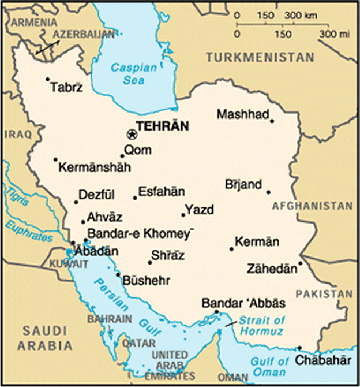
Iran and surrounding countries
Look west and what do we see? Iraq, where we have tens of thousands of troops; Saudi Arabia, which will likely be no help at all; and Kuwait, where we have three military bases.
Look north, and we see Turkmenistan -- no help from President Niyazov.
To the east is Afghanistan, where we have bases and about 15,000 troops, and Pakistan, another U.S. ally in the war on Islamist jihadi terrorism -- but one who might not want to incur the wrath of its radical Moslem population.
And now we look south, to Qatar, where we have the al Udeid Air Base... and to the United Arab Emirates, which already allow us to use their military facilities to transport troops, aircraft, and supplies. In addition, the UAE controls the Strait of Hormuz, through which all Iranian oil must move to enter the world petroleum market.
We need support and bases from which to launch either an attack or a blockade, depending on how other events flow. The UAE needs the money from the deal. Can we connect some dots here?
Hatched by Dafydd on this day, February 22, 2006, at the time of 9:42 PM | Comments (8) | TrackBack
February 21, 2006
UAE and American Ports: a Modest Proposal
A very curious conflict has arisen between the president and most shipping experts on one side, and virtually the entire political establishment, Republican and Democrat, on the other. A British company, Peninsular and Oriental Steam Navigation Co. (P&O), which had the management of cargo and other operations (not port security) at six American ports, including New York and New Orleans, was bought by Dubai Ports World -- a company wholly owned by the government of Dubai, one of the emirates within the United Arab Emirates.
The sale - expected to be finalized in early March - would put Dubai Ports in charge of major shipping operations in New York, New Jersey, Baltimore, New Orleans, Miami and Philadelphia. "If there was any chance that this transaction would jeopardize the security of the United States, it would not go forward," Bush said.
Bluntly put, there are very good reasons to go ahead with this deal -- but also some very real security concerns that must be dealt with. We at Big Lizards have a modest proposal for cutting this Gordian Knot (one that is meant seriously, not as satirist Jonathon Swift meant his own Modest Proposal!)
The Two-Headed Dragon
There are two problems with this proposal, one security-related and the other political; but there are also good reasons in favor of it. Bush apparently has completely ignored the problems (this is likely an illusion), while Republicans and Democrats high in the political heirarchy seemingly do not even notice any of the arguments in favor: the deal is bitterly opposed by such stalwarts on both sides, Republicans such as Senate Majority Leader Bill Frist of Tennessee, House Speaker Dennis Hastert of Illinois, and New York Gov. George Pataki, and Democrats including Sen. Charles Schumer, Sen. Hillary Clinton, and Rep. Edward Markey, all of New York... although Republican opposition is more in the form of wanting further study, while Democrats simply want the deal killed outright.
Head #1: National Security
The security related problem is easier to deal with. Dubai Ports would not, in fact, run any of the security operations at any of the ports; but they would deal with cargo issues, and they would have access to plans showing the layout and configuration of the cargo areas... plans which are, however, already publicly available to every company that does business in those ports (including Saudi Arabian, Turkish, and Indonesian companies).
The UAE has been America's most reliable Arab partner in the war against Islamist jihadi terrorism. Nobody is worried that the current Emir of Dubai will suddenly link up with al-Qaeda, just as we're not worried that General Pervez Musharraf of Pakistan will cut a deal with Osama bin Laden. But both countries have many Islamists and many supporters of terrorism and of al-Qaeda... and they cannot always ensure that their companies have not been infiltrated by sleeper agents. That is the danger of Dubai Ports having such access to American ports.
Lawmakers from both parties have noted that some of the Sept. 11 hijackers used the United Arab Emirates as an operational and financial base. In addition, critics contend the UAE was an important transfer point for shipments of smuggled nuclear components sent to Iran, North Korea and Libya by a Pakistani scientist.
[This cryptic phrase refers to A.Q. Khan, the "father" of the Pakistan nuclear program, who then sold the technology to dangerous regimes all over the world. He was subsequently fired and remains under surveillance... though his national popularity within Pakistan precludes him being imprisoned. -- the Mgt.]
[Lawmakers] say a port operator complicit in smuggling or terrorism could manipulate manifests and other records to frustrate Homeland Security's already limited scrutiny of shipping containers and slip contraband past U.S. Customs inspectors.
Head #2: the Political Dimension
The political problem, of course, is the appearance that the Bush administration is turning a blind eye to Arab infiltration of critical port operations. This tends to damage Bush's great political strength, his fight against terrorism.
There is another, subtler political danger: Democrats, who until now have appeared as nothing but weaklings and moral cowards on national security issues -- Rep. John Murtha, D-PA, demanding an immediate withdrawal of all U.S. forces from Iraq springs to mind -- have the chance to get to the "right" of the president on a national-security issue, as Schumer and Clinton are doing: as hard to credit as it may be that Sen. Clinton cares a fig for national security, she can nevertheless sound tough and still oppose the president... and that is a golden opportunity in an election year, and also for her expected presidential run in 2008.
On the Plus Side
But there are political perils on the anti-deal side, too... notably that America has allowed foreign companies, including those based in countries with unfriendly populations or even enemy governments (such as Red China), to operate other American ports, just as Dubai Ports wants to do:
The White House appeared stunned by the uprising, over a transaction that they considered routine — especially since China's biggest state-owned shipper runs major ports in the United States, as do a host of other foreign companies. Mr. Bush's aides defended their decision, saying the company, Dubai Ports World, which is owned by the United Arab Emirates, would have no control over security issues....
But [the] firestorm of opposition to the deal drew a similarly intense expression of befuddlement by shipping industry and port experts.
The shipping business, they said, went global more than a decade ago and across the United States, foreign-based companies already control more than 30 percent of the port terminals.
That inventory includes APL Limited, which is controlled by the government of Singapore, and which operates terminals in Los Angeles, Oakland, Seattle, and Dutch Harbor, Alaska. Globally, 24 of the top 25 ship terminal operators are foreign-based, meaning most of the containers sent to the United States leave terminals around the world that are operated by foreign government or foreign-based companies.
"This kind of reaction is totally illogical," said Philip Damas, research director at Drewry Shipping Consultants of London. "The location of the headquarters of a company in the age of globalism is irrelevant."
Singapore, of course, is also a country with a large and radicalized Moslem population that is infiltrated -- inundated is the better word -- by international terrorist organizations like al-Qaeda and their affilliate, Jemaah Islamiah; yet no one is up in arms about APL operating American ports. What is the difference?
The danger to the shrillest voices opposing this deal (especially the Democrats) is that they never objected when other dicey foreign countries operated the ports... but when an Arab country, even a friendly one that has been a huge help to us in the war, wants to do the same thing, the Democrats become hysterical. It smacks of racism -- the idea that it doesn't matter what an Arab thinks or even how hard he has fought on our side in the war against jihadism... his ethnicity alone makes him suspect. After flinging such charges at Republicans for so many decades, Democrats are very edgy about such accusations sticking to them.
There are other, more tangible arguments in favor of the deal, mostly that the UAE has agreed to dramatically increase their already very high level of cooperation with the United States and our Western allies in the war effort. According to AP:
To assuage concerns, the administration disclosed some assurances it had negotiated with Dubai Ports. It required mandatory participation in U.S. security programs to stop smuggling and detect illegal shipments of nuclear materials; roughly 33 other port companies participate in these voluntarily. The Coast Guard also said Tuesday it was nearly finished inspecting Dubai Ports' facilities in the United States.
A senior Homeland Security official, Stewart Baker, said this was the first-ever sale involving U.S. port operations to a state-owned government. "In that sense this is a new layer of controls," he said. Baker added that U.S. intelligence agencies were consulted "very early on to actually look at vulnerabilities and threats...."
A senior executive from Dubai Ports World pledged the company would agree to whatever security precautions the U.S. government demanded to salvage the deal. Chief operating officer Edward "Ted" H. Bilkey promised Dubai Ports "will fully cooperate in putting into place whatever is necessary to protect the terminals...."
Bush, who has never vetoed a bill as president, said on the White House South Lawn: "This is a company that has played by the rules, has been cooperative with the United States, from a country that's an ally on the war on terror, and it would send a terrible signal to friends and allies not to let this transaction go through."
A Modest Proposal
Neither side has noticed that there is a fairly obvious compromise staring us in the face, which Big Lizards believes would resolve the very real security concerns without losing the equally real security benefits from this deal.
Both the actual national-security risk and also the political danger come, not from the ownership of the company, but rather from the day to day management -- the actual control of operations. The emirate wants the profits that accrue from ownership; rational Americans want to see control of the port, even the cargo areas, in friendly hands, preferably American.
This suggests a workable compromise: an American company should be chartered -- American owned and American managed -- that is a wholly owned but independently operated subsidiary of Dubai Ports... call it American Port Services, Inc., or somesuch name that makes clear the nationality; and then let all the actual management of the ports be handled by the American APS, not by Dubai Ports.
This will add a middle corporate layer, so Dubai Ports won't make quite as much of a profit as they would running the ports directly; but on the other hand, it's still better than no profit at all. And Americans can be assured that rather than shifting from British control to UAE control, we will in fact have shifted from British to American control of port operations.
This resolves both the security and the political problems:
- Americans will be running day to day operations, quieting the very real fears of terrorist infiltration;
- Republican senators, representatives, and governors can truthfully say that they negotiated a much better deal with the president, so their protest to the initial version was successful;
- President Bush can deliver on his promise to a friend and ally in the war on jihadi terrorism, thus gaining even more cooperation from the UAE on anti-terrorist measures -- and making America more secure;
- The White House and Republicans in Congress and the state houses can again unite on matters of national security, as before;
- The only losers will be the hysterical Democrats: unlike the Republicans, who insisted only upon more "scrutiny" of the deal, Democrats have simply been howling for the whole thing to be killed... and they'll be left out in the cold by a solid, secure "new deal" that incorporates all the benefits while avoiding the dangerous pitfalls.
Once again, the Democrats have overreacted, demanding death to the deal, when in fact we can address the real and sincere threats without having to pull the beard of a long-time ally in the war effort. As Dubai Ports has already agreed to "whatever security precautions the U.S. government demanded to salvage the deal," they should be willing to sign off on being a holding company, rather than the actual operator, which will be "American Port Services," or whatever they decide to call it.
All sides will be satisfied, and we can then proceed with the deal.
Hatched by Dafydd on this day, February 21, 2006, at the time of 8:36 PM | Comments (16) | TrackBack
February 17, 2006
Ball Is In Your Court, Democrats - the Rest of the Story
Way, way back last week, I noted that, with the return of Republicans to the fold on the Patriot Act extension, the Democrats would be unable to sustain a filibuster in the Senate -- despite the fact that more than the required number of Democrats voted against cloture on December 16th. They needed 41; they got 43 two months ago.
That was then; this is now. Yesterday, the Senate took another cloture vote; and in fact, Reid's Raiders did far worse than even I predicted. In the original Ball Is In Your Court, Democrats, I wrote:
My prediction: one by one by one, Democrats will start announcing that they're going to vote for cloture; and the moment three have done so, the whole idea of a filibuster will be quietly dropped. Reid will proclaim that it would be futile, and a flood of Democrats will announce that they're against filibustering such an important bill.
But then at the actual vote, 25 Democrats will vote against cloture... including Sen. Dianne Feinstein (D-Vista del Cowardly), after Cindy Sheehan threatens to re-enter the race she actually didn't enter the first time (and she'll once again misspell the senator's name).
But according to the Washington Times (hat tip to Power Line), the total number of senators who voted against cloture on Thursday was -- drum roll -- three. All Democrats, of course.
So after a few minor tweaks that everyone, Democratic and Republican, agreed were largely "cosmetic," forty Democrats jumped and swam for their lives, leaving only filibuster king Russell Feingold (D-WI), 154 year old Sen. Robert Byrd (D-Cuckooland)... and of course Jumpin' Jim Jeffords (I-VT), marking one of the few times a rat has been caught swimming towards a sinking ship.
Congratulations, Sen. Harry Reid (D-Las Vegas), for giving us the most effective TV commercial of the upcoming campaign -- for the Republicans. That clip of Reid pumping his fist in the air, to the wild ululations of the Democratic mob, as the minority leader shrieks "we killed the Patriot Act!" will surely live on and on and on... until long after everyone has forgotten why the Patriot Act was enacted in the first place.
Hatched by Dafydd on this day, February 17, 2006, at the time of 5:46 PM | Comments (5) | TrackBack
Not Every Clinton Judge Is an Embarassment
It's a truism that whenever some insane ruling (or likely ruling) rolls down the road, we nearly always discover that a Clinton crony sits at the heart of it.
But we would be unfair and imbalanced if we didn't point out when a Clinton judge -- confirmed while the Democrats still controlled the Senate, even -- makes a great decision. And Judge David G. Trager just got it right, very right, in a cause fraught with peril... literally, as a bad decision would have put us on a collision course with disaster in the war on jihadi terrorism.
Judge Tosses Lawsuit Alleging U.S. Deported Man to Syria for Torture
Associated Press
Friday, February 17, 2006NEW YORK — A federal judge has tossed out a civil rights lawsuit filed by a Syrian-born Canadian man who claimed U.S. counterterrorism officials deported him so he could be tortured in Syria.
Maher Arar had sued the officials in 2004 in what was believed to be the first case challenging extraordinary rendition — the policy of transferring foreign terror suspects to third countries without court approval.
Arar is not an American citizen, nor is he a U.S. resident. He carries dual Syrian-Canadian citizenship and only passed through the United States en route from Tunisia back to Montréal. While in JFK, transitioning from one plane to another, the Immigration and Naturalization Service (INS), as it was known then, detained Arar when his name popped upon a terrorist watch list. He was taken and interrogated, then eventually deported to Syria -- where he claims he was tortured by the Syrians (who deny the allegation).
An "independent" investigator, law professor and political activist Stephen Toope, says the he believes Arar was tortured; but Toope, the president of the Trudeau Foundation, is a "human rights" activist whose specialty appears to be extreme rendition, which he vigorously opposes. So his own objectivity is certainly open to question.
Arar has become a huge cause celebre among liberals and Democrats -- on both sides of the 49th parallel, as the Arar case resulted in numerous investigations and fulminations in Canada, being seized upon as evidence of President Bush's perfidy by both the anti-American Liberal government of Paul Edgar Philippe Martin and the near-Socialist New Democratic Party under Alexa McDonough... despite the fact (or perhaps because of the fact) that Canadian officials were involved in the detention: it was the Royal Canadian Mounted Police who provided the American INS with the watch list that included Arar's name; and the Canadian Consulate admitted that they knew Arar was in custody in the United States, but did not know (they said) that he was to be deported to Jordan or Syria.
Arar's story -- invariably told from Arar's viewpoint with little or no attempt to get our side of it -- appeared in Time Canada (Google cache), Counterpunch, CBC News, the New York Times (reprint from a lefty website; you can visit the NYT and pay for the archived article, if you wish to compare them), and other favorite liberal and lefty sources.
But despite all that pressure, Judge Trager made a very sharp and (oddly) courageous ruling that since Arar was not any kind of a U.S. person, the law he was suing under did not apply to him:
U.S. District Judge David G. Trager rejected arguments that Arar was protected by the Torture Victim Prevention Act, which allows U.S. courts to assess damages for human rights abuses committed abroad.
Trager said that as a non-citizen, Arar couldn't demonstrate that he has a viable cause of action under that statute.
Citing "the national security and foreign policy considerations at stake," the judge said Arar had no grounds in a U.S. court to claim his constitutional right to due process was violated.
In other words, Judge Trager actually relied upon the law, rather than his gut feeling about what was "right" (or what some international tribunal says our law ought to be). The Torture Victim Prevention Act does not apply to foreigners living abroad; unlike Belgium, American courts do not claim to have jurisdiction over any "crime against humanity" committed by anybody, against anybody, anywhere in the world.
So he kicked it. And to hell with the liberal whiners who wanted Trager to use the claim to indict the Bush administration generally and the "rendition" policy (if it even exists) in particular... that is, to substitute the liberal foreign policy of Clinton for the conservative foreign policy of Bush at gavel-point.
To his great credit, Judge Trager refused to play that game. And I think if we're going to castigate judges who scamp the law in favor of their own preferences, we should salute those judges -- no matter who appointed them -- who do the opposite.
Hatched by Dafydd on this day, February 17, 2006, at the time of 5:17 PM | Comments (1) | TrackBack
February 9, 2006
Ball Is In Your Court, Democrats
Back on December 16th, when the Senate failed to break the filibuster on making the Patriot Act permanent, four Republicans joined with 43 Democrats in voting against cloture:
A band of Senate Republican holdouts reached agreement Thursday with the White House on minor changes in the Patriot Act, hoping to clear the way for passage of anti-terror legislation stalled in a dispute over protection of civil liberties.
Sen. John Sununu, R-N.H., and three other GOP lawmakers - all of whom joined with Democrats last year to block a long-term extension of the law - were to announce the accord later Thursday.
But today, the Republicans are back in the fold; the "mavericks" came to a side-deal with the White House, and they will now vote to make the Patriot Act permanent. But that still leaves 43 Democrats who voted against cloture last time, which is three more than they need to filibuster the Patriot Act.
Thus, the fate of the expiring provisions of the Patriot Act is entirely in the hands of Democrats: will they be wiling to filibuster one of the most popular acts of the war against jihadi terrorism, knowing this will play directly into Karl Rove's and GOP Chairman Ken Mehlman's gameplan to portray Democrats as limp-wristed on national security? It would only take three of those 43 to seize upon these minor changes -- as Sununu, Larry Craig (R-ID), Lisa Murkowski (R-AK), and Chuck Hagel (R-NE) did -- to say they're now satisfied, and therefore break the filibuster.
Bear in mind that when the cloture vote was taken on December 16th, Democrats knew that they had Republican cover for the filibuster. Will they be so willing to kill the bill if they know they'll be doing it on a strict, party-line vote?
Sen. Harry Reid (D-Las Vegas) is still waiting for Jimmy the Greek to give him the odds, but Sen. Russell Feingold (D-WI) is still champing at the bit for a filibuster:
But two other Democrats swiftly denounced it as short of what was needed.
"The few minor changes that the White House agreed to do not address the major problems with the Patriot Act that a bipartisan coalition has been trying to fix," said Sen. Russell Feingold of Wisconsin.
Sen. Patrick Leahy of Vermont, the senior Democrat on the Senate Judiciary Committee, accused the White House of "naysaying and partisanship."
Still, Leahy's statement stopped short of having the senator join in Feingold's threat to renew a filibuster that stalled the legislation last year.
Feingold is right that the changes are pretty minor; all the White House appears to have agreed to do is "make clear that an individual receiving a National Security Letter was not required to notify the FBI if he consulted a lawyer" and "clarify that only libraries that are 'electronic service providers' could be required to provide information to government agents as part of a terrorist investigation," neither of which sounds like a deal-breaker to me.
Leahy's and Reid's equivocation is encouraging; the Patriot Act is too important to play political football with. But I particularly note that Feingold still invokes bipartisanship, despite all four Republicans now being satisfied, leaving only Democrats still complaining. Perhaps Feingold uses "bipartisan" to mean the regular Democratic Party -- and "the Democratic wing of the Democratic Party."
(Reminds of the country club that said "oh, we don't discriminate; we're open to all religions: Catholics, Episcopalians, Methodists... even Baptists!")
My prediction: one by one by one, Democrats will start announcing that they're going to vote for cloture; and the moment three have done so, the whole idea of a filibuster will be quietly dropped. Reid will proclaim that it would be futile, and a flood of Democrats will announce that they're against filibustering such an important bill.
But then at the actual vote, 25 Democrats will vote against cloture... including Sen. Dianne Feinstein (D-Vista del Cowardly), after Cindy Sheehan threatens to re-enter the race she actually didn't enter the first time (and she'll once again misspell the senator's name).
Oh, wait, that's what happened with Alito. What the heck... it'll probably happen the same way this time. As the old expression goes, "those who cannot remember Santayana are condemned to repeat him." (Santayana, repeating himself.)
Hatched by Dafydd on this day, February 9, 2006, at the time of 4:02 PM | Comments (5) | TrackBack
February 6, 2006
Are We Really at War With All Islam?
(I will also post this piece as the first returning column of the Lizard's Tongue, which I had previously allowed to languish.)
A number of commenters here and at other blogsites, as well as some bloggers and even a few talk-show hosts, have claimed that we are "at war with Islam." Sometimes they get sneaky, claiming that all Islam is at war with the West, as if every Moslem, whatever his nationality, secretly yearned for a sharia-ridden world run by a Grand Caliph.
Besides being an obvious variation on the antisemitic canard that all American Jews have "divided loyalties," this claim is functionally equivalent to saying we're at war (or should be) with all Islam. It's a cute dodge, but it amounts to the same thing.
Hugh Hewitt makes an impassioned argument that we're not at war with all of Islam, as does the administration. Not even Ann Coulter has called for such an Armageddon against a whole religion worldwide. Big Lizards certainly agrees with the Hewitt-Bush side of this argument (that is our bias); but we do not do so thoughtlessly, rather after thinking long and hard about it.
But what exactly would it mean to be "at war with Islam" anyway? Let's really take a look.
The proponents of this position clearly mean we should be at war with Islam in the same way we were at war with Nazi Germany: that is, I have never heard anyone both call for a war against all Islam -- and then suggest that the war should be a limited war; anyone calling for the first is calling for a total war, a kulturkampf, Armageddon.
So I will assume throughout, until the end, that this is the meaning of "at war with Islam." At the end, I'll poke around a bit about the possibility of a "limited" war with all Islam. Until then, we assume we're talking about war with Islam the way we were at war with Germany in World War II.
Targeting
During WWII, warfare was fought on both sides with a complete disregard for civilian deaths; we have the German attack on Guernica, but we also have the British and American attack (mostly British) on Dresden. But contemporary warfare -- post Geneva Conventions -- requires countries waging war to avoid deliberately targeting civilian populations, and I assume this would continue.
But contemporary warfare certainly sanctions the ancillary deaths of civilians in attacks clearly aimed at military and political targets. So the question arises -- what would we target?
Obviously any terrorist bases would be legitimate targets. But when fighting a nation in a total war, we're certainly not restricted to only attacking irregulars! We're allowed to attack regular army units... therefore, we would in this scenario be allowed (and encouraged) to attack any military target of any Moslem country anywhere in the world, even a military that has not previously participated in any warfare against us (just as we could attack units of the Wehrmacht that had not yet engaged in any combat).
Similarly, political and industrial targets are fair game in total war; that's pretty much part of the definition of total war. Therefore, proponents of this position claim we have the right to attack any factory, any railway or airport, any port, any highway, any dam, or indeed, any highrise office building anywhere in any majority-Moslem country, as well as every government building.
Since most Moslem countries mandate Islam as the state religion, making Islam a part of the government, that would extend to every mosque or madras anywhere in any Moslem country. This is especially true because militant Islamists very commonly use mosques as military bases: plotting attacks from mosques, retreating to mosques, and even storing munitions and WMD in mosques. Thus, no mosque can be assumed to be entirely civilian, and most proponents of the "war against all Islam" position typically make it explicit that every mosque is a possible target.
Finally, even in countries that were nominally not allied with Germany, we certainly held during WWII that we had the authority to attack German sympathizers who might be working to sabotage the friendly nations. We did this with or without the help or even acquiescence of the governments of those countries on a "military necessity" basis.
Therefore, inherent in the definition of total war, if we were "at war with Islam," we would quite literally be claiming the authority to attack any majority-Moslem nation anywhere in the world, or any Moslem population within a non-Moslem nation, including any economic, political, or Moslem-religious building, place, or entity, with or without specific provocation, and with lethal intent.
Tactics
In total war, a nation uses its entire military and economic might to reduce the enemy. Thus, certainly there would be no restriction on using our most powerful munitions -- including nuclear weapons -- in this war. (As we refrained from using either poison gas or biological warfare even during WWII, I will assume those same restrictions would apply in the war against all of Islam.)
However, we certainly would be allowed to use flame throwers, tanks, bombs of any size, extensive mining of roads and areas that might be used by Moslems, defoliation, cluster bombs, airdropped Napalm and white phosphorus, the destruction of dams upstream from large population centers (such as the Aswan High and Low Dams in Egypt, which would threaten the lives of 70 million people who live within a dozen miles of one or the other), the destruction of nuclear power plants (regardless of any radioactive danger to surrounding civilian populations), and the firebombing of crops that could result in mass starvation.
Ordinarily, we would avoid attacking hospitals or Red Crescent centers, personnel, or vehicles; but Islamic jihadis have a history of using such facilities for military purposes (transporting terrorists inside a Red Crescent or even Red Cross ambulance, for example), and I doubt that a country committed to total war against all Islam could be prevented from targeting medical facilities that were suspected of also being military sites.
In total war, everything goes except that which is specifically forbidden by treaty.
Executing prisoners was not particularly uncommon during WWII, particularly during the liberation of the Nazi death camps. When passions among our soldiers ran high, they would sometimes simply machine-gun the SS death-camp guards -- or indeed any nearby German unit that was mistaken for death-camp guards. While officers would typically try to stop such massacres, the soldiers involved were not significantly punished. After all, there was a war on.
Presumably then, with this precedent, persons suspected of particularly vicious attacks who were captured in battle would be subject to mass extermination -- either legally or simply as a fact on the ground.
As "de-Nazification" followed whenever we liberated a country from the Nazis, presumably the American military would have to "de-Islamicize" all captured territories, making the religion of Islam illegal and enforcing the prohibition with punishment from imprisonment up to and including execution. We would need to be on the lookout for, e.g., ostensibly Christian or Jewish sects that were in fact covertly Islamic; the military authorities would need to maintain up-to-date lists of all acceptable religions, and they would have to have the power to question any person about his religious beliefs and arrest him if those beliefs were suspect.
As captured Germans were pressured to turn against their earlier comrades, so presumably would the advocates of the "war against Islam" proposal urge that captured Moslems be encouraged or threatened into going back into communities of secret Moslems and turning them in to American authorities to be rounded up like the rest.
"Fifth columnists" are fair game in total war; indeed, in the 1940s, we rounded up about 75 thousand Americans of Japanese descent (and 45 thousand Japanese nationals) merely on the possibility they might turn out to be fifth columnists. Therefore, we would be justified, indeed compelled, under this war-against-all-Islam doctrine to close all American mosques and round up all 3 million or so Moslems in the United States. The Constitution would be suspended in this instance (as it was in 1943 in the Supreme Court decisions in Yasui v. United States, Hirabayashi v. United States, and Korematsu v. United States).
We would need to build vast War Relocation Camps (concentration camps) to warehouse all these people. As the war could take decades, many of these people would live their entire lives in these camps, as would their children and grandchildren. They would have to be more or less permanent "Moslem zones," with people only being allowed to leave if they formally converted to some other religion -- as determined by the American government.
Victory Conditions
In 1945, Germany formally and unconditionally surrendered to the Allies (we insisted that the surrender be unconditional); later that same year, so did Imperial Japan. But those were each single political entities that could, in fact, designate persons authorized to sign such surrender documents.
Islam is a religion, not a single political entity. Moreover, unlike Catholicism, Islam does not even have one recognized caliph who could speak for all Moslems... so "Islam," as an entity, cannot surrender.
Therefore we would presumably be forced to continue fighting until all possible resistance was destroyed. That means every city leveled, every population reduced, every industrial or economic base ruined or captured, every pocket of Moslems ferreted out and either destroyed or otherwise neutralized, all resistance crushed, all mosques in the world either destroyed or at least monitored constantly, all transportation restricted, and concentration camps built to contain hundreds of millions of "enemy soldiers" pretty much from here to eternity.
We would require American hegemony over the entire world, in the manner of the Roman Empire (or perhaps the Spanish colonial period of 1500 to 1800), with constant spying on everyone to ensure no rebellion was being plotted. The military would by and large be in charge of most enforcement on the ground, as it always is in such empires, even if there is nominal civilian control of the military. The president's role as commander in chief would trump his role as chief executive officer in such a state.
Then we could declare victory.
Consequences
For the hardy souls who have made it this far, it should be pretty clear that the consequences of honestly declaring war on all of Islam even in victory would be dire: America would cease to exist as we know her today; we would instead have something akin to a combination of Roman Empire and Nazi America, but with the venom against Jews replaced by venom against Moslems.
There would be so many executions, we would have to have special sites set up for round-the-clock extermination of people who refused to convert from Islam to some other religion. As none of our historic allies would likely join in such a crusade, America, in order to conquer all of Islam, would have to first conquer all the world to impose pax Americana.
Freedom of religion would be one of the first things to go, as every person in the world -- including every American -- would have to prove again and again that his religion was acceptable to the military authorities. Of course the rest of the Bill of Rights would also be gone.
The Soviet gulags would be replaced by American counterparts. Millions would be wrongly suspected of Moslem sympathies and would lose jobs, children, and perhaps even their liberty. Children would have to be raised by the government to ensure there was no backsliding on such dangerous subjects as religion and rights.
In trying to rid the world of Moslems, we would have rid ourselves of our own souls; that is the first and worst consequence of making war upon an entire religion.
Total War Lite: the Limited Version of the War on All Islam
There is a good reason that proponents of the "war against Islam" don't accept the idea of it being a limited war, and that is because limited wars typically end only two ways, especially against entire cultures: either in escalation to total war -- or in defeat.
It's hard even in theory to imagine how one could have a limited war against something as large, entrenched, and ubiquitous as a religion; it would be worse than saying we're going to fight Nazi Germany -- but only particular battalions, leaving other battalions unmolested.
And even if we began to fight it as a limited war, the natural consequence to America attacking non-terrorist Islamic countries simply because they were run by Moslems would be for other Moslems themselves to escalate attacks. Heck, they already do that to some extent even when we are clear in word and deed that we're only attacking terrorists!
So for those reasons, I believe that a "limited war against all Islam" is a non-starter and need not be extensively analyzed.
Conclusion
For all these reasons, I draw several conclusions:
- The consequences of attempting to eradicate not just militant or terrorist sects of Islam but Islam itself from the world would be awful and dire were we to win -- and unthinkable were we to lose.
- We have neither the might nor the means to carry such a total war on Islam to victory.
- Americans would not stand for it unless we had already suffered an attack so catastrophic that our entire national character were changed; and if we had, we would have even less might and means to carry out such a program.
- None of our allies would stand with us in such a total war on all Islam.
- Even if we somehow managed to win the war, we could not keep the peace.
- An America that would seriously contemplate such a program would be an America unrecongizable to anyone reading these words.
And finally, - Those people advocating such a proposal -- a war against all Islam, a clash of West vs. East, the final Armageddon of Christianity against Islam -- have not actually thought it through, or are incapable of understanding the consequences, or are simply bleating for effect... and in any event are fundamentally unserious people who cannot distinguish between a Moslem who believes in democracy (of which there are millions in this country alone) and a Moslem who believes in tyranny.
That is, anyone who advocates such a course, even for effect, is a mindless bigot who should be shunned by all persons actually serious about winning the real war: the war against terroristic jihadism, militant Islamism, or Islamofascism, whatever one chooses to call it... not against "all Islam."
Hatched by Dafydd on this day, February 6, 2006, at the time of 6:19 PM | Comments (15) | TrackBack
January 18, 2006
Corruption of the Blood
It's sad and pathetic that after our Predator drone struck the al-Qaeda not-so-safehouse in Pakistan, the local Pakistanis -- likely Pashtuns who share tribal affiliation and ideology with the Taliban, hence al-Qaeda itself -- descended upon the smoking hole like creepsie thieves in the night, spiriting away the bodies in the belief that this would prevent us from identifying who we had killed.
And it worked -- for a couple of days. Long enough for Democrats and their accomplices in the mainstream media to humiliate themselves by crowing that the strike was a total failure because it failed to kill Zawahiri.
But the magical absurdity of such hide-and-seek games is that we don't need the bodies to identify the bloody dead. One thing you can say about Hellfire missiles: they spread a goodly amount of blood, flesh, spinal fluid, and shredded hair around the impact site. And the forensic abbreviation for all of those components is DNA, deoxyribonucleic acid, the identifying nucleus of biological cells.
Naturally, with so many body byproducts spread to an even thickness across the ground, it takes a few days to sort one DNA molecule from another, and then to run matches on every individual pattern to find a consanguineous match. But it happens; like the law, forensic gene-matching moves at an orderly pace. And so we now know, bodies or no bodies, that we sent Midhat Mursi "Abu Khabab" al-Sayid 'Umar (the Five Million Dollar Man), Abdul Rehman Al-Misri al Maghribi, and Obaidah al Misri on to Paradise, where they can collect their seventy-two sloe-eyed raisins.
One of the dead was said to be Abdul Rehman Al-Misri al Maghribi, a son-in-law of Zawahri. Maghribi was responsible for al Qaeda's media [propaganda] department.
Another was Midhat Mursi al-Sayid 'Umar, an expert in explosives and poisons who carried a $5 million U.S. bounty on his head under the Federal Bureau of Investigation's Rewards for Justice program....
The third man identified by Pakistani intelligence officers was Abu Obaidah al Misri, al Qaeda's chief of operations in Afghanistan's eastern Kunar province, where U.S. and Afghan forces regularly come under attack from militant groups.
Just imagine Goebbels, Speer, and Himmler.
But let's keep this between ourselves and the oven, all right? Let the tribesmen think they've stymied our intelligence collection by hiding the cookie crumbs under the Persian carpet. No matter: the corruption of their blood cries out its guilt.
With 'er 'ead tucked underneath 'er arm,
She walks the bludy Tower;
With 'er 'ead tucked underneath 'er arm,
At the midnight hour!
Kaboom, Abu Khabab.
Hatched by Dafydd on this day, January 18, 2006, at the time of 11:16 PM | Comments (7) | TrackBack
Offered For Your Approval
At least the provincial government of the "semiautonomous tribal regions bordering Afghanistan" now admits that there were, in fact, "four or five foreign terrorists" present in one or another of the three houses in Pakistan that we hit with a missile attack a couple of days ago. They also now agree that the compound (when was the last time a normal, residential house was referred to as a "compound?") was a routine meeting place for terrorists, both foreign and Pakistani, and that a large number of foreign terrorists, including Ayman Zawahiri, the al-Qaeda Number Two (perhaps Number One now), had been invited to the celebratory dinner there:
The statement, citing the chief official in the Bajur region where the Damadola is located, said its findings were from a report compiled by a "joint investigation team" but gave no specifics on who was included in the team.
"Four or five foreign terrorists have been killed in this missile attack whose dead bodies have been taken away by their companions to hide the real reason of the attack," the statement said.
"It is regrettable that 18 local people lost their lives in the attack, but this fact also cannot be denied, that 10-12 foreign extremists had been invited on a dinner," it said.
In Washington, a U.S counterterrorism official said Monday it was not yet known if al-Zawahri was killed.
This brought to my mind the earlier reaction by the American Left when local Pakistanis -- probably Pashtun tribesmen -- gleefully announced that Zawahiri was not among those present or killed by the attack (a claim as yet unverified). The Democrats' response was to call the attack a failed attempt to kill Zawahiri, as if the only purpose of such an attack was to get one particular man... and if he were still sucking air, then the entire attack was a miserable failure.
For some reason, this reminded me of the response by the Democrats to the entire invasion of Iraq: they call it a colossal, wasted distraction from what we should be doing, which is to pour every man and woman in the Army into Afghanistan to scour the Tora Bora mountain range looking for Zawahiri and his boss, Osama bin Laden. The image is absurd: hundreds of thousands of soldiers tramping around a sheer-faced moonscape, looking under every rock and behind every scrubtree for a man who would by then be five hundred miles away. But that is what the Democrats demanded.
So I had two points before me: an attack that was a failure because it didn't get Zawahiri, and a front of the global war on terrorism that was a distraction from the war on terrorism. Something must connect these two responses. I sought some "theory of everything" solution.
After a day or so thinking about it, I believe I finally understand the connection. Both sentiments arise from a common understanding among Democrats of what the GWOT is and how it should be prosecuted. The Democratic version of the GWOT is actually just the WOT, because it is decidely not "global;" I'll call it the DemoWOT. On a nutshell, the DemoWOT understanding is that:
- We were attacked on 9/11 by a criminal organization named al-Qaeda;
- Al-Qaeda consists of a handful of people: bin Laden, Zawahiri, Mullah Omar, and just a few other associates;
- Our primary duty is to round up the masterminds of al-Qaeda, arrest them, and put them on trial;
- Because they're international "criminals," they must be tried by an international body: the International Court of Justice (World Court) at the Hague, Belgium's War Crimes Law, or the International Criminal Court (also at the Hague but distinct from the World Court);
- If found guilty, the masterminds of the 9/11 attacks should be imprisoned, perhaps for life, but not given the death penalty -- because that would "make us no better than they are;"
- Once they have been brought to justice, we can all go home, because the war on terrorism will be over.
We can party like it's (still) 1999!
The crowd that shares this understanding of the GWOT today encompasses virtually every Democrat in a leadership position in either house of Congress, all Democratic presidential aspirants (except Joe Lieberman), and swirls around Chairman Howard Dean and the big supporters (and drivers) of the party, such as Michael Moore, MoveOn.org, George Soros, the Hollywood crowd, and the New York intelligensia; it's about as universal as it's possible to be in a modern political party, rivaling the unity of understanding among the top members of the GOP that lower taxes are good.
The DemoWOT Understanding -- it sounds like a Robert Ludlum title; and that's appropriate, because it strikes me as quite childish, a way of minimizing and trivializing the very real war we find ourselves in, of turning it into the Phil Donohue or Steven Spielberg version: the Democrats make the actual GWOT simplistic, narrow, legalistic, and most important, a fight that has a "magic bullet" that will make it all go away very soon, allowing everyone to slide back to September 10th, when the issue of greatest moment was whether Bush was going to roll back the environmental "gains" of the Clinton administration... and the only American ground troops abroad wore either NATO patches or blue UN helmets.
Every attempt to expand the GWOT to include countries other than Afghanistan, no matter how logical or how well connected they are to terrorism (not only Iraq but Iran, Indonesia, Syria, North Korea, and now Venezuela, which has begun to ally itself with the lunatics in Teheran, embracing Holocaust denial and nuclear threats against America), provokes a visceral reaction among the American Left to the effect that it's all just a further distraction from the real job -- which is to scrub those Afghan mountains and arrest bin Laden.
This, I believe, is the GWOT manifestation of the core Democratic void: without universal animating principles, they are left with an ideology that is just a hastily stitched patchwork quilt, where no thought is given to an overall pattern, or even whether adjoining patches match or clash violently. But this is likewise true of the membership of the modern Democratic Party itself: members are special interests first, and Democrats only second. In that sense, fragmentation is the "natural manure" of the Democratic Party, to paraphrase Thomas Jefferson.
They've buttered their bread, and now they have to sleep in it. This political pointillism, more than any other defect of the Democratic Party, will keep them out of power in this country for the forseeable future.
Hatched by Dafydd on this day, January 18, 2006, at the time of 2:04 AM | Comments (19) | TrackBack
December 30, 2005
Expect Many Sudden New "Foreign Correspondents"
From CNN.com:
Inquiry into leak of NSA spying program launched
CNN
Friday, December 30, 2005WASHINGTON (CNN) -- The Justice Department has opened an investigation into leaks to the media about the National Security Agency's classified domestic surveillance program.
For those who missed it in an earlier post: Heh.
I anticipate a number of journalists will get a sudden yen for assignments in Venezuela or Russia or France -- countries with no effective extradition treaty with the United States (at least not one they honor where political crimes of conscience are concerned, such as when Ira Einhorn murdered his girlfriend, Holly Maddux). Just in case they suddenly need to retire from Bush's police state to breath freely in some Communist or socialist paradise, you see.
I expect the Captain Renaults of the MSM will be shocked, shocked to find themselves hauled before FBI agents and forced to testify, or else spend some time in the Judy Miller memorial cell themselves. How could the monstrous Bush administration demand they name names, when the New York Times has already formally granted anonymity to the leakers, to protect them against retaliation by disgruntled law-enforcement officials?
Nearly a dozen current and former officials, who were granted anonymity [by the New York Times] because of the classified nature of the program, discussed it with reporters for The New York Times because of their concerns about the operation's legality and oversight.
The CNN story continues the fine MSM tradition of knowingly writing legal nonsense because it conforms to how the journalist thinks the world should work, regardless of how it actually does work in real life -- though at least now they're putting them into quotation marks, so we're making some progress:
"FISA says it's the exclusive law to authorize wiretaps," Democratic Sen. Russ Feingold of Wisconsin told CNN. "This administration is playing fast and loose with the law in national security. The issue here is whether the president of the United States is putting himself above the law, and I believe he has done so."
Though I don't want to judge before all the facts are in, it does appear that Sen. Feingold lied; "FISA," the Foreign Intelligence Surveillance Court of Review, in fact said the polar opposite in Sealed Case No. 02-001:
Finally, in 2002, the United States Foreign Intelligence Surveillance Court of Review decided Sealed Case No. 02-001. This case arose out of a provision of the Patriot Act that was intended to break down the “wall” between law enforcement and intelligence gathering. The Patriot Act modified Truong’s “primary purpose” test by providing that surveillance under FISA was proper if intelligence gathering was one “significant” purpose of the intercept. In the course of discussing the constitutional underpinnings (or lack thereof) of the Truong test, the court wrote:
The Truong court, as did all the other courts to have decided the issue, held that the President did have inherent authority to conduct warrantless searches to obtain foreign intelligence information. It was incumbent upon the court, therefore, to determine the boundaries of that constitutional authority in the case before it. We take for granted that the President does have that authority and, assuming that is so, FISA could not encroach on the President’s constitutional power. The question before us is the reverse, does FISA amplify the President’s power by providing a mechanism that at least approaches a classic warrant and which therefore supports the government’s contention that FISA searches are constitutionally reasonable.[Emphasis in original Hinderaker post from Power Line.]
Here is the other CNN quotation:
Sen. Jack Reed, D-Rhode Island, said the president could have gone back to a FISA court to get approval even after the wiretaps started if he was concerned about speed. "I'm just stunned by the president's rationales with respect to the illegal wiretapping," Reed said. "There are two points that have to be emphasized with respect to the FISA procedure: They're secret and they're retroactive."
But of course, if the wiretapping is legal, because the president has the inherent legal authority to order wiretapping for national-security purposes (as even the FISA court itself agrees he does), it doesn't suddenly become illegal just because he fails to seek the retroactive cover of the FISA court that he doesn't need in the first place. The fact that the Bush administration sought 5,645 wiretap authorizations from the FISA court since 9/11 shows the president is not unmindful of the requirements for warrants when the conditions of the NSA intercept program are not met.
Finally, CNN quotes the well-known constitutional scholar, Tom Daschle (D-Nowhere), on whether the congressional Authorization for the Use of Military Force enacted after the attacks buttressed Bush's residual plenary power to order such wiretaps:
However, former Senate Majority Leader Tom Daschle, who negotiated the congressional resolution with the White House, disputes the claim that the authorization to use force permitted Bush to launch the secret wiretaps without court authorization. (Full Story)
You have to click on the misleadingly labeled "Full Story" to discover that what they really mean by saying that Daschle "disputes the claim" is that Daschle says the Senate never actually discussed the issue explicitly... which is not quite the same thing as discussing it and deciding that the law they were passing did not authorize tapping the phone calls and e-mails of foreign al-Qaeda members communicating with their agents inside the U.S., isn't it?
And of course, there is the killer question to ask of any elected official, Democrat or RINO, inveighing against the program: "All right, so are you actually calling for the NSA to stop monitoring al-Qaeda calls and e-mails?"
If Feingold says yes, as he surely would (he was the only senator to vote against the Patriot Act in 2001), then once again, the Democrats are on record caring more about Zacarias Moussaoui's civil liberties than the lives of American citizens. And if Jack Reed says no, as he probably would -- along with Sens. Nelson (D-NE), Nelson(D-FL), Specter(R-PA), Salazar (D-CO), and Clinton (D-NY), et al -- then he is exposed as the worst sort of hypocrite: he wants those involved to be labeled as corrupt tyrants, so he can gain political advantage; but he nevetheless wants the program to continue, so his kids will be safe.
This is as bad as those who want any sort of aggressive questioning to be illegal, so they can posture to the Europeans about America's moral purity... but they still want interrogators to break the law when we need to obtain intelligence vital to our security. (Then they want to prosecute the "lawbreakers," of course.)
This story is such an albatross for the Democrats and their willing accomplices in the media. What does the charge boil down to? George W. Bush cut through the legal red tape in order to protect Americans from being blown up. Yeah, I can see how that's going to turn the heartland against him.
Both John McIntyre and Tom Bevan at Real Clear Politics have argued repeatedly (here, here, and here) that this issue is an incredible political loser for the Democrats. Both Fred Barnes and Mort Kondrake have noted that it was this overreaching by the Democratic house organ, the New York Times, and the Democrats' falling upon it (along with the demand to cut and run from Iraq), that more than anything else confirmed Bush's vigorous defense of his administration's war conduct in Iraq and Afghanistan and likely helped turn around the president's job-approval numbers.
The Left's attempt to gin up a Watergate-style scandal out of the NSA issue has been exploding in their faces since the very first day of it; at what point do they just stop, take a stress pill, and ask if this is really in their best interests?
In any event, the media has made such a stink about this and rubbed the leaking into the administration's face so blatantly that now they've drawn yet another federal investigation (added to the one already in place to find out who leaked the classified information about the CIA's secret prisons in Eastern Europe, as Power Line reminds us). So at least it's had some minor good effect to slightly counterbalance the huge blow to American national security: maybe these blatantly illegal leaks will result, after a few prosecutions and lengthy prison terms, in the White House finally gaining control of the CIA and NSA.
Hatched by Dafydd on this day, December 30, 2005, at the time of 3:40 PM | Comments (3) | TrackBack
December 27, 2005
Maybe This Explains It? UPDATED
UPDATE: see below.
A UPI report -- if true -- may actually give us some insight into why Bush bypassed the Foreign Intelligence Surveillance Act (FISA) court and ordered, using his own plenary power as president, the National Security Agency (NSA) to intercept foreign-based phone calls and e-mails to known al-Qaeda affilliates and to analyze the traffic patterns of such electronic communications:
Bush was denied wiretaps, bypassed them
United Press International
December 27th, 2005WASHINGTON, Dec. 26 (UPI) -- U.S. President George Bush decided to skip seeking warrants for international wiretaps because the court was challenging him at an unprecedented rate.
A review of Justice Department reports to Congress by Hearst newspapers shows the 26-year-old Foreign Intelligence Surveillance Court modified more wiretap requests from the Bush administration than the four previous presidential administrations combined. [Emphasis added]
The story claims that, while the FISA court ordered "substantive modifications" on only 2 of 13,000 surveillance warrant requests prior to the 9/11 attacks (and denied none), since then, they have demanded modifications on 179 out of 5,645 requests -- and rejected six others outright. The court went from a modification rate of 0.015% before we were at war to a rate of 3.2% afterwards, more than 200 times the rate of demands for modification.
Nearly all of these demands (97%) occurred in 2003 and 2004, a year after Bush began the NSA program; so Bush's order was clearly not a reaction to being rebuffed, as the newsies will doubtless try to spin it (including UPI above: the court was not yet "challenging him at an unprecedented rate" in 2002, when he made the decision).
But the most plausible explanation to me is that Bush realized we would need vastly increased surveillance of known or suspected terrorists operating within the United States and communicating to al-Qaeda agents abroad... and the president rightly suspected that the plain inertia of the court meant it would forever be a "September-10th" body, unable to deal with the September-11th world in which we now live.
This, plus the spotty record of courts dealing with actual terrorism-related prosecutions, is the unanswerable argument why we cannot fight against jihadist terrorism solely through the criminal justice system -- or even, as with the FISA court, a justice system set up for dealing with Soviet spies. The Bush doctrine and approach is the only workable alternative we have.
UPDATE: Bill Faith of Small Town Veteran notes that the Seattle Post Intelligencer has a longer article on the FISA court denials. Alas, it doesn't give us any more information, except that James Bamford, author of the Puzzle Palace, opposes the NSA surveillance... and that he cannot count either, as he, too, claims that this meddling was responsible for Bush's decision, despite the fact that nearly all the modification requests came after Bush issued the executive order to the NSA.
Hatched by Dafydd on this day, December 27, 2005, at the time of 1:55 PM | Comments (3) | TrackBack
December 26, 2005
Celebrity Jeopardy
During World War II, and in every subsequent war, our troops in the field have had one uplifting treat to look forward to amid all the danger and destruction of combat far away from home: that is the USO, the United Service Organizations, and the celebrities who came to entertain to troops, no matter where they were. But for this war, according to the Guardian, most celebrities have decided simply to "opt out" of entertaining the troops.
The USO was created in 1941 -- before the Pearl Harbor bombing -- as a joint endeavor between six organizations (hence the plural in the name): the Salvation Army, the YMCA and YWCA, the National Catholic Community Services, the National Jewish Welfare Board, and the National Travelers Aid Association. From the USO website:
Throughout World War II, the USO was the channel for community participation in the war effort. In more than 3,000 communities, USO centers were established to become the GI.'s "Home Away from Home." Between 1940 and 1944, U.S. troops grew from 50,000 to 12 million and their need for a variety of services grew accordingly. USO facilities were quickly opened in such unlikely places as churches, log cabins, museums, castles, barns, beach and yacht clubs, railroad sleeping cars, old mansions and storefronts.
At its high point in 1944, the USO had more than 3,000 clubs. USOs could be many things to many people: a lively place to dance and meet people; a place to see movies or find religious counsel; a quiet place to talk or write letters; and, of course, the place to go for free coffee and doughnuts.
From 1941 to 1947, USO Camp Shows presented an amazing 428,521 performances. In 1945, curtains were rising 700 times a day to audiences as large as 15,000 and as small as 25 on some outposts all over the world. More than 7,000 entertainers traveled overseas. During World War II, Americans had come together as never before. By war's end, the USO could claim that more than 1.5 million volunteers had worked on its behalf.
(In 1944, Universal made a wonderful movie about the creation of the USO: Follow the Boys, starring George Raft -- did you know he began his career as a dancer? -- and spotlighting the talents of Orson Welles, Marlene Dietrich, the Andrews Sisters, W.C. Fields, Donald O'Connor and Peggy Ryan, and the only complete dance routine ever filmed of the incomparable female flamenco dancer, Carmen Amaya... along with many, many others. If you can find it, rent this movie! It's not particularly historically accurate, but who cares?)
Alas, that proud history is less than nothing to today's self-absorbed, narcissistic "stars," who refuse to travel to combat zones abroad to entertain the troops, but rather stay home in droves. The Guardian article coyly speculates that the reason may be ideological:
It is a far cry from the days following the September 11 2001 attacks, when some of the biggest names in show business, from Jennifer Lopez to Brad Pitt, rallied to the cause. "After 9/11 we couldn't have had enough airplanes for the people who were volunteering to go," Wayne Newton, the Las Vegas crooner who succeeded Bob Hope as head of USO's talent recruiting effort, told USA Today. "Now with 9/11 being as far removed as it is, the war being up one day and down the next, it becomes increasingly difficult to get people to go."
Newton said many celebrities have been wary of going because they think it might be seen that they are endorsing the war.
Frankly, I think this is a shuck. There is no logical argument why even a diehard anti-war fanatic could not entertain the troops -- who, after all, didn't get to vote on when and where they would be deployed. In fact, several mainstays of USO tours are just such ardent anti-war types: Robin Williams, Henry Rollins, Joan Jett, and astonishingly enough, Al Franken. I heard one of Franken's jokes, and I thought it was pretty funny. He said that in the Army, even the food was controversial: "I've eaten five MREs since arriving here, and not a single one of them has had an exit strategy." (Plenty of conservatives are also going, including Ted Nugent, Wayne Newton, and Toby Keith.)
I'm sorry to say that the more plausible reason why so many celebs are boycotting the troops is simple cowardice: they're too afraid to go to Iraq or Afghanistan.
Fear is also a factor. "They're scared," country singer Craig Morton, who is in Iraq on the USO's Hope and Freedom Tour 2005, told USA Today. "It's understandable. It's not a safe and fun place and a lot of people don't want to take the chance."
Just about everything in Hollywood except the special effects is worse today than in days of yore... including, I believe, the manliness of the men and women working there. When we were fighting the Nazis and the Japanese (who deliberately targeted USO shows and transport craft, by the way, as a way to demoralize the Allies), every major and minor star in Hollywood, every singer, every dancer gritted his teeth and flew into the war zones to cheer up the weary troops. On the distaff side, soldiers' days were brightened by Dietrich, Betty Grable, Hedy Lamarr, Myrna Loy, Ginger Rogers, Olivia de Havilland, and other first-magnitude stars. In later wars, Marilyn Monroe, Jane Russell, and Raquel Welch traveled to steamy jungles and snowy plains to remind the men what they were fighting for, as Bob Hope, the greatest USO asset ever, put it.
Today, about the best they can scrounge are Miss USA, Miss Teen USA, a couple of Dallas Cowboy Cheerleaders, and Jessica SImpson. For the rest -- thus doth cowardice make conscientious objectors of them all.
Hatched by Dafydd on this day, December 26, 2005, at the time of 4:59 AM | Comments (4) | TrackBack
December 25, 2005
Just a Reminder of What We're Fighting
Merry Christmas, and be thankful for what we in the West -- even in France and Belgium -- have that exists almost nowhere else: civilization. Thank heavens our society believes in a God Whose primary concern is that we behave ethically towards one another, rather than slaughter people just to make an exclamation point to a religious frenzy:
Pakistani Father Slays 4 Daughters in 'Honor Killings'
Fox News
Sunday, December 25, 2005MULTAN, Pakistan — A father, angry that his eldest daughter had married against his wishes, slit her throat as she slept and then killed three of his other daughters in a remote village in eastern Pakistan, police said Saturday.
Nazir Ahmad, a laborer in his 40s, feared the younger girls, aged 4, 8, and 12, would follow in their sister's footsteps, police officer Shahzad Gul said.
Hatched by Dafydd on this day, December 25, 2005, at the time of 5:46 PM | Comments (1) | TrackBack
December 24, 2005
Speaking Clarity to Obscurantism
I think a lot of folks are still a bit confused about the most recent New York Times accusation against the NSA (Spy Agency Mined Vast Data Trove, Officials Report), the "superceding indictment" that appears -- from the misleading way they wrote it -- to imply that, rather than the small group of 500 or so foreign terrorists (at any one time) that the Bush administration cheerfully acknowledges wiretapping, the NSA actually "monitored" millions of people.
What the Times wants the reader to walk away thinking is that the phone calls of millions of American citizens are being listened to by the NSA, those blackguards, and that something must be done to rein in this tyrannical police state. But if you closely parse the Times story, you realize that they're not really saying what they're strongly implying. In fact, that larger group of phone calls they're talking about in the most recent article are not being listened to at all.
This is an analogy I just thought up: suppose the government designated a large number of suspected terrorist supporters -- the Memorial Mohammed Atta Mosque, CAIR, the Georgetown U. political-science department, and so forth; and then suppose they monitored how many pieces of mail those target sites received from Kabul, Islamabad, and Cairo, correlated with attacks by terrorist groups operating out of those regions. Perhaps the feds also note the actual foreign post office that postmarked the letters, and even such trivia as the size and shape of the envelope and whether the sender used a scented envelope.
But at no time was any one of these pieces of mail actually opened and read, nor the specific sender recorded. All the feds want to do in this case is see if, for example, Georgetown poli-sci always receives lots of mail from Mindanao in green manilla envelopes three days before the Abu Sayyaf Group attacks an American base in the region... allowing them perhaps to predict upcoming attacks.
That's the larger group, the one discussed in the second Times accusation of "domestic surveillance" "without a warrant," according to "officials."
But at the same time, there is another program in place that tracks all mail sent to anywhere in the United States with the return address "Osama and Ayman, the Cave, Tora Bora." Those letters are actually steamed open and read, then resealed and allowed to continue en route to the recipient -- whoever that might happen to be.
That is the smaller group, the one exposed by the first Times accusation article. Two different groups, two entirely different sets of actions by the NSA.
(Hence the absurdity of the Times' vapid claim that if the feds were actually listening to this larger group of phone calls, then they would need a warrant. But they're not. So they don't. Duh. But boy, it sure sounds bad!)
Note, I'm not commenting on the legality of steaming open mail; in the real case, we're talking about electronic intercepts, "wiretaps" if you will, and the laws governing those are very different than the laws governing physical mail. But I do want to help folks understand the distinction between the two groups; it took me many minutes of pondering, close reading, and consulting my editorial Magic 8-Ball before I finally understood what the Times was really saying... and by contrast, what they hoped the readers would misunderstand them to be saying.
I realize this may be hard to swallow, but it does appear there is a possibility that perhaps there might be rather less here than meets the eye.
Hatched by Dafydd on this day, December 24, 2005, at the time of 2:05 PM | Comments (3) | TrackBack
The Times' Reach Exceeds Its Grasp
At this point, it's not even eyebrow-raising that the New York Times is vigorously trying to destroy the foreign-intelligence gathering program run by the National Security Agency (a.k.a., "No Such Agency"). "America's newspaper" being a traitor to America has actually become ho-hum.
The newest attack -- specifically designed to disrupt relations between the United States and our foreign allies in Europe, Latin America, Canada, and the Orient -- is the "charge" that since 9/11, the NSA has actually (please sit down before you read this) analyzed the communications traffic patterns of phone calls into and out of Afghanistan and other terrorist hot spots. That is, they are actually determining how many international calls running through American phone nodes originate from or route to known terrorist sites, how long they last, and how frequently they occur. And without a warrant, b'dad!
Here is the Times's charge on a nutshell:
What has not been publicly acknowledged is that N.S.A. technicians, besides actually eavesdropping on specific conversations, have combed through large volumes of phone and Internet traffic in search of patterns that might point to terrorism suspects. Some officials describe the program as a large data-mining operation.
The New York Times then offers an accusation that I make no doubt must be true:
This so-called "pattern analysis" on calls within the United States would, in many circumstances, require a court warrant if the government wanted to trace who calls whom.
This is of course inarguable; just as I can say that my visit to the grocery store today would have required a warrant if I had been searching for clues of artichoke smuggling. And if I'd been a cop, that is.
Now I know you must be shocked and infuriated. Imagine, an intelligence agency monitoring the patterns of phone calls and their connection to terrorist attacks. Outrageous! And without a warrant. The next thing you know, they'll be setting up radiation monitors in public places to guard against nuclear or radiological weapons. Oh, wait, that was yesterday's scandal. (Also without a warrant.)
The Times consistently refers to this as "domestic surveillance," presumably on the grounds that this communication between foreign nations actually passes through phone nodes in the United States. Yet it is clear that the real hope of the Times is to create some international mischief:
The switches are some of the main arteries for moving voice and some Internet traffic into and out of the United States, and, with the globalization of the telecommunications industry in recent years, many international-to-international calls are also routed through such American switches.
One outside expert on communications privacy who previously worked at the N.S.A. said that to exploit its technological capabilities, the American government had in the last few years been quietly encouraging the telecommunications industry to increase the amount of international traffic that is routed through American-based switches.
The Times editors can already savor the screams of hysteria in France over this revelation: "Sacré Bleu! Les Américains might be tapping into our hostage-ransoming téléphone calls... they shall know toute la saleté! Why, I shall be un gopher avec un nez bleu!" Ambassadors will be withdrawn; insults will fly. Somebody will throw a chair, and the next thing you know, John Kerry will be elected.
Alas for the New York Times, I think they have wildly overplayed their hand. If nobody heaved any furniture over the last twenty-three scandals, what makes them think the Frenchies will do anything but yawn over the twenty-fourth -- with or without warrants?
Unlike some previous stories in the Times attacking America's wartime intelligence efforts, this particular accusation actually has a great many sources. The complete list, in order of appearance:
- Current and former government officials
- Officials
- Some law enforcement and judicial officials
- A Justice Department official
- Some officials
- Current and former government officials (I don't know, but these may be the same fellows as before and might not warrant a separate number)
- Officials in the government and the telecommunications industry
- Officials familiar with the program (one presumes the others listed above were not familiar with the program)
- A former technology manager at a major telecommunications company (but is he or she official?)
- Several officials
- Officials
- Some judges and law enforcement officials (note the distinction between this group and number 3 above)
- Current and former government officials
- Phil Karn
- And one outside expert on communications privacy who previously worked at the N.S.A.
It is unknown at this date whether any of these fifteen (or fourteen) sources had warrants.
Naturally, nobody has to tell the New York Times how to argue a case logically....
The use of similar data-mining operations by the Bush administration in other contexts has raised strong objections, most notably in connection with the Total Information Awareness system, developed by the Pentagon for tracking terror suspects, and the Department of Homeland Security's Capps program for screening airline passengers. Both programs were ultimately scrapped after public outcries over possible threats to privacy and civil liberties.
Well! Who can argue with that?
I find it a bit hard to shake the apprehension that the Times is hoping for precisely such an ignominious fate for the NSA data-mining operation -- preferably before it actually finds a bona-fide terrorist cell and helps break it up (after which it will be much harder to kill, since it would actually be doing a great job protecting us here at home.)
Isn't there any point at which even the MSM realizes that it's dug itself halfway to China by now, and it's going to start getting powerful hot in just a few more strokes of the spade? First there was the scandal that a few sadistic, exhibitionist prison guards at Abu Ghraib were humiliating probable al-Qaeda members. Then we discovered that guards at Gitmo occasionally handled the Koran without wearing surgical gloves and apologizing afterwards for the passengers of Flight 93 preventing the holy martyrs from completing their mission and earning paradise and seventy-two raisins.
The left-stream media then breathlessly informed us that the CIA had scandalously started keeping the most important terrorist prisoners of war (without warrants) in prisons other than Abu Ghraib and Guantanamo Bay. Hm....
Subsequently, we were treated to the scandal that the NSA had actually begun doing its job after 9/11, unlike the CIA, which had applied for the new job of leaking classified information to damage American security on the off chance that, like chemotherapy, such leaks would destroy the Bush "cancer" faster than they destroyed the country.
The media reported to us that the FBI domestic counterterrorism bureau was unfathomably keeping tabs on domestic terrorist groups and those who supported them. Then they whispered in our ears that the tyrannical Big Brother at 1600 Pennsylvania Ave. was deliberately and with malice aforethought checking for possible radiation leakage around various mosques and other Moslem sites in the United States that were well-known for having terrorist sympathies. And now, finally -- actually, while I hope it's "finally," I rather doubt it -- the Times completes its tribute to the late Jack Anderson by telling us that, in addition to eavesdropping on the phone calls and e-mails of known al-Qaeda groups abroad and suspected terrorist agents here at home, the NSA has also been monitoring traffic patterns surrounding these same terrorist plotters. Quelle horreur!
Having nailed down the actual terrorism-supporting vote for the next election, the Times and the rest of the MSM appear determined to seize the entire September 10th population of the United States as well.
Evidently, next November's election bids fair to be the War Between the Dates: the 10th vs. the 11th. I wonder which is stronger in today's America?
Hatched by Dafydd on this day, December 24, 2005, at the time of 1:48 AM | Comments (17) | TrackBack
December 22, 2005
Patient At Death's Door - Doc Frist Pulls Him Through
The Patriot Act is on life support, but there is still a good chance that it will recover. At least, that was the verdict of Sen. John Kyl (the other R-AZ) on Hugh Hewitt's program today.
On the other hand, the prognosis for Bill Frist (R-TN) ever being considered a good (or even adequate) majority leader in the Senate is grim indeed.
Ignore what you read in the linked Reuters story; this is the real version of what happened.
Despite Kyl's assurances yesterday on Hewitt's radio show that the four renegade Republicans -- Lisa Murkowski (AK), Chuck Hagel (NE), Larry Craig (ID), and ringleader John Sununu (NH) (remember those names), who were siding with the Democrats in filibustering the bill to reauthorize some of the most important provisions of the Patriot Act -- that those four would "come back to the fold" and vote with the majority for cloture, offering the tantalizing possibility that the Democrats would have to decide whether to go it alone on the filibuster and take all the heat, or else give it up and allow the reauthorization bill to pass as negotiated... Frist completely lost control of the Senate late last night.
According to Kyl, the first thing that happened was Sen. Harry "we don't need no stinkin' democracy" Reid (D-NV) called Frist into a private meeting and told him flatly that if Frist proceeded with the vote on cloture, the Democrats would filibuster the Defense Authorization bill, the Labor bill, and one other important bill whose name escapes me at the moment, plus they would freeze all appointments, including that of Samuel Alito for the Supreme Court. That is, Reid threatened to completely shut down the Senate.
Now, you would think that Frist would personally remember, or would at least have access to the institutional memory of his colleagues in the Senate and House, what happened to Speaker Newt Gingrich (R-GA) when he threatened to shut down Congress: Newt got his head handed to him by the American people, and the Democrats laughed all the way to the polls that year. You would imagine that Frist would hoot in Reid's face and dare him to go right ahead and pitch a temper tantrum on a national-security issue... "I'm going out right now to the press gallery, Harry, and I'm going to tell all the reporters (including Carl Cameron from Fox News Channel) what you just threatened!"
But Frist is made of tougher stuff. He's much too much of a macho man to call Reid's bluff; no, Bill Frist prefers to show his manhood by suffering any humiliation, by breaking every bone in his back bending over that-a-ways to appease the minority (?) leader. Sensing abject surrender, Reid demanded a six-month extension, not the three-monther he originally offered: half a year would give the Democrats plenty of time to demagogue the issue and wear down the Republicans to the point where they would accept any bill at all, so long as the word "reauthorization" was prominently featured -- even if all it did in reality was rename Reagan National Airport to the Stanley "Tookie" Williams Motivational Dirigible Hangar. Frist, sensing relief at not having lost his Rolex in the deal, wriggled on his belly and licked Reid's hand.
(I'm sorry, do I sound a tad bitter? I assure you, it's all in your mind.)
Fortunately, the deal they struck and pushed through the Senate by voice vote was to have extended the Act as is... that is, as it was enacted in 2001, without any of the extra "civil liberty" provisions the House and Senate conference committee had negotiated (where "civil liberty" here means "crippling the original Patriot Act to avoid offending touchy members of al-Qaeda"). I say fortunately because, as Kyl noted, he and a lot of other people knew that Rep. James Sensenbrenner (R-WI), Chairman of the House J-Com, would never accept six more months of the old Patriot Act, since he was the prime mover behind the compromises.
Instead, Sensenbrenner said five weeks, take it or leave it. Backed against a wall, Frist and Reid had to agree. The House voted by unanimous consent (with a non-quorum, I think, but with pockets full of proxies); the Senate acquiesced by voice vote, and everybody got to go home for the holidays.
The only victims were the people. But they don't get a vote.
The reason I'm still hopeful is that Sensenbrenner desperately wants the act to pass as he and the other conference members negotiated it, and that was why he set such a short time limit (the provisions will now expire on February 3rd, and the Senate comes back in mid-January). There simply will not be enough time to ram through any significant changes to the negotiated agreement; and at that point, when the renegade Republicans see that there just is no support for the extra changes they want to make in the bill, they will probably go ahead and vote for cloture -- having made their point and being able to go home and say "well, I tried."
This will leave it entirely up to the Democrats. There are 45 of them, and two already joined with the Republicans to vote cloture (Ben Nelson of NE and Tim Johnson of SD -- both up for reelection next year in very red states). That means if just three more Democrats support cloture, it goes to a vote and almost immediately to the president's desk.
If the filibuster is still sustained, the entire onus will be on the Democrats -- who once more will be the "peace at any price" party of Neville Chamberlain. And I suspect that if that happens, President Bush will simply order the roving wiretaps and the business-record subpoenas (plus the gag order) on his own authority as commander in chief, just as he did the NSA intercepts. The Democrats will be destroyed in 2006, and we'll still have the intelligence-gathering provisions we need.
For some mind-boggling reason, the Democrats have decided to make Oedipus Rex their poster boy: they desperately want America to blind itself by cutting off as many sources of terrorism intelligence as it can, and then go into exile from the rest of the world. I hope the Senate Republicans can find enough spine by October to point this little fact out to the American people, if it's not too aggressive a campaign style for them to endure.
Hatched by Dafydd on this day, December 22, 2005, at the time of 11:59 PM | Comments (4) | TrackBack
December 20, 2005
Serendipity Strikes Again
This Reuters article desperately wants to hand ammunition to those who would repeal the Patriot Act in its entirety, not merely refuse to reauthorize selected portions. It argues that criminal prosecutions of terrorists have been hit-and-miss:
Four years after September 11, the Bush administration has claimed some legal victories in its war on terrorism, but critics say there have been few major convictions and not a single trial of anyone caught trying to carry out an attack.
In a media blitz over the past few weeks to build support for renewal of parts of the Patriot Act -- passed after September 11, to expand authority of the federal government to track down terrorism suspects -- Attorney General Alberto Gonzales has recited a laundry list of legal victories by the government....
But while critics acknowledge the government had scored some legal victories, they questioned how major they were.
"What's the most remarkable fact is that we have yet to see any al Qaeda terror cell uncovered in the United States," said Georgetown University law professor David Cole.
"Apart from Richard Reid, we have yet to see any prosecution of any individual attempting to engage in a terrorist act," he said.
(Reuters dances around the apparent contradiction of the bolded phrases above by noting that Reid did not actually go to trial... he pled guilty and received a life sentence. Ah, yes. I see the distinction now.)
But in trying to make this anti-Patriot Act case, all Reuters does is highlight how difficult it is to gain a conviction in cases involving highly organized and professional terrorist groups; they cite as climax the case of Sami al-Arian, charged with seventeen counts -- and acquitted on eight, hung jury on the other nine (which include "some of the most serious", the MSM now admits, I think for the first time).
Yup... and that's why terrorism cannot be fought in the courts alone; that is why we also need an aggressive and forward-based military response to al-Qaeda and other jihadi groups, dummy!
Because of the national-security need to protect sources and methods and the urgent necessity to capture terrorists and disrupt their attacks before they're carried out -- we can't wait until after the bomb goes off, thanks -- we often have to go to trial with very little tangible evidence that can be introduced into open court. The criminal justice system is ill-equipped to deal with acts of war, like invasion, missile attack, or terrorism. The primary value of the Patriot Act is to facilitate investigation (roving wiretaps, business records, and gag rules) and communication between different agencies (primarily the CIA and domestic law enforcement).
And thanks for making that case, Reuters!
Hatched by Dafydd on this day, December 20, 2005, at the time of 2:37 PM | Comments (1) | TrackBack
December 18, 2005
Guess Who's Coming to Dinner
That fellow who just popped up to defend the president -- after several decades of nigh invisibility, during which he learned Esperanto, climbed K2, and took the controls of a Boeing 767 for a two-point landing at Reagan National -- was none other than Secretary Colin Powell, erstwhile Chairman of the Joint Chiefs, General of the Army, and Major Pain in the Patootie. A fiery tank with the speed of light, a cloud of glitterati, and a hearty, decaffeinated Kofi Annan... the lone statesman rides again!
Reuters reports that Powell, being interviewed by the BBC, gave a rousing defense of the practice of rendition, whereby terrorist suspects are handed over to a third-party government that is not, perhaps, quite a scrupulous about their "rights" as we're forced to be. Well, "rousing" is relative word, of course; we are still talking about Colin Powell, not Hugh Hewitt:
LONDON (Reuters) - Rendition, the controversial practice of moving terrorism suspects from one country to another, is not new and European governments should not be surprised by it, Colin Powell said on Saturday....
"Most of our European friends cannot be shocked that this kind of thing takes place," Powell told BBC World.
"The fact that we have, over the years, had procedures in place that would deal with people who are responsible for terrorist activities, or suspected of terrorist activities.
"And so the thing that is called rendition is not something that is new or unknown to my European friends."
All of a sudden, the Bush team (present and past) has been galvanized! Bush himself made a powerful speech yesterday, taking full credit for ordering the NSA to eavesdrop on the conversations of foreign temporary residents of the United States who have known connections to al-Qaeda and other terrorist groups. Credit, that is, not blame, as the Democrats evidently anticipated he would play it.
And now Colin Powell drops down from the sky to play CYA for Condoleezza Rice, while twitting his erstwhile allies against Bush -- the Europeans.
Rice also said rendition was a decades-old instrument used by the United States when local governments could not detain or prosecute a suspect, and traditional extradition was not an option.
Of course, being Colin, even his strident defense comes giftwrapped in barbed wire:
Powell also defended the U.S. against charges that it was unilateralist, but acknowledged it did not have a good image around the world at the moment and was going through a period where "public opinion world-wide is against us."
"I think that's a function of some of the policies we have followed in recent years with respect to Iraq and in not solving the Middle East's problem and perhaps the way in which we have communicated our views to the rest of the world," he said.
Darn the luck, we still haven't managed to solve "the Middle East's problem." Still and all, the Dems must be shocked and nonplussed to see Powell defend the honor and integrity of BusHitler: the internationalists may feel how sharper than a serpent's tooth it is to have a thankless catspaw!
Hatched by Dafydd on this day, December 18, 2005, at the time of 6:08 AM | Comments (6) | TrackBack
December 16, 2005
PATRIOTs Shaken, Not Stirred
Democrats in the Senate prevailed in the first vote for cloture; the four previously identified Republicans voted with the Democrats, but they had no other converts. (Bill Frist, R-TN, voted against cloture so that he would have the power to call another vote at any time.)
The vote was 52 in favor of cloture, with sixty needed. Note that there are 55 Republicans in the Senate; subtract the five that voted for the filibuster and you have only 50 Republicans left... which means that at least two Democrats voted for cloture. (I say at least two because there were only 99 senators voting, and I don't know whether the one who didn't vote was Republican or Democrat; if the former, then three Dems would have voted for cloture.)
But so far, not a single story that I've read has identified those two Democrats (see UPDATE a few paragraphs down), although every story has identified the four dissenting Republicans:
Five Republicans voted against the reauthorization: Chuck Hagel of Nebraska, Lisa Murkowski of Alaska, John Sununu of New Hampshire, Craig and Frist. Two Democrats voted to extend the provisions: Sens. Tim Johnson of South Dakota and Ben Nelson of Nebraska.
Frist, R-Tenn., changed his vote at the last moment after seeing the critics would win. He decided to vote with the prevailing side so he could call for a new vote at any time.
Why not say who the Democrats who support it are? Could it be that the MSM wants the anti-Patriot position to appear "bipartisan," but they don't want to admit that the pro-Patriot position is also bipartisan? Consider this sentence from the second paragraph:
In a crucial vote early Friday, the bill's Senate supporters were not able to get the 60 votes needed to overcome a filibuster by Sens. Russ Feingold, D-Wis., and Larry Craig, R-Idaho, and their allies.
The filibuster consisted of four Republicans and forty-three Democrats... but if someone only read the sentence above, he would be excused for thinking the filibuster was more or less evenly divided between the two. Bipartisan!
UPDATE: While editing this post, the New York Times finally broke the embargo on the names of the Democrats who supported bringing the reauthorization bill to a vote. They were Ben Nelson (D-NE) and Tim Johnson (D-SD). I am shocked and very disappointed that Joe Lieberman (D-CT) voted against cloture.
(The Times headline is Supporters of Patriot Act Suffer a Stinging Defeat in Senate; Zawahiri and Zarqawi Call Vote "Promising." All right, I added that last part; but you know they'll be pumping their fists the moment they hear about it.)
This is literally insane. There are only two provisions that keep being cited again and again as why senators just can't bring themselves to vote to reauthorize the Patriot Act: roving wiretaps and subpoenas for business records.
Roving Wiretaps
Prior to the Patriot Act, the FBI could only obtain permission to wiretap a specific phone number. But in today's age of cell-phones, satellite phones, and voice over internet, all a terrorist need do to thwart any wiretap is borrow a phone from one of the other members of his cell.
With roving wiretap authority, however, the wiretap attaches to the person, not the phone number: legally, the law-enforcement agency would have authorization to tap any phone that a particular terrorist suspect used. Again, note that this warrant must be issued by a federal judge; the FBI cannot simply tap a domestic phone call because they feel like it. (There is longstanding authority for the National Security Agency, the NSA, to tap international phone calls, which is what the New York Times breathlessly reports Bush did after 9/11 -- like, duh -- but this has nothing whatsoever to do with the Patriot Act -- no matter what the voices in Sen. Feingold's head say.)
Thus, if a terrorist switches to a different cell phone for each call, each phone can be tapped so long as that terrorist is using it. Perhaps someone out there can explain to me what sacred civil liberty this violates, because for the life of me, I cannot fathom it. How can it be constitutionally acceptable to tap one phone, but not two?
Subpoenaing Business Records
Here is the dreadful, horrible depredation of our "essential liberties" that John Sununu (R-NH) is screaming about; from the Patriot Act, Public Law 107-56, section 215:
SEC. 501. ACCESS TO CERTAIN BUSINESS RECORDS FOR FOREIGN INTELLIGENCE AND INTERNATIONAL TERRORISM INVESTIGATIONS.
(a)(1) The Director of the Federal Bureau of Investigation or a designee of the Director (whose rank shall be no lower than Assistant Special Agent in Charge) may make an application for an order requiring the production of any tangible things (including books, records, papers, documents, and other items) for an investigation to protect against international terrorism or clandestine intelligence activities, provided that such investigation of a United States person is not conducted solely upon the basis of activities protected by the first amendment to the Constitution.
Boiled down, this means that the FBI can request that a federal judge force a business to turn over records to the FBI so that the latter can conduct a terrorist investigation... provided the investigation doesn't arise out of some freedom-of-speech issue -- for example, they cannot demand records under this act solely because someone spoke out against the Iraq War.
Here is the gag-order provision:
(d) No person shall disclose to any other person (other than those persons necessary to produce the tangible things under this section) that the Federal Bureau of Investigation has sought or obtained tangible things under this section.
Let's see if we can't put on our thinking caps and deduce why, if the FBI subpoenas, say, the records from a flying school at which several suspected terrorists are learning how to fly -- but not to take off or land -- a jumbo jet, it might be important that the flying school not inform the suspects that the FBI subpoenaed those records. Yes, I know it's a toughie; its importance certainly has eluded the finely honed brains of Ted Kennedy (D-MA), Charles Schumer (D-NY), Pat Leahy (D-VT), and of course Republicans Sununu, Craig, Hagel, and Murkowski, along with forty other members of the United States Senate.
Once again, we're talking about court-ordered, judge-approved subpoenas, where the information is only turned over to the FBI if the federal judge decides that it meets all the requirements of the act (which are pretty stringent). The only way this can be considered to violate civil liberties is if the Democrats (and four renegade Republicans) actually fear the United States government more than they fear al-Qaeda.
The Dishonest Rhetoric
When Russel Feingold (D-WI) heard that since 9/11, the NSA has actually been doing its job, monitoring international electronic communications (signals intelligence, or SigInt), which it is entirely authorized under law to do, he blew a gasket:
"I don't want to hear again from the attorney general or anyone on this floor that this government has shown it can be trusted to use the power we give it with restraint and care," said Feingold, the only senator to vote against the Patriot Act in 2001.
How about this one: if the Democrats succeed in preventing reauthorization of these provisions of the Patriot Act -- and if the United States again suffers a horrific terrorist attack, and thousands or tens of thousands of Americans are murdered in a single, mad act of jihad -- then I don't want to hear again from Feingold, Reid, or any other Democrat demanding to know why we "failed to connect the dots."
Because we will already know why: the Democrats don't want those dots connected; they want another terrorist attack on the homeland, because they can then blame it all on Bush... and gain a little temporary political advantage for 2006. Pick up a seat or two.
Who's with me on this?
Hatched by Dafydd on this day, December 16, 2005, at the time of 2:39 PM | Comments (16) | TrackBack
The PATRIOT Quadrille
My head is spinning.
On Tuesday, in Patriot Paroxysms, I opined:
All eyes turn now to the Senate, where the biggest problems lurk. Those problems are named John Sununu (R-NH), Lincoln Chafee (R-RI), Susan Collins (R-ME), Olympia Snowe (R-ME), Lindsay Graham (R-SC), and possibly Arlen Specter (R-PA) -- though it looks as though Arlen is satisfied with the deal cut in the conference committee to reauthorize the most controversial provisions for an additional four years... basically, to kick the can down the road a bit more, leaving it up to the 111th Congress in 2009 to figure out what to do about it.
The next day, receiving new information, I amended my previous testimony in More PATRIOT Doubters:
Today, Tom Bevan suggests we need to add Lisa Murkowski (R-AK) and Larry Craig (R-ID) to that list. I actually haven't heard for certain how Chafee, Collins, and Snowe are leaning; last I heard, Graham seemed to have serious reservations.
But now, courtesy of the Washington Times Insider (and a hat tip to Captain Ed), we learn the actual group of Republicans who have announced they're willing to join the Democratic filibuster against renewing the Patriot Act, unwilling to allow these horrible depredations against civil liberties to continue (anti-American ravages such as tapping not just a single phone number but a particular person and all the phones he uses, or allowing the FBI to check whether some suspected terrorist with an American bank account is sending money to Abu Sayaf -- dreadful, dreadful):
Four Republicans -- Sens. John E. Sununu of New Hampshire, Larry E. Craig of Idaho, Lisa Murkowski of Alaska and Chuck Hagel of Nebraska -- said yesterday that they will join Democrats in opposing the legislation, even helping block a final vote on its passage.
Well at least I was right about John Sununu.
This, by the way, is the unanswerable answer to the question of why Bush doesn't just "push a conservative agenda through Congress." There are always a critical number of supposed Republicans who, for whatever quirky, narcissistic, or reality-challenged motivation, decides to go to the mattresses fighting against the Bush agenda -- which happens to mirror the agenda of real America.
So far, our delicate Senate flowers who cannot stand the heat of a robust conservative platform include Arlen Specter (judges), John McCain (judicial filibuster, ANWR), Lincoln Chafee (judicial filibuster, ANWR), Susan Collins (judicial filibuster, ANWR), Olympia Snowe (judicial filibuster, ANWR), Lindsay Graham (judicial filibuster), Mike DeWine (judicial filibuster, ANWR), John Warner (judicial filibuster), John Sununu (Patriot Act), Lisa Murkowski (Patriot Act), Larry Craig (Patriot Act), Chuck Hagel (Patriot Act), Gordon Smith (ANWR), Norm Coleman (ANWR) -- and of course, the 44 Senate Republicans who voted for the McCain amendment on "torture."
Even assuming that 44 includes all of the above, that still leaves an additional thirty GOP Senators willing to look the American voter straight in the eye -- and spit. Fortunately, it's rare that the heartbleeders can overwhelm the wills of so many; typically, there are just enough betrayers to make the fight dicey, but not quite enough to cause Bush to lose.
This is the most remarkable thing about President George W. Bush: he has never, not even for a moment of his presidency, had a majority of conservatives in either house of Congress. Yet what amazing changes he has wrought anyway, from huge tax cuts to a complete change in consciousness about terrorism to a stunning recreation of the American military away from fighting World War II for a seventh time and towards a modern force; fighting and winning two major wars; removing a dictator and turning a long-term thrall-state into a democracy in just three years; forcing the Democrats into such paroxysms of rage (I like that word) that I expect at any moment, Sen. Harry Reid (D-Caesar's Palace) will stamp his foot so hard, the ground will open up and swallow him, like Rumplestiltskin.
In addition to those clear victories, Bush is working hard on an ownership society that would allow Social Security, Medicare, Medicaid, and pensions to be actually owned by the recipient, fully portable, and under his control. He hasn't achieved this goal yet, and he may never; but he's not giving up on it, either.
He has also shouldered a hole for faith-based organizations to be allowed inside the government tent (much as he shouldered a hole for his Secret Service detachment, when Hugo Chavez's goons tried to separate Bush from his bodyguards in Caracas).
He defused the Left on a couple of issues where I wish he had fought them instead. But I understand why he didn't; you simply cannot fight everywhere, on every issue: he supported a limited form of racial preferences in the Gratz and Grrutter v. Bollinger cases, arising out of programs at the University of Michigan undergraduate admissions and Law School, respectively.
And he pushed a prescription-drug benefit to Medicare. I oppose both of those; but at least he short-circuited the Democrats, who might have rammed through something much more egregious -- as we have seen, they're very good at peeling off a Republican here, a RINO there, and at least thwarting a conservative agenda.
I actually rather like Bush's compromise on stem-cell research (I think I'm in a minority of one here): personally, I would prefer full federal funding of embryonic stem-cell research lines; and pro-lifers would prefer no federal money at all used for that. Bush found a middle path that, while it satisfied no one, at least stymied both sides.
But the big problem remains: as Bush's term progresses, each Republican senator looks in the mirror, as the saying goes, and sees the next president of the United States. So he starts to craft his own foreign policy, his own strategy as Commander in Chief, his own judicial philosophy as appointer of robed wizards. And little clumps fall out every time the sun wheels from east to west, like a man losing his hair.
So far, in this case -- we were talking about reauthorizing the Patriot Act, in case you forgotten in all the excitement -- there are only four Republican defectors, and the Democrats either need two more to defeat the reauthorization (assuming no Democrat votes for it, and I think a number will) -- or else they need to be able to sustain a filibuster of the reauthorization bill. But if they do that, they will sear, sear into the memories of the American voters the catastrophic image of a peacenik Democratic Party that cares infinitely more about the civil liberties of Khalid Sheikh Mohammed than about the lives of American citizens in New York City and Washington D.C.
I suspect that in the end, Sen. Reid will find he cannot scrape together forty-one senators willing to go home to their constituents and explain why American lives are less valuable than terrorist sensibilities. And I'd be willing to bet that when it becomes clear the filibuster will fail, none of those four Republicans will actually vote against cloture.
So I think Bush and Majority Leader Frist should call their bluff -- but have Dick Cheney on hand just in case. And I still think that in the final analysis, Bush will actually win this one, balancing out his loss on the torturous McCain amendment.
Hatched by Dafydd on this day, December 16, 2005, at the time of 5:11 AM | Comments (1) | TrackBack
Tortuous Rhetoric Obscures Torturous Language
Yesterday, the House of Representatives went on record as being firmly against torturing prisoners. Then they swiftly voted in favor of a bill that said Nazis are bad, slavery should be abolished, and that Shoeless Joe Jackson shouldn't have accepted a bribe to throw the World Series.
What they didn't do, and neither did the Senate, in their lopsided votes in favor of the McCain "anti-torture" amendment, was address the actual problem of that remarkably insidious grab for attention from perhaps the supreme ego in Congress, John McCain: what exactly constitutes the cruel, inhumane, and/or degrading treatment that will be banned, now that the White House has been bullied into agreement?
As a commenter on Brit Hume asked Tuesday, does incarceration itself count as degrading? How about interrogation? Many jihadis doubtless consider it very cruel to prevent them from dying as martyrs (and getting their seventy-two raisins in Paradise) by blowing up forty or fifty apostates (voters) in a mosque.
So far, no news story I've read has really spelled any of this out. It's likely that Congress hasn't, either. The closest was this AP story, which ended with the following cryptic explanation:
The ban defines "cruel, inhuman and degrading" as treatment prohibited by the U.S. Constitution as defined in the U.N. convention against torture.
So what exactly does this mean? The only related reference in the Constitution is this, the Eighth Amendment:
Excessive bail shall not be required, nor excessive fines imposed, nor cruel and unusual punishments inflicted.
Considering the entire circus court system, I rather suspect that the phrase "cruel and unusual punishments" has more than a two hundred year history of litigation to define exactly what is meant. But the McCain amendment doesn't prohibit "cruel and unusual amendments," it prohibits "cruel, inhuman and degrading practices."
The first question would be, does that mean practices that are all three -- cruel AND inhuman (or inhumane, there seems to be consistency) AND degrading? Or any practice that is any one of the three?
Assuming the latter, as clearly is the intent, then what do those terms themselves mean? Unlike "cruel and unusual punishment," there is no long chain of litigation to define just what exactly is prohibited. Waterboarding? Sleep deprivation? Isolation? Loud noises or lousy music? Bad-tasting food? Yelling?
If I were a judge hearing such a case, I would be sore tempted simply to use the constitutional definition of cruel and unusual punishment... especially if, as AP claims above, the agreed-upon amendment actually mentions the Constitution in the context of defining the meanings of the words. If that becomes the standard, then I think we're in a lot better shape than if it's defined by what will satisfy Belgium.
The one agreement extracted by Bush, thus avoiding a total cave, was that both military and civilian interrogators can use as a defense (presumably an affirmative defense, requiring them to prove beyond a reasonable doubt) that "a reasonable person could have concluded they were following a lawful order," as AP put it. This removes the immediate danger of mass prosecutions of all interrogators (perhaps going after anyone who is unusually effective at eliciting information), but the principle is still hanging out there: thou shalt not make detainees uncomfortable.
Thus, in despite of the side agreement, I would have to agree with what appears to be a very recent addendum to an October 30th editorial in the Wall Street Journal:
One old Washington hand--who served in the Nixon Cabinet--tells us that the Senate vote on the McCain Amendment was "a Vietnam moment." He fears that the lopsided 90-9 tally will be read by our enemies as a sign of flagging American willingness to act firmly in our own self-defense.
Unfortunately, the White House has contributed to this signal by blinking on its veto threat. Vice President Dick Cheney's office has proposed a compromise that would exempt the CIA from the McCain Amendment. We understand the impulse to preserve at least some flexibility for the Agency interrogators who question the worst of al Qaeda--such as Khalid Sheikh Mohammed, who planned 9/11.
But this Bush compromise isn't tenable. If U.S. interrogation practices are morally defensible, then they should be justified for all departments under executive branch supervision. And if the White House truly believes the McCain Amendment will damage American ability to obtain actionable intelligence from the enemy, then it ought to say so loudly and clearly and force Congress to take responsibility for its wartime micromanagement. Mr. McCain will then be accountable for the inevitable loss of intelligence-gathering capacity.
Alas, the Bush administration doesn't have the freedom of the WSJ's editorial staff: they actually have to govern for the next three years. And this time, the president, a former military pilot, obviously decided that a controlled crash was better than a midair explosion.
Hatched by Dafydd on this day, December 16, 2005, at the time of 12:03 AM | Comments (3) | TrackBack
December 14, 2005
More "Patriot" Doubters
Yesterday, in Patriot Paroxysms, I wrote the following:
All eyes turn now to the Senate, where the biggest problems lurk. Those problems are named John Sununu (R-NH), Lincoln Chafee (R-RI), Susan Collins (R-ME), Olympia Snowe (R-ME), Lindsay Graham (R-SC), and possibly Arlen Specter (R-PA) -- though it looks as though Arlen is satisfied with the deal cut in the conference committee to reauthorize the most controversial provisions for an additional four years... basically, to kick the can down the road a bit more, leaving it up to the 111th Congress in 2009 to figure out what to do about it.
Today, Tom Bevan suggests we need to add Lisa Murkowski (R-AK) and Larry Craig (R-ID) to that list. I actually haven't heard for certain how Chafee, Collins, and Snowe are leaning; last I heard, Graham seemed to have serious reservations.
Bevan goes on to note:
John Sununu is neither a RINO or a reactionary, and he's co-author of the bill in the Senate seeking to postpone permanent reauthorization of the Patriot Act.
Perhaps not, Tom; but Sununu is also not at all forthcoming about what, precisely, he fears. Here is the closest he comes in his op-ed in the Manchester Union Leader yesterday:
As originally written, the Patriot Act created and/or expanded two specific types of subpoena power for federal authorities: the first, a “215 order,” allows the confiscation of any business or library records believed to be relevant to a terrorism investigation; the second, National Security Letters (NSLs) — issued without the approval of a judge — allow the government to compel businesses to provide access to a broad range of financial information, including transaction records and data. In both cases, a “gag order” is automatically imposed, preventing a business or individual from even discussing that the order has been issued. As dramatic as these powers may be, I do not oppose their creation or extension. It is essential, however, that Americans are given the fair opportunity to appeal these orders and their accompanying “gag order” before a judge in a court of law.
The PATRIOT Act fails to provide for meaningful judicial review of NSLs by placing an unreasonable burden on the individual to show that the government acted “in bad faith.” Even in the most egregious of cases, an innocent American would have difficulty meeting such a high threshold.
Sununu fails to even mention the purpose behind these provisions, even while he insists he has no problem with them per se:
- Law enforcement needs to see financial and other records to track the funding, planning, and organizing of terrorist groups -- often the only way that we can find them and haul them into court.
- The gag order is essential because terrorists are, above all else, highly mobile; if they learn they're under investigation, they simply disappear and reappear in another city with new identification in a different name. Secrecy is essential -- until we pounce; thereafter, those records obtained by 215s and NSLs must be produced in court (assuming this occurs in the U.S.) and their provenance explored.
It appears the sole dispute Sununu has with reauthorizing the Patriot Act is that the burden a recipient must prove to get out of providing information demanded by an NSL is "bad faith" on the part of the law enforcement agency. But what standard does Sununu want? Typically, the person receiving the NSL isn't the target of the probe, so you can't demand "reasonable cause" to suspect the recipient. And why should the recipient be able to insist upon seeing your case against the actual suspect when the only connection is that the suspect is an account holder of the recipient's bank? If the whole point is secrecy, then revealing the extent of your case against the suspect is even worse than allowing the suspect to find out that the FBI has examined his bank records.
Attempting to quashing the evidence should be restricted to the actual person who is eventually charged; and the time to do it is during the trial. The idea that an unrelated third party, not under suspicion himself but who possesses important evidence about the actual suspect, should be able to quash the investigation before it even has a chance to develop sufficient evidence to charge, is simply absurd. It argues that the cops need reasonable cause to seek reasonable cause.
None of this makes any sense at all, and Sununu's flagwaving about Benjamin Franklin and the sacred right of freedom of speech does absolutely nothing to illuminate his objections. Free speech has never meant the right to say anything anytime to anyone; otherwise, we couldn't have laws against fraud, slander, libel, or passing classified information to foreign agents.
Freedom of speech was always recognized as the right of members of the American community to express their views, ideas, thoughts, likes, and dislikes. No grand juror has a First Amendment right to spill the beans about the prosecutor's evidence, and Sen. Sununu doesn't seem to object to that limitation on speech. So why does he object to a similar bar to Bank of America telling Khalid Sheikh Mohammed that the FBI is looking into financial transactions of some company he runs? Just how high a hurdle does he want the Feds to have to overcome to obtain those records? Does the secrecy aspect matter to Sununu, or does he think all criminal investigations should be carried out in the full glare of the public spotlight?
And believe me, while B of A probably wouldn't want to tell a terrorist suspect he's being investigated, there are many, many Islamic and left-liberal businesses that would rush to do precisely that... purely on general, anti-Bush, anti-American principles, or else because they actually support the terrorist cause.
And what about the objections other senators have to the roving wiretaps? Is Sununu all right with those? He doesn't deign to tell us, leaving the impression that he could decide to seize upon that issue if the NSL issue goes bust, and the Senate votes to maintain that provision unchanged.
If he supports roving wiretaps, he has the responsibility to argue in favor of them with the other complaining senators: since they know he's with them on the NSL controversy, his support for roving wiretaps should carry a lot of weight.
But if he opposes those too, he has just as great a responsibility to explain to the American people what, exactly, is wrong with issuing wiretap orders on the basis of the target of the tap -- rather than the specific phone number he may happen to be using at this time. Considering how easy it is today to switch phones and continue a conversation, it's pretty urgent that the cops have that investigative power (at all levels, and even for ordinary criminal investigations). Again, I fail to see how it violates anyone's civil liberties to allow a roving wiretap -- but not to allow a regular wiretap.
So I understand Tom Bevan's point; and of course, he makes it clear that he is perfectly fine with reauthorizing the Patriot Act as is; but it is simply incorrect to treat Sen. Sununu's objection as if it were a coherent argument against the act as it now stands, or to treat this tantrum of his as anything other than a play for attention -- and likely an attempt to extract some concessions, possibly in some other area.
Hatched by Dafydd on this day, December 14, 2005, at the time of 3:19 PM | Comments (1) | TrackBack
Patriot Paroxysms
The House appears to be in good order and will pass the reauthorization of the Patriot Act today (Wednesday, December 14th). Actually, most of it is permanent anyway; but there are some "controversial" sections that were only passed as temporary stopgap measures back in 2001, set to expire in four years.
Which, by a curious coincidence, would mean December 31st this year.
All eyes turn now to the Senate, where the biggest problems lurk. Those problems are named John Sununu (R-NH), Lincoln Chafee (R-RI), Susan Collins (R-ME), Olympia Snowe (R-ME), Lindsay Graham (R-SC), and possibly Arlen Specter (R-PA) -- though it looks as though Arlen is satisfied with the deal cut in the conference committee to reauthorize the most controversial provisions for an additional four years... basically, to kick the can down the road a bit more, leaving it up to the 111th Congress in 2009 to figure out what to do about it.
If those first five are the only Republicans shaky on the Patriot Act, we're fine; even without a single Democrat (and I still hold out hope for a couple), we would pass the reauthorization by at worse 51-50 (Vice President Cheney casting the tie-breaker; and he'd better be at a disclosed location -- to wit, the Senate floor -- when that vote is taken!) But what worries me is this:
About a dozen Republicans and Democrats in the Senate are complaining that the Patriot Act gives government too much power to investigate people's private transactions, including bank, library, medical and computer records. They also say it doesn't place enough limits on the FBI's use of National Security Letters, which compel thirds parties to produce those documents during terrorism investigations.
How does that "about a dozen" break down? Naturally, this being the Associated Press, they don't tell us: too much depth, Professor!
If it's five Republicans and seven Democrats, well and good. But what if it's the other way around? If six Republicans defect, then we could lose some of the most important elements of the act, including the ability to authorize "roving wiretaps" (where the cops get a warrant to tap any phone that a suspected bad guy uses, even one borrowed from someone else, rather than just a particular phone number); and the ability to subpoena, from private businesses, records of the actions by the target -- and to prohibit the business from tipping off the target of the probe. Thus, company invoices for materials purchased by the target of the probe could be subpoenaed from the company, or travel records, or even theoretically a list of books on bomb-making purchased from Amazon or checked out of the library (this is the one that causes "civil libertarians" to literally float six and a half feet in the air and twirl around faster and faster until they explode).
I used scare-quotes around the word "controversial" in the first paragraph of this post because the controversy is entirely manufactured by opponents of fighting the war against Islamic jihadi terrorists. Curiously, these same people point their fingers and accuse the CIA and FBI of not "connecting the dots" before 9/11 -- while simultaneously doing everything they can to prevent us from connecting any future dots we may stumble across. There is actually nothing controversial about these provisions... because they have been sitting in the federal code for years now, or in some cases decades, to be applied to cases of foreign espionage, drug running, and racketeering. All that the Patriot Act does is add terrorism to that list of crimes for which such measures are allowed.
Nevertheless, nearly all the Democrats and a few wilting-violet Republicans are adamant that allowing us to use the same tactics against Osama bin Laden that we already used against John Gotti would spell the end of liberty in America. They don't quite explain the point; like Mary Poppins, they never explain anything!
Alas, they have votes, even if they are potato-heads; and they must be appeased. One awful possibility -- which I hope the Senate GOP caucus votes against in lockstep -- would be to authorize only a three-month extension, allowing an additional ninety days to play Let's Make a Deal ("I'll vote to reauthorize the Patriot Act, but only if you promise to drop ANWR from the Energy Bill conference report... and restore that Bridge to Nowhere, too!")
Senate Democrats joined by some libertarian-leaning Republicans want to extend the expiring provisions of the law by three months to give Congress time to add more protections against what they say are excessive police powers.
"There's no reason to compromise right to due process, the right to a judicial review, fair and reasonable standards of evidence in the pursuit of our security," said Sen. John E. Sununu, R-N.H., one of several senators urging Congress to move the expiration date to March 31. [Sununu went on to fail to explain how allowing roving wiretaps would compromise due process, judicial review, or standards of evidence; does he think a roving wiretap means the suspect doesn't get to hire a lawyer? -- the Mgt.]
That would be a nightmare, especially as there would be no guarantee that, on March 32nd, they wouldn't just do the same thing: refuse to vote for anything but yet another three-monther, another episode of Monty Hall. April Fool!
For this reason, it would actually be worse for the country to reauthorize for a token period than it would simply to call Harry Reid's (D-NV) bluff and allow the Act to expire. Then go to the mattresses -- and the airwaves -- and announce that the country just became a heck of a lot less safe, and terrorists a heck of a lot more secure, until the Democrats and the RINOs come to their senses and reauthorize the Act.
Spend a couple weeks on the talk shows explaining the provisions, why they're needed (and why they don't threaten our rights), and reminding voters that the next 9/11 is already being plotted, and the only question is whether we pick the terrorists up before they strike -- or after.
It's a risky game; but this is the Great Game -- the one where, as I said before, you can't quit. To paraphrase Bette Davis, Fasten your seatbelt, it's gonna be a bumpy fortnight!
Hatched by Dafydd on this day, December 14, 2005, at the time of 3:14 AM | Comments (0) | TrackBack
December 12, 2005
When Mob Violence May Actually Be a Good Thing
Violent attacks -- reprisals, now -- back and forth between the Arab-Moslem population of Cronulla, Australia (a southern suburb of Sydney) and the white Australian population are both disturbing and interesting. The Sydney Morning Herald reports:
Mobs of men have damaged a number of vehicles in an outbreak of fresh violence in the southern Sydney suburb of Cronulla tonight.
A reporter from radio station 2GB said "chaos" had broken out in the beach shopping centre with vehicles damaged and police making arrests as mobs of men roam the streets.
They're disturbing in that both the Arab-Australians/Arab immigrants and the white Australians are increasingly using race as a proxy for deciding whether a person is good or bad. Racism is the ugliest and lowest form of tribalism, in my opinion; and it's depressing to see it bubble forth whenever danger threatens. (It happens here too, when concerns about illegal immigration cross the line into generic immigrant bashing.)
But there is also an element of hope here... because mobs of patriots standing up to Moslem rioters is precisely the element that was missing from the recent riots in France, where nobody, it appeared, was willing to stand up for his country and culture.
After Australians were legally disarmed by repressive anti-gun legislation in 1996, following a highly publicized mass gun murder, violent crime in Australia increased markedly: from 1995 to 2001, assaults rose by 39% per 100,000, rape by 19%, and robbery by 70%... while all three categories of crime decreased during the same period in the United States, as many more states made it easier for civilians to get concealed-carry permits. The murder rate in Australia did decrease, but only by 11%; it plummeted 32%, three times as much, in the U.S. (Australian numbers from "the Australian Bureau of Statistics, as compiled and reported by the Australian Institute of Criminology (AIC)," then posted by the website linked above; American stats can be obtained online from the Bureau of Justice Statistics, a division of the Department of Justice).
But even so, and even in despite of the racially tinged nature of the Australian mobs, there is still a refreshing brashness to the Aussies who will not "respond" to Moslem violence by sitting quietly in the dark and waiting for instructions from the hapless government. Of course, the Australian government is not "hapless," as the Chirac government in France was: it took Paris more than a ten days before they decided to "crack down;" and even then, the riots only receded when the rioters got tired and bored. The violence in France eventually ebbed down to the normal rate -- of 900 cars torched every night.
I trust John Howard a lot more than Jacques Chirac, or even Nicolas Sarkozy, French minister of the Interior (that is, the top cop in France -- and probably the next president). After the Sydney police warned about rampaging racism -- they seemed to apply the term only to the white rioters, not the Arab rioters -- Howard responded in a measured way, noting the danger of both racism and also hysterical charges of mass racism; the Sydney Morning Herald quotes the prime minister:
"Mob violence is always sickening,'' Mr Howard told reporters.
"Attacking people on the basis of their race, their appearance, their ethnicity, is totally unacceptable and should be repudiated by all Australians irrespective of their own background and their politics,'' he said.
"I believe yesterday's behaviour was completely unacceptable but I'm not going to put a general tag [of] racism on the Australian community.
"I think it's a term that is flung around sometimes carelessly and I'm simply not going to do so.''
Howard continued by warning that the police were not going to stand idle while lives were threatened and property damaged:
Mr Howard said he fully supported the actions of police at Cronulla and said that anybody who broke the law yesterday or on the previous weekend, when two lifesavers and a camera crew were assaulted, should be apprehended and prosecuted.
Mr Howard warned anyone considering further violent behaviour they would face the full force of the law.
Yet it remains to be seen whether he means it (and has the political power to carry through), or whether this is just tough talk. The French government talked very tough throughout the riots while doing virtually nothing for days. In the meanwhile, both sides have now tasted the wrong end of violence, and each knows that it can be burned as well. I expect this in itself will dampen enthusiasm for the fight.
Mob violence is always ugly, but we should think a second time before opining that it is always wrong; the Birmingham bombing was an act of mob violence -- but so was the Boston Tea Party. Like nearly everything else in life, nuance is important: the former was a horrific act of terrorism intended to frighten blacks into accepting American apartheid, while the latter was a legitimate act of protest against unrepresentative government.
In the Australian case, the mob might cut either way; but I have faith that the innate decency of Australian culture will steer sentiment towards defending Australian and Western values and away from the knuckle-dragging racial hatred we've seen in, e.g., Zimbabwe.
Of all the countries in the Commonwealth of Nations, I've always thought of Oz as the closest to America in spirit, even as it's the farthest in geographical distance.
Hatched by Dafydd on this day, December 12, 2005, at the time of 5:59 PM | Comments (1) | TrackBack
December 11, 2005
Going Downrange
SEALs of my generation seldom used the term "Vietnam" and never "Nam." We said we were "In Country." Laos and Cambodia were "Up Country." Everything above the DMZ was "the North." The SEALs in Afghanistan and Iraq, the guns in this current fight, simply say they are going downrange--or back downrange.
I've been forcusing on the Iraq situation and neglecting our efforts in Afghanistan. Although the situation there is stable, comparatively speaking of course, the war against Jihadi terrorism is still being fought in that South Asian country.
A MilBlogger from Afghanistan, Going Down Range, reports an interesting perspective on the Afghan mindset in a recent post:
I have been working with the Afghans and I have come to the conclusions that most have a complete different set of values. If something does not happen or goes to s**t, it is not somebody’s fault or responsibility. It is “ishmal Allah” or God wills it. It is frustrating and I feel sorry for the interpreters who are stuck in the middle between a US soldier and the Afghan National Army, Police or Border Police. [One explicitive deleted. -- the Mgt.]
I think we often misunderstand what it means to be "religious" in the Islamic world. They may be fanatics, but that does not mean they actually cherish their own religion. They might claim that everything they do is in the name of Allah, but that does not mean thery really believe what they say. Our enemies know how we react to religious sensibility -- so they manipulate our perpetually guilty consciences.
How many times have Americans been accused of violating Islamic sensibilities by attacking Moslem terrorists on one of their hundreds of holy days, or planting our infidel boots in the 617th holiest city in the entire Anbar province? What about the hullabaloo over a single Koran that might have been touched by ungloved infidel hand, or over American soldiers burning the bodies of dead Taliban -- once they became a health hazard? Every time we manage to offend some Moslems somewhere by neglecting to notice one of the thousands of obscure Islamic laws, rituals, traditions, or dietary peculiarities, somehow we are at fault and must apologize.
And yet, Moslem terrorists do this kind of thing all the time... not only to us infidels but to fellow Moslems! The same people who get up in arms about the possibility that one Koran might have been mistreated by an American's hand will tomorrow turn around and attack a Mosque during Ramadan, not only killing a bunch of peolpe but destroying hundreds of Korans in the process.
We actually have no evidence that ordinary Moslems are particularly upset about us killing terrorists and burning their bodies:
Some of the Afghans I talked to said that the Taliban deserved what they got. One mentioned that car bombs are bad and why is the Taliban getting upset? What does a suicide bomber looks like after he perpetrates his evil deed? They blasphemed Islam and put Afghanistan through hell, so it is pay back.
This is an interesting point: when a suicide/homicide bomber detonates his bomb belt, his body (as well as those of his innocent victims) is burnt and destroyed -- thus unfit to be buried.
So, next time some activist or journalist starts flapping his wings about us burning terrorists' bodies for hygienic reasons, or "desecrating" a Koran by picking it up with our bare hands, we would do well to remind them of the four Americans whose bodies were burnt and hung from a bridge in Fallujah -- and quit worrying about the terrorists' feelings.
Hatched by Sachi on this day, December 11, 2005, at the time of 10:22 PM | Comments (2) | TrackBack
All They Want For Christmas
This is a time of giving. So I am sure I am not alone in wondering what we can do for our troops overseas, the brave men and women spending Chrismas away from home, whether in Iraq, Afganistan, Kosovo (yes, they are still there) or any other lonely or dangerous place in the world -- even places we couldn't find on a map. Well One Marine has a great idea:
Many people leave comments (thank you very much by the way) and send emails about what they can send us, what do we need. What do we need? Really? Its more armor right…..nope. Its more troops right?..........nope. Its gotta be the stooper idea of pulling us out of here, right?..........mention that again and someone’s getting hurt, NO.
We simply need your support. Think back during past holidays. How many American flags have you seen flying? Cmon think!!!! Oh I know you see the usual holiday decorations and flags at the post office and bank but how about your work place, neighbor’s house or even your house? Im not trying to drive up my stock in American flags but the fact that they arnt that expensive and cost about as much as a lunch at McDonalds why don’t you have one flying??? Well??? ....
The American flag, a simple symbol that says “Land of the free home of the brave”. A representation of what we believe in and a simple way for YOU to show that you support us and the country. What would potential terrorist think if they went past a street with the stars and bars flying on everyone’s porch? [Yeah, yeah, he meant "Stars and Stripes;" he doesn't mean the Confederate flag! -- the Mgt.]
Also, this poem, posted by Hilary (No, not that Hillary!), brings tears to my eyes:
"I can carry the weight of killing another,
Or lay down my life with my sister and brother,
Who stand at the front against any and all,
To ensure for all time that this flag will not fall.""Just tell us you love us, and never forget
To fight for our rights back at home while we're gone,
To stand your own watch, no matter how long.""For when we come home, either standing or dead,
To know you remember we fought and we bled.
Is payment enough, and with that we will trust,
That we mattered to you as you mattered to us."
Our commentator and author of Small Town Veteran, Bill Faith, kindly informs me that the poem, "a Soldiers Christmas," I linked from Hilary's site was written by Michael Marks. Michael has written many other poems. Be sure to check them out.
Read the whole thing. Fly Old Glory. And let's pray for the men and women upon the wall: they're standing their posts for us.
Hatched by Sachi on this day, December 11, 2005, at the time of 2:46 AM | Comments (2) | TrackBack
December 9, 2005
Good Triumphs Even As the Mask Slips
House and Senate negotiators have reached a compromise on making permanent most elements of the Patriot Act (actually, absurdly enough, the USA PATRIOT Act: Uniting and Strengthening America by Providing Appropriate Tools Required to Intercept and Obstruct Terrorism... how many sleepless nights did that take to concoct?) However, several "Republican" senators have let their masks slip ever so slightly....
Senate Judiciary Chairman Arlen Specter, R-Pa., announced that the negotiating committee had reached an agreement that would extend for four years two of the Patriot Act's most controversial provisions - authorizing roving wiretaps and permitting secret warrants for books, records and other items from businesses, hospitals and organizations such as libraries. Those provisions would expire in four years unless Congress acted on them again.
"All factors considered it's reasonably good, not perfect, but it's acceptable," Specter said of the agreement.
Also to be extended for four years are standards for monitoring "lone wolf" terrorists who may be operating independent of a foreign agent or power. While not part of the Patriot Act, officials considered that along with the Patriot Act provisions.
The Republican-controlled House had been pushing for those provisions to stay in effect as long as a decade, but negotiators decided to go with the GOP-controlled Senate's suggestion.
But not every senator was happy with this deal. Russ Feingold (D-WI) -- "the only senator to vote against the original version of the Patriot Act" -- is incensed, unsurprisingly:
"I will do everything I can, including a filibuster, to stop this Patriot Act conference report, which does not include adequate safeguards to protect our constitutional freedoms," said Sen. Russ Feingold.
Alas, he is not alone... and half of those who have expressed an intent to vote against reauthoritzing the Patriot Act are Republicans.
Democratic Leader Harry Reid of Nevada intends to vote against the measure as currently drafted, according to an aide.
Feingold and five other senators from both parties issued a statement that said, "We believe this conference report will not be able to get through the Senate." They said they wouldn't support it in any form.
The other senators are Republicans Larry Craig of Idaho, John Sununu of New Hampshire and Lisa Murkowski of Alaska and Democrats Dick Durbin of Illinois and Ken Salazar of Colorado.
Ken Salazar we already knew about: he ran for election against Pete Coors as a moderate Democrat; but he has voted as a liberal ever since (though he isn't ready to charge off the "immediate withdrawal from Iraq" cliff, like some of his stampeding-buffalo party-mates). But Craig and Sununu have formerly been known as conservatives.
There is a certain kind of conservative, such as former Rep. Bob Barr, who slides so far towards libertarianism that he ceases to support even the concept of law enforcement... these "conservatives" see even so much as tapping the cellphone of a suspected al-Qaeda bombmaker as an unacceptable abrogation of our rights.
There is little we can do about those who have drifted into Cloud Cuckooland, so far to the right they warp around and meet Ted Kennedy on the other side. But Lisa Murkowski is still in her formative years as a first-term senator -- and she can still be saved.
I think the governor of her state should have a long talk with her; I understand they know each other pretty well.
In any event, now we know which Republicans can be relied upon in a pinch -- I think Sen. Specter did a pretty good job shepherding this through the conference committee -- and which simply cannot. The latter is a distressingly large group.
Hatched by Dafydd on this day, December 9, 2005, at the time of 3:04 AM | Comments (2) | TrackBack
December 7, 2005
Remembering Pearl Harbor
When 9/11 happened, many people compared it to the Japanese attack on Pearl Harbor 64 years ago today. We Americans of Japanese ancestry felt a little bit uncomfortable with the comparison. My father, who still lives in Japan, thought “remember Pearl Harbor” meant “never forgive the Japanese.” But I know better. "No Dad," I told him, "that’s not what it means."
The commonality between the Pearl Harbor attack and 9/11 is its unexpectedness. Both attacks happened when our (American) world was seemingly at peace. What angered us was the enemy’s cowardly and dishonorable attack, the savage disregard for innocent lives. But we were more angry with ourselves for letting our guard down. We were angry at the enemy, sad for our loss, but worse yet, humiliated.
How could mighty America, my adopted country, which has the strongest military and economy in the world and is the most moral nation on the planet, let an enemy attack on our own soil? How could we miss the signs that militant Islamists had been plotting against us for years? How could we have been so complacent?
“Never again,” Americans of 64 years ago swore, “will we allow a savage enemy to attack us on our own soil.” And yet 60 years later, we made exactly the same mistake. Why?
For exactly the same reason: because we forgot. We forgot who was out there beyond the pale. And we forgot how we felt that day December 7th, 1941.
The enemy are not the Japanese. The enemy are not the Moslems. The enemy are the faceless, cowardly savages who are always lurking in the shadows around us, looking for an opportunity to strike at our most vulnerable spot, which usually means innocent women, children, and other civilians. We must never forget that such an enemy exists.
So when we say “remember Pearl Harbor,” Dad, we're really saying "remember that, even when there are no bullets or bombs flying, we are always at war against evil. We have to become like Terminators against barbarity. To paraphrase James Cameron, we can't reason with it, we can't bargain with it, we can't feel pity or remorse or fear... and we absolutely must not stop, ever, until it is dead.”
So, let’s not forget what we felt on Dec 7th and Sept. 11th. Because the minute we forget, it will surely happen again... and another terrible disaster will be forever known only by a date.
Hatched by Sachi on this day, December 7, 2005, at the time of 5:40 PM | Comments (0) | TrackBack
December 2, 2005
Is "Torture" UnAmerican?
Tom Bevan at the Real Clear Politics blog steered me to this Victor Davis Hanson piece, in which, while ceding virtually every point to those who advocate allowing the use of "torture" in extreme, life-and-death cases (such as Charles Krauthammer does), nevertheless ends on the McCain side of the debate thus:
But all that is precisely the risk we must take in supporting the McCain amendment — because it is a public reaffirmation of our country's ideals. [Emphasis added]
But is it really? What ideals are those?
There is of course the Eighth Amendment's prohibition against inflicting "cruel and unusual punishments." But nobody is talking about using torture as a punishment; we're discussing using it in wartime as a tool to gather intelligence, particularly in the fabled "ticking time bomb" scenario. Our "country's ideals," such as we can deduce from our foundational documents, don't even address this question.
The Fifth Amendment bans compelling people to testify against themselves in a criminal case, which of course includes the use of confessions wrung from unwilling defendants by torture. But again, we're not trying these terrorists in a criminal court, nor would we use the coerced information as evidence against them in a military tribunal (since they would just argue they lied to stop the pain). So that doesn't appear to be one of the "ideals" that Hanson meant, either.
The United States has routinely engaged in acts of "torture," by a sufficiently tortuous definition, throughout our history: in the current conflict, we take away the terrorists' liberty, which most would find pretty torturous. We allow our military captives to be questioned by infidels -- Jews, even! -- instead of restricting all contact to fellow Moslems. We often prevent them from dying as martyrs, being sent directly to Paradise, and collecting their seventy-two raisins. We might even feed them "non-kosher" food, if we don't happen to have any halal ready to hand on the battlefield. Many Islamists would consider each of these to be a war crime.
In fact, torture itself doesn't exist as a discrete thing; there is a sliding scale. As Hanson himself admits:
There is also a danger that once we try to quantify precisely what constitutes torture, we could, in the ensuing utopian debate, define anything from sleep deprivation to loud noise as unacceptable. Indeed, we might achieve the unintended effect of only creating disdain for our moral pretensions from incarcerated terrorists. They would have no worries of suffering pain but plenty of new demands on their legalistic hosts, from ethnically correct meals to proper protocols in handling their Qurans.
What strikes me as bizarre is that Hanson makes the best case I've seen for at least allowing for the possibility of torture, knocking down each and every argument that has been raised against it... yet at the end, he thinks he has trumped them all by a simplistic appeal to "our country's ideals" -- ideals he never enunciates or even identifies. It's as if "torture," however defined, violates some ritual tabu and will bring down on us the retribution of the gods.
In the first half of the twentieth century, Albert Einstein found himself very disturbed by some of the spooky implications of quantum theory. He offered what he must have supposed was a reductio ad absurdum: if the Heisenberg Uncertainty Principle were true -- that (in one formulation) you could never, even in theory, reduce the measurement error of a particle's position or its momentum to zero -- then it would also have to be true that you could never reduce to zero the error in its measured energy or the error in the time you choose to measure it. Einstein thought this was absurd, hence it should prove the Uncertainty Principle was wrong.
Instead, Niels Bohr and Werner Heisenberg eagerly embraced the supposedly "absurd" result; and most physicists agree that rather than debunking quantum mechanics, Einstein inadvertently added to its spookiness.
I'm afraid that's just what my fellow U.C. Santa Cruz alum Victor Davis Hanson has done here. In his attempt to argue in favor of the McCain amendment banning all torture under all circumstances, he has presented the best case possible against it -- even better than Charles Krauthammer's.
The first ten paragraphs of your twelve-paragraph op-ed have convinced me, Dr. Hanson: I will now wholeheartedly fight against the McCain amendment to ban all torture.
Hatched by Dafydd on this day, December 2, 2005, at the time of 6:31 PM | Comments (4) | TrackBack
November 28, 2005
America As Networked Anti-State
This analysis by Wretchard of the Belmont Club is absolutely riveting. He argues that post-national criminal and terrorist cells are actually the first truly 21st-century form of warfare; and that they are badly undermatched by the classic nation-state, such as those found in Europe, or the superstate that many Europeans want to create. He continues on to contrast these approaches with that of the United States:
But most States are an anti-network; in fact the ultimate hive, where drones swarm in vast pyramids around a Dear Leader, a Great Helmsman or a Driver of the Locomotive of History. And if the United States has one advantage over other states in an age of network warfare, it is because in some respects America is an anti-state; ideally, though not always in practice, a framework within which individuals can thrive. In this respect America was conceptually at variance with the scheme of Westphalia whose key precept was state sovereignty: in America sovereignty was useful mainly to allow the growth of individual freedom. For years European intellectuals have secretly suspected America of really being a religion masquerading as a country. And if that is true the First Republic is ironically well adapted to meet the Jihad on the intellectual battlefields of the 21st century.
The key challenge is whether America, in the sense of a shared idea, can be expansive enough to permit subordinate threads which can truly "take on a life of their own", and so become agile enough to engage the Jihadis at the lowest level. We are some of us familiar with the idea of multithreaded applications which can leave the main program and be re-entrant at an indeterminate point. Max Boot had hoped in 2003 that decentralized decision making would be part of the "new American way of war", multithreading within a larger architecture. Yet no sooner had those tendencies appeared when they were reined in by an American Left determined to impose all the blessings of the bureaucratic state upon networked warfare: oversight, endless hearings, legalisms -- the clanking apparatus of the unitary Sovereign -- to 'aid' in the pursuit of nimble bands of modern Mongols contemptuous of boundaries.
If technology has undermined the bureaucratic state, then the intellectual heirs of Westphalia, with their visions of supranational institutions will have truly confused the problem for the solution. In the face of increasing attacks by networks of criminals and terrorists, their answer will be bigger, more international bureaucracies. The United Nations will become the smallest unit capable of fighting modern terrorism. And some would call that good.
I even sampled a few of the comments. Belmont-Club comments always intimidate and dishearten me: he posts only three or four times a week -- but each post gets sixty, eighty, a hundred and twenty comments or more! The comments to this one are almost as fascinating as Wretchard's discussion itself.
Read it and weep (as I did) for our own pitiful efforts at blogging...
Hatched by Dafydd on this day, November 28, 2005, at the time of 2:43 AM | Comments (1) | TrackBack
November 22, 2005
Beautiful Maidens
This past October 4th, as Ramadan began across the Middle East, Arabs were watching a the first of a thirty-episode television series titled "Al-Hour Al-Ayn," Arabic for "Beautiful Maidens" -- a reference to the 72 sloe-eyed virgins that supposedly await martyrs in Paradise. But what is significant about this series is its message:
DAMASCUS, Syria - A new television series being broadcast around the Middle East tells the story of Arabs living in residential compounds in Saudi Arabia and the militant Islamists who want to blow them up so they can collect their rewards in heaven - 72 beautiful virgins.
The show's message -- terrorism is giving Islam a bad name, and Muslims are suffering because of the actions of a few. [Emphasis added]
Considering the fact that the Syrian government is one of the primary terrorism-sponsoring states, this program, produced out of a studio in Damascus, is quite remarkable. But the way al-Qaeda terrorists have been operating, it was also inevitable.
The letter believed to have been writtin by Ayman Zawahiri to Musab Zaqarwi warned Zarqawi that his senseless slaughter of Moslems was alienating the militant-Islamist movement from Moslem society. This alienation appears to be spreading from country to country, a pandemic of sudden road-to-Damascus revelations in Syria, Lebanon, Saudi Arabia, Jordan, Iraq, Libya, Qatar, Yemen, and many others.
Recently, Moslem societies have started openly rejecting the jihadis. The attack on the Radisson SAS Hotel (killing many members of a wedding party), the Grand Hyatt Hotel, and the Days Inn, all in Amman, Jordan, created a firestorm of rage against Zarqawi and his terrorist organization, al-Qaeda In Iraq -- and against terrorism in general. Zarqawi's own al-Khalayleh tribe in Jordan went so far as to sever all ties with him and denounce terrorism.
"If my son was a terrorist, I wouldn't hesitate to kill him," family member Mousa al-Khalayleh said during Friday's rally, claiming he spoke on behalf of the tribe. "This is the slogan raised by the tribe as of this moment."
Sunday's message was similar to one sent last year by some members of al-Zarqawi's clan to [King] Abdullah [of Jordan]. That message, which contained fewer signatories, severed links with the terrorist for claiming a failed plot in April 2004 that targeted the Amman headquarters of Jordan's intelligence agency, the prime minister's office and the U.S. Embassy.
The reactions of the terrorists and their supporters to the Syrian-produced television show being broadcast on a Saudi satellite station are likewise predictable and tiresome. A Saudi entertainment Journalist, interviewed on CNN today (sorry no link), said that actors were "receiving death threats."
The critics are demanding the Saudi-owned and Dubai-based Middle East Broadcasting Corporation, a popular Arabic satellite television station that bought the show and broadcasts it across the region, cancel it.
Others lambasted its Syrian Muslim director and producer, Najdat Anzour, as an infidel for tarnishing the image of Islam. But still others have praised the groundbreaking series.
But after a daily dose of such death threats for years now, how threatening can such threats still be?
During Ramadan, devout Moslems fast during the day; but that means they stay home at night, gorge themselves on food, and watch TV. Many new television series debut during Ramadan, then repeat throughout the year. Millions of Arab families have already watched the series. The anti-terrorism program is being broadcast throughout the Moslem countries of the Middle East via satellite and is also being broadcast on local television in Syria and Lebanon.
I'm sure that as months pass, the memory of the Jordanian hotel bombings will fade (as the memory of 9/11 has faded for many here in America). Then many Arabs will lose some of their hatred of terrorists, especially if the jihadis refrain from attacking Moslem targets. But every time something like this happens, a few million more Moslems cross the Rubicon, finally and permanently rejecting the whole "holy war" model for the bombings and killings.
At some point, the Islamists will be on the run and without friends and safety, even in Riyadh, Damascus, and Baghdad; the civilized world will have won the global war on terrorism.
A few months ago, I (Sachi) watched a documentary about Saudi TV news. In it, a producer talking with his staff members said "terrorism is evil." A young staffer responded, "that is your opinion." The producer snapped back: "No! that is the truth!"
Truth indeed. Militant Islamism is not only the enemy of the entire free world; it has foolishly made itself an enemy to Moslems as well. The sooner the Moslem world figures this out and loudly rejects the jihad message, the better this world will be for everyone.
Hatched by Sachi on this day, November 22, 2005, at the time of 10:53 PM | Comments (4) | TrackBack
November 4, 2005
Thickening the Plot
Borrowing a thought from frequent commenter KarmiCommunist, who seems ever exercised over the limitations of dualism, I think we've got the wrong end of the dog when we ask whether the riots in France are a "French intifada" or only a natural militant response to the social anomie and economic dislocation that are inevitable under extreme social-welfarism. Let's suppose that they started out as the latter... what are the odds that corrosive Islamism will somehow get twisted into the weave as time passes and turns riot into rebellion?
We assume a riot either is or is not an uprising; Dualism. But in fact, it changes constantly, because it is a dynamic hydra that has not one head or a dozen heads but thousands and thousands. The rioters do not seem to have been militant Islamists at the beginning; the violence arose spontaneously from grief, anger, Gallic gall, and seething resentment. But as I noted in a previous post, events are simply events with no inherent significance; it is we hairless apes who invest observation with consequence; we spin a thread, then another, then we weave the threads together into the big tapestry of meaning.
I don't mean to get all hippie-dippy on you. A Molotov Cocktail is thrown into a building; that is a fact, it is measurable: we know what gasoline is, we know what a bottle looks like, we can tell when something is on fire. But is it jihad? An angry assault upon the cops because the thrower's brother was arrested? Or maybe insurance fraud? Even if it started out as the latter, how difficult would it be for others, victims or the rioters themselves, to inspire an act of simple arson with the organized and exciting rationalization of Holy War -- even ex post facto?
There's your real danger: that what begins as a race riot can metamorphose, inside its coccoon of post-hoc justification and organization, into jihad. The search for meaning is universal; but French Socialism-Lite has stripped France of such meaning. France isn't France anymore; it's a cog in the United States of Europe European Economic Community European Union. The entire continent is sans frontières, and humans need frontiers -- boundaries, walls, fences, divisions between this nation and the other.
For the immigrants who fled Algeria for France, and even more so for their children who grew up in atomized "Eurabia," the only meaning they can access is the one they or their parents left behind; around them they find only a moral, religious, and nationalistic vacuum. As we Republicans have said many times about the Democrats, you can't fight Something with Nothing; that is even truer for faith-based immigrants in the faithless wasteland of today's Europe, where the only acceptable belief is nihilism.
This is why I do not particularly fear that what is happening in France and Denmark and elsewhere on that continent will spread to the United States, or even to Great Britain; we are not the same. Most Americans are religious; and even those of us who are not religious still have a strong quasi-religious belief in our own exceptionalism: America is different, and real Americans know that. Immigrants to America can find new meaning and significance to replace the old; to a large extent, it works to suppress resurgence of old-world values.
We understand the concept of Americanism, even if we argue about what it encompasses; but I don't believe the French even have the word, let alone the concept of, Francism. How would it differ from Netherlandism, Belgism, or Italianism? America had the advantage of always being defined by a philosophy, an ideology, a creed, rather than the blind chance of people living near each other who happened to speak the same tongue. We have weathered the changes brought by the technology-shrunken world much better than has Western Europe.
Eastern Europeans are in better shape because at least they have vitalities to cling to -- their newly gained liberty and democracy -- that seem almost holy after decades of being nothing but little cogs in the big machine of the Evil Empire. And Great Britain still has a sense of self that transcends any tenative toe they have stuck into the waters of the European Union (within the memory of living Brits, all of occupied Europe was arrayed against England during the Battle of Britain). But I believe the French elite have lost their national identity, and I can't envision Jacques Chirac or Dominique de Villepin rising up in defense of French nationalism against imported Algerian Islam. And that's sad; France used to have a unique national identy as recently as under le général de Gaulle.
Europe needs another crusade.
If France can bestir itself to rediscover what makes it unique in the world, and if it can start teaching its children (and their parents and grandparents) what it means to be French and why that is vital for them, then they may redevelop a national identity to defend against Islamism in the great struggle over meaning. But if they contine along the present course, we may one day be asking "who lost France?" the way somebody lost China.
One last non-dualist answer to the question above: "this book is a mirror: when a monkey looks in, no acolyte looks out."
Hatched by Dafydd on this day, November 4, 2005, at the time of 6:21 PM | Comments (8) | TrackBack
October 31, 2005
UN to Syria: It's Déjà-Vu All Over Again - UPDATED
UPDATE 5:18 pm PST: See below.
Once again, I must trot out poor, old Yogi Berra to explain international affairs.
The United Nations Security Council (UNSC) just voted unanimously to impose an inspection regime on Syria similar to that imposed on Iraq... but in this case, they're looking for evidence about Syria's involvement in the assassination of Rafiq Hariri.
But I have a question: suppose the team investigating Hariri's assassination, poring through records, comes across evidence that Syria accepted "large stockpiles" of weapons of mass destruction from their Baathist brothers in Iraq; is there any way that the investigation can be expanded to include that question?
I suppose I'm really asking three questions:
- Is there any possibility that the UN inspection team members would decide to follow such a lead if they stumbled across it?
- Is there any possibility that the UNSC could rein them in if they decided to do so?
- Is there any wiggle room for Syria to prevent the investigation turning that direction without violating the resolution?
Number 2 is the easiest to answer: since the United States and Britain are both permanent members and have veto authority in the UNSC, if the inspectors did start moving that direction, I don't believe the UNSC would, as a body, stop them; any such attempt to restrict the investigation would be vetoed by us and probably by the Brits as well.
Number 3 is so inside baseball that it could only by answered by an attorney familiar with this particular resolution and with "international law" in this area (those are scare quotes because I am very skeptical about the existence of international law in the first place). It certainly seems as if the leader of the inspection team, Detlev Mehlis, has the authority to pursue the case wherever he wants to take it:
The resolution grants the U.N.'s chief investigator, Detlev Mehlis of Germany, the authority to take his investigation anywhere in Syria, demand any documents and interview any individual, including Syrian President Bashar Assad, inside Syria or abroad. Syria is also required to abide by any request by Mehlis to arrest suspects, including Assad's closest aides and relatives.
So the most interesting question is number 1: suppose such evidence of WMD transfer cropped up... would Mehlis pursue it? He is the investigator who just submitted a hard-hitting report accusing Syria of active complicity in the assassination and also specifically naming a number of top Syrians, including chief of Syrian military intelligence Asef Shawkat (Bashar Assad's brother in law), President Bashar Assad's brother Maher, and other top members of the Assad regime. So it's pretty clear that Mehlis is rock solid on the assassination question.
But I don't know how he would react to discovering evidence on the two questions that are more interesting to me than the fairly settled issue of the Hariri bombing: did Iraq transfer its WMD to Syria before the war to prevent it being found, and is Syria actively complicit (as opposed to passively turning a blind eye) to terrorists crossing the border into Iraq to kill Americans and Iraqis?
How wide is Detlev Mehlis willing to expand his investigation to follow the evidence?
If he is more of a Norm Coleman or Richard Butler type, then I think the answer would be "as far as the evidence leads;" but if he's a Hans Blix clone, I would suspect "not one inch beyond the mandate."
My guess is he is somewhere in between those two extremes, so I'm left in a state of uncertainty.
One delicious Freudian slip on the part of the Syrians is contained in the article, though the Washington Post reporter, Colum Lynch, doesn't seem to have noticed:
The Syrian foreign minister, Farouk Sharaa, said Syria would cooperate, but he argued that the U.N. report produced no evidence that Syrians had committed a crime. He denied that Syrians knew in advance of the plans to kill Hariri and said such suggestions were akin to saying that U.S. officials were aware that the Sept. 11, 2001, attacks were coming or that British officials expected the subway bombings last summer.
In other words, Sharaa drew a comparison between the United States suffering an attack on American soil and Great Britain suffering an attack on British soil -- with a terrorist attack on Lebanese soil. Is he admitting that the Syrians consider Lebanon a "renegade province" of Syria, as Saddam Hussein used to consider Kuwait to be Province 19 of Iraq, and as China considers Taiwan to be a breakaway part of Red China? An interesting admission!
One excellent sign: Secretary of State Condoleezza Rice used exactly the same phrase, "serious consequences," to describe what would happen if Syria refused to cooperate as UN Resolution 1441 threatened if Iraq refused to cooperate -- which, of course, is just what he failed to do.
Even if the United Nations refuses, at the end, to enforce its own resolution (again), let's hope that America will show as much resolve in 2006 as we did in 2003.
UPDATE: Captain Ed at Captain's Quarters earlier predicted dire consequences for the Assad dynasty if this resolution passed... which of course it did, unanimously. If Detlev Mehlis exercises his mandate and demands that Bashar Assad hand over military intelligence chief Asef Shawkat or Assad's brother Maher Assad, this puts the Syrian president in a quandry:
Assad doesn't generate the same kind of fear his father did, and that means his enemies will not find themselves cowed merely by his personality the way they might have with his father.
Turning over the suspects, of course, means coughing up his own family and the people at the top of the military intelligence apparatus. Before that happens, the military will likely have something to say about protecting its own, especially after suffering the humiliation of the withdrawal from Lebanon just this year. That looks like actual suicide, rather than political suicide.
If Assad chooses not to turn over the suspects, it will likely trigger real economic sanctions: even Russia and China will be hard-pressed to vote against such sanctions if Syria thumbs its nose at the resolution that they, themselves supported. As Ed notes,
After losing Lebanon for economic exploitation, the Syrians cannot afford any more economic hurdles and will not handle this kind of outside assault. The collapse of the Syrian economy will force the monied interests out of the country, and those have provided Assad with most of his power base.
So if Ed is correct, then the real question is who will follow Bashar Assad in the UnComfy Chair? If Syria suffers an actual coup d'etat, that might well open the door for the US forces just across the border to intervene much more directly and aggressively by launching attacks on so-called "safe cities" inside Syria, where terrorists gather and plot before infiltrating into Iraq.
It also might make it easier for Syrian democrats -- and I am sure they exist -- to try to seize their own country back from the vicious Baathists who have ruled there since 1963, after Syria split from the United Arab Republic (under which Syria had unified into a single country with Gamil Nasser's Egypt). If so, I hope that we offer whatever support such democrats may request from our nearby troops and airpower.
Hatched by Dafydd on this day, October 31, 2005, at the time of 4:33 PM | Comments (6) | TrackBack
October 27, 2005
Who Are We Fighting For Anyway -- Déjà Vu
In Lizard's Tongue number 3, I asked the question "who are we fighting for anyway?" If America is the champion of liberty everywhere but guardian only of our own, then why are we fighting in such far-flung lands as Iraq, Afghanistan, Columbia, the Horn of Africa -- and the Philippines?
My answer is the same as President Bush's: because if there ever was a time when we could retire behind the walls of Fortress America, counting on the two oceans to more or less protect us from attack, that era vanished in a blaze of bombings more than thirty years ago.
And today, we see just what the president meant by that. In Suspected Muslim Militants Caught in Philippines, from AP via FoxNews.com, we learn that seven Islamic terrorist converts were just captured in Zamboanga City, at the tip of the Zamboanga penninsula (south) on the island of Mindanao. This is an area of the Philippines that has seen almost continuous battles for a number of years between the terrorist groups Abu Sayyaf and Jemaah Islamiyah (both affilliated with al-Qaeda) on one side and the Philippine Marines and American forces on the other. (The Moro Islamic Liberation Front, MILF, is another Islamic terrorist organization based in Mindanao; but it's currently in peace talks with the Philippine government in Manilla. It does, however, give save haven to members of Abu Sayyaf and JI, from which they can strike against targets across the South Pacific.)
The group whose leader and six other members were just captured, the Rajah Solaiman Revolutionary Movement, is small compared to the two above; but it is also linked to both of them and to al-Qaeda as well. In fact, Philippine authorities on terrorism believe Rajah Solaiman was deliberately recruited and trained by Abu Sayyaf in order to take the terrorist campaign to new level... because the leader of Rajah Solaiman, Hilarion del Rosario Santos III, and most of his followers are Christians who converted to Islam, presumably in order to join the jihad.
This is truly bizarre. They are not Arabs, of course; they are not even natively Islamic. Why on earth would people convert to a religion and immediately begin planting bombs and massacring the innocent in the name of that religion? This indicates that the appeal of lawlessness to the hopeless spans culture and religion: militant Islamism has become the "lingua franca" of barbarity. Anybody or any group with a grievance and smouldering hatred can convert to Islam and receive an immediate terrorism indulgence.
Here is more on Rajah Solaiman from Newsweek International Edition from May 2005:
[Wally] Villanueva calmly entered the office of Norberto Gonzales, national-security adviser to President Gloria Macapagal-Arroyo, and in the presence of a NEWSWEEK reporter, surrendered himself.
The nondescript young man, it turns out, was a radical Muslim convert, one of dozens wanted on an arrest warrant in connection to deadly terrorist attacks and recently planned bombings in the Philippines. Filipino authorities hope his ongoing interrogation will reveal the whereabouts of other converts believed to be lurking in Manila, waiting to strike. "This is a bigger threat [than past terrorist plots]," says one official from the government's new antiterrorism task force. "Muslim converts are now one of the strategies that [terrorist groups] like to employ." [Emphasis added]
...
Abu Sayyaf, which dates back to the early 1990s, has promoted its goal of a Muslim state through repeated terrorist attacks and kidnappings. But a previously little-known Islamic group called the Rajah Solaiman Movement, whose membership consists of Filipino Christians who have converted to Islam, is now one of the top worries for the country's intelligence services.
Filipino authorities say the group's members have been trained, financed and directed by Abu Sayyaf and Jemaah Islamiah, a regional terrorist group with links to Al Qaeda, for at least two years. They claim the movement has dispatched dozens of its operatives to Manila to plan and carry out terrorist attacks.
The AP story makes clear the American military implications of this arrest:
Santos' group allegedly hid about 1,322 pounds of explosives, including TNT, that the military seized in a hideout in Manila's Fairview residential district in March. Soldiers arrested a brother of Santos in connection with the seizure, military officials said.
National Security Adviser Norberto Gonzales said the explosives appeared to be intended for a 2,204-pound truck bomb that militants planned to use against the U.S. Embassy. That plot, along with other planned bombings by the group in the capital, was foiled with the seizure of the explosives, he said. [Emphasis added]
This is exactly why "Fortress America" cannot work. There simply is no way to tell whether someone entering the United States is a Filipino Christian -- or a recent convert to militant Islamism bent on jihad. Unless we have a workable plan to hermetically seal-off our borders (including all 12,000 miles of coastline), we cannot rely upon stopping these demonically possessed, sociopathic, "ticking time bombs" at the border. Unless we are forward-deployed, disrupting their plans at the source, we will lose this war.
That is why it is so vital to keep the reins of government out of the hand of the unserious, such as Howard Dean, John Kerry, or even Hillary Clinton, for all that she talks a great fight. Certainly, neither she nor her husband had any plan for aggressively assailing these terrorist groups in their heartland... so instead, we had to deal with them in ours.
It was there in the Philippines that the first glimmerings of the 9/11 attacks were planned. From Robert D. Kaplan's essential Imperial Grunts, about America's forever-war with terrorism around the globe:
It was in Afghanistan that AbuSayyaf's founders, Abduajak Janjalani and Abdul Murad, befriended Mohammed Jamal Khalifa -- Osama bin Laden's brouther-in-law -- and Ramzi Yousef, the organizer of the first World Trade Center bombing in 1993. In 1995 in Manila, Abdul Murad and Ramzi Yousef planned an attack on Pope John Paul II during the pontiff's upcoming visit to the Phiippines.
Following a fire that erupted as they were mixing explosives, Murad was captured; the Philippine security services are believed to have tortured him.
Murad gave Philippine investigators the password to his computer that was recovered from the burned-out apartment. On the hard disk they found the details of several terrorist plots, including one to use eleven jetliners to crash into CIA headquartes and other prominent buildings in Washington and New York. [Emphasis added]
It was this plot, hatched in Manila, that evolved into the most horrific act of terrorism ever committed on American soil.
Hatched by Dafydd on this day, October 27, 2005, at the time of 6:47 AM | Comments (3) | TrackBack
October 26, 2005
Who Are We Fighting For Anyway? The Lizard's Tongue 3
I found occasion in the previous post to quote from Major E., a frequent corresponder on Power Line... and it struck me that the question in the title above demands an answer: who are we fighting for in Iraq?
I hope those reading this will make the connection between the sacrifice of the troops and the ever-expanding freedom of the Iraqi people.... Every American deserves to know that the sacrifice made on the streets of Fallujah by US servicemembers last year is what made possible last week the jubilant dancing of Iraqis waving their ink-stained fingers after they had cast the first vote of their lives. The Iraqi people know and appreciate what we have done for them, and I hope that the American people will come to know it more and more as well.
Are we fighting for good of the Iraqis? Should we demand appreciation? Do they owe us a debt they can never repay? Or are we really fighting for ourselves, our own land, our own people?
There is an old saying that America is the champion of freedom everywhere but guardian only of our own. The thought might occur to many that we seem to be guarding the freedom of an awful lot of other people lately -- should we be? Are the neocons right that it's in America's interest, or should we listen to the paleocons who want us to withdraw our troops from all these "foreign entanglements" and just defend the dadblamed country?
For a long time, George W. Bush was simply not making the case. I reckon it seemed so obvious to him that he didn't realize that lots of folks may agree that freedom is good but just plain disagree that the United States is reponsible for dispensing it. But lately, he has done a much more conscientious job of defending his position; and it's time for us to really start to listen. Even when the president's strategery is being misunderestimated, he really does make a whole lot of sense.
I thought to write a post to delve more deeply into the president's argument; but it turned out to be too long for a blog post. So instead, it has become the third instance of the Lizard's Tongue column.
Hence, to see what sense we may make of the grand strategy of George W. Bush, read on to the Lizard's Tongue, o wise!
Hatched by Dafydd on this day, October 26, 2005, at the time of 4:03 AM | Comments (1) | TrackBack
October 14, 2005
Scales of Military Justice
On Tuesday the 11th, Special Report With Brit Hume had a truly inspiring interview with Major General Bob Scales, whose assessment of the Iraqi Army was very good news indeed. They made the transcript available the next day, but I've been dilatory in putting it up here.
First the setup. General Scales went to Iraq to evaluate with his own eyes the combat-readiness of the Greater Iraq Army. He had no particular expectations either way, since he had heard both positive and negative assessments.
We were there for six days. We spent time in Baghdad. And then we went up to a place called Taji, which is the headquarters of the Ninth Iraqi Mechanized Division.
We specifically asked not only to see our American men and women but, "Let's just go up north and talk to the Iraqis, look them straight in the eye, and get a sense of their military readiness," not readiness in terms of readiness reporting, you know, how many vehicles have you got, what's your percent filled and all that.
Instead, we wanted to look at things like, you know, their training, their will to win, the courage factor, bonding, and cohesion, and leadership, and all those intangibles that really make an army effective, rather than just, you know, "How are you equipped?" And, frankly, what I saw was very encouraging.
Scales discussed a particular unit he interacted with extensively while there, a self-created mechanized infantry division, I believe (actually, I'm just assuming infantry, since he didn't say armored cavalry). The unit was only partially formed, but already it was patrolling and fighting the Sunni terrorists around Baghdad. Significantly, 75% of the unit comprised combat veterans. And although they had American embeds, they only numbered a dozen -- in a division that already had eight or nine thousand soldiers.
All in all, General Scales said that the Iraqi Army had 117 battalions, of which 80 were currently fighting alongside American forces, sometimes taking the lead (as in Operation Restoring Rights in Tal Afar).
Scales gave a vivid example of the progress that has been made in just a few months:
SCALES: Remember about eight months ago, Bill Cowan was in here talking about the BIAP [Baghdad International Airport] road, you know, the airport road?
HUME: Yes, yes, yes, yes, yes, the alley of death.
SCALES: Right. I drove the BIAP road, five miles along that road. And it's clear of the enemy. It's full of commerce. And who's protecting it? The Iraqi Sixth Infantry Division.
And in many ways, they're better than we are, in the sense that they're better able to gather intelligence. I mean, they can spot insurgents by their body language and by how they act and the language they use. They can spot foreigners far better than our soldiers can.
And they're better able to engage these terrorists when they find them oftentimes than our own soldiers are. You know, being part of the culture really means a lot when you're fighting an insurgency.
General Scales' final assessment was tremendously upbeat:
The insurgency is on a steady downward trend, mainly because U.S. forces and Iraqi forces have been successful in cleaning out the ratlines.... But I think the greatest hope is Iraq, Iraq units, the regular army, building them up very quickly so that they can take over the fighting and increase the probability of coming out of this OK.... It's happening.
"Cleaning out the ratlines?" Say... I wonder if MG Scales has been reading Big Lizards? Nah; probably just reading something a little more worthwhile, like the Fourth Rail, instead!
Hatched by Dafydd on this day, October 14, 2005, at the time of 5:36 AM | Comments (5) | TrackBack
October 12, 2005
British Policy Still Clueless
Earlier I wrote that "the [British] lion may be old, but it is not toothless." But I might have written in haste.
Yesterday, the UK Government announced that they will pay for the damage they caused during the September raid to rescue two British soldiers, according to BBC.
The joint statement said: "We regret the incidents that took place in Basra on 19 September 2005 at the Serious Crimes Unit.
"We also regret the casualties on both sides and the material damage to public facilities.
"The British government is prepared to pay valid claims for compensation for casualties and material damage in the well-established manner."
This announcement came after British troops arrested twelve insurgents last Friday without the cooperation of the corrupted Basra police, according to an October 7th AP article.
On September 21st, AP reported that after the September rescue raid, the governor of Basra Province, Mohammed al-Waili, publicly "threatened to end all cooperation with British forces unless Prime Minister Tony Blair's government apologizes for the deadly clash with Iraqi police."
The British government has already issued an apology. But Basra's provincial council continued to demand compensation. From the September 21st AP article:
In a statement, the council demanded Britain apologize to Basra's citizens and police and provide compensation for the families of people killed or wounded in the violence.
Why did the Brits choose to reward the terrorists? They decided they needed the cooperation of the officials in Basra Province; it was extortion, plain and simple. The Basra police are largely terrorists themselves now, thanks to the previous "softly, softly" strategy of Great Britain. We haven't heard much about this growing problem, but it has been brewing for a long time now.
Since the beginning, the British prided themselves in their soft approach in Basra and other areas under their jurisdiction. The relatively peaceful situation seemed to justify this strategy, exemplified by their insistance on wearing cloth berets instead of helmets while on patrol. But beneath the surface, Shia militiamen with strong ties to Iran, including the infamous "Mahdi Army" of Mugtada Sadr, slowly (but not so secretly) have taken over the Basra police. By May of this year, the Basra police chief said only one quarter of his men could be trusted.
According to our correspondent Silverlining, there was a bombing near the Iran border last June that killed three British soldiers. The bomb used was very similar to those that Iran provides to Hezbollah. This prompted the British to bring in their Special Reconnaissance Regiment (SRR) for investigation.
Silverlining, who has proved to be an accurate source before, speculates that the kidnapped soldiers were SRR members investigating the Iranian connection inside the Basra police, and that they had been directly responsible for arresting two members of Sadr's terrorist army. In the comments to a previous Big Lizards post, Silverlining wrote:
Sheik Ahmed Majid Farttusi and Sayyid Sajjad are believed to be senior leaders in the police mafia at al-Jameat and commanders of a terrorist group receiving funding and weaponry from Iran.
My own speculation is that British soldiers were kidnapped for retaliation as well as for bargaining chips; they were responding to anger on the part of Iran-supported Shia, and they also intended the British histages to be used as bait in a hostage exchange.
With all this going on, what purpose does it serve the British to kow-tow to the Basra provincial council? True, we need their cooperation; but this is equivalent to paying ransom to kidnappers. What was the point of rescuing them in such a dramatic way, if they then turn around and pay for the damages?
The British have fumbled the ball here. The Basra police and the provincial government are totally corrupt. I don’t know if the British can straighten this out on their own; but the more they show weakness, the more British soldiers will be attacked.
Tony Blair insists that Great Britain will not pull out of Iraq, and the British do continue to make arrests. Just yesterday, Defence Secretary John Reid praised the troops involved in the very raid for which Great Britain now pays compensation and apologizes; so all is not lost by any means.
If the UK does indeed prove true and stays the course, then I would have to say that the lion's gums may be getting a bit mushy, but his fangs haven't fallen out quite yet.
Hatched by Sachi on this day, October 12, 2005, at the time of 6:11 PM | Comments (2) | TrackBack
October 10, 2005
Al-Qaeda In Exile
John on Power Line (one of my three favorite blogs!) has a thoughtful and thought-provoking post up about the first stirrings of al-Qaeda in Gaza. He links a Jerusalem Post article that discusses some leaflets recently found in Gaza that are being distributed by a group called "al-Qaida of Jihad in Palestine." As per usual with AQ, the litany of complaint begins rather far back:
"The Muslim nation has been subjected, through various periods, to conspiracies by the infidels," the leaflet said. "[The infidels] have brought down the Islamic Caliphate, dividing the nation into small and weak states. They also managed to dilute the Islamic and character [sic] of the nation."
Since the last time there was an Islamic caliphate that included Gaza was the Ottoman Empire, which collapsed in 1922, I should think both we and even Israel would be off the hook. But you never know.
From 1517 onwards, the Ottoman Sultan was also the Caliph of Islam, and the Ottoman Empire was from 1517 until 1922 (or 1924) synonymous with the Caliphate, the Islamic State.
I wonder if this edition of al-Qaeda is still holding a grudge from the crusades?
John more or less agrees that the nascent al-Qaeda in Gaza may actually be a good thing, finally persuading President Bush that there's no future in the policy of treating the Palestinians and the Israelis in a "more or less even-handed" manner. My own view, expressed oft before -- e.g., Dafydd: Crystal Gaza -- is that the real advantage Israel gained by disengaging from Gaza and to a lesser extent the West Bank was a clearer military order of battle that allows them to respond more freely than if they had thousands of potential hostages they had to protect with tens of thousands of soldiers... soldiers who could be better deployed actually fighting strategic battles.
But I think John's point has equal validity and is just as important. And in any event, John's posts are always worth reading for their own sake, whether one agrees with them or not!
The only odd omission from "Al Qaeda Moving Into Gaza" is that, while discussing how this might force the United States to finally begin treating jihadist terrorism against Israel as we treat jihadist terrorism everywhere else, and how we might have to move into the region in some force, John inexplicably fails to ask how Israel itself will respond: since they're right next door and have shown no particularly reluctance to defend themselves, one might expect they will react even before we do -- and perhaps their response will be so effective that we won't have to send any of our own troops... except perhaps veterans of Iraqi reconstruction projects!
Hatched by Dafydd on this day, October 10, 2005, at the time of 12:47 PM | Comments (3) | TrackBack
October 8, 2005
BBC's Dilemma
The BBC planned to stake their reputation on the claim that President Bush said that God told him to invade Afghanistan and Iraq. But will they actually broadcast this story, now that their only source is backpedaling like a circus clown on a unicycle?
In its three-part series “Elusive Peace: Israel and the Arabs,” the BBC will feature Abu Mazen, Palestinian Prime Minister, and Nabil Shaath, his Foreign Misnister, describing their first meeting with President Bush in June 2003.
Nabil Shaath says: "President Bush said to all of us: 'I'm driven with a mission from God. God would tell me, "George, go and fight those terrorists in Afghanistan." And I did, and then God would tell me, "George, go and end the tyranny in Iraq …" And I did. And now, again, I feel God's words coming to me, "Go get the Palestinians their state and get the Israelis their security, and get peace in the Middle East." And by God I'm gonna do it.'"
The Bush administration denies that the subject of Iraq and Afghanistan even came up during the meeting. And now Shaath, the only source for the divine-guidance quotation from the president, has already begun to backtrack from his extraordinary claim, according to Fox News:
Shaath, whose comments will be featured in an upcoming BBC documentary, clarified his remarks Friday saying, "We never thought that God was literally whispering in his ears or that the angel Gabriel gave him a direct message from God ... We understood this to mean a commitment by President Bush in the Middle East." Late today Palestinian President Mahmoud Abbas issued a statement supporting the notion that Shaath's account was inaccurate.
So the MSM conundrum du jour is, what is the BBC to do? That depends on what they think they can get away with, and how much it will cost them. They may decide they can damage Bush’s credibility world-wide, or at least in the Arab countries, without losing too much of their own reputation when the charges collapse. Just like CBS, the BBC may well decide to trade some of their luster for a chance to bash Bush, and maybe damage Prime Minister Tony Blair on the bank shot, as well. But does even the Beeb have enough chutzpah to broadcast a story that their only source now repudiates?
They are left in a quandry: whether 'tis nobler in the mind to suffer the slings and arrows of being caught in outrageous propagandizing, or to drop the only reason why anyone would want to watch a three-part series on the Palestinian Authority in the first place -- the ridiculous "God talks to me" charge -- and end up with the Masterpiece Theater version of Al Capone's Vault.
But there is another option for the BBC, if they're brazen enough to take it. I understand Mary Mapes and Bill Burkett are available at the moment... perhaps, if they put their collective mind to it, they can discover a gospel written by Lieutenant George W. Bush on a word-processer in 1973 in which he reveals that he's the fifth Beatle.
Then at least they'd have something.
Hatched by Sachi on this day, October 8, 2005, at the time of 12:59 AM | Comments (6) | TrackBack
October 6, 2005
Harry Reid's Babysitting Service
This morning, President Bush delivered yet another exceptionally good speech on the Global War on Terrorism (GWOT), this time to the National Endowment for Democracy in D.C. Bush candidly explained where we are now, what our strategy is for the future, how Iraq fits into the plan, and what specifically we're doing to continue winning that smaller war, as well as the larger GWOT itself.
In response Sen. Harry Reid (D-Las Vegas) issued a terse and Kennedy-esque -- Ted Kennedy-esque, that is -- "response" that did not respond to anything the president said; in fact, it clearly was written before the speech, comprising nothing but boilerplate invective from the disloyal opposition. But even so, I will take up the smart man's burden and let you know what Sen. Reid said. It's a tedious task, but somebody gotta do it.
Reid: The Rhetoric Doesn't Match The Reality
Thursday, October 6, 2005Washington, DC – Democratic Leader Harry Reid released the following statement today on Bush’s continued failure to talk straight to the American people about the war in Iraq:
Failure to "talk straight?" What about Harry Reid's continued failure to use the English language with clarity and precision? What on earth does that phrase, "talk straight," mean anyway? I'm really getting sick of this argument-by-illiterate-catch-phrase... and yes, I do include McCain's "Straight-Talk Express."
"Talk straight" is quite evidently a placeholder phrase, like a movie stand-in: you insert it into a sentence to take the place of what you really mean to say, so you can get the lighting and camera angles right without wasting the real term's time. The problem arises when, after you polish up the sentence, you forget to go back and replace the placeholder with the real words!
In that case, you end up with nothing but airy persiflage: things are looking bad, because the president won't bite the bullet and just do what needs doing. It's gut-check time, Mr. President! It's now or never! The American people eagerly await the straight talk, the real deal... but all you give us is the same-old, same-old. Our patience is not limitless, sir! For the last time, the American people demand to know just exactly where you stand: are you going to stick with the failed policies of the past? Or will you finally, at long last, move forward boldly into the future?
Once again the president had an opportunity to lay out for the American people the facts on the ground in Iraq and his strategy to achieve the military, political and economic success needed in order to bring our troops home.
Uh... yes; exactly like that.
Once again, he failed to do so. Instead, the president continued to falsely assert there is a link between the war in Iraq and the tragedy of September 11th, a link that did not and does not exist.
He did? I just read the speech, and I don't see anything like that in what I read. Of course, I have an unfair advantage over Sen. Reid... I actually did read the speech before attempting to comment on it.
Here is what Bush actually said on this subject, as opposed to what Harry Reid imagined Bush would say a couple of days ago, when Reid actually write his "response":
We know the vision of the radicals because they've openly stated it — in videos, and audiotapes, and letters, and declarations, and websites. First, these extremists want to end American and Western influence in the broader Middle East, because we stand for democracy and peace, and stand in the way of their ambitions. Al Qaeda's leader, Osama bin Laden, has called on Muslims to dedicate, quote, their "resources, sons and money to driving the infidels out of their lands." Their tactic to meet this goal has been consistent for a quarter-century: They hit us, and expect us to run. They want us to repeat the sad history of Beirut in 1983, and Mogadishu in 1993 — only this time on a larger scale, with greater consequences.
Second, the militant network wants to use the vacuum created by an American retreat to gain control of a country, a base from which to launch attacks and conduct their war against non-radical Muslim governments. Over the past few decades, radicals have specifically targeted Egypt, and Saudi Arabia, and Pakistan, and Jordan for potential takeover. They achieved their goal, for a time, in Afghanistan. Now they've set their sights on Iraq. Bin Laden has stated, "The whole world is watching this war and the two adversaries. It's either victory and glory, or misery and humiliation." The terrorists regard Iraq as the central front in their war against humanity. And we must recognize Iraq as the central front in our war on terror.
Third, the militants believe that controlling one country will rally the Muslim masses, enabling them to overthrow all moderate governments in the region, and establish a radical Islamic empire that spans from Spain to Indonesia. With greater economic and military and political power, the terrorists would be able to advance their stated agenda: to develop weapons of mass destruction, to destroy Israel, to intimidate Europe, to assault the American people, and to blackmail our government into isolation.
I'm curious which part of this Reid rejects. Does the good senator argue that al-Qaeda doesn't really mind us being in the Middle East, that they've decided democracy and peace are pretty cool after all, and that they've given up their Blofeldian ambitions of world domination?
Or maybe it's the second paragraph that Reid disputes: perhaps Harry Reid argues that if we pulled out of Iraq instanter, then Zarqawi and his butt-monkey brigade would be mollified and would likewise leave Iraq to return to certain arrest and execution in Jordan, Saudi Arabia, Pakistan, Afghanistan, Kuwait, and Egypt. Or that they would emmigrate out of Iraq to Iran, Syria, Sudan, or Cechnya, but they would retire from the mindless mass murder biz; perhaps they would become shrimp farmers or start a cotton plantation.
If it's Bush's third point that Harry Reid pooh-poohs, then I can only conclude that Nevada's favorite son believes in the power of Islamist jihadi redemption: sure, the terrorist killers may have claimed they want a globe-spanning caliphate from "al-Andaluz" and the Moorish North Africa, the Persian Caliphate eastward to India, the deserts of Arabia, then following the old Ottoman Sultanate through Algiers, Tripoli, Egypt, through Mesopotamia right up against the Caspian Sea in Russia, up around into Europe, across Hungary, and right up to the gates of Vienna, Austria, plus the new elements of the ummah -- Indonesia (the largest Moslem country), Micronesia, the Philippines, and everything in between Australia and China.
Sure, maybe that's what they say; but it's just trash-talk (not straight talk, as Harry Reid gives us). They don't really want nukes, chemical weapons, or biological agents. And Israel? Heck, the jihadis are willing to "live and let live" alongside all those Jews and Crusaders. Don't harsh their mellow, man!
Show of hands: anybody here persuaded by Sen. Reid's read on the Jihadi mindset?
Once again, he failed to do so. Instead, the president continued to falsely assert there is a link between the war in Iraq and the tragedy of September 11th, a link that did not and does not exist.
Harry Reid's homework list:
- The Connection : How al Qaeda's Collaboration with Saddam Hussein Has Endangered America
- Countdown to Crisis : The Coming Nuclear Showdown with Iran
- 9/11 Commission Report: Staff Statement No. 15, Overview of the Enemy
(The official version of the document from the 9/11 Commission is unsearchable; they seem to have messed up something in the pdf. Here is a searchable version of that same document.)
The truth is the Administration’s mishandling of the war in Iraq has made us less safe and Iraq risks becoming what it was not before the war: a training ground for terrorists.
"Made us less safe." Hm. We're safer with an avowed and bitter enemy of America in charge of the world's second-largest known oil reserve, a military machine that includes missiles and chemical artillery shells, active and ongoing programs to develop nuclear and chemical/biological weapons, and who has deep, extensive, and rapidly expanding alliances with al-Qaeda and other international terrorist groups that desperately desire to destroy America -- than we are with 140,000 American troops in Iraq protecting a democratic state that is about to vote on a constitution (and if they reject it, upon another, and another until they get their democracy)?
Yeah, I can see that... if the pronoun "us" in "made us less safe" stands for "Democrats in Congress," and "safe" refers to their electoral prospects. Indeed, Bush's entire prosecution of the GWOT has made Democratic seats in Congress very unsafe indeed, as the last couple of elections -- and the prospects for 2006 -- have shown. So in that sense, Harry Reid is right about this claim. Ten points for Slytherin!
I do note, however, that while Iraq may have become a training ground for terrorists, what it has mainly trained them to do is to be killed by the thousands by Coalition forces. And it has unquestionably become a training ground for American forces, turning us into the premier urban-terrorist warfare-fighting military on the face of the Earth.
It is clear our window of opportunity is closing in Iraq and the president continues to fail to provide a strategy for success in order to prevent this outcome.
See above, long discussion of Reid's obsession with torturing the English language until it converts.
My Democratic colleagues and I submitted four specific questions to the president about his strategy for Iraq that the American people demand be answered.
Which particular American people would those be? I don't recall being asked. Then again, statistical probability suggests that the vast majority of the people will not, in fact, be questioned for any particular poll. I'm willing to believe that Reid, Kerry, Leahy, Schumer, and Kennedy (and any other colleagues Reid has left) all got together and commissioned Gallup or Pew Research to poll the American people on which particular, specific four questions they demand the president answer, which turned out to be the very four that Reid asks below... so if he could give us a link or even a citation of this poll, it would be very helpful.
Instead of answering those questions, the president offered the same failed approach, stay the course. We cannot continue to stay the course, we must change the course. The American people and our brave men and women in Iraq deserve better.
It's like déjà-vu all over again!
Ah... here come those four questions that were determined by extensive polling among statistically weighted representative samples of the American people:
THE AMERICAN PEOPLE’S KEY QUESTIONS ON IRAQ
- How many capable Iraqi forces do we need before we can bring our troops home?
- What is the administration doing to forge a political consensus?
- What is the administration doing to make Iraq’s neighbors a part of our strategy?
- What progress is being made on the reconstruction in Iraq and how do we know taxpayers dollars are being spent wisely?
Let's see if we can answer the senator's questions; then he can say "my job here is done" and head back to the video-poker slots.
How many capable Iraqi forces do we need before we can bring our troops home?
I have no idea how to answer this. What is a "force?" If he means "how many individual soldiers," that's a much larger number than if he means "how many battalions."
And what does he mean by "capable?" Wretchard of the Belmont Club has done a bravura job of analyzing just what we have done so far in building up a free Iraqi army, composed of volunteers led by officers who actually care about democracy and freedom, to take the place of the Saddam's old army, led by would-be military dictators (such as Col. Izzat Ibrahim al-Duri, the King of Clubs on my quasi-official Iraqi Deck of Death) and largely manned by wretched Shiite and Kurdish conscripts who desperately didn't want to be there and would flee at the first opportunity.
First the raw numbers. Secretary Rumsfeld reports there are "technically 194,000 Iraqis" in the security forces. In terms of what may properly be referred to as the Iraqi army, General Casey said there were 100 battalions in all. These were divided, in terms of their capability into three categories: Category 1, 2 and 3 -- with Category 1 being the most capable [and available, per Wretchard's update].
The widely circulated report in the press that of 3 Iraqi battalions that were formerly combat ready, only one is currently rated in that status is an example of how the 'quantity of men' issue has been misunderstood. That number turns out to be the number of Iraqi battalions in Category 1, which as we shall see later, is not the critical category at all.
When Democrats disparage the capability level of the Iraqi troops, they refer only to the paucity of "Category 1" battalions; but Category 1 refers to a capability nearly equal that of the United States; and by this measure, virtually no other nation in Christendom has more than one or two such battalions, most not even that. Even Israeli units don't come up to our present capability to fight an urban war against terrorists... though we certainly couldn't have said that prior to the Iraq War. It is the units in the middle capability level, Category 2, that form the backbone of the fighting force in Iraq, as Wretchard explains:
The eightfold increase in company-level operations in five months (from 160 company level operations in May rising to 1,300 in September) is one crude way to estimate the rate of training of Iraqi battalions . If operational tempo has not increased, this suggests that since there are 100 battalions now then there were only about 12 in May and the US military transition teams have been training about 18 new battalions each month. This is a very crude estimate, but it should in the correct order of magnitude.
Of these 100 battalions the truly important number are those in Category 2 (not the Category 1 batts the press was interested in) because it is on these that the operations over the next six months will be fought. The members of Press realized this in the course of the briefing and attempted to get the speakers to state this number without success.
All right, let's pick one measure that Reid might have meant and run with that. What does he mean by asking "how many capable Iraqi [battalions] do we need before we can bring our troops home?" Does he imagine that is the goal: as soon as there are X number of operational Iraqi battalions, we splitski?
This is a perfect example of Democratic illogic. Bush has enunciated a perfectly comprehensible "exist strategy": as soon as the Iraqis begin to be able to take over their own defense, we begin to pull out. This could be accomplished with the 100 battalions in place now, if they improve their capabilities. Or we could raise another fifty battalions who are at the same level as today. Or we could degrade the terrorist ability so much that a mere seventy Iraqi battalions would be enough to drive them out... there are many routes to the victory condition.
Look at it this way. You're driving to the Grand Canyon. When is the trip officially finished -- when you arrive at the parking lot of Bright Angel Lodge? Or do you pull over and park when you have traveled exactly three and a half hours or 210 miles, no matter where you actually are?
What is the administration doing to forge a political consensus?
Among whom? Is this question left over from a previous set of four about, say, Social Security reform?
What is the administration doing to make Iraq’s neighbors a part of our strategy?
Well, we're telling Saudi Arabia to stop exporting jihadi materials to American mosques; we're welcoming Kuwait's and Jordan's recognition of Israel; we're trying to bring Iran's nuclear program before the UN Security Council; we're supporting Turkey's bid to join the European Union; and we're pressuring Syria to pull its intelligence agents out of Lebanon and fighting a riverine campaign along the Tigris and Euphrates Rivers to seal the Iraq border against Syrian terrorist incursion. Why do you ask, Sen. Reid... has your newspaper been stopped?
What progress is being made on the reconstruction in Iraq and how do we know taxpayers dollars are being spent wisely?
First question in this double-question, reconstruction progress: ca. September 29th, 2005, see this post from Good News Central.
Second question, how we know taxpayer dollars are being spend wisely: we know, obviosuly, because they're being spent by the Bush administration, not by the Democratic Congressional caucus. Was this a trick question?
And that appears to cover the entirety of Sen. Reid's "response." I suspect I'll never have to write this again... because the next time President Bush gives a speech about Iraq -- or about Hurricane Rita, the repeal of the death tax, or the Patriot Act -- Harry Reid will send out this same general, all-purpose "response," and I can just link back to this post.
Hatched by Dafydd on this day, October 6, 2005, at the time of 7:38 PM | Comments (2) | TrackBack
October 3, 2005
Miller's Time
In an excellent post on Captain's Quarters about the sub-rosa negotiations that appear to have preceded Judith Miller's agreement to testify to what everybody has known for a year -- that Lewis "Scooter" Libby, Dick Cheney's chief of staff, was one of her sources that Joseph Wilson's wife Valerie Plame worked for the CIA -- Captain Ed draws a conclusion about who won and who lost those negotiations; I think that conclusion is premature and unwarranted.
Captain Ed first breaks some news:
This revelation didn't receive a lot of notice, but the lawyer for Judith Miller told reporters yesterday that he asked Patrick Fitzgerald for essentially the same deal a year ago that sprang Miller from prison last week. This seems to indicate that Fitzgerald really wanted testimony from Miller on another matter and later on settled for testimony about Scooter Libby instead.
After quoting from an AP article to that effect, the Captain concludes:
This changes the context of the new agreement in a couple of subtle ways. First, the jailing of Miller never had anything to do with Libby or his statements to Miller. According to Abrams, the grand jury could have heard that testimony from Miller at any time as long as Fitzgerald agreed to only ask about Libby. Fitzgerald refused, which seems to clearly indicate that his investigative thrust didn't include Libby as a potential target. If so, it means that Fitzgerald's belated acceptance of this limitation acknowledges that he lost the battle with Miller and wanted to wrap up her situation before the grand jury mandate expired later this month.
The first part of Captain Ed's conclusion is sound; no question but that the naming of Libby was never what Miller and Fitzgerald were fighting about. But there may be a much bigger leviathan swimming beneath the waves, something only dimly seen on the sonar scope. Let's turn to Power Line for another submarine "ping."
In an earlier post, John at Power Line posted speculation he had received from a reader to the effect that Miller was involved in a case of much more moment than who outed Valerie Plame.
Sometime in late November or early December of 2001, less than two months after the 9/11 attacks, Judith Miller became aware that the FBI was planning to freeze the assets of the Holy Land Foundation, a Moslem "charity" organization that has since been listed as a terrorist front. On December 3rd, Miller telephoned the offices of the Holy Land Foundation for Relief and Development (HLF) to ask for "comment" from them on this impending freeze; Patrick Fitzgerald, the special counsel investigating the Plame blame game, alleged in the district court case New York Times v. Gonzales (04 Civ. 7677) that Miller also warned them that "government action was imminent." (Opinion of Judge Robert W. Sweet at page 13.)
That "action" was more than just freezing the funds; the FBI conducted a search of the offices of the HLF on the day after Miller's article appeared in the New York Times. Then on December 13th, Miller's colleague Philip Shenon called the offices of the Global Relief Foundation (GRF), yet another Moslem "charity" foundation since identified as a front for terrorism, to warn them -- rather, to get "comment" from the GRF about the impending freezing of their assets, as well; in a curious coincidence, Shenon's phone call also came just one day before the FBI searched those offices. (Judge Sweet's opinion, p. 14.)
Both tips came from "confidential sources" inside the government, and Fitzgerald has been investigating who leaked word of those asset freezes, whether the leaker(s) likewise told Miller or Shenon that the charities' offices were to be raided, and whether the reporters inadvertently (or deliberately) passed along that information in their phone calls, allowing the terrorist fronts enough warning to sanitize their files, getting all incriminating evidence out of the office, or even to set a booby-trap for the FBI agents, had they so chosen.
Fitzgerald's office contacted Miller and Shenon, trying to find out who the tipster was; they refused, through the New York Times, and Fitzgerald threatened to subpoena the phone records from the Times's telephone service provider. After some back and forth, the Times sued in federal court to prevent such a subpoena, and Robert Sweet heard the case.
Sweet, a Jimmy Carter appointee, ruled in February 2005 that the records were protected under the First Amendment as well as federal laws and common law shielding reporters from having to reveal sources; the case is currently under appeal, I believe (unless it's already been adjudicated). But in reading the opinion, I stumbled across information that may well change the determination of who "won" this round, Fitzgerald or Miller. Here is the sequence of events:
1. After July 12th, 2004, the Times contacted its telephone service provider and asked that they inform the Times if they receive a subpoena for the records, and that they refuse to hand over the records until the Times can litigate the issue; the phone company refused. (Opinion, p. 17)
2. The Times received a letter from Fitzgerald dated July 27th, in which he wrote, "We do not intend to engage in debate by letter. We will not delay further and will proceed." (P. 19)
3. The Times' lead attorney, Floyd Abrams, called Fitzgerald to ask whether the government had already obtained Miller's and Shenon's phone records; Fitzgerald refused to answer. He did, however, offer Abrams "a period of time" during which they would not seek such records or review those they already had:
After The Times received Fitzgerald's July 27 letter, Abrams spoke with Fitzgerald by telephone. During the course of this conversation, Abrams asked Fitzgerald whether The Times' telephone records were being sought in connection with a grand jury investigation and whether the telephone records had already been obtained. Fitzgerald declined to answer either question. However, Fitzgerald agreed to give Abrams a period of time to familiarize himself with the situation, and that, in the interim, the government would not seek to obtain any of The Times' telephone records that it had not already obtained and that it would not review any such previously-obtained records. (P. 19)
4. On September 23rd, Deputy U.S. Attorney James Comey, who had looked into the possible subpoenas at Abrams' request, "concluded that Fitzgerald's conduct was proper in all respects." Comey found that Fitzgerald had no "obligation to share with the New York Times a summary of the investigation to date before we can conduct our investigation," nor that they need to "afford the New York Times an opportunity to challenge the obtaining of telephone records from a third party prior to our review of the records, especially in investigations in which the entity whose records are being subpoenaed chooses not to cooperate with the investigation." (P. 21)
Having diligently pursued all reasonable alternatives out of regard for First Amendment concerns, and having adhered scrupulously to [DOJ] policy, including a thorough review of Mr. Fitzgerald's request within [DOJ], we are now obliged to proceed.
5. On September 29th, the Times filed suit in federal court to quash any subpoenas that may have been issued for the phone records.
6. On October 14th, Abrams sent a letter to the court claiming that "the Government has agreed to forgo any action to obtain records or to review any records that may have already been obtained until such time as [the Court] has ruled on the planned motions." (P. 21)
This must have been a new agreement, because it is completely at odds with Judge Sweet's own characterization of the earlier agreement, in which Fitzgerald agreed only to give Abrams "time to familiarize himself with the situation."
Speculation alert: I believe that Fitzgerald would have concluded that from July 27th, 2004 until September 23rd, 2004, when Comey concluded that the Department of Justice had acted properly and "we are now obliged to proceed," was all the time that Fitzgerald had promised to Abrams to allow him to come up to speed.
And if there were a new agreement (if Abrams were not simply mischaracterizing the old one), it could only date from some time after the case was actually filed, on September 29th, 2004. That leaves a gap from Friday, September 23rd to some time after Thursday the 29th (the day the case was filed) during which there was, in Al Gore's infamous words, "no controlling legal authority" to prevent the Department of Justice from subpoenaing records or reviewing records it already had: at least four working days.
Four days might not have been enough time to issue a subpoena and have it complied with (though it might); but recall that as early as July 27th, Fitzgerald refused to tell Abrams whether he had already obtained those records. He only promised not to review them during the grace period. If I had to guess, Fitzgerald probably subpoenaed those records as soon as he realized the NYT was going to be intransigent about it... back in July of 2004, shortly after sending the letter to the Times informing them he was investigating Miller as well as Shenon and would obtain the phone records elsewhere. If, in fact, he did already have them, then four days was certainly ample time to run the phone numbers and determine to whom Miller and Shenon had talked just before calling those two terrorist front organizations.
In other words, Patrick Fitzgerald may already have known who leaked news of the impending FBI government action before the federal case was even filed.
It poses an interesting quandry. If Sweet's ruling is upheld, then presumably Fitzgerald cannot use those phone records even to investigate the leakers (fruit of the poisoned tree); if it's upheld, he can. But everything depends upon the fate of the appeal of Sweet's ruling -- not on the testimony of Judith Miller.
In fact, I am certain that Miller would refuse to testify about the HLF case in any event, on grounds much firmer than some journalistic shield law: she would probably stand on the Fifth Amendment, since she could well be incriminated as an accessory or even accomplice in obstruction of justice. And she could not be put in jail for refusing to testify if she took the Fifth, as she could (we now see) for refusing to testify on grounds of journalistic "privilege."
This is because a few days before Judge Sweet made his ruling, the D.C. Circuit held in Miller v. United States/Cooper v. United States that the reporters themselves could be compelled to testify; as this is certainly more chilling to investigative journalism than merely obtaining phone records, I suspect that Fitzgerald believes that when Sweet's ruling comes up in the New York Circuit -- or at least before the Supreme Court -- that it will be overturned. In which case, Fitzgerald can subpoena Miller and Shenon at that time (under a new or extended grand jury) and compel testimony, telephone records in hand, about who tipped them off to the action against HLF and GRF. Even if they take the Fifth, Fitzgerald can still proceed against whoever is incriminated by the phone records.
Abrams claims that he "tried to get a deal a year ago."
I spoke to Mr. Fitzgerald, the prosecutor, and he did not agree at that time to something that he later did agree to, which was to limit the scope of the questions he would ask, so as to assure that the only source he would effectively be asking about was Mr. Libby. [Emphasis added]
But we do not know the exact wording of the two deals, so there is no way to know whether they really are identical. I'm curious about the word "effectively" in there; it very much qualifies and limits the earlier phrase "the only source." The sticking point could indeed be the HLF case; and by "the only source," it's possible that Abrams now means the only source relating to the Plame affair.
More speculation: if the two deals are substantially similar, but they differ on the prospect of future testimony on the HLF case in the event that the appellate court overturns Sweet's decision, that would certainly be a good reason for Fitzgerald to refuse the first time but accept the second.
I think it very premature to conclude that Fitzgerald lost this contest of wills; it's more likely that he concluded that there was no reason to keep Miller in jail right now, because the real action will have to wait until he finds out whether he can proceed with the phone records he already has (or subpoena them, if he has not already done so), and neither Miller nor Shenon is likely to flee the country in the meantime.
My speculation does involve some reading between the lines; but I still think it more probable than the idea that Fitzgerald was so cowed by Miller's intransigence that he has simply given up on the Moslem "charity" leak probe, which he has been investigating since at least August of 2002.
Hatched by Dafydd on this day, October 3, 2005, at the time of 6:48 PM | Comments (2) | TrackBack
September 27, 2005
One Out of Three Ain't... Deja-Vu
"It's déjà-vu all over again!" (Attributed to Yogi Berra by many, including himself)
In the previous post, I wrote a few caustic words about the Spanish approach to fighting terrorism, which, under the government of Jose Zapatero of the Spanish Socialist Workers Party (PSOE), seems to consist primarily of furiously firing off subpoenas and warrants and prosecuting terrorists after they commit atrocities that kill and maim hundreds (or thousands).
Today, John Hinkeraker on Power Line notes that several suspects have been arrested in France for plotting to bomb a number of Paris targets, including the metro, an airport, and the domestic intelligence agency headquarters. He links to an Agence France-Presse article:
Terror suspects eyeing up Paris metro, airport
Tue Sep 27, 5:09 AM ETPARIS, (AFP) - Terror suspects detained in France had been eyeing up the Parisian metro network, an airport and the headquarters of the domestic intelligence service as possible targets, sources close to the investigation said....
Nine people were detained by police early Monday in a series of raids west of Paris in what officials said was a crackdown on suspected Islamic terrorist activities.
John puckishly suggests that "Early reports indicate that the bombers were motivated by France's support for the U.S. war effort in Iraq." Cute, John; his point, of course, is that of all countries in the world, France was probably the most adamantly opposed to our Iraq invasion and certainly did the most to prevent it -- and failing that, to nakedly sabotage our military action, probably resulting in more dead American soldiers. France was Saddam Hussein's best international buddy, of course, and has been at the center of the U.N.'s Oil for Fraud scandal, currently being "investigated" by Paul Volcker, under the control of U.N. Secretary General Kofi Annan, and also being "for-real" investigated by Sen. Norm Coleman, chairman of the Senate Permanent Subcommittee on Investigations.
But I want to focus on a different aspect of the story, contained in these paragraphs:
Among those being held is Safe Bourada, 35, who was released from prison in 2003 after five years for helping organise a series of bomb attacks in France in 1995 for the Algerian Armed Islamic Group (GIA)....
Officials said the men were members of the Salafist Group for Preaching and Combat (GSPC), an armed Algerian group that grew out of the GIA and has links to the Al-Qaeda network. Bourada was described as their ringleader. [emphasis added]
Once again, we see the stunning success of the "judicial approach" to combatting terrorism. This time through was a little better, since at least the French arrested Bourada before he carried out his bloody bombing du jour; still, what was he doing out of prison in the first place?
Safe Bourada was convicted in 1998 of recruiting GIA members to carry out "a 1995 wave of deadly bombings in Paris," which killed nine and wounded 200. According to CNN.com:
Bombing trial opens in Paris
Restive mood inside, outside the court
November 24, 1997PARIS (CNN) -- More than three dozen suspects went on trial Monday on charges of helping Algerian Islamic rebels stage a 1995 wave of deadly bombings in Paris....
[Ali Touchent]'s deputy, Safe Bourada, 27, is to be questioned. He has admitted to police that he recruited young activists in France for the network.
BBC News has more details:
The defendants denied any involvement in the attacks. But they admitted helping the GIA in various ways, ranging from gun-running and providing forged documents to driving cars and offering accommodation.The alleged leader of the support group for the GIA was Ali Tarek Touchent. He was sentenced in his absence to 10 years in prison....
Safe Bourada, who was considered to be one of Touchent's closest allies, also received a 10-year sentence.
Touchent was Bourada's boss; he evaded arrest in 1995, but the Algerians say they killed him in 1997.
So let's review the bidding: Safe Bourada was arrested as the "deputy" and "one of [the] closest allies" of the "leader of the support group" (recruiting, etc.), Ali Tarek Touchent, for the Algerian Armed Islamic Group (GIA), in a plot that staged a "wave of deadly bombings in Paris," including one in a Paris metro. Nine died and two hundred were injured in these bombings.
In February of 1998, Bourada was convicted in open court and sentenced to ten years. But he was released from prison after serving only half his sentence.
After being released, he swiftly joined the Salafist Group for Preaching and Combat, a child-organization of the GIA (his old pals) that is also connected to al-Qaeda.
And now he has been arrested again, this time for plotting -- wait for it -- a "wave of deadly bombings in Paris," including one in a Paris metro.
As my old D.I. used to day, "how many things are wrong with this picture?"
This is precisely the problem with the judicial approach to fighting terrorism. France is at war; to quote the movie version of the Lord of the Rings, "open war is upon you, whether you risk it or not." It makes no difference to their enemies that they opposed America in the Iraq war... these terrorists are upset at France's actions in Algeria. In Spain, the terrorists are still upset about King Ferdinand and Queen Isabella kicking the Moors out of "al-Andaluz" in 1492, for heaven's sake.
Western civilization is at war. I do not agree we're at war with "all of Islam;" but we're surely at war with a particularly violent and relentless segment of it. This war is being fought mostly in the shadows, which benefits our enemies -- though American troops have become experts at such shadow warfare recently, and the tide is definitely turning in our favor. But whenever we manage to drag the war onto a real battlefield, as we did recently at Tal Afar in Iraq, the mismatch is so overwhelming that it's like shooting drunks in a barrel.
And that is a good thing, even if it upsets delicate, sensitive plants like Ramsey Clarke.
The judicial approach is great; I'm all for it; we should keep it up... as a sideshow whose primary purpose is intelligence gathering; the main event must be a full-blown military and intelligence operation, spanning many countries on every continent of the globe except perhaps Antarctica (and only because there are no militant Islamists there that we know of). We must be as relentless as the enemy and twice as determined.
The French and Spanish approach of all judicial, all the time simply does not work. There are too many procedural safeguards for criminal defendants, too many soft-hearted, soft-headed judges who simply feel sorry for "the chained-up dog," without bothering to ask why it was chained in the first place. These tendencies are bad enough for ordinary defendants accused, say, of carjacking or income-tax evasion; at least that's understandable. But for terrorist suspects who consider themselves in a "holy war" against "Jews and Crusaders," such an approach is a suicide pact.
And guess which American political party advocates exactly such a policy for how the United States should respond to future terrorist attacks? I cannot think of a single Democrat in the Democratic leadership (now that Dick Gephardt is gone) who actually advocates the Bush Doctrine:
- Preemption when required to prevent terrorist plots from becoming "imminent threats;"
- Multilateralism when possible, but unilateralism if needs must be;
- Extending democracy, by force if necessary, to the worst parts of the globe; and
- "Military strengths beyond challenge," as President Bush put it, to remain the supreme military power in the world.
One of our political parties is broken, as is much of the Western world. If the rest cannot fix the damage, we may not win this struggle.
Hatched by Dafydd on this day, September 27, 2005, at the time of 6:15 PM | Comments (1) | TrackBack
One Out of Three Ain't...
...Well, it ain't good, actually.
Captain Ed of Captain's Quarters was the first I read to really pay attention to the al-Qaeda prosecutions in Spain. Yesterday, he wrote:
Spanish authorities expect a verdict soon in their prosecution of three alleged 9/11 conspirators, in a case that has received scant attention in the American media -- and even less from the 9/11 Commission report. Twenty-four defendants will find out whether a panel of Spanish judges will rule that they gave material support to Mohammed Atta and Ramzi Binalshibh in the run-up to the 9/11 attacks.
Captain Ed goes on to quote from Daniel Woolls, of the Associated Press:
The lead suspect in the Spanish trial, alleged al-Qaida cell leader Imad Yarkas, 42, a Syrian-born Spaniard, is accused of having set up that meeting along with another suspect, Moroccan Driss Chebli, 33. Both denied knowing Binalshibh or Atta or having anything to do with the terror attacks....
The third suspect facing specific Sept. 11 charges is Ghasoub al-Abrash Ghalyoun, another Syrian-born Spaniard, who was indicted over detailed video footage he shot of the World Trade Center and other landmarks during a trip to several American cities in 1997.
So we had Yarkas, Chebli, and Ghalyoun on trial, plus twenty-one supernumeraries, groupies, minions, lickspittles, and hangers on. But the three named were the Big Kahunas.
And today, lo and behold, we have the verdicts. From the New York Times:
Spain Issues First Prison Sentence for 9/11
By Renwick McLean
Published: September 27, 2005MADRID, Sept. 26 - A Spanish court on Monday sentenced a Syrian man to 27 years in prison for conspiring to commit the Sept. 11 terrorist attacks in the United States and leading a cell of the terrorist network Al Qaeda in Madrid. The sentence is the only one to date in connection with the attacks.
"A Syrian man?" Uh-oh, this doesn't sound good.
In addition to the main defendant, Imad Eddin Barakat Yarkas, 41, also known as Abu Dahdah, 17 other men were found guilty of either belonging to or aiding his terrorist cell. Those men, including Taysir Alony, a correspondent for the Arabic satellite network Al Jazeera, received sentences of 6 to 11 years.
All right... what about the other two top dogs? What happened to Chebli and Ghalyoun?
Some analysts here hailed the verdict as at least a partial affirmation of the Spanish approach to fighting Islamic terrorism, which under Judge Baltasar Garzón has emphasized legal prosecutions over military action and intelligence gathering. "This is a clear sign that the rule of law has instruments that can be used to fight terrorism," said Jesús Nuñez Villaverde, director of the Institute for the Study of Conflicts and Humanitarian Action, a research group in Madrid. "It shows that there are effective methods that are not Guantánamo." [emphasis added]
We're very impressed. So what, exactly, did those brilliant and sensitive legal prosecutions in lieu of "military action and intelligence gathering" accomplish? What about Chebli and Ghalyoun? (Oh Lord, I sound like Al Gore: "What about Dingell-Norwood? What about Dingell-Norwood?")
Finally, ten paragraphs down, we finally get what Paul Harvey would have called the rest of the story:
In addition to Mr. Yarkas, two other men, Driss Chebli, a Moroccan, and Ghasoub al-Abrash Ghalyoun, a Syrian, were accused of involvement in the Sept. 11 plot, but they were acquitted of the charges on Monday, although Mr. Chebli was convicted of collaborating with a terrorist group. [emphasis added]
And there we have it. We have located the distinction between the judicial approach, as advocated by John Kerry, Hillary Clinton, Howard Dean, and the Democrats -- and the military/intelligence approach, advocated by Dick Cheney, Donald Rumsfeld, Condoleezza Rice, Paul Wolfowitz, and a cast of thousands of neocons... and of course, the president: the United States, Great Britain, the Iraqi Defense Force, and the rest of the Coalition of the Willing have netted thousands of members of al-Qaeda and personally introduced hundreds of top leaders to Allah... while the kinder, gentler Spanish Socialist Workers Party (Partido Socialista Obrero Español), led by Jose Luis Rodriguez "I'm Not Aznar" Zapatero, managed to convict one big cheese, plus a bunch of other nonentities.
The biggest catch got a reduced sentence of twenty-seven years (prosecutors had asked for 72,000 years, which would possibly have kept him in prison for the rest of his life); and two of the big fish got away clean on the most serious charges, though one got a minor conviction that will probably have him out and about before the next Spanish elections.
Of course, Spain needn't feel lonely in the "I almost got a bad guy!" sweepstakes. They can drown their sorrows with Germany in a massive hasenpfeffer and paella pity party:
In August, Mounir el-Motassadeq, a Moroccan, was acquitted by a German court of complicity in the attacks, although he was found guilty of belonging to Al Qaeda. Mr. Motassadeq had previously been convicted of involvement in the Sept. 11 plot, but the decision was overturned last year after a court ruled he had been denied a fair trial because of the American refusal to allow testimony from Qaeda suspects in United States custody. [emphasis added]
(See? It's all America's fault.)
Yep, the Spaniards certainly showed us how to do things. I wonder if the Democrats in Washington D.C. will point with admiration in November 2006 to this less-than-spectacular result of the antiterrorism policies they advocate...?
Hatched by Dafydd on this day, September 27, 2005, at the time of 4:05 AM | Comments (2) | TrackBack
September 26, 2005
My Adventure In Civil Disobedience
I think I'm going to have to Make A Statement. After all, somebody has to Speak Out. I will Speak Truth to Power!
Tomorrow, I'm going to pick a random government office, concentrating on places that will most inconvenience ordinary people who are unconnected in any way, shape, or form with the Global War On Terrorism. Maybe the VA facility over in Westwood, or an INS office in Orange County.
Then I'll go there with an entourage of groupies, wackos, protestors, and hangers-on. Even if I have to hire them. There will be no requirement that they actually have any knowledge about my protest; indeed, I don't even care whether they know what it is or not. So long as they're willing to disrupt daily life. The only requirement will be that they have to carry a picture of a child... anyone's child will do.
We will sit down in front of the front doors of my target government office (whatever the coin-flip indicates), link arms, chain ourselves to a door handle, and begin singing Pete Seeger songs -- each of us in his own, private key, of course. We'll block traffic, prevent people from conducting their daily lives, irritate the pedestrians, and frighten the horses. We'll refuse to move, even when the police ask extra-specially nice with sugar on top.
And then we'll be arrested, which violates all our civil rights! We Shall Overcome!
We'll sit in a police van for two hours, then go to a station. A bored clerk will take our names and a judge will remotely release us all on OR. On the court date, we'll get a lecture from the judge, be fined $120, and released.
That will prove that AmeriKKKa has become a Fascist, Nazi dictatorship that stifles all dissent!
Say, I think I managed to get through this entire post without giving a sixteenth minute of infamy to -- oops, better end now.
Hatched by Dafydd on this day, September 26, 2005, at the time of 4:36 PM | Comments (2) | TrackBack
September 25, 2005
IRA Disarming... Well, Maybe
If this Associated Press story is remotely accurate, this could be a very good first step indeed:
International weapons inspectors have supervised the full disarmament of the outlawed Irish Republican Army, a long-sought goal of Northern Ireland's peace process, an aide to the process' monitor said Sunday.
The IRA permitted two independent witnesses, including a Methodist minister and a Roman Catholic priest close to Sinn Fein leader Gerry Adams, to view the secret disarmament work conducted by officials from Canada, Finland and the United States, the aide to retired Canadian Gen. John de Chastelain said on condition of anonymity.
The office of de Chastelain, who in recent weeks has been in secret locations overseeing the weapons destruction, scheduled a Monday news conference in Belfast.
The aide told The Associated Press that the Independent International Commission on Decommissioning news conference would detail the scrapping of many tons of IRA weaponry this month at a confidential location in the Republic of Ireland. The aide spoke on condition of anonymity because of the sensitivity of the situation.
Alas, it's a bit hard to verify. Libya's dictator Muammar Qadhafi sold the IRA many tons of weapons in the 1980s, and international arms inspectors have the inventory of this sale, which they likely got from the United States, who probably (I don't know this for sure) obtained it from Qadhafi himself, after he dismantled his own nuclear programs, in response to the Afghanistan and Iraq wars, and began cooperating with the United States on fighting terrorism. But of course, the IRA has other sources of weaponry and munitions besides Libya; it will be very hard ever to verify whether they have fully disarmed, certainly not to the satisfaction of the Paisleyites.
But frankly, I don't think it matters: the mere fact that the IRA are now destroying weapons, instead of simply claiming with appropriate vagueness that they have "decommissioned" them (which means what, exactly?), will, I believe, go a long way towards convincing Brits that the terrorist group is serious about renouncing its bloody campaign.
And I believe we have George W. Bush to thank for this sudden turnabout. Read on!
Ian Paisley's response is predictable, of course; he is Adams' mirror-image and just as evil:
The Rev. Ian Paisley, whose uncompromising Democratic Unionist Party represents most Protestants today, has dismissed the coming IRA moves as inadequate. Paisley insists on photographs, a detailed record and a Paisley-approved Protestant clergyman to serve as an independent witness.
A senior Democratic Unionist, Jeffrey Donaldson, said the IRA's apparent refusal to provide any photos and its refusal to use a Protestant minister nominated by his party as a witness meant that many Protestants would not fully believe the IRA moves.
"I don't think we're going to get that level of transparency tomorrow, and I think that's most unfortunate," Donaldson said. "People want to see what has happened ...
"The witnesses have been appointed by the IRA," he said. "It does diminish the credibility of whatever is going to happen tomorrow."
Actually, this statement only diminishes the Unionists -- who are every bit as terroristic, and who have not themselves invited any independent witnesses (let alone witnesses appointed by the IRA or Sinn Fein) to observe international arms controllers destroying all the Orangemen's weapons; in fact, they have not even offered to disarm.
At one point, during the days of the Irish Revolution (from 1916 to 1921), the Irish Republican Army was more or less an actual army; an army of insurgency, of course, but insurgency in its proper meaning: a native uprising against an oppressive government, in this case the occupation government of the United Kingdom of Great Britain and Ireland. The war -- fought against the backdrop of World War I and the collapse of the British Empire -- led to the founding of the Irish Republic.
The current multiple terrorist organizations that confusingly use the name Irish Republican Army are the remnants of the split in the Irish nationalists from 1969 through 1998. The nationalist movement became Socialist in politics (possibly reacting to student leftist movements in the United States) under the leadership of Cathal Goulding. The IRA then split into two warring pieces: the Official IRA, which was the Marxist branch led by Goulding, and the Provisional IRA, also called "Provos" or "Provies," the hard-core warriors.
The Official IRA quickly faded from the field of armed conflict; while it still probably exists on paper, it's moribund. The Provos, however, led by Seán Mac Stíofáin -- an Englishman of some Irish ancestory born John Stephenson -- began a campaign of horrific terrorist violence against the Unionists in Northern Ireland; the Ulster Defence Association (sort of a terrorist holding company for the loyalist militias) responded with attacks on civilians in the Republic of Ireland, and Mac Stíofáin retaliated with attacks on civilians in England.
The Provos themselves split in 1986, when the more-radical Continuity IRA peeled off; and again in 1998, following the Good Friday Agreement with the UK, when the likewise radical Real IRA (which opposed the cease fire) declared itself.
It's likely that this disarmament and weapons destruction covers only the Provisional IRA, now led by Gerry Adams (who long maintained he was only involved in the Provisional Sinn Fein, the political branch, but who was outed recently as one of the military commanders as well); I speculate that the Real IRA and the Continuity IRA, which consider the Provos to be traitors to the cause, are not parties to the disarmament; they will continue operations and probably even step up their terrorist bombings, just to prove that they're still relevant. It could end up as an all-Irish version what Captain Ed calls the "Palestinian Three-Step," only with two groups instead of three.
If so, they have doomed themselves to extinction: the world has changed from the 1990s, as Afghanistan and Iraq demonstrate.
What truly matters, however, is that the largest and best known branch of the IRA is at least going through the motions of disarming. And I would flatly argue that this is largely due to President Bush's response to the 9/11 attacks, paradoxical as that sounds.
The world changed in many ways on that day; one was in the way civilized nations respond to terrorism. No longer would terrorist activity be considered primarily a police problem, to be solved by subpoenas and warrants... though that will certainly always be part of the response. Now, the United States, the UK, and even countries such as France, Spain, and Germany treat terrorism as a military problem... and that has led to a number of reactions among sponsors of terrorism in countries as disparate as Libya, Lebanon, Syria, Ukraine, and -- in my opinion -- Northern Ireland.
Simply put, sponsoring terror has suddenly become much more dangerous; terrorist paymasters are rethinking their involvement. Some, such as Qadhafi, appear to be dropping out entirely... though of course that has yet to be proven. Others, such as Bashar Assad of Syria, are simply losing control of areas long controlled (Lebanon), as the people rise up and begin to fight back. Others are making last-ditch efforts to utilize terrorism as a military weapon: Iran and North Korea, for example. None, however, is completely unaffected.
The Irish people are clearly sick of the terrorism... not only the Irish in Ireland but the Irish in America, as well; in addition, the Bush administration has clamped down severely on terrorist fundraising organizations, freezing their assets and seizing their bank accounts. Since Irish Americans used to be the terrorists' primary source of funding, their coffers are drying up: this was undoubtedly the reason behind the December 20th, 2004 Belfast bank robbery, in which alleged IRA Provos made off with £22 million ($42.8 million) -- money that likely cannot be spent without attracting British police and military attention.
That robbery, which convinced the Irish in Ireland that the IRA had simply become a Gaelic Mafia, plus the January 31st, 2005 pub-brawl murder of Robert McCartney by Provos -- and especially the subsequent thuggish "offer" by the IRA to McCartney's family that they would simply shoot the murderers! -- has brought public disgust at the IRA to what must be its highest level in recent history. These, plus the disclosure of Gerry Adams' personal involvement in terrorist operations has, I believe, forced the Provisionals' hand: they must make a serious and significant movement towards disarming, demilitarizing, and mainstreaming themselves into a purely political movement, with no terrorist involvement at all.
Ian Paisley is correct that they haven't gone far enough; they need also to denounce the other Republican terrorist groups and cooperate with the authorities in turning them in... which will be a bitter pill indeed to swallow after years of denouncing (and frequently killing) those they consider to be traitors to the IRA cause. I don't know if the current leadership can bring itself to do that, but the snowball is already rolling down the hill. Eventually, they will either comply or be crushed beneath it.
But what applies to Sinn Fein and the IRA applies equally to the Paisleyites. Bloody-handed Ian Paisley, who is every bit as involved in terrorism against innocent civilians, must eat the same crow: the Unionists must likewise disarm, every bit as transparently as they demand the Republicans do, and must likewise disavow terrorism and turn in their unrepentant brothers.
I have great faith it will happen; but I have great sadness that it will not happen quickly, nor without terrible dying strikes by the die-hards and bitter-enders as they collapse. Now that civilization, as one organism, is finally rising up, the cancer of terrorism is doomed. It is just a matter of time -- and lives, both innocent and guilty -- until terrorism as a political force in the world is obliterated... something which I could not have said on September 10th, 2001.
Hatched by Dafydd on this day, September 25, 2005, at the time of 4:07 PM | Comments (0) | TrackBack
September 21, 2005
Shia Need Come-to-Jesus Meeting
This is profoundly disturbing. We all cheered -- well, except for Cindy and George -- when the Brits raided a jail (and then a private residence) in Basra to rescue their two special-forces comrades.
But the more details come out about the jailing and what happened to the soldiers afterward, the more it appears a reckoning is due between the Coalition forces and the Shia in the Iraqi South.
According to the governor of Basra province, the British soldiers were handed over by Iraqi authorities to Muqtada al-Sadr's terrorist forces, which it pleases him to call the "al-Mahdi Army." Via AP, "Iraqis in Basra Slam 'British Aggression'," September 21st, 2005:
Iraqi Interior Minister Bayan Jabr disputed the British account of the raid that followed. He told the British Broadcasting Corp. the two soldiers never left police custody or the jail, were not handed over to militants, and that the British army acted on a "rumor" when it stormed the jail.But Basra's governor, Mohammed al-Waili, said the two men were indeed moved from the jail. He said they were placed in the custody of the al-Mahdi Army, the militia of radical Shiite cleric Muqtada al-Sadr.
"The two British were being kept in a house controlled by militiamen when the rescue operation took place," al-Waili said. "Police who are members of the militia group took them to a nearby house after jail authorities learned the facility was about to be stormed."
These are the same terrorists who tried to rebel against Iraqi authority in mid-2004, seizing the city of Najaf at the same time the Sunni terrorists under the command of Abu Musab al-Zarwawi grabbed Fallujah, killing four American contractors and mutilating their bodies for the TV cameras. This was the worst insurrection of the entire war, the only one that threatened to start an actual national front of resistance to Coalition forces; it was thwarted by the controversial but ultimately successful strategy of abandoning Fallujah for a time while we focused on Najaf and Basra. Once Sadr's "army" was crushed, we eventually returned to Fallujah, this time with a joint Coalition-Iraqi force that could not only conquer the city but hold it in Iraqi hands.
So after all that trouble, why on Earth are Iraqi police in Basra handing captured British soldiers off to Sadr's terrorists?
Iraqi National Security Adviser Mowaffak al-Rubaie, a Shiite politician who has criticized the British raid as "a violation of Iraqi sovereignty," acknowledged that one problem coalition forces face is that insurgents have joined the ranks of security forces."Iraqi security forces in general, police in particular, in many parts of Iraq, I have to admit, have been penetrated by some of the insurgents, some of the terrorists as well," he said in an interview with the BBC on Tuesday night.
Officials in Basra, speaking on condition of anonymity because they feared for their lives, said at least 60 percent of the police force there is made up of Shiite militiamen from one of three groups: the Mahdi Army; the Badr Brigade, the armed wing of the Supreme Council of the Islamic Revolution in Iraq; and Hezbollah in Iraq, a small group based in the southern marshlands.
The militias have deep historical, religious and political ties to Iran, where many Shiite political and religious figures took refuge during the rule of Saddam Hussein.
This is grim news indeed; but it need not be catastrophic. Basra clearly needs a thorough sanitizing; and respected Shiite leaders, such as Grand Ayatollah Ali al-Sistani, the highest ranking and most respected Shiite cleric in Iraq, must make it very clear to Iraqi Shia that they must choose. They can either be militiamen, or they can be Iraqis; they cannot be both, as the militias do not have the interests of Iraq at heart.
In fact, there are persistent claims that Sadr himself is an agent of Iran; certainly the Badr Brigade and Hezbollah In Iraq are fully creatures of that vengeful, bloody theocracy. From the Asia Times, "Iraq goes courting in Iran," July 19th, 2005:
If sincere, Tehran could help both Iraqi and US-led forces to better fight the largely Sunni-based insurgency in Iraq by engaging the 15,000 to 20,000 al-Badr Brigade, the military wing of the Shi'ite Supreme Assembly of Islamic Revolution of Iraq, formed, trained and equipped by the Iranian Revolutionary Guards to oppose Saddam.
This astonishing action on the part of Basra police who are also members of the "al-Mahdi Army" terrorist group is a shot across the bow at the Bush administration's handling of the war. We cannot allow Shiite terrorist militias to take over the Iraqi South or North Baghdad any more than we can allow Sunni terrorists to take over the center of Iraq. President George Bush and Prime Minister Tony Blair had better take this event seriously and start working with Shiite authorities to cleanse Shiite police forces of terrorist elements. The alternative may be to witness the birth of "Greater Iran."
Hatched by Dafydd on this day, September 21, 2005, at the time of 7:33 PM | Comments (5) | TrackBack
September 20, 2005
Where Are All the Moslem Methodists II
Matt Barr over at New World Man has an interesting response to my previous post in this thread. He suggests that rather than needing more "Moslem Methodists," as I called them -- Moslems who took their religiosity with the seriousness of 21st-century Americans, rather than 12th-century crusaders -- what they really need are more "Moslem Republicans." He recounts a good history of the radicalization of several organizations originally set up for mainstream purposes (NOW, labor unions, and the teachers unions) but which metastisized into radical organs of the New Left, leaving the American people behind... and sparking a surge of voters to switch from the Democratic Party to the GOP.
I'm sure Barr is correct that more Moslem "Republicans" would be great for Islam, but I'm not sure the analogy works as well as the religious one I used (for all the controversy it sparked!)
The biggest problem in analogizing Democrats to Moslems is that the former did have other voices surrounding them, voices that were pointing out the radical nature of those organizations Barr mentioned (NOW, the unions, and the teaching establishment): first, the Republicans, of course; in our republic, the critiques from the GOP could not be entirely shut out, even back in the 60s and 70s.
But second and more important, we need to bear in mind what Barr himself noted: Democratic leaders and organizations were not always so insane. The switchover (I'm using Judge Bork's timeline here from, I think, Slouching Towards Gomorrah) was when the New Left began to arise following the Port Huron Statement, released by the SDS in 1962 (the Students for a Democratic Society was the group from which the radical faction the Weathermen later spun off).
Most older Democrats never particularly embraced the New Left -- which was radicalized, hard-core, and Stalinist, inexplicably combined with feverishly anti-science, anti-technology, Luddite "environmentalism" -- and the New Left didn't take over the Democratic Party until, to be blunt, the older generation died off.
Thus, there has been reasoned resistance to the radicalization of the Democratic Party from the very beginning, coming from sources with unassailable liberal credentials, such as Hubert Humphrey and Pat Moynihan. Many Democrats retained their basic love of America... and unfortunately for the new radicalized Democratic Party (but fortunately for the country), that meant a lot of people left the Democrats and joined the Republicans, bringing the two parties into rough parity (during World War II, I would guess the Democrats enjoyed at least a 2-1 advantage over the GOP).
Alas, the Moslem world did not have any history of modernity, and they did not suddenly became radical; as Bernard Lewis discusses in many sources (e.g., Freedom and Justice in the Modern Middle East, Foreign Affairs, May/June 2005), the history of modernity in the Moslem (especially Arabic) world is depressingly stunted. The first introduction of modernity was when Napoleon, then a general in the French revolutionary republic, invaded and conquered Egypt with nearly casual ease in 1798. He imposed French ideas of equality (concept well understood in the ummah) and "liberty" -- which the Arabs at first thought meant simply the lack of being a slave but later translated into their concept of justice, as in a just ruler vs. an unjust ruler.
During this period, the Moslem world was forced to confront its woeful technological and sociological retardedness, compared to the Europeans. Alas, what they most took from their abrupt contact with modernity was the technological tools of war and oppression; they were eagerly embraced by low-level local leaders to make themselves into caliphs and sultans. Thus, I believe (this is my analysis, not taken from the Lewis article above), the ordinary Moslem and especially the Moslem cleric would come to associate modernity with oppression by unjust rulers and despots using surveillance and control techniques never before seen in Islam.
And the second period of modernist influence -- back to Lewis's history, now -- was when the French government surrendered to Hitler, and the elements of the erstwhile French empire had to decide whether to declare alliegance to the Nazi-controlled French government of Marshal Philippe Pétain at Vichy, or to the Free French Forces under Charles de Gaulle, then in exile in London. The French Arab colony of Syria-Lebanon chose Vichy, and Syria became a haven for Nazi forces. Thus, the Moslem "education" in modernity that began with Napoleon ended with Hitler; the Baath Party was nurtured and eventually hatched just after the war, and many Arabist rulers embraced first Naziism and then Stalinism as a way to further their personal goals of pan-Arabism, totalitarianism, and empire.
Back to my own reading, not Bernard Lewis. There are basically two types of Islamic societies now: those that embraced modernism, which are still heavily influenced by totalitarian European political systems, such as Iraq, Syria, Egypt, and others; and those who rejected modernism, either all along (like Yemen and Sudan) or at least for decades, such as Iran. Since Islam never had a Reformation, they never had an Enlightenment (I believe the former, which leads to intellectual freedom, is necessary for the latter.)
Moslems, whether they live in pre-modern Islamic countries or modernist-socialist Islamic countries, probably reject the ideas of modernism with equal fervor: the former out of fear of the unknown; the latter out of memory of the particular form in which they did, in fact, know modernism. Leaders from both types of Islamic nation would reject the modernist ideas of freedom of speech (or thought), of the press, dissent, and democracy, as both radical Islamism and also Baathism and its ideological cousins condemn individualism.
But Moslems do have communication with the modern worlds of Christianity, Buddhism, and Judaism; they see the infidels living very different lives that seem better, easier, and richer. Western Civilization (especially American) is incredibly infectious, and a great many Moslems, especially in countries that are not majority Moslem, have succumbed ot its lure (thank goodness) and, well, westernized themselves. Their lives are materially better, but there is still that conflict with the religous leaders, hence with the religion itself. This conflict between how they actually live and how they are told they should live leads to feelings of guilt and restlessness.
In the West, Christians frequently "get religion" and become more conscious of and committed to their religion. Here, that means going to church more often, participating in charity drives, becoming a volunteer to help the poor, preaching to prisoners about self-control and taking personal responsiblity for their mistakes, and so forth.
In Islam, people often feel the same impulse to become more committed to their religion; it's a natural human trait. But in Islamic countries, while that often includes all of the above, it also typically includes leaders who preach jihad, hatred, and the denigration of the lives of infidels and apostates.
This, in longer form, is what I meant in my first post: before they can have a political divergence into peaceful parties separated by philosophy -- an Enlightenment -- as we have here, they first have to have a religious Reformation. Remember, even in the West, the Reformation caused the Enlightenment, which culminated in the rise of democracy in America and then everywhere else in Christendom. Look at the language our Founding Fathers used in creating democracy: the basic argument was that God had created human beings with freedom of choice... so who is Man to take it away from them?
Thus I say that without a Reformation to make Islam itself less all-encompassing and more modern, less like a crusader and more like a contemporary Catholic, Episcopalian, Baptist, or what have you, I cannot see how democracy can work.
The two Islamic countries we have been fairly successful at "democratizing" both came through a period of forced modernity. Iraq had been a secular Moslem state for decades before the war, due to the influence of the Baath Party; it's not so surprising, even given the tribal nature of Iraq, that democracy has caught on there... the people already had the taste of modernity -- and even though it was bitter, they could not go back again to the pre-modern beliefs of, say, Saudi Arabia: once tasting the fruit of the Tree of Knowledge of Good and Evil, you cannot go back to the Garden. (The Kurds even had a fairly democratic society in the North during Saddam Hussein's reign).
Similarly, Afghanistan had been forcibly exposed to the brutality of the Soviety Union for a dozen years, from 1979 to 1991-1992, when the Soviets were finally driven out. But during those years, they too got their taste of modernity, both its abuses (Communism) and uses (the American Stinger missile that helped liberate them from Soviet occupation). In 1996, the Taliban religious maniacs imposed upon them by brute force the harshest form of sharia around. The contrast must have been shocking; fortunately, no generation had time to be raised entirely under it before we destroyed it. Thus, I believe many Afghans, especially in Kabul, are thrilled at the ability to select their own leaders by the vote.
We seem to do better with states that have already been exposed to the advanced ideas of modernity. I would imagine that Egypt is another likely target, as Hosni Mubarik (and Anwar Sadat before him) are more in the mold of the Baathists than the Taliban; the same goes for Syria and Lebanon, of course. Iran might be a good match for democracy too, because of the history of the shahs, who were modernist "Moslem Methodists." Likewise Pakistan under Musharaf; and of course Turkey is already the very model of a modern Moslem nation-state.
But we're likely to have a harder time creating real democracy in Saudi Arabia, the home of Wahabbism... because that has always been a strongly Islamic religious state. Likewise, the states in Africa have already demonstrated a serious inability to modernize, as do many of the smaller Islamic countries in the Middle East. I don't know enough about the Philippines and Indonesia (the largest Moslem county in terms of population) to guess how well democracy could take hold there.
But in any country, religious Reformation must come first, then an Enlightenment, then democracy, and only then can we even begin to imagine "Moslem Republicans." Thus, while Barr’s history of the radicalization of the Democratic Party is accurate, in those areas of the ummah that did not pass through the forced secularization of socialism, we need "Moslem Methodists" before we can have "Moslem Republicans."
Hatched by Dafydd on this day, September 20, 2005, at the time of 8:43 PM | Comments (14) | TrackBack
September 18, 2005
Where Are All the Moslem Methodists?
UPDATED: See below
Way, way, way back when I first began this blog -- by which I mean yesterday -- one of the earliest commenters, pbswatcher, posed a very fair and hard-to-answer question:
The phrase "militant islamist" immediately raises the question of how to define a "non-militant islamist."
Actually, there are two questions here: first, what would a non-militant Islamist look like; and second, how many of them are there?
The first one is easier to answer. Centuries ago, Christianity used to be as aggressively militant as militant Islamists are today, attacking not only Jews and other infidels but also apostates, heretics, blasphemers, and witches -- all real or imagined. The crusades; Torquemada; Kramer and Sprenger.
But the Church, after bifurcating, underwent a transformation across all of Christendom that is collectively lumped together as "the Reformation," though it occurred at different times and paces in different places. By the time it ended, we had a Christianity spread across many different sects and churches more or less living in harmony with each other: I don't mean a complete, worldwide lack of religious violence among Christian sects and religions; I mean that there are no two Christian sects or religions that are at war nearly everywhere, nor is there any sect or religion that still wants to massacre everyone who isn't of their particular faith -- not even the Phalangists in Lebanon, to the extent they're even still there in any strength.
Today, it's commonplace to see a Catholic church, a Baptist church, and a Russian Orthodox church on the same block, with the pastors visiting each other and setting up combined charity drives. There are still billions of Christians (if we combine Catholic and Protestant religions); but the average guy or gal just doesn't live and die by the faith the way he used to do, in the days of the St. Bartholomew's Day Massacre, for example.
Christians today are by and large domesticated. Some may sigh for the "old days;" but they imagine days that never really existed like that. In any event, real-life counterparts of those "good old days" are five hundred years in the past, and nobody alive today actually experienced them. The reality is that whatever most Christians (and Jews) may say about the depth of their faith -- in real-life encounters, faith is secondary to comity, commerce, employment, and secular-civic involvement (the PTA, for example).
And this is good. It means that I can live next door to Catholics and have no fear of an auto-da-fé. Also, a typical American Jew doesn't have to stubbornly refuse to eat at his gentile neighbor's house because it's not kosher; most Jews who claim to keep kosher really just mean they avoid the really obvious traif, like pork... and often not even that, if it's inconvenient. Heck, the rabbi who married my wife and I ate an Egg McMuffin just before one of the rehearsals! (Wait -- wasn't Egg McMuffin the sidekick of Johnny Carson? Or am I hallucinating again?)
This is exactly what I want to see happen to Islam: what the world needs are more Moslem Methodists.
I know there are some, because one works with Sachi: he's a Moslem, he claims to be kosher (he avoids pork; that's about it), and he prays at least once a month or so, when he remembers. I think it pretty obvious we're not at war with him.
Such a person could still think of himself as an Islamist, if he sees it as more of an internal thing: the mere fact that he tells himself that sharia is the goal may liberate him from having to live by it in practice. The trick is to divorce Islam (or at least Islamism) from the here and now and transplant it to the afterlife. Specific inconvenient rituals can be largely abandoned, even while the Moslem bemoans their abandonment in a general sense -- in the same way that even the great majority of orthodox Jews who keep strictly kosher don't treat their wives as "unclean" and refuse to touch them during the wives' menstrual periods (Leviticus 15:19).
I think we can envision a moderate Moslem, or even a non-militant (if not actually moderate) Islamist: for the latter, even if a person obeyed sharia in his home, it's not a foregone conclusion that he wants to kill everyone who doesn't. The real question is how many of these moderate and non-millitant Moslems and Islamists are there?
I don't have data on this; but my gut feeling is that the majority of Moslems are moderate as I have described it... but nearly all national or international Moslem organizations, whether overtly religious (like a mosque) or more secular in purpose (like CAIR), are strongly inclined towards militant Islamism and therefore dangerously tolerant of Islamic terrorism. If all that a moderate Moslem sees around him as the public face of Islam are groups that call for jihad, either overtly or slyly, he may well feel that there must be something wrong with him not to feel that same rage and hate. He'll probably fall silent, afraid to object, both because of physical threat, and more important, fear of social shunning.
The mass of men lead lives of quiet desperation. What is called resignation is confirmed desperation. From the desperate city you go into the desperate country, and have to console yourself with the bravery of minks and muskrats. A stereotyped but unconscious despair is concealed even under what are called the games and amusements of mankind. There is no play in them, for this comes after work. But it is a characteristic of wisdom not to do desperate things. -- Henry David Thoreau, Walden
Maybe if moderate Moslems would concentrate on creating Islamic organizations that give a sense of solidarity to "Moslem Methodists," showing them they're not alone, the natural tendency toward laziness would take over: hating is hot, hard work.
I wonder; how many secularized Moslems "live lives of quiet desperation?" There must be some way to persuade them "not to do desperate things."
UPDATE September 18th 2:55pm: There is an excellent discussion going on in the comments section about whether Islam is inherently militant or whether it's unfairly tarred with that brush because of religious bigotry. Several things to throw into the mix: I heard Dennis Prager point out -- though I don't know whether it was original with him -- that of all the most populous religions in the world that have actual, known founders, only Islam was founded by a warrior; a general, in fact, who personally led armies into battle. I have heard it said, though I cannot vouch for the accuracy of this statement (not having read the Koran myself), that the later writings of Mohammed, when he was an old man, are distinctly more angry, bitter, and bigotted, particularly towards the Jews, against whom he held a grudge for refusing to recognize him as a prophet.
To what extent do these two points color the religion of Islam itself? Does the "strain of pacifism" in Christianity arise from the fact that despite occasional references to violence by Jesus (e.g., coming to bring a sword and the incident in the Temple with the moneychangers), Jesus was mostly pacific Himself? (E.g., put away your sword.)
Also, I do wish to note to those who take some offence at my point that in Christianity and Judaism today, "faith is secondary to comity, commerce, employment, and secular-civic involvement," and who insist that religion is the most important thing to them... beware the danger of temporocentrism: people in the Mediaeval period really did think so radically different than we, that we barely even have words to describe what they meant by "religious."
Remember, the typical Christian at the time of the Crusades had no explanation whatsoever for anything he saw in the universe other than "God did it by personal command." They did not know the world was round, for example -- though the Greeks had, and the few educated people in Europe may have known; thus they had no other explanation for sunrise and sunset other than direct divine intervention every single day.
There were virtually no books and no library science, so even what "knowledged" existed was in an inaccessible form... even for scholars. The masses were illiterate, so they could not even read the Bible. The very basics of scientific (empirical) reasoning, which are second nature to everyone today, were unknown.
They knew no mathematics other than -- for a few people -- simple, accounting-level arithmetic. If they thought about the heavens at all (as opposed to Heaven, the place), they would have seen the sun, the Moon, the stars and planets as fixed to crystal spheres that revolved above the Earth. They lived, in Carl Sagan's term, in a "demon-haunted world," where the slightest religious transgression could result in nearly instantaneous attack by hellish creatures bent on destruction of all humanity.
Yet they were as intelligent as we, by and large; they had story-telling brains, as do we, and therefore, they created stories to explain the world around them... as do we. Their belief in the cosmic battle between good and evil was not metaphorical but literal, including the killing of "witches" who were Satan's agents; burning them alive was a kindness, because they might repent just before death and be spared eternal damnation.
A "religous" person back then would be one who attended every, single mass the local monastery or church conducted, which would be multiple times a day, every day; a moderately secular person would be one who only attended one mass per week.
What we today call "religious," which includes reaching out in friendship and religious solidarity to other sects and even to Jews and Moslems, would be considered daringly apostate if translated into their terms.
So no, the vast majority of religious Christians today are not "religious" in the same sense of the word as their counterparts in the 11th century, when it became a vital, burning desire in the hearts of average, everyday Christians in England, Germany, and Spain to go to war (on campaigns that took many years) to reconquer Jerusalem from the Moslems -- and to kill the Jews they accidentally met along the way.
They lived in a very different world, one so alien it may as well be another planet.
Hatched by Dafydd on this day, September 18, 2005, at the time of 2:33 AM | Comments (55) | TrackBack
September 17, 2005
Victory Conditional
This story on Fox News raises -- and begs -- the most fascinating question about the GWOT, the Global War on Terrorism; or as I prefer it, the war on militant Islamism.
The story -- "Baghdad Terror Campaign Claims More Lives" -- reels off the usual litany of brutish attacks by the troglodytes who call themselves al-Qaeda In Iraq. Being Fox News, the story also recites a number of military successes that the Coalition has had recently, particularly the Tal Afar and Haditha campaigns along the Syrian border that Wretchard at the Belmont Club has analyzed.
But there is a larger question here: what exactly constitutes victory or defeat in "this" war, whether the referrant of "this" is Iraq or the GWOT itself? To put it in military terminology, what are the victory conditions?
Without knowing the victory conditions, it's impossible to decide whether we're winning or losing. But the Bush administration has done a wretched job articulating just what these are. Come on, guys, we're tough; we can take it!
They've done a better job communicating the goals of the Iraq phase of the GWOT: the victory conditions are (1) a free and democratic Iraq that (2) does not threaten its neighbors or the United States and (3) stands on its own feet, both economically and militarily to (4) deny sanctuary to international terrorism.
But what about the larger war, of which Iraq is only a part? What are the victory conditions anent Iran, for example? Must the mullahs be overthrown for us to have "won," or would permanently preventing them from developing nuclear weapons be sufficient?
And how about our quasi-allies, such as Pakistan or Egypt? Need they become true democracies, at least at the level of Turkey? Or is it enough if they're still ruled by strongmen, but those autarchs fight alongside America to destroy terrorist infestations?
The Pentagon and the White House need to butt heads and come up with a clear set of victory conditions, understandable to the average citizen, by which we can measure success and failure in today's struggle... which is every bit as consequential as the Cold War against Communism or World War II against Fascism.
And perhaps the blogosphere can lead the way... suggestions, anyone?
Hatched by Dafydd on this day, September 17, 2005, at the time of 1:13 AM | Comments (8) | TrackBack
Why I Don’t Write “Islamofascist”
First, why is this even important? Because language frames thought. I won't go as far as George Orwell in the "Newspeak" chapter of Nineteen Eighty-Four; I don't believe that absent a word for a concept, the concept itself becomes literally unthinkable. But I do believe language structures thought, changing how we think about an idea.
So creating a new word for Islamic terrorism changes how we perceive it, which affects how we fight it. This is especially true when the new word is actually a contraction of two other words, Islamic and fascism, into Islamofascism. The shortening restricts the ability to think critically about the alleged connection, short-circuiting rational thought and heading straight for the emotional centers.
Or as Orwell put it, "Comintern is a word that can be uttered almost without taking thought, whereas Communist International is a phrase over which one is obliged to linger at least momentarily."
The point here is twofold: first, somewhat trivially, the Islamists who commit acts of terror are not typically Fascists, or even lower-case-f "fascists." The Muslim Brotherhood allied with Adolf Hitler in the 1930s, but that was primarily because Hitler was such a strident Jew hater.
Most of the militant Islamist groups around today simply have no economic ideas, plans, or principles. Yet the distinguishing characteristic of fascism -- what differentiates it from garden-variety socialism, racism, and antisemitism -- is intensely economic: fascism is totalitarianism that operates through corporatism. As my pal and co-writer Brad Linaweaver explains it:
The Communists gathered up all the corporate heads and took them out to be shot; the fascists gathered up all the corporate heads and took them out to lunch -- where they were told to obey orders or be shot.
Precisely none of the Islamic countries or terrorist organizations who want to destroy us is a corporatist state; none is fascist.
The word "Islamofascist" is just an example of using Nazi or fascist as an all-purpose intensifier to mean anything bad. It cheapens the historicity of the real fascists. What's next, discussing the Communofascism of North Korea?
But the more important point is that the word "fascism" has a magical power: it overwhelms every other word you connect it to. In the real world, "Islamofascism" transsubstantiates into (islamo)-FASCISM! Kaboom!
The danger we face is Islamism and the willingness to murder hundreds of thousands in the name of jihad. What matters is the religion itself and the militancy by which it's spread -- not some putative connection to Mussolini or Hitler. To understand the jihadi, we need to confront the true source of the danger: the death cult that animates the slayer-of-thousands.
What we don't need is to hide it behind the big, black shadow of a different boogieman, and one that -- unlike Islamism -- doesn't even exist in any signficance anymore. Rather than intensifying our perception of what actually assails us, tacking that silly predicate on the end actually diminishes the intensity, fuzzing up the picture. If we lose focus and forget the real danger, as 9/11 recedes into the past, we will be tempted to just shrug it off and go back to the Clintonian "situation normal, all f---ed up" response.
And a word like Islamofascist pushes us in just that direction. In fact, it sounds exactly like something the Comintern might come up with to attack pro-democracy Moslems, like the brothers who run Iraq the Model.
The proper word that truly describes the enemy to his poisoned core is militant Islamist; and that is the word I will use.
Hatched by Dafydd on this day, September 17, 2005, at the time of 12:06 AM | Comments (28) | TrackBack
© 2005-2013 by Dafydd ab Hugh - All Rights Reserved
)