Category ►►► Econ. 101
September 25, 2013
Obamunism = Drowning In Debt
Peter J. Tanous presents a grim and grisly future of staggering debt due to the Federal Reserve's "quantitative easing" (QE) -- which itself appears to stem from a bad misreading of John Maynard Keynes. (Is there a good reading of Keynes?)
(I'm certainly no expert on Keynesianism; I never even made it to the 50-page mark in any of its creator's books. But I've read Keynesian analyses -- written by true-believer Keynesians -- that say JMK himself only advocated flooding the market with money when the country being flooded had a very, very small debt-to-GDP ratio... and definitely not when it was already deeply underwater. If any Keynesian expert wants to correct me, please feel free to do so in the comments!)
Under QE, as the Wikipedia article indicates,
The central bank may enact quantitative easing by purchasing a predetermined quantity of bonds or other assets from financial institutions without reference to the interest rate. The goal of this policy is to increase the money supply rather than to decrease the interest rate, which cannot be decreased further.
The last sentence of this paragraph offers a dire warning:
This is often considered a last resort to stimulate the economy.
I wonder whether this mindset, that the government must "stimulate" the economy, is actually the root cause of the fiscal and economic problem in the first place. Perhaps we should consider being more hands-off, helping the "deserving poor" hit by unmanageable financial collapse, and letting Capitalism right the ship in its own time. But be that as it may, that's not the system we have nor likely to have in the near future. So let's return to what is actually happening and the dire consequences quantitiative easing may produce.
The article identifies several risks of QE that can severely damage the American economy:
- The intended result of QE is to flood the economy with cheap money; but another word for "cheap money" is "inflation."
- Because interest rates have dropped precipitously, interest on pensions and savings may not stay ahead of said inflation, leading to a continuing loss of retirement income for ordinary people.
- "The new money could be used by the banks to invest in emerging markets, commodity-based economies, commodities themselves, and non-local opportunities rather than to lend to local businesses that are having difficulty getting loans." We see this today, with stock prices soaring even as wages are stagnant or dropping, employers are cutting hours to push more of their employees into "part time" status, and startups that could have filled the job gaps are depressed because of the lack of lending to new businesses.
The recipients of the extra cash under QE tend to be banks, companies that already have ready access to large lines of credit, and homeowners who already have mortgages; consider how many of us have taken advantage of the low interest rates to reduce payments on our existing home mortgages. The article notes, "Economist Anthony Randazzo of the Reason Foundation wrote that QE 'is fundamentally a regressive redistribution program that has been boosting wealth for those already engaged in the financial sector or those who already own homes, but passing little along to the rest of the economy. It is a primary driver of income inequality'."
Massive income inequality typically leads to social dislocation, a two-tiered economy, the loss of belief in opportunity for upward mobility, and ultimately, to more reliance on government handouts -- thus leading to a more big-government paternalism and a citizenry leaning more towards socialism and welfare.
But Tanous notes an even nastier consequenece of QE... one which, rather than being unintentional, might actually be the "hidden agenda" of the Fed's policy of flooding the economy with cheap dollars. From the CNBC piece:
Let me start with a question: How would you feel if you knew that almost all of the money you pay in personal income tax went to pay just one bill, the interest on the debt? Chances are, you and millions of Americans would find that completely unacceptable and indeed they should.
But that is where we may be heading.
That eventuality may be shocking, but it would not be difficult to achieve. QE has driven down interest rates on federal debt to 2.4%; as we have about $12 trillion of such debt, we're paying about $288 billion every year just to service that debt... that is, to pay the interest; we are not, of course, reducing that debt. In fact, it's still increasing and is expected to rise by 2020 to the princely sum of $16.6 trillion.
But the chief danger of QE is that it cannot continue indefinitely, because, as Friend Lee has said, government can set the price but not the cost of goods and services. An excess of money (which is what is meant by quantitative easing, e.g. cheap money, e.g. electronic counterfeiting) cannot be forever suspended overhead. Sooner or later, it must come crashing down.
And when it does, among other dread problems, interest rates will rise again. Obamunists hope that the crash will hold off until a Republican sits in la Casa Blanca, so they can blame the resulting financial carnage (from their own stupid policies) on that luckless bag-holder... just as Democrats tried to blame the 9/11 attacks on George W. Bush.
So how high might interest rates rise? Tanous says that the average interest rate for U.S. debt over the last two decades is actually 5.7%. If interest rates were only to return to the average, then instead of $288 billion per year in interest, we would be paying $684 billion.
But in the meantime, more debt will accumulate up to that $16.6 trillion level by 2020. Thus not only the interest but the principal would rise... and we would actually be paying $946 billion in debt service alone. (Tanous says $930 billion; I'm not sure why the discrepency, perhaps a rounding error.)
In 2012, the entire amount of personal income tax collected by the IRS was $1.1 trillion. Assuming QE doesn't lead to a great economic leap forward -- not even the Feds predict that! -- Americans would soon realize that 85% of their income taxes (or 86%, if you use the $946 billion number) went to nothing but paying interest on the bloated national debt.
Tanous drolly suggests that --
[I]f Americans find out that the lion's share of their income tax payments are going to service the debt, prepare for a new American revolution.
I think that's an understatement. But the scariest uncertainty is whether that revolution will target the real culprits -- the Obamunists, going all the way back to the Progressivist cadres who captured the 2006 election, the ones who broke the economy in the first place... or whether voters will simply (and simplistically) blame whoever is president at the moment -- likely a fiscally conservative Republican trying his best to clean up the awful mess the Left left behind.
If I wasn't utterly convinced of the essential incompetence of the administration and its lickspittels in Congress, of their inability to think beyond a two-year window, I might believe this was a deliberate conspiracy to destroy the American economy, ushering in a new New Deal era of socialism, tyranny, and totalitarianism. The only thing missing would be another "world war" to warp patriotism into slavish devotion to a cult of personality, an American Hugo Chavez.
Fortunately, there is nobody on the Progressivist horizon with enough charisma to fill that role; at worst, we might end up with a Teddy Roosevelt-like, big-government Republican... a Chris Christie, for example. And as bad as Christie might be, he would still be more interested in preserving the Union than "transforming" it.
Hatched by Dafydd on this day, September 25, 2013, at the time of 3:20 PM | Comments (1)
January 10, 2013
The Imperator Misses a Bet
President-for-Life Barack Obama and his Treasury flunkies have concocted a wonderous lotos-dream of an idea. They can't simply print money willy-nilly to reduce the deficit; that's the Federal Reserve's job!
But a bizarre loophole allows them to print -- I mean mint -- a trillion-dollar coin... but only if made out of platinum; evidently, no other chemical element will do.
Their idea is to mint such a coin and stick it in the United States Treasury's account at the Fed. I'm not sure who gets to keep it in his pocket. This would, of course, pretty much eliminate the deficit; after all, the government would just have deposited a trillion dollars in its account -- abra-cadabra, our deficit problems are solved.
But the president and his advisors appear to have missed a huge opportunity... why not simply mint sixteen of those trillion-dollar coins and deposit them all? Voilà, the entire federal debt has just been paid off!
With those sixteen platinum blondes as hostages (is Lady Liberty the new Jean Harlow?), the Fed will cheerfully pump $16 trillion into the economy, in cash-like electronic blips. I'm sure Paul Krugman and other genius economists will assure us that air-dropping sixteen thousand thousand thousand thousand buckaroonies won't affect inflation much; maybe just 100% to 500% per year -- we can live with that. And the One can then take credit for being the first POTUS ever to completely eliminate the national debt. Another spectacular triumph! (All right, except for that old krummhorn Andy Jackson in 1835-1836; but he was an old, white southern racist, so he can safely be ignored.)
Solving great dilemmas is so much simpler when you get to redefine and reprogram all the normal rules of economics, politics, science, and mathematics to suit your own convenience and conceits. Just ask Captain Kirk about that pesky Kobayashi Maru test.
Hatched by Dafydd on this day, January 10, 2013, at the time of 2:30 AM | Comments (3)
January 9, 2013
Best "In a Nuthouse" Explanation of the Year!
Of course, the year is still young...
This is ripped straight from Rich Galen's most recent Mullings; and if you're not reading Mullings -- for free! (but please send a $30 donation at fundraising time) -- you're missing a treat and a wonder.
Here's the bit, sent in by one of Rich's readers; and boy does this just put the federal debt cliff on that old nutshell:
- U.S. Tax revenue: $ 2,170,000,000,000
- Fed budget: $ 3,820,000,000,000
- New debt: $ 1,650,000,000,000
- National debt: $14,271,000,000,000
- Recent budget cuts: $ 38,500,000,000
Let's now remove 8 zeros and pretend it's a household budget:
- Annual family income: $ 21,700
- Money the family spent: $ 38,200
- New debt on the credit card: $ 16,500
- Outstanding credit card balances: $ 142,710
- Total budget cuts so far: $ 38.50
One quibble: I believe the national debt is closer to $16 trillion than $14 trillion -- leaving the "household budget" in dutch for $160,000 samolians, not $142,710; but who's counting? (Certainly not Obama, Geithner, or "Pinky" Reid!) But that just gilds the cake.
I wonder if a simple YouTube of someone pointing at a chart very like unto this one could go viral, and maybe shake the faith of a few Obamolytes?
Hatched by Dafydd on this day, January 9, 2013, at the time of 12:17 AM | Comments (1)
July 2, 2012
Don't They Ever Run Out Of Ink?
Fresh off the press at MSNBC comes a useful article for a change. Manufacturing contracted for the first time in three years, a sign that the companies that make the stuff we buy are anticipating tougher times ahead -- not quite the "private sector is doing fine" assurances that Barack Obama shared with us the other week.
More troubling, however, is how the markets reacted to the news. It's not that I'm wishing for a steep drop, because God knows my 401(k) has been on a roller coaster ride lately; but the assertion that the Fed is cushioning the blow with even more more easy money policies makes me very, very nervous.
The reason? Interest rates are already near zero--which means the only way the Fed can make things "easier" is to -- drum roll, please -- that's right, print more money!
Basically, the administration is continuing to feed the stock market a sugar high in the hopes of keeping the Dow elevated. While this makes things look better in the short term, the time is going to come when all that loose money is going to cause massive inflation. Some predictions have it happening as soon as next year.
Throw in ObamaCare, the expiration of the Bush tax cuts extension in January, and the reams of regulations imposed by Washington since Obama took office, and the picture doesn't look at all good. Hang on to your assets, folks.
Hatched by Korso on this day, July 2, 2012, at the time of 6:42 PM | Comments (2)
December 7, 2011
Lefties Love the Static Quo!
California Gov. Edmund Gerald "Jerry" Brown, jr. (son of former California Gov. Edmund Gerald "Pat" Brown, sr.) is pushing hard for a big, punitive state income-tax hike on "the rich," meaning the top 1% -- who pay nearly 50% of California income tax.
New York Gov. Andrew Cuomo (son of former New York Gov. Mario Cuomo) just cut a deal to raise taxes an extra two percent (from 6.85% to 8.82%) on those earning $2 million per year or more.
And numerous other blue states are seeking to do the same... as is, of course, President Barack H. "Lucky Lefty" Obama (son of no one).
One thing all these economically challenged chief executives have in common is their inability -- or unwillingness -- to grok the idea of dynamic economic analysis, and their subsequent slavish devotion to static analysis. That is, they assume that a new tax policy will not itself alter people's tax-avoidance behavior. Or else they pretend to assume it, as it helps their duplicitous schemes; I lean towards the latter explanation.
Their real or feigned "reasoning" goes thus:
- We have a state income tax of 7% that brings in $10 billion.
- We have a budget shortfall of $2 billion.
- Therefore, all we need do is raise taxes to 8.4%; if 7% brings in $10 billion, then jacking it up by 20% of that 7% -- by 1.4% extra -- will surely bring in $12 billion.
- Problem solved! Q.E.D.
Leave aside for a moment the first obvious point: No such plan has ever or will ever allocate all the extra money to deficit reduction; even if it seems to do so and is actually written into the law, money is fungible... and the state legislature (or Congress) will simply increase other spending... thereby increasing the deficit by even more than it was reduced by revenue from the new tax. But we're not here to talk politics; let's just stick with the tax itself for a moment.
The syllogism above is a perfect gem of static analysis: The politicos argue (honestly or mendaciously) that if 7% raises $10 billion, then 8.4% will raise $12 billion. If we continue the argument, then a state income tax of 14% will raise $20 billion, 50% will raise $71 billion -- and if the state would only have the guts to raise its income tax to 100%, that would firehose a whopping $143 billion into the state coffers!!1!
Which points out (a) the absurdity of the naïve static hypothesis, and (b) the proper use of reductio ad absurdum.
It's clear to anyone with more than a couple neurons to rub together that any increase in tax rates will trigger people to engage in more tax-avoidance tactics. It's a no-brainer. And what socioeconomic group do you reckon is best equipped to legally avoid taxes? Yep, that's what I reckon, too: the rich.
For state income taxes, the absolute best tax-avoidance tactic is (drum roll) to move out of the high-tax state into a low- or no-tax state... of which there are plenty; they're called "red states." Until and unless Democrats begin requiring internal passports for travel -- any month now, I expect -- they can't stop the Evile Rich from fleeing California to repatriate in Nevada or Texas.
But beyond moving, the very, very successful also have the unique ability to restructure their revenue stream, shifting it, say, from ordinary income to capital gains, or from American sources to foreign sources, or to delay receipts until a more favorable tax situation presents itself. If need be, they can forgo salaries and such for years without feeling any pain, living off savings or just mooching off friends (who will expect reciprocity in their own time).
The ne plus ultras can engage in tax-reduction activities, taking advantage of "loopholes" that are, in reality, congressional subsidies to lure rich investors into otherwise unexciting ventures. The rich can get their friends to receive their income for a while, then pay it back later. And of course, the rich can afford legal beagles who are paid a hundred times as much as, and therefore are correspondingly cleverer than, the IRS's own pathetic, also-ran tax lawyers.
The ultra-rich are the very people that municipalities, counties, states, and even the feds are least able to reel back in state, should the designated victims decide they're being overtaxed. The Capitalists always win; in the long run, the invisible hand of the market beats the invisible foot of the government every time.
And if worse comes to worst, the little Monopoly guy can just buy a few more congressmen.
Ergo, since such surcharges on the rich are notoriously uncollectable, static economic analysis is as futile a gesture as passing a law declaring pi to be equal to 3.0 (which the state legislature of Indiana, I believe, nearly did); as futile as passing a law declaring that the United States will return to the carbon footprint it had in 1980. Trying to repeal the laws of economics is like trying to repeal entropy: You can make a good show of it for a geological microsecond; but in the end, you're left with nothing but a big bag of fully expanded hot air.
By contrast, those of us willing to use dynamic analysis -- where we assume that human beings will actually respond intelligently to stimuli -- then we already know what happens when states lower, rather than raise, their taxes, whether personal, business, or capital gains, as well as when states reduce regulations and defund the unions (including public-empoyee unions): Money, talent, genius, and especially people pour into the newly financially attractive state, the new free-trade zone; this in turn causes an economic sonic boom.
But don't expect any of that from elected liberals. I've long been convinced that they're neither stupid nor ignorant of economic laws; they just reject market reality and substitute their own, imposed by executive fiat.
That, in a nuthouse, is what Michael Barone means by calling Obamunism "gangster government."
Hatched by Dafydd on this day, December 7, 2011, at the time of 1:01 AM | Comments (3)
August 30, 2011
The New York Times Defines "Fiscal Conservative"
Just in case you weren't sure of the definition, the New York Times shows us the perfect "fiscal conservative" in Yoshihiko Noda, incoming Prime Minister of Japan:
Yoshihiko Noda, a down-to-earth fiscal conservative, was elected prime minister by the Japanese Parliament on Tuesday in the sixth change of leaders in five years, a period of mounting economic and social challenges to the world’s third-largest economy. [Emphasis added - DaH]
And what fiscal policies does this plucky, self-deprecating, "down-to-earth fiscal conservative" intend to enact to earn that title? The Times clarifies:
In his previous role [as finance minister], he orchestrated multiple interventions in currency markets to weaken a strong yen that has battered Japanese exporters....
As a fiscal conservative, he is one of few within his party to suggest that raising taxes might be necessary to rein in Japan’s deficit....
Mr. Noda “will most likely temper his fiscally hawkish stance, which other candidates were loath to espouse, even as he champions an eventual return to fiscal responsibility,” Naomi Fink, a Tokyo-based strategist at the investment house Jefferies, said in a note....
Mr. Noda has said that he will stick to [outgoing Prime Minister Naoto] Kan’s promise to gradually phase out nuclear power, but that it remains necessary in the short term to prevent electricity shortages that could further cripple the economy. [Emphasis added - DaH]
All right, I think I've got it. A fiscal conservative is a government official who:
- Manipulates currency markets for corporatist political purposes...
- Raises taxes on a shattered citizenry during a terrible recession and ongoing disaster recovery...
- Offers, as the cornerstone of his energy policy, to eliminate (on grounds of eco-hysteria and radical enviromentalism) efficient, highly productive, and clean nuclear power, which is already up and operating, to be replaced (when?) by what, oil and coal, which must be imported at enormous cost, and the infrastructure for which Japan does not even possess? More likely by "green energy": windmills, solar cells, or perhaps banks of perpetual-motion machines to power the island nation...
- And who sees "fiscal responsibility" as a vague and distant goal he might embrace... "eventually."
Yessiree, that's the kind of steely-eyed fiscal conservative the Little Old Grey Lady pines for, in America as well as abroad.
And let's add one more qualification: Japan's Yoshihiko Noda is definitely not one of those slope-browed, slack-jawed, snake-handling, tongues-speaking, science-rejecting, theocratic "Christianists" who lurk in the United States; I'm certain he rejects "either-or" dichotomies: Right and Left, right and wrong, economic and uneconomic, true and false.
If Noda is like his brethren in the Diet, he sees the world in shades of grey, a twilight zone where the wild things are never quite asleep but never fully awake. Noda is certainly from one of the good religions that reject harsh, Judeo-Christian values -- Buddhism, Shinto, Atheism, Communism... something into which a man like Bill Keller can sink his teeth!
Perhaps now we understand Keller's urgency in getting to the bottom of all this "Christianity" stuff rampant among Republican candidates for President: Keller is still searching for those elusive, Times-approved "fiscal conservatives" in the GOP.
Hatched by Dafydd on this day, August 30, 2011, at the time of 2:16 PM | Comments (0)
August 19, 2011
The Permanent Floating Unbalanced Budget Act of 2011
Aaron Worthing, guest blogger at my old stomping grounds of Patterico's Pontifications, draws our attention to the well argued and very persuasive case against a balanced-budget amendment (BBA) by political scientist Carson Holloway of Public Discourse. I was never really on board the federal balanced-budget amendment; it has always struck me as being magical thinking, utopianism -- pass an amendment, and all our spending problems will softly and suddenly vanish away.
(I liken this sort of thinking to Franklin Roosevelt declaring "freedom from want" and "freedom from fear" to be basic civil liberties.)
But the Holloway piece has really crystalized my objections to a BBA. Let me try to explain what's so dreadfully wrong with it.
Holloway's point, on a nutshell, is that there is no way to craft a balanced-budget amndment (BBA) such that it neither cripples our ability to borrow when absolutely necessary, nor allows, under cover of a ficticious "balanced budget," the same unrestricted borrowing for frivolous political reasons that Congress enjoys today. No matter how it's crafted, it will de facto sink into one fallacy or the other (I'm not sure which is worse).
Not only that, but the mere existence of a BBA in the Constitution practically compels Congress to jack up taxes whenever it overspends, probably with wide, bipartisan support: The socialist Left votes to raise taxes because, well, they always want to do that; and big-government Republicans follow suit for reasons of "fiscal responsibility." Can't violate that BBA!
Most likely, "responsible" congressmen will pass enabling legislation that automatically triggers tax hikes if the budget remains unbalanced in a fiscal year; and I can easily imagine a Democratic majority deliberately overspending, precisely in order to trigger that hike, under cover of "constitutional prescription."
Our problem isn't the lack of a BBA; our problem is that individual voters aren't holding their congressman's nose to the fire on limitless federal borrowing and spending, to infinity and beyond.
Or rather, they haven't in the recent past held Congress accountable; we took a huge step towards fiscal sanity last November and are poised to do so again in 2012. My friend and worth co-conspirator Brad Linaweaver recently sent me an e-mail bemoaning the fact that all political parties seem to have to "reinvent the wheel" every generation; and of course, Brad is absolutely right. I believe this is one of those instances, and there's nothing we can do but wait for the renaissance -- which is coming fast and strong, as witness the popular front for Capitalism... i.e., the tea-party movements.
But there is another point to be made beyond Holloway's argument: No real BBA (with teeth) has a chance in Hades of passing the current Congress or any other in the future. The only way a BBA will pass with a two-thirds vote in both House and Senate is if it's so watered down, its only purpose is to give cover to the very fiscal irresponsibility it purports to curtail. For evidence, look how easily states, which generally do have constitutional balanced-budget requirements (like my home state of California), can skirt around them by either manipulating the budget to make it facially appear to be in balance, no matter what the reality; or by simply ignoring the state constitution altogether. Not only is a BBA no panacea, it's not even a good placebo!
Worse, fighting tooth and nail for a BBA is a distraction from the real work of reining in Congress; it drains money, energy, time, and political capital that could be better utilized rolling back Obamunism. Democrats would be overjoyed to see the focus of the 2012 campaign shift from Obama's abominable economic record to a partisan tussle over a BBA... especially with the Left's proven talent at monkeying with statutory language and finding friendly judges to reinterpret out of existence any real restriction on federal power. Instead, we need to spend our considerable resources getting rid of the current squatter at 1600 Pennsylvania Ave., along with his gangster government (as Michael Barone dubbed it), and cleaning out the cesspool of socialism and loony leftism in Congress -- on both sides the aisle, alas.
So let's boil the cabbage down:
- It's impossible to enact a BBA that would really work, at least in the present environment; it's utopian wish fulfillment to think some constitutional amendment will be a "magic bullet" that will solve our economic crisis.
- In the long run, the crusade to implement a BBA would cripple our ability actually to solve our terrible fiscal and economic crisis by sucking up vital political and financial resources better spent on voting the thugs out of office; it substitutes wheel spinning for actual progress, in the proper meaning of that word, away from "liberal fascism" and towards individualism, Americanism, and Capitalism.
- And in the very short run, it would remove the spotlight from liberal corruption, incompetence, and socialistic experimentation and focus it instead upon Republican "radicalism," almost certainly giving the DNC a huge boost at the ballot booth in 2012.
If a BBA becomes the main Republican economic platform plank, then I predict we will only barely retake the Senate, may actually lose seats in the House -- and Barack Obama will be easily reelected, running against "radical Republicans" who want to write wartime insolvency and automatic tax hikes into the Constitution.
It's hard to think of a worse economic strategy, for the election and for the country.
Hatched by Dafydd on this day, August 19, 2011, at the time of 3:44 PM | Comments (1)
July 13, 2011
Look What We Made the Obamacle Do, Part Two
I seem to have dropped a casual bombshell in the sister-post to this, and I ought to cite a source.
After writing the following --
Money comes into the American treasury all the time: quarterly tax payments, corporate taxes, employee withholding, sales of government property, fees, licenses, and so forth. I understand that such continuous income greatly exceeds the bare-bones payment obligations of the United States government -- entitlement payments and debt service. In other words, we have enough revenue to meet those obligations; just not enough to meet them in addition to all the other expensive projects that the Obamunists want to fund at the same time...
-- I received a comment from a frequent commenter who raised the obvious question: Was my back-of-the-thumbnail guesstimate about income and outgo correct? MikeR asked,
You made a claim that there is enough money to cover our bare-bones obligations. I have heard otherwise: That in the month of August, we would essentially have to choose between paying our soldiers, Social Security, and debt service. Did you have a source?
Ask and ye shall receive. I found this on the American Spectator blog, posted today:
But, assuming the debt limit is reached and the Treasury has the power to privilege certain bills over others, there's no doubt that it's within it's power to pay Social Security recipients. The federal government will take in about $172 billion in August, and owe roughly $307 billion. It will have no problem paying the interest on the debt (about $30 billion) and Social Security recipients (about $50 billion).
But what about "paying our soldiers?" The author of the Spectator blogpost, Joseph Lawler, digs deeper:
Bloomberg Businessweek has created a debt ceiling prioritization calculator, using figures from the Bipartisan Policy Center. Using broad categories, it shows which items the government could continue to fund past the deadline while avoiding a default on the debt. By BPC's calculations, it would be possible to continue paying not only for Social Security and the interest on the debt, but also Medicare, Medicaid, unemployment insurance, active duty military pay, TANF [welfare], food stamps, and Homeland Security emergency preparation and response, with billions left over just in case.
Joseph Lawler is the managing editor of the American Spectator; Bloomberg L.P., which publishes Bloomberg Buisinessweek (formerly BusinessWeek), is nearly entirely owned (88%) by Michael Bloomberg, the current Mayor of New York City and a flaming Democrat, for all that he ran for the mayorship as a "Republican." He, his company, and the magazine are hardly likely to tilt towards tea partiers, conservatives, or actual Republicans. I think it safe to trust them all on this point, which constitutes an admission against the Left's interest.
(To be a compleat completist, another commenter, LarryD, posted much of this same information in a comment to the previous post; and MikeR himself found a similar story here.)
Just remember: When in doubt, always trust Big Lizards; we may not always be right, but we're never wrong. (And Power Line. And Patterico's Puntifications, of course; trust them too. And even Beldar, when you can scrape the crust off'n him; but that's a whole 'nuther box of fish.)
Hatched by Dafydd on this day, July 13, 2011, at the time of 4:59 PM | Comments (5)
July 12, 2011
Look What We Made the Obamacle Do!
First it was "Hope and Change," where any kind of change would make things better, any government spending at all would be "stimulative," and hope arose from the mere fact that a man who called himself "post-partisan" and "post-racial" had planted himself in la Casa Blanca. Under his reign, the oceans would subside, the Earth would heal, and like Milo Minderbinder's M&M Enterprises, everybody would have a share.
This idyllic intro-interlude quickly morphed into "gangster government," as Michael Barone put it: a lethal combination of legal bribery from unions and other special-interest groups, followed by wholesale privileges (literally, "private laws") granted to favored constituencies, from auto-worker unions, to teachers, to gays, to federally privileged minorities, to Silicon Valley billionaires, to silicone-mountain Hollywood elites. The president had discovered that democracy is messy, and even those who disagree with Obama are allowed to vote, protest, organize, and voice their opinions.
Faced with such disunity and "chaos" coming from bitter people who cling to their religion and their guns, what was a newly anointed Keeper of the Vision supposed to do? Naturally he had to turn to criminal mobs to appease the liberal mobs who made him -- and who could break him just as easily.
But at last, after years of increasingly dirty (and incompetent) governance coupled with crony "capitalism," the administration of Barack H. Obama slithered into its third and terminal phase: extortion government, in which the President of the United States directly threatens to inflict grievous damage, in a planned and calculating way, upon the most vulnerable of his own people -- unless his political opponents kow-tow to his every demand. (Actually, as Barack Obama considers himself a "fellow citizen of the world," perhaps he doesn't consider them "his people" in the first place.)
In a sense stronger than merely symbolic, Barack Hussein Obama has become Maximilien François Marie Isidore de Robespierre, architect of the French Revolution, the bloodiest community-organizing mob action in history.
Witness: France during the Terror had the guillotine, the "national barber;" America, held hostage, has the deficit -- the national credit card. The administration has maxed out the national credit card (even gone over the limit), and the president is beside himself that he cannot continue charging, charging, and charging to pay for his caviar tastes in government largess.
So today, in a fit of pique, Obama threatens that unless Republicans agree immediately to a Brobdingnagian hike in the national credit card's credit limit and to trilliions of dollars in new taxes and spending, he will deliberately, and with malice aforethought, refuse to send out Social Security and Veterans Benefits checks.
From CBS:
"I cannot guarantee that those checks go out on August 3rd if we haven't resolved this issue. Because there may simply not be the money in the coffers to do it," Mr. Obama said in an interview with CBS Evening News anchor Scott Pelley, according to excerpts released by CBS News.
"Look what you made me do!"
But of course, the administration is responsible for all federal spending. Congress can only appropriate; it's up to the Executive actually to send out the checks. And that means the president has the legal authority and obligation to prioritize spending.
In this case, he has the duty to privilege certain spending -- interest and principal payments to bond holders and "entitlement" payments to seniors and veterans, among others -- over other types of spending, including payments to doctors and hospitals under ObamaCare; block grants to states; foreign aid; funding of Fannie Mae and Freddie Mac, paying vendors and federal contractors; paying for travel by government employees (including the president, Mrs. President, and their posse/entourage); money to the National Science Foundation, the National Institutes of Mental Health, the Corporation for Public Broadcasting, and every other federally funded foundation or institute (no matter how worthy); and even paying federal workers.
Not to mention the hundreds of billions of dollars appropriated by Congress every year for porkbarrel projects in the districts of powerful representatives and senators.
Money comes into the American treasury all the time: quarterly tax payments, corporate taxes, employee withholding, sales of government property, fees, licenses, and so forth. I understand that such continuous income greatly exceeds the bare-bones payment obligations of the United States government -- entitlement payments and debt service. In other words, we have enough revenue to meet those obligations; just not enough to meet them in addition to all the other expensive projects that the Obamunists want to fund at the same time. (What's most galling, of course, is that Barack Obama himself and his cronies in Congress are the very culprits who brought on this terrible financial catastrophe in the first place. "Look what I made you make me do!")
The obvious solution presents itself.
Every large corporation must have a budget; and every such budget must, among other requirements, prioritize the corporation's financial obligations: What gets paid first? What gets paid second, third, nth? I suspect that if a publicly traded corporation was so mismanaged that it didn't even have a contingency plan for what bills to pay if it experienced a sudden revenue shortfall, not only would it be liable for massive lawsuits, but the SEC and the Justice Department might open a criminal investigation of the corporate officers.
Thinking of the federal government as the nation's largest (if not the world's largest) corporation, then mustn't it, too, have a heirarchy of payments to guide the president during a temporary shortfall? Isn't the obvious lack of such an emergency plan, resulting in threats to withhold pledged funds to those who could literally die from such embezzlement -- which is what the president's threat amounts to -- the very definition of financial malfeasance and nonfeasance?
But this sort of hysterical extortion is the liberal's stock in trade. I cannot begin to count how many times a Democratic governor or mayor has responded to reduced revenues by threatening to furlough police and firefighters first, before even considering laying off the thousands of non-essential government workers, from state license form filler-outers and scrutinizers, to inspectors who prowl neighborhoods to make sure nobody has the wrong kind of front lawn or too high a fence, to complicated "diversity" (affirmative action) schemes, to pothole repair, to state highway construction, to light rail, to establishment of new state parks, to city-hall barbers, to spiraling billions to state "education" funding.
It's a vile and shabby trick: Pandering to the liberal mob, Obama attacks the weakest and most vulnerable citizens by directly threatening them with penury and starvation unless Republicans cave. "Nice pension you have there; sure would be a shame if something was to happen to it..." Such intimidation of America's own citizens is so thuggish, so antidemocratic, so unAmerican that it easily rises to the level of high crimes and misdemeanors in the meaning of Article II, Section 4 of the Constitution.
Any ordinary person would burn with shame to threaten the old, the sick, and wounded vets just to enact his pet policies, against the clearly expressed will of the people. I can only conclude that Obama's narcissism is so advanced that he has become a functional sociopath -- the anti-Clinton -- literally incapable of feeling anybody's pain, responsive only to his own sense of aristocratic entitlement and his outrage at being thwarted.
Obama's "audacity" is positively brazen; it doesn't even occur to him to conceal his real motivation. He nakedly commands this issue to go away until after his presumed re-coronation next year:
Mr. Obama has repeatedly said he wants a deal that would allow the U.S. to avoid confronting the issue again until after the 2012 elections and vowed on Monday that he would "not sign a 30-day or a 60-day or a 90-day extension."
He insists that both sides "put politics aside" -- and simply enact the Democratic minority agenda. There's post-partisanship for you, Chicago style. What's next? Will President B.O. take a page from the National Lampoon? "If Republicans don't raise taxes and jack up the debt ceiling, we'll kill this dog!"
November 2012 cannot come soon enough. I only wonder... if Barack Obama continues on the path he has trodden for the past two and a half years, will he become the first incumbent president to lose all fifty-seven states?
Cross-posted on Hot Air's rogues' gallery...
Hatched by Dafydd on this day, July 12, 2011, at the time of 4:36 PM | Comments (6)
June 23, 2011
Can I Buy a Clue, Vanna?
I readily admit that I'm quite ignorant when it comes to macroeconomics. (I was a math major; we try to avoid actual numbers.)
I do know a bit about household (and micro-sized business) finances, given that I have negotiated eighteen book contracts, prepared my own federal and state taxes for several decades, negotiated the sale of our previous condo and purchase of our current house, managed to stay solvent, managed to avoid overdrafts, and managed to stay out of prison. I also worked on the Contracts Committee and the Grievance Committee of Science Fiction and Fantasy Writers of America for several years, delving into other people's contracts and financial disputes.
But as my best buddy Clinton says (I don't mean Bill), a man's got to know his limitations. And as my close pal Donald says (I don't mean Trump), known unknowns are much less dangerous than unknown unknowns. So I cheerfully own that I'm clueless when it comes to the economy of an entire country (or lone superpower, as in the present case -- so far). I'm hoping one of youse readers can comment and explain to me why, in the event that the Republican walk-a-way from the debt-ceiling negotiations becomes permanent, my cockamamie prescription for what to do next is wrongheaded and unworkable.
Here's the setup:
House Majority Leader Eric Cantor pulled out of talks with Vice President Joe Biden on a deficit reduction-debt ceiling deal, saying they had reached an impasse over Democratic demands for tax increases to be paired with spending cuts wanted by the GOP.
The Virginia Republican said in a statement that the Republican-dominated House simply won't support tax increases, and that he wouldn't participate in the budget meeting scheduled for Thursday. Cantor said that it's time for President Barack Obama to weigh in directly on the budget because Democrats insist on negotiating some tax increases.
Sen. Jon Kyl of Arizona, who is representing Senate Republicans in the talks, also dropped out. White House press secretary Jay Carney declared the talks "in abeyance" but said they had been successful in identifying areas of common ground.
Here are the allegedly dire consequences upon epic fail of the talks:
There are only 5 1/2 weeks remaining until an Aug. 2 deadline for enacting an increase in the nation's debt limit to prevent a U.S. default. Economists warn that could damage the nation's credit rating and force the government to pay higher interest rates to continue to borrow the $125 billion a month it needs to finance its operations.
Reuters apes the Associated Press:
Negotiators had hoped to reach a budget deal by next week that would give lawmakers political cover to raise the $14.3 trillion debt ceiling before the Treasury Department runs out of money to pay the country's bills.
Default could occur if Congress does not act by August 2, pushing the United States back into recession and sending markets plunging around the globe.
Now please bear with me, as my main man Pete (I don't mean Sneaky) would say, because I must be making an elementary and risible oops. Anyone with actual training in economics, feel free to leap in with both feet in the fire! But I have long been under the impression that a "default" occurs only when a person, corporation, group, or other entity fails to meet a payment by the mandated deadline.
And as I understand (or wildly misunderstand), in the case of a government, "default" only occurs if it fails to pay the interest on its national debt. For the United States, that interest would be the interest on Treasury bills and other debt instruments held by individuals -- mostly American citizens -- or by other countries. Here, look at this chart from Business Insider:
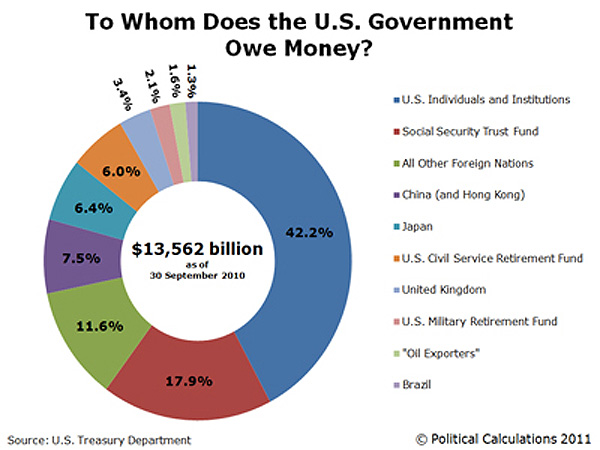
U.S. National Debt Pie Chart
(It's not really germane to the point, but I think it's interesting.)
I've always thought that so long as the interest on T-bills and similar instruments is paid on maturity to Americans and others who own them, we're not in defaut.
My touchstone here is in my personal finances and in the book contracts: Darn near every month, various creditors -- the mortgage company, the gas company, water and power, credit-card companies, car insurance, medical and dental professionals and facilities, the gym, and so forth, send us letters enclosing bills. Each bill lists an amount due and a "pay by" date.
A couple of times a month, I gather all the current bills together and write the creditors a bunch of checks. This money is deducted from our income that month. From the remainder, we pay for food, clothing, gasoline, vodka, and other necessities. Then when all that is allotted, we spend on entertainment, books, CDs, and suchlike frivolities. Finally, whatever still remains we can invest or hold in a savings account or give away to lovable tramps who come to our back door.
You may note, by the order in which I wrote the above, that we always pay the bills first, before spending on anything else. If a particular month has more bills than usual, we spend less on current purchases (duh). If a particular month is lighter in the bill department, we have more disposable income, allowing us to buy more stuff or invest more in stocks or mutuals or gold. But we pay the bills first.
And so long as we pay each creditor by its due date, we're not in default on our debt, and they can't take us to court or jack up our interest rate or otherwise take vengeance against us.
This all seems straightforward to me; but I reckon it must be completely different with a government. Because otherwise there would be a very simple way, a scheme, a strategy to ensure that our government never finds itself in default, thus never suffering the dire consequences that Reuters and AP threaten is about to engulf us, now that House Majority Leader Eric Cantor (R-VA, 100%) and Sen. Jon Kyl (R-AZ, 96%) have "walked away" from the negotiations to raise the limit on the national credit card.
Here is my cunning plan: In the event that the negotiations "collapse," and the debt ceiling isn't raised -- can't Congress simply prioritize paying interest on the national debt?
That is, when it's crafting a budget, can't Congress budget the funds to make any required payments for maturing U.S. national-debt investment instruments, such as T-bills, first, before any other budget item? Once those payments are accounted for, Congress can budget money for other purposes, such as funding departments (Defense, State, etc) and paying federal salaries, funding so-called "entitlement programs," and finally discretionary spending. Why not prioritize interest on the debt over eveything else, just as they prioritize "entitlement" spending over discretionary spending? (The analogy to the household finances is that we pay our bills first, then we pay for necessities, and finally we spend on unnecessaries.)
All right, maybe we wouldn't be able to fund all the discretionary projects we wish we could. But hey, them's the breaks. As Mason said to Dixon, "you gotta draw the line somewhere!" (I don't mean Perry and Cromwell.) But at least the national debt would be serviced, if that's the word I want. (It sounds oddly salacious.)
I realize it can't possibly be that easy, or else Congress would routinely enact a budget like that. Heck, the Democratic Senate hasn't enacted any budget at all since Barack H. Obama became president, so there must be some arcane reason why "pay the interest on the debt first" budgeting isn't possible or feasible for the wealthiest nation in all of human history.
But could somebody please enlighten me as to why not? I hate feeling so completely gormless.
Hatched by Dafydd on this day, June 23, 2011, at the time of 2:37 PM | Comments (9)
March 31, 2011
The Pension Suspension Is Killing Us!
Budget negotiations between California Democrat-retread Gov. Jerry Brown and the legislative Republicans have collapsed. (Surprise, surprise on the Jungle River Boat ride tonight.)
Brown recognizes (or claims to recognize) that the biggest problem in the Leaden State (formerly the Golden State) is too darned much spending; yet for political reasons -- mainly because his own Democratic Party would never accept such a solution -- he doesn't want to close the "$26 billion abyss" in the budget on spending cuts alone. So in addition to proposing some cuts ($11.2 billion, or 43% of the deficit), Brown also seeks to extend a series of "temporary taxes" due to expire this year.
And therein lies the dilemma: Under California's constitution, raising taxes requires a 2/3rds vote in both chambers. But despite Democratic gains in the 2010 elections, the current party mix is as follows:
Lead-in paragraph:
| Chamber | Democrats | Republicans | Votes needed for Democrats to raise taxes |
|---|---|---|---|
| State Senate | 25 (62.5%) | 15 (38.5%) | 2 more votes |
| State Assembly | 52 (65.8%) | 27 (38.5%) | 1 more vote (or 2, if vacancy filled) |
In other words, Democrats alone do not have enough votes to extend those taxes; and so far, the Republicans have held firm, casting not a single vote for the extensions. Besides, again for political cover, Gov. Brown wants the state's voters to approve the tax extension (that is, the tax increase from what current law mandates starting in July). Thus, what the Democrats actually want to pass is a bill that would place on the June 7th, 2011 state ballot an initiative to extend the temporary, two-year tax increases imposed in 2009 for an additional five years. That ballot currently has only local issues; but the legislature can put statewide legislative initiatives onto the ballot if they act by tomorrow, Friday, April 1st, I believe.
(Does anybody doubt that in 2016, Jerry Brown, if he's still governor, or any other Democrat will demand that we "extend" the tax increases for an additional five or ten or twenty years? "With such a whopping huge deficit in 2016," he or she will wail, "we mustn't even think about tax cuts for California fat cats!")
However, at the moment, the Cal-GOP legislators won't give Brown his initiative, either. Nor is it even likely to pass, even if Democrats find a way to shoehorn it onto the June ballot:
The bigger problem is whether Democrats could drum up enough votes among a cash-strapped electorate to pass a tax increase, especially without the backing of any Republican lawmakers.
A Public Policy Institute of California poll released March 23 showed voter support for the proposal waning. While 66 percent of likely voters agreed with the plan in January, only 51 percent still thought it was a good idea by March.
The survey also showed likely voters divided on how to balance the budget, with 41 percent saying they preferred a mixture of cuts and tax increases, and 40 percent favoring the so-called “all-cuts” solution.
“They seem to be convinced it will not pass,” said Tony Quinn, co-editor of the California Target Book in Sacramento. “They’ve probably got internal polling data saying that if they don’t have Republican votes, voters won’t pass it.”
That's a fifteen-point drop in support for the tax extensions in just two months. Most Californios understand that there are three proximate causes for the reality-warping state deficit... and "undertaxation" is not among them:
- The refusal by Democrats to rein in spending on so-called "entitlements," most especially including unfunded public-employee pension plans.
- A stifling regulatory regime, still expanding, that is tying down California businesses like the Lilliputians tying down Lemuel Gulliver with a million regulatory threads... to the point where, as Robert Anton Wilson put it, "Everything not compulsory is forbidden; everything not forbidden is compulsory." And in fact, some forbidden things are nevertheless compulsory, as regulatory worlds collide.
- One of the most business-hating tort environments in the United States suing more and more local companies out of California and into Oregon, Nevada, and other nearby states.
By an amazing coincidence, the three most potent, greedy, and narcissistic special interests within the California Democratic Party are public-employee labor unions, who demand that all pensions and benefits be sacrosanct, no matter how big a hole they blow in the state budget; ultra-liberal government regulators, appropriators, and other rent-seekers, who think Capitalism is out of control and needs to be under the thumb of the State; and plaintiff civil trial-lawyers, who loot the state to the tune of billions of dollars by filing bogus class-action lawsuits and ridiculous personal injury, medical malpractice, and consumer product safety claims (the only lawsuits they seem to have no interest filing are claims of legal malpractice).
And by a second amazing coincidence, those issues are precisely the Rubicon that the Democrats in the state legislature will not cross: public-employee pensions and benefits, regulation and welfare entitlements, and tort reform. Hence the "unexpected" collapse of budget negotiations.
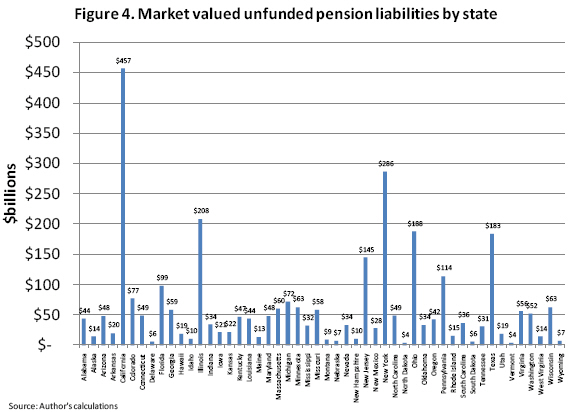
Long term, the biggest problem is probably pensions; in February of last year, the American Enterprise Institute published a detailed calculation of just how much unfunded liability public pensions have dumped on the states, and specifically on California in the present case:
As the largest state, California not surprisingly has the largest absolute public pension funding shortfall at $454 billion, followed by New York with $284 billion and Illinois with $208 billion. Figure 4 shows the market value of unfunded pension liabilities by state.
In case you're interested, here's "figure 4":
Republicans have specifically targeted out-of-control public pension plans, and that is one of the shoals upon which negotiations foundered:
The GOP had pushed for pension reform for public employees, a hard cap on state spending, and a loosening of the state’s regulatory climate. Democrats said the Republican demands were unreasonable, while Republicans blamed the state’s public-employee unions and trial attorneys for sinking the negotiations.
“As a result of these groups’ refusal to challenge the status quo, it has become clear the governor and legislative Democrats are not in a position to work with us to pass the measures necessary to move California forward,” said Republican state Sen. Anthony Cannella in a statement.
So there we are. The California budget is shattered by a budget chasm the size of the Valles Marineris on Mars. The deficit is primarily fueled by public pensions, overregulation, and a trial-lawyer's wet dream of a tort system. But the Democrats utterly refuse to touch any of those three causes, because they would have to defy the most powerful and aggressive special interests within their own party.
The Democrats' solution? Balance the budget on the backs of California taxpayers: When liberals are in charge, Econ. 101 is invariably trumped by Politics 101.
In the end, California voters will have their say; and Gov. Jerry Brown will very likely have to find a way to close the gap without raising taxes that are already unconscionably high. But how long will those same voters who reject tax increases and endless spending nevertheless keep reflexively reelecting the party that is completely and impulsively defined by the mantra "tax, borrow, and spend?"
Hatched by Dafydd on this day, March 31, 2011, at the time of 7:33 PM | Comments (0)
January 20, 2011
A Good Start; Keep Plugging!
The Republican Study Committee, a conservative caucus within the House of Representatives that is chaired by Rep. Jim Jordan (R-OH, 100%), has proposed the Spending Reduction Act of 2011. But before taking a look, let's review the status quo.
Let's recall that the GOP leadership was talking about possibly, maybe, well not quite but close, cutting about $100 billion from the 2011 budget -- that is, cutting approximately 2.6% from total federal outlays as proposed by President Barack H. Obama in 2010. And let's also understand that the total Obama proposed includes hundreds of billions of dollars in fantasy spending cuts that the Left would never actually implement, coupled with hundreds of billions of dollars in "off-line" spending that is separately accounted. Realistically, real spending would likely be closer to $4.5 trillion under the generous hand of the Obamunist (always willing to dig down deep in your pocket and take until it hurts). So on Planet Earth, the Republican leadership is really talking about a robust 2.2% reduction. Wow.
Now back to the RSC's proposal; they begin with a much bolder goal:
Moving aggressively to make good on election promises to slash the federal budget, the House GOP today unveiled an eye-popping plan to eliminate $2.5 trillion in spending over the next 10 years. Gone would be Amtrak subsidies, fat checks to the Legal Services Corporation and National Endowment for the Arts, and some $900 million to run President Obama's healthcare reform program.
What's more, the "Spending Reduction Act of 2011" proposed by members of the conservative Republican Study Committee, chaired by Ohio Rep. Jim Jordan, would reduce current spending for non-defense, non-homeland security and non-veterans programs to 2008 levels, eliminate federal control of Fannie Mae and Freddie Mac, cut the federal workforce by 15 percent through attrition, and cut some $80 billion by blocking implementation of Obamacare.
(I've put the entire list of cuts, from the RSC Overview of their spending-cut proposal, in the extended portion of this post; click the "Slither on.")
Dividing $2.5 trillion by ten years yields an annual reduction (from proposed budgets) of $250 billion, two and a half times what the GOP top dogs first proposed, then walked back. Another way to look at it is that, instead of a yearly 2.2% reduction of the real spending mountain we face, the RSC proposes a yearly reduction of 5.6%.
So as I said, a good start. But there is another benefit if this proposal or anything close were enacted, perhaps after a lengthy negotiation with frightened Democrats; it would demonstrate that we can cut spending.
Actual spending reduction (as opposed to a reduction in the increase) is as rare as a Democrat with callused hands. Ronald Reagan and George W. Bush were able to significantly reduce taxes, but never spending. Bill Clinton, in concert with a newly Republican Congress (both houses), was able to balance the budget, but primarily by the fortuitous explosion of the computer/high-tech industry, which expanded the tax base... which itself had more to do with economic and regulatory policies initiated by Reagan than anything Clinton did. But I cannot recall significant spending cuts in my lifetime.
(Checking the budget history, there was a major spending reduction when World War II ended -- we were no longer supporting seven million men in the field, fighting half the world -- and a small reduction when the Korean War ended. But spending rose continuously throughout the Vietnam War and kept on rising after the war ended, not with a bang but a bug-out.)
Many Americans, having no experience with actually cutting spending from year to year, simply accept as read that it's impossible; but if we can demonstrate it before our very unbelieving eyes, then maybe folks will get all het up about cutting more and more and more. What Man has done, men can aspire to do!
With courage, perseverence, and good argument, we might be able to slash spending further and deeper than this nice jumping-off point from the RSC, down to a level that is actually comprehensible to mortal humans; at the very least, we should be able to slash Obama's ten-year deficit from $10 trillion to, say, only $3-4 trillion. And from there, it's only a short hop to a real balanced budget. And this time, once we have achieved balance through spending cuts, not tax increases, maybe we'll be diligent enough to keep it there.
On the other hand, if this proposal comes to nought; if it's watered down by the Republican nomenklatura in the House; blocked by the Democrats in the Senate; summarily rejected without even a nod towards negotiation by la Casa Blanca; and tossed in the dustbin of history... then it will have the opposite effect: It will confirm the initial thesis, that real spending cuts are literally impossible.
So this is very high-stakes political poker, and we're all-in on this one. Let's hope the RSC isn't just playing a stone bluff.
A complete listing of the spending cuts proposed by the Republican Study Committee
- FY 2011 CR Amendment: Replace the spending levels in the FY 2011 continuing resolution (CR) with non-defense, non-homeland security, non-veterans spending at FY 2008 levels. The legislation will further prohibit any FY 2011 funding from being used to carry out any provision of the Democrat government takeover of health care, or to defend the health care law against any lawsuit challenging any provision of the act. $80 billion savings.
- Discretionary Spending Limit, FY 2012-2021: Eliminate automatic increases for inflation from CBO baseline projections for future discretionary appropriations. Further, impose discretionary spending limits through 2021 at 2006 levels on the non-defense portion of the discretionary budget. $2.29 trillion savings over ten years.
- Federal Workforce Reforms: Eliminate automatic pay increases for civilian federal workers for five years. Additionally, cut the civilian workforce by a total of 15 percent through attrition. Allow the hiring of only one new worker for every two workers who leave federal employment until the reduction target has been met. (Savings included in above discretionary savings figure).
- "Stimulus" Repeal: Eliminate all remaining "stimulus" funding. $45 billion total savings.
- Eliminate federal control of Fannie Mae and Freddie Mac. $30 billion total savings.
- Repeal the Medicaid FMAP increase in the "State Bailout" (Senate amendments to S. 1586). $16.1 billion total savings.
- More than 100 specific program eliminations and spending reductions listed below: $330 billion savings over ten years (included in above discretionary savings figure).
Additional Program Eliminations/Spending Reforms
- Corporation for Public Broadcasting Subsidy. $445 million annual savings.
- Save America's Treasures Program. $25 million annual savings.
- International Fund for Ireland. $17 million annual savings.
- Legal Services Corporation. $420 million annual savings.
- National Endowment for the Arts. $167.5 million annual savings.
- National Endowment for the Humanities. $167.5 million annual savings.
- Hope VI Program. $250 million annual savings.
- Amtrak Subsidies. $1.565 billion annual savings.
- Eliminate duplicative education programs. H.R. 2274 (in last Congress), authored by Rep. McKeon, eliminates 68 at a savings of $1.3 billion annually.
- U.S. Trade Development Agency. $55 million annual savings.
- Woodrow Wilson Center Subsidy. $20 million annual savings.
- Cut in half funding for congressional printing and binding. $47 million annual savings.
- John C. Stennis Center Subsidy. $430,000 annual savings.
- Community Development Fund. $4.5 billion annual savings.
- Heritage Area Grants and Statutory Aid. $24 million annual savings.
- Cut Federal Travel Budget in Half. $7.5 billion annual savings.
- Trim Federal Vehicle Budget by 20%. $600 million annual savings.
- Essential Air Service. $150 million annual savings.
- Technology Innovation Program. $70 million annual savings.
- Manufacturing Extension Partnership (MEP) Program. $125 million annual savings.
- Department of Energy Grants to States for Weatherization. $530 million annual savings.
- Beach Replenishment. $95 million annual savings.
- New Starts Transit. $2 billion annual savings.
- Exchange Programs for Alaska, Natives Native Hawaiians, and Their Historical Trading Partners in Massachusetts. $9 million annual savings.
- Intercity and High Speed Rail Grants. $2.5 billion annual savings.
- Title X Family Planning. $318 million annual savings.
- Appalachian Regional Commission. $76 million annual savings.
- Economic Development Administration. $293 million annual savings.
- Programs under the National and Community Services Act. $1.15 billion annual savings.
- Applied Research at Department of Energy. $1.27 billion annual savings.
- FreedomCAR and Fuel Partnership. $200 million annual savings.
- Energy Star Program. $52 million annual savings.
- Economic Assistance to Egypt. $250 million annually.
- U.S. Agency for International Development. $1.39 billion annual savings.
- General Assistance to District of Columbia. $210 million annual savings.
- Subsidy for Washington Metropolitan Area Transit Authority. $150 million annual savings.
- Presidential Campaign Fund. $775 million savings over ten years.
- No funding for federal office space acquisition. $864 million annual savings.
- End prohibitions on competitive sourcing of government services.
- Repeal the Davis-Bacon Act. More than $1 billion annually.
- IRS Direct Deposit: Require the IRS to deposit fees for some services it offers (such as processing payment plans for taxpayers) to the Treasury, instead of allowing it to remain as part of its budget. $1.8 billion savings over ten years.
- Require collection of unpaid taxes by federal employees. $1 billion total savings.
- Prohibit taxpayer funded union activities by federal employees. $1.2 billion savings over ten years.
- Sell excess federal properties the government does not make use of. $15 billion total savings.
- Eliminate death gratuity for Members of Congress.
- Eliminate Mohair Subsidies. $1 million annual savings.
- Eliminate taxpayer subsidies to the United Nations Intergovernmental Panel on Climate Change. $12.5 million annual savings.
- Eliminate Market Access Program. $200 million annual savings.
- USDA Sugar Program. $14 million annual savings.
- Eliminate the National Organic Certification Cost-Share Program. $56.2 million annual savings.
- Eliminate fund for Obamacare administrative costs. $900 million savings.
- Ready to Learn TV Program. $27 million savings.
- HUD Ph.D. Program.
- Deficit Reduction Check-Off Act.
Subsidy to Organisation for Economic Co-operation and Development (OECD). $93 million annual savings.
TOTAL SAVINGS: $2.5 Trillion over Ten Years
Hatched by Dafydd on this day, January 20, 2011, at the time of 6:04 PM | Comments (0) | TrackBack
October 19, 2010
"Not Responsible for Advice Not Taken"
Credit where it's due: That phrase is one of Larry Niven's favorite sayings. (I don't know whether he made it up or heard it somewhere.)
The advice in this case comes from many economists, including Thomas Sowell and Walter Williams, and I'm sure Milton Friedman and Henry Hazlitt had something to say about it: The real-world effect of minimum-wage laws is not to raise incomes -- but to depress employment, thus killing the incomes of the very people the Left purports to protect.
The classical theory is pretty clear: What you subsize, you get more of; what you tax, you get less of. Suppose you're an employer, and you need to hire some guys... for example, teenagers to work in your pizza joint. Taking into account your profit margin, your customer base, and your competition, you determine each employee is worth, say, $5 per hour. But then the Feds -- or more often, your state -- decides that in order to preserve the "dignity of labor," it must impose a minimum wage of, say, $8 per hour (California's rate).
The difference of $3 per hour constitutes the economic equivalent of a 60% tax on labor: By making each worker 60% more expensive than he otherwise would be, the minimum-wage law reduces employment: Where you planned to hire four employees for an extra $20 per hour total, now that same $20 will only buy you two and a half employees... which translates either to two employees instead of four, each stretched pretty thin; or else three employees, and your profit margin (never very high) goes out the window. In either case, you get a significant increase in unemployment, especially among teenaged workers, low-income workers, and low-skilled workers... the very people the law ostensibly is designed to protect and support.
(The labor costs even for higher-paid workers also increases, as many union contracts mandate salaries of all unionized employees at some fixed multiple of the minimum wage.)
That's the classical theory; but a handful of studies by more "progressive" economists in the Clinton 1990s purported to show that decades of classical theory were wrong... and in fact, minimum wage laws and increasing the minimum wage were either neutral on employment -- or actually increased employment! Wow, we could have our tax and eat it, too.
Authors studied several minimum-wage increases in this or that state, compared them to nearby states, and concluded that no evidence showed increased unemployment in the states whose minimum wage had risen, relative to those states whose minimum wage had remained the same.
But during this last decade of the oughts, grave doubt has been cast on these recent studies by even newer research. The basic criticism, I believe, is sound: The question about minimum-wage laws is not whether they exist, but whether a particular minimum is "effective" at raising wages significantly: If not, then employers can absorb the minor cost increase and make it up in other ways; but when it is, when the increase is too big to skirt, then classical theory kicks in and employment drops.
And of course, if a minimum wage increase is too small to significantly impact wages -- then what's the point, exactly?
Suppose you decide to hire those four employees at $5 per hour; but then the government imposes a minimum wage -- of $5.15 per hour, a 3% increase over what you expected to pay. That means instead of a direct labor increase of $20 per hour for your four new employees, you must pay $20.60.
But with a difference of only sixty cents per hour total, you can probably still hire all four employees; you'll just raise prices by 3% or so to make up for it, or you'll slightly decrease the hours your employees work, or some other substitution for not hiring.
But if the minimum wage is raised significantly more, then you can no longer pass the cost along to customers or just make everybody work less; there's not enough slack to stretch that far. Your only option is to cut back employment, which means cutting back services, which means a gigantic slowdown in the economy.
So why did research back in the 90s find what they found? Because, as it happens, states don't normally make drastic, overnight increases in the minimum wage; so the studies were looking at reasonably small increases over the prevailing wage -- which, not surprisingly, did not always cause statistically significant increases in unemployment. Still, it would be nice to have a case study proving what seems obvious in the classical theory: Make labor expensive enough, and business will significantly reduce employment.
What we really need in order to test the classical theory is to have a much more drastic wage increase mandated by government, then see whether that does or does not send the unemployment rate skyrocketing; but such an experiment could be so grotesquely destructive of the economy that nobody but a complete idiot or a madman would champion such a scheme.
Cue the Democratic Congress elected in 2006.
One of the first orders of business of the 110th United States Congress, which took office on January 3rd, 2007, was to raise the federal minimum wage from $5.15 to $7.25 per hour, a 40.8% increase, in three stages of 70 cents each: up to $5.85 in 2007, to $6.55 the next year, and the full $7.25 in 2009.
Coincidentally, the U.S. unemployment rate rose from 4.6% in January, 2007 to 4.9% one year later (an increase of 6.5%); then up to 7.6% by January, 2009 (an increase of 55%); then to 9.7% this last January (another 28% increase), where it has more or less stayed all year. The total increase in unemployment under the Democratic Congress has been 108.7%.
Obviously, you can't attribute the entire surge in unemployment on the drastic increase in the minimum wage; but circumstantial evidence certainly makes it seem likely that the policy must shoulder at least some of the blame. ("Not responsible for advice not taken.")
But the effect of minimum-wage laws can be seen even more transparently when minimum wages designed for the First-World United States are applied, willy-nilly, to its effectively Third-World territories. One of the other provisions of the Democrats' minimum-wage debacle in 2007 was to force the same rule to apply to American Samoa and the Northern Mariana Islands.
As Walter Williams notes, prior to the 110th Congress, the minimum wage in American Samoa was $3.26 per hour; thus the Democratic scheme to increase wages to a minimum of $7.25 per hour amounted to a 122.4% "raise" for all workers in that territory. Surprise, surprise, even though the law is being phased in at fifty cents per hour per year (slightly slower than in the United States) and hasn't gotten anywhere near the looming peak, the net result has been to devastate the Samoan economy, particularly the tuna canneries:
Chicken of the Sea International moved its operation from Samoa to a highly automated cannery plant in Lyon, Georgia. That resulted in roughly 2,000 jobs lost in Samoa and a gain of 200 jobs in Georgia.
Given Samoa's low cost of living, $3.26 provided Samoan workers a higher standard of living than some of their neighbors on other islands. Now these workers are unemployed. What's worse is that Starkist, Chicken of the Sea's competitor, might leave the island as well. If that happens, increases in the minimum wage will have cost more than 8,000 jobs in Samoa's canneries and related industries; that's nearly half of its labor force.
And now, the Democrat-induced extreme labor surplus in Samoa has become so glaringly obvious, even the Democratic Congress has (reluctantly) noticed and been forced (even more reluctantly) to undo its own "progressive" scheme:
Just three years after a Democrat-led Congress imposed the federal minimum wage on two U.S. territories in the Pacific, lawmakers last month halted the program in its tracks, acknowledging the move had sapped thousands of jobs from American Samoa and the commonwealth of the Northern Mariana Islands.
The two-year delay in the case of American Samoa and one-year reprieve for the Northern Mariana Islands was imposed even as both parties have sparred over the effects of the minimum wage in the U.S. during the troubled economy.
"We said this increase would be harmful in 2007, and the Democrats did it anyway," said Rep. Patrick T. McHenry, North Carolina Republican. "It proves our point that the federal government setting wage rates is destructive to job creation, whether it's in American Samoa or western North Carolina."
So it appears that classical economics theory is still valid; not even so eminent a liberal as the One We Had Supposedly Been Awaiting All This Time can repeal the basic relationship between marginal cost and supply and demand, of labor or any other commodity: By making labor more expensive, you reduce its demand and therefore increase unemployment. And the more expensive you make labor, the higher you drive unemployment (take a long look at Europe).
I believe the experience of the last few years of Democratic control of Congress and (after the 2008 election catastrophe) the White House should cause even ultra-liberal economists, such as Paul Krugman, to rethink their tendentious rejection of any linkage between (a) increasing the cost of doing business, and (b) decreasing the amount of business being done... and in particular their risible contention that increasing the cost of labor actually reduces unemployment.
But I would put the odds that even the hardest reality can penetrate the liberal-progressive-socialist body armor of faith-based ideology at somewhere south of zero. Perhaps instead of teaching college students the joys of Keynesian economics -- or worse, Alinskyism -- universities should make every student read and pass a comprehension test on the classic sociology book When Prophecy Fails, chronicling how true believers in a UFO cult react when their date for the end of the world comes and goes, but Earth abides.
(Study hint: A few cultists peeled off, but most not only remained they picked a newer, later date for world destruction -- and redoubled their efforts to proselytize for new members! Sound familiar?)
Hatched by Dafydd on this day, October 19, 2010, at the time of 3:08 PM | Comments (1) | TrackBack
September 24, 2010
The New Girls Network
The Tea Party has always been predominantly a women’s movement, or else they would have called it the “beer party.” Because of the high profile of Tea Party types like Glenn Beck, it is easy to forget that those frequently taking the point in reforming the Republican Party -- and the nation itself -- are outsiders like Sarah Palin and her “constipated grizzlies,” or whatever she calls them.
The latest of eight almost unbroken series of Tea Party victories in Republican primaries -- against candidates endorsed by the National Republican Senate Committee -- was racked up last week by Christine O'Donnell of Delaware, who is reminiscent of Palin, but without her laserlike intellectual firepower.
But you don’t need a big brain -- although perhaps a big mouth helps -- if your message is simple: cut spending, get big government out of our lives, and cut taxes.
It is becoming obvious that we are witnessing a movement that comes along once a century; and like most such movements, it will wreck anything that stands in its path.
It is vastly entertaining on several levels. One is the obvious discomfort of old time feminists who just can’t understand how a feminist could be a) a Republican, and b) a conservative. It’s been Democratic Party doctrine for ages that the GOP is just a "good old boys" network. How can women, of all people, run as conservative Republicans? I mean, ewwwwwww!
In a sense the GOP is a good old boys network, as one can see by watching notable political hacks like Karl Rove having fits on TV about outsiders like O’Donnell challenging establishment candidates.
For me, finding something nice to say about Rove is like trying to pick up the poo by the clean end; under his firm pilot’s hand, Republicans drifted into being as much a big-government party as the Dems. But one thing he has always had going for him was that he is an incredibly savvy (if totally amoral) political operative. Rove is obviously flummoxed by the pitchfork and guillotine quality of the Tea Party movement; but let’s face it, there is nothing that has more righteous indignation and pure, electric fury than a female on the rampage... hence Palin’s grizzly-bear metaphor.
But the Tea Party isn’t just anger; it is sophisticated, supple, and as net-savvy as a ‘Droid.
Two years ago political pundits remarked about the online organization of the Obama team and its remarkable exploitation of the net. However, today’s organizational effort by the Tea Party defies the term organization. It has been described as being like a “hive,” without a central guiding hand, with each individual party in contact with each other, but run independently. It runs rings around the old style organizations.
[I have been calling the Tea Party movement the "popular front for Capitalism and against government expansion and intrusion; students of history will understand the nuclear fusion packed into the phrase "popular front." -- DaH.]
It is a true grassroots movement, with the impetus moving up from the bottom. Democrats who think there is some conservative Soros as its Wizard of Oz are delusional.
I have a liberal friend who buys into that comforting fantasy. He keeps repeating the mantra, “Well, why weren’t they complaining eight years ago when Bush was running up all those deficits?” The answer to that, of course, is that they were, and the Republicans didn’t listen to them; and that was, in part, why the Republicans were kicked out of power in 2006 and 2008.
But that didn’t mean that the disaffected Independents and outraged Republicans wanted big government solutions. The Democrats decided to party like it was 1932, and they are about to pay in a big way.
As columnist David Paul Kuhn wrote this week: “The political establishment's reign has finally ended.... One week ago, the primary season closed with the most suitable of metaphors: The tea party movement sacked GOP’s Castle.” I wish I’d written that; if I were Joe Biden I eventually would have.
Hatched by Dave Ross on this day, September 24, 2010, at the time of 10:24 AM | Comments (1) | TrackBack
September 23, 2010
The Pledge Report
Today, the Republicans released what they call, with obvious reference, their Pledge to America. Many fiscal conservatives and TPers are savaging the Pledge on grounds that it doesn't go nearly as far as necessary; a good example is Karl, a too-infrequent guest poster at Patterico's Pontifications. (Note to Patterico: More Karl, please!)
Karl inexplicably sees the Pledge less as a political campaign document than as a roadmap (if I may use that term) to how the new GOP majority will govern... and by this analysis, the Pledge comes up wanting:
This year, with the odds already favoring the GOP regaining a House majority, it is again better to judge the new “Pledge” -- which this year’s candidates are not even formally agreeing to support -- on the basis of how well it serves as a governing document and potential confidence builder....
The rise of the Tea Party was driven in no small part by failures in political leadership, particularly Republican leadership. The political task of Republican leadership now is to reconcile the demands of the Tea Party (and, more broadly, the small-government base of the GOP) with the limits imposed by a divided government and the need to attract swing voters who are voting more for gridlock than they are for Republicans. There is not much in the Pledge to suggest the House GOP has figured out how to square that circle.
I don't follow Karl's logic. The main beef every other detractor has against the Pledge is that it comprises nothing but vague generalities; how can that be a governing document, when governing documents tend to be tortuous, byzantine exercises in lawyerese? At best, the Pledge to America is a restatment of the foundational principles of the United States of America, axioms which the GOP now pledges to rededicate itself to restoring.
I have a very different take than Karl: Pledges are useful distractions; by nature, they're all nothing but campaign broadsides:
- Pledges always materialize before the election, never after. Obviously they're intended to affect the outcome in a way favorable to the pledgers.
- It's impossible to know exactly how the new majority will govern, because you never know in advance the contours of victory. Will the new Squeaker of the House have enough hegemony to control the agenda? Will the Senate majority be filibuster-proof? Will the president decide to cooperate with the new Congress in order to leave a legacy -- or fight hammer and tooth out of quixotic principle, quasi-legal bribery from special-interest lobbyists, or out of sheer cussedness?
- Nobody knows for sure how the new majority will vote in the congressional leadership elections, hence who will be running the show.
- Nobody knows what unexpected crises will derail the entire agenda. Think of mid-September 2001 for an extreme example.
- Nobody can say for sure how the judiciary will respond, and how that might reshape the majority's governance.
Once in power, the majority will decide and revamp its own agenda on a continuing basis, and it may or may not resemble any previous pledge. Furthermore, voters will approve or reject it based upon its ongoing content -- not whether it conforms with a campaign promise.
I mean what I write: I don't believe significant numbers of voters really care whether an elected representative does what he said he would do; they care that he does what they (now) want him to do! On some occasions, voters may actually demand that an earlier pledge be broken; think of those hapless Democrats elected in 2008 on a pro-ObamaCare platform, who today feel compelled to run away from the very package for which they voted, threatened by the very constituents who were for it before they were against it!
For that matter, think of Barack H. Obama in the 2008 elections: The only people who cared that he broke his solemn oath to accept public funding -- were those who never had any intention of voting for him in the first place. His supporters didn't give a rat's badonkadonk.
In any event, earlier pledges are far less important than what the majority does in office. Case in point: Tea Partiers will be furious if the new GOP majority doesn't cut the budget significantly below its level in November 2008; but their anger will be just as great given the Pledge to America -- which only promises a cutback to the last George W. Bush budget, which in this scenario the GOP fulfills -- as they would have been had the GOP promised to cut back to, say, the 2004 budget, then broken that promise.
The anger is the same; they would just use different words to describe it... "fiscal irresponsibility" in the first scenario, "a broken pledge" in the second.
As a campaign tactic, I think the Pledge works just fine. It aligns the GOP with the midpoint on the anger scale... going not as far as Tea Partiers would want but probably further than many Independents and "moderate" Democrats (Jim Webb, e.g.) prefer.
(I called pledges "useful distractions" above; they're useful because they can help boot Democrats out of office; they're distractions because they discombobulate the multitudinous liberal talking heads, since a good pledge must be answered by some handwaving -- time those master debaters could have better spent going on the attack instead of playing defense.)
As far as governing, the test will be who gets the chairmanships of which committees, and what they do once ensconced in their new chairs. We need to see some significant shakeups in the current heirarchy to be reassured it's not just business as usual. If every financial, banking, taxing, and spending committee chairmanship slides automatically to the ranking Republican, and if the current Republican leadership moves seamlessly from minority to majority, then we'll know that the tin-ear GOP has done it again -- and 2012 may become another 2006.
But if a few ranking old toots on critical committees find themselves passed over in favor of younger, more dynamic, and more economically conservative members, we should be optimistic that Republicans have finally learnt their lesson.
Hatched by Dafydd on this day, September 23, 2010, at the time of 11:21 PM | Comments (1) | TrackBack
August 27, 2010
What's in Your Wallet... That Won't Be There Tomorrow?
The Republican leadership still can't absorb the new reality of the popular front for Capitalism and against statism; surprise, surprise on the Jungle Riverboat Cruise tonight. They're running away from the vital spending cuts offered by Rep. Paul Ryan (R-WI, 96%), afraid to embrace them -- unwilling to debate them. Once again, the people must lead their putative "leaders":
Rep. Paul D. Ryan's "Roadmap for America's Future" - which proposes major changes to taxes, Social Security, Medicare and Medicaid - has attracted support from some of the GOP's most conservative members, but top leaders have kept their distance....
The plan has attracted just 13 co-sponsors in the House, and a handful of candidates running for the House and Senate have also embraced it. But no congressional Republican leader has signed on, drawing a rebuke from former Rep. Dick Armey, an architect of Republicans' 1994 electoral success.
"The fact that he only has 13 co-sponsors is a big reason why our folks are agitated against the Republicans as well as the Democrats," he said Sunday on NBC's "Meet The Press." "The difference between being a co-sponsor with Ryan or not is a thing called courage."
For those of you saying "roadmap... huh?" -- here's a pointer. The Roadmap for America's Future, developed by Paul Ryan, the ranking Republican on the House Budget Committee, is a fully integrated plan for eliminating debt and sustaining economic growth via spending cuts and transferring some government and employer benefits to individual ownership. Here are the major planks; descriptions come straight from the website, where there is of course more detail:
- Health care - The plan ensures universal access to affordable health insurance by restructuring the tax code, allowing all Americans to secure affordable health plans that best suit their needs, and shifting the ownership of health coverage away from the government and employers to individuals.
Medicare/Medicaid - The Roadmap preserves the existing Medicare program for those currently enrolled or becoming eligible in the next 10 years (those 55 and older today); [f]or those currently under 55 -- as they become Medicare-eligible -- it creates a Medicare payment, initially averaging $11,000, to be used to purchase a Medicare certified plan....
The proposal also fully funds Medical Savings Accounts [MSAs] for low-income beneficiaries, while continuing to allow all beneficiaries, regardless of income, to set up tax-free MSAs.
Social Security - Preserves the existing Social Security program for those 55 or older.
Offers workers under 55 the option of investing over one third of their current Social Security taxes into personal retirement accounts, similar to the Thrift Savings Plan available to Federal employees. Includes a property right so they can pass on these assets to their heirs, and a guarantee that individuals will not lose a dollar they contribute to their accounts, even after inflation.
Makes the program permanently solvent -- according to the Congressional Budget Office [CBO] -- by combining a more realistic measure of growth in Social Security’s initial benefits, with an eventual modernization of the retirement age.
Tax reform - Provides individual income tax payers a choice of how to pay their taxes -- through existing law, or through a highly simplified code that fits on a postcard with just two rates and virtually no special tax deductions, credits, or exclusions (except the health care tax credit).
Simplifies tax rates to 10 percent on income up to $100,000 for joint filers, and $50,000 for single filers; and 25 percent on taxable income above these amounts. Also includes a generous standard deduction and personal exemption (totaling $39,000 for a family of four).
Eliminates the alternative minimum tax [AMT].
Promotes saving by eliminating taxes on interest, capital gains, and dividends; also eliminates the death tax.
Replaces the corporate income tax -- currently the second highest in the industrialized world -- with a border-adjustable business consumption tax of 8.5 percent. This new rate is roughly half that of the rest of the industrialized world.
There are some other elements, but that is the gist.
The Roadmap doesn't just nibble around the edges of the federal budget; it sets its sites squarely on the real spending blockbusters, the so-called "entitlement" programs that comprise, all by themselves, about 40% of the budget -- and are responsible for many tens of trillions of dollars of unfunded liability. Every economist agrees that without somehow reforming entitlement programs, they will continue to grow out of control until they gobble up the entire federal budget, and sooner than most of us realize.
So naturally, you can see why Republican "leaders" seemngly have no interest in signing aboard the Roadmap for America's Future; heaven forbid they should actually take a stand, one way or the other, on the biggest economic calamity facing the United States today. I think Dick Armey has it pegged: "The fact that [Ryan] only has 13 co-sponsors is a big reason why our folks are agitated against the Republicans as well as the Democrats."
Among those afraid to embrace, but unwilling to debate are House Minority Leader John Boehner (R-OH, 96%) -- the man who would be Squeaker -- and Senate Minority Leader Mitch McConnell (R-KY, 96%), the man who would be president (in a sow's ear).
Just two more "profiles in cowardice." Time to light a spur under the pair of them, and the rest of the established Republican establishment. The goal should not be merely to "get more Republicans" into Congress; it should be to get more Capitalists, anti-statists, and defenders of individual liberty.
Most will surely be Republican, as the Democratic Party has been consumed and digested by its most radical wing; but sometimes, a lukewarm Republican is worse than a Democrat... if he's so "moderate" that he can cross the aisle and start caucusing with the Democrats at the drop of a primary challenge, a la Charlie Crist in Florida or the execrable Arlen Specter (R D-PA, 75%).
Hatched by Dafydd on this day, August 27, 2010, at the time of 4:30 PM | Comments (6) | TrackBack
August 23, 2010
An Excellent Mystery
We have a very curious coincidence this year -- or else a parable that should forever alter our approach to elections. But which could it be? According to political analysts on both left and right, it's a mystery!
We start with a little recent history:
- In 2006, Democrats took back the Senate and House, riding the unpopularity of the Iraq and Afghanistan wars (both going badly) and some economic discontent, to which the GOP responded by not really responding.
In 2008, Democrats crushed the GOP, this time primarily due to what turned out to be a very wide and deep recession, which (as is oft the case) voters blamed more on President George W. Bush than on Senate Majority Leader Harry "Pinky" Reid (D-Caesar's Palace, 95%) or Squeaker of the House Nancy "San Fran Nan" Pelosi (D-Haight-Ashbury, 100%).
[Note that Pelosi's 100% liberal record does not count the times she voted against the ADA due to "Speaker's privilege," a parliamentary maneuver to allow her to bring up failed legislation again at a later time.]
Note that in both cases, religious and social issues such as abortion, embryonic stem cells, voluntary school prayer, immigration, and racial preferences would tend to favor Republicans; yet both times, those issues were overwhelmed by the bedrock concerns of national defense and the economy.
Today, we stand on the brink of a revolutionary election that could undo much of the gains the Democrats made in the last two elections. Every pollster, politician, and political prognosticator agrees that the Republicans are going to surge forward, will very likely recapture the House, and could possibly also capture the Senate (which I would have rejected as wish-fulfillment fantasy just three months ago). The Democrats are in disarray, their electoral prospects plummeting so quickly one can hardly keep up with the news.
What is so different this time from 2006 andf 2008? The biggest difference appears to be that this time, the GOP is focused like a Marine Corps sniper on the bedrock concern of national security -- specifically, the inability of the administration of Barack H. Obama and of the Democratic supermajorities in House and Senate to come to grips with the War Against Radical Islamism -- and especially upon the bedrock concern of the failing economy and the Democrats' "response" of tax, tax, tax and spend, spend, spend, spend, spend (more spending than taxing).
Let's try this again: When Republicans focused on religious issues, social issues, and intangibles like "competence," energy, and so forth, they very badly lost two elections in a row; in both cases, Democrats pounded on military and economic failures of Republicans. But now that the GOP has shifted focus to national security -- they forced Obama to accept George W. Bush's great general, David Petraeus, and his counterinsurgency strategy in Afghanistan -- and to reviving Capitalism in America, for which they actually have specific plans -- e.g., permanizing the Bush tax cuts, slashing government, and the free-market recovery plan of Rep. Paul Ryan, R-WI, 96% -- Republicans are surging ahead of their "Progressive" rivals.
By a remarkable "coincidence," what I call a popular front for Capitalism and against Progressivism has swept the nation, in the form of Tea Party rallies and suchlike.
Could this be no coincidence? Might voters really prefer the free market to five-year plans? That we prefer aggressive defense of American national security over diplomacy, negotiation, and appeasement? I suggest we at least consider this as a possibility.
Could we have mitigated the ill effects of the the 2008 election by refocusing on national security and the economy? Think back to the election of 1982, when, as in 2008, Republicans faced an election during a serious recession; and as in 2008, they were in the minority in the House of Representatives. (Though Republicans had a reasonably solid lead in the Senate, conservatives did not; a great many Republicans were quite liberal, à la Lowell Weicker of Connecticut.) Worse, the Republican standard-bearer, President Ronald Reagan, was not on the ballot, as 1982 was a midterm election; by contrast, Republicans in 2008 had the opportunity to nominate a nationally recognized fiscal conservative as president.
Yet in 1982, Republicans lost only 27 seats in the House, a normal midterm correction. While the GOP lost only 21 House seats in 2008, six fewer than in 1982, that was not a midterm, so there was no "normal correction" expected; it was just a straight-up contest, and the GOP was thumped.
Too, I believe even many of those 1982 losses were due more to redistricting in Democratic states than in voters switching allegiance; were it not for redistricting, the House losses might actually have been lighter than usual -- even during a recession.
And in the Senate, Republicans lost no seats whatsoever in 1982, despite the recession. In 2008, Republicans lost eight Senate seats, as well as the presidency -- completing the shellacking.
Why? What was different between 1982 and 2008? In the former, Ronald Reagan and the minority Republicans not only emphasized jobs and growing the economy, they actually had a Capitalist plan -- courtesy of Reagan -- for doing just that: Cut taxes, shrink the government, lower interest rates, and unshackle American business from senseless and crippling government regulation.
In addition, Republicans had a president who favored taking the Cold-War fight to the enemy, the "evil empire" of the Soviet Union, rather than conceding issue after issue in a futile attempt to appease the Bear and the Dragon. Reagan dared to demand, not mere survival, but actual victory.
I strongly suggest that the GOP did all right in 1982 and looks to be ready to surge forward this year precisely due to boldly advancing both a victory-oriented strategy for national security and a capitalist reformation and revival of the economy -- more the "invisible hand" of the free market and less the "invisible foot" of government.
And I further suggest that in all future elections, just to be on the safe side, we actually make aggressive national defense and growing the economy (while shrinking the government) the cornerstones of our national campaigns... while leaving religious, social, and intangible issues to those local races that have particular interests in them that year.
A few more elections fought on the basis of American strength and freeing the American economy, and we might actually solve this excellent electoral mystery!
Hatched by Dafydd on this day, August 23, 2010, at the time of 3:51 PM | Comments (2) | TrackBack
August 18, 2010
A Capital Idea
I find it simultaneously astonishing and predictably believable that even today, August 18th, 2010, the great majority of the commentariat, the political establishment, and the people themselves -- no to mention the financial mavins and captains of industry! -- have no idea in the world what Capitalism is or how it works.
Believable because, having suffered through the public school system in Southern California, I know just how dreadful government education is (and quite deliberately so), particularly on economics... which, if it's taught at all, takes its cue from the deplorable a People's History of the United States, by Communist Party member and Chomskyite Howard Zinn. (Even if a People's History isn't directly taught in middle school or high school, that book is the source is nearly all the economic "knowledge," or rather factoids, of middle-school and high-school teachers. However, there is a Young People's History of the United States, adapted by Zinn from the deranged original. From little ACORNs do mighty orcs grow.)
And hardly a surprise that multinational corporations are violently protectionist, anti-market, and anticapitalist; it's a natural fallout of Lizardian Lemma 1: The bigger a corporation becomes, the more it resembles a government.
CEOs envy and crave the power of the State to tax the citizenry and spend the stolen loot how it pleases. And as much as possible, boards of directors ape the high-handed fiduciary corruption of their imperial mentors in the government.
Still I find the ignorance of and antipathy against Capitalim astonishing... because properly understood, a vigorous, free-market capitalist economy is better in the long run than the modern-day robber-baronism, the corporate-government "partnerships" and payoffs -- better even for the robber barons themselves! The thesis is not hard to understand; liberty, both political and economic, has produced a world where even the hundreds of millions of lower-middle income workers live better, more fulfilling lives than did the kings and emperors of the Middle Ages.
I don't demand we all have the deep understanding of Capitalism of a Steve Forbes or a Rubert Murdoch; I certainly don't. But the core-basic principles are understood today as poorly as they were in the midst of the Great Socialism-Driven Depression of the 1930s, and much more egregiously misunderstood than they were in the 19th century. A hundred years of liberal government re-education camps, with no child left behind, has worked diabolical wonders of ignorance and paranoia against economic liberty.
The first source of my headshaking... the bizarre notion that savers should be punished with higher taxes:
Figures recently published by the Commerce Department show the mostly upper-income households that hold stocks earned $169 billion more in dividends since 2007 than previously estimated. Much of that money was stowed away in savings, helping drive the personal savings rate to 6.25 percent earlier this year -- the highest level in decades....
The Obama administration -- despite its calls for people to save -- has seized on the number, with Treasury Secretary Timothy F. Geithner stressing that extending Bush-era tax cuts for the top 2 percent of earners would not be a good way to provide stimulus to the economy.
"The top 2 percent are the least likely to spend those tax cuts, certainly not in comparison to the 98 percent of Americans who make less than $250,000 per year," he said. "While they would surely welcome extended tax cuts, its not likely to change their spending habits."
Let's boil this down to a talking-points memo:
- Rich slackers aren't spending enough money to "stimulate" the economy.
- Instead, they're hoarding their Bush tax cuts, "socking away" tens of billions of dollars that should be put to use in the economy.
- The fact that they're not spending their tax cuts proves they didn't need them in the first place.
- So we should raise taxes on rich people so we can "stimulate" the economy the right way, our way... which has worked out so beautifully in the last couple of years!
Wait... what exactly does the Left mean by saying rich people "socked away their money?" The impression given is a Princess-and-the-Pea-sized stack of mattresses, all stuffed with thousand-dollar bills; swimming pools of gold doubloons; entire mansions built from solid gold, like Scrooge McDuck might have!
The reality is rather more prosaic, and it belies the very premise upon which the Left (Democratic, Progressive, and Republican) bases its economic theory. When we say the rich "socked away their money," we really mean they invested it -- in stocks and bonds, real estate, small businesses, and of course in banks... banks that turned around and lent out much of that $169 billion to those of us lower in the economic spectrum, so that we could buy houses and cars, and via credit cards, items too pricey to be purchased with what's in our wallets at any moment.
The take-away is this: Rich people's money is not hoarded or out of circulation; it is invested directly in our economy, and indirectly via banks and S&Ls. That money is stimulating our economy far more that any corrupt and command-directed government program. The "socked away" money of the rich is the only thing keeping our economy afloat... and the only thing keeping the vast majority of Americans working.
Second depressing article, merely because it reaffirms Lizardian Lemma 1 above. In an article primarily about the new collusion between so-called "greens" and labor unions, we stumble across the following:
Despite protests on the impact of imports from China on its industry, the paper giant Kimberly-Clark "has announced that they will expand their manufacturing facilities in China," according to a briefing paper from the Washington, D.C.-based Economic Policy Institute, "No Paper Tiger." Yet in Australia, Kimberly-Clark's subsidiary KCA has taken the Australian government to court to force the introduction of green-trade restrictions on imports from Indonesia and China.
Alas, this example is the rule, not than the exception; giant corporations think nothing of whining about anti-competitive tariffs when they want to import products from abroad, then even more loudly demanding the government slap an 80% tariff on their foreign rivals' imports. Multinationals especially have no desire to compete in the free market; they demand laws forcing their competitors out of business!
And of course, there is always a friendly, reliable congressman or senator to sponsor just such protectionist legislation... in exchange for, shall we say, a couple of million to the politician's favorite PAC? (It's largely irrelevant whether the subsidy to corporation A or the huge tax on competitor B is in the form of an earmark or just a regular amendment to the bill; the problem is government interference in the market, not the precise mechanism of that interference.)
The Left has nothing but fear and loathing of free-market Capitalism, but so does the corporatist, whether Democrat or Republican. But each unwittingly hurts himself by creating or fostering an anti-competitive environment, in which profit depends entirely upon pull, schmoozing, and who you know, rather than on how good a product you sell and how much you sell it for. The whimsical nature of profit and loss in such a world makes it virtually impossible accurately to predict sales and revenue, because you never know who is going to be up and who down in the next couple of years. That hurts everybody, even the narcissist who doesn't care who he hurts, because he imagines he's profiting from the chaos itself. Ironic, isn't it?
In Schmoozeworld, the legal intrepetation of the law changes whenever the pendulum swings; what was de-facto legal yesterday is unambiguously criminal tomorrow. Because it's not the actual legal words but the way the administration interprets them that has shifted (in response to more and better lobbying by different lobbyists), amoral, anti-market corporatists often abruptly find themselves in la calabooza, convicted of imperfect precognition of how the legal environment would shift in several years time.
We desperately need to get back to a truly capitalist system, including:
- Economic liberty without the constraints of endless regulation and punitive taxation.
- Laws strictly forbidding the government from taking sides in legitimate competition between different companies.
- Laws preventing the government from buying companies and going into business, or else partnering with some private or quasi-private company. Given the State's "superuser" power to set, then reset the rules by which all other actors play, it is literally impossible for such acquisitions or partnerships to avoid the appearance of impropriety; and it's nearly impossible to avoid actual impropriety itself.
- And a court system that takes contracts seriously, takes private property seriously, and that takes seriously the mano a mano competition within the free market; a court that desires neither to hinder it nor "help it along," but only adjudicate disputes.
The market is a bias-free medium meant to facilitate a "meeting of minds" between buyer and seller; it was never meant to be a government-owned monopoly that picked and chose who would be allowed to sell and who excluded for insufficient payment of tribute.
We conclude with a short parable in which is contained all wisdom.
When Sachi was in college back in the early 19th century, she took a Sociology class. During the course, the professor engaged the class in a fascinating and illuminating experiment.
- Every student in the experiment was given the same number of "dollars" at the start.
- Everyone then engaged in a complex series of business transactions, in which it was possible to win, lose, or stay at roughly the same monetary level; some randomness was involved, but skill also played a role.
- At the end of that series of transactions, the "richest" 20% of the class -- eight students -- was segregated into a special area of the room. In addition to those who earned their way there, one student not already in the upper group won a "lottery;" he too was put into the ritzy area of the classroom, making nine in all. Sachi was one of the upper group (not the lottery winner), but she insists it was due more to luck than skill.
- Before the second round of transactions, the professor told those students in the upper-income group (including the lottery winner) that they could change the rules of the transaction game any way they chose.
The uppers discussed proposed rule changes in a different room. Of the nine students, three argued that the rules should remain exactly the same for the second set of transactions, even though that meant the uppers might very well fall down the socioeconomic ladder.
Three more argued the opposite: That they should change the rules to ensure the uppers would always win. One illuminating observation was that the lottery winner, the only person in the uppers who didn't earn his way there, was in this "cheater" group.
The third group was somewhere in between: They wanted to change the rules so that the uppers had some advantage in the second-round transactions (contra the first group), but not an absolute lock on winning (as with group two).
Sachi was in this third group... and she admits today that the fact that she believed, rightly or wrongly, that she was only in the upper group because of luck played a large role in her decision to join the third group, giving all the uppers some advantage but not an iron grip on power. She was afraid that in a fair competition, she would lose the next time and be cast down among the rabble.
- The uppers finally voted to go with the third group, the ones saying "some advantage but not a lock on power." Presumably the lock-on-power group realized they couldn't prevail, so they joined the some-advantage group to outvote the no-changes group.
- But when the uppers came back and announced the new rules -- the rest of the class refused to continue the game, got up, and walked out: They refused to participate when the rules of the game were changed in the middle of play.
It was an amazing effort for a small college in a suburban area, where one would ordinarily expect a deluge of liberal indoctrination. But the results should be eye-opening.
- Most of those on the top have a natural impulse to change the rules to keep themselves right where they are.
- But not all of them: A significant minority want strict fairness, while another significant minority is willing to tolerate a little cheating but not utter tyranny.
- Finally, nearly everyone has an inborn rejection of changing the rules to his disfavor... and he rightfully reacts with extreme measures when he senses it happening.
I believe the American people have sensed that Obama, the national government, the special-interest favorites, and the biggest corporations are conspiring to change the rules -- to the people's disfavor... and the rest of us are reacting by refusing to play and leaving the room.
You can see it in the polls, in the reactions at townhall meetings (when the anticapitalist incrumbents deign to show up), and in the rallies and protests mounted by Tea Partiers and other members of the popular front against socialism. The pot has boiled over, the lid has blown off, and we're going to see a volcanic eruption at the polls in 76 days.
It will be raining electoral lava and liberal ashes; so grab your asbestos brolly and make ready to mount the battlements. It's long past time to cap the progressivist-socialist-corporatist oil spill and set the Wayback Machine to the days when competition was cut-throat but played under fair rules, with no invisible foot of government stamping on the scales. And if you can wade your way through that big, muddy morass of mixed meaphors (and the big fool says to push on), perhaps it will give you some cheer.
Hatched by Dafydd on this day, August 18, 2010, at the time of 11:11 PM | Comments (0) | TrackBack
July 21, 2010
The Impotence of Being Snakebit
No, he's not there yet. But he's trending in that direction... and he knows it. It's already starting to affect his responses -- he's drifting, drifting into Nixonian levels of paranoia and Johnsonian levels of ennui.
All right, let's back up and start this right. First, I love the July 13-19 Quinnipiac poll showing that President Barack H. Obama's job approval has plunged to 44%, with 48% disapproving -- a 9 point drop in the spread (from positive 5 to negative 4), just since May. Even better is their finding that very few Americans other than die-hard Democrats want, at this juncture, to see Obama reelected: By a 39% to 36% margin, respondents chose the generic Republican over President Obama.
The president is in a slump right now, but he could still pull it all back... at least in theory. Paul Mirengoff of Power Line is convinced that the economy will improve significantly before 2012, and that a rising economy would make Obama very competitive in his reelection bid.
It could happen that way; generally, the American economy automatically recovers from most recessions. But history tells us that if the federal response to an economic downturn is stupid enough, recovery can be delayed indefinitely -- as Franklin Roosevelt's disastrous handling of the Great Depression conclusively proved.
I think even Paul would agree with me that if the economy hasn't improved significantly by early 2012 -- with real employment being the primary indicator of such improvement -- then Obama will head into his reelection without the upper hand; without a drawing hand; without a useful under-handed move he can make; in fact, with no hand at all.
But even if the economy limps forward, avoids a double-dip recession, but shows no dramatic recovery, I suspect his approval ratings would continue to slump. And a very important tipping point looms.
When a president's approval sinks low enough, there is nothing he can do to recover; he becomes effectively impotent, neutered. No matter what action he takes to help the economy, the people become further enraged at him:
- If he raises taxes, Left, Right, and Center are furious that he's raising taxes in the middle of a recession.
- But if he lowers taxes, the Right is furious that he's adding to the deficit; the Left is furious that he's pandering to the Right; and the Center is furious that he's not "creating jobs."
The mechanism at work is the opposite of normal. Under normal circumstances, the people evaluate the policy; if they like it, their approval of the president rises; if they don't like the policy, then approval drops and disapproval rises. But in the situation above, where the president has become unpopular enough, people dislike any policy he enunciates just because they dislike him. If he's fer it, they're agin' it -- no matter what "it" is!
The crisis becomes a vicious circle, a negative feedback loop: The people having decided that they dislike the policy because the disliked president proposed it, they then seize upon the now-disliked policy to disapprove of the president all the more so. The technical term for such a negative feedback loop of job disapproval causing policy rejection causing more job disapproval is "snakebit", if Peggy Noonan can be believed. (And why shouldn't we?)
Eventually the president strikes rock bottom; empirical observation puts that point at about 35%; that's the number of people who would vote for a yellow dog if it called itself a (fill in the blank party).
- George W. Bush hit bottom and stayed there.
- Richard M. Nixon came close and probably would have cratered, had he stayed on.
- And if Barack Obama cannot find a way to really swing the economy around, visibly and spectactularly -- for example, by turning into a pro-Capitalism triangulator -- I believe he will find the same hole as the others.
At the moment, the Obamunist is on a direct glidepath to the snakepit, and there are very few ways for him to reverse course... particularly since the best way to do so is to dramatically remake oneself, as Bill Clinton did; then go before the American people, apologize for his mistakes, ask forgiveness, and promise to turn over a new leaf -- as Ronald Reagan did at the nadir of the Iran-Contra scandal.
But from my read on the current occupant of la Casa Blanca, that option is a non-starter: Obama would have to (a) admit he was wrong, then (b) do an about-face on his signature issue, the economy. I'm not sure which task would be more psychically painful to the man who announced that his ascension to the Petal Throne would cause the oceans to begin to recede and the Earth cool.
Paul Mirengoff is a real expert on Washington D.C. He lives and works there (all right, on the Maryland side); he's an attorney; he's well-connected in conservative and Republican circles; he lunches with movers and shakers -- and I don't mean guys who drive vans full of furniture while singing "Simple Gifts" -- in fine, he's plugged in to the Washington zeitgeist. But he has a chink in his Achilles heel: Paul Mirengoff is relentlessly establishmentarian; as it was, so shall it be, there is nothing new under the sun.
I have none of his political advantages, but what I do have is a speculative ability; from my training both in mathematics and science fiction, I see trends as physical, moving forces... and I sometimes can skate along them to their far ends and see how it all comes out, when to others it still seems as if it could go either way. (For example, I could tell just a few days into the "long count" of the 2000 election in Florida that Algore was never going to surpass Bush, and that the latter would finally prevail.)
I won't say it's inevitable that Obama will become snakebit; but there is a swing, a momentum in that direction; and it's getting heavier with every passing day. If I were required by law to wager $100 on the future, I would bet that by 2012, Obama's reelection will look so dismal that, like Lyndon Johnson, he simply declares godlike success and walks away from the wreckage.
Then he'll write a third autobiographical memoir, and it will be filed in the fiction section at Borders.
Hatched by Dafydd on this day, July 21, 2010, at the time of 11:57 PM | Comments (2) | TrackBack
July 2, 2010
Obamunism on a Nutshell
I rarely do this kind of post; but today, I just can't resist:
Employers cut 125,000 jobs last month, the most since October, the Labor Department said Friday. The loss was driven by the end of 225,000 temporary census jobs. Businesses added a net total of 83,000 workers, the sixth straight month of private-sector job gains but not enough to speed up the recovery.
Unemployment dropped to 9.5 percent - the lowest level since July 2009 -- from 9.7 percent. But the reason for the decline was more than 650,000 people gave up on their job searches and left the labor force. People who are no longer looking for work aren't counted as unemployed.
The latest figures suggest businesses are still slow to hire amid a weak economic recovery. Many economists were hoping to see more private-sector job growth, which would fuel the economy by boosting consumers' ability to spend....
In a separate report, factory orders fell by 1.4 percent in May, the Commerce Department said. It was the first decline after nine months of gains and the biggest drop since March 2009.
The reports follow a slew of data and developments this week that point to slower growth in the months ahead.
In May, home sales plunged and construction spending dropped after a popular homebuyers' tax credit expired on April 30. Consumer confidence has fallen sharply. The European debt crisis has sent U.S. financial markets downward, lowering household wealth. And more than a million jobless Americans have been cut off from unemployment benefits after Congress adjourned for a weeklong Independence Day recess without extending federal aid.
And now, as Monty Python might say, the punchline:
President Barack Obama said the economy is moving in the right direction, but not quickly enough. He seized on the latest data to push for more government stimulus -- including the extension of jobless benefits -- to aid the recovery.
Our entire economic policy is a complete catastrophe; everything we've tried has had the exact opposite effect; now we're on the brink of a double-dip recession -- or a complete collapse -- and the private sector is shattered, the government rapidly gobbling up the stabilizing corporations and crushing the wealth-producing small businesses that could have pulled us out of economic ruin. So clearly -- we must redouble our efforts!
...That, gentle readers, is Obamunism in a nuthouse.
Cross-posted on Hot Air's rogues' gallery...
Hatched by Dafydd on this day, July 2, 2010, at the time of 12:56 PM | Comments (2) | TrackBack
April 15, 2010
Catching up... CBO Scoring: All You Can Eat, Baby!
As you've probably surmised, everything anent translocation is taking much longer than we expected; as we must vacate the old reptillian presence by Thursday (that's today!), you can likely imagine the -- er, Upper Iguanan fire drill, trundling back and forth between the two domiciles toting dozens of boxes on scores of trips. All this is special pleading, of course, trying to bias your response to the post below. To quote the one-termer, "that's how we roll."
I've puzzled for days over the scoring of ObamaCare by the Congressional Budget Office (CBO); what exactly does it mean to say that a bill will reduce the deficit... when we all know, including the board of directors of the CBO, that it actually adds hideous amounts to the deficit?
The explanation is simple: The CBO must, by law, score in accordance with the assumptions provided by Congress -- rather, by the majority party in the House and Senate -- no matter how preposterous, mendacious, or insane.
Pondering this quirk of the law, I think I have come up with a good analogy to illustrate its absurdity. Suppose you decide upon a weight-loss program. You visit a reputable doctor, describe your new diet, and ask him to estimate how many pounds you will lose in the next six months. You say:
- My new diet is called the Pizza and Cheesecake Freakout Diet; I eat nothing but those two food items.
- I will eat only one half of one slice of pizza and one tablespoon of cheesecake per day... nothing else.
- I will spend six hours each day in the gym, seven days a week, vigorously exercising -- I will burn 3,000 calories a day doing so.
- How many pounds will I lose by October, Doc?
By some bizarre section of the medical licensing regulations, the doctor is barred from questioning any of the assumptions you gave him. In theory, then, he could calculate how many calories you claim you will consume, subtract how many you say you will burn in the gym, subtract the calories you burn simply by daily existence, multiply by 182 days, divide the total by 3,500 calories per pound -- and tell you the absurd answer of how many pounds you will "lose"... probably 200 or somesuch.
He knows it's nonsense, but he is forbidden from using more accurate figures. His only choices are to give you the fantasy answer you clearly desire, perhaps enabling you to get some job that has an upper weight limit or some other scam... or else quit the medical profession.
But why would the law require the CBO to operate under such ridiculous constraints? Let me rephrase the question: Why would Congress force the CBO to accept Congress' own bogus assumptions? Why wouldn't Congress allow the CBO to second-guess the legislators instead? Put this way, I believe the question is self-answering.
My guess is that many of the economists working at the CBO are frothing at the mouth, wishing they could make a real projection of what ObamaCare will do to the federal deficit. But of course, they can: All they need do is quit their phony-baloney government jobs and go to work for the Heritage Foundation!
Here's hoping that they all simultaneously come to their senses; admit that money and prestige are less important than truth, a reputation for integrity and competence, and good public policy; and resign en masse. A forlorn hope is better than no hope at all.
Hatched by Dafydd on this day, April 15, 2010, at the time of 9:07 AM | Comments (1) | TrackBack
March 26, 2010
"It's Like Déjà Vu All Over Again!"
Stop me if you've heard this one before:
The Obama administration plans to overhaul how it is tackling the foreclosure crisis, in part by requiring lenders to temporarily slash or eliminate monthly mortgage payments for many borrowers who are unemployed, senior officials said Thursday.
Banks and other lenders would have to reduce the payments to no more than 31 percent of a borrower's income, which would typically be the amount of unemployment insurance, for three to six months. In some cases, administration officials said, a lender could allow a borrower to skip payments altogether.
So a year and a half into the greatest financial and real-estate collapse in decades, and the Barack H. Obama administration still hasn't learned its lesson: You can control the price but not the cost of goods, services -- or money itself.
I envison Greg from the Brady Bunch, perpetually trapped in the throes of "teen logic." It's not a picture to inspire confidence.
Oh, but this time, everything is totally different:
The new push, which the White House is scheduled to announce Friday, takes direct aim at the major cause of the current wave of foreclosures: the spike in unemployment. While the initial mortgage crisis that erupted three years ago resulted from millions of risky home loans that went bad, more-recent defaults reflect the country's economic downturn and the inability of jobless borrowers to keep paying.
Suppose someone has a perfectly sensible mortgage -- fixed or ARM shouldn't make much difference, since interest rates haven't gone up -- and was responsible enough to obtain mortgage insurance; suppose something terrible happens, and he can't pay his mortgage... and then the mortgage insurer goes belly-up, to boot.
I don't believe that has happened, at least not on a large scale; the closest analogy is American International Group (AIG) -- and even AIG didn't go bankrupt; if you'll recall, the Bush and Obama administrations gave the insurer $182.5 billion in loan guarantees in exchange for 80% of its stock.
But suppose this "unfortunate series of events" occurred, through no fault of the borrowers but due entirely to government meddling in the mortgage market. Under that scenario, I can see those folks directly impacted getting some mortgage relief from the feds.
But what about freeloaders who obtain (by hook or by congressional crook) mortgages they are unqualified to receive, predictably too large to pay, perhaps with a huge balloon payment (like Octomom's dad), certainly with no insurance. In the fullness of time, the inevitable inevits, they default on their loans, and they have no money to make it right. What then?
Under our capitalist system, when a borrower makes stupid decisions and winds up underwater, we should let him sink. At least as far as allowing the bank which lent the money to foreclose on the house and sell it for what it can get (generally taking a bath itself, as well it should!) -- then to sue the borrower for the remainder, which the stupid bank likely won't get.
It's not as if we'll wind up with millions starving on the streets; our bankruptcy laws are pretty lenient... probably overly so. (I don't believe we've given adequate consideration to indentured servitude.) But the price of liberty is that each of us has the "right" to fail, and in failing, to learn from our mistakes and serve as an example "pour l'encouragement des autres." That's the capitalist way.
Heartless conservatives push the unenlightened idea that rank stupidity and extreme bad judgment carry harsh consequences, demanding contrition, restitution, and penance before the law and society can grant fiscal absolution. Finally, regressive classical economics suggests that when government tries to obviate or short-circuit that natural economic process, chaos and counterincentives ensue, leading to an economic death-spiral for the whole nation, or even the global financial markets. Obamunism, meet Greece.
Well all I can say is -- thank goodness our beloved president has cast aside that running-dog, imperialist thuggery upon which the country was founded! Who needs Capitalism when you've got Obamunism? The essence of the latter is simple: Vote for us, and we'll give you free money, as much as you want!
- Borrowed more than you can pay off? No problemo; the president will simply order your creditors to wipe away part or all of the principal. Problem solved.
- Can't borrow at all, because you have insufficient (or no) income, bad credit, and a history of defaulting on loans? The One will order banks to lend you the money anyway. At virtual gunpoint.
- Hallelujah, you're a bum? Easy as falling off a bicycle: Uncle Barack will simply extend you another 26 weeks of unemployment "compensation."
Market, schmarket, we haven't time to wait for the ectoplasmic "invisible hand" to guide buyers to sellers; the government will tell you what to buy and how much to pay. As Brother Benito said, no time for talk, no time to think -- we need action, action, action! Impatience is the new creed of the masses: We want everything -- not now, yesterday.
Subjects suffering the malady of Americanism have a cockamamie fantasy that if a borrower makes a terrible mistake, buys too much house with an unpayable mortgage, and can't find another lender to extract him from the tar pit, then he should suffer the consequences.
But that was before the Dear Leader came along and invented the New Obamunist Man, he who scorns fiscal consequences and economic law as relics of a bygone, transitional antiquity. The authors of the progressive housing revolution -- from Jimmy Carter, to Bill Clinton, to Sen. Chris Dodd (D-CT, 100%), Rep. Barney Frank (D-MA, 100%), and umpteen directors of Fannie Mae and Freddie Mac -- have long since thoroughly discredited the bourgeois sentiment of monetary sobriety. Since money is naught but fiat anyway, unrelated to any real underlying wealth, why not just buy our way out of debt by super-sizing the Bureau of Printing and Engraving?
And why not "solve" the problem of foreclosure by forbidding it?
(Technically we needn't even print more money... just increase a few figures on a central spreadsheet at the Federal Reserve.)
My Magic 8-Ball foresees a big, fat, Greek shredding of fiscal responsibility, the free market, the national debt, and any other roadblock that stands between the nationalist-socialist Left and a total "income shift," spreading the wealth away from those who made it and redirecting it to those who, in the government's opinion, really deserve it.
Here's a hint: One surefire way to demonstrate to the feds that you really need to spend someone else's money is to join a union -- preferably the SEIU -- and start beating up conservative "Tea Baggers." That seems to have become the de facto federal relief application.
Cross-posted on Hot Air's rogues' gallery...
Hatched by Dafydd on this day, March 26, 2010, at the time of 3:57 PM | Comments (2) | TrackBack
January 8, 2010
Obama's Jobless Relapse
Let's see...
The economy is rocky; so the Obama Administration responds by:
- Pouring hundreds of billions of dollars down the rathole of "stimulus," funneling most of it to well-heeled political cronies, ficticious accounts, and radical organizations;
- Forcing banks, financial institutions, and huge corporations to accept "bailouts" -- accompanied by nationalization;
- Piling on hundreds of new, hideously expensive government programs whose primary purpose is to buy Democratic votes by paying off special-interest groups;
- Taking over health care, looting Medicare, and engineering a socialist system, as near as makes no difference -- one that costs about $2.5 trillion that we don't have;
- Taxing the energy industry to death, making it so expensive to generate power that we just stop doing do, to prop up a dubious, unscientific thesis that has been all but disproven already;
- Pushing Unionization über Alles, regardless of how that affects job creation;
- Jacking up all other taxes, particularly on various despised industries and on the hated "rich," but with a good, healthy wallop at ordinary Americans across the country;
- Issuing -- without industry input but with the connivance of a murder of wacko, anti-capitalist groups -- a labyrinth of new, untested, and incomprehensible regulations for businesses to follow or be slaughtered by;
- And warning America that Barack H. Obama knows what more it really needs -- and he's going to give it to us, good and hard, in 2010! (Including throwing open the immigration floodgates, tearing down the wall, and heavily favoring those immigrants least likely to assimilate and become productive workers, rather than welfare hunters.)
And now the administration is shocked, shocked that unemployment remains at 10%; that real unemployment -- unemployment plus underemployment plus discouraged workers who have quit looking for jobs -- rises to 17.3%; that the deficit skyrockets by trillions of dollars; that other countries (read: Fascist China) are increasingly reluctant to lend more to a bad-risk borrower -- say, too bad there's no extraterrestrial Fannie Mae to buy our toxic asshats! -- and that every economic indicator is headed further south.
Welcome to Econ. 101.
The first principle of Obamunism appears to be "more, harder, faster!" It's almost as if Obama has accepted that he will be a one-termer, and that he'll lose most (or all) of his Democratic majority in November; so he wants to ram through as much radical leftism as possible before he becomes a lame duck next January. Maybe we can reach a tipping point where even a Republican takeover in 2010 and a President Mitt Romney in 2012 can't stop America's slide into ACORNism...
It's no wonder he's such pals with Mahmoud Ahmadinejad, Oogo Chavez, Mel Zelaya, and los bros Castro: birds of a feather, you know. Let's hope we can clip his wings -- before he flocks us all.
Hatched by Dafydd on this day, January 8, 2010, at the time of 12:05 PM | Comments (1) | TrackBack
November 19, 2009
"Not Getting It" as the New Democratic Religion
Many, many years ago -- around the time of the battle of Gettysburg, I think -- I heard a radio commercial for some MBA school. For some unknown reason, it was seared, seared in my mind.
The advert has a number of employees gathered around the water cooler (I suppose; it's radio, not TV). They're all stunned by the recent promotion of Fred, and each gives increasingly bizarre and utterly irrelevant premises why he (one she) should have been promoted instead:
"I keep my desk cleaner than anyone else in the department!"
"I wear a two thousand dollar suit!"
"I offered to paint the boss' house!"
"I'm the tallest guy here!"
Then the last fellow, voice practically breaking in anguish:
Whenever I read stuff like this from the Democrats, that commercial always bubbles up in my memory...
Any tax imposed on financial transactions would have to take effect internationally to prevent Wall Street jobs and related business moving overseas, U.S. House Speaker Nancy Pelosi said on Thursday.
"It would have to be an international rule, not just a U.S. rule," Pelosi said at a news conference. "We couldn't do it alone, we'd have to do it as an international initiative."
The top Democrat's comments seemed to spell longer odds for the Wall Street tax, which some Democrats in the House of Representatives are proposing as a way to pay for job-creating legislation.
The "Wall Street tax?" Somehow I missed this one. By "financial transactions," they can only mean what the rest of us call Capitalism. I read further:
The tax, which could raise $150 billion per year, would tap into widespread public outrage at Wall Street in the wake of the financial crisis, but support is lackluster among key legislators.
First, if there is "widespread public outrage at Wall Street," it was surely whipped up by Democrats themselves, especially during the 2008 presidential and congressional elections. But second -- a hundred and fifty billion a year? Over ten years, that works out to -- ah -- let me get my calculator... to $1.5 trillion dollars over ten years! A trillion and a half sucked out of the economy into the maw of federal government... so what is it supposed to buy us? Oh, here it is:
Democrats in the House aim to pass legislation designed to create more jobs before the end of the year to ease double-digit unemployment levels that threaten an economic recovery. The Senate is expected to act early next year.
The bill could include increased road construction, money to help states avoid layoffs of police and other public employees, and a further extension of unemployment benefits, Pelosi said.
Other options include extending health-insurance subsidies for the jobless, a tax credit for businesses that create jobs, more funding for energy-efficiency programs, and low-interest loans for small businesses.
Well for Pete's sake -- Nancy Pelosi has sideburns!
We're currently experiencing the worst unemployment rates federally and statewide in decades; businesses, especially small businesses, have been crippled by excessive regulation, soaring energy costs, skyrocketing health-care costs, and of course by draconian taxation levied by all levels of government.
So what is the Democrats' solution? It's as rational as pi: Pass another massive tax on "financial transactions" (wouldn't that hit everybody, not just Wall Street?) -- in order to "create more jobs." "Oh, of course we all support that Capitalism stuff, something about buyers and sellers... but surely you understand that companies can't create jobs; that requires federal legislation!"
And it sure worked out well the last time, didn't it? I mean way, way back in February, when the Democrats enacted the American Recovery and Reinvestment Act of 2009 -- the first "stimulus" bill, without which unemployment might have risen as high as 8.2%. It worked... it stimulated the economy so much that now they're talking about a massive new tax on Capitalism to pay for government-created jobs.
Squeaker of the House Nancy Pelosi (D-Haight-Ashbury, 100%) enthuses about the scheme:
"This is just something that is on the table, it hasn't been developed to a high priority, but it has substantial currency in our caucus," Pelosi said.
I find it increasingly hard to believe that liberals and Democrats are merely stupid, too dense to understand the fundamental premise of the market: That the "invisible hand" of the market allows buyers and sellers to find each other... so long as the "invisible foot" of government doesn't trip them up.
More and more, I am driven to the conclusion that the liberals in Congress and the White House reject the doctrine of Capitalism as heresy against their religion of government-enforced altruism... much the way many Fundamentalist Christians and Jews reject evolution in the (mistaken, I argue) belief that evolutionary biology denies God. Liberals appear to believe that altruism, complete selflessness, is the only moral way to resolve "crises" like hunger, health care, poverty, and security. Worse, they believe that altruism is even more effective when embraced at gunpoint.
A true altruist will take food from his own starving child to give to the starving child of a stranger; he is harsher on his friends than his enemies, because he must deny all forms of self interest, including sentiment.
But liberalism demands not only forced personal altruism but forced national altruism as well; so they cripple their own country to empower the worst and strangest countries in the world, just to prove how selfless America is (when driven by Democrats). Thus they make us bow before kings and fawn over tyrants, then kick our democratic allies in the shins and betray them to their enemies.
This cannot be sheer idiocy; never attribute to stupidity what can adequately be explained by malice: Leaders of mass movements usually know exactly what they're doing. Alas, in this era, the strongest mass religion is the First Church of Enforced Altruism... and it may require a religious civil war to take back our country.
Cross-posted on Hot Air's rogues' gallery...
Hatched by Dafydd on this day, November 19, 2009, at the time of 2:54 PM | Comments (2) | TrackBack
October 7, 2009
Confusticated Conservatives in Congress
Why is it that Republicans and conservatives in Congress are so easy to bamboozle with Candyland promises of government largess? Honestly, it drives me nuts (which may not be that far of a trip).
Here, riddle me this: How many things are wrong in this picture?
The idea of a tax credit for companies that create new jobs, something the federal government has not tried since the 1970s, is gaining support among economists and Washington officials grappling with the highest unemployment in a generation.
The proposal has some bipartisan appeal among politicians eager both to help their unemployed constituents and to encourage small-business development. Legislators on Capitol Hill and President Obama’s economic team have been quietly researching the policy for several weeks.
“There is a lot of traction for this kind of idea,” said Representative Eric Cantor of Virginia, the Republican whip. “If the White House will take the lead on this, I’m fairly positive it would be welcomed in a bipartisan fashion.”
You see, this is why I'm loathe to support a congressman running for president: Even when he's (relatively) conservative, as is Rep. Eric Cantor (R-VA, 92%), Washington D.C. exudes a magical corruption field that sucks him into the Big Government maw... and like the Borg, assimilates him. Resistance is futile.
Here's the syllogism in a nutbag:
- Jack up business taxes to be the highest in the civilized world. (Republicans will cheerfully help if you tell them it will "reduce the deficit!")
- Announce highly selective tax credits for businesses who toe the federal line.
- Bully putative "conservatives" into supporting these temporary selective tax credits -- hey, it's almost like a tax cut! -- by threatening to tell on them to their constituents. (Note: Some conservatives are already so corrupted or senile that they don't need any bullying; they bully themselves, like good "citizens of the world.")
- Use the credits (and the threat of cutting them off) to manipulate businesses, thwart the workings of the market, and cripple Capitalism.
- When the scheme explodes in America's face like a trick cigar, blame the Republicans in Congress who voted against it (they voted for high taxes!), the ones who voted for it (they offered amendments to the bill!), and the "previous administration." Laugh all the way to the polls.
How long do the tax credits last? Guess what: That's how long the jobs last, too. Since they're fake jobs -- by definition, a job created by a tax credit is a job that would be uneconomic without the credit -- as soon as the distorting factor (the credit) disappears, so too does the job.
You really want to create jobs, permanent jobs? Try this approach instead:
- Dramatically reduce business income tax.
- Repeal the capital-gains tax: We want to encourage investment, not discourage it by taxation.
- Repeal the estate tax -- at all levels. There is no moral reason why the government should get a cut when a parent leaves money or property to a child, or an uncle to a niece or nephew, or anybody to anbody else; that money has already been taxed.
- Meaningfully reform the tort system.
We already know that reforming the medical malpractice tort system would save the medical industry between $60 billion and $200 billion per year; taking the mean average, that's $1.3 trillion savings over ten years -- more than enough to subsidize medical insurance for the deserving poor. And that doesn't even count how much would be saved by the pharmaceutical and medical-device industries.
(Don't be misled; the big savings don't come from reducing medical malpractice judgments and settlements; that's only a small portion of the cost of "jackpot justice." The real savings come from eliminating ludicrously wasteful "defensive medicine" practices, whose only purpose is to cover the backsides of doctors in case they get sued by John Edwards.)
Now magnify that savings across the other 7/8ths of the American economy; let's say that non-medical businesses would only reap half the savings of doctors and hospitals. Even at that, a real and significant tort reform for all cases would likely save our private sector more than half a trillion dollars each and every year. That's over $5,000,000,000,000.00 in that same ten-year window. And it would still protect consumers and innocent (or not so innocent) victims.
Sorry for the digression; back to the plan.
- Reduce government business regulation; much of it (not all of it) is really designed to drive small competitors out of competition with big corporations -- since the latter have full-time legal-compliance staff.
- For banks and other financial corporations, get rid of mark-to-market accounting to increase reserves and free up credit; I think this may already be easing, but let's kill it off entirely.
- Strangle Fannie Mae and Freddie Mac like Hercules throttled the twin serpents in his cradle.
- Refrain from passing any health-care bill that includes mandates, government options, or any other intrusive government meddling.
- Refrain from passing a huge tax on energy.
- While you're at it, make the personal income tax completely flat -- and set it fairly low. This gives consumers more money to spend buying products. Which, you know, helps businesses that sell those products.
I guarantee this will improve the economy, get credit flowing to businesses again, ramp up consumer spending, and cause a much greater increase in hiring than would some targeted, temporary tax credits from the feds... especially since the latter will be accompanied by the hammer of massive tax increases on those same businesses.
Yeesh; why can't Eric Cantor suss this one out? This is Economics 101, for heaven's sake.
Post-Toasteed to Hot Air's rogues' gallery...
Hatched by Dafydd on this day, October 7, 2009, at the time of 5:11 PM | Comments (3) | TrackBack
August 29, 2009
Economic Malcontentery
President Barack H. Obama and his Windy-City White House have admitted that their projected deficits were far too low, so they've upped the 10-year total to $9 trillion, more or less matching the CBO. But aren't they still playing fast and loose with their figures?
Illth care
Obama swears that ObamaCare won't add even a dime to the deficit; thus he has not included any costs from that program in his projection. But wait -- nearly every non-White House source believes it will be very expensive, costing anywhere from $750 billion to $3 trillion.
Which means, I fear, that even the expanded Obamic deficit projection is significantly low -- and we're actually looking at adding nearly $11 trillion (taking the mean average of the projection boundaries), not a "mere" $9 trillion, to the national debt by 2020.
Medicare malpractice
In addition to the problems with ObamaCare, the administration also estimates that they will save an additional $200 billion (per year?) on Medicare. According to AP:
Democrats also are calling for cuts in Medicare spending, using some of the savings to help uninsured workers. A House bill would result in a net reduction in Medicare of about $200 billion, though Obama has insisted the reductions would not cut benefits in the health program for the elderly.
Five'll get you eight that the administration is including this as "deficit reductions" in their budget estimates, since no "new government programs" have yet been enacted specifically to eat up that supposed reduction (the reductions are counted immediately; the spending won't be counted until it's actually spent).
In the event that this amazing Medicare savings (without cutting any benefits!) fails to eventuate, the deficit increases by another $200 billion -- if that alleged savings is allegedly a one-shot -- or by another $2 trillion, if it's supposedly a structural change. So the national debt rises by a total of more than $11 trillion (best case) to as much as $13 trillion (worst case).
The joy of tax
Economist John Mauldin, in his weekly e-letter, notes the following point about some of President Obama's assumptions underlying the recent budget estimate:
Instead of fiscal discipline, we are hearing increased demands for more spending. Please note that the very rosy future deficit assumptions assume the end of the Bush tax cuts at the close of 2010. But raising taxes back to the level of 2000 does not make the projected future budget deficits go away.
I mean, seriously, does anyone think Pelosi or Reid are going to lead us to fiscal constraint? Obama talks a good game, but he has not offered a serious deficit-reduction proposal, other than further tax increases. And by serious, I mean we need cuts on the order of several hundred billion dollars.
Liberal squawking notwithstanding, most of the Bush tax cuts went to middle-income taxpayers. Obama has sworn that he won't raise the taxes of anyone making less than $250,000 a year... which means he wouldn't be able to cut the Bush tax cut much at all. And even if the president proposed breaking his word on this issue ("read my lips..."), it's very unlikely that wavering members of the House and especially Senate would go along with it, since the congressional debate would have to be flooding the airwaves in 2010, swamping almost every other issue in the November elections.
So that's one assumption that appears to be busted from the git-go; who's going to vote for massive tax increases right before an election? Let's assume no significant tax increase on the middle income, including allowing the Bush cuts to die "quietly" (yeah, right -- quietly!)
So how much is the net hit on the deficit projection due to the unlikelihood of repealing the Bush tax cuts?
Mind, we're not talking about an actual deficit (if any) was created by the tax cuts; that's a whole different argument. I'm asking how much the Obama administration estimated the Bush tax cuts were costing per year, and how much of that amount they expected to recover from killing them. In other words, how much deficit reduction did they include in their calculations that they're not actually getting?
The leftist Economic Policy Institute is just the sort of econ think tank that Barack Obama would find trustworthy; it was founded by various liberal economists (including Bill Clinton's future Secretary of Labor, Robert Reich) in 1986, and it consistently presents the view from the Left. Their 2005/2006 position paper on tax cuts estimates the deficit impact thus:
In the recently completed fiscal year 2005, the combined effect of the tax cuts passed since 2001 was $225 billion without interest. When the interest costs from greater debt is included, the tax cuts raised the deficit by $260 billion, a sum that would wipe out most of last year’s unsustainable $317 billion deficit.
I wonder if they consider Obama's trillion-dollar deficits, marching into eternity, "sustainable"...
I think it reasonable to assume that the current administration accepts the estimate that the Bush tax cuts increased the deficit by at least $260 billion per year; how much do they expect to "recover" by killing the tax cuts? It would be hard for me to believe, given the urgency of the budget-deficit problem, that Obama would have low-balled the savings. I think it's not unreasonable that he would have "estimated" savings of about $200 billion per year, or 78% of what he (and liberal economists) imagine the cuts are costing the economy.
So bursting that soap-and-change bubble, adds another $2 trillion over ten years to the national debt, bringing the adjusted total increase up to $13 to $15 trillion.
Very interesting...
Finally, Mauldin quotes from economist Richard Russell:
“The US national debt is now over $11 trillion dollars. The interest on our national debt is now $340 billion. This is about at 3.04% rate of interest. In ten years the Obama administration admits that they will add $9 trillion to the national debt. That would take it to $20 trillion. Let's say that by some miracle the interest on the national debt in 10 years will still be 3.09%. That would mean that the interest on the national debt would be $618 billion a year or over one billion a day [sic; more like $1.7 billion per day -- DaH]. No nation can hold up in the face of those kinds of expenses. Either the dollar would collapse or interest rates would go through the roof.”
But Russell is assuming only nine trillion dollars added to the debt; splitting the difference, what if it's really $14 trillion, going from $11 trillion today to $25 trillion by 2020?
Under Russell's formula, an increase from $11 trillion to $20 trillion (182%) yields an increase in budgetary "debt maintenance" from $340 billion up to $618 billion, or 182%; so the equation is roughly linear.
That makes it easy to calculate with the new figures: An increase of the debt from $11 trillion today to $25 trillion -- 227% -- should result in a corresponding increase in debt maintenance from $340 billion per year to $773 billion. But wait, there's worse! A perception of increased financial risk for the United States could force us to raise the interest rates for U.S. Treasury securities, which would of course dramatically raise the interest payments on the national debt. That $773 billion could easily rise to a trillion dollars or more... just to pay the interest on the debt.
It could easily become the largest component of the entire budget, en route to gobbling up the whole thing, lock, stock, and kaboodle.
Like a spiderweb, the pieces all fall into place
Such a huge chunk of the budget going to pay mere interest on the debt will have a devastating effect on our economy (Mauldin sarcastically suggests we borrow money to pay the interest on the money we borrow). But the frustrating thing is that economists cannot agree whether such a collapse would produce massive inflation, as in a typical recession -- or massive deflation, as we had in the Great Depression. Alas, the strategies individuals should follow are completely different for each of these options: You don't want to be holding gold during deflation, for example; you want to be holding cash.
The only thing that might lessen the march towards economic collapse would be to drastically reduce spending; that means not only not enacting the rest of Obama's grandiose and delusional agenda, but actually rolling back the budget by an additional $300 to $400 billion from where it was in 2008. Such fiscal discipline would also have the serendipitous effect of keeping Treasury securities at lower interest rates, as default would be less likely in a scenario of economic responsibility.
Some kind of stimulus would almost certainly still be needed to stave off a double-dip recession; but we could do an awful lot to mitigate the damage caused by such spending by spending it more wisely. That is, Barack Obama's syllogism is simply false: It really does matter to the economy what you stimulate.
Instead of shoveling money to pet projects of liberals, if our "stimulus" included things that actually create wealth directly or indirectly, rather than just spreading the existing wealth around -- we would encourage our economy to grow. Instead of focusing on dividing the pie, focus on baking a bigger one.
What kind of stimulus am I talking about?
- Repair and upgrade of infrastructure, including water distrubution, road building, the electricity grid, and hardening our electronics against the electromagnetic pluse (EMP) effect;
- Building a bunch of new nuclear power plants;
- Dramatically upgrading and improving our border security;
- Offering low-cost loans to recent or even start-up small businesses;
- Fully privatize Social Security, Medicare, and Medicaid (paying the transition costs), and so forth.
And that is the only long-term solution to such fiscal problems: growth, growth, growth. Knowledge is being created all the time; wealth is the application of knowledge and human industry to natural resources; thus an increase in knowledge should normally trigger an increase of real wealth. As knowledge always increases, in this day of survivable recording media (the Dark Ages could not happen again), the normal state should be a continuing rise in real weath over time.
The theory is sound; it's only its application that has been wanting in recent years.
Cross-posted to Hot Air's rogues' gallery...
Hatched by Dafydd on this day, August 29, 2009, at the time of 7:27 PM | Comments (6) | TrackBack
August 25, 2009
Day 217... and It's STILL All Bush's Fault!
Viddie this, oh my droogies, with glazzies of your very own...
The federal government faces exploding deficits and mounting debt over the next decade, White House officials predicted Tuesday in a fiscal assessment far bleaker than what the Obama administration had estimated just a few months ago.
Figures released by the White House budget office foresee a cumulative $9 trillion deficit from 2010-2019, $2 trillion more than the administration estimated in May. Moreover, the figures show the public debt doubling by 2019 and reaching three-quarters the size of the entire national economy.
Obama economic adviser Christina Romer predicted unemployment could reach 10 percent this year and begin a slow decline next year. Still, she said, the average unemployment will be 9.3 in 2009 and 9.8 percent in 2010.
And now, the punchline:
"This recession was simply worse than the information that we and other forecasters had back in last fall and early this winter," Romer said.
I think we all get it now. Hunker down for 41 more months of "Look what you made me do!"
But wait -- there's light at the end of the tunnel. President Barack H. Obama has a cunning plan to get us out of this economic death spiral:
[Budget director Peter] Orszag, anticipating backlash over the deficit numbers [you think?], conceded that the long-term deficits are "higher than desirable." [You think?] The annual negative balances amount to about 4 percent of the gross domestic product, a number that many economists say is unsustainable [you think?].
But Orszag also argued that overhauling the health system would reduce health care costs and address the biggest contributor to higher deficits.
Thanks goodness for ObamaCare; we can balance the budget with huge cuts in health care.
Isn't it wonderful finally to have an actual genius in the White House, instead of that slope-browed illiterate from Texas, whose only experience with financial matters was running several businesses?
Say -- is that an onrushing train I hear?
Hatched by Dafydd on this day, August 25, 2009, at the time of 7:21 AM | Comments (4) | TrackBack
June 19, 2009
An Immodest Disposal
The state of California -- the most populous by far at 36.8 million -- is staring down the barrel of a $24 billion deficit; there is a very strong likelihood that barring any unforseen windfall, California will have to declare bankruptcy within the next few months.
Now mind, $24 billion is chickenfeed by federal standards -- even the federal standards preceding the One Who Will Spend Us Into Oblivion. However, despite pleas from all factions in the factious state government (some sincere, others perhaps not so), the feds flatly refuse to bail California out.
Now I happen to agree with this position; states should not be "bailed out" when their financial messes are entirely self-generated... which describes California to a tea party. During the boom times, the state -- well, the Democratic legislature, which has run the state more or less continuously, in despite of Republican governors, for decades -- the Democrats enacted enough new "entitlement" programs and other new and frivolous spending to fill the Yosemite Valley. Now times aren't so flushed; and my libertarian response is, "You buttered your bread, now sleep in it."
But you have to admit, refusing to bail out one of the most liberal, pro-Obama, leftist-socialist states in the United States is awfully out of character for the Barack H. Obama administration and the Congress of Majority Leader Harry "Pinky" Reid (D-Caesar's Palace, 70%) and Squeaker of the House Nancy Pelosi (D-Haight-Ashbury, 100%).
Great leaping horny toads, Obama has already pledged more than twice as much to bail out a single company: GM. GM employed 243,000 people in 2008, probably less now; California employs 242,939 total people as of May, 2009 -- not to mention having the largest economy, again by far, of any state: $1.812 trillion gross state product. One would think it a no-brainer for the Democrat president and Democrat Congress to offer "fiscal amnesty" to the Democratic state with the largest number of electoral votes, the largest economy, and the largest population.
So why aren't they?
I really don't think it's because the Oogo-istas running the federal government, who are throwing money at every problem the pops up and nationalizing one major industry after another, have got a sudden attack of fiscal restraint. Rather, I think there are two other major reasons for the denial:
- California has a (nominally) Republican governor, Arnold Schwarzenegger, who is term-limited and cannot run for re-election in 2010.
It will be an open contest; but if Schwarzenegger has actually solved the state's long-running fiscal crisis, Republican candidates for the legislature and the governorship will receive a major electoral boost... which they sorely need; on its own merits, the California Republican Party is possibly the most inept and dimwitted in the Union.
But if Schwarzenegger is seen to fail -- even if it's due to the Democratic legislature's refusal to enact any meaningful spending cuts -- Republicans will nevetheless get the blame; and the Democratic nominee (probably Los Angeles Mayor Antonio Villaraigosa) will be elected by a landslide.
Simply put, the Democrats see a fantastic chance to grab the governor's mansion to go along with the state legislature, thus enjoying a limitless free pass to enact any socialist measure, no matter how unpopular, no matter how insane. Democrats may be calling for a federal bailout of California in public, but I strongly suspect they're privately sending a very different message to the Obamacle and his bestial virgins... one that says, "Hold off on any bailout until Antonio, not Arnold, demands it."
Certainly Democrats are not acting like they want to solve the crisis (at least not until 2011); with a state budget of $131 billion, they would only need to cut 18% across the board to have a balanced budget again. From 1998 to 2008, the budget grew from $73 billion (in 2008 dollars) to $131 billion, an 80% spending increase -- what a spree! Reducing the budget by $24 billion would only mean returning to 2006's budget. Yet the legislature "cannot find" even 5% in cuts!
I don't think any serious person could argue that the legislature is honestly or sincerely trying to solve the crisis. And I don't believe they will try -- until a Democrat is in place to take all the credit.
- I suspect the second main reason for no Obamic bailout of California is lingering anger and resentment over the citizen's constitutional amendment that overturned California's State Supreme Court on the issue of same-sex marriage (SSM).
Proposition 8 was passed by a strong majority; it amended the state constitution to declare marriage to be only between one man and one woman; no other form of union would be legal or recognized in the state as a "marriage." (The 18,000 same-sex couples who married during the brief interval in which it was legal are "grandfathered" in.) I suspect that a great many Democrats in Congress -- and the One Himself -- still seethe that the people of the state took back their own government from the elites... and still fear that such resistance might set an example to citizens in many other states, on many other issues. Government of the people, by the people, and for the people has never been very popular in "people's republics."
Yes, I know; President Obama says that he agrees with the voters of California that marriage should be restricted to mixed-sex couples. Color me skeptical; I find it much more likely that, like many other Democrats, he sincerely wants to revolutionize marriage, along with every other bedrock principle upon which Western Civilization is built. I believe he would not only be fine with same-sex marriage but polygamy as well -- that strokes two special-interest groups at once!
But he doesn't want his fingerprints on such a radical, drastic change in social culture. The president would much prefer others to do the dirty work (preferably federal judges, who are more reliably liberal and don't have to worry about re-election), while he stands above the fray and votes "present." He thought he had nabbed the biggest prize of them all when the California Supreme Court issued its ruling last year; the state is home to the largest population of gays, of Hollywood celebrities, and of liberals (with, of course, a gigantic overlap), and it routinely gives Democratic candidates the largest amount of campaign cash.
But then along came the traditional-marriage amendment, chopping the legs out from under the court's ruling. Injury became insult when that selfsame court -- ignoring the blatant "hints" from the Left -- actually held that Proposition 8 was valid and legitimate, and would be enforced.
And then immediately afterwards, along comes Republican Gov. Arnold Schwarzenegger, cap in hand, begging for money from the federal coffers. Hah!
Sure, Schwarzenegger himself pretty much supports SSM, and he's hardly what anyone would call a conservative. Ne'ertheless, he still has that scarlet R stitched onto his 52-inch chest; and that was sufficient to evoke all the rage, hatred, and fury: You don't expect the Democratic Congress to give money to a state full of homophobes, do you? (Especially not a state whose citizens had also voted in recent years to end state subsidies to illegal aliens and to terminate all racial-preference programs statewide. Good heavens, they must be Nazis!)
So take my thoughts for what they're worth; I'm glad we weren't bailed out, no matter how disreputable the reason why not. But I'm apprehensive how this will all play out in next year's gubernatorial and legislative elections. It's hard to imagine that the liberal monopoly here could get any worse; but no matter how deep you already are, you can always dig another sub-basement.
Hatched by Dafydd on this day, June 19, 2009, at the time of 6:57 PM | Comments (6) | TrackBack
April 20, 2009
On Feudalism, Capitalism, and "American Chopper"
I have been watching "American Chopper," a real reality show on the Learning Channel (formerly on its sister station, the Discovery Channel), since the show began several years ago. It follows the adventures of a real company, Orange County Choppers (Orange County, New York), which builds choppers... in this case, the word doesn't mean helicopters but rather heavily customized motorcycles.
The company, Orange County Choppers (OCC), is a family business; it's majority-owned by the father, Paul Teutul, Sr.. (or usually just "Senior"); I believe the middle son, Paul jr. -- "Junior," or just "Paulie" -- is a partner, but I don't know how much of the company he owns (if any). As this is a multi-million dollar manufacturing business -- started from scratch in a garage -- it's a perfect symbol of the American dream: achieving almost miraculous success from ingenuity, determination, skill, and the freedom to succeed (or fail). In other words, OCC is a paean to Capitalism.
From a small genesis, they have managed to expand from hand-building custom-designed choppers for a handful of fairly wealthy clients -- which they still do, though mostly for corporate clients -- to include a product line of already assembled bikes ready for sale to those of more moderate means who still want a cool chopper. They recently constructed their own huge building for fabrication, display, and sales; and they're now sailing the tricky waters of selling their products throughout the EU, navigating the dangerous coral reefs of European environmental and labor regulations.
But recently, a catastrophe befell them... one which is part of the implicate order of contemporary corporate culture in the world today -- per David Bohm, I mean it is inherent within the corporation even before being realized, much as an oak tree is part of the implicate order of an acorn. And the solution to this inherent dilemma/contradiction is frightening, awesome (in the sense of inspiring awe), and exhilarating in its implications for the future of the GOP, of America, for the completion of Western civilization, and for the expansion of the vistas of Capitalism.
This post is quite long, so I'm putting the rest into the "Slither on." I urge you to read it because the concept (not necessarily my discussion of it) is vital to the future of, well, everything.
So let's jump right in...
Blow-ups happen
Like many family businesses, there is a growing disruptive rivalry between Senior and Junior at OCC. They sometimes have terrible arguments... not as often as they used to, in the beginning of the series; but while fewer in number they seem to have grown in intensity. That's hardly surprising; as Paulie has grown into his thirties, he naturally chafes under the total control of his father; and as Junior rebels, Senior clamps down ever harder, wanting to hold onto the company that he built.
But Paulie has a huge claim to the success as well, for two reasons:
- It was Paulie who persuaded his father, over a long period of time, to allow the Discovery Channel to create a reality show around their then-small company. It was the visibility gained from that very popular cable-TV show that led to their tremendous international success today.
- And more important, it was Paulie who designed and built the spectacular choppers that repeatedly won awards, nabbed the cover of any number of motorcycle magazines, and in fact, attracted the attention of the Discovery Channel in the first place. Without Junior's creative vision and amazing ability to fabricate sheets of metal into works of art in the medium of "motorcycles," the business would still just be a tiny wart on the nose of the custom-chopper industry.
At the beginning of this season, Junior and Senior got into a horrible screaming match (over nothing, as usual)... but this time it culminated in Paul, sr., firing his son: Paulie is terminated and no longer works for OCC.
I expect that in a few more episodes, Senior (who wants his son back) and Junior (who is going crazy doing nothing) will find some way to get back together in some fashion; in the meanwhile, they are going through terrible angst that may well end up destroying their family business, flinging their success to date into the dustbin of startup history, and even tearing them apart as a family.
The builds they have finished since Paulie was fired have been uninspired at best; they produced a bike for the Ringling Brothers Barnum and Bailey Circus, for example, that was a fairly standard chopper with a circus-like paint job. Wow. They also finished a build for the 20th anniversary of the B-2 stealth bomber; but in my opinion, the bike was a near ringer for the bike that Paulie designed and built several seasons ago for the Apache helicopter.
Compared to what Junior has been doing since the show began, this is junk. Not only that, but employees of OCC have admitted on camera (in the show) that with Paulie gone, all the builds are "taking twice as long as they should," and that they've fallen behind on other builds -- presumably the stock bikes that are almost certainly the bread and butter of Orange County Chopper. The company is being damaged and its reputation shredded, all because it's guiding spirit -- Junior, not Senior, even though the latter founded the company -- was unceremoniously ousted by his old-guard pop.
They're in serious trouble. If they don't soon come up with a workable solution to bring Paulie back, OCC will collapse under the weight of its own financial obligations, undertaken in the flush years... yet the "status quo ante" is unacceptable to both parties: Senior demands that his employees all follow certain standards, including his son; and Paulie is being driven mad by the increasingly autocratic demands of his father. What to do, what to do?
Mediaeval times
The real cause of the split is so painfully obvious to me that I wonder they didn't see it coming years ago; and to me, the solution is equally clear. The problem is that Senior runs his company like most corporations are run: as a feudal kingdom:
- The CEO is the king;
- He has his vassal lords -- his dukes, counts, and barons, the senior corporate officers;
- He has his parliament -- the board of directors, on which he may or may not sit, and which more or less controls the purse strings but not the company itself (unless the CEO is also the majority stockholder, as in this case);
- He has his sheriffs -- the managers, group leaders, and shop foremen;
- And the rest of the workers are basically serfs... they have no authority, generally no input, and like mushrooms, are kept in the dark and fed fertilizer.
This organization model works no better in a corporation than its counterpart did in national government. If you have a really good king, he can overcome the inherent inefficiency and inevitable scheming and backstabbing; if you have a mediocre to poor monarch, the company settles, collapses, and dies an ignominious death.
But long ago, we found a much better way to organize society's resources, human capital, ingenuity, energy, and time; we call that new model Capitalism.
Enter the Mises ex machina
This is a true anecdote. No, really. I remembered an article I read many years ago about the feudal structure of most corporations; it advocated extending the principles of Capitalism into the workplace itself... but I couldn't quite remember exactly what the author suggested.
But then, while putting things into storage, I opened a box stored in our linen closet, and behold! There was the very article I'd been trying to resurrect in my memory. It's titled "New Work for Invisible Hands," by Richard Cornuelle (born 1927), and it appeared in the Times Literary Supplement almost exactly 18 years ago (April 5th, 1991). It was supposedly reprinted by the Cato Institute, but I can't find it online. (If somebody can, please let me know the URL in comments, and I'll include it here. Note that the TLS online archives only date back to 1994.)
The piece galvanized me as nothing on the subject had before. For years, I had struggled in the workforce, aware that something was terrible awry but not really knowing what to do about it. Rereading the piece today, I found the exact paragraph that made me leap to my feet back in 1991. (Remember, this was in the age of Papa Bush; the very idea of the piece was revolutionary):
Libertarian thought is wonderfully sound as far as it goes, but there are two gaping holes in it that now gravely threaten its relevance. For one thing, there is no very distinct libertarian vision of community -- of social as opposed to economic process -- outside the state: The alluring libertarian contention that society would probably work better if the state could somehow be limited to keeping the peace and enforcing contracts has to be taken largely on faith. Nor have libertarians confronted the disabling hypocrisy of the capitalist rationale which insists that while the capitalists themselves must have extensive freedom of action, their employees may have much less. Their explanation of how an invisible hand arranges economic resources rationally without authoritarian direction stops short at the factory gate. Inside factories and offices, the heavy, visible hand of management continues to rule with only token opposition. [All emphasis added.]
Mises! That point, which seems so obvious once stated, lit so many intellectual fires in my cerebral cortex that I'm still steaming.
Through much of the article, Cornuelle concerns himself with describing a culture of "imaginative voluntary action" (service organizations, churches and synagogues, private charities, and other forms of volunteerism) to take the place of government social action on poverty; disease control; illiteracy, innumeracy, and miseducation; environmental pollution; crime; drug addiction; cultural isolation; and so forth. This section is fascinating, but much work on this subject has already been published in the intervening two decades, so I won't go into it.
I'm more interested in the area that has been virtually bereft of creative, innovative libertarian and free-market thought before and after Cornuelle's article... and that is where the author truly illuminates the path forward.
This little piggie goes to market
The first task before creating the future is to describe the now, and Cornuelle does this beautifully; it's virtually impossible to argue with any sentence in this complex yet crystaline paragraph, as true today as in 1991:
When freemen went to work in factories, their status was not unlike that of the iron-collared serfs who had preceded them. Their employment was a kind of voluntary indenture, tacitly renewed each day, in which the worker agreed to submit to supervision for a certain number of hours for an agreed-to amount of pay. Workers were free in one sense, but painfully unfree in another. Feudalism had only moved indoors. The movement to civilize this relationship has been more or less continuous. Workplaces have been made safer, lighter, warmer and more agreeable. Wages are higher, hours shorter, and an accumulation of law and custom has elaborated the rights of employees and put limits on the prerogatives of employers. But the system has yet to be altered elementally. Working people are far, far freer than slaves or indentured servants, but they are not as free as their bosses and not nearly as free as they might be.
The economic and spiritual consequences of such "wage slavery" (to liberate a term from the Marxists) are devastating, not only to workplace productivity but to the soul of the employee... particularly in the case of what the Japanese call the "salaryman."
If you are employed by someone else, the odds are high that when you come home from work you are drained mentally and emotionally, which manifests physically as well (falling asleep in front of the TV at 9:00 pm). You often miss milestones in your children's development, much of your social life revolves around co-workers, you find it hard to talk about anything other than work at parties and other social gatherings; your life revolves around Work, and a terrible temptation arises to begin defining yourself in terms of your Work: "What are you?" Not "I'm a father of three," or "I'm a writer," or "I'm a Hasidic Jew," or "My husband and I are adventure racers;" but "I work for Lockheed."
There is little time to see a play, sing-along with your family, go hunting, read a book, or wrestle with your kids. And on the week-ends, you cram every chore that had to be postponed during the week-days into the few hours you have away from Work... so even that precious time is sucked dry by the corporation, like a fat, gouty aristo Hoovering the marrow from a pork bone.
Worse is the psychological effect: Saluting and obeying become the essential thread of your personality; you internalize the military-like regimentation of Work; you begin to think of yourself as a servant, not a free human with the capacity and potential to rise above your lot.
Thus does Work prime you for socialism; as Cornuelle puts it, paraphrasing Friedrich Hayek:
Employed people can scarcely be expected to revere qualities they have been carefully instructed to repress. Instead, they tend to become what the way they work requires: politicized, unimaginative, unenterprising, petty, security-obsessed, and passive.
These are not qualities that can sustain the American experiment of individual liberty and self-government.
Cornuelle gets a bit cryptic when he discusses practical treatments for the social disease he diagnoses; but I think I can flesh it out somewhat. He writes:
[N]ow there is a movement toward more elemental reform which would de-politicize workplaces entirely, make each worker self-supervising, and base compensation on some credible estimate of the value each person adds to whatever product or service the firm produces, in effect bringing the principle of the free market into the plant. But without a legitimatizing rationale, something the libertarians are best equipped to provide, this is bound to be a confused and halting process.
Alas, that is all the guidance he gives us; nevertheless, let's extrapolate that out to a workable, practical reform and see what it looks like.
The military model of decentralization (?!)
Here I'll drag Donald Rumsfeld, willy-nilly, into the debate (probably against his will). Besides winning two wars (and almost losing two peaces), Rumsfeld will be best remembered, at least by military historians, for his reform of the American military. Boiled down to its essentials, he sought to do three things:
- Decentralize control of the troops to put as much responsibility and accountability as possible in the smallest units -- squads -- shifting power from the standard divisional structure to men with stripes on their sleeves, the actual war-fighters. Officers would set the goals, keep track of progress, and ensure that the units in contact with the enemy (or containing the enemy) have all the resources they needed to do their jobs.
- Break down the barriers between types of units, so that small, almost voluntary collectives of soldiers (I'm using the word "soldier" generically) with disparate specialities can integrate into a powerful, self-sustaining, and self-directed team. Thus, instead of having an infantry unit that depends upon a separate and not-very-well coordinated artillery unit -- controlled by a colonel "somewhere else" who is not necessarily even in communication with the general in command of the infantry brigade -- to bombard the enemy prior to a firefight, under the Rumsfeld reforms, small units could themselves call in airstrikes or artillery as needed from individual air-support or artillery squads, without waiting for the bird and the star to have a sit-down with each other.
- Uplink each soldier (ideally), or at least each squad-level unit, with a coordinated, networked virtual battlefield, allowing the brass to follow the entire conflict in a way that Napoleon could only dream of doing. As in Robert A. Heinlein's seminal novel Starship Troopers, the battle can now be mapped almost as a problem in fluid-flow. Commanders can zoom in on hot spots or widen the view to catch opportunities missed by the men on the ground -- or catch potential threats before they coalesce into devastation.
The decentralized, integrated, coordinated battlefield of today and tomorrow revolutionizes warfare as thoroughly as did air power, repeating arms, or even gunpowder itself. And this same model can revolutionize Work -- to the point where it may become unrecognizable.
Free the human 200 million!
We're already seeing the beginnings of decentralization in the increasing use of independent contractors in large businesses -- non-employees who pay their own medical insurance, retirement (including paying self-employment tax instead of having FICA contributions deducted), and other benefits in exchange for a higher rate of payment. But we'll cross a more vital threshold when companies cease paying contractors by the hour worked, and begin paying instead for projects completed.
Whenever a person is paid on the basis of time spent with butt in chair, he is an employee even if he is an ostensibly independent contractor: The client has every right and every motivation to clock the worker's every working moment, to ensure the client is not being cheated. After all, if he's being paid by the hour, the incentive is to take as long as he can possibly justify... the opposite of productivity. If he finishes your project early, his reward is to be paid less!
But if the contractor is paid according to what he produces, then his time is his own: So long as he finishes the project on time and within the budget (or can make a convincing case why he and the client had underestimated the original schedule and budget), the client has neither right nor reason to inquire about how the contractor spends his time... any more than you have reason to interrogate your dentist about how long a lunch break he takes or when he knocks off for the day.
Not only that, but the quicker he finished the first project (in a manner that the client approves), the quicker he can move to the next; being more productive means he makes more money, incentivizing productivity. This is a huge economic boost for the client as well as the contractor.
Of course it's important to recognize the most intractible limitation to Capitalism: Most people don't really want to be capitalists. They want to be told what to do and supervised closely; most folks really do want to be "wage slaves," because they enjoy the security they fancy it supplies.
Of course, after getting laid off a few times, they may change their minds; but as even Ayn Rand understood and depicted in Atlas Shrugged, for every independent, fully self-actualized Dagny Taggart, there are a thousand Eddie Willers -- competent, loyal followers who simply lack either the creative capacity or the will to become independent, fully-realized human beings.
In spite of that dreary reality, however, there are many more budding capitalists than the contemporary fascist structure of corporations allows to bloom; and even for the Eddie Willers, increasing the scope of Capitalism will benefit them indirectly by increasing the wealth of society and making the workplace more livable. But potential capitalists cannot truly revolutionize the workplace, let alone Work, without the next phase: integrating Capitalism into that corporate structure itself.
Cellsmanship
Just as the armed forces are moving rapidly towards small, self-contained military units that have all the capacity they need to independently accomplish their missions, corporations can move away from discrete and disconnected, overly specialized corporate departments to integrated business units or cells organized around products or projects. As Heinlein said, "specialization is for insects."
Why should Accounting, Personnel, Legal, Sales, Marketing, Operations, and Management all be separated from the productive departments? It may have made sense in the early days of industrialization, as perhaps did unions; but like unions, the time for a wall of separation between "creation" and "control" has passed.
A new, post-modern corporate structure would be organized into business units around the various products -- that which customers want to buy. A big company would have many business units; a small might have only one. Each business unit or cell would comprise an array of contractors (and some Eddie Willers-type employees) who are all assigned to the same project, which provides the organizing reason for the business unit itself.
Consider, for instance, a software company, and imagine this integrated work environment:
- One of the major product lines is an accounting application called Mercury. The Mercury team comprises software engineers, accountants, marketers, and salespeople.
- Each element has a team lead (an engineering team lead, an accounting team lead, and so forth). The team leads keep track of the progress of their piece of the project and the needs of their people, and they coordinate with each other to set schedules and allocate resources.
- The accountants actually use the Mercury application to do their accounting; they're usually a version behind, because they need it to work. But they regularly alpha-test the current software.
- The engineers work closely with the accountants, ensuring that the product is oriented around what accountants actually do, rather than around the software modules that make up the application code: That is, the program menus and functions reflect the real-world work of accountants... not the way the code happens to be divided up and distributed for purposes of efficient program design.
- The marketing people within the Mercury team have input into the product design; they too consult with the accountants, so they can more effectively find out what the target market wants to see in the product.
- The sales people use the product in their own work (updating their sales targets and such), so they too can better sell the product to the target market.
- Lawyer members of the Mercury legal team would focus on the project's legal issues, whether it's software compliance with the tax code (a product issue) or collections, lawsuits anent the application, team-member disputes, and so forth (corporate issues).
- More important, the entire team (as a unit) must "buy" its resources -- manpower, computers, packaging, printing, and even utilities and office supplies -- from the parent company, using company scrip; but they keep a royalty (in scrip) from the product sales, which is used to pay for these resources... and leftover scrip becomes real money, paid to the team members as bonuses.
(Note another important point: A single person can be assigned to multiple projects... and he gets paid for each. Thus, an engineer might work on the Mercury project, but he might also write code for a tax-filing application, a workflow application, or a customer sales-contact application. Each contractor must manage his own time to ensure timely completion of all the projects to which he's attached. The current corporate structure tends to infantalize employees; a more internally capitalist structure matures and expands the abilities of its independent contractors.)
You see the point? We need to create little mini-companies within the parent corporation to institutionalize Capitalism in the belly of the beast; and each independent contractor team member has a monetary incentive to maximize sales (by making the best possible product) and minimize cost (because bonuses are paid based upon the "profit" earned by the team).
"The part that they forgot to kill went on to organize!"
Finally, the project officers who "run" the Mercury project are actually clients of the team member contractors... and their incentive is to get the best application out the fastest they can to be as profitable as possible -- not to waste time supervising every minute of every "employee's" day, attending endless (and useless) meetings, or writing detailed reports of everything the vice president demands to justify his own phony-baloney job.
Similarly, the higher-up corporate officers have the same incentive: Their only bonuses, perhaps their only income, would come from direct ownership (stock holdings in the company) or profit-based bonuses; no more question about whether they truly "earned" their money... if they don't, they don't get any.
And the best part, from my perspective, is that independent contractors, being their own bosses, don't need industrial unions; in fact, the very idea of an involuntary union of independents is self contradictory. Thus the only "union" possible would in fact be the very type of voluntary organization that we want to train people to accept and rely upon, in order to wean our larger society away from government control of every social issue towards a more robust volunteerism and self-help. Capitalism leads directly to more social interaction between people -- and more volunteerism.
Enchained of the world unite; you have nothing to lose but your Work
You may have noticed that I use the word Work, capitalized; this signifies what I think it means to most people in the country: the central component of their lives. They spend more time at Work than anywhere else. Work supplies the lion's share of their human relationships; and many bosses believe Work should take precedence over everything else in their employees' lives -- over recreation, over sleep, even over their families.
In Judeo-Christian (and probably Islamic) cultures, Work is penance, a punishment assumed to atone for the original sin of disobeying God's order not to eat of the Tree of Knowledge of Good and Evil. In Tanakh, the Jewish bible, Genesis 3:19 covers it pretty well: "By the sweat of your brow shall you get bread to eat, until you return to the ground -- for from it you were taken. For dust you are, and to dust you shall return." The King James and Catholic bibles are equally grim.
(I believe the whole problem stems from mistaking the natural consequences of maturity for a curse. As a child, your parents do everything for you; the price of growing up is that you must scratch for your own seed. In fact, I see the entire Old Testament as a parable of this same dynamic, applied to human civilization as a whole... but developing this theme further is beyond the scope of this post.)
Work becomes a God to be worshipped; to speak against "hard work" (meaning Work) is blasphemy. To reject Work is heresy that is punished by casting out the heretic. That is why so many people routinely refer to the self-employed as "lazy bums," even if they in fact work (small-w) harder than an employee would: The fact that they work for themselves, are not employed by a boss-man, means that they don't really Work... so the time they spend and the products they create are meaningless. How can they be productive? They don't suffered the way I do!
Capitalism is pro-work, but it is inherently anti-Work; Work is a remnant from the early days of modern industrialization in the heavily repressed Victorian era. Pleasure is the opposite of Work; but work (small-w) can and should be a pleasure, and it can and will happily co-exist with non-work related pleasures, strengthening family ties and mentally heathful recreation away from the workplace and one's co-workers.
Ideally, increasing automation will drastically reduce the amount of time we must spend at work -- which violates a central tenet of Work-as-God. At the event horizon, we would need to spend only a few minutes per day doing things to create wealth, and the rest of our time we will spend enjoying that wealth.
But first, we must eliminate Work in favor of work; that is the first step. We must rise up as a culture and abolish Work, at least for anyone who aspires to be more than an Eddie Willers.
Chopping the chopper
But in case you've forgotten in all the excitement of Capitalist revolution, this has all been a tangent; we were really talking about Orange County Choppers, Paul Sr., and his son Paulie... remember?
Senior is the boss, and he sets very strict rules for his employees. He monitors their movements like a hawk monitors the movements of mice. Every employee must show up at 7:00 am on the dot; lunch and other breaks are short and strictly enforced; I believe they work 10-hour days.
Worse, if Senior looks out the glass wall of his office and sees people talking or walking around instead of actually banging metal, he comes storming out to scream at them in front of everybody... and he doesn't even accept the defense that such non-physical activities as thinking, designing, sketching, and communicating with other employees can also constitute Work. It was only with a lot of tooth-pulling that Paulie got his father to hire a computer graphic designer, Jason Pohl; and even now, Senior treats Jason as a bad joke -- except when he forces him to bend metal, a task for which he really is not suited.
But when Paulie was there, he would spend many hours conversing with Jason before even touching any tools, coming up with increasingly fantastic designs as the seasons passed. And a lot of times, Paulie comes in late, leaves early, and takes long lunches. Bad "employee," right? But his father also berates him for taking too long thinking about the build before starting to hammer out gas tanks or bend tubing for handlebars.
To me, the solution is so obvious, it's actually frustrating that neither Senior nor Junior gets it... so much so that if this Hamlet-like indecision continues much longer, I may cease watching the show: Paulie is simply not meant to be an employee; he is a Capitalist at heart.
Paulie should come back to OCC -- as an independent contractor. He should incorporate himself, and Senior (his father) should contract with that company to design and build the special bikes, plus the stock bikes when there is time. In other words, he should do the same job he was doing as an employee, but as a non-employee.
OCC would not pay him a salary, nor would it pay any benefits at all. Instead, it would pay a contracting fee, and Paulie would pay all those other things himself -- for himself, and also for his employees. Yes, OCC should let other employees go; they already realize they must lay people off, due to the bad financial times (which curtail both corporate sponsorship of elaborate motorcycles and also ordinary people buying the stock choppers, which are after all luxuries). Paulie's design company should hire some of these laid-off employees -- especially including Jason Pohl.
The benefits to OCC are obvious: They don't have all the overhead of so many employees, and they only have to pay Paulie when he's actually working for them. They pay a lump sum, which is just as deductable as a business expense as were Paulie's salary and bennies when he was an employee. And most important, Senior can relax, because Junior's work habits are no longer his business -- literally.
The benefits to Paulie are equally clear: He can come and go as he pleases, work however he wants in order to create the build, and isn't under the thumb of his father. But at the same time, since he doesn't want his business to fail, he has a gigantic incentive to ensure that come what may, the build is completed on time, within budget, and to the customer's satisfaction... because if he doesn't, Senior can easily contract with a different bike designer for the same product.
In addition, Paulie can use all the machines at OCC -- from lifts and compressed air for power tools to the FlowJet and its five-axis bigger cousin to the CAD setup for Jason -- to design and create his choppers, along with the actual physical space; Paulie doesn't have to buy all those things for himself. In fact, even if he contracts with some other company in the future, if it doesn't interfere with OCC's own work, he might be able to lease access to OCC's infrastructure; again, everybody benefits.
Having his own employees will force Junior to start understanding and confronting the same pressures that his father has to deal with, which will probably bring them closer together as a family (a serendipitous effect of the market). But since his will be a much, much smaller company, his employees -- the Eddie Willers who really do want and need to be told what to do -- will have much more input, responsibilty, accountability, and access than they would as employees of the larger company as a whole. They will be happier and will have a financial incentive to be more innovative and creative; they will likely be paid with both straight compensation and with company stock, as most startups do, so Paulie's success is the employees' success in a very direct way.
Then in the future, when even Paulie's company gets too big and begins to emulate a government (and a feudal one at that!), key employees of Paulie can split off and become independent contractors to him, just as he did with OCC.
Back to the future
This corporate reform would introduce a dose of real Capitalism into the work relationship... which is exactly what has been missing from the Mediaeval structure of nearly every corporation in America (and the world). A number of companies have in fact been experimenting with just such an arrangement of business units, with varying success. (Contrary to libertarian rhetoric, freedom does not come naturally to people: One must command them to be free.)
But once people get a taste for liberty, you cannot take it away without a fight. As that is our greatest strength as a country and society, it makes sense for us to incorporate it into every facet of America that we can... and most especially, we must ditch the "command economy," at all levels, in favor of economic freedom, Capitalism, and the ownership society.
Else we will end up in just as dire a straite as Orange County Chopper, as our most creative minds will simply pack up and find somewhere more congenial to work -- small-w.
Hatched by Dafydd on this day, April 20, 2009, at the time of 5:21 PM | Comments (10) | TrackBack
March 27, 2009
Separated at Birth - and Diverging Ever Since
Here is difference number (insert unreasonably large figure) between the private sector and government:
- During a recession, the private sector lowers prices, because the public is not obliged to buy its services.
- During a recession, government raises prices -- because the public is.
Hatched by Dafydd on this day, March 27, 2009, at the time of 3:24 PM | Comments (0) | TrackBack
March 7, 2009
I'll Take Both A and B, Patterico
Patterico published a post yesterday comparing two statements, one by Rush Limbaugh, the other by Huffington Post commentator Lee Stranahan. (Patterico titled his post "More on Limbaugh," ha ha.)
Patterico draws a parallel between the two statements -- not difficult, since Stranahan cooperated by deliberately crafting his to reflect Limbaugh's -- and our friend Patterico appears to believe he has scored a point by noting that both have the same structure (which was Stranahan's point anyway). Here's Patterico:
If I were a liberal, and if Stranahan had had a major national platform where the entire country was discussing his views, I’d want to tell him to find a different way to say what he said. Do you think it would help Democrat politicians to spend days answering questions like: “Do you also want the Iraq war to fail, like Lee Stranahan?” -- and have to spend time explaining to people that Stranahan didn’t really want soldiers to die? I’d tell Stranahan: You want to say you opposed Bush’s policies, great. Stop saying it in a way that makes it sound like you wanted troops to die. Yes, I know you don’t mean that. People will still think you do -- and frankly, you weren’t all that clear about saying you didn’t. You said it, but the implications of what you said could suggest to some that you might not have meant it....
Rush has had a major national platform where the entire country was discussing his views. As a result, I wish he’d find a different way to say what he said. I say to him: If you want to say you oppose Obama’s policies, great. Stop saying it in a way that makes it sound like you want Americans out of work. Yes, I know you don’t mean that. People will still think you do -- and frankly, you weren’t all that clear about saying you didn’t.
Anyone who bristles at hearing the phrase “You’re damn right I wanted the Iraq war to fail.” -- or who can imagine other Americans bristling at that line -- should understand what I’m saying.
I have a very different reaction than Patterico, however: I am offended by neither statement; neither makes me "bristle." I take each as a pronouncement of the core position of its speaker:
- Rush Limbaugh wants Barack H. Obama's leftist revolution in America to fail utterly, even if that means many thousands of Americans are temporarily hurt economically; Limbaugh hopes and believes this will make America stronger, so that America will become once more the "shining city on a hill" that Ronald Reagan dubbed us, spreading American-style republicanism across the globe.
- Stranahan wants America's military opposition to the militant Islamism of the Iran/al-Qaeda axis to fail utterly, even if that means many thousands of American soldiers are killed permanently; Stranahan hopes and believes this will make America weaker and more like a European country, so that internationalism will reign supreme and we have one-world government in the model of the United Nations.
What demarcates these polar-opposite worldviews is not the structure of their presentation but the substance of their philosophies; I ringingly endorse Limbaugh's and resoundingly reject Stranahan's.
I share Limbaugh's statement that he hopes Obama fails in his quest to remake America into a socialist state and remake the American citizen into the New Soviet Man... and I reject Stranahan's statement that he hopes the Iraq war fails to stop the tide of militant, fundamentalist Islamism, "jihadism," and terrorism from washing across the entire world, making America an international laughingstock and making it easier for his god, Barack Obama, to utterly transform us into antiAmerica.
I make no apology for being a partisan in that philosophical, political, and military conflict; and I'm astonished that Patterico doesn't see that we can defend Limbaugh's statement on its merits, and attack Stranahan's on its -- using as controversial language as we want -- without offending middle America or being in the least hypocritical: The two philosophies are substantively worlds apart, which is far more important to ordinary people than Stranahan's tendentiously crafted structural similarity.
Hatched by Dafydd on this day, March 7, 2009, at the time of 12:07 PM | Comments (9) | TrackBack
March 3, 2009
Bostonizing America
A number of Massachusetts same-sex couples, not content with their judicially decreed right to marry in that state, are now suing the federal government to force them to offer the same benefits to same-sex couples -- income-tax filing status, Social Security, federal pensions, and suchlike -- that they offer to opposite-sex married couples. Surprise, surprise on the Jungle Cruise tonight.
The Associated press story quotes numerous advocates of exactly such a change, including President Barack H. Obama:
President Barack Obama has pledged to work to repeal [the Defense of Marriage Act] and reverse the Department of Defense policy that prevents openly gay people from serving in the military. [DOMA says that states and the federal government cannot be forced to recognize same-sex marriages (SSMs) from other states, despite the "full faith and credit" clause of the Constitution.]
Only one opponent is quoted... at the very end of the article. AP quotes Mathew Staver, whom I've never heard of, from the Liberty Counsel, which I've also never heard of, making a weak counter that amounts to nothing more than a statement of purpose:
"Massachusetts has made benefits available on a state level, but Massachusetts can't force the federal government's hand or the other states to accept same-sex marriage," said Mathew Staver, founder of the Liberty Counsel, a nonprofit that says it's dedicated to advancing religious freedom and the traditional family.
Wikipedia tells me that Liberty Counsel is a husband and wife pair of attorneys, possibly with others, who defend or prosecute cases involving religious liberty; they have some sort of affiliation with Jerry Fallwell's Liberty University and clearly base their opposition to SSM on religion -- which is a very unconvincing argument, since everyone knows we have religious liberty in this country. (There are much better secular arguments against SSM; see many previous posts here on Big Lizards.)
Lost in the non-debate is any nuance. For example, I strongly support the second policy change attributed to Obama above -- allowing gays to serve openly in the military and in combat; but I adamantly oppose SSM. Yet according to the elite media, I don't exist.
There are two classes of people, as seen from Liberalville:
- Positive people who support omnibus legislation to remove each and every policy, public or private, that treats same-sex couples differently than opposite-sex married couples or gay men and women differently than heterosexual men and women... from marriage to adoption to renting a room to military service to being a Scoutmaster in the Boy Scouts of America;
- Negative people who hate anybody who is different, want to see all gays killed, think gays are all going to Hell, are violent bigots, are probably racists and sexists as well as being homophobes (a given), and are vile, disgusting people who should be locked away for the good of America.
No room for Mr. In-Between!
This is the worst form of mass judgmentalism -- which is supposed to be the greatest crime anyone can commit, if you believe liberals believe their own rhetoric. (Personally, I think it more likely they believe in the power of their rhetoric, rather than in its accuracy or honesty. Liberals know the impact of pointing at some poor schnook and crying "Witch!")
The Left does not even recognize individuals, only interest groups; and justice to a liberal or a socialist means a firm understanding of which groups have the power and which can be trodden on.
Gay activists and SSM advocates are tiny in numbers; but as a group, they have tremendous power, because they tap into the authority of the judiciary, where there are many liberal judges willing to prostitute their oaths in order to bring about what Thomas Sowell calls "the Vision of the Anointed."
Such powerful groups must be placated. By contrast, conservatives have emasculated themselves in the last eight years by falling upon and devouring each other -- as we just saw the new Chairman of the Republican National Committee, Michael Steele, do by taking the bait and attacking Rush Limbaugh. Fortunately, when Steele realized he had painted himself into a hole, he stopped digging; but it was a stupid, unforced error... which fits right into the conservative and Republican playbook, alas.
Our greatest problem today is that we seem congenitally unable to get our message out and across the nation, whether it's opposition to statism and socialism, support for traditional virtues, or the urgency of national security and the deadly peril posed by the Iran/al-Qaeda axis.
There is obviously room for some disagreement: I support abortion in the early phases of pregnancy; Patterico supports SSM; and both of us (I believe) support allowing gays and lesbians to serve openly in the military. If the GOP were restricted only to those people who Limbaugh would call conservatives, it would soon go the way of the Constipation Party, the Rewarmed Party, and the Libertine Party.
But we must insist upon vocal support for at least the solid center of the principles of Republicanism:
- The importance of marriage (whether or not one includes SSM under that definition);
- Support for a culture of life (at least where nearly everyone agrees on personhood);
- Defending the nation against all enemies, foreign and domestic (including defending it from arrogant and elitist journalists, who believe in "outing" any classified program they dislike);
- The essential Americanness of individual, mind-your-own-business, personal liberty (as much as possible; but my right to swing my fist ends where your nose begins);
- Capitalism (with some obvious safeguards built in so the whole shebang doesn't collapse);
- Due process and the rule of law (with the conscience of the people being the ultimate safeguard).
Most liberals and Democrats oppose all of these principles in principle, though there are of course exceptions: They scoff at marriage and take every opportunity to undermine it; they support what can only be described as a culture of death (which may be why they find Islamist terrorists so congenial); they oppose individualism in general and individual liberty in particular -- except the "liberty" to be a libertine; they support naked socialism (as we see in the economic policies of President Obama and the Pelosi/Reid axis); and they believe in brazenly abusing due process to achieve their political goals.
Including suing the federal government to force it to de facto recognize SSM -- knowing full well that the Obama Department of Justice is very likely to throw in the towel, since it supports the underlying policy, SSM, anyway, and to hell with any precedent that might set. That's justice and due process... liberal style.
Hatched by Dafydd on this day, March 3, 2009, at the time of 10:14 PM | Comments (8) | TrackBack
January 15, 2009
But in Theory...
Of all the crazy memes flogged by Democrats and liberals, this one is, I believe, the most psychotic:
Attorney General-nominee Eric Holder forcefully broke from the Bush administration's counterterrorism policies Thursday, declaring that waterboarding is torture and pledging to prosecute some Guantanamo Bay detainees in U.S. courts.
It was the latest signal that President-elect Barack Obama will chart a new course in combatting terrorism. As recently as last week, Vice President Dick Cheney defended waterboarding, a harsh interrogation tactic that simulates drowning, saying it provided valuable intelligence.
The CIA has used the tactic on at least three terrorism suspects, included alleged Sept. 11 mastermind Khalid Sheikh Mohammed. In past hearings, Attorney General Michael Mukasey and his predecessor, Alberto Gonzales, frustrated senators by repeatedly sidestepping questions about waterboarding.
It was the first topic discussed at Holder's confirmation hearing, and he made an unambiguous statement about its nature: "Waterboarding is torture."
As a practical matter, Holder said torture does not lead to reliable intelligence. And on principle, he said the United States needs to live up to its own high standards, even in the face of fear and terrorism.
Let's walk it through; what exactly is Holder saying? Many members of President George W. Bush's administration have testified -- from those interrogators who were directly involved in the interrogations of Khalid Sheikh Mohammed, Abu Zubaydah, and Abd al-Rahim al-Nashiri, each in 2003 (the only time evidence indicates we ever used waterboarding), to experienced military and intelligence experts, to high officials (including, op.cit., Vice President Dick Cheney) -- that waterboarding those three top terrorists in fact yielded a wealth of intelligence; that intel directly led to hundreds of arrests and the disrupting and interdicting of scores of follow-on terrorist attacks against the United States, saving thousands upon thousands of American civilian lives.
Numerous people are in custody in Guantanamo Bay today because we caught them red-handed in the midst of plotting terrorist attacks -- with ample physical evidence to back up the charges -- on the basis of searches and investigations sparked by the intelligence gained from waterboarding Mohammed, Zubayday, and Nashiri.
But no... the Left considers waterboarding to be "torture," and the Left's theory about torture states unequivocally and without exception that "torture does not lead to reliable intelligence."
Ergo, none of the foregoing ever really happened: We didn't actually get intelligence from waterboarding the Three Amigos; we didn't really disrupt any terrorist plots; we didn't actually arrest anyone (or if we did, they were necessarily innocent bystanders); and in fact, we didn't stop further attacks on the country; thus, by a simple deduction, we actually were hit again and again by the terrorists -- and the Bush regime just covered it all up, yet another Bush war crime!
Sure, physical observation appears to indicate that waterboarding, the putative "torture," in fact yielded reliable and even vital intelligence; but appearances can be deceiving. Theory proves this cannot be, so logic dictates we must throw out the observations as obviously flawed.
Oddly, this is the same argumentative technique used in the globaloney debate; perhaps it needs its own name: How about Argument of the Irresistable Theoretical Construct?
- Your so-called "measurements" claim that the Earth's temperature rise since 1900 correlates almost exactly with solar activity, and there has been no global temperature increase since 1998 (in fact, a decrease). But the theory of anthropogenic ("human created") global warming -- which every legitimate scientist accepts -- belies that claim. Therefore, your measurements must be in error... go and fix them, and don't come back for more funding until you do!
- According to all supposed observers in Iraq, including those vehemently opposed to the war from the beginning, since the Bush regime implemented the surge, military and civilian deaths have plummeted to the normal base-level of violence found in Arab countries. But as we told you repeatedly, the "surge" could not possibly work, because there is no military solution to military defeat. So who are you going to believe -- the considered weight of expert opinion from nearly all foreign-policy professionals, including some who have won the Nobel Peace Prize... or your own lyin' eyes?
- All those revisionist historians and economists have been busy tarnishing the reputation of the greatest president of the 20th century, Franklin Delano Roosevelt, producing fact after evidence after measurement indicating that none of his New Deal programs did anything to end the Great Depression, that it continued unabated until the beginning of World War II; but it's utterly impossible in theory that programs with such good intentions -- implemented by a brilliant president who was not only the darling of liberal, compassionate professors and socialist progressives and reformers but even of the masses -- could possibly fail. Clearly then, FDR's NRA and other programs restored the American economy and ended the depression... and any claims to the contrary are just mean-spirited attacks by frustrated conservative Republican robber-barons.
- John Lott and other eggheads have published numerous books purporting to show that increasing civilian ownership of guns decreases, not increases, the homicide and other violent crime rates; but this is absurd on its face: The only purpose of a gun is to kill; and everybody knows that guns are useless in self-defense because the criminal will simply take it away from the victim (and get very angry). So the only explanation for the spate of pro-gun books is... Lott, et al, are being paid off by the NRA! (The other NRA, the bad NRA -- not the good one of the previous example. Nitpicker.)
Argument of the Irresistable Theoretical Construct: Add that one to the list; it will crop up again and again.
Hatched by Dafydd on this day, January 15, 2009, at the time of 3:01 PM | Comments (8) | TrackBack
December 16, 2008
The Party of Pre-Americans
In today's topsy-turvy world, best described by Lewis Carroll's Alice's Adventures in Wonderland --
"Let the jury consider their verdict," the King said, for about the twentieth time that day.
"No, no!" said the Queen. "Sentence first -- verdict afterwards."
-- I thought it best to present my conclusions first, then tuck all the boring explication and justification into the slither-on. This will make it easier for 95% of readers to skip the post entirely, and the remaining 8 to proceed to the argumentum already in a state fit to be tie-dyed.
Accordingly, I conclude that the Republican Party cannot survive as "the native-born American party." We have no option but to reach out to all those immigrants and children of immigrants who come here because they love America and what she stands for. Instead of discouraging or even stopping immigration, we must encourage it -- but only by the right people, those who come here anxious to assimilate, who already believe in American values, no matter where they were born. We need more, not less, immigration by folks who were already American in their hearts long before they immigrated here.
I call such folks "pre-Americans." If we don't want to repeat the same mistake with the rising population of Hispanics that we made with blacks, the Republican Party must become the party of pre-Americans. Here are the three main reasons I discover:
- Without Hispanic votes, we are sunk as a viable party;
- Without (pre-American) immigrants, we cannot survive economically;
- Nor can we win the war against the Iran/al-Qaeda axis.
All else is dicta. Please read the dicta before raining katzenjammers on us in the comments section.
The more I think about it, the more convinced I am that my earlier prediction was correct: The anti-immigration hysteria of some putative "conservatives" during the 109th Congress, while the immigration-reform bill was under consideration, has so poisoned the well that we may never win another national election -- unless we act immediately to undo what a few prominent Republicans did.
I'll call them the Tancredistas, not because Tom Tancredo was the leader of the opposition (he wasn't), but because his anti-immigrant rage -- not simply anti-illegal immigrant, but anti-immigrant, period -- exemplifies all that is wrong with the GOP's approach to the subject. Angry opponents of what they were pleased to call "amnesty" often demanded a moratorium on all immigration; this went far beyond mere opposition to fence-jumping and cut right at the heart of America, which has always been a nation of immigrants.
Worse, whenever any pro-legal immigrationist wondered why the Tancredistas thought we needed to curtail all immigration, the stock answer was invariably that Hispanics "refused to assimilate," or even that it was impossible for Hispanics to assimilate. Sometimes Moslems were tossed into the mix as non-assimilationers, as well; but the Tancredistas never complained about non-assimilating Europeans or Canadians. Evidently, Italians and Albanians were quite willing and able -- just not Hispanics and Moslems. (I wondered aloud about immigrants from Spain, but no one rose to clarify.)
I am quite convinced that the number of out and out racists among the Tancredistas was always very, very small. Most in the anti-"amnesty" camp believe, in their hearts, that they're only opposed to illegality, to lawbreaking, to flouting our national borders.
Alas, even the non-racists adopted exclusionary language, phrases that could hardly be distinguished from those signs during Jim Crow that read "No dogs, Jews, or Coloreds allowed." This sort of cold, harsh language was frequently coupled with irrational arguments: A few La Raza activists parading through Los Angeles carrying Mexican flags and chanting "Aztlan!" were equated to the entire Hispanic population of the United States, for example; any method of regularizing illegals already living here was dubbed "amnesty," even if it involved punishment; and any call to reform the legal immigration system was rejected as "selling out to Ted Kennedy."
Tancredistas offered increasingly pugnacious counterproposals:
- Closing the borders (that permanent "moratorium" on immigration)
- Mass round-ups and deportations
- Kicking "illegal" children out of school
- And denying citizenship to the children of illegals, even if they were born in the United States
All of this energetic and frankly over-the-top anti-immigrant activism has convinced a great majority of American Hispanics, both immigrants and first- or second-generation native-born Americans, that the Republican Party hates them and wants to deport them all -- not just the illegals, but those here legally as well. I believe that most of those I'm labeling Tancredistas (let alone other Republicans) don't really want to deport legal Hispanic immigrants. But that's the way it comes across; and in politics, perception is just as important as reality.
Democrats constantly try to hang a label of racism on us; they hoot that the GOP cannot survive as "the white party." That's certainly true, but it's a vile smear, well befitting their general approach to life: "It's not how you play the game, it's whether you win -- and utterly destroy your opponent." I've never heard anybody inside the Republican Party suggest we should be "the white party."
But a more appropriate and accurate variation on that vile, racist, anti-GOP slander is also true: We cannot survive as "the native-born American party;" we must, must reach out to those who come here wanting to become Americans, those who come here anxious to assimilate, those who come here with American values, no matter where else they had the misfortune to be born. Let's call these folks, those who were already American in hearts and minds even before coming here, "pre-Americans": We must rebrand the Republican Party as "the party of pre-Americans." (Note, I'm not saying exclusively pre-Americans.)
Once our immigration laws become more rational, predictable, and fair, then and only then we can equate pre-Americans with legal immigrants. But our laws are neither rational nor predictable nor fair; they are arbitrary, capricious, and unjust to a staggering degree. (Their only virtue is that they're nowhere near as irrational, unpredictable, and unfair as those of every other nation on the planet.)
Thus, the first step in rebranding the GOP is for the GOP to unify behind a legal-immigration reform law -- which could be separate and distinct from a decision on what to do with illegal immigrants already here, about guest workers, and so forth. The sole purpose of the legal-immigration reform law should be to make the system:
- Rational. Agents should decide who gets residency and citizenship on the basis of assimilability and American values, not irrational criteria such as country of origin or whether the applicant has a cousin with a green card.
- Predictable. Applicants must know in advance how likely they are to gain residency or citizenship... and more important, what steps to take to increase their odds. Thus, those who really want to become Americans and are willing to work for it will have a clue what to do.
- Fair. Agents must decide based upon the individual applicant, not some larger group over which he has no control and may disagree vehemently ("Sorry, we've already admitted our quota of PhDs; we're only admitting plumbers now"). They must also decide based upon known and published criteria that do not change from day to day, depending on which agent or office the immigrant happens to get.
Reform is a good first step, but it's not sufficient to woo back Hispanic Americans who feel betrayed by the GOP. In politics, it's not just what you say but how you say it. Too many Republicans picked an incredibly toxic way to argue against a plan they thought too generous towards illegal aliens... and the words they used convinced tens of millions of immigrants and children of immigrants that they were unwanted nuisances polluting the precious bodily fluids of the United States.
This reaction may be unfair; reality often is. However, given John S. McCain's dismal performance among Hispanics in November -- he was equated with the Tancredistas by a series of Spanish-language ads run by Obama, despite McCain being the leading Republican voice for immigration reform -- it's almost undeniable at this point that the GOP "brand" among Hispanics and other ethnically foreign populations within the country is more unpopular than New Coke.
Therefore, we not only must support significant reform of the legal immigration system, we must start to rebuild our relationship with, in particular, Hispanics. Having given them the impression we were spitting in their faces, we must now show regret for the intemperate language used and begin using much more inclusive language in the future.
There is no need to compromise on the fundamental requirement of controlling our borders; but we must finally recognize that most illegal immigrants are not "criminals," not in the commonly understood sense of a convenience-store robber or a carjacker. Most are simply responding irrationally to an irrational and unjust immigration system. Correct the system -- which we should do anyway for our own reasons -- and we'll see a huge drop in illegal entries, as those pre-Americans who rationally should be admitted are allowed in legally.
But it is important to show sympathy and support for those "huddled masses yearning to breath free" who desperately desire to become real Americans -- those that already have the distinctive American values and virtues. Instead of talking about a moratorium on immigration (which comes across as "There are too many of your sort here already"), we must say, in essence, "While it's important to enforce our territorial integrity, we understand that many folks see America as a 'shining city on a hill,' and we'll do everything in our party's power to open the gates to all those who are truly American at heart... no matter where they were born."
Then actually do it.
When the legal immigration procedure is more rational, predictable, and fair, the honest will use it rather than trying to swim the Rio Grande. With a much smaller rate of illegal border crossings, we could focus much more attention on those who still feel the need to sneak into the United States; likely, there is a very good reason why they cannot immigrate legally. And we would be able to use harsher, more authoritarian means to crack down, since (again) when the honest can enter honestly, only the dishonest persist in entering dishonestly.
Not only do Republicans (and the nation) need pre-American immigrants for economic reasons (they're far better for our country than "guest workers" who feel no affiliation or affinity with the United States), but they would also benefit and strengthen American borg culture, as has every other wave of immigration. American immigration has always been another example, besides Capitalism, of the "creative destruction" that signals a nation rising, rather than the cultural stagnation that betokens a nation in decline. And that's something we desperately need, as we're engaged in a true Kulturkampf (and I don't mean against American liberals).
We're at war with a vicious culture that worships a murder-totem who demands endless human sacrifices; that militant Islamist culture wants to overwhelm the West and institute so-called "sharia" law, enslaving both Christendom and the rest of Islam to its bloodthirsty death cult. All Western, Judeo-Christian and anti-militant Moslem cultures must join forces to defeat the Moloch worshippers.
We cannot retreat into ethnic enclaves and still win that war. Yes, admitting massive numbers of pre-American Hispanics will change American culture... just as did admitting massive numbers of Russians, Poles, Chinese, Irish, Catholics, Jews, and of course Africans. Allowing anyone other than British Anglicans or German Lutherans, the dominant groups when the country was founded, to become American necessarily changed American culture.
But there's nothing inherently wrong with changing American culture; what matters is how it's changed. And there is nothing within traditional Latin-American culture that's incompatible with the deepest American values; it's not like admitting tens of millions of Ayatollah-Khomeini followers. If anything, Latin-American values of work, family, and entrepeneurship are a perfect compliment to the corresponding Republican (and American) values.
The same could have been said of black values back before the civil-rights era... and had we taken the route of eliminating institutionalize state racism, empowering individuals through Capitalism and home-ownership, and raising victims of discrimination up to meet the universal standards (instead of lowering the standards to make it easier for the class of all blacks to exceed them), then I believe we would have a black voting population today that cast its individual votes on the basis of individual opinion, instead of a black voting population that is wholly captive to a single party -- one that does not have the best interests of individual black families at heart.
Ergo, if we don't want to repeat the same mistake with the rising population of Hispanics, the Republican Party must become the party of pre-Americans. I reiterate the three reasons, in increasing order of importance:
- Because without Hispanic votes, we cannot survive as a viable American political party;
- Because without pre-American immigrants, we cannot survive economically;
- Because without pre-American immigrants, we cannot win the war against the Iran/al-Qaeda axis.
It's long past time to swallow our pride and accept the inevitable: There are going to be millions of Latin American immigrants into the United States annually for the forseeable future. The only question is whether they come in through the gate or over the fence... and whether we make it easy for the law-abiding and hard for the bad guys by reforming our broken system -- or do nothing, leaving it equally easy for everyone, righteous or rotten, to enter anywhere and everywhere.
Hatched by Dafydd on this day, December 16, 2008, at the time of 8:25 PM | Comments (41) | TrackBack
October 4, 2008
The Art of the Possible
Several long-time commenters to Big Lizards have decried the Paulson-Bernanke rescue package. The line of argument is that, instead of a massively statist approach (we certainly agree on the description), we should have allowed the "free market" to correct itself.
I agree, this would have been a very much better approach -- if we had a free market to begin with. But we don't; we have a mixed socialist-free market, and that is what we will have for the forseeable future. So in the real world, the claim of the naysayers is that "We should have allowed the socialist-statist-populist-quasi-free market to correct itself."
Perhaps they have confidence that such a bizarre hybrid is capable of self-correcting; I do not.
We all agree, I think, that the crisis of the frozen credit markets was created by ham-fisted government intervention; but this does not logically imply that the solution is for government to just back off and walk away. I have been using the following analogy; you can dispute whether the analogy is accurate, but at the very least, it will tell you why I, myself, believe we needed further government intervention (intelligently, this time) rather than just letting the entire economy go on autopilot in whatever direction it chooses:
Imagine you are the anaesthesiologist during coronary bypass surgery. Halfway through the operation, you realize, to your horror, that the surgeon performing the bypass is a buffoon who doesn't know what the hell he is doing. He has already screwed up the operation, and the patient is starting to die.
Obviously, the first step is to remove the dolt from the operating theater. All right; you do that. It takes a little muscle, but you get the imbecile out of the room. But now what do you do?
The critics of this plan say that you should simply turn off the lights and walk away, letting the patient's own biology resolve both his original problem (coronary occlusion) -- and also the new problem that his chest cavity has been surgically opened up and is still gaping wide. He is attached to a heart-lung machine, and the bleeders are temporarily clamped.
I say that the intervention by the admittedly incompetent heart surgeon has created a situation where, no matter how he got into this position, the patient will die if somebody doesn't take over the operation, fix the problem, and finish the bypass, including closing the patient up. In other words, even though the patient's worst problem was actually created by the previous "ham-fisted" surgical intervention, nevertheless, the patient need further surgical intervention, or he will die on the table.
If I am right that our current financial situation resembles my operating-room analogy, then it is certain that you cannot solve this crisis by backing away and allowing the (socialist-statist-populist-quasi-free) market to work a fathomless miracle in the next few months.
I believe my analogy is accurate; if you disagree, tell me why. But don't simply wave the magic wand of the "free market" when we have no free market in the first place.
I absolutely agree with y'all that if we had a freer market -- specifically, if GSEs like Fannie and Freddie had not agreed to buy up questionable mortgages (or MBSs) to relieve banks of their basic lending responsibilities; if the government had not forced banks to lend money to people who could not afford to pay the mortgage; if the SEC had not forced the stupid "mark to market" rule onto the banks -- we would not be in this situation in the first place.
But having gotten there, we cannot solve this crisis by just walking away. Once we resolve it, as I believe the rescue plan will do, then we can, we must, take steps to reintroduce market forces into the housing market: We must reward borrowers with good credit and keep out those seeking a mortgage on a house that they cannot afford.
It sounds harsh, but some people are so poor -- or so irresponsible -- that they're really fit for nothing but renting... and sometimes not even that.
But the remarketization of the mortgage industry is a long and gradual process; it will take many years. There is no royal road to fiscal sanity.
But that is a long-term issue that cannot be resolved in the same breath as fixing a credit crisis that threatens to bring the entire economy crashing down around our ears, destroying fools and wise men alike with undifferentiated abandon.
We're stuck with using government intervention to resolve the issue, and government intervention necessarily includes politics. But what kind of intervention?
Otto von Bismark shrewdly remarked that "Politics is the art of the possible." What he meant is that it's all well and good to come up with the perfect plan (from your perspective) to solve some crisis; but no plan is "perfect" that does not include garnering the necessary votes to be passed.
In this case, as in so many others, the best is enemy of good enough: No matter how beautiful, simple, and obvious is your plan, if you cannot get enough votes to pass it, it's completely useless.
While the Republicans have many wonderful plans that utilize the market much more effectively than this one, none of those plans will be passed by a Democratic Congress. To paraphrase a former secretary, we go to the vote with the Congress we have -- not the Congress we wish we had.
Ergo, our syllogism:
- We must do something; we cannot simply walk away and hope for the best;
- That "something" must include significant government intervention in and interference with the market; the situation is already too "fouled" up to allow us the luxury of avoiding interventionism;
- Whatever that something is, it must be acceptable to at least a handful of Democrats in the House -- and to at least eleven Senate Democrats to avoid a filibuster.
The Democrats are not going to roll over for us; thus we cannot enact a significantly more market-based plan. The core of the Paulson-Bernanke plan is as good as they'll let us get, and we're by and large stuck with it. Our only option is to chip away at the garbage around the edges added by liberal Democrats.
I understand that the plan that Congress enacted and the president signed on Friday sticks in the craw of many of you; it gags in my own throat. But we live in a real world, not Fantasyland; there simply is no other plan that can actually pass the 110th Congress.
(And if you think we can just wait a few months until the new Congress is sworn in, I can almost guarantee you that you'll like the 111th even less than you like the 110th.)
This deal was quite literally the best we could get enacted into law... and it was much, much better than doing nothing. So we had no choice.
Face it, gentle readers... you cannot put your foot down when you're stretched over the barrel.
Hatched by Dafydd on this day, October 4, 2008, at the time of 10:09 PM | Comments (10) | TrackBack
October 1, 2008
While Washington Wilts, Soros Schemes
With the failure of the intricately worked-out compromise bill to rescue the frozen credit market, torpedoed on Monday by House Republicans and many House Democrats -- the former on ideological grounds, the latter because they didn't want to be left holding the baggage -- the hard Left is vulturing down from the trees to muscle into the hand.
George Soros, who I believe needs no introduction, now proposes his own version of a bailout -- a real bailout, not a "buy out" or rescue -- according to an article by Alexander Bolton in the Hill:
Soros has outlined his plan in an opinion editorial in the Financial Times and circulated a concept paper among decision-makers.
Specifically, the liberal philanthropist has proposed that government funds should be used to recapitalize the American banking system by purchasing equity in banks and investment firms.
Let's be clear: What Soros proposes is for Treasury to "recapitalize" the banks by buying about $500 billion of equity in them. From George Soros' opinion piece in the Financial Times:
This is how it would work. The Treasury secretary would rely on bank examiners rather than delegate implementation of Tarp to Wall Street firms. The bank examiners would establish how much additional equity capital each bank needs in order to be properly capitalised according to existing capital requirements. If managements could not raise equity from the private sector they could turn to Tarp.
Tarp would invest in preference shares with warrants attached. The preference shares would carry a low coupon (say 5 per cent) so that banks would find it profitable to continue lending, but shareholders would pay a heavy price because they would be diluted by the warrants; they would be given the right, however, to subscribe on Tarp’s terms. The rights would be tradeable and the secretary of the Treasury would be instructed to set the terms so that the rights would have a positive value.
Private investors, including me, are likely to jump at the opportunity. The recapitalised banks would be allowed to increase their leverage, so they would resume lending. Limits on bank leverage could be imposed later, after the economy has recovered. If the funds were used in this way, the recapitalisation of the banking system could be achieved with less than $500bn of public funds.
This is precisely the breach in the wall of separation between bank and State I most fear -- on steroids. With half a trillion dollars of money to swing, we could probably buy a controlling interest in the top dozen or score financial institutions.
Soros does not say whether this equity interest would include voting rights; but in practice, the 800-pound gorilla doesn't need voting shares to bully the institution. For example, imagine the next Democrat in the White House (Barack H. Obama or someone later) issuing an executive order to divest all equities from banks that do business with Israel, as a way to pressure Israel to sign a suicidal agreement with Hezbollah.
No matter how much of the actual vote the private investors retain, the threat to dump 30% or 40% of the company's stock at fire-sale prices, thus tanking the rest of it, would likely be enough to "encourage" the BoD to obey orders.
I'm not entirely clear what Soros means by "warrants." Does he mean what amount to stock options, so that the Treasury can buy even more stock in the future at the same price, even if by then, the share price has risen? (That's at least one common financial use of the term "warrant.")
If so, this is a license to loot the financial institutions exactly the way that so many top executives do: By bargaining for a huge stock-op package, running the share price up by flakey (but temporary) accounting, and then quickly exercising the options and selling them in the same transaction -- before the funny CPA tricks become known and the stock plummets. After selling the stock ops high, the exec could even turn around and short a bunch more stock, knowing that the financial shenanigans are bound to come to light soon.
Soros made many of his billions in currency exchanges, which are highly manipulable by political lobbying; he is very experienced with pushing prices up when selling long and down when selling short; he is known as "the man who broke the Bank of England." Thus it's hardly surprising that he wants Treasury to implement the equity scheme he advocates; if it's implemented, he himself admits (in this very opinion piece) that he intends to profit massively.
As he put it, "Private investors, including me, are likely to jump at the opportunity." The opportunity to do what? To pull billions of dollars out of the banking industry... which appears to be just what he wants the feds to do, but on a much grander scale.
According to the Hill, he has already presented this scheme to Barack Obama, the man he has long supported for president, and to Rep. Jim Moran (D-VA, 95%), the earmark-loving, Murtha-supporting Democrat who famously blamed the "Jewish community" and the American Israel Public Affairs Committee for our invasion of Iraq:
Democratic Rep. Jim Moran (Va.) scheduled a meeting Tuesday afternoon with Robert Johnson, a former manager of the Soros Fund Management, to discuss the proposal.
Moran compared the proposal to Warren Buffet’s $5 billion investment in the investment firm Goldman Sachs Group in return for preferred stock and warrants to buy common stock at a discount. [There you go; evidently, my guess above is exactly what Soros means by "warrants."]
Soros has also contacted Sen. Barack Obama’s (D-Ill.) presidential campaign to share his views on the financial crisis and the best way to solve it.
Bolton in the Hill notes that Soros is determined to shift the House debate from the Paulson-Bernanke plan to the Soros scheme:
Soros, who is widely regarded as a financial wizard, could jumpstart congressional negotiations in a new direction, especially now that some strategists believe the Paulson-based plan that failed Monday will be difficult to revive.
One banking industry lobbyist said it would be very difficult politically for Republicans who voted against the package Monday to change their minds and vote for it a few days later. More than two thirds of the House Republican conference voted against the plan, which failed by a vote of 228-205.
Soros is also "widely regarded" as a leftist crank who has consistently predicted the collapse of Capitalism (even while he reaps billions from legal but morally questionable currency and stock manipulation). Besides his overt political support for the left, Soros created and heavily funds the Open Society Institute, a screamingly leftist grant-dispurser with more than $850 million; it funnels millions of dollars each year to such "nonpartisan" groups as NARAL, ACORN, La Raza, MoveOn.org, the Lynne Stewart Defense Committee, the Death Penalty Mobilization Fund, and the Death with Dignity National Center. (Evidently, Soros supports the death of the innocent, but never the guilty.) You can read a somewhat more complete list of groups funded by the OSI, thus by Soros, here.
Anything he proposes is going to be designed not only to push more socialism and Statism -- both of which directly benefit his personal financial portfolio -- but also designed to improve his future business prospects by electing a much more left-liberal Congress in November.
So now we have a race: The Senate may be about to vote for the Paulson-Bernanke bill with a couple of sweeteners -- some minor and temporary tax relief to pique the interest of a handful of Republicans, and even more low-cost housing mortgages for the poor, to drag in those liberal House Democrats who rejected the bill because it retains our generally capitalist economy.
But at the same time, the Soros scheme for the federal government to buy the banks (unadulterated liberal fascism, in case you missed the point) is making the rounds of influential Democrats, such as Jim Moran -- who has the ear, and perhaps the earmarks, of Squeaker of the House Nancy Pelosi (D-Haight-Ashbury, 93%).
Which side wins? I suppose it must depend upon whether Democrats want to run on fiscal responsibility -- say, by nominating Hillary Clinton -- or on a platform of massive but unspecified and decidedly liberal "change;" to more and more Statism; to curtailing freedom of speech; to criminally prosecuting political differences; to enact huge tax increases and even more gargantuan spending hikes; and to deprivatize and nationalize as much of the economy as possible. The party might signal the latter by nominating an anti-Hillary... say, somebody who has argued in favor of all these OSI-type ideas; somebody who has a background in street-level leftist organizing, deep friendships with anti-American revolutionaries and radicals, and a voting record to match.
The Democratic House has the power to pass whatever it wants, if Pelosi makes the vote a "party discipline vote" this time. It's entirely in her hands, though anything really bad probably wouldn't get through the Senate. Again, everything hinges on whether House Dems are more interested in solving the problem or exploiting it in the election.
Neither of these indicators comforts me.
Hatched by Dafydd on this day, October 1, 2008, at the time of 5:03 PM | Comments (8) | TrackBack
September 30, 2008
The Pearlstein Option Reconsidered
Clearly, we need a new proposal for the credit catastrophe... a proposal that is both workable and passable in the current 110th Congress (the 111th will almost certainly be worse). But allow me to start by looking at one that is obviously un-workable and un-passable.
Read this war statement by Rep. Michelle Bachmann (R-MN, 100%) "explaining" her Nay vote on the Paulson rescue plan; she first exults in her triumph, then enunciates her putatively new proposal. The statement was quoted rather approvingly by John Hinderaker as a good example of the "conservative case" that could be made against the plan:
Today marks an historic moment for America as a solid bipartisan majority of Congress rejected the fatally flawed Paulson Plan. Standing shoulder to shoulder with taxpayers, we declared that we can do better.
As I’ve stated previously, this plan was rushed, unworkable, and short-sighted. A majority of House Republicans have parted ways with President Bush on this plan and we demand that alternative proposals be put on the table. There is universal agreement that this plan was bad, but its supporters claimed it was the only option. There were alternatives available, but Speaker Pelosi and the Administration chose to ignore them and used every parliamentary trick in the book to stifle debate. Now, they will have to listen to the voices of American taxpayers who refuse to open their checkbooks to Wall Street to write a $700 billion check with no strings attached.
I support a plan that would have Wall Street bail itself out, not hardworking taxpayers, by requiring institutions to insure troublesome assets that are causing today’s credit crunch. It would suspend mark-to-market accounting, which forces companies to take losses on artificially devalued assets on an artificial timetable, to give investors more confidence.
The plan I support would break up Fannie Mae and Freddie Mac -- government sponsored enterprises that are at the heart of this crisis -- so that the encumbered taxpayer no longer backs them -- implicitly or explicitly -- and so that they do not artificially grow larger than the market will allow. We cannot pass legislation that sets America up for a Groundhog Day reprise of this mess and that means changing the problem at its core - the GSEs.
Furthermore, the plan I support suspends capital-punishing tax rates to bring more capital into the U.S. markets rather than our foreign competitors. And, the plan ensures the Federal Reserve’s attention is focused on long-term price stability rather than short term economic growth. Finally, it requires the US Treasury to write rules keeping executives who made the risky decisions from personally profiting from them with excessive compensation or golden parachutes all at the expense of taxpayers. We can't have a market that only condones risky behavior. The balance between risk and reward is an important part of the free market.
My colleagues and I stand ready and willing to negotiate with any parties on a plan that will help stabilize our financial markets and relieve the liquidity crisis without exposing taxpayers to a $700 billion bailout debacle.
What is wrong with this picture? Two things:
First of all, in the first blue-highlighted passage, she falsely -- even mendaciously -- caracatures the Paulson plan as a bid to "open [taxpayer] checkbooks to Wall Street to write a $700 billion check with no strings attached."
This is demagogy, pure and simple; it's as bad as Squeaker of the House Nancy Pelosi's (D-Haight-Ashbury, 93%) "history lesson" on the Bizarro-world origins of the crisis in the "unregulated, anything goes" economic policy of the Bush-McCain administration.
Bachmann knows better; she knows that nobody is writing a check to "Wall Street" (is that what Paulson scribbles on the "pay to the order of" line?); that we would in fact be buying securities that are underpinned, at their core, by real property; that the initial cost would be much less than $700 billion; and that the most likely outcome is that those securities would rise in value, so we would make back much of what we spent... and maybe even make a profit.
(We know that House Republicans understand this, else why would they have fought so hard to get a provision ensuring that all "profits" would go to pay down the federal debt?)
But apart from the libelous description of the rejected plan, there is another problem with Bachmann's statement: The centerpiece of Bachmann's own alternative is the same insurance-only option Democrats already rejected.
Why would the Democrats make an abrupt about-face and support it now? After deliberately (most now agree) killing the plan in the first place, does anybody honestly believe that they will now do everything in their power to give the Republicans a huge, huge victory -- right before the election?
The insurance option was never very well explained, and I for one cannot fathom how anyone could think that it, all by itself, would inject enough liquidity to unfreeze the credit market. For one reason, it requires massive insurance premiums to be paid on very, very insecure securities by the same firms that have no capital to pay anything. That's the whole problem... they have no liquidity, and they cannot borrow any money.
What are we supposed to do -- lend them the money to pay for the insurance premiums we charge them? Isn't that a lot closer to "opening taxpayer checkbooks to Wall Street" than the plan they rejected?
It is surreal to offer as a "plan" for resolving a congressional impasse the very provision the other side has already declared a deal-killer. It is absurdist to pretend that this time, everything will be different. Why -- does she think Democrats are now contrite? And it is breathtakingly hypocritical to reject a plan on the grounds that it constitutes writing a check to Wall Street... and then offer in its place a plan that constitutes writing a check to Wall Street.
If there were other new ideas in her "plan" besides the insurance option, something that Democrats had not already emphatically rejected, it might be a good basis to begin negotiation on a compromise. Here are the other ideas she proposes; see if any strikes you as either original or able to resolve the current crisis in any reasonable period of time (that is, before the axe rolls):
- Suspend (why not eliminate entirely?) "mark to market" accounting, which forces even those firms that have no intention of selling a security nevertheless to revalue it everytime some other panicked or desperate institution dumps it below the current price -- thus devaluing the reserves of even healthy financial institutions, holding them hostage to the sickest.
This is a good idea -- but not only was it already in the previous bill she voted against, it can only help somewhat... and almost by definition, only helps those institutions that are the healthiest anyway. We need a way to prevent hundreds of unhealthy firms from going belly-up right now.
- "Break up" Fannie and Freddie "so that the encumbered taxpayer no longer backs them -- implicitly or explicitly."
I have no idea what she means here: just remove their status as government sponsored enterprises (GSEs), so they become private institutions instead? Or forcibly dismantle them?
While that takes the taxpayer off the hook for propping them up, which is a worthy long-term reform, how does that make either more solvent right now? Wouldn't both Fannie Mae and Freddie Mac then immediately collapse, forcing them to flood the market with more than a trillion dollars (!) of currently toxic, illiquid instruments?
- Temporarily suspend the capital-gains tax.
Again, a wonderful idea for the long-term (but let's make it a permanent elimination)... but how does this help now? Does Rep. Bachmann actually think that those firms currently in danger of sinking under the waves are worried about being taxed on some huge capital gain? In fact, as we discussed earlier, suspending the tax removes the incentive for firms to write off bad debts for tax purposes, pushing them towards bankruptcy instead.
- Prevent "executives who made the risky decisions from personally profiting from them with excessive compensation or golden parachutes all at the expense of taxpayers."
An interesting argument to make from a congresswoman who goes on, two sentences later, to extol the "free market!" But again, the Democrats are foresquare behind this -- and it would have no short-term impact whatsoever on frozen credit.
- [Ensuring] the Federal Reserve’s attention is focused on long-term price stability rather than short term economic growth.
This isn't a proposal; it's a description of the result that Bachmann hopes will accrue from the other elements of the plan. Congress cannot order the Fed to focus on one thing or another and expect to be obeyed:
Owen Glendower: I can call spirits from the vasty deep.
Hotspur: Why, so can I, or so can any man. But will they come when you do call for them?
What we need is a plan that is both workable -- that is, it would actually help resolve the present credit crisis, not simply a grab-bag of great ideas for making the system better far in the future -- and also passable... something both conservatives and liberals can back. To propose something that is neither is the pinacle of irresponsibility (and electoral stupidity).
I believe several points are imperative; for workability:
- Such a compromise plan must give a gigantic incentive for somebody with enough liquidity to take the toxics off the backs of the struggling financial institutions before they all collapse, taking the larger economy with them.
- This "somebody" must be able to make them thoroughly transparent, to give the market a chance to revalue them, allowing subsequent sale.
- Thus, Mr. Somebody must be able to compel compliance by the former owners in investigating the history of the security.
These three requirements narrow that "whoever" down to some branch of the administration or a proxy that holds the same powers, in my opinion; in other words, this program must be administered by the Treasury, FDIC, the SEC, some other regulatory body, or a corporation administered by one of the above and granted pass-through authority by Congress. Nobody else has the trust, the ready capital, and the regulatory power to make it work.
This doesn't mean that private capital cannot compete with the government for those securities... so long as, in the end, financial institutions are compelled to cooperate with some entity to detoxify their frozen assets and get the credit market moving again.
And for passability through Congress:
- The plan cannot be something already rejected by one or the other side as a "deal killer." (Liberal Democrats cannot ram through a Pelosi dream-list -- at least not for four months -- because (a) the Senate would filibuster it, and (b) the president would veto it.)
- Yet it must resolve the central problem stopping House conservatives like Michelle Bachmann from supporting it: putting taxpayers at risk for the huge price tag of what they have dubbed a giveaway to Wall Street.
In an earlier post here, we briefly mentioned an intriguing suggestion, the "Pearlstein Option":
There are some other proposals floating about. Steven Pearlstein in the Washington Post has a very interesting one... Treasury sets up a resolution corporation (as per Paulson-Bernanke); but then instead of buying the illiquid securities with cash, they swap them for preferred stock in the new resolution corporation itself:
My own suggestion would be to structure the rescue around a new government-owned corporation that would be capitalized, initially, with $100 billion in taxpayer funds. The company would use auctions or other mechanisms to buy the troubled securities from banks and other regulated institutions, but instead of paying for them in cash, the government would swap them for an equal number of preferred shares in the new company. (Preferred shares are something of a cross between a bond and common stock.) Those preferred shares would pay a government-guaranteed dividend and could be redeemed by the government at any time. But they could also be used by banks to augment the capital they are required to maintain by regulators.
The beauty of this arrangement is that, rather than protecting taxpayers by having the government take an ownership stake in hundreds of privately owned banks, it would be the banks that would own a stake of the government's rescue vehicle. The government would suffer the first $100 billion in losses from buying and selling the asset-backed securities, but any further losses would be borne by the other shareholders. And should the rescue effort actually wind up making a profit, then the banks would share in that as well.
I believe this could be the basis of a new compromise (sorry, more bullets incoming):
- It would remove the risk from taxpayers and put it back on Wall Street institutions who accept the preferred stock; the only money spent would be the initial capitalization of the resolution corporation, and perhaps some later recapitalization in the early phases (probably less than the $85 billion required by the takeover of AIG... let alone if, say, Bank of Amerca were to go under).
- Nevertheless, by allowing those institutions to count such preferred stock as reserves against whatever they have leveraged, it removes the pressure to sell, sell, sell to get their reserve-to-debt ratio down below the legal minimum.
- Since no significant taxpayer money would be going directly to failed financial institutions, there is no way that any rational voter could consider this a "bailout" of Wall Street.
- The resolution corporation (fully government-owned, not one of those pesky GSEs) would have the legal authority to compel cooperation by former security owners, thus allowing them to create a paper trail of each security. This will make it possible for the market to "reset" those securities by auctioning them off -- generally for much more than they paid for them.
- But because even a government-owned corporation is still a corporation, not the U.S. Treasury itself, other institutions should be allowed to bid against it to buy securities. This creates market forces at both ends, buying the illiquid asset and reselling it.
- Assuming all goes more or less as planned, the resolution corporation will make a profit... thus giving a big incentive to institutions to participate, since the value of their preferred shares in the resolution corporation will rise, giving them even more reserves.
- The Democrats evidently had no problem with allowing the federal insurance idea as an option, not the entire plan, since it was an option in the last bill; I presume this means they'll allow it as an option again.
I hope this idea is at least brought up; I'm sure that a sizeable minority of Republicans now regrets its Nay vote and are looking for an excuse to change it; and I further suspect the majority of conservative Naysayers is quite willing to consider voting Aye -- for a less statist, more free-market proposal such as the Pearlstein Option.
But whatever we do, we need to do something quick. This isn't just the "do something!" disease; we really are on the brink of catastrophe. You know I'm not given to Cassandra-like dire warnings of pending doom... but let's all remember that Cassandra was right, and Troy did indeed fall.
Like a blinking VCR clock, even a prophet of doom can be right once a day.
Hatched by Dafydd on this day, September 30, 2008, at the time of 3:24 PM | Comments (17) | TrackBack
September 29, 2008
For Those Who Still Think Republicans Can Win the Blame War...
You think so? You really think that the American people will somehow realize that it's all the fault of the Democrats -- which it is -- in time to vote for John S. McCain and Republicans in Congress?
Watch this... but watch it from the perspective of someone who doesn't already know the history behind the collapse of the mortgage market. This is the infamous pre-vote speech by Squeaker of the House Nancy Pelosi (D-Haight-Ashbury, 93%). But don't watch it saying, "Oh, such lies! We all know what really happened," because we don't "all know" what really happened; most people have not heard anything but the liberal, anti-free-market narrative.
I am particularly thinking of Hugh Hewitt.
If speeches like this one from the Squeaker is all that voters hear, imagine what they will think. And believe me, for at least the next few weeks, this is all they will hear: The vast majority of undecided voters still get their news from elite-media sources... not from blogs (which reach a tiny number of people), nor from talk radio (whose listeners are already for the most part in the Republican camp).
Make your mind a complete blank on things you have learned from Rush or Hugh or Michael Medved, everything you've read on Power Line or Instapundit or Patterico's or Wolf Howling -- or even here. Just watch and tell me: Does Pelosi come across on this video as a raving left-winger, a bomb-throwing radical, a poison-spewing harpy? Because honestly, I think she comes across as very reasonable and even-handed -- even as she fires lie after lie after vile, despicable lie into the heartland:
Democrats are 8-dan blackbelts at twisting the blame away from themselves and onto us; while we only visit the swamp occasionally, liberals live there 24-7. They're so good at flinging poo, they even do it among themselves, just for fun and practice.
The most likely response, of course, is that the House Democrats will put all the horrible socialist provisions, stripped out by the HRs, right back into the bill... and then they'll pass it in the House by attracting back the most radical of the 95 Democratic Dr. Nos.
And the American people will decide that they were right after all: The Democrats (and Barack H. Obama) are the party to trust on economics! And then, years and years down the line, Republicans may have the enormous satisfaction of saying "I told you so."
But nobody will be listening... because once again, Democrats will blame their own failures in this very bill on us.
Hatched by Dafydd on this day, September 29, 2008, at the time of 4:31 PM | Comments (16) | TrackBack
Did House Conservatives Just Hand the Election to Obama?
They invite John S. McCain to Washington D.C. to get them a better deal on the bailout. They accept his help in negotiating with the Senate. They strongly praise him when the deal is improved, and their own negotiator strongly implies that they will accept it -- or at least oppose it only narrowly, so that it will still pass with substantial Republican support.
Then on the vote, perhaps miffed at Squeaker of the House Nancy Pelosi (D-Haight-Ashbury, 93%), they betray McCain and instead vote against the rescue measure en masse, triggering a cascade failure that causes the bill to collapse, the stock market to record its biggest one-day drop in decades, and to plunge the entire country -- and world -- into financial chaos.
...And this leaves the American voter with the sour impression that:
- John McCain is completely ineffectual even at managing his own party;
- He is not the person to turn to on economic matters;
- He is not ready to be president.
Hey, nice strategy, Mr. Conservative! Perhaps next, they can openly question whether McCain should be the nominee and call for him to be replaced by Mike Huckabee. Or Bob Barr. That would make everything much, much better.
The American people are now terrified that they'll lose everything... and when terrified to this extent, we have a disturbing tendency to turn to the man on the socialist horse, who promises (like Woodrow Wilson, like Benito Mussolini) that a massive government takeover will fix everything and comfort the masses -- by relieving them of all future responsibility.
There is now only one chance for McCain to turn this around: He must return to D.C. and somehow, someway, get enough of those ideology-plated "conservative" morons to change their votes -- it only takes a few, but they all should do it -- that a (slightly) modified version of the bill actually passes.
And this time, when Pelosi, who senses that she can goad and manipulate House Republicans as easily as the hysterical, chained-up dog in the yard next door, gives another insulting, gloating, triumphalist speech, the HRs have to swallow hard and just vote for the damned rescue anyway, even if it wounds their pride.
If they want to introduce more market-based incentives and regulations into the process later, they will have the best opportunity since the era of Newt Gingrich (during which they never bothered to do much about the issue). But for right now, not passing a rescue bill is not only a political catastrophe (for John McCain and even for congressional Republicans) but an economic disaster as well.
Whose fault is it? Certainly it's as much or more the fault of the Democrats as Republicans. But anybody who thinks the GOP is going to be able to convince the American voter that it's really Pelosi's fault (and by extension, Barack H. Obama's fault), that Republicans can persuade voters to punish Democrats, not Republicans, in November, is living in sin with Prince Nemo in Slumberland.
Logic and rationality fly out the window when voters panic, hysteria and demagogy rule the day. And Democrats are, if nothing else, masters of demagogy in a way that Republicans have never been able to match. If this election becomes a contest to see which party is the better at flinging poo, Republicans will be buried.
To put it in a nuthouse, if the HRs fold their arms and simply say "Nyet" over and over, then we will wake up on Guy Fawkes Day to President Barack Obama -- and a 60-vote, fillibuster-proof Democratic majority in the Senate.
I know there are some putative "conservatives" who call for exactly that; they believe that the Democrats will overreach, and in two years, they will recapture the House and Senate... "just like in 1994!"
But I have another date for them to bear in mind: I say the current political mood -- if they don't change their minds on this bailout -- is more akin to 1932 than 1994... and there certainly is no Gingrich waiting in the wings, as there was (and already very well known and trusted) in 1994.
The 1932 election was falsely sold as a choice between the "progressivism" of FDR and the "failed laissez-faire capitalism" of Herbert Hoover; in fact, Hoover had enacted virtually every "progressive" policy that Franklin Roosevelt later tried in response to the Great Depression, and neither version worked. Yet not only was the Democrat elected president for the first time in 16 years, but both houses of Congress went overwhelmingly Democratic... and they both stayed Democratic for fourteen long years, through seven congressional elections.
The Democrats continued to hold the White House for twenty years, until 1952; and the only reason Republicans won that year was that Eisenhower, who had never said what party he belonged to while on active duty, declared himself a Republican. Had he declared himself a Democrat, he still would have won; and the Democrats would have continued to hold the White House until 1968, which would have given them a 36-year run.
As of 1946, after fourteen years of a Democratic president and a thoroughly Democratic Senate, seven justices on the Supreme Court had been appointed by Franklin Roosevelt... and the other two (Justice H.H. Burton and Chief Justice Frederick Vinson) were appointed by Harry Truman. All nine justices were Democratic appointees.
Democrats controlled the Court until 1958, when Dwight David Eisenhower nominated his fifth justice, Potter Stewart, ending a twenty-year run of Democratic control of the Court, starting when the Warren Harding appointee George Sutherland retired, and Roosevelt nominated Stanley Reed to replace him.
This period includes one of the worst runs of judicial activism in our history. Yeah, that 1932 election sure worked out well for the Republicans... and so too would the election of Barack Obama, if it comes to that.
And it will come to that, if House Republicans don't get their minds out of the ideological clouds. Please, for the love of God, stop lecturing us on how the free market would have built a better boat, and start bailing out the water that's pouring through the hole in the hull. The time to rethink boat-building, which we desperately need to do, is when you're home safe in drydock... not when you're rounding the tip of Africa.
But here is a contrary scenario: Obama dithers, blaming Republicans; but McCain immediately flies back to D.C., and by mid-week, he is able to get HRs to agree to a modified version of the bill. The vote is held on, say, Thursday or Friday... and this time, it actually passes.
In which case, John McCain becomes the man on the white (and capitalist) horse who has saved everything... and he might -- might -- make this rescue work politically as well as economically.
So the ball is now in the court of the House Republicans. They have two choices:
- Continue to be obstructionists -- and prepare for a rerun of the horrific 1932 election;
- Become problem-solvers -- and help elect John McCain president... and hold their own or even pick up seats in the congressional races, if they can successfully don McCain's mantle as a principled but practical reformer.
Pick a hand, Mr. Conservative. Which shall it be?
Hatched by Dafydd on this day, September 29, 2008, at the time of 2:53 PM | Comments (13) | TrackBack
September 28, 2008
Done Deal - at Least, Very Likely Done
It appears that John S. McCain's intervention has borne fruit: All of the major players -- the White House, the Senate and House Democrats, the Senate Republicans, and now even the House Republicans (HRs) -- appear to have signed off on a credit-rescue deal tonight.
As we predicted, it is basically the original deal with some of the HRs' proposals rolled in... notably the insurance option, which would be one of the choices that Secretary Henry Paulson has at his disposal and is required to set up and at least attempt before buying the toxic assets on behalf of the government:
At the insistence of House Republicans, who threatened to sidetrack negotiations at midweek, the insurance provision was added as an alternative to having the government buy distressed securities. House Republicans say it will require less taxpayer spending for the bailout.
But the Treasury Department has said the insurance provision would not pump enough money into the financial sector to make credit sufficiently available. The department would decide how to structure the insurance provisions, said Sen. Kent Conrad, D-N.D., one of the negotiators.
This story doesn't quote any House Republicans directly; but I don't think they would stay silent if they were once again being rolled by the other players. Still, the AP story is cautious -- having been fooled once by Squeaker of the House Nancy Pelosi (D-Haight-Ashbury, 93%) and Senate Majority Leader Harry "Pinky" Reid (D-Caesar's Palace, 85%):
It was not immediately clear how many House Republicans might vote for the measure. With the election five weeks away, Democrats have said they would not push a plan that appeared sharply partisan in nature.
(That is, "Fool me once, shame on you; fool me 527 times in a row, and you can call me an Obamaton.")
The New York Times story did manage to corral Rep. Roy Blunt (R-MO, 96%), lead negotiator for the HRs, but he was in a "show-me" mood:
Representative Roy Blunt of Missouri, the chief negotiator for House Republicans, who have been among the most reluctant to support the plan, expressed some satisfaction but did not commit his members’ support.
“We need to look and see where we are on paper tomorrow,” Mr. Blunt said. “We have been talking about how we can make these things work in a way that our conference can come together.”
Some other concessions to the free market and conservative principles were obtained by Blunt, McCain, and the HRs:
- The salary and bonus caps would only apply to "fired executives of financial firms, and executives of firms that go bankrupt," as AP puts it, not to every executive at every company that sells distressed securities to the federal government, as Democrats originally demanded.
- The "equity interest" that the Democrats wanted in all firms that sell assets to the resolution corporation will be limited to only some of them, but I cannot discover the criteria that will determine which do and do not have to give up some stock to the Treasury-created corporation.
- The Democrats had demanded that 20% of any profits that the feds might make on the deal, as they auction off value-added securities in an improved market, be ploughed into affordable housing -- which is what got us into this mess in the first place; but the HRs appear to have killed that provision.
- Democrats also have given up on their scheme to allow bankruptcy judges to unilaterally alter the terms of first mortgages in bankruptcy proceedings; instead, the Treasury will have the authority to attempt to renegotiate mortgage terms if that would reduce the liability facing the government by reducing the risk of default or even foreclosure. That is, only when such renegotiation is good for the United States... not whenever it's advantageous to the over-extended borrower (buying a $400,000 dream house when he really could only afford a $200,000 fixer-upper).
But for the timely intervention of John McCain, no one would have talked to the House Republicans, and none of these concessions would have been made; therefore, the deal would never have gone through. McCain has kept in constant contact with the negotiators, relaying information back and forth, pushing for the necessary compromises, and selling the HRs on the plan.
Barack H. Obama, meanwhile, has also been "active," as the Times insists:
Early in the day, the two presidential nominees were active from the sidelines. Mr. McCain telephoned Congressional Republicans to sound them out, and Mr. Obama got regular updates by phone from Mr. Paulson and top lawmakers.
Evidently, the word "active" in Obama's case means standing anxiously by the phone, waiting for a call to bring him up to speed, so he won't look ridiculous.
Finally, I find this tidbit to be most illuminating:
While Congressional Republicans sent only their chief negotiators, Mr. Blunt and Senator Judd Gregg of New Hampshire, at least nine Democrats with competing priorities piled into the meeting, surprising the Republicans but apparently not unsettling them.
It fills my heart with patriotic joy to see the Democratic Party put aside its petty, internecine differences to resolve a true national crisis.
Hatched by Dafydd on this day, September 28, 2008, at the time of 4:04 AM | Comments (7) | TrackBack
September 26, 2008
The Roads Must Roll, Along With a Few Heads - slight UPDATE
Here is the bailout problem in a nutbag. There was indeed a deal before John S. McCain arrived... a completely bicameral deal between House Democrats -- and Senate Democrats. The deal also included (evidently) the White House; and the Senate Republican conference climbed aboard the bandwagon.
The outlines of the deal were that President George W. Bush gets the Paulson-Bernanke emergency rescue plan -- and the Democrats extort a number of their domestic welfare programs:
- Long-term extension of unemployment benefits, so that fewer people will go back to work;
- A "housing trust fund" that would funnel taxpayer money to ACORN and other radical groups;
- Salary caps on everyone who makes more money than members of Congress;
- A secret, back-door restoration of the ban on shale-oil development, which Majority Leader Harry "Pinky" Reid (D-Caesar's Palace, 85%) tried to sneak into the rescue bill;
- Fascistic government ownership of the banks, and so forth.
Of course, if you pore over the list above of participants in this deal, you will of course notice one missing piece: House Republicans. The House Republican conference is consistently more conservative, free-market, and even libertarian than any of the other four groups... and not surprisingly, they completely rejected this deal.
But nobody was speaking for the House Republicans; in fact, it appears that nobody was speaking to them, either. So despite the fact that McCain is a senator, not a representative, he nevertheless realized that without the House Republicans (HRs, from now on), no deal would ever be inked. Even though Democrats have a majority in the House (and no filibuster rule), they refused to pass legislation without the "cover" of a majority of the HRs along for the ride. (Which itself is a telling sign: The Democrats did not want to "own" the package.)
Thus, McCain thought it important enough to temporarily (for a few days) suspend his campaign, fly back to D.C. -- which is where his actual job is (and Barack H. Obama's too, by the way) -- and see if he could restart the dialog between the HRs and Everybody Else.
I believe every element of the House plan is worth some consideration in itself, and several would probably help the situation; but I do not believe that even all of them put together would actually resolve the illiquidity of the mortgage markets.
The core of their plan is to get the financial institutions to buy the toxic assets themselves by federally insuring them:
Under the alternative Republican plan, the government would set up an expanded insurance system, financed by the banks, that would rescue individual home mortgages. The government would not have to buy up the toxic mortgage-backed assets that are weighing down financial institutions.
They've also proposed a two-year suspension of the capital-gains tax -- which might actually be counterproductive in the short-term: These toxic assets are of course worth much less than the institutions paid for them; which means if they sell them, they would actually have a capital loss, not gain. Under the current system, they can claim a deduction for that loss; but if we suspend the cap-gains tax for two years, the financial institutions won't be able to deduct their losses.
In the long run, reducing or even eliminating capital-gains tax is a great idea. But it's not going to help in the present crisis.
In the end, I suspect the HRs will relent and compromise: They will accept the guts of the Paulson-Bernanke proposal in exchange for some significant trimming of the Democrats' grab-bag of socialist-populist goodies, particularly including the "equity stake" that the federal government would take in the affected institutions; my reading of the tea leaves tells me this is something that Senate Republicans love but of which House Republicans are very, very skeptical, for the same reasons I enunciated yesterday.
There is already some movement towards a compromise:
Cantor said that some of the "exotic sliced and diced" mortgage-backed securities at issue for the financial institutions are of such little value -- because the underlying mortgages are already in foreclosure -- that using the Republicans' preferred approach of federally insuring them is pointless. "So you've got to go with Paulson's model," Cantor said today, endorsing the federal purchase of those securities to clean up the books for financial firms in distress.
In exchange, Cantor said he is seeking some sort of assurance that that the Treasury secretary would be allowed to create an insurance program for the other mortgages, charging premiums to the firms holding securities tied to those mortgages.
There are some other proposals floating about. Steven Pearlstein in the Washington Post has a very interesting one... Treasury sets up a resolution corporation (as per Paulson-Bernanke); but then instead of buying the illiquid securities with cash, they swap them for preferred stock in the new resolution corporation itself:
My own suggestion would be to structure the rescue around a new government-owned corporation that would be capitalized, initially, with $100 billion in taxpayer funds. The company would use auctions or other mechanisms to buy the troubled securities from banks and other regulated institutions, but instead of paying for them in cash, the government would swap them for an equal number of preferred shares in the new company. (Preferred shares are something of a cross between a bond and common stock.) Those preferred shares would pay a government-guaranteed dividend and could be redeemed by the government at any time. But they could also be used by banks to augment the capital they are required to maintain by regulators.
The beauty of this arrangement is that, rather than protecting taxpayers by having the government take an ownership stake in hundreds of privately owned banks, it would be the banks that would own a stake of the government's rescue vehicle. The government would suffer the first $100 billion in losses from buying and selling the asset-backed securities, but any further losses would be borne by the other shareholders. And should the rescue effort actually wind up making a profit, then the banks would share in that as well.
I don't believe this would have happened without John McCain's presence: It took the support of a man so universally respected on the Republican side, even by those Republicans who frequently oppose him -- ironically, the very same House Republican conservatives whose cause he champions today -- to get the corrupt Democrats and the blowhard Senate Republicans to pay their House brethren any attention at all.
My guess is that many of the HRs' proposals (and several proposals of other critics, such as Pearlstein's "preferred shares" swap) will be rolled into the plan; much of the Democratic garbage will be stripped out; and the guts of the Paulson-Bernanke plan will be enacted with near universal support in both the House and Senate, to be signed by the president into law.
The liquidity crisis will be averted; companies will stop going under; the stock market will rebound (it hasn't dropped all that much, really); the Democrats will be exposed (well, by us, at least) as the venal rats who caused the problem in the first place; President Bush will seem a bit more presidential; John McCain will seem a lot more presidential.
The biggest loser will be, I think, Barack H. Obama, as more and more voters start to ask -- "Who is this guy anyway?"
And he'll lose tonight's debate, too.
UPDATE:
These two videos are making the rounds; they fit so perfectly here, I just have to include them.
First, here is the blunt Rep. Roy Blunt (R-MO, 96%), official negotiator for the HRs in the Big Blowout, discoursing on how helpful John S. McCain has been during the negotiations, appointing himself Speaker to Animals... that is, guardian angel for the House Republicans. Watch this one first...
Now, here is the "same" video -- as creatively edited by the Barack H. Obama campaign, or some surrogate. Notice a few very subtle excisions, almost too small even to notice:
Team Obama is pointing to the truncated video to claim that even Roy Blunt agrees that McCain has been nothing but a roadblock, toppling a done deal and plunging America into a dark night of the financial soul.
Want to know just how corrupt, mendacious, and dishonorable is the campaign by the One We Have Been Waiting For, campaigning by what we call "Chicago rules?" That's how.
If in fact they have nothing to do with this disgraceful knife-job on Blunt's praise, there is a simple way to show it: The campaign can denounce this bearing of false witness. Let's see if any such denunciation forthcomes.
Hatched by Dafydd on this day, September 26, 2008, at the time of 6:03 PM | Comments (7) | TrackBack
September 17, 2008
Sub-Prime Crisis On a Nutshell: Corrupt Democratic Mortgage Manipulation
The good: President George W. Bush; Sens. John McCain and Phil Gramm; Senate Republicans.
The bad: Presidents Jimmy Carter and Bill Clinton; Sens. Chris Dodd and Barack Obama; Congressional Democrats; the propagandistic "news" media.
The cowardly and flummoxed: House Republicans.
All else is dicta. (Dicta follows below.)
Credits: I am indebted to a post by "Karl" over on Patterico's Pontifications; Karl has all the information... but (pace) I found his explanation a bit compressed and opaque. I wrote this post as much to understand it all myself as to explain to anybody else! I also call your attention to an excellent post on Wolf Howling, from which I learned a great deal. Also, a pair of posts by Captain Ed Morrissey at Hot Air explain much of this (with links galore).
Note that I am not a lawyer, and I really don't understand all this as well as do those who actually work in the field as lawyers, mortgage brokers, or loan agents. If anyone who knows what he's talking about can correct any misinformation I have here, I will pay close attention. Thanks!
I hope you have all taken note that Barack H. Obama has been rising in the polls and is now ahead of John S. McCain on several major tracking polls. If McCain doesn't do something quick, we will head right back to where we were six months ago, in early March, with Obama consistently leading by 5% in the polls. Obama could win and Democrats take huge majorities in both House and Senate.
If you're wondering why this is happening now, it's unquestionably because McCain is losing again on the economy -- what with the whole ongoing, slow-motion collapse of the entire charade of "sub-prime mortgages"... which the Democrats, aided by the elite media, of course, have blamed entirely on President George W. Bush -- and on McCain. This allows the Democrats to campaign on fear, their favorite "issue."
Economic fear drove the huge sell-off on the stock markets today. Money panic drives people to the Democrats, who promise to "tax the ultra-wealthy" and give that money to everybody else. If McCain doesn't calm voters down immediately, he will lose.
At the end of this post, I suggest that McCain cut a new commercial with him speaking directly to the American people, himself. This is what I suggest he say:
My friends, let me give you some Straight Talk about the economy. The American economic system is not the problem. The free market is not the problem. The problem is sub-prime lending, where the government forced banks to lend too much money to people who cannot meet the payments; when they default, the taxpayer picks up the bill. This is nothing less than housing welfare.
Now it's time for some straight talk from my opponent. Sen. Obama blames the Republicans; but he knows the entire failed program was created by his fellow Democrats, who have stopped Republicans from reforming it for decades.
He talks the talk of reform but refuses to walk the walk. Any plan that doesn't get the government out of the business of forcing banks to issue bad mortgages is a sham and will only make the crisis worse.
There's no time left for Sen. Obama and his fellow Democrats to dither. We must reform mortgage lending now. I've put a detailed plan on my website to resolve this crisis, reform the system, and return to fiscal sanity, giving a powerful, short-term boost to the economy. The long-term fix must come from cutting out-of-control spending, letting you keep more of your own money, and producing dramatically more real energy right here in America.
I'm John McCain, and I emphatically approve this message.
For the rest of the story, please click the Slither On.
Where things stand
John McCain must speak directly to the American people about the economy, lest Obama and the Democrats get a chance to "define" McCain as an old, out of touch beltway boy. Voters can see that we're in the midst of a collapse in the mortgage market, as lender after lender (and now insurers, like American International Group) goes belly-up or must find a buyer; and folks want to hear what McCain himself has to say.
But perhaps the public doesn't understand -- as I didn't until this month -- just how much of that collapse was in fact orchestrated by the socialist hijinks of congressional Democrats (including Obama), by Bill Clinton, and by Jimmy Carter: Between them, they forced banks and S&Ls into the volatile and risky sub-prime market; and then the Democrats repeatedly prevented any attempt by congressional Republicans (and by President Bush) to oversee and regulate that market.
Why would they do this? First, because Democrats have long been getting huge campaign donations from banks and other mortgage lenders; in fact, the top two recipients of such money are Sens. Chris Dodd (D-CT, 95%) and Barack Obama. Both subsequently encouraged exactly the sort of loan speculation they now decry, an act that reeks of corruption. In addition, many former members of the Clinton administration, including Franklin Delano Raines, former Commerce Secretary William Daley, and Deputy Attorney General Jamie Gorelick (of "Gorelick's wall" infamy), ended up running Fannie and Freddie or lobbying for them... and incidentally raking off tens of millions of dollars for themselves.
But the real culprit in this collapse isn't just Democratic corruption; it's the leftist demand to increase minority home ownership by lending low-income borrowers more money than they qualify to borrow, with higher mortgage payments than they are able to pay. That is, offering mortgages that violate the most basic rules of banking, as a form of "housing welfare." That is the crux of this very real, but very specific crisis.
What caused the sub-prime mortgage crisis?
One of the most evil, anti-capitalist movies ever made is also one of the most beloved by audiences and critics (including supposedly capitalist critics and pundits such as Michael Medved and Hugh Hewitt): It's a Wonderful Life, directed by liberal fascist Frank Capra and starring conservative Jimmy Stewart.
In that movie, George Bailey (Stewart) is shown to be a great guy because he offers mortgages to people who cannot afford to pay them -- and then lets them slide on their payments without foreclosing. Such a wonderful life! (Well, not for the bank's investors; and not for the depositors, when the bank fails -- as it inevitably will do.) In a sense, then, Philip Van Doren Stern (author of the short story, "the Greatest Gift," that was the basis for the movie) invented the utopian idea of "sub-prime mortgages."
It's a Wonderful Life makes great theater but lousy economics, and the financial events of the past few months illustrate why.
The primary rules to prevent the collapse of banking are (1) not to lend money to unqualified borrowers -- you can't give a mortgage to someone who cannot possibly pay it -- and (2) to maintain a sufficiently high cash reserve that people who need to draw out all their money can do so -- the bank can't lend out all its depositors' money. But those rules make it more difficult for the poor (disproportionately minorities and Democrats) to obtain housing loans: They're restricted to much smaller mortgages for a smaller percentage of the total cost of the house; and because the bank can't lend out every penny, it must pick and choose to whom to lend.
This infuriates liberals, who believe the very purpose of a bank is to give the poor a chance to own their own home (even without pulling themselves out of poverty first). Thus, liberals have long championed a supposed "reform" that is actually an element of unbridled liberal fascism: That government should force private banks to make bad loans to Democratic constituents, under threat of massive fines from the SEC... or even loss of their license.
Democrats in Congress forced that act of semi-nationalization on the banks as long ago as 1977, where they pushed through Congress the anti-capitalist, Carter-era Community Reinvestment Act (CRA) of 1977. That was the year that was: Democrats in the 95th Congress, still surfing the tsunami of Watergate, enjoyed a 61% majority in the Senate and a 67% majority in the House; and in Jimmy Carter, they had the most left-liberal Democrat in office since FDR. It was the perfect storm of socialism.
The umpires strike back
In 1999, Republicans, who by then controlled the House and Senate, tried to do away with that horrible piece of utopianism. Sen. Phil Gramm, then chairman of the Senate Banking Committee, offered a sweeping deregulation of the financial industry (S. 900, later called the Financial Services Modernization Act, FSMA). It was true deregulation that left the financial institutions free to decide what activities to engage in and with whom, but left them accountable for their actions; and it explicitly removed the CRA mandate to offer mortgages to poor people who couldn't afford them.
Democrats voted en masse against this version of the FSMA, with only one Democrat -- Sen. Ernest F. Hollings -- voting for it. Nevetheless, it passed the Senate by 54-44; every single Republican voted for this clean version, including John McCain. But President Clinton threatened to veto the bill for that very reason: He wanted to strengthen the CRA, not gut it! Clinton wanted to make it even easier for low-income borrowers to get a mortgage... and even easier to find somebody else to make the payments (while the borrower kept the house) when the inevitable happened. So President Clinton made it clear that the bill, as passed by the Senate, would never become law:
Administration officials say the President would veto the Senate version because it would dilute requirements that banks make loans to minorities, farmers and others who have had little access to credit. The legislation also contains provisions that have been criticized by Treasury Secretary Robert E. Rubin because they reduce his department's oversight of banks.
But privately, some Democrats and Administration officials say that Mr. Clinton might agree to legislation if the objectionable provisions in the Senate measure were watered down or eliminated when the House and Senate negotiate a final bill in conference.
Alas, that is exactly what happened. Throwing gasoline to the winds, Senate Democrats insisted on retaining the It's a Wonderful Life provision, Jimmy Carter's CRA; the final version of the FSMA, passed in 1999, still compelled banks and S&Ls to issue sub-prime mortgages. The provision was inserted during the House-Senate conference, and no senator or representative ever got to vote for it... very similar to an earmark, except it was designed to protect Democratic votes (the poor and irresponsible being their natural constituency), rather than enrich some particular Democratic crony.
Shamefully, the Senate Republicans eventually agreed to this version, which passed 90-8. The only Republicans who did not vote for it were Richard Shelby (R-AL, %), who voted Nay, and John McCain, who did not vote.
I suspect McCain wanted to vote Nay, but he did not want to oppose his longtime friend and ally Phil Gramm -- who voted for this version, since it did contain most of the deregulation he wanted. Gramm and the other Republicans who went along probably thought the sub-prime lending was just a small "bone" they'd thrown to the Democrats.
But it was exactly this Democratic bone that led to the current collapse, the Law of Unintended Consequences in full cry.
President Bush tries to reform Freddie and Fannie
Fannie Mae (Federal National Mortgage Association) was part of Franklin Roosevelt's New Deal; founded in 1938, its purpose is to buy mortgages from banks and savings & loans to inject more liquidity (cash) into the mortgage market. In other words, it's a legal way for the government to pump more money into the banking industry... exactly the sort of government intervention in the market that is rightly dubbed "liberal fascism." It was turned into a quasi-private corporation in 1968, to get it off the government accounts due to its perennial shortfalls. (This sort of quasi-private company is called a "government sponsored enterprise," or GSE.)
Freddie Mac (Federal Home Loan Mortgage Corporation) is another GSE, this one founded in 1970; its purpose is to create the illusion of competition with Fannie Mae. Fannie and Freddie have been in near constant financial deep water for decades because of their very nature -- but especially after they became the primary avenues for implementing Jimmy Carter's vision of housing welfare, the CRA.
As of September 7th, 2008, both Fannie Mae and Freddie Mac were placed under conservatorship of the federal government, due to extraordinary mismanagement by the former members of the Clinton administration who have been running the two GSEs.
In 2003, Bush proposed a major reform of Freddie and Fannie. Specifically, he wanted regulation to be put under the Treasury Department, which would tighten the lending rules... again, trying to bring some capitalist rationality to Carter's CRA. But again, the Democrats threw themselves athwart fiscal sanity and cried "stop!" As the New York Times reported:
Significant details must still be worked out before Congress can approve a bill. Among the groups denouncing the proposal today were the National Association of Home Builders and Congressional Democrats who fear that tighter regulation of the companies could sharply reduce their commitment to financing low-income and affordable housing.
''These two entities -- Fannie Mae and Freddie Mac -- are not facing any kind of financial crisis,'' said Representative Barney Frank of Massachusetts, the ranking Democrat on the Financial Services Committee. ''The more people exaggerate these problems, the more pressure there is on these companies, the less we will see in terms of affordable housing.''
Representative Melvin L. Watt, Democrat of North Carolina, agreed.
''I don't see much other than a shell game going on here, moving something from one agency to another and in the process weakening the bargaining power of poorer families and their ability to get affordable housing,'' Mr. Watt said.
Bear in mind that to Democrats, "affordable housing" is code for giving Democratic constituents mortgages that they cannot pay to buy houses they cannot afford -- with the proviso that when they default on their loans (as so many do), you, the American taxpayer, will pick up the tab so that other fellow can keep his house.
Bush's reform attempt went nowhere, due to lack of congressional support, primarily by Democrats but without much help from Republicans, either. (In this sense, it was very much like Bush's attempt to reform Social Security. Thanks, GOP Congress!)
Republicans' last shot at averting the looming disaster
Republicans, including John McCain, made one more valiant effort to stave off the implosion that he and others actually foresaw; in 2005, just three years ago, McCain joined as a co-sponsor of the Federal Housing Enterprise Regulatory Reform Act of 2005.
The bill sought to shift authority over Fannie and Freddie from HUD -- which historically pushes lenders towards quasi-socialism and liberal fascism, including the It's a Wonderful Life provision -- to an independent agency, the Federal Housing Enterprise Regulatory Agency.
McCain spoke powerfully in its favor; but Democratic Sen. Chris Dodd killed it in the Senate Banking Committee, in which he was ranking minority member. (Thanks, Senate parliamentarians!)
Bottom line
Here are the "straight talk" bullet points you need to know about the sub-prime mortgage crisis:
- Starting three decades ago, Democrats have used every parliamentary trick in the book to construct exactly the system we have today, where banks are bullied into making bad loans to borrowers who cannot afford them; then they sell those bad loans to Freddie Mac or Fannie Mae; and when a borrower defaults, taxpayers pick up the bill for the defaulter's nice, new house. This amounts to housing welfare for Democrats;
- Republicans have tried repeatedly to kill that program, warning that such an anti-capitalist practice can only result in a complete, diastrous collapse;
- Democrats "denounced" those warnings as "exaggerated." Because of the arcane rules in the House of Representatives and especially in the Senate, Democrats have repeatedly managed to squash those attempts at real reform -- whether they were in the majority or the minority;
- Now that the warnings are proved prescient, and the collapse is underway and impossible to conceal any longer, Democrats point their fingers at President Bush, John McCain, and Republicans in general -- "Look what you made us do!"
- Democrats pretend that the collapse was caused by a lack of regulation and government control -- when it was actually caused by overregulation, amounting to quasi-nationalization of mortgage lenders, vigorously pushed by Democrats in 1977, 1999, 2003, and 2005 -- the It's a Wonderful Life provision;
- Democrats pretend that John McCain was pushing for complete deregulation of Fannie and Freddie, when in fact he was pushing for greater oversight -- but favored the rescinding of the particular Democratic provision that has now led to the collapse. Barack Obama and Joe Biden have consistently supported this provision -- and now blame McCain when its inevitable, predictable, and predicted consequences come crashing down upon us.
What's to be done, then?
Very simple: It's time for some straight talk from Mr. Straight Talk himself.
So far, McCain hasn't said anything stupid about this crisis. But he hasn't said anything smart, either. In fact, he has barely said anything at all.
John McCain needs to move and move quickly. He needs to jump out in front of this issue and not allow himself to become "Katrina-ed." McCain needs to cut a commercial; and taking a page from his opponent, he should simply talk straightforwardly to the camera and say something along the following lines:
My friends, let me give you some Straight Talk about the economy. The American economic system is not the problem. The free market is not the problem. The problem is sub-prime lending, where the government forced banks to lend too much money to people who cannot meet the payments; when they default, the taxpayer picks up the bill. This is nothing less than housing welfare.
Now it's time for some straight talk from my opponent. Sen. Obama blames the Republicans; but he knows the entire failed program was created by his fellow Democrats, who have stopped Republicans from reforming it for decades.
He talks the talk of reform but refuses to walk the walk. Any plan that doesn't get the government out of the business of forcing banks to issue bad mortgages is a sham and will only make the crisis worse.
There's no time left for Sen. Obama and his fellow Democrats to dither. We must reform mortgage lending now. I've put a detailed plan on my website to resolve this crisis, reform the system, and return to fiscal sanity, giving a powerful, short-term boost to the economy. The long-term fix must come from cutting out-of-control spending, letting you keep more of your own money, and producing dramatically more real energy right here in America.
Both parties contributed to this collapse, and it's time to hold both accountable... and come together to fix this problem before it wrecks our otherwise strong economy.
I'm John McCain, and I emphatically approve this message.
I agree we should let John McCain be John McCain; but for God's sake, can't he be John McCain a little faster and louder, please?
Hatched by Dafydd on this day, September 17, 2008, at the time of 10:55 PM | Comments (11) | TrackBack
August 5, 2008
The American Genius
I find it fascinating that, in spite of the fact that the U.S. has endured the body blows of the terrorist attack in 2001 and the current high oil prices, our economy isn’t actually in the toilet. Instead, it's merely teetering on the edge, not yet fallen into recession.
Neither of these causative events can be laid at the doorstep of the Republicans, although the Democrats would sure like to try. While both parties have been in the pocket of the environmentalists for decades, so that we have gradually allowed domestic production of energy to erode, it is demonstrably the Democrats who preach a policy of salvation through deprivation, of virtue by doing with less.
And they oppose any solution that doesn’t require us to “sacrifice” our way of life. Oil? We can’t drill our way out. Nuclear? Too dangerous. Mega acres of coal? Too threatening to the environment. Natural gas? Ditto.
Instead they suggest two technologies that can only make a slight dent in our energy needs:
- Wind -- Even with all the hot air coming out of Washington, we will never have enough of that.
- Solar -- The technology for efficient solar is just as far away as it has been for decades.
There’s nothing more plentiful in the universe than energy, yet small minds and small politicians constantly talk about how we have to learn to do with less of it. That’s not the American genius. The American genius is finding ways to make the impossible happen. That’s what we’ve always done. That’s what we have to do again.
Hatched by Dave Ross on this day, August 5, 2008, at the time of 11:00 PM | Comments (6) | TrackBack
July 22, 2008
Bush Still the Straight-Talker... But Only Behind Closed Doors
Lately, many of President George W. Bush's public comments have been, well, rather "diplomatic" -- by which I mean cryptic, eliptical, and filled with so many multiple-entendres that it's hard to know what he really believes. A far cry from when he was first elected and when he ran for reelection, when we could rely on a candor rare in sitting or running presidents.
But it appears that you can still get the simple truth out of Bush... but only when he believes the cameras are not rolling:
Explaining the current economic downturn to a closed-door fundraiser last week, President Bush said, "Wall Street got drunk."
"There's no question about it," Bush said. "Wall Street got drunk, that's one of the reasons I asked you to turn off the TV cameras. It got drunk and now it's got a hangover. The question is how long will it sober up and not try to do all these fancy financial instruments."
I sure wish he would return to saying such things when he knows America is watching, as he used to do. This is as good and succinct a description of our self-made economic woes as I've ever seen.
For some reason, the Briefing Room piece implies this is some terrible faux pas on the president's part that will hurt him (and McCain) somehow:
Last week, Bush indicated that he fears YouTube moments such as this making it to the web.
After asking a room of 400 supporters gathered for a fundraiser in Tucson, Arizona to turn off any recording devices, Bush said, "I don't know a lot about technology, but I do know about YouTube."
But I think real Americans will be as impressed by his honest assessment as we are. Now if only he would go back to doing the same in his public pronunciamentos.
Hatched by Dafydd on this day, July 22, 2008, at the time of 11:04 PM | Comments (3) | TrackBack
June 19, 2008
Oogo Fever: After Big Oil, Can Big Food and Big Gun Be Far Behind?
Nothing much happened this week. Oh, yes, I almost forgot: A plurality of likely Democratic voters said the federal government should nationalize the entire oil industry. (By the end of next week, I expect George Will to join them, preening all the way.)
According to Rasmussen Reports:
A Rasmussen Reports national telephone survey found that 29% of voters favor nationalizing the oil industry. Just 47% are opposed and 24% are not sure.
The survey found that a plurality of Democrats (37%) believe the oil industry should be nationalized. Just 32% of voters in Barack Obama’s party disagree with that approach. Republicans oppose nationalizing the oil industry by a 66% to 16% margin [16% of Republicans think we should follow the lead of Oogo Chavez? Great leaping horny toads.] Unaffiliated voters are opposed by a 47% to 33% margin.
I blame public schools.
Meanwhile, marginal Democratic Rep. Maxine Waters (D-CA, 85%) called for "socializing" the oil industry on a House panel in May:
John Hoffmeister from Shell Oil: I can guarantee to the American people because of the inaction of the United States Congress ever increasing prices unless the demand comes down and the five dollars will look like a very low price in the years to come if we are prohibited from finding new reserves and new opportunities to increase supplies.
Rep. Maxine Waters: And, guess what this liberal will be all about? This liberal will be about socializing... uh, will be about, basically taking over and the government running all of your companies.
Then last Monday, another Democrat in Congress, this time a much bigger fish, has joined the call... at least to nationalize the nation's oil refineries. From a video clip shown during the "all-star" panel on Special Report With Brit Hume last night:
REP. MAURICE HINCHEY, (D) NEW YORK: Do we own refineries? No. The oil companies own refineries. Should the people of the United States own refineries? Maybe so. Frankly, I think that's a good idea.
Just in case the above seems vague, here is Hinchey (D-NY, 100%), who sits on the Appropriations Subcommittee on Interior, Environment, and Related Agencies and the Natural Resources Subcommittee on Energy and Mineral Resources, clarifying his position... this time on a video played on Neil Cavuto's show on Fox News:
If there’s any seriousness about what some of our Republican colleages are saying here in the House and elsewhere about improving the number of refineries, then maybe they’d be willing to have these refineries owned publicly, owned by the people of the United States, so that the people of the United States can determine how much of the product is refined and put out on the market. To me that sounds like a good idea.
The dirty, little secret is that Democrats really do believe that there's no connection between supply and price... because they sincerely believe in a secret oil-company Illuminati-like conspiracy to keep prices high. Thus, they "reason," it doesn't matter even if we triple or quadruple the world oil supply: Somehow, Big Oil will conspire to hide the oil and raise the price even more.
An article in yesterday's Investor's Business Daily makes the point:
Others have found a new culprit: speculation in oil markets.
Senate Majority Whip Dick Durbin, D-Ill., a close ally of Obama, held an Appropriations Committee hearing Tuesday into just that.
"Increasing evidence shows that the run-up in crude oil prices and gasoline is being driven by larger trader banks, pension and hedge funds. Speculation may have as much, if not more, to do with high gas prices than any Saudi sheik."
Well, yes: The oil futures market has a huge influence on the current price of oil and gasoline. But that doesn't mean it's all controlled via illegal manipulation by a cartel of speculators and oil companies... it just means that investors consider future supply when they decide how much they're willing to value a barrel of oil today.
When you combine a deeply conspiratorial mindset with a propensity to believe in State control over private control, it's no wonder that the Democratic mind tends to see Capitalism itself as a giant pyramid scheme: They don't trust markets, they don't trust the profit motive, they don't trust Big Tobacco, Big Oil, Big Food, Big Gun, or Big Garment. Heck, they don't even trust the very people they claim to speak for... which is why they must speak for them, of course.
Democrats as a collective (how apt) trust only one "big" on the planet: Big Government. What does that profound difference in worldview mean? Slither on to read more...
The further from the apex of power you look, the more blatant Democrats are about wanting a "progressivist" tyranny of the proletariat, guided by the invisible fist of the Party. Thus Maxine Waters, lower on the DNC totem pole, is willing to come out and say "This liberal will be about... basically taking over and the government running all of your companies;" but the much more powerful Maurice Hinchey only suggests nationalizing refineries, not the entire industry.
And even further down the progressivism food chain, 37% of Democratic voters answer Yes to the question, "Should the government nationalize all the oil companies and run them on a non-profit basis?", while they're evenly divided on the following question: "Suppose a major oil company discovered an alternative energy source that would dramatically reduce the price of gas and other energy sources. If that new energy source would make a lot of money for the oil company, should the company be allowed to keep those profits?"
They don't stop to ask themselves, if this "major oil company" isn't going to be allowed to keep the profits of their invention that would "dramatically reduce the price of gas and other energy sources," why would they bother inventing "an alternative energy source" in the first place?
When you begin shuffling down the Socialist superhighway, you are quickly faced by two reality-based questions that have bedeviled progressivists for more than a century:
- If you remove the profit motive, with what incentive do you replace it? Why should people work hard if they won't personally benefit? We're not angels in the forms of proles.
- Once you nationalize an industry, you also "own" the consequences: You can no longer blame the opposition, impersonal forces, or external enemies. What do you do if things get worse, not better?
To resolve the first question, many Democrats now call for a "Manhattan Project-like" crash program to completely substitute "alternative energy sources" for fossil fuels (geothermal cars, windmill-powered airplanes, whatever). They believe that virtually all great inventions and innovations come from government, not the private sector -- which merely hijacks what belongs to "the people" and exploits it to line their own pockets.
But the reality is that aside from very limited and special circumstances such as the pressures of world war, government almost never innovates anything anywhere. It can fund, it can organize, it can certainly help secure exploitation rights of the private developer. But it, itself, does little to bring new products onto the shelves.
Even enormously valuable federal projects, like the nuclear labs, NASA, and DARPA, generally work to demonstrate broad, fundamental engineering principles and concepts; they leave the process of actually making those concepts workable and bringing them to market to the private sector. (And even for basic research, private companies give the government stiff competition: Who has developed more useful inventions, DARPA or Bell Labs?)
The second question is more devastating to the progressivist theory: If the State "owns" energy produciton, in all senses of the verb, then when things begin going badly, everybody will necessarily blame the State. What does a progressivist lawmaker do then?
We see this Catch-22 playing out today: To placate the environmentalist lobby, Democrats have prevented us obtaining oil offshore, from shale, along the outer continental shelf (OCS), in the deep waters of the Gulf of Mexico and the Caribbean, and in ANWR. But now we have premium gas approaching $5 a gallon here in California.
For some unfathomable reason, voters are pointing the finger at the Democrats who actually caused the problem, rather than accepting the Democratic mantras that it's all the fault of the "failed policies of the Bush-McCain administration" and that "We can't drill our way out of an oil shortage."
Democrats are going to have to do something; something other than haul oil-company executives before congress and harangue them for three hours. But that "something" will probably be to double-down: They will pull drilling bills from the Congressional docket and not let them be voted; they will push an extension of the drilling ban through the House and will try to do so in the Senate (where Republicans will stop them by filibuster); and they will attach ludicrous environmentalist riders to bills that have nothing to do with energy or the economy.
Each of these somethings will be to the same effect: To drive up the price of gasoline higher and higher, because the anointed ones simply know better. They have the vision, and they deserve to rule.
Democrats clearly take their cue from the Marxist machinations of Venezuelan President Oogo Chavez, who nationalized the Venezuelan oil industry starting in May, 2006. So how well did that work out?
In fact, it appears to have been about as successful as Robert Mugabe nationalizing all the farmland in Zimbabwe (where in this case, "nationalizing" means butchering the white owners, their wives, and their children, seizing the land, and handing it over to tribal Mugabe supporters... remarkably similar, if rather more thuggish, than the mass land-snatch committed by the Sandinistas the last time they ran Nicaragua).
Chavez first ordered all oil companies operating in Venezuela to pay a huge chunk of their revenues to the government, unilaterally rewriting longstanding contracts... in the name of the People, naturally. Democrats defended this as "social justice;" real Americans saw it as State extortion.
When that didn't get Oogo enough cash, he went ahead and nationalized the entire industry... and then he fired all of the geologists, engineers, and other professionals at the State-run oil company, PDVSA (Petróleos de Venezuela, S.A.), and replaced them with Oogo cronies:
The Venezuelan government claims that between 2006 and 2012 it will reinvest $76 billion of its earnings to increase production, but analysts canvassed by the three reporters who wrote the story think that the figure comes closer to between $2 and $5 billion a year--a drastic short-fall. Moreover, many of PDVSA's activities are now unrelated to oil--it has hatched subsidiaries to distribute powdered milk, or to mill corn, or even to build boats. (Anyone who knows Venezuela can imagine the lush opportunities this offers for illicit enrichment by the agency officials or the military who work with them.) Meanwhile, as oil production falters, the state company has decided to take on more employees. When Chavez took office PDVSA had 48,000 workers. It now has nearly 75,000, and the president-dictator has announced plans to hire an additional 30,000 by the end of next year. (One cannot help recalling the case of the Argentine YPF, which was the only oil company in the world that lost money in the go-go 1970s!)
This kind of crony capitalism is pushing Venezuela to the edge. Under these circumstances it won't take much of a decline in oil prices to destabilize Chavez's regime.
Meanwhile, Venezuela is experiencing a collapse of its (national) health-care industry to respond to epidemics of infectious disease, a collapse of its food industry, and a sweeping crisis of confidence by its people -- even the poor -- in the Venezuelan strongman:
But for each minor policy shift or good economic statistic from the government, Mr. Chávez has stirred deeper anxiety by intensifying threats to expand state control of the economy and society. For instance, Mr. Chávez warned Monday that he would nationalize large food distributors caught hoarding groceries.
Pedro E. Piñate, an agricultural consultant in the city of Maracay, said: “We live in two countries, one inhabited by officials who think they can alter reality by sending soldiers to intimidate citizens. The other country is where the rest of us live in fear of being killed or kidnapped or of our businesses being seized.”
But how can these trivial setbacks dampen the enthusiastic support of Democrats who still think that Fidel Castro is the savior of Cuba, the Sandinistas were a revolution of poets, and who still wear their faded, tie-dyed Che t-shirts? They are far more apt to follow Oogo even farther down that road, because the alternative is for Democrats to admit that they have been wrong all this time -- and to spit in the face of the special-interest lobbyists that maintain them in power. (That is, they would have to commit political suicide.)
The Great Dictator has now begun to nationalize other industries and threatens to nationalize the entire economy. He even tried to give himself full dictatorial powers last December, via a new constitution -- including the power to remain president-for-life. How long before Democrats seize upon a weak-tea version of that "solution" to the second problem?
All it requires is to identify some sector of the economy, no matter how small, which is not yet under direct control of progressives... and nationalize that, too. When that fails, find another. And another. And yet another. Thus they can stave off complete collapse until the current crop of Reids, Pelosis, Obamas, and Murthas retire.
But Democrats are unwise to rely upon the unwisdom and lack of intelligence of the people; the people have a refreshing tendency to be smarter than the Left thinks them. For example, Oogo himself was resoundingly defeated in his attempt to become the Supreme Tyrant of South America six months ago... and now, per the New York Times article above, there is for the first time in years a very strong political opposition building in Venezuela for the regional elections this November, in response to Oogo's overreaching.
And I believe we're going to see the same dynamic here as well: The overreach by Barack H. Obama and the Don't-Drill, Windfall, Nationalizing Surrendercrats is at least as egregious, relatively speaking, as that by Chavez: We expect more sanity from our leaders than they do in South America. (For example, Chavez was overwhelmingly elected in 1998 even though, just six years earlier, he had attempted to seize power in a coup d'état.)
I believe Obama's risible pandering to every nutty theme and meme of the New Left will finally drag him down, ensuring John McCain's election; and I believe the Democrats will not do anywhere near as well as they hope in the Congressional elections. They might even lose some seats, which could mean losing one or both houses of Congress.
I never bet against the wisdom of the American people; but Democrats stake their party's entire future doing just that every two years. They filled a gut-shot straight on the river in 2006, but the odds are against them doing it twice in a row.
Hatched by Dafydd on this day, June 19, 2008, at the time of 6:16 PM | Comments (8) | TrackBack
June 6, 2008
"What's Bad for General Motors Is Good for the DNC!"
Over at Real Clear Politics, Tom Bevan speaks for nearly all pundits, spread across three parties unto the tenth generation, when he writes:
Of course, the worse the economy gets, the better it is politically for Obama...
This is Conventional Wisdom 101. But why? What is the connection?
CW 102 explains CW 101 by postulating the following syllogism:
- Economy heads south;
- Voters decide to blame the "party in charge" and punish them at the polls;
- The elite media always declare that the party in charge is the Republican Party;
- Thus, the voters will inevitably punish the GOP (and the country) in November by voting Democratic. It's elementary!
The truly sad thing is that Democrats actually do believe this; they believe what's bad for America is good for them, because they can play "pin the blame on the elephant" and parlay some terrible catastrophe -- an earthquake, an act of terrorism, an economic challenge -- into furthering their congressional careers.
But there's something kind of weird about this syllogism... for some odd reason, whenever anything bad happens that (we are told) will earn the ire of the electorate against the party in charge -- it always seems to turn out that the responsible party is the Republican Party.
Today the voters will blame the GOP because, while Democrats control Congress, a Republican sits in the White House. But conversely, back in the 1990s, the voters blamed the GOP... after all, while a Democrat sat in the White House, it was the Republicans who controlled Congress!
I understand why the elite media would always blame Republicans for anything bad; they're knee-jerk New Left liberals who vote 93% for Democrats.
I even understand why commentators on the right so often assume voters will blame the Republicans: First, they see all the other pundits around them blaming Republicans, and if they did the opposite, they would experience cognitive dissonance; second, Republicans by their very natures tend to be dour and pessimistic... so much so that they, themselves, reflexively assume that everything that can go wrong will... and even things that can't go wrong will find a way to do so anyway.
You just watch: The closer we slide to the election, the more depressed and apocalyptic will be the Republican and conservative columnists, talking heads, and bloggers, no matter what the facts on the ground may be; the perennial pundits' pessimism and pity parade will once again take over Fox News Channel, the WSJ and the Washington Times, the Weekly Standard and the National Review, and virtually the entire dextrosphere.
In terms of Republican Party temperment (as opposed to policy), Ronald Reagan is the exception; Richard "They're coming to take me away, ha ha!" Nixon is more the rule.
But understanding a bizarre psychological syndrome of conspiracy and defeat is not the same as believing it. Here's a new syllogism that begins from my own core political belief:
- Contrary to what the Left thinks, ordinary voters are not utter fools;
- If the economy goes south, they will want to punish the predators and incompetents who caused it to go south;
- Whichever party is best able to make a logical and rational argument that the economic problems are caused by the policies of the other guys will be rewarded at the polls;
- The biggest economic problem today is the ludicrously high cost of fuel, which is driving up the price of virtually everything else;
- The primary cause of that high cost is legislation preventing us from exploiting our own energy resources;
- The party responsible for that legislation is the Democratic Party, not the GOP;
- Thus if John McCain will actually articulate that argument and run on policies that would significantly increase our energy production -- something that Barack H. Obama will not, cannot do -- McCain has a very good shot at actually being rewarded by voters in November;
- Even better, if the GOP across the board were to run on that platform in congressional, gubernatorial, and other races, it might mitigate by future-policy promises the "bad branding" that threatens to decimate Republicans once again, as it did in 2006.
The only really big "ifs" in this syllogism, I believe, are the last two points, (7) and (8). So far, neither the presumptive Republican nominee nor Republicans running for reelection has embraced the stark difference between the two parties: In general, the GOP defines success through growth and expansion -- while Democrats define their success through contraction, contrition, and condemnation of everything American.
But right now, McCain is still stuck on globaloney hysteria, while Republican congressmen running for reelection stand on the brink of accepting the Devil's bargain that the California GOP bought into long ago: Accepting permanent minority status in exchange for perpetual reelection. This is the basest of bargains: GOP incrumbents get their perks, and we get punked.
You can't recapture Congress by graciously conceding defeat -- months before the election!
Boldness is what we need now: Instead of accepting our political dhimmitude at the hands of Majority Leader Harry "Pinky" Reid (D-Caesar's Palace, 85%) and Squeaker of the House Nancy Pelosi (D-Haight-Ashbury, 93%, not counting missed votes), we must risk everything on a real campaign to take back the Congress.
The GOP needs a new national strategy, similar in some ways to the Contract With America in 1994; but that contract was entirely procedural and inside-baseball. What we need today is a substantive national strategy.
Obama has his "American Moment" speech; fine. But for those of us who want America to last more than a moment, let's have a strategy based around the theme, Vote For an American Future:
1 - Vote for American energy for America and our friends
America is an energy nation: We use a lot, but we have a lot more reserves than we're allowed by law to tap.
We need to drill for oil everywhere on American territory where oil is to be found, as well as in international waters; but we'll use American high-technology to drill in an environmentally safe and sound way.. Produce energy for America, while preserving nature's beauty for all Americans.
With oil above $130 per barrel and people feeling the pinch everywhere, we no longer have the luxury of leaving our oil fields and natural gas mines unexplored and untapped. We must drill in the Bakken oil formation, off the two coasts, in ANWR, in the Gulf of Mexico, in international waters in the Caribbean and elsewhere. We mine oil shale and extract the oil. We mine for natural gas. We begin building smaller nuclear reactors using the safest of modern designs... and the federal government should insure them.
2 - Vote for an economy of wealth, not illth
A simple rule that applies universally: You cannot tax yourself into prosperity. We need some form of taxation to pay for things we need; but we don't need taxes to "level the playing field" by crippling successful people so that life's losers don't feel so bad.
Unless we make the tax cuts permanent, they'll expire (the Democrats forced that poison pill on us)... resulting in the largest tax increase in American history. But we need to go farther: We need to eliminate the alternative minimum tax altogether, cut the capital-gains tax to zero, and shift to a "fair tax" flat tax.
And we "pay for" these tax cuts, not with more tax increases, but by actually cutting spending -- reducing entitlements (see 4 below) and trimming unnecessary government departments and agencies -- and by growing the economy, letting Americans keep, spend, and invest more of what they earn.
3 - Vote for security, not surrender
We stand at a tipping point of history: We have it in our power to destroy the Iran/al-Qaeda axis and secure not just America but the West for decades. But we need to mobilize more than just our military, brilliant as it is. This existential struggle cannot be won by bullets and bombs alone.
We need to bring together defense, diplomacy, intelligence, and the ideology of freedom in this world-wide conflict. Americans instinctively distrust "nation building;" but that makes us ideal stewards to help failed states in the "non-integrated gap" to rebuild their own nations -- with our support and know-how.
We must completely rebuild our intelligence agencies from the ground up. They have failed terribly in recent years, but not because of the men and women who work tirelessly to get inside our enemies' heads. They failed because we're asking our intelligence agencies to do things they were never designed to do; they were birthed during the great wars of the twentieth century and raised during the cold war... but this is the twenty-first century, and we're fighting an enemy we've never faced before: A world-wide death cult that wants to destroy the entire modern world and drag us all back to the seventh century.
We fight on behalf of modernity -- so we need modern, up to date, redesigned, and reenergized intelligence agencies to be our eyes and ears.
Finally, the enemy has an ideology of repression, human sacrifice, and slavery. It sounds horrible to us; but to Muslim subjects living under totalitarian tyrants, peasant tribesmen whose world is a nightmare, the promise that, if they'll slaughter the innocent in this world, they'll gain paradise in the next must sound like a bargain.
You can't fight something with nothing: We need to create an ideological counterinsurgency to fight the war of ideas with the Iran/al-Qaeda axis. We need to spread the ideology of freedom, hope, security, stability, and the rights of the individual across the hellholes of the Earth. We must give potential terrorist recruits alternatives to that dreadful path, if we're ever going to be safe ourselves.
4 - Vote for the ownership society
So-called "entitlements" are bleeding us dry. Out of the $3 trillion budget, Medicare, Medicaid, and Social Security alone account for nearly 50% of spending. This is completely unsustainable; either we find a long-term solution to out of control entitlement programs, or else we give up on America.
The problem is right in the name: "Entitlement" programs are services and money that we've told citizens they're "entitled" to extract from the government, no matter how fiscally catastrophic that is. The amount we pay each recipient increases by more than inflation every year, while the number of recipients grow as we all live longer, due to better medical care, and lead healthier lives. Add those together, and you have a prescription for disaster.
Like the intelligence agencies, entitlement programs were created during a very different era, when people didn't live much past 65. Senior citizens, the disabled, and the poor had very real problems that were going unaddressed; and these three programs and similar ones were created by Democratic Presidents Franklin Roosevelt and Lyndon Johnson out of compassion. But their compassion turned out to be based on extremely bad economics.
We don't live there anymore... so we need a new paradigm to solve the old problems. The solution is to shift retirement planning and health care for the elderly, disabled, and poor from a "hand-out" mentality to an "ownership" mentality: Turn benefits into investments, and let the very people who need them control them.
This saves money two ways: First, when you're living on other people's money, it's easy to slip into the trap of "the sky's the limit;" but when you own your own programs, you have an incentive to avoid waste, fraud, and abuse. Second, owning your own retirement program is more economical in the long run for exactly the same reason that owning your own home is more economical than renting all your life: It's an asset that appreciates.
It would save big money for the country, too. The government invests today's Social Security so badly, it barely earns interest at all; that's because the feds want to be able to loot the money at a moment's notice, so it can't be tied up in anything high-yielding.
The government must pay for every dime of retirement out of current receipts. But in an ownership society, Social Security is like a government-guaranteed 401K that earns most or even all of its own expenditures by interest paid.
So your kids (and grandkids) won't be breaking their backs supporting you; with the same SSI tax you pay now, you'll have an account that could well earn more money per year than you take out of it. Thus, no matter how long you and your spouse live, you won't run out of money... and you can even leave it to your kids as a nest egg.
5 - Vote for Capitalism, not crony liberalism and corruption
Earmarks are the corruption of ruling elite; they're personal budget items stuffed into legislation in the dead of night, often without any other senator or representative even seeing them. They pour money into the pockets of special interests, to the tune of hundreds of thousands, millions, and sometimes even tens of millions of dollars.
The recipient then kicks back some of that money to the reelection campaign of the member who pushed through the earmark. Earmarks as close as you can get to out and out bribery without being arrested.
The Republican Party has tried time and again to get the rest of Congress to eliminate earmarks altogether, but the Democrats won't do it. John McCain has refused to insert earmarks into legislation for many years now -- and his constituents know that and respect him for his principled stand.
But America simply cannot wallow in quasi-legal corruption. It brings our entire government into disrepute. Neither Republicans nor Democrats can resist the temptation to funnel millions of taxpayer dollars for a twine museum or cookbook library in their home districts... or even giving public money to local churches, including the Rev. Michael Pfleger's church in Chicago.
Earmarks to a politician are like whiskey to an alcoholic: He can't have "just one drink." The only solution is that we must do away with earmarks, root and branch. Every expenditure in a piece of legislation must go through the regular process, with all senators and representatives getting a chance to vote up or down.
When no member of Congress has the power to sneak your tax money to his own favorite business (the one that supports his reelection most heavily); when you can look on the internet and find where every dollar of your tax money went; then the citizens can regain control of their government once more.
E pluribus unum
Democrats have controlled Congress for the past two years, and they had significant veto power even before the 2006 elections. The president is not a dictator; he can only sign the bills he's sent... he can't simply make up legislation and put it into effect by decree. There is no reason to assume from the outset that everybody in America thinks every bad thing that happens is all Bush's fault -- or that every Republican running is a Bush "mini-me." Voters are not stupid; they're you and me and that feller behind the tree.
Politically, an economic downturn is going to hurt whichever party is perceived as not having a clue how to grow the economy again. The only plan the Democrats have for growing the economy is to tax us all to death.
It shouldn't be too hard to show voters that we Republicans have a better plan than "taxicide." But we have to be unified. I want to see the party develop some sort of "Vote for an American Future" contract with voters: This is what we stand for; this is where we're miles ahead of the Democrats; this is what we will do if elected. Then each GOP candidate should flesh out what exactly these points mean in terms that resonate with his own constituents.
If we do that, we'll very quickly "rebrand" the Republican Party... and we might lose hardly any seats at all.
Heck, we could conceivably even gain seats; it wouldn't take much to flip either the House or Senate back to GOP control. But if Republicans stubbornly refuse to unite; if they don't support the Republican nominee for president; if they try to run as "diet liberals," then we're going to get kicked in the stomach by Jubilation T. Jackass.
Hatched by Dafydd on this day, June 6, 2008, at the time of 6:39 PM | Comments (10) | TrackBack
May 21, 2008
Marriage, Money, and Ursus Maritimus
I have in my pocket three horrible court decisions: One is a state supreme-court decision from California; another is a decision by a panel of the D.C. Circus Court; and the third is an initial court order followed by further action now pending before U.S. District Court Judge Claudia Wilken, based in Oakland, California.
What do these three decisions have in common? Let's get you some particulars...
California Supreme Court to California Voters: Drop Dead
In a previous post here (Californichusetts), we discussed the demerits of the underlying policy of same-sex marriage. Today, we're more concerned with how the court reached its decision -- the process -- and the implications of such a process for the future of democracy.
A liberal on a bulletin-board I frequent chastised me; "a court would never" -- I paraphase him -- "pull a claim of unconstitutionality out of hat!"
Oh yes they did, sez I; this is easily seen by anyone who actually reads California Chief Justice Ronald George's appalling opinion. But it's even more obvious when reading the magnificent and stunning dissent by Justice Marvin Baxter, which begins on page 128 of the pdf linked above. Baxter wrote perhaps the most devastating dissenting opinion since Hugo Black's dissent on Griswold.
In this case, the court admitted that there was no history at all, none whatsoever, of same-sex marriage even being contemplated in the writing of the California constitution. So how on earth could the court be "in accordance with the constitution" when they say -- and this really is their reasoning -- that the fact that the legislature has passed some legislative relief for gays that does not include marriage means the legislature has inadvertently given "exlicit official recognition" (George's words) to the putative right of persons of the same sex to marry?
It's completely loony. From Baxter (pp. 5-7, 132-134 of the pdf -- the italics are Baxter's):
But a bare majority of this court, not satisfied with the pace of democratic change, now abruptly forestalls that process and substitutes, by judicial fiat, its own social policy views for those expressed by the People themselves. Undeterred by the strong weight of state and federal law and authority, the majority invents a new constitutional right, immune from the ordinary process of legislative consideration. The majority finds that our Constitution suddenly demands no less than a permanent redefinition of marriage, regardless of the popular will.
In doing so, the majority holds, in effect, that the Legislature has done indirectly what the Constitution prohibits it from doing directly. Under article II, section 10, subdivision (c), that body cannot unilaterally repeal an initiative statute, such as Family Code section 308.5, unless the initiative measure itself so provides. Section 308.5 contains no such provision. Yet the majority suggests that, by enacting other statutes which do provide substantial rights to gays and lesbians -- including domestic partnership rights which, under section 308.5, the Legislature could not call "marriage" -- the Legislature has given "explicit official recognition" (maj. opn., ante, at pp. 68, 69) to a California right of equal treatment which, because it includes the right to marry, thereby invalidates section 308.5.
I cannot join this exercise in legal jujitsu, by which the Legislature’s own weight is used against it to create a constitutional right from whole cloth, defeat the People’s will, and invalidate a statute otherwise immune from legislative interference. Though the majority insists otherwise, its pronouncement seriously oversteps the judicial power. The majority purports to apply certain fundamental provisions of the state Constitution, but it runs afoul of another just as fundamental -- article III, section 3, the separation of powers clause. This clause declares that "[t]he powers of state government are legislative, executive, and judicial," and that "[p]ersons charged with the exercise of one power may not exercise either of the others" except as the Constitution itself specifically provides.
The rest is equally brutal.
This decision was a pure power-play: Four members of the court wrestled the other three to the ground, declaring a brand, new right to marry a person of the same sex... and at the same time, declared homosexuality to be a "suspect class," like race, requiring "strict scrutiny" to be applied to any law that affects disparately those with different sexual preferences.
Who needs a legislature, an executive, democracy, or the people themselves, when we have black-robed masters who will so kindly tell us what to do?
But worse even than the policy is the usurpation of the will of the people. The people are striking back now: More than 1.2 million Californios signed a petition to place upon the November ballot a state constitutional amendment that has the exact wording of Proposition 22, which passed in 2000 by 61.4% -- and which the court just struck down. The idea is that if the constitution itself is amended to restrict marriage to one man, one woman, then clearly the court cannot continue to find that same-sex marriage is required by the very constitution that forbids it.
But of course, that assumes at least a faint, embryonic heartbeat of judicial dignity and humility in the breasts of the four members of the majority. If the citizen initiative constitutional amendment passes, but the justices in fact defy the will of the people and double down on same-sex marriage... well, we'll have a full-scale revolt in the Golden State, like the one that led to three California Supreme Court justices being recalled by the people (for persistently preventing the death penalty from being executed).
Democracy only works, and only serves to fuse individuals into a society, when voters have reason to believe their votes actually count. That allows us to accept defeat graciously, because we know that if in the future, we managed to get a majority to see it our way, we can reopen the policy in question.
But if the judiciary only supports democracy so long as the judges agree with the vote, then citizens will have no choice but to seize jurisdiction from the courts. And that could signal the beginning of the end of Western Civ. So let us hope the court accepts passage of the amendment with the same grace that those of us who support it would accept the will of the people should it lose.
Pawing the money
The next case takes place across the country, in the District of Columbia; the Treasury Department is in a lather after a three-judge panel of the D.C. Circus ruled today that folding money "discriminates" against the blind.
And why is that? Because blind people cannot see what denomination bill they have in their wallets! AP takes up the trail of tears:
The U.S. acknowledges the current design hinders blind people, but it argues that they have adapted. Some rely on store clerks to help, some use credit cards and others fold certain corners to help distinguish between bills....
The court ruled 2-1 that such adaptations were insufficient under the Rehabilitation Act. The government might as well argue that there's no need to make buildings accessible to wheelchairs because handicapped people can crawl on all fours or ask passers-by for help, the court said.
"Even the most searching tactile examination will reveal no difference between a $100 bill and a $1 bill. The secretary has identified no reason that requires paper currency to be uniform to the touch," Judge Judith W. Rogers wrote for the majority.
Courts don't decide how to design currency. That's up to the Treasury Department [well... it used to be!], and the ruling forces the department to address what the court called a discriminatory problem.
This is absurd, of course. Recorded phone-help systems at government offices ("Push 1 for English, 2 for Spanish, 64 for Serbo-Croatian...") discriminate against the deaf, because they cannot access that information without "adaptations," like a texting phone. (The recorders of these phone-help trees "might as well argue that there's no need to make buildings accessible to wheelchairs because handicapped people can crawl on all fours or ask passers-by for help.")
Elevator buttons in tall buildings discriminate against the vertically challenged, because they cannot reach the top buttons. Police discriminate against schizophrenics who want to live on the streets, because the cops continually arrest them for sleeping on the sidewalk.
Everybody has some inconvenience in life, and especially so when he has a disability. But failure to create a landscape with no sharp edges -- "Nerfworld," I dubbed it in a story anthologized here -- is not automatically unlawful discrimination.
One blind man makes exactly that point:
Not all blind people agree that U.S. money should be changed. The National Federation of the Blind sided with the government and told the appeals court that no changes were needed.
Charlie Richardson, the legally blind manager of Charlie's Express Stop inside the Capitol in Albany, N.Y., said he doesn't oppose changing the money but disagrees with the ruling.
"To actually be discriminated against is to have something denied to you," Richardson said. "We're not denied the use of money."
But the court did not agree; it has ordered Treasury to redesign all American currency, without regard to what Congress and the President have already decided.
Polar bear on a stick
Finally, recall that a few days ago, some environmental extremists won a court ruling from federal Judge Claudia Wilken, forcing the Department of the Interior to immediately rule whether the polar bear (Ursus maritimus) falls under the Endangered Species Act. As we all expected, this was simply Phase One of a deep plan.
The plaintiffs dropped the other shoe yesterday -- Phase Two of the judicial coup d'état: The enviro-mentally challenged loons have gone back to court to abuse the judicially forced listing of polar bears as "threatened" by "global warming" (which supposedly causes the Arctic ice to melt): They demand a judicial order forcing the Bush administration to implement the Kyoto Protocol, or some similar regulatory regime to combat Anthropogenic Global Climate Change (AGCC) -- a.k.a. Globaloney.
Judge Wilken issued her ruling in spite of (possibly in complete ignorance of) the fact that there is a raging conflagration within the atmospheric sciences community on whether global temperatures are still warming now, whether they will warm in the near future, whether it has anything significantly to do with human activity, and whether we can do anything about it anyway. I doubt she even cared... some scientists said Globaloney would kill the polar bears, and her heart simply bled at the thought.
Thus, she flexed her judicial muscles and forced Interior to dance to her tune. And now the same plaintiffs that she favored once want her to use her robe to force an anti-climate-change policy upon the entire United States, outside the democratic system:
[Interior Secretary Dirk] Kempthorne, echoing President Bush, said last week the Endangered Species Act was the wrong tool to reduce greenhouse gas emissions. Kempthorne that he would propose "common sense modifications" to make sure the polar bear listing would not set backdoor climate policy outside the normal system of political accountability.
The conservation groups said Kempthorne acted improperly.
"On the one hand, he's acknowledging that global warming is impacting polar bears," said Melanie Duchin of Greenpeace in Alaska. "On the other hand, he's not willing to do anything about it. We're asking the administration to uphold the spirit and intent of the Endangered Species Act."
Since when was the "spirit and intent" of the ESA to completely bypass Congress and the President to allow judges to enact sweeping changes to our energy, economic, and pollution regulations, all ordered by an unelected person who holds her appointment for life? I reckon I missed that part of the debate over passage of the Endangered Species Act.
In this case, it's clear that the polar bears don't even enter into the affair, except as hairy, white bludgeons by which leftist enviromentalists hope to pound the Bush administration into combating AGCC -- no matter how many scientists doubt the connection between human activity and global warming, and no matter what it does to the economy. They want to bypass not only the democratic process but also the normal scientific vetting process; instead, they would use the courts to render a final verdict on the issue... quickly, before somebody discovers something contrary!
That last line is not a joke; I believe some of the activists are actually aware of the rising chorus of well-credentialed scientific naysayers, and they want to cut them off at the knees. Once the Judiciary has decided, how could mere research undo that judicial decision? The colossal edifice of Globaloney would stand thus in perpetuity, unaffected by the tides and vagaries of honest scientific theory.
The leaden thread
In the brilliant "Rumpole" stories by John Mortimer, British barrister Horace Rumpole often argues in the Old Bailey that British justice hangs by a "golden thread," the principle that the crown must prove a man guilty before he can be punished, that he starts out with the presumption of innocence. But in America's courtrooms today, we have a new principle -- the leaden thread of judicial activism: This is the presumption by an increasing number of judges that, by virtue of the very robes they wear, they know best how to govern society.
In his column yesterday on the same-sex marriage decision by the California Supreme Court, Dennis Prager nailed the "hubris" -- I would say narcissism -- that applies to all the judges discussed above:
Another reason for this decision is arrogance. First, the arrogance of four individuals to impose their understanding of what is right and wrong on the rest of society. And second is the arrogance of the four compassionate ones in assuming that all thinkers, theologians, philosophers, religions and moral systems in history were wrong, while they and their supporters have seen a moral light never seen before. Not a single religion or moral philosophical system -- East or West -- since antiquity ever defined marriage as between members of the same sex.
That is one reason the argument that this decision is the same as courts undoing legal bans on marriages between races is false. No major religion -- not Judaism, not Christianity, not Islam, not Buddhism -- ever banned interracial marriage. Some religions have banned marriages with members of other religions. But since these religions allowed anyone of any race to convert, i.e., become a member of that religion, the race or ethnicity of individuals never mattered with regard to marriage. American bans on interracial marriages were not supported by any major religious or moral system; those bans were immoral aberrations, no matter how many religious individuals may have supported them. Justices who overthrew bans on interracial marriages, therefore, had virtually every moral and religious value system since ancient times on their side. But justices who overthrow the ban on same-sex marriage have nothing other their hubris and their notions of compassion on their side.
These undemocratic judges ride high above the fray on great, white stallions, passing lordly judgment -- immune from being gainsayed, corrected, or even criticized:
- Four (out of seven) justices on the California Supreme Court know better than the legislature, the governor, even the people themselves; they know better than thousands of years of religious and philsophical systems how to organize society. And by golly, these Anointed -- with their Vision of the perfectability of society -- will fix all our problems for us.
- The D.C. Circus (well, two out of a three-judge panel of the appellate court) feel great compassion for the blind -- itself a noble emotion; so to assuage their feelings of pity and sympathy (and perhaps guilt at being sighted), they order the Treasury Department to implement the judges' own personal solution to the problem they themselves defined. (The decisions of the democratic branches of government which normally have jurisdiction over printing and engraving are irrelevant; those folks just don't share the Vision.)
- And lone Judge Wilken -- I know you're shocked to discover that she is a Clinton appointee, confirmed by the Democratic Senate of 1993 -- decides all by herself that polar bears must be designated as "threatened" (the plaintiffs now demand that be changed to "endangered," the stronger classification)... and she will decide, again all by herself, whether that means we must implement a drastic curtailing of energy usage, costing us hundreds of billions of dollars every year (irrelevant as an issue in the case) and damaging our ability to generate energy for generations to come (equally irrelevant... the poor, suffering polar bears!), all to reduce greenhouse gas emissions that may or may not have anything to do with Arctic sea ice that may or may not be melting in temperatures that may or may not still be rising.
Three cases; three separate jurisdictions; one leaden thread: "benevolent" judicial tyranny... for our own good. And one presidential candidate who promises to appoint that exact kind of judge, and only that kind, in every federal judicial opening he is allowed to fill. Judges who will rule for life, with no realistic way to get them out of office, no matter how egregiously they rule. (Thelton Henderson was never impeached, despite his ghastly ruling that refusing to discriminate on the basis of race constitutes discrimination on the basis of race.)
All right, conservatives... still think there's "not a dime's worth of difference" between John McCain and Barack H. Obama?
It's well at this point to recall Auric Goldfinger's great rule of threes; it was only alluded to in the Ian Fleming "James Bond" novel Goldfinger, I believe, but stated explicitly in the movie: "Once is happenstance, twice is coincidence. The third time is enemy action."
Just so long as we all know what's going on here.
Hatched by Dafydd on this day, May 21, 2008, at the time of 4:51 PM | Comments (2) | TrackBack
April 12, 2008
Barack Obama - "Liberal Fascist" on Parade
Here's Sen. O:
Obama, in remarks he planned to make to reporters Friday morning, wants Congress to pass legislation he has sponsored that would require corporations to have a nonbinding vote by shareholders on executive compensation packages.
Under Obama's legislation, shareholders could not veto a compensation package offered to an executive and would not place limits on pay. Rather, they would have a means to publicly express their position.
A similar bill passed the House last year.
Oh. Well... I turn to my well-thumbed pocket-sized edition of the United States Constitution (I filched it from Sen. Robert Byrd's jacket while he was gibbering on about his little dog Billy). There's this section in there, see, that lists what powers Congress has... the only powers. You'll find it in Article 1, Section 8; but to save you the trouble of looking it up, I'll quote it here. It's pretty long, but you can just skim, if you're in a hurry:
Section 8. The Congress shall have power to lay and collect taxes, duties, imposts and excises, to pay the debts and provide for the common defense and general welfare of the United States; but all duties, imposts and excises shall be uniform throughout the United States;
To borrow money on the credit of the United States;
To regulate commerce with foreign nations, and among the several states, and with the Indian tribes;
To establish a uniform rule of naturalization, and uniform laws on the subject of bankruptcies throughout the United States;
To coin money, regulate the value thereof, and of foreign coin, and fix the standard of weights and measures;
To provide for the punishment of counterfeiting the securities and current coin of the United States;
To establish post offices and post roads;
To promote the progress of science and useful arts, by securing for limited times to authors and inventors the exclusive right to their respective writings and discoveries;
To constitute tribunals inferior to the Supreme Court;
To define and punish piracies and felonies committed on the high seas, and offenses against the law of nations;
To declare war, grant letters of marque and reprisal, and make rules concerning captures on land and water;
To raise and support armies, but no appropriation of money to that use shall be for a longer term than two years;
To provide and maintain a navy;
To make rules for the government and regulation of the land and naval forces;
To provide for calling forth the militia to execute the laws of the union, suppress insurrections and repel invasions;
To provide for organizing, arming, and disciplining, the militia, and for governing such part of them as may be employed in the service of the United States, reserving to the states respectively, the appointment of the officers, and the authority of training the militia according to the discipline prescribed by Congress;
To exercise exclusive legislation in all cases whatsoever, over such District (not exceeding ten miles square) as may, by cession of particular states, and the acceptance of Congress, become the seat of the government of the United States, and to exercise like authority over all places purchased by the consent of the legislature of the state in which the same shall be, for the erection of forts, magazines, arsenals, dockyards, and other needful buildings;--And
To make all laws which shall be necessary and proper for carrying into execution the foregoing powers, and all other powers vested by this Constitution in the government of the United States, or in any department or officer thereof.
And that's pretty much all the powers that Congress has. You may notice that nowhere in there does it say that Congress has any authority to order corporations to hold a vote among all their shareholders -- non-binding or not -- on the compensation packages they offer the CEO or any other corporate officer or employee. If the Senate follows suit on what the House already did, then both chambers will be in egregious breach of the Constitution.
Of course, that possibility holds no terror for members of Congress: They've been passing laws that bore no relation to any enumerated power for many decades now, and usually they're upheld by liberal judges. But that's not the issue here.
Rather, this proposal of Barack Obama's is a wonderfully illustrative window into his totalitarian heart. Like all good "liberal fascists," Obama is not concerned with ancient words written on dead trees. So what if Congress has no authority to do what is necessary... it's necessary! Enough talk; Obama wants action, action, action!
John McCain at least understands constitutionality: He promises only to use the presidency as a "bully pulpit" to try to shame corporate boards of directors into reining in some of the more outrageous salaries, bonuses, and stock options; and fulminating from the presidential pulpit is certainly within the scope of powers of the president. (Now, if he were to issue an executive order forcing corporations to comply, that would be just as unconstitutional as Barack Obama's law.)
Nor do I think the Securities and Exchange Commission has any such authority, nor the Federal Trade Commission, nor OSHA, nor any other regulatory regime. I'm pretty sure executive pay is solely at the discretion of the corporation itself, through its officers and its directors. If they choose to put the CEO's compensation up for a non-binding referendum among the shareholders, that's their own business (literally).
Neither Congress, nor the president, nor the Court has the right to issue such an order, in my non-lawyerly opinion. There is still such a thing as freedom and Capitalism in this country; and we have a Constitution that restrains government from just steamrolling over private parties or publicly held corporations.
But to Obama, the Constitution is just an obstacle that must be got around or simply ignored. What's more important, all those "procedures" that limit what government can do to help people's lives? Or enacting what the masses really want -- making CEOs work for no more than the company would pay a journeyman machinist? Action, action!
"President Obama" will try to force his laws through; and if blocked, he'll issue a whirlwind of royal proclamations (executive orders)... all to "solve problems" using the "third way"... not Communism nor democracy and Capitalism, but just the efficiency of a maximum leader who has his finger on the pulse of America, giving the people what they want without the foot-dragging of democracy or the destructive competition of Capitalism.
Just letting you know what we're in for, if -- out of mistaken support for Mr. Audacity or equally foolish McCain Derangement Syndrome -- we allow Senator B.O. to be elected president.
Hatched by Dafydd on this day, April 12, 2008, at the time of 6:24 AM | Comments (8) | TrackBack
March 13, 2008
Democrats Reject "Slashing" Medicare Down to a Scant 5% Increase
Here's a fun party game: Google the following phrase: budget 2009 slash
I got 135,000 hits... how about you?
Now, there are some false hits there -- "Lawmakers vote to slash Florida budget," for example. But if you just keep clicking Next, you'll see page after page of links with titles like "Bush Budget Slashes Women's Health Funding | Reproductive Health" and "Bush's 2009 Budget Calls For Slashing Public TV Funding"... but especially ones like "Bush budget would slash Medicaid, Medicare budgets."
If they don't say "slashes," nearly all these pieces generally include some equivalent; here's a typical example, from the Associated Press today, that talks about "huge cuts" rather than "slashes":
A Republican alternative that largely mirrored a plan by McCain to permanently extend Bush's tax cuts and eliminate the alternative minimum tax was expected to fail badly, with party moderates distancing themselves from the GOP plan's huge cuts in popular programs like Medicare, housing, community development, and the Medicaid health care program for the poor and disabled. Such cuts were needed to make room for big tax cuts and still project a balanced budget.
So why the obsession with how President Bush's budget or John McCain's budget "slashes" (or inflicts "huge cuts" -- get a bandage, ow!) in "popular programs like" [fill in a series of "entitlement" programs that Americans now rely upon, after decades of "liberal fascism" under both Democratic and Republican administrations]? Why is any cut -- rather, any reduction in the rate of increase -- denounced as draconian, ruinous, and thuggish? Read on to find out...
Pay no attention to that budgetary black hole behind the curtain!
Quite simply, the inflammatory rhetoric is designed to take our minds off of the real story:
- Democrats fully intend to vastly raise taxes -- by stealth. Allowing the Bush tax cuts to expire at the end of 2010 will jack up income taxes by $683 billion over five years, or $137 billion per year. Yet even so, Democrats propose even more spending increases than the tax increases, so the deficit will explode as well, probably triggering a real, live recession (and lowering tax receipts even further).
- Democrats have no intention whatsoever of doing anything to restrain the growth of putative "entitlement" programs -- Medicare, Medicaid, and Social Security. They will allow the programs to rise at more than double the inflation rate until the cows come home to roost.
- Therefore, in fewer years than most folks realize, either Congress must enact tax increases on the level of trillions of dollars... or else the "entitlement" programs will grow to the point where they literally gobble up the entire rest of the budget. All revenues will go for entitlements, leaving nothing left over for anything else -- no more national defense, education, NASA, scientific research, or any other discretionary spending.
The Bush budget (unveiled last month) will at least "slash" the Medicare growth rate from 7.2% per year to 5% -- which is still more than inflation: Inflation has averaged 2.69% per year during Bush's presidency, but will probably rise to around 3.5% this year. This "huge cut" -- which still leaves the programs advancing more than retreating, even in constant dollars -- would trim about $10 trillion, about a third, off the unfunded liability of the program, currently estimated at $34 trillion.
But that still leaves the unfunded liabilities of Social Security, Medicaid, and other "entitlement" programs. Estimates vary, but a figure I've often seen is that all of them add up to about $75 trillion dollars... a staggering amount that equals the entire gross domestic product of the United States for 5.7 years. In budgetary terms, it represents the entire annual federal budget for a quarter century.
Unfunded liability stems from the fact that the cost of the programs rises so much faster than the inflation rate; this will only get worse as baby boomers begin to retire in mass numbers in 2011, just three years from now, and as retirees live longer and collect benefits for many more years.
John McCain has not yet proposed a serious solution to the problem, but there are quite a few very good ideas out there. I expect he will make entitlement reform the centerpiece of the domestic part of his campaign... because he has no choice. The retirement time-bomb is ticking, ticking, ticking; and neither Barack Obama nor Hillary Clinton has made -- or will make -- any serious proposal.
Social Security
There are two serious problems; eventually, Congress must fix both in order to make the program sustainable into the future:
The return on investment (ROI) for an individual's payroll-tax contribution to Social Security varies due to a number of factors, including lifespan, how much he contributed while working, when he retired, and so forth. But the Heritage Foundation calculates that the ROI for a person born in 2006 is no more than 1%... and it can even be negative, meaning you literally pay more than you ever receive. (This is especially true for men, who tend to have shorter life expectecies than women.)
In other words, the Social Security Trust Fund is a terrible, miserable investment. Your retirement money would do better in virtually any private investment imaginable.
The ROI may go up if lifespan increases significantly, as I expect it will; but that means the cost of the program will again become unsustainable, since it does not generate any wealth, as a real investment would, thus cannot pay for itself over the long run.
Even the pittance we earn on our "investment" (not much better than stuffing the money into a mattress) has been systematically raided by past Congresses, Democratic and Republican, to finance current expenses.
There is no trust fund. There is no "lockbox." There is no money; there is only a wad of hand-scribbled IOUs.
Social Security is a pay-as-you-go program. We paid as we went... but we also spent that money on a vast array of other "popular programs" besides Social Security, and it's all gone. C'est la vie.
Both problems can be solved by a single change... but it's going to hurt. Social Security must be fully privatized. Not the namby-pamby partial privatization proposed by President Bush (and shot down in a green-eyeshade second by the Republican Congress), but the whole kit and kaboodle. We do it like this:
Each payroll taxpayer gets an individual Social Security Retirement Account; the SSRA can be maintained by any brokerage firm, which sets up any number of SEC-approved investment funds... divided into three tiers of investment: 1 - Safe, 2 - Moderately Aggressive, and 3 - Aggressive.
All Social-Security "contributions" by a taxpayer are poured into his own personal SSRA. The taxpayer picks the tiers and the funds to invest in; when he retires, that's his own money -- to spend, to reinvest, or to pass along to his children.
And there you have it:
- The ROI is the same as for a 401K, so the SSRAs will be self-sustaining;
- And since they're in the name of the taxpayer, the government cannot raid them.
That's about the only way to permanently solve the problem -- as numerous countries have already discovered, including Argentina, Australia, El Salvadore, Great Britain, Hong Kong, Hungary, Mexico, Peru, Poland, Sweden, and many others.
The feds will have to skim off the top to partially subsidize the program for those folks who, for whatever reason, have SSRAs deemed too small to live... and also to pay the transition cost of all the past contributions by taxpayers into the current system, spread over some period of time to avoid bankrupting the country. Alas, the transition costs will be very, very high; payroll taxes will have to rise, though hopefully not damagingly so.
Such a fix would be market-positive, since it would increase America's "net worth." It's like paying to put a new roof on your house: The money you pay now will increase the value of the house for later resale by more than you put into it.
Will John McCain have the guts to propose it? I hope so; but I know for a fact that neither Hillary nor Obama will.
Medicare/Medicaid
Medicare is basically health insurance for senior citizens of any income level. Medicaid is a group of needs-based state-run (under federal guidelines) medical welfare programs for the poor, which is currently gnawing away at state economies, gobbling up 20% to 30% of state budgets.
With these entitlement programs, the real problem is the rising cost of health care itself. But the cost is being driven to a large extent by factors external to medical care:
- Medical malpractice lawsuits, which force doctors and hospitals to practice "defensive medicine," ordering unnecessary tests for the purpose of covering themselves in the event of a lawsuit.
The vile practice in other countries (especially Canada) of legally requiring prescription drugs to be sold to their citizens below manufacturer's cost... forcing Big Drug to jack up the price here to avoid going out of business.
(Were we to follow suit -- an idea that McCain has flirted with in the past, alas -- we would likely lose many pharmaceutical manufacturers... and all the lifesaving and life-enhancing drugs they would have produced.)
- Increasing lifespan: Just as with Social Security, when people live longer -- as they have been, due to medical advances, the decreased rate of smoking, and so forth -- the government must pay more money per person. Thus, if the taxes paid by future recipients don't rise as fast as the increased payments due to living longer, any system will eventually become insolvent.
The solution has several components. First, we need major tort reform, especially in the area of medical malpractice. The reforms must include loser pays; barring "expert witnesses" hired by the plaintiffs' attorneys (let them come from a pool hired by the court, with no financial incentive to lie); and ending the practice of expanding liability further and further outward until one finally reaches a parent company with enough money to satisfy the trial lawyer's greed.
Second, patients are just going to have to be responsible for more of their own medical costs; this will force them to budget their medical dollars more wisely. A very, very good first step is to introduce medical savings accounts (MSAs) into the Medicare system in a big way, particularly for affluent seniors. Getting fiscal responsibility into Medicaid is harder, because it is by definition a program for the poor; but we should put some thought into it.
Third, rather than pay doctors and hospitals directly, perhaps Medicare and Medicaid should pay the patient -- then let him pay the bills. If doctors charge more than the government pays, they will have to get the rest from the patient himself.
This gives patients a huge incentive to shop around and think twice about going to the doctor for minor problems; and it likewise gives doctors a huge incentive to reduce costs by bringing the free market into the equation. At the moment, they simply get paid according to a government "schedule"... which encourages medical professionals to spend money on lobbyists to increase the scheduled payment rates, rather than on finding ways to contain their own costs and remain competitive, as every other business must do.
Fiscal responsibility
If Republicans want to regain control of Congress someday -- and if John McCain wants to get elected president -- then both must offer bold, permanent solutions to the entitlement crisis. There is no more time for tepid "can-kicking."
Even if the Democrats shoot down the GOP proposals, that will give us a vital and future-oriented issue to run on, buttressing our claim to be the party of great new ideas. And this issue will be one that clearly differentiates between the European-style socialism of the Left and the American tradition of personal responsibility on the Right.
Let's hope that if the GOP can ride this issue back into power (this election or the next), that this time, the reality of Republican governance will actually live up to the stirring rhetoric of personal responsibility.
Hatched by Dafydd on this day, March 13, 2008, at the time of 8:14 PM | Comments (3) | TrackBack
October 10, 2007
Are We Going to HillaryFare?
Sen. Hillary Clinton (D-Carpetbag, 95%) was roundly mocked for her "Hillsbury Doughboy" proposal, which she made before a forum hosted by the Congressional Black Caucus, to dig down deep into other people's pockets to send $5,000 to every newborn in America. So she dumped it as casually as she threw Billy Dale under the bus. What are black voters going to do -- vote Republican?
Now she has a new scheme to lurch America further along towards Socialism: She wants the federal government to pay $1,000 in "matching funds" every year to every (low-income) American who puts $1,000 in a fake, government-run "401K". What a wonderful, new way to create yet another government piggy bank -- in addition to Social Security -- that the liberals can loot whenever they run short!
(Nota bene: That's $1,000 matching funds to lower-income investors only -- under 60 Gs; higher-income investors, 60 to 100 grand, only get $500 per year in matching funds. $100 thou a year, and you're SOL.)
The tens of billions of dollars to fund this scheme would come from heavily taxing "large" estates. So let's think this through: We kill the rich and feed them to the poor, forcing middle-income people to liquidate family farms and family businesses, so that we can redistribute that (clearly unearned) wealth to the poor. Sounds familiar, somehow...
Let's call Hillary's new welfare program "HillaryFare" for short.
Of course, it likely wouldn't pass Congress; but that's not the point, is it? It serves to burnish Hillary's credentials with the all-important MoveOn.org, George Soros, "two Americas" crowd, thus further crippling the anemic campaign of the Silky Pony, John Edwards, and causing Sen. Barack Obama (D-IL, 95%) to become even more tongue-tied in debates:
While many Democrats would embrace an estate tax freeze, many Republicans and antitax stalwarts would oppose it, and Democrats would probably have a hard time passing such legislation in the United States Senate, where the party’s majority is currently razor-thin.
But suppose enough Democrats are elected that President Hillary is able to get this thing passed as she proposes it. Has anybody bothered to run the numbers, here?
Hillary boldly estimates that the whole pyramid scheme would only cost "$20 billion to $25 billion a year." Let's assume that half the "investors" in this government numbers racket fall in the under sixty thousand category, while the rest are between sixty and a hundred. Then the average per capita payment by the federal government is $750 per year; the total cost, allowing for about 40% in overhead costs (which is typical of government programs), would be $1,250 per person, per year.
The $20 billion to $25 billion that Hillary proposes for this, er, idea would cover only 16 to 20 million people (the way the Times writes it, it appears to be open to every person, not every family).
So what if instead, after a year or two, we have 40 million families taking advantage of the government's largess? It shouldn't be that tough to get 13% of the population to go for it; heck, even higher-income earners wouldn't sneeze at a guaranteed 50% return on investment. I would take it!
All right; with 40 million fake investors, now the cost is up to $30 billion of actual matching funds, which works out to $50 billion per year in total costs to the government. That's a lot of samoyans. But in fact, Hillary is far more grandiose -- though she keeps this part of the mathematics pretty close to her vest. Viz:
“We’ve got a lot of workers -- more than half in America right now -- without any employer-based retirement system,” she added, noting that the number included about 770,000 workers in Iowa.
Half of all workers in America: According to the Bureau of Labor Statistics household data, "total employment" in the United States is currently 146.3 million (page 2, table A). So if half of those don't have an "employer-based retirement system," and those are the targets of HillaryFare -- then is she really planning on sending those $500 and $1,000 matching-fund checks to 73.15 million people every year?
That's $55 billion dollars a year just in matching funds; add in the overhead, and you get an annual price tag of over $90 billion each and every year.
But wait -- just like the Ginsu knives, there's more! Of course, the investment ceiling of the program would have to have its own growth curve; in ten years, $1,000 won't be worth what it is today. If Social Security and welfare programs are any indicator, that growth curve will be significantly steeper than the inflation index. So how long before HillaryCare is costing us $100 billion, $130 billion, even $180 billion per year in a new middle-class entitlement program?
So in addition to HillaryCare II -- where 25 year old children whose families make up to $80 thousand a year get government-run health-care plans -- the good senator more or less from New York also promises to put half the whole country on the government welfare rolls.
But all is not lost. Having learnt her lesson from the 1994 HillaryCare I debacle, Sen. Clinton now supports individual choice:
As with her biggest policy plan for universal health insurance, Mrs. Clinton cast her savings proposal in terms of choice: If Americans like their 401(k) plans and other retirement accounts, they can keep those, while those who lack any savings plan will have a chance to start one with government help and save $5,000 a year on a tax-deferred basis.
In other words, those who like HillaryFare better than their own retirement accoutns will be lured from private to public funding... just the way the new Democratic S-CHP proposal lures millions of families from private medical insurance for their kids to government-run health care. So it's not just the 73.15 million people above; we may well be paying matching funds to a bunch of people who currently do have an employer-based retirement system!
Can we go back to the $5,000 baby bounty instead?
You know, the way Hillary Rodham Clinton Rodham is going, I fully expect that by this time next year... she'll be offering to buy our children at birth and raise them in liberal incubators.
Sen. Clinton has a simple philosophy about our golden years:
“Saving in the accounts will be easy -- it should not require a Ph.D. to save for retirement,” Mrs. Clinton said.
She's right, it doesn't take a Ph.D. It takes a village idiot.
Hatched by Dafydd on this day, October 10, 2007, at the time of 3:18 AM | Comments (8) | TrackBack
September 24, 2007
Cindy Sheehan's Day of Out-of-Tunement Manifesto
I rarely do this, as you know: I rarely link to some piece and say simply "read this." (I'm too in love with the sound of my own fingers typing on a keyboard.)
But here's an exception. Read Cindy Sheehan's Yom Kippur "sermon," delivered at Michael Lerner's Beyt Tikkun "synogogue;" you will be -- if not exactly glad, then at least agape. (Rabbi Lerner is Hillary Clinton's mentor, author of the Politics of Meaning and other works of Socialist agit-prop masquerading as theology.)
My response (I love this) is entirely contained in the list of categories I had to attach to this post.
(Well, one more thing. It has always been my understanding that Yom Kippur, the Jewish Day of Atonement, is a day for each person to atone for what he, personally, has done wrong -- not "atone" for his enemies failing to live up to his own lofty standards, apologize for all the times America hasn't followed his lead, or wallow in self-righteous indignation that nobody listens to him. 'Nuff said; read the list of categories above.)
Hatched by Dafydd on this day, September 24, 2007, at the time of 2:36 PM | Comments (3) | TrackBack
August 8, 2007
Kosher Security: the War Against Global Pork
This is the second in our ongoing series, searching for a unifying theme of national security in the campaigns of Republican candidates for president. I believe that we desperately need such a theme: an easy-to-understand, overarching "narrative" that melds together a number of urgent problems and their solutions. Our first post in this series explained why the future of energy production is actually a national-security issue:
In this installment, I hope we can demonstrate that eliminating "pork" (earmarks, phonemarks) from the government's diet is also a vital national-security issue.
First, let's start with a definition: Not every earmark is "pork." In the Congress, an earmark means a section of appropriations legislation that directs funding to a specific, named purpose. If the purpose truly benefits the entire country -- for example, earmarking funds to upgrade and improve the Air Traffic Control computer system -- there is nothing untoward about it. It could still be either a good or bad expenditure, but it's not necessarily corrupt, even if it specifies the company that will perform the upgrade.
The problem arises when the earmark is directed to a project benefitting only the district or state of the powerful congressman who forced its inclusion... and especially when it benefits a particular business within that district (or even elsewhere) that just happens to have contributed significant money to that congressman's reelection fund. Let's agree to call earmarks intended to benfit only a narrow subset of Americans, at the expense of the rest of us, "evil-earmarks," or EEs, to distinguish them from the other kind.
EEs can be a profitable deal for the company: They bundle $200 thousand from "voluntary" employee contributions to Congressman Smitty, and Congressman Smitty directs $223 million worth of new business to the company, building a Mucus Museum or a new dome for the George Soreass Sports Centre. If it just so happens that the 200 Gs came from a hundred executives, each of whom owns significant stock in the company, and if the company stock rises a few points because of the earmark, it can even be profitable (and legal) for the donating employees.
Of course, it's not so good for the rest of us, who have to pay higher taxes to support somebody else's wretched soccer stadium. $223 million may be a mere molecule in the opalescent ocean of federal spending; but a couple thousand of such earmarks would be greater than this year's entire budget for the Department of Defense. A billion dollars here, a billion dollars there... it adds up.
And as it adds up, such corruption saps the economic strength of the United States.
Econ. 101
Most economists -- and by definition all free-market economists, who are the only ones I care about (color me prejudiced) -- agree that wealth is generally much better spent or invested by its creators, or those who legitimately purchase it, than by the government. Financial decisions of governmental bodies or functionaries are often not made on the basis of a proper cost-benefit analysis but for purely political reasons.
For example, consider the move by politicians (and left-liberal academics at state-funded universities) in the 1970s and 80s to divest pension-fund portfolios of all stock in South African companies, to protest Apartheid... and the similar move among many state and local governments -- and left-liberal academics at state-funded universities -- to divest pension funds of all stock in Israeli companies, and even non-Israeli companies that do business in Israel, to protest Israel's continued existence. Or consider the move to divest from Wal-Mart because Wal-Mart's employees continue to vote against unionizing.
When people invest their own money, they tend to take more care; and they tend to put economic considerations above sending a partisan message. But when they invest "OPM," they're much less circumspect. Democrats especially are always willing to purchase sanctimony by digging down deep -- into your pocket.
It is a truism requiring no argument that investing for non-economic reasons will not, in general, generate as great a return as investing based upon purely economic reasons. Bad investments of great magnitude damage the economy. Thus, evil-earmarks damage the economy.
Why does this matter? For the obvious reason that the operating budget of the United States -- and all components, including the DoD, the CIA, DHS, NSA, FBI, and the State Department -- critically depends upon the health of the nation's economy: Anything that damages the economy, including evil-earmarks, harms national security.
The road to apathy
But there is a more subtle way that EEs become a national-security issue: They are the most visible examples of corruption in government; and when the government is seen as corrupt, it's harder to inspire support for vital national-security programs, from the NSA's Terrorist Surveillance Program and the data-mining program, to support for the Iraq and Afghanistan wars, to military recruitment.
The more people believe the government is corrupt, the less likely they are to believe anything government officials say... hence the less likely they are to support intelligence gathering programs and major sacrifices, such as war. In an indirect but nevertheless very real sense, past GOP corruption led Americans to discount defenses of the war and other security measures. Many Americans believed "they'll say anything to keep the spigot wide open."
Now the Democrats are in charge, to a large extent because of the perception of a "Republican culture of corruption;" and voters have discovered that lobbyists are equal-opportunity seducers: They're just as happy bribing Democrats as Republicans, and the former are equally willing to grab for the cash. Thus, despite many promises to the contrary, in the end, the Democrats could not bring themselves to shine a spotlight on individual earmarks; since they took over the corrupt practice of evil-earmarks themselves, they have lost all interest in making EEs public record.
In fact, they even invented a brand new method of achieving the same goal, which has been dubbed "phonemarking." See the link above.
Visible corruption leads to the erroneous belief that it "doesn't matter" who is in charge, because "they're all equally corrupt." This in turn leads to voter apathy... or even worse, electoral tribalism, where elections are treated as playoff games; voters cheer when "their guy" wins, regardless of his issue positions, experience, or even fitness for the job.
An apathetic or tribalist electorate has a very hard time understanding bipartisan issues such as war, national security, protecting the borders, the rule of law, and leadership. They care only where their "team" stands in the rankings.
Finis
A presidential candidate can sum up this entire syllogism very pithily:
I have never seen a valid counterargument: Stopping evil-earmarks is a vital national-security issue, and it should be defended as such by all the Republican candidates for president... and indeed, the Democrats as well; though so far, the latter -- notably including the Democratic presidential candidates -- seem as incapable of understanding this point as the Republicans who ran the 109th Congress last term.
Hatched by Dafydd on this day, August 8, 2007, at the time of 3:22 PM | Comments (2) | TrackBack
July 24, 2007
Executive Energy
One of the reasons I'm not entirely thrilled with the current bunch of presidential candidates... wait, a detour: Many animal-nouns have associated words for collections of that animal; for example, a gaggle of geese, an exhaltation of larks, a bay of hounds, a bale of turtles, and a murder of crows. Since most politicians are more or less barnyard animals, it makes sense that they have their own collection term. I propose "a corruption of politicians" and a "smarm of candidates."
One of the reasons I'm not entirely thrilled with the current smarm of presidential candidates is that none of them seems to be able to articulate a coherent theme... a single "big issue" that can spawn a whole series of positions that all relate to a central principle. You can have more than one; Reagan had two: The destruction of the Evil Empire, which drove every element of his foreign policy, and the primacy of the individual taxpayer in running his own life, which informed most of his domestic ideas. But without at least one, it's very hard to answer the fundamental question of electoral politics: What makes you different from the other guys?
We live in dangerous times. I believe that our candidates need to focus like a laser beam on national security, but not just in the form of mass invasions of enemy countries (though that is clearly one element that should never be taken off the table). I want to see national security taken seriously enough by some candidate for president that it drives both his foreign and domestic programs. (Naturally, no Democrat would care for principle-based governance; so consider that I speak only to the GOP candidates.)
Let me give you an example of what I mean: One of the big four -- Rudy, Fred, Mitt, or John -- should distinguish himself from the smarm by developing and repeatedly enunciating a coherent, long-term energy policy geared towards replacing foreign oil importation with domestic production as much as possible, as a necessary component of national security. And that should be a major and oft-explained component of his presidential campaign.
The connection is clear; anyone can understand it: The only reason that either Sunni "al-Qaeda" terrorist groups or Shiite "Twelver" terrorists have the resources to threaten the world is that oil-rich countries like Iran and Saudi Arabia (and Venezuela) keep shoveling mountains of petrodollars at them. How long would Hezbollah last if Iran were not able to pay for it? How many radical mosques would we have in the United States if Saudi Arabia didn't have enough money to finance them?
Obviously, then, we can drastically cut the threat to American national security by reducing the price of oil. High oil prices mean the oil producers have money to burn... and they burn it by giving it to Salafists, Wahhabis, and Shiite death squads. But low oil prices means that members of OPEC do not have anywhere near the money they need to fund global hirabah ("unholy war").
All right, so how do we reduce the price of oil? This is Econ. 101 stuff: Price is controlled by demand drawing upon supply. When demand is high and supply low, prices rise; but if either demand drops or supply rises, prices fall.
We cannot significantly reduce demand for oil, so we concentrate on the supply side. And the best -- and most readily apparent -- method of increasing the world supply of oil is to drill more. If we were to drill in the Gulf of Mexico, off the California coast, and of course in the Arctic National Wildlife Refuge in the northeast corner of Alaska, we could reduce our own need to buy foreign oil so dramatically, it would likely drop the price of oil for everyone else, too.
And even though it's difficult to reduce world demand while China and India grow exponentially, we could still reduce our own demand by expedited building of scores of high-tech, safe nuclear power plants (Integral Fast or Pebble Bed designs). Why not? It's a good thing with or without the unifying theme.
OPEC would be in a tizzy. Terrorist butchers would find their paychecks slim and sporatic. And the economic side benefits here in America would include reduced prices and shrinking inflation for all... which would probably also mean the Federal Reserve loosening money, allowing more economic expansion. We increase our national security and improve our economy all in one swell foop.
So where is the GOP candidate willing to step forward and forcefully make this case? Where is the Fred Thompson or Mitt Romney or Rudy Giuliani who will seize this strongest of all electoral themes and beat Hillary and Barack over the head with it?
I even have his slogan: "Defund al-Qaeda by drilling in ANWR!"
Over the next few weeks, I'll post a few more examples of how a principled theme of "boosting national security" can lead to a surprising number of foreign and domestic policies, each of which are good ideas in themselves; but together, they will make our country, and everyone who lives here, safer, more prosperous, and more secure.
Hillary Clinton has her "theme song;" let's us have our campaign theme. There, I'm done.
Hatched by Dafydd on this day, July 24, 2007, at the time of 4:33 AM | Comments (35) | TrackBack
June 22, 2007
China's Growing Pains
Recently, we have started to hear one disturbing story after another coming out of China:
- Poisonous pet food;
- Toxic toothpaste;
- Dangerous toys, and so on.
All of a sudden, we started to notice that one of our largest trading partners was not living up to the standard we demand. But in fact, China’s sloppy business practice has been noticed by many businessmen all over the world who have dealt with them over the years. Only recently, however -- when their products started to kill us (and especially our pets!) -- have we started to pay attention.
Decades ago my father, a patent attorney in Japan, was engaged as a business consultant to a Japanese company dealing with a Chinese manufacturer. As you probably know, patents and copyrights are foreign concepts for the Chinese. After a few months of frustrating and fruitless negotiation, the Japanese company, disgusted by the “unprofessional, and childish behavior,” terminated the contract. In my father’s opinion, the Chinese were not ready for real world business.
For years, I have heard bits and pieces of news about the terrible pollution and lethal food in China. I heard that the soil of southern China was so contaminated that northern Chinese would not eat any vegetables coming from the South; they called them “poison vegetables." I even heard that some Chinese started bringing their own cooking oil to restaurants after they discovered the chefs using industrial oil to cook food.
However, not until I started reading Japanese language Chinese blogs few months ago did I realize just how serious the situation has become.

Contaminated lake bed in China
I honestly do not think that China is unusually unethical or uncaring a country. After all, the western world went through the exact same phase of industrial innovation vastly outstripping resource management and pollution control. The very reason we have a Food and Drug Administration today is the careless or ignorant misuse of chemicals in food, particularly diethylene glycol; DEG was used extensively in the late 19th century as a cheap substitute for non-toxic, pharmaceutical-grade glycerin.
It was used in our tooth paste, just as China does now; and many children's toys were painted with colors containing lead... just as many Chinese toys are today. We made such practices illegal precisely because the toxic materials killed and harmed thousands of Americans in the past:
[diethylene glycol] has been responsible for a number of mass poisonings:
The most infamous incident was the 1937 Elixir Sulfanilamide disaster in the USA, in which 107 people died after taking sulfanilamide dissolved in diethylene glycol. This episode was the impetus for the Federal Food, Drug, and Cosmetic Act of 1938.
The reason today’s air is cleaner than yesterday is that most individuals realized, somewhere along the road, that it's not a good idea to pollute the environment we live in. We figured out that killing consumers with unsafe food is, shall I say, fatal to marketing.
The distinction is that we did not know the bad effects at first, and nobody else did either. The industrial revolution was new then; we had to learn from our mistakes by trial and terrible error.
But China does not. China need not make the same mistakes we made, because they have the West as an example. They study our experience and do the right thing from the beginning. Even though it may cost more money initially, when you take the long view and consider lost business, law suites, and so on, clean and safe manufacturing of products will save billions of dollars.
Eventually, China will learn... because it must. Their survival depends upon it.
But meanwhile, how many people are going to be poisoned or killed by their products? We cannot wait forever for China to grow up.
Hatched by Sachi on this day, June 22, 2007, at the time of 3:53 AM | Comments (4) | TrackBack
March 20, 2007
The Contranomics of Global Jihad
So the burning (sorry) question is -- can Iran actually be brought low by mere economics?
The answer is not yet known for certain; but a new wrinkle in the ongoing crisis about Iran's development of nuclear weapons makes the answer to the riddle above seem more and more like "Yes, it can."
What am I talking about? (Does anybody really know what I'm ever talking about?) Yesterday, Russia announced that it was suspending its shipment of low-grade enriched Uranium fuel to Iran -- ostensibly on the grounds that Iran has missed two payments of $25 million to Russia. However, sources say the real reason is that Iran refuses to stop enriching the low-grade fuel at its centrifuge complex at Natanz:
Russia has informed Iran that it will withhold nuclear fuel for Iran’s nearly completed Bushehr power plant unless Iran suspends its uranium enrichment as demanded by the United Nations Security Council, European, American and Iranian officials say....
For years, President Bush has been pressing President Vladimir V. Putin of Russia to cut off help to Iran on the nuclear power plant that Russia is building at Bushehr, in southern Iran. But Mr. Putin has resisted. The project is Tehran’s first serious effort to produce nuclear energy and has been very profitable for Russia.
Recently, however, Moscow and Tehran have been engaged in a public argument about whether Iran has paid its bills, which may explain Russia’s apparent shift. But the ultimatum may also reflect an increasing displeasure and frustration on Moscow’s part with Iran over its refusal to stop enriching uranium at its vast facility at Natanz.
“We’re not sure what mix of commercial and political motives are at play here,” one senior Bush administration official said in Washington. “But clearly the Russians and the Iranians are getting on each other’s nerves -- and that’s not all bad.”
I maintain that it's impossible to separate the "commercial and political motives," because each drives the other: Russia has a political interest in stopping Iran from being nuclear armed; but that is also an economic interest, because a nuclear Iran would force Russia to deploy more military power to the region to prevent itself being bullied and extorted by Iran. Force projection costs money, especially for a country with inadequate access to the open sea.
Similarly, the better Iran gets at enrichment, the less enrichment it must buy from Russia. Already, the United States has dangled a proposition for Russia to do all the Uranium enrichment for Iran -- at a staggering charge.
But American officials have been trying to create a commercial incentive for Russia to put pressure on Iran. One proposal the Bush administration has endorsed since late 2005 envisions having the Russians enrich Iran’s uranium in Russia. That creates the prospect of tens or hundreds of millions of dollars in business for Russia, and a way to ensure that Iran receives only uranium enriched for use in power reactors, instead of for use in weapons.
Iran has rejected those proposals, saying it has the right to enrich uranium on its own territory.
Iran is desperate to develop the ability to enrich their own Uranium in part because they can't afford the fee to have Russia do it... at least not if Iran keeps pouring money down a pair of rat-holes...
- Why hasn't Iran paid the $50 million in bills it owes Russia? (Iran denies this, but nobody believes them or cares what they say.) They haven't paid because their economy is currently broken -- and headed like the Titanic towards the iceberg.
- Why is Iran's economy broken? Because they've been spending so much money on two things: nuclear enrichment at Natanz... and global jihadism.
Force projection is dreadfully expensive, even if you call it global jihadism: Iran is supporting Hezbollah in Syria and Lebanon, the Qods Force in Iraq, a war against Israel a few months ago, assassins all over the world, and Shiite revolutionary movements from Malaysia to Venezuela. But at the same time, the drain on their resources from trying to develop a nuclear "Qods bomb" and buy a delivery system from North Korea, Russia, or Red China has caused Iran to stop investing in its oil infrastructure.
Not investing in oil extraction and gasoline refining is crippling Iran; they must import between 40% and 60% (depending on who is making the estimate) of their gasoline from third-party countries -- who, not surprisingly, charge Iran an arm and a leg and an arm, since they have the mullahs over an oil barrel.
But for the Iranians to return to investing in maintenance and expansion of their oil economy, they would have to cut back on both WMD development and on global jihadism... which their religiously driven ideology won't allow them to do!
It's the ultimate Catch-22... and it illuminates the central conundrum:
- Only those nations with vibrant economies can afford to both develop new weapons technology and also to project force around the world.
- Only those nations with capitalist financial systems will have a vibrant economy.
- But nations with capitalist financial systems must, of necessity, be free and open, connected with the rest of the world, democratic, and operate under a transparent rule of law: in other words, members of what Thomas P.M. Barnett calls the Functioning Core.
- But if a nation is in the Functioning Core, it is not a national security concern if they develop nuclear weapons; attacking the West is the farthest thing from their minds. Aside from the United States, Core countries spend much less money either developing new weapons technology or projecting their force (yet another instance of American exceptionalism). When we try to get them to do so -- for example, in Afghanistan or Iraq -- it's like pulling fingernails.
Thus, Iran appears to be imploding due to the built-in contradiction of wanting to be a super-power -- and simultaneously wanting to be a closed society run by fanatical religious totalitarians. They will only be able to afford military technological development and serious force projection when they transform themselves into a society that has no interest in military technological development and serious force projection.
It looks more and more like Iran will be defeated, not by military invasion, not even by missile attack, but by the economic realities of Western style capitalism. (The irony is so thick, you could cut it with a sword.)
Econ. 101: It's not just a good idea; it's the natural law of the universe.
Hatched by Dafydd on this day, March 20, 2007, at the time of 6:54 AM | Comments (16) | TrackBack
March 2, 2007
Dividing the Tar Baby
Or, the text and subtext of black gold
This AP story amazes; it manages to encapsulate, in a very few words, the essence of what is happening overall in Iraq; what America's role in the transmutation; and even points to the challenges and achievements still to come.
This is a tale of shrinking the Non-Integrating Gap, one country at a time; and this is exactly how it will be done:
The Iraqi Cabinet approved draft legislation Monday to manage the country's vast oil industry and divide its wealth among the population, a key U.S. benchmark for progress in this country. The legislation now goes to parliament for approval....
All major parties [of the Shia, the Kurds, and the Sunni] have agreed to work for approval of the measure by May, but there are no guarantees in Iraq's fractious, sectarian political system.
There it is in a nutmeg: Representatives of the entire country of Iraq have finally agreed that their own economic and political interests are best served by constructing a national rule-set for divvying up the oil leases, oil contracts, and oil revenue -- rather than every Arab for himself.
We all hope it will pass parliament; but even if it does not, the impetus is there: The government will simply amend the bill to take the objections into account and try again, and eventually it will pass.
That's not Gap thinking; that's Core thinking. And it's beautiful to see.
But wait, what exactly is the deal? Is it really fair and just to every province?
Under the measure, revenues will be distributed to all 18 provinces based on population size -- a concession to the Sunnis whose central and western homeland has relatively few proven reserves. Most of Iraq's oil is in the Kurdish north and Shiite south, and many Sunnis fear they would be cut out of a fair share....
Under the oil legislation, regional administrations will be empowered to negotiate contracts with international oil companies. The contracts will be reviewed by a central government committee in Baghdad headed by the prime minister.
Note the strong appeal to an almost American-style Federalism: the central government does not control how the provinces or regions distribute their oil revenues, nor is the ultimate power to negotiate held close by parliament. Instead, the regions or provinces can negotiate deals, subject only to a veto by the national government. This is a huge improvement from the traditional parliamentary system, which is Nationalist, not Federalist (the central government decides everything and tells the states, provinces, or prefectures what to do).
All Iraqi provinces get a per-capita share of the revenue, whether they actually produce oil or not. This represents the long-awaited recognition by Iraqis that they'll all in this game together. The Sunni may not have any oil, but they carry out other services (anything high tech, for example) that enables the oil to flow... and without the cohesion of a unified national state, there would be no oil to pump or sell.
But why is it so important to come up with a new economic rule-set for oil revenues and contract negotiation? Why don't the majority Shia just seize all the oil revenues from the southern fields and let the Kurds keep all the revenue from the north? Why not just have warlords and tribal leaders control everything, using oil as a way to bribe the West, as Saddam always did?
Because they desperately want foreign investment, which further integrates Iraq into the global economy:
A new law is needed, most outside experts believe, to encourage international companies to pour billions into Iraq to repair pipelines, upgrade wells, develop new fields and begin to exploit the country's vast petroleum reserves, estimated at about 115 billion barrels.
According to Iraqis familiar with the deliberations, the draft law would offer international oil companies several methods to invest, including production-sharing agreements. Those would give U.S. and other international companies a substantial share of the oil revenues to recover their initial investments and then allow them big tax breaks.
The correlation is absolute: Iraq needs the huge Western companies, with their staggering financial and engineering resources, to heavily invest in the oil fields in order to fully exploit their potential value. But such companies as Exxon-Mobile and Royal Dutch Shell will not invest any significant money at all -- unless they are assured that there is a just, fair, and predictable rule-set that will ensure Iraq doesn't treat them like Hurricane Hugo in Venezuela:
- There must be strict rules governing who gets what from each deal;
- The rules must be in writing and known in advance;
- The interpretation of rules must be consistent from contract to contract; you cannot have a tax of 10% suddenly become a tax of 30% because a creative judge decided the government needed more revenue;
- There must be a civil-court system that has actual teeth and will treat all litigants with fairness and justice;
- Above all else, business wants stable growth: they hate surprises... and a system like Iraq had under the late and unlamented dictator was full of 'em. Every time Saddam's mood changed, so would change the contracts, like a weathervane.
This new law -- when passed by parliament -- will go a long, long way towards reassuring "big oil" that they will make a profit, that they will be able to predict the profit, and that the profit (or even the original investment) won't be "nationalized" away from them, and that they won't be forced to pay a bribe at the drop of a turban.
But did the United States have anything to do with this? Are we doing anything in Iraq besides killing people and breaking things? I'm glad you asked:
The tortuous negotiations are reminiscent of the intense American arm-twisting, public pressure and backroom dealmaking that have pushed nearly every step in Iraq's political transformation since the U.S.-led invasion nearly four years ago.
The process sometimes has produced agreements that enabled Washington to declare success but ultimately created a new set of problems -- such as a divisive 2005 election that invigorated the Sunni insurgency, and a new constitution that the U.S. now acknowledges must be amended substantially to bring peace.
Hey, how about that? Is this perhaps the first time that the Associated Press has admitted that America has been working just as hard to build a nation, where once there was only a criminal state, as we have to kill the bad guys?
And notice now negatively AP sees this process: How else do they expect a nascent country like Iraq to make the painful transition from tribalist, traditionalist Gap state to Core state but by being dragged, kicking and screaming all the way? And that "new set of problems" they worry about is akin to the new challenges faced by a child when he transitions to being a teenager.
We are giving Iraq a future; we are slowly raising them to Core status. In a generation, Iraq will be a free, stable democracy with a very significant per-capita GDP... and they will be our allies. How do I know this? Because fellow Core nations always end up allied against states and transnationals in the Gap.
(Yes, even France: they're not doing any fighting in Iraq or Afghanistan because they're incapable of doing so, due to decades of neglect of their military obligations. But they are helping us in many other ways, from intelligence gathering to police training to helping with technological upgrades.)
There are problems; traditionalists (religious and nationalist) will fight against Iraq integrating with the global economy, the global legal assumptions, and most especially the global communications grid. They'll scream and lash out against internet porn and trashy Hollywood movies. Heck, Tipper Gore did a pretty good job lashing out herself against smutty rap lyrics, right here in the United States.
And as far as amending constitutions, of course Iraq will have to do so! As major problems or challenges arise, they must change their operating system to take them into account. For heaven's sake, we ourselves have amended our own Constitution twenty-seven times -- the last time as recently as 1992. (We even used one Genie wish to unwish a previous wish.)
This is a spectacular breakthrough... but AP is so mired in Bush Derangement Syndrome and so terrified that a Republican might win the presidency in 2008 that they don't even recognize what is happening right under their collective proboscises. (Or worse: They do, but they hope that we don't!)
This single act is just as important as our security operation, the enactment of the Iraqi constitution, and the parliamentary vote... because it's the first really big example demonstrating that the constitution and the government actually work to benefit the Iraqi people, all of them, in "real time." Their rule-sets are not purely ornamental, as with the "constitution" of the old Soviet Union (whose only function was to serve as a Potempkin document.)
Similarly, in our own history, the four "Organic Laws of the United States of America" comprise four documents:
- The Declaration of Independence;
- The Articles of Confederation;
- The Constitution;
- And the Northwest Ordinance of 1787.
Why that last? Because that act of Congress created the Northwest Territory... the first expansion of the United States beyond the foundational thirteen states. The Northwest Ordinance was the first real demonstration that America was to be a real country, not simply a historical quirk, stifled in its cradle by the inability to grow and eventually reabsorbed back into Mother England.
For a country to thrive (or even exist) in actuality, it needs not only an intellectually rigorous set of rules; it must also demonstrate that those rules can actually operate for the good of its citizens in the crucible of the real world. Because of the Nothwest Ordinance, and because of the new oil-sharing law (when it's finally approved), we can honestly say that the United States and Iraq are more "real" than the United Nations -- which consists of unbridled intellectualism deliberately divorced from any real-world application.
I say that's a hell of an achievement by our "decider" in la Casa Blanca, one with which he is not generally credited, even by Republicans.
Hatched by Dafydd on this day, March 2, 2007, at the time of 4:05 AM | Comments (3) | TrackBack
February 28, 2007
The Birth of the Functioning Core
Commenter Ashowalt asked a great couple of questions. I started answering in the comments section... but after writing a bunch, I realized I could get a cheap blogpost out it instead. So here we go...
Thomas P.M. Barnett, in the Pentagon's New Map (and geez, shouldn't I at least get a virtual beer from him for so tirelessly flogging that fascinating book?), argues that nations within the Functioning Core simply do not go to war with each other... that all of our military engagements since the end of World War II have been either within the Non-Integrating Gap or with a Gap nation that was trying to invade the Core. Core nations are too economically intertwined for war to be a viable option.
Ashowalt challenged me: What were the "factors" that I believed made the post-World War II world significantly different than that of 1910, just before a number of civilized nations fought each other?
I responded that the most significant factor was World War II itself. I was on the right track, but I hadn't really thought it through until Ashowalt asked me to elaborate:
How does the fact that WWII has occurred increase the extent to which economic interdependence would dissuade countries from going to war with one another?
First a warning: I am not an economist; but if I had to hazard a guess, it would be not so much the war itself but the massive economic rebuilding that followed.
I have no idea what Barnett himself would say; if he talks about this in the book cited above, I haven't gotten to it yet. So if this explanation turns out to be nothing but airy-fairy spun sugar, blame me, not him. (I have some disagreements with his thesis, but none that affect this point.)
First, note that prior to the war, there was no "Functioning Core," because there was barely the first inklings of a global economy; many civilized states were still economically isolated from other countries (including the United States, for the most part). Remember that the Core comprises those countries that are integrated economically, legally, and in a "communications grid" (telephone, radio, television, satellite and cable, internet) with the "global net" -- which didn't exist in the 1930s:
- Economic integration: hurting your neighbor hurts yourself nearly as badly, since your neighbor cannot or will not buy your exports anymore; thus, there is a huge monetary incentive to work out any disagreements amicably -- by treaty or lawsuit.
- Legal integration: every country within the Core has the same basic expectations in terms of how a citizen or subject will be treated by his own and by other governments in the Core: If you visit France, you do not expect the la Sûreté Nationale to kidnap you and hold you for ransom; in Canada, you are protected against being arrested for something that was legal last week, when you did it.
- Communications integration: information flows freely, through every avenue available, within and between Core nations; thus also floweth culture (music, literature, religion), news, commentary, personal correspondence, scientific and technological discoveries, and so forth. I can pick up the phone and call friends in Germany, Mexico, or the Netherlands. I can watch cable TV from Japan. I can e-mail anywhere that allows internet access.
That last bullet item is very important: With the free flow of information, cultures bump into each other; they're forced to interact and get along non-violently. Thus, they evolve towards each other; this leads to a set of worldwide norms, taking on similar characteristics... and prohibiting "atrocities" or "crimes against humanity."
(The Soviet Union, Nazi Germany, and Imperial Japan were very secretive countries that did not allow information to pass their borders in either direction, if they could stop it.)
Cultures tend to become very similar in the Core... it's why I say that Core culture, and especially that of America (the core of the Core), is "Borg culture": We assimilate every other culture that we contact; resistance is futile.
After WWII, the United States and the victorious European powers (mostly us) spent then unimaginable sums on the Marshall Plan to rebuild Europe and on our occupation and rebuilding of Japan.
But it wasn't just money pounded down existing rat-holes; we insisted upon major economic and political reforms, moving the European and Japanese establishments towards more openness, away from tariffs, and -- specifically and deliberately -- towards integration with other economies around the world.
The economic boom that followed was so overwhelming that none of these states has moved (voluntarily) towards isolation since. Rather, there have been repeated attempts, some successful, others not, to make Europe even more interdependent in all three spheres (economic, legal, and communications): the United States of Europe; the European Economic Community; the European Union.
(In a curious footnote to history, we offered the same aid to the Soviet Union at the same time... but we conditioned it upon Stalin accepting the same reforms. He refused -- and instead we had the Evil Empire, which was definitely a part of the Non-Integrating Gap. But imagine what a different world we would have today had he accepted the deal!)
Anyway, following both the war and the rebuilding of the late 1940s and early 1950s, the global economy was born; the "Functioning Core" could come into existence.
Hatched by Dafydd on this day, February 28, 2007, at the time of 7:14 PM | Comments (30) | TrackBack
February 27, 2007
The Chinese Interconnection
By now, everybody reading these words knows about the huge sell-off on Wall Street today (ah, the joys of e-communications!); the Dow dropped 416.02 (3.29%), S&P was down 3.47%, and NASDAQ fell 3.86%.
I'm certain that the Democrats will immediately pounce, saying "this shows the terrible economic stewardship of the Republicans, who have left America in the worst financial situation in our nation's entire history!"
But of course, the American economy is excellent. Consider this:
The decline was the Dow's worst since Sept. 17, 2001, the first trading day after the terror attacks, when the blue chips closed down 684.81, or 7.13 percent.
From that figure (that 684.81 was 7.13% of the Dow then), I deduce that just before 9/11, the Dow stood at 9,605; after today's tumble, it's 12,216. That is a rise of more than 27% over the past 5.5 years -- about 5% per year. Considering that stocks actually sagged for months after the attacks, that actually means a recovery of closer to 6.2% per year in the market.
Not bad for a "miserable failure" of a president, Mr. Gephardt, eh?
And of course, there are the millions of jobs added to the payroll since Bush was inaugurated, the huge run-up in the GDP, and so forth. (President Clinton also did quite well on the economic front: he benefitted from a GOP Congress, no attacks on the American homeland by Islamist fanatics, and that whole personal-computer/internet fad.)
But none of this is new or startling; my theory is that anyone who reads center-right blogs is more interested in the news than the average news consumer; he knows about world events before the morning newspaper or even the evening news can tell him. In fact, he probably knows about most world news before it even happens, such sagacity has he (the Lizard writes, to thunderous applause from those who have just been complimented). So what is the point of this post? Does it even have one?
Actually, yes; there is a point. Here is the lesson that I took away from today's stock action...
The drop today was caused by a number of factors; but it was actually triggered by a massive stock sell-off in China. (The reason for the Shanghai sell off was the fear that China may raise interest rates, but that's not really relevant here.) What does that tell us?
Thomas P.M. Barnett has argued for some time that China is trying desperately to enter the "Functioning Core," and has by and large succeeded. He defines the Functioning Core as those countries that have fully integrated their legal systems, their communications, and their economies into the burgeoning globalist system. Nations within the Functioning Core have not fought each other since World War II; thus Barnett argues that China is simply not a credible threat for the next "big enemy" of America.
(Note: "fully integrated" doesn't mean everybody has the same rules; our legal system is different from the Napoleonic Code of France, for example. But all modern, civilized countries have legal systems whose core elements agree: rule of law, no ex-post-facto crimes, no double-jeopardy, accused has the right to an attorney and to see and confront evidence against him, etc. So don't get excited; I'm not proposing we jettison the Constitution and join the EU.)
China's legal system has a long way to go before it's integrated with that of the civilized world. China has problems not only with regard to the rights of the accused, but also with their willingness to share information with other countries. They're not even up to the standards of France, let alone Great Britain or the United States. Similarly, China's repeated attempts to censor the internet demonstrate that they're still frightened of allowing their citizens full access to communications around the world.
But the fact that an 8.8% drop in the Shanghai Index could trigger a 3.5% - 3.9% drop in American markets, plus a significant (but somewhat smaller) plunge in European markets as well, is very solid evidence that the Chinese economy, at least, is strongly integrating into the global economy; full integration is not that far into the future, if things keep going the way they have been.
Does this mean that China is already in the Functioning Core? No, I wouldn't say so. But of the three criteria Barnett cites -- economy, communications, and legal system -- I believe that the first is the biggest stumbling block for most countries that try to move from the Non-Integrating Gap to the Functioning Core: the other two are easily within the reach of the government, which can simply lift restrictions on communications and ram legal reforms through parliament, the Supreme Council, or the Central Committee, as the case may be.
But a nation's economy depends upon many factors beyond the immediate control of the government:
- Material resources -- land, water, agriculture, mineral deposits, energy sources;
- Human capital -- birthrate, labor, education, religion, scientific advances, technological innovation;
- Military machinations -- is the country surrounded by hostile neighbors who constantly invade? Are they pawns in the larger struggles surrounding them?
- Monetary matters -- do they labor under a crushing international debt load bequeathed them by a previous government? Is their currency accepted in international markets? Will other countries extend them credit without imposing undue socialist burdens?
- Their index of leading cultural indicators (to borrow a phrase from Bill Bennett) -- does the national culture support innovation, good work habits, the honoring of contracts, rule of law, and a belief in the future?
These cats are much harder to herd than simply conforming their legal system to that of the civilized world or merely taking their grubby mits off of international communications. So the fact that China seems well on its way to fully integrating its economy into the globalization of world markets gives me great hope that fairly soon, they will go "all the way." They're already members of the World Trade Organization (since December, 2001), and they're slowly opening their markets to foreign imports.
I think on this point, Barnett has a very strong argument: China is not going to be America's next "Big One," to replace the old Soviet Union. And on a similar note, I personally believe they will not try to seize Taiwan by force; such a reckless act would squander the huge economic gains they have made since the death of Mao Zedong and bring them into direct military conflict with the greatest superpower in the world.
And they're just not willing to sacrifice la dolce vita merely for the satisfaction of conquering a "renegade province" on the Island of Formosa. And that's assuming they would even win; considering the difficulty of transporting troops and weapons of war across a hostile sea and onto a swampy land -- in the teeth of American military might -- the very idea of such a war would be daunting to the Chinese, even setting aside the complete collapse of the Chinese economy that would almost certainly follow.
(In fact, I don't even believe that China would have the eggrolls to carry out another Tiananmen Square massacre; they simply have much more to lose today than they did 18 years ago.)
So that's one upside of a worldwide stock-market correction; I'll leave it to people who actually know what they're talking about to discuss other upsides and downsides -- or even upside-down sides.
Hatched by Dafydd on this day, February 27, 2007, at the time of 3:39 PM | Comments (12) | TrackBack
December 26, 2006
The Way the Future Wasn't
Talk about "the biter bit," or perhaps people getting their "just desserts" -- Iran appears to be running out of oil, or more accurately, running out of oil revenues:
Iran earns about $50 billion a year in oil exports. The decline is estimated at 10 to 12 percent annually. In less than five years, exports could be halved, and they could disappear by 2015, Stern predicted. [Roger Stern is "an economic geographer at Johns Hopkins University."]
The problem is that they're pouring so much of their revenue into their military, into terrorist groups like Hezbollah (and now Hamas), and into nuclear research -- that they have neglected to reinvest in oil exploration and extraction technologies.
Surprise, surprise... another socialist economy that lives in the present and ignores the future. In this case, it allows us to refine our thesis.
We've known for some time that atheism is both a symptom of, and the cause of a lack of belief in the future; when one doesn't believe in the future, one lives for today, and to hell with tomorrow. (Think of Europe, as Mark Steyn notes, where birthrates have plummeted to about half replacement-rate in countries like Spain; a society that does not envision a future does not have children, and vice versa.)
But evidently, there are also some religions that care only about amassing power today and do not think about tomorrow... those religions whose god is concerned more about obeisance to sterile, mindless rituals than about creating a just and decent life for Mankind on Earth (see the comments in Jihadis With Yarmulkes for my definition of "sterile rituals").
They may obsess about "the end times," but not about next year -- and certainly not about 2015! Ahmadinejad doubtless believes that the Twelfth Imam will have returned long before then, so the oil revenues won't matter a whit: Allah will provide for Iran from the treasures of the shattered infidels and dhimmi.
Once again, we see the intimate relationship between what Dennis Prager calls "ethical monotheism" and what we call "futurism," the belief that there is a future that will be controlled by humans for a long time; and that therefore, we had better think very carefully about how our behavior today affects our options in that anthropogenic future.
Note that neither James Watt nor Ronald Reagan ever said that it doesn't matter how many trees we cut down, because Jesus is coming back soon. That supposed quotation is in fact a fabrication of the secular Left. Neither did they believe that, because they believed -- this is integral to the faith of the vast majority of evangelicals -- that since no man knows when Jesus will return (or for Jews, when the messiah will come for the first time), we must therefore create a just and decent society today, and one that will sustain into the undetermined future.
Thus does it appear that the social belief in ethical monotheism is essential for a society to be capitalist, individualist, and to provide liberty.
This is true even if some individual agnostics or atheists are perfectly capable of supporting capitalism, individualism, or liberty themselves (though that's not the betting line): such folks are exceptional... but society needs belief to enforce due consideration of tomorrow and tomorrow's tomorrow: you cannot build a self-sustaining culture out of the exceptions.
Hatched by Dafydd on this day, December 26, 2006, at the time of 2:22 PM | Comments (15) | TrackBack
November 11, 2006
The Missing Earpiece
Ladies and gents, this here post falls into that beloved category of What Is Wrong With This Picture? We seem to play that a lot on this blog.
Yesterday, AP rolled out the first of what will undoubtedly be a myriad of Democratic glorifications. This one was titled, humbly enough, Dems Pledge to Sever Ties to Lobbyists.
In it, the writer (Larry Margasak) gushes about the spanking new Democratic program (now that clean-government Democrats are in charge) to clean up the cesspool left by the "Republican culture of corruption" -- which was one of the major reasons the GOP lost control of both houses of Congress. Funnily enough, even in this paean to the new way, the elite media cannot help introducing a cynical note to mar the beauty of the symphony:
On Day 1 of the next session of Congress, newly empowered Democrats are promising restrictive rules to "break the link between lobbyists and legislation." The city's veteran lobbyists know what to expect on Day 2: requests for political donations from the Capitol's new stewards.
The divine Mrs. Pelosi, Speaker to Be, unveils the Democrats' Honest Leadership and Open Government program on the first day of the 110th Congress, January 3rd, 2007:
Fred Wertheimer, president of the ethics watchdog group Democracy 21, acknowledged there's no magic cure, but added: "There's a difference between doing nothing and doing something. We've got a real shot here of doing something important."
Pelosi says Democrats will end the culture that allowed one-time super lobbyist Jack Abramoff to hand out perks in return for lawmaker favors for his clients, and that led to the jailing of former Rep. Randy "Duke" Cunningham, R-Calif., for accepting $2.4 million in bribes....
Abramoff faces a prison term, as do former congressional aides who worked for him and one of his lobbying targets, former Rep. Bob Ney, R-Ohio.
Several other lawmakers in both parties are being investigated by the Justice Department, and former House Majority Leader Tom DeLay, R-Texas, has been indicted in his home state.
Here's one missing piece: nowhere does the story even mention Rep. William Jefferson (D-New Orleans, 85%), headed for a runoff with the number two vote getter -- another Democrat; a search of Mr. Jefferson's home found about $90,000 of cold, hard cash hidden in his freezer. But that's not the missing piece I meant; that's just garden mill media bias.
So what does the program do? The enthusiastic AP tells us (here is where you come in; please read this list and see if you can detect what is the missing piece):
- "Ban gifts and travel paid for by lobbyists;"
- "Double, to two years, the time in which lawmakers and senior officials are barred from lobbying their former offices;"
- "Force lobbyists to disclose more of their activities;"
- "Shut down efforts like the Republican 'K Street Project' - a forced alliance with lobbying firms, named for the Washington street that is home to many lobbying offices;"
- "Require lawmakers to disclose when they are negotiating for private-sector jobs;"
- "Require House-Senate conferences to be open to the public;"
- "And subject government contracts to public disclosure and aggressive competition."
So what piece is missing from this enumeration?
Let's take a brief detour: we know what the politician gets out of the contact: loot. The lobbyist funnels a bunch of campaign contributions to the pol, or donations to the Clinton Library, or whatnot. This can add up to a lot of lettuce -- millions of dollars in the case of Cunningham, for example.
Now, we assume the lobbyists (and the special interests they represent) aren't the generous sort. They're not giving away bucks and perks for free! So what do they get in return? What would be so valuable to a corporation, say, that they would be willing to spend several hundred thousand dollars of squeeze to get it?
The payback, of course, is in government expenditures inserted into public bills which go to private corporations for purely private purposes. In a word, earmarks.
Where, Mrs. P., in that laundry list of anti-corruption measures, is the ban on earmarks?
If earmarks were banned, that would probably take care of most of the corruption... which is, of course, equal opportunity between both parties. After all, nobody is going to bribe a congressman if the congressman cannot funnel public funds into the briber's pocket. Jack Abramoff was called many vile epithets, but never a philanthropist... at least, not unless it would drum up some more business.
In fact, it probably wouldn't even be necessary to ban earmarks: a law making all earmarks public record, with a database accessible by anybody through the internet, would have much the same effect: very few senators or representatives are ballsy enough to let the whole world know who is bribing them and how much taxpayer money they're skimming in return.
If you thought charges of a "culture of corruption" were effective last Tuesday, imagine if every challenger in every state and district of the Union had access to a complete list of every dirty deal his incumbent opponent conducted in the past term -- and which slimy special-interest group got the benefit of the fellow's undivided attention!
That would be a novel and exciting thing for the Democrats to propos. Oh, wait -- the Republicans already enacted just such a sunshine policy for earmarks in the 109th Congress. The House passed a rules change on September 14th that requires listing all earmark sponsors in the Congressional Record. (Captain Ed Morrissey has been the go-to blogger on this important subject.)
Earmark reform has been a special project of Sen. Tom Coburn (R-OK, 100%) for many months now. He couldn't get a bill to ban them or even shine the light of day on them through the Senate; but he did manage to team up with Barak Obama and pass an actual bill creating the Coburn-Obama database; the bill was passed by both houses of Congress and signed into law by the president.
But wait, don't pop that cork just yet. The Coburn-Obama database covers spending by the federal administration -- the executive branch -- not special spending by Congress itself; although we would be able to search a database of executive-branch expenditures, there would be no link posted to the individual representatives or senators who inserted such payoffs... thus, no way to use this database to expose pork-chomping earmarkers.
And the new House policy of exposing earmarks was just a rules change, not a law.
Whenever a new session of Congress begins, the majority typically incorporates the previous rules by voice vote; but it isn't required to do so. In this case, there is reason to doubt the zeal of Mrs. P. and her partisans for this particular program... given that she and the rest of the Democratic leadership, along with most of the Democrats, voted resoundingly against it by more than 3-1 when the Republicans forced it through. From Captain's Quarters:
The vote shows who on the Hill gets the new paradigm, and who still lives in the passing age of pork. Democrats voted 147-45 to defeat the new rule, and that included their leadership. Among those opposing the identification of earmarks are Nancy Pelosi, Sheila Jackson-Lee, Patrick Kennedy, Tom Lantos, Dennis Kucinich, John Conyers, Betty McCollum, Allan Mollohan, Barney Frank, Henry Waxman, and Ike Skelton, some of whom have been named as committee chairs if the Democrats retake control of the House this fall. Alcee Hastings voted to continue the practice of secret earmarking, no surprise given his impeachment for bribery that removed him from the federal judiciary, and the Democrats want to put him in charge of the Intelligence Committee. Jane Harman, the ranking Democrat on the committee now, voted to support the rule.
In contrast, only 24 Republicans voted against the rule, and all but two of those are appropriators. Twelve GOP appropriators voted for reform, however, including Ray LaHood, a surprise supporter of the rule.
So we have a law that creates a database of the administration's spending, but not Congress's; and we have a strong committment to shining a spotlight on earmark bribery, but only a rules change that can be changed back with a simple majority on January 3rd.
Given Nancy Pelosi's vote against the rule in the first place, and given that there is no mention of doing anything about earmarks as part of the Mrs. Pelosi's Honest Leadership and Open Government program, I think it better than even odds that Captain Ed's joy will be short lived: the Democrats will likely do away with the new rule, quietly and without comment by the antique media, on the same day they introduce their new, improved replacement... which doesn't include any public disclosure of earmarks.
Now, I want to be totally fair about this. One of the planks of Mrs. Pelosi's program could perhaps be stretched to cover this most invidious legal bribery. It's the last one:
- "And subject government contracts to public disclosure and aggressive competition."
But I'm dubious. Why not just use the word "earmarks," which everybody already knows?
There are thousands of contracts awarded by the government every year; but when someone says "government contracts," he usually means the huge ones worth billions of dollars. I think I'm not going too far out on a limb by suggesting that incoming Squeaker of the House Nancy Pelosi actually has in mind all those contracts awarded to, ah, Halliburton Energy Services and its subsidiaries, such as KBR (née Kellogg Brown and Root).
Earmarks, by contrast, are often inserted in the dead of night, after a bill has been passed by both House and Senate, during or after the joint conference; the final bill voted on by the two bodies is typically made available to the members only a day or so before the vote... and 24 hours is very little time to read a 3,000-page transportation bill to locate the $12,000,000 allocation for a Grateful Dead museum in San Francisco, or $30,000,000 for a Steve Wynn Library in Las Vegas, or whatever else was slipped in by wily legislators.
If the Democrats had meant to curtail earmarks, they would have mentioned them by name, rather than use such nebulous circumlocutions as "government contracts." Heck, they don't even say "all government contracts!"
When this bill hits the floor on January 3rd... wouldn't it be a blast if Republicans in both houses were ready with an instant amendment to incorporate the House's original earmark sunshine policy into federal law? That way, no future House could simply brush it aside, changing the rules back to where they were before.
I would almost die laughing as I watched the Democrats' contortions, while they try to explain why Mrs. Pelosi's Honest Leadership and Open Government program could not include the anti-earmark rules change that Nancy Pelosi and 77% of House Democrats tried to kill in the first place.
Hatched by Dafydd on this day, November 11, 2006, at the time of 6:49 AM | Comments (8) | TrackBack
October 12, 2006
Beyond the Democratic Event Horizon
In the midst of a curious piece carried on Breitbart, AP's Economics writer, Martin Crutsinger, straight-facedly reports a rollicking "180" rejoinder from the Democrats that almost gave me whiplash.
The tale ledes with an in-your-face "toldja so" to the tax-hikers and Paris-Hilton spenders in the Democratic Party (the tax-cutting, drunken-sailor spenders in the Republican Party differ from their co-conspirators across the aisle, in that economic growth does not actually hurl them into anaphylactic shock):
The federal deficit in the budget year that just ended fell to a four- year low of $247.7 billion -- a figure President Bush touted Wednesday as "proof that pro-growth policies work."
The deficit for the budget year that ended Sept. 30 was 22.3 percent lower than the $318.7 billion imbalance for 2005, handing Bush a welcome economic talking point as Republicans battle to hold onto control of Congress in the midterm elections.
Bush called the outcome for Fiscal 2006 a "dramatic reduction" that redeemed his 2004 campaign pledge to halve the deficit earlier than his original 2009 target date.
"These numbers show that we have now achieved our goal of cutting the federal deficit in half and we've done it three years ahead of schedule," Bush told reporters at a Rose Garden news conference.
Blah blah. Good stuff. Shocked it appeared on Breitbart, but not as shocked as if it had appeared on Reuters.
The Democrats respond predictably: Yak blah five years of surpluses in the Clinton era blah yak blah Iraq blah blah mismanagement twiddle twaddle tax cuts for the rich. But then some Democrat -- we don't know who it was, only who it was not, and that is Sen. Kent Conrad (D-ND, 85%) -- adds the following:
Republicans said the big improvement showed that Bush's economic policies were working to stimulate growth and boost tax revenues. But Democrats said the narrowing of the deficit would be temporary as the pending retirement of 78 million baby boomers will send costs of the government's big benefit programs soaring. [Great Scott! Who'd'a thunk it?]
"The fact that some are trumpeting this year's deficit number as good news shows just how far we've fallen. Our budget picture is extremely serious by any measure," said Sen. Kent Conrad, the senior Democrat on the Budget Committee.
So I take it that the Democrats are now ready to get serious about resolving the unfunded liability of the Social Security scam and the Medicare manglement? Perhaps by --
- Switching Medicare from a defined benefits program to a defined contribution program;
- Capping automatic benefit increases in both programs to the actual rate of inflation;
- Privatizing all (or at least some significant portion) of Social Security for anyone who wants to switch over;
- Letting private investment and brokerage firms administer the accounts, instead of the government, which has a disturbing tendency to raid them whenever they run short of funds;
- Making contributions to Social Security fully deductable, even for those who take the standard deduction;
- Allowing taxpayers to deduct generously large payments to IRAs and MSAs (more than allowed now);
-- and other such elements to make both retirement and medical care part of the "ownership society," so that we can all control our own futures?
That the Democrats now believe that individuals are better able to handle their own savings, investment, retirement, and medical choices than Congress? That the party of Clinton, Carter, Johnson, and FDR is now willing, at long last, to embrace Capitalism?
Occam's Razor demands instead that we conclude that Democrats randomly belch out words and catch-phrases they vaguely recall having heard somewhere, in order to shout down the president... not even remembering that the danger they warn us about, Cassandra like, is precisely the same danger they scornfully rejected when Bush rang his own tocsin and demanded real, workable solutions.
The same imminent explosion they now raise to suggest the economy isn't as good as it looks is just what President Bush's programs were designed to prevent -- programs that the Democrats fought, filibustered, and finally finished off, with a great whoop and holler. (The hullabaloo was only topped by Sen. Harry Reid, D-Caesar's Palace, 100%, triumphantly -- and prematurely -- ejaculating "we killed the Patriot Act!")
I call the panic reaction of uncontrollably shouting out spurious slogans and jingoisms "Spurrette's Syndrome": the Tourette's-like eruption of spurious, anti-Bush non-sequiturs in the middle of debates, arguments, news stories, and the like. (I've been working on a post about it, but my natural inclination towards sloth gets in the way.)
But God, what must it be like to live behind Democratic eyes? They live in a world that is three days wide: yesterday, today, and tomorrow. Anything more than a day in past or future is beyond the Democratic event horizon and ceases to exist.
Hatched by Dafydd on this day, October 12, 2006, at the time of 4:29 AM | Comments (6) | TrackBack
September 19, 2006
Hungary for the Truth
Blah, blah, cut through all the nonsense. Hungarian Prime Minister Ferenc Gyurcsany (say that three times fast) was caught on tape copping to members of parliament that he and his coalition have lied to Hungarian voters for four years straight. They lied about the state of the budget and the economy, and they did it to get reelected:
Hungarian Prime Minister Ferenc Gyurcsany defied opposition pressure to quit on Tuesday after anti-government riots he called "the longest and darkest night of the republic."
The worst riots in Hungary since the end of communism followed the leak of a tape on Sunday in which Gyurcsany said he and his Socialist party had lied for four years about Hungary's budget in order to win a general election in April.
Thousands of people took to the streets of the capital Budapest late on Monday, attacking the state television building in clashes which left 150 injured.
They got themselves reelected (barely) back in April. But the tape just surfaced Sunday... inconveniently in the midst of a riot over a completely different subject: the "austerity measures" which Hungary has adopted on orders from the European Union (EU):
Protests had already been planned this week over tough austerity measures imposed following the Socialists' victory in last April's election, which have seen the government's popularity plummet.
The measures, imposed under pressure from Brussels, include higher taxes and benefit cuts, are aimed at reducing Hungary's large public deficit.
But our correspondent says the leaked revelations were, for some of the protesters, the straw that broke the camel's back.
Bottom line: the EU (pronounced "eeeuww!") is like the Butcher in Lewis Carroll's "the Hunting of the Snark":
The last of the crew needs especial remark,
Though he looked an incredible dunce:
He had just one idea--but, that one being "Snark,"
The good Bellman engaged him at once.
The financial mavins in Brussels (well, actually the European Central Bank is in Frankfurt, Germany; but who's counting?) see disasterous economies across the continent... and they have "just one idea" for fixing them:
- Dramatically cut benefits (good idea)
- Dramatically raise taxes (terrible idea that completely undoes idea 1 above)
The double-whammy of benefit cuts (so the huge unemployed underclass has no money to spend) and cranking taxes up on a hydraulic jack (so those few actually earning money don't get to keep any of it) sends economies into a death spiral... or as aviators would say, a flat inverted spin. (In a flat inverted spin, an airplane has the aerodynamics of a dropped brick, which pretty much describes most European economies as well.)
So for four years, Hungary has been struggling to obey the diktat from "Brussels" (I'm not going to get into that geographical argument again), while not actually crippling the economy to the point where the whole country -- parking lots, deserted industries, and the combined valuable blood chemicals of all the citizens -- is worth less than the price of a middling-sized three-bedroom home in Brentwood, California.
Had Hungarian Prime Minister Ferenc Gyurcsany ("I have said it twice: That alone should encourage the crew") actually gotten on the state-run TV station (before the rioters burned and looted it) and told the truth, the next sounds he would have heard would be ten million Hungarians saying "boil the tar, pluck a goose, and for God's sake, somebody find me a rail!" -- or Hungarian words to like effect.
So guess what? He lied. He told the populace that God's in His heaven and all's right with the world.
He's a Socialist. That's one of their best things.
So what are Hungary's prospects for the future? Not good, but looking somewhat brighter. Reuters:
The protests came two weeks ahead of local elections on October 1 and follow a slump in the ruling Socialist Party's popularity to 25 percent in polls from 40 percent at the election.
The Beeb agrees:
Local elections are scheduled in two weeks' time. The Socialists and their liberal coalition allies are trailing Fidesz in the polls. [Fidesz "is a large centre-right conservative and Christian Democratic political party in Hungary; as of 2006, it is the largest opposition party."]
Here is some more from Wikipedia:
Fidesz gained power in 1998 under leader and Prime Minister Viktor Orbán, who governed Hungary in coalition with the smaller Hungarian Democratic Forum and the Independent Smallholders' Party.
It lost the 2002 elections to the Hungarian Socialist Party, by 41.07% to the Socialists' 42.05%.
I wonder if the Socialists lied in 2002, too? In any event, after four years of admitted lying, the April, 2006 election was nearly as close as 2002; the Socialists won by 43.21% to Fidesz's 42.03%. (In the second round, Fidesz actually beat the Socialists 46.65% to 46.62%; but they couldn't catch up on seats.)
With the catastrophic plunge in the fortunes of the Socialists since April, the EU austerity package, the riots, and now the revelation of callous, deliberate, almost jubilant lying, I believe if there were new elections anytime soon, the Socialists would be ousted. But the PM is hanging on, supported by the Alliance of Free Democrats, who have 18 seats. The local elections will sting, but they can't alter the makeup of the parliament.
The moral here is threefold:
- People dislike being told that their economic problems are less important than feeding a huge government maw with 31.6% of the gross domestic product (by contrast, the United States budget comprises only 17% of GDP, and even that's too big);
- People really dislike being lied to about basic, critical facts -- like how well the government is handling the economy;
- Socialism sucks.
But we already knew that, didn't we?
Hungary's first step, which Fidesz should start explaining to the Hungarian people, is to move the country back towards American-style capitalism and away from failed European socialism. Hungary will never climb out of its hole until it stops thinking of government as the people's first resort and starts thinking of it as the last resort.
I don't know if this will go down well; but they probably have plenty of time to educate the voters. If Hungarian Prime Minister Ferenc Gyurcsany ("I have said it thrice: What i tell you three times is true") has his way, the next national election won't be until everyone currently alive in Hungary dies of old age.
Let's hope that Fidesz doesn't simply decide to lie and tell everyone they'll slash taxes and double the choco ration!
Hatched by Dafydd on this day, September 19, 2006, at the time of 4:51 AM | Comments (4) | TrackBack
August 3, 2006
Sneaking Apples From the Great Wealth Tree
My v-e-r-y f-i-r-s-t entry into the world of blogging, courtesy a surprise invitation from blogger extraordinaire Patterico to help him out by posting something "interesting" on his site while he was on holiday. Fortunately for Patterico, he also invited other bloggers with a somewhat tighter grip on reality....
This post first appeared on May 27th, 2005, with about as much anticipation and (frustrated letdown on the part of readers) as the last North Korean missile launch.
Hello, and welcome to words from the Lizard’s Tongue. My name is Dafydd ab Hugh, and I’m one of the guest bloggers who will be tormenting you until Patterico returns.
I am not a blogger in the strictest sense. I am guilty of publishing fiction, but I’m still (still!) working on my web site, which will contain a blog. And articles, columns, movie reviews, fiction, two partners in crime (Brad Linaweaver and my wife Sachiko), and bilingual contributions (English and Japanese), a streaming internet radio show, and, and.... well, “good enough is enemy of the best,” I always say.
Because I’m only a guest here, I will mostly not blog about current events; there is plenty of that. When my own blog is up (when the best gives way and lets good enough have a clean shot), I will write about issues both eternal and temporal. But for now, I will focus on metablogging about more fundamental issues; and to make things easy, I’ll hide most of my posts behind the magic “more” button.
Fundamental issues -- such as the topic at hand: stealing apples from the Great Wealth Tree.
The greatest economic divide is not between rich and poor; it’s between those who believe that only the creators of wealth have the right to distribute it, and those who believe that wealth is intrinsically part of “the commons,” and that everybody has at least some stake in deciding how it is spent, even those who had nothing to do with making it. We can roughly label these two philosophies capitalism and socialism.
Most people believe a mix of the two, but that’s not my point. I want to peek behind the impulse towards socialism (however weak or distilled) to the fundamental worldview it requires.
The base claim socialism relies upon is “fairness”: it isn’t fair, they say, that some are so rich while others are mired in poverty. But this makes no sense if you believe that people create their own wealth; if you build a house, few would claim as a matter of principle that you have to let everyone else live in it. The only way the “fairness” argument works is if socialists believe that wealth is a natural resource.
But more than just that. After all, oil is a natural resource; but it requires intelligence and effort to extract it from the ground: crude oil is not created, but oil-in-the-barrel is. The “fairness” doctrine requires you to believe not only that wealth is a natural resource, it’s one that simply falls like manna from heaven equally upon the just and unjust alike.
Socialists must believe that each person is born with a Great Wealth Tree. Each man or woman can reach up and pluck wealth-apples from his Wealth Tree. And each Wealth Tree is the same size -- otherwise wealth disparity could still be a natural phenomenon unrelated to human endeavor, and as fruitless to correct as it would be to pass laws to equalize everyone’s height, weight, and IQ (cf. “Harrison Bergeron,” by intelligent socialist Kurt Vonnegut, jr.)
So if each person has his own Great Wealth Tree, and if every Wealth Tree is the same size... then why is there a disparity in wealth between people and nations? Simple: according to the only worldview that can support socialism, if one person has a bigger pile of wealth-apples than his neighbors -- he must be leaning over and plucking apples from his neighbor’s tree.
And at last, we understand why socialists consider all the rich to be “robber barons” and demand re-distribution of wealth “from each according to his ability to each according to his need”: because they can’t believe that intelligent gardening can grow a bigger Wealth Tree, and the only way one man gets rich is by sneaking his neighbor’s apples. This crabapple view of the world is the logical root of all socialist ideas.
Hatched by Dafydd on this day, August 3, 2006, at the time of 2:40 PM | Comments (4) | TrackBack
July 27, 2006
Is Slavery the Inevitable End Result of a Free Market?
What is a neocon? (This is not a diversion from the subject of this post; keep reading.)
The term is used so much as a simple pejorative these days that many folks, trying to deduce its meaning from context, are probably befuddled. In fact, as used by anti-neocons, the word really has no meaning apart from "people I don't like."
But they didn't invent the term; it has a long and honorable lineage. Up until the 2000 election, a "neoconservative" was, as the name implies, someone who was a liberal but switched to being conservative by the speeches and writings of Ronald Reagan (going back to his 1964 speech introducing Barry Goldwater in his "a Time for Choosing" televised address); it became more or less a synonym for "Reagan Democrat" after Reagan's first presidential run in 1976.
(I'm not sure when Irving Kristol first began using the term; it could possibly be when he was editor of Commentary in the 1940s. But the term didn't really catch on until the 1970s.)
I decided quite some time ago that this use was too time-bound: Reagan is gone, but the process continues; shouldn't the term be more open-ended? I suggested to my partner in slrime, Brad Linaweaver, that a better definition would be "a person who thinks like a liberal but arrives at conservative conclusions."
This seems to be a good working definition. It encompasses all those who would be "neocons" under the original definition, Dennis Prager, for example. Yet it also includes young people who come from a liberal background and still have those thought processes -- they grew up reading Maya Angelou, Edward Said, and Howard Zinn, rather than William F. Buckley, C.S. Lewis, Whittiker Chambers, or Ayn Rand -- yet who nevertheless vote as conservative as they effectively can.
Neocons by my definition think and react very differently from what we call "paleoconservatives," those who grew up thinking conservative from the git-go... people like Bill Kristol, who is often mislabeled a "neocon" by those for whom it means "Republican warmonger," but who actually grew up in the household of a paleo-neocon, if I can coin that term: Irving Kristol, like Chambers, was an actual Communist -- though in Kristol's case, a Trotskyite -- until sometime during World War II, when he converted.
Bill was born in 1952, after Irving Kristol had already seen the light. He was never a liberal and did not grow up thinking like one.
Here is a marvelous example of the distinction between true neocons and true economic conservatives. Today, Michael Medved, speaking on his radio show, explicitly agreed with a caller's statement that "the end result of a totally free market" was "slavery."
I rib you not. Slither on for more.
Because the market always pushes for the lowest possible price of labor, argued the caller, in the end, it always leads to slavery and indentured servitude (which are two completely different institutions, only one of which is uniformly bad). Medved agreed, arguing that we must have government "regulation" of business, one presumes to prevent slavery from sweeping across the nation again.
He did not specify what business practices need federal regulation; one is left with the disquieting idea that he may not be able to define "good" regulation, but he knows it when he sees it. But he could not have meant, e.g., the FDA or the FTC, because none of those affect the caller's syllogism. He must have been talking about some sort of control of employee compensation... minimum wage? defined-benefit pension plans? federally mandated promotion schedule for incompetent dolts?
Only somebody who thinks like a liberal could think this. And only a neocon could say this, then turn around and vote Republican.
From a free-market perspective, the statement itself is nonsensical. A "free market" is defined as one where buyer and seller are both free to set their own prices and buy from or sell to anyone willing to meet that price. But inherent in this definition is that the transaction is voluntary on all parties: if one party is forced into the deal, he is not "free" to set anything, and it's not a market transaction of any kind... the correct word for it is theft, the same as if I get to set the price of a new TV to "zero" by grabbing it at gunpoint.
Slavery is not in any way an example of a free market; in fact, by its very nature, slavery can only exist in a "market" that is heavily controlled by the government: only government collusion allows people to legally buy, sell, or hold captured human beings and legally prevent them from escaping -- which should be obvious on its face. A process leading to more and more freedom cannot logically have as its "endpoint" the complete lack of freedom.
Attributing such a quintessentially statist institution as slavery to the free market that it mocks and inverts is so nutty that only a man whose mind was warped by liberalism during vulnerable youth could think it.
And of course, slavery is one of the oldest institutions of mankind, long predating (by millennia) any conceptualization of a "market," free or otherwise, and surviving where the only markets are State-controlled: Nazis and Stalinists, who utterly reject the very idea of a free market, have no difficulty with slavery.
Reduce the Medved Thesis to its logical components: he is saying that a government that increasingly allows individuals the right to control their own labor will inevitably lead to the government giving all control to the labor buyer by forcing the seller to offer his labor for free. This is like saying that allowing GM to set its own prices for automobiles will inevitably lead to the government forcing GM to give its cars away gratis.
Such folly calls into question everything else Medved says, on any other subject. But he has demonstrated his fundamental inability to reason logically time and again. (For another example, he rejects the theory of evolution -- but he believes in Bigfoot!)
Sadly, neocons across the country reject the fundamental thesis that a free market regulates itself. For all the pressure of labor buyers to drive wages downward, there is equal pressure among potential employees driving them upward; the forces meet somewhere in between, and that is the market price (by definition).
If you don't believe it, try selling your labor for a million dollars an hour: your gross income will be zero. And try hiring some guy to paint your house for zero dollars per hour: your house will remain unpainted. Neither buyer nor seller has the final say in a free market... they must come to "a meeting of minds."
The market takes care of itself; if a company sells dangerous or defective products, it quickly loses its customer base. Too, a robust free market requires the rule of law, including a widely accepted civil judicial system, whether public or private: besides losing sales, a company that injures or damages its customers or innocent third parties will be sued into oblivion by its victims.
What neocons (and their liberal co-conspirators) resent is that the market doesn't move speedily enough for them. Government regulation, including that supported by Medved (whatever it is), is a shortcut for impatient pressure groups.
They want bad food off the market immediately... which sounds great, until you realize that the same mechanism that can do that, a federal Food and Drug Administration, can also pull good food like olestra and saccharine off the market immediately (or good medical devices, such as silicone breast implants), because they threaten the hegemony of established companies or the prevailing ideology of the federal administration.
The "cure" is worse than the disease; impatience is a terrible heuristic.
The same impatience for change drives demand for a minimum wage: all you need do to help the poor, the neocons and liberals think, is simply raise the minimum wage to a "living wage." If we would only mandate that WalMart pay its meanest employee at least $13/hour in wages and benefits, as the city of Chicago has just done, then every employee will live a better life.
But they ignore what should be obvious: legislation can control the price but not the cost of goods or services. Raising the price of labor doesn't produce money from nothing; somebody has to pay for that cost. Labor is typically the largest cost of any company... if you raise its price, the cost increases... probably more than the entire profit margin.
But a company is not voluntarily going to pursue bankruptcy; for one thing, its own shareholders would sue. Which means the company must reduce the cost to stay in business; and since the price of labor is controlled, the only way to reduce the cost is to buy less of it.
That means reduced hiring, more layoffs, or in the case of Chicago, the likely decision not to open a WalMart store inside the city limits. While every employee may live a better life, there are simply fewer employees and more unemployed workers collecting unemployment compensation and welfare.
Honest neocons like Dennis Prager brashly declare that "they" are willing to pay that price, though of course "they" are not the ones being laid off. Medved sometimes argues against the minimum wage (Prager supports it). But Medved does so unconvincingly, because he calls for many other forms of government regulation of essential market mechanisms, such as workplace health and safety codes, the FDA, the FCC; so he really has no principled case against government regulation of labor price.
Many free-marketeers accept the inevitability of OSHA, but they decry it nonetheless. But Medved actively supports such regulation, and therein lies his rejection of capitalism. I accept the inevitability of racial preferences; we can't seem to get rid of them. But I call anathema upon them. Those who promote them under any circumstances or for any reason -- such as Dennis Prager (for blacks only) and George W. Bush (under some circumstances for college admissions) -- have no moral high ground by which to denounce racial preferences when they get out of hand, as they inevitably will.
Which brings me roundabout back to the title of this overly long rant: not only is slavery not the "end result" of a free market, they are diametric opposites: the market requires the rule of law; slavery requires machete-law. But slavery is, contrariwise, the endpoint of the slippery slope of statism, which elevates the State to a higher position on the heirarchy of hegemony than the individual... just as Kelo is the endpoint of the theory of eminent domain.
That does not mean that either slavery or mass government confiscation of property is "inevitable." But it does mean that if you see either one a-comin', the solution is not more regulation... it is less.
Hatched by Dafydd on this day, July 27, 2006, at the time of 5:18 PM | Comments (18) | TrackBack
June 22, 2006
Shock: Sanity From the Senate!
The crackpot idea to raise the federal minimum wage -- thereby forcing all states to become California -- which we blogged about here... is deader than a Zepplin filled with seawater. The Senate just killed it on a filibuster, and the House refuses even to bring to the floor:
The 52-46 vote [in the Senate] was eight short of the 60 needed for approval under budget rules and came one day after House Republican leaders made clear they do not intend to allow a vote on the issue, fearing it might pass.
This quote from House Majority Leader John Boehner (R-OH, 100%) is absolutely priceless:
"I am opposed to it, and I think a vast majority of our (rank and file) is opposed to it," House Majority Leader John Boehner, R-Ohio, said Tuesday.
Pressed by reporters, he said, "There are limits to my willingness to just throw anything out on the floor."
What's interesting is that the Republicans have persistently offered an increase in the minimum wage -- coupled with various tax and workplace changes that would be friendly enough to business (small business especially) that they would be willing to eat the hike in labor costs... but the Democrats insist they get the minimum-wage hike for free. That's why there's an impasse.
This is a perfect example of the fallacy of "splitting the difference": Johnny wants to divide the cupcake in half, but Betsy wants the whole cupcake for herself; so we'll be fair and just split the difference: Betsy gets three quarters of the cupcake and Johnny gets one quarter.
In situations where one party is right and the other wrong, the naive split-the-difference approach is guaranteed to be unjust. Thus:
Sen. Mike Enzi, R-Wyo., chairman of the Senate Health, Education, Labor and Pensions Committee, offered an alternative that proposed a minimum wage increase of $1.10 over 18 months, in two steps.
The increase was coupled with a variety of provisions offering regulatory or tax relief to small businesses, including one to exempt enterprises with less than $1 million in annual receipts from the federal wage and hour law entirely. The current exemption level is $500,000, and a Republican document noted the amount had "lagged behind inflation." [Fancy that... just like the minimum wage. -- the Mgt.]
Additionally, Republicans proposed a system of optional "flextime" for workers, a step that Enzi said would allow employees, at their discretion, to work more than 40 hours one week in exchange for more time off the next. Unions generally oppose such initiatives, and the Republican plan drew 45 votes, with 53 in opposition.
AP doesn't tell us whether any Democrats voted in favor of this counterproposal or against cloture for the original minimum-wage hike; but after some digging, it turns out (to no one's surprise) that none did.
The Republicans who failed to vote for this commonsense and very fair compromise were:
- Wayne Allard (CO, 96%)
- Saxby Chambliss (GA, 96%)
- David Vitter (LA, 96%)
- Christopher Bond (MO, 96%)
- Richard Burr (NC, 87%)
- James Inhofe (OK, 100%) -- probably not 100% for long...
- Lincoln Chafee (RI, 40%) -- there's a shock!
- Jim DeMint (SC, 100%) -- see Inhofe, James
- John Cornyn (TX, 100%) -- see DeMint, Jim
And the Undyed Finger Award goes to Sen. Richard Shelby (R-AL, 84%), who managed to fail to vote.
It's disappointing that so many 100%-ers and 96%-ers voted against this; I understand it hikes the minimum wage... but the benefits to small business especially from flex time and exemption from a big chunk of federal regulations more than makes up for the rise in labor costs. Honestly, guys: "the best is enemy of good enough."
That's assuming, of course, that these "conservatives" voted against the Enzi amendment because they were opposed to the wage hike; but that's actually not very likely. I can't find the roll call for the cloture vote, but since it was nearly the same vote as the amendment vote, with just one switch from the Democratic to the Republican position, I wouldn't be surprised if all but one of those certified 100% and 96% conservatives voted to bring the minimum wage hike to the floor... where it would certainly have won.
This on one of the signature conservative economic issues, second only to tax cuts. Would these be the same conservatives complaining about the "leftward drift" of the Republican Party?
Hatched by Dafydd on this day, June 22, 2006, at the time of 3:23 PM | Comments (7) | TrackBack
June 17, 2006
"Minimum" Wage?
A pair of quick hits from Robert Novak's column today. First, economics -- Democrat style:
[Seven - Novak mistakenly says six] Republican defections (in the House Appropriations Committee) produced a 32 to 27 committee vote, amending the health and education spending bill, for an increase to $7.25 an hour of the current $5.15 rate that has not been changed since 1997.
Though the bill will evidently not be brought to the floor of the House, let's pause a moment to look at those figures. According to the inflation calculator on the Bureau of Labor Statistics website, $5.15 in 1997 is worth $6.50 in 2006. That is an increase of 26% over nine years, or 2.9% per year.
But the amount that the Democrats (and seven Republicans) want to raise the minimum wage is 41%! That means they are acting as if inflation has been running at more than 4.5% per year the last nine years, rather than the actual rate of 2.9%.
This is the essence of liberalism. This is nothing more than a tax hike on businesses... and guaranteed to cause a massive rise in unemployment, as small businesses -- the backbone of the American economy and the source of the lion's share of the job growth during this excellent recovery -- suddenly discover that five employees next year cost as much as seven employees do this year... with predictable consequences for businesses that typically operate at the bare minimum of profit margin.
Thus, among smaller businesses that employ primarily minimum-wage employees -- and among all businesses whose labor contracts for their employees are negotiated with the union as defined multiples of the minimum wage -- a hike of 41% in the minimum wage could lead to a 25% - 30% layoff rate... especially for unskilled workers, the very ones least likely to find another job... and the very ones that Democrats pretend to be concerned about.
And who are those six Republicans? Novak doesn't tell us, but from the virtually unreadable MSNBC websight, where some advert threatens to engulf and devour the entire page (at least on Netscape and Firefox), we learn who they are:
- Bill Young (R-FL, 87%);
- Mike Simpson (R-ID, 92%);
- Ray LaHood (R-IL, 65%);
- Jo Ann Emerson (R-MO, 88%);
- John Sweeney (R-NY, 72%);
- Jim Walsh (R-NY 65%);
- Don Sherwood (R-PA, 84%).
If you think they're all liberals, think again. This is an eclectic mix of liberal Republicans (LaHood, Walsh), moderates Sweeny, Sherwood), and conservatives (Young, Emerson, and Simpson.) Sadly, the fundamentals of economics -- what I call "Econ. 101" in the categories here -- elude not just the Left but also many conservative Republicans. Among those who agitate for a much higher minimum wage is the soft-hearted, soft-headed conservative Dennis Prager. (Prager also supports affirmative action -- but "only for blacks," because of the "legacy of slavery and Jim Crow.") Maths and economics do not appear to be Mr. Prager's long suit.
If the conservative Republicans voted on committee for the hike expecting Speaker Hastert to kill it by bringing last year's Health and Education spending bill to the floor instead -- which he did -- then I find that even more reprehensible: it's both dishonest and hypocritical. Dishonest, because they know it isn't going to happen, so they're deliberately raising false hopes among the working poor; hypocritical, because they will go home in August and tell their constituents about their frugality and how much they support a free market.
Novak continues, saying:
Republicans want to avoid a minimum wage floor fight, where Democrats would point out that House members Tuesday, for the eighth straight Congress, raised their own pay. The latest $3,300 increase puts the House's annual salary at $168,500.
But again, do the math: this hike of $3,300 from a base salary of $165,200 is only 2%... which is less than a single year's inflation. So Democrats want to shame Republicans, who accepted a 2% COLA, into voting for a 41% increase in the minimum wage, and the GOP is running scared.
I'm certainly no fan of congressional pay hikes; but I'm also no fan of innumeracy... and the plain fact is that the House's raise is insignificant, while the proposed increase in the minimum wage would be devastating not only for small businesses but for the working poor as well -- Prager or no Prager.
Hatched by Dafydd on this day, June 17, 2006, at the time of 1:54 PM | Comments (13) | TrackBack
June 13, 2006
We Didn't Start the Fryer
And while we're on the subject:
A U.S. consumer group sued the operator of the KFC fried chicken restaurant chain on Tuesday to try and force it to stop frying foods in an artery- clogging fat.
The Center for Science in the Public Interest, in a suit filed against Yum Brands Inc., said some KFC meals were "startlingly" high in harmful trans fat from the partially hydrogenated oils used for frying.
(We gloss lightly over the collapse of grammatical standards among news providers, such as Reuters. "Try and force it?" Do they also write "prolly," as in "I'm prolly going to die from all this fried chicken?")
In a related story, the CSPI announced that any day now, they will file another suit in the Superior Court of the District of Columbia against McDonalds, accusing them of deliberately making hamburgers that don't taste as good as those made by Carl's Jr.
"I'm sure we can find some cause of action here, if we look hard enough," a spokesman for the CSPI was expected to say shortly. "These fast food corporations act as if they own the joint!"
Hatched by Dafydd on this day, June 13, 2006, at the time of 3:28 PM | Comments (4) | TrackBack
Let's All Move Into Daryl Hannah's House!
So we start with these grafs, showing poor farmers being evicted by the evil government from the land they had farmed for many years:
Sheriff's deputies evicted people from an urban community garden to make room for a warehouse Tuesday, touching off a furious protest in which actress Daryl Hannah and others climbed into a walnut tree or chained themselves to concrete-filled barrels. More than 40 people were arrested.
Authorities cut away branches and used a fire truck to bring down the "Splash" actress and another tree-sitter, who raised their fists as they were removed. Hannah was arrested.
"I'm very confident this is the morally right thing to do, to take a principled stand in solidarity with the farmers," she said by cell phone before the fire truck raised officers into the tree.
So right away, we're all reaching for our Solidarność t-shirts and singing Pete Seeger songs. And then we discover just exactly what "principle" Hannah is standing in solidarity with, along with (we learn) Willie Nelson, Joan Baez, and professional tree-sitting protester Julia Butterfly Hill.
They are bravely protecting the right of Mexican immigrants to steal other people's land:
About 350 people grow produce and flowers on the 14 acres of privately owned land, in an inner-city area surrounded by warehouses and railroad tracks. The garden has been there for more than a decade, but the landowner, Ralph Horowitz, now wants to replace it with a warehouse....
Dozens of protesters chanted, "We're here and we're not going to leave!" in Spanish, blew whistles and blocked traffic in the surrounding streets. Protesters linked arms and sat on the tracks. Officers dragged some protesters away.
It seems that the owner, Ralph Horowitz -- probably a liberal -- foolishly allowed the poor, immigrant farmers (Reuters makes clear they are immigrants) to grow food and other crops on his land for a number of years; but at $25,000 per month, it has become too expensive to maintain the mortgage without any income. So Horowitz asked them to leave.
They told him No: now that he had graciously allowed them to farm it for so long, it was now their land, and he could jolly well shove off, or Spanish words to that effect. He tried to evict them, and they fought back in the courts, suing Horowitz. (What on earth was the cause of action? AP doesn't say.) They picketed his office, they picketed his home.
And lefty celebrities by the bushel, possibly having flashbacks to the grand old days of the Nicaraguan Sandinistas, rushed forward to support the theft of land worth millions of dollars -- from a man whose only crime was to allow poor, Spanish-speaking immigrants the opportunity to grow crops while he decides how best to use the land that he bought with his own money.
That's the American spirit! That's the way to persuade voters to support normalization of illegal immigrants already here -- though of course we have no way of knowing whether these particular immigrants are legal or illegal. (I should ask Patterico whether there is any state or local law that forbids the Los Angeles County Sheriff's Deputies to inquire about the immigration status of people they arrest.) But even if they're legal... shouldn't attempted grand theft be sufficient to deport them?
Horowitz noted that the farmers were squatting on land zoned for warehouses and factories. The landowner said in a telephone interview that he was paying $25,000 to $30,000 a month in mortgage and other land costs.
"We've made, in the last three years, enough of a donation to those farmers," he said. "I just want my land back."
Oh, but how could the city of Los Angeles be so cruel and inhuman as to force people out to starve, wives and children huddled together in the snowdrifts? But of course, we don't learn until the very end that L.A. has actually provided other spaces for the farmers:
Horowitz also said the city had provided other locations for the gardeners, and most had left. In a statement, City Councilwoman Jan Perry also said many gardeners had moved to new garden sites.
So it's not even that they want some land; they demand this specific 14-acre plot. I wonder how long the warehouse will stand before somebody -- out of revenge for having "his" land stolen -- will burn it down.
So with what is Daryl Hannah standing in "solidarity?" With the proposition that if someone moves onto your land and squats there, and if you don't immediately summon the cops and have him evicted, but rather make the mistake of letting him stay for a few years while you get the land ready for sale -- then the squatter now owns that land, even if you told him all along that he had only temporary permission to stay.
In other words, if I want some piece of property -- let's say one of multi-millionaire Daryl Hannah's houses, or some piece of property owned by Joan Baez or Willie Nelson, or whatever tree Julia Butterfly Hill currently calls home... then all I need do is plant myself on it and declare it mine.
So let's all go move into Daryl Hannah's house. I'm sure, in the spirit of consistency and solidarity with the land-snatching Sandinistas, she will be delighted to let us stay... and equally delighted when we evict her -- from our new property.
Whaddya say, Daryl? You good with that?
Hatched by Dafydd on this day, June 13, 2006, at the time of 3:13 PM | Comments (10) | TrackBack
February 16, 2006
Grey China
The limitation of demography is that it's almost by definition a form of static analysis: it cannot take into account significant changes that the demographics themselves may cause in demography's own predictions.
Thus, when Mark Steyn remarks that China will never be a superpower because "its population will get old before it gets rich," he is including a hidden assumption: that they will not notice what is happening and respond in any way to mitigate the danger.
What is the underlying science behind this claim, and how might a nation avoid Economic Progeria Syndrome?
Tom Bevan at RealClearPolitics blog links not only to the Steyn column but also to Andy Mukherjee at Bloomberg (they seem to like Bloomberg at RCP); Mukherjee explains it all for you (longish quote, but you should read it all):
Helen Qiao, an economist at Goldman Sachs Group Inc. in Hong Kong, posed an interesting question this week: "Will China grow old before getting rich?"
Qiao's research shows that China's dependency ratio -- the number of people too young and too old to work divided by the working-age population -- will start rising at the end of this decade and approach 50 percent in 2030, from less than 40 percent at present, making China as gray as Japan was last year.
By 2050, every 10 Chinese workers in the age group of 15 to 64 will support a total of seven younger and older people -- a dependency ratio of 70 percent.
An aging society may be an inevitable part of demographic transition, though "what makes China's case unique is that the sharp rise in dependency ratio will arrive earlier in terms of per capita income level relative to other countries,'' Qiao says in her report.
In 2030, China's annual per capita income will be a little more than $11,000 measured in current prices, compared with almost $36,000 in Japan last year, according to Goldman Sachs's estimates. South Korea's dependency ratio will approach 50 percent in 2025, with its citizens earning $52,000 a year.
Does it matter if China gets old before it gets rich? It does, for a number of reasons. First, economic growth rates taper off with aging: It's difficult for a developing nation to get rich after its population has already grown old.
Of course, the increase in China's "dependency ratio" doesn't come from a bunch of extra children being born; the real increase, not only for China but for the United States, Japan, South Korea, and every other country as it develops, comes from people living longer. (Considering the alternative, we should hope this is a "ratchet" effect that will never go backwards.)
It's fairly well known that when FDR pushed Social Security through Congress in 1935, the life expectancy of a white male who lived to twenty years old (entering the workplace) was only about 66-67 years, meaning the typical person would only receive four or five years of "old-age" benefits before conveniently dying. But a twenty year old white male today can expect to live at least ten years longer -- more, much more, if we factor in likely breakthroughs in medical science and life extension.
But note the important point, what makes the dependency ratio static analysis: all such projections assume that at a certain set age, each person retires and ceases earning income, therefore becoming dependent upon a "worker" to support him.
The first step in recovery is to admit you have a problem. The first step in making static analysis dynamic is to identify the hidden assumptions of stasis. The question is, if people are aging and retaining mental and physical health longer... why shouldn't they continue earning money longer?
The typical economist's answer is that if old people don't retire, there will be no jobs available for younger workers. Therefore, they conclude (with a patronizing flourish), you have simply moved the dependency from the end to the beginning of the work career.
But of course, this argument is just as static: the hidden assumption of stasis this time is that the old model of big corporations that hire X number of human robots to produce Y number of widgets will continue unto the era of our children's children's children.
In reality, we are already seeing a massive shift in the earning model, and have been for decades: more and more entrepreneurs are starting up their own businesses, then hiring some small number of people. This is not a trivial component of the economy of an advanced nation like the United States; about 75% percent of all new job growth is due to more and more small business (fewer than 500 employees) hiring more and more people. In fact, 20 million Americans work for companies that employ fewer than twenty workers each... almost half as many workers as are employed by large companies (> 500 employees), 47 million.
Small businesses are more concerned with the individual than with demographics, and they are far more likely to employ older workers. And of course, there is no age limit at all to starting your own business, as (Honorary) Col. Harland Sanders proved as long ago as 1952, when he used his Social Security check to open a restaurant called Kentucky Fried Chicken.
This, then, is the dynamic solution to the static problem of the dependency ratio: there is no economic danger in an earner "living too long" if he continues to earn money as an entrepreneur (or working for one). Note the change in nomenclature: we should call productive people earners, not "workers," because it's irrelevant how they earn money: by employment, by investment, or by royalties.
Additionally, consider that the damage wrought by too much dependency occurs when the government is forced to support older and older retirees via Social Security, Medicare, Medicaid, and other entitlement programs. There are far more rational policies that a country can adopt: for example, an earner's Social-Security tax can actually be privately invested on his behalf, owned and controlled by the earner (with limits), and paid out after "retirement" to supplement whatever other money he continues to earn... as opposed to the current American model, where the tax is taken by the government and spent on current budget items, leaving it up to future Congresses to find the money to pay retirees. In a privatized system, much of a senior citizen's income would simply be interest, dividends, and growth from his own investments. This, too, reduces dependency, working hand-in-glove with his own entrepreneurship.
A country can likewise mitigate the damage caused by the dependency ratio by switching entitlement programs like Medicare and Medicaid towards "defined contribution," where the program pays a fixed amount towards a benefit, and away from "defined benefit," where the program guarantees certain specific benefits, no matter what the cost.
The solutions to a rising dependency ratio are out there; but Mark Steyn is inadvertently right on one point: China, because of its Communist history, is very unlikely to embrace these free-market solutions to their crisis until it becomes too late. But then again, so are we... as the privatization wars of 2005 make pretty plain.
If we want to survive as a hyperpower throughout the 21st century, it's time to kick butt and take names in Congress, cramming economic salvation down the Democrats' throats whether they want it or not.
Hatched by Dafydd on this day, February 16, 2006, at the time of 8:45 PM | Comments (4) | TrackBack
January 27, 2006
Soft! Slowest! Weakest! Meagre! Tepid! Tumbling!
I must assume you are all shocked, shocked to see that the MSM have leapt upon the "soft" economic figures from the Commerce Department like a starving chick gulping a juicy worm. (As a sad aside, it must be nerve-wracking to be an editor on a major newspaper -- having to spend all day, every day hunting for the least bit of bad news for Bush you can find, in a state of incipient panic that today something good might have happened... and might be wrongly attributed by the rabble to That Man.)
And I must also conclude the fellows who brought you the story assume you will not read beyond the first couple of paragraphs; because if you dare, you will wonder at the end how they got the headlines they did.
First, of course, those all-important headlines. I have added the necessary punctuation:
Growth pace weakest in three years!
The U.S. economy ended 2005 on a surprisingly soft note as consumer spending grew at the slowest rate since 2001 and businesses were less eager to boost investment, a government report on Friday showed.
The Commerce Department said gross domestic product, the broadest measure of economic activity within U.S. borders, expanded at a weak 1.1 percent annual rate in the October-December period -- little more than a quarter of the third quarter's 4.1 percent rate.
It was the weakest growth rate for any three months since 0.2 percent in the fourth quarter of 2002 and much below what Wall Street had anticipated, and initially sent stock futures and the dollar tumbling and bond prices soaring.
I'm not quite sure how 4Q05 can have grown "at the slowest rate since 2001" and also suffered "the weakest growth rate for any three months since 0.2 percent in the fourth quarter of 2002," but let that go. Either way, it means there has been at least thirty-six months of steady growth -- right? And pay attention to that keyword "initially" in the last paragraph.
Lackluster economic news adds to Bush's woes!!!
A surprisingly tepid report on the U.S. economy brought new perils to President George W. Bush as he prepared to unveil his 2006 agenda and struggled to help vulnerable Republicans in a congressional election year.
The meager 1.1 percent gain in U.S. fourth-quarter gross domestic product, reported by the Commerce Department, threatened to undercut Bush's argument his tax-cutting policies had set the stage for a thriving economy.
The GDP growth was the weakest in three years and marked an abrupt slowdown from the third quarter's 4.1 percent pace.
I will continue to quote more or less randomly from these two stories without bothering to distinguish them; it's really just one story split in two chapters -- which the MSM believes should be titled Chapter 11 and Chapter 13, naturally.
I suggested you should pay attention to the word "initially," as in "initially sent stock futures and the dollar tumbling and bond prices soaring." Because the very next few grafs read:
But later data showing a pickup in new home sales in December, together with speculation that some of the fourth-quarter slowdown might prove temporary, helped stocks rally strongly as the day wore on.
The Dow Jones industrial average ended up 97.74 points at 10,907.21 while the high tech-laden Nasdaq composite index added 21.23 points to close at 2,304.23. Strong earnings reports by blue-chip companies Microsoft Corp. and Procter & Gamble Co. stimulated buying.
Bond prices steadied after early volatile trading. By the end of the day, the 30-year U.S. Treasury bond ahead 5/32 in price to yield 4.696 percent against 4.707 percent on Thursday.
Benchmark 10-year notes, which jumped as much as 10/32 after the GDP report, were 1/32 higher and yielded 4.519 percent, down from 4.525 percent late on Thursday.
This is the part where you are permitted to shake your head. Had the president been one of those D people, rather than an R, the headline would have read Early 2006 Economic News Boosts Moderate Fourth Quarter Growth. I still haven't figured out which players in the MSM actually still believe they are impartial and unbiased and cannot understand why anyone would say otherwise -- and which ones know they are as partisan as Ted Kennedy but just cynically believe they can maintain the charade for the rest of their careers.
There are of course reasons why 4Q05 would be soft -- the Hurricane Katrina aftermath being chief among them, but also residual effects (on industry) of the high gas prices in summer and fall. But it's really irrelevant: the economy moves up and down by its very nature, which is why we pay more attention to the annual growth rate, not the rate in a particular quarter. Over 2005, GDP grew at 3.5%, which is very healthy and respectable and in fact much more pleasing to the Federal Reserve than 2004's somewhat breakneck growth of 4.2%. The Fed is far less likely to raise interest rates again in March if growth remains between 3% and 4%.
According to the Bureau of Labor Statistics Household Survey, total employment rose 2.6 million from December 2004 to December 2005 (an increase of about 2%); the percent of the labor force employed rose from 62.4% to 62.8%.
The Payroll Survey (a.k.a. the Establishment Survey) shows an increase in payroll jobs (this doesn't include the self-employed or those employed by recent startups) of 2.0 million jobs from December to December (seasonally adjusted) with every single sector of employment rising -- including manufacturing. This is excellent news; if it continues, Bush will finish his administration having added about 10 million new jobs -- despite inheriting a recession from his predecessor, inheriting bin Laden and 9/11 from his predecessor, and fighting two major wars.
John Snow is absolutely correct:
Administration officials rushed to play down the latest GDP number, with Treasury Secretary John Snow and White House economic adviser Al Hubbard hitting the airwaves to insist the expansion was solid, job growth was strong and businesses were healthy.
"By virtue of every index of economic performance, we're going the right way," Treasury Secretary John Snow told a Vermont talk radio show.
People will believe what they choose to believe. I know for a fact that many liberals literally believe "we're in the midst of the worst economic downturn since a Republican caused the Great Depression." But I suspect that when people and their friends and neighbors are all personally doing well and have been for years, that they will not attach much voting significance to the economy -- no matter what they have been brainwashed into believing.
National security, however, is another issue entirely... one that, once again, will be the major theme of the 2006 elections, to the distress of one side of the aisle and the delight of the other.
But I must end on a high note. I absolutely love this grudging admission:
"If the first quarter is weak as well, this could pose some problems for Republicans," said Kenneth Mayer, a political scientist at the University of Wisconsin. "There's a lot of latent unhappiness out there...."
Mayer noted that blows to the economy from Hurricane Katrina and higher energy costs could mean the GDP figure was little more than "blip" whose impact would be short-lived.
So far, he said, "We are not talking about a recession."
Well that's mighty big of you, Mr. Mayer... considering that what we are talking about is GDP growth: most folks still define a recession as having actual, you know, shrinkage -- and for three quarters in a row. So yes, I suppose I would be forced to agree that twelve straight quarters of economic growth would not normally be associated with a "recession."
No matter what Howard Dean will have said by October.
Hatched by Dafydd on this day, January 27, 2006, at the time of 5:44 PM | Comments (1) | TrackBack
December 26, 2005
Cutting Throats Is Not "Capitalism" - UPDATED
It seems as if half my posts recently have had the category "Media Madness." I'm not on the hunt for it, I swear! It's just that something about the Christmas season brings out the best in real Americans -- and the worst in pseudojournalism.
This latest offense against the English language is a continual complaint of mine: the idea that any activity, no matter how criminal or repulsive, committed by a merchant of a product or service is accurately described as "Capitalism," no matter how anti-capitalist it actually is:
ST. PETERSBURG, Russia (AP) - A gas attack in a home-supply store on one of the busiest shopping days of the year sickened scores of people Monday in an incident that police called likely motivated by a commercial dispute or blackmail attempt.
Boxes containing timers wired to glass vials were discovered at the scene of the attack and three other stores in the same chain in Russia's second-largest city....
Most efforts to undermine competitors' sales in Russia's sharp-elbowed free market take the form of negative advertising or damaging rumors. Business-related violence nonetheless remains a feature of the cutthroat capitalism that enveloped Russia following the 1991 collapse of the Soviet Union.
Get it? Do you get it? Back in the good, old days of the neo-Stalinists, those wretched, evil capitalists were leashed like the mad dogs they are. But now that the despicable Ronald Reagan collapsed the worker's paradise, out of pure envy at how well it was working, "cutthroat" capitalists are raging out of control, launching gas attacks against Russian proletariats, just like the American robber-baron capitalists always used to do!
I realize that the writer, Irina Titova, probably grew up in the Soviet Union and has no idea what Capitalism really means: the free exchange of goods for capital; and she likely does not understand that Mafia tactics like this to damage one's competitors are not any part of Capitalism, any more than is extortion, robbery, slavery, or murder for hire: every human involved in the transaction must freely enter into it, not be driven from one merchant to another by chemical weaponry. But for heaven's sake, are there no American editors at the Associated Press who have a passing intimacy (or even a one-night stand) with the English language?
The core of Capitalism is, to borrow the title of Ludwig von Mises' masterpiece, the freedom of human action; any activity whose purpose is to limit or repeal that freedom of choice is not Capitalism... it's criminality. This is true whether it's done by a government (as in the Soviet Union, and sadly, now Russia as well) or by a "competitor." The former is socialism; the latter is mobsterism.
Is freedom of choice really so difficult a concept? Can reporters not at least understand it, even as they reject it?
UPDATE; from the New York Times:
The authorities ruled out terrorism. Instead, they attributed the attacks to the rough edges of Russian capitalism and gangsterism, saying the most likely motive was an effort to hurt the chain's sales on one of the most important shopping days of the year.
CBS, by contrast, resisted the urge to call the gas attack "Capitalism."
Hatched by Dafydd on this day, December 26, 2005, at the time of 1:02 PM | Comments (2) | TrackBack
December 9, 2005
EverQuest For Capitalism
I thought at first this was a typical New York Times gag article... like their articles rewriting urban legends, their left-wing polemics dessed up as news stories, or anything about an Al Gore comeback. But after reading to the end, I realized that it's actually rather profound. But as usual, the MSM grabs the pointy end of the sword, rather than the hilt.
Ogre to Slay? Outsource It to Chinese
by David Barboza
Published: December 9, 2005FUZHOU, China - One of China's newest factories operates here in the basement of an old warehouse. Posters of World of Warcraft and Magic Land hang above a corps of young people glued to their computer screens, pounding away at their keyboards in the latest hustle for money.
Workers have strict quotas and are supervised by bosses who equip them with computers, software and Internet connections to thrash online trolls, gnomes and ogres.
The people working at this clandestine locale are "gold farmers." Every day, in 12-hour shifts, they "play" computer games by killing onscreen monsters and winning battles, harvesting artificial gold coins and other virtual goods as rewards that, as it turns out, can be transformed into real cash.
That is because, from Seoul to San Francisco, affluent online gamers who lack the time and patience to work their way up to the higher levels of gamedom are willing to pay the young Chinese here to play the early rounds for them.
Despite the viewing-with-alarm, what the Times has stumbled upon is capitalism in its purest form: a niche whereby the young unemployed in a developing country can make a few bucks, new entrepeneurs can start businesses, and the well-off can pay for goods or services behind the back of a Communist country determined to clamp down on the industry (in between machine-gunning rioters, of course -- tip of the hat to Hugh Hewitt). And we may be witnessing the birth of a virtual monetary exchange -- in the form of computer-game "gold" or "character levels." Capitalism is out of control... it's just busting out all over.
No wonder the New York Times views with alarm!
The market-based origin of the practice is easy to grasp: there are games called "massively multiplayer online games" (MPOGs), in which hundreds of thousands or even millions of players all over the world sign up, develop characters or "avatars," and play in the same virtual universe, interacting with each other and with in-game characters in various ways. As a character survives encounters with virtual danger -- fighting trolls or evil wizards in a fantasy game, engaging in aerial combat against the Nazis in a World War II game, etc. -- and achieves certain goals, it gains in power and abilities, often quantized by moving up to higher "levels."
The problem for many is that it can take a long time to work a character up to a very high level, and many experienced gamers find the early stages of a character's development tedious; they just don't have the time to play a character up to the level where gameplay becomes interesting to them.
Enter the free market. Unemployed Chinese youths have nothing but time; if they weren't just hanging in Beijing or Shanghai, they would be slaving away on their family farms, performing backbreaking labor for basically just room and board, since Communist policies prevent those small family farms from being profitable. Having so much time on their hands, many spend their small amount of money in internet cafes playing these MPOGs; and many have gotten very good at them.
So all of a sudden, people all over the world (not just in China) began to recognize that there was a demand for high-level MPOG characters and a ready supply of talent to create such characters... the perfect spark-and-tinder combination to produce a market:
The Internet is now filled with classified advertisements from small companies - many of them here in China - auctioning for real money their powerful figures, called avatars. These ventures join individual gamers who started marketing such virtual weapons and wares a few years ago to help support their hobby.
"I'm selling an account with a level-60 Shaman," says one ad from a player code-named Silver Fire, who uses QQ, the popular Chinese instant messaging service here in China. "If you want to know more details, let's chat on QQ."
The trend of outsourcing the lower levels of MPOGs began with individual "consultants," but it's starting to grow into actual small businesses:
That has spawned the creation of hundreds - perhaps thousands - of online gaming factories here in China. By some estimates, there are well over 100,000 young people working in China as full-time gamers, toiling away in dark Internet cafes, abandoned warehouses, small offices and private homes....
Now there are factories all over China. In central Henan Province, one factory has 300 computers. At another factory in western Gansu Province, the workers log up to 18 hours a day.
The operators are mostly young men like Luo Gang, a 28-year-old college graduate who borrowed $25,000 from his father to start an Internet cafe that morphed into a gold farm on the outskirts of Chongqing in central China.
Mr. Luo has 23 workers, who each earn about $75 a month.
"If they didn't work here they'd probably be working as waiters in hot pot restaurants," he said, "or go back to help their parents farm the land - or more likely, hang out on the streets with no job at all."
The Times thinks this is terrible, of course; they fret that wealthy gamers are just oppressing the poor again...
"They're exploiting the wage difference between the U.S. and China for unskilled labor," says Edward Castronova, a professor of telecommunications at Indiana University and the author of "Synthetic Worlds," a study of the economy of online games. "The cost of someone's time is much bigger in America than in China."
But I say hallelujah -- 100,000 poor Chinese youths have jobs, when they would otherwise be hanging out on street corners and committing impulse-crimes. It's a small number in a nation of 1.3 billion people, but it's growing; and other industries are spawning in its wake: now a virtual contracting market is forming around the core market of "gold farmers":
Other start-up companies are also rushing in, acting as international brokers to match buyers and sellers in different countries, and contracting out business to Chinese gold-farming factories.
"We're like a stock exchange. You can buy and sell with us," says Alan Qiu, a founder of the Shanghai-based Ucdao.com. "We farm out the different jobs. Some people say, 'I want to get from Level 1 to 60,' so we find someone to do that."
The game companies and some old-school gamers are upset, rightly noting that the existence of so many "farmed" high-level avatars will change the game universe. But this is an inevitable result of the phenomenon of the MPOG itself: by throwing a single game open to such a vast army of players, you guarantee that gamers -- and gameplay -- will follow a statistical model. Bell-Curve city... the virtual universe will begin to respond to the same universal market forces as the real universe outside. In fact, in this case, they're inextricably intertwined: the demand for high-level characters causes the real universe to spawn mercenary players who create an artificial bump of powerful avatars.
Some companies have realized that they may as well play King Canute, ordering the waves in and out, as stand against this tide of capitalism (actually, I'm being unfair to King Canute, who knew very well he couldn't command the tides; he was demonstrating the folly of some of his flatterers); MPOG companies themselves have jumped into the fray, hoping to provide a branded alternative to the Chinese and other foreign markets:
Sony Online Entertainment, the creator of EverQuest, a popular medieval war and fantasy game, recently created Station Exchange. Sony calls the site an alternative to "crooked sellers in unsanctioned auctions."
Note that, because of Red Chinese animosity towards and overregulation of small business, most of these gamer "sweatshops" don't register with the government, don't pay taxes, and don't abide by all the various laws designed to stifle innovation. The "gold farms" are illegal... which is probably the only reason they can make a profit in a country like China. China attempts to crack down -- finding such "gold farm" factories and shutting them down as quickly as they can... which is much slower than new ones are created.
The market continues to grow and will doubtless spawn other industries. What interests me most is the possibility that the fictional "currency" of MPOGs (gold pieces, for example) may eventually work its way into actual currency exchanges. If pricing becomes very reliable, so that $10 of real money buys you a predictable amount of gold pieces in EverQuest, then it may make sense to simply trade EverQuest "money" as a real commodity. I picture commodity trading in magic swords, armor, and even high-level elves -- derivatives on dwarfs -- Hobbit hedge funds! (Actually, I don't play EverQuest or any other MPOG, so I don't know if they use the copyrighted term "Hobbit.")
"What we're seeing here is the emergence of virtual currencies and virtual economies," says Peter Ludlow, a longtime gamer and a professor of philosophy at the University of Michigan, Ann Arbor. "People are making real money here, so these games are becoming like real economies."
But let us not be bad winners. Let's console those at the New York Times and other MSM organs who never fail to find the dark cloud behind every economic silver lining. The free market is proving damnably tough to control... even in a Communist dictatorship like Red China.
To paraphrase George R. Stewart, men may go and come, but Capitalism abides.
Hatched by Dafydd on this day, December 9, 2005, at the time of 3:46 PM | Comments (2) | TrackBack
The Only Three Certainties In Life...
...Are death, taxes, and that Democrats will call tax cuts "spending increases."
Here's some good news if ever I heard any:
House Passes 3 Tax Cuts, Plans a 4th
Cost Would Outstrip Recent Action on DeficitBy Jonathan Weisman
Washington Post Staff Writer
Thursday, December 8, 2005; A01The House passed three separate tax cuts yesterday and plans to approve a fourth today, trimming the federal revenue by $94.5 billion over five years -- nearly double the budget savings that Republicans muscled through the House last month.
GOP leaders portray the tax bills -- for the hurricane-ravaged Gulf Coast, affluent investors, U.S. troops serving in Iraq and taxpayers who otherwise would be hit by the alternative minimum tax -- as vital to keeping the economy rolling....
The three measures passed overwhelmingly, with virtually all Democrats voting with Republicans, and with hardly a mention of their impact on the deficit, which is projected to reach $331 billion in fiscal 2006 and remain above $300 billion a year through the end of the decade, when most of Bush's tax cuts are set to expire. The Senate has already passed similar measures, indicating that all the measures are likely to become law.
Now, if you were Dr. Sinister, Professor of Liberal Economics, how would you portray this early Christmas present to the American taxpayer? Oh, of course....
But some budget analysts say the flourish of tax cutting badly undermines the recent shows of fiscal discipline. Last month's budget-cutting bill would save $50 billion over five years by imposing new fees on Medicaid recipients, trimming the food stamp rolls, squeezing student lenders and cutting federal child support enforcement.
"I don't think it makes any sense to go through all the difficulty they just went through with the budget-cutting bill, then give it all back in tax cuts," said Robert L. Bixby, executive director of the Concord Coalition, a nonpartisan budget watchdog group. "If they want to cut taxes, fine, but they are going to have to cut spending by at least that much to help the deficit, and clearly they are not willing to do that. They have to start looking reality in the face."
"Nonpartisan?" Ear-ache, my eye!
Since it's demonstrable that the economy has flourished since Congress enacted the Bush tax cuts of 2001 -- before 9/11, by the way -- how exactly do lefties manage to spin this as bad news? Take a look:
Although the federal tax revenue has grown since the passage of the 2003 tax cuts -- from $1.9 trillion in 2004 to $2.1 trillion in 2005 -- the tax revenue measured against the size of the economy remains below the 2002 level and well below the level of 2001, when the first of Bush's five tax cuts was passed. "The argument that tax cuts will grow the economy and pay for themselves is very attractive, but it's just not true," [Maya MacGuineas, president of the Committee for a Responsible Federal Budget] said.
All right, please sit down for this, because you will fall over in a dead faint when I translate what she just said. We're doing bad economically because the federal revenues are a lower percent of GDP than they were during the depths of the recession. Got it?
In other words, if the gross domestic product of the United States had only grown at a lower rate -- so that the revenues collected were a larger percentage of that lower GDP -- then we would be better off. Contrariwise, had the GDP skyrocketed at 7% or 10% per year (an unheard of growth rate in modern times), so that the GDP was significantly higher than it is now... then we would be much, much worse off, according to Maya MacGuineas and the Committee for a Responsible [!] Federal Budget.
And there you have it: Econ. 101 in the topsy-turvy world of Democratic finance.
Hatched by Dafydd on this day, December 9, 2005, at the time of 2:44 AM | Comments (1) | TrackBack
November 16, 2005
Nowhere Bridge Is Nowhere Now
The Sierra Club, of all sources, is reporting that the infamous "bridge to nowhere" in Alaska has been stripped from the budget by the Senate Appropriations Committee:
The Senate Appropriations Committee removed earmarks for two controversial "bridges to nowhere" in Alaska: the Gravina bridge, which would connect Ketchikan to an island of 50 people, and the Knik Arm bridge, which would link Anchorage to a sparsely populated area. The projects have been the subject of strong criticism because of the general backlog of existing roads and bridges in desperate need of repair, especially those affected by Hurricanes Katrina and Rita. According to the National Association of Civil Engineers, one in four bridges nationwide is structurally deficient or functionally obsolete, not including the damage from Katrina and Rita.
If the Sierra Club is correct (hey, first time for everything), this is excellent news indeed; these earmarks were terrible embarassments, not only for the majority Republicans but for the Senate and the United States itself. Let's keep our fingers crossed this isn't just some absurd misunderstanding!
Hatched by Dafydd on this day, November 16, 2005, at the time of 5:51 AM | Comments (12) | TrackBack
October 3, 2005
The Evitable Collapse
Beebop, in the comments of Bill Bennett, Won't You Please Come Home?, called my attention to an article by Charles Murray linked at Real Clear Politics: "The Hallmark of the Underclass," from the Wall Street Journal's opinionjournal.com, Sunday, October 2, 2005.
It is a sobering article, even for those of us who haven't been drinking. Murray argues that Hurricane Katrina blew down the screens our society had erected to shield the "underclass" from view.
We haven't rediscovered poverty, we have rediscovered the underclass; the underclass has been growing during all the years that people were ignoring it, including the Clinton years; and the programs politicians tout as solutions are a mismatch for the people who constitute the problem.
What is the underclass? The Democrats like to portray all those currently in poverty as the underclass, undifferentiated between the deserving poor -- those who are temporarily poor because of bad luck, but who otherwise exemplify the virtues our society tries to inculcate -- and the undeserving poor, who are poor because of stupid choices they have made (and typically continue to make, over and over, until their miserable lives end in well-earned misery). But this is a tendentious (and tedious) class-warfare argument that Murray, of course, has no intention of perpetuating.
Charles Murray restricts the label "underclass" to the "looters and thugs," the "young men who grow up unsocialized and who, given the opportunity, commit crimes," the "young males who choose not to work," even when jobs are available, and the "inert women doing nothing to help themselves or their children. They are the underclass."
The underclass manifests as the "yeah, right, whatever" society (my quotation, not Murray's) who believe that life is pure destiny, though they would not have the words to describe it so concisely. They are not actors; they are passive elements that are acted upon by outside forces. Criminality is only one manifestation of the underclass; another is the complete lack of ambition or the mental connection between material comfort and holding a job:
Criminality is the most extreme manifestation of the unsocialized young male. Another is the proportion of young males who choose not to work. Among black males ages 20-24, for example, the percentage who were not working or looking for work when the first numbers were gathered in 1954 was 9%. That figure grew during the 1960s and 1970s, stabilizing at around 20% during the 1980s. The proportion rose again, reaching 30% in 1999, a year when employers were frantically seeking workers for every level of job. The dropout rate among young white males is lower, but has been increasing faster than among blacks.
Theodore Dalrymple, "a British doctor and writer... [who] now works in a British inner city hospital and a prison," published an entire book on the subject of the underclass: Life At the Bottom, © 2001, Ivan R. Dee Publisher. Dalrymple put his finger on the definition of the underclass, something which we urgently need to understand:
Nevertheless, patterns of behavior emerge -- in the case of the underclass, almost entirely self-destructive ones. Day after day I hear of the same violence, the same neglect and abuse of children, the same broken relationships, the same victimization by crime, the same nihilism, the same dumb despair. If everyone is a unique individual, how do patterns such as this emerge?
Dalrymple considers and rejects "economic determinism, of the vicious cycle-of-poverty variety," "genetic or racial determinism," and "the role of the welfare state." That last cause contributes and may even be a necessary precondition. Not even welfarism, however, makes the underclass inevitable.
What Dr. Dalrymple finally realized, after interviewing and treating literally thousands upon thousands of patients, is that the universal defining characteristic of the underclass is an idea: the utter lack of responsibility for their own lives. They all believe themselves to be helpless victims of forces beyond their control. It's immaterial whether those forces are economic, occult, or medical; it is the collapse of free will that sends a man or woman spiraling into the underclass.
The contrary idea [that we lack free will], however, has been endlessly propagated by intellectuals and acaemics who do not believe it of themselves, of course, but only of others less fortunately placed than themselves. In this there is a considerable element of condescension: that some people do not measure up fully to the status of human. The extension of the term "addiction," for example, to cover any undesirable but nonetheless gratifying behavior that is repeated, is one example of denial of personal agency that has swiftly percolated downward from academe....
In fact most of the social pathology exhibited by the underclass has its origin in ideas that have filtered down from the intelligentsia. Of nothing is this more true than the system of sexual relations that now prevails in the underclass, with the result that 70 percent of the births in my hospital are now illegitimate (a figure that would approach 100 percent if it were not for the presence in the area of a large number of immigrants from the Indian subcontinent).
In yet another brick in the wall of evidence that the underclass is growing to devour an ever-larger segment of society, Drudge linked an article from the Associated Press: Marriage On the Rocks in Britain.
Marriage is on the rocks in Britain, with the proportion of unmarried people set to exceed that of married people within 25 years as more men and women opt to live together without constraints, according to government statistics published this week.
The proportion of married men is expected to fall from 53 percent in 2003 to 42 percent in 2031, while the percentage of married women will decline from 50 percent to 40 percent, Britain's Office for National Statistics predicted Thursday.
The "Population Trends" report predicted on the other hand that the number of unmarried couples living together will almost double from two million in 2003 to 3.8 million in 2031.
We each have anecdotes that bring home the shock of the growing underclass -- including those rich in material wealth but impoverished of moral courage. My wife, Sachi, took a class in ethics at university some years ago; the students were asked what they would do if they discovered their best friend at work had been embezzling funds from his employer for months. Out of a class of forty-five students, exactly two said they would turn their friend in... by coincidence (perhaps), the only two girls in the class. (It was a class for engineering students only.)
When Sachi said that of course she would turn in the thief, that she could never remain friends with a person who could do such a thing, one of her male classmates sniggered "that's just like a woman!" He almost lost some teeth -- Sachi was furious.
Charles Murray gloomily notes (he was born with a dark thundercloud over his head) that none of the legislation proposed in the wake of Katrina stands even a chance of truely changing the mindset of the underclass. They will help the deserving poor, of course; but the deserving poor hardly even need help: with a mindset that a man is responsible for his own life, virtually nothing short of death can keep him down.
One might argue that by definition, only the deserving poor "deserve" to be helped. But reforming the underclass is not an act of altruism, which I find repugnant. Altruism is selflessness in the sense Ayn Rand used the term, the complete negation of self: a true altruist will take food from the mouth of his own starving child to give to another man's child.
Reforming the underclass -- ripping from their brains, root and branch, this crazed idea that somebody or something else is really to blame for the calamities the befall them -- is rather a life-and-death necessity for society. For even if we're willing to write off as "subhuman" the tens of millions of human beings in the underclass, without any concern for what will happen to them; even if we have icewater coursing through our veins; there is still the cancerous effect of such dreadful memes: they grow and metastasize through the body politic, infecting the young at all levels of society. As Dalrymple writes,
Worse still, cultural relativism spreads all too easily. The tastes, conduct, and mores of the underclass are seeping up the social scale with astonishing rapidity.... Never before has there been so much downward cultural aspiration.
Murray characteristically despairs that anything can or will be done. "Five years from now," he concludes, "the official evaluations will report that there were no statistically significant differences between the subsequent lives of people who got the government help and the lives of people in a control group. Newspapers will not carry that story, because no one will be interested any longer."
Murray's implication is that we are destined to tailspin inevitably down into a smoking hole; but this is flatly wrong. There is much we can do... but first we must shake not only the passivity induced by underclass-style disconnect between actions and consequences but also Murray's passivity of despair, cultural malaise, and gloom. What is most urgently needed to avoid losing yet another generation to the underclass mentality is not massive piles of money, nor smaller classrooms, nor better pedagogies, nor unions, nor governments, nor even homeschooling, though any of these can help along a program founded upon the proper strategy.
What we need more than anything else is to admit, first to ourselves and then to our children, that our own cultural virtues are worth learning and passing along. That there really is a right and wrong path; that evil exists, but so does good; that every person is absolutely responsible for the direction of his or her life. We need to teach that stealing is wrong; cheating is wrong; lying is wrong, wrong, wrong.
Those who say "there are no right or wrong answers" are colossally foolish. That still, small voice is not just a "Jiminy Cricket" to be crushed underfoot but a moral compass telling you that what you are doing is wrong. There are civil institutions -- police, military, religious, judicial, service organizations, and especially youth groups such as the Boy Scouts and the Girl Scouts -- that are worth preserving, not destroying. That voting may be a right, but voting intelligently is a duty. That children are for marriage, and that parenthood is for life. That sobriety is vital, while intoxication is toxic.
In other words, we need once again to begin teaching Civics to the young. It was stupid to stop in the first place... another brainy scheme from eggheaded intellectuals who never see the connection between ideas and their natural consequences. We need to begin teaching civics and requiring a passing grade in order to advance and graduate. And we need, above all else, to teach personal responsibility and accountability: as "Red" Foreman said in the only great line I ever heard on the TV series That 70s Show, "son, bad things happen to you because you're a dumbass."
The final collapse of society is not inevitable; it is, in fact, thoroughly evitable.
We didn't get to the edge of this cliff overnight; and it will take at least a generation to back away from the abyss. But two generations have already passed since Sen. Daniel Patrick Moynihan published his 1965 report for the Department of Labor, The Negro Family: the Case for National Action, warning of the impending dangers of fatherlessness, illegitimacy, divorce, and welfare dependency. Two lost generations.
If we allow another twenty years to pass, it will be three lost generations. The alarm is ringing; it is time to wake up.
Hatched by Dafydd on this day, October 3, 2005, at the time of 4:36 AM | Comments (16) | TrackBack
© 2005-2013 by Dafydd ab Hugh - All Rights Reserved
)